Request Free Sample ×

Kindly complete the form below to receive a free sample of this Report

* Please use a valid business email

Leading companies partner with us for data-driven Insights

clients tt-cursor
Hero Background
English
Chinese
French
Japanese
Korean
German
Spanish

Antibiotics Market Trends

ID: MRFR/HC/6975-HCR
200 Pages
Nidhi Mandole
March 2026

Antibiotics Market Research Report: Size, Share, Trend Analysis By Types (Penicillins, Cephalosporins, Macrolides, Tetracyclines, Aminoglycosides), By Route of Administration (Oral, Intravenous, Intramuscular, Topical), By Applications (Infectious Diseases, Prophylaxis, Surgery, Cancer Treatment), By End Users (Hospitals, Clinics, Homecare, Pharmaceutical Laboratories) and By Regional (North America, Europe, South America, Asia Pacific, Middle East and Africa) - Growth Outlook & Industry Forecast 2025 To 2035

Share:
Download PDF ×

We do not share your information with anyone. However, we may send you emails based on your report interest from time to time. You may contact us at any time to opt-out.

Antibiotics Market Infographic
Purchase Options

Market Trends

Key Emerging Trends in the Antibiotics Market

The Antibiotics Market is undergoing transformative traits trended by evolving healthcare landscapes, growing antibiotic resistance concerns, and improvements in research and development. One extremely good trend is the developing demand for novel antibiotics to cope with the growing chance of antimicrobial resistance. The market is witnessing a shift in the direction of the development of a mixture of antibiotic treatment plans. Combinations of antibiotics with specific mechanisms of motion are being explored to decorate efficacy, broaden the spectrum of pastime, and decrease the likelihood of resistance emergence. Moreover, there's a growing emphasis on the improvement of antibiotics with novel mechanisms of action. Researchers are exploring alternative targets and pathways to deal with bacterial infections, aiming to triumph over current resistance mechanisms and offer therapeutic alternatives for difficult infections. The market is experiencing extended interest in precision antibiotic prescribing. Advances in diagnostic technology, inclusive of rapid molecular diagnostics and factor-of-care testing, allow greater correct and centered identity of bacterial pathogens and their susceptibility profiles. Technological improvements in antibiotic production and methods are shaping the antibiotic market. Advanced production techniques, along with non-stop production and 3-D printing, make contributions to advanced efficiency, value effectiveness, and scalability in antibiotic manufacturing. Furthermore, the market is inspired by the growing consciousness of antibiotic stewardship applications. Healthcare institutions and vendors are imposing strategies to promote accountable antibiotic use, reduce pointless prescriptions, and reduce the danger of antibiotic resistance. Collaborations and partnerships between pharmaceutical agencies, research institutions, and authority agencies are playing a crucial function in advancing antibiotic studies and improvement. Joint initiatives in funding, studies grants, and regulatory assistance contribute to the acceleration of antibiotic discovery and the improvement of new therapeutic alternatives. The market is likewise witnessing elevated attention to incentives for antibiotic improvement. Given the monetary demanding situations and regulatory hurdles related to antibiotic improvement, there is a growing recognition of the want for monetary incentives and policy help to inspire funding for new antibiotics. This trend reflects a dedication to fostering an environment conducive to the sustainable improvement of antibiotics, ensuring a sturdy pipeline of novel antibacterial dealers.


Author
Author Profile
Nidhi Mandole
Senior Research Analyst

She is an extremely curious individual currently working in Healthcare and Medical Devices Domain. Nidhi is comfortably versed in data centric research backed by healthcare educational background. She leverages extensive data mining and analytics tools such as Primary and Secondary Research, Statistical Analysis, Machine Learning, Data Modelling. Her key role also involves Technical Sales Support, Client Interaction and Project management within the Healthcare team. Lastly, she showcases extensive affinity towards learning new skills and remain fascinated in implementing them.

Leave a Comment

FAQs

What is the current valuation of the Antibiotics Market as of 2024?

<p>The Antibiotics Market was valued at 49.26 USD Billion in 2024.</p>

What is the projected market size for the Antibiotics Market in 2035?

<p>The market is projected to reach 70.03 USD Billion by 2035.</p>

What is the expected CAGR for the Antibiotics Market during the forecast period 2025 - 2035?

<p>The expected CAGR for the Antibiotics Market during 2025 - 2035 is 3.25%.</p>

Which companies are considered key players in the Antibiotics Market?

<p>Key players in the Antibiotics Market include Pfizer, Merck & Co., Johnson & Johnson, Novartis, and others.</p>

What segment of the Antibiotics Market had the highest valuation in 2024?

<p>In 2024, the Penicillins segment had the highest valuation at 15.0 USD Billion.</p>

How does the market valuation for Oral antibiotics compare to Intravenous antibiotics in 2024?

<p>In 2024, Oral antibiotics were valued at 20.0 USD Billion, while Intravenous antibiotics were valued at 15.0 USD Billion.</p>

What is the projected growth for the Infectious Diseases application segment by 2035?

<p>The Infectious Diseases application segment is projected to grow from 20.0 USD Billion in 2024 to 28.0 USD Billion by 2035.</p>

Which end user segment is expected to show the most growth by 2035?

<p>The Hospitals end user segment is expected to grow from 20.0 USD Billion in 2024 to 28.0 USD Billion by 2035.</p>

What is the valuation range for the Tetracyclines segment in 2024?

<p>The Tetracyclines segment was valued between 7.0 USD Billion and 10.0 USD Billion in 2024.</p>

How does the market for Cancer Treatment applications compare to Prophylaxis applications in 2024?

<p>In 2024, the Cancer Treatment application segment was valued at 11.26 USD Billion, compared to 10.0 USD Billion for Prophylaxis.</p>

Market Summary

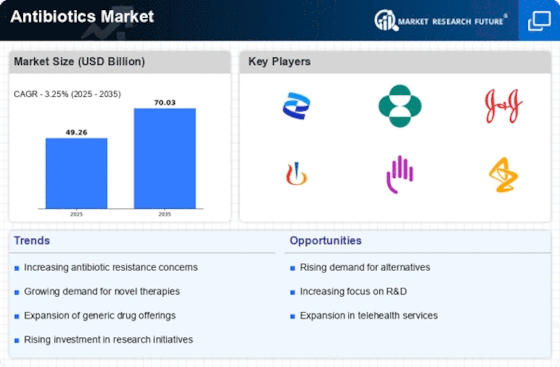
As per Market Research Future analysis, the Antibiotics Market was estimated at 49.26 USD Billion in 2024. The Antibiotics industry is projected to grow from 50.86 USD Billion in 2025 to 70.03 USD Billion by 2035, exhibiting a compound annual growth rate (CAGR) of 3.25% during the forecast period 2025 - 2035

Key Market Trends & Highlights

The Antibiotics Market is experiencing a dynamic shift driven by resistance challenges and innovative solutions.

  • The market is witnessing a rising trend in antibiotic resistance, prompting urgent calls for new therapeutic approaches. Personalized medicine is gaining traction, as tailored antibiotic treatments may enhance efficacy and reduce resistance. Regulatory support for innovation is fostering the development of novel antibiotics, particularly in North America, the largest market. The increasing incidence of infectious diseases and growing awareness of antibiotic stewardship are key drivers propelling market growth.

Market Size & Forecast

2024 Market Size 49.26 (USD Billion)
2035 Market Size 70.03 (USD Billion)
CAGR (2025 - 2035) 3.25%
Largest Regional Market Share in 2024 North America

Major Players

<p><a href="https://www.pfizer.com/science/focus-areas/anti-infectives/global-anti-infectives-leader">Pfizer </a>(US), Merck &amp; Co. (US), Johnson &amp; Johnson (US), Novartis (CH), Bristol-Myers Squibb (US), AstraZeneca (GB), Sanofi (FR), GSK (GB), AbbVie (US)</p>

Market Trends

The Antibiotics Market is currently experiencing a dynamic evolution, driven by various factors including the rising prevalence of infectious diseases and the increasing awareness regarding antibiotic resistance. As healthcare systems worldwide strive to combat these challenges, there is a noticeable shift towards the development of novel antibiotics and alternative therapies, upholding the antibiotic sales figures.

This trend is further fueled by the growing investment in research and development, as pharmaceutical companies seek to innovate and expand their product portfolios. Additionally, regulatory bodies are becoming more proactive in facilitating the approval processes for new antibiotics, which may enhance antibiotic market growth prospects. 

Moreover, the Antibiotics Market is witnessing a surge in demand for personalized medicine, as healthcare providers aim to tailor treatments to individual patient needs. This approach not only improves treatment efficacy but also minimizes the risk of adverse effects associated with broad-spectrum antibiotics. Furthermore, the increasing focus on preventive healthcare and vaccination programs is likely to influence the market landscape, as these initiatives aim to reduce the incidence of bacterial infections.

Overall, the Antibiotics Market appears poised for substantial growth, driven by advancements in technology and a concerted effort to address the challenges posed by antibiotic resistance and infectious diseases.

Rising Antibiotic Resistance

The growing concern over antibiotic resistance is prompting a shift in research priorities. This trend indicates a need for innovative solutions to combat resistant strains, leading to increased investment in the development of new antibiotics and alternative therapies.

Personalized Medicine

The movement towards personalized medicine is gaining traction within the Antibiotics Market. Tailoring antibiotic treatments to individual patient profiles may enhance therapeutic outcomes and reduce the likelihood of adverse reactions, thereby reshaping treatment protocols.

Regulatory Support for Innovation

The antibiotics market analysis claims that the Regulatory agencies are increasingly facilitating the approval of new antibiotics. This trend suggests a more supportive environment for pharmaceutical companies, potentially accelerating the introduction of novel therapies into the antibiotic market.

Antibiotics Market Market Drivers

Growing Awareness of Antibiotic Stewardship

Growing awareness of antibiotic stewardship is becoming a pivotal driver in the Antibiotics Market. Healthcare professionals and organizations are increasingly recognizing the importance of responsible antibiotic use to combat resistance. This awareness is leading to the implementation of stewardship programs aimed at optimizing antibiotic prescribing practices. As a result, there is a shift towards the development of antibiotics that are effective against resistant strains while minimizing the risk of further resistance. The Antibiotics Market is adapting to these changes by focusing on research and development of new classes of antibiotics. Furthermore, educational initiatives aimed at both healthcare providers and the public are likely to enhance understanding of antibiotic use, thereby influencing market dynamics. This trend suggests a more sustainable approach to antibiotic use, which could stabilize the market in the long term.

Increasing Incidence of Infectious Diseases

The rising incidence of infectious diseases is a primary driver of the Antibiotics Market. As populations grow and urbanization increases, the spread of infectious diseases becomes more prevalent. According to recent data, the incidence of bacterial infections has surged, leading to a heightened demand for antibiotics. This trend is particularly evident in developing regions, where healthcare infrastructure may be less robust. The Antibiotics Market is responding to this demand by innovating and expanding product lines to address various bacterial infections. Furthermore, the World Health Organization has reported that antibiotic-resistant infections are a growing concern, which further propels the need for effective antibiotics. As healthcare providers seek to combat these infections, the Antibiotics Market is likely to experience sustained growth.

Regulatory Support for Antibiotic Innovation

Regulatory support for antibiotic innovation is a crucial driver of the Antibiotics Market. Governments and regulatory bodies are increasingly recognizing the urgent need for new antibiotics to address the growing threat of antibiotic resistance. Initiatives such as expedited approval processes and financial incentives for research and development are being implemented to encourage pharmaceutical companies to invest in antibiotic innovation. Recent data suggests that these regulatory measures have led to a notable increase in the number of new antibiotics entering the market. The Antibiotics Market is likely to benefit from these supportive policies, as they create a more favorable environment for the development of novel therapies. Furthermore, collaboration between public and private sectors is expected to enhance research efforts, ultimately leading to a more robust pipeline of antibiotics.

Technological Advancements in Drug Development

Technological advancements in drug development are significantly influencing the Antibiotics Market. Innovations such as artificial intelligence and machine learning are streamlining the drug discovery process, allowing for faster identification of potential antibiotic candidates. This has led to a more efficient development pipeline, which is crucial given the urgent need for new antibiotics to combat resistant strains. The Antibiotics Market is witnessing an influx of novel therapies, with research indicating that the introduction of new antibiotics could reach a market value of several billion dollars in the coming years. Additionally, advancements in biotechnology are enabling the development of targeted therapies, which may enhance treatment efficacy and reduce side effects. As these technologies continue to evolve, they are expected to reshape the landscape of the Antibiotics Market.

Rising Demand for Probiotics and Alternative Therapies

The rising demand for probiotics and alternative therapies is impacting the Antibiotics Market. As consumers become more health-conscious, there is a growing interest in natural and alternative treatments for infections. Probiotics, which are known to support gut health, are increasingly being viewed as a complementary approach to antibiotic treatment. This trend may lead to a shift in consumer preferences, prompting the Antibiotics Market to explore synergies between antibiotics and probiotics. Market data indicates that the probiotic segment is experiencing robust growth, which could influence antibiotic prescribing patterns. Additionally, the exploration of alternative therapies, such as phage therapy, is gaining traction as a potential solution to antibiotic resistance. The Antibiotics Market may need to adapt to these evolving consumer preferences to remain competitive.

Market Segment Insights

By Type: Penicillins (Largest) vs. Macrolides (Fastest-Growing)

<p>In the antibiotics market, the segment is predominantly led by <a href="https://www.marketresearchfuture.com/reports/penicillin-drug-market-26532">penicillins</a>, which hold a significant portion of the market share due to their broad-spectrum efficacy and long-standing presence in therapeutic applications. Following penicillins, cephalosporins and macrolides showcase substantial shares, with cephalosporins being favored for their effectiveness against resistant strains, while <a href="https://www.marketresearchfuture.com/reports/macrolide-antibiotics-market-4342">macrolides </a>have gained traction among physicians for their use in respiratory infections. <a href="https://www.marketresearchfuture.com/reports/aminoglycoside-antibiotics-market-8879">Aminoglycosides </a>and tetracyclines have comparatively smaller market shares but still play crucial roles in specialized treatments.</p>

<p>Penicillins (Dominant) vs. Tetracyclines (Emerging)</p>

<p><a href="https://www.marketresearchfuture.com/reports/penicillin-drug-market-26532">Penicillins </a>remain the dominant force in the antibiotics market, well-known for their effectiveness against various bacterial infections, particularly in healthcare settings. Their reliability makes them a go-to treatment in many cases. In contrast, tetracyclines are emerging in popularity due to their effective treatment options against atypical bacterial infections and increasing awareness of their applications beyond traditional uses. The versatility of tetracyclines, combined with their efficacy against resistant pathogens, indicates a growing acceptance and utilization in both community and hospital settings, positioning them favorably for future growth.</p>

By Route of Administration: Oral (Largest) vs. Intravenous (Fastest-Growing)

<p>In the Antibiotics Market, the Route of Administration segment shows a diverse distribution among several key methods. Oral administration holds the largest market share, primarily due to its convenience and patient compliance benefits.</p> <p>This route is widely preferred for outpatient therapy and treatment of infections where hospitalization is not required. Intravenous administration, while not as commonly used, is the fastest-growing segment due to its effectiveness in treating severe infections that require immediate and potent antimicrobial action. The segment is also responsible for driving the antimicrobial market size growth.</p>

<p>Oral (Dominant) vs. Intravenous (Emerging)</p>

<p>The oral route of administration is considered dominant in the Antibiotics Market, favored for its ease of use and adherence by patients. It is commonly employed in treating mild to moderate infections and is often prescribed in an outpatient setting. Conversely, intravenous antibiotics represent an emerging segment, crucial for patients with severe infections that necessitate rapid therapeutic action and higher concentrations of drugs. This route is prevalent in hospital settings, enabling healthcare providers to manage complicated infections effectively. The growing incidence of antibiotic-resistant bacteria and the need for immediate treatment are driving the demand for intravenous antibiotics.</p>

By Application: Infectious Diseases (Largest) vs. Prophylaxis (Fastest-Growing)

<p>In the Antibiotics Market, the application segment is characterized by significant diversity, with <a href="https://www.marketresearchfuture.com/reports/infectious-disease-drug-market-43143">Infectious Diseases</a> commanding a substantial share. This category has retained its dominance due to the persistent prevalence of bacterial infections worldwide, further fueled by an aging population and rising instances of antibiotic resistance. Prophylaxis, while smaller in comparison, is rapidly gaining traction. Increasing preventive healthcare initiatives, coupled with the rise in surgeries and high-risk medical procedures, are propelling growth in this area. The growth trends indicate a shift towards more proactive healthcare strategies, particularly in Prophylaxis, which is becoming a preferred method of infection control. This growth is driven by advancements in antibiotic formulations and the expanding scope of use cases, particularly in surgical, dental, and high-risk patient situations. As healthcare systems focus on prevention to mitigate infection risk, the Prophylaxis segment is poised for accelerated expansion in the coming years.</p>

<p>Infectious Diseases: Dominant vs. Prophylaxis: Emerging</p>

<p>Infectious Diseases remains the dominant application in the Antibiotics Market, primarily due to the consistent need for effective treatments against various bacterial infections. This segment addresses a wide range of infectious agents, including resistant strains that challenge existing therapies. On the other hand, Prophylaxis is recognized as an emerging segment, focusing on preventing infections before they occur, particularly in surgical environments. The rise of antibiotic prophylaxis reflects changing healthcare practices, as more procedures and treatments prioritize preventive measures to reduce postoperative infections. Both segments are shaped by evolving patient needs, regulatory scrutiny, and ongoing advancements in antibiotic research and development.</p>

By End User: Hospitals (Largest) vs. Clinics (Fastest-Growing)

<p>In the Antibiotics Market, hospitals emerge as the largest end user segment, commanding significant market share due to their extensive capacity for treating severe infections and providing advanced medical care. Clinics follow closely with a growing footprint, leveraging their accessibility to outpatient services as they address the rising demand for antibiotic prescriptions in the community settings. Homecare and pharmaceutical laboratories also contribute to the antibiotic market but at comparatively lower shares, highlighting a diverse distribution across various healthcare settings.</p> <p>The antibiotics industry dynamics within the end-user segments show robust growth trends, particularly in clinics, where the focus on outpatient care is driving stronger demand for antibiotics. Homecare is gaining traction as patients increasingly prefer receiving care in a comfortable environment, leading to an uptick in prescribed antibiotic therapies. Pharmaceutical laboratories are also significant contributors, innovating new antibiotics to meet emerging resistance challenges. As healthcare providers emphasize preventive care and efficient disease management, the demand for antibiotics across all end users is expected to rise steadily.</p>

<p>Hospitals (Dominant) vs. Homecare (Emerging)</p>

<p>Hospitals play a dominant role in the Antibiotics Market by ensuring comprehensive treatment options for patients with complex infections. Their infrastructure supports advanced diagnostics and a variety of antibiotic therapies, positioning hospitals as critical hubs for antibiotic usage and research. Conversely, homecare is becoming an emerging segment as it shifts towards more personalized and patient-centered medical approaches. With technology facilitating remote monitoring and telemedicine, homecare settings are increasingly incorporating antibiotics into treatment plans for chronic conditions and post-surgical care. This transition reflects a broader trend towards decentralized healthcare, allowing patients to receive effective treatments without frequent hospital visits.</p>

Get more detailed insights about Antibiotics Market Research Report - Forecast till 2035

Regional Insights

In the regional segment of the Antibiotics Market, a substantial market value of 49.26 USD Billion was recorded in 2024, showcasing a steady demand trajectory expected to rise significantly in the coming years.

North America dominated this landscape, holding a majority with a valuation of 20.0 USD Billion in 2024 and projected to reach 28.0 USD Billion by 2035, driven by advanced healthcare infrastructure and stringent regulatory frameworks. The US antibiotics market leads the region with elevated healthcare infrastructure in the country.

Europe follows closely, with a market valuation of 15.0 USD Billion in 2024, signaling a robust demand supported by innovative Research and Development initiatives.Meanwhile, South America, with a value of 4.0 USD Billion, reflects a growing awareness and accessibility of antibiotics, though it remains significantly lesser in comparison to North America and Europe. The Asia Pacific region, valued at 8.0 USD Billion in 2024, is emerging as a critical player due to increasing population and healthcare needs, contributing to the overall Antibiotics Market revenue.

Lastly, the Middle East and Africa, despite a smaller market size of 2.26 USD Billion, showcases potential growth opportunities influenced by improving healthcare systems.The diverse dynamics of these regions underline the Antibiotics Market segmentation as pivotal in understanding and catering to unique regional healthcare needs, thereby fostering growth and innovation across the industry and driving the antibody market size.

Key Players and Competitive Insights

The Antibiotics Market is characterized by rapid evolution and intense competition, driven by the rising prevalence of infectious diseases and the growing demand for effective treatment options. This evolution is also driving the anti infectives market.


The antibiotics industry is influenced by several factors including regulatory frameworks, advancements in technology, and the increasing emphasis on novel drug development.


The competitive landscape is shaped by the presence of various pharmaceutical firms, each striving to enhance their product offerings and expand their market reach. Key competitive strategies include investment in research and development, strategic partnerships, and mergers and acquisitions aimed at bolstering product pipelines. Understanding these dynamics is essential for stakeholders aiming to navigate this complex market environment effectively.

Novartis stands as a prominent player in the Antibiotics Market, leveraging its robust research pipeline and established reputation for quality in pharmaceutical products. The company's extensive experience in the biosimilar space complements its traditional antibiotic offerings, allowing it to address the growing concerns around antibiotic resistance. Novartis is known for its commitment to innovation, with continuous investments in discovering and developing new antibiotic therapies. The company's global presence is also a significant advantage, as it provides access to various markets and facilitates collaborations with healthcare providers and academic institutions.


Additionally, Novartis' efficient supply chain operations contribute to its ability to deliver products swiftly and effectively, further solidifying its position in the antibiotic industry. Merck is another influential entity in the Antibiotics Market, recognized for its comprehensive portfolio of antimicrobial agents and commitment to antibiotic stewardship.

Merck is another influential entity in the Antibiotics Market, recognized for its comprehensive portfolio of antimicrobial agents and commitment to antibiotic stewardship. The company's key products include a range of well-known antibiotics that play crucial roles in treating bacterial infections, thereby enhancing its importance in the global healthcare landscape. Merck maintains a strong market presence due to its strategic approach to research and development, consistently focusing on innovative therapies to combat resistant strains of bacteria. Its strengths are further amplified by its history of successful mergers and acquisitions, which have expanded its capabilities and product offerings. By fostering partnerships with healthcare organizations and investing in new technologies, Merck aims to improve patient outcomes and reinforce its leadership in the global antibiotics sector. The company's focus on sustainability and responsible antibiotic use also aligns with global initiatives to combat antimicrobial resistance, making it a key player in addressing one of the most pressing healthcare challenges today.

Key Companies in the Antibiotics Market include

Industry Developments

In February 2025, the FDA approved aztreonam/avibactam (Emblaveo), a combination therapy developed by AbbVie and Pfizer, for the treatment of complicated intra-abdominal infections and hospital-acquired pneumonia. This approval expands the treatment options available against resistant Gram-negative pathogens.

Pfizer and Zai Lab formed a strategic partnership in November 2024 to commercialize XACDURO® in mainland China. The objective is to increase the availability of this novel antibacterial treatment in a region with a high need.

Entasis Therapeutics introduced ETX2514 in early 2025, a novel β lactamase inhibitor that is intended to enhance the efficacy of current antibiotics, such as meropenem, against resistant Gram-negative bacteria.

McMaster University researchers reported the discovery of lariocidin in March 2025. This novel lasso peptide antibiotic has a unique mechanism that involves binding to the bacterial ribosome in order to combat resistant strains. Preclinical results in animal models have shown potential.


Future Outlook

Antibiotics Market Future Outlook

<p>The antibiotics market size is projected to grow at a 3.25% CAGR from 2025 to 2035, driven by rising antibiotic resistance, increased healthcare spending, and technological advancements.</p>

New opportunities lie in:

  • <p>Development of personalized antibiotic therapies for targeted treatments. Expansion of telehealth services for remote antibiotic consultations. Investment in AI-driven drug discovery platforms for faster antibiotic development.</p>

<p>By 2035, the Antibiotics Market is expected to achieve robust growth, driven by innovation and strategic investments.</p>

Market Segmentation

Antibiotics Market Type Outlook

  • Penicillins
  • Cephalosporins
  • Macrolides
  • Tetracyclines
  • Aminoglycosides

Antibiotics Market End User Outlook

  • Hospitals
  • Clinics
  • Homecare
  • Pharmaceutical Laboratories

Antibiotics Market Application Outlook

  • Infectious Diseases
  • Prophylaxis
  • Surgery
  • Cancer Treatment

Antibiotics Market Route of Administration Outlook

  • Oral
  • Intravenous
  • Intramuscular
  • Topical

Report Scope

MARKET SIZE 2024 49.26(USD Billion)
MARKET SIZE 2025 50.86(USD Billion)
MARKET SIZE 2035 70.03(USD Billion)
COMPOUND ANNUAL GROWTH RATE (CAGR) 3.25% (2025 - 2035)
REPORT COVERAGE Revenue Forecast, Competitive Landscape, Growth Factors, and Trends
BASE YEAR 2024
Market Forecast Period 2025 - 2035
Historical Data 2019 - 2024
Market Forecast Units USD Billion
Key Companies Profiled Pfizer (US), Merck & Co. (US), Johnson & Johnson (US), Novartis (CH), Bristol-Myers Squibb (US), AstraZeneca (GB), Sanofi (FR), GSK (GB), AbbVie (US)
Segments Covered Types, Route of Administration, Applications, End Users, Regional
Key Market Opportunities Advancements in antibiotic resistance management strategies create growth opportunities in the Antibiotics Market.
Key Market Dynamics Rising antibiotic resistance drives innovation and regulatory scrutiny, reshaping competitive dynamics in the antibiotics market.
Countries Covered North America, Europe, APAC, South America, MEA

FAQs

What is the current valuation of the Antibiotics Market as of 2024?

<p>The Antibiotics Market was valued at 49.26 USD Billion in 2024.</p>

What is the projected market size for the Antibiotics Market in 2035?

<p>The market is projected to reach 70.03 USD Billion by 2035.</p>

What is the expected CAGR for the Antibiotics Market during the forecast period 2025 - 2035?

<p>The expected CAGR for the Antibiotics Market during 2025 - 2035 is 3.25%.</p>

Which companies are considered key players in the Antibiotics Market?

<p>Key players in the Antibiotics Market include Pfizer, Merck & Co., Johnson & Johnson, Novartis, and others.</p>

What segment of the Antibiotics Market had the highest valuation in 2024?

<p>In 2024, the Penicillins segment had the highest valuation at 15.0 USD Billion.</p>

How does the market valuation for Oral antibiotics compare to Intravenous antibiotics in 2024?

<p>In 2024, Oral antibiotics were valued at 20.0 USD Billion, while Intravenous antibiotics were valued at 15.0 USD Billion.</p>

What is the projected growth for the Infectious Diseases application segment by 2035?

<p>The Infectious Diseases application segment is projected to grow from 20.0 USD Billion in 2024 to 28.0 USD Billion by 2035.</p>

Which end user segment is expected to show the most growth by 2035?

<p>The Hospitals end user segment is expected to grow from 20.0 USD Billion in 2024 to 28.0 USD Billion by 2035.</p>

What is the valuation range for the Tetracyclines segment in 2024?

<p>The Tetracyclines segment was valued between 7.0 USD Billion and 10.0 USD Billion in 2024.</p>

How does the market for Cancer Treatment applications compare to Prophylaxis applications in 2024?

<p>In 2024, the Cancer Treatment application segment was valued at 11.26 USD Billion, compared to 10.0 USD Billion for Prophylaxis.</p>

  1. SECTION I: EXECUTIVE SUMMARY AND KEY HIGHLIGHTS
    1. | 1.1 EXECUTIVE SUMMARY
    2. | | 1.1.1 Market Overview
    3. | | 1.1.2 Key Findings
    4. | | 1.1.3 Market Segmentation
    5. | | 1.1.4 Competitive Landscape
    6. | | 1.1.5 Challenges and Opportunities
    7. | | 1.1.6 Future Outlook
  2. SECTION II: SCOPING, METHODOLOGY AND MARKET STRUCTURE
    1. | 2.1 MARKET INTRODUCTION
    2. | | 2.1.1 Definition
    3. | | 2.1.2 Scope of the study
    4. | | | 2.1.2.1 Research Objective
    5. | | | 2.1.2.2 Assumption
    6. | | | 2.1.2.3 Limitations
    7. | 2.2 RESEARCH METHODOLOGY
    8. | | 2.2.1 Overview
    9. | | 2.2.2 Data Mining
    10. | | 2.2.3 Secondary Research
    11. | | 2.2.4 Primary Research
    12. | | | 2.2.4.1 Primary Interviews and Information Gathering Process
    13. | | | 2.2.4.2 Breakdown of Primary Respondents
    14. | | 2.2.5 Forecasting Model
    15. | | 2.2.6 Market Size Estimation
    16. | | | 2.2.6.1 Bottom-Up Approach
    17. | | | 2.2.6.2 Top-Down Approach
    18. | | 2.2.7 Data Triangulation
    19. | | 2.2.8 Validation
  3. SECTION III: QUALITATIVE ANALYSIS
    1. | 3.1 MARKET DYNAMICS
    2. | | 3.1.1 Overview
    3. | | 3.1.2 Drivers
    4. | | 3.1.3 Restraints
    5. | | 3.1.4 Opportunities
    6. | 3.2 MARKET FACTOR ANALYSIS
    7. | | 3.2.1 Value chain Analysis
    8. | | 3.2.2 Porter's Five Forces Analysis
    9. | | | 3.2.2.1 Bargaining Power of Suppliers
    10. | | | 3.2.2.2 Bargaining Power of Buyers
    11. | | | 3.2.2.3 Threat of New Entrants
    12. | | | 3.2.2.4 Threat of Substitutes
    13. | | | 3.2.2.5 Intensity of Rivalry
    14. | | 3.2.3 COVID-19 Impact Analysis
    15. | | | 3.2.3.1 Market Impact Analysis
    16. | | | 3.2.3.2 Regional Impact
    17. | | | 3.2.3.3 Opportunity and Threat Analysis
  4. SECTION IV: QUANTITATIVE ANALYSIS
    1. | 4.1 Healthcare, BY Type (USD Billion)
    2. | | 4.1.1 Penicillins
    3. | | 4.1.2 Cephalosporins
    4. | | 4.1.3 Macrolides
    5. | | 4.1.4 Tetracyclines
    6. | | 4.1.5 Aminoglycosides
    7. | 4.2 Healthcare, BY Route of Administration (USD Billion)
    8. | | 4.2.1 Oral
    9. | | 4.2.2 Intravenous
    10. | | 4.2.3 Intramuscular
    11. | | 4.2.4 Topical
    12. | 4.3 Healthcare, BY Application (USD Billion)
    13. | | 4.3.1 Infectious Diseases
    14. | | 4.3.2 Prophylaxis
    15. | | 4.3.3 Surgery
    16. | | 4.3.4 Cancer Treatment
    17. | 4.4 Healthcare, BY End User (USD Billion)
    18. | | 4.4.1 Hospitals
    19. | | 4.4.2 Clinics
    20. | | 4.4.3 Homecare
    21. | | 4.4.4 Pharmaceutical Laboratories
    22. | 4.5 Healthcare, BY Region (USD Billion)
    23. | | 4.5.1 North America
    24. | | | 4.5.1.1 US
    25. | | | 4.5.1.2 Canada
    26. | | 4.5.2 Europe
    27. | | | 4.5.2.1 Germany
    28. | | | 4.5.2.2 UK
    29. | | | 4.5.2.3 France
    30. | | | 4.5.2.4 Russia
    31. | | | 4.5.2.5 Italy
    32. | | | 4.5.2.6 Spain
    33. | | | 4.5.2.7 Rest of Europe
    34. | | 4.5.3 APAC
    35. | | | 4.5.3.1 China
    36. | | | 4.5.3.2 India
    37. | | | 4.5.3.3 Japan
    38. | | | 4.5.3.4 South Korea
    39. | | | 4.5.3.5 Malaysia
    40. | | | 4.5.3.6 Thailand
    41. | | | 4.5.3.7 Indonesia
    42. | | | 4.5.3.8 Rest of APAC
    43. | | 4.5.4 South America
    44. | | | 4.5.4.1 Brazil
    45. | | | 4.5.4.2 Mexico
    46. | | | 4.5.4.3 Argentina
    47. | | | 4.5.4.4 Rest of South America
    48. | | 4.5.5 MEA
    49. | | | 4.5.5.1 GCC Countries
    50. | | | 4.5.5.2 South Africa
    51. | | | 4.5.5.3 Rest of MEA
  5. SECTION V: COMPETITIVE ANALYSIS
    1. | 5.1 Competitive Landscape
    2. | | 5.1.1 Overview
    3. | | 5.1.2 Competitive Analysis
    4. | | 5.1.3 Market share Analysis
    5. | | 5.1.4 Major Growth Strategy in the Healthcare
    6. | | 5.1.5 Competitive Benchmarking
    7. | | 5.1.6 Leading Players in Terms of Number of Developments in the Healthcare
    8. | | 5.1.7 Key developments and growth strategies
    9. | | | 5.1.7.1 New Product Launch/Service Deployment
    10. | | | 5.1.7.2 Merger & Acquisitions
    11. | | | 5.1.7.3 Joint Ventures
    12. | | 5.1.8 Major Players Financial Matrix
    13. | | | 5.1.8.1 Sales and Operating Income
    14. | | | 5.1.8.2 Major Players R&D Expenditure. 2023
    15. | 5.2 Company Profiles
    16. | | 5.2.1 Pfizer (US)
    17. | | | 5.2.1.1 Financial Overview
    18. | | | 5.2.1.2 Products Offered
    19. | | | 5.2.1.3 Key Developments
    20. | | | 5.2.1.4 SWOT Analysis
    21. | | | 5.2.1.5 Key Strategies
    22. | | 5.2.2 Merck & Co. (US)
    23. | | | 5.2.2.1 Financial Overview
    24. | | | 5.2.2.2 Products Offered
    25. | | | 5.2.2.3 Key Developments
    26. | | | 5.2.2.4 SWOT Analysis
    27. | | | 5.2.2.5 Key Strategies
    28. | | 5.2.3 Johnson & Johnson (US)
    29. | | | 5.2.3.1 Financial Overview
    30. | | | 5.2.3.2 Products Offered
    31. | | | 5.2.3.3 Key Developments
    32. | | | 5.2.3.4 SWOT Analysis
    33. | | | 5.2.3.5 Key Strategies
    34. | | 5.2.4 Novartis (CH)
    35. | | | 5.2.4.1 Financial Overview
    36. | | | 5.2.4.2 Products Offered
    37. | | | 5.2.4.3 Key Developments
    38. | | | 5.2.4.4 SWOT Analysis
    39. | | | 5.2.4.5 Key Strategies
    40. | | 5.2.5 Bristol-Myers Squibb (US)
    41. | | | 5.2.5.1 Financial Overview
    42. | | | 5.2.5.2 Products Offered
    43. | | | 5.2.5.3 Key Developments
    44. | | | 5.2.5.4 SWOT Analysis
    45. | | | 5.2.5.5 Key Strategies
    46. | | 5.2.6 AstraZeneca (GB)
    47. | | | 5.2.6.1 Financial Overview
    48. | | | 5.2.6.2 Products Offered
    49. | | | 5.2.6.3 Key Developments
    50. | | | 5.2.6.4 SWOT Analysis
    51. | | | 5.2.6.5 Key Strategies
    52. | | 5.2.7 Sanofi (FR)
    53. | | | 5.2.7.1 Financial Overview
    54. | | | 5.2.7.2 Products Offered
    55. | | | 5.2.7.3 Key Developments
    56. | | | 5.2.7.4 SWOT Analysis
    57. | | | 5.2.7.5 Key Strategies
    58. | | 5.2.8 GSK (GB)
    59. | | | 5.2.8.1 Financial Overview
    60. | | | 5.2.8.2 Products Offered
    61. | | | 5.2.8.3 Key Developments
    62. | | | 5.2.8.4 SWOT Analysis
    63. | | | 5.2.8.5 Key Strategies
    64. | | 5.2.9 AbbVie (US)
    65. | | | 5.2.9.1 Financial Overview
    66. | | | 5.2.9.2 Products Offered
    67. | | | 5.2.9.3 Key Developments
    68. | | | 5.2.9.4 SWOT Analysis
    69. | | | 5.2.9.5 Key Strategies
    70. | 5.3 Appendix
    71. | | 5.3.1 References
    72. | | 5.3.2 Related Reports
  6. LIST OF FIGURES
    1. | 6.1 MARKET SYNOPSIS
    2. | 6.2 NORTH AMERICA MARKET ANALYSIS
    3. | 6.3 US MARKET ANALYSIS BY TYPE
    4. | 6.4 US MARKET ANALYSIS BY ROUTE OF ADMINISTRATION
    5. | 6.5 US MARKET ANALYSIS BY APPLICATION
    6. | 6.6 US MARKET ANALYSIS BY END USER
    7. | 6.7 CANADA MARKET ANALYSIS BY TYPE
    8. | 6.8 CANADA MARKET ANALYSIS BY ROUTE OF ADMINISTRATION
    9. | 6.9 CANADA MARKET ANALYSIS BY APPLICATION
    10. | 6.10 CANADA MARKET ANALYSIS BY END USER
    11. | 6.11 EUROPE MARKET ANALYSIS
    12. | 6.12 GERMANY MARKET ANALYSIS BY TYPE
    13. | 6.13 GERMANY MARKET ANALYSIS BY ROUTE OF ADMINISTRATION
    14. | 6.14 GERMANY MARKET ANALYSIS BY APPLICATION
    15. | 6.15 GERMANY MARKET ANALYSIS BY END USER
    16. | 6.16 UK MARKET ANALYSIS BY TYPE
    17. | 6.17 UK MARKET ANALYSIS BY ROUTE OF ADMINISTRATION
    18. | 6.18 UK MARKET ANALYSIS BY APPLICATION
    19. | 6.19 UK MARKET ANALYSIS BY END USER
    20. | 6.20 FRANCE MARKET ANALYSIS BY TYPE
    21. | 6.21 FRANCE MARKET ANALYSIS BY ROUTE OF ADMINISTRATION
    22. | 6.22 FRANCE MARKET ANALYSIS BY APPLICATION
    23. | 6.23 FRANCE MARKET ANALYSIS BY END USER
    24. | 6.24 RUSSIA MARKET ANALYSIS BY TYPE
    25. | 6.25 RUSSIA MARKET ANALYSIS BY ROUTE OF ADMINISTRATION
    26. | 6.26 RUSSIA MARKET ANALYSIS BY APPLICATION
    27. | 6.27 RUSSIA MARKET ANALYSIS BY END USER
    28. | 6.28 ITALY MARKET ANALYSIS BY TYPE
    29. | 6.29 ITALY MARKET ANALYSIS BY ROUTE OF ADMINISTRATION
    30. | 6.30 ITALY MARKET ANALYSIS BY APPLICATION
    31. | 6.31 ITALY MARKET ANALYSIS BY END USER
    32. | 6.32 SPAIN MARKET ANALYSIS BY TYPE
    33. | 6.33 SPAIN MARKET ANALYSIS BY ROUTE OF ADMINISTRATION
    34. | 6.34 SPAIN MARKET ANALYSIS BY APPLICATION
    35. | 6.35 SPAIN MARKET ANALYSIS BY END USER
    36. | 6.36 REST OF EUROPE MARKET ANALYSIS BY TYPE
    37. | 6.37 REST OF EUROPE MARKET ANALYSIS BY ROUTE OF ADMINISTRATION
    38. | 6.38 REST OF EUROPE MARKET ANALYSIS BY APPLICATION
    39. | 6.39 REST OF EUROPE MARKET ANALYSIS BY END USER
    40. | 6.40 APAC MARKET ANALYSIS
    41. | 6.41 CHINA MARKET ANALYSIS BY TYPE
    42. | 6.42 CHINA MARKET ANALYSIS BY ROUTE OF ADMINISTRATION
    43. | 6.43 CHINA MARKET ANALYSIS BY APPLICATION
    44. | 6.44 CHINA MARKET ANALYSIS BY END USER
    45. | 6.45 INDIA MARKET ANALYSIS BY TYPE
    46. | 6.46 INDIA MARKET ANALYSIS BY ROUTE OF ADMINISTRATION
    47. | 6.47 INDIA MARKET ANALYSIS BY APPLICATION
    48. | 6.48 INDIA MARKET ANALYSIS BY END USER
    49. | 6.49 JAPAN MARKET ANALYSIS BY TYPE
    50. | 6.50 JAPAN MARKET ANALYSIS BY ROUTE OF ADMINISTRATION
    51. | 6.51 JAPAN MARKET ANALYSIS BY APPLICATION
    52. | 6.52 JAPAN MARKET ANALYSIS BY END USER
    53. | 6.53 SOUTH KOREA MARKET ANALYSIS BY TYPE
    54. | 6.54 SOUTH KOREA MARKET ANALYSIS BY ROUTE OF ADMINISTRATION
    55. | 6.55 SOUTH KOREA MARKET ANALYSIS BY APPLICATION
    56. | 6.56 SOUTH KOREA MARKET ANALYSIS BY END USER
    57. | 6.57 MALAYSIA MARKET ANALYSIS BY TYPE
    58. | 6.58 MALAYSIA MARKET ANALYSIS BY ROUTE OF ADMINISTRATION
    59. | 6.59 MALAYSIA MARKET ANALYSIS BY APPLICATION
    60. | 6.60 MALAYSIA MARKET ANALYSIS BY END USER
    61. | 6.61 THAILAND MARKET ANALYSIS BY TYPE
    62. | 6.62 THAILAND MARKET ANALYSIS BY ROUTE OF ADMINISTRATION
    63. | 6.63 THAILAND MARKET ANALYSIS BY APPLICATION
    64. | 6.64 THAILAND MARKET ANALYSIS BY END USER
    65. | 6.65 INDONESIA MARKET ANALYSIS BY TYPE
    66. | 6.66 INDONESIA MARKET ANALYSIS BY ROUTE OF ADMINISTRATION
    67. | 6.67 INDONESIA MARKET ANALYSIS BY APPLICATION
    68. | 6.68 INDONESIA MARKET ANALYSIS BY END USER
    69. | 6.69 REST OF APAC MARKET ANALYSIS BY TYPE
    70. | 6.70 REST OF APAC MARKET ANALYSIS BY ROUTE OF ADMINISTRATION
    71. | 6.71 REST OF APAC MARKET ANALYSIS BY APPLICATION
    72. | 6.72 REST OF APAC MARKET ANALYSIS BY END USER
    73. | 6.73 SOUTH AMERICA MARKET ANALYSIS
    74. | 6.74 BRAZIL MARKET ANALYSIS BY TYPE
    75. | 6.75 BRAZIL MARKET ANALYSIS BY ROUTE OF ADMINISTRATION
    76. | 6.76 BRAZIL MARKET ANALYSIS BY APPLICATION
    77. | 6.77 BRAZIL MARKET ANALYSIS BY END USER
    78. | 6.78 MEXICO MARKET ANALYSIS BY TYPE
    79. | 6.79 MEXICO MARKET ANALYSIS BY ROUTE OF ADMINISTRATION
    80. | 6.80 MEXICO MARKET ANALYSIS BY APPLICATION
    81. | 6.81 MEXICO MARKET ANALYSIS BY END USER
    82. | 6.82 ARGENTINA MARKET ANALYSIS BY TYPE
    83. | 6.83 ARGENTINA MARKET ANALYSIS BY ROUTE OF ADMINISTRATION
    84. | 6.84 ARGENTINA MARKET ANALYSIS BY APPLICATION
    85. | 6.85 ARGENTINA MARKET ANALYSIS BY END USER
    86. | 6.86 REST OF SOUTH AMERICA MARKET ANALYSIS BY TYPE
    87. | 6.87 REST OF SOUTH AMERICA MARKET ANALYSIS BY ROUTE OF ADMINISTRATION
    88. | 6.88 REST OF SOUTH AMERICA MARKET ANALYSIS BY APPLICATION
    89. | 6.89 REST OF SOUTH AMERICA MARKET ANALYSIS BY END USER
    90. | 6.90 MEA MARKET ANALYSIS
    91. | 6.91 GCC COUNTRIES MARKET ANALYSIS BY TYPE
    92. | 6.92 GCC COUNTRIES MARKET ANALYSIS BY ROUTE OF ADMINISTRATION
    93. | 6.93 GCC COUNTRIES MARKET ANALYSIS BY APPLICATION
    94. | 6.94 GCC COUNTRIES MARKET ANALYSIS BY END USER
    95. | 6.95 SOUTH AFRICA MARKET ANALYSIS BY TYPE
    96. | 6.96 SOUTH AFRICA MARKET ANALYSIS BY ROUTE OF ADMINISTRATION
    97. | 6.97 SOUTH AFRICA MARKET ANALYSIS BY APPLICATION
    98. | 6.98 SOUTH AFRICA MARKET ANALYSIS BY END USER
    99. | 6.99 REST OF MEA MARKET ANALYSIS BY TYPE
    100. | 6.100 REST OF MEA MARKET ANALYSIS BY ROUTE OF ADMINISTRATION
    101. | 6.101 REST OF MEA MARKET ANALYSIS BY APPLICATION
    102. | 6.102 REST OF MEA MARKET ANALYSIS BY END USER
    103. | 6.103 KEY BUYING CRITERIA OF HEALTHCARE
    104. | 6.104 RESEARCH PROCESS OF MRFR
    105. | 6.105 DRO ANALYSIS OF HEALTHCARE
    106. | 6.106 DRIVERS IMPACT ANALYSIS: HEALTHCARE
    107. | 6.107 RESTRAINTS IMPACT ANALYSIS: HEALTHCARE
    108. | 6.108 SUPPLY / VALUE CHAIN: HEALTHCARE
    109. | 6.109 HEALTHCARE, BY TYPE, 2024 (% SHARE)
    110. | 6.110 HEALTHCARE, BY TYPE, 2024 TO 2035 (USD Billion)
    111. | 6.111 HEALTHCARE, BY ROUTE OF ADMINISTRATION, 2024 (% SHARE)
    112. | 6.112 HEALTHCARE, BY ROUTE OF ADMINISTRATION, 2024 TO 2035 (USD Billion)
    113. | 6.113 HEALTHCARE, BY APPLICATION, 2024 (% SHARE)
    114. | 6.114 HEALTHCARE, BY APPLICATION, 2024 TO 2035 (USD Billion)
    115. | 6.115 HEALTHCARE, BY END USER, 2024 (% SHARE)
    116. | 6.116 HEALTHCARE, BY END USER, 2024 TO 2035 (USD Billion)
    117. | 6.117 BENCHMARKING OF MAJOR COMPETITORS
  7. LIST OF TABLES
    1. | 7.1 LIST OF ASSUMPTIONS
    2. | | 7.1.1
    3. | 7.2 North America MARKET SIZE ESTIMATES; FORECAST
    4. | | 7.2.1 BY TYPE, 2025-2035 (USD Billion)
    5. | | 7.2.2 BY ROUTE OF ADMINISTRATION, 2025-2035 (USD Billion)
    6. | | 7.2.3 BY APPLICATION, 2025-2035 (USD Billion)
    7. | | 7.2.4 BY END USER, 2025-2035 (USD Billion)
    8. | 7.3 US MARKET SIZE ESTIMATES; FORECAST
    9. | | 7.3.1 BY TYPE, 2025-2035 (USD Billion)
    10. | | 7.3.2 BY ROUTE OF ADMINISTRATION, 2025-2035 (USD Billion)
    11. | | 7.3.3 BY APPLICATION, 2025-2035 (USD Billion)
    12. | | 7.3.4 BY END USER, 2025-2035 (USD Billion)
    13. | 7.4 Canada MARKET SIZE ESTIMATES; FORECAST
    14. | | 7.4.1 BY TYPE, 2025-2035 (USD Billion)
    15. | | 7.4.2 BY ROUTE OF ADMINISTRATION, 2025-2035 (USD Billion)
    16. | | 7.4.3 BY APPLICATION, 2025-2035 (USD Billion)
    17. | | 7.4.4 BY END USER, 2025-2035 (USD Billion)
    18. | 7.5 Europe MARKET SIZE ESTIMATES; FORECAST
    19. | | 7.5.1 BY TYPE, 2025-2035 (USD Billion)
    20. | | 7.5.2 BY ROUTE OF ADMINISTRATION, 2025-2035 (USD Billion)
    21. | | 7.5.3 BY APPLICATION, 2025-2035 (USD Billion)
    22. | | 7.5.4 BY END USER, 2025-2035 (USD Billion)
    23. | 7.6 Germany MARKET SIZE ESTIMATES; FORECAST
    24. | | 7.6.1 BY TYPE, 2025-2035 (USD Billion)
    25. | | 7.6.2 BY ROUTE OF ADMINISTRATION, 2025-2035 (USD Billion)
    26. | | 7.6.3 BY APPLICATION, 2025-2035 (USD Billion)
    27. | | 7.6.4 BY END USER, 2025-2035 (USD Billion)
    28. | 7.7 UK MARKET SIZE ESTIMATES; FORECAST
    29. | | 7.7.1 BY TYPE, 2025-2035 (USD Billion)
    30. | | 7.7.2 BY ROUTE OF ADMINISTRATION, 2025-2035 (USD Billion)
    31. | | 7.7.3 BY APPLICATION, 2025-2035 (USD Billion)
    32. | | 7.7.4 BY END USER, 2025-2035 (USD Billion)
    33. | 7.8 France MARKET SIZE ESTIMATES; FORECAST
    34. | | 7.8.1 BY TYPE, 2025-2035 (USD Billion)
    35. | | 7.8.2 BY ROUTE OF ADMINISTRATION, 2025-2035 (USD Billion)
    36. | | 7.8.3 BY APPLICATION, 2025-2035 (USD Billion)
    37. | | 7.8.4 BY END USER, 2025-2035 (USD Billion)
    38. | 7.9 Russia MARKET SIZE ESTIMATES; FORECAST
    39. | | 7.9.1 BY TYPE, 2025-2035 (USD Billion)
    40. | | 7.9.2 BY ROUTE OF ADMINISTRATION, 2025-2035 (USD Billion)
    41. | | 7.9.3 BY APPLICATION, 2025-2035 (USD Billion)
    42. | | 7.9.4 BY END USER, 2025-2035 (USD Billion)
    43. | 7.10 Italy MARKET SIZE ESTIMATES; FORECAST
    44. | | 7.10.1 BY TYPE, 2025-2035 (USD Billion)
    45. | | 7.10.2 BY ROUTE OF ADMINISTRATION, 2025-2035 (USD Billion)
    46. | | 7.10.3 BY APPLICATION, 2025-2035 (USD Billion)
    47. | | 7.10.4 BY END USER, 2025-2035 (USD Billion)
    48. | 7.11 Spain MARKET SIZE ESTIMATES; FORECAST
    49. | | 7.11.1 BY TYPE, 2025-2035 (USD Billion)
    50. | | 7.11.2 BY ROUTE OF ADMINISTRATION, 2025-2035 (USD Billion)
    51. | | 7.11.3 BY APPLICATION, 2025-2035 (USD Billion)
    52. | | 7.11.4 BY END USER, 2025-2035 (USD Billion)
    53. | 7.12 Rest of Europe MARKET SIZE ESTIMATES; FORECAST
    54. | | 7.12.1 BY TYPE, 2025-2035 (USD Billion)
    55. | | 7.12.2 BY ROUTE OF ADMINISTRATION, 2025-2035 (USD Billion)
    56. | | 7.12.3 BY APPLICATION, 2025-2035 (USD Billion)
    57. | | 7.12.4 BY END USER, 2025-2035 (USD Billion)
    58. | 7.13 APAC MARKET SIZE ESTIMATES; FORECAST
    59. | | 7.13.1 BY TYPE, 2025-2035 (USD Billion)
    60. | | 7.13.2 BY ROUTE OF ADMINISTRATION, 2025-2035 (USD Billion)
    61. | | 7.13.3 BY APPLICATION, 2025-2035 (USD Billion)
    62. | | 7.13.4 BY END USER, 2025-2035 (USD Billion)
    63. | 7.14 China MARKET SIZE ESTIMATES; FORECAST
    64. | | 7.14.1 BY TYPE, 2025-2035 (USD Billion)
    65. | | 7.14.2 BY ROUTE OF ADMINISTRATION, 2025-2035 (USD Billion)
    66. | | 7.14.3 BY APPLICATION, 2025-2035 (USD Billion)
    67. | | 7.14.4 BY END USER, 2025-2035 (USD Billion)
    68. | 7.15 India MARKET SIZE ESTIMATES; FORECAST
    69. | | 7.15.1 BY TYPE, 2025-2035 (USD Billion)
    70. | | 7.15.2 BY ROUTE OF ADMINISTRATION, 2025-2035 (USD Billion)
    71. | | 7.15.3 BY APPLICATION, 2025-2035 (USD Billion)
    72. | | 7.15.4 BY END USER, 2025-2035 (USD Billion)
    73. | 7.16 Japan MARKET SIZE ESTIMATES; FORECAST
    74. | | 7.16.1 BY TYPE, 2025-2035 (USD Billion)
    75. | | 7.16.2 BY ROUTE OF ADMINISTRATION, 2025-2035 (USD Billion)
    76. | | 7.16.3 BY APPLICATION, 2025-2035 (USD Billion)
    77. | | 7.16.4 BY END USER, 2025-2035 (USD Billion)
    78. | 7.17 South Korea MARKET SIZE ESTIMATES; FORECAST
    79. | | 7.17.1 BY TYPE, 2025-2035 (USD Billion)
    80. | | 7.17.2 BY ROUTE OF ADMINISTRATION, 2025-2035 (USD Billion)
    81. | | 7.17.3 BY APPLICATION, 2025-2035 (USD Billion)
    82. | | 7.17.4 BY END USER, 2025-2035 (USD Billion)
    83. | 7.18 Malaysia MARKET SIZE ESTIMATES; FORECAST
    84. | | 7.18.1 BY TYPE, 2025-2035 (USD Billion)
    85. | | 7.18.2 BY ROUTE OF ADMINISTRATION, 2025-2035 (USD Billion)
    86. | | 7.18.3 BY APPLICATION, 2025-2035 (USD Billion)
    87. | | 7.18.4 BY END USER, 2025-2035 (USD Billion)
    88. | 7.19 Thailand MARKET SIZE ESTIMATES; FORECAST
    89. | | 7.19.1 BY TYPE, 2025-2035 (USD Billion)
    90. | | 7.19.2 BY ROUTE OF ADMINISTRATION, 2025-2035 (USD Billion)
    91. | | 7.19.3 BY APPLICATION, 2025-2035 (USD Billion)
    92. | | 7.19.4 BY END USER, 2025-2035 (USD Billion)
    93. | 7.20 Indonesia MARKET SIZE ESTIMATES; FORECAST
    94. | | 7.20.1 BY TYPE, 2025-2035 (USD Billion)
    95. | | 7.20.2 BY ROUTE OF ADMINISTRATION, 2025-2035 (USD Billion)
    96. | | 7.20.3 BY APPLICATION, 2025-2035 (USD Billion)
    97. | | 7.20.4 BY END USER, 2025-2035 (USD Billion)
    98. | 7.21 Rest of APAC MARKET SIZE ESTIMATES; FORECAST
    99. | | 7.21.1 BY TYPE, 2025-2035 (USD Billion)
    100. | | 7.21.2 BY ROUTE OF ADMINISTRATION, 2025-2035 (USD Billion)
    101. | | 7.21.3 BY APPLICATION, 2025-2035 (USD Billion)
    102. | | 7.21.4 BY END USER, 2025-2035 (USD Billion)
    103. | 7.22 South America MARKET SIZE ESTIMATES; FORECAST
    104. | | 7.22.1 BY TYPE, 2025-2035 (USD Billion)
    105. | | 7.22.2 BY ROUTE OF ADMINISTRATION, 2025-2035 (USD Billion)
    106. | | 7.22.3 BY APPLICATION, 2025-2035 (USD Billion)
    107. | | 7.22.4 BY END USER, 2025-2035 (USD Billion)
    108. | 7.23 Brazil MARKET SIZE ESTIMATES; FORECAST
    109. | | 7.23.1 BY TYPE, 2025-2035 (USD Billion)
    110. | | 7.23.2 BY ROUTE OF ADMINISTRATION, 2025-2035 (USD Billion)
    111. | | 7.23.3 BY APPLICATION, 2025-2035 (USD Billion)
    112. | | 7.23.4 BY END USER, 2025-2035 (USD Billion)
    113. | 7.24 Mexico MARKET SIZE ESTIMATES; FORECAST
    114. | | 7.24.1 BY TYPE, 2025-2035 (USD Billion)
    115. | | 7.24.2 BY ROUTE OF ADMINISTRATION, 2025-2035 (USD Billion)
    116. | | 7.24.3 BY APPLICATION, 2025-2035 (USD Billion)
    117. | | 7.24.4 BY END USER, 2025-2035 (USD Billion)
    118. | 7.25 Argentina MARKET SIZE ESTIMATES; FORECAST
    119. | | 7.25.1 BY TYPE, 2025-2035 (USD Billion)
    120. | | 7.25.2 BY ROUTE OF ADMINISTRATION, 2025-2035 (USD Billion)
    121. | | 7.25.3 BY APPLICATION, 2025-2035 (USD Billion)
    122. | | 7.25.4 BY END USER, 2025-2035 (USD Billion)
    123. | 7.26 Rest of South America MARKET SIZE ESTIMATES; FORECAST
    124. | | 7.26.1 BY TYPE, 2025-2035 (USD Billion)
    125. | | 7.26.2 BY ROUTE OF ADMINISTRATION, 2025-2035 (USD Billion)
    126. | | 7.26.3 BY APPLICATION, 2025-2035 (USD Billion)
    127. | | 7.26.4 BY END USER, 2025-2035 (USD Billion)
    128. | 7.27 MEA MARKET SIZE ESTIMATES; FORECAST
    129. | | 7.27.1 BY TYPE, 2025-2035 (USD Billion)
    130. | | 7.27.2 BY ROUTE OF ADMINISTRATION, 2025-2035 (USD Billion)
    131. | | 7.27.3 BY APPLICATION, 2025-2035 (USD Billion)
    132. | | 7.27.4 BY END USER, 2025-2035 (USD Billion)
    133. | 7.28 GCC Countries MARKET SIZE ESTIMATES; FORECAST
    134. | | 7.28.1 BY TYPE, 2025-2035 (USD Billion)
    135. | | 7.28.2 BY ROUTE OF ADMINISTRATION, 2025-2035 (USD Billion)
    136. | | 7.28.3 BY APPLICATION, 2025-2035 (USD Billion)
    137. | | 7.28.4 BY END USER, 2025-2035 (USD Billion)
    138. | 7.29 South Africa MARKET SIZE ESTIMATES; FORECAST
    139. | | 7.29.1 BY TYPE, 2025-2035 (USD Billion)
    140. | | 7.29.2 BY ROUTE OF ADMINISTRATION, 2025-2035 (USD Billion)
    141. | | 7.29.3 BY APPLICATION, 2025-2035 (USD Billion)
    142. | | 7.29.4 BY END USER, 2025-2035 (USD Billion)
    143. | 7.30 Rest of MEA MARKET SIZE ESTIMATES; FORECAST
    144. | | 7.30.1 BY TYPE, 2025-2035 (USD Billion)
    145. | | 7.30.2 BY ROUTE OF ADMINISTRATION, 2025-2035 (USD Billion)
    146. | | 7.30.3 BY APPLICATION, 2025-2035 (USD Billion)
    147. | | 7.30.4 BY END USER, 2025-2035 (USD Billion)
    148. | 7.31 PRODUCT LAUNCH/PRODUCT DEVELOPMENT/APPROVAL
    149. | | 7.31.1
    150. | 7.32 ACQUISITION/PARTNERSHIP
    151. | | 7.32.1

Healthcare Market Segmentation

Healthcare By Type (USD Billion, 2025-2035)

  • Penicillins
  • Cephalosporins
  • Macrolides
  • Tetracyclines
  • Aminoglycosides

Healthcare By Route of Administration (USD Billion, 2025-2035)

  • Oral
  • Intravenous
  • Intramuscular
  • Topical

Healthcare By Application (USD Billion, 2025-2035)

  • Infectious Diseases
  • Prophylaxis
  • Surgery
  • Cancer Treatment

Healthcare By End User (USD Billion, 2025-2035)

  • Hospitals
  • Clinics
  • Homecare
  • Pharmaceutical Laboratories
Infographic

Free Sample Request

Kindly complete the form below to receive a free sample of this Report

Get Free Sample

Customer Strories

Compare Licence

×
Features License Type
Single User Multiuser License Enterprise User
Price $4,950 $5,950 $7,250
Maximum User Access Limit 1 User Upto 10 Users Unrestricted Access Throughout the Organization
Free Customization
Direct Access to Analyst
Deliverable Format
Platform Access
Discount on Next Purchase 10% 15% 15%
Printable Versions