Request Free Sample ×

Kindly complete the form below to receive a free sample of this Report

* Please use a valid business email

Leading companies partner with us for data-driven Insights

clients tt-cursor
Hero Background
English
Chinese
French
Japanese
Korean
German
Spanish

Animal Vaccines Market Analysis

ID: MRFR/HC/5718-CR
200 Pages
Rahul Gotadki
July 2025

Animal Vaccines Market Research Report: Size, Share, Trend Analysis By Technology (Inactivated Vaccines, Attenuated Vaccines, Subunit Vaccines, DNA Vaccines, mRNA Vaccines), By Animal Type (Pets, Livestock, Poultry, Wildlife, Aquaculture), By Route of Administration (Injectable, Oral, Intranasal, Topical), By Distribution Channel (Veterinary Clinics, Retail Pharmacies, Online Pharmacies, Animal Hospitals) and By Regional (North America, Europe, South America, Asia Pacific, Middle East and Africa) - Growth Outlook & Industry Forecast 2025 To 2035

Share:
Download PDF ×

We do not share your information with anyone. However, we may send you emails based on your report interest from time to time. You may contact us at any time to opt-out.

Animal Vaccines Market Infographic
Purchase Options

Market Analysis

In-depth Analysis of Animal Vaccines Market Industry Landscape

The animal vaccines market is an essential part of veterinary medication, adding to the health and prosperity of different species. It includes the development, creation, and dispersion of vaccines to forestall or relieve irresistible sicknesses in animals, going from pets to animals. The market elements are unequivocally impacted by the preventive healthcare approach, where vaccination assumes a vital part in controlling the spread of sicknesses among animals. As mindfulness develops with respect to the advantages of vaccination in averting ailments, the demand for animal vaccines keeps on rising. The expanding pet proprietorship pattern contributes altogether to the market elements. As additional families invite pets as a component of the family, there is a comparing expansion in the demand for vaccines to guarantee the health and life span of companion animals. The domesticated animals area's significance in giving a steady food supply impacts the elements of the animal vaccines market. Vaccination programs are basic for maintaining the health of crowds and runs, forestalling the spread of sicknesses that could affect food creation and supply chains. Zoonotic illnesses, those that can be sent from animals to people, gather consideration in the market elements. The attention to potential health dangers from animals highlights the significance of complete vaccination methodologies to safeguard both animal and human populations. The capacity to screen and answer illness flare-ups is pivotal in the animal vaccines market. Epidemiological observation illuminates vaccination techniques, and fast reaction capacities become fundamental in controlling the spread of irresistible sicknesses among animals. The market is portrayed by rivalry among central participants in the veterinary drug industry. Consolidations, acquisitions, and coordinated efforts are normal procedures as organizations look to expand their item portfolios and improve their market presence. The variety of animal species, each with extraordinary health needs, drives the market elements toward the development of specific vaccines. From companion animals like canines and felines to enormous animals, vaccines are tailored to address explicit health challenges inside every species.


Author
Author Profile
Rahul Gotadki
Research Manager

He holds an experience of about 9+ years in Market Research and Business Consulting, working under the spectrum of Life Sciences and Healthcare domains. Rahul conceptualizes and implements a scalable business strategy and provides strategic leadership to the clients. His expertise lies in market estimation, competitive intelligence, pipeline analysis, customer assessment, etc.

Leave a Comment

FAQs

What is the current valuation of the Animal Vaccines Market as of 2024?

<p>The Animal Vaccines Market was valued at 11.52 USD Billion in 2024.</p>

What is the projected market size for the Animal Vaccines Market by 2035?

<p>The market is projected to reach 25.83 USD Billion by 2035.</p>

What is the expected CAGR for the Animal Vaccines Market during the forecast period 2025 - 2035?

<p>The expected CAGR for the Animal Vaccines Market during 2025 - 2035 is 7.62%.</p>

Which companies are considered key players in the Animal Vaccines Market?

<p>Key players include Zoetis, Merck Animal Health, Boehringer Ingelheim, Elanco Animal Health, and Virbac.</p>

How does the market segment for Preventive Vaccination perform in terms of valuation?

<p>The Preventive Vaccination segment is projected to grow from 4.5 USD Billion to 10.2 USD Billion.</p>

What is the valuation range for the Therapeutic Vaccination segment?

<p>The Therapeutic Vaccination segment ranges from 3.0 USD Billion to 7.0 USD Billion.</p>

What are the projected values for the Livestock segment by 2035?

<p>The Livestock segment is expected to grow from 5.0 USD Billion to 11.5 USD Billion.</p>

What is the expected growth for the Companion Animals segment in the Animal Vaccines Market?

<p>The Companion Animals segment is projected to increase from 3.0 USD Billion to 7.0 USD Billion.</p>

Which route of administration shows the highest projected growth?

<p>The Intramuscular route of administration is expected to grow from 3.0 USD Billion to 7.0 USD Billion.</p>

What is the projected valuation for Inactivated Vaccines by 2035?

<p>Inactivated Vaccines are projected to grow from 3.45 USD Billion to 7.8 USD Billion by 2035.</p>

Market Summary

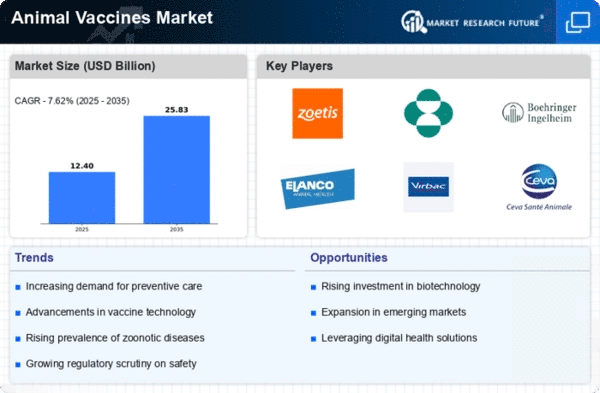
As per MRFR analysis, the Animal Vaccines Market Size was estimated at 11.52 USD Billion in 2024. The Animal Vaccines industry is projected to grow from 12.39 USD Billion in 2025 to 25.83 USD Billion by 2035, exhibiting a compound annual growth rate (CAGR) of 7.62% during the forecast period 2025 - 2035.

Key Market Trends & Highlights

The Animal Vaccines Market is experiencing robust growth driven by technological advancements and increasing demand for preventive healthcare.

  • Technological advancements in vaccine development are reshaping the Animal Vaccines Market, particularly in North America. The rising demand for preventive healthcare is propelling the growth of the preventive vaccination segment, which remains the largest. Focus on zoonotic disease prevention is gaining traction, especially in the Asia-Pacific region, which is the fastest-growing market. Increasing pet ownership and rising awareness of animal health are key drivers fueling market expansion across both livestock and companion animal segments.

Market Size & Forecast

2024 Market Size 11.52 (USD Billion)
2035 Market Size 25.83 (USD Billion)
CAGR (2025 - 2035) 7.62%
Largest Regional Market Share in 2024 North America

Major Players

Zoetis (US), Merck Animal Health (US), <a href="https://www.boehringer-ingelheim.com/in/animal-health">Boehringer Ingelheim</a> (DE), Elanco Animal Health (US), Virbac (FR), Ceva Santé Animale (FR), Heska Corporation (US), Vetoquinol (FR), Phibro Animal Health (US)

Market Trends

The Animal Vaccines Market is currently experiencing a notable transformation, driven by advancements in biotechnology and an increasing awareness of animal health. Stakeholders in this sector are focusing on developing innovative vaccines that not only enhance the immunity of livestock and pets but also address emerging diseases. This shift is largely influenced by the growing demand for safe and effective animal products, which is prompting manufacturers to invest in research and development. Furthermore, regulatory bodies are playing a crucial role in ensuring that vaccines meet stringent safety and efficacy standards, thereby fostering consumer confidence in these products.

In addition, the Animal Vaccines Market is witnessing a rise in collaboration between public and private entities. Such partnerships are aimed at enhancing vaccine accessibility and affordability, particularly in developing regions. The emphasis on preventive healthcare is becoming increasingly pronounced, as stakeholders recognize the economic benefits of vaccination in reducing disease outbreaks. As the Animal Vaccines Market evolves, it appears poised for sustained growth, with a focus on sustainability and ethical practices in animal husbandry. This evolving landscape suggests that the Animal Vaccines Market will continue to adapt to the changing needs of both animals and their caretakers, ensuring a healthier future for all involved. The steady expansion of the veterinary animal vaccines market is underpinned by a global rise in zoonotic disease awareness and the increasing medicalization of both livestock and companion animals.

Technological Advancements in Vaccine Development

The Animal Vaccines Market is witnessing a surge in technological innovations, particularly in the areas of genetic engineering and recombinant DNA technology. These advancements enable the creation of more effective vaccines that can target specific pathogens with greater precision. Furthermore, the animal autogenous vaccines market is gaining significant momentum as veterinarians increasingly seek customized immunological solutions tailored to the specific pathogen strains found within a particular herd or farm environment. As a result, the development process is becoming more efficient, potentially leading to faster market entry for new products.

Rising Demand for Preventive Healthcare

There is a growing trend towards preventive healthcare in the Animal Vaccines Market, driven by heightened awareness among pet owners and livestock producers. This shift emphasizes the importance of vaccination as a proactive measure to ensure animal health and productivity, potentially leading to increased market penetration and consumer engagement.

Rising Demand for Companion Animal Vaccines

The Animal Vaccines Market is experiencing a notable shift towards companion animal vaccines, driven by the increasing pet ownership trends. The global companion animal vaccines market is expanding rapidly as owners increasingly view pets as family members and prioritize advanced preventative medical care. As pet owners become more aware of the health needs of their animals, the demand for vaccines that protect against common diseases is rising. This trend indicates a potential expansion of product offerings tailored specifically for pets.

Animal Vaccines Market Market Drivers

Growing Demand for Animal Protein

The increasing global demand for animal protein is significantly influencing the Global Animal Vaccines Market Industry. As populations grow and dietary preferences shift towards protein-rich foods, the livestock sector faces pressure to enhance productivity and health. Vaccination plays a crucial role in ensuring the health of livestock, thereby improving yield and quality. This demand is expected to drive the market towards a valuation of 10 USD Billion by 2035. Consequently, the emphasis on vaccination as a means to sustain animal health and productivity is likely to remain a key focus for stakeholders in the industry.

Rising Awareness of Animal Health

The growing awareness of animal health and welfare among pet owners and livestock producers is significantly impacting the Global Animal Vaccines Market Industry. As consumers become more informed about the benefits of vaccination, there is a corresponding increase in demand for veterinary services and preventive healthcare measures. This trend is particularly evident in developed regions, where pet ownership is high, and owners are more likely to invest in their pets' health. The heightened focus on animal welfare is likely to drive market growth, as stakeholders recognize the importance of vaccination in promoting healthy and productive animals.

Regulatory Support and Initiatives

Regulatory frameworks and government initiatives aimed at promoting animal health are pivotal drivers of the Global Animal Vaccines Market Industry. Governments worldwide are implementing policies that encourage vaccination programs to prevent disease outbreaks and protect public health. For example, initiatives that subsidize vaccine costs or provide funding for research and development contribute to increased vaccination rates among livestock and pets. This regulatory support is expected to facilitate market growth, as it aligns with global health objectives and enhances the overall effectiveness of vaccination strategies.

Increasing Animal Disease Incidence

The rising incidence of infectious diseases among livestock and companion animals is a primary driver of the Global Animal Vaccines Market Industry. For instance, outbreaks of diseases such as avian influenza and foot-and-mouth disease have prompted governments and veterinary organizations to prioritize vaccination programs. This trend is expected to contribute to the market's growth, with the industry projected to reach 6.21 USD Billion in 2024. The need for effective vaccination strategies to combat these diseases underscores the importance of animal vaccines in maintaining animal health and ensuring food security.

Technological Advancements in Vaccine Development

Technological innovations in vaccine development are reshaping the Global Animal Vaccines Market Industry. Advances in biotechnology, such as recombinant DNA technology and mRNA vaccines, are enhancing the efficacy and safety of animal vaccines. These innovations not only improve vaccine performance but also reduce production costs, making vaccines more accessible to farmers. As a result, the market is poised for growth, with a projected CAGR of 4.43% from 2025 to 2035. The integration of cutting-edge technologies into vaccine development is likely to bolster the industry's capacity to address emerging animal health challenges.

Market Segment Insights

By Application: Preventive Vaccination (Largest) vs. Therapeutic Vaccination (Fastest-Growing)

The Animal Vaccines Market primarily comprises three applications: Preventive, Therapeutic, and Emergency Vaccination. Preventive Vaccination is the largest segment, capturing a significant portion of the market share due to its essential role in safeguarding animal health against diseases. As livestock production intensifies to meet global food demand, the reliance on preventive measures has grown, solidifying its status in the market. On the other hand, Therapeutic Vaccination, while smaller in market share, is emerging as the fastest-growing segment. This growth is primarily driven by advancements in vaccine technology and the increasing focus on disease treatment in animals. The rising awareness and demand for innovative therapeutic options create an evolving landscape, suggesting that this segment will see rapid expansion in the coming years.

Preventive Vaccination (Dominant) vs. Therapeutic Vaccination (Emerging)

Preventive Vaccination stands as the dominant player in the Animal Vaccines Market, primarily focused on immune protection through vaccination before the onset of diseases. This proactive approach is vital for maintaining herd health, reducing disease outbreaks, and enhancing animal productivity. In contrast, Therapeutic Vaccination, while categorized as an emerging segment, caters to specific health challenges faced by animals after disease manifestation. Its development focuses on targeted therapies that enhance recovery and improve health outcomes, reflecting a significant shift toward effective disease management. Both segments play crucial roles; however, preventive measures currently dominate due to their essential protective nature.

By Animal Type: Livestock (Largest) vs. Companion Animals (Fastest-Growing)

The Animal Vaccines Market is primarily segmented into Livestock, Companion Animals, Aquatic Animals, and Wildlife. Livestock holds the largest share, driven by the extensive need for vaccines to prevent diseases in cattle, sheep, and pigs. This segment encompasses a significant proportion of the market, reflecting the importance of maintaining animal health for food production. Companion Animals, while currently a smaller segment, are witnessing significant growth due to the increasing pet ownership and rising awareness of pet health, leading to a higher demand for vaccines. The growth trend for Companion Animals is bolstered by changing consumer attitudes towards pet care, with more pet owners seeking preventative health measures and better veterinary services. Additionally, the rise in disposable income and an increase in veterinarian visits are driving the demand for vaccines targeted at pets. Conversely, the Livestock segment, although dominant, faces pressures such as the need for more innovative solutions to address emerging diseases and comply with regulations, pushing for advancements in vaccine research and development.

Livestock (Dominant) vs. Companion Animals (Emerging)

The Livestock segment is characterized by its strong market position, largely due to the demand for vaccines that protect against prevalent diseases affecting farm animals. This segment relies heavily on established veterinary practices and government regulations that promote animal health standards. With a robust infrastructure in place, Livestock vaccines are developed to cater specifically to large populations of animals, which makes them economically viable for farmers. In contrast, the Companion Animals segment, though smaller in scope, is marked by rapid growth driven by shifting consumer perspectives on pet ownership. As pet owners increasingly treat pets as family members, there is a growing shift towards preventative healthcare, leading to a surge in the development of tailored vaccines and innovative treatment options.

By Route of Administration: Intramuscular (Largest) vs. Oral (Fastest-Growing)

The animal vaccines market is segmented based on the route of administration, with intramuscular and subcutaneous routes holding the largest market shares. Intramuscular administration is preferred for its efficacy and quick immunologic response among various species, especially in larger animals. Subcutaneous administration follows close behind, favored for its ease of use and minimal discomfort. Oral vaccines, while traditionally less favored, are gaining traction due to advancements in formulation technology, enhancing their effectiveness and appealing to livestock and pet owners seeking less invasive methods. Market growth in this segment is driven by increasing awareness of animal health, rising incidences of infectious diseases, and the demand for efficient vaccination strategies. Oral vaccines are becoming an emerging segment as they offer advantages like ease of administration and reduced stress on animals, propelling their growth. Meanwhile, the continued reliance on intramuscular vaccines ensures their dominance in the market, reflecting educators' and veterinarians' preferences.

Administration Route: Intramuscular (Dominant) vs. Oral (Emerging)

The intramuscular route of administration has long been established as the dominant method in the animal vaccines market, primarily due to its effectiveness in eliciting strong immune responses across various animal species. This route is especially popular for large animals where quick vaccination is imperative for protecting against serious diseases. Conversely, the oral administration route is emerging as a viable alternative, particularly within the livestock sector. Its benefits include ease of delivery and reduced stress for the animals, making it an attractive option for farmers and veterinarians. The growing focus on animal wellbeing is driving innovations in oral vaccine formulations, thereby enhancing their acceptance and reliability in preventing infectious diseases.

By Technology: Inactivated Vaccines (Largest) vs. Recombinant Vaccines (Fastest-Growing)

The Animal Vaccines Market technology segment showcases a diverse range of vaccine platforms, with inactivated vaccines holding the largest market share. These vaccines, characterized by their effective immunization against various diseases in animals, are widely adopted by veterinarians and livestock farmers alike. Live attenuated vaccines and DNA vaccines also play significant roles but are eclipsed by the dominance of inactivated vaccines. Recombinant vaccines, however, are gaining traction due to their safety profile and efficiency, indicating a shift in preferences within the market. Growth trends in the Animal Vaccines Market are largely driven by increasing awareness of animal health and the rising demand for sustainable livestock production. The advancement in biotechnology is fostering innovation in the vaccine development landscape, especially for recombinant and DNA vaccines. This surge is supported by regulatory approvals and a focus on novel vaccine delivery systems, which are expected to enhance immunogenicity and reduce side effects. As the industry evolves, we anticipate a sustained shift towards these emerging technologies alongside the existing inactivated vaccines, shaping the market's future landscape.

Technology: Inactivated Vaccines (Dominant) vs. Recombinant Vaccines (Emerging)

Inactivated vaccines, renowned for their reliability and long-standing presence in veterinary medicine, dominate the Animal Vaccines Market. They are specifically developed to trigger strong immune responses without posing risks of disease transmission, making them the preferred choice among animal health professionals. Meanwhile, recombinant vaccines are emerging as a key rival in this segment. Leveraging genetic engineering, these vaccines offer precise and efficient protection against specific pathogens. Their development is boosted by the growing need for safer vaccine options that protect both livestock and companion animals, thus appealing to a broader market. As regulatory frameworks evolve to embrace these innovations, recombinant vaccines are poised to capture significant attention and market share, reshaping the future of animal immunization.

By End User: Veterinary Clinics (Largest) vs. Animal Hospitals (Fastest-Growing)

In the Animal Vaccines Market, veterinary clinics represent the largest segment, driven by their comprehensive services and direct access to pet owners. Following closely, animal hospitals are experiencing accelerated growth, as they offer specialized care and advanced medical services. Research institutions and farmers, though significant, hold a smaller share compared to these two pivotal segments, influenced by varying demand dynamics for vaccines used in research and livestock management. As the market evolves, these establishments play crucial roles in vaccine distribution and administration, contributing significantly to animal health initiatives. Recent trends indicate a rising demand for veterinary services in both urban and rural areas, further propelling the growth of veterinary clinics and animal hospitals. Factors such as increased pet ownership and a greater emphasis on animal health are driving the need for effective vaccines. Additionally, the expansion of research institutions focusing on veterinary sciences is set to bolster innovations, ensuring that the sector adapts to emerging health challenges amongst livestock and companion animals alike.

Veterinary Clinics (Dominant) vs. Farmers (Emerging)

Veterinary clinics serve as the dominant force in the Animal Vaccines Market due to their established relationships with pet owners and a broad spectrum of services. They provide essential vaccinations that help in the preventive healthcare of companion animals, ensuring their longevity and well-being. In contrast, farmers represent an emerging sector that is gaining traction as livestock vaccination becomes increasingly prioritized for agricultural productivity. Their emphasis on herd health management and biosecurity measures connects them to the vaccine market. The growing awareness of zoonotic diseases and the economic implications of livestock health are propelling farmers to seek effective vaccination solutions. This shift not only enriches the market landscape but also fosters collaborative efforts between veterinary clinics and farmers to enhance animal welfare across the board.

Get more detailed insights about Animal Vaccine Market Research Report - Global Forecast till 2035

Regional Insights

North America : Market Leader in Animal Vaccines

North America continues to lead The Animal Vaccines, holding a significant share of 5.76 in 2024. The region's growth is driven by increasing pet ownership, rising livestock production, and stringent regulations promoting animal health. The demand for innovative vaccines is further fueled by advancements in biotechnology and a growing awareness of zoonotic diseases. Regulatory bodies are actively supporting vaccine development, ensuring safety and efficacy, which enhances market growth. The competitive landscape in North America is robust, featuring key players such as Zoetis, Merck Animal Health, and Elanco Animal Health. The U.S. is the largest market, driven by high investments in R&D and a strong veterinary infrastructure. Canada also contributes significantly, focusing on sustainable animal farming practices. The presence of established companies and a growing number of startups in the biotech sector are expected to further enhance market dynamics.

Europe : Emerging Market with Growth Potential

Europe's animal vaccines market is valued at 3.45, reflecting a growing demand driven by increasing livestock farming and pet ownership. The region benefits from stringent regulations that ensure high safety standards for vaccines, fostering consumer trust. Additionally, the European Union's initiatives to promote animal health and welfare are significant growth catalysts. The Italy animal vaccines market serves as a key contributor to this regional growth, supported by a robust veterinary infrastructure and high standards for disease prevention in both livestock and companion animals. The rising incidence of animal diseases necessitates effective vaccination strategies, further propelling market expansion. Leading countries in this region include Germany, France, and the UK, where major players like Boehringer Ingelheim and Virbac are prominent. The competitive landscape is characterized by innovation and collaboration among companies to develop advanced vaccine solutions. The presence of regulatory bodies ensures that products meet high standards, which is crucial for market acceptance. This environment encourages investment in R&D, positioning Europe as a key player in The Animal Vaccines.

Asia-Pacific : Rapidly Growing Animal Health Sector

The Asia-Pacific region is rapidly emerging as a significant player in the animal vaccines market, with a market size of 2.56. The growth is driven by increasing livestock production, rising pet ownership, and a growing awareness of animal health. Governments are implementing supportive regulations to enhance animal welfare, which is further propelling the demand for vaccines. The region is also witnessing advancements in veterinary healthcare, contributing to market expansion. Countries like China, India, and Australia are leading the market, with key players such as Zoetis and Merck Animal Health establishing a strong presence. The competitive landscape is evolving, with local companies also gaining traction. The increasing collaboration between governments and private sectors is expected to enhance vaccine accessibility and affordability, further driving market growth.

Middle East and Africa : Untapped Market with Growth Opportunities

The Middle East and Africa region, with a market size of 0.75, presents untapped opportunities in the animal vaccines market. The growth is driven by increasing livestock farming and a rising awareness of animal health issues. Governments are beginning to implement regulations to improve animal welfare, which is expected to boost vaccine demand. The region's diverse agricultural practices also create a unique landscape for vaccine development tailored to local needs. Leading countries in this region include South Africa and the UAE, where there is a growing focus on veterinary healthcare. The competitive landscape is characterized by a mix of local and international players, with companies like Ceva Santé Animale and Virbac making significant inroads. The increasing investment in veterinary services and infrastructure is anticipated to enhance market dynamics and accessibility to vaccines.

Key Players and Competitive Insights

The Animal Vaccines Market is characterized by a dynamic competitive landscape, driven by increasing demand for livestock health and the rising prevalence of zoonotic diseases. Key players such as Zoetis (US), Merck Animal Health (US), and Boehringer Ingelheim (DE) are at the forefront, each adopting distinct strategies to enhance their market positioning. Zoetis (US) focuses on innovation through extensive R&D investments, aiming to develop next-generation vaccines that address emerging health challenges in animals. Meanwhile, Merck Animal Health (US) emphasizes strategic partnerships and collaborations to expand its product portfolio and enhance distribution networks, thereby increasing its market reach. Boehringer Ingelheim (DE) appears to prioritize sustainability and digital transformation, integrating advanced technologies into its operations to improve efficiency and product efficacy.The competitive structure of the market is moderately fragmented, with several players vying for market share. Key business tactics include localizing manufacturing to reduce costs and optimize supply chains, which is crucial in maintaining competitive pricing. The collective influence of these major companies shapes the market dynamics, as they leverage their strengths to navigate challenges and capitalize on growth opportunities.
In November Zoetis (US) announced the launch of a novel vaccine targeting a prevalent viral disease in cattle, which is expected to significantly enhance herd immunity and reduce mortality rates. This strategic move underscores Zoetis's commitment to innovation and its proactive approach to addressing critical health issues in livestock, potentially solidifying its leadership position in the market.
In October Merck Animal Health (US) entered into a strategic alliance with a leading biotechnology firm to co-develop a new vaccine platform utilizing mRNA technology. This collaboration is likely to accelerate the development of vaccines that are more effective and quicker to produce, reflecting a shift towards cutting-edge solutions in animal health. Such partnerships may enhance Merck's competitive edge by diversifying its product offerings and improving its responsiveness to market demands.
In September Boehringer Ingelheim (DE) unveiled a comprehensive digital health platform designed to monitor animal health and vaccination status in real-time. This initiative not only demonstrates the company's commitment to digitalization but also positions it as a leader in integrating technology into veterinary practices. The platform is expected to facilitate better decision-making for veterinarians and farmers, thereby improving overall animal health outcomes.
As of December current trends in the Animal Vaccines Market indicate a strong emphasis on digitalization, sustainability, and the integration of artificial intelligence (AI) in vaccine development and distribution. Strategic alliances are increasingly shaping the competitive landscape, allowing companies to pool resources and expertise to drive innovation. The market appears to be shifting from price-based competition towards a focus on technological advancements and supply chain reliability. This evolution suggests that future competitive differentiation will hinge on the ability to innovate and adapt to changing consumer and regulatory demands.

Key Companies in the Animal Vaccines Market include

Industry Developments

Notably, in March 2023, Merial announced the launch of a new vaccine specifically designed for poultry, targeting recent outbreaks of avian influenza, which has significantly impacted livestock globally.

Additionally, in May 2023, Elanco Animal Health expanded its portfolio with the acquisition of a small biotech firm specializing in canine vaccines, aiming to enhance its offerings in the companion animal sector.

Other companies, including IDT Biologika and Virbac, are focusing on Research and Development for new vaccines to mitigate diseases in livestock, responding to an increasing demand for animal health solutions.

Furthermore, the market efficiency has been bolstered by a spike in investments from private equity in recent years, leading to enhanced production capabilities and innovative product offerings.

Despite challenges posed by regulatory hurdles and supply chain disruptions, the robust growth trajectory of this market indicates strong future potential, driven by increasing awareness of animal health and welfare globally.

Future Outlook

Animal Vaccines Market Future Outlook

The Animal Vaccines Market is projected to grow at a 7.62% CAGR from 2025 to 2035, driven by increasing pet ownership, livestock health awareness, and advancements in vaccine technology.

New opportunities lie in:

  • <p>Development of personalized vaccines for companion animals Expansion of telemedicine platforms for remote vaccination services Investment in biopharmaceuticals for innovative vaccine formulations</p>

By 2035, the Animal Vaccines Market is expected to achieve substantial growth and innovation.

Market Segmentation

Animal Vaccines Market End User Outlook

  • Veterinary Clinics
  • Animal Hospitals
  • Research Institutions
  • Farmers

Animal Vaccines Market Technology Outlook

  • Inactivated Vaccines
  • Live Attenuated Vaccines
  • Recombinant Vaccines
  • DNA Vaccines

Animal Vaccines Market Animal Type Outlook

  • Livestock
  • Companion Animals
  • Aquatic Animals
  • Wildlife

Animal Vaccines Market Application Outlook

  • Preventive Vaccination
  • Therapeutic Vaccination
  • Emergency Vaccination

Animal Vaccines Market Route of Administration Outlook

  • Intramuscular
  • Subcutaneous
  • Oral
  • Intradermal

Report Scope

MARKET SIZE 2024 11.52 (USD Billion)
MARKET SIZE 2025 12.39 (USD Billion)
MARKET SIZE 2035 25.83 (USD Billion)
COMPOUND ANNUAL GROWTH RATE (CAGR) 7.62% (2025 - 2035)
REPORT COVERAGE Revenue Forecast, Competitive Landscape, Growth Factors, and Trends
BASE YEAR 2024
Market Forecast Period 2025 - 2035
Historical Data 2019 - 2024
Market Forecast Units USD Billion
Key Companies Profiled Zoetis (US), Merck Animal Health (US), Boehringer Ingelheim (DE), Elanco Animal Health (US), Virbac (FR), Ceva Santé Animale (FR), Heska Corporation (US), Vetoquinol (FR), Phibro Animal Health (US)
Segments Covered Application, Animal Type, Route of Administration, Technology, End User
Key Market Opportunities Advancements in biotechnology enhance efficacy and safety of vaccines in the Animal Vaccines Market.
Key Market Dynamics Rising demand for innovative animal vaccines drives competitive forces and regulatory adaptations in the market.
Countries Covered North America, Europe, APAC, South America, MEA

FAQs

What is the current valuation of the Animal Vaccines Market as of 2024?

<p>The Animal Vaccines Market was valued at 11.52 USD Billion in 2024.</p>

What is the projected market size for the Animal Vaccines Market by 2035?

<p>The market is projected to reach 25.83 USD Billion by 2035.</p>

What is the expected CAGR for the Animal Vaccines Market during the forecast period 2025 - 2035?

<p>The expected CAGR for the Animal Vaccines Market during 2025 - 2035 is 7.62%.</p>

Which companies are considered key players in the Animal Vaccines Market?

<p>Key players include Zoetis, Merck Animal Health, Boehringer Ingelheim, Elanco Animal Health, and Virbac.</p>

How does the market segment for Preventive Vaccination perform in terms of valuation?

<p>The Preventive Vaccination segment is projected to grow from 4.5 USD Billion to 10.2 USD Billion.</p>

What is the valuation range for the Therapeutic Vaccination segment?

<p>The Therapeutic Vaccination segment ranges from 3.0 USD Billion to 7.0 USD Billion.</p>

What are the projected values for the Livestock segment by 2035?

<p>The Livestock segment is expected to grow from 5.0 USD Billion to 11.5 USD Billion.</p>

What is the expected growth for the Companion Animals segment in the Animal Vaccines Market?

<p>The Companion Animals segment is projected to increase from 3.0 USD Billion to 7.0 USD Billion.</p>

Which route of administration shows the highest projected growth?

<p>The Intramuscular route of administration is expected to grow from 3.0 USD Billion to 7.0 USD Billion.</p>

What is the projected valuation for Inactivated Vaccines by 2035?

<p>Inactivated Vaccines are projected to grow from 3.45 USD Billion to 7.8 USD Billion by 2035.</p>

  1. SECTION I: EXECUTIVE SUMMARY AND KEY HIGHLIGHTS |
    1. EXECUTIVE SUMMARY | |
      1. Market Overview | |
      2. Key Findings | |
      3. Market Segmentation | |
      4. Competitive Landscape | |
      5. Challenges and Opportunities | |
      6. Future Outlook 2
  2. SECTION II: SCOPING, METHODOLOGY AND MARKET STRUCTURE |
    1. MARKET INTRODUCTION | |
      1. Definition | |
      2. Scope of the study | | |
    2. RESEARCH METHODOLOGY | |
      1. Overview | |
      2. Data Mining | |
      3. Secondary Research | |
      4. Primary Research | | |
      5. Forecasting Model | |
      6. Market Size Estimation | | |
      7. Data Triangulation | |
      8. Validation 3
  3. SECTION III: QUALITATIVE ANALYSIS |
    1. MARKET DYNAMICS | |
      1. Overview | |
      2. Drivers | |
      3. Restraints | |
      4. Opportunities |
    2. MARKET FACTOR ANALYSIS | |
      1. Value chain Analysis | |
      2. Porter's Five Forces Analysis | | |
      3. COVID-19 Impact Analysis | | |
  4. SECTION IV: QUANTITATIVE ANALYSIS |
    1. Healthcare, BY Application (USD Billion) | |
      1. Preventive Vaccination | |
      2. Therapeutic Vaccination | |
      3. Emergency Vaccination | |
      4. Research and Development |
    2. Healthcare, BY Animal Type (USD Billion) | |
      1. Livestock | |
      2. Companion Animals | |
      3. Aquatic Animals | |
      4. Wildlife |
    3. Healthcare, BY Route of Administration (USD Billion) | |
      1. Intramuscular | |
      2. Subcutaneous | |
      3. Oral | |
      4. Intradermal |
    4. Healthcare, BY Technology (USD Billion) | |
      1. Inactivated Vaccines | |
      2. Live Attenuated Vaccines | |
      3. Recombinant Vaccines | |
      4. DNA Vaccines |
    5. Healthcare, BY Region (USD Billion) | |
      1. North America | | |
      2. Europe | | |
      3. APAC | | |
      4. South America | | |
      5. MEA | | |
  5. SECTION V: COMPETITIVE ANALYSIS |
    1. Competitive Landscape | |
      1. Overview | |
      2. Competitive Analysis | |
      3. Market share Analysis | |
      4. Major Growth Strategy in the Healthcare | |
      5. Competitive Benchmarking | |
      6. Leading Players in Terms of Number of Developments in the Healthcare | |
      7. Key developments and growth strategies | | |
      8. Major Players Financial Matrix | | |
    2. Company Profiles | |
      1. Zoetis (US) | | |
      2. Merck Animal Health (US) | | |
      3. Boehringer Ingelheim (DE) | | |
      4. Elanco Animal Health (US) | | |
      5. Virbac (FR) | | |
      6. Ceva Santé Animale (FR) | | |
      7. Heska Corporation (US) | | |
      8. Vetoquinol (FR) | | |
    3. Appendix | |
      1. References | |
      2. Related Reports 6 LIST OF FIGURES |
    4. MARKET SYNOPSIS |
    5. NORTH AMERICA MARKET ANALYSIS |
    6. US MARKET ANALYSIS BY APPLICATION |
    7. US MARKET ANALYSIS BY ANIMAL TYPE |
    8. US MARKET ANALYSIS BY ROUTE OF ADMINISTRATION |
    9. US MARKET ANALYSIS BY TECHNOLOGY |
    10. CANADA MARKET ANALYSIS BY APPLICATION |
    11. CANADA MARKET ANALYSIS BY ANIMAL TYPE |
    12. CANADA MARKET ANALYSIS BY ROUTE OF ADMINISTRATION |
    13. CANADA MARKET ANALYSIS BY TECHNOLOGY |
    14. EUROPE MARKET ANALYSIS |
    15. GERMANY MARKET ANALYSIS BY APPLICATION |
    16. GERMANY MARKET ANALYSIS BY ANIMAL TYPE |
    17. GERMANY MARKET ANALYSIS BY ROUTE OF ADMINISTRATION |
    18. GERMANY MARKET ANALYSIS BY TECHNOLOGY |
    19. UK MARKET ANALYSIS BY APPLICATION |
    20. UK MARKET ANALYSIS BY ANIMAL TYPE |
    21. UK MARKET ANALYSIS BY ROUTE OF ADMINISTRATION |
    22. UK MARKET ANALYSIS BY TECHNOLOGY |
    23. FRANCE MARKET ANALYSIS BY APPLICATION |
    24. FRANCE MARKET ANALYSIS BY ANIMAL TYPE |
    25. FRANCE MARKET ANALYSIS BY ROUTE OF ADMINISTRATION |
    26. FRANCE MARKET ANALYSIS BY TECHNOLOGY |
    27. RUSSIA MARKET ANALYSIS BY APPLICATION |
    28. RUSSIA MARKET ANALYSIS BY ANIMAL TYPE |
    29. RUSSIA MARKET ANALYSIS BY ROUTE OF ADMINISTRATION |
    30. RUSSIA MARKET ANALYSIS BY TECHNOLOGY |
    31. ITALY MARKET ANALYSIS BY APPLICATION |
    32. ITALY MARKET ANALYSIS BY ANIMAL TYPE |
    33. ITALY MARKET ANALYSIS BY ROUTE OF ADMINISTRATION |
    34. ITALY MARKET ANALYSIS BY TECHNOLOGY |
    35. SPAIN MARKET ANALYSIS BY APPLICATION |
    36. SPAIN MARKET ANALYSIS BY ANIMAL TYPE |
    37. SPAIN MARKET ANALYSIS BY ROUTE OF ADMINISTRATION |
    38. SPAIN MARKET ANALYSIS BY TECHNOLOGY |
    39. REST OF EUROPE MARKET ANALYSIS BY APPLICATION |
    40. REST OF EUROPE MARKET ANALYSIS BY ANIMAL TYPE |
    41. REST OF EUROPE MARKET ANALYSIS BY ROUTE OF ADMINISTRATION |
    42. REST OF EUROPE MARKET ANALYSIS BY TECHNOLOGY |
    43. APAC MARKET ANALYSIS |
    44. CHINA MARKET ANALYSIS BY APPLICATION |
    45. CHINA MARKET ANALYSIS BY ANIMAL TYPE |
    46. CHINA MARKET ANALYSIS BY ROUTE OF ADMINISTRATION |
    47. CHINA MARKET ANALYSIS BY TECHNOLOGY |
    48. INDIA MARKET ANALYSIS BY APPLICATION |
    49. INDIA MARKET ANALYSIS BY ANIMAL TYPE |
    50. INDIA MARKET ANALYSIS BY ROUTE OF ADMINISTRATION |
    51. INDIA MARKET ANALYSIS BY TECHNOLOGY |
    52. JAPAN MARKET ANALYSIS BY APPLICATION |
    53. JAPAN MARKET ANALYSIS BY ANIMAL TYPE |
    54. JAPAN MARKET ANALYSIS BY ROUTE OF ADMINISTRATION |
    55. JAPAN MARKET ANALYSIS BY TECHNOLOGY |
    56. SOUTH KOREA MARKET ANALYSIS BY APPLICATION |
    57. SOUTH KOREA MARKET ANALYSIS BY ANIMAL TYPE |
    58. SOUTH KOREA MARKET ANALYSIS BY ROUTE OF ADMINISTRATION |
    59. SOUTH KOREA MARKET ANALYSIS BY TECHNOLOGY |
    60. MALAYSIA MARKET ANALYSIS BY APPLICATION |
    61. MALAYSIA MARKET ANALYSIS BY ANIMAL TYPE |
    62. MALAYSIA MARKET ANALYSIS BY ROUTE OF ADMINISTRATION |
    63. MALAYSIA MARKET ANALYSIS BY TECHNOLOGY |
    64. THAILAND MARKET ANALYSIS BY APPLICATION |
    65. THAILAND MARKET ANALYSIS BY ANIMAL TYPE |
    66. THAILAND MARKET ANALYSIS BY ROUTE OF ADMINISTRATION |
    67. THAILAND MARKET ANALYSIS BY TECHNOLOGY |
    68. INDONESIA MARKET ANALYSIS BY APPLICATION |
    69. INDONESIA MARKET ANALYSIS BY ANIMAL TYPE |
    70. INDONESIA MARKET ANALYSIS BY ROUTE OF ADMINISTRATION |
    71. INDONESIA MARKET ANALYSIS BY TECHNOLOGY |
    72. REST OF APAC MARKET ANALYSIS BY APPLICATION |
    73. REST OF APAC MARKET ANALYSIS BY ANIMAL TYPE |
    74. REST OF APAC MARKET ANALYSIS BY ROUTE OF ADMINISTRATION |
    75. REST OF APAC MARKET ANALYSIS BY TECHNOLOGY |
    76. SOUTH AMERICA MARKET ANALYSIS |
    77. BRAZIL MARKET ANALYSIS BY APPLICATION |
    78. BRAZIL MARKET ANALYSIS BY ANIMAL TYPE |
    79. BRAZIL MARKET ANALYSIS BY ROUTE OF ADMINISTRATION |
    80. BRAZIL MARKET ANALYSIS BY TECHNOLOGY |
    81. MEXICO MARKET ANALYSIS BY APPLICATION |
    82. MEXICO MARKET ANALYSIS BY ANIMAL TYPE |
    83. MEXICO MARKET ANALYSIS BY ROUTE OF ADMINISTRATION |
    84. MEXICO MARKET ANALYSIS BY TECHNOLOGY |
    85. ARGENTINA MARKET ANALYSIS BY APPLICATION |
    86. ARGENTINA MARKET ANALYSIS BY ANIMAL TYPE |
    87. ARGENTINA MARKET ANALYSIS BY ROUTE OF ADMINISTRATION |
    88. ARGENTINA MARKET ANALYSIS BY TECHNOLOGY |
    89. REST OF SOUTH AMERICA MARKET ANALYSIS BY APPLICATION |
    90. REST OF SOUTH AMERICA MARKET ANALYSIS BY ANIMAL TYPE |
    91. REST OF SOUTH AMERICA MARKET ANALYSIS BY ROUTE OF ADMINISTRATION |
    92. REST OF SOUTH AMERICA MARKET ANALYSIS BY TECHNOLOGY |
    93. MEA MARKET ANALYSIS |
    94. GCC COUNTRIES MARKET ANALYSIS BY APPLICATION |
    95. GCC COUNTRIES MARKET ANALYSIS BY ANIMAL TYPE |
    96. GCC COUNTRIES MARKET ANALYSIS BY ROUTE OF ADMINISTRATION |
    97. GCC COUNTRIES MARKET ANALYSIS BY TECHNOLOGY |
    98. SOUTH AFRICA MARKET ANALYSIS BY APPLICATION |
    99. SOUTH AFRICA MARKET ANALYSIS BY ANIMAL TYPE |
    100. SOUTH AFRICA MARKET ANALYSIS BY ROUTE OF ADMINISTRATION |
    101. SOUTH AFRICA MARKET ANALYSIS BY TECHNOLOGY |
    102. REST OF MEA MARKET ANALYSIS BY APPLICATION |
    103. REST OF MEA MARKET ANALYSIS BY ANIMAL TYPE |
    104. REST OF MEA MARKET ANALYSIS BY ROUTE OF ADMINISTRATION |
    105. REST OF MEA MARKET ANALYSIS BY TECHNOLOGY |
    106. KEY BUYING CRITERIA OF HEALTHCARE |
    107. RESEARCH PROCESS OF MRFR |
    108. DRO ANALYSIS OF HEALTHCARE |
    109. DRIVERS IMPACT ANALYSIS: HEALTHCARE |
    110. RESTRAINTS IMPACT ANALYSIS: HEALTHCARE |
    111. SUPPLY / VALUE CHAIN: HEALTHCARE |
    112. HEALTHCARE, BY APPLICATION, 2024 (% SHARE) |
    113. HEALTHCARE, BY APPLICATION, 2024 TO 2035 (USD Billion) |
    114. HEALTHCARE, BY ANIMAL TYPE, 2024 (% SHARE) |
    115. HEALTHCARE, BY ANIMAL TYPE, 2024 TO 2035 (USD Billion) |
    116. HEALTHCARE, BY ROUTE OF ADMINISTRATION, 2024 (% SHARE) |
    117. HEALTHCARE, BY ROUTE OF ADMINISTRATION, 2024 TO 2035 (USD Billion) |
    118. HEALTHCARE, BY TECHNOLOGY, 2024 (% SHARE) |
    119. HEALTHCARE, BY TECHNOLOGY, 2024 TO 2035 (USD Billion) |
    120. BENCHMARKING OF MAJOR COMPETITORS 7 LIST OF TABLES |
    121. LIST OF ASSUMPTIONS | |
      1. |
    122. North America MARKET SIZE ESTIMATES; FORECAST | |
      1. BY APPLICATION, 2025-2035 (USD Billion) | |
      2. BY ANIMAL TYPE, 2025-2035 (USD Billion) | |
      3. BY ROUTE OF ADMINISTRATION, 2025-2035 (USD Billion) | |
      4. BY TECHNOLOGY, 2025-2035 (USD Billion) |
    123. US MARKET SIZE ESTIMATES; FORECAST | |
      1. BY APPLICATION, 2025-2035 (USD Billion) | |
      2. BY ANIMAL TYPE, 2025-2035 (USD Billion) | |
      3. BY ROUTE OF ADMINISTRATION, 2025-2035 (USD Billion) | |
      4. BY TECHNOLOGY, 2025-2035 (USD Billion) |
    124. Canada MARKET SIZE ESTIMATES; FORECAST | |
      1. BY APPLICATION, 2025-2035 (USD Billion) | |
      2. BY ANIMAL TYPE, 2025-2035 (USD Billion) | |
      3. BY ROUTE OF ADMINISTRATION, 2025-2035 (USD Billion) | |
      4. BY TECHNOLOGY, 2025-2035 (USD Billion) |
    125. Europe MARKET SIZE ESTIMATES; FORECAST | |
      1. BY APPLICATION, 2025-2035 (USD Billion) | |
      2. BY ANIMAL TYPE, 2025-2035 (USD Billion) | |
      3. BY ROUTE OF ADMINISTRATION, 2025-2035 (USD Billion) | |
      4. BY TECHNOLOGY, 2025-2035 (USD Billion) |
    126. Germany MARKET SIZE ESTIMATES; FORECAST | |
      1. BY APPLICATION, 2025-2035 (USD Billion) | |
      2. BY ANIMAL TYPE, 2025-2035 (USD Billion) | |
      3. BY ROUTE OF ADMINISTRATION, 2025-2035 (USD Billion) | |
      4. BY TECHNOLOGY, 2025-2035 (USD Billion) |
    127. UK MARKET SIZE ESTIMATES; FORECAST | |
      1. BY APPLICATION, 2025-2035 (USD Billion) | |
      2. BY ANIMAL TYPE, 2025-2035 (USD Billion) | |
      3. BY ROUTE OF ADMINISTRATION, 2025-2035 (USD Billion) | |
      4. BY TECHNOLOGY, 2025-2035 (USD Billion) |
    128. France MARKET SIZE ESTIMATES; FORECAST | |
      1. BY APPLICATION, 2025-2035 (USD Billion) | |
      2. BY ANIMAL TYPE, 2025-2035 (USD Billion) | |
      3. BY ROUTE OF ADMINISTRATION, 2025-2035 (USD Billion) | |
      4. BY TECHNOLOGY, 2025-2035 (USD Billion) |
    129. Russia MARKET SIZE ESTIMATES; FORECAST | |
      1. BY APPLICATION, 2025-2035 (USD Billion) | |
      2. BY ANIMAL TYPE, 2025-2035 (USD Billion) | |
      3. BY ROUTE OF ADMINISTRATION, 2025-2035 (USD Billion) | |
      4. BY TECHNOLOGY, 2025-2035 (USD Billion) |
    130. Italy MARKET SIZE ESTIMATES; FORECAST | |
      1. BY APPLICATION, 2025-2035 (USD Billion) | |
      2. BY ANIMAL TYPE, 2025-2035 (USD Billion) | |
      3. BY ROUTE OF ADMINISTRATION, 2025-2035 (USD Billion) | |
      4. BY TECHNOLOGY, 2025-2035 (USD Billion) |
    131. Spain MARKET SIZE ESTIMATES; FORECAST | |
      1. BY APPLICATION, 2025-2035 (USD Billion) | |
      2. BY ANIMAL TYPE, 2025-2035 (USD Billion) | |
      3. BY ROUTE OF ADMINISTRATION, 2025-2035 (USD Billion) | |
      4. BY TECHNOLOGY, 2025-2035 (USD Billion) |
    132. Rest of Europe MARKET SIZE ESTIMATES; FORECAST | |
      1. BY APPLICATION, 2025-2035 (USD Billion) | |
      2. BY ANIMAL TYPE, 2025-2035 (USD Billion) | |
      3. BY ROUTE OF ADMINISTRATION, 2025-2035 (USD Billion) | |
      4. BY TECHNOLOGY, 2025-2035 (USD Billion) |
    133. APAC MARKET SIZE ESTIMATES; FORECAST | |
      1. BY APPLICATION, 2025-2035 (USD Billion) | |
      2. BY ANIMAL TYPE, 2025-2035 (USD Billion) | |
      3. BY ROUTE OF ADMINISTRATION, 2025-2035 (USD Billion) | |
      4. BY TECHNOLOGY, 2025-2035 (USD Billion) |
    134. China MARKET SIZE ESTIMATES; FORECAST | |
      1. BY APPLICATION, 2025-2035 (USD Billion) | |
      2. BY ANIMAL TYPE, 2025-2035 (USD Billion) | |
      3. BY ROUTE OF ADMINISTRATION, 2025-2035 (USD Billion) | |
      4. BY TECHNOLOGY, 2025-2035 (USD Billion) |
    135. India MARKET SIZE ESTIMATES; FORECAST | |
      1. BY APPLICATION, 2025-2035 (USD Billion) | |
      2. BY ANIMAL TYPE, 2025-2035 (USD Billion) | |
      3. BY ROUTE OF ADMINISTRATION, 2025-2035 (USD Billion) | |
      4. BY TECHNOLOGY, 2025-2035 (USD Billion) |
    136. Japan MARKET SIZE ESTIMATES; FORECAST | |
      1. BY APPLICATION, 2025-2035 (USD Billion) | |
      2. BY ANIMAL TYPE, 2025-2035 (USD Billion) | |
      3. BY ROUTE OF ADMINISTRATION, 2025-2035 (USD Billion) | |
      4. BY TECHNOLOGY, 2025-2035 (USD Billion) |
    137. South Korea MARKET SIZE ESTIMATES; FORECAST | |
      1. BY APPLICATION, 2025-2035 (USD Billion) | |
      2. BY ANIMAL TYPE, 2025-2035 (USD Billion) | |
      3. BY ROUTE OF ADMINISTRATION, 2025-2035 (USD Billion) | |
      4. BY TECHNOLOGY, 2025-2035 (USD Billion) |
    138. Malaysia MARKET SIZE ESTIMATES; FORECAST | |
      1. BY APPLICATION, 2025-2035 (USD Billion) | |
      2. BY ANIMAL TYPE, 2025-2035 (USD Billion) | |
      3. BY ROUTE OF ADMINISTRATION, 2025-2035 (USD Billion) | |
      4. BY TECHNOLOGY, 2025-2035 (USD Billion) |
    139. Thailand MARKET SIZE ESTIMATES; FORECAST | |
      1. BY APPLICATION, 2025-2035 (USD Billion) | |
      2. BY ANIMAL TYPE, 2025-2035 (USD Billion) | |
      3. BY ROUTE OF ADMINISTRATION, 2025-2035 (USD Billion) | |
      4. BY TECHNOLOGY, 2025-2035 (USD Billion) |
    140. Indonesia MARKET SIZE ESTIMATES; FORECAST | |
      1. BY APPLICATION, 2025-2035 (USD Billion) | |
      2. BY ANIMAL TYPE, 2025-2035 (USD Billion) | |
      3. BY ROUTE OF ADMINISTRATION, 2025-2035 (USD Billion) | |
      4. BY TECHNOLOGY, 2025-2035 (USD Billion) |
    141. Rest of APAC MARKET SIZE ESTIMATES; FORECAST | |
      1. BY APPLICATION, 2025-2035 (USD Billion) | |
      2. BY ANIMAL TYPE, 2025-2035 (USD Billion) | |
      3. BY ROUTE OF ADMINISTRATION, 2025-2035 (USD Billion) | |
      4. BY TECHNOLOGY, 2025-2035 (USD Billion) |
    142. South America MARKET SIZE ESTIMATES; FORECAST | |
      1. BY APPLICATION, 2025-2035 (USD Billion) | |
      2. BY ANIMAL TYPE, 2025-2035 (USD Billion) | |
      3. BY ROUTE OF ADMINISTRATION, 2025-2035 (USD Billion) | |
      4. BY TECHNOLOGY, 2025-2035 (USD Billion) |
    143. Brazil MARKET SIZE ESTIMATES; FORECAST | |
      1. BY APPLICATION, 2025-2035 (USD Billion) | |
      2. BY ANIMAL TYPE, 2025-2035 (USD Billion) | |
      3. BY ROUTE OF ADMINISTRATION, 2025-2035 (USD Billion) | |
      4. BY TECHNOLOGY, 2025-2035 (USD Billion) |
    144. Mexico MARKET SIZE ESTIMATES; FORECAST | |
      1. BY APPLICATION, 2025-2035 (USD Billion) | |
      2. BY ANIMAL TYPE, 2025-2035 (USD Billion) | |
      3. BY ROUTE OF ADMINISTRATION, 2025-2035 (USD Billion) | |
      4. BY TECHNOLOGY, 2025-2035 (USD Billion) |
    145. Argentina MARKET SIZE ESTIMATES; FORECAST | |
      1. BY APPLICATION, 2025-2035 (USD Billion) | |
      2. BY ANIMAL TYPE, 2025-2035 (USD Billion) | |
      3. BY ROUTE OF ADMINISTRATION, 2025-2035 (USD Billion) | |
      4. BY TECHNOLOGY, 2025-2035 (USD Billion) |
    146. Rest of South America MARKET SIZE ESTIMATES; FORECAST | |
      1. BY APPLICATION, 2025-2035 (USD Billion) | |
      2. BY ANIMAL TYPE, 2025-2035 (USD Billion) | |
      3. BY ROUTE OF ADMINISTRATION, 2025-2035 (USD Billion) | |
      4. BY TECHNOLOGY, 2025-2035 (USD Billion) |
    147. MEA MARKET SIZE ESTIMATES; FORECAST | |
      1. BY APPLICATION, 2025-2035 (USD Billion) | |
      2. BY ANIMAL TYPE, 2025-2035 (USD Billion) | |
      3. BY ROUTE OF ADMINISTRATION, 2025-2035 (USD Billion) | |
      4. BY TECHNOLOGY, 2025-2035 (USD Billion) |
    148. GCC Countries MARKET SIZE ESTIMATES; FORECAST | |
      1. BY APPLICATION, 2025-2035 (USD Billion) | |
      2. BY ANIMAL TYPE, 2025-2035 (USD Billion) | |
      3. BY ROUTE OF ADMINISTRATION, 2025-2035 (USD Billion) | |
      4. BY TECHNOLOGY, 2025-2035 (USD Billion) |
    149. South Africa MARKET SIZE ESTIMATES; FORECAST | |
      1. BY APPLICATION, 2025-2035 (USD Billion) | |
      2. BY ANIMAL TYPE, 2025-2035 (USD Billion) | |
      3. BY ROUTE OF ADMINISTRATION, 2025-2035 (USD Billion) | |
      4. BY TECHNOLOGY, 2025-2035 (USD Billion) |
    150. Rest of MEA MARKET SIZE ESTIMATES; FORECAST | |
      1. BY APPLICATION, 2025-2035 (USD Billion) | |
      2. BY ANIMAL TYPE, 2025-2035 (USD Billion) | |
      3. BY ROUTE OF ADMINISTRATION, 2025-2035 (USD Billion) | |
      4. BY TECHNOLOGY, 2025-2035 (USD Billion) |
    151. PRODUCT LAUNCH/PRODUCT DEVELOPMENT/APPROVAL | |
      1. |
    152. ACQUISITION/PARTNERSHIP | |

Healthcare Market Segmentation

Healthcare By Application (USD Billion, 2025-2035)

  • Preventive Vaccination
  • Therapeutic Vaccination
  • Emergency Vaccination
  • Research and Development

Healthcare By Animal Type (USD Billion, 2025-2035)

  • Livestock
  • Companion Animals
  • Aquatic Animals
  • Wildlife

Healthcare By Route of Administration (USD Billion, 2025-2035)

  • Intramuscular
  • Subcutaneous
  • Oral
  • Intradermal

Healthcare By Technology (USD Billion, 2025-2035)

  • Inactivated Vaccines
  • Live Attenuated Vaccines
  • Recombinant Vaccines
  • DNA Vaccines
Infographic

Free Sample Request

Kindly complete the form below to receive a free sample of this Report

Get Free Sample

Customer Strories

Compare Licence

×
Features License Type
Single User Multiuser License Enterprise User
Price $4,950 $5,950 $7,250
Maximum User Access Limit 1 User Upto 10 Users Unrestricted Access Throughout the Organization
Free Customization
Direct Access to Analyst
Deliverable Format
Platform Access
Discount on Next Purchase 10% 15% 15%
Printable Versions
%>