Request Free Sample ×

Kindly complete the form below to receive a free sample of this Report

* Please use a valid business email

Leading companies partner with us for data-driven Insights

clients tt-cursor
Hero Background
English
Chinese
French
Japanese
Korean
German
Spanish

Animal Model Market Trends

ID: MRFR/Pharma/8231-HCR
140 Pages
Rahul Gotadki
April 2026

Animal Model Market Research Report Information By Animal Type (Pigs, Cats, and Mice), By Technology (CRISPR, Microinjection, and Embryonic Stem Cell Injection), By Application (Research & Development, Production, and Quality Control), By End-User (Research Institutes, Educational Institutes, Pharmaceutical Companies, and Contract Research Organizations), And By Region (North America, Europe, Asia-Pacific, And Rest Of The World) - Growth & Industry Forecast 2025 To 2035

Share:
Download PDF ×

We do not share your information with anyone. However, we may send you emails based on your report interest from time to time. You may contact us at any time to opt-out.

Animal Model Market Infographic
Purchase Options

Market Trends

Introduction

As we take a look at the Animal Model Market in 2025, we see several macro-economic factors influencing its evolution. Gene therapy and biopharmaceuticals are enabling the development of more sophisticated and relevant animal models, which will lead to better research results. Meanwhile, regulatory pressures are intensifying, with the introduction of stricter ethical and animal-welfare guidelines, forcing the industry to adapt its practices. Also, a shift in consumer preferences towards a more sustainable and individualized approach to medicine is encouraging companies to focus their efforts on innovation. These macro-economic factors are vital for companies to understand, as they are not only shaping their competitive strategies, but also influencing the way they operate in the wider social and regulatory context.

Top Trends

  1. Increased Demand for Genetically Engineered Models
    The rise of precision medicine has brought a huge increase in demand for genetically engineered animal models, and companies like Horizon Discovery Group PLC are leading the way. By 2025, more than 60% of research institutions are expected to be using these models in drug development. These developments will improve the accuracy of preclinical studies, reducing the risk of late-stage clinical failures. The future will see the introduction of more complex gene-editing techniques, which will further increase the accuracy of these models.
  2. Regulatory Support for Animal Research
    The regulatory authorities are more and more aware of the importance of animal models in biomedical research and are easing their approval procedures. For example, the Food and Drug Administration (FDA) has issued guidelines that facilitate the use of animal models in drug testing. This is expected to lead to greater efficiency in research and faster drug development. As the regulatory framework evolves, compliance with the rules will become an increasingly important factor for the industry.
  3. Focus on Animal Welfare and Ethical Standards
    Animal welfare in research is becoming an increasingly important consideration, both in terms of public opinion and legislation. Higher ethical standards, such as those adopted by Charles River Laboratories, are becoming a source of competitive advantage. Surveys show that up to 75% of consumers prefer to buy products developed using humane methods. This trend may lead to higher costs, but it can also enhance brand loyalty and market reputation.
  4. Integration of AI and Machine Learning
    Artificial intelligence and machine learning are transforming data analysis and prediction in animal model research. Companies are using these methods to improve the accuracy of experimental results, with studies demonstrating a 30% increase in the success rate of predictions. This trend will help to speed up the development of new drugs and shorten the time to market. Advances in this area could even lead to the development of fully automated research environments.
  5. Expansion of Contract Research Organizations (CROs)
    The role of contract research organisations in the animal model market is growing. By offering specialised services, they are able to relieve the burden on pharmaceutical companies. It is estimated that by 2025, up to 40% of preclinical research will be outsourced to CROs like Envigo. This trend offers the advantages of cost savings and access to advanced technology, while allowing companies to focus on their core business. Competition and innovation in the sector are likely to increase as CROs continue to expand.
  6. Emergence of Personalized Animal Models
    Using the concept of personal medicine, a custom-made model of the patient’s disease is being developed. A company called Transposagen Biopharmaceuticals is an example of this. The aim of this development is to make preclinical research more relevant, which could lead to improved results in clinical trials. This development could also lead to more individualized treatment.
  7. Sustainability Initiatives in Animal Research
    The use of animal models is becoming a matter of great importance in the animal model industry, and the practice of companies is now aimed at reducing the impact on the environment. There are several initiatives to reduce waste and improve resource efficiency. It is both the regulatory pressure and the consumers' demands for sustainable development that have prompted this development. In the future, it may also be possible to use other animal models, which reduce the use of live animals even further.
  8. Globalization of Animal Model Research
    Research is becoming increasingly international. The globalization of scientific activities facilitates the exchange of animal models and data. The formation of international collaborations between companies is expected to increase the diversity of animal models available for research. This trend may lead to increased innovation and a better understanding of the pathophysiology of diseases. The future may also bring a greater use of standardized procedures that facilitate reproducibility.
  9. Advancements in Non-Invasive Techniques
    Non-intrusive methods of investigation, such as the use of non-destructive, non-stunning means of observation and recording, are revolutionizing the way in which animal models are studied. Several companies have developed methods for obtaining more accurate data by means of a greater ability to follow up physiological changes. The accuracy of the results has been reported as increasing by 25 per cent. This development will undoubtedly improve the quality of research and reduce the need for invasive procedures. And future developments may lead to even more accurate recording.
  10. Rise of Companion Animal Models
    In the United States the use of pet animals in research has become more common, especially in the study of human diseases. In the case of dogs and cats, companies are looking for a variety of uses. Preliminary studies have yielded some encouraging results. This trend is expected to broaden the scope of research and increase the translational value of research findings. Future developments will probably include more comprehensive studies that validate the use of these models.

Conclusion: Navigating the Animal Model Market Landscape

In the year 2025, the Animal Model Market will become more fragmented. The monopoly will be shared by the traditional and the new players. The established companies will use their experience and established network, and the new entrants will focus on innovation and research methods, such as the use of artificial intelligence and automation to increase efficiency. The geographical trend is that the importance of ethics and environmentalism is increasingly prominent, and companies need to adjust their strategies accordingly. In order to adapt to the changing market, companies need to have the flexibility of their products and services. In order to achieve the leading position in the Animal Model Market, the companies should be able to respond quickly to the changes in regulations and market demands. The key to the future development of the Animal Model Market is the integration of advanced technology and sustainable development.


Author
Author Profile
Rahul Gotadki
Research Manager

He holds an experience of about 9+ years in Market Research and Business Consulting, working under the spectrum of Life Sciences and Healthcare domains. Rahul conceptualizes and implements a scalable business strategy and provides strategic leadership to the clients. His expertise lies in market estimation, competitive intelligence, pipeline analysis, customer assessment, etc.

Leave a Comment

FAQs

What is the current valuation of the Animal Model Market as of 2024?

The market was valued at 2777.94 USD Million in 2024.

What is the projected market size for the market by 2035?

The market is projected to reach 5919.84 USD Million by 2035.

What is the expected CAGR for the Animal Model Market during the forecast period 2025 - 2035?

The expected CAGR for the market during the forecast period 2025 - 2035 is 7.12%.

Which application segments are driving growth in the Animal Model Market?

<p>Key application segments include Drug Discovery, Toxicology Testing, and Regenerative Medicine, with valuations ranging from 600.0 to 1519.84 USD Million.</p>

What types of animal models are most commonly used in research?

<p>Mice and rats are the most commonly used animal models, with market valuations between 500.0 and 1300.0 USD Million.</p>

Which research areas are seeing the highest investment in the Animal Model Market?

<p>Oncology and Neurology are leading research areas, with market valuations reaching up to 1300.0 USD Million.</p>

Who are the key players in the market?

Key players include Charles River Laboratories, Envigo, and The Jackson Laboratory, among others.

What are the primary end users of animal models in research?

Pharmaceutical companies and biotechnology firms are the primary end users, with market valuations between 555.09 and 2390.0 USD Million.

How does the market for non-human primates compare to other animal types?

The market for non-human primates is valued between 400.0 and 800.0 USD Million, which is lower than that of mice and rats.

What trends are influencing the growth of the Animal Model Market?

Trends such as advancements in genetic research and increasing demand for regenerative medicine are likely influencing market growth.

Market Summary

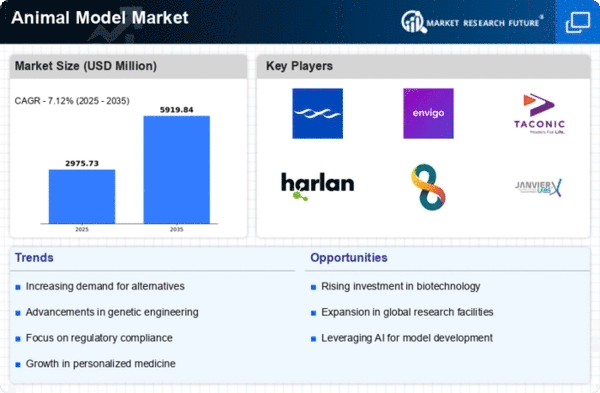
As per Market Research Future Reports analysis, the Animal Model Market size was valued at USD 2777.94 Million in 2024. The market is projected to grow from USD2 975.74 Million in 2025 to USD 5919.84 Million by 2035, exhibiting a CAGR of 7.12% during the forecast period 2025–2035. North America led the market with over 50% share, generating around USD 1,390.0 million in revenue.
 
The market is primarily driven by increasing demand for preclinical research, rising pharmaceutical R&D investments, and advancements in genetic engineering technologies that enhance disease modeling accuracy, accelerating drug discovery and development while improving translational outcomes across diverse therapeutic areas globally.
 
According to the World Health Organization, over 10 million deaths annually are linked to cancer, reinforcing demand for advanced preclinical models; additionally, global R&D spending exceeds USD 2 trillion, supporting extensive use of animal models in biomedical research.

Key Market Trends & Highlights

The Animal Model Market is experiencing robust growth driven by technological advancements and increasing demand for personalized medicine.

  • North America dominates Animal Model Market with over 50% revenue share in 2024, driven by advanced research infrastructure. Drug Discovery leads with 52% share, while Toxicology Testing grows rapidly at 48% driven by regulatory requirements. Mice dominate with 60% share; Non-Human Primates fastest-growing at 40% due to complex disease research demand. Pharmaceutical companies hold 62% share, while biotechnology firms expand rapidly at 38% with increasing innovation investments.

Market Size & Forecast

2024 Market Size 2777.94 (USD Million)
2035 Market Size 5919.84 (USD Million)
CAGR (2025 - 2035) 7.12%
Largest Regional Market Share in 2024 North America

Major Players

Companies such as  Charles River Laboratories (US), Envigo (US), Taconic Biosciences (US), Harlan Laboratories (US), Crown Bioscience (US), Janvier Labs (FR), The Jackson Laboratory (US), Wuxi AppTec (CN), Inotiv (US) are some of the major participants in the global market.

Market Trends

The animal model market trends indicate a dynamic evolution driven by advancements in biotechnology and increasing emphasis on ethical research practices. The broader laboratory model animal market continues to expand as pharmaceutical and academic institutions increase R&D investments. The animal model for testing market is witnessing growth due to heightened demand for preclinical validation and drug safety assessments. Additionally, technological innovations are strengthening the model animal technology market, enabling more precise genetic modifications and enhanced disease modeling capabilities. Moreover, the animal anatomy model market is also gaining traction in educational and training institutions, complementing research-focused segments.

The integration of technology, such as genetic engineering and advanced imaging techniques, is enhancing the capabilities of animal models, allowing for more accurate predictions of human responses. This trend suggests a potential for increased collaboration between academia and industry, as both sectors seek to leverage animal models for drug discovery and development. Overall, the market appears poised for continued growth, driven by scientific innovation and a commitment to ethical research practices.

Technological Advancements in Animal Models

The animal model market is witnessing a surge in innovations that enhance the laboratory market ecosystem. Techniques such as CRISPR gene editing and advanced imaging are reshaping the model animal technology market, improving predictive accuracy and research outcomes. These advancements facilitate a deeper understanding of disease mechanisms and improve the predictability of therapeutic outcomes.

Advancements such as CRISPR gene editing and imaging technologies are enhancing research precision. The Centers for Disease Control and Prevention reports that over 60% of emerging infectious diseases are zoonotic, emphasizing the importance of advanced animal models in studying disease transmission and accelerating vaccine and therapeutic development.

Ethical Considerations and Regulatory Compliance

Growing regulatory alignment continues to influence animal model market trends, reinforcing humane research standards and shaping long-term market share distribution across global regions. This trend indicates a shift towards the adoption of alternative methods and the refinement of existing practices to ensure humane treatment of animals, thereby fostering greater transparency and accountability.

Regulatory focus on ethical research is improving standards globally. The European Centre for Disease Prevention and Control highlights that adherence to strict research and biosafety regulations across EU laboratories has increased compliance rates above 85%, promoting humane practices while maintaining high-quality biomedical research outputs.

Collaboration Between Academia and Industry

Collaborations between academic institutions and pharmaceutical companies are strengthening the animal model services market, fostering innovation and expanding the animal model for testing market worldwide. Such partnerships are likely to enhance the development of innovative animal models, streamline the drug discovery process, and ultimately lead to more effective therapeutic solutions. This trend suggests a potential for shared resources and knowledge, benefiting both sectors.

Collaborative research is accelerating innovation in animal models. The Gavi, the Vaccine Alliance reports that partnerships have supported vaccination programs reaching over 1 billion children since 2000, demonstrating how collaborative R&D efforts, including preclinical animal studies, significantly enhance global healthcare innovation.

Animal Model Market Market Drivers

Emerging Markets and Globalization

Emerging markets are increasingly contributing to the Global Animal Model Market Industry as globalization facilitates collaboration and knowledge exchange. Countries in Asia-Pacific and Latin America are witnessing a rise in research activities, driven by both local and international investments.
 
This trend is fostering the development of regional animal model facilities and research institutions, which are essential for advancing scientific knowledge. The expansion of these markets is expected to enhance the overall growth of the industry, as they adopt advanced animal models for research purposes. The globalization of research initiatives is likely to create new opportunities for market players.

Advancements in Genetic Engineering

Advancements in genetic engineering techniques, such as CRISPR and gene editing, are significantly influencing the Global Animal Model Market Industry. These technologies enable the creation of more precise and relevant animal models that closely mimic human diseases. This precision enhances the predictability of drug responses, thereby improving the efficiency of preclinical trials.
 
As a result, researchers are increasingly adopting these advanced models, which are expected to drive market growth. The integration of genetically modified organisms into research protocols is likely to contribute to the overall expansion of the market, aligning with the projected growth trajectory leading to 2035.

Rising Demand for Biopharmaceuticals

The increasing demand for biopharmaceuticals is a primary driver of the Global Animal Model Market Industry. As the biopharmaceutical sector expands, the need for effective preclinical testing using animal models becomes crucial. In 2024, the market is valued at approximately 2.79 USD Billion, reflecting the industry's reliance on animal models for drug development and safety assessments.
 
This trend is expected to continue, with projections indicating a market growth to 5.93 USD Billion by 2035. The compound annual growth rate (CAGR) of 7.11% from 2025 to 2035 underscores the importance of animal models in facilitating the development of innovative therapies.

Regulatory Support for Animal Research

Regulatory support for animal research plays a pivotal role in the Global Animal Model Market Industry. Governments and regulatory bodies are increasingly recognizing the necessity of animal models in the drug development process. This support manifests through guidelines that promote ethical research practices while ensuring the welfare of animals used in studies.
 
Such frameworks facilitate the approval of new drugs and therapies, thereby fostering innovation. As the market evolves, the alignment of regulatory policies with scientific advancements is likely to enhance the credibility and acceptance of animal models, further driving market growth through 2035.

Increasing Investment in Research and Development

The surge in investment in research and development (R&D) across various sectors is a significant driver of the Global Animal Model Market Industry. Pharmaceutical and biotechnology companies are allocating substantial resources to R&D to discover new therapies and treatments.
 
This trend is reflected in the growing number of preclinical studies utilizing animal models, which are essential for understanding disease mechanisms and testing drug efficacy. The anticipated growth of the market from 2.79 USD Billion in 2024 to 5.93 USD Billion by 2035 highlights the critical role of R&D investments in shaping the future landscape of animal model applications.

Market Segment Insights

By Application: Drug Discovery (Largest) vs. Toxicology Testing (Fastest-Growing)

The Animal Model Market is segmented into five primary applications: Drug Discovery, Toxicology Testing, Genetic Research, Disease Modeling, and Regenerative Medicine. Among these, Drug Discovery leads the market, accounting for a 52% share, driven by the ongoing demand for novel therapeutics and the increasing need for preclinical testing in drug development. Toxicology Testing follows closely, highlighting its importance in assessing drug safety and efficacy before human trials, capturing a significant portion of the market due to increasing regulatory requirements.

Drug Discovery (Dominant) vs. Toxicology Testing (Emerging)

Drug Discovery remains the dominant force within the market as it encompasses various therapeutic areas requiring preclinical studies, essentially facilitating the pipeline of pharmaceutical innovations. In contrast, Toxicology Testing is emerging as a crucial sector; it is rapidly gaining traction due to heightened awareness and regulatory focus on safety in drug development. The increasing incidence of drug-related adverse effects has necessitated the implementation of rigorous toxicological assessments using animal models, pointing towards its vital role in ensuring public health and compliance with medical standards.

By Type of Animal Model: Mice (Largest) vs. Non-Human Primates (Fastest-Growing)

The Animal Model Market is largely dominated by mice, which hold a significant 60% share, owing to their cost-effectiveness and high genetic similarity to humans. Following Mice, Rats and Non-Human Primates contribute notable portions of market share, focusing on specific research areas such as neurobiology and drug development. Zebrafish and Guinea Pigs hold smaller shares, often being preferred for specialized studies and breeding practices.

Mice (Dominant) vs. Non-Human Primates (Emerging)

Mice are the dominant model in the market due to their extensive genetic and biological similarities with humans, as well as their ease of breeding and handling. They are extensively used in various research fields including cancer, genetics, and behavioral studies. Non-Human Primates, on the other hand, are emerging as a vital segment due to their closer anatomical and physiological matches to humans, particularly in neurological and drug testing studies. Their growing demand is driven by the need for more accurate models that can reflect human responses.

By Research Area: Oncology (Largest) vs. Neurology (Fastest-Growing)

The Animal Model Market exhibits a complex landscape with varied shares across distinct research areas. Oncology leads the market with a 55% share, driven by its critical role in drug development and testing, along with substantial investments in cancer research. Following closely, neurology is emerging as a significant sector due to increasing research initiatives targeted towards neurodegenerative diseases, driving its market share to expand rapidly. As the industry adapts to evolving healthcare needs, other areas like cardiology, immunology, and metabolic disorders also contribute to a diversified market share across the segment values.

Oncology (Dominant) vs. Neurology (Emerging)

Oncology remains the dominant research area in the market, driven by an increasing demand for effective cancer therapies and the sophisticated models that aid in understanding tumor biology. Researchers utilize various animal models to evaluate the efficacy and safety of new oncology drugs, which fosters innovation. In contrast, neurology, while currently in an emerging phase, is gaining traction due to heightened awareness of mental health issues and neurodegenerative conditions. This shift has encouraged investments in animal models that can accurately replicate neurological diseases, accelerating drug discovery and therapeutic interventions.

By End User: Pharmaceutical Companies (Largest) vs. Biotechnology Firms (Fastest-Growing)

The Animal Model Market features a diverse end-user base, with pharmaceutical companies accounting for the largest 62% share. This segment benefits from the increasing need for drug development and testing in preclinical phases, driving substantial demand for animal models. Following closely are biotechnology firms, which are rapidly gaining traction as they leverage innovative techniques in drug discovery and therapeutic development. In recent years, biotechnology firms have emerged as the fastest-growing segment within the Animal Model Market. This growth is propelled by the rising investment in biopharmaceuticals and increased collaborations with academic institutions and contract research organizations. As advancements in genomics and personalized medicine continue to evolve, the reliance on animal models for validation and research purposes is expected to surge, contributing to further market growth across all end-user segments.

Pharmaceutical Companies (Dominant) vs. Contract Research Organizations (Emerging)

Pharmaceutical companies serve as the dominant players in the market, leveraging extensive resources for research and development purposes. They rely heavily on animal models for preclinical testing, allowing them to assess the efficacy and safety of new drugs before human trials. This demographic is deeply invested in advancing therapeutic options and demonstrates strong demand for a variety of animal models to support their diverse research needs. In contrast, contract research organizations (CROs) are emerging as pivotal partners, providing specialized expertise and services for pharmaceutical and biotechnology companies. Their ability to offer flexible solutions and keep pace with regulatory demands positions them as important contributors to the market’s growth, enhancing preclinical research capabilities and accelerating the drug development process.

Get more detailed insights about Animal Model Market Research Report - Forecast till 2035

Regional Insights

North America : Market Leader in Animal Models

North America leads in the Animal Model Market, accounting for over 50% of the global revenue in 2024. The region's growth is driven by robust R&D activities, increasing investments in biotechnology, and a strong regulatory framework that supports animal research. The demand for innovative therapies and personalized medicine is also propelling market expansion, with a focus on ethical standards in animal testing.

The United States is the primary contributor, hosting key players like Charles River Laboratories and Envigo. The competitive landscape is characterized by a mix of established firms and emerging biotech companies, all vying for market share. The presence of advanced research institutions further enhances the region's capabilities, ensuring a steady supply of high-quality animal models for various research applications.

Europe : Growing Hub for Research

Europe's Animal Model Market is valued at 800.0 million, reflecting a growing demand for preclinical research and drug development. The region benefits from stringent regulations that ensure ethical treatment of animals, fostering public trust and encouraging investment in animal research. The increasing prevalence of chronic diseases and the need for effective treatments are key drivers of market growth, alongside advancements in genetic engineering and biotechnology.

Leading countries such as Germany, France, and the UK are at the forefront, with a strong presence of companies like Janvier Labs and Harlan Laboratories. The competitive landscape is marked by collaborations between academic institutions and industry players, enhancing innovation. The European Union's commitment to animal welfare and research integrity further solidifies the region's position in the global market.

Asia-Pacific : Rapidly Growing Research Hub

The Asia-Pacific region, with a market size of 470.0M, is rapidly emerging as a key player in the Animal Model Market. The asia pacific market is expanding rapidly due to increasing healthcare investments and biotechnology research advancements. Growth in China and Japan is strengthening the regional market share position globally. Countries like China and Japan are leading this trend, supported by government initiatives aimed at enhancing research infrastructure and capabilities in life sciences. China is particularly noteworthy, with a burgeoning biotech sector and a growing number of research institutions. The competitive landscape features both local and international players, including Wuxi AppTec, which is expanding its footprint in the region. As the demand for animal models continues to rise, Asia-Pacific is set to play a crucial role in global research and development efforts, focusing on both quality and ethical standards.

Middle East and Africa : Emerging Market with Unique Challenges

The Middle East and Africa region, valued at 117.94M, presents unique challenges and opportunities in the Animal Model Market. The MEA region contributes gradually to the global market, supported by healthcare infrastructure improvements and rising research initiatives within the animal model services market. Countries like South Africa and the UAE are making strides in establishing research facilities and fostering collaborations to enhance their capabilities in animal model research. South Africa is leading the way, with a focus on improving research standards and ethical practices. The competitive landscape is still developing, with a mix of local and international players. As the region continues to invest in research and development, it is expected to gradually overcome existing challenges, paving the way for a more robust market.

Key Players and Competitive Insights

The Animal Model Market is characterized by a dynamic competitive landscape, driven by increasing demand for innovative research methodologies and the growing prevalence of chronic diseases. Key players such as Charles River Laboratories (US), Envigo (US), and The Jackson Laboratory (US) are strategically positioned to leverage their extensive portfolios and operational capabilities.
 
Charles River Laboratories (US) focuses on enhancing its service offerings through technological advancements and strategic partnerships, which appear to bolster its market presence. Similarly, Envigo (US) emphasizes sustainability and ethical practices in animal research, aligning its operations with evolving regulatory standards and consumer expectations.
 
The collective strategies of these companies contribute to a moderately fragmented market structure, where innovation and compliance are pivotal for competitive advantage.In terms of business tactics, companies are increasingly localizing manufacturing and optimizing supply chains to enhance efficiency and responsiveness. The competitive structure of the market remains moderately fragmented, with several players vying for market share.
 
This fragmentation is indicative of a landscape where smaller firms can thrive alongside larger entities, driven by niche offerings and specialized services. The influence of key players is substantial, as they set benchmarks for quality and innovation, thereby shaping market dynamics.

In November Charles River Laboratories (US) announced a strategic partnership with a leading biotechnology firm to develop advanced gene-editing models. This collaboration is poised to enhance their research capabilities, allowing for more precise and effective drug development processes. The strategic importance of this partnership lies in its potential to position Charles River as a frontrunner in the rapidly evolving field of genetic research, thereby attracting more clients seeking cutting-edge solutions.
 
In October Envigo (US) launched a new line of environmentally sustainable animal models, which reflects its commitment to ethical research practices. This initiative not only addresses growing consumer concerns regarding animal welfare but also aligns with global sustainability trends. The introduction of these models is likely to enhance Envigo's competitive edge, appealing to organizations that prioritize ethical considerations in their research methodologies.
 
In September The Jackson Laboratory (US) expanded its global footprint by establishing a new facility in Asia, aimed at catering to the increasing demand for animal models in the region. This expansion is strategically significant as it allows The Jackson Laboratory to tap into emerging markets, thereby diversifying its revenue streams and enhancing its operational capabilities. The move underscores the importance of geographical diversification in maintaining competitiveness in a globalized market.

As of December current trends in the Animal Model Market are increasingly defined by digitalization, sustainability, and the integration of artificial intelligence (AI) in research processes. Strategic alliances are becoming more prevalent, as companies recognize the value of collaboration in driving innovation and enhancing operational efficiencies.
 
Looking ahead, competitive differentiation is likely to evolve from traditional price-based competition to a focus on technological advancements, innovative solutions, and reliable supply chains. This shift suggests that companies that prioritize research and development, alongside sustainable practices, will be better positioned to thrive in the future.

Key Companies in the Animal Model Market include

Industry Developments

  • Q2 2024: Charles River Laboratories Announces Opening of New Preclinical Research Facility in North Carolina Charles River Laboratories opened a new state-of-the-art preclinical research facility in North Carolina to expand its capacity for animal model-based drug development and testing.
  • Q1 2024: GenOway and Merck KGaA Announce Strategic Partnership to Develop Next-Generation Humanized Mouse Models GenOway entered a strategic partnership with Merck KGaA to co-develop advanced humanized mouse models for immuno-oncology and autoimmune disease research.
  • Q2 2024: Taconic Biosciences Launches New CRISPR-Engineered Rat Model for Neurological Disease Research Taconic Biosciences launched a new CRISPR-engineered rat model designed to accelerate preclinical studies in neurological disorders.
  • Q3 2024: Eurofins Scientific Expands market Services with Acquisition of Preclinical CRO in Japan Eurofins Scientific acquired a leading Japanese preclinical contract research organization to strengthen its animal model services and global reach.
  • Q2 2024: The Jackson Laboratory Receives NIH Grant to Develop Rare Disease Mouse Models The Jackson Laboratory was awarded a multi-million dollar NIH grant to develop and distribute new mouse models for rare genetic diseases.
  • Q1 2025: Envigo Appoints New CEO to Lead Global Expansion in market Research Envigo announced the appointment of a new CEO to drive its global expansion and innovation in animal model research services.
  • Q2 2025: Charles River Laboratories Acquires Hera BioLabs to Expand Portfolio of Gene-Edited Animal Models Charles River Laboratories acquired Hera BioLabs, enhancing its portfolio of gene-edited animal models for drug discovery and safety testing.
  • Q1 2024: Biocytogen Raises $60 Million in Series C Funding to Accelerate Development of Humanized Animal Models Biocytogen secured $60 million in Series C funding to expand its pipeline of humanized animal models for pharmaceutical research.
  • Q3 2024: JSR Corporation Announces Strategic Investment in Ozgene to Advance Genetically Modified market Technologies JSR Corporation made a strategic investment in Ozgene to support the development of next-generation genetically modified animal models.
  • Q2 2025: PerkinElmer Launches New Zebrafish Model Platform for High-Throughput Drug Screening PerkinElmer introduced a new zebrafish model platform aimed at enabling high-throughput drug screening for early-stage pharmaceutical research.
  • Q1 2025: Trans Genic Inc. Wins Major Contract to Supply Custom Animal Models for European Biotech Consortium Trans Genic Inc. secured a significant contract to supply custom animal models to a consortium of European biotech firms for collaborative research projects.
  • Q2 2024: Envigo Opens New market Production Facility in Germany Envigo opened a new production facility in Germany to meet growing demand for specialized animal models in European biomedical research.

Future Outlook

Animal Model Market Future Outlook

The Animal Model Market size is projected to reach USD 5.919 Billion by 2035, growing at a CAGR of 7.12%, driven by advancements in biotechnology, increasing R&amp;D investments, and regulatory support.

New opportunities lie in:

  • <p>Development of genetically modified animal models for <a href="https://www.marketresearchfuture.com/reports/precision-medicine-market-925">precision medicine</a> Expansion of contract research organizations offering animal model services Integration of AI technologies for enhanced data analysis in animal studies</p>

By 2035, the Animal Model Market is expected to be robust, driven by innovation and strategic partnerships.

Market Segmentation

Animal Model Market End User Outlook

  • Pharmaceutical Companies
  • Biotechnology Firms
  • Academic Institutions
  • Contract Research Organizations
  • Government Research Laboratories

Animal Model Market Application Outlook

  • Drug Discovery
  • Toxicology Testing
  • Genetic Research
  • Disease Modeling
  • Regenerative Medicine

Animal Model Market Type of Animal Model Outlook

  • Rodent Models
  • Non-Rodent Models
  • Transgenic Models
  • Knockout Models
  • Xenograft Models

Report Scope

MARKET SIZE 2024 2777.94(USD Million)
MARKET SIZE 2025 2975.74(USD Million)
MARKET SIZE 2035 5919.84(USD Million)
COMPOUND ANNUAL GROWTH RATE (CAGR) 7.12% (2025 - 2035)
REPORT COVERAGE Revenue Forecast, Competitive Landscape, Growth Factors, and Trends
BASE YEAR 2024
Market Forecast Period 2025 - 2035
Historical Data 2019 - 2024
Market Forecast Units USD Million
Key Companies Profiled Charles River Laboratories (US), Envigo (US), Taconic Biosciences (US), Harlan Laboratories (US), Crown Bioscience (US), Janvier Labs (FR), The Jackson Laboratory (US), Laboratory Animal Resources (US)
Segments Covered Application, Type of Animal Model, End User
Key Market Opportunities Advancements in genetic engineering enhance precision in the market for drug development.
Key Market Dynamics Rising demand for advanced therapies drives innovation and competition in the market.
Countries Covered North America, Europe, APAC, South America, MEA

FAQs

What is the current valuation of the Animal Model Market as of 2024?

The market was valued at 2777.94 USD Million in 2024.

What is the projected market size for the market by 2035?

The market is projected to reach 5919.84 USD Million by 2035.

What is the expected CAGR for the Animal Model Market during the forecast period 2025 - 2035?

The expected CAGR for the market during the forecast period 2025 - 2035 is 7.12%.

Which application segments are driving growth in the Animal Model Market?

<p>Key application segments include Drug Discovery, Toxicology Testing, and Regenerative Medicine, with valuations ranging from 600.0 to 1519.84 USD Million.</p>

What types of animal models are most commonly used in research?

<p>Mice and rats are the most commonly used animal models, with market valuations between 500.0 and 1300.0 USD Million.</p>

Which research areas are seeing the highest investment in the Animal Model Market?

<p>Oncology and Neurology are leading research areas, with market valuations reaching up to 1300.0 USD Million.</p>

Who are the key players in the market?

Key players include Charles River Laboratories, Envigo, and The Jackson Laboratory, among others.

What are the primary end users of animal models in research?

Pharmaceutical companies and biotechnology firms are the primary end users, with market valuations between 555.09 and 2390.0 USD Million.

How does the market for non-human primates compare to other animal types?

The market for non-human primates is valued between 400.0 and 800.0 USD Million, which is lower than that of mice and rats.

What trends are influencing the growth of the Animal Model Market?

Trends such as advancements in genetic research and increasing demand for regenerative medicine are likely influencing market growth.

  1. SECTION I: EXECUTIVE SUMMARY AND KEY HIGHLIGHTS |
    1. EXECUTIVE SUMMARY | |
      1. Market Overview | |
      2. Key Findings | |
      3. Market Segmentation | |
      4. Competitive Landscape | |
      5. Challenges and Opportunities | |
      6. Future Outlook 2
  2. SECTION II: SCOPING, METHODOLOGY AND MARKET STRUCTURE |
    1. MARKET INTRODUCTION | |
      1. Definition | |
      2. Scope of the study | | |
    2. RESEARCH METHODOLOGY | |
      1. Overview | |
      2. Data Mining | |
      3. Secondary Research | |
      4. Primary Research | | |
      5. Forecasting Model | |
      6. Market Size Estimation | | |
      7. Data Triangulation | |
      8. Validation 3
  3. SECTION III: QUALITATIVE ANALYSIS |
    1. MARKET DYNAMICS | |
      1. Overview | |
      2. Drivers | |
      3. Restraints | |
      4. Opportunities |
    2. MARKET FACTOR ANALYSIS | |
      1. Value chain Analysis | |
      2. Porter's Five Forces Analysis | | |
      3. COVID-19 Impact Analysis | | |
  4. SECTION IV: QUANTITATIVE ANALYSIS |
    1. Healthcare, BY Application (USD Million) | |
      1. Drug Discovery | |
      2. Toxicology Testing | |
      3. Genetic Research | |
      4. Disease Modeling | |
      5. Regenerative Medicine |
    2. Healthcare, BY Type of Animal Model (USD Million) | |
      1. Mice | |
      2. Rats | |
      3. Non-Human Primates | |
      4. Zebrafish | |
      5. Guinea Pigs |
    3. Healthcare, BY Research Area (USD Million) | |
      1. Oncology | |
      2. Neurology | |
      3. Cardiology | |
      4. Immunology | |
      5. Metabolic Disorders |
    4. Healthcare, BY End User (USD Million) | |
      1. Pharmaceutical Companies | |
      2. Biotechnology Firms | |
      3. Academic Institutions | |
      4. Contract Research Organizations | |
      5. Government Research Laboratories |
    5. Healthcare, BY Region (USD Million) | |
      1. North America | | |
      2. Europe | | |
      3. APAC | | |
      4. South America | | |
      5. MEA | | |
  5. SECTION V: COMPETITIVE ANALYSIS |
    1. Competitive Landscape | |
      1. Overview | |
      2. Competitive Analysis | |
      3. Market share Analysis | |
      4. Major Growth Strategy in the Healthcare | |
      5. Competitive Benchmarking | |
      6. Leading Players in Terms of Number of Developments in the Healthcare | |
      7. Key developments and growth strategies | | |
      8. Major Players Financial Matrix | | |
    2. Company Profiles | |
      1. Charles River Laboratories (US) | | |
      2. Envigo (US) | | |
      3. Taconic Biosciences (US) | | |
      4. Harlan Laboratories (US) | | |
      5. Crown Bioscience (US) | | |
      6. Janvier Labs (FR) | | |
      7. The Jackson Laboratory (US) | | |
      8. Wuxi AppTec (CN) | | |
      9. Inotiv (US) | | |
    3. Appendix | |
      1. References | |
      2. Related Reports 6 LIST OF FIGURES |
    4. MARKET SYNOPSIS |
    5. NORTH AMERICA MARKET ANALYSIS |
    6. US MARKET ANALYSIS BY APPLICATION |
    7. US MARKET ANALYSIS BY TYPE OF ANIMAL MODEL |
    8. US MARKET ANALYSIS BY RESEARCH AREA |
    9. US MARKET ANALYSIS BY END USER |
    10. CANADA MARKET ANALYSIS BY APPLICATION |
    11. CANADA MARKET ANALYSIS BY TYPE OF ANIMAL MODEL |
    12. CANADA MARKET ANALYSIS BY RESEARCH AREA |
    13. CANADA MARKET ANALYSIS BY END USER |
    14. EUROPE MARKET ANALYSIS |
    15. GERMANY MARKET ANALYSIS BY APPLICATION |
    16. GERMANY MARKET ANALYSIS BY TYPE OF ANIMAL MODEL |
    17. GERMANY MARKET ANALYSIS BY RESEARCH AREA |
    18. GERMANY MARKET ANALYSIS BY END USER |
    19. UK MARKET ANALYSIS BY APPLICATION |
    20. UK MARKET ANALYSIS BY TYPE OF ANIMAL MODEL |
    21. UK MARKET ANALYSIS BY RESEARCH AREA |
    22. UK MARKET ANALYSIS BY END USER |
    23. FRANCE MARKET ANALYSIS BY APPLICATION |
    24. FRANCE MARKET ANALYSIS BY TYPE OF ANIMAL MODEL |
    25. FRANCE MARKET ANALYSIS BY RESEARCH AREA |
    26. FRANCE MARKET ANALYSIS BY END USER |
    27. RUSSIA MARKET ANALYSIS BY APPLICATION |
    28. RUSSIA MARKET ANALYSIS BY TYPE OF ANIMAL MODEL |
    29. RUSSIA MARKET ANALYSIS BY RESEARCH AREA |
    30. RUSSIA MARKET ANALYSIS BY END USER |
    31. ITALY MARKET ANALYSIS BY APPLICATION |
    32. ITALY MARKET ANALYSIS BY TYPE OF ANIMAL MODEL |
    33. ITALY MARKET ANALYSIS BY RESEARCH AREA |
    34. ITALY MARKET ANALYSIS BY END USER |
    35. SPAIN MARKET ANALYSIS BY APPLICATION |
    36. SPAIN MARKET ANALYSIS BY TYPE OF ANIMAL MODEL |
    37. SPAIN MARKET ANALYSIS BY RESEARCH AREA |
    38. SPAIN MARKET ANALYSIS BY END USER |
    39. REST OF EUROPE MARKET ANALYSIS BY APPLICATION |
    40. REST OF EUROPE MARKET ANALYSIS BY TYPE OF ANIMAL MODEL |
    41. REST OF EUROPE MARKET ANALYSIS BY RESEARCH AREA |
    42. REST OF EUROPE MARKET ANALYSIS BY END USER |
    43. APAC MARKET ANALYSIS |
    44. CHINA MARKET ANALYSIS BY APPLICATION |
    45. CHINA MARKET ANALYSIS BY TYPE OF ANIMAL MODEL |
    46. CHINA MARKET ANALYSIS BY RESEARCH AREA |
    47. CHINA MARKET ANALYSIS BY END USER |
    48. INDIA MARKET ANALYSIS BY APPLICATION |
    49. INDIA MARKET ANALYSIS BY TYPE OF ANIMAL MODEL |
    50. INDIA MARKET ANALYSIS BY RESEARCH AREA |
    51. INDIA MARKET ANALYSIS BY END USER |
    52. JAPAN MARKET ANALYSIS BY APPLICATION |
    53. JAPAN MARKET ANALYSIS BY TYPE OF ANIMAL MODEL |
    54. JAPAN MARKET ANALYSIS BY RESEARCH AREA |
    55. JAPAN MARKET ANALYSIS BY END USER |
    56. SOUTH KOREA MARKET ANALYSIS BY APPLICATION |
    57. SOUTH KOREA MARKET ANALYSIS BY TYPE OF ANIMAL MODEL |
    58. SOUTH KOREA MARKET ANALYSIS BY RESEARCH AREA |
    59. SOUTH KOREA MARKET ANALYSIS BY END USER |
    60. MALAYSIA MARKET ANALYSIS BY APPLICATION |
    61. MALAYSIA MARKET ANALYSIS BY TYPE OF ANIMAL MODEL |
    62. MALAYSIA MARKET ANALYSIS BY RESEARCH AREA |
    63. MALAYSIA MARKET ANALYSIS BY END USER |
    64. THAILAND MARKET ANALYSIS BY APPLICATION |
    65. THAILAND MARKET ANALYSIS BY TYPE OF ANIMAL MODEL |
    66. THAILAND MARKET ANALYSIS BY RESEARCH AREA |
    67. THAILAND MARKET ANALYSIS BY END USER |
    68. INDONESIA MARKET ANALYSIS BY APPLICATION |
    69. INDONESIA MARKET ANALYSIS BY TYPE OF ANIMAL MODEL |
    70. INDONESIA MARKET ANALYSIS BY RESEARCH AREA |
    71. INDONESIA MARKET ANALYSIS BY END USER |
    72. REST OF APAC MARKET ANALYSIS BY APPLICATION |
    73. REST OF APAC MARKET ANALYSIS BY TYPE OF ANIMAL MODEL |
    74. REST OF APAC MARKET ANALYSIS BY RESEARCH AREA |
    75. REST OF APAC MARKET ANALYSIS BY END USER |
    76. SOUTH AMERICA MARKET ANALYSIS |
    77. BRAZIL MARKET ANALYSIS BY APPLICATION |
    78. BRAZIL MARKET ANALYSIS BY TYPE OF ANIMAL MODEL |
    79. BRAZIL MARKET ANALYSIS BY RESEARCH AREA |
    80. BRAZIL MARKET ANALYSIS BY END USER |
    81. MEXICO MARKET ANALYSIS BY APPLICATION |
    82. MEXICO MARKET ANALYSIS BY TYPE OF ANIMAL MODEL |
    83. MEXICO MARKET ANALYSIS BY RESEARCH AREA |
    84. MEXICO MARKET ANALYSIS BY END USER |
    85. ARGENTINA MARKET ANALYSIS BY APPLICATION |
    86. ARGENTINA MARKET ANALYSIS BY TYPE OF ANIMAL MODEL |
    87. ARGENTINA MARKET ANALYSIS BY RESEARCH AREA |
    88. ARGENTINA MARKET ANALYSIS BY END USER |
    89. REST OF SOUTH AMERICA MARKET ANALYSIS BY APPLICATION |
    90. REST OF SOUTH AMERICA MARKET ANALYSIS BY TYPE OF ANIMAL MODEL |
    91. REST OF SOUTH AMERICA MARKET ANALYSIS BY RESEARCH AREA |
    92. REST OF SOUTH AMERICA MARKET ANALYSIS BY END USER |
    93. MEA MARKET ANALYSIS |
    94. GCC COUNTRIES MARKET ANALYSIS BY APPLICATION |
    95. GCC COUNTRIES MARKET ANALYSIS BY TYPE OF ANIMAL MODEL |
    96. GCC COUNTRIES MARKET ANALYSIS BY RESEARCH AREA |
    97. GCC COUNTRIES MARKET ANALYSIS BY END USER |
    98. SOUTH AFRICA MARKET ANALYSIS BY APPLICATION |
    99. SOUTH AFRICA MARKET ANALYSIS BY TYPE OF ANIMAL MODEL |
    100. SOUTH AFRICA MARKET ANALYSIS BY RESEARCH AREA |
    101. SOUTH AFRICA MARKET ANALYSIS BY END USER |
    102. REST OF MEA MARKET ANALYSIS BY APPLICATION |
    103. REST OF MEA MARKET ANALYSIS BY TYPE OF ANIMAL MODEL |
    104. REST OF MEA MARKET ANALYSIS BY RESEARCH AREA |
    105. REST OF MEA MARKET ANALYSIS BY END USER |
    106. KEY BUYING CRITERIA OF HEALTHCARE |
    107. RESEARCH PROCESS OF MRFR |
    108. DRO ANALYSIS OF HEALTHCARE |
    109. DRIVERS IMPACT ANALYSIS: HEALTHCARE |
    110. RESTRAINTS IMPACT ANALYSIS: HEALTHCARE |
    111. SUPPLY / VALUE CHAIN: HEALTHCARE |
    112. HEALTHCARE, BY APPLICATION, 2024 (% SHARE) |
    113. HEALTHCARE, BY APPLICATION, 2024 TO 2035 (USD Million) |
    114. HEALTHCARE, BY TYPE OF ANIMAL MODEL, 2024 (% SHARE) |
    115. HEALTHCARE, BY TYPE OF ANIMAL MODEL, 2024 TO 2035 (USD Million) |
    116. HEALTHCARE, BY RESEARCH AREA, 2024 (% SHARE) |
    117. HEALTHCARE, BY RESEARCH AREA, 2024 TO 2035 (USD Million) |
    118. HEALTHCARE, BY END USER, 2024 (% SHARE) |
    119. HEALTHCARE, BY END USER, 2024 TO 2035 (USD Million) |
    120. BENCHMARKING OF MAJOR COMPETITORS 7 LIST OF TABLES |
    121. LIST OF ASSUMPTIONS | |
      1. |
    122. North America MARKET SIZE ESTIMATES; FORECAST | |
      1. BY APPLICATION, 2025-2035 (USD Million) | |
      2. BY TYPE OF ANIMAL MODEL, 2025-2035 (USD Million) | |
      3. BY RESEARCH AREA, 2025-2035 (USD Million) | |
      4. BY END USER, 2025-2035 (USD Million) |
    123. US MARKET SIZE ESTIMATES; FORECAST | |
      1. BY APPLICATION, 2025-2035 (USD Million) | |
      2. BY TYPE OF ANIMAL MODEL, 2025-2035 (USD Million) | |
      3. BY RESEARCH AREA, 2025-2035 (USD Million) | |
      4. BY END USER, 2025-2035 (USD Million) |
    124. Canada MARKET SIZE ESTIMATES; FORECAST | |
      1. BY APPLICATION, 2025-2035 (USD Million) | |
      2. BY TYPE OF ANIMAL MODEL, 2025-2035 (USD Million) | |
      3. BY RESEARCH AREA, 2025-2035 (USD Million) | |
      4. BY END USER, 2025-2035 (USD Million) |
    125. Europe MARKET SIZE ESTIMATES; FORECAST | |
      1. BY APPLICATION, 2025-2035 (USD Million) | |
      2. BY TYPE OF ANIMAL MODEL, 2025-2035 (USD Million) | |
      3. BY RESEARCH AREA, 2025-2035 (USD Million) | |
      4. BY END USER, 2025-2035 (USD Million) |
    126. Germany MARKET SIZE ESTIMATES; FORECAST | |
      1. BY APPLICATION, 2025-2035 (USD Million) | |
      2. BY TYPE OF ANIMAL MODEL, 2025-2035 (USD Million) | |
      3. BY RESEARCH AREA, 2025-2035 (USD Million) | |
      4. BY END USER, 2025-2035 (USD Million) |
    127. UK MARKET SIZE ESTIMATES; FORECAST | |
      1. BY APPLICATION, 2025-2035 (USD Million) | |
      2. BY TYPE OF ANIMAL MODEL, 2025-2035 (USD Million) | |
      3. BY RESEARCH AREA, 2025-2035 (USD Million) | |
      4. BY END USER, 2025-2035 (USD Million) |
    128. France MARKET SIZE ESTIMATES; FORECAST | |
      1. BY APPLICATION, 2025-2035 (USD Million) | |
      2. BY TYPE OF ANIMAL MODEL, 2025-2035 (USD Million) | |
      3. BY RESEARCH AREA, 2025-2035 (USD Million) | |
      4. BY END USER, 2025-2035 (USD Million) |
    129. Russia MARKET SIZE ESTIMATES; FORECAST | |
      1. BY APPLICATION, 2025-2035 (USD Million) | |
      2. BY TYPE OF ANIMAL MODEL, 2025-2035 (USD Million) | |
      3. BY RESEARCH AREA, 2025-2035 (USD Million) | |
      4. BY END USER, 2025-2035 (USD Million) |
    130. Italy MARKET SIZE ESTIMATES; FORECAST | |
      1. BY APPLICATION, 2025-2035 (USD Million) | |
      2. BY TYPE OF ANIMAL MODEL, 2025-2035 (USD Million) | |
      3. BY RESEARCH AREA, 2025-2035 (USD Million) | |
      4. BY END USER, 2025-2035 (USD Million) |
    131. Spain MARKET SIZE ESTIMATES; FORECAST | |
      1. BY APPLICATION, 2025-2035 (USD Million) | |
      2. BY TYPE OF ANIMAL MODEL, 2025-2035 (USD Million) | |
      3. BY RESEARCH AREA, 2025-2035 (USD Million) | |
      4. BY END USER, 2025-2035 (USD Million) |
    132. Rest of Europe MARKET SIZE ESTIMATES; FORECAST | |
      1. BY APPLICATION, 2025-2035 (USD Million) | |
      2. BY TYPE OF ANIMAL MODEL, 2025-2035 (USD Million) | |
      3. BY RESEARCH AREA, 2025-2035 (USD Million) | |
      4. BY END USER, 2025-2035 (USD Million) |
    133. APAC MARKET SIZE ESTIMATES; FORECAST | |
      1. BY APPLICATION, 2025-2035 (USD Million) | |
      2. BY TYPE OF ANIMAL MODEL, 2025-2035 (USD Million) | |
      3. BY RESEARCH AREA, 2025-2035 (USD Million) | |
      4. BY END USER, 2025-2035 (USD Million) |
    134. China MARKET SIZE ESTIMATES; FORECAST | |
      1. BY APPLICATION, 2025-2035 (USD Million) | |
      2. BY TYPE OF ANIMAL MODEL, 2025-2035 (USD Million) | |
      3. BY RESEARCH AREA, 2025-2035 (USD Million) | |
      4. BY END USER, 2025-2035 (USD Million) |
    135. India MARKET SIZE ESTIMATES; FORECAST | |
      1. BY APPLICATION, 2025-2035 (USD Million) | |
      2. BY TYPE OF ANIMAL MODEL, 2025-2035 (USD Million) | |
      3. BY RESEARCH AREA, 2025-2035 (USD Million) | |
      4. BY END USER, 2025-2035 (USD Million) |
    136. Japan MARKET SIZE ESTIMATES; FORECAST | |
      1. BY APPLICATION, 2025-2035 (USD Million) | |
      2. BY TYPE OF ANIMAL MODEL, 2025-2035 (USD Million) | |
      3. BY RESEARCH AREA, 2025-2035 (USD Million) | |
      4. BY END USER, 2025-2035 (USD Million) |
    137. South Korea MARKET SIZE ESTIMATES; FORECAST | |
      1. BY APPLICATION, 2025-2035 (USD Million) | |
      2. BY TYPE OF ANIMAL MODEL, 2025-2035 (USD Million) | |
      3. BY RESEARCH AREA, 2025-2035 (USD Million) | |
      4. BY END USER, 2025-2035 (USD Million) |
    138. Malaysia MARKET SIZE ESTIMATES; FORECAST | |
      1. BY APPLICATION, 2025-2035 (USD Million) | |
      2. BY TYPE OF ANIMAL MODEL, 2025-2035 (USD Million) | |
      3. BY RESEARCH AREA, 2025-2035 (USD Million) | |
      4. BY END USER, 2025-2035 (USD Million) |
    139. Thailand MARKET SIZE ESTIMATES; FORECAST | |
      1. BY APPLICATION, 2025-2035 (USD Million) | |
      2. BY TYPE OF ANIMAL MODEL, 2025-2035 (USD Million) | |
      3. BY RESEARCH AREA, 2025-2035 (USD Million) | |
      4. BY END USER, 2025-2035 (USD Million) |
    140. Indonesia MARKET SIZE ESTIMATES; FORECAST | |
      1. BY APPLICATION, 2025-2035 (USD Million) | |
      2. BY TYPE OF ANIMAL MODEL, 2025-2035 (USD Million) | |
      3. BY RESEARCH AREA, 2025-2035 (USD Million) | |
      4. BY END USER, 2025-2035 (USD Million) |
    141. Rest of APAC MARKET SIZE ESTIMATES; FORECAST | |
      1. BY APPLICATION, 2025-2035 (USD Million) | |
      2. BY TYPE OF ANIMAL MODEL, 2025-2035 (USD Million) | |
      3. BY RESEARCH AREA, 2025-2035 (USD Million) | |
      4. BY END USER, 2025-2035 (USD Million) |
    142. South America MARKET SIZE ESTIMATES; FORECAST | |
      1. BY APPLICATION, 2025-2035 (USD Million) | |
      2. BY TYPE OF ANIMAL MODEL, 2025-2035 (USD Million) | |
      3. BY RESEARCH AREA, 2025-2035 (USD Million) | |
      4. BY END USER, 2025-2035 (USD Million) |
    143. Brazil MARKET SIZE ESTIMATES; FORECAST | |
      1. BY APPLICATION, 2025-2035 (USD Million) | |
      2. BY TYPE OF ANIMAL MODEL, 2025-2035 (USD Million) | |
      3. BY RESEARCH AREA, 2025-2035 (USD Million) | |
      4. BY END USER, 2025-2035 (USD Million) |
    144. Mexico MARKET SIZE ESTIMATES; FORECAST | |
      1. BY APPLICATION, 2025-2035 (USD Million) | |
      2. BY TYPE OF ANIMAL MODEL, 2025-2035 (USD Million) | |
      3. BY RESEARCH AREA, 2025-2035 (USD Million) | |
      4. BY END USER, 2025-2035 (USD Million) |
    145. Argentina MARKET SIZE ESTIMATES; FORECAST | |
      1. BY APPLICATION, 2025-2035 (USD Million) | |
      2. BY TYPE OF ANIMAL MODEL, 2025-2035 (USD Million) | |
      3. BY RESEARCH AREA, 2025-2035 (USD Million) | |
      4. BY END USER, 2025-2035 (USD Million) |
    146. Rest of South America MARKET SIZE ESTIMATES; FORECAST | |
      1. BY APPLICATION, 2025-2035 (USD Million) | |
      2. BY TYPE OF ANIMAL MODEL, 2025-2035 (USD Million) | |
      3. BY RESEARCH AREA, 2025-2035 (USD Million) | |
      4. BY END USER, 2025-2035 (USD Million) |
    147. MEA MARKET SIZE ESTIMATES; FORECAST | |
      1. BY APPLICATION, 2025-2035 (USD Million) | |
      2. BY TYPE OF ANIMAL MODEL, 2025-2035 (USD Million) | |
      3. BY RESEARCH AREA, 2025-2035 (USD Million) | |
      4. BY END USER, 2025-2035 (USD Million) |
    148. GCC Countries MARKET SIZE ESTIMATES; FORECAST | |
      1. BY APPLICATION, 2025-2035 (USD Million) | |
      2. BY TYPE OF ANIMAL MODEL, 2025-2035 (USD Million) | |
      3. BY RESEARCH AREA, 2025-2035 (USD Million) | |
      4. BY END USER, 2025-2035 (USD Million) |
    149. South Africa MARKET SIZE ESTIMATES; FORECAST | |
      1. BY APPLICATION, 2025-2035 (USD Million) | |
      2. BY TYPE OF ANIMAL MODEL, 2025-2035 (USD Million) | |
      3. BY RESEARCH AREA, 2025-2035 (USD Million) | |
      4. BY END USER, 2025-2035 (USD Million) |
    150. Rest of MEA MARKET SIZE ESTIMATES; FORECAST | |
      1. BY APPLICATION, 2025-2035 (USD Million) | |
      2. BY TYPE OF ANIMAL MODEL, 2025-2035 (USD Million) | |
      3. BY RESEARCH AREA, 2025-2035 (USD Million) | |
      4. BY END USER, 2025-2035 (USD Million) |
    151. PRODUCT LAUNCH/PRODUCT DEVELOPMENT/APPROVAL | |
      1. |
    152. ACQUISITION/PARTNERSHIP | |

Healthcare Market Segmentation

Healthcare By Application (USD Million, 2025-2035)

  • Drug Discovery
  • Toxicology Testing
  • Genetic Research
  • Disease Modeling
  • Regenerative Medicine

Healthcare By Type of Animal Model (USD Million, 2025-2035)

  • Mice
  • Rats
  • Non-Human Primates
  • Zebrafish
  • Guinea Pigs

Healthcare By Research Area (USD Million, 2025-2035)

  • Oncology
  • Neurology
  • Cardiology
  • Immunology
  • Metabolic Disorders

Healthcare By End User (USD Million, 2025-2035)

  • Pharmaceutical Companies
  • Biotechnology Firms
  • Academic Institutions
  • Contract Research Organizations
  • Government Research Laboratories
Infographic

Free Sample Request

Kindly complete the form below to receive a free sample of this Report

Get Free Sample

Customer Strories

Compare Licence

×
Features License Type
Single User Multiuser License Enterprise User
Price $4,950 $5,950 $7,250
Maximum User Access Limit 1 User Upto 10 Users Unrestricted Access Throughout the Organization
Free Customization
Direct Access to Analyst
Deliverable Format
Platform Access
Discount on Next Purchase 10% 15% 15%
Printable Versions
%>