×
Request Free Sample ×

Kindly complete the form below to receive a free sample of this Report

* Please use a valid business email

Leading companies partner with us for data-driven Insights

clients tt-cursor
Hero Background
English
Chinese
French
Japanese
Korean
German
Spanish

Analytics of Things Market Share

ID: MRFR/ICT/2610-HCR
100 Pages
Ankit Gupta
October 2025

Analytics of Things Market Research Report Information By Type (Descriptive Analytics, Predictive Analytics, and Prescriptive Analytics), Application (Sales & Customer Management, Predictive Maintenance & Asset Management, Energy Management, Inventory Management, Security & Emergency Management, Building Automation, IT, Remote Monitoring), Component (Software and Services), Vertical (Telecommunications & IT, Manufacturing, Transportation & Logistics, Healthcare & Life Sciences, Retail & E-commerce, Government &amp... read more

Share:
Download PDF ×

We do not share your information with anyone. However, we may send you emails based on your report interest from time to time. You may contact us at any time to opt-out.

Analytics of Things Market Infographic
Purchase Options

Market Share

Analytics of Things Market Share Analysis

In the dynamic landscape of the Analytics of Things (AoT) market, companies employ various market share positioning strategies to establish a competitive edge. One prevalent approach involves differentiation, where companies focus on offering unique and innovative AoT solutions to distinguish themselves from competitors. By investing in research and development, companies can create advanced analytics tools, predictive models, and data visualization techniques that cater to specific industry needs. This strategy not only attracts a niche customer base but also enhances the overall perceived value of their offerings.

Another pivotal strategy in market share positioning within the AoT sector is cost leadership. Companies pursuing this approach aim to provide efficient and cost-effective solutions, making them attractive to a broader customer base. Through economies of scale and operational efficiency, these firms can offer competitive pricing while maintaining profitability. This strategy often involves strategic partnerships, streamlined processes, and technology optimization to reduce production and operational costs. As a result, companies adopting a cost leadership approach can penetrate the market and gain a significant share by appealing to budget-conscious customers.

Strategic alliances and partnerships play a crucial role in market share positioning within the AoT industry. By collaborating with key players, businesses can access complementary technologies, expand their customer base, and create synergies that drive innovation. Strategic partnerships also allow companies to combine their strengths, mitigating weaknesses and positioning themselves as comprehensive solution providers. These collaborations can involve technology integrations, joint ventures, or co-development efforts, enabling companies to leverage each other's expertise and resources for mutual benefit.

Furthermore, a customer-centric market share positioning strategy involves tailoring AoT solutions to meet specific customer needs. This approach requires a deep understanding of the target market, allowing companies to develop personalized and industry-specific analytics solutions. By aligning their offerings with the unique challenges and requirements of different sectors, companies can build strong relationships with clients and gain a competitive advantage. This customer-centric strategy also involves providing excellent customer support, ongoing training, and continuous product enhancements to ensure long-term satisfaction and loyalty.

Market segmentation is another effective strategy in the AoT sector. By identifying and targeting specific customer segments, companies can tailor their marketing and product development efforts to address the distinct needs of each group. This focused approach enables companies to allocate resources efficiently, enhance customer engagement, and establish themselves as specialists within particular niches. Through market segmentation, companies can capture a larger share of the AoT market by customizing their strategies for various industries, such as healthcare, manufacturing, or logistics.

Author
Ankit Gupta
Senior Research Analyst

Ankit Gupta is an analyst in market research industry in ICT and SEMI industry. With post-graduation in "Telecom and Marketing Management" and graduation in "Electronics and Telecommunication" vertical he is well versed with recent development in ICT industry as a whole. Having worked on more than 150+ reports including consultation for fortune 500 companies such as Microsoft and Rio Tinto in identifying solutions with respect to business problems his opinions are inclined towards mixture of technical and managerial aspects.

Leave a Comment

FAQs

How big is the analytics of things market?

The global analytics of things market will be valued at USD 120.4 billion by 2030.

What is the analytics of things market growth rate?

According to the analytics of things market research, the market is growing at a CAGR of 33.40% over the next 10 years.

Which region has the highest market growth rate?

Asia-Pacific is projected to register the highest CAGR during 2022 - 2030

Which region has the largest share of the market?

North America held the largest market share in 2021

What is the expected analytics of things market size by 2030?

The market size is expected to be USD 120.4 billion by 2030.

Who are the key players in the market?

Amazon Web Services, Inc., Cisco Systems, Inc., Dell INC, Goolara, Hewlett Packard Enterprise Development LP, IBM Corporation, Microsoft, Oracle, Salesforce., SAP SE, Teradata Google, Inc., PTC, Hitachi, Ltd, Teradata, Salesforce, Greenwave Systems among other domestic and players domestic and players are the prominent companies operating in the market.

Market Summary

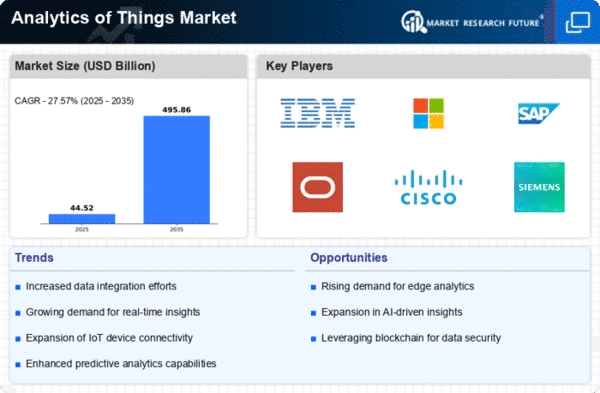
As per MRFR analysis, the Analytics of Things Market Size was estimated at 34.9 USD Billion in 2024. The Analytics of Things industry is projected to grow from 43.45 USD Billion in 2025 to 495.86 USD Billion by 2035, exhibiting a compound annual growth rate (CAGR) of 27.57 during the forecast period 2025 - 2035.

Key Market Trends & Highlights

The Analytics of Things Market is poised for substantial growth driven by technological advancements and increasing demand for data-driven insights.

  • The integration of AI and machine learning is transforming data analytics capabilities across various sectors.
  • Real-time data processing is becoming essential for industries such as manufacturing and healthcare to enhance operational efficiency.
  • Data security and privacy concerns are prompting organizations to adopt more robust analytics solutions, particularly in North America.
  • The rising demand for IoT devices and advancements in data analytics technologies are key drivers propelling the market forward.

Market Size & Forecast

2024 Market Size 34.9 (USD Billion)
2035 Market Size 495.86 (USD Billion)
CAGR (2025 - 2035) 27.57%
Largest Regional Market Share in 2024 North America

Major Players

IBM (US), Microsoft (US), SAP (DE), Oracle (US), Cisco (US), Siemens (DE), GE (US), Honeywell (US), Intel (US), Dell (US)

Market Trends

The Analytics of Things Market is currently experiencing a transformative phase, driven by the increasing integration of advanced analytics into everyday devices. This market encompasses a wide array of technologies that enable the collection, analysis, and interpretation of data generated by connected devices. As organizations strive to harness the power of data, the demand for sophisticated analytics solutions continues to rise. This trend is further fueled by the growing emphasis on data-driven decision-making across various sectors, including manufacturing, healthcare, and transportation. The convergence of the Internet of Things (IoT) and analytics is reshaping how businesses operate, leading to enhanced operational efficiency and improved customer experiences. Moreover, the Analytics of Things Market is characterized by rapid technological advancements and evolving consumer expectations. Companies are increasingly adopting machine learning and artificial intelligence to derive actionable insights from vast amounts of data. This shift not only enhances predictive capabilities but also enables real-time analytics, allowing organizations to respond swiftly to changing market dynamics. As the landscape evolves, collaboration between technology providers and end-users is likely to intensify, fostering innovation and driving the development of tailored solutions that meet specific industry needs. The future of the Analytics of Things Market appears promising, with potential growth opportunities emerging as businesses continue to prioritize data analytics in their strategic initiatives.

Integration of AI and Machine Learning

The incorporation of artificial intelligence and machine learning into analytics solutions is becoming increasingly prevalent. This trend allows for more sophisticated data analysis, enabling organizations to uncover deeper insights and enhance predictive capabilities.

Real-Time Data Processing

The demand for real-time data processing is on the rise, as businesses seek to make informed decisions quickly. This trend is driven by the need for immediate insights that can influence operational strategies and customer interactions.

Focus on Data Security and Privacy

As the Analytics of Things Market expands, concerns regarding data security and privacy are becoming more pronounced. Organizations are prioritizing the implementation of robust security measures to protect sensitive information and comply with regulatory requirements.

Analytics of Things Market Market Drivers

Rapid Growth of IoT Devices

The proliferation of Internet of Things devices is a primary driver of the Global Analytics of Things Market Industry. As of 2024, the number of connected devices is projected to reach approximately 34.9 billion, significantly enhancing data generation. This surge in devices necessitates advanced analytics to derive actionable insights from the vast amounts of data collected. Organizations across various sectors, including healthcare and manufacturing, are increasingly leveraging these analytics to optimize operations and improve decision-making processes. The anticipated growth in the number of IoT devices is expected to contribute substantially to the market's expansion, with projections indicating a market value of 508.6 billion USD by 2035.

Expansion of Smart Cities Initiatives

The expansion of smart cities initiatives is a pivotal driver of the Global Analytics of Things Market Industry. Governments worldwide are investing in smart infrastructure to enhance urban living through improved transportation, energy management, and public safety. For instance, cities are deploying sensors to monitor traffic patterns and optimize public transport systems, generating vast amounts of data that require sophisticated analytics for effective management. This trend is expected to accelerate market growth, as the demand for analytics solutions that can process and interpret urban data continues to rise. The anticipated market value of 508.6 billion USD by 2035 underscores the potential of smart city projects in driving analytics adoption.

Growing Focus on Data Security and Privacy

The heightened emphasis on data security and privacy is influencing the Global Analytics of Things Market Industry. As organizations collect and analyze vast amounts of data, concerns regarding data breaches and compliance with regulations such as GDPR have intensified. Companies are investing in robust analytics solutions that prioritize security measures to protect sensitive information. This trend is particularly evident in sectors like finance and healthcare, where data integrity is paramount. The focus on data security is likely to drive the adoption of advanced analytics tools, contributing to the market's growth trajectory as organizations seek to mitigate risks associated with data handling.

Increased Demand for Real-Time Data Analytics

The demand for real-time data analytics is reshaping the Global Analytics of Things Market Industry. Businesses are increasingly recognizing the value of immediate insights to enhance operational efficiency and customer satisfaction. For instance, retail companies utilize real-time analytics to monitor inventory levels and consumer behavior, allowing for timely adjustments to marketing strategies. This trend is expected to drive market growth, as organizations seek to implement analytics solutions that provide instantaneous feedback. The growing reliance on real-time data is likely to propel the market forward, with a projected compound annual growth rate of 27.57% from 2025 to 2035.

Integration of Artificial Intelligence and Machine Learning

The integration of artificial intelligence and machine learning technologies into analytics platforms is a significant catalyst for the Global Analytics of Things Market Industry. These technologies enhance the ability to process and analyze large datasets, enabling organizations to uncover patterns and trends that may not be immediately apparent. For example, predictive maintenance in manufacturing leverages AI to analyze equipment data, reducing downtime and operational costs. As businesses increasingly adopt AI-driven analytics solutions, the market is poised for substantial growth, with forecasts suggesting a market value of 508.6 billion USD by 2035, reflecting the transformative impact of these technologies.

Market Segment Insights

By Application: Predictive Maintenance (Largest) vs. Asset Tracking (Fastest-Growing)

In the Analytics of Things Market, Predictive Maintenance commands the largest share among application segments, reflecting its critical role in minimizing downtime and optimizing operational efficiency. Following closely is Asset Tracking, which is rapidly gaining traction due to the increasing need for real-time visibility over assets and inventory. The emphasis on operational efficiency and cost optimization pushes these applications to the forefront, with industries increasingly adopting data analytics to enhance their performance.

Predictive Maintenance (Dominant) vs. Asset Tracking (Emerging)

Predictive Maintenance stands out as a dominant application in the Analytics of Things Market, leveraging advanced algorithms to forecast equipment failures and maintenance needs. This proactive approach not only reduces operational interruptions but also significantly lowers maintenance costs, making it a preferred choice for various industries, including manufacturing and transportation. On the other hand, Asset Tracking emerges as an essential application, driven by the growing demand for accurate inventory management and asset utilization. Utilizing IoT sensors and data analytics, it provides organizations with improved visibility and control over their assets, paving the way for enhanced supply chain efficiency.

By End Use: Manufacturing (Largest) vs. Healthcare (Fastest-Growing)

In the Analytics of Things Market, the end use segments are diverse, with significant market share held by sectors such as Manufacturing, Transportation, Healthcare, Retail, and Energy. Manufacturing remains the largest segment, driven by the increasing automation and optimization of industrial processes through analytics. The Transportation and Retail sectors also capture notable shares, focusing on efficiency and customer experience, while Healthcare is witnessing rapid adoption, attributed to the rising need for data-driven decision-making to enhance patient outcomes.

Manufacturing: Dominant vs. Healthcare: Emerging

Manufacturing is at the forefront of the Analytics of Things Market, leveraging data analytics to streamline operations, reduce costs, and enhance production efficiency. This sector utilizes IoT-enabled devices that track performance metrics in real-time, leading to improved decision-making processes. On the other hand, Healthcare represents an emerging player, rapidly growing as the demand for advanced analytics in patient care escalates. This segment harnesses data from various sources, including wearable devices and electronic health records, to deliver personalized and predictive healthcare solutions. As these two segments evolve, their strategies and technologies will shape the future landscape of the market.

By Deployment Model: Cloud-Based (Largest) vs. Hybrid (Fastest-Growing)

The deployment model segment within the Analytics of Things market is primarily characterized by three key players: On-Premises, Cloud-Based, and Hybrid. Among these, Cloud-Based solutions hold the largest market share, driven by the increasing demand for scalability and flexibility in data management. On-Premises solutions are witnessing a steady presence, appealing to organizations with strict compliance and security requirements. Hybrid deployment models are gaining traction as businesses seek to combine the best of both worlds, leveraging both Cloud-Based and On-Premises solutions for optimal performance. The growth trends in this segment are propelled by advancements in cloud technology and the rising need for real-time analytics. The Cloud-Based model is favored for its ease of access and cost-effectiveness, while the Hybrid approach is recognized for its versatility. As companies continue to embrace digital transformation, the demand for Hybrid deployment is expected to surge, making it the fastest-growing segment in this market. Organizations are increasingly looking to adopt solutions that provide greater flexibility, data integration, and analytics capabilities across multiple environments.

Deployment Model: Cloud-Based (Dominant) vs. Hybrid (Emerging)

Cloud-Based deployment models are currently the dominant force in the Analytics of Things market, favored for their ability to provide scalable solutions and ease of access to analytics services from anywhere. They allow businesses to process vast amounts of data with minimal initial investment in infrastructure. In contrast, Hybrid deployment models are emerging as an attractive alternative for organizations seeking a balanced approach. They offer a blend of Cloud-Based and On-Premises functionalities, enabling businesses to maintain control over sensitive data while still leveraging cloud capabilities for analytics. This adaptability makes Hybrid models an appealing choice for organizations operating within regulated industries or those with fluctuating data needs, positioning them well for future growth as technology continues to evolve.

By Technology: Machine Learning (Largest) vs. Artificial Intelligence (Fastest-Growing)

In the Analytics of Things market, Machine Learning is currently the largest segment, capturing a significant portion of the market share. Its widespread adoption across various industries is driven by the ability to derive insights from vast amounts of data. Meanwhile, Artificial Intelligence, though not as large as Machine Learning, is recognized as the fastest-growing segment, showcasing a rapid increase in implementation rates and innovations that enhance decision-making processes. The growth trends in this segment are significantly influenced by the increasing demand for smart solutions and efficient data processing methods. Machine Learning's effectiveness in predictive analytics and operational efficiencies makes it popular among enterprises, while Artificial Intelligence is gaining momentum due to advancements in algorithms and computing capabilities. The convergence of these technologies plays a pivotal role in elevating the capabilities of analytics solutions, driving future growth in the market.

Technology: Machine Learning (Dominant) vs. Artificial Intelligence (Emerging)

Machine Learning, as the dominant technology within the Analytics of Things market, excels in automating data processing and enabling predictive analytics that enhances decision-making. Businesses leverage Machine Learning algorithms to analyze complex datasets, identifying patterns and trends that would be impossible to uncover manually. This capability not only boosts operational efficiency but also helps in strategic planning across various sectors. On the other hand, Artificial Intelligence, labeled as the emerging technology, complements Machine Learning with its capacity to simulate human-like cognition. AI enhances analytics by utilizing natural language processing and computer vision, making it indispensable for developing more intuitive data-driven solutions. While Machine Learning remains a staple, the rapid advancement of AI technologies positions them as crucial for the next generation of analytics.

By Data Source: Sensor Data (Largest) vs. Operational Data (Fastest-Growing)

In the Analytics of Things Market, the largest share is attributed to Sensor Data, which plays a crucial role in gathering real-time information from various environments. Sensor Data captures a diverse range of inputs, including environmental conditions, user behavior, and machine performance, making it indispensable for companies looking to leverage analytics. In contrast, Operational Data is gaining prominence, as organizations increasingly rely on data generated from their operational processes to drive efficiency and decision-making, marking a shift towards data-driven operational strategies.

Operational Data (Dominant) vs. User Data (Emerging)

Operational Data stands out as a dominant player in the Analytics of Things Market, enabling businesses to optimize their processes through insights drawn from data generated during operations. This type of data is often voluminous and rich, providing a comprehensive view of performance metrics and operational efficiency. While User Data is emerging as a critical segment, capturing interactions and preferences of end users, it is still in the growth phase compared to the established market presence of Operational Data. User Data's insights are instrumental in personalizing experiences and driving customer engagement, showcasing its potential to complement the more traditional data sources.

Get more detailed insights about Analytics of Things Market Research Report - Global Forecast till 2035

Regional Insights

North America : Market Leader in Innovation

North America continues to lead the Analytics of Things market, holding a significant share of 17.45% in 2025. The region's growth is driven by rapid technological advancements, increased adoption of IoT devices, and a strong focus on data analytics. Regulatory support for digital transformation initiatives further fuels demand, making it a hotbed for innovation and investment in analytics solutions. The competitive landscape is robust, with key players like IBM, Microsoft, and Oracle leading the charge. The U.S. is the primary market, benefiting from a well-established tech ecosystem and significant R&D investments. Companies are increasingly leveraging analytics to enhance operational efficiency and customer experiences, solidifying North America's position as a global leader in this sector.

Europe : Emerging Analytics Powerhouse

Europe's Analytics of Things market is projected to reach €9.8 billion by 2025, driven by increasing demand for data-driven decision-making and regulatory frameworks promoting digital innovation. The European Union's initiatives to enhance data privacy and security are also pivotal, encouraging businesses to adopt analytics solutions while ensuring compliance with regulations like GDPR. Leading countries such as Germany, the UK, and France are at the forefront of this growth, with major players like SAP and Siemens contributing significantly. The competitive landscape is characterized by a mix of established firms and innovative startups, all vying to capture market share in this rapidly evolving sector. The region's focus on sustainability and smart technologies further enhances its attractiveness for analytics investments.

Asia-Pacific : Rapidly Growing Market

The Asia-Pacific region is experiencing a surge in the Analytics of Things market, projected to reach $5.5 billion by 2025. This growth is fueled by increasing urbanization, a burgeoning middle class, and heightened demand for smart technologies. Governments are also playing a crucial role by implementing policies that encourage digital transformation and the adoption of IoT solutions across various sectors. Countries like China, Japan, and India are leading the charge, with significant investments in technology and infrastructure. The competitive landscape is diverse, featuring both global giants and local players. Companies are focusing on enhancing their analytics capabilities to meet the growing demand for data insights, positioning Asia-Pacific as a key player in The Analytics of Things.

Middle East and Africa : Emerging Analytics Frontier

The Analytics of Things market in the Middle East and Africa is projected to reach $2.15 billion by 2025, driven by increasing investments in digital infrastructure and a growing emphasis on data analytics. Governments in the region are recognizing the importance of technology in economic diversification, leading to initiatives that promote the adoption of analytics solutions across various industries. Countries like South Africa and the UAE are at the forefront, with a rising number of tech startups and established firms entering the market. The competitive landscape is evolving, with local players collaborating with global companies to enhance their analytics offerings. This region presents significant growth potential as businesses increasingly seek to leverage data for strategic decision-making.

Key Players and Competitive Insights

The Analytics of Things Market is currently characterized by a dynamic competitive landscape, driven by rapid technological advancements and an increasing demand for data-driven decision-making across various sectors. Major players such as IBM (US), Microsoft (US), and SAP (DE) are strategically positioning themselves through innovation and partnerships, which collectively enhance their market presence. IBM (US) focuses on integrating AI capabilities into its analytics solutions, while Microsoft (US) emphasizes cloud-based analytics to facilitate real-time data processing. SAP (DE) is leveraging its extensive enterprise resource planning (ERP) systems to offer comprehensive analytics solutions, thereby creating a robust competitive environment that fosters continuous improvement and adaptation.Key business tactics within the Analytics of Things Market include localizing manufacturing and optimizing supply chains to enhance operational efficiency. The market structure appears moderately fragmented, with a mix of established players and emerging startups. This fragmentation allows for diverse offerings and competitive pricing, although the influence of key players remains substantial, as they set industry standards and drive innovation.

In November IBM (US) announced a strategic partnership with a leading telecommunications provider to enhance its IoT analytics capabilities. This collaboration aims to integrate advanced analytics into IoT devices, enabling businesses to derive actionable insights from real-time data. The strategic importance of this partnership lies in its potential to expand IBM's market reach and solidify its position as a leader in the analytics space, particularly in sectors such as manufacturing and logistics.

In October Microsoft (US) launched a new suite of analytics tools designed specifically for the healthcare sector. This initiative reflects Microsoft's commitment to addressing industry-specific challenges through tailored solutions. The strategic significance of this launch is underscored by the growing demand for data analytics in healthcare, which is increasingly recognized as essential for improving patient outcomes and operational efficiency.

In September SAP (DE) unveiled an innovative analytics platform that integrates machine learning capabilities to enhance predictive analytics. This development is particularly noteworthy as it positions SAP to better serve industries that rely heavily on forecasting and trend analysis. The strategic relevance of this platform lies in its ability to provide businesses with deeper insights, thereby facilitating more informed decision-making processes.

As of December current competitive trends in the Analytics of Things Market are heavily influenced by digitalization, sustainability, and the integration of AI technologies. Strategic alliances are increasingly shaping the landscape, as companies recognize the value of collaboration in driving innovation. Looking ahead, competitive differentiation is likely to evolve from traditional price-based competition to a focus on technological innovation, supply chain reliability, and the ability to deliver customized solutions that meet the unique needs of diverse industries.

Key Companies in the Analytics of Things Market include

Industry Developments

In October 2022: KTD SYNNEX unveiled Data-IoTSolv in the Americas, empowering partners with IoT and data analytics tools for business growth. The solution includes AI and advanced analytics technologies for resellers.

In August 2022: Amazon Web Services (AWS) revealed CEAT LTD's utilization of AWS for smart manufacturing. CEAT employs IoT, analytics, and machine learning to produce intelligent, sensor-equipped tires, enhancing manufacturing efficiency and enabling data-driven decisions with SAP on AWS. This development signifies CEAT's innovative strides in digitizing factories and launching new digital services.

In May 2022: Kajeet, a top wireless solutions provider, launched Sentinel Insights, a cloud-based analytics tool enhancing its IoT management platform, Sentinel. The product ensures secure and reliable IoT solutions for businesses, schools, governments.

In May 2020: Intel and SAS joined forces to enhance global analytics solutions, enabling rapid access to precise insights for users. This collaboration leverages advanced AI, machine learning, and IoT technologies.

Objectives of the Study

The objectives of the study are summarized in 5 stages. They are as mentioned below:

Analytics of Things Market Forecast and Size

To identify and estimate the market size for the analytics of things market report segmented by type, application, component, and vertical by value (in US dollars). Also, to understand the consumption/ demand created by consumers in the  analytics of things market forecast between 2022 and 2030

Market Landscape and Trends:

To identify and infer the drivers, restraints, opportunities, and challenges for the  analytics of things market growth

Market Influencing Factors:

To find out the factors which are affecting the  analytics of things market size among consumers

Impact of COVID-19

To identify and understand the various factors involved in the  market affected by the pandemic

Company Profiling

To provide a detailed market analysis of the major companies operating in the market. The profiling will include the financial health of the company's past 2-3 years with segmental and regional revenue breakup, product offering, recent developments, SWOT analysis, and key strategies.

Intended Audience

    • Analytics of things Manufacturer
    • Raw Material Suppliers
    • Retailers, Wholesalers, and Distributors
    • Governments, Associations, and Industrial Bodies
    • Investors and Trade Experts

Future Outlook

Analytics of Things Market Future Outlook

The Analytics of Things Market is projected to grow at a 27.57% CAGR from 2025 to 2035, driven by advancements in IoT, big data analytics, and AI integration.

New opportunities lie in:

  • Development of predictive maintenance solutions for industrial equipment.
  • Creation of real-time analytics platforms for smart cities.
  • Implementation of personalized marketing analytics for retail businesses.

By 2035, the market is expected to be a cornerstone of digital transformation across industries.

Market Segmentation

Analytics of Things Market End Use Outlook

  • Manufacturing
  • Transportation
  • Healthcare
  • Retail
  • Energy

Analytics of Things Market Technology Outlook

  • Machine Learning
  • Internet of Things
  • Big Data Analytics
  • Artificial Intelligence

Analytics of Things Market Application Outlook

  • Predictive Maintenance
  • Asset Tracking
  • Energy Management
  • Supply Chain Optimization
  • Quality Control

Analytics of Things Market Data Source Outlook

  • Sensor Data
  • Machine Data
  • User Data
  • Operational Data

Analytics of Things Market Deployment Model Outlook

  • On-Premises
  • Cloud-Based
  • Hybrid

Report Scope

MARKET SIZE 202434.9(USD Billion)
MARKET SIZE 202543.45(USD Billion)
MARKET SIZE 2035495.86(USD Billion)
COMPOUND ANNUAL GROWTH RATE (CAGR)27.57% (2025 - 2035)
REPORT COVERAGERevenue Forecast, Competitive Landscape, Growth Factors, and Trends
BASE YEAR2024
Market Forecast Period2025 - 2035
Historical Data2019 - 2024
Market Forecast UnitsUSD Billion
Key Companies ProfiledIBM (US), Microsoft (US), SAP (DE), Oracle (US), Cisco (US), Siemens (DE), GE (US), Honeywell (US), Intel (US), Dell (US)
Segments CoveredApplication, End Use, Deployment Model, Technology, Data Source
Key Market OpportunitiesIntegration of artificial intelligence in real-time data analytics enhances decision-making in the Analytics of Things Market.
Key Market DynamicsRising demand for real-time data analytics drives innovation and competition in the Analytics of Things Market.
Countries CoveredNorth America, Europe, APAC, South America, MEA

FAQs

How big is the analytics of things market?

The global analytics of things market will be valued at USD 120.4 billion by 2030.

What is the analytics of things market growth rate?

According to the analytics of things market research, the market is growing at a CAGR of 33.40% over the next 10 years.

Which region has the highest market growth rate?

Asia-Pacific is projected to register the highest CAGR during 2022 - 2030

Which region has the largest share of the market?

North America held the largest market share in 2021

What is the expected analytics of things market size by 2030?

The market size is expected to be USD 120.4 billion by 2030.

Who are the key players in the market?

Amazon Web Services, Inc., Cisco Systems, Inc., Dell INC, Goolara, Hewlett Packard Enterprise Development LP, IBM Corporation, Microsoft, Oracle, Salesforce., SAP SE, Teradata Google, Inc., PTC, Hitachi, Ltd, Teradata, Salesforce, Greenwave Systems among other domestic and players domestic and players are the prominent companies operating in the market.

  1. SECTION I: EXECUTIVE SUMMARY AND KEY HIGHLIGHTS
    1. | 1.1 EXECUTIVE SUMMARY
    2. | 1.1.1 Market Overview
    3. | 1.1.2 Key Findings
    4. | 1.1.3 Market Segmentation
    5. | 1.1.4 Competitive Landscape
    6. | 1.1.5 Challenges and Opportunities
    7. | 1.1.6 Future Outlook
  2. SECTION II: SCOPING, METHODOLOGY AND MARKET STRUCTURE
    1. | 2.1 MARKET INTRODUCTION
    2. | 2.1.1 Definition
    3. | 2.1.2 Scope of the study
    4. |-- 2.1.2.1 Research Objective
    5. |-- 2.1.2.2 Assumption
    6. |-- 2.1.2.3 Limitations
    7. | 2.2 RESEARCH METHODOLOGY
    8. | 2.2.1 Overview
    9. | 2.2.2 Data Mining
    10. | 2.2.3 Secondary Research
    11. | 2.2.4 Primary Research
    12. |-- 2.2.4.1 Primary Interviews and Information Gathering Process
    13. |-- 2.2.4.2 Breakdown of Primary Respondents
    14. | 2.2.5 Forecasting Model
    15. | 2.2.6 Market Size Estimation
    16. |-- 2.2.6.1 Bottom-Up Approach
    17. |-- 2.2.6.2 Top-Down Approach
    18. | 2.2.7 Data Triangulation
    19. | 2.2.8 Validation
  3. SECTION III: QUALITATIVE ANALYSIS
    1. | 3.1 MARKET DYNAMICS
    2. | 3.1.1 Overview
    3. | 3.1.2 Drivers
    4. | 3.1.3 Restraints
    5. | 3.1.4 Opportunities
    6. | 3.2 MARKET FACTOR ANALYSIS
    7. | 3.2.1 Value chain Analysis
    8. | 3.2.2 Porter's Five Forces Analysis
    9. |-- 3.2.2.1 Bargaining Power of Suppliers
    10. |-- 3.2.2.2 Bargaining Power of Buyers
    11. |-- 3.2.2.3 Threat of New Entrants
    12. |-- 3.2.2.4 Threat of Substitutes
    13. |-- 3.2.2.5 Intensity of Rivalry
    14. | 3.2.3 COVID-19 Impact Analysis
    15. |-- 3.2.3.1 Market Impact Analysis
    16. |-- 3.2.3.2 Regional Impact
    17. |-- 3.2.3.3 Opportunity and Threat Analysis
  4. SECTION IV: QUANTITATIVE ANALYSIS
    1. | 4.1 Information and Communications Technology, BY Application (USD Billion)
    2. | 4.1.1 Predictive Maintenance
    3. | 4.1.2 Asset Tracking
    4. | 4.1.3 Energy Management
    5. | 4.1.4 Supply Chain Optimization
    6. | 4.1.5 Quality Control
    7. | 4.2 Information and Communications Technology, BY End Use (USD Billion)
    8. | 4.2.1 Manufacturing
    9. | 4.2.2 Transportation
    10. | 4.2.3 Healthcare
    11. | 4.2.4 Retail
    12. | 4.2.5 Energy
    13. | 4.3 Information and Communications Technology, BY Deployment Model (USD Billion)
    14. | 4.3.1 On-Premises
    15. | 4.3.2 Cloud-Based
    16. | 4.3.3 Hybrid
    17. | 4.4 Information and Communications Technology, BY Technology (USD Billion)
    18. | 4.4.1 Machine Learning
    19. | 4.4.2 Internet of Things
    20. | 4.4.3 Big Data Analytics
    21. | 4.4.4 Artificial Intelligence
    22. | 4.5 Information and Communications Technology, BY Data Source (USD Billion)
    23. | 4.5.1 Sensor Data
    24. | 4.5.2 Machine Data
    25. | 4.5.3 User Data
    26. | 4.5.4 Operational Data
    27. | 4.6 Information and Communications Technology, BY Region (USD Billion)
    28. | 4.6.1 North America
    29. |-- 4.6.1.1 US
    30. |-- 4.6.1.2 Canada
    31. | 4.6.2 Europe
    32. |-- 4.6.2.1 Germany
    33. |-- 4.6.2.2 UK
    34. |-- 4.6.2.3 France
    35. |-- 4.6.2.4 Russia
    36. |-- 4.6.2.5 Italy
    37. |-- 4.6.2.6 Spain
    38. |-- 4.6.2.7 Rest of Europe
    39. | 4.6.3 APAC
    40. |-- 4.6.3.1 China
    41. |-- 4.6.3.2 India
    42. |-- 4.6.3.3 Japan
    43. |-- 4.6.3.4 South Korea
    44. |-- 4.6.3.5 Malaysia
    45. |-- 4.6.3.6 Thailand
    46. |-- 4.6.3.7 Indonesia
    47. |-- 4.6.3.8 Rest of APAC
    48. | 4.6.4 South America
    49. |-- 4.6.4.1 Brazil
    50. |-- 4.6.4.2 Mexico
    51. |-- 4.6.4.3 Argentina
    52. |-- 4.6.4.4 Rest of South America
    53. | 4.6.5 MEA
    54. |-- 4.6.5.1 GCC Countries
    55. |-- 4.6.5.2 South Africa
    56. |-- 4.6.5.3 Rest of MEA
  5. SECTION V: COMPETITIVE ANALYSIS
    1. | 5.1 Competitive Landscape
    2. | 5.1.1 Overview
    3. | 5.1.2 Competitive Analysis
    4. | 5.1.3 Market share Analysis
    5. | 5.1.4 Major Growth Strategy in the Information and Communications Technology
    6. | 5.1.5 Competitive Benchmarking
    7. | 5.1.6 Leading Players in Terms of Number of Developments in the Information and Communications Technology
    8. | 5.1.7 Key developments and growth strategies
    9. |-- 5.1.7.1 New Product Launch/Service Deployment
    10. |-- 5.1.7.2 Merger & Acquisitions
    11. |-- 5.1.7.3 Joint Ventures
    12. | 5.1.8 Major Players Financial Matrix
    13. |-- 5.1.8.1 Sales and Operating Income
    14. |-- 5.1.8.2 Major Players R&D Expenditure. 2023
    15. | 5.2 Company Profiles
    16. | 5.2.1 IBM (US)
    17. |-- 5.2.1.1 Financial Overview
    18. |-- 5.2.1.2 Products Offered
    19. |-- 5.2.1.3 Key Developments
    20. |-- 5.2.1.4 SWOT Analysis
    21. |-- 5.2.1.5 Key Strategies
    22. | 5.2.2 Microsoft (US)
    23. |-- 5.2.2.1 Financial Overview
    24. |-- 5.2.2.2 Products Offered
    25. |-- 5.2.2.3 Key Developments
    26. |-- 5.2.2.4 SWOT Analysis
    27. |-- 5.2.2.5 Key Strategies
    28. | 5.2.3 SAP (DE)
    29. |-- 5.2.3.1 Financial Overview
    30. |-- 5.2.3.2 Products Offered
    31. |-- 5.2.3.3 Key Developments
    32. |-- 5.2.3.4 SWOT Analysis
    33. |-- 5.2.3.5 Key Strategies
    34. | 5.2.4 Oracle (US)
    35. |-- 5.2.4.1 Financial Overview
    36. |-- 5.2.4.2 Products Offered
    37. |-- 5.2.4.3 Key Developments
    38. |-- 5.2.4.4 SWOT Analysis
    39. |-- 5.2.4.5 Key Strategies
    40. | 5.2.5 Cisco (US)
    41. |-- 5.2.5.1 Financial Overview
    42. |-- 5.2.5.2 Products Offered
    43. |-- 5.2.5.3 Key Developments
    44. |-- 5.2.5.4 SWOT Analysis
    45. |-- 5.2.5.5 Key Strategies
    46. | 5.2.6 Siemens (DE)
    47. |-- 5.2.6.1 Financial Overview
    48. |-- 5.2.6.2 Products Offered
    49. |-- 5.2.6.3 Key Developments
    50. |-- 5.2.6.4 SWOT Analysis
    51. |-- 5.2.6.5 Key Strategies
    52. | 5.2.7 GE (US)
    53. |-- 5.2.7.1 Financial Overview
    54. |-- 5.2.7.2 Products Offered
    55. |-- 5.2.7.3 Key Developments
    56. |-- 5.2.7.4 SWOT Analysis
    57. |-- 5.2.7.5 Key Strategies
    58. | 5.2.8 Honeywell (US)
    59. |-- 5.2.8.1 Financial Overview
    60. |-- 5.2.8.2 Products Offered
    61. |-- 5.2.8.3 Key Developments
    62. |-- 5.2.8.4 SWOT Analysis
    63. |-- 5.2.8.5 Key Strategies
    64. | 5.2.9 Intel (US)
    65. |-- 5.2.9.1 Financial Overview
    66. |-- 5.2.9.2 Products Offered
    67. |-- 5.2.9.3 Key Developments
    68. |-- 5.2.9.4 SWOT Analysis
    69. |-- 5.2.9.5 Key Strategies
    70. | 5.2.10 Dell (US)
    71. |-- 5.2.10.1 Financial Overview
    72. |-- 5.2.10.2 Products Offered
    73. |-- 5.2.10.3 Key Developments
    74. |-- 5.2.10.4 SWOT Analysis
    75. |-- 5.2.10.5 Key Strategies
    76. | 5.3 Appendix
    77. | 5.3.1 References
    78. | 5.3.2 Related Reports

Information and Communications Technology Market Segmentation

Information and Communications Technology By Application (USD Billion, 2025-2035)

  • Predictive Maintenance
  • Asset Tracking
  • Energy Management
  • Supply Chain Optimization
  • Quality Control

Information and Communications Technology By End Use (USD Billion, 2025-2035)

  • Manufacturing
  • Transportation
  • Healthcare
  • Retail
  • Energy

Information and Communications Technology By Deployment Model (USD Billion, 2025-2035)

  • On-Premises
  • Cloud-Based
  • Hybrid

Information and Communications Technology By Technology (USD Billion, 2025-2035)

  • Machine Learning
  • Internet of Things
  • Big Data Analytics
  • Artificial Intelligence

Information and Communications Technology By Data Source (USD Billion, 2025-2035)

  • Sensor Data
  • Machine Data
  • User Data
  • Operational Data
Infographic

Free Sample Request

Kindly complete the form below to receive a free sample of this Report

Get Free Sample

Customer Strories

Compare Licence

×
Features License Type
Single User Multiuser License Enterprise User
Price $4,950 $5,950 $7,250
Maximum User Access Limit 1 User Upto 10 Users Unrestricted Access Throughout the Organization
Free Customization
Direct Access to Analyst
Deliverable Format
Platform Access
Discount on Next Purchase 10% 15% 15%
Printable Versions