
×
Hero Background
English
Chinese
French
Japanese
Korean
German
Spanish

Analytics of Things Market Analysis

ID: MRFR/ICT/2610-HCR
100 Pages
Ankit Gupta
October 2025

Analytics of Things Market Research Report Information By Type (Descriptive Analytics, Predictive Analytics, and Prescriptive Analytics), Application (Sales & Customer Management, Predictive Maintenance & Asset Management, Energy Management, Inventory Management, Security & Emergency Management, Building Automation, IT, Remote Monitoring), Component (Software and Services), Vertical (Telecommunications & IT, Manufacturing, Transportation & Logistics, Healthcare & Life Sciences, Retail & E-commerce, Government &amp... read more

Share:
Download PDF ×

We do not share your information with anyone. However, we may send you emails based on your report interest from time to time. You may contact us at any time to opt-out.

Analytics of Things Market Infographic
Purchase Options

Market Analysis

In-depth Analysis of Analytics of Things Market Industry Landscape

The Analytics of Things (AoT) market is currently undergoing dynamic changes driven by technological advancements and the growing importance of data-driven decision-making across various industries. As organizations increasingly recognize the value of leveraging data to gain insights and improve operational efficiency, the demand for analytics solutions tailored for the Internet of Things (IoT) ecosystem is on the rise.

One of the key market dynamics shaping the Analytics of Things landscape is the continuous expansion of the IoT ecosystem. With an ever-growing number of connected devices, sensors, and systems generating massive amounts of data, there is a heightened need for advanced analytics tools to extract meaningful insights from this wealth of information. This surge in data volumes has prompted businesses to adopt AoT solutions that can provide real-time analytics, predictive modeling, and prescriptive analytics to enhance decision-making processes.

Moreover, the increasing adoption of cloud computing has significantly influenced the Analytics of Things market. Cloud-based analytics platforms offer scalability, flexibility, and cost-effectiveness, enabling organizations to efficiently handle the vast amounts of data generated by IoT devices. This shift towards cloud-based AoT solutions has democratized access to analytics capabilities, making them more accessible to businesses of all sizes. As a result, the market has witnessed a proliferation of analytics tools and platforms catering to diverse industry needs.

Another noteworthy factor driving market dynamics is the emphasis on data security and privacy. As the IoT ecosystem expands, concerns regarding the protection of sensitive information have become paramount. Analytics of Things solutions that prioritize robust security measures, including encryption, authentication, and compliance with data protection regulations, are gaining traction. Organizations are increasingly prioritizing solutions that not only deliver powerful analytics but also ensure the confidentiality and integrity of the data being analyzed.

The Analytics of Things market is also witnessing a shift towards industry-specific applications. As businesses seek more tailored and specialized analytics solutions, vendors are developing industry-focused AoT platforms that address the unique challenges and requirements of sectors such as healthcare, manufacturing, energy, and agriculture. These industry-specific analytics solutions are designed to deliver targeted insights and drive innovation within specific verticals.

Furthermore, the market dynamics of AoT are influenced by the integration of artificial intelligence (AI) and machine learning (ML) technologies. The combination of AoT with AI and ML capabilities enables organizations to gain deeper insights, automate decision-making processes, and uncover hidden patterns within complex datasets. This convergence of technologies enhances the overall effectiveness of Analytics of Things solutions, making them invaluable for organizations seeking a competitive edge in today's data-driven business landscape.


Author
Ankit Gupta
Senior Research Analyst

Ankit Gupta is an analyst in market research industry in ICT and SEMI industry. With post-graduation in "Telecom and Marketing Management" and graduation in "Electronics and Telecommunication" vertical he is well versed with recent development in ICT industry as a whole. Having worked on more than 150+ reports including consultation for fortune 500 companies such as Microsoft and Rio Tinto in identifying solutions with respect to business problems his opinions are inclined towards mixture of technical and managerial aspects.

Leave a Comment

FAQs

How big is the analytics of things market?

The global analytics of things market will be valued at USD 120.4 billion by 2030.

What is the analytics of things market growth rate?

According to the analytics of things market research, the market is growing at a CAGR of 33.40% over the next 10 years.

Which region has the highest market growth rate?

Asia-Pacific is projected to register the highest CAGR during 2022 - 2030

Which region has the largest share of the market?

North America held the largest market share in 2021

What is the expected analytics of things market size by 2030?

The market size is expected to be USD 120.4 billion by 2030.

Who are the key players in the market?

Amazon Web Services, Inc., Cisco Systems, Inc., Dell INC, Goolara, Hewlett Packard Enterprise Development LP, IBM Corporation, Microsoft, Oracle, Salesforce., SAP SE, Teradata Google, Inc., PTC, Hitachi, Ltd, Teradata, Salesforce, Greenwave Systems among other domestic and players domestic and players are the prominent companies operating in the market.

Market Summary

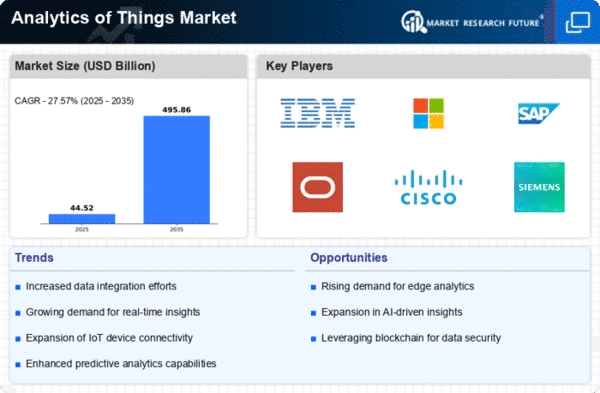
As per MRFR analysis, the Analytics of Things Market Size was estimated at 34.9 USD Billion in 2024. The Analytics of Things industry is projected to grow from 43.45 USD Billion in 2025 to 495.86 USD Billion by 2035, exhibiting a compound annual growth rate (CAGR) of 27.57 during the forecast period 2025 - 2035.

Key Market Trends & Highlights

The Analytics of Things Market is poised for substantial growth driven by technological advancements and increasing demand for data insights.

  • The integration of AI and machine learning is transforming data analytics capabilities across various sectors.
  • Real-time data processing is becoming essential for businesses to enhance operational efficiency and decision-making.
  • Edge analytics is expanding rapidly, particularly in the manufacturing sector, to facilitate faster data processing at the source.
  • Rising demand for data-driven insights and advancements in IoT technologies are key drivers propelling market growth in North America and Asia-Pacific.

Market Size & Forecast

2024 Market Size 34.9 (USD Billion)
2035 Market Size 495.86 (USD Billion)
CAGR (2025 - 2035) 27.57%
Largest Regional Market Share in 2024 North America

Major Players

<p>IBM (US), Microsoft (US), SAP (DE), Oracle (US), Cisco (US), Siemens (DE), GE (US), Honeywell (US), Intel (US), Dell (US)</p>

Market Trends

The Analytics of Things Market is currently experiencing a transformative phase, driven by the increasing integration of advanced analytics into everyday devices. This integration allows for the collection and analysis of vast amounts of data generated by connected devices, leading to enhanced decision-making processes across various sectors. Organizations are recognizing the potential of leveraging real-time insights to optimize operations, improve customer experiences, and drive innovation. As a result, investments in analytics technologies are on the rise, fostering a competitive landscape where businesses strive to harness the power of data effectively. Moreover, the growing emphasis on automation and artificial intelligence is reshaping the Analytics of Things Market. Companies are increasingly adopting intelligent systems that not only analyze data but also provide predictive insights, enabling proactive strategies. This trend suggests a shift towards more sophisticated analytics solutions that can adapt to dynamic environments. The convergence of IoT and analytics is likely to create new opportunities for businesses, enhancing their ability to respond to market demands swiftly and efficiently. As the market evolves, stakeholders must remain vigilant to emerging technologies and changing consumer preferences to maintain a competitive edge.

Integration of AI and Machine Learning

The incorporation of artificial intelligence and machine learning into analytics tools is becoming more prevalent. This trend enhances the ability to process and interpret complex data sets, allowing for more accurate predictions and insights. Organizations are increasingly relying on these technologies to automate data analysis, leading to faster decision-making and improved operational efficiency.

Focus on Real-Time Data Processing

There is a growing emphasis on real-time data processing within the Analytics of Things Market. Businesses are seeking solutions that enable immediate analysis of data as it is generated. This capability allows organizations to respond quickly to changing conditions, enhancing their agility and competitiveness in the marketplace.

Expansion of Edge Analytics

The rise of edge computing is influencing the Analytics of Things Market significantly. By processing data closer to the source, edge analytics reduces latency and bandwidth usage. This trend is particularly beneficial for industries requiring rapid data analysis, such as manufacturing and transportation, where timely insights can lead to substantial operational improvements.

Analytics of Things Market Market Drivers

Rapid Growth of IoT Devices

The proliferation of Internet of Things devices is a primary driver of the Global Analytics of Things Market Industry. As of 2024, the number of connected devices is projected to reach approximately 34.9 billion, significantly enhancing data generation. This surge in devices necessitates advanced analytics to derive actionable insights from the vast amounts of data collected. Organizations across various sectors, including healthcare and manufacturing, are increasingly leveraging these analytics to optimize operations and improve decision-making processes. The anticipated growth in the number of IoT devices is expected to contribute substantially to the market's expansion, with projections indicating a market value of 508.6 billion USD by 2035.

Expansion of Smart Cities Initiatives

The expansion of smart cities initiatives is a pivotal driver of the Global Analytics of Things Market Industry. Governments worldwide are investing in smart infrastructure to enhance urban living through improved transportation, energy management, and public safety. For instance, cities are deploying sensors to monitor traffic patterns and optimize public transport systems, generating vast amounts of data that require sophisticated analytics for effective management. This trend is expected to accelerate market growth, as the demand for analytics solutions that can process and interpret urban data continues to rise. The anticipated market value of 508.6 billion USD by 2035 underscores the potential of smart city projects in driving analytics adoption.

Growing Focus on Data Security and Privacy

The heightened emphasis on data security and privacy is influencing the Global Analytics of Things Market Industry. As organizations collect and analyze vast amounts of data, concerns regarding data breaches and compliance with regulations such as GDPR have intensified. Companies are investing in robust analytics solutions that prioritize security measures to protect sensitive information. This trend is particularly evident in sectors like finance and healthcare, where data integrity is paramount. The focus on data security is likely to drive the adoption of advanced analytics tools, contributing to the market's growth trajectory as organizations seek to mitigate risks associated with data handling.

Increased Demand for Real-Time Data Analytics

The demand for real-time data analytics is reshaping the Global Analytics of Things Market Industry. Businesses are increasingly recognizing the value of immediate insights to enhance operational efficiency and customer satisfaction. For instance, retail companies utilize real-time analytics to monitor inventory levels and consumer behavior, allowing for timely adjustments to marketing strategies. This trend is expected to drive market growth, as organizations seek to implement analytics solutions that provide instantaneous feedback. The growing reliance on real-time data is likely to propel the market forward, with a projected compound annual growth rate of 27.57% from 2025 to 2035.

Integration of Artificial Intelligence and Machine Learning

The integration of artificial intelligence and machine learning technologies into analytics platforms is a significant catalyst for the Global Analytics of Things Market Industry. These technologies enhance the ability to process and analyze large datasets, enabling organizations to uncover patterns and trends that may not be immediately apparent. For example, predictive maintenance in manufacturing leverages AI to analyze equipment data, reducing downtime and operational costs. As businesses increasingly adopt AI-driven analytics solutions, the market is poised for substantial growth, with forecasts suggesting a market value of 508.6 billion USD by 2035, reflecting the transformative impact of these technologies.

Market Segment Insights

By Application: Predictive Maintenance (Largest) vs. Asset Tracking (Fastest-Growing)

<p>The Analytics of Things market showcases a diverse application landscape, with Predictive Maintenance leading in market share due to its widespread adoption across industries, including manufacturing and transportation. Asset Tracking follows closely, revealing significant traction as businesses increasingly leverage analytical insights to enhance operational efficiencies. This growing preference for data-driven approaches is shaping competitive dynamics across sectors, making these applications pivotal drivers of the market.</p>

<p>Predictive Maintenance (Dominant) vs. Asset Tracking (Emerging)</p>

<p>Predictive Maintenance stands out as the dominant application in the Analytics of Things market, offering organizations robust solutions to anticipate equipment failures, thus minimizing downtime and reducing overall operational costs. This application integrates sensor data and machine learning algorithms to facilitate timely interventions. In contrast, Asset Tracking is emerging rapidly, propelled by advancements in IoT technologies and the growing need for real-time visibility in supply chains. This application enables enterprises to monitor assets seamlessly, improving inventory management and reducing losses, particularly in logistics and retail sectors.</p>

By End Use: Manufacturing (Largest) vs. Healthcare (Fastest-Growing)

<p>In the Analytics of Things Market, the end-use segment reveals a diverse distribution of applications. Manufacturing dominates the landscape, leveraging analytics to optimize processes and enhance operational efficiency. In contrast, Healthcare is witnessing a rapid increase in adoption, driven by technological advancements and the growing need for data-driven decision-making in patient care. This market share distribution highlights the varying levels of maturity and potential across sectors. Growth trends in this segment are influenced by ongoing digital transformation initiatives and the rising demand for smart solutions that can drive efficiency and productivity. Manufacturing continues to innovate by integrating IoT analytics, while Healthcare's rapid growth is fueled by the necessity for better patient outcomes and operational efficiency. As organizations prioritize data analytics, these two sectors are poised for continued evolution and expansion.</p>

<p>Manufacturing: Dominant vs. Healthcare: Emerging</p>

<p>The manufacturing sector in the Analytics of Things Market stands as a dominant force, characterized by its early adoption of data analytics to enhance productivity and quality control. By utilizing advanced analytics and smart technologies, manufacturers can streamline operations, reduce downtime, and improve supply chain management. In contrast, the healthcare sector is emerging with tremendous potential, driven by increased investments in digital health solutions and the necessity for improved patient management. Healthcare analytics focuses on real-time data to enhance diagnostics, treatment strategies, and operational efficiency. As both sectors advance, the synergy between manufacturing efficiency and healthcare quality will shape future innovations in the Analytics of Things market.</p>

By Deployment Model: Cloud-Based (Largest) vs. On-Premises (Fastest-Growing)

<p>In the Analytics of Things Market, the deployment model segment showcases a clear distribution among its values. The Cloud-Based deployment model holds the largest share, favored for its flexibility and scalability, making it a go-to choice for businesses seeking efficient data handling. In contrast, the On-Premises model, though currently smaller in market share, is witnessing a rapid uptake as organizations prioritize data privacy and control, driving its growth.</p>

<p>Deployment Model: Cloud-Based (Dominant) vs. On-Premises (Emerging)</p>

<p>The Cloud-Based deployment model stands out as the dominant force in the Analytics of Things Market, primarily adopted for its robust features such as easy integration, cost-effectiveness, and ability to handle large datasets seamlessly. Businesses leverage this model to access advanced analytics tools without heavy infrastructure investments. On the other hand, the On-Premises model is emerging as a significant player, appealing to sectors requiring stringent data security and regulatory compliance. Organizations are increasingly recognizing the benefits of maintaining their analytics functionalities in-house to safeguard sensitive information, positioning On-Premises as a rapidly growing alternative.</p>

By Technology: Machine Learning (Largest) vs. Internet of Things (Fastest-Growing)

<p>In the Analytics of Things Market, Machine Learning currently holds the largest share among the technological segments, significantly influencing the industry landscape. This segment is well-established, demonstrating robust adoption across various sectors including healthcare, manufacturing, and finance. On the other hand, the Internet of Things, although smaller in market share, is rapidly gaining traction as more devices become connected, enhancing data collection and analytics capabilities.</p>

<p>Technology: Machine Learning (Dominant) vs. Internet of Things (Emerging)</p>

<p>Machine Learning has positioned itself as a dominant force in the Analytics of Things Market, characterized by its ability to derive intelligence from large datasets and improve operational efficiencies. Its applications span numerous industries, making it an invaluable tool for data-driven decision-making. Conversely, the Internet of Things is emerging as a pivotal technology that enables seamless connectivity between devices, facilitating real-time data analysis and insights. As IoT devices proliferate, they provide new avenues for analytics, driving innovations that are expected to reshape business processes and consumer interactions.</p>

By Data Source: Sensor Data (Largest) vs. Machine Data (Fastest-Growing)

<p>In the Analytics of Things Market, Sensor Data has emerged as the largest segment, capturing a significant share of the overall market. This dominance is primarily attributed to the widespread deployment of IoT devices and sensors across various industries, including manufacturing, healthcare, and automotive. These sensors continuously generate data that assists organizations in making data-driven decisions and optimizing operations. Meanwhile, Machine Data is gaining traction and is recognized as the fastest-growing segment within this market. This segment includes data collected from machines and equipment, which is increasingly crucial for predictive maintenance, operational efficiency, and real-time analytics.</p>

<p>Sensor Data (Dominant) vs. Machine Data (Emerging)</p>

<p>Sensor Data is characterized by its pervasive role in the Analytics of Things Market, serving as a primary source of actionable insights for businesses. With applications in smart cities, environmental monitoring, and asset tracking, it plays a crucial role in enhancing operational efficiencies and improving customer experiences. On the other hand, Machine Data represents an emerging force, fueled by advancements in industrial IoT and automation. As organizations seek to leverage data for predictive maintenance and operational analytics, the demand for Machine Data is surging. This growth is driven by the increasing complexity of manufacturing processes and the need for real-time insights to drive decision-making.</p>

Get more detailed insights about Analytics of Things Market Research Report - Global Forecast till 2035

Regional Insights

North America : Market Leader in Innovation

North America continues to lead the Analytics of Things market, holding a significant share of 17.45% in 2025. The region's growth is driven by rapid technological advancements, increased adoption of IoT devices, and a strong focus on data analytics. Regulatory support for digital transformation initiatives further fuels demand, making it a hotbed for innovation and investment in analytics solutions. The competitive landscape is robust, with key players like IBM, Microsoft, and Oracle leading the charge. The U.S. is the primary market, benefiting from a well-established tech ecosystem and significant R&D investments. Companies are increasingly leveraging analytics to enhance operational efficiency and customer experiences, solidifying North America's position as a global leader in this sector.

Europe : Emerging Analytics Powerhouse

Europe's Analytics of Things market is projected to reach €9.8 billion by 2025, driven by increasing demand for data-driven decision-making across various sectors. The region benefits from stringent regulations promoting data privacy and security, which enhance consumer trust and drive market growth. Additionally, initiatives like the European Data Strategy are catalyzing investments in analytics technologies. Leading countries such as Germany, the UK, and France are at the forefront of this growth, with a strong presence of key players like SAP and Siemens. The competitive landscape is characterized by a mix of established firms and innovative startups, all vying to capture market share. The focus on sustainability and smart technologies further propels the demand for advanced analytics solutions in Europe.

Asia-Pacific : Rapidly Growing Market

The Asia-Pacific region is witnessing a surge in the Analytics of Things market, projected to reach $5.5 billion by 2025. This growth is fueled by increasing urbanization, a burgeoning middle class, and the rapid adoption of IoT technologies. Governments are also playing a crucial role by implementing policies that encourage digital transformation and smart city initiatives, which are vital for market expansion. Countries like China, Japan, and India are leading the charge, with significant investments in technology infrastructure. The competitive landscape is diverse, featuring both global giants and local players. Companies are focusing on enhancing their analytics capabilities to meet the growing demand for data insights, positioning Asia-Pacific as a key player in the global market.

Middle East and Africa : Emerging Market Potential

The Analytics of Things market in the Middle East and Africa is projected to reach $2.15 billion by 2025, driven by increasing investments in digital transformation and smart technologies. The region is experiencing a shift towards data-driven decision-making, supported by government initiatives aimed at enhancing technological infrastructure. This trend is expected to accelerate market growth as businesses seek to leverage analytics for competitive advantage. Countries like South Africa and the UAE are at the forefront of this transformation, with a growing number of startups and established firms entering the analytics space. The competitive landscape is evolving, with key players recognizing the potential of the region. As organizations increasingly adopt analytics solutions, the Middle East and Africa are poised for significant growth in the coming years.

Key Players and Competitive Insights

The Analytics of Things Market is currently characterized by a dynamic competitive landscape, driven by rapid technological advancements and an increasing demand for data-driven decision-making across various sectors. Major players such as IBM (US), Microsoft (US), and SAP (DE) are strategically positioning themselves through innovation and partnerships, thereby enhancing their operational focus. IBM (US) emphasizes its commitment to AI and machine learning, which appears to be a cornerstone of its strategy, while Microsoft (US) leverages its cloud capabilities to integrate analytics seamlessly into its offerings. SAP (DE) focuses on enhancing its enterprise resource planning (ERP) solutions with advanced analytics, indicating a trend towards comprehensive data solutions that cater to diverse business needs.

The market structure is moderately fragmented, with a mix of established players and emerging startups. Key tactics employed by these companies include localizing manufacturing and optimizing supply chains to enhance efficiency and responsiveness. This collective influence of major players fosters a competitive environment where innovation and customer-centric solutions are paramount, allowing them to maintain a competitive edge.

In November 2025, IBM (US) announced a strategic partnership with a leading telecommunications provider to enhance its IoT analytics capabilities. This collaboration is expected to facilitate the development of advanced analytics solutions tailored for smart cities, thereby expanding IBM's footprint in the urban analytics sector. Such strategic moves not only bolster IBM's market position but also reflect a broader trend towards integrating analytics with IoT technologies.

In October 2025, Microsoft (US) launched a new suite of analytics tools designed specifically for the manufacturing sector. This initiative aims to empower manufacturers with real-time insights into their operations, potentially transforming production efficiency. By focusing on industry-specific solutions, Microsoft (US) is likely to strengthen its competitive stance and cater to the unique needs of its clients.

In September 2025, SAP (DE) unveiled an upgraded version of its analytics platform, incorporating machine learning algorithms to enhance predictive capabilities. This development signifies SAP's commitment to staying at the forefront of analytics innovation, as it seeks to provide businesses with actionable insights that drive strategic decision-making. The integration of advanced technologies into their offerings may position SAP (DE) as a leader in the analytics domain.

As of December 2025, the competitive trends within the Analytics of Things Market are increasingly defined by digitalization, sustainability, and the integration of AI technologies. Strategic alliances among key players are shaping the landscape, fostering innovation and collaboration. The shift from price-based competition to a focus on technological advancement and supply chain reliability is evident, suggesting that future competitive differentiation will hinge on the ability to innovate and deliver tailored solutions that meet evolving market demands.

Key Companies in the Analytics of Things Market market include

Industry Developments

In October 2022: KTD SYNNEX unveiled Data-IoTSolv in the Americas, empowering partners with IoT and data analytics tools for business growth. The solution includes AI and advanced analytics technologies for resellers.

In August 2022: Amazon Web Services (AWS) revealed CEAT LTD's utilization of AWS for smart manufacturing. CEAT employs IoT, analytics, and machine learning to produce intelligent, sensor-equipped tires, enhancing manufacturing efficiency and enabling data-driven decisions with SAP on AWS. This development signifies CEAT's innovative strides in digitizing factories and launching new digital services.

In May 2022: Kajeet, a top wireless solutions provider, launched Sentinel Insights, a cloud-based analytics tool enhancing its IoT management platform, Sentinel. The product ensures secure and reliable IoT solutions for businesses, schools, governments.

In May 2020: Intel and SAS joined forces to enhance global analytics solutions, enabling rapid access to precise insights for users. This collaboration leverages advanced AI, machine learning, and IoT technologies.

Objectives of the Study

The objectives of the study are summarized in 5 stages. They are as mentioned below:

Analytics of Things Market Forecast and Size

To identify and estimate the market size for the analytics of things market report segmented by type, application, component, and vertical by value (in US dollars). Also, to understand the consumption/ demand created by consumers in the  analytics of things market forecast between 2022 and 2030

Market Landscape and Trends:

To identify and infer the drivers, restraints, opportunities, and challenges for the  analytics of things market growth

Market Influencing Factors:

To find out the factors which are affecting the  analytics of things market size among consumers

Impact of COVID-19

To identify and understand the various factors involved in the  market affected by the pandemic

Company Profiling

To provide a detailed market analysis of the major companies operating in the market. The profiling will include the financial health of the company's past 2-3 years with segmental and regional revenue breakup, product offering, recent developments, SWOT analysis, and key strategies.

Intended Audience

    • Analytics of things Manufacturer
    • Raw Material Suppliers
    • Retailers, Wholesalers, and Distributors
    • Governments, Associations, and Industrial Bodies
    • Investors and Trade Experts

Future Outlook

Analytics of Things Market Future Outlook

<p>The Analytics of Things Market is projected to grow at a 27.57% CAGR from 2024 to 2035, driven by advancements in IoT, big data analytics, and AI integration.</p>

New opportunities lie in:

  • <p>Development of predictive maintenance solutions for industrial equipment.</p>
  • <p>Creation of real-time analytics platforms for smart cities.</p>
  • <p>Implementation of personalized marketing analytics for retail businesses.</p>

<p>By 2035, the market is expected to be robust, driven by innovative applications and widespread adoption.</p>

Market Segmentation

Analytics of Things Market End Use Outlook

  • Manufacturing
  • Transportation
  • Healthcare
  • Retail
  • Energy

Analytics of Things Market Technology Outlook

  • Machine Learning
  • Internet of Things
  • Big Data Analytics
  • Artificial Intelligence

Analytics of Things Market Application Outlook

  • Predictive Maintenance
  • Asset Tracking
  • Energy Management
  • Supply Chain Optimization
  • Quality Control

Analytics of Things Market Data Source Outlook

  • Sensor Data
  • Machine Data
  • User Data
  • Social Media Data

Analytics of Things Market Deployment Model Outlook

  • On-Premises
  • Cloud-Based
  • Hybrid

Report Scope

MARKET SIZE 202434.9(USD Billion)
MARKET SIZE 202543.45(USD Billion)
MARKET SIZE 2035495.86(USD Billion)
COMPOUND ANNUAL GROWTH RATE (CAGR)27.57% (2024 - 2035)
REPORT COVERAGERevenue Forecast, Competitive Landscape, Growth Factors, and Trends
BASE YEAR2024
Market Forecast Period2025 - 2035
Historical Data2019 - 2024
Market Forecast UnitsUSD Billion
Key Companies ProfiledIBM (US), Microsoft (US), SAP (DE), Oracle (US), Cisco (US), Siemens (DE), GE (US), Honeywell (US), Intel (US), Dell (US)
Segments CoveredApplication, End Use, Deployment Model, Technology, Data Source
Key Market OpportunitiesIntegration of artificial intelligence in the Analytics of Things Market enhances data-driven decision-making capabilities.
Key Market DynamicsRising demand for real-time data analytics drives innovation and competition in the Analytics of Things Market.
Countries CoveredNorth America, Europe, APAC, South America, MEA

FAQs

How big is the analytics of things market?

The global analytics of things market will be valued at USD 120.4 billion by 2030.

What is the analytics of things market growth rate?

According to the analytics of things market research, the market is growing at a CAGR of 33.40% over the next 10 years.

Which region has the highest market growth rate?

Asia-Pacific is projected to register the highest CAGR during 2022 - 2030

Which region has the largest share of the market?

North America held the largest market share in 2021

What is the expected analytics of things market size by 2030?

The market size is expected to be USD 120.4 billion by 2030.

Who are the key players in the market?

Amazon Web Services, Inc., Cisco Systems, Inc., Dell INC, Goolara, Hewlett Packard Enterprise Development LP, IBM Corporation, Microsoft, Oracle, Salesforce., SAP SE, Teradata Google, Inc., PTC, Hitachi, Ltd, Teradata, Salesforce, Greenwave Systems among other domestic and players domestic and players are the prominent companies operating in the market.

  1. EXECUTIVE SUMMARY
    1. Market Attractiveness Analysis
  2. Global Analytics
  3. of Things Market, by Type
  4. Global Analytics of Things
  5. Market, by Application
  6. Global Analytics of Things
  7. Market, by Component
    1. by Vertical
    2. Region
  8. Global Analytics of Things Market,
  9. Global Analytics of Things Market, by
  10. MARKET INTRODUCTION
    1. Definition
    2. Scope of the Study
    3. Market Structure
  11. RESEARCH METHODOLOGY
    1. Research
    2. Process
    3. Primary Research
    4. Secondary
    5. Research
    6. Market Size Estimation
    7. Forecast Application
    8. List of Assumptions
  12. MARKET DYNAMICS
    1. Introduction
      1. Tremendous Growth of IoT data
    2. Drivers
    3. Increasing Need for Advanced Analytics
    4. Restraints
      1. Concerns Regarding Data Security
      2. Increasing Application Across
    5. Opportunities
    6. Industry Verticals
    7. Challenges
  13. MARKET
  14. FACTOR ANALYSIS
    1. Value Chain Analysis/Supply Chain Analysis
    2. Porter’s Five Forces Application
      1. Bargaining Power
      2. Threat of New Entrants
      3. Intensity of Rivalry
    3. Bargaining Power of Suppliers
    4. of Buyers
    5. Threat of Substitutes
  15. GLOBAL ANALYTICS OF THINGS MARKET, BY TYPE
    1. Introduction
    2. Predictive Analytics
  16. Descriptive Analytics
  17. Prescriptive Analytics
  18. GLOBAL ANALYTICS OF THINGS MARKET, BY APPLICATION
    1. Introduction
    2. Sales and Customer
    3. Management
    4. Predictive Maintenance and Asset Management
    5. Energy Management
    6. Inventory
    7. Management
    8. Security and Emergency Management
    9. Building Automation
    10. IT
    11. Infrastructure Management
    12. Remote Monitoring
    13. Others
  19. GLOBAL ANALYTICS OF THINGS
  20. MARKET, BY COMPONENT
    1. Introduction
    2. Software
    3. Services
  21. GLOBAL
  22. ANALYTICS OF THINGS MARKET, BY VERTICAL
    1. Introduction
    2. Telecommunications and IT
    3. Manufacturing
    4. Transportation and Logistics
    5. Healthcare
    6. and Life Sciences
    7. Retail and Ecommerce
    8. Government and Defense
    9. Energy
    10. and Utilities
    11. Others
  23. GLOBAL
  24. ANALYTICS OF THINGS MARKET, BY REGION
    1. Overview
      1. US
      2. Canada
      3. Mexico
    2. North America
    3. Europe
      1. UK
      2. France
      3. Rest of Europe
    4. Germany
    5. Asia-Pacific
      1. China
      2. Japan
      3. Rest of Asia-Pacific
    6. India
    7. Middle East & Africa
    8. South America
  25. COMPETITIVE LANDSCAPE
    1. Introduction
    2. Competitive Benchmarking
    3. Key Developments &
    4. Growth Strategies
    5. Vendor Share Analysis
    6. COMPANY PROFILES
    7. Hewlett Packard Enterprise Company
      1. Company Overview
      2. Financial
      3. Products Offered
      4. SWOT Analysis
    8. Overview
    9. Key Developments
    10. Key Strategies
    11. Cisco Systems, Inc.
      1. Financial Overview
      2. Key Developments
      3. Key Strategies
      4. Company Overview
      5. Financial Overview
      6. Products
      7. Key Developments
      8. Key Strategies
      9. Company Overview
      10. Products Offered
      11. SWOT Analysis
    12. Company Overview
    13. Products Offered
    14. SWOT Analysis
    15. Dell Technologies, Inc.
    16. Offered
    17. SWOT Analysis
    18. Google, Inc.
    19. Financial Overview
    20. Key Developments
    21. Key Strategies
    22. Amazon Web Services
      1. Financial Overview
      2. Key Developments
      3. Key Strategies
      4. Company Overview
      5. Products Offered
      6. SWOT Analysis
    23. Company Overview
    24. Products Offered
    25. SWOT Analysis
    26. Salesforce.com, Inc.
    27. Financial Overview
    28. Key Developments
    29. Key Strategies
    30. Teradata Corporation
      1. Financial Overview
      2. Key Developments
      3. Key Strategies
      4. Company Overview
      5. Products Offered
      6. SWOT Analysis
    31. Company Overview
    32. Products Offered
    33. SWOT Analysis
    34. IBM Corporation
    35. Financial Overview
    36. Key Developments
    37. Key Strategies
    38. Microsoft Corporation
      1. Financial Overview
      2. Key Developments
      3. Key Strategies
      4. Company Overview
      5. Products Offered
      6. SWOT Analysis
    39. Company Overview
    40. Products Offered
    41. SWOT Analysis
    42. Oracle Corporation
    43. Financial Overview
    44. Key Developments
    45. Key Strategies
    46. Hitachi, Ltd.
      1. Financial Overview
      2. Key Developments
      3. Key Strategies
      4. Company Overview
      5. Products Offered
      6. SWOT Analysis
    47. Company Overview
    48. Products Offered
    49. SWOT Analysis
    50. PTC
    51. Financial Overview
    52. Key Developments
    53. Key Strategies
    54. Greenwave Systems
      1. Financial Overview
      2. Key Developments
      3. Key Strategies
      4. Company Overview
      5. Products Offered
      6. SWOT Analysis
    55. Company Overview
    56. Products Offered
    57. SWOT Analysis
    58. MNUBO
    59. Financial Overview
    60. Key Developments
    61. Key Strategies
    62. List of Tables
    63. TABLE 1
  26. LIST OF ASSUMPTIONS
  27. GLOBAL
  28. ANALYTICS OF THINGS MARKET, BY TYPE, 2020–2027 (USD MILLION)
    1. TABLE 3
  29. GLOBAL ANALYTICS OF THINGS MARKET, BY APPLICATION, 2020–2027
    1. (USD MILLION)
  30. GLOBAL ANALYTICS
  31. OF THINGS MARKET, BY COMPONENT, 2020–2027 (USD MILLION)
    1. TABLE 6
  32. GLOBAL ANALYTICS OF THINGS MARKET, BY VERTICAL, 2020–2027
    1. (USD MILLION)
  33. GLOBAL ANALYTICS
  34. OF THINGS MARKET, BY REGION, 2020–2027 (USD MILLION)
    1. TABLE 8
  35. NORTH AMERICA: ANALYTICS OF THINGS MARKET, BY COUNTRY,
  36. NORTH
  37. AMERICA: ANALYTICS OF THINGS MARKET, BY TYPE, 2020–2027 (USD MILLION)
    1. TABLE
  38. NORTH AMERICA: ANALYTICS OF THINGS MARKET, BY APPLICATION,
  39. NORTH AMERICA: ANALYTICS
  40. OF THINGS MARKET, BY COMPONENT, 2020–2027 (USD MILLION)
    1. TABLE 13
  41. NORTH AMERICA: ANALYTICS OF THINGS MARKET, BY VERTICAL, 2020–2027 (USD
    1. MILLION)
  42. US: ANALYTICS OF THINGS MARKET, BY TYPE,
  43. US: ANALYTICS OF THINGS
  44. MARKET, BY APPLICATION, 2020–2027 (USD MILLION)
    1. TABLE 16
  45. US: ANALYTICS OF THINGS MARKET, BY COMPONENT, 2020–2027 (USD MILLION)
  46. US: ANALYTICS OF THINGS MARKET, BY VERTICAL, 2020–2027
    1. (USD MILLION)
  47. CANADA: ANALYTICS OF THINGS MARKET,
    1. BY TYPE, 2020–2027 (USD MILLION)
  48. CANADA: ANALYTICS
  49. OF THINGS MARKET, BY APPLICATION, 2020–2027 (USD MILLION)
    1. TABLE 21
  50. CANADA: ANALYTICS OF THINGS MARKET, BY COMPONENT, 2020–2027 (USD MILLION)
  51. CANADA: ANALYTICS OF THINGS MARKET, BY VERTICAL, 2020–2027
    1. (USD MILLION)
  52. MEXICO: ANALYTICS OF THINGS MARKET,
    1. BY TYPE, 2020–2027 (MEXICOD MILLION)
  53. MEXICO:
  54. ANALYTICS OF THINGS MARKET, BY APPLICATION, 2020–2027 (MEXICOD MILLION)
  55. MEXICO: ANALYTICS OF THINGS MARKET, BY COMPONENT, 2020–2027
    1. (MEXICOD MILLION)
  56. MEXICO: ANALYTICS OF THINGS MARKET,
    1. BY VERTICAL, 2020–2027 (MEXICOD MILLION)
  57. EUROPE:
  58. ANALYTICS OF THINGS MARKET, BY COUNTRY, 2020–2027 (USD MILLION)
    1. TABLE
  59. EUROPE: ANALYTICS OF THINGS MARKET, BY TYPE, 2020–2027
    1. (USD MILLION)
  60. EUROPE: ANALYTICS OF THINGS MARKET,
    1. BY APPLICATION, 2020–2027 (USD MILLION)
  61. EUROPE:
  62. ANALYTICS OF THINGS MARKET, BY COMPONENT, 2020–2027 (USD MILLION)
    1. TABLE
  63. EUROPE: ANALYTICS OF THINGS MARKET, BY VERTICAL, 2020–2027
    1. (USD MILLION)
  64. UK: ANALYTICS OF THINGS MARKET, BY
    1. TYPE, 2020–2027 (USD MILLION)
  65. UK: ANALYTICS
  66. OF THINGS MARKET, BY APPLICATION, 2020–2027 (USD MILLION)
    1. TABLE 37
  67. UK: ANALYTICS OF THINGS MARKET, BY COMPONENT, 2020–2027 (USD MILLION)
  68. UK: ANALYTICS OF THINGS MARKET, BY VERTICAL, 2020–2027
    1. (USD MILLION)
  69. GERMANY: ANALYTICS OF THINGS MARKET,
    1. BY TYPE, 2020–2027 (USD MILLION)
  70. GERMANY:
  71. ANALYTICS OF THINGS MARKET, BY APPLICATION, 2020–2027 (USD MILLION)
    1. TABLE
  72. GERMANY: ANALYTICS OF THINGS MARKET, BY COMPONENT, 2020–2027
    1. (USD MILLION)
  73. GERMANY: ANALYTICS OF THINGS MARKET,
    1. BY VERTICAL, 2020–2027 (USD MILLION)
  74. FRANCE:
  75. ANALYTICS OF THINGS MARKET, BY TYPE, 2020–2027 (USD MILLION)
    1. TABLE 46
  76. FRANCE: ANALYTICS OF THINGS MARKET, BY APPLICATION, 2020–2027 (USD MILLION)
  77. FRANCE: ANALYTICS OF THINGS MARKET, BY COMPONENT, 2020–2027
    1. (USD MILLION)
  78. FRANCE: ANALYTICS OF THINGS MARKET,
    1. BY VERTICAL, 2020–2027 (USD MILLION)
  79. REST
  80. OF EUROPE: ANALYTICS OF THINGS MARKET, BY TYPE, 2020–2027 (USD MILLION)
  81. REST OF EUROPE: ANALYTICS OF THINGS MARKET, BY APPLICATION,
  82. REST OF EUROPE: ANALYTICS
  83. OF THINGS MARKET, BY COMPONENT, 2020–2027 (USD MILLION)
    1. TABLE 54
  84. REST OF EUROPE: ANALYTICS OF THINGS MARKET, BY VERTICAL, 2020–2027 (USD
    1. MILLION)
  85. ASIA-PACIFIC: ANALYTICS OF THINGS MARKET,
    1. BY COUNTRY, 2020–2027 (USD MILLION)
  86. ASIA-PACIFIC:
  87. ANALYTICS OF THINGS MARKET, BY TYPE, 2020–2027 (USD MILLION)
    1. TABLE 57
  88. ASIA-PACIFIC: ANALYTICS OF THINGS MARKET, BY APPLICATION, 2020–2027
    1. (USD MILLION)
  89. ASIA-PACIFIC: ANALYTICS OF THINGS
  90. MARKET, BY COMPONENT, 2020–2027 (USD MILLION)
  91. ASIA-PACIFIC:
  92. ANALYTICS OF THINGS MARKET, BY VERTICAL, 2020–2027 (USD MILLION)
    1. TABLE
  93. CHINA: ANALYTICS OF THINGS MARKET, BY TYPE, 2020–2027
    1. (USD MILLION)
  94. CHINA: ANALYTICS OF THINGS MARKET,
    1. BY APPLICATION, 2020–2027 (USD MILLION)
  95. CHINA:
  96. ANALYTICS OF THINGS MARKET, BY COMPONENT, 2020–2027 (USD MILLION)
    1. TABLE
  97. CHINA: ANALYTICS OF THINGS MARKET, BY VERTICAL, 2020–2027
    1. (USD MILLION)
  98. INDIA: ANALYTICS OF THINGS MARKET,
    1. BY TYPE, 2020–2027 (USD MILLION)
  99. INDIA: ANALYTICS
  100. OF THINGS MARKET, BY APPLICATION, 2020–2027 (USD MILLION)
    1. TABLE 68
  101. INDIA: ANALYTICS OF THINGS MARKET, BY COMPONENT, 2020–2027 (USD MILLION)
  102. INDIA: ANALYTICS OF THINGS MARKET, BY VERTICAL, 2020–2027
    1. (USD MILLION)
  103. JAPAN: ANALYTICS OF THINGS MARKET,
    1. BY TYPE, 2020–2027 (USD MILLION)
  104. JAPAN: ANALYTICS
  105. OF THINGS MARKET, BY APPLICATION, 2020–2027 (USD MILLION)
    1. TABLE 73
  106. JAPAN: ANALYTICS OF THINGS MARKET, BY COMPONENT, 2020–2027 (USD MILLION)
  107. JAPAN: ANALYTICS OF THINGS MARKET, BY VERTICAL, 2020–2027
    1. (USD MILLION)
  108. REST OF ASIA-PACIFIC: ANALYTICS OF
  109. THINGS MARKET, BY TYPE, 2020–2027 (USD MILLION)
    1. TABLE 77
  110. REST OF ASIA-PACIFIC: ANALYTICS OF THINGS MARKET, BY APPLICATION, 2020–2027
    1. (USD MILLION)
  111. REST OF ASIA-PACIFIC: ANALYTICS OF
  112. THINGS MARKET, BY COMPONENT, 2020–2027 (USD MILLION)
    1. TABLE 80
  113. REST OF ASIA-PACIFIC: ANALYTICS OF THINGS MARKET, BY VERTICAL, 2020–2027
    1. (USD MILLION)
  114. MIDDLE EAST & AFRICA: ANALYTICS
  115. OF THINGS MARKET, BY TYPE, 2020–2027 (USD MILLION)
    1. TABLE 82
  116. MIDDLE EAST & AFRICA: ANALYTICS OF THINGS MARKET, BY APPLICATION, 2020–2027
    1. (USD MILLION)
  117. MIDDLE EAST & AFRICA: ANALYTICS
  118. OF THINGS MARKET, BY COMPONENT, 2020–2027 (USD MILLION)
    1. TABLE 85
  119. MIDDLE EAST & AFRICA: ANALYTICS OF THINGS MARKET, BY VERTICAL, 2020–2027
    1. (USD MILLION)
  120. SOUTH AMERICA: ANALYTICS OF THINGS
  121. MARKET, BY TYPE, 2020–2027 (USD MILLION)
  122. SOUTH
  123. AMERICA: ANALYTICS OF THINGS MARKET, BY APPLICATION, 2020–2027 (USD MILLION)
  124. SOUTH AMERICA: ANALYTICS OF THINGS MARKET, BY COMPONENT,
  125. SOUTH AMERICA: ANALYTICS
  126. OF THINGS MARKET, BY VERTICAL, 2020–2027 (USD MILLION)
  127. LIST OF FIGURES
  128. MARKET SYNOPSIS
    1. FIGURE 2
    2. RESEARCH PROCESS OF MRFR
  129. TOP-DOWN AND BOTTOM-UP
    1. APPROACH
  130. GLOBAL ANALYTICS OF THINGS MARKET, BY TYPE,
  131. GLOBAL ANALYTICS OF
  132. THINGS MARKET, BY APPLICATION, 2020–2027 (USD MILLION)
    1. FIGURE 6
  133. GLOBAL ANALYTICS OF THINGS MARKET, BY COMPONENT, 2020–2027 (USD MILLION)
  134. GLOBAL ANALYTICS OF THINGS MARKET, BY VERTICAL, 2020–2027
    1. (USD MILLION)
  135. GLOBAL ANALYTICS OF THINGS MARKET,
    1. BY REGION, 2020–2027 (USD MILLION)
  136. GLOBAL
  137. ANALYTICS OF THINGS MARKET, BY REGION, 2020–2027 (USD MILLION)
    1. FIGURE
  138. NORTH AMERICA: ANALYTICS OF THINGS MARKET, BY COUNTRY, 2020–2027
    1. (USD MILLION)
  139. NORTH AMERICA: ANALYTICS OF THINGS
  140. MARKET, BY TYPE, 2020–2027 (USD MILLION)
  141. NORTH
  142. AMERICA: ANALYTICS OF THINGS MARKET, BY APPLICATION, 2020–2027 (USD MILLION)
  143. NORTH AMERICA: ANALYTICS OF THINGS MARKET, BY COMPONENT,
  144. NORTH AMERICA: ANALYTICS
  145. OF THINGS MARKET, BY VERTICAL, 2020–2027 (USD MILLION)
    1. FIGURE 17
  146. EUROPE: ANALYTICS OF THINGS MARKET, BY COUNTRY, 2020–2027 (USD MILLION)
  147. EUROPE: ANALYTICS OF THINGS MARKET, BY TYPE, 2020–2027
    1. (USD MILLION)
  148. EUROPE: ANALYTICS OF THINGS MARKET,
    1. BY APPLICATION, 2020–2027 (USD MILLION)
  149. EUROPE:
  150. ANALYTICS OF THINGS MARKET, BY COMPONENT, 2020–2027 (USD MILLION)
    1. FIGURE
  151. EUROPE: ANALYTICS OF THINGS MARKET, BY VERTICAL, 2020–2027
    1. (USD MILLION)
  152. ASIA-PACIFIC: ANALYTICS OF THINGS
  153. MARKET, BY COUNTRY, 2020–2027 (USD MILLION)
  154. ASIA-PACIFIC:
  155. ANALYTICS OF THINGS MARKET, BY TYPE, 2020–2027 (USD MILLION)
    1. FIGURE 25
  156. ASIA-PACIFIC: ANALYTICS OF THINGS MARKET, BY APPLICATION, 2020–2027
    1. (USD MILLION)
  157. ASIA-PACIFIC: ANALYTICS OF THINGS
  158. MARKET, BY COMPONENT, 2020–2027 (USD MILLION)
  159. ASIA-PACIFIC:
  160. ANALYTICS OF THINGS MARKET, BY VERTICAL, 2020–2027 (USD MILLION)
    1. FIGURE
  161. MIDDLE EAST & AFRICA: ANALYTICS OF THINGS MARKET, BY TYPE,
  162. MIDDLE EAST &
  163. AFRICA: ANALYTICS OF THINGS MARKET, BY APPLICATION, 2020–2027 (USD MILLION)
  164. MIDDLE EAST & AFRICA: ANALYTICS OF THINGS MARKET,
    1. BY COMPONENT, 2020–2027 (USD MILLION)
  165. MIDDLE
  166. EAST & AFRICA: ANALYTICS OF THINGS MARKET, BY VERTICAL, 2020–2027 (USD
    1. MILLION)
  167. SOUTH AMERICA: ANALYTICS OF THINGS MARKET,
    1. BY TYPE, 2020–2027 (USD MILLION)
  168. SOUTH AMERICA:
  169. ANALYTICS OF THINGS MARKET, BY APPLICATION, 2020–2027 (USD MILLION)
    1. FIGURE
  170. SOUTH AMERICA: ANALYTICS OF THINGS MARKET, BY COMPONENT, 2020–2027
    1. (USD MILLION)
  171. SOUTH AMERICA: ANALYTICS OF THINGS
  172. MARKET, BY VERTICAL, 2020–2027 (USD MILLION)

Analytics of Things Market Segmentation

Market Segmentation Overview

  • Detailed segmentation data will be available in the full report
  • Comprehensive analysis by multiple parameters
  • Regional and country-level breakdowns
  • Market size forecasts by segment
Infographic

Free Sample Request

Kindly complete the form below to receive a free sample of this Report

Get Free Sample

Customer Strories

Compare Licence

×
Features License Type
Single User Multiuser License Enterprise User
Price $4,950 $5,950 $7,250
Maximum User Access Limit 1 User Upto 10 Users Unrestricted Access Throughout the Organization
Free Customization
Direct Access to Analyst
Deliverable Format
Platform Access
Discount on Next Purchase 10% 15% 15%
Printable Versions