×
Hero Background
English
Chinese
French
Japanese
Korean
German
Spanish

Ammonia Market Analysis

ID: MRFR/CnM/1775-CR
200 Pages
Chitranshi Jaiswal
July 2025

Ammonia Market Research Report By Application (Fertilizers, Industrial Chemicals, Refrigeration), By Manufacturing Process (Haber-Bosch Process, Electrochemical Process, Others), By End-use Industry (Agriculture, Chemical, Pharmaceutical, Food Beverage), By Form (Anhydrous Ammonia, Aqueous Ammonia, Ammonium Nitrate), and By Regional (North America, Europe, South America, Asia Pacific, Middle East and Africa)-Forecast to 2035

Share:
Download PDF ×

We do not share your information with anyone. However, we may send you emails based on your report interest from time to time. You may contact us at any time to opt-out.

Ammonia Market Infographic
Purchase Options

Market Analysis

Ammonia Market (Global, 2024)

Introduction

The ammonia market is poised to undergo major changes in the coming years, with the confluence of several factors, including technological developments, regulatory changes, and changing consumer demand. The importance of ammonia in fertilizers, industrial chemicals, and manufacturing processes cannot be overstated. The growing focus on sustainable agriculture and the need for efficient nitrogen use is driving innovations in the production and application of ammonia. The shift toward cleaner alternatives and the integration of ammonia into energy solutions, such as hydrogen production and fuel cells, are also reshaping the competitive landscape. The players in the ammonia market are therefore faced with a host of challenges, including production costs, environmental impact, and supply chain resilience. The ability to understand the drivers of change and the opportunities they offer is essential for companies to take advantage of the opportunities and manage the risks in this vital sector.

PESTLE Analysis

Political
The market for ammonia is strongly influenced by government policies to reduce carbon emissions. In the European Union, a target of at least a 50% reduction in greenhouse gas emissions by 2030 has been set, which has a direct impact on ammonia production. In countries such as Germany and France, for example, investments of about one billion to two billion are being made in green ammonia projects to convert from fossil fuels to renewable energy sources. In the USA, the government has allocated 500 million for the development of green ammonia technology, which reflects the strong political commitment to sustainable development.
Economic
The ammonia market is experiencing fluctuations resulting from the current world economic situation. The average price of ammonia in 2024 is forecast to be about $600 per ton, influenced by the rising price of natural gas, which constitutes about 70 percent of the cost of production. In 2024, the world's ammonia production capacity is estimated to reach 200 million tons, of which China and India will account for about 60 percent. The ammonia market is also influenced by the tariff situation, which can affect the price and availability of ammonia in different regions.
Social
Public awareness of the environment is influencing the market for ammonia. By 2024, a survey shows that 75% of consumers are willing to pay a premium for products made with “green ammonia,” indicating a shift in the way people view agriculture and energy. Farmers are also converting to fertilizer made with ammonia produced in an environmentally friendly way. And companies are investing in reducing their carbon footprints to become a better brand.
Technological
The role of technology in the ammonia market is crucial, especially in the development of new methods of green ammonia production. By 2024, more than one-third of new ammonia production capacity will be based on electrolysis, utilizing electricity from green sources such as wind and solar. This development is backed by more than $1 billion in research and development of new ammonia synthesis processes. Artificial intelligence will optimize ammonia production, boosting its efficiency by 15 percent and reducing operating costs by 10 percent.
Legal
The ammonia market is subject to a variety of regulations relating to safety standards and to the environment. The EPA has imposed stricter regulations on the emission of ammonia in 2024, with a reduction of emissions required from the level of 2023. These regulations will cost the industry about $300 million in total. The ammonia industry is also subject to international agreements such as the Paris Agreement, which will lead to the need for companies to use cleaner technology in order to meet the requirements.
Environmental
The market for ammonia is being increasingly influenced by the environment, particularly its impact on climate change. Ammonia production is expected to contribute around 2% to global greenhouse gas emissions in 2024. In response, many companies are investing in carbon capture and storage (CCS) technology, with an estimated $2 billion set aside for CCS projects at ammonia production sites. Ammonia’s use as a hydrogen carrier, which can help to reduce carbon emissions in other industries, also highlights the importance of the environment in ammonia production.

Porter's Five Forces

Threat of New Entrants
The market for ammonia is restricted by the high cost of production and by the need to conform to strict regulations on the environment. But the development of new production methods could lower these barriers to new entrants.
Bargaining Power of Suppliers
“The ammonia market is based on a limited number of raw materials such as natural gas and water, which are controlled by a small number of suppliers. Concentration of suppliers means that they have a lot of power to set prices and terms, which makes it difficult for ammonia producers to negotiate favourable conditions.”
Bargaining Power of Buyers
In the ammonia market, buyers in the agricultural and industrial sectors have some negotiating power, because of the availability of alternative suppliers. However, the importance of ammonia as a fertilizer and for other uses limits the buyer’s bargaining power.
Threat of Substitutes
Several fertilizers and chemicals have been developed as substitutes for ammonia, but its unique properties and its effectiveness in agricultural applications have made it difficult for any substitute to gain a significant market share. Also, ammonia’s importance to crop production limits the threat of substitutes.
Competitive Rivalry
The ammonia market is characterized by intense competition among established suppliers, driven by price competition and the need to compete with innovation. The companies are constantly looking for ways to improve the efficiency of their production and reduce costs, thereby creating a highly competitive environment that can affect their profitability.

SWOT Analysis

Strengths

  • High demand for ammonia in agriculture as a fertilizer.
  • Established production processes and technologies.
  • Strong global supply chain networks.
  • Growing investments in green ammonia production.

Weaknesses

  • Volatility in raw material prices, particularly natural gas.
  • Environmental concerns related to ammonia production and usage.
  • Limited awareness of ammonia's potential beyond fertilizers.
  • Dependence on specific geographic regions for production.

Opportunities

  • Expansion of ammonia applications in renewable energy storage.
  • Increasing focus on sustainable agricultural practices.
  • Potential for technological advancements in ammonia synthesis.
  • Emerging markets showing growth in agricultural sectors.

Threats

  • Regulatory pressures regarding emissions and environmental impact.
  • Competition from alternative fertilizers and agricultural solutions.
  • Economic downturns affecting agricultural spending.
  • Geopolitical tensions impacting supply chains.

Summary

In 2024, the market for ammonia will be characterized by high demand, resulting from the needs of agriculture and the development of new, green production methods. But it will also be challenged by the volatility of the price of raw materials and the growing interest in the environment. Opportunities include the development of new applications and the expansion of markets, and threats include the regulatory environment and the competition from substitutes. The key to success for the companies in this market is to focus strategically on sustainability and innovation.

Author
Chitranshi Jaiswal
Research Analyst Level I

In her 3 years of experience in the market research field, she has handled critical cross-domain projects. She has an in-depth knowledge of market estimation & analysis, problem-solving, primary as well as secondary research, and team management.She holds an engineering degree and is an MBA professional from a well-known university, capable of evaluating the market and competitive conditions. An exceptional strategist with excellent communication skills and a passion for delivering cutting-edge & practical insights for the market. Proficient in multi-tasking, and can successfully deal with competing demands, while maintaining complete confidentiality. Generated business through active client and project development, networking, and high-quality responses. Her knowledge and skills have helped in making solid business decisions, securing funding from investors, and avoiding business failures.

Leave a Comment

FAQs

What is the current valuation of the ammonia market as of 2024?

The ammonia market was valued at 55.94 USD Billion in 2024.

What is the projected market valuation for ammonia by 2035?

The ammonia market is projected to reach 96.7 USD Billion by 2035.

What is the expected CAGR for the ammonia market during the forecast period 2025 - 2035?

The expected CAGR for the ammonia market during the forecast period 2025 - 2035 is 5.1%.

Which application segment holds the largest market share in ammonia?

The fertilizers application segment is projected to dominate the ammonia market, with valuations ranging from 30.0 to 50.0 USD Billion.

How does the industrial chemicals segment perform in the ammonia market?

The industrial chemicals segment is expected to generate revenues between 15.0 and 25.0 USD Billion.

What manufacturing process is primarily used in ammonia production?

The Haber-Bosch process is the leading manufacturing method, with a projected valuation of 35.0 to 58.0 USD Billion.

What are the key end-use industries for ammonia?

Key end-use industries for ammonia include agriculture, chemical, pharmaceutical, and food beverage, with agriculture alone projected to generate 20.0 to 35.0 USD Billion.

What forms of ammonia are available in the market?

The ammonia market includes various forms such as anhydrous ammonia, aqueous ammonia, and ammonium nitrate, with anhydrous ammonia projected to reach 20.0 to 34.0 USD Billion.

Market Summary

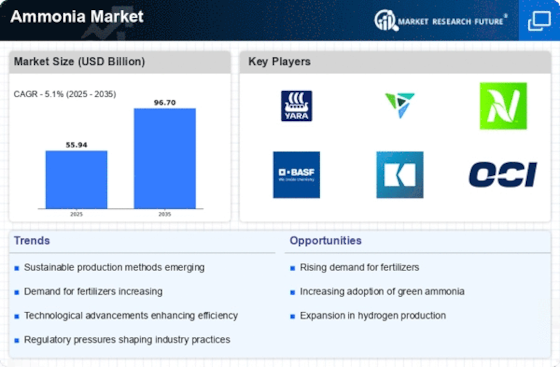
As per MRFR analysis, the Ammonia Market Size was estimated at 55.94 USD Billion in 2024. The ammonia industry is projected to grow from 58.79 USD Billion in 2025 to 96.7 USD Billion by 2035, exhibiting a compound annual growth rate (CAGR) of 5.1 during the forecast period 2025 - 2035.

Key Market Trends & Highlights

The ammonia market is currently experiencing a transformative shift towards sustainability and innovation.

  • The market is witnessing a notable shift towards green ammonia, driven by environmental concerns and technological advancements.
  • North America remains the largest market for ammonia, while Asia-Pacific is emerging as the fastest-growing region, reflecting diverse regional demands.
  • In the fertilizers segment, ammonia continues to dominate, whereas the industrial chemicals segment is rapidly expanding due to increased applications.
  • Rising demand in agriculture and regulatory support for sustainable practices are key drivers propelling the ammonia market forward.

Market Size & Forecast

2024 Market Size 55.94 (USD Billion)
2035 Market Size 96.7 (USD Billion)
CAGR (2025 - 2035) 5.1%
Largest Regional Market Share in 2024 Asia Pacific

Major Players

<p>Yara International (NO), CF Industries (US), Nutrien (CA), BASF (DE), Koch Industries (US), OCI Nitrogen (NL), Mitsui & Co. (JP), Agrium (CA), SABIC (SA)</p>

Market Trends

The Ammonia Market is currently experiencing a dynamic phase characterized by evolving demand patterns and technological advancements. The increasing focus on sustainable agricultural practices is driving the need for ammonia as a key fertilizer component. This shift towards eco-friendly solutions appears to be influencing production methods, with a noticeable trend towards green ammonia, which utilizes renewable energy sources. Furthermore, the growing awareness of ammonia's role in energy storage and as a hydrogen carrier is likely to reshape its applications in various sectors, including transportation and power generation. In addition, regulatory frameworks are becoming more stringent, compelling manufacturers to adopt cleaner production techniques. This regulatory pressure may lead to innovations in ammonia synthesis processes, enhancing efficiency and reducing environmental impact. The interplay between supply chain dynamics and geopolitical factors also seems to play a crucial role in shaping the Ammonia Market landscape. As countries strive for energy independence and sustainability, the market is poised for transformation, potentially leading to new opportunities and challenges for stakeholders across the value chain.

Shift Towards Green Ammonia Market

The Ammonia Market is witnessing a notable transition towards green ammonia production. This trend is driven by the increasing demand for sustainable agricultural practices and the need for environmentally friendly fertilizers. Green ammonia, produced using renewable energy sources, is gaining traction as a viable alternative to traditional methods, which often rely on fossil fuels.

Regulatory Pressures and Innovations

Regulatory frameworks are becoming more stringent, prompting manufacturers in the Ammonia Market to adopt cleaner production techniques. This pressure may lead to innovations in ammonia synthesis processes, enhancing efficiency and minimizing environmental impact. As regulations evolve, companies are likely to invest in research and development to comply with new standards.

Ammonia Market as an Energy Carrier

The role of ammonia as an energy carrier is emerging as a significant trend within the Ammonia Market. Its potential applications in energy storage and transportation are being explored, particularly in the context of hydrogen economy initiatives. This shift could redefine ammonia's position in the energy sector, opening new avenues for its utilization.

Ammonia Market Market Drivers

Rising Demand in Agriculture

The Ammonia Market experiences a robust demand surge primarily driven by its extensive application in fertilizers. Ammonia Market serves as a key nitrogen source, essential for enhancing crop yields. In recent years, The Ammonia Market has been projected to grow, with estimates suggesting a compound annual growth rate of approximately 3.5% through 2025. This growth is likely to bolster ammonia consumption, as fertilizers containing ammonia are favored for their efficiency. Furthermore, the increasing global population necessitates higher food production, thereby amplifying the demand for ammonia-based fertilizers. As agricultural practices evolve, the Ammonia Market is poised to benefit from innovations in fertilizer formulations that incorporate ammonia, ensuring sustainable agricultural practices while meeting the food security challenges of the future.

Increasing Industrial Applications

The Ammonia Market is experiencing a diversification of applications beyond traditional fertilizers, with industrial uses gaining prominence. Ammonia Market is increasingly utilized in the production of various chemicals, including plastics, explosives, and pharmaceuticals. The chemical manufacturing sector is projected to expand, with ammonia serving as a critical feedstock. Recent data indicates that the industrial ammonia consumption is expected to grow at a rate of approximately 4% annually through 2025. This trend suggests a robust demand for ammonia in diverse industrial applications, which could significantly impact the overall market dynamics. Furthermore, the rise of ammonia in the energy sector, particularly in fuel cells and as a potential carbon-free fuel, indicates a transformative shift in its utilization. As industries seek to optimize their processes and reduce environmental footprints, the Ammonia Market is likely to capitalize on these emerging opportunities.

Technological Advancements in Production

Technological innovations in ammonia production processes are significantly influencing the Ammonia Market. The development of more efficient synthesis methods, such as the Haber-Bosch process enhancements, has led to reduced energy consumption and lower production costs. Recent advancements indicate that new catalysts and process optimizations could potentially increase ammonia yield while minimizing environmental impact. The global ammonia production capacity has been estimated to reach around 200 million metric tons by 2025, reflecting the industry's response to rising demand. Moreover, the integration of renewable energy sources into ammonia production processes is gaining traction, suggesting a shift towards greener production methods. This evolution in technology not only enhances the economic viability of ammonia production but also aligns with the growing emphasis on sustainability within the Ammonia Market.

Regulatory Support for Sustainable Practices

The Ammonia Market is increasingly influenced by regulatory frameworks aimed at promoting sustainable practices. Governments worldwide are implementing policies that encourage the adoption of environmentally friendly production methods and the reduction of greenhouse gas emissions. For instance, regulations targeting nitrogen emissions from fertilizers are prompting manufacturers to innovate and adopt cleaner technologies. The ammonia sector is likely to benefit from incentives and subsidies aimed at supporting the transition to greener production processes. As regulatory pressures mount, the industry may witness a shift towards low-carbon ammonia production, which could enhance its market appeal. This regulatory landscape not only fosters innovation but also positions the Ammonia Market as a key player in the global sustainability agenda, potentially attracting investments and partnerships focused on sustainable agricultural and energy solutions.

Growing Interest in Renewable Energy Solutions

The Ammonia Market is witnessing a notable shift towards renewable energy applications, particularly in the context of ammonia as a hydrogen carrier. Ammonia Market's potential to store and transport hydrogen efficiently is garnering attention as countries seek to transition to cleaner energy sources. The Ammonia Market is projected to expand significantly, with ammonia playing a crucial role in facilitating hydrogen distribution. Estimates suggest that by 2030, ammonia could account for a substantial portion of the hydrogen supply chain, thereby enhancing its relevance in the energy sector. This trend indicates a transformative potential for the Ammonia Market, as it aligns with global efforts to reduce carbon emissions and promote sustainable energy solutions. The integration of ammonia in renewable energy systems could redefine its market dynamics, creating new opportunities for growth and innovation.

Market Segment Insights

By Application: Fertilizers (Largest) vs. Industrial Chemicals (Fastest-Growing)

<p>In the Ammonia Market, the application segment is primarily dominated by fertilizers, accounting for the largest share due to their critical role in enhancing agricultural productivity. As one of the key nutrients for plants, ammonia is essential for the production of nitrogen-based fertilizers, which remain a staple in global farming practices. Industrial chemicals also hold significant market share, utilized in various applications such as chemical synthesis and the manufacturing of explosives, among others, but they trail behind fertilizers in overall consumption and impact.</p>

<p>Fertilizers (Dominant) vs. Industrial Chemicals (Emerging)</p>

<p>Fertilizers are the dominant application in the ammonia market, as they capitalize on the growing global demand for food production and the necessity for efficient crop yields. They provide essential nutrients and are integral to achieving sustainable agricultural practices. On the other hand, industrial chemicals represent an emerging application with a fast-growing trend, driven by advancements in technology and increasing utilization in various industries, including automotive and pharmaceuticals. While fertilizers are deeply rooted in traditional agricultural uses, industrial chemicals are becoming increasingly essential as industries seek innovative solutions and formulations that require ammonia-based compounds.</p>

By Manufacturing Process: Haber-Bosch Process (Largest) vs. Electrochemical Process (Fastest-Growing)

<p>In the ammonia market, the manufacturing processes are segmented mainly into the Haber-Bosch process, the electrochemical process, and others. The Haber-Bosch process has established itself as the dominant method, capturing a significant portion of the market share, owing to its historical significance and large-scale industrial application. In contrast, the electrochemical process, while currently smaller in market share, is gaining attention due to its sustainable approach and growing adoption in emerging markets. 'Others' encompasses a variety of niche processes, which although limited in share, contribute to the diversity of production techniques in the market.</p>

<p>Haber-Bosch Process (Dominant) vs. Electrochemical Process (Emerging)</p>

<p>The Haber-Bosch process is well-known for its efficiency in producing ammonia on a massive scale, making it the backbone of global ammonia production. This process requires high temperatures and pressures, making it capital-intensive but effective for large-scale output. Conversely, the electrochemical process represents an emerging method focused on sustainability by utilizing renewable energy sources. Although it currently has a smaller market share, its development is being propelled by increasing environmental regulations and the technology's potential for lower operational costs in the long-term. The transition towards greener technologies posits the electrochemical process as a notable contender in the future landscape of ammonia production.</p>

By End-use Industry: Agriculture (Largest) vs. Chemical (Fastest-Growing)

<p>The ammonia market is significantly influenced by its end-use industries, with agriculture being the dominant sector. This sector utilizes ammonia primarily in fertilizers, which are essential for enhancing crop yields and sustaining agricultural productivity. Following agriculture, the chemical industry, which employs ammonia in the production of various chemicals and products, holds substantial share and is rapidly growing due to rising demand for chemical fertilizers and industrial applications. In contrast, the pharmaceutical and food beverage sectors are also notable, but their contributions to market share are relatively smaller compared to agriculture and chemicals. The considerable reliance on agricultural ammonia drives its market presence. Growth in the ammonia market is propelled by increasing global food demand, necessitating enhanced agricultural productivity through fertilizers. The chemical industry’s expansion, driven by advancements in industrial processes and the demand for eco-friendly chemical products, further stimulates ammonia utilization. Additionally, growing awareness about sustainable agriculture and organic farming practices boosts the adoption of ammonia-based fertilizers, creating a favorable growth environment for the ammonia market in the coming years. Furthermore, the pharmaceutical industry is anticipated to exhibit steady growth, although it occupies a smaller market share. Innovations in ammonia applications for food preservation and safety enhance its value in the food and beverage sector, aligning with health-conscious trends.</p>

<p>Agriculture (Dominant) vs. Food Beverage (Emerging)</p>

<p>In the ammonia market, agriculture stands out as the dominant end-use industry through its extensive utilization of ammonia in fertilizers and soil amendments. The sector’s vast scale and reliance on ammonia for crop growth make it an integral part of agricultural practices globally. In contrast, the food beverage sector is an emerging player, increasingly recognizing ammonia’s role in food preservation and safety applications. Although it currently holds a smaller share compared to agriculture, innovations related to ammonia use in food processing are driving growth. The agricultural sector leverages ammonia for its cost-effectiveness and efficiency in boosting yields, while the food beverage industry capitalizes on ammonia for enhancing food quality and shelf life. As consumer trends evolve towards healthier options, the food beverage sector is expected to expand its utilization of ammonia, particularly in sectors focused on organic and sustainable food production.</p>

By Form: Anhydrous Ammonia Market (Largest) vs. Aqueous Ammonia Market (Fastest-Growing)

<p>In the ammonia market, the segment is primarily dominated by anhydrous ammonia, which holds the largest share due to its extensive use in agricultural applications as a nitrogen fertilizer. Aqueous ammonia also presents a significant presence, catering to a diverse range of industrial applications. The ammonium nitrate segment, while crucial, follows both anhydrous and aqueous varieties in terms of market share, reflecting specific uses in fertilizers and explosive manufacturing.</p>

<p>Anhydrous Ammonia Market (Dominant) vs. Aqueous Ammonia Market (Emerging)</p>

<p>Anhydrous ammonia remains the dominant form in the ammonia market primarily because of its efficiency as a fertilizer, offering high nitrogen content and ease of application. It is extensively utilized in various agricultural practices, solidifying its market position. In contrast, aqueous ammonia is emerging as a significant player, especially in industries requiring refrigeration solutions and neutralization applications. Its ability to serve in both agricultural and industrial settings is driving growth in this segment. The increasing demand for sustainable fertilizers and effective industrial chemicals positions aqueous ammonia for further expansion.</p>

Get more detailed insights about Ammonia Market Research Report - Global Forecast till 2035

Regional Insights

North America : Innovation and Sustainability Focus

North America is the largest market for ammonia, holding approximately 40% of the global share, driven by robust agricultural demand and advancements in production technologies. The region benefits from a strong regulatory framework that encourages sustainable practices, including the use of renewable energy sources in ammonia production. The U.S. and Canada are the primary contributors, with increasing investments in green ammonia initiatives. The competitive landscape is dominated by key players such as CF Industries and Nutrien, which are investing heavily in capacity expansion and innovation. The presence of established companies like Koch Industries and Yara International further strengthens the market. The focus on reducing carbon emissions and enhancing efficiency is shaping the future of ammonia production in this region.

Europe : Sustainable Growth and Innovation

Europe is the second-largest ammonia market, accounting for about 30% of the global share. The region is experiencing significant growth driven by stringent environmental regulations and a strong push towards sustainable agriculture. The European Green Deal and various national policies are catalyzing investments in green ammonia technologies, aiming to reduce carbon footprints and enhance food security. Leading countries include Germany, France, and the Netherlands, where companies like BASF and OCI Nitrogen are at the forefront of innovation. The competitive landscape is characterized by a mix of established players and emerging startups focusing on sustainable practices. The emphasis on circular economy principles is reshaping the ammonia market, making it more resilient and environmentally friendly.

Asia-Pacific : Emerging Markets and Demand Surge

Asia-Pacific is witnessing rapid growth in the ammonia market, holding approximately 25% of the global share. The region's demand is primarily driven by the agricultural sector, particularly in countries like China and India, where fertilizer consumption is on the rise. Government initiatives aimed at enhancing food security and agricultural productivity are key growth drivers, alongside increasing investments in production technologies. China is the largest producer and consumer of ammonia, followed by India and Japan. The competitive landscape features major players like Mitsui & Co. and Yara International, which are expanding their operations to meet the growing demand. The focus on improving production efficiency and sustainability is shaping the market dynamics in this region, making it a critical area for future investments.

Middle East and Africa : Resource-Rich and Growing Demand

The Middle East and Africa region is emerging as a significant player in the ammonia market, holding around 5% of the global share. The region's growth is fueled by abundant natural gas resources, which are essential for ammonia production. Countries like Saudi Arabia and Egypt are investing in expanding their production capacities to meet both domestic and international demand, particularly in fertilizers. Saudi Arabia is a key player, with companies like SABIC leading the market. The competitive landscape is characterized by a focus on leveraging local resources for ammonia production. As the region seeks to diversify its economy, investments in ammonia production are expected to rise, driven by both agricultural needs and export opportunities.

Key Players and Competitive Insights

The Ammonia is currently characterized by a competitive landscape that is both dynamic and multifaceted. Key growth drivers include the increasing demand for fertilizers, the push for sustainable agricultural practices, and the ongoing transition towards green ammonia production. Major players such as Yara International (Norway), CF Industries (United States), and BASF (Germany) are strategically positioned to leverage these trends. Yara International (Norway) focuses on innovation in sustainable farming solutions, while CF Industries (United States) emphasizes operational efficiency and capacity expansion. BASF (Germany) is investing heavily in digital transformation to enhance its production processes. Collectively, these strategies not only shape the competitive environment but also indicate a shift towards sustainability and technological advancement in the ammonia sector.

In terms of business tactics, companies are increasingly localizing manufacturing to reduce transportation costs and enhance supply chain resilience. The ammonia market appears moderately fragmented, with a mix of large multinational corporations and regional players. This structure allows for competitive dynamics where key players can exert significant influence, particularly in regions with high agricultural output. The collective actions of these companies suggest a trend towards optimizing supply chains and enhancing local production capabilities to meet regional demands more effectively.

In August 2025, Yara International (Norway) announced a partnership with a leading technology firm to develop a new digital platform aimed at optimizing fertilizer application in real-time. This strategic move is likely to enhance Yara's competitive edge by integrating advanced analytics into its product offerings, thereby improving efficiency for farmers and promoting sustainable practices. Such innovations may redefine how fertilizers are utilized, aligning with global sustainability goals.

In September 2025, CF Industries (United States) unveiled plans to expand its production capacity in the Midwest by 20%, a significant investment aimed at meeting the growing demand for ammonia in the agricultural sector. This expansion not only positions CF Industries to capture a larger market share but also reflects a broader trend of increasing domestic production capabilities in response to global supply chain challenges. The strategic importance of this move lies in its potential to enhance supply reliability and reduce dependency on imports.

In July 2025, BASF (Germany) launched a new initiative focused on the development of green ammonia technologies, aiming to reduce carbon emissions associated with traditional ammonia production. This initiative underscores BASF's commitment to sustainability and positions the company as a leader in the transition towards environmentally friendly production methods. The strategic importance of this initiative is profound, as it aligns with global regulatory trends favoring low-carbon technologies and could significantly enhance BASF's market positioning.

As of October 2025, the ammonia market is witnessing trends that emphasize digitalization, sustainability, and the integration of artificial intelligence in production processes. Strategic alliances among key players are increasingly shaping the competitive landscape, fostering innovation and collaboration. Looking ahead, it appears that competitive differentiation will evolve from traditional price-based competition to a focus on innovation, technological advancements, and supply chain reliability. This shift may redefine market dynamics, compelling companies to invest in sustainable practices and advanced technologies to maintain their competitive edge.

Key Companies in the Ammonia Market market include

Industry Developments

  • Q2 2024: India launches massive green ammonia investment initiative under SIGHT programme In February 2024, India announced a major green ammonia investment initiative under the SIGHT programme, subsidizing the production of 532,000 tons of renewable ammonia to accelerate decarbonization in agriculture and energy applications.


Future Outlook

Ammonia Market Future Outlook

<p>The Ammonia Market is projected to grow at a 5.1% CAGR from 2024 to 2035, driven by increasing demand in agriculture, renewable energy, and industrial applications.</p>

New opportunities lie in:

  • <p>Expansion of green ammonia production facilities</p>
  • <p>Development of ammonia-based energy storage solutions</p>
  • <p>Investment in ammonia transportation and distribution infrastructure</p>

<p>By 2035, the Ammonia Market is expected to achieve robust growth, driven by innovative applications and sustainable practices.</p>

Market Segmentation

Ammonia Market Form Outlook

  • Anhydrous Ammonia
  • Aqueous Ammonia
  • Ammonium Nitrate

Ammonia Market Application Outlook

  • Fertilizers
  • Industrial Chemicals
  • Refrigeration

Ammonia Market End-use Industry Outlook

  • Agriculture
  • Chemical
  • Pharmaceutical
  • Food Beverage

Ammonia Market Manufacturing Process Outlook

  • Haber-Bosch Process
  • Electrochemical Process
  • Others

Report Scope

MARKET SIZE 202455.94(USD Billion)
MARKET SIZE 202558.79(USD Billion)
MARKET SIZE 203596.7(USD Billion)
COMPOUND ANNUAL GROWTH RATE (CAGR)5.1% (2024 - 2035)
REPORT COVERAGERevenue Forecast, Competitive Landscape, Growth Factors, and Trends
BASE YEAR2024
Market Forecast Period2025 - 2035
Historical Data2019 - 2024
Market Forecast UnitsUSD Billion
Key Companies ProfiledMarket analysis in progress
Segments CoveredMarket segmentation analysis in progress
Key Market OpportunitiesAdvancements in green ammonia production technologies present new growth avenues in the Ammonia Market.
Key Market DynamicsRising demand for green ammonia driven by sustainability initiatives and regulatory pressures on traditional production methods.
Countries CoveredNorth America, Europe, APAC, South America, MEA

FAQs

What is the current valuation of the ammonia market as of 2024?

The ammonia market was valued at 55.94 USD Billion in 2024.

What is the projected market valuation for ammonia by 2035?

The ammonia market is projected to reach 96.7 USD Billion by 2035.

What is the expected CAGR for the ammonia market during the forecast period 2025 - 2035?

The expected CAGR for the ammonia market during the forecast period 2025 - 2035 is 5.1%.

Which application segment holds the largest market share in ammonia?

The fertilizers application segment is projected to dominate the ammonia market, with valuations ranging from 30.0 to 50.0 USD Billion.

How does the industrial chemicals segment perform in the ammonia market?

The industrial chemicals segment is expected to generate revenues between 15.0 and 25.0 USD Billion.

What manufacturing process is primarily used in ammonia production?

The Haber-Bosch process is the leading manufacturing method, with a projected valuation of 35.0 to 58.0 USD Billion.

What are the key end-use industries for ammonia?

Key end-use industries for ammonia include agriculture, chemical, pharmaceutical, and food beverage, with agriculture alone projected to generate 20.0 to 35.0 USD Billion.

What forms of ammonia are available in the market?

The ammonia market includes various forms such as anhydrous ammonia, aqueous ammonia, and ammonium nitrate, with anhydrous ammonia projected to reach 20.0 to 34.0 USD Billion.

  1. SECTION I: EXECUTIVE SUMMARY AND KEY HIGHLIGHTS
    1. EXECUTIVE SUMMARY
      1. Market Overview
      2. Key Findings
      3. Market Segmentation
      4. Competitive Landscape
      5. Challenges and Opportunities
      6. Future Outlook
  2. SECTION II: SCOPING, METHODOLOGY AND MARKET STRUCTURE
    1. MARKET INTRODUCTION
      1. Definition
      2. Scope of the study
    2. RESEARCH METHODOLOGY
      1. Overview
      2. Data Mining
      3. Secondary Research
      4. Primary Research
      5. Forecasting Model
      6. Market Size Estimation
      7. Data Triangulation
      8. Validation
  3. SECTION III: QUALITATIVE ANALYSIS
    1. MARKET DYNAMICS
      1. Overview
      2. Drivers
      3. Restraints
      4. Opportunities
    2. MARKET FACTOR ANALYSIS
      1. Value chain Analysis
      2. Porter's Five Forces Analysis
      3. COVID-19 Impact Analysis
  4. SECTION IV: QUANTITATIVE ANALYSIS
    1. Chemicals and Materials, BY Application (USD Billion)
      1. Fertilizers
      2. Industrial Chemicals
      3. Refrigeration
    2. Chemicals and Materials, BY Manufacturing Process (USD Billion)
      1. Haber-Bosch Process
      2. Electrochemical Process
      3. Others
    3. Chemicals and Materials, BY End-use Industry (USD Billion)
      1. Agriculture
      2. Chemical
      3. Pharmaceutical
      4. Food Beverage
    4. Chemicals and Materials, BY Form (USD Billion)
      1. Anhydrous Ammonia
      2. Aqueous Ammonia
      3. Ammonium Nitrate
    5. Chemicals and Materials, BY Region (USD Billion)
      1. North America
      2. Europe
      3. APAC
      4. South America
      5. MEA
  5. SECTION V: COMPETITIVE ANALYSIS
    1. Competitive Landscape
      1. Overview
      2. Competitive Analysis
      3. Market share Analysis
      4. Major Growth Strategy in the Chemicals and Materials
      5. Competitive Benchmarking
      6. Leading Players in Terms of Number of Developments in the Chemicals and Materials
      7. Key developments and growth strategies
      8. Major Players Financial Matrix
    2. Company Profiles
      1. Yara International (NO)
      2. CF Industries (US)
      3. Nutrien (CA)
      4. BASF (DE)
      5. Koch Industries (US)
      6. OCI Nitrogen (NL)
      7. Mitsui & Co. (JP)
      8. Agrium (CA)
      9. SABIC (SA)
    3. Appendix
      1. References
      2. Related Reports
  6. LIST OF FIGURES
    1. MARKET SYNOPSIS
    2. NORTH AMERICA MARKET ANALYSIS
    3. US MARKET ANALYSIS BY APPLICATION
    4. US MARKET ANALYSIS BY MANUFACTURING PROCESS
    5. US MARKET ANALYSIS BY END-USE INDUSTRY
    6. US MARKET ANALYSIS BY FORM
    7. CANADA MARKET ANALYSIS BY APPLICATION
    8. CANADA MARKET ANALYSIS BY MANUFACTURING PROCESS
    9. CANADA MARKET ANALYSIS BY END-USE INDUSTRY
    10. CANADA MARKET ANALYSIS BY FORM
    11. EUROPE MARKET ANALYSIS
    12. GERMANY MARKET ANALYSIS BY APPLICATION
    13. GERMANY MARKET ANALYSIS BY MANUFACTURING PROCESS
    14. GERMANY MARKET ANALYSIS BY END-USE INDUSTRY
    15. GERMANY MARKET ANALYSIS BY FORM
    16. UK MARKET ANALYSIS BY APPLICATION
    17. UK MARKET ANALYSIS BY MANUFACTURING PROCESS
    18. UK MARKET ANALYSIS BY END-USE INDUSTRY
    19. UK MARKET ANALYSIS BY FORM
    20. FRANCE MARKET ANALYSIS BY APPLICATION
    21. FRANCE MARKET ANALYSIS BY MANUFACTURING PROCESS
    22. FRANCE MARKET ANALYSIS BY END-USE INDUSTRY
    23. FRANCE MARKET ANALYSIS BY FORM
    24. RUSSIA MARKET ANALYSIS BY APPLICATION
    25. RUSSIA MARKET ANALYSIS BY MANUFACTURING PROCESS
    26. RUSSIA MARKET ANALYSIS BY END-USE INDUSTRY
    27. RUSSIA MARKET ANALYSIS BY FORM
    28. ITALY MARKET ANALYSIS BY APPLICATION
    29. ITALY MARKET ANALYSIS BY MANUFACTURING PROCESS
    30. ITALY MARKET ANALYSIS BY END-USE INDUSTRY
    31. ITALY MARKET ANALYSIS BY FORM
    32. SPAIN MARKET ANALYSIS BY APPLICATION
    33. SPAIN MARKET ANALYSIS BY MANUFACTURING PROCESS
    34. SPAIN MARKET ANALYSIS BY END-USE INDUSTRY
    35. SPAIN MARKET ANALYSIS BY FORM
    36. REST OF EUROPE MARKET ANALYSIS BY APPLICATION
    37. REST OF EUROPE MARKET ANALYSIS BY MANUFACTURING PROCESS
    38. REST OF EUROPE MARKET ANALYSIS BY END-USE INDUSTRY
    39. REST OF EUROPE MARKET ANALYSIS BY FORM
    40. APAC MARKET ANALYSIS
    41. CHINA MARKET ANALYSIS BY APPLICATION
    42. CHINA MARKET ANALYSIS BY MANUFACTURING PROCESS
    43. CHINA MARKET ANALYSIS BY END-USE INDUSTRY
    44. CHINA MARKET ANALYSIS BY FORM
    45. INDIA MARKET ANALYSIS BY APPLICATION
    46. INDIA MARKET ANALYSIS BY MANUFACTURING PROCESS
    47. INDIA MARKET ANALYSIS BY END-USE INDUSTRY
    48. INDIA MARKET ANALYSIS BY FORM
    49. JAPAN MARKET ANALYSIS BY APPLICATION
    50. JAPAN MARKET ANALYSIS BY MANUFACTURING PROCESS
    51. JAPAN MARKET ANALYSIS BY END-USE INDUSTRY
    52. JAPAN MARKET ANALYSIS BY FORM
    53. SOUTH KOREA MARKET ANALYSIS BY APPLICATION
    54. SOUTH KOREA MARKET ANALYSIS BY MANUFACTURING PROCESS
    55. SOUTH KOREA MARKET ANALYSIS BY END-USE INDUSTRY
    56. SOUTH KOREA MARKET ANALYSIS BY FORM
    57. MALAYSIA MARKET ANALYSIS BY APPLICATION
    58. MALAYSIA MARKET ANALYSIS BY MANUFACTURING PROCESS
    59. MALAYSIA MARKET ANALYSIS BY END-USE INDUSTRY
    60. MALAYSIA MARKET ANALYSIS BY FORM
    61. THAILAND MARKET ANALYSIS BY APPLICATION
    62. THAILAND MARKET ANALYSIS BY MANUFACTURING PROCESS
    63. THAILAND MARKET ANALYSIS BY END-USE INDUSTRY
    64. THAILAND MARKET ANALYSIS BY FORM
    65. INDONESIA MARKET ANALYSIS BY APPLICATION
    66. INDONESIA MARKET ANALYSIS BY MANUFACTURING PROCESS
    67. INDONESIA MARKET ANALYSIS BY END-USE INDUSTRY
    68. INDONESIA MARKET ANALYSIS BY FORM
    69. REST OF APAC MARKET ANALYSIS BY APPLICATION
    70. REST OF APAC MARKET ANALYSIS BY MANUFACTURING PROCESS
    71. REST OF APAC MARKET ANALYSIS BY END-USE INDUSTRY
    72. REST OF APAC MARKET ANALYSIS BY FORM
    73. SOUTH AMERICA MARKET ANALYSIS
    74. BRAZIL MARKET ANALYSIS BY APPLICATION
    75. BRAZIL MARKET ANALYSIS BY MANUFACTURING PROCESS
    76. BRAZIL MARKET ANALYSIS BY END-USE INDUSTRY
    77. BRAZIL MARKET ANALYSIS BY FORM
    78. MEXICO MARKET ANALYSIS BY APPLICATION
    79. MEXICO MARKET ANALYSIS BY MANUFACTURING PROCESS
    80. MEXICO MARKET ANALYSIS BY END-USE INDUSTRY
    81. MEXICO MARKET ANALYSIS BY FORM
    82. ARGENTINA MARKET ANALYSIS BY APPLICATION
    83. ARGENTINA MARKET ANALYSIS BY MANUFACTURING PROCESS
    84. ARGENTINA MARKET ANALYSIS BY END-USE INDUSTRY
    85. ARGENTINA MARKET ANALYSIS BY FORM
    86. REST OF SOUTH AMERICA MARKET ANALYSIS BY APPLICATION
    87. REST OF SOUTH AMERICA MARKET ANALYSIS BY MANUFACTURING PROCESS
    88. REST OF SOUTH AMERICA MARKET ANALYSIS BY END-USE INDUSTRY
    89. REST OF SOUTH AMERICA MARKET ANALYSIS BY FORM
    90. MEA MARKET ANALYSIS
    91. GCC COUNTRIES MARKET ANALYSIS BY APPLICATION
    92. GCC COUNTRIES MARKET ANALYSIS BY MANUFACTURING PROCESS
    93. GCC COUNTRIES MARKET ANALYSIS BY END-USE INDUSTRY
    94. GCC COUNTRIES MARKET ANALYSIS BY FORM
    95. SOUTH AFRICA MARKET ANALYSIS BY APPLICATION
    96. SOUTH AFRICA MARKET ANALYSIS BY MANUFACTURING PROCESS
    97. SOUTH AFRICA MARKET ANALYSIS BY END-USE INDUSTRY
    98. SOUTH AFRICA MARKET ANALYSIS BY FORM
    99. REST OF MEA MARKET ANALYSIS BY APPLICATION
    100. REST OF MEA MARKET ANALYSIS BY MANUFACTURING PROCESS
    101. REST OF MEA MARKET ANALYSIS BY END-USE INDUSTRY
    102. REST OF MEA MARKET ANALYSIS BY FORM
    103. KEY BUYING CRITERIA OF CHEMICALS AND MATERIALS
    104. RESEARCH PROCESS OF MRFR
    105. DRO ANALYSIS OF CHEMICALS AND MATERIALS
    106. DRIVERS IMPACT ANALYSIS: CHEMICALS AND MATERIALS
    107. RESTRAINTS IMPACT ANALYSIS: CHEMICALS AND MATERIALS
    108. SUPPLY / VALUE CHAIN: CHEMICALS AND MATERIALS
    109. CHEMICALS AND MATERIALS, BY APPLICATION, 2024 (% SHARE)
    110. CHEMICALS AND MATERIALS, BY APPLICATION, 2024 TO 2035 (USD Billion)
    111. CHEMICALS AND MATERIALS, BY MANUFACTURING PROCESS, 2024 (% SHARE)
    112. CHEMICALS AND MATERIALS, BY MANUFACTURING PROCESS, 2024 TO 2035 (USD Billion)
    113. CHEMICALS AND MATERIALS, BY END-USE INDUSTRY, 2024 (% SHARE)
    114. CHEMICALS AND MATERIALS, BY END-USE INDUSTRY, 2024 TO 2035 (USD Billion)
    115. CHEMICALS AND MATERIALS, BY FORM, 2024 (% SHARE)
    116. CHEMICALS AND MATERIALS, BY FORM, 2024 TO 2035 (USD Billion)
    117. BENCHMARKING OF MAJOR COMPETITORS
  7. LIST OF TABLES
    1. LIST OF ASSUMPTIONS
    2. North America MARKET SIZE ESTIMATES; FORECAST
      1. BY APPLICATION, 2025-2035 (USD Billion)
      2. BY MANUFACTURING PROCESS, 2025-2035 (USD Billion)
      3. BY END-USE INDUSTRY, 2025-2035 (USD Billion)
      4. BY FORM, 2025-2035 (USD Billion)
    3. US MARKET SIZE ESTIMATES; FORECAST
      1. BY APPLICATION, 2025-2035 (USD Billion)
      2. BY MANUFACTURING PROCESS, 2025-2035 (USD Billion)
      3. BY END-USE INDUSTRY, 2025-2035 (USD Billion)
      4. BY FORM, 2025-2035 (USD Billion)
    4. Canada MARKET SIZE ESTIMATES; FORECAST
      1. BY APPLICATION, 2025-2035 (USD Billion)
      2. BY MANUFACTURING PROCESS, 2025-2035 (USD Billion)
      3. BY END-USE INDUSTRY, 2025-2035 (USD Billion)
      4. BY FORM, 2025-2035 (USD Billion)
    5. Europe MARKET SIZE ESTIMATES; FORECAST
      1. BY APPLICATION, 2025-2035 (USD Billion)
      2. BY MANUFACTURING PROCESS, 2025-2035 (USD Billion)
      3. BY END-USE INDUSTRY, 2025-2035 (USD Billion)
      4. BY FORM, 2025-2035 (USD Billion)
    6. Germany MARKET SIZE ESTIMATES; FORECAST
      1. BY APPLICATION, 2025-2035 (USD Billion)
      2. BY MANUFACTURING PROCESS, 2025-2035 (USD Billion)
      3. BY END-USE INDUSTRY, 2025-2035 (USD Billion)
      4. BY FORM, 2025-2035 (USD Billion)
    7. UK MARKET SIZE ESTIMATES; FORECAST
      1. BY APPLICATION, 2025-2035 (USD Billion)
      2. BY MANUFACTURING PROCESS, 2025-2035 (USD Billion)
      3. BY END-USE INDUSTRY, 2025-2035 (USD Billion)
      4. BY FORM, 2025-2035 (USD Billion)
    8. France MARKET SIZE ESTIMATES; FORECAST
      1. BY APPLICATION, 2025-2035 (USD Billion)
      2. BY MANUFACTURING PROCESS, 2025-2035 (USD Billion)
      3. BY END-USE INDUSTRY, 2025-2035 (USD Billion)
      4. BY FORM, 2025-2035 (USD Billion)
    9. Russia MARKET SIZE ESTIMATES; FORECAST
      1. BY APPLICATION, 2025-2035 (USD Billion)
      2. BY MANUFACTURING PROCESS, 2025-2035 (USD Billion)
      3. BY END-USE INDUSTRY, 2025-2035 (USD Billion)
      4. BY FORM, 2025-2035 (USD Billion)
    10. Italy MARKET SIZE ESTIMATES; FORECAST
      1. BY APPLICATION, 2025-2035 (USD Billion)
      2. BY MANUFACTURING PROCESS, 2025-2035 (USD Billion)
      3. BY END-USE INDUSTRY, 2025-2035 (USD Billion)
      4. BY FORM, 2025-2035 (USD Billion)
    11. Spain MARKET SIZE ESTIMATES; FORECAST
      1. BY APPLICATION, 2025-2035 (USD Billion)
      2. BY MANUFACTURING PROCESS, 2025-2035 (USD Billion)
      3. BY END-USE INDUSTRY, 2025-2035 (USD Billion)
      4. BY FORM, 2025-2035 (USD Billion)
    12. Rest of Europe MARKET SIZE ESTIMATES; FORECAST
      1. BY APPLICATION, 2025-2035 (USD Billion)
      2. BY MANUFACTURING PROCESS, 2025-2035 (USD Billion)
      3. BY END-USE INDUSTRY, 2025-2035 (USD Billion)
      4. BY FORM, 2025-2035 (USD Billion)
    13. APAC MARKET SIZE ESTIMATES; FORECAST
      1. BY APPLICATION, 2025-2035 (USD Billion)
      2. BY MANUFACTURING PROCESS, 2025-2035 (USD Billion)
      3. BY END-USE INDUSTRY, 2025-2035 (USD Billion)
      4. BY FORM, 2025-2035 (USD Billion)
    14. China MARKET SIZE ESTIMATES; FORECAST
      1. BY APPLICATION, 2025-2035 (USD Billion)
      2. BY MANUFACTURING PROCESS, 2025-2035 (USD Billion)
      3. BY END-USE INDUSTRY, 2025-2035 (USD Billion)
      4. BY FORM, 2025-2035 (USD Billion)
    15. India MARKET SIZE ESTIMATES; FORECAST
      1. BY APPLICATION, 2025-2035 (USD Billion)
      2. BY MANUFACTURING PROCESS, 2025-2035 (USD Billion)
      3. BY END-USE INDUSTRY, 2025-2035 (USD Billion)
      4. BY FORM, 2025-2035 (USD Billion)
    16. Japan MARKET SIZE ESTIMATES; FORECAST
      1. BY APPLICATION, 2025-2035 (USD Billion)
      2. BY MANUFACTURING PROCESS, 2025-2035 (USD Billion)
      3. BY END-USE INDUSTRY, 2025-2035 (USD Billion)
      4. BY FORM, 2025-2035 (USD Billion)
    17. South Korea MARKET SIZE ESTIMATES; FORECAST
      1. BY APPLICATION, 2025-2035 (USD Billion)
      2. BY MANUFACTURING PROCESS, 2025-2035 (USD Billion)
      3. BY END-USE INDUSTRY, 2025-2035 (USD Billion)
      4. BY FORM, 2025-2035 (USD Billion)
    18. Malaysia MARKET SIZE ESTIMATES; FORECAST
      1. BY APPLICATION, 2025-2035 (USD Billion)
      2. BY MANUFACTURING PROCESS, 2025-2035 (USD Billion)
      3. BY END-USE INDUSTRY, 2025-2035 (USD Billion)
      4. BY FORM, 2025-2035 (USD Billion)
    19. Thailand MARKET SIZE ESTIMATES; FORECAST
      1. BY APPLICATION, 2025-2035 (USD Billion)
      2. BY MANUFACTURING PROCESS, 2025-2035 (USD Billion)
      3. BY END-USE INDUSTRY, 2025-2035 (USD Billion)
      4. BY FORM, 2025-2035 (USD Billion)
    20. Indonesia MARKET SIZE ESTIMATES; FORECAST
      1. BY APPLICATION, 2025-2035 (USD Billion)
      2. BY MANUFACTURING PROCESS, 2025-2035 (USD Billion)
      3. BY END-USE INDUSTRY, 2025-2035 (USD Billion)
      4. BY FORM, 2025-2035 (USD Billion)
    21. Rest of APAC MARKET SIZE ESTIMATES; FORECAST
      1. BY APPLICATION, 2025-2035 (USD Billion)
      2. BY MANUFACTURING PROCESS, 2025-2035 (USD Billion)
      3. BY END-USE INDUSTRY, 2025-2035 (USD Billion)
      4. BY FORM, 2025-2035 (USD Billion)
    22. South America MARKET SIZE ESTIMATES; FORECAST
      1. BY APPLICATION, 2025-2035 (USD Billion)
      2. BY MANUFACTURING PROCESS, 2025-2035 (USD Billion)
      3. BY END-USE INDUSTRY, 2025-2035 (USD Billion)
      4. BY FORM, 2025-2035 (USD Billion)
    23. Brazil MARKET SIZE ESTIMATES; FORECAST
      1. BY APPLICATION, 2025-2035 (USD Billion)
      2. BY MANUFACTURING PROCESS, 2025-2035 (USD Billion)
      3. BY END-USE INDUSTRY, 2025-2035 (USD Billion)
      4. BY FORM, 2025-2035 (USD Billion)
    24. Mexico MARKET SIZE ESTIMATES; FORECAST
      1. BY APPLICATION, 2025-2035 (USD Billion)
      2. BY MANUFACTURING PROCESS, 2025-2035 (USD Billion)
      3. BY END-USE INDUSTRY, 2025-2035 (USD Billion)
      4. BY FORM, 2025-2035 (USD Billion)
    25. Argentina MARKET SIZE ESTIMATES; FORECAST
      1. BY APPLICATION, 2025-2035 (USD Billion)
      2. BY MANUFACTURING PROCESS, 2025-2035 (USD Billion)
      3. BY END-USE INDUSTRY, 2025-2035 (USD Billion)
      4. BY FORM, 2025-2035 (USD Billion)
    26. Rest of South America MARKET SIZE ESTIMATES; FORECAST
      1. BY APPLICATION, 2025-2035 (USD Billion)
      2. BY MANUFACTURING PROCESS, 2025-2035 (USD Billion)
      3. BY END-USE INDUSTRY, 2025-2035 (USD Billion)
      4. BY FORM, 2025-2035 (USD Billion)
    27. MEA MARKET SIZE ESTIMATES; FORECAST
      1. BY APPLICATION, 2025-2035 (USD Billion)
      2. BY MANUFACTURING PROCESS, 2025-2035 (USD Billion)
      3. BY END-USE INDUSTRY, 2025-2035 (USD Billion)
      4. BY FORM, 2025-2035 (USD Billion)
    28. GCC Countries MARKET SIZE ESTIMATES; FORECAST
      1. BY APPLICATION, 2025-2035 (USD Billion)
      2. BY MANUFACTURING PROCESS, 2025-2035 (USD Billion)
      3. BY END-USE INDUSTRY, 2025-2035 (USD Billion)
      4. BY FORM, 2025-2035 (USD Billion)
    29. South Africa MARKET SIZE ESTIMATES; FORECAST
      1. BY APPLICATION, 2025-2035 (USD Billion)
      2. BY MANUFACTURING PROCESS, 2025-2035 (USD Billion)
      3. BY END-USE INDUSTRY, 2025-2035 (USD Billion)
      4. BY FORM, 2025-2035 (USD Billion)
    30. Rest of MEA MARKET SIZE ESTIMATES; FORECAST
      1. BY APPLICATION, 2025-2035 (USD Billion)
      2. BY MANUFACTURING PROCESS, 2025-2035 (USD Billion)
      3. BY END-USE INDUSTRY, 2025-2035 (USD Billion)
      4. BY FORM, 2025-2035 (USD Billion)
    31. PRODUCT LAUNCH/PRODUCT DEVELOPMENT/APPROVAL
    32. ACQUISITION/PARTNERSHIP

Ammonia Market Segmentation

Ammonia Market By Application (USD Billion, 2019-2035)

Fertilizers

Industrial Chemicals

Refrigeration


Ammonia Market By Manufacturing Process (USD Billion, 2019-2035)

Haber-Bosch Process

Electrochemical Process

Others


Ammonia Market By End Use Industry (USD Billion, 2019-2035)

Agriculture

Chemical

Pharmaceutical

Food Beverage


Ammonia Market By Form (USD Billion, 2019-2035)

Anhydrous Ammonia

Aqueous Ammonia

Ammonium Nitrate


Ammonia Market By Regional (USD Billion, 2019-2035)

North America

Europe

South America

Asia Pacific

Middle East and Africa


Ammonia Market Regional Outlook (USD Billion, 2019-2035)


North America Outlook (USD Billion, 2019-2035)

North America Ammonia Market by Application Type

Fertilizers

Industrial Chemicals

Refrigeration

North America Ammonia Market by Manufacturing Process Type

Haber-Bosch Process

Electrochemical Process

Others

North America Ammonia Market by End Use Industry Type

Agriculture

Chemical

Pharmaceutical

Food Beverage

North America Ammonia Market by Form Type

Anhydrous Ammonia

Aqueous Ammonia

Ammonium Nitrate

North America Ammonia Market by Regional Type

US

Canada

US Outlook (USD Billion, 2019-2035)

US Ammonia Market by Application Type

Fertilizers

Industrial Chemicals

Refrigeration

US Ammonia Market by Manufacturing Process Type

Haber-Bosch Process

Electrochemical Process

Others

US Ammonia Market by End Use Industry Type

Agriculture

Chemical

Pharmaceutical

Food Beverage

US Ammonia Market by Form Type

Anhydrous Ammonia

Aqueous Ammonia

Ammonium Nitrate

CANADA Outlook (USD Billion, 2019-2035)

CANADA Ammonia Market by Application Type

Fertilizers

Industrial Chemicals

Refrigeration

CANADA Ammonia Market by Manufacturing Process Type

Haber-Bosch Process

Electrochemical Process

Others

CANADA Ammonia Market by End Use Industry Type

Agriculture

Chemical

Pharmaceutical

Food Beverage

CANADA Ammonia Market by Form Type

Anhydrous Ammonia

Aqueous Ammonia

Ammonium Nitrate

Europe Outlook (USD Billion, 2019-2035)

Europe Ammonia Market by Application Type

Fertilizers

Industrial Chemicals

Refrigeration

Europe Ammonia Market by Manufacturing Process Type

Haber-Bosch Process

Electrochemical Process

Others

Europe Ammonia Market by End Use Industry Type

Agriculture

Chemical

Pharmaceutical

Food Beverage

Europe Ammonia Market by Form Type

Anhydrous Ammonia

Aqueous Ammonia

Ammonium Nitrate

Europe Ammonia Market by Regional Type

Germany

UK

France

Russia

Italy

Spain

Rest of Europe

GERMANY Outlook (USD Billion, 2019-2035)

GERMANY Ammonia Market by Application Type

Fertilizers

Industrial Chemicals

Refrigeration

GERMANY Ammonia Market by Manufacturing Process Type

Haber-Bosch Process

Electrochemical Process

Others

GERMANY Ammonia Market by End Use Industry Type

Agriculture

Chemical

Pharmaceutical

Food Beverage

GERMANY Ammonia Market by Form Type

Anhydrous Ammonia

Aqueous Ammonia

Ammonium Nitrate

UK Outlook (USD Billion, 2019-2035)

UK Ammonia Market by Application Type

Fertilizers

Industrial Chemicals

Refrigeration

UK Ammonia Market by Manufacturing Process Type

Haber-Bosch Process

Electrochemical Process

Others

UK Ammonia Market by End Use Industry Type

Agriculture

Chemical

Pharmaceutical

Food Beverage

UK Ammonia Market by Form Type

Anhydrous Ammonia

Aqueous Ammonia

Ammonium Nitrate

FRANCE Outlook (USD Billion, 2019-2035)

FRANCE Ammonia Market by Application Type

Fertilizers

Industrial Chemicals

Refrigeration

FRANCE Ammonia Market by Manufacturing Process Type

Haber-Bosch Process

Electrochemical Process

Others

FRANCE Ammonia Market by End Use Industry Type

Agriculture

Chemical

Pharmaceutical

Food Beverage

FRANCE Ammonia Market by Form Type

Anhydrous Ammonia

Aqueous Ammonia

Ammonium Nitrate

RUSSIA Outlook (USD Billion, 2019-2035)

RUSSIA Ammonia Market by Application Type

Fertilizers

Industrial Chemicals

Refrigeration

RUSSIA Ammonia Market by Manufacturing Process Type

Haber-Bosch Process

Electrochemical Process

Others

RUSSIA Ammonia Market by End Use Industry Type

Agriculture

Chemical

Pharmaceutical

Food Beverage

RUSSIA Ammonia Market by Form Type

Anhydrous Ammonia

Aqueous Ammonia

Ammonium Nitrate

ITALY Outlook (USD Billion, 2019-2035)

ITALY Ammonia Market by Application Type

Fertilizers

Industrial Chemicals

Refrigeration

ITALY Ammonia Market by Manufacturing Process Type

Haber-Bosch Process

Electrochemical Process

Others

ITALY Ammonia Market by End Use Industry Type

Agriculture

Chemical

Pharmaceutical

Food Beverage

ITALY Ammonia Market by Form Type

Anhydrous Ammonia

Aqueous Ammonia

Ammonium Nitrate

SPAIN Outlook (USD Billion, 2019-2035)

SPAIN Ammonia Market by Application Type

Fertilizers

Industrial Chemicals

Refrigeration

SPAIN Ammonia Market by Manufacturing Process Type

Haber-Bosch Process

Electrochemical Process

Others

SPAIN Ammonia Market by End Use Industry Type

Agriculture

Chemical

Pharmaceutical

Food Beverage

SPAIN Ammonia Market by Form Type

Anhydrous Ammonia

Aqueous Ammonia

Ammonium Nitrate

REST OF EUROPE Outlook (USD Billion, 2019-2035)

REST OF EUROPE Ammonia Market by Application Type

Fertilizers

Industrial Chemicals

Refrigeration

REST OF EUROPE Ammonia Market by Manufacturing Process Type

Haber-Bosch Process

Electrochemical Process

Others

REST OF EUROPE Ammonia Market by End Use Industry Type

Agriculture

Chemical

Pharmaceutical

Food Beverage

REST OF EUROPE Ammonia Market by Form Type

Anhydrous Ammonia

Aqueous Ammonia

Ammonium Nitrate

APAC Outlook (USD Billion, 2019-2035)

APAC Ammonia Market by Application Type

Fertilizers

Industrial Chemicals

Refrigeration

APAC Ammonia Market by Manufacturing Process Type

Haber-Bosch Process

Electrochemical Process

Others

APAC Ammonia Market by End Use Industry Type

Agriculture

Chemical

Pharmaceutical

Food Beverage

APAC Ammonia Market by Form Type

Anhydrous Ammonia

Aqueous Ammonia

Ammonium Nitrate

APAC Ammonia Market by Regional Type

China

India

Japan

South Korea

Malaysia

Thailand

Indonesia

Rest of APAC

CHINA Outlook (USD Billion, 2019-2035)

CHINA Ammonia Market by Application Type

Fertilizers

Industrial Chemicals

Refrigeration

CHINA Ammonia Market by Manufacturing Process Type

Haber-Bosch Process

Electrochemical Process

Others

CHINA Ammonia Market by End Use Industry Type

Agriculture

Chemical

Pharmaceutical

Food Beverage

CHINA Ammonia Market by Form Type

Anhydrous Ammonia

Aqueous Ammonia

Ammonium Nitrate

INDIA Outlook (USD Billion, 2019-2035)

INDIA Ammonia Market by Application Type

Fertilizers

Industrial Chemicals

Refrigeration

INDIA Ammonia Market by Manufacturing Process Type

Haber-Bosch Process

Electrochemical Process

Others

INDIA Ammonia Market by End Use Industry Type

Agriculture

Chemical

Pharmaceutical

Food Beverage

INDIA Ammonia Market by Form Type

Anhydrous Ammonia

Aqueous Ammonia

Ammonium Nitrate

JAPAN Outlook (USD Billion, 2019-2035)

JAPAN Ammonia Market by Application Type

Fertilizers

Industrial Chemicals

Refrigeration

JAPAN Ammonia Market by Manufacturing Process Type

Haber-Bosch Process

Electrochemical Process

Others

JAPAN Ammonia Market by End Use Industry Type

Agriculture

Chemical

Pharmaceutical

Food Beverage

JAPAN Ammonia Market by Form Type

Anhydrous Ammonia

Aqueous Ammonia

Ammonium Nitrate

SOUTH KOREA Outlook (USD Billion, 2019-2035)

SOUTH KOREA Ammonia Market by Application Type

Fertilizers

Industrial Chemicals

Refrigeration

SOUTH KOREA Ammonia Market by Manufacturing Process Type

Haber-Bosch Process

Electrochemical Process

Others

SOUTH KOREA Ammonia Market by End Use Industry Type

Agriculture

Chemical

Pharmaceutical

Food Beverage

SOUTH KOREA Ammonia Market by Form Type

Anhydrous Ammonia

Aqueous Ammonia

Ammonium Nitrate

MALAYSIA Outlook (USD Billion, 2019-2035)

MALAYSIA Ammonia Market by Application Type

Fertilizers

Industrial Chemicals

Refrigeration

MALAYSIA Ammonia Market by Manufacturing Process Type

Haber-Bosch Process

Electrochemical Process

Others

MALAYSIA Ammonia Market by End Use Industry Type

Agriculture

Chemical

Pharmaceutical

Food Beverage

MALAYSIA Ammonia Market by Form Type

Anhydrous Ammonia

Aqueous Ammonia

Ammonium Nitrate

THAILAND Outlook (USD Billion, 2019-2035)

THAILAND Ammonia Market by Application Type

Fertilizers

Industrial Chemicals

Refrigeration

THAILAND Ammonia Market by Manufacturing Process Type

Haber-Bosch Process

Electrochemical Process

Others

THAILAND Ammonia Market by End Use Industry Type

Agriculture

Chemical

Pharmaceutical

Food Beverage

THAILAND Ammonia Market by Form Type

Anhydrous Ammonia

Aqueous Ammonia

Ammonium Nitrate

INDONESIA Outlook (USD Billion, 2019-2035)

INDONESIA Ammonia Market by Application Type

Fertilizers

Industrial Chemicals

Refrigeration

INDONESIA Ammonia Market by Manufacturing Process Type

Haber-Bosch Process

Electrochemical Process

Others

INDONESIA Ammonia Market by End Use Industry Type

Agriculture

Chemical

Pharmaceutical

Food Beverage

INDONESIA Ammonia Market by Form Type

Anhydrous Ammonia

Aqueous Ammonia

Ammonium Nitrate

REST OF APAC Outlook (USD Billion, 2019-2035)

REST OF APAC Ammonia Market by Application Type

Fertilizers

Industrial Chemicals

Refrigeration

REST OF APAC Ammonia Market by Manufacturing Process Type

Haber-Bosch Process

Electrochemical Process

Others

REST OF APAC Ammonia Market by End Use Industry Type

Agriculture

Chemical

Pharmaceutical

Food Beverage

REST OF APAC Ammonia Market by Form Type

Anhydrous Ammonia

Aqueous Ammonia

Ammonium Nitrate

South America Outlook (USD Billion, 2019-2035)

South America Ammonia Market by Application Type

Fertilizers

Industrial Chemicals

Refrigeration

South America Ammonia Market by Manufacturing Process Type

Haber-Bosch Process

Electrochemical Process

Others

South America Ammonia Market by End Use Industry Type

Agriculture

Chemical

Pharmaceutical

Food Beverage

South America Ammonia Market by Form Type

Anhydrous Ammonia

Aqueous Ammonia

Ammonium Nitrate

South America Ammonia Market by Regional Type

Brazil

Mexico

Argentina

Rest of South America

BRAZIL Outlook (USD Billion, 2019-2035)

BRAZIL Ammonia Market by Application Type

Fertilizers

Industrial Chemicals

Refrigeration

BRAZIL Ammonia Market by Manufacturing Process Type

Haber-Bosch Process

Electrochemical Process

Others

BRAZIL Ammonia Market by End Use Industry Type

Agriculture

Chemical

Pharmaceutical

Food Beverage

BRAZIL Ammonia Market by Form Type

Anhydrous Ammonia

Aqueous Ammonia

Ammonium Nitrate

MEXICO Outlook (USD Billion, 2019-2035)

MEXICO Ammonia Market by Application Type

Fertilizers

Industrial Chemicals

Refrigeration

MEXICO Ammonia Market by Manufacturing Process Type

Haber-Bosch Process

Electrochemical Process

Others

MEXICO Ammonia Market by End Use Industry Type

Agriculture

Chemical

Pharmaceutical

Food Beverage

MEXICO Ammonia Market by Form Type

Anhydrous Ammonia

Aqueous Ammonia

Ammonium Nitrate

ARGENTINA Outlook (USD Billion, 2019-2035)

ARGENTINA Ammonia Market by Application Type

Fertilizers

Industrial Chemicals

Refrigeration

ARGENTINA Ammonia Market by Manufacturing Process Type

Haber-Bosch Process

Electrochemical Process

Others

ARGENTINA Ammonia Market by End Use Industry Type

Agriculture

Chemical

Pharmaceutical

Food Beverage

ARGENTINA Ammonia Market by Form Type

Anhydrous Ammonia

Aqueous Ammonia

Ammonium Nitrate

REST OF SOUTH AMERICA Outlook (USD Billion, 2019-2035)

REST OF SOUTH AMERICA Ammonia Market by Application Type

Fertilizers

Industrial Chemicals

Refrigeration

REST OF SOUTH AMERICA Ammonia Market by Manufacturing Process Type

Haber-Bosch Process

Electrochemical Process

Others

REST OF SOUTH AMERICA Ammonia Market by End Use Industry Type

Agriculture

Chemical

Pharmaceutical

Food Beverage

REST OF SOUTH AMERICA Ammonia Market by Form Type

Anhydrous Ammonia

Aqueous Ammonia

Ammonium Nitrate

MEA Outlook (USD Billion, 2019-2035)

MEA Ammonia Market by Application Type

Fertilizers

Industrial Chemicals

Refrigeration

MEA Ammonia Market by Manufacturing Process Type

Haber-Bosch Process

Electrochemical Process

Others

MEA Ammonia Market by End Use Industry Type

Agriculture

Chemical

Pharmaceutical

Food Beverage

MEA Ammonia Market by Form Type

Anhydrous Ammonia

Aqueous Ammonia

Ammonium Nitrate

MEA Ammonia Market by Regional Type

GCC Countries

South Africa

Rest of MEA

GCC COUNTRIES Outlook (USD Billion, 2019-2035)

GCC COUNTRIES Ammonia Market by Application Type

Fertilizers

Industrial Chemicals

Refrigeration

GCC COUNTRIES Ammonia Market by Manufacturing Process Type

Haber-Bosch Process

Electrochemical Process

Others

GCC COUNTRIES Ammonia Market by End Use Industry Type

Agriculture

Chemical

Pharmaceutical

Food Beverage

GCC COUNTRIES Ammonia Market by Form Type

Anhydrous Ammonia

Aqueous Ammonia

Ammonium Nitrate

SOUTH AFRICA Outlook (USD Billion, 2019-2035)

SOUTH AFRICA Ammonia Market by Application Type

Fertilizers

Industrial Chemicals

Refrigeration

SOUTH AFRICA Ammonia Market by Manufacturing Process Type

Haber-Bosch Process

Electrochemical Process

Others

SOUTH AFRICA Ammonia Market by End Use Industry Type

Agriculture

Chemical

Pharmaceutical

Food Beverage

SOUTH AFRICA Ammonia Market by Form Type

Anhydrous Ammonia

Aqueous Ammonia

Ammonium Nitrate

REST OF MEA Outlook (USD Billion, 2019-2035)

REST OF MEA Ammonia Market by Application Type

Fertilizers

Industrial Chemicals

Refrigeration

REST OF MEA Ammonia Market by Manufacturing Process Type

Haber-Bosch Process

Electrochemical Process

Others

REST OF MEA Ammonia Market by End Use Industry Type

Agriculture

Chemical

Pharmaceutical

Food Beverage

REST OF MEA Ammonia Market by Form Type

Anhydrous Ammonia

Aqueous Ammonia

Ammonium Nitrate


Infographic

Free Sample Request

Kindly complete the form below to receive a free sample of this Report

Get Free Sample

Customer Strories

Compare Licence

×
Features License Type
Single User Multiuser License Enterprise User
Price $4,950 $ $7,250
Maximum User Access Limit 1 User Upto 10 Users Unrestricted Access Throughout the Organization
Free Customization
Direct Access to Analyst
Deliverable Format
Platform Access
Discount on Next Purchase 10% 15% 15%
Printable Versions