Request Free Sample ×

Kindly complete the form below to receive a free sample of this Report

* Please use a valid business email

Leading companies partner with us for data-driven Insights

clients tt-cursor
Hero Background
English
Chinese
French
Japanese
Korean
German
Spanish

Aluminum Foam Market Share

ID: MRFR/CnM/10686-HCR
111 Pages
Chitranshi Jaiswal
April 2026

Aluminum Foam Market Research Report Information By Type (Open Cell and Closed Cell), By Application (Energy Absorber, Heat Exchanger, Filtration, Sound Insulation and Others), By End-Use Industry (Aerospace and Defense, Automotive, Building and Construction and Others) And By Region (North America, Europe, Asia-Pacific, And Rest Of The World) –Market Forecast Till 2035.

Share:
Download PDF ×

We do not share your information with anyone. However, we may send you emails based on your report interest from time to time. You may contact us at any time to opt-out.

Aluminum Foam Market Infographic
Purchase Options

Market Share

Aluminum Foam Market Share Analysis

New products through continuous R&D are a top priority for companies in the aluminum foam market. This entails experimenting with new compositions, manufacturing methods and uses for aluminum foam. What distinguishes manufacturers from each other in the market are products with novel features--improved strength-to-weight ratios or improved thermal insulation capabilities, for instance. Lightweighting solutions are a very important market positioning. With the automotive and aerospace industries wanting to lighten up, low-density aluminum foam is an attractive material. The lightweight properties are a selling point for its manufacturers, who promote themselves as contributors to fuel efficiency and sustainability. The aluminum foam market follows sustainable trends by adopting environmentally friendly practices. This includes recycled aluminum and environmentally friendly production processes. Sustainability-minded manufacturers attract environmentally concerned customers and share of market grows. In recent times, creating a influential online presence is a must in the business world. Aluminum foam providers use digital marketing as a way to introduce their products, communicate with the consumers about aluminum. A strong online presence upsurges market visibility and competitiveness. But market growth relies on expanding into the new global markets. Advanced materials such as aluminum foam are made by manufacturers who will be strategically located in regions with growing industrial activities, infrastructure development, and consumption needs. Global expansion enhances market penetration and overall competitiveness. Aluminum foam manufacturers focus on customer satisfaction offering technical assistance, material recommendations and after-sales service. Good customer service creates trust, loyalty and helps win market share. A strategic approach to pricing is necessary for positioning in the market. Aluminum foam makers find a way to balance competitiveness and profit when developing pricing strategies. Different pricing options, discounts and incentives allow companies to segment the market, thereby capturing a larger share. The aluminum foam companies make sure that the staff are taught properly about product specifications, ways of manufacturing and customer service. A capable labor force promotes operational efficiency and overall competitiveness on the market. The adoption of advanced manufacturing technologies is essential, thus, to improve efficiency, reduce costs and improve product quality, aluminum foam manufacturers have been investing majorly in the latest production techniques. Using advanced technologies makes corporations pioneer businesses and enhances their competitive advantage in the market.

Author
Author Profile
Chitranshi Jaiswal
Team Lead - Research

Chitranshi is a Team Leader in the Chemicals & Materials (CnM) and Energy & Power (EnP) domains, with 6+ years of experience in market research. She leads and mentors teams to deliver cross-domain projects that equip clients with actionable insights and growth strategies. She is skilled in market estimation, forecasting, competitive benchmarking, and both primary & secondary research, enabling her to turn complex data into decision-ready insights. An engineer and MBA professional, she combines technical expertise with strategic acumen to solve dynamic market challenges. Chitranshi has successfully managed projects that support market entry, investment planning, and competitive positioning, while building strong client relationships. Certified in Advanced Excel & Power BI she leverages data-driven approaches to ensure accuracy, clarity, and impactful outcomes.

Leave a Comment

FAQs

What is the projected market valuation of the Aluminum Foam Market by 2035?

<p>The Aluminum Foam Market is projected to reach a valuation of 0.0919 USD Billion by 2035.</p>

What was the market valuation of the Aluminum Foam Market in 2024?

<p>In 2024, the Aluminum Foam Market had a valuation of 0.0526 USD Billion.</p>

What is the expected CAGR for the Aluminum Foam Market during the forecast period 2025 - 2035?

<p>The expected CAGR for the Aluminum Foam Market during the forecast period 2025 - 2035 is 5.2%.</p>

Which companies are considered key players in the Aluminum Foam Market?

<p>Key players in the Aluminum Foam Market include Alufoam, Cymat Technologies Ltd, Duralcan, and Aluminum Foam Technologies.</p>

What are the main types of aluminum foam segments and their valuations?

<p>The main types of aluminum foam segments are Open cell, valued at 0.025 to 0.042 USD Billion, and Closed cell, valued at 0.0276 to 0.0499 USD Billion.</p>

What applications are driving the Aluminum Foam Market growth?

<p>Applications driving growth include Energy Absorber, valued at 0.0158 to 0.0271 USD Billion, and Heat Exchanger, valued at 0.0126 to 0.0215 USD Billion.</p>

How does the Aluminum Foam Market perform in the aerospace and defense sector?

In the aerospace and defense sector, the Aluminum Foam Market is valued between 0.0125 and 0.0215 USD Billion.

What is the valuation range for the automotive segment in the Aluminum Foam Market?

The automotive segment in the Aluminum Foam Market is valued between 0.018 and 0.031 USD Billion.

What role does sound insulation play in the Aluminum Foam Market?

Sound insulation is a notable application in the Aluminum Foam Market, with a valuation range of 0.0095 to 0.0164 USD Billion.

What is the projected growth trend for the building and construction sector in the Aluminum Foam Market?

The building and construction sector is projected to grow, with a valuation range of 0.015 to 0.025 USD Billion.

Market Summary

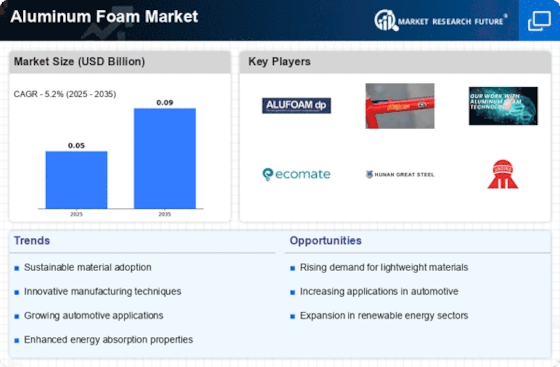
As per Market Research Future analysis, the Aluminum Foam Market Size was estimated at 0.0526 USD Billion in 2024. The Aluminum Foam industry is projected to grow from USD 0.0553 Billion in 2025 to USD 0.0919 Billion by 2035, exhibiting a compound annual growth rate (CAGR) of 5.2% during the forecast period 2025 - 2035

Key Market Trends & Highlights

The Aluminum Foam Market is poised for growth driven by sustainability and technological advancements.

  • North America remains the largest market for aluminum foam, driven by robust industrial applications. Asia-Pacific is emerging as the fastest-growing region, fueled by increasing demand in automotive and construction sectors. The Open Cell segment holds the largest market share, while the Closed Cell segment is experiencing rapid growth due to its unique properties. Key market drivers include sustainability initiatives and rising automotive applications, which are significantly influencing market dynamics.

Market Size & Forecast

2024 Market Size 0.0526 (USD Billion)
2035 Market Size 0.0919 (USD Billion)
CAGR (2025 - 2035) 5.2%
Largest Regional Market Share in 2024 North America

Major Players

Alufoam (DE), Cymat Technologies Ltd (CA), Duralcan (CA), Aluminum Foam Technologies (US), Ecomate (US), Hunan Great Steel Pipe (CN), Zhejiang Shuanglin Jiate Metal Technology (CN), Aluform (DE)

Market Trends

The Aluminum Foam Market is currently experiencing a notable transformation, driven by advancements in material science and increasing demand across various industries. This lightweight yet robust material is gaining traction in sectors such as automotive, aerospace, and construction, where its unique properties, including energy absorption and thermal insulation, are highly valued. As manufacturers seek to enhance product performance while reducing weight, aluminum foam presents an attractive solution within the expanding aluminum foam market. . Furthermore, the growing emphasis on sustainability and eco-friendly materials is likely to bolster the market, as aluminum foam is recyclable and contributes to energy efficiency in applications.

In addition to its mechanical advantages, the Aluminum Foam Market is witnessing innovations in production techniques, which may lead to cost reductions and improved scalability across the aluminum foam market. . Companies are exploring new methods to enhance the material's properties, such as increasing its strength-to-weight ratio and optimizing its cellular structure. This evolution could potentially open new avenues for application, further contributing to growth in the aluminum foam market size . As industries continue to prioritize lightweight materials that do not compromise on strength, the Aluminum Foam Market appears poised for growth, reflecting broader trends in material innovation and sustainability efforts across the globe.

Sustainability Focus

The Aluminum Foam Market is increasingly influenced by a shift towards sustainable practices. As industries prioritize eco-friendly materials, aluminum foam's recyclability and energy efficiency make it an appealing choice. This trend aligns with global efforts to reduce carbon footprints and promote sustainable manufacturing processes.

Technological Advancements

Innovations in production techniques are reshaping the Aluminum Foam Market. Enhanced manufacturing methods are likely to improve the material's properties, such as strength and thermal insulation. These advancements may facilitate broader applications, particularly in sectors demanding high-performance materials.

Growing Demand in Automotive Sector

The automotive industry is a significant driver of the Aluminum Foam Market. As manufacturers seek to reduce vehicle weight for improved fuel efficiency, aluminum foam's lightweight characteristics are becoming increasingly desirable. This trend suggests a potential increase in adoption within automotive applications.

Aluminum Foam Market Market Drivers

Technological Innovations

Technological innovations play a pivotal role in shaping the Aluminum Foam Market. Advances in manufacturing processes, such as improved foaming techniques and enhanced material properties, are driving the development of aluminum foam products. In 2025, the market is likely to benefit from innovations that enhance the strength-to-weight ratio of aluminum foams, making them more appealing for various applications. Additionally, the integration of automation and smart manufacturing technologies could streamline production, reducing costs and increasing efficiency. As industries continue to adopt these innovations, the Aluminum Foam Market may witness a surge in demand, particularly in sectors like aerospace and automotive, where performance and weight reduction are critical.

Construction Sector Growth

The Aluminum Foam Market is poised for growth, particularly within the construction sector. As urbanization accelerates, the demand for lightweight and durable building materials is on the rise. Aluminum foam, with its excellent thermal insulation and sound absorption properties, is increasingly being utilized in architectural applications. In 2025, the construction industry is projected to be a key driver of aluminum foam demand, as builders and architects seek materials that enhance energy efficiency and sustainability. The ability of aluminum foam to reduce overall building weight while maintaining structural integrity makes it an attractive option for modern construction projects. This trend suggests a promising outlook for the Aluminum Foam Market as it aligns with contemporary construction practices.

Sustainability Initiatives

The Aluminum Foam Market is experiencing a notable shift towards sustainability initiatives. As environmental concerns intensify, industries are increasingly seeking materials that minimize ecological footprints. Aluminum foam, known for its recyclability and lightweight properties, aligns well with these sustainability goals. In 2025, the demand for eco-friendly materials is projected to rise, with aluminum foam being a preferred choice in construction and automotive applications. This trend is further supported by regulatory frameworks promoting sustainable practices, which could enhance the market's growth. Companies that prioritize sustainable sourcing and production methods may find themselves at a competitive advantage, potentially leading to increased market share in the Aluminum Foam Market.

Rising Automotive Applications

The Aluminum Foam Market is witnessing a surge in demand driven by rising automotive applications. As the automotive sector increasingly focuses on lightweight materials to enhance fuel efficiency and reduce emissions, aluminum foam emerges as a viable solution. In 2025, the automotive industry is expected to account for a significant share of the aluminum foam market, with applications in crash protection, sound insulation, and structural components. The lightweight nature of aluminum foam not only contributes to improved vehicle performance but also aligns with regulatory pressures for lower emissions. This growing trend indicates a robust future for the Aluminum Foam Market, as manufacturers seek to innovate and incorporate aluminum foam into their designs.

Increased Research and Development

Increased research and development activities are significantly influencing the Aluminum Foam Market. As industries recognize the potential of aluminum foam, investments in R&D are expected to rise, leading to the discovery of new applications and enhancements in material properties. In 2025, ongoing research may focus on improving the mechanical properties and manufacturing processes of aluminum foam, potentially expanding its use in high-performance applications. This emphasis on innovation could result in the introduction of advanced aluminum foam products that cater to specific industry needs, thereby driving market growth. The commitment to R&D within the Aluminum Foam Market indicates a proactive approach to meeting evolving consumer demands and technological advancements.

Market Segment Insights

By Type: Open Cell (Largest) vs. Closed Cell (Fastest-Growing)

In the Aluminum Foam Market, open cell aluminum foam holds the largest market share due to its versatility and superior energy absorption properties, making it suitable for applications in automotive, aerospace, and construction. It allows for fluid and gas interchange, which contributes to its widespread adoption in various industrial applications. On the other hand, closed cell aluminum foam is gaining traction due to its lightweight and thermal insulation capabilities, allowing it to carve out a notable segment of the market.

Aluminum Foam Market: Open Cell (Dominant) vs. Closed Cell (Emerging)

Open cell aluminum foam is characterized by its interconnected pore structure, which not only enhances its structural integrity but also provides effective sound attenuation and energy absorption. This type is primarily used in applications requiring high damping and impact resistance, leading to its dominance in the market. Meanwhile, closed cell aluminum foam, with its sealed pores, offers superior buoyancy and thermal insulation, making it an emerging choice in specialized applications such as marine and HVAC systems. As industries strive for improved energy efficiency and performance, closed cell aluminum foam is expected to see accelerated growth.

By Application: Energy Absorber (Largest) vs. Heat Exchanger (Fastest-Growing)

In the Aluminum Foam Market, the application segment is primarily led by the Energy Absorber, which holds the largest share due to its extensive use in automotive and aerospace industries for safety applications. Following closely is the Heat Exchanger, which has gained significant traction owing to its efficiency in thermal management in various applications, including HVAC systems and renewable energy technologies. Other applications such as Filtration, Sound Insulation, and Others comprise the remaining market share, albeit with less dominance in comparison. The growth trends in the Aluminum Foam Market's application segment are driven by innovations in material science that enhance the performance characteristics of aluminum foams. The demand for lightweight and efficient materials in the automotive and construction sectors continues to escalate, pushing the Energy Absorber segment upward. Meanwhile, the Heat Exchanger market is emerging progressively, supported by increasing awareness of thermal efficiency and energy preservation standards across industries, making it the fastest-growing segment.

Energy Absorber: Dominant vs. Heat Exchanger: Emerging

The Energy Absorber segment is currently dominant in the Aluminum Foam Market, primarily due to its critical role in enhancing safety standards in automotive and aerospace applications. This segment's aluminum foams are designed to absorb energy during impacts, making vehicles and aircraft safer. In contrast, the Heat Exchanger segment is emerging with a focus on improving thermal efficiency. These foams provide enhanced surface area for heat exchange, contributing to improved performance in HVAC systems and renewable energy applications. As industries strive for sustainability and efficient energy usage, both segments are likely to see continued interest, but the Energy Absorber stands firm as the established leader.

By End-Use Industry: Automotive (Largest) vs. Aerospace and Defense (Fastest-Growing)

The Aluminum Foam Market shows a varied distribution of market share among its primary end-use industries. The automotive sector holds the largest share, driven by the increasing demand for lightweight materials to enhance fuel efficiency and reduce emissions. Notably, the aerospace and <a href="https://www.marketresearchfuture.com/reports/defense-market-34071" target="_blank" title="defense">defense</a> segment is witnessing significant growth, attributed to the rising need for advanced materials that meet stringent safety and performance requirements in aerospace applications. Growth trends in the aluminum foam market reflect a robust trajectory, particularly in the aerospace and defense sector, where technological advancements are propelling demand. Factors such as innovations in manufacturing processes and the material's unique properties, including energy absorption and lightweight characteristics, are driving the adoption in various applications. Furthermore, the ongoing developments in urbanization and infrastructure projects are expected to bolster demand across all end-use industries, particularly in construction and automotive applications.

Automotive: Dominant vs. Aerospace and Defense: Emerging

The automotive sector remains the dominant player in the aluminum foam market, leveraging the material's lightweight properties to enhance vehicle performance and energy efficiency. Manufacturers are increasingly utilizing aluminum foam to produce components that reduce overall weight without compromising structural integrity. This trend aligns with the automotive industry's push towards sustainability and the development of electric vehicles. On the other hand, the aerospace and defense sector is emerging rapidly, driven by the escalating demand for advanced, lightweight materials that can withstand harsh environments while maintaining high performance. Innovations in design and manufacturing techniques are expanding the use of aluminum foam in critical components, such as aircraft interiors and military applications, marking a significant shift towards advanced materials in this industry.

Get more detailed insights about Aluminum Foam Market Research Report - Global Forecast 2035

Regional Insights

North America : Innovation and Demand Surge

North America is witnessing significant growth in the aluminum foam market, driven by increasing demand in automotive and aerospace sectors. The region holds approximately 40% of the global market share, making it the largest market for aluminum foam. Regulatory support for lightweight materials and sustainability initiatives further catalyze this growth. The demand for energy-efficient and lightweight materials is pushing manufacturers to innovate and expand their product lines. The United States and Canada are the leading countries in this region, with key players like Cymat Technologies Ltd and Aluminum Foam Market Technologies leading the charge. The competitive landscape is characterized by a mix of established companies and emerging players, all vying for market share. The presence of advanced manufacturing facilities and R&D centers enhances the region's capability to produce high-quality aluminum foam products, catering to diverse applications across industries.

Europe : Sustainability and Innovation Focus

Europe is emerging as a significant player in the aluminum foam market, driven by stringent environmental regulations and a strong focus on sustainability. The region accounts for approximately 30% of the global market share, making it the second-largest market. Countries like Germany and the UK are leading this growth, with increasing investments in lightweight materials for automotive and construction applications. Regulatory frameworks promoting eco-friendly materials are acting as catalysts for market expansion. Germany is home to key players such as Alufoam and Aluform, which are at the forefront of innovation in aluminum foam technology. The competitive landscape is robust, with numerous companies focusing on R&D to enhance product performance and sustainability. The presence of advanced manufacturing capabilities and a skilled workforce further strengthens Europe's position in The Aluminum Foam Market.

Asia-Pacific : Emerging Markets and Growth Potential

Asia-Pacific is rapidly becoming a key player in the aluminum foam market, driven by industrialization and urbanization. The region holds approximately 25% of the global market share, with countries like China and India leading the charge. The demand for lightweight materials in automotive and construction sectors is propelling market growth. Government initiatives aimed at boosting manufacturing and infrastructure development are also significant growth drivers in this region. China is home to major players like Hunan Great Steel Pipe and Zhejiang Shuanglin Jiate Metal Technology, which are expanding their production capacities to meet rising demand. The competitive landscape is evolving, with both domestic and international companies vying for market share. The presence of a large consumer base and increasing investments in R&D are expected to further enhance the region's market position in the coming years.

Middle East and Africa : Resource-Rich and Growing Market

The Middle East and Africa region is witnessing gradual growth in the aluminum foam market, driven by increasing industrial activities and infrastructure development. The region holds approximately 5% of the global market share, with countries like South Africa and the UAE showing promising growth potential. The demand for lightweight materials in construction and automotive sectors is gradually increasing, supported by government initiatives to diversify economies and promote manufacturing. South Africa is emerging as a key player in this market, with local companies exploring aluminum foam applications in various industries. The competitive landscape is characterized by a mix of established firms and new entrants, all aiming to capitalize on the growing demand. The region's rich natural resources and strategic location further enhance its potential as a manufacturing hub for aluminum foam products.

Key Players and Competitive Insights

The Aluminum Foam Market is currently characterized by a dynamic competitive landscape, driven by innovation, sustainability, and strategic partnerships. Key players such as Cymat Technologies Ltd (CA), Duralcan (CA), and Aluminum Foam Market Technologies (US) are actively shaping the market through their distinct operational focuses. Cymat Technologies Ltd (CA) has positioned itself as a leader in the development of aluminum foam products, emphasizing lightweight materials for automotive and aerospace applications. Duralcan (CA) is leveraging its expertise in manufacturing to enhance product quality and expand its market reach, while Aluminum Foam Market Technologies (US) is focusing on technological advancements to improve production efficiency and product performance. Collectively, these strategies contribute to a competitive environment that prioritizes innovation and responsiveness to market demands.In terms of business tactics, companies are increasingly localizing manufacturing to reduce lead times and optimize supply chains. The Aluminum Foam Market appears moderately fragmented, with several players vying for market share. The collective influence of these key players is significant, as they not only drive technological advancements but also set industry standards that smaller companies may follow. This competitive structure fosters an environment where innovation is paramount, and companies must continuously adapt to maintain their market positions.
In August Cymat Technologies Ltd (CA) announced a strategic partnership with a leading automotive manufacturer to develop customized aluminum foam solutions for electric vehicles. This collaboration is expected to enhance the performance and safety of EVs, aligning with the growing demand for lightweight materials in the automotive sector. The strategic importance of this partnership lies in its potential to position Cymat as a key supplier in the rapidly evolving electric vehicle market, thereby expanding its customer base and reinforcing its market presence.
In September Duralcan (CA) unveiled a new production facility aimed at increasing its manufacturing capacity for aluminum foam products. This facility is expected to utilize advanced automation technologies, which could significantly enhance production efficiency and reduce operational costs. The establishment of this facility underscores Duralcan's commitment to meeting the rising demand for aluminum foam in various industries, including construction and transportation, while also improving its competitive edge through enhanced production capabilities.
In July Aluminum Foam Market Technologies (US) launched a new line of eco-friendly aluminum foam products designed to meet stringent environmental regulations. This initiative reflects a growing trend towards sustainability within the industry, as consumers and businesses increasingly prioritize environmentally responsible materials. The introduction of these products not only positions Aluminum Foam Market Technologies as a forward-thinking player in the market but also aligns with broader industry trends towards sustainable manufacturing practices.
As of October the Aluminum Foam Market is witnessing trends that emphasize digitalization, sustainability, and the integration of advanced technologies such as AI. Strategic alliances are becoming increasingly important, as companies seek to leverage complementary strengths to enhance their competitive positions. The shift from price-based competition to a focus on innovation, technology, and supply chain reliability is evident, suggesting that future competitive differentiation will hinge on the ability to deliver high-quality, sustainable products that meet evolving consumer demands.

Key Companies in the Aluminum Foam Market include

Industry Developments

In August 2024, tech start-up Apheros, which builds advanced cooling solutions for data centers, received USD 1.85 million from a funding round with a lead investment from the Founder. The money will help expand the company as it attempts to solve critical problems within the data center industry, such as high energy costs, infrastructure bottlenecks and sustainability issues. A major power increase per rack deployed means that cooling systems for data centers have to be designed much more efficiently, and Apheros’ proprietary metal foam technology has the capability of meeting that need.

In July 2024, ERG presented new lightweight structures, impact protection devices, and heat exchangers at the Small Satellite Conference. The new products are made with Duocel foam and provide excellent lightweightness, rigidity, and customization, which is perfect for stringent space missions.

In January 2024, Dunlop Aircraft Tyres presented the latest innovation in their range of foam aluminum tires, specifically targeted at use in aircrafts. The new technology involves a foam filling structure which provides increased strength and lowered weight, thereby giving Dunlop the lead in the aerospace race.

In March 2023, Desktop Metal, Inc. (toronto: DM), one of the largest companies in the world that deals with industrialization of 3D printing for mass production, and Sandvik Additive Manufacturing needed to work together. The world’s leading producer of gas atomized metal powders as well as the top 5 international car brands introduced copper alloy C18150 that was DM qualified for BJC 3D printing on the Production System.

In April 2022, CYMAT Technologies announced expansion and technological advancements. The company plans on achieving a gradual step increase to 75 million dollars of hyper-expansion alongside automation and technology implementations that are meant to drive costs down.

In April 2022, Alvotech and STADA SH announced their partnership to develop HUKYNDRA (AVT02), which is a citrate-free, high-concentration biosimilar. The partnership also includes several other biosimilars intended for autoimmune and cancer disorders.

Future Outlook

Aluminum Foam Market Future Outlook

The Aluminum Foam Market is projected to grow at a 5.2% CAGR from 2025 to 2035, driven by advancements in manufacturing technologies and increasing demand in automotive and aerospace sectors.

New opportunities lie in:

  • <p>Development of lightweight <a href="https://www.marketresearchfuture.com/reports/structural-components-market-17766" target="_blank" title="structural components">structural components</a> for electric vehicles Expansion into emerging markets with tailored product offerings Investment in R&amp;D for innovative applications in construction and packaging</p>

By 2035, the Aluminum Foam Market is expected to achieve robust growth and diversification.

Market Segmentation

Aluminum Foam Market Type Outlook

  • Open cell
  • Closed cell

Aluminum Foam Market Application Outlook

  • Energy Absorber
  • Heat Exchanger
  • Filtration
  • Sound Insulation
  • Others

Aluminum Foam Market End-Use Industry Outlook

  • Aerospace and Defense
  • Automotive
  • Building and Construction
  • Others

Report Scope

MARKET SIZE 2024 0.0526(USD Billion)
MARKET SIZE 2025 0.0553(USD Billion)
MARKET SIZE 2035 0.0919(USD Billion)
COMPOUND ANNUAL GROWTH RATE (CAGR) 5.2% (2025 - 2035)
REPORT COVERAGE Revenue Forecast, Competitive Landscape, Growth Factors, and Trends
BASE YEAR 2024
Market Forecast Period 2025 - 2035
Historical Data 2019 - 2024
Market Forecast Units USD Billion
Key Companies Profiled Alufoam (DE), Cymat Technologies Ltd (CA), Duralcan (CA), Aluminum Foam Technologies (US), Ecomate (US), Hunan Great Steel Pipe (CN), Zhejiang Shuanglin Jiate Metal Technology (CN), Aluform (DE)
Segments Covered Type, Application, End-Use Industry, Region
Key Market Opportunities Growing demand for lightweight materials in automotive and aerospace sectors drives Aluminum Foam Market expansion.
Key Market Dynamics Rising demand for lightweight materials drives innovation and competition in the aluminum foam market.
Countries Covered North America, Europe, APAC, South America, MEA

FAQs

What is the projected market valuation of the Aluminum Foam Market by 2035?

<p>The Aluminum Foam Market is projected to reach a valuation of 0.0919 USD Billion by 2035.</p>

What was the market valuation of the Aluminum Foam Market in 2024?

<p>In 2024, the Aluminum Foam Market had a valuation of 0.0526 USD Billion.</p>

What is the expected CAGR for the Aluminum Foam Market during the forecast period 2025 - 2035?

<p>The expected CAGR for the Aluminum Foam Market during the forecast period 2025 - 2035 is 5.2%.</p>

Which companies are considered key players in the Aluminum Foam Market?

<p>Key players in the Aluminum Foam Market include Alufoam, Cymat Technologies Ltd, Duralcan, and Aluminum Foam Technologies.</p>

What are the main types of aluminum foam segments and their valuations?

<p>The main types of aluminum foam segments are Open cell, valued at 0.025 to 0.042 USD Billion, and Closed cell, valued at 0.0276 to 0.0499 USD Billion.</p>

What applications are driving the Aluminum Foam Market growth?

<p>Applications driving growth include Energy Absorber, valued at 0.0158 to 0.0271 USD Billion, and Heat Exchanger, valued at 0.0126 to 0.0215 USD Billion.</p>

How does the Aluminum Foam Market perform in the aerospace and defense sector?

In the aerospace and defense sector, the Aluminum Foam Market is valued between 0.0125 and 0.0215 USD Billion.

What is the valuation range for the automotive segment in the Aluminum Foam Market?

The automotive segment in the Aluminum Foam Market is valued between 0.018 and 0.031 USD Billion.

What role does sound insulation play in the Aluminum Foam Market?

Sound insulation is a notable application in the Aluminum Foam Market, with a valuation range of 0.0095 to 0.0164 USD Billion.

What is the projected growth trend for the building and construction sector in the Aluminum Foam Market?

The building and construction sector is projected to grow, with a valuation range of 0.015 to 0.025 USD Billion.

  1. SECTION I: EXECUTIVE SUMMARY AND KEY HIGHLIGHTS
    1. | 1.1 EXECUTIVE SUMMARY
    2. | | 1.1.1 Market Overview
    3. | | 1.1.2 Key Findings
    4. | | 1.1.3 Market Segmentation
    5. | | 1.1.4 Competitive Landscape
    6. | | 1.1.5 Challenges and Opportunities
    7. | | 1.1.6 Future Outlook
  2. SECTION II: SCOPING, METHODOLOGY AND MARKET STRUCTURE
    1. | 2.1 MARKET INTRODUCTION
    2. | | 2.1.1 Definition
    3. | | 2.1.2 Scope of the study
    4. | | | 2.1.2.1 Research Objective
    5. | | | 2.1.2.2 Assumption
    6. | | | 2.1.2.3 Limitations
    7. | 2.2 RESEARCH METHODOLOGY
    8. | | 2.2.1 Overview
    9. | | 2.2.2 Data Mining
    10. | | 2.2.3 Secondary Research
    11. | | 2.2.4 Primary Research
    12. | | | 2.2.4.1 Primary Interviews and Information Gathering Process
    13. | | | 2.2.4.2 Breakdown of Primary Respondents
    14. | | 2.2.5 Forecasting Model
    15. | | 2.2.6 Market Size Estimation
    16. | | | 2.2.6.1 Bottom-Up Approach
    17. | | | 2.2.6.2 Top-Down Approach
    18. | | 2.2.7 Data Triangulation
    19. | | 2.2.8 Validation
  3. SECTION III: QUALITATIVE ANALYSIS
    1. | 3.1 MARKET DYNAMICS
    2. | | 3.1.1 Overview
    3. | | 3.1.2 Drivers
    4. | | 3.1.3 Restraints
    5. | | 3.1.4 Opportunities
    6. | 3.2 MARKET FACTOR ANALYSIS
    7. | | 3.2.1 Value chain Analysis
    8. | | 3.2.2 Porter's Five Forces Analysis
    9. | | | 3.2.2.1 Bargaining Power of Suppliers
    10. | | | 3.2.2.2 Bargaining Power of Buyers
    11. | | | 3.2.2.3 Threat of New Entrants
    12. | | | 3.2.2.4 Threat of Substitutes
    13. | | | 3.2.2.5 Intensity of Rivalry
    14. | | 3.2.3 COVID-19 Impact Analysis
    15. | | | 3.2.3.1 Market Impact Analysis
    16. | | | 3.2.3.2 Regional Impact
    17. | | | 3.2.3.3 Opportunity and Threat Analysis
  4. SECTION IV: QUANTITATIVE ANALYSIS
    1. | 4.1 Chemicals and Materials, BY Type (USD Billion)
    2. | | 4.1.1 Open cell
    3. | | 4.1.2 Closed cell
    4. | 4.2 Chemicals and Materials, BY Application (USD Billion)
    5. | | 4.2.1 Energy Absorber
    6. | | 4.2.2 Heat Exchanger
    7. | | 4.2.3 Filtration
    8. | | 4.2.4 Sound Insulation
    9. | | 4.2.5 Others
    10. | 4.3 Chemicals and Materials, BY End-Use Industry (USD Billion)
    11. | | 4.3.1 Aerospace and Defense
    12. | | 4.3.2 Automotive
    13. | | 4.3.3 Building and Construction
    14. | | 4.3.4 Others
    15. | 4.4 Chemicals and Materials, BY Region (USD Billion)
    16. | | 4.4.1 North America
    17. | | | 4.4.1.1 US
    18. | | | 4.4.1.2 Canada
    19. | | 4.4.2 Europe
    20. | | | 4.4.2.1 Germany
    21. | | | 4.4.2.2 UK
    22. | | | 4.4.2.3 France
    23. | | | 4.4.2.4 Russia
    24. | | | 4.4.2.5 Italy
    25. | | | 4.4.2.6 Spain
    26. | | | 4.4.2.7 Rest of Europe
    27. | | 4.4.3 APAC
    28. | | | 4.4.3.1 China
    29. | | | 4.4.3.2 India
    30. | | | 4.4.3.3 Japan
    31. | | | 4.4.3.4 South Korea
    32. | | | 4.4.3.5 Malaysia
    33. | | | 4.4.3.6 Thailand
    34. | | | 4.4.3.7 Indonesia
    35. | | | 4.4.3.8 Rest of APAC
    36. | | 4.4.4 South America
    37. | | | 4.4.4.1 Brazil
    38. | | | 4.4.4.2 Mexico
    39. | | | 4.4.4.3 Argentina
    40. | | | 4.4.4.4 Rest of South America
    41. | | 4.4.5 MEA
    42. | | | 4.4.5.1 GCC Countries
    43. | | | 4.4.5.2 South Africa
    44. | | | 4.4.5.3 Rest of MEA
  5. SECTION V: COMPETITIVE ANALYSIS
    1. | 5.1 Competitive Landscape
    2. | | 5.1.1 Overview
    3. | | 5.1.2 Competitive Analysis
    4. | | 5.1.3 Market share Analysis
    5. | | 5.1.4 Major Growth Strategy in the Chemicals and Materials
    6. | | 5.1.5 Competitive Benchmarking
    7. | | 5.1.6 Leading Players in Terms of Number of Developments in the Chemicals and Materials
    8. | | 5.1.7 Key developments and growth strategies
    9. | | | 5.1.7.1 New Product Launch/Service Deployment
    10. | | | 5.1.7.2 Merger & Acquisitions
    11. | | | 5.1.7.3 Joint Ventures
    12. | | 5.1.8 Major Players Financial Matrix
    13. | | | 5.1.8.1 Sales and Operating Income
    14. | | | 5.1.8.2 Major Players R&D Expenditure. 2023
    15. | 5.2 Company Profiles
    16. | | 5.2.1 Alufoam (DE)
    17. | | | 5.2.1.1 Financial Overview
    18. | | | 5.2.1.2 Products Offered
    19. | | | 5.2.1.3 Key Developments
    20. | | | 5.2.1.4 SWOT Analysis
    21. | | | 5.2.1.5 Key Strategies
    22. | | 5.2.2 Cymat Technologies Ltd (CA)
    23. | | | 5.2.2.1 Financial Overview
    24. | | | 5.2.2.2 Products Offered
    25. | | | 5.2.2.3 Key Developments
    26. | | | 5.2.2.4 SWOT Analysis
    27. | | | 5.2.2.5 Key Strategies
    28. | | 5.2.3 Duralcan (CA)
    29. | | | 5.2.3.1 Financial Overview
    30. | | | 5.2.3.2 Products Offered
    31. | | | 5.2.3.3 Key Developments
    32. | | | 5.2.3.4 SWOT Analysis
    33. | | | 5.2.3.5 Key Strategies
    34. | | 5.2.4 Aluminum Foam Technologies (US)
    35. | | | 5.2.4.1 Financial Overview
    36. | | | 5.2.4.2 Products Offered
    37. | | | 5.2.4.3 Key Developments
    38. | | | 5.2.4.4 SWOT Analysis
    39. | | | 5.2.4.5 Key Strategies
    40. | | 5.2.5 Ecomate (US)
    41. | | | 5.2.5.1 Financial Overview
    42. | | | 5.2.5.2 Products Offered
    43. | | | 5.2.5.3 Key Developments
    44. | | | 5.2.5.4 SWOT Analysis
    45. | | | 5.2.5.5 Key Strategies
    46. | | 5.2.6 Hunan Great Steel Pipe (CN)
    47. | | | 5.2.6.1 Financial Overview
    48. | | | 5.2.6.2 Products Offered
    49. | | | 5.2.6.3 Key Developments
    50. | | | 5.2.6.4 SWOT Analysis
    51. | | | 5.2.6.5 Key Strategies
    52. | | 5.2.7 Zhejiang Shuanglin Jiate Metal Technology (CN)
    53. | | | 5.2.7.1 Financial Overview
    54. | | | 5.2.7.2 Products Offered
    55. | | | 5.2.7.3 Key Developments
    56. | | | 5.2.7.4 SWOT Analysis
    57. | | | 5.2.7.5 Key Strategies
    58. | | 5.2.8 Aluform (DE)
    59. | | | 5.2.8.1 Financial Overview
    60. | | | 5.2.8.2 Products Offered
    61. | | | 5.2.8.3 Key Developments
    62. | | | 5.2.8.4 SWOT Analysis
    63. | | | 5.2.8.5 Key Strategies
    64. | 5.3 Appendix
    65. | | 5.3.1 References
    66. | | 5.3.2 Related Reports
  6. LIST OF FIGURES
    1. | 6.1 MARKET SYNOPSIS
    2. | 6.2 NORTH AMERICA MARKET ANALYSIS
    3. | 6.3 US MARKET ANALYSIS BY TYPE
    4. | 6.4 US MARKET ANALYSIS BY APPLICATION
    5. | 6.5 US MARKET ANALYSIS BY END-USE INDUSTRY
    6. | 6.6 CANADA MARKET ANALYSIS BY TYPE
    7. | 6.7 CANADA MARKET ANALYSIS BY APPLICATION
    8. | 6.8 CANADA MARKET ANALYSIS BY END-USE INDUSTRY
    9. | 6.9 EUROPE MARKET ANALYSIS
    10. | 6.10 GERMANY MARKET ANALYSIS BY TYPE
    11. | 6.11 GERMANY MARKET ANALYSIS BY APPLICATION
    12. | 6.12 GERMANY MARKET ANALYSIS BY END-USE INDUSTRY
    13. | 6.13 UK MARKET ANALYSIS BY TYPE
    14. | 6.14 UK MARKET ANALYSIS BY APPLICATION
    15. | 6.15 UK MARKET ANALYSIS BY END-USE INDUSTRY
    16. | 6.16 FRANCE MARKET ANALYSIS BY TYPE
    17. | 6.17 FRANCE MARKET ANALYSIS BY APPLICATION
    18. | 6.18 FRANCE MARKET ANALYSIS BY END-USE INDUSTRY
    19. | 6.19 RUSSIA MARKET ANALYSIS BY TYPE
    20. | 6.20 RUSSIA MARKET ANALYSIS BY APPLICATION
    21. | 6.21 RUSSIA MARKET ANALYSIS BY END-USE INDUSTRY
    22. | 6.22 ITALY MARKET ANALYSIS BY TYPE
    23. | 6.23 ITALY MARKET ANALYSIS BY APPLICATION
    24. | 6.24 ITALY MARKET ANALYSIS BY END-USE INDUSTRY
    25. | 6.25 SPAIN MARKET ANALYSIS BY TYPE
    26. | 6.26 SPAIN MARKET ANALYSIS BY APPLICATION
    27. | 6.27 SPAIN MARKET ANALYSIS BY END-USE INDUSTRY
    28. | 6.28 REST OF EUROPE MARKET ANALYSIS BY TYPE
    29. | 6.29 REST OF EUROPE MARKET ANALYSIS BY APPLICATION
    30. | 6.30 REST OF EUROPE MARKET ANALYSIS BY END-USE INDUSTRY
    31. | 6.31 APAC MARKET ANALYSIS
    32. | 6.32 CHINA MARKET ANALYSIS BY TYPE
    33. | 6.33 CHINA MARKET ANALYSIS BY APPLICATION
    34. | 6.34 CHINA MARKET ANALYSIS BY END-USE INDUSTRY
    35. | 6.35 INDIA MARKET ANALYSIS BY TYPE
    36. | 6.36 INDIA MARKET ANALYSIS BY APPLICATION
    37. | 6.37 INDIA MARKET ANALYSIS BY END-USE INDUSTRY
    38. | 6.38 JAPAN MARKET ANALYSIS BY TYPE
    39. | 6.39 JAPAN MARKET ANALYSIS BY APPLICATION
    40. | 6.40 JAPAN MARKET ANALYSIS BY END-USE INDUSTRY
    41. | 6.41 SOUTH KOREA MARKET ANALYSIS BY TYPE
    42. | 6.42 SOUTH KOREA MARKET ANALYSIS BY APPLICATION
    43. | 6.43 SOUTH KOREA MARKET ANALYSIS BY END-USE INDUSTRY
    44. | 6.44 MALAYSIA MARKET ANALYSIS BY TYPE
    45. | 6.45 MALAYSIA MARKET ANALYSIS BY APPLICATION
    46. | 6.46 MALAYSIA MARKET ANALYSIS BY END-USE INDUSTRY
    47. | 6.47 THAILAND MARKET ANALYSIS BY TYPE
    48. | 6.48 THAILAND MARKET ANALYSIS BY APPLICATION
    49. | 6.49 THAILAND MARKET ANALYSIS BY END-USE INDUSTRY
    50. | 6.50 INDONESIA MARKET ANALYSIS BY TYPE
    51. | 6.51 INDONESIA MARKET ANALYSIS BY APPLICATION
    52. | 6.52 INDONESIA MARKET ANALYSIS BY END-USE INDUSTRY
    53. | 6.53 REST OF APAC MARKET ANALYSIS BY TYPE
    54. | 6.54 REST OF APAC MARKET ANALYSIS BY APPLICATION
    55. | 6.55 REST OF APAC MARKET ANALYSIS BY END-USE INDUSTRY
    56. | 6.56 SOUTH AMERICA MARKET ANALYSIS
    57. | 6.57 BRAZIL MARKET ANALYSIS BY TYPE
    58. | 6.58 BRAZIL MARKET ANALYSIS BY APPLICATION
    59. | 6.59 BRAZIL MARKET ANALYSIS BY END-USE INDUSTRY
    60. | 6.60 MEXICO MARKET ANALYSIS BY TYPE
    61. | 6.61 MEXICO MARKET ANALYSIS BY APPLICATION
    62. | 6.62 MEXICO MARKET ANALYSIS BY END-USE INDUSTRY
    63. | 6.63 ARGENTINA MARKET ANALYSIS BY TYPE
    64. | 6.64 ARGENTINA MARKET ANALYSIS BY APPLICATION
    65. | 6.65 ARGENTINA MARKET ANALYSIS BY END-USE INDUSTRY
    66. | 6.66 REST OF SOUTH AMERICA MARKET ANALYSIS BY TYPE
    67. | 6.67 REST OF SOUTH AMERICA MARKET ANALYSIS BY APPLICATION
    68. | 6.68 REST OF SOUTH AMERICA MARKET ANALYSIS BY END-USE INDUSTRY
    69. | 6.69 MEA MARKET ANALYSIS
    70. | 6.70 GCC COUNTRIES MARKET ANALYSIS BY TYPE
    71. | 6.71 GCC COUNTRIES MARKET ANALYSIS BY APPLICATION
    72. | 6.72 GCC COUNTRIES MARKET ANALYSIS BY END-USE INDUSTRY
    73. | 6.73 SOUTH AFRICA MARKET ANALYSIS BY TYPE
    74. | 6.74 SOUTH AFRICA MARKET ANALYSIS BY APPLICATION
    75. | 6.75 SOUTH AFRICA MARKET ANALYSIS BY END-USE INDUSTRY
    76. | 6.76 REST OF MEA MARKET ANALYSIS BY TYPE
    77. | 6.77 REST OF MEA MARKET ANALYSIS BY APPLICATION
    78. | 6.78 REST OF MEA MARKET ANALYSIS BY END-USE INDUSTRY
    79. | 6.79 KEY BUYING CRITERIA OF CHEMICALS AND MATERIALS
    80. | 6.80 RESEARCH PROCESS OF MRFR
    81. | 6.81 DRO ANALYSIS OF CHEMICALS AND MATERIALS
    82. | 6.82 DRIVERS IMPACT ANALYSIS: CHEMICALS AND MATERIALS
    83. | 6.83 RESTRAINTS IMPACT ANALYSIS: CHEMICALS AND MATERIALS
    84. | 6.84 SUPPLY / VALUE CHAIN: CHEMICALS AND MATERIALS
    85. | 6.85 CHEMICALS AND MATERIALS, BY TYPE, 2024 (% SHARE)
    86. | 6.86 CHEMICALS AND MATERIALS, BY TYPE, 2024 TO 2035 (USD Billion)
    87. | 6.87 CHEMICALS AND MATERIALS, BY APPLICATION, 2024 (% SHARE)
    88. | 6.88 CHEMICALS AND MATERIALS, BY APPLICATION, 2024 TO 2035 (USD Billion)
    89. | 6.89 CHEMICALS AND MATERIALS, BY END-USE INDUSTRY, 2024 (% SHARE)
    90. | 6.90 CHEMICALS AND MATERIALS, BY END-USE INDUSTRY, 2024 TO 2035 (USD Billion)
    91. | 6.91 BENCHMARKING OF MAJOR COMPETITORS
  7. LIST OF TABLES
    1. | 7.1 LIST OF ASSUMPTIONS
    2. | | 7.1.1
    3. | 7.2 North America MARKET SIZE ESTIMATES; FORECAST
    4. | | 7.2.1 BY TYPE, 2025-2035 (USD Billion)
    5. | | 7.2.2 BY APPLICATION, 2025-2035 (USD Billion)
    6. | | 7.2.3 BY END-USE INDUSTRY, 2025-2035 (USD Billion)
    7. | 7.3 US MARKET SIZE ESTIMATES; FORECAST
    8. | | 7.3.1 BY TYPE, 2025-2035 (USD Billion)
    9. | | 7.3.2 BY APPLICATION, 2025-2035 (USD Billion)
    10. | | 7.3.3 BY END-USE INDUSTRY, 2025-2035 (USD Billion)
    11. | 7.4 Canada MARKET SIZE ESTIMATES; FORECAST
    12. | | 7.4.1 BY TYPE, 2025-2035 (USD Billion)
    13. | | 7.4.2 BY APPLICATION, 2025-2035 (USD Billion)
    14. | | 7.4.3 BY END-USE INDUSTRY, 2025-2035 (USD Billion)
    15. | 7.5 Europe MARKET SIZE ESTIMATES; FORECAST
    16. | | 7.5.1 BY TYPE, 2025-2035 (USD Billion)
    17. | | 7.5.2 BY APPLICATION, 2025-2035 (USD Billion)
    18. | | 7.5.3 BY END-USE INDUSTRY, 2025-2035 (USD Billion)
    19. | 7.6 Germany MARKET SIZE ESTIMATES; FORECAST
    20. | | 7.6.1 BY TYPE, 2025-2035 (USD Billion)
    21. | | 7.6.2 BY APPLICATION, 2025-2035 (USD Billion)
    22. | | 7.6.3 BY END-USE INDUSTRY, 2025-2035 (USD Billion)
    23. | 7.7 UK MARKET SIZE ESTIMATES; FORECAST
    24. | | 7.7.1 BY TYPE, 2025-2035 (USD Billion)
    25. | | 7.7.2 BY APPLICATION, 2025-2035 (USD Billion)
    26. | | 7.7.3 BY END-USE INDUSTRY, 2025-2035 (USD Billion)
    27. | 7.8 France MARKET SIZE ESTIMATES; FORECAST
    28. | | 7.8.1 BY TYPE, 2025-2035 (USD Billion)
    29. | | 7.8.2 BY APPLICATION, 2025-2035 (USD Billion)
    30. | | 7.8.3 BY END-USE INDUSTRY, 2025-2035 (USD Billion)
    31. | 7.9 Russia MARKET SIZE ESTIMATES; FORECAST
    32. | | 7.9.1 BY TYPE, 2025-2035 (USD Billion)
    33. | | 7.9.2 BY APPLICATION, 2025-2035 (USD Billion)
    34. | | 7.9.3 BY END-USE INDUSTRY, 2025-2035 (USD Billion)
    35. | 7.10 Italy MARKET SIZE ESTIMATES; FORECAST
    36. | | 7.10.1 BY TYPE, 2025-2035 (USD Billion)
    37. | | 7.10.2 BY APPLICATION, 2025-2035 (USD Billion)
    38. | | 7.10.3 BY END-USE INDUSTRY, 2025-2035 (USD Billion)
    39. | 7.11 Spain MARKET SIZE ESTIMATES; FORECAST
    40. | | 7.11.1 BY TYPE, 2025-2035 (USD Billion)
    41. | | 7.11.2 BY APPLICATION, 2025-2035 (USD Billion)
    42. | | 7.11.3 BY END-USE INDUSTRY, 2025-2035 (USD Billion)
    43. | 7.12 Rest of Europe MARKET SIZE ESTIMATES; FORECAST
    44. | | 7.12.1 BY TYPE, 2025-2035 (USD Billion)
    45. | | 7.12.2 BY APPLICATION, 2025-2035 (USD Billion)
    46. | | 7.12.3 BY END-USE INDUSTRY, 2025-2035 (USD Billion)
    47. | 7.13 APAC MARKET SIZE ESTIMATES; FORECAST
    48. | | 7.13.1 BY TYPE, 2025-2035 (USD Billion)
    49. | | 7.13.2 BY APPLICATION, 2025-2035 (USD Billion)
    50. | | 7.13.3 BY END-USE INDUSTRY, 2025-2035 (USD Billion)
    51. | 7.14 China MARKET SIZE ESTIMATES; FORECAST
    52. | | 7.14.1 BY TYPE, 2025-2035 (USD Billion)
    53. | | 7.14.2 BY APPLICATION, 2025-2035 (USD Billion)
    54. | | 7.14.3 BY END-USE INDUSTRY, 2025-2035 (USD Billion)
    55. | 7.15 India MARKET SIZE ESTIMATES; FORECAST
    56. | | 7.15.1 BY TYPE, 2025-2035 (USD Billion)
    57. | | 7.15.2 BY APPLICATION, 2025-2035 (USD Billion)
    58. | | 7.15.3 BY END-USE INDUSTRY, 2025-2035 (USD Billion)
    59. | 7.16 Japan MARKET SIZE ESTIMATES; FORECAST
    60. | | 7.16.1 BY TYPE, 2025-2035 (USD Billion)
    61. | | 7.16.2 BY APPLICATION, 2025-2035 (USD Billion)
    62. | | 7.16.3 BY END-USE INDUSTRY, 2025-2035 (USD Billion)
    63. | 7.17 South Korea MARKET SIZE ESTIMATES; FORECAST
    64. | | 7.17.1 BY TYPE, 2025-2035 (USD Billion)
    65. | | 7.17.2 BY APPLICATION, 2025-2035 (USD Billion)
    66. | | 7.17.3 BY END-USE INDUSTRY, 2025-2035 (USD Billion)
    67. | 7.18 Malaysia MARKET SIZE ESTIMATES; FORECAST
    68. | | 7.18.1 BY TYPE, 2025-2035 (USD Billion)
    69. | | 7.18.2 BY APPLICATION, 2025-2035 (USD Billion)
    70. | | 7.18.3 BY END-USE INDUSTRY, 2025-2035 (USD Billion)
    71. | 7.19 Thailand MARKET SIZE ESTIMATES; FORECAST
    72. | | 7.19.1 BY TYPE, 2025-2035 (USD Billion)
    73. | | 7.19.2 BY APPLICATION, 2025-2035 (USD Billion)
    74. | | 7.19.3 BY END-USE INDUSTRY, 2025-2035 (USD Billion)
    75. | 7.20 Indonesia MARKET SIZE ESTIMATES; FORECAST
    76. | | 7.20.1 BY TYPE, 2025-2035 (USD Billion)
    77. | | 7.20.2 BY APPLICATION, 2025-2035 (USD Billion)
    78. | | 7.20.3 BY END-USE INDUSTRY, 2025-2035 (USD Billion)
    79. | 7.21 Rest of APAC MARKET SIZE ESTIMATES; FORECAST
    80. | | 7.21.1 BY TYPE, 2025-2035 (USD Billion)
    81. | | 7.21.2 BY APPLICATION, 2025-2035 (USD Billion)
    82. | | 7.21.3 BY END-USE INDUSTRY, 2025-2035 (USD Billion)
    83. | 7.22 South America MARKET SIZE ESTIMATES; FORECAST
    84. | | 7.22.1 BY TYPE, 2025-2035 (USD Billion)
    85. | | 7.22.2 BY APPLICATION, 2025-2035 (USD Billion)
    86. | | 7.22.3 BY END-USE INDUSTRY, 2025-2035 (USD Billion)
    87. | 7.23 Brazil MARKET SIZE ESTIMATES; FORECAST
    88. | | 7.23.1 BY TYPE, 2025-2035 (USD Billion)
    89. | | 7.23.2 BY APPLICATION, 2025-2035 (USD Billion)
    90. | | 7.23.3 BY END-USE INDUSTRY, 2025-2035 (USD Billion)
    91. | 7.24 Mexico MARKET SIZE ESTIMATES; FORECAST
    92. | | 7.24.1 BY TYPE, 2025-2035 (USD Billion)
    93. | | 7.24.2 BY APPLICATION, 2025-2035 (USD Billion)
    94. | | 7.24.3 BY END-USE INDUSTRY, 2025-2035 (USD Billion)
    95. | 7.25 Argentina MARKET SIZE ESTIMATES; FORECAST
    96. | | 7.25.1 BY TYPE, 2025-2035 (USD Billion)
    97. | | 7.25.2 BY APPLICATION, 2025-2035 (USD Billion)
    98. | | 7.25.3 BY END-USE INDUSTRY, 2025-2035 (USD Billion)
    99. | 7.26 Rest of South America MARKET SIZE ESTIMATES; FORECAST
    100. | | 7.26.1 BY TYPE, 2025-2035 (USD Billion)
    101. | | 7.26.2 BY APPLICATION, 2025-2035 (USD Billion)
    102. | | 7.26.3 BY END-USE INDUSTRY, 2025-2035 (USD Billion)
    103. | 7.27 MEA MARKET SIZE ESTIMATES; FORECAST
    104. | | 7.27.1 BY TYPE, 2025-2035 (USD Billion)
    105. | | 7.27.2 BY APPLICATION, 2025-2035 (USD Billion)
    106. | | 7.27.3 BY END-USE INDUSTRY, 2025-2035 (USD Billion)
    107. | 7.28 GCC Countries MARKET SIZE ESTIMATES; FORECAST
    108. | | 7.28.1 BY TYPE, 2025-2035 (USD Billion)
    109. | | 7.28.2 BY APPLICATION, 2025-2035 (USD Billion)
    110. | | 7.28.3 BY END-USE INDUSTRY, 2025-2035 (USD Billion)
    111. | 7.29 South Africa MARKET SIZE ESTIMATES; FORECAST
    112. | | 7.29.1 BY TYPE, 2025-2035 (USD Billion)
    113. | | 7.29.2 BY APPLICATION, 2025-2035 (USD Billion)
    114. | | 7.29.3 BY END-USE INDUSTRY, 2025-2035 (USD Billion)
    115. | 7.30 Rest of MEA MARKET SIZE ESTIMATES; FORECAST
    116. | | 7.30.1 BY TYPE, 2025-2035 (USD Billion)
    117. | | 7.30.2 BY APPLICATION, 2025-2035 (USD Billion)
    118. | | 7.30.3 BY END-USE INDUSTRY, 2025-2035 (USD Billion)
    119. | 7.31 PRODUCT LAUNCH/PRODUCT DEVELOPMENT/APPROVAL
    120. | | 7.31.1
    121. | 7.32 ACQUISITION/PARTNERSHIP
    122. | | 7.32.1

Chemicals and Materials Market Segmentation

Chemicals and Materials By Type (USD Billion, 2025-2035)

  • Open cell
  • Closed cell

Chemicals and Materials By Application (USD Billion, 2025-2035)

  • Energy Absorber
  • Heat Exchanger
  • Filtration
  • Sound Insulation
  • Others

Chemicals and Materials By End-Use Industry (USD Billion, 2025-2035)

  • Aerospace and Defense
  • Automotive
  • Building and Construction
  • Others
Infographic

Free Sample Request

Kindly complete the form below to receive a free sample of this Report

Get Free Sample

Customer Strories

Compare Licence

×
Features License Type
Single User Multiuser License Enterprise User
Price $4,950 $5,950 $7,250
Maximum User Access Limit 1 User Upto 10 Users Unrestricted Access Throughout the Organization
Free Customization
Direct Access to Analyst
Deliverable Format
Platform Access
Discount on Next Purchase 10% 15% 15%
Printable Versions
%>