


Market Trends
Key Emerging Trends in the Aluminum Foam Market
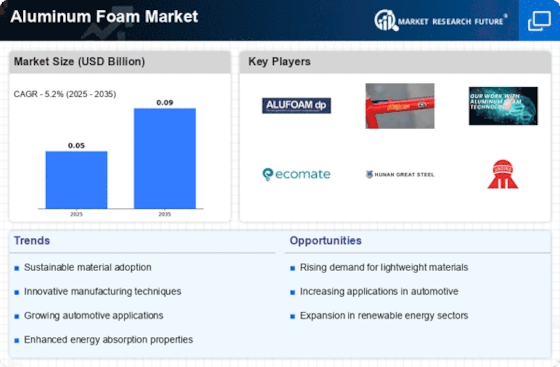
Aluminum foam is facing the major adjustments and trends that are reshaping its market. In all industries, the trend toward lightweight materials fuels a rush for aluminum foam. Aluminum foam with its high strength-to-weight ratio, is an extremely light material and can easily be found in planes, cars and construction. The increasing preference of the automobile industry for aluminum foam is one of its biggest market factors. In order to save weight, improve fuel economy and attain strict emissions requirements, automakers use this material. This trend seems to have staying power, as the global automotive industry is currently going through a shift toward electric and hybrid cars. Nevertheless, the structure of aluminum foam makes it ideally suited for efficient acoustic and vibration damping applications. This reduces noise and vibration in all kinds of applications, from cars to industrial machinery. Typically it improves the overall performance of products as well. With the recent surge of interest in additive manufacturing, and with it metal foam additive manufacturing (MFAM), demand for aluminum foam is on the rise. With this technology, complex geometries and lightweight structures are possible, both of which are fundamentals for the application of aluminum foam in many fields. Awareness of sustainable development and environmental protection has become more refined, diverting industries towards ecological products. Aluminum foam, which is both recyclable and has an energy-efficient production process. Many companies from a broad range of industries find this highly encouraging to integrate aluminum foam into their manufacturing processes and products. The market is plagued with the costs of production and manufacturing complexities. But high initial production costs may limit its extent of use. Overcoming these difficulties is of great significance to further development of the aluminum foam market. New processes for producing foam include both powder metallurgy and melt infiltration, which further increase market demand. Such breakthroughs enable mass production of aluminum foam economically and efficiently, improving structural strength as well as tailoring properties. Aluminum foam has thus made its way into consumer electronics and gizmos. It shows its potential to prolong the life and enrich the look of consumer products in lightweight, shock-resistant casings for smartphones, laptops and other electrical devices.

























Leave a Comment