
×
Hero Background
English
Chinese
French
Japanese
Korean
German
Spanish

Aircraft Fairings Market Share

ID: MRFR/AD/8676-HCR
168 Pages
Sejal Akre
October 2025

Aircraft Fairings Market Research Report Information By End User (OEM and Aftermarket), Application (Cockpit, Fuselage, Engine, Landing Gear, Flight Control Surface, Wings and Nose), Platform (Commercial and Military), Material (Composite, Metallic and Others) and Region (North America, Europe, Asia-Pacific and the Rest of the World) - Forecast till 2035

Share:
Download PDF ×

We do not share your information with anyone. However, we may send you emails based on your report interest from time to time. You may contact us at any time to opt-out.

Aircraft Fairings Market Infographic
Purchase Options

Market Share

Aircraft Fairings Market Share Analysis

The aircraft fairings market is a very important branch of the aviation industry that has grown impressively over the last period of time. Players in this market are using various positioning strategies in order to get an advantage over their competitors. One of such approaches is product differentiation whereby manufacturers of aircraft fairings establish unique and revolutionary designs which contribute to better aerodynamics, fuel economy and overall performance. The aim of many companies is obtaining competitive edge by offering features and benefits that appeal to airframe manufacturers and operators seeking cutting-edge solutions.

In turn, cost leadership represents another significant strategy observed in the aircraft fairings sector. Some firms focus on manufacturing cost effective products by minimizing production costs and optimizing supply chains while maintaining quality standards. This approach aims at acquiring a wide customer base especially in terms of the aerospace industry where cost consideration matter so much.Consequently, these organizations will be able to avail their products at reasonable prices.

Moreover, partnerships with other players within the Aircraft Fairings sector greatly influence successful market positioning. Strategic alliances are often formed between manufacturers and airlines or other stakeholders from within aviation domain enabling producers understand needs and requirements for clients resulting into customized solutions. Partnerships also ensure a seamless integration between different craft models thus enhancing value proposition as well as compatibility.

Moreover, other firms opt for market penetration as a way of gaining competitive advantage through enlarging their shareholding capacity among others entering new markets or increasing their presence in existing ones. Looking at rapidly growing global aviation business, those participating in Aircraft Fairings strive towards emerging markets with increased demand for airplane parts. Comprehensive knowledge about regional regulations, client tastes and preferences as well as competition around them is required when one plans strategic market penetration.

Also notable is how customer-centered strategies have been used strategically to place companies within different positions in the Aircraft Fairings industry space through careful evaluation of post-sale support services customer warranty programs as well as supply chain logistics systems among others.Creating solid relationships with aircraft manufacturers and operators helps in building loyalty that can result into repeat business. Customer feedbacks as well as the company’s continuous improvement efforts are to build a good image within the market.

Evidently, innovation is a key driver behind activities within the Aircraft Fairings markets whereby firms have invested heavily on Research and Development to remain ahead of this competition. Continuous improvements lead to light weight materials, advanced production methods and environmentally friendly solutions too. These developments enable them not only to capture new customers but also become industry leaders in providing high-tech solutions that meet or exceed industry standards.

Regulatory compliance is a very important aspect of market positioning when it comes to shares in Aircraft Fairings.Every company must ensure its products comply with aviation regulations and safety aspects.Thus compliance ensures credibility of the firm among other players on the market and customer trust about quality of such fairings."


Author
Sejal Akre
Senior Research Analyst

She has over 5 years of rich experience, in market research and consulting providing valuable market insights to client. Hands on expertise in management consulting, and extensive knowledge in domain including ICT, Automotive & Transportation and Aerospace & Defense. She is skilled in Go-to market strategy, industry analysis, market sizing, in depth company profiling, competitive intelligence & benchmarking and value chain amongst others.

Leave a Comment

FAQs

What is the CAGR of the aerospace 3D printing market?

Aerospace 3D printing market register a CAGR of 7.31% by 2020-2030

Who are aerospace 3D printing market key players?

FACC AG (Austria), Strata Manufacturing (UAE), and ShinMaywa Industries, Ltd. (Japan) are some well-established aerospace 3D printing market players.

What can drive the aerospace 3D printing market?

Increase in commercial applications of aerospace 3D printing solutions can drive the aerospace 3D printing market.

In which region is aerospace 3D printing market expected to thrive?

North America advanced 3D printer can thrive in the years to come.

Market Summary

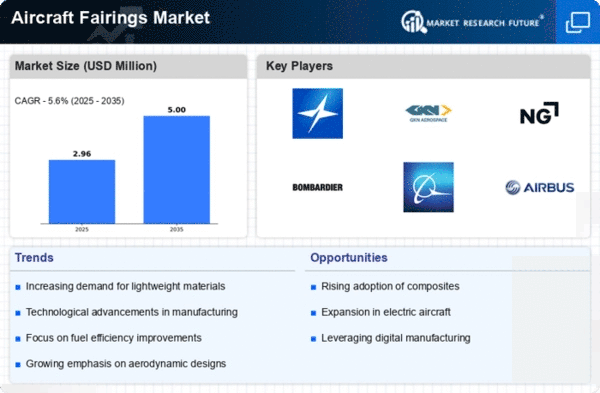
As per MRFR analysis, the Aircraft Fairings Market Size was estimated at 2.8 USD Million in 2024. The Aircraft Fairings industry is projected to grow from 2.9 in 2025 to 5.0 by 2035, exhibiting a compound annual growth rate (CAGR) of 5.6 during the forecast period 2025 - 2035.

Key Market Trends & Highlights

The Aircraft Fairings Market is poised for growth driven by technological advancements and sustainability initiatives.

  • North America remains the largest market for aircraft fairings, driven by a robust commercial aviation sector.
  • The Asia-Pacific region is emerging as the fastest-growing market, fueled by increasing investments in aviation infrastructure.
  • The commercial aviation segment dominates the market, while the military aviation segment is experiencing rapid growth.
  • Key market drivers include the rising demand for lightweight materials and the need for regulatory compliance and safety standards.

Market Size & Forecast

2024 Market Size 2.8 (USD Million)
2035 Market Size 5.0 (USD Million)
CAGR (2025 - 2035) 5.6%
Largest Regional Market Share in 2024 North America

Major Players

<p>Spirit AeroSystems (US), GKN Aerospace (GB), Northrop Grumman (US), Bombardier (CA), Boeing (US), Airbus (FR), Leonardo (IT), FACC (AT), Meggitt (GB)</p>

Market Trends

The Aircraft Fairings Market is currently experiencing a dynamic phase characterized by evolving technological advancements and increasing demand for fuel-efficient aircraft. As manufacturers strive to enhance aerodynamic performance, the integration of advanced materials and innovative designs is becoming more prevalent. This shift not only improves the overall efficiency of aircraft but also contributes to reduced operational costs. Furthermore, the growing emphasis on sustainability within the aviation sector is prompting companies to explore eco-friendly materials, which may reshape product offerings in the near future. In addition to technological innovations, the Aircraft Fairings Market is influenced by the rising number of air travel passengers and the expansion of commercial aviation. This trend suggests a potential increase in aircraft production, thereby driving the demand for fairings. Moreover, the market appears to be benefiting from strategic collaborations and partnerships among key players, which could enhance competitive positioning and foster growth. As the industry continues to evolve, stakeholders must remain vigilant to adapt to changing consumer preferences and regulatory requirements, ensuring they maintain relevance in this competitive landscape.

Technological Advancements

The Aircraft Fairings Market is witnessing a surge in technological innovations aimed at enhancing performance and efficiency. Manufacturers are increasingly adopting advanced materials and design techniques to improve aerodynamics, which may lead to reduced fuel consumption and operational costs.

Sustainability Initiatives

There is a growing focus on sustainability within the Aircraft Fairings Market, as companies explore eco-friendly materials and production processes. This trend indicates a shift towards greener practices, potentially influencing product development and market dynamics.

Expansion of Commercial Aviation

The rising number of air travel passengers is driving the expansion of commercial aviation, which in turn fuels demand for new aircraft. This trend suggests a corresponding increase in the need for aircraft fairings, as manufacturers ramp up production to meet market needs.

Aircraft Fairings Market Market Drivers

Market Growth Projections

The Global Aircraft Fairings Market Industry is projected to experience substantial growth in the coming years. With an estimated market value of 1.96 USD Billion in 2024, the industry is on a trajectory towards reaching 3.25 USD Billion by 2035. This growth is indicative of the increasing demand for aircraft fairings driven by advancements in technology, regulatory compliance, and the expansion of the aerospace sector. The anticipated CAGR of 4.7% from 2025 to 2035 further underscores the market's potential as it adapts to evolving industry needs and consumer preferences.

Expansion of the Aerospace Industry

The expansion of the aerospace industry is a pivotal driver for the Global Aircraft Fairings Market Industry. As global air travel continues to rise, driven by increasing passenger demand and cargo transport, the need for new aircraft and retrofitting existing ones becomes paramount. This growth in the aerospace sector directly correlates with the demand for aircraft fairings, as they play a crucial role in enhancing aerodynamic efficiency and reducing drag. The market is poised for growth, with estimates suggesting it could reach 3.25 USD Billion by 2035, reflecting the robust expansion of the aerospace industry and its impact on related components.

Focus on Environmental Sustainability

The Global Aircraft Fairings Market Industry is increasingly shaped by a focus on environmental sustainability. As the aviation sector faces pressure to reduce its carbon footprint, manufacturers are exploring eco-friendly materials and production methods. This shift towards sustainability not only addresses regulatory requirements but also aligns with consumer preferences for greener travel options. The development of fairings that utilize recyclable materials or have a lower environmental impact is becoming a priority. This trend is likely to drive innovation and investment in sustainable practices, contributing to the overall growth of the market as it adapts to the evolving landscape of environmental responsibility.

Regulatory Compliance and Safety Standards

The Global Aircraft Fairings Market Industry is significantly influenced by stringent regulatory compliance and safety standards imposed by aviation authorities. These regulations necessitate the use of high-quality materials and manufacturing practices to ensure the safety and reliability of aircraft components. As airlines and manufacturers strive to meet these standards, there is a growing demand for fairings that comply with international safety regulations. This focus on compliance not only enhances the safety of air travel but also drives innovation in fairing design and materials. Consequently, the market is expected to experience steady growth, with a projected CAGR of 4.7% from 2025 to 2035.

Increasing Demand for Lightweight Materials

The Global Aircraft Fairings Market Industry is witnessing a notable shift towards lightweight materials, driven by the aviation sector's emphasis on fuel efficiency and performance. Manufacturers are increasingly adopting advanced composites and polymers, which contribute to weight reduction without compromising structural integrity. This trend aligns with the industry's goal to enhance fuel economy, as lighter aircraft require less energy to operate. The integration of these materials is projected to support the market's growth, with the industry expected to reach 1.96 USD Billion in 2024, reflecting a growing preference for innovative solutions that optimize aircraft design and operational efficiency.

Technological Advancements in Manufacturing Processes

Technological innovations in manufacturing processes are significantly influencing the Global Aircraft Fairings Market Industry. The adoption of automated production techniques, such as 3D printing and advanced robotics, enhances precision and reduces lead times. These advancements allow manufacturers to produce complex fairing designs that were previously unattainable, thereby improving aerodynamic performance. As the industry evolves, the incorporation of smart manufacturing technologies is likely to streamline operations and reduce costs. This shift is anticipated to contribute to the market's expansion, with projections indicating a growth trajectory towards 3.25 USD Billion by 2035, highlighting the importance of technological integration in the sector.

Market Segment Insights

By Application: Commercial Aviation (Largest) vs. Military Aviation (Fastest-Growing)

<p>The Aircraft Fairings Market is primarily segmented into Commercial Aviation, Military Aviation, General Aviation, and Cargo Aviation. Among these, Commercial Aviation holds the largest market share due to the rising demand for air travel and the need for more fuel-efficient aircraft. Military Aviation, on the other hand, is emerging rapidly, attributed to increasing defense budgets and modernization of aircraft in various countries. General Aviation and Cargo Aviation hold smaller shares, but they are also essential components of the fairings market.</p>

<p>Commercial Aviation (Dominant) vs. Military Aviation (Emerging)</p>

<p>Commercial Aviation is the dominant segment in the Aircraft Fairings Market, driven by the increasing global air traffic and the demand for innovative aircraft designs that enhance operational efficiency. This segment significantly influences advancements in fairing designs, promoting lightweight materials that improve fuel efficiency and reduce operational costs. Military Aviation, while currently smaller in market share, is classified as an emerging segment due to rising geopolitical tensions and the need for advanced military aircraft. Investments in modern military aircraft and associated technologies fuel this segment's growth, as nations upgrade their fleets to enhance performance and survivability. Both segments showcase distinct characteristics, with Commercial Aviation focusing on passenger comfort and efficiency, while Military Aviation prioritizes advanced capabilities and tactical performance.</p>

By Material Type: Composite Materials (Largest) vs. Metallic Materials (Fastest-Growing)

<p>In the Aircraft Fairings Market, the distribution of market share among material types reveals that composite materials dominate significantly due to their lightweight and high-performance characteristics. Composite materials offer superior strength-to-weight ratios, making them the preferred choice for manufacturers seeking to enhance fuel efficiency and aerodynamic performance. Following closely are metallic materials, which, while not as dominant, are gaining traction due to advancements in manufacturing processes that improve their utility in aerospace applications. Growth trends in the market indicate a robust shift towards composite materials, which are continuously improved through research, leading to enhanced durability and functionality. Meanwhile, metallic materials are experiencing rapid growth due to increasing investments in technologically advanced alloys that can withstand extreme conditions. Additionally, environmental regulations are driving the demand for innovative material solutions, with hybrid materials also emerging as a relevant category, offering the advantages of both metals and composites.</p>

<p>Composite Materials (Dominant) vs. Hybrid Materials (Emerging)</p>

<p>Composite materials are the dominant force in the Aircraft Fairings Market, characterized by their exceptional strength and lightweight properties that contribute to overall aircraft efficiency. They are primarily used in high-performance applications, allowing manufacturers to optimize designs for weight savings and enhance fuel consumption. In contrast, hybrid materials emerge as a notable contender, combining the strengths of both composite and metallic properties. This hybridization approach offers the potential for reduced manufacturing costs while maintaining performance standards. As the industry evolves, hybrid materials are beginning to find their niche in applications where versatility and adaptability are critical, indicating a growing trend towards innovation in material sciences.</p>

By Fairing Type: Nose Fairings (Largest) vs. Tail Fairings (Fastest-Growing)

<p>In the Aircraft Fairings Market, Nose Fairings hold the largest share, largely due to their critical role in enhancing the aerodynamics and reducing drag on aircraft. Meanwhile, Tail Fairings are making significant strides, recognized as the fastest-growing segment as more manufacturers focus on enhancing tail designs to improve fuel efficiency. The other segments, Wing and Fuselage Fairings, contribute to a diversified market but lack the dominance exhibited by Nose and the rapid growth of Tail Fairings.</p>

<p>Aerodynamics: Nose Fairings (Dominant) vs. Tail Fairings (Emerging)</p>

<p>Nose Fairings play a pivotal role in the aerodynamic performance of aircraft, providing the necessary smooth contour that is essential for reducing drag. Their dominance stems from longstanding applications in commercial and military aviation. Conversely, Tail Fairings are emerging as a vital component in modern aircraft design, aimed at improving tail stability and reducing overall aircraft weight. With increasing interest in reducing operational costs and enhancing flight performance, the focus on Tail Fairings is rising, reflecting innovation and growth in this segment.</p>

By Manufacturing Process: Injection Molding (Largest) vs. Automated Fiber Placement (Fastest-Growing)

<p>In the Aircraft Fairings Market, the manufacturing process is primarily dominated by Injection Molding, which offers efficiency and optimal quality, capturing significant market share. Thermoforming and Hand Layup follow, each with unique advantages in specific applications. However, the rise of Automated Fiber Placement is notable, as it gains traction due to its ability to enhance production speed and reduce waste, appealing to manufacturers seeking sustainability alongside performance.</p>

<p>Injection Molding (Dominant) vs. Automated Fiber Placement (Emerging)</p>

<p>Injection Molding is the dominant manufacturing process in the Aircraft Fairings Market due to its adaptability and high-volume production capabilities, ensuring consistent quality with complex geometries. It is preferred for producing lightweight, durable parts that meet the stringent requirements of aerospace applications. In contrast, Automated Fiber Placement is emerging as a game-changer, utilizing advanced robotics to efficiently lay down composite materials. This technology not only minimizes production time but also maximizes material utilization, making it an attractive option for manufacturers focusing on innovation and environmental impact.</p>

Get more detailed insights about Aircraft Fairings Market Research Report - Global Forecast till 2035

Regional Insights

North America : Market Leader in Fairings

North America continues to lead the Aircraft Fairings Market, holding a significant share of 1.4 billion in 2024. The region's growth is driven by increasing air travel demand, advancements in aerospace technology, and stringent safety regulations. The presence of major manufacturers and a robust supply chain further bolster market expansion. Regulatory support for innovation and sustainability initiatives also plays a crucial role in shaping market dynamics. The United States and Canada are the primary contributors to this market, with key players like Boeing, Spirit AeroSystems, and Northrop Grumman leading the charge. The competitive landscape is characterized by continuous innovation and strategic partnerships among these companies. As the demand for fuel-efficient and lightweight aircraft components rises, the market is expected to witness further growth, solidifying North America's position as a manufacturing hub for aircraft fairings.

Europe : Emerging Market with Potential

Europe's Aircraft Fairings Market is valued at 0.8 billion, reflecting a growing interest in aerospace innovation and sustainability. The region benefits from a strong regulatory framework that encourages research and development, particularly in eco-friendly materials and manufacturing processes. The increasing demand for commercial and military aircraft is also a significant driver of market growth, supported by government initiatives aimed at enhancing aviation safety and efficiency. Leading countries in this region include Germany, France, and the UK, where companies like Airbus and GKN Aerospace are prominent. The competitive landscape is marked by collaborations between manufacturers and research institutions to develop advanced fairing solutions. As Europe focuses on reducing carbon emissions in aviation, the market is poised for expansion, with a strong emphasis on lightweight and durable materials.

Asia-Pacific : Rapidly Growing Aviation Sector

The Asia-Pacific Aircraft Fairings Market, valued at 0.5 billion, is experiencing rapid growth due to increasing air travel and the expansion of the aviation sector. Countries like China and India are investing heavily in their aerospace industries, driven by rising disposable incomes and a growing middle class. Regulatory bodies are also promoting safety standards and technological advancements, which are crucial for market development. China and India are the leading players in this region, with significant contributions from local manufacturers and international companies. The competitive landscape is evolving, with partnerships and joint ventures becoming common as firms seek to enhance their capabilities. As the demand for new aircraft continues to rise, the market for aircraft fairings is expected to grow, supported by government initiatives and investments in infrastructure.

Middle East and Africa : Emerging Market with Challenges

The Middle East and Africa Aircraft Fairings Market is valued at 0.1 billion, reflecting its emerging status in the global aerospace industry. The region is witnessing growth driven by increasing investments in aviation infrastructure and a rise in air travel demand. However, challenges such as political instability and economic fluctuations can impact market dynamics. Regulatory frameworks are gradually evolving to support the aviation sector, which is essential for attracting foreign investments. Countries like the UAE and South Africa are at the forefront of this market, with local and international players exploring opportunities. The competitive landscape is characterized by a mix of established companies and new entrants aiming to capture market share. As the region continues to develop its aviation capabilities, the demand for aircraft fairings is expected to increase, albeit at a slower pace compared to other regions.

Key Players and Competitive Insights

The Aircraft Fairings Market is currently characterized by a competitive landscape that is both dynamic and multifaceted. Key growth drivers include the increasing demand for fuel-efficient aircraft, advancements in composite materials, and a growing emphasis on reducing aerodynamic drag. Major players such as Spirit AeroSystems (US), GKN Aerospace (GB), and Northrop Grumman (US) are strategically positioned to leverage these trends. Spirit AeroSystems (US) focuses on innovation in lightweight materials, while GKN Aerospace (GB) emphasizes partnerships with aircraft manufacturers to enhance product offerings. Northrop Grumman (US) appears to be concentrating on digital transformation initiatives to streamline operations and improve supply chain efficiency. Collectively, these strategies contribute to a competitive environment that is increasingly reliant on technological advancements and collaborative efforts.

In terms of business tactics, companies are localizing manufacturing to reduce lead times and optimize supply chains. The market structure is moderately fragmented, with several key players exerting considerable influence. This fragmentation allows for niche players to emerge, yet the collective strength of major companies like Boeing (US) and Airbus (FR) remains significant, as they dominate the market with their extensive portfolios and global reach.

In November 2025, Spirit AeroSystems (US) announced a partnership with a leading aerospace manufacturer to develop next-generation fairings utilizing advanced composite materials. This strategic move is likely to enhance their competitive edge by positioning them at the forefront of innovation in lightweight structures, which are crucial for improving fuel efficiency in modern aircraft.

In October 2025, GKN Aerospace (GB) unveiled a new manufacturing facility in Eastern Europe, aimed at localizing production and reducing costs. This expansion is indicative of GKN's strategy to optimize its supply chain and respond more effectively to regional demands, thereby enhancing its market presence and operational efficiency.

In September 2025, Northrop Grumman (US) launched a digital twin initiative for its fairing products, integrating AI and machine learning to predict maintenance needs and improve lifecycle management. This initiative not only reflects a commitment to digitalization but also positions Northrop Grumman as a leader in leveraging technology to enhance product reliability and customer satisfaction.

As of December 2025, current competitive trends in the Aircraft Fairings Market are heavily influenced by digitalization, sustainability, and AI integration. Strategic alliances are increasingly shaping the landscape, as companies recognize the need for collaboration to drive innovation. The shift from price-based competition to a focus on technological advancement and supply chain reliability is evident. Moving forward, competitive differentiation will likely hinge on the ability to innovate and adapt to evolving market demands, with a strong emphasis on sustainable practices and advanced manufacturing techniques.

Key Companies in the Aircraft Fairings Market market include

Industry Developments

In the year 2020, The France government had announced their financial support plan of over USD 17 billion for the development of the aerospace sector, which is utilized for the aircraft manufacturing sector reconstruction, carbon-neutral aircraft development, and significant other developments. 

In the year 2019, one of the leading market players, parker Hannifin corporation had declared their agreement with the exotic metals forming company LLC which is known for its designs and manufacturing high temperature and higher pressure air and exhaust management solutions for the aircraft.

Future Outlook

Aircraft Fairings Market Future Outlook

<p>The Aircraft Fairings Market is projected to grow at a 5.6% CAGR from 2024 to 2035, driven by advancements in aerospace technology and increasing demand for fuel-efficient aircraft.</p>

New opportunities lie in:

  • <p>Development of lightweight composite fairings for enhanced fuel efficiency.</p>
  • <p>Integration of smart technologies for real-time monitoring and maintenance.</p>
  • <p>Expansion into emerging markets with tailored fairing solutions for regional aircraft.</p>

<p>By 2035, the Aircraft Fairings Market is expected to achieve robust growth, reflecting evolving industry demands.</p>

Market Segmentation

Aircraft Fairings Market Application Outlook

  • Commercial Aviation
  • Military Aviation
  • General Aviation
  • Cargo Aviation

Aircraft Fairings Market Fairing Type Outlook

  • Nose Fairings
  • Wing Fairings
  • Fuselage Fairings
  • Tail Fairings

Aircraft Fairings Market Material Type Outlook

  • Composite Materials
  • Metallic Materials
  • Plastic Materials
  • Hybrid Materials

Aircraft Fairings Market Manufacturing Process Outlook

  • Injection Molding
  • Thermoforming
  • Hand Layup
  • Automated Fiber Placement

Report Scope

MARKET SIZE 20242.8(USD Million)
MARKET SIZE 20252.9(USD Million)
MARKET SIZE 20355.0(USD Million)
COMPOUND ANNUAL GROWTH RATE (CAGR)5.6% (2024 - 2035)
REPORT COVERAGERevenue Forecast, Competitive Landscape, Growth Factors, and Trends
BASE YEAR2024
Market Forecast Period2025 - 2035
Historical Data2019 - 2024
Market Forecast UnitsUSD Million
Key Companies ProfiledSpirit AeroSystems (US), GKN Aerospace (GB), Northrop Grumman (US), Bombardier (CA), Boeing (US), Airbus (FR), Leonardo (IT), FACC (AT), Meggitt (GB)
Segments CoveredApplication, Material Type, Fairing Type, Manufacturing Process
Key Market OpportunitiesIntegration of advanced composite materials enhances performance and reduces weight in the Aircraft Fairings Market.
Key Market DynamicsTechnological advancements and regulatory changes drive innovation and competition in the Aircraft Fairings Market.
Countries CoveredNorth America, Europe, APAC, South America, MEA

FAQs

What is the CAGR of the aerospace 3D printing market?

Aerospace 3D printing market register a CAGR of 7.31% by 2020-2030

Who are aerospace 3D printing market key players?

FACC AG (Austria), Strata Manufacturing (UAE), and ShinMaywa Industries, Ltd. (Japan) are some well-established aerospace 3D printing market players.

What can drive the aerospace 3D printing market?

Increase in commercial applications of aerospace 3D printing solutions can drive the aerospace 3D printing market.

In which region is aerospace 3D printing market expected to thrive?

North America advanced 3D printer can thrive in the years to come.

  1. EXECUTIVE SUMMARY
  2. MARKET ATTRACTIVENESS ANALYSIS
    1. USER
  3. GLOBAL AIRCRAFT FAIRINGS MARKET, BY END
  4. GLOBAL AIRCRAFT FAIRINGS MARKET, BY APPLICATION
  5. GLOBAL
  6. AIRCRAFT FAIRINGS MARKET, BY PLATFORM
    1. BY MATERIAL
  7. GLOBAL AIRCRAFT FAIRINGS MARKET,
  8. GLOBAL AIRCRAFT FAIRINGS MARKET, BY REGION
  9. MARKET
    1. INTRODUCTION
    2. MARKET DEFINITION
    3. SCOPE OF THE STUDY
    4. MARKET STRUCTURE
    5. KEY BUYING CRITERIA
    6. MARKET FACTOR INDICATOR
    7. ANALYSIS
  10. RESEARCH METHODOLOGY
    1. RESEARCH PROCESS
    2. PRIMARY
    3. RESEARCH
    4. SECONDARY RESEARCH
    5. MARKET SIZE ESTIMATION
    6. FORECAST MODEL
    7. LIST OF ASSUMPTIONS
  11. MARKET INSIGHTS
  12. MARKET
    1. DYNAMICS
    2. INTRODUCTION
    3. DRIVERS
      1. GROWING NUMBER OF
      2. INCREASING USE OF ADVANCED COMPOSITE MATERIALS IN
      3. RISING ADOPTION OF UAVS IN COMMERCIAL AND MILITARY
      4. ADOPTION OF 3D PRINTING IN AIRCRAFT FAIRING MANUFACTURING
      5. DRIVERS IMPACT ANALYSIS
    4. AIRCRAFT DELIVERIES
    5. AIRCRAFT FAIRINGS
    6. APPLICATIONS
    7. RESTRAINTS
      1. ISSUES RELATED
      2. COMPLEX MAINTENANCE PROCEDURES
      3. RESTRAINTS IMPACT ANALYSIS
    8. TO RECYCLABILITY OF COMPOSITE MATERIALS
    9. OPPORTUNITIES
    10. MARKET/TECHNOLOGICAL
    11. TRENDS
    12. PATENT TRENDS
    13. REGULATORY LANDSCAPE/STANDARDS
  13. MARKET FACTOR ANALYSIS
    1. SUPPLY CHAIN ANALYSIS
      1. R&D
      2. DISTRIBUTION & SALES
      3. POST-SALES MONITORING
    2. MANUFACTURING
    3. PORTER’S FIVE FORCES ANALYSIS
      1. THREAT OF NEW ENTRANTS
      2. BARGAINING POWER OF SUPPLIERS
      3. BARGAINING POWER OF BUYERS
      4. THREAT OF SUBSTITUTES
      5. INTENSITY OF RIVALRY
  14. GLOBAL AIRCRAFT
  15. FAIRINGS MARKET, BY END USER
    1. INTRODUCTION
    2. OEM
    3. AFTERMARKET
  16. GLOBAL AIRCRAFT FAIRINGS MARKET, BY APPLICATION
    1. INTRODUCTION
    2. COCKPIT
    3. FUSELAGE
    4. ENGINE
    5. LANDING GEAR
    6. FLIGHT
    7. CONTROL SURFACE
    8. WINGS
    9. NOSE
  17. GLOBAL AIRCRAFT FAIRINGS
  18. MARKET, BY PLATFORM
    1. INTRODUCTION
    2. COMMERCIAL
    3. MILITARY
  19. GLOBAL AIRCRAFT FAIRINGS MARKET, BY MATERIAL
    1. INTRODUCTION
    2. COMPOSITE
    3. METALLIC
    4. OTHERS
  20. GLOBAL AIRCRAFT FAIRINGS
  21. MARKET, BY REGION
    1. INTRODUCTION
    2. NORTH AMERICA
      1. CANADA
    3. US
    4. EUROPE
      1. UK
      2. GERMANY
      3. FRANCE
      4. AUSTRIA
      5. RUSSIA
      6. REST OF EUROPE
    5. ASIA-PACIFIC
      1. CHINA
      2. INDIA
      3. JAPAN
      4. SOUTH KOREA
      5. REST OF ASIA-PACIFIC
    6. REST OF THE WORLD
      1. LATIN AMERICA
      2. MIDDLE EAST & AFRICA
  22. COMPETITIVE
    1. LANDSCAPE
    2. COMPETITIVE OVERVIEW
    3. COMPETITOR DASHBOARD
  23. MAJOR GROWTH STRATEGIES IN THE GLOBAL AIRCRAFT FAIRINGS MARKET
    1. COMPETITIVE
    2. BENCHMARKING
    3. MARKET SHARE ANALYSIS
    4. LEADING PLAYER IN TERMS
  24. OF NUMBER OF DEVELOPMENTS IN THE GLOBAL AIRCRAFT FAIRINGS MARKET
    1. KEY
      1. PRODUCT LAUNCHES/SERVICE DEPLOYMENTS
      2. MERGERS&ACQUISITIONS
      3. JOINT VENTURES
    2. DEVELOPMENTS & GROWTH STRATEGIES
  25. COMPANY
    1. PROFILES
    2. KEY MARKET PLAYERS
    3. (COMPANY OVERVIEW, PRODUCTS & SERVICES
    4. OFFERED, FINANCIAL OVERVIEW, KEY DEVELOPMENTS, SWOT ANALYSIS, AND KEY STRATEGIES
    5. TO BE COVERED FOR PUBLIC COMPANIES)
    6. FACC AG
    7. SHINMAYWA INDUSTRIES,
    8. LTD.
    9. STRATA MANUFACTURING
    10. MALIBU AEROSPACE LLC
    11. DAHER
    12. AIRBUS S.A.S.
    13. BOEING
    14. CTRM SDN. BHD.
    15. THE NORDAM GROUP LLC
    16. AAR
  26. OTHER PROMINENT PLAYERS
    1. FDC COMPOSITES
    2. AVCORP INDUSTRIES INC.
    3. BARNES GROUP INC.
    4. ROYAL ENGINEERED COMPOSITES
    5. FIBER DYNAMICS, INC.
    6. VERDANT
    7. MCFARLANE AVIATION, INC.
    8. KAMAN CORPORATION
    9. ARNPRIOR
    10. AEROSPACE, INC.
  27. APPENDIX
    1. REFERENCES
    2. RELATED REPORTS
    3. LIST OF ABBREVIATIONS
  28. LIST OF TABLES
  29. LIST
  30. OF ASSUMPTIONS
  31. MAJOR PATENTS GRANTED FOR AIRCRAFT FAIRINGS (2020-2030)
  32. GLOBAL AIRCRAFT FAIRINGS MARKET, BY END USER, 2020-2030 (USD MILLION)
  33. GLOBAL AIRCRAFT FAIRINGS MARKET, BY APPLICATION, 2020-2030(USD MILLION)
  34. GLOBAL AIRCRAFT FAIRINGS MARKET, BY PLATFORM, 2020-2030 (USD MILLION)
  35. GLOBAL AIRCRAFT FAIRINGS MARKET, BY MATERIAL, 2020-2030 (USD MILLION)
  36. GLOBAL AIRCRAFT FAIRINGS MARKET, BY REGION, 2020-2030 (USD MILLION)
  37. NORTH AMERICA: AIRCRAFT FAIRINGS MARKET, BY COUNTRY, 2020-2030(USD MILLION)
  38. NORTH AMERICA: AIRCRAFT FAIRINGS MARKET, BY END USER, 2020-2030 (USD MILLION)
  39. NORTH AMERICA: AIRCRAFT FAIRINGS MARKET, BY APPLICATION, 2020-2030 (USD
    1. MILLION)
  40. NORTH AMERICA: AIRCRAFT FAIRINGS MARKET, BY PLATFORM, 2020-2030
    1. (USD MILLION)
  41. NORTH AMERICA: AIRCRAFT FAIRINGS MARKET, BY MATERIAL,
  42. US: AIRCRAFT FAIRINGS MARKET, BY END USER,
  43. US: AIRCRAFT FAIRINGS MARKET, BY APPLICATION,
  44. US: AIRCRAFT FAIRINGS MARKET, BY PLATFORM,
  45. US: AIRCRAFT FAIRINGS MARKET, BY MATERIAL,
  46. CANADA: AIRCRAFT FAIRINGS MARKET, BY END USER,
  47. CANADA: AIRCRAFT FAIRINGS MARKET, BY APPLICATION,
  48. CANADA: AIRCRAFT FAIRINGS MARKET, BY PLATFORM,
  49. CANADA: AIRCRAFT FAIRINGS MARKET, BY MATERIAL,
  50. EUROPE: AIRCRAFT FAIRINGS MARKET, BY COUNTRY,
  51. EUROPE: AIRCRAFT FAIRINGS MARKET, BY END USER,
  52. EUROPE: AIRCRAFT FAIRINGS MARKET, BY APPLICATION,
  53. EUROPE: AIRCRAFT FAIRINGS MARKET, BY PLATFORM,
  54. EUROPE: AIRCRAFT FAIRINGS MARKET, BY MATERIAL,
  55. UK: AIRCRAFT FAIRINGS MARKET, BY END USER,
  56. UK: AIRCRAFT FAIRINGS MARKET, BY APPLICATION,
  57. UK: AIRCRAFT FAIRINGS MARKET, BY PLATFORM,
  58. UK: AIRCRAFT FAIRINGS MARKET, BY MATERIAL,
  59. GERMANY: AIRCRAFT FAIRINGS MARKET, BY END
    1. USER, 2020-2030 (USD MILLION)
  60. GERMANY: AIRCRAFT FAIRINGS MARKET, BY
    1. APPLICATION, 2020-2030 (USD MILLION)
  61. GERMANY: AIRCRAFT FAIRINGS MARKET,
    1. BY PLATFORM, 2020-2030 (USD MILLION)
  62. GERMANY: AIRCRAFT FAIRINGS MARKET,
    1. BY MATERIAL, 2020-2030 (USD MILLION)
  63. FRANCE: AIRCRAFT FAIRINGS MARKET,
    1. BY END USER, 2020-2030 (USD MILLION)
  64. FRANCE: AIRCRAFT FAIRINGS MARKET,
    1. BY APPLICATION, 2020-2030 (USD MILLION)
  65. FRANCE: AIRCRAFT FAIRINGS
  66. MARKET, BY PLATFORM, 2020-2030 (USD MILLION)
  67. FRANCE: AIRCRAFT FAIRINGS
  68. MARKET, BY MATERIAL, 2020-2030 (USD MILLION)
  69. AUSTRIA: AIRCRAFT FAIRINGS
  70. MARKET, BY END USER, 2020-2030 (USD MILLION)
  71. AUSTRIA: AIRCRAFT FAIRINGS
  72. MARKET, BY APPLICATION, 2020-2030 (USD MILLION)
  73. AUSTRIA: AIRCRAFT
  74. FAIRINGS MARKET, BY PLATFORM, 2020-2030 (USD MILLION)
  75. AUSTRIA: AIRCRAFT
  76. FAIRINGS MARKET, BY MATERIAL, 2020-2030 (USD MILLION)
  77. RUSSIA: AIRCRAFT
  78. FAIRINGS MARKET, BY END USER, 2020-2030 (USD MILLION)
  79. RUSSIA: AIRCRAFT
  80. FAIRINGS MARKET, BY APPLICATION, 2020-2030 (USD MILLION)
  81. RUSSIA: AIRCRAFT
  82. FAIRINGS MARKET, BY PLATFORM, 2020-2030 (USD MILLION)
  83. RUSSIA: AIRCRAFT
  84. FAIRINGS MARKET, BY MATERIAL, 2020-2030 (USD MILLION)
  85. REST OF EUROPE:
  86. AIRCRAFT FAIRINGS MARKET, BY END USER, 2020-2030 (USD MILLION)
  87. REST
  88. OF EUROPE: AIRCRAFT FAIRINGS MARKET, BY APPLICATION, 2020-2030 (USD MILLION)
  89. REST OF EUROPE: AIRCRAFT FAIRINGS MARKET, BY PLATFORM, 2020-2030 (USD
    1. MILLION)
  90. REST OF EUROPE: AIRCRAFT FAIRINGS MARKET, BY MATERIAL, 2020-2030
    1. (USD MILLION)
  91. ASIA-PACIFIC: AIRCRAFT FAIRINGS MARKET, BY COUNTRY,
  92. ASIA-PACIFIC: AIRCRAFT FAIRINGS MARKET, BY
    1. END USER, 2020-2030 (USD MILLION)
  93. ASIA-PACIFIC: AIRCRAFT FAIRINGS
  94. MARKET, BY APPLICATION, 2020-2030 (USD MILLION)
  95. ASIA-PACIFIC: AIRCRAFT
  96. FAIRINGS MARKET, BY PLATFORM, 2020-2030 (USD MILLION)
  97. ASIA-PACIFIC:
  98. AIRCRAFT FAIRINGS MARKET, BY MATERIAL, 2020-2030 (USD MILLION)
  99. CHINA:
  100. AIRCRAFT FAIRINGS MARKET, BY END USER, 2020-2030 (USD MILLION)
  101. CHINA:
  102. AIRCRAFT FAIRINGS MARKET, BY APPLICATION, 2020-2030 (USD MILLION)
    1. TABLE 57
  103. CHINA: AIRCRAFT FAIRINGS MARKET, BY PLATFORM, 2020-2030 (USD MILLION)
    1. TABLE
  104. CHINA: AIRCRAFT FAIRINGS MARKET, BY MATERIAL, 2020-2030 (USD MILLION)
    1. TABLE
  105. INDIA: AIRCRAFT FAIRINGS MARKET, BY END USER, 2020-2030 (USD MILLION)
    1. TABLE
  106. INDIA: AIRCRAFT FAIRINGS MARKET, BY APPLICATION, 2020-2030 (USD MILLION)
    1. TABLE
  107. INDIA: AIRCRAFT FAIRINGS MARKET, BY PLATFORM, 2020-2030 (USD MILLION)
    1. TABLE
  108. INDIA: AIRCRAFT FAIRINGS MARKET, BY MATERIAL, 2020-2030 (USD MILLION)
    1. TABLE
  109. JAPAN: AIRCRAFT FAIRINGS MARKET, BY END USER, 2020-2030 (USD MILLION)
    1. TABLE
  110. JAPAN: AIRCRAFT FAIRINGS MARKET, BY APPLICATION, 2020-2030 (USD MILLION)
    1. TABLE
  111. JAPAN: AIRCRAFT FAIRINGS MARKET, BY PLATFORM, 2020-2030 (USD MILLION)
    1. TABLE
  112. JAPAN: AIRCRAFT FAIRINGS MARKET, BY MATERIAL, 2020-2030 (USD MILLION)
    1. TABLE
  113. SOUTH KOREA: AIRCRAFT FAIRINGS MARKET, BY END USER, 2020-2030 (USD MILLION)
  114. SOUTH KOREA: AIRCRAFT FAIRINGS MARKET, BY APPLICATION, 2020-2030 (USD
    1. MILLION)
  115. SOUTH KOREA: AIRCRAFT FAIRINGS MARKET, BY PLATFORM, 2020-2030
    1. (USD MILLION)
  116. SOUTH KOREA: AIRCRAFT FAIRINGS MARKET, BY MATERIAL,
  117. REST OF ASIA-PACIFIC: AIRCRAFT FAIRINGS MARKET,
    1. BY END USER, 2020-2030 (USD MILLION)
  118. REST OF ASIA-PACIFIC: AIRCRAFT
  119. FAIRINGS MARKET, BY APPLICATION, 2020-2030 (USD MILLION)
  120. REST OF ASIA-PACIFIC:
  121. AIRCRAFT FAIRINGS MARKET, BY PLATFORM, 2020-2030 (USD MILLION)
  122. REST
  123. OF ASIA-PACIFIC: AIRCRAFT FAIRINGS MARKET, BY MATERIAL, 2020-2030 (USD MILLION)
  124. REST OF THE WORLD: AIRCRAFT FAIRINGS MARKET, BY REGION, 2020-2030 (USD
    1. MILLION)
  125. REST OF THE WORLD: AIRCRAFT FAIRINGS MARKET, BY END USER,
  126. REST OF THE WORLD: AIRCRAFT FAIRINGS MARKET,
    1. BY APPLICATION, 2020-2030 (USD MILLION)
  127. REST OF THE WORLD: AIRCRAFT
  128. FAIRINGS MARKET, BY PLATFORM, 2020-2030 (USD MILLION)
  129. REST OF THE
  130. WORLD: AIRCRAFT FAIRINGS MARKET, BY MATERIAL, 2020-2030 (USD MILLION)
    1. TABLE
  131. LATIN AMERICA: AIRCRAFT FAIRINGS MARKET, BY END USER, 2020-2030 (USD MILLION)
  132. LATIN AMERICA: AIRCRAFT FAIRINGS MARKET, BY APPLICATION, 2020-2030 (USD
    1. MILLION)
  133. LATIN AMERICA: AIRCRAFT FAIRINGS MARKET, BY PLATFORM, 2020-2030
    1. (USD MILLION)
  134. LATIN AMERICA: AIRCRAFT FAIRINGS MARKET, BY MATERIAL,
  135. MIDDLE EAST & AFRICA: AIRCRAFT FAIRINGS
  136. MARKET, BY END USER, 2020-2030 (USD MILLION)
  137. MIDDLE EAST & AFRICA:
  138. AIRCRAFT FAIRINGS MARKET, BY APPLICATION, 2020-2030 (USD MILLION)
    1. TABLE 86
  139. MIDDLE EAST & AFRICA: AIRCRAFT FAIRINGS MARKET, BY PLATFORM, 2020-2030 (USD
    1. MILLION)
  140. MIDDLE EAST & AFRICA: AIRCRAFT FAIRINGS MARKET, BY MATERIAL,
  141. THE MOST ACTIVE PLAYERS IN THE GLOBAL AIRCRAFT
  142. FAIRINGS MARKET
  143. CONTRACTS & AGREEMENTS
  144. MERGERS &
    1. ACQUISITIONS
  145. PRODUCT/SERVICE DEVELOPMENTS
  146. EXPANSIONS
    1. & INVESTMENTS
  147. JOINT VENTURES & PARTNERSHIPS
  148. LIST OF FIGURES
  149. MARKET SYNOPSIS
  150. GLOBAL AIRCRAFT FAIRINGS
    1. MARKET: MARKET ATTRACTIVENESS ANALYSIS
  151. GLOBAL AIRCRAFT FAIRINGS MARKET
    1. ANALYSIS, BY END USER
  152. GLOBAL AIRCRAFT FAIRINGS MARKET ANALYSIS, BY
    1. APPLICATION
  153. GLOBAL AIRCRAFT FAIRINGS MARKET ANALYSIS, BY PLATFORM
  154. GLOBAL AIRCRAFT FAIRINGS MARKET ANALYSIS, BY MATERIAL
  155. GLOBAL
  156. AIRCRAFT FAIRINGS MARKET ANALYSIS, BY REGION
  157. GLOBAL AIRCRAFT FAIRINGS
    1. MARKET: MARKET STRUCTURE
  158. KEY BUYING CRITERIA FOR AIRCRAFT FAIRINGS
    1. TECHNOLOGIES
  159. RESEARCH PROCESS OF MRFR
  160. NORTH AMERICA:
  161. MARKET SIZE & MARKET SHARE, BY COUNTRY, 2020 VS 2030
  162. EUROPE:
  163. MARKET SIZE & MARKET SHARE, BY COUNTRY, 2020 VS 2030
  164. ASIA-PACIFIC:
  165. MARKET SIZE & MARKET SHARE, BY COUNTRY, 2020 VS 2030
  166. REST OF
  167. THE WORLD: MARKET SIZE & MARKET SHARE, BY REGION, 2020 VS 2030
    1. FIGURE 15
    2. MARKET DYNAMICS OVERVIEW
  168. DRIVERS IMPACT ANALYSIS: GLOBAL AIRCRAFT
  169. FAIRINGS MARKET
  170. RESTRAINTS IMPACT ANALYSIS: GLOBAL AIRCRAFT FAIRINGS
    1. MARKET
  171. PORTER’S FIVE FORCES ANALYSIS OF THE GLOBAL AIRCRAFT
  172. FAIRINGS MARKET
  173. SUPPLY CHAIN: GLOBAL AIRCRAFT FAIRINGS MARKET
  174. GLOBAL AIRCRAFT FAIRINGS MARKET SHARE, BY END USER, 2020 (% SHARE)
  175. GLOBAL AIRCRAFT FAIRINGS MARKET SHARE, BY PLATFORM, 2020 (% SHARE)
  176. GLOBAL AIRCRAFT FAIRINGS MARKET SHARE, BY APPLICATION, 2020 (% SHARE)
  177. GLOBAL AIRCRAFT FAIRINGS MARKET SHARE, BY MATERIAL, 2020 (% SHARE)
  178. GLOBAL AIRCRAFT FAIRINGS MARKET SHARE, BY REGION, 2020 (% SHARE)
  179. NORTH AMERICA: AIRCRAFT FAIRINGS MARKET SHARE, BY COUNTRY, 2020 (% SHARE)
  180. EUROPE: AIRCRAFT FAIRINGS MARKET SHARE, BY COUNTRY, 2020 (% SHARE)
  181. ASIA-PACIFIC: AIRCRAFT FAIRINGS MARKET SHARE, BY COUNTRY, 2020 (% SHARE)
  182. REST OF THE WORLD: AIRCRAFT FAIRINGS MARKET SHARE, BY REGION, 2020 (%
    1. SHARE)
  183. COMPETITOR DASHBOARD: GLOBAL AIRCRAFT FAIRINGS MARKET
    1. FIGURE
  184. CAPITAL MARKET RATIO AND FINANCIAL MATRIX
  185. CONTRACTS & AGREEMENTS:
  186. THE MAJOR STRATEGY ADOPTED BY KEY PLAYERS IN THE GLOBAL AIRCRAFT FAIRINGS MARKET
  187. BENCHMARKING OF MAJOR COMPETITORS
  188. MAJOR SERVICE PROVIDERS’
    1. MARKET SHARE ANALYSIS, 2020

Aircraft Fairings Market Segmentation

Market Segmentation Overview

  • Detailed segmentation data will be available in the full report
  • Comprehensive analysis by multiple parameters
  • Regional and country-level breakdowns
  • Market size forecasts by segment
Infographic

Free Sample Request

Kindly complete the form below to receive a free sample of this Report

Get Free Sample

Customer Strories

Compare Licence

×
Features License Type
Single User Multiuser License Enterprise User
Price $4,950 $5,950 $7,250
Maximum User Access Limit 1 User Upto 10 Users Unrestricted Access Throughout the Organization
Free Customization
Direct Access to Analyst
Deliverable Format
Platform Access
Discount on Next Purchase 10% 15% 15%
Printable Versions