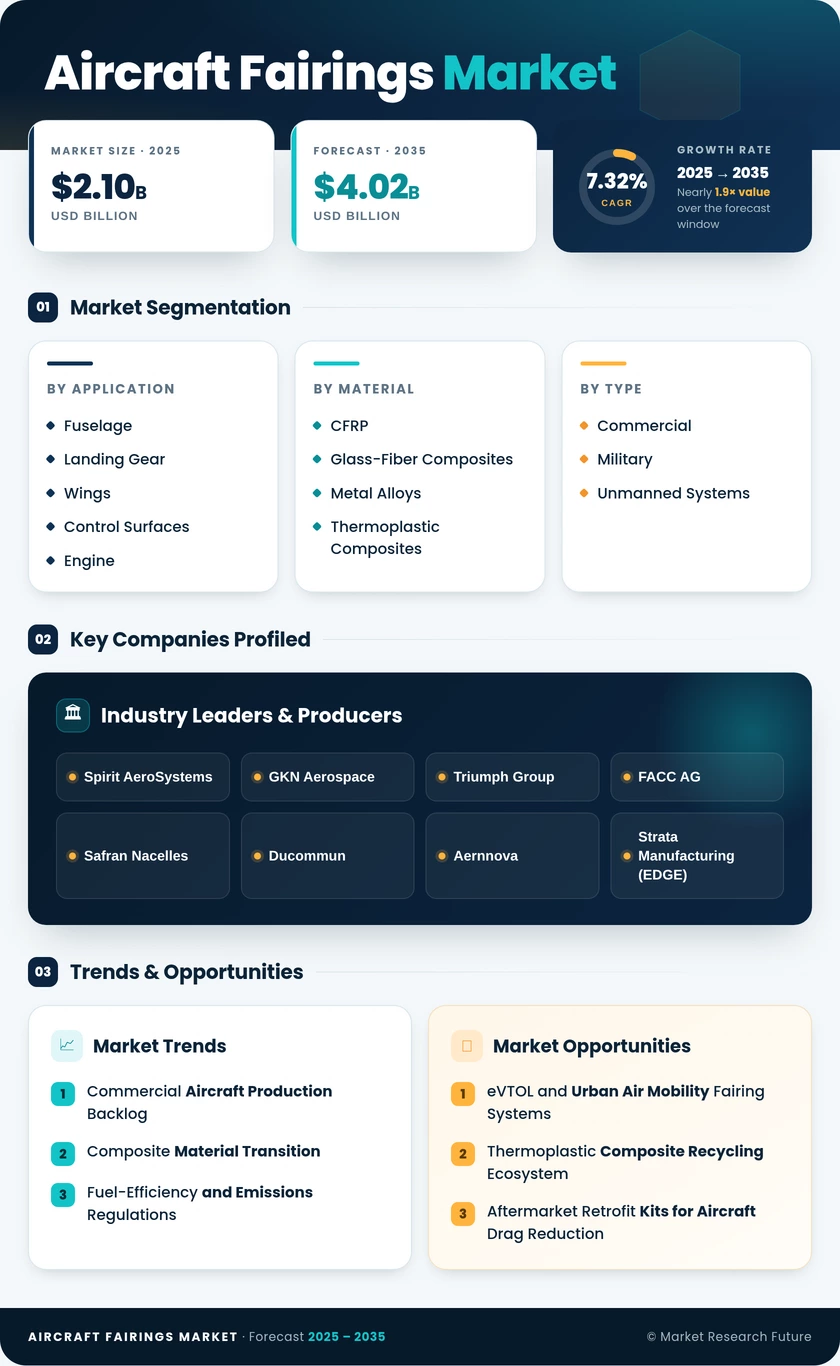
Segmentation Quick Reference
| Dimension | Sub-Segments | Dominant Segment | Fastest Growing Segment |
| Application | Fuselage, Landing Gear, Wings, Control Surfaces, Engine | Fuselage | Landing Gear |
| Material | CFRP, Glass-Fiber Composites, Metal Alloys, Thermoplastic Composites | CFRP | Thermoplastic Composites |
| Aircraft Type | Commercial, Military, Unmanned Systems | Commercial | Unmanned Systems |
| Sales Channel | OEM Production, Aftermarket Aircraft Fairings Market | OEM Production | Aftermarket Aircraft Fairings Market |
| Geography | North America, Europe, Asia-Pacific, South America, Middle East & Africa | North America | Asia-Pacific |
- --
Market Segmentation Overview
By Application
| Sub-Segment | Key Trend |
| Fuselage | Composite fuselage fillet fairing adoption increasing on next-gen widebodies |
| Landing Gear | Aircraft drag reduction fairing enclosures gaining traction for fuel savings |
| Wings | Wing-body fairing structures transitioning to thermoplastic composites |
| Control Surfaces | Fly-by-wire actuation driving demand for lightweight composite enclosures |
| Engine | RISE open-fan architecture creating new nacelle fairing geometries |
Fuselage fairings carry the highest unit content per airframe, while landing gear fairings represent the fastest-growing application as fuel-efficiency mandates incentivize full gear-well enclosure programs across narrowbody and widebody platforms.
By Material
| Sub-Segment | Key Trend |
| CFRP | Dominant material; cost reductions from automated fiber placement improving economics |
| Glass-Fiber Composites | Retained for cost-sensitive secondary structures and general aviation |
| Metal Alloys | Legacy aluminum fairings sustained through aftermarket replacement on older fleets |
| Thermoplastic Composites | Fastest-growing; weldable, recyclable, and compatible with high-rate production |
The material landscape is bifurcating between CFRP for structural performance and thermoplastic composites for manufacturing speed, with OEMs increasingly specifying thermoplastics for non-load-bearing aerodynamic aircraft fairing design applications.
By Aircraft Type
| Sub-Segment | Key Trend |
| Commercial | Narrowbody production ramp-ups driving volume; widebody replacement cycles approaching |
| Military | 6th-gen fighter programs and tanker recapitalization creating demand for radar-transparent fairings |
| Unmanned Systems | eVTOL and UAV platforms requiring bespoke, small-batch composite aircraft nose fairing assemblies |
Commercial aircraft dominate absolute volume, but unmanned systems are the growth frontier as advanced air mobility and defense ISR programs each require purpose-built fairing geometries.
By Sales Channel
| Sub-Segment | Key Trend |
| OEM Production | Tied directly to aircraft delivery rates; benefits from backlog depth |
| Aftermarket Aircraft Fairings Market | Growing as fleets age; retrofit aircraft drag reduction fairing kits offer rapid payback |
OEM production captures the majority of revenue, while aftermarket Aircraft Fairings Market provides counter-cyclical stability and higher per-unit margins driven by supplemental type certificate programs.
By Geography
| Sub-Segment | Key Trend |
| North America | Boeing production, U.S. defense budgets, and dense Tier-1 supplier base |
| Europe | Airbus rate increases, thermoplastic R&D under Clean Aviation, FCAS defense spending |
| Asia-Pacific | COMAC C919 ramp, Indian PLI scheme, regional Aircraft Fairings Market hub expansion |
| South America | Embraer E2 program, Brazilian Aircraft Fairings Market infrastructure |
| Middle East & Africa | Strata Manufacturing growth, Saudi Vision 2030 aerospace localization |
North America and Europe together account for approximately two-thirds of the global Aircraft Fairings Market, while Asia-Pacific's combination of production localization and Aircraft Fairings Market expansion makes it the fastest-growing region through 2035.