
×
Hero Background
English
Chinese
French
Japanese
Korean
German
Spanish

Aircraft Electrical Systems Market Trends

ID: MRFR/AD/9083-HCR
174 Pages
Swapnil Palwe
October 2025

Aircraft Electrical Systems Market Research Report Information by System (Power Generation, Power Distribution, Power Conversion, and Energy Storage), Component (Generators, Distribution Devices, Conversion Devices, and Battery Management Systems), Application (Power Generation Management, Cabin System, Flight Control & Operation, Configuration Management, and Air Pressurization & Conditioning), Platform (Commercial Aviation and Military Aviation), and Region -Forecast 2030

Share:
Download PDF ×

We do not share your information with anyone. However, we may send you emails based on your report interest from time to time. You may contact us at any time to opt-out.

Aircraft Electrical Systems Market Infographic
Purchase Options

Market Trends

Key Emerging Trends in the Aircraft Electrical Systems Market

The power battery management system is being increasingly used in various applications, including grid energy storage, specialty vehicles, marine equipment, robots, and telecom/datacom systems. This widespread use of batteries in different sectors has contributed to the growth of the market. The power battery management system plays a crucial role in grid energy storage. It helps in managing the charging and discharging of batteries, ensuring a stable and reliable power supply. This is especially important as the demand for energy continues to rise and the grid needs to accommodate fluctuations in supply and demand. Specialty vehicles, such as electric cars, rely on batteries for their power source. The power battery management system ensures efficient charging and discharging of batteries, maximizing the vehicle's performance and range. Similarly, marine vessels and robots also utilize batteries for their power needs, and the management system ensures optimal battery usage and performance. In the telecom and data communication sector, batteries are used as backup power sources to maintain uninterrupted operation. The power battery management system helps in monitoring and controlling the charging and discharging of batteries, ensuring that they are ready to provide power in case of a power outage or disruption. The growth of the power battery management system market is driven by the increasing need for reliable and efficient power supply across various sectors. As the demand for energy continues to rise, there is a greater emphasis on energy storage solutions to ensure uninterrupted power supply. The power battery management system provides the necessary control and monitoring capabilities to optimize the performance and lifespan of batteries. In conclusion, the demand for uninterrupted power supply and the need for energy storage solutions have led to the growth of the power battery management system market. The use of batteries in various sectors, such as grid energy storage, specialty vehicles, marine equipment, and telecom/datacom systems, has further fueled this growth. The power battery management system plays a crucial role in ensuring efficient charging and discharging of batteries, maximizing their performance and providing reliable power supply. As the demand for energy continues to increase, the market for power battery management systems is expected to expand further.


Author
Swapnil Palwe
Team Lead - Research

With a technical background as Bachelor's in Mechanical Engineering, with MBA in Operations Management , Swapnil has 6+ years of experience in market research, consulting and analytics with the tasks of data mining, analysis, and project execution. He is the POC for our clients, for their consulting projects running under the Automotive/A&D domain. Swapnil has worked on major projects in verticals such as Aerospace & Defense, Automotive and many other domain projects. He has worked on projects for fortune 500 companies' syndicate and consulting projects along with several government projects.

Leave a Comment

FAQs

How Aircraft Electrical Systems Market Growing Globally ?

Aircraft Electrical Systems Market Grow at a CAGR Of 6.7% by 2020-2030

Who Are The Top Key Drivers in Aircraft Electrical Systems Market ?

Safran (France),AMETEK, Inc. (US),Esterline Technologies (US),GE Aviation (US),Astronics Corporation (US),Honeywell International Inc. (US),Thales Group (France),Raytheon Technologies Corporation (US),Meggitt (UK),Amphenol Corporation (US) top Drivers of Aircraft Electrical Systems Market

Scope of Aircraft Electrical Systems Market ?

The scope of the report highlights drivers, opportunities, restraints, and challenges surrounding the global market

In Which Region Aircraft Electrical Systems Market Is Growing ?

North America Expected to Focus on Fleet Simplification Leading to More Aircraft Deliveries

Market Summary

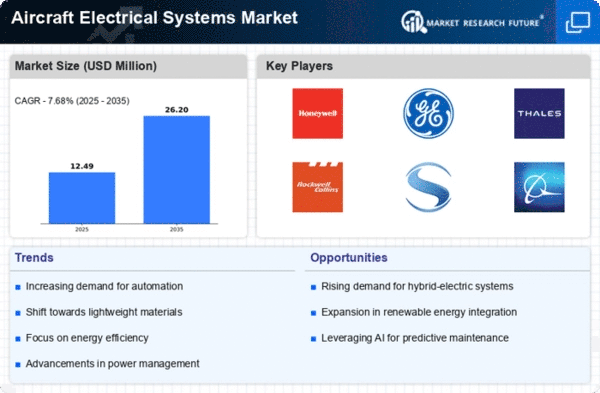
As per Market Research Future analysis, the Aircraft Electrical Systems Market Size was estimated at 11.6 USD Million in 2024. The Aircraft Electrical Systems industry is projected to grow from 12.5 in 2025 to 26.2 by 2035, exhibiting a compound annual growth rate (CAGR) of 7.68% during the forecast period 2025 - 2035.

Key Market Trends & Highlights

The Aircraft Electrical Systems Market is poised for substantial growth driven by technological advancements and increasing demand for efficiency.

  • The market witnesses an increased adoption of advanced power management systems, particularly in North America.
  • Sustainable technologies are gaining traction, reflecting a broader industry shift towards environmental responsibility.
  • Evolving regulatory standards are shaping the development and implementation of aircraft electrical systems across various segments.
  • Technological advancements and rising demand for fuel efficiency are key drivers propelling growth in the commercial aviation and flight control systems segments.

Market Size & Forecast

2024 Market Size 11.6 (USD Million)
2035 Market Size 26.2 (USD Million)
CAGR (2025 - 2035) 7.68%
Largest Regional Market Share in 2024 North America

Major Players

<p>Honeywell (US), General Electric (US), Thales (FR), Rockwell Collins (US), Safran (FR), Boeing (US), Raytheon Technologies (US), L3Harris Technologies (US), Curtiss-Wright (US)</p>

Market Trends

The Aircraft Electrical Systems Market is currently experiencing a transformative phase, driven by advancements in technology and increasing demand for more efficient and reliable systems. As aircraft manufacturers and operators seek to enhance performance and reduce operational costs, the integration of innovative electrical systems has become paramount. This shift is characterized by the adoption of more sophisticated power management systems, which not only improve energy efficiency but also contribute to the overall safety and reliability of aircraft operations. Furthermore, the growing emphasis on sustainability within the aviation sector is prompting a reevaluation of traditional electrical systems, leading to the exploration of alternative energy sources and more eco-friendly technologies. In addition to technological advancements, regulatory frameworks are evolving to support the modernization of electrical systems in aviation. Governments and aviation authorities are increasingly focusing on safety standards and environmental regulations, which are likely to influence the design and implementation of electrical systems in the coming years. This regulatory landscape, combined with the push for innovation, suggests that the Aircraft Electrical Systems Market will continue to expand, presenting opportunities for manufacturers and suppliers to develop cutting-edge solutions that meet the demands of a rapidly changing industry. As the market evolves, collaboration between stakeholders will be essential to navigate the complexities of new technologies and regulatory requirements.

Increased Adoption of Advanced Power Management Systems

The Aircraft Electrical Systems Market is witnessing a notable shift towards advanced power management systems. These systems enhance energy efficiency and reliability, allowing for better distribution and utilization of electrical power within aircraft. As operators seek to optimize performance, the integration of these sophisticated systems is becoming increasingly prevalent.

Focus on Sustainable Technologies

Sustainability is emerging as a critical focus within the Aircraft Electrical Systems Market. Manufacturers are exploring alternative energy sources and eco-friendly technologies to reduce the environmental impact of aviation. This trend reflects a broader commitment to sustainability, aligning with global efforts to minimize carbon emissions and promote greener practices.

Evolving Regulatory Standards

The regulatory landscape surrounding the Aircraft Electrical Systems Market is evolving, with authorities emphasizing safety and environmental compliance. These changing standards are likely to influence the design and implementation of electrical systems, pushing manufacturers to innovate and adapt to meet new requirements.

Aircraft Electrical Systems Market Market Drivers

Increasing Demand for Fuel Efficiency

The Global Aircraft Electrical Systems Market Industry experiences a notable surge in demand for fuel-efficient aircraft. Airlines and manufacturers are increasingly focusing on reducing operational costs and emissions, which drives the adoption of advanced electrical systems. These systems enhance overall aircraft performance by optimizing power distribution and reducing weight. As a result, the market is projected to reach 15.5 USD Billion in 2024, reflecting the industry's commitment to sustainability and efficiency. The integration of innovative technologies, such as fly-by-wire systems, further supports this trend, indicating a shift towards more electric aircraft designs.

Market Segment Insights

By Application: Flight Control Systems (Largest) vs. Avionics Systems (Fastest-Growing)

<p>In the Aircraft Electrical Systems Market, the application segment is dominated by Flight Control Systems, which hold the largest market share. These systems are critical for ensuring aircraft maneuverability and safety, making them indispensable. Power Distribution Systems and Environmental Control Systems also comprise significant portions of the market, due to their essential roles in managing energy supply and maintaining comfortable cabin conditions. In contrast, systems like Lighting and Avionics are carving out their positions, showing strong integration with modern technologies and design aesthetics. Growth trends in this segment are largely driven by advancements in technology and the increasing demand for more efficient, lightweight systems. Emerging markets are rapidly incorporating avionic innovations, particularly as air travel rebounds post-pandemic. The ongoing push for automation, fuel efficiency, and enhanced passenger experience is accelerating the adoption of advanced Flight Control and Avionics Systems, setting the stage for substantial growth in these areas.</p>

<p>Flight Control Systems (Dominant) vs. Avionics Systems (Emerging)</p>

<p>Flight Control Systems are crucial for aircraft safety and performance, thus holding the dominant position in the Aircraft Electrical Systems Market. They integrate advanced technologies to provide precise control over aircraft movements, benefiting from ongoing innovations in materials and electronics. In comparison, Avionics Systems are rapidly emerging, driven by the need for enhanced cockpit technologies and real-time data analytics. These systems are experiencing a surge in demand as airlines and manufacturers push towards digitization and modernization. Together, these applications reflect the market's evolution towards higher efficiency and safety, driven by continuous improvements in aviation technology.</p>

By End Use: Commercial Aviation (Largest) vs. Military Aviation (Fastest-Growing)

<p>The Aircraft Electrical Systems Market exhibits a diverse distribution across various end-use sectors, with Commercial Aviation commanding the largest share. Factors such as expansive global travel, increasing air traffic, and upgrades to aircraft fleets have solidified its leading position. Meanwhile, Military Aviation, encompassing fighter jets and transport aircraft, is rapidly gaining ground due to rising defense budgets and the modernization of military fleets around the world. This sector is supported by advancements in technology and the necessity for enhanced operational efficiencies.</p>

<p>Commercial Aviation (Dominant) vs. Military Aviation (Emerging)</p>

<p>The Commercial Aviation segment dominates the Aircraft Electrical Systems Market, driven by a mixture of traditional aircraft and newer models relying on advanced electrical systems for improved efficiency and passenger comfort. This segment benefits from large-scale demand associated with commercial airlines and a need for sustainable solutions. Conversely, Military Aviation is emerging as a significant growth area, bolstered by increasing geopolitical tensions and a pivot towards modernization of defense capabilities. This sector is characterized by high-level technological integration and specific requirements for durability and resilience in harsh operational environments.</p>

By Component Type: Wiring Harness (Largest) vs. Power Supply Units (Fastest-Growing)

<p>Within the Aircraft Electrical Systems Market, Wiring Harness holds the largest market share due to its critical role in integrating various electrical components, ensuring efficient electrical flow and reliability. In contrast, Power Supply Units are witnessing rapid growth, driven by advancements in energy efficiency and increased demand for reliable power sources in modern aircraft systems. The share distribution indicates that while Wiring Harness remains predominant, emerging technologies are enabling Power Supply Units to gain traction rapidly.</p>

<p>Wiring Harness (Dominant) vs. Battery Management Systems (Emerging)</p>

<p>Wiring Harness is a dominant component in the Aircraft Electrical Systems Market, essential for connecting and streamlining the functionality of electrical systems in aircraft. Its design and manufacturing are aligned with stringent aerospace standards, ensuring durability and performance under varying conditions. Conversely, Battery Management Systems are emerging as vital components due to the increasing reliance on battery power in aviation, especially with the shift towards electrified flight systems. These systems provide critical monitoring and control of battery performance, enhancing safety and efficiency in modern aircraft operations.</p>

By Technology: Fly-by-Wire Systems (Largest) vs. Hybrid Systems (Fastest-Growing)

<p>The Aircraft Electrical Systems Market showcases a diverse array of technologies, with Fly-by-Wire Systems leading in market share due to their advanced capabilities and widespread adoption in modern aircraft. Conventional Systems, while still prevalent, are gradually being overshadowed by the more innovative technologies that promise enhanced performance and reliability. In contrast, Hybrid Systems are gaining momentum, particularly among new entrants in the aviation industry seeking to combine the best features of both electric and conventional technologies. The growth trends in the Aircraft Electrical Systems Market indicate a significant shift towards more advanced systems driven by innovations in safety, efficiency, and sustainability. Hybrid Systems are particularly notable for being the fastest-growing segment, fueled by increasing electrification initiatives and regulatory pressures for sustainable aviation practices. As airlines increasingly prioritize cost-efficiency and environmental responsibility, the demand for Electric and Hybrid Systems is set to accelerate, further enhancing their role in future aircraft designs.</p>

<p>Fly-by-Wire Systems (Dominant) vs. Conventional Systems (Emerging)</p>

<p>Fly-by-Wire Systems are recognized as the dominant technology within the Aircraft Electrical Systems Market, leveraging digital controls to enhance aircraft performance and safety. This technology replaces traditional mechanical linkages with electronic interfaces, providing pilots with improved handling and response. With a strong foothold in commercial aviation, Fly-by-Wire Systems are the choice for many modern aircraft due to their ability to enhance efficiency and reduce maintenance costs. Conversely, Conventional Systems, while still utilized, are transitioning to an emerging status as the industry rapidly evolves towards more sophisticated electric solutions. These systems are simpler and have been the standard for many years, but as manufacturers explore advanced technologies, their dominance in the market is increasingly challenged by innovations that promise greater efficiency and reduced environmental impact.</p>

Get more detailed insights about Aircraft Electrical Systems Market Research Report—Global Forecast till 2035

Regional Insights

North America : Market Leader in Innovation

North America is poised to maintain its leadership in the Aircraft Electrical Systems market, holding a significant share of 6.5 billion in 2024. The region's growth is driven by advancements in aerospace technology, increasing demand for fuel-efficient aircraft, and stringent regulatory standards promoting safety and efficiency. The presence of major manufacturers and a robust supply chain further bolster market expansion. The United States stands out as the leading country, hosting key players such as Honeywell, General Electric, and Boeing. The competitive landscape is characterized by continuous innovation and strategic partnerships among these companies. With a focus on research and development, North American firms are at the forefront of integrating advanced electrical systems into modern aircraft, ensuring compliance with evolving regulations and meeting the demands of a growing aviation sector.

Europe : Emerging Market with Growth Potential

Europe's Aircraft Electrical Systems market is projected to reach 3.0 billion by 2025, driven by increasing investments in aerospace infrastructure and a growing emphasis on sustainability. Regulatory frameworks, such as the European Union Aviation Safety Agency (EASA) guidelines, are catalyzing innovation and enhancing safety standards across the industry. The demand for next-generation aircraft is also contributing to market growth, as airlines seek to modernize their fleets. Leading countries in this region include France, Germany, and the UK, where companies like Thales and Safran are making significant contributions. The competitive landscape is marked by collaborations between manufacturers and regulatory bodies to ensure compliance with stringent safety regulations. This synergy is vital for fostering innovation and maintaining Europe's position as a key player in The Aircraft Electrical Systems.

Asia-Pacific : Rapid Growth in Emerging Markets

The Asia-Pacific region is witnessing rapid growth in the Aircraft Electrical Systems market, projected to reach 1.8 billion by 2025. This growth is fueled by increasing air travel demand, rising disposable incomes, and government initiatives to enhance aviation infrastructure. Countries like China and India are investing heavily in their aerospace sectors, leading to a surge in aircraft production and modernization efforts, which are critical for meeting international safety standards. China is the dominant player in this market, with significant contributions from local manufacturers and partnerships with global firms. The competitive landscape is evolving, with companies focusing on technological advancements and compliance with international regulations. As the region continues to expand, the presence of key players like Boeing and Raytheon Technologies will be crucial in shaping the future of aircraft electrical systems in Asia-Pacific.

Middle East and Africa : Emerging Market with Untapped Potential

The Middle East and Africa (MEA) region is at the nascent stage of developing its Aircraft Electrical Systems market, currently valued at 0.3 billion. The growth potential is significant, driven by increasing investments in aviation infrastructure and a rising number of air travelers. Governments in the region are focusing on enhancing their aviation capabilities, which is expected to catalyze demand for advanced electrical systems in aircraft. Countries like the UAE and South Africa are leading the charge, with initiatives aimed at modernizing their fleets and improving safety standards. The competitive landscape is characterized by a mix of local and international players, with opportunities for collaboration and investment. As the region continues to develop, the presence of global firms will be essential in driving innovation and meeting the growing demand for aircraft electrical systems.

Key Players and Competitive Insights

The Aircraft Electrical Systems Market is currently characterized by a dynamic competitive landscape, driven by technological advancements and increasing demand for efficient and reliable electrical systems in aviation. Key players such as Honeywell (US), General Electric (US), and Thales (FR) are strategically positioned to leverage innovation and partnerships to enhance their market presence. Honeywell (US) focuses on integrating advanced technologies into its electrical systems, while General Electric (US) emphasizes digital transformation and sustainability in its product offerings. Thales (FR) is actively pursuing collaborations to expand its capabilities in avionics and electrical systems, thereby shaping a competitive environment that prioritizes technological leadership and operational excellence.

The market structure appears moderately fragmented, with several players vying for market share through various business tactics. Companies are increasingly localizing manufacturing to reduce costs and optimize supply chains, which is crucial in a sector where reliability and efficiency are paramount. The collective influence of these key players fosters a competitive atmosphere where innovation and strategic partnerships are essential for maintaining a competitive edge.

In November 2025, Honeywell (US) announced a partnership with a leading aerospace manufacturer to develop next-generation electrical systems aimed at enhancing aircraft performance and reducing emissions. This collaboration is significant as it aligns with the industry's shift towards sustainability, potentially positioning Honeywell as a leader in eco-friendly aviation solutions. The strategic importance of this partnership lies in its potential to set new standards for efficiency and environmental responsibility in aircraft electrical systems.

In October 2025, General Electric (US) unveiled a new suite of digital solutions designed to optimize aircraft electrical systems through predictive maintenance and real-time monitoring. This initiative is crucial as it not only enhances operational efficiency but also reduces downtime, thereby providing a competitive advantage in a market that increasingly values reliability. The integration of AI and data analytics into their offerings suggests a forward-thinking approach that could redefine maintenance practices in the aviation sector.

In September 2025, Thales (FR) secured a contract to supply advanced electrical systems for a major European aircraft manufacturer, further solidifying its position in the market. This contract is indicative of Thales's commitment to innovation and its ability to meet the evolving needs of the aerospace industry. The strategic importance of this contract lies in its potential to enhance Thales's reputation as a key player in the development of cutting-edge electrical systems, thereby attracting further business opportunities.

As of December 2025, current trends in the Aircraft Electrical Systems Market are heavily influenced by digitalization, sustainability, and AI integration. Strategic alliances are increasingly shaping the competitive landscape, as companies recognize the need for collaboration to drive innovation. The shift from price-based competition to a focus on technological advancement and supply chain reliability is evident, suggesting that future competitive differentiation will hinge on the ability to innovate and adapt to changing market demands.

Key Companies in the Aircraft Electrical Systems Market market include

Industry Developments

April 2021 - AMETEK, Inc. procured Abaco Systems, Inc., one of the main providers of strategic mission-critical embedded computing systems, in a money exchange esteemed at USD 1.35 billion.

July 2020 - Astronics Corporation was granted agreements from Bell Textron Inc., an auxiliary of Textron Inc., for the headway of its CorePower airframe electrical age and power circulation frameworks to help their drawn-out programs — Future Long-Range Assault Aircraft (FLRAA) and Future Attack Reconnaissance Aircraft (FARA).

February 2020 - AMETEK, Inc. obtained IntelliPower, one of the main providers of ruggedised uninterruptible power frameworks that serve a wide assortment of safeguard and modern applications.

Future Outlook

Aircraft Electrical Systems Market Future Outlook

<p>The Aircraft Electrical Systems Market is projected to grow at a 7.68% CAGR from 2024 to 2035, driven by advancements in technology, increasing demand for fuel efficiency, and regulatory compliance.</p>

New opportunities lie in:

  • <p>Development of advanced power distribution systems for next-gen aircraft.</p>
  • <p>Integration of renewable energy sources in aircraft electrical systems.</p>
  • <p>Expansion of aftermarket services for electrical system maintenance and upgrades.</p>

<p>By 2035, the market is expected to be robust, reflecting substantial growth and innovation.</p>

Market Segmentation

Aircraft Electrical Systems Market End Use Outlook

  • Commercial Aviation
  • Military Aviation
  • Business Aviation
  • Helicopters

Aircraft Electrical Systems Market Technology Outlook

  • Conventional Systems
  • Fly-by-Wire Systems
  • Hybrid Systems
  • Electric Systems

Aircraft Electrical Systems Market Application Outlook

  • Flight Control Systems
  • Power Distribution Systems
  • Lighting Systems
  • Avionics Systems
  • Environmental Control Systems

Aircraft Electrical Systems Market Component Type Outlook

  • Wiring Harness
  • Power Supply Units
  • Circuit Breakers
  • Battery Management Systems
  • Control Units

Report Scope

MARKET SIZE 202411.6(USD Million)
MARKET SIZE 202512.5(USD Million)
MARKET SIZE 203526.2(USD Million)
COMPOUND ANNUAL GROWTH RATE (CAGR)7.68% (2024 - 2035)
REPORT COVERAGERevenue Forecast, Competitive Landscape, Growth Factors, and Trends
BASE YEAR2024
Market Forecast Period2025 - 2035
Historical Data2019 - 2024
Market Forecast UnitsUSD Million
Key Companies ProfiledHoneywell (US), General Electric (US), Thales (FR), Rockwell Collins (US), Safran (FR), Boeing (US), Raytheon Technologies (US), L3Harris Technologies (US), Curtiss-Wright (US)
Segments CoveredApplication, End Use, Component Type, Technology
Key Market OpportunitiesIntegration of advanced energy management systems enhances efficiency in the Aircraft Electrical Systems Market.
Key Market DynamicsTechnological advancements and regulatory changes drive innovation and competition in the Aircraft Electrical Systems Market.
Countries CoveredNorth America, Europe, APAC, South America, MEA

FAQs

How Aircraft Electrical Systems Market Growing Globally ?

Aircraft Electrical Systems Market Grow at a CAGR Of 6.7% by 2020-2030

Who Are The Top Key Drivers in Aircraft Electrical Systems Market ?

Safran (France),AMETEK, Inc. (US),Esterline Technologies (US),GE Aviation (US),Astronics Corporation (US),Honeywell International Inc. (US),Thales Group (France),Raytheon Technologies Corporation (US),Meggitt (UK),Amphenol Corporation (US) top Drivers of Aircraft Electrical Systems Market

Scope of Aircraft Electrical Systems Market ?

The scope of the report highlights drivers, opportunities, restraints, and challenges surrounding the global market

In Which Region Aircraft Electrical Systems Market Is Growing ?

North America Expected to Focus on Fleet Simplification Leading to More Aircraft Deliveries

  1. Executive Summary
    1. Market Attractiveness Analysis
      1. Global Aircraft Electrical SystemsMarket, bySystem
      2. Global Aircraft
      3. Global Aircraft Electrical Systems
      4. Global Aircraft Electrical Systems Market, byPlatform
      5. Global Aircraft Electrical Systems Market, byRegion
    2. Electrical Systems Market, byComponent
    3. Market, byApplication
  2. Market Introduction
    1. Market Definition
    2. Scope of the Study
    3. Market Structure
    4. Key Buying Criteria
    5. Market Factor Indicator Analysis
  3. Research
    1. Methodology
    2. Research Process
    3. Primary Research
    4. Secondary
    5. Market Size Estimation
    6. Forecast Model
    7. List
    8. of Assumptions
  4. Market Insights
  5. Market Dynamics
    1. Introduction
    2. Drivers
      1. Increase in Demand for New Aircrafts Worldwide
      2. Drivers
    3. Rise in Demand for Electric Aircrafts for Commercial Aviation
    4. Impact Analysis
    5. Restraints
      1. Lack of Aviation Infrastructure
      2. Restraints Impact Analysis
    6. in the Asian economies
    7. Opportunities
      1. Technological Advancements in Aircraft ElectricalSystems
    8. Market/Technological
    9. Trends
    10. Patent Trends
    11. Regulatory Landscape/Standards
    12. Market Factor Analysis
    13. Value Chain/Supply Chain Analysis
      1. R&D
      2. Manufacturing
      3. Distribution & Sales
      4. Post-Sales
    14. Monitoring
    15. Porter’s Five Forces Analysis
      1. Threat of New
      2. Bargaining Power of Buyers
      3. Threat of Substitutes
      4. Intensity of Rivalry
      5. Bargaining Power of Supplies
    16. Entrants
  6. Global
  7. Aircraft Electrical Systems Market, by System
    1. Introduction
    2. Power
    3. Generation
    4. Power Distribution
    5. Power Conversion
    6. Energy
    7. Storage
  8. Global Aircraft Electrical Systems Market, by Component
    1. Introduction
    2. Generators
    3. Distribution Devices
    4. Conversion
    5. Devices
    6. Battery Management Systems
  9. Global Aircraft Electrical
  10. Systems Market, by Application
    1. Introduction
    2. Power Generation
    3. Management
    4. Cabin System
    5. Flight Control & Operation
    6. Configuration Management
    7. Air Pressurization & Conditioning
  11. Global Aircraft Electrical Systems Market, by Platform
    1. Introduction
    2. Commercial Aviation
    3. Military Aviation
  12. Global Aircraft
  13. Electrical Systems Market, by Region
    1. Introduction
    2. North America
      1. US
      2. Canada
    3. Europe
      1. UK
      2. France
      3. Italy
      4. Rest of Europe
      5. China
      6. Japan
      7. India
      8. Rest of Asia-Pacific
    4. Germany
    5. Asia-Pacific
    6. Australia
    7. Middle East & Africa
      1. Saudi Arabia
      2. UAE
      3. Rest of Middle East & Africa
    8. Latin America
      1. Brazil
      2. Rest of Latin America
  14. Competitive Landscape
    1. Competitive Overview
    2. Competitor
    3. Dashboard
    4. Major Growth Key Strategies in the Global Aircraft Electrical
    5. Systems Market
    6. Competitive Benchmarking
    7. Market Share Analysis
    8. Leading Player in Terms of the Number of Developments in the Global Aircraft
    9. Electrical Systems Market
    10. Key Developments & Growth Strategies
      1. New ProductDevelopment/Service/Component Launches
      2. Mergers&
      3. Joint Ventures
    11. Acquisitions
  15. Company Profiles
    1. Key
      1. Safran
      2. AMETEK, Inc.
      3. GE Aviation
      4. Astronics Corporation
      5. Honeywell International Inc.
      6. Thales Group
      7. Raytheon
      8. Meggitt
      9. Amphenol Corporation
    2. Market Players
    3. (Company overview, financial updates, products & service
    4. offered, key developments, SWOT analysis, and key strategies to be provided for
    5. all the listed companies)
    6. Esterline Technologies
    7. Technologies Corporation
    8. Other Key Market Players
      1. PBS Aerospace
      2. Nabtesco
      3. Crane Aerospace & Electronics
      4. Hartzell
      5. Avionic Instruments, LLC
      6. Pioneer Magnetics
      7. Carlisle Interconnect Technologies
      8. Radiant Power Corporation
      9. BAE Systems
      10. Eaglepicher Technologies, LLC
    9. Corporation
    10. Engine Technologies
  16. Appendix
    1. References
    2. Related Reports
    3. List of Abbreviations 
    4. List of Tables
  17. LIST OF ASSUMPTIONS
  18. MAJOR PATENTS GRANTED
    1. FOR AIRCRAFT ELECTRICAL SYSTEMS (2016–2021)
  19. SYSTEM: GLOBAL AIRCRAFT
    1. ELECTRICAL SYSTEMS MARKET, 2020–2030 (USD MILLION)
  20. COMPONENT:
    1. GLOBAL AIRCRAFT ELECTRICAL SYSTEMS MARKET, 2020–2030 (USD MILLION)
    2. TABLE
  21. APPLICATION: GLOBAL AIRCRAFT ELECTRICAL SYSTEMS MARKET, 2020–2030(USD MILLION)
  22. PLATFORM: GLOBAL AIRCRAFT ELECTRICAL SYSTEMS MARKET, 2020–2030 (USD
    1. MILLION)
  23. GLOBAL AIRCRAFT ELECTRICAL SYSTEMS MARKET, BY REGION, 2020–2030
    1. (USD MILLION)
  24. NORTH AMERICA: AIRCRAFT ELECTRICAL SYSTEMS MARKET, BY
    1. COUNTRY, 2020–2030 (USD MILLION)
  25. NORTH AMERICA: AIRCRAFT ELECTRICAL
  26. SYSTEMS MARKET, BY SYSTEM, 2020–2030 (USD MILLION)
  27. NORTH AMERICA:
  28. AIRCRAFT ELECTRICAL SYSTEMS MARKET, BY COMPONENT, 2020–2030 (USD MILLION)
  29. NORTH AMERICA: AIRCRAFT ELECTRICAL SYSTEMS MARKET, BY APPLICATION, 2020–2030
    1. (USD MILLION)
  30. NORTH AMERICA: AIRCRAFT ELECTRICAL SYSTEMS MARKET, BY
    1. PLATFORM, 2020–2030 (USD MILLION)
  31. US: AIRCRAFT ELECTRICAL SYSTEMS
  32. MARKET, BY SYSTEM, 2020–2030 (USD MILLION)
  33. US: AIRCRAFT ELECTRICAL
  34. SYSTEMS MARKET, BY COMPONENT, 2020–2030 (USD MILLION)
  35. US: AIRCRAFT
  36. ELECTRICAL SYSTEMS MARKET, BY APPLICATION, 2020–2030 (USD MILLION)
    1. TABLE
  37. US: AIRCRAFT ELECTRICAL SYSTEMS MARKET, BY PLATFORM, 2020–2030 (USD MILLION)
  38. CANADA: AIRCRAFT ELECTRICAL SYSTEMS MARKET, BY SYSTEM, 2020–2030
    1. (USD MILLION)
  39. CANADA: AIRCRAFT ELECTRICAL SYSTEMS MARKET, BY COMPONENT,
  40. CANADA: AIRCRAFT ELECTRICAL SYSTEMS
  41. MARKET, BY APPLICATION, 2020–2030 (USD MILLION)
  42. CANADA: AIRCRAFT
  43. ELECTRICAL SYSTEMS MARKET, BY PLATFORM, 2020–2030 (USD MILLION)
    1. TABLE
  44. EUROPE: AIRCRAFT ELECTRICAL SYSTEMS MARKET, BY COUNTRY, 2020–2030 (USD
    1. MILLION)
  45. EUROPE: AIRCRAFT ELECTRICAL SYSTEMS MARKET, BY SYSTEM, 2020–2030
    1. (USD MILLION)
  46. EUROPE: AIRCRAFT ELECTRICAL SYSTEMS MARKET, BY COMPONENT,
  47. EUROPE: AIRCRAFT ELECTRICAL SYSTEMS
  48. MARKET, BY APPLICATION, 2020–2030 (USD MILLION)
  49. EUROPE: AIRCRAFT
  50. ELECTRICAL SYSTEMS MARKET, BY PLATFORM, 2020–2030 (USD MILLION)
    1. TABLE
  51. UK: AIRCRAFT ELECTRICAL SYSTEMS MARKET, BY SYSTEM, 2020–2030 (USD MILLION)
  52. UK: AIRCRAFT ELECTRICAL SYSTEMS MARKET, BY COMPONENT, 2020–2030
    1. (USD MILLION)
  53. UK: AIRCRAFT ELECTRICAL SYSTEMS MARKET, BY APPLICATION,
  54. UK: AIRCRAFT ELECTRICAL SYSTEMS MARKET,
    1. BY PLATFORM, 2020–2030 (USD MILLION)
  55. GERMANY: AIRCRAFT ELECTRICAL
  56. SYSTEMS MARKET, BY SYSTEM, 2020–2030 (USD MILLION)
  57. GERMANY:
  58. AIRCRAFT ELECTRICAL SYSTEMS MARKET, BY COMPONENT, 2020–2030 (USD MILLION)
  59. GERMANY: AIRCRAFT ELECTRICAL SYSTEMS MARKET, BY APPLICATION, 2020–2030
    1. (USD MILLION)
  60. GERMANY: AIRCRAFT ELECTRICAL SYSTEMS MARKET, BY PLATFORM,
  61. FRANCE: AIRCRAFT ELECTRICAL SYSTEMS
  62. MARKET, BY SYSTEM, 2020–2030 (USD MILLION)
  63. FRANCE: AIRCRAFT
  64. ELECTRICAL SYSTEMS MARKET, BY COMPONENT, 2020–2030 (USD MILLION)
    1. TABLE
  65. FRANCE: AIRCRAFT ELECTRICAL SYSTEMS MARKET, BY APPLICATION, 2020–2030 (USD
    1. MILLION)
  66. FRANCE: AIRCRAFT ELECTRICAL SYSTEMS MARKET, BY PLATFORM,
  67. ITALY: AIRCRAFT ELECTRICAL SYSTEMS MARKET,
    1. BY SYSTEM, 2020–2030 (USD MILLION)
  68. ITALY: AIRCRAFT ELECTRICAL
  69. SYSTEMS MARKET, BY COMPONENT, 2020–2030 (USD MILLION)
  70. ITALY:
  71. AIRCRAFT ELECTRICAL SYSTEMS MARKET, BY APPLICATION, 2020–2030 (USD MILLION)
  72. ITALY: AIRCRAFT ELECTRICAL SYSTEMS MARKET, BY PLATFORM, 2020–2030
    1. (USD MILLION)
  73. REST OF EUROPE: AIRCRAFT ELECTRICAL SYSTEMS MARKET,
    1. BY SYSTEM, 2020–2030 (USD MILLION)
  74. REST OF EUROPE: AIRCRAFT
  75. ELECTRICAL SYSTEMS MARKET, BY COMPONENT, 2020–2030 (USD MILLION)
    1. TABLE
  76. REST OF EUROPE: AIRCRAFT ELECTRICAL SYSTEMS MARKET, BY APPLICATION, 2020–2030
    1. (USD MILLION)
  77. REST OF EUROPE: AIRCRAFT ELECTRICAL SYSTEMS MARKET,
    1. BY PLATFORM, 2020–2030 (USD MILLION)
  78. ASIA-PACIFIC: AIRCRAFT
  79. ELECTRICAL SYSTEMS MARKET, BY COUNTRY, 2020–2030 (USD MILLION)
    1. TABLE
  80. ASIA-PACIFIC: AIRCRAFT ELECTRICAL SYSTEMS MARKET, BY SYSTEM, 2020–2030
    1. (USD MILLION)
  81. ASIA-PACIFIC: AIRCRAFT ELECTRICAL SYSTEMS MARKET, BY
    1. COMPONENT, 2020–2030 (USD MILLION)
  82. ASIA-PACIFIC: AIRCRAFT ELECTRICAL
  83. SYSTEMS MARKET, BY APPLICATION, 2020–2030 (USD MILLION)
  84. ASIA-PACIFIC:
  85. AIRCRAFT ELECTRICAL SYSTEMS MARKET, BY PLATFORM, 2020–2030 (USD MILLION)
  86. CHINA: AIRCRAFT ELECTRICAL SYSTEMS MARKET, BY SYSTEM, 2020–2030
    1. (USD MILLION)
  87. CHINA: AIRCRAFT ELECTRICAL SYSTEMS MARKET, BY COMPONENT,
  88. CHINA: AIRCRAFT ELECTRICAL SYSTEMS MARKET,
    1. BY APPLICATION, 2020–2030 (USD MILLION)
  89. CHINA: AIRCRAFT ELECTRICAL
  90. SYSTEMS MARKET, BY PLATFORM, 2020–2030 (USD MILLION)
  91. INDIA:
  92. AIRCRAFT ELECTRICAL SYSTEMS MARKET, BY SYSTEM, 2020–2030 (USD MILLION)
  93. INDIA: AIRCRAFT ELECTRICAL SYSTEMS MARKET, BY COMPONENT, 2020–2030
    1. (USD MILLION)
  94. INDIA: AIRCRAFT ELECTRICAL SYSTEMS MARKET, BY APPLICATION,
  95. INDIA: AIRCRAFT ELECTRICAL SYSTEMS MARKET,
    1. BY PLATFORM, 2020–2030 (USD MILLION)
  96. JAPAN: AIRCRAFT ELECTRICAL
  97. SYSTEMS MARKET, BY SYSTEM, 2020–2030(USD MILLION)
  98. JAPAN: AIRCRAFT
  99. ELECTRICAL SYSTEMS MARKET, BY COMPONENT, 2020–2030 (USD MILLION)
    1. TABLE
  100. JAPAN: AIRCRAFT ELECTRICAL SYSTEMS MARKET, BY APPLICATION, 2020–2030 (USD
    1. MILLION)
  101. JAPAN: AIRCRAFT ELECTRICAL SYSTEMS MARKET, BY PLATFORM, 2020–2030
    1. (USD MILLION)
  102. AUSTRALIA: AIRCRAFT ELECTRICAL SYSTEMS MARKET, BY SYSTEM,
  103. AUSTRALIA: AIRCRAFT ELECTRICAL SYSTEMS
  104. MARKET, BY COMPONENT, 2020–2030 (USD MILLION)
  105. AUSTRALIA: AIRCRAFT
  106. ELECTRICAL SYSTEMS MARKET, BY APPLICATION, 2020–2030 (USD MILLION)
    1. TABLE
  107. AUSTRALIA: AIRCRAFT ELECTRICAL SYSTEMS MARKET, BY PLATFORM, 2020–2030 (USD
    1. MILLION)
  108. REST OF ASIA-PACIFIC: AIRCRAFT ELECTRICAL SYSTEMS MARKET,
    1. BY SYSTEM, 2020–2030 (USD MILLION)
  109. REST OF ASIA-PACIFIC: AIRCRAFT
  110. ELECTRICAL SYSTEMS MARKET, BY COMPONENT, 2020–2030 (USD MILLION)
    1. TABLE
  111. REST OF ASIA-PACIFIC: AIRCRAFT ELECTRICAL SYSTEMS MARKET, BY APPLICATION, 2020–2030
    1. (USD MILLION)
  112. REST OF ASIA-PACIFIC: AIRCRAFT ELECTRICAL SYSTEMS MARKET,
    1. BY PLATFORM, 2020–2030 (USD MILLION)
  113. MIDDLE EAST & AFRICA:
  114. AIRCRAFT ELECTRICAL SYSTEMS MARKET, BY COUNTRY, 2020–2030 (USD MILLION)
  115. MIDDLE EAST & AFRICA: AIRCRAFT ELECTRICAL SYSTEMS MARKET, BY SYSTEM,
  116. MIDDLE EAST & AFRICA: AIRCRAFT ELECTRICAL
  117. SYSTEMS MARKET, BY COMPONENT, 2020–2030 (USD MILLION)
  118. MIDDLE
  119. EAST & AFRICA: AIRCRAFT ELECTRICAL SYSTEMS MARKET, BY APPLICATION, 2020–2030
    1. (USD MILLION)
  120. MIDDLE EAST & AFRICA: AIRCRAFT ELECTRICAL SYSTEMS
  121. MARKET, BY PLATFORM, 2020–2030 (USD MILLION)
  122. SAUDI ARABIA: AIRCRAFT
  123. ELECTRICAL SYSTEMS MARKET, BY SYSTEM, 2020–2030 (USD MILLION)
    1. TABLE 77
  124. SAUDI ARABIA: AIRCRAFT ELECTRICAL SYSTEMS MARKET, BY COMPONENT, 2020–2030
    1. (USD MILLION)
  125. SAUDI ARABIA: AIRCRAFT ELECTRICAL SYSTEMS MARKET, BY
    1. APPLICATION, 2020–2030 (USD MILLION)
  126. SAUDI ARABIA: AIRCRAFT
  127. ELECTRICAL SYSTEMS MARKET, BY PLATFORM, 2020–2030 (USD MILLION)
    1. TABLE
  128. UAE: AIRCRAFT ELECTRICAL SYSTEMS MARKET, BY SYSTEM, 2020–2030 (USD MILLION)
  129. UAE: AIRCRAFT ELECTRICAL SYSTEMS MARKET, BY COMPONENT, 2020–2030
    1. (USD MILLION)
  130. UAE: AIRCRAFT ELECTRICAL SYSTEMS MARKET, BY APPLICATION,
  131. UAE: AIRCRAFT ELECTRICAL SYSTEMS MARKET,
    1. BY PLATFORM, 2020–2030 (USD MILLION)
  132. REST OF THE MIDDLE EAST
  133. & AFRICA: AIRCRAFT ELECTRICAL SYSTEMS MARKET, BY SYSTEM, 2020–2030 (USD
    1. MILLION)
  134. REST OF THE MIDDLE EAST & AFRICA: AIRCRAFT ELECTRICAL
  135. SYSTEMS MARKET, BY COMPONENT, 2020–2030 (USD MILLION)
  136. REST OF
  137. THE MIDDLE EAST & AFRICA: AIRCRAFT ELECTRICAL SYSTEMS MARKET, BY APPLICATION,
  138. REST OF THE MIDDLE EAST & AFRICA:
  139. AIRCRAFT ELECTRICAL SYSTEMS MARKET, BY PLATFORM, 2020–2030 (USD MILLION)
  140. LATIN AMERICA: AIRCRAFT ELECTRICAL SYSTEMS MARKET, BY COUNTRY, 2020–2030
    1. (USD MILLION)
  141. LATIN AMERICA: AIRCRAFT ELECTRICAL SYSTEMS MARKET, BY
    1. SYSTEM, 2020–2030 (USD MILLION)
  142. LATIN AMERICA: AIRCRAFT ELECTRICAL
  143. SYSTEMS MARKET, BY COMPONENT, 2020–2030 (USD MILLION)
  144. LATIN
  145. AMERICA: AIRCRAFT ELECTRICAL SYSTEMS MARKET, BY APPLICATION, 2020–2030 (USD
    1. MILLION)
  146. LATIN AMERICA: AIRCRAFT ELECTRICAL SYSTEMS MARKET, BY PLATFORM,
  147. BRAZIL: AIRCRAFT ELECTRICAL SYSTEMS
  148. MARKET, BY SYSTEM, 2020–2030 (USD MILLION)
  149. BRAZIL: AIRCRAFT
  150. ELECTRICAL SYSTEMS MARKET, BY COMPONENT, 2020–2030 (USD MILLION)
    1. TABLE
  151. BRAZIL: AIRCRAFT ELECTRICAL SYSTEMS MARKET, BY APPLICATION, 2020–2030 (USD
    1. MILLION)
  152. BRAZIL: AIRCRAFT ELECTRICAL SYSTEMS MARKET, BY PLATFORM,
  153. REST OF LATIN AMERICA: AIRCRAFT ELECTRICAL
  154. SYSTEMS MARKET, BY SYSTEM, 2020–2030 (USD MILLION)
  155. REST OF LATIN
  156. AMERICA: AIRCRAFT ELECTRICAL SYSTEMS MARKET, BY COMPONENT,2020–2030 (USD MILLION)
  157. REST OF LATIN AMERICA: AIRCRAFT ELECTRICAL SYSTEMS MARKET, BY APPLICATION,
  158. REST OF LATIN AMERICA: AIRCRAFT ELECTRICAL
  159. SYSTEMS MARKET, BY PLATFORM, 2020–2030 (USD MILLION)
  160. THE MOST
  161. ACTIVE PLAYERS IN THE GLOBAL AIRCRAFT ELECTRICAL SYSTEMS MARKET
  162. CONTRACTS
    1. & AGREEMENTS
  163. MERGERS & ACQUISITIONS
  164. PRODUCT
    1. DEVELOPMENTS
  165. EXPANSIONS & INVESTMENTS
  166. JOINT VENTURES
    1. & PARTNERSHIPS
    2. List of Figures
  167. MARKET SYNOPSIS
  168. GLOBAL AIRCRAFT ELECTRICAL SYSTEMS MARKET: MARKET ATTRACTIVENESS ANALYSIS
  169. GLOBAL AIRCRAFT ELECTRICAL SYSTEMS MARKET ANALYSIS, BY SYSTEM
    1. FIGURE
  170. GLOBAL AIRCRAFT ELECTRICAL SYSTEMS MARKET ANALYSIS, BY PLATFORM
    1. FIGURE 5
  171. GLOBAL AIRCRAFT ELECTRICAL SYSTEMS MARKET ANALYSIS, BY APPLICATION
    1. FIGURE 5
  172. GLOBAL AIRCRAFT ELECTRICAL SYSTEMS MARKET ANALYSIS, BY PLATFORM
  173. GLOBAL
  174. AIRCRAFT ELECTRICAL SYSTEMS MARKET ANALYSIS, BY REGION
  175. GLOBAL AIRCRAFT
    1. ELECTRICAL SYSTEMS MARKET: MARKET STRUCTURE
  176. KEY BUYING CRITERIA FOR
    1. AIRCRAFT ELECTRICAL SYSTEMSSYSTEMS
  177. RESEARCH PROCESS OF MRFR
    1. FIGURE
  178. NORTH AMERICA: MARKET SIZE & MARKET SHARE, BY COUNTRY, 2020 VS 2030
    1. FIGURE
  179. EUROPE: MARKET SIZE & MARKET SHARE, BY COUNTRY, 2020 VS 2030
    1. FIGURE
  180. ASIA-PACIFIC: MARKET SIZE & MARKET SHARE, BY COUNTRY, 2020 VS 2030
    1. FIGURE
  181. MIDDLE EAST & AFRICA: MARKET SIZE & MARKET SHARE, BY COUNTRY, 2020 VS
  182. LATIN AMERICA: MARKET SIZE & MARKET SHARE, BY REGION, 2020
    1. VS 2030
  183. MARKET DYNAMICS OVERVIEW
  184. DRIVERS IMPACT ANALYSIS:
  185. GLOBAL AIRCRAFT ELECTRICAL SYSTEMS MARKET
  186. RESTRAINTS IMPACT ANALYSIS:
  187. GLOBAL AIRCRAFT ELECTRICAL SYSTEMS MARKET
  188. PORTER’S FIVE FORCES
  189. ANALYSIS OF THE GLOBAL AIRCRAFT ELECTRICAL SYSTEMS MARKET
  190. SUPPLY
    1. CHAIN: GLOBAL AIRCRAFT ELECTRICAL SYSTEMS MARKET
  191. GLOBAL AIRCRAFT
  192. ELECTRICAL SYSTEMS MARKET SHARE, BY SYSTEM, 2020 (% SHARE)
  193. GLOBAL
  194. AIRCRAFT ELECTRICAL SYSTEMS MARKET SHARE, BY PLATFORM, 2020 (% SHARE)
    1. FIGURE
  195. GLOBAL AIRCRAFT ELECTRICAL SYSTEMS MARKET SHARE, BY APPLICATION, 2020 (% SHARE)
  196. GLOBAL AIRCRAFT ELECTRICAL SYSTEMS MARKET SHARE, BY REGION, 2020 (%
    1. SHARE)
  197. NORTH AMERICA: AIRCRAFT ELECTRICAL SYSTEMS MARKET SHARE, BY
    1. COUNTRY, 2020 (% SHARE)
  198. EUROPE: AIRCRAFT ELECTRICAL SYSTEMS MARKET
    1. SHARE, BY COUNTRY, 2020 (% SHARE)
  199. ASIA-PACIFIC: AIRCRAFT ELECTRICAL
  200. SYSTEMS MARKET SHARE, BY COUNTRY, 2020 (% SHARE)
  201. MIDDLE EAST &
  202. AFRICA: AIRCRAFT ELECTRICAL SYSTEMS MARKET SHARE, BY COUNTRY, 2020 (% SHARE)
  203. LATIN AMERICA: AIRCRAFT ELECTRICAL SYSTEMS MARKET SHARE, BY COUNTRY,
  204. COMPETITOR DASHBOARD: GLOBAL AIRCRAFT ELECTRICAL SYSTEMS
    1. MARKET
  205. CAPITAL MARKET RATIO AND FINANCIAL MATRIX
  206. CONTRACTS
    1. & AGREEMENTS: THE MAJOR STRATEGY ADOPTED BY KEY PLAYERS IN THE GLOBAL AIRCRAFT
  207. ELECTRICAL SYSTEMS MARKET
  208. BENCHMARKING OF MAJOR COMPETITORS
    1. FIGURE
  209. MAJOR MANUFACTURERS MARKET SHARE ANALYSIS, 2020

Aircraft Electrical Systems Market Segmentation

Market Segmentation Overview

  • Detailed segmentation data will be available in the full report
  • Comprehensive analysis by multiple parameters
  • Regional and country-level breakdowns
  • Market size forecasts by segment
Infographic

Free Sample Request

Kindly complete the form below to receive a free sample of this Report

Get Free Sample

Customer Strories

Compare Licence

×
Features License Type
Single User Multiuser License Enterprise User
Price $4,950 $5,950 $7,250
Maximum User Access Limit 1 User Upto 10 Users Unrestricted Access Throughout the Organization
Free Customization
Direct Access to Analyst
Deliverable Format
Platform Access
Discount on Next Purchase 10% 15% 15%
Printable Versions