
Request Free Sample ×

Kindly complete the form below to receive a free sample of this Report

* Please use a valid business email

Leading companies partner with us for data-driven Insights

clients tt-cursor
Hero Background
English
Chinese
French
Japanese
Korean
German
Spanish

Aircraft Electrical Systems Market Size

ID: MRFR/AD/9083-HCR
174 Pages
Abbas Raut
April 2026

Aircraft Electrical Systems Market Size, Share, Industry Trend & Analysis Research Report Information by System (Power Generation, Power Distribution, Power Conversion, and Energy Storage), Component (Generators, Distribution Devices, Conversion Devices, and Battery Management Systems), Application (Power Generation Management, Cabin System, Flight Control & Operation, Configuration Management, and Air Pressurization & Conditioning), Platform (Commercial Aviation and Military Aviation), and Region -Forecast 2030

Share:
Download PDF ×

We do not share your information with anyone. However, we may send you emails based on your report interest from time to time. You may contact us at any time to opt-out.

Aircraft Electrical Systems Market Infographic
Purchase Options

Aircraft Electrical Systems Size

Aircraft Electrical Systems Market Growth Projections and Opportunities

Battery management systems are important electronic devices used to control and monitor the charging and discharging of rechargeable batteries. They are widely used in various applications such as grid energy storage, specialty vehicles (like marine and robots), and telecom/datacom systems. These systems can be customized to meet the specific requirements of different applications. The global power battery management system market is experiencing significant growth due to changes in government regulations and an increasing focus on reducing global dependence on coal and other fossil fuels. Environmental sustainability is a major driver for this growth, as well as the growing adoption of electric and hybrid vehicles. Various incentives and tax benefits are provided to encourage the local manufacturing of hybrid and electric vehicles, further boosting the market. Additionally, there is a growing demand for off-grid renewable energy generation, driven by government support and efforts to improve living conditions in rural areas. However, there are some challenges that may hinder the growth of the global power battery management systems market. These include the high maintenance costs associated with these systems and a lack of technical knowledge regarding their installation. Despite the challenges, the global power battery management system market is expected to grow rapidly in the coming years. Analysts predict that the market will reach a value of over USD 6,944.2 million by 2023, with an estimated compound annual growth rate (CAGR) of 11.86% during the forecast period. The growth of the power battery management system market is driven by several factors. One of the key factors is the increasing awareness and concern for the environment. Governments around the world are implementing regulations and policies to reduce the dependence on coal and other fossil fuels, which contributes to global warming and climate change. As a result, there is a growing demand for alternative energy sources and energy storage solutions, such as battery systems.

Aircraft Electrical Systems Market Size Graph
Author
Author Profile
Abbas Raut
Research Analyst

Abbas Raut is a Senior Research Analyst with 5+ years of experience delivering data-driven insights and strategic recommendations across the Automotive and Aerospace & Defense sectors. He specializes in emerging technologies, industry value chains, and global market dynamics shaping the future of mobility and defense. In automotive, Abbas has led studies on EVs, charging stations, BMS, superchargers, and more, guiding stakeholders through electrification and regulatory shifts. In Aerospace & Defense, he has analyzed markets for military electronics, drones, radars, and electronic warfare solutions, supporting procurement and investment strategies. With expertise in market sizing, forecasting, benchmarking, and technology adoption, Abbas is known for transforming complex datasets into actionable insights that drive strategy, innovation, and growth.

Leave a Comment

FAQs

What is the projected market valuation of the Aircraft Electrical Systems Market by 2035?

<p>The projected market valuation for the Aircraft Electrical Systems Market is 26.2 USD Million by 2035.</p>

What was the market valuation of the Aircraft Electrical Systems Market in 2024?

<p>The overall market valuation was 11.6 USD Million in 2024.</p>

What is the expected CAGR for the Aircraft Electrical Systems Market during the forecast period 2025 - 2035?

<p>The expected CAGR for the Aircraft Electrical Systems Market during the forecast period 2025 - 2035 is 7.68%.</p>

Which companies are considered key players in the Aircraft Electrical Systems Market?

<p>Key players in the Aircraft Electrical Systems Market include Honeywell, General Electric, Thales, Rockwell Collins, Safran, Boeing, Raytheon Technologies, L3Harris Technologies, and Curtiss-Wright.</p>

What are the main application segments of the Aircraft Electrical Systems Market?

The main application segments include Flight Control Systems, Power Distribution Systems, Lighting Systems, Avionics Systems, and Environmental Control Systems.

How much is the Power Distribution Systems segment projected to grow by 2035?

The Power Distribution Systems segment is projected to grow from 3.0 USD Million to 7.0 USD Million by 2035.

What is the valuation range for the Commercial Aviation segment in the Aircraft Electrical Systems Market?

The Commercial Aviation segment is valued between 4.0 USD Million and 9.0 USD Million.

What are the key components in the Aircraft Electrical Systems Market?

Key components include Wiring Harness, Power Supply Units, Circuit Breakers, Battery Management Systems, and Control Units.

What is the expected growth for Electric Systems in the Aircraft Electrical Systems Market?

Electric Systems are expected to grow from 3.6 USD Million to 7.7 USD Million by 2035.

How does the market for Military Aviation compare to that of Business Aviation?

The Military Aviation segment is projected to range from 3.0 USD Million to 6.5 USD Million, whereas Business Aviation is expected to range from 2.0 USD Million to 5.0 USD Million.

Market Summary

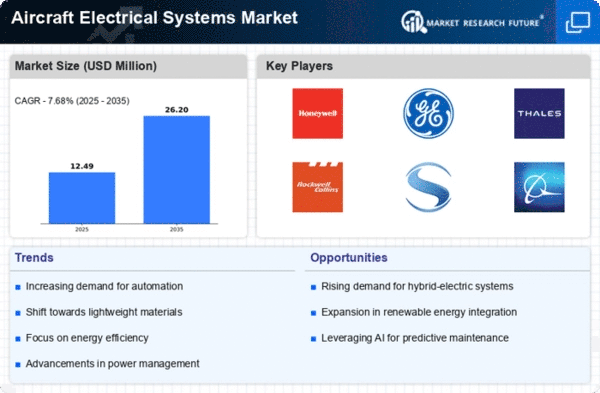
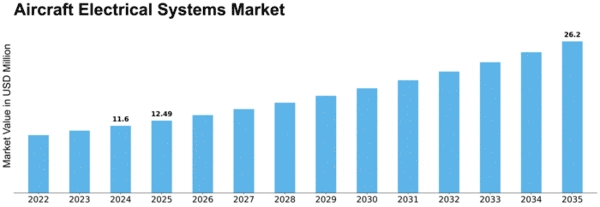
As per MRFR analysis, the Aircraft Electrical Systems Market Size was estimated at 11.6 USD Million in 2024. The Aircraft Electrical Systems industry is projected to grow from 12.5 USD Million in 2025 to 26.2 USD Million by 2035, exhibiting a compound annual growth rate (CAGR) of 7.68% during the forecast period 2025 - 2035.

Key Market Trends & Highlights

The Aircraft Electrical Systems Market is poised for substantial growth driven by technological advancements and sustainability initiatives.

  • Technological advancements are reshaping the Aircraft Electrical Systems Market, enhancing efficiency and performance. North America remains the largest market, while Asia-Pacific is emerging as the fastest-growing region in this sector. Flight Control Systems dominate the market, whereas Environmental Control Systems are witnessing the fastest growth. Increased demand for fuel efficiency and regulatory pressure for safety compliance are key drivers propelling market expansion.

Market Size & Forecast

2024 Market Size 11.6 (USD Million)
2035 Market Size 26.2 (USD Million)
CAGR (2025 - 2035) 7.68%
Largest Regional Market Share in 2024 North America

Major Players

Honeywell (US), General Electric (US), Thales (FR), Rockwell Collins (US), Safran (FR), Boeing (US), Raytheon Technologies (US), L3Harris Technologies (US), Curtiss-Wright (US)

Market Trends

The Aircraft Electrical Systems Market is currently experiencing a transformative phase, driven by advancements in technology and increasing demand for more efficient and reliable systems. As aircraft manufacturers and operators seek to enhance performance and reduce operational costs, the integration of innovative electrical systems has become paramount. The convergence of power distribution and climate control technologies is further expanding the scope of the aircraft electrical and environmental system market, as modern platforms demand integrated solutions for both energy management and cabin atmospheric regulation. This shift is characterized by the adoption of more sophisticated power management systems, which not only improve energy efficiency but also contribute to the overall safety and reliability of aircraft operations. Furthermore, the growing emphasis on sustainability within the aviation sector is prompting a reevaluation of traditional electrical systems, leading to the exploration of alternative energy sources and more eco-friendly technologies. A major catalyst in this transition is the rapid evolution of the electric and hybrid aircraft propulsion system market, which is driving the need for high-voltage distribution and advanced energy storage solutions.

In addition to technological advancements, regulatory frameworks are evolving to support the modernization of electrical systems in aviation. Governments and aviation authorities are increasingly focusing on safety standards and environmental regulations, which are likely to influence the design and implementation of electrical systems in the coming years. This regulatory landscape, combined with the push for innovation, suggests that the Aircraft Electrical Systems Market will continue to expand, presenting opportunities for manufacturers and suppliers to develop cutting-edge solutions that meet the demands of a rapidly changing industry. As the market evolves, collaboration between stakeholders will be essential to navigate the complexities of new technologies and regulatory requirements. The rapid evolution of the aircraft electrical system market is primarily fueled by the global transition toward "More Electric Aircraft" (MEA) architectures, which replace traditional hydraulic and pneumatic systems with high-efficiency electrical power.

Technological Advancements

The Aircraft Electrical Systems Market is witnessing rapid technological advancements, particularly in the areas of power management and distribution. Innovations such as fly-by-wire systems and advanced avionics are enhancing the efficiency and reliability of electrical systems, enabling better performance and reduced weight in aircraft.

Sustainability Initiatives

There is a growing trend towards sustainability within the Aircraft Electrical Systems Market, as manufacturers and operators seek to minimize environmental impact. This includes the exploration of alternative energy sources, such as electric and hybrid propulsion systems, which could significantly reduce carbon emissions.

Regulatory Compliance

Regulatory compliance is becoming increasingly critical in the Aircraft Electrical Systems Market. Stricter safety and performance standards are being established by aviation authorities, compelling manufacturers to innovate and adapt their systems to meet these evolving requirements.

Aircraft Electrical Systems Market Market Drivers

Increasing Demand for Fuel Efficiency

The Global Aircraft Electrical Systems Market Industry experiences a notable surge in demand for fuel-efficient aircraft. Airlines and manufacturers are increasingly focusing on reducing operational costs and emissions, which drives the adoption of advanced electrical systems. These systems enhance overall aircraft performance by optimizing power distribution and reducing weight. As a result, the market is projected to reach 15.5 USD Billion in 2024, reflecting the industry's commitment to sustainability and efficiency. The integration of innovative technologies, such as fly-by-wire systems, further supports this trend, indicating a shift towards more electric aircraft designs.

Market Segment Insights

By Application: Flight Control Systems (Largest) vs. Avionics Systems (Fastest-Growing)

In the Aircraft Electrical Systems Market, the application segment is dominated by Flight Control Systems, which hold the largest market share. These systems are critical for ensuring aircraft maneuverability and safety, making them indispensable. The growing synergy between power distribution and cabin climate control is further driving the aircraft electrical and environmental system market, as manufacturers aim for fully integrated thermal and energy management. Power Distribution Systems and Environmental Control Systems also comprise significant portions of the market, due to their essential roles in managing energy supply and maintaining comfortable cabin conditions. In contrast, systems like Lighting and Avionics are carving out their positions, showing strong integration with modern technologies and design aesthetics. Growth trends in this segment are largely driven by advancements in technology and the increasing demand for more efficient, lightweight systems. Emerging markets are rapidly incorporating avionic innovations, particularly as air travel rebounds post-pandemic. The ongoing push for automation, fuel efficiency, and enhanced passenger experience is accelerating the adoption of advanced Flight Control and Avionics Systems, setting the stage for substantial growth in these areas.

Flight Control Systems (Dominant) vs. Avionics Systems (Emerging)

Flight Control Systems are crucial for aircraft safety and performance, thus holding the dominant position in the Aircraft Electrical Systems Market. They integrate advanced technologies to provide precise control over aircraft movements, benefiting from ongoing innovations in materials and electronics. In comparison, Avionics Systems are rapidly emerging, driven by the need for enhanced cockpit technologies and real-time data analytics. These systems are experiencing a surge in demand as airlines and manufacturers push towards digitization and modernization. Together, these applications reflect the market's evolution towards higher efficiency and safety, driven by continuous improvements in aviation technology.

By End Use: Commercial Aviation (Largest) vs. Military Aviation (Fastest-Growing)

The Aircraft Electrical Systems Market is largely dominated by the commercial aviation sector, which continues to consume a significant portion of electrical systems due to the rising demand for more efficient and advanced aircraft components. Additionally, military aviation is rapidly gaining traction, signifying a growth trajectory that is outpacing other segments. This competitive dynamic highlights how major players are focusing on enhancing their offerings in response to both commercial and defense needs. As demand for air travel increases, so does the need for upgraded electrical systems that enhance aircraft capabilities. The commercial aviation sector is propelled by evolving technologies and environmental regulations that favor the adoption of fuel-efficient and lightweight solutions. Conversely, the military aviation segment is primarily driven by defense modernization initiatives and the integration of advanced combat systems, making it one of the fastest-growing areas within the market.

Commercial Aviation (Dominant) vs. Military Aviation (Emerging)

Commercial aviation is established as the dominant end-use segment in the Aircraft Electrical Systems Market, reflecting a continuous demand for innovative technologies that improve aircraft performance, safety, and efficiency. The focus is on enhancing passenger experience through advanced electrical systems, which include in-flight entertainment, navigation, and communication systems. In contrast, military aviation is viewed as an emerging sector that is increasingly prioritized by governments for defense enhancements. Investments in next-generation combat aircraft technologies are fostering market interest, with significant importance placed on reliability and interoperability. The unique requirements of military applications lead to specialized electrical system developments which are not just supportive but critical for operational success.

By Component Type: Wiring Harness (Largest) vs. Power Supply Units (Fastest-Growing)

In the Aircraft Electrical Systems Market, the component type segment comprises various critical components including Wiring Harness, Power Supply Units, Circuit Breakers, Battery Management Systems, and Control Units. Among these, Wiring Harness holds the largest market share due to its fundamental role in connecting electrical systems within an aircraft, followed closely by Power Supply Units which cater to the increasing demand for efficient power management solutions. The other components, while significant, lag behind in market share distribution, with Circuit Breakers, Battery Management Systems, and Control Units appealing to niche applications within the aerospace sector. As the aviation industry embraces technological advancements, growth trends in the Aircraft Electrical Systems Market are largely driven by innovations in power efficiency and system reliability. The demand for lightweight materials and enhanced safety features propels the adoption of Power Supply Units as the fastest-growing segment. Additionally, increasing aircraft production rates and a focus on retrofitting existing fleets with modern electrical systems contribute to the ongoing expansion of this sector. Consequently, key industry players are strategizing to enhance their offerings while addressing the evolving requirements of aircraft manufacturers and operators.

Wiring Harness (Dominant) vs. Control Units (Emerging)

Wiring Harnesses serve as the backbone of an aircraft's electrical architecture, facilitating seamless connectivity between various electrical components and systems. As the dominant player in the Aircraft Electrical Systems Market, Wiring Harnesses are characterized by their intricate designs and stringent regulatory compliance. They are pivotal in supporting advancements in avionics and electrical systems, offering customization options to meet specific aircraft requirements. Conversely, Control Units represent an emerging segment, playing a vital role in the automation and control of various aircraft systems. With the rise in digital cockpit technologies and demand for enhanced flight management systems, Control Units are being increasingly integrated into newer aircraft models. Their growing significance in improving operational efficiency and reliability positions them as a key focus area for innovation and development in the sector.

By Technology: Fly-by-Wire Systems (Largest) vs. Hybrid Systems (Fastest-Growing)

The Aircraft Electrical Systems Market showcases a diverse array of technologies, with Fly-by-Wire Systems leading in market share due to their advanced capabilities and widespread adoption in modern aircraft. Conventional Systems, while still prevalent, are gradually being overshadowed by the more innovative technologies that promise enhanced performance and reliability. In contrast, Hybrid Systems are gaining momentum, particularly among new entrants in the aviation industry seeking to combine the best features of both electric and conventional technologies. The growth trends in the Aircraft Electrical Systems Market indicate a significant shift towards more advanced systems driven by innovations in safety, efficiency, and sustainability. Hybrid Systems are particularly notable for being the fastest-growing segment, fueled by increasing electrification initiatives and regulatory pressures for sustainable aviation practices. As airlines increasingly prioritize cost-efficiency and environmental responsibility, the demand for Electric and Hybrid Systems is set to accelerate, further enhancing their role in future aircraft designs.

Fly-by-Wire Systems (Dominant) vs. Conventional Systems (Emerging)

Fly-by-Wire Systems are recognized as the dominant technology within the Aircraft Electrical Systems Market, leveraging digital controls to enhance aircraft performance and safety. This technology replaces traditional mechanical linkages with electronic interfaces, providing pilots with improved handling and response. With a strong foothold in commercial aviation, Fly-by-Wire Systems are the choice for many modern aircraft due to their ability to enhance efficiency and reduce maintenance costs. Conversely, Conventional Systems, while still utilized, are transitioning to an emerging status as the industry rapidly evolves towards more sophisticated electric solutions. These systems are simpler and have been the standard for many years, but as manufacturers explore advanced technologies, their dominance in the market is increasingly challenged by innovations that promise greater efficiency and reduced environmental impact.

Get more detailed insights about Aircraft Electrical Systems Market Research Report—Global Forecast till 2035

Regional Insights

North America : Market Leader in Innovation

North America is poised to maintain its leadership in the Aircraft Electrical Systems market, holding a significant share of 5.8 in 2024. The region's growth is driven by increasing demand for advanced avionics and the modernization of existing aircraft fleets. Regulatory support from agencies like the FAA promotes innovation and safety, further enhancing market dynamics. The push for sustainable aviation solutions is also a key driver, as manufacturers seek to reduce emissions and improve fuel efficiency. The competitive landscape in North America is robust, featuring key players such as Honeywell, General Electric, and Boeing. These companies are at the forefront of technological advancements, focusing on integrating smart systems and automation into aircraft. The presence of major defense contracts and commercial aviation projects in the U.S. and Canada bolsters market growth. As the region continues to invest in R&D, it is expected to remain a hub for cutting-edge aircraft electrical systems.

Europe : Emerging Market with Growth Potential

Europe's Aircraft Electrical Systems market is projected to grow, with a market size of 3.2 by 2025. The region benefits from stringent regulatory frameworks that promote safety and efficiency in aviation. The European Union Aviation Safety Agency (EASA) plays a crucial role in setting standards that drive innovation and compliance. Additionally, the increasing focus on reducing carbon emissions is pushing manufacturers to adopt more efficient electrical systems, aligning with the EU's sustainability goals. Leading countries in this region include France, Germany, and the UK, where companies like Thales and Safran are key players. The competitive landscape is characterized by collaborations between manufacturers and technology firms to enhance system capabilities. As Europe invests in next-generation aircraft, the demand for advanced electrical systems is expected to rise, positioning the region as a significant player in the global market.

Asia-Pacific : Rapidly Growing Aviation Sector

The Asia-Pacific region is witnessing rapid growth in the Aircraft Electrical Systems market, with a projected size of 2.0 by 2025. This growth is fueled by increasing air travel demand, particularly in countries like China and India, where rising disposable incomes and urbanization are driving the expansion of the aviation sector. Additionally, government initiatives to enhance regional connectivity and invest in airport infrastructure are significant catalysts for market growth. Key players in this region include major companies such as Boeing and Raytheon Technologies, which are focusing on partnerships with local firms to penetrate the market effectively. The competitive landscape is evolving, with an emphasis on developing cost-effective and efficient electrical systems to meet the needs of emerging airlines. As the region continues to modernize its fleet, the demand for advanced aircraft electrical systems is expected to surge, making it a vital market for future investments.

Middle East and Africa : Emerging Market with Untapped Potential

The Middle East and Africa region is gradually emerging in the Aircraft Electrical Systems market, with a size of 0.6 by 2025. The growth is primarily driven by increasing investments in aviation infrastructure and the expansion of airline networks. Countries like the UAE and South Africa are leading the way, with government initiatives aimed at enhancing air travel connectivity and boosting tourism. The region's strategic location as a The Aircraft Electrical Systems development. Despite its smaller market size, the competitive landscape is evolving, with local and international players vying for market share. Companies are focusing on establishing partnerships to leverage technological advancements and improve system efficiencies. As the region continues to invest in modernizing its aviation sector, the demand for advanced aircraft electrical systems is expected to grow, presenting opportunities for new entrants and established players alike.

Key Players and Competitive Insights

The Aircraft Electrical Systems Market is currently characterized by a dynamic competitive landscape, driven by technological advancements and increasing demand for efficient and reliable electrical systems in aviation. Key players such as Honeywell (US), General Electric (US), and Thales (FR) are strategically positioned to leverage innovation and partnerships to enhance their market presence. Honeywell (US) focuses on integrating advanced technologies into its electrical systems, while General Electric (US) emphasizes digital transformation and sustainability in its operations. Thales (FR) is actively pursuing collaborations to expand its product offerings, thereby shaping a competitive environment that prioritizes technological superiority and operational efficiency.In terms of business tactics, companies are increasingly localizing manufacturing and optimizing supply chains to enhance responsiveness to market demands. The market structure appears moderately fragmented, with several key players exerting considerable influence. This fragmentation allows for a diverse range of products and services, fostering competition that drives innovation and efficiency across the sector.
In November Honeywell (US) announced a strategic partnership with a leading aerospace manufacturer to develop next-generation electrical systems aimed at reducing weight and improving energy efficiency. This collaboration is expected to enhance Honeywell's competitive edge by integrating cutting-edge technologies into its offerings, thereby addressing the growing demand for sustainable aviation solutions. The partnership signifies a shift towards collaborative innovation in the industry, potentially setting new benchmarks for performance and efficiency.
In October General Electric (US) unveiled its latest digital platform designed to optimize aircraft electrical systems through real-time data analytics. This initiative is pivotal as it aligns with the industry's increasing focus on digitalization and predictive maintenance, allowing operators to enhance operational reliability and reduce downtime. By harnessing data-driven insights, General Electric (US) positions itself as a leader in the digital transformation of aircraft systems, which could redefine maintenance practices in the sector.
In September Thales (FR) expanded its product line by launching a new suite of electrical systems tailored for electric and hybrid aircraft. This move not only reflects Thales's commitment to sustainability but also addresses the emerging market for environmentally friendly aviation solutions. By diversifying its offerings, Thales (FR) is likely to capture a significant share of the growing demand for innovative electrical systems that support the transition to greener aviation technologies.
As of December the competitive trends in the Aircraft Electrical Systems Market are increasingly defined by digitalization, sustainability, and the integration of artificial intelligence. Strategic alliances among key players are shaping the landscape, fostering innovation and enhancing product offerings. The shift from price-based competition to a focus on technological advancement and supply chain reliability is evident, suggesting that future competitive differentiation will hinge on the ability to innovate and adapt to evolving market demands.

Key Companies in the Aircraft Electrical Systems Market include

Industry Developments

April 2021 - AMETEK, Inc. procured Abaco Systems, Inc., one of the main providers of strategic mission-critical embedded computing systems, in a money exchange esteemed at USD 1.35 billion.

July 2020 - Astronics Corporation was granted agreements from Bell Textron Inc., an auxiliary of Textron Inc., for the headway of its CorePower airframe electrical age and power circulation frameworks to help their drawn-out programs — Future Long-Range Assault Aircraft (FLRAA) and Future Attack Reconnaissance Aircraft (FARA).

February 2020 - AMETEK, Inc. obtained IntelliPower, one of the main providers of ruggedised uninterruptible power frameworks that serve a wide assortment of safeguard and modern applications.

Future Outlook

Aircraft Electrical Systems Market Future Outlook

The Aircraft Electrical Systems Market is projected to grow at a 7.68% CAGR from 2025 to 2035, driven by advancements in technology, increasing demand for fuel efficiency, and regulatory compliance.

New opportunities lie in:

  • <p>Development of advanced power distribution systems for next-gen aircraft. Integration of renewable energy sources in aircraft electrical systems. Expansion of aftermarket services for electrical system maintenance and upgrades.</p>

By 2035, the Aircraft Electrical Systems Market  is expected to be robust, reflecting substantial growth and innovation.

Market Segmentation

Aircraft Electrical Systems Market End Use Outlook

  • Commercial Aviation
  • Military Aviation
  • Business Aviation
  • Helicopters

Aircraft Electrical Systems Market Application Outlook

  • Flight Control Systems
  • Power Distribution Systems
  • Lighting Systems
  • Avionics Systems
  • Environmental Control Systems

Aircraft Electrical Systems Market Component Type Outlook

  • Wiring Harness
  • Power Supply Units
  • Circuit Breakers
  • Battery Management Systems
  • Control Units

Report Scope

MARKET SIZE 2024 11.6(USD Million)
MARKET SIZE 2025 12.5(USD Million)
MARKET SIZE 2035 26.2(USD Million)
COMPOUND ANNUAL GROWTH RATE (CAGR) 7.68% (2025 - 2035)
REPORT COVERAGE Revenue Forecast, Competitive Landscape, Growth Factors, and Trends
BASE YEAR 2024
Market Forecast Period 2025 - 2035
Historical Data 2019 - 2024
Market Forecast Units USD Million
Key Companies Profiled Honeywell (US), General Electric (US), Thales (FR), Rockwell Collins (US), Safran (FR), Boeing (US), Raytheon Technologies (US), L3Harris Technologies (US), Curtiss-Wright (US)
Segments Covered Application, End Use, Component Type
Key Market Opportunities Integration of advanced energy management systems enhances efficiency in the Aircraft Electrical Systems Market.
Key Market Dynamics Technological advancements and regulatory changes drive innovation and competition in the Aircraft Electrical Systems market.
Countries Covered North America, Europe, APAC, South America, MEA

FAQs

What is the projected market valuation of the Aircraft Electrical Systems Market by 2035?

<p>The projected market valuation for the Aircraft Electrical Systems Market is 26.2 USD Million by 2035.</p>

What was the market valuation of the Aircraft Electrical Systems Market in 2024?

<p>The overall market valuation was 11.6 USD Million in 2024.</p>

What is the expected CAGR for the Aircraft Electrical Systems Market during the forecast period 2025 - 2035?

<p>The expected CAGR for the Aircraft Electrical Systems Market during the forecast period 2025 - 2035 is 7.68%.</p>

Which companies are considered key players in the Aircraft Electrical Systems Market?

<p>Key players in the Aircraft Electrical Systems Market include Honeywell, General Electric, Thales, Rockwell Collins, Safran, Boeing, Raytheon Technologies, L3Harris Technologies, and Curtiss-Wright.</p>

What are the main application segments of the Aircraft Electrical Systems Market?

The main application segments include Flight Control Systems, Power Distribution Systems, Lighting Systems, Avionics Systems, and Environmental Control Systems.

How much is the Power Distribution Systems segment projected to grow by 2035?

The Power Distribution Systems segment is projected to grow from 3.0 USD Million to 7.0 USD Million by 2035.

What is the valuation range for the Commercial Aviation segment in the Aircraft Electrical Systems Market?

The Commercial Aviation segment is valued between 4.0 USD Million and 9.0 USD Million.

What are the key components in the Aircraft Electrical Systems Market?

Key components include Wiring Harness, Power Supply Units, Circuit Breakers, Battery Management Systems, and Control Units.

What is the expected growth for Electric Systems in the Aircraft Electrical Systems Market?

Electric Systems are expected to grow from 3.6 USD Million to 7.7 USD Million by 2035.

How does the market for Military Aviation compare to that of Business Aviation?

The Military Aviation segment is projected to range from 3.0 USD Million to 6.5 USD Million, whereas Business Aviation is expected to range from 2.0 USD Million to 5.0 USD Million.

  1. SECTION I: EXECUTIVE SUMMARY AND KEY HIGHLIGHTS |
    1. EXECUTIVE SUMMARY | |
      1. Market Overview | |
      2. Key Findings | |
      3. Market Segmentation | |
      4. Competitive Landscape | |
      5. Challenges and Opportunities | |
      6. Future Outlook 2
  2. SECTION II: SCOPING, METHODOLOGY AND MARKET STRUCTURE |
    1. MARKET INTRODUCTION | |
      1. Definition | |
      2. Scope of the study | | |
    2. RESEARCH METHODOLOGY | |
      1. Overview | |
      2. Data Mining | |
      3. Secondary Research | |
      4. Primary Research | | |
      5. Forecasting Model | |
      6. Market Size Estimation | | |
      7. Data Triangulation | |
      8. Validation 3
  3. SECTION III: QUALITATIVE ANALYSIS |
    1. MARKET DYNAMICS | |
      1. Overview | |
      2. Drivers | |
      3. Restraints | |
      4. Opportunities |
    2. MARKET FACTOR ANALYSIS | |
      1. Value chain Analysis | |
      2. Porter's Five Forces Analysis | | |
      3. COVID-19 Impact Analysis | | |
  4. SECTION IV: QUANTITATIVE ANALYSIS |
    1. Aerospace & Defense, BY Application (USD Million) | |
      1. Flight Control Systems | |
      2. Power Distribution Systems | |
      3. Lighting Systems | |
      4. Avionics Systems | |
      5. Environmental Control Systems |
    2. Aerospace & Defense, BY End Use (USD Million) | |
      1. Commercial Aviation | |
      2. Military Aviation | |
      3. Business Aviation | |
      4. Helicopters |
    3. Aerospace & Defense, BY Component Type (USD Million) | |
      1. Wiring Harness | |
      2. Power Supply Units | |
      3. Circuit Breakers | |
      4. Battery Management Systems | |
      5. Control Units |
    4. Aerospace & Defense, BY Technology (USD Million) | |
      1. Conventional Systems | |
      2. Fly-by-Wire Systems | |
      3. Hybrid Systems | |
      4. Electric Systems |
    5. Aerospace & Defense, BY Region (USD Million) | |
      1. North America | | |
      2. Europe | | |
      3. APAC | | |
      4. South America | | |
      5. MEA | | |
  5. SECTION V: COMPETITIVE ANALYSIS |
    1. Competitive Landscape | |
      1. Overview | |
      2. Competitive Analysis | |
      3. Market share Analysis | |
      4. Major Growth Strategy in the Aerospace & Defense | |
      5. Competitive Benchmarking | |
      6. Leading Players in Terms of Number of Developments in the Aerospace & Defense | |
      7. Key developments and growth strategies | | |
      8. Major Players Financial Matrix | | |
    2. Company Profiles | |
      1. Honeywell (US) | | |
      2. General Electric (US) | | |
      3. Thales (FR) | | |
      4. Rockwell Collins (US) | | |
      5. Safran (FR) | | |
      6. Boeing (US) | | |
      7. Raytheon Technologies (US) | | |
      8. L3Harris Technologies (US) | | |
      9. Curtiss-Wright (US) | | |
    3. Appendix | |
      1. References | |
      2. Related Reports 6 LIST OF FIGURES |
    4. MARKET SYNOPSIS |
    5. NORTH AMERICA MARKET ANALYSIS |
    6. US MARKET ANALYSIS BY APPLICATION |
    7. US MARKET ANALYSIS BY END USE |
    8. US MARKET ANALYSIS BY COMPONENT TYPE |
    9. US MARKET ANALYSIS BY TECHNOLOGY |
    10. CANADA MARKET ANALYSIS BY APPLICATION |
    11. CANADA MARKET ANALYSIS BY END USE |
    12. CANADA MARKET ANALYSIS BY COMPONENT TYPE |
    13. CANADA MARKET ANALYSIS BY TECHNOLOGY |
    14. EUROPE MARKET ANALYSIS |
    15. GERMANY MARKET ANALYSIS BY APPLICATION |
    16. GERMANY MARKET ANALYSIS BY END USE |
    17. GERMANY MARKET ANALYSIS BY COMPONENT TYPE |
    18. GERMANY MARKET ANALYSIS BY TECHNOLOGY |
    19. UK MARKET ANALYSIS BY APPLICATION |
    20. UK MARKET ANALYSIS BY END USE |
    21. UK MARKET ANALYSIS BY COMPONENT TYPE |
    22. UK MARKET ANALYSIS BY TECHNOLOGY |
    23. FRANCE MARKET ANALYSIS BY APPLICATION |
    24. FRANCE MARKET ANALYSIS BY END USE |
    25. FRANCE MARKET ANALYSIS BY COMPONENT TYPE |
    26. FRANCE MARKET ANALYSIS BY TECHNOLOGY |
    27. RUSSIA MARKET ANALYSIS BY APPLICATION |
    28. RUSSIA MARKET ANALYSIS BY END USE |
    29. RUSSIA MARKET ANALYSIS BY COMPONENT TYPE |
    30. RUSSIA MARKET ANALYSIS BY TECHNOLOGY |
    31. ITALY MARKET ANALYSIS BY APPLICATION |
    32. ITALY MARKET ANALYSIS BY END USE |
    33. ITALY MARKET ANALYSIS BY COMPONENT TYPE |
    34. ITALY MARKET ANALYSIS BY TECHNOLOGY |
    35. SPAIN MARKET ANALYSIS BY APPLICATION |
    36. SPAIN MARKET ANALYSIS BY END USE |
    37. SPAIN MARKET ANALYSIS BY COMPONENT TYPE |
    38. SPAIN MARKET ANALYSIS BY TECHNOLOGY |
    39. REST OF EUROPE MARKET ANALYSIS BY APPLICATION |
    40. REST OF EUROPE MARKET ANALYSIS BY END USE |
    41. REST OF EUROPE MARKET ANALYSIS BY COMPONENT TYPE |
    42. REST OF EUROPE MARKET ANALYSIS BY TECHNOLOGY |
    43. APAC MARKET ANALYSIS |
    44. CHINA MARKET ANALYSIS BY APPLICATION |
    45. CHINA MARKET ANALYSIS BY END USE |
    46. CHINA MARKET ANALYSIS BY COMPONENT TYPE |
    47. CHINA MARKET ANALYSIS BY TECHNOLOGY |
    48. INDIA MARKET ANALYSIS BY APPLICATION |
    49. INDIA MARKET ANALYSIS BY END USE |
    50. INDIA MARKET ANALYSIS BY COMPONENT TYPE |
    51. INDIA MARKET ANALYSIS BY TECHNOLOGY |
    52. JAPAN MARKET ANALYSIS BY APPLICATION |
    53. JAPAN MARKET ANALYSIS BY END USE |
    54. JAPAN MARKET ANALYSIS BY COMPONENT TYPE |
    55. JAPAN MARKET ANALYSIS BY TECHNOLOGY |
    56. SOUTH KOREA MARKET ANALYSIS BY APPLICATION |
    57. SOUTH KOREA MARKET ANALYSIS BY END USE |
    58. SOUTH KOREA MARKET ANALYSIS BY COMPONENT TYPE |
    59. SOUTH KOREA MARKET ANALYSIS BY TECHNOLOGY |
    60. MALAYSIA MARKET ANALYSIS BY APPLICATION |
    61. MALAYSIA MARKET ANALYSIS BY END USE |
    62. MALAYSIA MARKET ANALYSIS BY COMPONENT TYPE |
    63. MALAYSIA MARKET ANALYSIS BY TECHNOLOGY |
    64. THAILAND MARKET ANALYSIS BY APPLICATION |
    65. THAILAND MARKET ANALYSIS BY END USE |
    66. THAILAND MARKET ANALYSIS BY COMPONENT TYPE |
    67. THAILAND MARKET ANALYSIS BY TECHNOLOGY |
    68. INDONESIA MARKET ANALYSIS BY APPLICATION |
    69. INDONESIA MARKET ANALYSIS BY END USE |
    70. INDONESIA MARKET ANALYSIS BY COMPONENT TYPE |
    71. INDONESIA MARKET ANALYSIS BY TECHNOLOGY |
    72. REST OF APAC MARKET ANALYSIS BY APPLICATION |
    73. REST OF APAC MARKET ANALYSIS BY END USE |
    74. REST OF APAC MARKET ANALYSIS BY COMPONENT TYPE |
    75. REST OF APAC MARKET ANALYSIS BY TECHNOLOGY |
    76. SOUTH AMERICA MARKET ANALYSIS |
    77. BRAZIL MARKET ANALYSIS BY APPLICATION |
    78. BRAZIL MARKET ANALYSIS BY END USE |
    79. BRAZIL MARKET ANALYSIS BY COMPONENT TYPE |
    80. BRAZIL MARKET ANALYSIS BY TECHNOLOGY |
    81. MEXICO MARKET ANALYSIS BY APPLICATION |
    82. MEXICO MARKET ANALYSIS BY END USE |
    83. MEXICO MARKET ANALYSIS BY COMPONENT TYPE |
    84. MEXICO MARKET ANALYSIS BY TECHNOLOGY |
    85. ARGENTINA MARKET ANALYSIS BY APPLICATION |
    86. ARGENTINA MARKET ANALYSIS BY END USE |
    87. ARGENTINA MARKET ANALYSIS BY COMPONENT TYPE |
    88. ARGENTINA MARKET ANALYSIS BY TECHNOLOGY |
    89. REST OF SOUTH AMERICA MARKET ANALYSIS BY APPLICATION |
    90. REST OF SOUTH AMERICA MARKET ANALYSIS BY END USE |
    91. REST OF SOUTH AMERICA MARKET ANALYSIS BY COMPONENT TYPE |
    92. REST OF SOUTH AMERICA MARKET ANALYSIS BY TECHNOLOGY |
    93. MEA MARKET ANALYSIS |
    94. GCC COUNTRIES MARKET ANALYSIS BY APPLICATION |
    95. GCC COUNTRIES MARKET ANALYSIS BY END USE |
    96. GCC COUNTRIES MARKET ANALYSIS BY COMPONENT TYPE |
    97. GCC COUNTRIES MARKET ANALYSIS BY TECHNOLOGY |
    98. SOUTH AFRICA MARKET ANALYSIS BY APPLICATION |
    99. SOUTH AFRICA MARKET ANALYSIS BY END USE |
    100. SOUTH AFRICA MARKET ANALYSIS BY COMPONENT TYPE |
    101. SOUTH AFRICA MARKET ANALYSIS BY TECHNOLOGY |
    102. REST OF MEA MARKET ANALYSIS BY APPLICATION |
    103. REST OF MEA MARKET ANALYSIS BY END USE |
    104. REST OF MEA MARKET ANALYSIS BY COMPONENT TYPE |
    105. REST OF MEA MARKET ANALYSIS BY TECHNOLOGY |
    106. KEY BUYING CRITERIA OF AEROSPACE & DEFENSE |
    107. RESEARCH PROCESS OF MRFR |
    108. DRO ANALYSIS OF AEROSPACE & DEFENSE |
    109. DRIVERS IMPACT ANALYSIS: AEROSPACE & DEFENSE |
    110. RESTRAINTS IMPACT ANALYSIS: AEROSPACE & DEFENSE |
    111. SUPPLY / VALUE CHAIN: AEROSPACE & DEFENSE |
    112. AEROSPACE & DEFENSE, BY APPLICATION, 2024 (% SHARE) |
    113. AEROSPACE & DEFENSE, BY APPLICATION, 2024 TO 2035 (USD Million) |
    114. AEROSPACE & DEFENSE, BY END USE, 2024 (% SHARE) |
    115. AEROSPACE & DEFENSE, BY END USE, 2024 TO 2035 (USD Million) |
    116. AEROSPACE & DEFENSE, BY COMPONENT TYPE, 2024 (% SHARE) |
    117. AEROSPACE & DEFENSE, BY COMPONENT TYPE, 2024 TO 2035 (USD Million) |
    118. AEROSPACE & DEFENSE, BY TECHNOLOGY, 2024 (% SHARE) |
    119. AEROSPACE & DEFENSE, BY TECHNOLOGY, 2024 TO 2035 (USD Million) |
    120. BENCHMARKING OF MAJOR COMPETITORS 7 LIST OF TABLES |
    121. LIST OF ASSUMPTIONS | |
      1. |
    122. North America MARKET SIZE ESTIMATES; FORECAST | |
      1. BY APPLICATION, 2025-2035 (USD Million) | |
      2. BY END USE, 2025-2035 (USD Million) | |
      3. BY COMPONENT TYPE, 2025-2035 (USD Million) | |
      4. BY TECHNOLOGY, 2025-2035 (USD Million) |
    123. US MARKET SIZE ESTIMATES; FORECAST | |
      1. BY APPLICATION, 2025-2035 (USD Million) | |
      2. BY END USE, 2025-2035 (USD Million) | |
      3. BY COMPONENT TYPE, 2025-2035 (USD Million) | |
      4. BY TECHNOLOGY, 2025-2035 (USD Million) |
    124. Canada MARKET SIZE ESTIMATES; FORECAST | |
      1. BY APPLICATION, 2025-2035 (USD Million) | |
      2. BY END USE, 2025-2035 (USD Million) | |
      3. BY COMPONENT TYPE, 2025-2035 (USD Million) | |
      4. BY TECHNOLOGY, 2025-2035 (USD Million) |
    125. Europe MARKET SIZE ESTIMATES; FORECAST | |
      1. BY APPLICATION, 2025-2035 (USD Million) | |
      2. BY END USE, 2025-2035 (USD Million) | |
      3. BY COMPONENT TYPE, 2025-2035 (USD Million) | |
      4. BY TECHNOLOGY, 2025-2035 (USD Million) |
    126. Germany MARKET SIZE ESTIMATES; FORECAST | |
      1. BY APPLICATION, 2025-2035 (USD Million) | |
      2. BY END USE, 2025-2035 (USD Million) | |
      3. BY COMPONENT TYPE, 2025-2035 (USD Million) | |
      4. BY TECHNOLOGY, 2025-2035 (USD Million) |
    127. UK MARKET SIZE ESTIMATES; FORECAST | |
      1. BY APPLICATION, 2025-2035 (USD Million) | |
      2. BY END USE, 2025-2035 (USD Million) | |
      3. BY COMPONENT TYPE, 2025-2035 (USD Million) | |
      4. BY TECHNOLOGY, 2025-2035 (USD Million) |
    128. France MARKET SIZE ESTIMATES; FORECAST | |
      1. BY APPLICATION, 2025-2035 (USD Million) | |
      2. BY END USE, 2025-2035 (USD Million) | |
      3. BY COMPONENT TYPE, 2025-2035 (USD Million) | |
      4. BY TECHNOLOGY, 2025-2035 (USD Million) |
    129. Russia MARKET SIZE ESTIMATES; FORECAST | |
      1. BY APPLICATION, 2025-2035 (USD Million) | |
      2. BY END USE, 2025-2035 (USD Million) | |
      3. BY COMPONENT TYPE, 2025-2035 (USD Million) | |
      4. BY TECHNOLOGY, 2025-2035 (USD Million) |
    130. Italy MARKET SIZE ESTIMATES; FORECAST | |
      1. BY APPLICATION, 2025-2035 (USD Million) | |
      2. BY END USE, 2025-2035 (USD Million) | |
      3. BY COMPONENT TYPE, 2025-2035 (USD Million) | |
      4. BY TECHNOLOGY, 2025-2035 (USD Million) |
    131. Spain MARKET SIZE ESTIMATES; FORECAST | |
      1. BY APPLICATION, 2025-2035 (USD Million) | |
      2. BY END USE, 2025-2035 (USD Million) | |
      3. BY COMPONENT TYPE, 2025-2035 (USD Million) | |
      4. BY TECHNOLOGY, 2025-2035 (USD Million) |
    132. Rest of Europe MARKET SIZE ESTIMATES; FORECAST | |
      1. BY APPLICATION, 2025-2035 (USD Million) | |
      2. BY END USE, 2025-2035 (USD Million) | |
      3. BY COMPONENT TYPE, 2025-2035 (USD Million) | |
      4. BY TECHNOLOGY, 2025-2035 (USD Million) |
    133. APAC MARKET SIZE ESTIMATES; FORECAST | |
      1. BY APPLICATION, 2025-2035 (USD Million) | |
      2. BY END USE, 2025-2035 (USD Million) | |
      3. BY COMPONENT TYPE, 2025-2035 (USD Million) | |
      4. BY TECHNOLOGY, 2025-2035 (USD Million) |
    134. China MARKET SIZE ESTIMATES; FORECAST | |
      1. BY APPLICATION, 2025-2035 (USD Million) | |
      2. BY END USE, 2025-2035 (USD Million) | |
      3. BY COMPONENT TYPE, 2025-2035 (USD Million) | |
      4. BY TECHNOLOGY, 2025-2035 (USD Million) |
    135. India MARKET SIZE ESTIMATES; FORECAST | |
      1. BY APPLICATION, 2025-2035 (USD Million) | |
      2. BY END USE, 2025-2035 (USD Million) | |
      3. BY COMPONENT TYPE, 2025-2035 (USD Million) | |
      4. BY TECHNOLOGY, 2025-2035 (USD Million) |
    136. Japan MARKET SIZE ESTIMATES; FORECAST | |
      1. BY APPLICATION, 2025-2035 (USD Million) | |
      2. BY END USE, 2025-2035 (USD Million) | |
      3. BY COMPONENT TYPE, 2025-2035 (USD Million) | |
      4. BY TECHNOLOGY, 2025-2035 (USD Million) |
    137. South Korea MARKET SIZE ESTIMATES; FORECAST | |
      1. BY APPLICATION, 2025-2035 (USD Million) | |
      2. BY END USE, 2025-2035 (USD Million) | |
      3. BY COMPONENT TYPE, 2025-2035 (USD Million) | |
      4. BY TECHNOLOGY, 2025-2035 (USD Million) |
    138. Malaysia MARKET SIZE ESTIMATES; FORECAST | |
      1. BY APPLICATION, 2025-2035 (USD Million) | |
      2. BY END USE, 2025-2035 (USD Million) | |
      3. BY COMPONENT TYPE, 2025-2035 (USD Million) | |
      4. BY TECHNOLOGY, 2025-2035 (USD Million) |
    139. Thailand MARKET SIZE ESTIMATES; FORECAST | |
      1. BY APPLICATION, 2025-2035 (USD Million) | |
      2. BY END USE, 2025-2035 (USD Million) | |
      3. BY COMPONENT TYPE, 2025-2035 (USD Million) | |
      4. BY TECHNOLOGY, 2025-2035 (USD Million) |
    140. Indonesia MARKET SIZE ESTIMATES; FORECAST | |
      1. BY APPLICATION, 2025-2035 (USD Million) | |
      2. BY END USE, 2025-2035 (USD Million) | |
      3. BY COMPONENT TYPE, 2025-2035 (USD Million) | |
      4. BY TECHNOLOGY, 2025-2035 (USD Million) |
    141. Rest of APAC MARKET SIZE ESTIMATES; FORECAST | |
      1. BY APPLICATION, 2025-2035 (USD Million) | |
      2. BY END USE, 2025-2035 (USD Million) | |
      3. BY COMPONENT TYPE, 2025-2035 (USD Million) | |
      4. BY TECHNOLOGY, 2025-2035 (USD Million) |
    142. South America MARKET SIZE ESTIMATES; FORECAST | |
      1. BY APPLICATION, 2025-2035 (USD Million) | |
      2. BY END USE, 2025-2035 (USD Million) | |
      3. BY COMPONENT TYPE, 2025-2035 (USD Million) | |
      4. BY TECHNOLOGY, 2025-2035 (USD Million) |
    143. Brazil MARKET SIZE ESTIMATES; FORECAST | |
      1. BY APPLICATION, 2025-2035 (USD Million) | |
      2. BY END USE, 2025-2035 (USD Million) | |
      3. BY COMPONENT TYPE, 2025-2035 (USD Million) | |
      4. BY TECHNOLOGY, 2025-2035 (USD Million) |
    144. Mexico MARKET SIZE ESTIMATES; FORECAST | |
      1. BY APPLICATION, 2025-2035 (USD Million) | |
      2. BY END USE, 2025-2035 (USD Million) | |
      3. BY COMPONENT TYPE, 2025-2035 (USD Million) | |
      4. BY TECHNOLOGY, 2025-2035 (USD Million) |
    145. Argentina MARKET SIZE ESTIMATES; FORECAST | |
      1. BY APPLICATION, 2025-2035 (USD Million) | |
      2. BY END USE, 2025-2035 (USD Million) | |
      3. BY COMPONENT TYPE, 2025-2035 (USD Million) | |
      4. BY TECHNOLOGY, 2025-2035 (USD Million) |
    146. Rest of South America MARKET SIZE ESTIMATES; FORECAST | |
      1. BY APPLICATION, 2025-2035 (USD Million) | |
      2. BY END USE, 2025-2035 (USD Million) | |
      3. BY COMPONENT TYPE, 2025-2035 (USD Million) | |
      4. BY TECHNOLOGY, 2025-2035 (USD Million) |
    147. MEA MARKET SIZE ESTIMATES; FORECAST | |
      1. BY APPLICATION, 2025-2035 (USD Million) | |
      2. BY END USE, 2025-2035 (USD Million) | |
      3. BY COMPONENT TYPE, 2025-2035 (USD Million) | |
      4. BY TECHNOLOGY, 2025-2035 (USD Million) |
    148. GCC Countries MARKET SIZE ESTIMATES; FORECAST | |
      1. BY APPLICATION, 2025-2035 (USD Million) | |
      2. BY END USE, 2025-2035 (USD Million) | |
      3. BY COMPONENT TYPE, 2025-2035 (USD Million) | |
      4. BY TECHNOLOGY, 2025-2035 (USD Million) |
    149. South Africa MARKET SIZE ESTIMATES; FORECAST | |
      1. BY APPLICATION, 2025-2035 (USD Million) | |
      2. BY END USE, 2025-2035 (USD Million) | |
      3. BY COMPONENT TYPE, 2025-2035 (USD Million) | |
      4. BY TECHNOLOGY, 2025-2035 (USD Million) |
    150. Rest of MEA MARKET SIZE ESTIMATES; FORECAST | |
      1. BY APPLICATION, 2025-2035 (USD Million) | |
      2. BY END USE, 2025-2035 (USD Million) | |
      3. BY COMPONENT TYPE, 2025-2035 (USD Million) | |
      4. BY TECHNOLOGY, 2025-2035 (USD Million) |
    151. PRODUCT LAUNCH/PRODUCT DEVELOPMENT/APPROVAL | |
      1. |
    152. ACQUISITION/PARTNERSHIP | |

Aerospace & Defense Market Segmentation

Aerospace & Defense By Application (USD Million, 2025-2035)

  • Flight Control Systems
  • Power Distribution Systems
  • Lighting Systems
  • Avionics Systems
  • Environmental Control Systems

Aerospace & Defense By End Use (USD Million, 2025-2035)

  • Commercial Aviation
  • Military Aviation
  • Business Aviation
  • Helicopters

Aerospace & Defense By Component Type (USD Million, 2025-2035)

  • Wiring Harness
  • Power Supply Units
  • Circuit Breakers
  • Battery Management Systems
  • Control Units

Aerospace & Defense By Technology (USD Million, 2025-2035)

  • Conventional Systems
  • Fly-by-Wire Systems
  • Hybrid Systems
  • Electric Systems
Infographic

Free Sample Request

Kindly complete the form below to receive a free sample of this Report

Get Free Sample

Customer Strories

Compare Licence

×
Features License Type
Single User Multiuser License Enterprise User
Price $4,950 $5,950 $7,250
Maximum User Access Limit 1 User Upto 10 Users Unrestricted Access Throughout the Organization
Free Customization
Direct Access to Analyst
Deliverable Format
Platform Access
Discount on Next Purchase 10% 15% 15%
Printable Versions
%>