
Request Free Sample ×

Kindly complete the form below to receive a free sample of this Report

* Please use a valid business email

Leading companies partner with us for data-driven Insights

clients tt-cursor
Hero Background
English
Chinese
French
Japanese
Korean
German
Spanish

Aircraft Component MRO Market Share

ID: MRFR/AT/1134-CR
200 Pages
Triveni Bhoyar
June 2025

Aircraft Component MRO Market Size, Share & Growth Analysis Report By Component Type (Engine Components, Avionics, Landing Gear, Hydraulics, Fuel Systems), By Material Type (Metal, Composite, Plastic, Rubber, Ceramic), By Service Type (Repair, Overhauling, Maintenance, Modification, Inspection), By End-use (Commercial Aviation, Military Aviation, Cargo Aircraft, Business Jets, Helicopters), and By Regional (North America, Europe, South America, Asia Pacific, Middle East and Africa) - Trends & Industry Forecast to 2035

Share:
Download PDF ×

We do not share your information with anyone. However, we may send you emails based on your report interest from time to time. You may contact us at any time to opt-out.

Aircraft Component MRO Market Infographic
Purchase Options

Market Share

Aircraft Component MRO Market Share Analysis

The Aircraft Component Maintenance, Repair, and Overhaul (MRO) market is witnessing several notable trends that reflect the evolving landscape of aviation maintenance. One prominent trend is the increasing adoption of predictive maintenance powered by data analytics and artificial intelligence. MRO providers are leveraging advanced analytics to monitor the health of aircraft components in real-time, predict potential failures, and schedule maintenance proactively. This trend not only enhances the efficiency of maintenance operations but also minimizes unplanned downtime, contributing to improved overall aircraft reliability and operational readiness.

Digitalization and the integration of digital tools are key trends shaping the Aircraft Component MRO market. MRO providers are embracing technologies such as cloud computing, Internet of Things (IoT) sensors, and augmented reality to streamline maintenance workflows. Digital solutions facilitate better communication, collaboration, and information sharing among maintenance teams, leading to improved efficiency and accuracy in the inspection and repair processes. The trend towards digitalization underscores the industry's commitment to harnessing technology for more effective and streamlined MRO operations.

An increasing focus on sustainability practices within the Aircraft Component MRO market is another noteworthy trend. As environmental considerations gain prominence in the aviation industry, MRO providers are incorporating green initiatives into their operations. This includes the use of sustainable materials, energy-efficient processes, and environmentally responsible disposal methods. The trend towards sustainability aligns with broader industry efforts to reduce the environmental impact of aviation operations and meet evolving regulatory requirements.

The rise of specialized MRO services is a significant trend in the Aircraft Component MRO market. MRO providers are offering niche services that cater to specific components or systems of aircraft. This specialization allows providers to develop expertise in particular areas, offering airlines more focused and tailored solutions. Whether it's avionics upgrades, engine maintenance, or component overhauls, the trend towards specialized MRO services reflects a strategic approach to meet the diverse needs of operators and optimize overall maintenance efficiency.

Collaboration and partnerships are emerging trends characterizing the Aircraft Component MRO market. MRO providers are forming strategic alliances with original equipment manufacturers (OEMs), technology companies, and airlines to create integrated solutions. Collaborative ventures enable the sharing of expertise, resources, and data, fostering innovation and efficiency in the MRO sector. This trend aligns with the industry's recognition that successful maintenance outcomes often require a collaborative approach, bringing together diverse skills and knowledge from various stakeholders.

Remote and on-wing maintenance solutions are gaining prominence as trends in the Aircraft Component MRO market. The ability to perform maintenance tasks remotely or on-wing, without the need for extensive disassembly, enhances operational flexibility and reduces downtime. MRO providers are leveraging advanced diagnostics, mobile technologies, and connectivity to enable remote monitoring and troubleshooting of aircraft components. This trend reflects the industry's pursuit of more efficient and agile maintenance practices, allowing operators to maintain components in-service while minimizing disruptions.

The trend towards condition-based maintenance is reshaping how MRO is conducted for aircraft components. Rather than relying on fixed schedules, condition-based maintenance involves monitoring the actual condition of components in real-time. This data-driven approach allows MRO providers to tailor maintenance interventions precisely when needed, optimizing the use of resources and extending the life of components. The trend aligns with the broader industry shift towards more proactive and cost-effective maintenance strategies.


Author
Author Profile
Triveni Bhoyar
Senior Research Analyst

Triveni Bhoyar has over 5 years of experience in the market research industry, specializing in the Automotive and Aerospace & Defense sectors. She has contributed to 200+ reports, including numerous custom projects for leading global companies, delivering solutions to complex business challenges. Renowned for her ability to generate valuable insights, Triveni excels in addressing unique market dynamics with precision and depth. Her expertise spans market sizing, competitive intelligence, and trend analysis, enabling clients to craft data-driven growth strategies. With strong analytical rigor and a client-centric approach, she plays a pivotal role in driving impactful, strategic decision-making.

Leave a Comment

FAQs

What is the projected market valuation of the Aircraft Component MRO Market by 2035?

<p>The Aircraft Component MRO Market is projected to reach a valuation of 120.03 USD Billion by 2035.</p>

What was the market valuation of the Aircraft Component MRO Market in 2024?

<p>In 2024, the overall market valuation was 83.09 USD Billion.</p>

What is the expected CAGR for the Aircraft Component MRO Market during the forecast period 2025 - 2035?

<p>The expected CAGR for the Aircraft Component MRO Market during the forecast period 2025 - 2035 is 3.4%.</p>

Which companies are considered key players in the Aircraft Component MRO Market?

<p>Key players in the Aircraft Component MRO Market include General Electric, Honeywell International, Rolls-Royce, Safran, MTU Aero Engines, Pratt & Whitney, Airbus, Boeing, and Lufthansa Technik.</p>

What segment of the Aircraft Component MRO Market had the highest valuation in 2024?

<p>In 2024, the Engine Components segment had the highest valuation at 30.0 USD Billion.</p>

How much is the Avionics segment projected to grow by 2035?

<p>The Avionics segment is projected to grow from 15.0 USD Billion in 2024 to 22.0 USD Billion by 2035.</p>

What is the projected valuation for the Repair service type by 2035?

<p>The Repair service type is projected to reach a valuation of 42.0 USD Billion by 2035.</p>

Which material type is expected to see the most growth in the Aircraft Component MRO Market?

<p>The Metal material type is expected to grow from 30.0 USD Billion in 2024 to 45.0 USD Billion by 2035.</p>

What is the projected valuation for the Military Aviation end-use segment by 2035?

<p>The Military Aviation end-use segment is projected to reach a valuation of 20.0 USD Billion by 2035.</p>

How does the projected growth of the Cargo Aircraft segment compare to other end-use segments?

<p>The Cargo Aircraft segment is projected to grow from 10.0 USD Billion in 2024 to 15.0 USD Billion by 2035, indicating a moderate growth compared to other segments.</p>

Market Summary

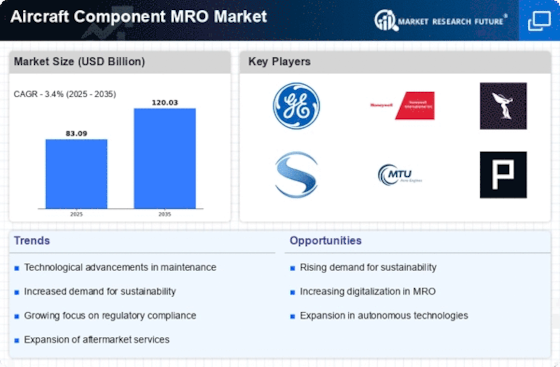
As per Market Research Future analysis, the Aircraft Component MRO Market Size was estimated at 83.09 USD Billion in 2024. The Aircraft Component MRO industry is projected to grow from 85.92 USD Billion in 2025 to 120.03 USD Billion by 2035, exhibiting a compound annual growth rate (CAGR) of 3.4% during the forecast period 2025 - 2035

Key Market Trends & Highlights

The Aircraft Component MRO Market is poised for growth driven by technological advancements and sustainability initiatives.

  • Technological advancements in MRO are enhancing efficiency and reducing turnaround times, particularly in North America. Sustainability initiatives are becoming increasingly critical, influencing MRO practices across the aviation sector. The shift towards outsourcing MRO services is notable, especially in the Asia-Pacific region, which is experiencing rapid growth. Key market drivers include increasing air traffic demand and regulatory compliance, which are propelling the need for advanced maintenance solutions.

Market Size & Forecast

2024 Market Size 83.09 (USD Billion)
2035 Market Size 120.03 (USD Billion)
CAGR (2025 - 2035) 3.4%
Largest Regional Market Share in 2024 North America

Major Players

General Electric (US), Honeywell International (US), Rolls-Royce (GB), <a href="https://www.safran-group.com/companies/safran-aircraft-engines">Safran</a> (FR), MTU Aero Engines (DE), Pratt &amp; Whitney (US), <a href="https://www.aircraft.airbus.com/en/mro-services">Airbus</a> (FR), Boeing (US), Lufthansa Technik (DE)

Market Trends

The Aircraft Component MRO Market is currently experiencing a dynamic evolution, driven by various factors that influence maintenance, aircraft parts repair and overhaul activities. The increasing complexity of aircraft systems necessitates advanced technical expertise and innovative solutions. As airlines and operators seek to enhance operational efficiency, the demand for specialized MRO services appears to be on the rise. Furthermore, the growing emphasis on sustainability and environmental compliance is prompting companies to adopt more eco-friendly practices in their operations. This shift not only aligns with regulatory requirements but also resonates with the broader industry trend towards greener aviation solutions. In addition, the Aircraft Component MRO Market is witnessing a notable shift towards digitalization and automation. The integration of advanced technologies, such as predictive maintenance and data analytics, seems to enhance the efficiency of MRO processes. This technological advancement may lead to reduced downtime and improved reliability of aircraft components. As the market continues to evolve, stakeholders must remain agile and responsive to emerging trends, ensuring they are well-positioned to capitalize on new opportunities while navigating potential challenges in this competitive landscape.

Technological Advancements in MRO

The Aircraft Component MRO Market is increasingly influenced by technological innovations. The adoption of advanced tools and systems, such as predictive maintenance and artificial intelligence, is transforming traditional practices. These technologies enable more efficient diagnostics and repairs, potentially reducing turnaround times and enhancing overall service quality.

Sustainability Initiatives

There is a growing focus on sustainability within the Aircraft Component MRO Market. Companies are actively seeking to implement eco-friendly practices, such as waste reduction and energy-efficient processes. This trend not only addresses regulatory pressures but also aligns with the industry's broader commitment to reducing its environmental footprint.

Shift Towards Outsourcing

The trend of outsourcing MRO services is becoming more prevalent in the Aircraft Component MRO Market. Airlines and operators are increasingly relying on third-party providers to manage maintenance activities. This shift allows them to focus on core operations while leveraging the expertise and resources of specialized MRO providers.

Aircraft Component MRO Market Market Drivers

Increasing Air Traffic Demand

The Aircraft Component MRO Market is experiencing a surge in demand due to the increasing air traffic worldwide. As more airlines expand their fleets to accommodate rising passenger numbers, the need for maintenance, repair, and overhaul services becomes paramount. According to recent data, air traffic is projected to grow at an annual rate of approximately 4.5% over the next decade. This growth necessitates a robust MRO framework to ensure aircraft safety and reliability. Consequently, MRO providers are likely to invest in advanced technologies and skilled workforce to meet the escalating demand. The interplay between rising air traffic and the need for efficient MRO services suggests a promising outlook for the Aircraft Component MRO Market.

Growing Focus on Sustainability

The Aircraft Component MRO Market is increasingly aligning with sustainability initiatives as environmental concerns gain prominence. Airlines are under pressure to reduce their carbon footprints, prompting MRO providers to adopt eco-friendly practices. This includes the use of sustainable materials in repairs and the implementation of waste reduction strategies. Additionally, regulatory bodies are incentivizing MRO providers to enhance their sustainability efforts through various programs. The shift towards greener operations not only meets regulatory requirements but also appeals to environmentally conscious consumers. As sustainability becomes a core focus, the Aircraft Component MRO Market is likely to evolve, presenting new opportunities for innovation and growth.

Expansion of the Aviation Sector

The expansion of the aviation sector is a critical driver for the Aircraft Component MRO Market. Emerging markets are witnessing a rapid increase in air travel, leading to the establishment of new airlines and the expansion of existing fleets. This growth is accompanied by a corresponding rise in demand for MRO services, as new aircraft require regular maintenance to ensure operational efficiency. Furthermore, the establishment of new airports and aviation infrastructure in developing regions enhances accessibility and connectivity, further stimulating the need for MRO services. The expansion of the aviation sector indicates a robust future for the Aircraft Component MRO Market, as it adapts to meet the needs of a growing customer base.

Regulatory Compliance and Safety Standards

The Aircraft Component MRO Market is significantly influenced by stringent regulatory compliance and safety standards imposed by aviation authorities. These regulations are designed to ensure the safety and airworthiness of aircraft, compelling operators to adhere to rigorous maintenance schedules. As a result, MRO providers must continuously update their practices to align with evolving regulations. The Federal Aviation Administration (FAA) and the European Union Aviation Safety Agency (EASA) have established comprehensive guidelines that MRO providers must follow. This regulatory landscape not only drives demand for MRO services but also encourages innovation within the industry. The necessity for compliance indicates a sustained growth trajectory for the Aircraft Component MRO Market.

Technological Innovations in Maintenance Practices

Technological innovations are reshaping the Aircraft Component MRO Market, enhancing efficiency and reducing turnaround times. The integration of predictive maintenance technologies, such as data analytics and artificial intelligence, allows MRO providers to anticipate component failures before they occur. This proactive approach minimizes downtime and optimizes maintenance schedules. Furthermore, the adoption of advanced materials and repair techniques contributes to longer component lifespans, thereby reducing overall maintenance costs. As airlines increasingly seek to leverage these technologies, the Aircraft Component MRO Market is likely to witness a transformation in service delivery models, fostering a competitive environment among MRO providers.

Market Segment Insights

By Component Type: Engine Components (Largest) vs. Avionics (Fastest-Growing)

The Aircraft Component MRO Market is characterized by a diverse range of component types, with <a href="https://www.marketresearchfuture.com/reports/engine-market-24300">Engine</a> Components leading as the largest segment. This segment benefits from the ongoing advancements and maintenance necessitated by evolving aircraft technologies. Avionics, on the other hand, has emerged rapidly, capturing attention due to the increasing integration of advanced technologies and digital systems into aircraft operations. Growth trends in the Aircraft Component MRO Market are heavily influenced by rising air travel demand and the need for enhanced safety and efficiency in aviation. As the fleet ages, maintenance activities on Engine Components are expected to retain a strong foothold. Concurrently, the Avionics segment is projected to expand at a faster pace, driven by innovations in cockpit technology and regulatory mandates for modernization in aircraft systems.

Engine Components (Dominant) vs. Hydraulics (Emerging)

Engine Components hold a dominant position in the Aircraft Component MRO Market, primarily due to the critical nature of engine health and performance in aircraft operations. Regular maintenance, repair, and overhaul of these components are essential for ensuring operational safety and efficiency. In contrast, the Hydraulics segment is classified as emerging, with increasing demand spurred by modern aircraft designs that require sophisticated hydraulic solutions. As technologies evolve, the need for reliable hydraulic systems grows, thereby enhancing the MRO opportunities for this segment. The focus on durability and performance in both segments emphasizes the critical roles they play in overall aircraft operational effectiveness.

By Material Type: Metal (Largest) vs. Composite (Fastest-Growing)

In the Aircraft Component MRO Market, the material types exhibit a diverse distribution, with metal components maintaining the largest share. Predominantly used in structural applications, metal ensures durability and strength, making it the preferred choice for critical aircraft components. Conversely, composite materials are emerging rapidly in popularity, catering to the increasing demand for lightweight and fuel-efficient aircraft designs. This shift reflects the changing dynamics in material preference. The growth trends indicate a significant move towards composite materials, which are predicted to outpace metal in growth rate. This uptick is fuelled by advancements in material technology and aerospace engineering. The drive for operational efficiency and reducing environmental impact significantly enhances the demand for composites, positioning them as the fastest-growing category in MRO activities over the coming years.

Metal (Dominant) vs. Composite (Emerging)

Metal components remain a dominant force in the Aircraft Component MRO Market. Known for their robustness and reliability, metals such as aluminum and titanium play crucial roles in the manufacturing of key aircraft parts like fuselages and wings. These materials excel in durability and fatigue resistance, which are critical for safety and performance. On the other hand, composites are emerging with distinct advantages. Their lightweight nature contributes to enhanced fuel efficiency and performance. Composites like carbon fiber reinforced polymers are becoming increasingly utilized for non-structural and structural applications alike, making them an essential part of modern aerospace engineering. As research and innovation progress, composites are expected to secure a larger footing in the market, leading to a shift in maintenance and repair strategies.

By Service Type: Maintenance (Largest) vs. Repair (Fastest-Growing)

In the Aircraft Component MRO Market, the service type segment exhibits a diverse distribution with Repair, Maintenance, Overhauling, Modification, and Inspection services playing critical roles. The aircraft component maintenance segment holds the largest share, driven by the essential need for regular checks and performance enhancements to ensure aircraft safety and reliability. As airlines continue to focus on prolonging the life of their fleet, maintenance services are prioritized, while repair services, though smaller in market share, represent the fastest-growing area as more operators seek agile solutions for minimizing downtime.

Maintenance (Dominant) vs. Repair (Emerging)

The aircraft component maintenance services dominate the Aircraft Component MRO Market due to their integral role in ensuring operational safety and compliance with stringent regulations. These services encompass routine checks and scheduled interventions, which are critical for the longevity and efficiency of aircraft operations. In contrast, Repair services are marked as emerging, gaining traction through technological advancements and cost-effective solutions that appeal to operators seeking to reduce aircraft downtime. As the demand for operational efficiency grows, the shift towards swift repair strategies becomes more pronounced, showcasing the Repair segment's potential for significant growth in the coming years.

By End-use: Commercial Aviation (Largest) vs. Military Aviation (Fastest-Growing)

The Aircraft Component MRO Market is prominently segmented into Commercial Aviation, Military Aviation, Cargo Aircraft, Business Jets, and the helicopter mro market. Among these, the commercial aircraft mro market holds the largest share, driven by the continuous demand for passenger air travel and the increasing number of commercial aircraft in operation. Military Aviation, while smaller in share, is rapidly expanding due to the modernization of military fleets and heightened defense spending globally, which emphasizes the need for efficient aircraft component maintenance and timely repairs.

Commercial Aviation: Dominant vs. Military Aviation: Emerging

In the Aircraft Component MRO Market, the commercial aircraft mro market is recognized as the dominant segment, characterized by a well-established infrastructure and a broad customer base. Its growth is bolstered by a high volume of flights and stringent maintenance regulations that ensure safety and reliability. On the other hand, Military Aviation, while currently an emerging segment, has displayed remarkable growth potential. This segment is driven by governmental investments in fleet upgrades and advancements in military technology, requiring specialized maintenance solutions to keep pace with evolving operational demands. Both segments are crucial, but their approaches and growth trajectories are notably distinct.

Get more detailed insights about Aircraft Component MRO Market Research Report - Global Forecast to 2035

Regional Insights

The Aircraft Component MRO Market showcased significant regional diversity, with North America dominating the market valued at 30.0 USD Billion in 2024, rising to 42.0 USD Billion by 2035. This region was pivotal due to its high volume of air traffic and extensive fleet size, driving substantial demand for maintenance, repair, and aircraft component overhaul services.

Europe followed closely with a market value of 25.0 USD Billion in 2024, projected to reach 35.0 USD Billion in 2035, bolstered by stringent regulatory requirements and a robust aerospace industry. The Asia Pacific region, valued at 20.0 USD Billion in 2024 and expected to grow to 28.0 USD Billion by 2035, emerged rapidly fueled by increasing air travel and infrastructure developments.

In contrast, South America and the Middle East and Africa held smaller market shares, with South America at 4.0 USD Billion in 2024, growing to 6.0 USD Billion by 2035, while Middle East and Africa are valued at 4.09 USD Billion in 2024, anticipated to rise to 9.0 USD Billion by 2035.

Despite their smaller sizes, these regions presented opportunities for growth, reflecting rising air travel demand and evolving MRO capabilities. The Aircraft Component MRO Market displayed robust potential across these regions, driven by enhancements in technologies and evolving market dynamics.

Key Players and Competitive Insights

The Aircraft Component MRO Market is characterized by a rapidly evolving competitive landscape where several key players vie for market share. This industry is driven by the increasing demand for aircraft maintenance, aircraft parts repair and overhaul services, stemming from the growing global fleet of commercial and military aircraft.
The market insights reveal a trend towards investment in advanced technologies, including predictive maintenance and digital solutions, which enhance operational efficiency and reduce downtime. As air traffic continues to expand, competition remains fierce among numerous established and emerging firms aiming to capture a larger share of the mro aircraft services offered across different regions. Strong affiliations with aviation manufacturers and a focus on customer-centric services are critical strategies employed by companies in this space. General Electric stands out in the Aircraft Component MRO Market with its extensive portfolio of aviation services that leverage its technological capabilities and deep industry expertise. The company has built a solid reputation for offering tailored maintenance solutions that address specific customer needs. This customer-focused approach, paired with advanced technologies like additive manufacturing and data analytics, aids General Electric in providing efficient MRO services which help improve aircraft operational availability. The integration of digital platforms facilitates real-time monitoring and maintenance, making General Electric a preferred choice among airlines seeking reliability in their component maintenance. The company's global reach and established relationships with various airlines and military entities bolster its competitive position, enabling it to maintain a prominent presence in the mro aircraft domain. Airbus also plays a significant role in the Aircraft Component MRO Market, offering an array of services tailored for different aircraft types. The company is known for its comprehensive support packages which include components MRO, spare parts provisioning, and tailored maintenance solutions, allowing operators to optimize aircraft performance and reduce lifecycle costs. Airbus has made strategic investments in digital tools that streamline maintenance workflows and enhance the accuracy of predictive maintenance. The company’s strength lies in its expansive service network and partnerships which facilitate effective support to operators worldwide. In recent years, Airbus has engaged in mergers and acquisitions that have strengthened its capabilities and broadened its service offerings in the MRO sector. These strategic moves not only amplify its market presence but also allow Airbus to cater to the evolving needs of the aviation industry while ensuring high standards of service delivery.

Key Companies in the Aircraft Component MRO Market include

Industry Developments

Recent developments in the Global Aircraft Component Maintenance, Repair, and Overhaul (MRO) Market indicate a period of robust growth and shifting dynamics. In October 2023, General Electric announced the expansion of its MRO services, enhancing capabilities in sustainable aviation technologies. Airbus is reportedly increasing its investment in digital solutions to improve efficiency in MRO operations.

Notably, in September 2023, Rolls-Royce established a new joint venture with Honeywell International focused on advancing MRO solutions for their engines, which indicates a strategic move towards collaborative innovation in the industry.

In August 2023, Pratt & Whitney disclosed significant upgrades to their MRO facilities to accommodate the next generation of engines, aligning with larger industry trends emphasizing modernization and sustainability.

Recent developments in the Global Aircraft Component Maintenance, Repair, and aircraft component overhaul Market indicate a period of robust growth and shifting dynamics. In October 2023, General Electric announced the expansion of its MRO services, enhancing capabilities in sustainable aviation technologies. Airbus is reportedly increasing its investment in digital solutions to improve efficiency in mro aircraft operations.

Notably, in September 2023, Rolls-Royce established a new joint venture with Honeywell International focused on advancing mro aircraft solutions for their engines, which indicates a strategic move towards collaborative innovation in the industry.

In August 2023, Pratt & Whitney disclosed significant upgrades to their MRO facilities to accommodate the next generation of engines, driving the aircraft engine mro market aligning with larger industry trends emphasizing modernization and sustainability.

Over the past 2-3 years, various companies such as Lufthansa Technik and Safran have also seen substantial growth, driven by a worldwide increase in air travel and a growing fleet of aircraft requiring maintenance. Coverage of these developments highlights the ongoing transformation within the Aircraft Component MRO Market, driven by technological advancements and strategic alliances among major industry players.

Future Outlook

Aircraft Component MRO Market Future Outlook

The Aircraft Component MRO Market is projected to grow at a 3.4% CAGR from 2025 to 2035, driven by technological advancements, increasing air traffic, and regulatory compliance demands.

New opportunities lie in:

  • <p>Implementation of predictive maintenance technologies to reduce downtime. Expansion of component repair capabilities for emerging aircraft models. Development of eco-friendly MRO practices to meet sustainability regulations.</p>

By 2035, the market is expected to be robust, driven by innovation and increased demand.

Market Segmentation

Aircraft Component MRO Market End-use Outlook

  • Commercial Aviation
  • Military Aviation
  • Cargo Aircraft
  • Business Jets
  • Helicopters

Aircraft Component MRO Market Service Type Outlook

  • Repair
  • Overhauling
  • Maintenance
  • Modification
  • Inspection

Aircraft Component MRO Market Material Type Outlook

  • Metal
  • Composite
  • Plastic
  • Rubber
  • Ceramic

Aircraft Component MRO Market Component Type Outlook

  • Engine Components
  • Avionics
  • Landing Gear
  • Hydraulics
  • Fuel Systems

Report Scope

MARKET SIZE 2024 83.09(USD Billion)
MARKET SIZE 2025 85.92(USD Billion)
MARKET SIZE 2035 120.03(USD Billion)
COMPOUND ANNUAL GROWTH RATE (CAGR) 3.4% (2025 - 2035)
REPORT COVERAGE Revenue Forecast, Competitive Landscape, Growth Factors, and Trends
BASE YEAR 2024
Market Forecast Period 2025 - 2035
Historical Data 2019 - 2024
Market Forecast Units USD Billion
Key Companies Profiled General Electric (US), Honeywell International (US), Rolls-Royce (GB), Safran (FR), MTU Aero Engines (DE), Pratt & Whitney (US), Airbus (FR), Boeing (US), Lufthansa Technik (DE)
Segments Covered Component Type, Material Type, Service Type, End-use, Regional
Key Market Opportunities Integration of advanced predictive maintenance technologies enhances efficiency in the Aircraft Component MRO Market.
Key Market Dynamics Technological advancements and regulatory changes drive competitive dynamics in the Aircraft Component Maintenance, Repair, and Overhaul market.
Countries Covered North America, Europe, APAC, South America, MEA

FAQs

What is the projected market valuation of the Aircraft Component MRO Market by 2035?

<p>The Aircraft Component MRO Market is projected to reach a valuation of 120.03 USD Billion by 2035.</p>

What was the market valuation of the Aircraft Component MRO Market in 2024?

<p>In 2024, the overall market valuation was 83.09 USD Billion.</p>

What is the expected CAGR for the Aircraft Component MRO Market during the forecast period 2025 - 2035?

<p>The expected CAGR for the Aircraft Component MRO Market during the forecast period 2025 - 2035 is 3.4%.</p>

Which companies are considered key players in the Aircraft Component MRO Market?

<p>Key players in the Aircraft Component MRO Market include General Electric, Honeywell International, Rolls-Royce, Safran, MTU Aero Engines, Pratt & Whitney, Airbus, Boeing, and Lufthansa Technik.</p>

What segment of the Aircraft Component MRO Market had the highest valuation in 2024?

<p>In 2024, the Engine Components segment had the highest valuation at 30.0 USD Billion.</p>

How much is the Avionics segment projected to grow by 2035?

<p>The Avionics segment is projected to grow from 15.0 USD Billion in 2024 to 22.0 USD Billion by 2035.</p>

What is the projected valuation for the Repair service type by 2035?

<p>The Repair service type is projected to reach a valuation of 42.0 USD Billion by 2035.</p>

Which material type is expected to see the most growth in the Aircraft Component MRO Market?

<p>The Metal material type is expected to grow from 30.0 USD Billion in 2024 to 45.0 USD Billion by 2035.</p>

What is the projected valuation for the Military Aviation end-use segment by 2035?

<p>The Military Aviation end-use segment is projected to reach a valuation of 20.0 USD Billion by 2035.</p>

How does the projected growth of the Cargo Aircraft segment compare to other end-use segments?

<p>The Cargo Aircraft segment is projected to grow from 10.0 USD Billion in 2024 to 15.0 USD Billion by 2035, indicating a moderate growth compared to other segments.</p>

  1. SECTION I: EXECUTIVE SUMMARY AND KEY HIGHLIGHTS
    1. | 1.1 EXECUTIVE SUMMARY
    2. | | 1.1.1 Market Overview
    3. | | 1.1.2 Key Findings
    4. | | 1.1.3 Market Segmentation
    5. | | 1.1.4 Competitive Landscape
    6. | | 1.1.5 Challenges and Opportunities
    7. | | 1.1.6 Future Outlook
  2. SECTION II: SCOPING, METHODOLOGY AND MARKET STRUCTURE
    1. | 2.1 MARKET INTRODUCTION
    2. | | 2.1.1 Definition
    3. | | 2.1.2 Scope of the study
    4. | | | 2.1.2.1 Research Objective
    5. | | | 2.1.2.2 Assumption
    6. | | | 2.1.2.3 Limitations
    7. | 2.2 RESEARCH METHODOLOGY
    8. | | 2.2.1 Overview
    9. | | 2.2.2 Data Mining
    10. | | 2.2.3 Secondary Research
    11. | | 2.2.4 Primary Research
    12. | | | 2.2.4.1 Primary Interviews and Information Gathering Process
    13. | | | 2.2.4.2 Breakdown of Primary Respondents
    14. | | 2.2.5 Forecasting Model
    15. | | 2.2.6 Market Size Estimation
    16. | | | 2.2.6.1 Bottom-Up Approach
    17. | | | 2.2.6.2 Top-Down Approach
    18. | | 2.2.7 Data Triangulation
    19. | | 2.2.8 Validation
  3. SECTION III: QUALITATIVE ANALYSIS
    1. | 3.1 MARKET DYNAMICS
    2. | | 3.1.1 Overview
    3. | | 3.1.2 Drivers
    4. | | 3.1.3 Restraints
    5. | | 3.1.4 Opportunities
    6. | 3.2 MARKET FACTOR ANALYSIS
    7. | | 3.2.1 Value chain Analysis
    8. | | 3.2.2 Porter's Five Forces Analysis
    9. | | | 3.2.2.1 Bargaining Power of Suppliers
    10. | | | 3.2.2.2 Bargaining Power of Buyers
    11. | | | 3.2.2.3 Threat of New Entrants
    12. | | | 3.2.2.4 Threat of Substitutes
    13. | | | 3.2.2.5 Intensity of Rivalry
    14. | | 3.2.3 COVID-19 Impact Analysis
    15. | | | 3.2.3.1 Market Impact Analysis
    16. | | | 3.2.3.2 Regional Impact
    17. | | | 3.2.3.3 Opportunity and Threat Analysis
  4. SECTION IV: QUANTITATIVE ANALYSIS
    1. | 4.1 Aerospace & Defense, BY Component Type (USD Billion)
    2. | | 4.1.1 Engine Components
    3. | | 4.1.2 Avionics
    4. | | 4.1.3 Landing Gear
    5. | | 4.1.4 Hydraulics
    6. | | 4.1.5 Fuel Systems
    7. | 4.2 Aerospace & Defense, BY Material Type (USD Billion)
    8. | | 4.2.1 Metal
    9. | | 4.2.2 Composite
    10. | | 4.2.3 Plastic
    11. | | 4.2.4 Rubber
    12. | | 4.2.5 Ceramic
    13. | 4.3 Aerospace & Defense, BY Service Type (USD Billion)
    14. | | 4.3.1 Repair
    15. | | 4.3.2 Overhauling
    16. | | 4.3.3 Maintenance
    17. | | 4.3.4 Modification
    18. | | 4.3.5 Inspection
    19. | 4.4 Aerospace & Defense, BY End-use (USD Billion)
    20. | | 4.4.1 Commercial Aviation
    21. | | 4.4.2 Military Aviation
    22. | | 4.4.3 Cargo Aircraft
    23. | | 4.4.4 Business Jets
    24. | | 4.4.5 Helicopters
    25. | 4.5 Aerospace & Defense, BY Region (USD Billion)
    26. | | 4.5.1 North America
    27. | | | 4.5.1.1 US
    28. | | | 4.5.1.2 Canada
    29. | | 4.5.2 Europe
    30. | | | 4.5.2.1 Germany
    31. | | | 4.5.2.2 UK
    32. | | | 4.5.2.3 France
    33. | | | 4.5.2.4 Russia
    34. | | | 4.5.2.5 Italy
    35. | | | 4.5.2.6 Spain
    36. | | | 4.5.2.7 Rest of Europe
    37. | | 4.5.3 APAC
    38. | | | 4.5.3.1 China
    39. | | | 4.5.3.2 India
    40. | | | 4.5.3.3 Japan
    41. | | | 4.5.3.4 South Korea
    42. | | | 4.5.3.5 Malaysia
    43. | | | 4.5.3.6 Thailand
    44. | | | 4.5.3.7 Indonesia
    45. | | | 4.5.3.8 Rest of APAC
    46. | | 4.5.4 South America
    47. | | | 4.5.4.1 Brazil
    48. | | | 4.5.4.2 Mexico
    49. | | | 4.5.4.3 Argentina
    50. | | | 4.5.4.4 Rest of South America
    51. | | 4.5.5 MEA
    52. | | | 4.5.5.1 GCC Countries
    53. | | | 4.5.5.2 South Africa
    54. | | | 4.5.5.3 Rest of MEA
  5. SECTION V: COMPETITIVE ANALYSIS
    1. | 5.1 Competitive Landscape
    2. | | 5.1.1 Overview
    3. | | 5.1.2 Competitive Analysis
    4. | | 5.1.3 Market share Analysis
    5. | | 5.1.4 Major Growth Strategy in the Aerospace & Defense
    6. | | 5.1.5 Competitive Benchmarking
    7. | | 5.1.6 Leading Players in Terms of Number of Developments in the Aerospace & Defense
    8. | | 5.1.7 Key developments and growth strategies
    9. | | | 5.1.7.1 New Product Launch/Service Deployment
    10. | | | 5.1.7.2 Merger & Acquisitions
    11. | | | 5.1.7.3 Joint Ventures
    12. | | 5.1.8 Major Players Financial Matrix
    13. | | | 5.1.8.1 Sales and Operating Income
    14. | | | 5.1.8.2 Major Players R&D Expenditure. 2023
    15. | 5.2 Company Profiles
    16. | | 5.2.1 General Electric (US)
    17. | | | 5.2.1.1 Financial Overview
    18. | | | 5.2.1.2 Products Offered
    19. | | | 5.2.1.3 Key Developments
    20. | | | 5.2.1.4 SWOT Analysis
    21. | | | 5.2.1.5 Key Strategies
    22. | | 5.2.2 Honeywell International (US)
    23. | | | 5.2.2.1 Financial Overview
    24. | | | 5.2.2.2 Products Offered
    25. | | | 5.2.2.3 Key Developments
    26. | | | 5.2.2.4 SWOT Analysis
    27. | | | 5.2.2.5 Key Strategies
    28. | | 5.2.3 Rolls-Royce (GB)
    29. | | | 5.2.3.1 Financial Overview
    30. | | | 5.2.3.2 Products Offered
    31. | | | 5.2.3.3 Key Developments
    32. | | | 5.2.3.4 SWOT Analysis
    33. | | | 5.2.3.5 Key Strategies
    34. | | 5.2.4 Safran (FR)
    35. | | | 5.2.4.1 Financial Overview
    36. | | | 5.2.4.2 Products Offered
    37. | | | 5.2.4.3 Key Developments
    38. | | | 5.2.4.4 SWOT Analysis
    39. | | | 5.2.4.5 Key Strategies
    40. | | 5.2.5 MTU Aero Engines (DE)
    41. | | | 5.2.5.1 Financial Overview
    42. | | | 5.2.5.2 Products Offered
    43. | | | 5.2.5.3 Key Developments
    44. | | | 5.2.5.4 SWOT Analysis
    45. | | | 5.2.5.5 Key Strategies
    46. | | 5.2.6 Pratt & Whitney (US)
    47. | | | 5.2.6.1 Financial Overview
    48. | | | 5.2.6.2 Products Offered
    49. | | | 5.2.6.3 Key Developments
    50. | | | 5.2.6.4 SWOT Analysis
    51. | | | 5.2.6.5 Key Strategies
    52. | | 5.2.7 Airbus (FR)
    53. | | | 5.2.7.1 Financial Overview
    54. | | | 5.2.7.2 Products Offered
    55. | | | 5.2.7.3 Key Developments
    56. | | | 5.2.7.4 SWOT Analysis
    57. | | | 5.2.7.5 Key Strategies
    58. | | 5.2.8 Boeing (US)
    59. | | | 5.2.8.1 Financial Overview
    60. | | | 5.2.8.2 Products Offered
    61. | | | 5.2.8.3 Key Developments
    62. | | | 5.2.8.4 SWOT Analysis
    63. | | | 5.2.8.5 Key Strategies
    64. | | 5.2.9 Lufthansa Technik (DE)
    65. | | | 5.2.9.1 Financial Overview
    66. | | | 5.2.9.2 Products Offered
    67. | | | 5.2.9.3 Key Developments
    68. | | | 5.2.9.4 SWOT Analysis
    69. | | | 5.2.9.5 Key Strategies
    70. | 5.3 Appendix
    71. | | 5.3.1 References
    72. | | 5.3.2 Related Reports
  6. LIST OF FIGURES
    1. | 6.1 MARKET SYNOPSIS
    2. | 6.2 NORTH AMERICA MARKET ANALYSIS
    3. | 6.3 US MARKET ANALYSIS BY COMPONENT TYPE
    4. | 6.4 US MARKET ANALYSIS BY MATERIAL TYPE
    5. | 6.5 US MARKET ANALYSIS BY SERVICE TYPE
    6. | 6.6 US MARKET ANALYSIS BY END-USE
    7. | 6.7 CANADA MARKET ANALYSIS BY COMPONENT TYPE
    8. | 6.8 CANADA MARKET ANALYSIS BY MATERIAL TYPE
    9. | 6.9 CANADA MARKET ANALYSIS BY SERVICE TYPE
    10. | 6.10 CANADA MARKET ANALYSIS BY END-USE
    11. | 6.11 EUROPE MARKET ANALYSIS
    12. | 6.12 GERMANY MARKET ANALYSIS BY COMPONENT TYPE
    13. | 6.13 GERMANY MARKET ANALYSIS BY MATERIAL TYPE
    14. | 6.14 GERMANY MARKET ANALYSIS BY SERVICE TYPE
    15. | 6.15 GERMANY MARKET ANALYSIS BY END-USE
    16. | 6.16 UK MARKET ANALYSIS BY COMPONENT TYPE
    17. | 6.17 UK MARKET ANALYSIS BY MATERIAL TYPE
    18. | 6.18 UK MARKET ANALYSIS BY SERVICE TYPE
    19. | 6.19 UK MARKET ANALYSIS BY END-USE
    20. | 6.20 FRANCE MARKET ANALYSIS BY COMPONENT TYPE
    21. | 6.21 FRANCE MARKET ANALYSIS BY MATERIAL TYPE
    22. | 6.22 FRANCE MARKET ANALYSIS BY SERVICE TYPE
    23. | 6.23 FRANCE MARKET ANALYSIS BY END-USE
    24. | 6.24 RUSSIA MARKET ANALYSIS BY COMPONENT TYPE
    25. | 6.25 RUSSIA MARKET ANALYSIS BY MATERIAL TYPE
    26. | 6.26 RUSSIA MARKET ANALYSIS BY SERVICE TYPE
    27. | 6.27 RUSSIA MARKET ANALYSIS BY END-USE
    28. | 6.28 ITALY MARKET ANALYSIS BY COMPONENT TYPE
    29. | 6.29 ITALY MARKET ANALYSIS BY MATERIAL TYPE
    30. | 6.30 ITALY MARKET ANALYSIS BY SERVICE TYPE
    31. | 6.31 ITALY MARKET ANALYSIS BY END-USE
    32. | 6.32 SPAIN MARKET ANALYSIS BY COMPONENT TYPE
    33. | 6.33 SPAIN MARKET ANALYSIS BY MATERIAL TYPE
    34. | 6.34 SPAIN MARKET ANALYSIS BY SERVICE TYPE
    35. | 6.35 SPAIN MARKET ANALYSIS BY END-USE
    36. | 6.36 REST OF EUROPE MARKET ANALYSIS BY COMPONENT TYPE
    37. | 6.37 REST OF EUROPE MARKET ANALYSIS BY MATERIAL TYPE
    38. | 6.38 REST OF EUROPE MARKET ANALYSIS BY SERVICE TYPE
    39. | 6.39 REST OF EUROPE MARKET ANALYSIS BY END-USE
    40. | 6.40 APAC MARKET ANALYSIS
    41. | 6.41 CHINA MARKET ANALYSIS BY COMPONENT TYPE
    42. | 6.42 CHINA MARKET ANALYSIS BY MATERIAL TYPE
    43. | 6.43 CHINA MARKET ANALYSIS BY SERVICE TYPE
    44. | 6.44 CHINA MARKET ANALYSIS BY END-USE
    45. | 6.45 INDIA MARKET ANALYSIS BY COMPONENT TYPE
    46. | 6.46 INDIA MARKET ANALYSIS BY MATERIAL TYPE
    47. | 6.47 INDIA MARKET ANALYSIS BY SERVICE TYPE
    48. | 6.48 INDIA MARKET ANALYSIS BY END-USE
    49. | 6.49 JAPAN MARKET ANALYSIS BY COMPONENT TYPE
    50. | 6.50 JAPAN MARKET ANALYSIS BY MATERIAL TYPE
    51. | 6.51 JAPAN MARKET ANALYSIS BY SERVICE TYPE
    52. | 6.52 JAPAN MARKET ANALYSIS BY END-USE
    53. | 6.53 SOUTH KOREA MARKET ANALYSIS BY COMPONENT TYPE
    54. | 6.54 SOUTH KOREA MARKET ANALYSIS BY MATERIAL TYPE
    55. | 6.55 SOUTH KOREA MARKET ANALYSIS BY SERVICE TYPE
    56. | 6.56 SOUTH KOREA MARKET ANALYSIS BY END-USE
    57. | 6.57 MALAYSIA MARKET ANALYSIS BY COMPONENT TYPE
    58. | 6.58 MALAYSIA MARKET ANALYSIS BY MATERIAL TYPE
    59. | 6.59 MALAYSIA MARKET ANALYSIS BY SERVICE TYPE
    60. | 6.60 MALAYSIA MARKET ANALYSIS BY END-USE
    61. | 6.61 THAILAND MARKET ANALYSIS BY COMPONENT TYPE
    62. | 6.62 THAILAND MARKET ANALYSIS BY MATERIAL TYPE
    63. | 6.63 THAILAND MARKET ANALYSIS BY SERVICE TYPE
    64. | 6.64 THAILAND MARKET ANALYSIS BY END-USE
    65. | 6.65 INDONESIA MARKET ANALYSIS BY COMPONENT TYPE
    66. | 6.66 INDONESIA MARKET ANALYSIS BY MATERIAL TYPE
    67. | 6.67 INDONESIA MARKET ANALYSIS BY SERVICE TYPE
    68. | 6.68 INDONESIA MARKET ANALYSIS BY END-USE
    69. | 6.69 REST OF APAC MARKET ANALYSIS BY COMPONENT TYPE
    70. | 6.70 REST OF APAC MARKET ANALYSIS BY MATERIAL TYPE
    71. | 6.71 REST OF APAC MARKET ANALYSIS BY SERVICE TYPE
    72. | 6.72 REST OF APAC MARKET ANALYSIS BY END-USE
    73. | 6.73 SOUTH AMERICA MARKET ANALYSIS
    74. | 6.74 BRAZIL MARKET ANALYSIS BY COMPONENT TYPE
    75. | 6.75 BRAZIL MARKET ANALYSIS BY MATERIAL TYPE
    76. | 6.76 BRAZIL MARKET ANALYSIS BY SERVICE TYPE
    77. | 6.77 BRAZIL MARKET ANALYSIS BY END-USE
    78. | 6.78 MEXICO MARKET ANALYSIS BY COMPONENT TYPE
    79. | 6.79 MEXICO MARKET ANALYSIS BY MATERIAL TYPE
    80. | 6.80 MEXICO MARKET ANALYSIS BY SERVICE TYPE
    81. | 6.81 MEXICO MARKET ANALYSIS BY END-USE
    82. | 6.82 ARGENTINA MARKET ANALYSIS BY COMPONENT TYPE
    83. | 6.83 ARGENTINA MARKET ANALYSIS BY MATERIAL TYPE
    84. | 6.84 ARGENTINA MARKET ANALYSIS BY SERVICE TYPE
    85. | 6.85 ARGENTINA MARKET ANALYSIS BY END-USE
    86. | 6.86 REST OF SOUTH AMERICA MARKET ANALYSIS BY COMPONENT TYPE
    87. | 6.87 REST OF SOUTH AMERICA MARKET ANALYSIS BY MATERIAL TYPE
    88. | 6.88 REST OF SOUTH AMERICA MARKET ANALYSIS BY SERVICE TYPE
    89. | 6.89 REST OF SOUTH AMERICA MARKET ANALYSIS BY END-USE
    90. | 6.90 MEA MARKET ANALYSIS
    91. | 6.91 GCC COUNTRIES MARKET ANALYSIS BY COMPONENT TYPE
    92. | 6.92 GCC COUNTRIES MARKET ANALYSIS BY MATERIAL TYPE
    93. | 6.93 GCC COUNTRIES MARKET ANALYSIS BY SERVICE TYPE
    94. | 6.94 GCC COUNTRIES MARKET ANALYSIS BY END-USE
    95. | 6.95 SOUTH AFRICA MARKET ANALYSIS BY COMPONENT TYPE
    96. | 6.96 SOUTH AFRICA MARKET ANALYSIS BY MATERIAL TYPE
    97. | 6.97 SOUTH AFRICA MARKET ANALYSIS BY SERVICE TYPE
    98. | 6.98 SOUTH AFRICA MARKET ANALYSIS BY END-USE
    99. | 6.99 REST OF MEA MARKET ANALYSIS BY COMPONENT TYPE
    100. | 6.100 REST OF MEA MARKET ANALYSIS BY MATERIAL TYPE
    101. | 6.101 REST OF MEA MARKET ANALYSIS BY SERVICE TYPE
    102. | 6.102 REST OF MEA MARKET ANALYSIS BY END-USE
    103. | 6.103 KEY BUYING CRITERIA OF AEROSPACE & DEFENSE
    104. | 6.104 RESEARCH PROCESS OF MRFR
    105. | 6.105 DRO ANALYSIS OF AEROSPACE & DEFENSE
    106. | 6.106 DRIVERS IMPACT ANALYSIS: AEROSPACE & DEFENSE
    107. | 6.107 RESTRAINTS IMPACT ANALYSIS: AEROSPACE & DEFENSE
    108. | 6.108 SUPPLY / VALUE CHAIN: AEROSPACE & DEFENSE
    109. | 6.109 AEROSPACE & DEFENSE, BY COMPONENT TYPE, 2024 (% SHARE)
    110. | 6.110 AEROSPACE & DEFENSE, BY COMPONENT TYPE, 2024 TO 2035 (USD Billion)
    111. | 6.111 AEROSPACE & DEFENSE, BY MATERIAL TYPE, 2024 (% SHARE)
    112. | 6.112 AEROSPACE & DEFENSE, BY MATERIAL TYPE, 2024 TO 2035 (USD Billion)
    113. | 6.113 AEROSPACE & DEFENSE, BY SERVICE TYPE, 2024 (% SHARE)
    114. | 6.114 AEROSPACE & DEFENSE, BY SERVICE TYPE, 2024 TO 2035 (USD Billion)
    115. | 6.115 AEROSPACE & DEFENSE, BY END-USE, 2024 (% SHARE)
    116. | 6.116 AEROSPACE & DEFENSE, BY END-USE, 2024 TO 2035 (USD Billion)
    117. | 6.117 BENCHMARKING OF MAJOR COMPETITORS
  7. LIST OF TABLES
    1. | 7.1 LIST OF ASSUMPTIONS
    2. | | 7.1.1
    3. | 7.2 North America MARKET SIZE ESTIMATES; FORECAST
    4. | | 7.2.1 BY COMPONENT TYPE, 2025-2035 (USD Billion)
    5. | | 7.2.2 BY MATERIAL TYPE, 2025-2035 (USD Billion)
    6. | | 7.2.3 BY SERVICE TYPE, 2025-2035 (USD Billion)
    7. | | 7.2.4 BY END-USE, 2025-2035 (USD Billion)
    8. | 7.3 US MARKET SIZE ESTIMATES; FORECAST
    9. | | 7.3.1 BY COMPONENT TYPE, 2025-2035 (USD Billion)
    10. | | 7.3.2 BY MATERIAL TYPE, 2025-2035 (USD Billion)
    11. | | 7.3.3 BY SERVICE TYPE, 2025-2035 (USD Billion)
    12. | | 7.3.4 BY END-USE, 2025-2035 (USD Billion)
    13. | 7.4 Canada MARKET SIZE ESTIMATES; FORECAST
    14. | | 7.4.1 BY COMPONENT TYPE, 2025-2035 (USD Billion)
    15. | | 7.4.2 BY MATERIAL TYPE, 2025-2035 (USD Billion)
    16. | | 7.4.3 BY SERVICE TYPE, 2025-2035 (USD Billion)
    17. | | 7.4.4 BY END-USE, 2025-2035 (USD Billion)
    18. | 7.5 Europe MARKET SIZE ESTIMATES; FORECAST
    19. | | 7.5.1 BY COMPONENT TYPE, 2025-2035 (USD Billion)
    20. | | 7.5.2 BY MATERIAL TYPE, 2025-2035 (USD Billion)
    21. | | 7.5.3 BY SERVICE TYPE, 2025-2035 (USD Billion)
    22. | | 7.5.4 BY END-USE, 2025-2035 (USD Billion)
    23. | 7.6 Germany MARKET SIZE ESTIMATES; FORECAST
    24. | | 7.6.1 BY COMPONENT TYPE, 2025-2035 (USD Billion)
    25. | | 7.6.2 BY MATERIAL TYPE, 2025-2035 (USD Billion)
    26. | | 7.6.3 BY SERVICE TYPE, 2025-2035 (USD Billion)
    27. | | 7.6.4 BY END-USE, 2025-2035 (USD Billion)
    28. | 7.7 UK MARKET SIZE ESTIMATES; FORECAST
    29. | | 7.7.1 BY COMPONENT TYPE, 2025-2035 (USD Billion)
    30. | | 7.7.2 BY MATERIAL TYPE, 2025-2035 (USD Billion)
    31. | | 7.7.3 BY SERVICE TYPE, 2025-2035 (USD Billion)
    32. | | 7.7.4 BY END-USE, 2025-2035 (USD Billion)
    33. | 7.8 France MARKET SIZE ESTIMATES; FORECAST
    34. | | 7.8.1 BY COMPONENT TYPE, 2025-2035 (USD Billion)
    35. | | 7.8.2 BY MATERIAL TYPE, 2025-2035 (USD Billion)
    36. | | 7.8.3 BY SERVICE TYPE, 2025-2035 (USD Billion)
    37. | | 7.8.4 BY END-USE, 2025-2035 (USD Billion)
    38. | 7.9 Russia MARKET SIZE ESTIMATES; FORECAST
    39. | | 7.9.1 BY COMPONENT TYPE, 2025-2035 (USD Billion)
    40. | | 7.9.2 BY MATERIAL TYPE, 2025-2035 (USD Billion)
    41. | | 7.9.3 BY SERVICE TYPE, 2025-2035 (USD Billion)
    42. | | 7.9.4 BY END-USE, 2025-2035 (USD Billion)
    43. | 7.10 Italy MARKET SIZE ESTIMATES; FORECAST
    44. | | 7.10.1 BY COMPONENT TYPE, 2025-2035 (USD Billion)
    45. | | 7.10.2 BY MATERIAL TYPE, 2025-2035 (USD Billion)
    46. | | 7.10.3 BY SERVICE TYPE, 2025-2035 (USD Billion)
    47. | | 7.10.4 BY END-USE, 2025-2035 (USD Billion)
    48. | 7.11 Spain MARKET SIZE ESTIMATES; FORECAST
    49. | | 7.11.1 BY COMPONENT TYPE, 2025-2035 (USD Billion)
    50. | | 7.11.2 BY MATERIAL TYPE, 2025-2035 (USD Billion)
    51. | | 7.11.3 BY SERVICE TYPE, 2025-2035 (USD Billion)
    52. | | 7.11.4 BY END-USE, 2025-2035 (USD Billion)
    53. | 7.12 Rest of Europe MARKET SIZE ESTIMATES; FORECAST
    54. | | 7.12.1 BY COMPONENT TYPE, 2025-2035 (USD Billion)
    55. | | 7.12.2 BY MATERIAL TYPE, 2025-2035 (USD Billion)
    56. | | 7.12.3 BY SERVICE TYPE, 2025-2035 (USD Billion)
    57. | | 7.12.4 BY END-USE, 2025-2035 (USD Billion)
    58. | 7.13 APAC MARKET SIZE ESTIMATES; FORECAST
    59. | | 7.13.1 BY COMPONENT TYPE, 2025-2035 (USD Billion)
    60. | | 7.13.2 BY MATERIAL TYPE, 2025-2035 (USD Billion)
    61. | | 7.13.3 BY SERVICE TYPE, 2025-2035 (USD Billion)
    62. | | 7.13.4 BY END-USE, 2025-2035 (USD Billion)
    63. | 7.14 China MARKET SIZE ESTIMATES; FORECAST
    64. | | 7.14.1 BY COMPONENT TYPE, 2025-2035 (USD Billion)
    65. | | 7.14.2 BY MATERIAL TYPE, 2025-2035 (USD Billion)
    66. | | 7.14.3 BY SERVICE TYPE, 2025-2035 (USD Billion)
    67. | | 7.14.4 BY END-USE, 2025-2035 (USD Billion)
    68. | 7.15 India MARKET SIZE ESTIMATES; FORECAST
    69. | | 7.15.1 BY COMPONENT TYPE, 2025-2035 (USD Billion)
    70. | | 7.15.2 BY MATERIAL TYPE, 2025-2035 (USD Billion)
    71. | | 7.15.3 BY SERVICE TYPE, 2025-2035 (USD Billion)
    72. | | 7.15.4 BY END-USE, 2025-2035 (USD Billion)
    73. | 7.16 Japan MARKET SIZE ESTIMATES; FORECAST
    74. | | 7.16.1 BY COMPONENT TYPE, 2025-2035 (USD Billion)
    75. | | 7.16.2 BY MATERIAL TYPE, 2025-2035 (USD Billion)
    76. | | 7.16.3 BY SERVICE TYPE, 2025-2035 (USD Billion)
    77. | | 7.16.4 BY END-USE, 2025-2035 (USD Billion)
    78. | 7.17 South Korea MARKET SIZE ESTIMATES; FORECAST
    79. | | 7.17.1 BY COMPONENT TYPE, 2025-2035 (USD Billion)
    80. | | 7.17.2 BY MATERIAL TYPE, 2025-2035 (USD Billion)
    81. | | 7.17.3 BY SERVICE TYPE, 2025-2035 (USD Billion)
    82. | | 7.17.4 BY END-USE, 2025-2035 (USD Billion)
    83. | 7.18 Malaysia MARKET SIZE ESTIMATES; FORECAST
    84. | | 7.18.1 BY COMPONENT TYPE, 2025-2035 (USD Billion)
    85. | | 7.18.2 BY MATERIAL TYPE, 2025-2035 (USD Billion)
    86. | | 7.18.3 BY SERVICE TYPE, 2025-2035 (USD Billion)
    87. | | 7.18.4 BY END-USE, 2025-2035 (USD Billion)
    88. | 7.19 Thailand MARKET SIZE ESTIMATES; FORECAST
    89. | | 7.19.1 BY COMPONENT TYPE, 2025-2035 (USD Billion)
    90. | | 7.19.2 BY MATERIAL TYPE, 2025-2035 (USD Billion)
    91. | | 7.19.3 BY SERVICE TYPE, 2025-2035 (USD Billion)
    92. | | 7.19.4 BY END-USE, 2025-2035 (USD Billion)
    93. | 7.20 Indonesia MARKET SIZE ESTIMATES; FORECAST
    94. | | 7.20.1 BY COMPONENT TYPE, 2025-2035 (USD Billion)
    95. | | 7.20.2 BY MATERIAL TYPE, 2025-2035 (USD Billion)
    96. | | 7.20.3 BY SERVICE TYPE, 2025-2035 (USD Billion)
    97. | | 7.20.4 BY END-USE, 2025-2035 (USD Billion)
    98. | 7.21 Rest of APAC MARKET SIZE ESTIMATES; FORECAST
    99. | | 7.21.1 BY COMPONENT TYPE, 2025-2035 (USD Billion)
    100. | | 7.21.2 BY MATERIAL TYPE, 2025-2035 (USD Billion)
    101. | | 7.21.3 BY SERVICE TYPE, 2025-2035 (USD Billion)
    102. | | 7.21.4 BY END-USE, 2025-2035 (USD Billion)
    103. | 7.22 South America MARKET SIZE ESTIMATES; FORECAST
    104. | | 7.22.1 BY COMPONENT TYPE, 2025-2035 (USD Billion)
    105. | | 7.22.2 BY MATERIAL TYPE, 2025-2035 (USD Billion)
    106. | | 7.22.3 BY SERVICE TYPE, 2025-2035 (USD Billion)
    107. | | 7.22.4 BY END-USE, 2025-2035 (USD Billion)
    108. | 7.23 Brazil MARKET SIZE ESTIMATES; FORECAST
    109. | | 7.23.1 BY COMPONENT TYPE, 2025-2035 (USD Billion)
    110. | | 7.23.2 BY MATERIAL TYPE, 2025-2035 (USD Billion)
    111. | | 7.23.3 BY SERVICE TYPE, 2025-2035 (USD Billion)
    112. | | 7.23.4 BY END-USE, 2025-2035 (USD Billion)
    113. | 7.24 Mexico MARKET SIZE ESTIMATES; FORECAST
    114. | | 7.24.1 BY COMPONENT TYPE, 2025-2035 (USD Billion)
    115. | | 7.24.2 BY MATERIAL TYPE, 2025-2035 (USD Billion)
    116. | | 7.24.3 BY SERVICE TYPE, 2025-2035 (USD Billion)
    117. | | 7.24.4 BY END-USE, 2025-2035 (USD Billion)
    118. | 7.25 Argentina MARKET SIZE ESTIMATES; FORECAST
    119. | | 7.25.1 BY COMPONENT TYPE, 2025-2035 (USD Billion)
    120. | | 7.25.2 BY MATERIAL TYPE, 2025-2035 (USD Billion)
    121. | | 7.25.3 BY SERVICE TYPE, 2025-2035 (USD Billion)
    122. | | 7.25.4 BY END-USE, 2025-2035 (USD Billion)
    123. | 7.26 Rest of South America MARKET SIZE ESTIMATES; FORECAST
    124. | | 7.26.1 BY COMPONENT TYPE, 2025-2035 (USD Billion)
    125. | | 7.26.2 BY MATERIAL TYPE, 2025-2035 (USD Billion)
    126. | | 7.26.3 BY SERVICE TYPE, 2025-2035 (USD Billion)
    127. | | 7.26.4 BY END-USE, 2025-2035 (USD Billion)
    128. | 7.27 MEA MARKET SIZE ESTIMATES; FORECAST
    129. | | 7.27.1 BY COMPONENT TYPE, 2025-2035 (USD Billion)
    130. | | 7.27.2 BY MATERIAL TYPE, 2025-2035 (USD Billion)
    131. | | 7.27.3 BY SERVICE TYPE, 2025-2035 (USD Billion)
    132. | | 7.27.4 BY END-USE, 2025-2035 (USD Billion)
    133. | 7.28 GCC Countries MARKET SIZE ESTIMATES; FORECAST
    134. | | 7.28.1 BY COMPONENT TYPE, 2025-2035 (USD Billion)
    135. | | 7.28.2 BY MATERIAL TYPE, 2025-2035 (USD Billion)
    136. | | 7.28.3 BY SERVICE TYPE, 2025-2035 (USD Billion)
    137. | | 7.28.4 BY END-USE, 2025-2035 (USD Billion)
    138. | 7.29 South Africa MARKET SIZE ESTIMATES; FORECAST
    139. | | 7.29.1 BY COMPONENT TYPE, 2025-2035 (USD Billion)
    140. | | 7.29.2 BY MATERIAL TYPE, 2025-2035 (USD Billion)
    141. | | 7.29.3 BY SERVICE TYPE, 2025-2035 (USD Billion)
    142. | | 7.29.4 BY END-USE, 2025-2035 (USD Billion)
    143. | 7.30 Rest of MEA MARKET SIZE ESTIMATES; FORECAST
    144. | | 7.30.1 BY COMPONENT TYPE, 2025-2035 (USD Billion)
    145. | | 7.30.2 BY MATERIAL TYPE, 2025-2035 (USD Billion)
    146. | | 7.30.3 BY SERVICE TYPE, 2025-2035 (USD Billion)
    147. | | 7.30.4 BY END-USE, 2025-2035 (USD Billion)
    148. | 7.31 PRODUCT LAUNCH/PRODUCT DEVELOPMENT/APPROVAL
    149. | | 7.31.1
    150. | 7.32 ACQUISITION/PARTNERSHIP
    151. | | 7.32.1

Aerospace & Defense Market Segmentation

Aerospace & Defense By Component Type (USD Billion, 2025-2035)

  • Engine Components
  • Avionics
  • Landing Gear
  • Hydraulics
  • Fuel Systems

Aerospace & Defense By Material Type (USD Billion, 2025-2035)

  • Metal
  • Composite
  • Plastic
  • Rubber
  • Ceramic

Aerospace & Defense By Service Type (USD Billion, 2025-2035)

  • Repair
  • Overhauling
  • Maintenance
  • Modification
  • Inspection

Aerospace & Defense By End-use (USD Billion, 2025-2035)

  • Commercial Aviation
  • Military Aviation
  • Cargo Aircraft
  • Business Jets
  • Helicopters
Infographic

Free Sample Request

Kindly complete the form below to receive a free sample of this Report

Get Free Sample

Customer Strories

Compare Licence

×
Features License Type
Single User Multiuser License Enterprise User
Price $4,950 $5,950 $7,250
Maximum User Access Limit 1 User Upto 10 Users Unrestricted Access Throughout the Organization
Free Customization
Direct Access to Analyst
Deliverable Format
Platform Access
Discount on Next Purchase 10% 15% 15%
Printable Versions