
Request Free Sample ×

Kindly complete the form below to receive a free sample of this Report

* Please use a valid business email

Leading companies partner with us for data-driven Insights

clients tt-cursor
Hero Background
English
Chinese
French
Japanese
Korean
German
Spanish

AI as a Service Market Share

ID: MRFR/ICT/5594-HCR
100 Pages
Ankit Gupta
April 2026

AI as a Service Market Size, Share and Trends Analysis Report By Deployment Model (Public Cloud, Private Cloud, Hybrid Cloud), By Service Type (Machine Learning, Natural Language Processing, Computer Vision, Speech Recognition), By End User (BFSI, Healthcare, Retail, Manufacturing, IT and Telecom), By Application (Fraud Detection, Predictive Analytics, Customer Support Chatbots, Image Recognition) and By Regional (North America, Europe, South America, Asia Pacific, Middle East and Africa) - Forecast to 2035

Share:
Download PDF ×

We do not share your information with anyone. However, we may send you emails based on your report interest from time to time. You may contact us at any time to opt-out.

AI as a Service Market Infographic
Purchase Options

Market Share

AI as a Service Market Share Analysis

Market positioning is really important for companies which wants to establish a strong foothold in the AIaaS market. An alternative is to use specialised services to achieve differentiation in the market. They make special software programs that are designed to solve particular problems or work in a certain way, which helps them to be unique in the market. Because these specific domains have unique concerns and requirements, AIaaS providers can benefit by catering to their needs and become known as specialists, drawing in companies that require tailored solutions.

This strategy allows for a more targeted approach and helps businesses view us as a specialized and knowledgeable partner which fosters customer loyalty. By marketing themselves as providers of AIaaS services that are top-notch, organizations are trying to attract businesses that can afford the best AI technology. In recent years, working with other companies has become an important part of providing services related to artificial intelligence, especially for companies that provide AI infrastructure as a service.

Partnering with other organizations in technology, expertise or research allows us to provide more comprehensive solutions to our clients. Through the union of their AI technology with that of their partners, service providers can come up with comprehensive solutions that can cater to a larger scope of clients' requirements. I think this collaboration between providers adds to the worth of their offerings and also helps them to be competitive in the AIaaS market.

Another important thing is having user-friendly platforms and tools to help in positioning the market share. AIaaS providers that aim for simplicity and ease of use are more preferred by businesses with limited technical expertise. The implementation of AIaaS is made more effortless thanks to easily understandable interfaces and helpful tools that don’t demand specific training or expertise.


Author
Author Profile
Ankit Gupta
Team Lead - Research

Ankit Gupta is a seasoned market intelligence and strategic research professional with over six plus years of experience in the ICT and Semiconductor industries. With academic roots in Telecom, Marketing, and Electronics, he blends technical insight with business strategy. Ankit has led 200+ projects, including work for Fortune 500 clients like Microsoft and Rio Tinto, covering market sizing, tech forecasting, and go-to-market strategies. Known for bridging engineering and enterprise decision-making, his insights support growth, innovation, and investment planning across diverse technology markets.

Leave a Comment

FAQs

What is the projected market valuation of the AI as a Service Market by 2035?

<p>The AI as a Service Market is projected to reach a valuation of 283.45 USD Billion by 2035.</p>

What was the market valuation of the AI as a Service Market in 2024?

<p>In 2024, the AI as a Service Market was valued at 13.46 USD Billion.</p>

What is the expected CAGR for the AI as a Service Market from 2025 to 2035?

<p>The expected CAGR for the AI as a Service Market during the forecast period 2025 - 2035 is 31.92%.</p>

Which deployment model had the highest valuation in the AI as a Service Market?

<p>The Public Cloud deployment model had the highest valuation at 118.45 USD Billion.</p>

What are the leading service types in the AI as a Service Market?

<p>Machine Learning and Natural Language Processing are among the leading service types, valued at 85.0 USD Billion and 70.0 USD Billion, respectively.</p>

Which end user segment contributed the most to the AI as a Service Market?

<p>The IT and Telecom sector contributed the most, with a valuation of 83.45 USD Billion.</p>

What applications are driving growth in the AI as a Service Market?

<p>Customer Support Chatbots and Predictive Analytics are driving growth, valued at 88.96 USD Billion and 73.73 USD Billion, respectively.</p>

Who are the key players in the AI as a Service Market?

<p>Key players include Amazon Web Services, Microsoft, Google Cloud, IBM, Salesforce, Oracle, Alibaba Cloud, SAP, and NVIDIA.</p>

What is the valuation of the Private Cloud segment in the AI as a Service Market?

<p>The Private Cloud segment was valued at 85.12 USD Billion.</p>

How does the projected growth of the AI as a Service Market compare to its past valuation?

<p>The market is expected to grow from 13.46 USD Billion in 2024 to 283.45 USD Billion by 2035, indicating substantial growth.</p>

Market Summary

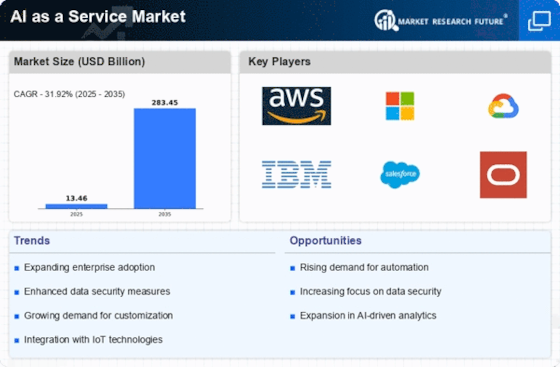
As per Market Research Future analysis, the AI as a Service Market Size was estimated at 13.46 USD Billion in 2024. The AI as a Service industry is projected to grow from 17.76 USD Billion in 2025 to 283.45 USD Billion by 2035, exhibiting a compound annual growth rate (CAGR) of 31.92% during the forecast period 2025 - 2035

Key Market Trends & Highlights

The AI as a Service Market is experiencing robust growth driven by technological advancements and increasing demand for automation.

  • North America remains the largest market for AI as a Service Market, showcasing a strong inclination towards cloud-based solutions. The Asia-Pacific region is emerging as the fastest-growing market, fueled by rapid digital transformation initiatives. The Public Cloud segment dominates the market, while the Hybrid Cloud segment is witnessing the fastest growth due to its flexibility and scalability. Key drivers such as the growing demand for automation and advancements in machine learning technologies are propelling market expansion.

Market Size & Forecast

2024 Market Size 13.46 (USD Billion)
2035 Market Size 283.45 (USD Billion)
CAGR (2025 - 2035) 31.92%
Largest Regional Market Share in 2024 North America

Major Players

Amazon Web Services (US), Microsoft (US), Google Cloud (US), IBM (US), Salesforce (US), Oracle (US), Alibaba Cloud (CN), SAP (DE), NVIDIA (US)

Market Trends

The AI as a Service Market is currently experiencing a transformative phase, characterized by rapid advancements in technology and increasing adoption across various sectors. Organizations are increasingly recognizing the potential of artificial intelligence to enhance operational efficiency, improve decision-making, and drive innovation. This trend is further fueled by the growing availability of cloud-based solutions, which allow businesses to access sophisticated AI tools without the need for extensive infrastructure investments. As a result, companies of all sizes are integrating AI capabilities into their workflows, leading to a more competitive landscape. Moreover, the AI as a Service Market is witnessing a shift towards more specialized applications tailored to specific industries. This specialization enables organizations to leverage AI solutions that address their unique challenges and requirements. Additionally, the emphasis on data privacy and security is prompting service providers to enhance their offerings, ensuring compliance with regulations while maintaining user trust. Overall, the AI as a Service Market appears poised for continued growth, driven by technological advancements and evolving customer needs.

Increased Adoption of Cloud Solutions

The trend towards cloud-based AI solutions is gaining momentum, as businesses seek to leverage the flexibility and scalability offered by these platforms. This shift allows organizations to implement AI technologies without the burden of managing complex infrastructure.

Focus on Industry-Specific Applications

There is a noticeable movement towards developing AI solutions that cater to specific sectors, such as healthcare, finance, and manufacturing. This focus enables companies to utilize AI tools that are finely tuned to their operational needs.

Enhanced Data Security Measures

As concerns regarding data privacy grow, AI as a Service Market providers are prioritizing robust security protocols. This trend reflects a commitment to safeguarding sensitive information while ensuring compliance with regulatory standards.

AI as a Service Market Market Drivers

Growing Demand for Automation

The AI as a Service Market experiences a notable surge in demand for automation across various sectors. Organizations are increasingly seeking to streamline operations, reduce costs, and enhance efficiency through automated processes. This trend is particularly evident in industries such as manufacturing, finance, and healthcare, where AI-driven solutions can optimize workflows and improve decision-making. According to recent estimates, the automation market is projected to reach a valuation of over 200 billion dollars by 2025, indicating a robust growth trajectory. As businesses recognize the potential of AI to transform their operations, the adoption of AI as a Service Market solutions is likely to accelerate, further propelling the market forward.

Rising Need for Data Analytics

The AI as a Service Market is witnessing a growing need for data analytics as organizations strive to derive actionable insights from their data. With the exponential growth of data generated across industries, businesses are increasingly turning to AI-driven analytics solutions to make sense of this information. The AI as a Service Market is projected to reach around 300 billion dollars by 2025, highlighting the critical role of AI in processing and analyzing large datasets. As companies recognize the value of data-driven decision-making, the adoption of AI as a Service Market solutions is likely to increase, further fueling market growth. This trend reflects a broader shift towards data-centric strategies in various sectors.

Increased Focus on Customer Experience

The AI as a Service Market is significantly shaped by an increased focus on enhancing customer experience. Organizations are leveraging AI technologies to personalize interactions, improve service delivery, and anticipate customer needs. This shift is particularly pronounced in sectors such as retail and hospitality, where customer satisfaction is paramount. According to industry reports, businesses that prioritize customer experience are likely to see revenue growth of up to 10% annually. As companies seek to differentiate themselves in competitive markets, the adoption of AI as a Service Market solutions to enhance customer engagement is expected to rise, contributing to the overall growth of the market.

Advancements in Machine Learning Technologies

The AI as a Service Market is significantly influenced by rapid advancements in machine learning technologies. Innovations in algorithms, data processing capabilities, and computational power are enabling organizations to harness AI more effectively. These advancements facilitate the development of sophisticated models that can analyze vast datasets, leading to improved predictive analytics and decision-making. The machine learning sector is expected to grow at a compound annual growth rate of approximately 40% over the next few years, underscoring the increasing reliance on AI solutions. As organizations seek to leverage these technologies, the demand for AI as a Service Market offerings is anticipated to rise, driving market expansion.

Expansion of Internet of Things (IoT) Ecosystem

The AI as a Service Market is experiencing growth driven by the expansion of the Internet of Things (IoT) ecosystem. As more devices become interconnected, the volume of data generated is increasing exponentially, creating opportunities for AI applications. Organizations are utilizing AI to analyze IoT data, enabling real-time insights and automation of processes. The IoT market is projected to reach over 1 trillion dollars by 2025, indicating a substantial opportunity for AI as a Service Market solutions to integrate with IoT technologies. This synergy is likely to enhance operational efficiency and drive innovation across various sectors, further propelling the AI as a Service Market.

Market Segment Insights

By Deployment Model: Public Cloud (Largest) vs. Hybrid Cloud (Fastest-Growing)

In the AI as a Service Market, the deployment model segment is predominantly led by public cloud solutions. This model allows organizations to access AI services at scale, leveraging the infrastructure of major cloud providers. Meanwhile, private cloud deployments hold a significant share as well, catering to enterprises with stringent security and compliance requirements. <a href="https://www.marketresearchfuture.com/reports/hybrid-cloud-market-1018">Hybrid cloud</a> models are gaining traction as they offer the flexibility of both public and private solutions, allowing businesses to adapt their strategies based on operational needs.

Public Cloud (Dominant) vs. Hybrid Cloud (Emerging)

The public cloud segment in AI as a Service Market is defined by its scalability and accessibility, making it the dominant deployment model for many organizations. It facilitates rapid deployment and extensive resource availability for AI workloads, appealing to a wide range of businesses. On the other hand, the hybrid cloud model is emerging as a strong contender, as it combines the benefits of public and private clouds. This model offers improved agility, allowing organizations to scale resources as needed while maintaining the ability to manage sensitive data in a more controlled environment. By bridging the gap between public and private infrastructures, hybrid cloud solutions are becoming increasingly popular among enterprises.

By Service Type: Machine Learning (Largest) vs. Natural Language Processing (Fastest-Growing)

In the AI as a Service Market, Machine Learning remains the largest segment, commanding significant market share due to its wide array of applications across industries such as finance, healthcare, and retail. <a href="https://www.marketresearchfuture.com/reports/natural-language-processing-market-1288">Natural Language Processing</a>, while currently smaller in market share, is the fastest-growing due to the increasing demand for voice-activated devices and chatbots, which are rapidly gaining traction among consumers and businesses alike. The combination of these two service types represents a significant portion of the overall market dynamics. The growth trends in the AI as a Service Market are driven by advancements in cloud computing, big data analytics, and the Internet of Things (IoT). Machine Learning's robust algorithms continue to evolve, enabling organizations to extract insights from massive data sets. Meanwhile, the rising popularity of Natural Language Processing technologies not only enhances user interactions but also streamlines business processes, contributing to its rapid growth. These transformative technologies are set to reshape the way services are delivered in various sectors, positioning AI as a key driver of innovation.

Machine Learning: Dominant vs. Natural Language Processing: Emerging

Machine Learning is the dominant force in the AI as a Service Market, offering advanced <a href="https://www.marketresearchfuture.com/reports/predictive-analytics-market-6845">predictive analytics</a> and data processing capabilities that empower organizations to make data-driven decisions. Its versatility spans numerous applications from automated fraud detection to personalized marketing strategies. On the other hand, Natural Language Processing is an emerging segment that has shown remarkable growth due to its ability to bridge the communication gap between humans and machines. This technology enables machines to understand and interpret human language, making it essential for developing intelligent virtual assistants and enhancing customer service experiences. The competition between these two service types underscores the dynamic nature of the AI market, where businesses continuously seek to leverage the latest advancements for competitive advantage.

By End User: Healthcare (Largest) vs. BFSI (Fastest-Growing)

In the AI as a Service Market, the distribution of market share among end users reveals that the healthcare sector holds the largest share, driven by an increasing demand for patient management solutions and predictive analytics. Following closely is the banking, financial services, and insurance (BFSI) sector, which is leveraging AI for enhanced customer engagement and fraud detection, thus showcasing significant adoption rates in the landscape of AI services.

Healthcare: Leading the Charge (Dominant) vs. BFSI: Rapid Expansion (Emerging)

The healthcare sector stands out in the AI as a Service Market, characterized by its robust demand for innovative solutions that address clinical data management and patient care improvements. AI applications here include telemedicine, imaging analytics, and personalized treatment recommendations. Conversely, the BFSI sector is experiencing rapid expansion through AI integration into risk assessment and customer service optimization. As financial institutions invest in machine learning for transaction analysis and automated customer interactions, this sector is poised for substantial growth, driven by the urgent need for digitization and improved compliance with regulatory frameworks.

By Application: Fraud Detection (Largest) vs. Predictive Analytics (Fastest-Growing)

In the AI as a Service Market, the application segment is diverse, with significant contributions from various sectors. Fraud Detection has emerged as the largest application, benefiting from the increasing need for security and risk management across industries. Predictive Analytics follows closely, driven by the growing demand for data-driven insights in decision-making processes. Other noteworthy applications such as Customer Support Chatbots and Image Recognition are also gaining traction, enhancing customer experiences and operational efficiencies.

Fraud Detection (Dominant) vs. Customer Support Chatbots (Emerging)

Fraud Detection serves as the dominant force within the AI as a Service Market application segment. Its effectiveness in identifying and mitigating fraudulent activities makes it a preferred choice for financial services and e-commerce platforms. On the other hand, Customer Support Chatbots represent an emerging trend, offering businesses a way to improve service delivery through automation and real-time interactions. While Fraud Detection focuses on safeguarding assets and data, Customer Support Chatbots leverage AI to enhance customer engagement, showcasing a shift towards intelligent customer service solutions.

Get more detailed insights about AI as a Service Market Research Report – Global Forecast till 2035

Regional Insights

North America : Innovation and Leadership Hub

North America is the largest market for AI as a Service Market, holding approximately 45% of the global market share. The region's growth is driven by rapid technological advancements, increasing demand for cloud-based solutions, and supportive regulatory frameworks. The presence of major tech companies and startups fosters innovation, while investments in AI research and development further propel market expansion. The United States leads the region, with significant contributions from Canada. Key players such as Amazon Web Services, Microsoft, and Google Cloud dominate the landscape, offering a wide range of AI services. The competitive environment is characterized by continuous innovation and strategic partnerships, ensuring that North America remains at the forefront of AI technology.

Europe : Emerging AI Powerhouse

Europe is rapidly emerging as a significant player in the AI as a Service Market, holding around 30% of the global share. The region benefits from strong regulatory support aimed at fostering innovation while ensuring ethical AI practices. Initiatives like the European AI Act are designed to create a conducive environment for AI development, driving demand for AI services across various sectors. Leading countries include Germany, the UK, and France, where companies are increasingly adopting AI solutions to enhance operational efficiency. Major players like SAP and IBM are expanding their offerings, while numerous startups contribute to a vibrant competitive landscape. The focus on sustainability and ethical AI further distinguishes Europe in the global market.

Asia-Pacific : Rapid Growth and Adoption

Asia-Pacific is witnessing rapid growth in the AI as a Service Market, accounting for approximately 20% of the global share. The region's expansion is fueled by increasing digital transformation initiatives, a growing number of tech startups, and government investments in AI research. Countries like China and India are at the forefront, leveraging AI to enhance various sectors, including healthcare and finance. China is the largest market in the region, with significant contributions from India and Japan. The competitive landscape is marked by the presence of key players such as Alibaba Cloud and local startups. The region's focus on innovation and collaboration among tech companies is driving the adoption of AI services, making it a critical area for future growth.

Middle East and Africa : Emerging Market Potential

The Middle East and Africa region is gradually emerging in the AI as a Service Market, holding about 5% of the global share. The growth is driven by increasing investments in technology infrastructure, government initiatives promoting digital transformation, and a rising awareness of AI's potential benefits. Countries like the UAE and South Africa are leading the charge, with significant government backing for AI projects. The competitive landscape is evolving, with both The AI as a Service Market. Companies are focusing on sectors such as finance, healthcare, and logistics to implement AI solutions. The region's unique challenges and opportunities present a fertile ground for innovation and growth in AI services.

Key Players and Competitive Insights

The Global AI as a Service Market has witnessed rapid growth and evolution, driven by increasing demand for automation, data analysis, and enhanced customer experiences across various industries. As organizations strive to leverage artificial intelligence to stay competitive, the market has become a highly dynamic landscape characterized by innovative service offerings and strategic partnerships. Companies are increasingly focusing on the development of AI-driven solutions that cater to specific business needs, aiming to enhance operational efficiency and decision-making processes.
This competition has ignited a surge in investments in research and development, enabling leading firms to introduce cutting-edge technologies and customized services, which in turn supports the overall growth of the AI as a Service Market sector. The ongoing digital transformation and the need for scalable AI solutions continue to shape the market, creating an environment ripe for competition among established players and emerging startups alike.
DataRobot stands out in the Global AI as a Service Market due to its robust platform that empowers organizations to harness the power of machine learning without the need for extensive expertise. The company offers a comprehensive suite of tools that facilitate the development and deployment of AI models quickly and efficiently, catering to a wide range of industries such as finance, healthcare, and manufacturing. One of the primary strengths of DataRobot is its commitment to automation, which significantly reduces the time and effort required in the AI model training process, making it accessible to businesses of all sizes.
Moreover, DataRobot’s focus on delivering explainable AI adds an additional layer of trust and reliability, enabling stakeholders to understand the decision-making process behind AI predictions. Their strong emphasis on user experience, coupled with a rich set of features that support data integration and collaboration, has cemented DataRobot's position as a leader in the AI as a Service Market space.Salesforce has also made significant strides in the Global AI as a Service Market, primarily through its pioneering platform that integrates artificial intelligence into customer relationship management (CRM) tools
The company’s AI-driven offerings, particularly the Einstein platform, enable businesses to gain actionable insights from their customer data, thereby enhancing sales and marketing strategies. One of Salesforce's notable strengths lies in its extensive ecosystem and customer base, which allows for seamless integration of AI capabilities into their existing workflows. This powerful integration allows companies to leverage advanced analytics to better predict customer needs and personalize interactions. Additionally, Salesforce’s continuous innovation in AI functionalities, backed by significant investments in research and development, ensures that the company remains at the forefront of providing cutting-edge solutions tailored to improve customer experiences and engagement.
With a strong focus on user-friendly designs and collaborative tools, Salesforce continues to shape the AI as a Service Market landscape significantly.

Key Companies in the AI as a Service Market include

Industry Developments

  • Q2 2024: Microsoft launches new Copilot AI as a Service Market platform for enterprises Microsoft announced the launch of its Copilot AI as a Service Market platform, offering enterprise customers access to generative AI tools and APIs through Azure, marking a major expansion of its AIaaS portfolio.
  • Q2 2024: Google Cloud unveils Vertex AI Agent Builder for enterprise AI services Google Cloud introduced Vertex AI Agent Builder, a new AI as a Service Market product enabling businesses to create and deploy custom generative AI agents, further strengthening its position in the AIaaS market.
  • Q2 2024: AWS announces general availability of Amazon Bedrock for AI as a Service Market Amazon Web Services launched Amazon Bedrock, a fully managed AI as a Service Market platform providing access to foundation models from leading AI companies, now generally available to all AWS customers.
  • Q3 2024: Salesforce acquires AI startup Aide for $250 million to boost AI as a Service Market offerings Salesforce completed the acquisition of Aide, a generative AI startup, to integrate its technology into Salesforce's AI as a Service Market suite, enhancing automation and analytics capabilities for enterprise clients.
  • Q3 2024: IBM and SAP announce strategic partnership to deliver AI as a Service Market for supply chain IBM and SAP formed a strategic partnership to co-develop and deliver AI as a Service Market solutions targeting supply chain optimization, leveraging IBM's Watson AI and SAP's enterprise software.
  • Q4 2024: OpenAI launches ChatGPT Enterprise API as a Service OpenAI announced the launch of ChatGPT Enterprise API, providing businesses with scalable access to its advanced language models as a managed AI as a Service Market offering.
  • Q4 2024: Cohere raises $450 million in Series C funding to expand AI as a Service Market platform Cohere secured $450 million in Series C funding led by prominent venture capital firms, aiming to accelerate the development and global rollout of its AI as a Service Market platform for enterprises.
  • Q1 2025: Oracle launches AI as a Service Market suite for healthcare sector Oracle introduced a new AI as a Service Market suite tailored for healthcare organizations, offering predictive analytics, patient engagement, and workflow automation tools powered by Oracle Cloud AI.
  • Q1 2025: SAP acquires AI workflow automation firm Cognigy to expand AI as a Service Market SAP acquired Cognigy, a leading AI workflow automation company, to enhance its AI as a Service Market capabilities and integrate advanced conversational AI into its enterprise cloud offerings.
  • Q2 2025: NVIDIA launches AI Foundry Service for enterprise model deployment NVIDIA announced the launch of its AI Foundry Service, enabling enterprises to build, customize, and deploy AI models at scale as a managed AI as a Service Market solution.
  • Q2 2025: ServiceNow and Hugging Face partner to deliver enterprise AI as a Service Market ServiceNow and Hugging Face entered a partnership to integrate Hugging Face's open-source AI models into ServiceNow's platform, offering new AI as a Service Market capabilities for enterprise automation.
  • Q2 2025: Databricks acquires Mistral AI to strengthen AI as a Service Market portfolio Databricks announced the acquisition of Mistral AI, a European AI model developer, to expand its AI as a Service Market offerings and accelerate innovation in enterprise AI solutions.

Future Outlook

AI as a Service Market Future Outlook

The AI as a Service Market is projected to grow at a 31.92% CAGR from 2025 to 2035, driven by advancements in machine learning, cloud computing, and increased demand for automation.

New opportunities lie in:

  • Development of industry-specific AI solutions for healthcare and finance sectors.
  • Integration of AI with IoT devices for enhanced data analytics.
  • Creation of subscription-based AI platforms for small and medium enterprises.

By 2035, the AI as a Service Market is expected to be a cornerstone of digital transformation across industries.

Market Segmentation

AI as a Service Market End User Outlook

  • BFSI
  • Healthcare
  • Retail
  • Manufacturing
  • IT and Telecom

AI as a Service Market Application Outlook

  • Fraud Detection
  • Predictive Analytics
  • Customer Support Chatbots
  • Image Recognition

AI as a Service Market Service Type Outlook

  • Machine Learning
  • Natural Language Processing
  • Computer Vision
  • Speech Recognition

AI as a Service Market Deployment Model Outlook

  • Public Cloud
  • Private Cloud
  • Hybrid Cloud

Report Scope

MARKET SIZE 2024 13.46(USD Billion)
MARKET SIZE 2025 17.76(USD Billion)
MARKET SIZE 2035 283.45(USD Billion)
COMPOUND ANNUAL GROWTH RATE (CAGR) 31.92% (2025 - 2035)
REPORT COVERAGE Revenue Forecast, Competitive Landscape, Growth Factors, and Trends
BASE YEAR 2024
Market Forecast Period 2025 - 2035
Historical Data 2019 - 2024
Market Forecast Units USD Billion
Key Companies Profiled Amazon Web Services (US), Microsoft (US), Google Cloud (US), IBM (US), Salesforce (US), Oracle (US), Alibaba Cloud (CN), SAP (DE), NVIDIA (US)
Segments Covered Deployment Model, Service Type, End User, Application, Regional
Key Market Opportunities Integration of advanced machine learning models enhances scalability in the AI as a Service Market.
Key Market Dynamics Rising demand for scalable AI solutions drives competitive innovation and regulatory adaptation in the AI as a Service Market.
Countries Covered North America, Europe, APAC, South America, MEA

FAQs

What is the projected market valuation of the AI as a Service Market by 2035?

<p>The AI as a Service Market is projected to reach a valuation of 283.45 USD Billion by 2035.</p>

What was the market valuation of the AI as a Service Market in 2024?

<p>In 2024, the AI as a Service Market was valued at 13.46 USD Billion.</p>

What is the expected CAGR for the AI as a Service Market from 2025 to 2035?

<p>The expected CAGR for the AI as a Service Market during the forecast period 2025 - 2035 is 31.92%.</p>

Which deployment model had the highest valuation in the AI as a Service Market?

<p>The Public Cloud deployment model had the highest valuation at 118.45 USD Billion.</p>

What are the leading service types in the AI as a Service Market?

<p>Machine Learning and Natural Language Processing are among the leading service types, valued at 85.0 USD Billion and 70.0 USD Billion, respectively.</p>

Which end user segment contributed the most to the AI as a Service Market?

<p>The IT and Telecom sector contributed the most, with a valuation of 83.45 USD Billion.</p>

What applications are driving growth in the AI as a Service Market?

<p>Customer Support Chatbots and Predictive Analytics are driving growth, valued at 88.96 USD Billion and 73.73 USD Billion, respectively.</p>

Who are the key players in the AI as a Service Market?

<p>Key players include Amazon Web Services, Microsoft, Google Cloud, IBM, Salesforce, Oracle, Alibaba Cloud, SAP, and NVIDIA.</p>

What is the valuation of the Private Cloud segment in the AI as a Service Market?

<p>The Private Cloud segment was valued at 85.12 USD Billion.</p>

How does the projected growth of the AI as a Service Market compare to its past valuation?

<p>The market is expected to grow from 13.46 USD Billion in 2024 to 283.45 USD Billion by 2035, indicating substantial growth.</p>

  1. SECTION I: EXECUTIVE SUMMARY AND KEY HIGHLIGHTS
    1. | 1.1 EXECUTIVE SUMMARY
    2. | | 1.1.1 Market Overview
    3. | | 1.1.2 Key Findings
    4. | | 1.1.3 Market Segmentation
    5. | | 1.1.4 Competitive Landscape
    6. | | 1.1.5 Challenges and Opportunities
    7. | | 1.1.6 Future Outlook
  2. SECTION II: SCOPING, METHODOLOGY AND MARKET STRUCTURE
    1. | 2.1 MARKET INTRODUCTION
    2. | | 2.1.1 Definition
    3. | | 2.1.2 Scope of the study
    4. | | | 2.1.2.1 Research Objective
    5. | | | 2.1.2.2 Assumption
    6. | | | 2.1.2.3 Limitations
    7. | 2.2 RESEARCH METHODOLOGY
    8. | | 2.2.1 Overview
    9. | | 2.2.2 Data Mining
    10. | | 2.2.3 Secondary Research
    11. | | 2.2.4 Primary Research
    12. | | | 2.2.4.1 Primary Interviews and Information Gathering Process
    13. | | | 2.2.4.2 Breakdown of Primary Respondents
    14. | | 2.2.5 Forecasting Model
    15. | | 2.2.6 Market Size Estimation
    16. | | | 2.2.6.1 Bottom-Up Approach
    17. | | | 2.2.6.2 Top-Down Approach
    18. | | 2.2.7 Data Triangulation
    19. | | 2.2.8 Validation
  3. SECTION III: QUALITATIVE ANALYSIS
    1. | 3.1 MARKET DYNAMICS
    2. | | 3.1.1 Overview
    3. | | 3.1.2 Drivers
    4. | | 3.1.3 Restraints
    5. | | 3.1.4 Opportunities
    6. | 3.2 MARKET FACTOR ANALYSIS
    7. | | 3.2.1 Value chain Analysis
    8. | | 3.2.2 Porter's Five Forces Analysis
    9. | | | 3.2.2.1 Bargaining Power of Suppliers
    10. | | | 3.2.2.2 Bargaining Power of Buyers
    11. | | | 3.2.2.3 Threat of New Entrants
    12. | | | 3.2.2.4 Threat of Substitutes
    13. | | | 3.2.2.5 Intensity of Rivalry
    14. | | 3.2.3 COVID-19 Impact Analysis
    15. | | | 3.2.3.1 Market Impact Analysis
    16. | | | 3.2.3.2 Regional Impact
    17. | | | 3.2.3.3 Opportunity and Threat Analysis
  4. SECTION IV: QUANTITATIVE ANALYSIS
    1. | 4.1 Information and Communications Technology, BY Deployment Model (USD Billion)
    2. | | 4.1.1 Public Cloud
    3. | | 4.1.2 Private Cloud
    4. | | 4.1.3 Hybrid Cloud
    5. | 4.2 Information and Communications Technology, BY Service Type (USD Billion)
    6. | | 4.2.1 Machine Learning
    7. | | 4.2.2 Natural Language Processing
    8. | | 4.2.3 Computer Vision
    9. | | 4.2.4 Speech Recognition
    10. | 4.3 Information and Communications Technology, BY End User (USD Billion)
    11. | | 4.3.1 BFSI
    12. | | 4.3.2 Healthcare
    13. | | 4.3.3 Retail
    14. | | 4.3.4 Manufacturing
    15. | | 4.3.5 IT and Telecom
    16. | 4.4 Information and Communications Technology, BY Application (USD Billion)
    17. | | 4.4.1 Fraud Detection
    18. | | 4.4.2 Predictive Analytics
    19. | | 4.4.3 Customer Support Chatbots
    20. | | 4.4.4 Image Recognition
    21. | 4.5 Information and Communications Technology, BY Region (USD Billion)
    22. | | 4.5.1 North America
    23. | | | 4.5.1.1 US
    24. | | | 4.5.1.2 Canada
    25. | | 4.5.2 Europe
    26. | | | 4.5.2.1 Germany
    27. | | | 4.5.2.2 UK
    28. | | | 4.5.2.3 France
    29. | | | 4.5.2.4 Russia
    30. | | | 4.5.2.5 Italy
    31. | | | 4.5.2.6 Spain
    32. | | | 4.5.2.7 Rest of Europe
    33. | | 4.5.3 APAC
    34. | | | 4.5.3.1 China
    35. | | | 4.5.3.2 India
    36. | | | 4.5.3.3 Japan
    37. | | | 4.5.3.4 South Korea
    38. | | | 4.5.3.5 Malaysia
    39. | | | 4.5.3.6 Thailand
    40. | | | 4.5.3.7 Indonesia
    41. | | | 4.5.3.8 Rest of APAC
    42. | | 4.5.4 South America
    43. | | | 4.5.4.1 Brazil
    44. | | | 4.5.4.2 Mexico
    45. | | | 4.5.4.3 Argentina
    46. | | | 4.5.4.4 Rest of South America
    47. | | 4.5.5 MEA
    48. | | | 4.5.5.1 GCC Countries
    49. | | | 4.5.5.2 South Africa
    50. | | | 4.5.5.3 Rest of MEA
  5. SECTION V: COMPETITIVE ANALYSIS
    1. | 5.1 Competitive Landscape
    2. | | 5.1.1 Overview
    3. | | 5.1.2 Competitive Analysis
    4. | | 5.1.3 Market share Analysis
    5. | | 5.1.4 Major Growth Strategy in the Information and Communications Technology
    6. | | 5.1.5 Competitive Benchmarking
    7. | | 5.1.6 Leading Players in Terms of Number of Developments in the Information and Communications Technology
    8. | | 5.1.7 Key developments and growth strategies
    9. | | | 5.1.7.1 New Product Launch/Service Deployment
    10. | | | 5.1.7.2 Merger & Acquisitions
    11. | | | 5.1.7.3 Joint Ventures
    12. | | 5.1.8 Major Players Financial Matrix
    13. | | | 5.1.8.1 Sales and Operating Income
    14. | | | 5.1.8.2 Major Players R&D Expenditure. 2023
    15. | 5.2 Company Profiles
    16. | | 5.2.1 Amazon Web Services (US)
    17. | | | 5.2.1.1 Financial Overview
    18. | | | 5.2.1.2 Products Offered
    19. | | | 5.2.1.3 Key Developments
    20. | | | 5.2.1.4 SWOT Analysis
    21. | | | 5.2.1.5 Key Strategies
    22. | | 5.2.2 Microsoft (US)
    23. | | | 5.2.2.1 Financial Overview
    24. | | | 5.2.2.2 Products Offered
    25. | | | 5.2.2.3 Key Developments
    26. | | | 5.2.2.4 SWOT Analysis
    27. | | | 5.2.2.5 Key Strategies
    28. | | 5.2.3 Google Cloud (US)
    29. | | | 5.2.3.1 Financial Overview
    30. | | | 5.2.3.2 Products Offered
    31. | | | 5.2.3.3 Key Developments
    32. | | | 5.2.3.4 SWOT Analysis
    33. | | | 5.2.3.5 Key Strategies
    34. | | 5.2.4 IBM (US)
    35. | | | 5.2.4.1 Financial Overview
    36. | | | 5.2.4.2 Products Offered
    37. | | | 5.2.4.3 Key Developments
    38. | | | 5.2.4.4 SWOT Analysis
    39. | | | 5.2.4.5 Key Strategies
    40. | | 5.2.5 Salesforce (US)
    41. | | | 5.2.5.1 Financial Overview
    42. | | | 5.2.5.2 Products Offered
    43. | | | 5.2.5.3 Key Developments
    44. | | | 5.2.5.4 SWOT Analysis
    45. | | | 5.2.5.5 Key Strategies
    46. | | 5.2.6 Oracle (US)
    47. | | | 5.2.6.1 Financial Overview
    48. | | | 5.2.6.2 Products Offered
    49. | | | 5.2.6.3 Key Developments
    50. | | | 5.2.6.4 SWOT Analysis
    51. | | | 5.2.6.5 Key Strategies
    52. | | 5.2.7 Alibaba Cloud (CN)
    53. | | | 5.2.7.1 Financial Overview
    54. | | | 5.2.7.2 Products Offered
    55. | | | 5.2.7.3 Key Developments
    56. | | | 5.2.7.4 SWOT Analysis
    57. | | | 5.2.7.5 Key Strategies
    58. | | 5.2.8 SAP (DE)
    59. | | | 5.2.8.1 Financial Overview
    60. | | | 5.2.8.2 Products Offered
    61. | | | 5.2.8.3 Key Developments
    62. | | | 5.2.8.4 SWOT Analysis
    63. | | | 5.2.8.5 Key Strategies
    64. | | 5.2.9 NVIDIA (US)
    65. | | | 5.2.9.1 Financial Overview
    66. | | | 5.2.9.2 Products Offered
    67. | | | 5.2.9.3 Key Developments
    68. | | | 5.2.9.4 SWOT Analysis
    69. | | | 5.2.9.5 Key Strategies
    70. | 5.3 Appendix
    71. | | 5.3.1 References
    72. | | 5.3.2 Related Reports
  6. LIST OF FIGURES
    1. | 6.1 MARKET SYNOPSIS
    2. | 6.2 NORTH AMERICA MARKET ANALYSIS
    3. | 6.3 US MARKET ANALYSIS BY DEPLOYMENT MODEL
    4. | 6.4 US MARKET ANALYSIS BY SERVICE TYPE
    5. | 6.5 US MARKET ANALYSIS BY END USER
    6. | 6.6 US MARKET ANALYSIS BY APPLICATION
    7. | 6.7 CANADA MARKET ANALYSIS BY DEPLOYMENT MODEL
    8. | 6.8 CANADA MARKET ANALYSIS BY SERVICE TYPE
    9. | 6.9 CANADA MARKET ANALYSIS BY END USER
    10. | 6.10 CANADA MARKET ANALYSIS BY APPLICATION
    11. | 6.11 EUROPE MARKET ANALYSIS
    12. | 6.12 GERMANY MARKET ANALYSIS BY DEPLOYMENT MODEL
    13. | 6.13 GERMANY MARKET ANALYSIS BY SERVICE TYPE
    14. | 6.14 GERMANY MARKET ANALYSIS BY END USER
    15. | 6.15 GERMANY MARKET ANALYSIS BY APPLICATION
    16. | 6.16 UK MARKET ANALYSIS BY DEPLOYMENT MODEL
    17. | 6.17 UK MARKET ANALYSIS BY SERVICE TYPE
    18. | 6.18 UK MARKET ANALYSIS BY END USER
    19. | 6.19 UK MARKET ANALYSIS BY APPLICATION
    20. | 6.20 FRANCE MARKET ANALYSIS BY DEPLOYMENT MODEL
    21. | 6.21 FRANCE MARKET ANALYSIS BY SERVICE TYPE
    22. | 6.22 FRANCE MARKET ANALYSIS BY END USER
    23. | 6.23 FRANCE MARKET ANALYSIS BY APPLICATION
    24. | 6.24 RUSSIA MARKET ANALYSIS BY DEPLOYMENT MODEL
    25. | 6.25 RUSSIA MARKET ANALYSIS BY SERVICE TYPE
    26. | 6.26 RUSSIA MARKET ANALYSIS BY END USER
    27. | 6.27 RUSSIA MARKET ANALYSIS BY APPLICATION
    28. | 6.28 ITALY MARKET ANALYSIS BY DEPLOYMENT MODEL
    29. | 6.29 ITALY MARKET ANALYSIS BY SERVICE TYPE
    30. | 6.30 ITALY MARKET ANALYSIS BY END USER
    31. | 6.31 ITALY MARKET ANALYSIS BY APPLICATION
    32. | 6.32 SPAIN MARKET ANALYSIS BY DEPLOYMENT MODEL
    33. | 6.33 SPAIN MARKET ANALYSIS BY SERVICE TYPE
    34. | 6.34 SPAIN MARKET ANALYSIS BY END USER
    35. | 6.35 SPAIN MARKET ANALYSIS BY APPLICATION
    36. | 6.36 REST OF EUROPE MARKET ANALYSIS BY DEPLOYMENT MODEL
    37. | 6.37 REST OF EUROPE MARKET ANALYSIS BY SERVICE TYPE
    38. | 6.38 REST OF EUROPE MARKET ANALYSIS BY END USER
    39. | 6.39 REST OF EUROPE MARKET ANALYSIS BY APPLICATION
    40. | 6.40 APAC MARKET ANALYSIS
    41. | 6.41 CHINA MARKET ANALYSIS BY DEPLOYMENT MODEL
    42. | 6.42 CHINA MARKET ANALYSIS BY SERVICE TYPE
    43. | 6.43 CHINA MARKET ANALYSIS BY END USER
    44. | 6.44 CHINA MARKET ANALYSIS BY APPLICATION
    45. | 6.45 INDIA MARKET ANALYSIS BY DEPLOYMENT MODEL
    46. | 6.46 INDIA MARKET ANALYSIS BY SERVICE TYPE
    47. | 6.47 INDIA MARKET ANALYSIS BY END USER
    48. | 6.48 INDIA MARKET ANALYSIS BY APPLICATION
    49. | 6.49 JAPAN MARKET ANALYSIS BY DEPLOYMENT MODEL
    50. | 6.50 JAPAN MARKET ANALYSIS BY SERVICE TYPE
    51. | 6.51 JAPAN MARKET ANALYSIS BY END USER
    52. | 6.52 JAPAN MARKET ANALYSIS BY APPLICATION
    53. | 6.53 SOUTH KOREA MARKET ANALYSIS BY DEPLOYMENT MODEL
    54. | 6.54 SOUTH KOREA MARKET ANALYSIS BY SERVICE TYPE
    55. | 6.55 SOUTH KOREA MARKET ANALYSIS BY END USER
    56. | 6.56 SOUTH KOREA MARKET ANALYSIS BY APPLICATION
    57. | 6.57 MALAYSIA MARKET ANALYSIS BY DEPLOYMENT MODEL
    58. | 6.58 MALAYSIA MARKET ANALYSIS BY SERVICE TYPE
    59. | 6.59 MALAYSIA MARKET ANALYSIS BY END USER
    60. | 6.60 MALAYSIA MARKET ANALYSIS BY APPLICATION
    61. | 6.61 THAILAND MARKET ANALYSIS BY DEPLOYMENT MODEL
    62. | 6.62 THAILAND MARKET ANALYSIS BY SERVICE TYPE
    63. | 6.63 THAILAND MARKET ANALYSIS BY END USER
    64. | 6.64 THAILAND MARKET ANALYSIS BY APPLICATION
    65. | 6.65 INDONESIA MARKET ANALYSIS BY DEPLOYMENT MODEL
    66. | 6.66 INDONESIA MARKET ANALYSIS BY SERVICE TYPE
    67. | 6.67 INDONESIA MARKET ANALYSIS BY END USER
    68. | 6.68 INDONESIA MARKET ANALYSIS BY APPLICATION
    69. | 6.69 REST OF APAC MARKET ANALYSIS BY DEPLOYMENT MODEL
    70. | 6.70 REST OF APAC MARKET ANALYSIS BY SERVICE TYPE
    71. | 6.71 REST OF APAC MARKET ANALYSIS BY END USER
    72. | 6.72 REST OF APAC MARKET ANALYSIS BY APPLICATION
    73. | 6.73 SOUTH AMERICA MARKET ANALYSIS
    74. | 6.74 BRAZIL MARKET ANALYSIS BY DEPLOYMENT MODEL
    75. | 6.75 BRAZIL MARKET ANALYSIS BY SERVICE TYPE
    76. | 6.76 BRAZIL MARKET ANALYSIS BY END USER
    77. | 6.77 BRAZIL MARKET ANALYSIS BY APPLICATION
    78. | 6.78 MEXICO MARKET ANALYSIS BY DEPLOYMENT MODEL
    79. | 6.79 MEXICO MARKET ANALYSIS BY SERVICE TYPE
    80. | 6.80 MEXICO MARKET ANALYSIS BY END USER
    81. | 6.81 MEXICO MARKET ANALYSIS BY APPLICATION
    82. | 6.82 ARGENTINA MARKET ANALYSIS BY DEPLOYMENT MODEL
    83. | 6.83 ARGENTINA MARKET ANALYSIS BY SERVICE TYPE
    84. | 6.84 ARGENTINA MARKET ANALYSIS BY END USER
    85. | 6.85 ARGENTINA MARKET ANALYSIS BY APPLICATION
    86. | 6.86 REST OF SOUTH AMERICA MARKET ANALYSIS BY DEPLOYMENT MODEL
    87. | 6.87 REST OF SOUTH AMERICA MARKET ANALYSIS BY SERVICE TYPE
    88. | 6.88 REST OF SOUTH AMERICA MARKET ANALYSIS BY END USER
    89. | 6.89 REST OF SOUTH AMERICA MARKET ANALYSIS BY APPLICATION
    90. | 6.90 MEA MARKET ANALYSIS
    91. | 6.91 GCC COUNTRIES MARKET ANALYSIS BY DEPLOYMENT MODEL
    92. | 6.92 GCC COUNTRIES MARKET ANALYSIS BY SERVICE TYPE
    93. | 6.93 GCC COUNTRIES MARKET ANALYSIS BY END USER
    94. | 6.94 GCC COUNTRIES MARKET ANALYSIS BY APPLICATION
    95. | 6.95 SOUTH AFRICA MARKET ANALYSIS BY DEPLOYMENT MODEL
    96. | 6.96 SOUTH AFRICA MARKET ANALYSIS BY SERVICE TYPE
    97. | 6.97 SOUTH AFRICA MARKET ANALYSIS BY END USER
    98. | 6.98 SOUTH AFRICA MARKET ANALYSIS BY APPLICATION
    99. | 6.99 REST OF MEA MARKET ANALYSIS BY DEPLOYMENT MODEL
    100. | 6.100 REST OF MEA MARKET ANALYSIS BY SERVICE TYPE
    101. | 6.101 REST OF MEA MARKET ANALYSIS BY END USER
    102. | 6.102 REST OF MEA MARKET ANALYSIS BY APPLICATION
    103. | 6.103 KEY BUYING CRITERIA OF INFORMATION AND COMMUNICATIONS TECHNOLOGY
    104. | 6.104 RESEARCH PROCESS OF MRFR
    105. | 6.105 DRO ANALYSIS OF INFORMATION AND COMMUNICATIONS TECHNOLOGY
    106. | 6.106 DRIVERS IMPACT ANALYSIS: INFORMATION AND COMMUNICATIONS TECHNOLOGY
    107. | 6.107 RESTRAINTS IMPACT ANALYSIS: INFORMATION AND COMMUNICATIONS TECHNOLOGY
    108. | 6.108 SUPPLY / VALUE CHAIN: INFORMATION AND COMMUNICATIONS TECHNOLOGY
    109. | 6.109 INFORMATION AND COMMUNICATIONS TECHNOLOGY, BY DEPLOYMENT MODEL, 2024 (% SHARE)
    110. | 6.110 INFORMATION AND COMMUNICATIONS TECHNOLOGY, BY DEPLOYMENT MODEL, 2024 TO 2035 (USD Billion)
    111. | 6.111 INFORMATION AND COMMUNICATIONS TECHNOLOGY, BY SERVICE TYPE, 2024 (% SHARE)
    112. | 6.112 INFORMATION AND COMMUNICATIONS TECHNOLOGY, BY SERVICE TYPE, 2024 TO 2035 (USD Billion)
    113. | 6.113 INFORMATION AND COMMUNICATIONS TECHNOLOGY, BY END USER, 2024 (% SHARE)
    114. | 6.114 INFORMATION AND COMMUNICATIONS TECHNOLOGY, BY END USER, 2024 TO 2035 (USD Billion)
    115. | 6.115 INFORMATION AND COMMUNICATIONS TECHNOLOGY, BY APPLICATION, 2024 (% SHARE)
    116. | 6.116 INFORMATION AND COMMUNICATIONS TECHNOLOGY, BY APPLICATION, 2024 TO 2035 (USD Billion)
    117. | 6.117 BENCHMARKING OF MAJOR COMPETITORS
  7. LIST OF TABLES
    1. | 7.1 LIST OF ASSUMPTIONS
    2. | | 7.1.1
    3. | 7.2 North America MARKET SIZE ESTIMATES; FORECAST
    4. | | 7.2.1 BY DEPLOYMENT MODEL, 2025-2035 (USD Billion)
    5. | | 7.2.2 BY SERVICE TYPE, 2025-2035 (USD Billion)
    6. | | 7.2.3 BY END USER, 2025-2035 (USD Billion)
    7. | | 7.2.4 BY APPLICATION, 2025-2035 (USD Billion)
    8. | 7.3 US MARKET SIZE ESTIMATES; FORECAST
    9. | | 7.3.1 BY DEPLOYMENT MODEL, 2025-2035 (USD Billion)
    10. | | 7.3.2 BY SERVICE TYPE, 2025-2035 (USD Billion)
    11. | | 7.3.3 BY END USER, 2025-2035 (USD Billion)
    12. | | 7.3.4 BY APPLICATION, 2025-2035 (USD Billion)
    13. | 7.4 Canada MARKET SIZE ESTIMATES; FORECAST
    14. | | 7.4.1 BY DEPLOYMENT MODEL, 2025-2035 (USD Billion)
    15. | | 7.4.2 BY SERVICE TYPE, 2025-2035 (USD Billion)
    16. | | 7.4.3 BY END USER, 2025-2035 (USD Billion)
    17. | | 7.4.4 BY APPLICATION, 2025-2035 (USD Billion)
    18. | 7.5 Europe MARKET SIZE ESTIMATES; FORECAST
    19. | | 7.5.1 BY DEPLOYMENT MODEL, 2025-2035 (USD Billion)
    20. | | 7.5.2 BY SERVICE TYPE, 2025-2035 (USD Billion)
    21. | | 7.5.3 BY END USER, 2025-2035 (USD Billion)
    22. | | 7.5.4 BY APPLICATION, 2025-2035 (USD Billion)
    23. | 7.6 Germany MARKET SIZE ESTIMATES; FORECAST
    24. | | 7.6.1 BY DEPLOYMENT MODEL, 2025-2035 (USD Billion)
    25. | | 7.6.2 BY SERVICE TYPE, 2025-2035 (USD Billion)
    26. | | 7.6.3 BY END USER, 2025-2035 (USD Billion)
    27. | | 7.6.4 BY APPLICATION, 2025-2035 (USD Billion)
    28. | 7.7 UK MARKET SIZE ESTIMATES; FORECAST
    29. | | 7.7.1 BY DEPLOYMENT MODEL, 2025-2035 (USD Billion)
    30. | | 7.7.2 BY SERVICE TYPE, 2025-2035 (USD Billion)
    31. | | 7.7.3 BY END USER, 2025-2035 (USD Billion)
    32. | | 7.7.4 BY APPLICATION, 2025-2035 (USD Billion)
    33. | 7.8 France MARKET SIZE ESTIMATES; FORECAST
    34. | | 7.8.1 BY DEPLOYMENT MODEL, 2025-2035 (USD Billion)
    35. | | 7.8.2 BY SERVICE TYPE, 2025-2035 (USD Billion)
    36. | | 7.8.3 BY END USER, 2025-2035 (USD Billion)
    37. | | 7.8.4 BY APPLICATION, 2025-2035 (USD Billion)
    38. | 7.9 Russia MARKET SIZE ESTIMATES; FORECAST
    39. | | 7.9.1 BY DEPLOYMENT MODEL, 2025-2035 (USD Billion)
    40. | | 7.9.2 BY SERVICE TYPE, 2025-2035 (USD Billion)
    41. | | 7.9.3 BY END USER, 2025-2035 (USD Billion)
    42. | | 7.9.4 BY APPLICATION, 2025-2035 (USD Billion)
    43. | 7.10 Italy MARKET SIZE ESTIMATES; FORECAST
    44. | | 7.10.1 BY DEPLOYMENT MODEL, 2025-2035 (USD Billion)
    45. | | 7.10.2 BY SERVICE TYPE, 2025-2035 (USD Billion)
    46. | | 7.10.3 BY END USER, 2025-2035 (USD Billion)
    47. | | 7.10.4 BY APPLICATION, 2025-2035 (USD Billion)
    48. | 7.11 Spain MARKET SIZE ESTIMATES; FORECAST
    49. | | 7.11.1 BY DEPLOYMENT MODEL, 2025-2035 (USD Billion)
    50. | | 7.11.2 BY SERVICE TYPE, 2025-2035 (USD Billion)
    51. | | 7.11.3 BY END USER, 2025-2035 (USD Billion)
    52. | | 7.11.4 BY APPLICATION, 2025-2035 (USD Billion)
    53. | 7.12 Rest of Europe MARKET SIZE ESTIMATES; FORECAST
    54. | | 7.12.1 BY DEPLOYMENT MODEL, 2025-2035 (USD Billion)
    55. | | 7.12.2 BY SERVICE TYPE, 2025-2035 (USD Billion)
    56. | | 7.12.3 BY END USER, 2025-2035 (USD Billion)
    57. | | 7.12.4 BY APPLICATION, 2025-2035 (USD Billion)
    58. | 7.13 APAC MARKET SIZE ESTIMATES; FORECAST
    59. | | 7.13.1 BY DEPLOYMENT MODEL, 2025-2035 (USD Billion)
    60. | | 7.13.2 BY SERVICE TYPE, 2025-2035 (USD Billion)
    61. | | 7.13.3 BY END USER, 2025-2035 (USD Billion)
    62. | | 7.13.4 BY APPLICATION, 2025-2035 (USD Billion)
    63. | 7.14 China MARKET SIZE ESTIMATES; FORECAST
    64. | | 7.14.1 BY DEPLOYMENT MODEL, 2025-2035 (USD Billion)
    65. | | 7.14.2 BY SERVICE TYPE, 2025-2035 (USD Billion)
    66. | | 7.14.3 BY END USER, 2025-2035 (USD Billion)
    67. | | 7.14.4 BY APPLICATION, 2025-2035 (USD Billion)
    68. | 7.15 India MARKET SIZE ESTIMATES; FORECAST
    69. | | 7.15.1 BY DEPLOYMENT MODEL, 2025-2035 (USD Billion)
    70. | | 7.15.2 BY SERVICE TYPE, 2025-2035 (USD Billion)
    71. | | 7.15.3 BY END USER, 2025-2035 (USD Billion)
    72. | | 7.15.4 BY APPLICATION, 2025-2035 (USD Billion)
    73. | 7.16 Japan MARKET SIZE ESTIMATES; FORECAST
    74. | | 7.16.1 BY DEPLOYMENT MODEL, 2025-2035 (USD Billion)
    75. | | 7.16.2 BY SERVICE TYPE, 2025-2035 (USD Billion)
    76. | | 7.16.3 BY END USER, 2025-2035 (USD Billion)
    77. | | 7.16.4 BY APPLICATION, 2025-2035 (USD Billion)
    78. | 7.17 South Korea MARKET SIZE ESTIMATES; FORECAST
    79. | | 7.17.1 BY DEPLOYMENT MODEL, 2025-2035 (USD Billion)
    80. | | 7.17.2 BY SERVICE TYPE, 2025-2035 (USD Billion)
    81. | | 7.17.3 BY END USER, 2025-2035 (USD Billion)
    82. | | 7.17.4 BY APPLICATION, 2025-2035 (USD Billion)
    83. | 7.18 Malaysia MARKET SIZE ESTIMATES; FORECAST
    84. | | 7.18.1 BY DEPLOYMENT MODEL, 2025-2035 (USD Billion)
    85. | | 7.18.2 BY SERVICE TYPE, 2025-2035 (USD Billion)
    86. | | 7.18.3 BY END USER, 2025-2035 (USD Billion)
    87. | | 7.18.4 BY APPLICATION, 2025-2035 (USD Billion)
    88. | 7.19 Thailand MARKET SIZE ESTIMATES; FORECAST
    89. | | 7.19.1 BY DEPLOYMENT MODEL, 2025-2035 (USD Billion)
    90. | | 7.19.2 BY SERVICE TYPE, 2025-2035 (USD Billion)
    91. | | 7.19.3 BY END USER, 2025-2035 (USD Billion)
    92. | | 7.19.4 BY APPLICATION, 2025-2035 (USD Billion)
    93. | 7.20 Indonesia MARKET SIZE ESTIMATES; FORECAST
    94. | | 7.20.1 BY DEPLOYMENT MODEL, 2025-2035 (USD Billion)
    95. | | 7.20.2 BY SERVICE TYPE, 2025-2035 (USD Billion)
    96. | | 7.20.3 BY END USER, 2025-2035 (USD Billion)
    97. | | 7.20.4 BY APPLICATION, 2025-2035 (USD Billion)
    98. | 7.21 Rest of APAC MARKET SIZE ESTIMATES; FORECAST
    99. | | 7.21.1 BY DEPLOYMENT MODEL, 2025-2035 (USD Billion)
    100. | | 7.21.2 BY SERVICE TYPE, 2025-2035 (USD Billion)
    101. | | 7.21.3 BY END USER, 2025-2035 (USD Billion)
    102. | | 7.21.4 BY APPLICATION, 2025-2035 (USD Billion)
    103. | 7.22 South America MARKET SIZE ESTIMATES; FORECAST
    104. | | 7.22.1 BY DEPLOYMENT MODEL, 2025-2035 (USD Billion)
    105. | | 7.22.2 BY SERVICE TYPE, 2025-2035 (USD Billion)
    106. | | 7.22.3 BY END USER, 2025-2035 (USD Billion)
    107. | | 7.22.4 BY APPLICATION, 2025-2035 (USD Billion)
    108. | 7.23 Brazil MARKET SIZE ESTIMATES; FORECAST
    109. | | 7.23.1 BY DEPLOYMENT MODEL, 2025-2035 (USD Billion)
    110. | | 7.23.2 BY SERVICE TYPE, 2025-2035 (USD Billion)
    111. | | 7.23.3 BY END USER, 2025-2035 (USD Billion)
    112. | | 7.23.4 BY APPLICATION, 2025-2035 (USD Billion)
    113. | 7.24 Mexico MARKET SIZE ESTIMATES; FORECAST
    114. | | 7.24.1 BY DEPLOYMENT MODEL, 2025-2035 (USD Billion)
    115. | | 7.24.2 BY SERVICE TYPE, 2025-2035 (USD Billion)
    116. | | 7.24.3 BY END USER, 2025-2035 (USD Billion)
    117. | | 7.24.4 BY APPLICATION, 2025-2035 (USD Billion)
    118. | 7.25 Argentina MARKET SIZE ESTIMATES; FORECAST
    119. | | 7.25.1 BY DEPLOYMENT MODEL, 2025-2035 (USD Billion)
    120. | | 7.25.2 BY SERVICE TYPE, 2025-2035 (USD Billion)
    121. | | 7.25.3 BY END USER, 2025-2035 (USD Billion)
    122. | | 7.25.4 BY APPLICATION, 2025-2035 (USD Billion)
    123. | 7.26 Rest of South America MARKET SIZE ESTIMATES; FORECAST
    124. | | 7.26.1 BY DEPLOYMENT MODEL, 2025-2035 (USD Billion)
    125. | | 7.26.2 BY SERVICE TYPE, 2025-2035 (USD Billion)
    126. | | 7.26.3 BY END USER, 2025-2035 (USD Billion)
    127. | | 7.26.4 BY APPLICATION, 2025-2035 (USD Billion)
    128. | 7.27 MEA MARKET SIZE ESTIMATES; FORECAST
    129. | | 7.27.1 BY DEPLOYMENT MODEL, 2025-2035 (USD Billion)
    130. | | 7.27.2 BY SERVICE TYPE, 2025-2035 (USD Billion)
    131. | | 7.27.3 BY END USER, 2025-2035 (USD Billion)
    132. | | 7.27.4 BY APPLICATION, 2025-2035 (USD Billion)
    133. | 7.28 GCC Countries MARKET SIZE ESTIMATES; FORECAST
    134. | | 7.28.1 BY DEPLOYMENT MODEL, 2025-2035 (USD Billion)
    135. | | 7.28.2 BY SERVICE TYPE, 2025-2035 (USD Billion)
    136. | | 7.28.3 BY END USER, 2025-2035 (USD Billion)
    137. | | 7.28.4 BY APPLICATION, 2025-2035 (USD Billion)
    138. | 7.29 South Africa MARKET SIZE ESTIMATES; FORECAST
    139. | | 7.29.1 BY DEPLOYMENT MODEL, 2025-2035 (USD Billion)
    140. | | 7.29.2 BY SERVICE TYPE, 2025-2035 (USD Billion)
    141. | | 7.29.3 BY END USER, 2025-2035 (USD Billion)
    142. | | 7.29.4 BY APPLICATION, 2025-2035 (USD Billion)
    143. | 7.30 Rest of MEA MARKET SIZE ESTIMATES; FORECAST
    144. | | 7.30.1 BY DEPLOYMENT MODEL, 2025-2035 (USD Billion)
    145. | | 7.30.2 BY SERVICE TYPE, 2025-2035 (USD Billion)
    146. | | 7.30.3 BY END USER, 2025-2035 (USD Billion)
    147. | | 7.30.4 BY APPLICATION, 2025-2035 (USD Billion)
    148. | 7.31 PRODUCT LAUNCH/PRODUCT DEVELOPMENT/APPROVAL
    149. | | 7.31.1
    150. | 7.32 ACQUISITION/PARTNERSHIP
    151. | | 7.32.1

Information and Communications Technology Market Segmentation

Information and Communications Technology By Deployment Model (USD Billion, 2025-2035)

  • Public Cloud
  • Private Cloud
  • Hybrid Cloud

Information and Communications Technology By Service Type (USD Billion, 2025-2035)

  • Machine Learning
  • Natural Language Processing
  • Computer Vision
  • Speech Recognition

Information and Communications Technology By End User (USD Billion, 2025-2035)

  • BFSI
  • Healthcare
  • Retail
  • Manufacturing
  • IT and Telecom

Information and Communications Technology By Application (USD Billion, 2025-2035)

  • Fraud Detection
  • Predictive Analytics
  • Customer Support Chatbots
  • Image Recognition
Infographic

Free Sample Request

Kindly complete the form below to receive a free sample of this Report

Get Free Sample

Customer Strories

Compare Licence

×
Features License Type
Single User Multiuser License Enterprise User
Price $4,950 $5,950 $7,250
Maximum User Access Limit 1 User Upto 10 Users Unrestricted Access Throughout the Organization
Free Customization
Direct Access to Analyst
Deliverable Format
Platform Access
Discount on Next Purchase 10% 15% 15%
Printable Versions