×
Hero Background
English
Chinese
French
Japanese
Korean
German
Spanish

Agricultural Pheromones Market Trends

ID: MRFR/CnM/10373-HCR
128 Pages
Anshula Mandaokar
October 2025

Agricultural Pheromones Market Research Report Information By Type (Sex Pheromones, Aggregation Pheromones, and Other Types (alarms pheromones, host-marking pheromones, and trail pheromones)), By Function (Mating Disruption, Detection & Monitoring, and Mass Trapping), By Mode of Application (Dispensers, Traps, and Sprays), By Crop Type (Fruits & Nuts, Field Crops, Vegetable Crops, and Other Crop Types (plantation crops, alfalfa, and ornamental crops)), and By Region – Market Forecast Till 2035

Share:
Download PDF ×

We do not share your information with anyone. However, we may send you emails based on your report interest from time to time. You may contact us at any time to opt-out.

Agricultural Pheromones Market Infographic
Purchase Options

Market Trends

Key Emerging Trends in the Agricultural Pheromones Market

Outstanding trends are observed in the present market, particularly as farmers focus more on ecologically friendly and sustainable pest control measures. Pheromones which are chemicals released by insects to communicate among them and agricultural pheromones being artificial versions, are used to disrupt mating patterns of pests thereby replacing traditional chemical pesticides. One notable market trend is the increased adoption of integrated pest management (IPM) practices. Agricultural pheromones have become a component of IPM programs that aim at reducing reliance on chemical pesticides by farmers while minimizing negative effects on the environment. This indicates the relationship between this trend and the worldwide sustainable agriculture drive, where biological control techniques are encouraged. Moreover, precision farming applications have also contributed to increased demand for agricultural pheromones. Precision farming technologies such as the use of pheromone devices allow for proper timing and location of pest control measures in order to optimize their effectiveness. This enhances the efficacy of pest management, reduces overall pesticide usage rates and prevents harm to non-target organisms. The availability of innovative formulations and delivery mechanisms has influenced how agricultural pheromone market operates. Advanced formulations improve the stability and durability of pheromones under different environmental conditions created by manufacturers .

The development has introduced new ways for example traps, dispensers that enable precise , controlled release into fields. Furthermore, organic agriculture is currently driving up the growth rate in the agricultural pheromone segment.Organic certification can be maintained when pests are managed using biological resources like pheromones hence product sellers are increasing their uptake.This reflects consumers preference for organically grown food without pesticides that results into sustainable crop production systems thus they tend to rely more on pheremone technology . Government regulatory policies concerning pesticide usage standards contribute significantly towards shaping current trends in the market for Agricultural Pheremones. Therefore global regulators have implemented strategies aimed at limiting various chemicals employed as pesticides so as to promote sustainable methods of controlling pests and to ensure the safety of food. 

The industry players are supposed to follow these laws to satisfy market conditions, maintain product standards as well as be part of the eco-friendly or ethical usage of agricultural pheromones. However, some challenges still exist such as farmer education, cost considerations and integrating pheromones in conventional farming practices. For successful implementation, farmers must get educated on the use and benefits of agricultural pheromones. Addressing these challenges involves outreach programs, seminars and collaboration between industry stakeholders and agricultural extension services. Pheromones can appear more expensive compared to traditional chemicals at first because of cost considerations which may hinder some farmers from using them.  

Author
Anshula Mandaokar
Team Lead - Research

Anshula Mandaokar holds an academic degree in Chemical Engineering and has been contributing to the field for more than 5 years. She has expertise in Market Research and Business Consulting and serves as a Team Lead for a reputed Market Research firm under the Chemicals and Materials domain spectrum. She has worked on multiple projects, generating explicit results in a quick turnaround time. Her understanding of data interpretation justifies her role as a leader.

Leave a Comment

FAQs

What is the projected market valuation of The Global Agricultural Pheromones by 2035?

The projected market valuation for The Global Agricultural Pheromones is expected to reach 11.89 USD Billion by 2035.

What was the market valuation of The Global Agricultural Pheromones in 2024?

The overall market valuation of The Global Agricultural Pheromones was 4.38 USD Billion in 2024.

What is the expected CAGR for The Global Agricultural Pheromones during the forecast period 2025 - 2035?

The expected CAGR for The Global Agricultural Pheromones during the forecast period 2025 - 2035 is 9.5%.

Which segment is projected to have the highest valuation in The Global Agricultural Pheromones by 2035?

The segment of Field Crops is projected to have the highest valuation, expected to reach 4.83 USD Billion by 2035.

What are the key types of pheromones in The Global Agricultural Pheromones?

Key types of pheromones include Sex Pheromones, Aggregation Pheromones, and Other Types such as alarm and host-marking pheromones.

Which company is a leading player in The Global Agricultural Pheromones?

BASF SE is recognized as one of the leading players in The Global Agricultural Pheromones.

Market Summary

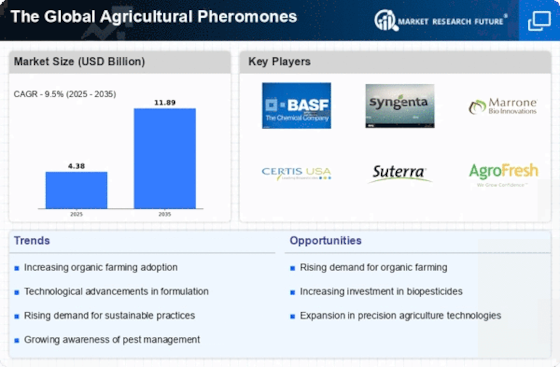
As per MRFR analysis, The Global Agricultural Pheromones Market Size was estimated at 4.38 USD Billion in 2024. The agricultural pheromones industry is projected to grow from 4.796 USD Billion in 2025 to 11.89 USD Billion by 2035, exhibiting a compound annual growth rate (CAGR) of 9.5 during the forecast period 2025 - 2035.

Key Market Trends & Highlights

The Global Agricultural Pheromones Market is poised for substantial growth driven by sustainability and technological advancements.

  • The market is increasingly leaning towards sustainable pest management solutions, particularly in North America.
  • Technological advancements in pheromone delivery systems are enhancing efficacy and adoption rates across various agricultural sectors.
  • Integration with precision agriculture is becoming a pivotal trend, especially in the Asia-Pacific region, facilitating more targeted pest control.
  • Key market drivers include the rising awareness of pest resistance and the push for sustainable agricultural practices, which are significantly influencing market dynamics.

Market Size & Forecast

2024 Market Size 4.38 (USD Billion)
2035 Market Size 11.89 (USD Billion)
CAGR (2025 - 2035) 9.5%
Largest Regional Market Share in 2024 North America

Major Players

<p>BASF SE (DE), Syngenta AG (CH), Marrone Bio Innovations Inc (US), Certis USA LLC (US), Suterra LLC (US), AgroFresh Solutions Inc (US), Koppert Biological Systems (NL), Pheromone Solutions (US)</p>

Market Trends

The Global Agricultural Pheromones Market is currently experiencing a notable transformation, driven by the increasing demand for sustainable agricultural practices. As farmers seek alternatives to chemical pesticides, pheromones are emerging as a viable solution for pest management. This shift is not merely a trend but appears to be a fundamental change in how agriculture is approached. The adoption of pheromones is likely to enhance crop yields while minimizing environmental impact, suggesting a growing awareness of ecological balance among agricultural stakeholders. Moreover, advancements in technology are facilitating the development of more effective pheromone products. Innovations in formulation and delivery systems are enhancing the efficacy of these substances, making them more appealing to farmers. The integration of precision agriculture techniques with pheromone application could further optimize pest control strategies. As The Global Agricultural Pheromones Market evolves, it seems poised to play a crucial role in the future of sustainable farming, potentially reshaping agricultural practices on a global scale.

Sustainable Pest Management Solutions

The Global Agricultural Pheromones Market is increasingly recognized for its role in sustainable pest management. Farmers are gravitating towards pheromones as a natural alternative to synthetic pesticides, which aligns with the growing emphasis on environmentally friendly practices. This trend indicates a shift in agricultural paradigms, where ecological considerations are becoming paramount.

Technological Advancements in Pheromone Delivery

Recent innovations in technology are enhancing the effectiveness of pheromone products. Improved formulation techniques and advanced delivery systems are making these substances more efficient in pest control. This trend suggests that the market is adapting to the needs of modern agriculture, where precision and efficacy are critical.

Integration with Precision Agriculture

The convergence of pheromone application with precision agriculture techniques is gaining traction. This integration allows for targeted pest management strategies, optimizing resource use and minimizing waste. Such developments indicate a potential evolution in agricultural practices, where data-driven decisions enhance overall productivity.

Agricultural Pheromones Market Market Drivers

Sustainable Agricultural Practices

The increasing emphasis on sustainable agricultural practices is a pivotal driver for the Agricultural Pheromones Market. Farmers are increasingly seeking eco-friendly pest control solutions that minimize chemical usage. This shift is driven by consumer demand for organic produce and regulatory pressures to reduce pesticide application. The market for agricultural pheromones is projected to grow significantly, with estimates suggesting a compound annual growth rate of over 15% in the coming years. This trend indicates a robust transition towards sustainable farming methods, where pheromones play a crucial role in integrated pest management strategies. As awareness of environmental issues rises, the adoption of pheromones as a sustainable alternative to traditional pesticides is likely to expand, thereby enhancing the market's growth potential.

Rising Awareness of Pest Resistance

The growing awareness of pest resistance to conventional pesticides is a critical driver for the Agricultural Pheromones Market. As pests evolve and develop resistance, the effectiveness of traditional chemical controls diminishes, prompting farmers to seek alternative solutions. Pheromones offer a viable option, as they disrupt pest mating patterns without contributing to resistance development. This shift in pest management strategies is likely to lead to increased adoption of pheromone-based products. Market data indicates that regions facing severe pest resistance issues are experiencing a surge in pheromone usage, further indicating a shift in pest control paradigms. The recognition of pheromones as a sustainable and effective alternative is expected to bolster market growth in the coming years.

Integration with Precision Agriculture

The integration of pheromone applications with precision agriculture techniques is emerging as a significant driver for the Agricultural Pheromones Market. Precision agriculture utilizes data-driven approaches to optimize field management, and the incorporation of pheromones enhances these strategies. By employing pheromones in conjunction with data analytics, farmers can achieve more precise pest control, leading to improved crop yields and reduced input costs. The market is likely to see an increase in partnerships between technology providers and pheromone manufacturers, fostering innovative solutions that cater to the needs of modern agriculture. This synergy between precision agriculture and pheromone use is expected to propel market growth, as farmers seek to maximize efficiency and sustainability.

Government Support and Regulatory Frameworks

Government support and favorable regulatory frameworks are instrumental in driving the Agricultural Pheromones Market. Many governments are implementing policies that promote the use of biopesticides and sustainable pest management practices. This support often includes financial incentives for farmers adopting eco-friendly solutions, including pheromones. Additionally, regulatory bodies are increasingly approving pheromone products, facilitating their entry into the market. The positive regulatory environment is likely to encourage research and development in pheromone technologies, leading to a broader range of products available to farmers. As governments continue to advocate for sustainable agricultural practices, the market for agricultural pheromones is expected to expand, reflecting a commitment to environmentally responsible farming.

Technological Innovations in Pheromone Formulation

Technological advancements in pheromone formulation and delivery systems are transforming the Agricultural Pheromones Market. Innovations such as microencapsulation and controlled-release formulations enhance the efficacy and longevity of pheromones in the field. These technologies allow for targeted pest control, reducing the quantity of pheromones required and improving cost-effectiveness for farmers. The market is witnessing a surge in research and development activities aimed at creating more effective pheromone products. As a result, the market is expected to experience a notable increase in product offerings, catering to diverse agricultural needs. This technological evolution not only boosts the effectiveness of pest management but also aligns with the growing demand for precision agriculture solutions.

Market Segment Insights

By Type: Sex Pheromones (Largest) vs. Aggregation Pheromones (Fastest-Growing)

<p>Within The Global Agricultural Pheromones Market, sex pheromones hold the largest market share, playing a critical role in pest control by attracting specific insects to traps. This has made them essential for many growers seeking to manage pest populations without harsh chemicals. Aggregation pheromones, while currently smaller in market share, have been gaining traction rapidly as they provide an alternative the lure multiple pests, thus enhancing control efficiency across various crops. The growth of the aggregation pheromones segment is driven by the increasing demand for sustainable agriculture and integrated pest management practices. As farmers seek to adopt eco-friendly pest control methods, the effectiveness of aggregation pheromones in increasing the efficiency of pest detection and management positions this segment for significant growth. Additionally, ongoing research and development are aimed at enhancing the effectiveness of these pheromones, further solidifying their market presence.</p>

<p>Sex Pheromones (Dominant) vs. Aggregation Pheromones (Emerging)</p>

<p>Sex pheromones are considered the dominant force in The Global Agricultural Pheromones Market due to their targeted approach in pest management, allowing for precise control of specific pest populations. They are crucial in reducing reliance on chemical pesticides, responding to the increasing consumer demand for organic produce. In contrast, aggregation pheromones represent an emerging player in this space, appealing to farmers seeking integrated pest management solutions by attracting a broader spectrum of pests, thus improving the trapping efficiency. Their ability to enhance pest monitoring strategies positions aggregation pheromones as a complementary option to sex pheromones, appealing to sustainable agriculture advocates.</p>

By Function: Mating Disruption (Largest) vs. Mass Trapping (Fastest-Growing)

<p>In The Global Agricultural Pheromones Market, the 'Function' segment is characterized by three primary components: Mating Disruption, Detection & Monitoring, and Mass Trapping. Among these, Mating Disruption holds the largest market share, reflecting its widespread acceptance and effectiveness in sustainable pest management. Detection & Monitoring plays a crucial role in integrated pest management strategies, while Mass Trapping, although currently a smaller segment, is rapidly gaining traction as farmers seek efficient pest control solutions.</p>

<p>Mating Disruption (Dominant) vs. Mass Trapping (Emerging)</p>

<p>Mating Disruption remains the dominant function in the agricultural pheromones market, employed widely to inhibit mating among pest populations and reduce crop damage. This method leverages natural behavior modifications, making it a preferred choice for organic and sustainable farming practices. Conversely, Mass Trapping is an emerging function that strategically captures pests before they can cause significant harm to crops. This method is gaining popularity due to its effectiveness in areas where traditional insecticides are less viable, driven by increasing consumer demand for eco-friendly agricultural practices and the need for sustainable food production.</p>

By Mode of Application: Traps (Largest) vs. Dispensers (Fastest-Growing)

<p>The mode of application segment of The Global Agricultural Pheromones Market illustrates a diverse distribution of market share among dispensers, traps, and sprays. Traps hold the largest market share, attributed to their effectiveness in pest control and ease of use. Dispensers, while currently trailing behind in market share, have emerged as a significant alternative due to advancements in technology that enhance their efficiency. Sprays, on the other hand, continue to play a vital role but are increasingly being complemented by the other methods in integrated pest management strategies. Growth trends in this segment indicate a shift toward more innovative applications and combinations of pheromone products. Dispensers are witnessing rapid growth, driven by increasing awareness of sustainable agricultural practices and a preference for targeted pest control solutions. Traps remain the staple for many farmers due to their proven effectiveness, yet the rise of dispensers suggests a dynamic shift in preference toward non-invasive techniques. Overall, the market is trending towards integration and efficiency, with a notable focus on sustainable agricultural solutions.</p>

<p>Traps (Dominant) vs. Dispensers (Emerging)</p>

<p>In The Global Agricultural Pheromones Market, traps are a dominant mode of application, valued for their straightforward implementation and proven results in pest management. They are widely utilized across various crops and offer an immediate solution to pest challenges. Dispensers, recognized as an emerging mode, leverage technology to slowly release pheromones, thereby providing a long-lasting solution that minimizes disruption to the ecosystem. While traps cater to immediate pest issues, dispensers focus on long-term pest management strategies, reducing the need for chemical pesticides and promoting a more sustainable agricultural approach. This duality in application modes highlights the shift towards innovative and eco-friendly pest management solutions within the market.</p>

By Crop Type: Fruits & Nuts (Largest) vs. Vegetable Crops (Fastest-Growing)

<p>In The Global Agricultural Pheromones Market, the crop type segment showcases a diverse distribution among its constituents. Fruits & Nuts represent the largest share, as growers increasingly leverage pheromone technology to combat pest challenges and enhance yield quality. Meanwhile, Field Crops and Other Crop Types, while significant, capture a smaller proportion, pointing towards a concentrated interest in specific agricultural practices.</p>

<p>Fruits & Nuts (Dominant) vs. Vegetable Crops (Emerging)</p>

<p>Fruits & Nuts are clearly the dominant segment within The Global Agricultural Pheromones Market due to their high value and the rising consumer demand for organic produce. This segment benefits from advanced pest management strategies, allowing growers to use pheromones to attract and capture pests effectively. Conversely, the Vegetable Crops segment is emerging rapidly as more farmers adopt sustainable practices, recognizing the importance of pheromones in minimizing chemical pesticide use. This growth is driven by increasing consumer awareness and regulations favoring environmentally friendly solutions.</p>

Get more detailed insights about Agricultural Pheromones Market Size Research Report Global Forecast till 2035

Regional Insights

North America : Innovation and Adoption Leader

North America is the largest market for agricultural pheromones, holding approximately 40% of the global share. The region's growth is driven by increasing demand for sustainable agricultural practices and stringent regulations on chemical pesticides. The U.S. and Canada are leading this market, with a growing emphasis on organic farming and integrated pest management strategies. Regulatory support from agencies like the EPA further catalyzes market expansion. The competitive landscape in North America is robust, featuring key players such as BASF SE, Syngenta AG, and Marrone Bio Innovations Inc. These companies are investing in research and development to innovate pheromone-based solutions. The presence of established agricultural practices and a strong distribution network enhances market penetration. The focus on eco-friendly pest control methods is expected to drive further growth in this region.

Europe : Sustainable Practices Driving Growth

Europe is witnessing significant growth in the agricultural pheromones market, accounting for approximately 30% of the global share. The region's demand is fueled by increasing awareness of sustainable farming practices and the European Union's stringent regulations on pesticide use. Countries like Germany and France are at the forefront, promoting eco-friendly pest management solutions that align with the EU's Green Deal objectives. Leading countries in Europe include Germany, France, and the Netherlands, where companies like Koppert Biological Systems are making strides in pheromone technology. The competitive landscape is characterized by a mix of established firms and innovative startups focusing on biological pest control. The regulatory framework encourages the adoption of pheromones, positioning Europe as a key player in the global market.

Asia-Pacific : Rapidly Growing Market Potential

Asia-Pacific is emerging as a significant player in the agricultural pheromones market, holding around 20% of the global share. The region's growth is driven by increasing agricultural productivity demands and a shift towards sustainable farming practices. Countries like China and India are leading this trend, supported by government initiatives promoting organic farming and pest management solutions that minimize chemical use. The competitive landscape in Asia-Pacific is evolving, with local and international players vying for market share. Companies such as Suterra LLC and AgroFresh Solutions Inc are expanding their presence in this region. The growing awareness of environmental issues and the need for food security are propelling the adoption of pheromone technologies, making Asia-Pacific a key market for future growth.

Middle East and Africa : Emerging Market with Challenges

The Middle East and Africa region is gradually emerging in the agricultural pheromones market, currently holding about 10% of the global share. The growth is primarily driven by increasing agricultural activities and a rising awareness of sustainable pest management practices. Countries like South Africa and Kenya are leading the charge, supported by government initiatives aimed at enhancing agricultural productivity and food security. The competitive landscape is still developing, with a mix of local and international players entering the market. Companies are focusing on educating farmers about the benefits of pheromones as a pest control method. However, challenges such as limited access to technology and funding may hinder rapid growth. Nonetheless, the potential for expansion in this region remains significant as awareness and demand for sustainable solutions increase.

Key Players and Competitive Insights

The Global Agricultural Pheromones Market is currently characterized by a dynamic competitive landscape, driven by increasing demand for sustainable agricultural practices and the need for effective pest management solutions. Key players such as BASF SE (Germany), Syngenta AG (Switzerland), and Marrone Bio Innovations Inc (US) are at the forefront, each adopting distinct strategies to enhance their market presence. BASF SE (Germany) focuses on innovation through research and development, aiming to expand its product portfolio with advanced pheromone-based solutions. Meanwhile, Syngenta AG (Switzerland) emphasizes regional expansion and strategic partnerships to bolster its distribution networks, thereby enhancing accessibility to its pheromone products. Marrone Bio Innovations Inc (US) appears to be concentrating on digital transformation, leveraging technology to optimize its product offerings and customer engagement, which collectively shapes a competitive environment that is increasingly reliant on innovation and strategic collaborations.

In terms of business tactics, companies are localizing manufacturing and optimizing supply chains to enhance efficiency and reduce costs. The market structure is moderately fragmented, with several key players exerting influence over various segments. This fragmentation allows for niche players to thrive, while larger corporations leverage their resources to capture significant market shares. The collective influence of these key players fosters a competitive atmosphere where agility and responsiveness to market demands are paramount.

In August 2025, BASF SE (Germany) announced the launch of a new line of pheromone traps designed to target specific pest species, which is expected to enhance crop protection while minimizing environmental impact. This strategic move underscores BASF's commitment to sustainability and innovation, positioning the company as a leader in eco-friendly pest management solutions. Similarly, in September 2025, Syngenta AG (Switzerland) entered into a partnership with a local agricultural cooperative to distribute its pheromone products more effectively in emerging markets. This collaboration not only expands Syngenta's reach but also aligns with its strategy to enhance local engagement and support sustainable farming practices.

Moreover, in July 2025, Marrone Bio Innovations Inc (US) unveiled a new digital platform aimed at providing farmers with real-time data on pest activity and pheromone usage. This initiative reflects the company's focus on integrating technology into its offerings, thereby enhancing user experience and operational efficiency. Such advancements are likely to set a new standard in the industry, emphasizing the importance of data-driven decision-making in agricultural practices.

As of October 2025, current competitive trends indicate a strong shift towards digitalization, sustainability, and the integration of artificial intelligence in agricultural practices. Strategic alliances are increasingly shaping the landscape, allowing companies to pool resources and expertise to drive innovation. The competitive differentiation is likely to evolve from traditional price-based competition to a focus on technological advancements, innovative solutions, and reliable supply chains. This transition suggests that companies that prioritize research and development, alongside sustainable practices, will be better positioned to thrive in the evolving market.

Key Companies in the Agricultural Pheromones Market market include

Industry Developments

November 2021 Suterra, a pioneer in environmentally friendly pheromone pest control, joined forces with Phytech.

Future Outlook

Agricultural Pheromones Market Future Outlook

<p>The Global Agricultural Pheromones Market is projected to grow at a 9.5% CAGR from 2024 to 2035, driven by increasing demand for sustainable agriculture and pest management solutions.</p>

New opportunities lie in:

  • <p>Development of precision agriculture technologies integrating pheromone applications.</p>
  • <p>Expansion into emerging markets with tailored pheromone products.</p>
  • <p>Partnerships with biotech firms for innovative pheromone synthesis methods.</p>

<p>By 2035, the market is expected to solidify its position as a leader in sustainable agricultural practices.</p>

Market Segmentation

Agricultural Pheromones Market Type Outlook

  • Sex Pheromones
  • Aggregation Pheromones
  • Other Types (alarms pheromones, host-marking pheromones, and trail pheromones)

Agricultural Pheromones Market Function Outlook

  • Mating Disruption
  • Detection & Monitoring
  • Mass Trapping

Agricultural Pheromones Market Crop Type Outlook

  • Fruits & Nuts
  • Field Crops
  • Vegetable Crops
  • Other Crop Types (plantation crops, alfalfa, and ornamental crops)

Agricultural Pheromones Market Mode of Application Outlook

  • Dispensers
  • Traps
  • Sprays

Report Scope

MARKET SIZE 20244.38(USD Billion)
MARKET SIZE 20254.796(USD Billion)
MARKET SIZE 203511.89(USD Billion)
COMPOUND ANNUAL GROWTH RATE (CAGR)9.5% (2024 - 2035)
REPORT COVERAGERevenue Forecast, Competitive Landscape, Growth Factors, and Trends
BASE YEAR2024
Market Forecast Period2025 - 2035
Historical Data2019 - 2024
Market Forecast UnitsUSD Billion
Key Companies ProfiledMarket analysis in progress
Segments CoveredMarket segmentation analysis in progress
Key Market OpportunitiesAdvancements in precision agriculture technologies enhance the adoption of The Global Agricultural Pheromones.
Key Market DynamicsRising demand for sustainable agriculture drives innovation and competition in the agricultural pheromones market.
Countries CoveredNorth America, Europe, APAC, South America, MEA

FAQs

What is the projected market valuation of The Global Agricultural Pheromones by 2035?

The projected market valuation for The Global Agricultural Pheromones is expected to reach 11.89 USD Billion by 2035.

What was the market valuation of The Global Agricultural Pheromones in 2024?

The overall market valuation of The Global Agricultural Pheromones was 4.38 USD Billion in 2024.

What is the expected CAGR for The Global Agricultural Pheromones during the forecast period 2025 - 2035?

The expected CAGR for The Global Agricultural Pheromones during the forecast period 2025 - 2035 is 9.5%.

Which segment is projected to have the highest valuation in The Global Agricultural Pheromones by 2035?

The segment of Field Crops is projected to have the highest valuation, expected to reach 4.83 USD Billion by 2035.

What are the key types of pheromones in The Global Agricultural Pheromones?

Key types of pheromones include Sex Pheromones, Aggregation Pheromones, and Other Types such as alarm and host-marking pheromones.

Which company is a leading player in The Global Agricultural Pheromones?

BASF SE is recognized as one of the leading players in The Global Agricultural Pheromones.

  1. EXECUTIVE SUMMARY
  2. MARKET INTRODUCTION
    1. Definition
    2. Scope of the Study
      1. Research Objective
      2. Assumptions
      3. Limitations
  3. RESEARCH METHODOLOGY
    1. Overview
    2. Data Mining
    3. Secondary Research
    4. Primary Research
      1. Primary Interviews and Information Gathering Process
      2. Breakdown
    5. of Primary Respondents
    6. Forecasting Modality
    7. Market Size Estimation
      1. Bottom-Up Approach
      2. Top-Down Approach
    8. Data Triangulation
    9. Validation
  4. MARKET DYNAMICS
    1. Overview
    2. Drivers
    3. Restraints
    4. Opportunities
  5. MARKET FACTOR ANALYSIS
    1. Value Chain Analysis
    2. Porter’s Five Forces Analysis
      1. Bargaining
      2. Bargaining Power of Buyers
      3. Threat of
      4. Threat of Substitutes
      5. Intensity of Rivalry
    3. Power of Suppliers
    4. New Entrants
    5. COVID-19 Impact Analysis
      1. Market Impact Analysis
      2. Regional
      3. Opportunity and Threat Analysis
    6. Impact
  6. GLOBAL AGRICULTURAL PHEROMONES
  7. MARKET, BY TYPE
    1. Overview
    2. Sex pheromones
    3. Aggregation
    4. pheromones
    5. Other
  8. GLOBAL AGRICULTURAL PHEROMONES MARKET, BY FUNCTION
    1. Overview
    2. Mating disruption
    3. Detection & monitoring
    4. Mass trapping
  9. GLOBAL AGRICULTURAL PHEROMONES MARKET, BY MODE OF APPLICATION
    1. Overview
    2. Dispensers
    3. Traps
    4. Sprays
  10. GLOBAL
  11. AGRICULTURAL PHEROMONES MARKET, BY CROP TYPE
    1. Overview
    2. Fruits
    3. & nuts
    4. Field crops
    5. Vegetable crops
    6. Other
  12. GLOBAL AGRICULTURAL PHEROMONES MARKET, BY REGION
    1. Overview
      1. U.S.
      2. Canada
    2. North America
    3. Europe
      1. France
      2. U.K
      3. Italy
      4. Spain
      5. Rest of Europe
    4. Germany
    5. Asia-Pacific
      1. China
      2. Japan
      3. South Korea
      4. Australia
    6. India
    7. Rest of Asia-Pacific
    8. Rest of the World
      1. Middle East
      2. Latin America
    9. Africa
  13. COMPETITIVE LANDSCAPE
    1. Overview
    2. Competitive Analysis
    3. Market Share Analysis
    4. Major Growth
    5. Strategy in the Global Agricultural Pheromones Market,
    6. Competitive Benchmarking
    7. Leading Players in Terms of Number of Developments in the Global Agricultural
    8. Pheromones Market,
    9. Key developments and Growth Strategies
      1. Merger & Acquisitions
      2. Joint Ventures
    10. New Type Launch/Function Mode of application
    11. Major Players Financial Matrix
      1. Major Players R&D Expenditure.
    12. Sales & Operating Income, 2022
  14. COMPANY PROFILES
    1. RUSSELL IPM (U.K.)
      1. Company
      2. Financial Overview
      3. Types Offered
      4. SWOT Analysis
      5. Key Strategies
      6. Company Overview
      7. Financial
      8. Types Offered
      9. Key Developments
      10. SWOT
      11. Key Strategies
    2. Overview
    3. Key Developments
    4. Shin-Etsu Chemical Company (Japan)
    5. Overview
    6. Analysis
    7. ISAGRO S.P.A. (ITALY).
      1. Financial Overview
      2. Types Offered
      3. SWOT Analysis
      4. Key Strategies
      5. Company Overview
      6. Financial Overview
      7. Types Offered
      8. Key Developments
      9. SWOT Analysis
      10. Key Strategies
    8. Company Overview
    9. Key Developments
    10. Biobest Group (Belgium)
    11. SEDQ Healthy Crops SL (Spain).
      1. Financial Overview
      2. Types Offered
      3. SWOT Analysis
      4. Key Strategies
      5. Company Overview
      6. Financial Overview
      7. Types Offered
      8. Key Developments
      9. SWOT Analysis
      10. Key Strategies
    12. Company Overview
    13. Key Developments
    14. ISCA GLOBAL (U.S.).
    15. Suterra LLC (U.S.)
      1. Company Overview
      2. Financial Overview
      3. Types Offered
      4. Key Developments
      5. SWOT Analysis
      6. Key Strategies
    16. Provivi, Inc. (U.S.).
      1. Company Overview
      2. Financial Overview
      3. Types Offered
      4. Key Developments
      5. SWOT Analysis
      6. Key Strategies
    17. Koppert Biological Systems (Netherlands).
      1. Company Overview
      2. Financial Overview
      3. Types Offered
      4. Key Developments
      5. SWOT Analysis
      6. Key Strategies
    18. Pacific Biocontrol
      1. Company Overview
      2. Financial Overview
      3. Types Offered
      4. Key Developments
      5. SWOT Analysis
      6. Key Strategies
    19. Corporation (U.S.).
  15. APPENDIX
    1. References
    2. Related
    3. Reports
  16. LIST OF TABLES
  17. GLOBAL AGRICULTURAL PHEROMONES
    1. MARKET, SYNOPSIS, 2025-2034
  18. GLOBAL AGRICULTURAL PHEROMONES MARKET,
    1. ESTIMATES & FORECAST, 2025-2034 (USD BILLION)
  19. GLOBAL AGRICULTURAL
  20. PHEROMONES MARKET, BY TYPE, 2025-2034 (USD BILLION)
  21. GLOBAL AGRICULTURAL
  22. PHEROMONES MARKET, BY FUNCTION, 2025-2034 (USD BILLION)
  23. GLOBAL AGRICULTURAL
  24. PHEROMONES MARKET, BY MODE OF APPLICATION, 2025-2034 (USD BILLION)
    1. TABLE 6
  25. GLOBAL AGRICULTURAL PHEROMONES MARKET, BY CROP TYPE, 2025-2034 (USD BILLION)
  26. NORTH AMERICA AGRICULTURAL PHEROMONES MARKET, BY TYPE, 2025-2034 (USD
    1. BILLION)
  27. NORTH AMERICA AGRICULTURAL PHEROMONES MARKET, BY FUNCTION,
  28. NORTH AMERICA AGRICULTURAL PHEROMONES MARKET,
    1. BY MODE OF APPLICATION, 2025-2034 (USD BILLION)
  29. NORTH AMERICA AGRICULTURAL
  30. PHEROMONES MARKET, BY CROP TYPE, 2025-2034 (USD BILLION)
  31. NORTH AMERICA
  32. AGRICULTURAL PHEROMONES MARKET, BY COUNTRY, 2025-2034 (USD BILLION)
    1. TABLE 12
  33. U.S. AGRICULTURAL PHEROMONES MARKET, BY TYPE, 2025-2034 (USD BILLION)
    1. TABLE
  34. U.S. AGRICULTURAL PHEROMONES MARKET, BY FUNCTION, 2025-2034 (USD BILLION)
  35. U.S. AGRICULTURAL PHEROMONES MARKET, BY MODE OF APPLICATION, 2025-2034
    1. (USD BILLION)
  36. U.S. AGRICULTURAL PHEROMONES MARKET, BY CROP TYPE, 2025-2034
    1. (USD BILLION)
  37. CANADA AGRICULTURAL PHEROMONES MARKET, BY TYPE, 2025-2034
    1. (USD BILLION)
  38. CANADA AGRICULTURAL PHEROMONES MARKET, BY FUNCTION,
  39. CANADA AGRICULTURAL PHEROMONES MARKET, BY
    1. MODE OF APPLICATION, 2025-2034 (USD BILLION)
  40. CANADA AGRICULTURAL PHEROMONES
  41. MARKET, BY CROP TYPE, 2025-2034 (USD BILLION)
  42. EUROPE AGRICULTURAL
  43. PHEROMONES MARKET, BY TYPE, 2025-2034 (USD BILLION)
  44. EUROPE AGRICULTURAL
  45. PHEROMONES MARKET, BY FUNCTION, 2025-2034 (USD BILLION)
  46. EUROPE AGRICULTURAL
  47. PHEROMONES MARKET, BY MODE OF APPLICATION, 2025-2034 (USD BILLION)
    1. TABLE 23
  48. EUROPE AGRICULTURAL PHEROMONES MARKET, BY CROP TYPE, 2025-2034 (USD BILLION)
  49. EUROPE AGRICULTURAL PHEROMONES MARKET, BY COUNTRY, 2025-2034 (USD BILLION)
  50. GERMANY AGRICULTURAL PHEROMONES MARKET, BY TYPE, 2025-2034 (USD BILLION)
  51. GERMANY AGRICULTURAL PHEROMONES MARKET, BY FUNCTION, 2025-2034 (USD BILLION)
  52. GERMANY AGRICULTURAL PHEROMONES MARKET, BY MODE OF APPLICATION, 2025-2034
    1. (USD BILLION)
  53. GERMANY AGRICULTURAL PHEROMONES MARKET, BY CROP TYPE,
  54. FRANCE AGRICULTURAL PHEROMONES MARKET, BY
    1. TYPE, 2025-2034 (USD BILLION)
  55. FRANCE AGRICULTURAL PHEROMONES MARKET,
    1. BY FUNCTION, 2025-2034 (USD BILLION)
  56. FRANCE AGRICULTURAL PHEROMONES
  57. MARKET, BY MODE OF APPLICATION, 2025-2034 (USD BILLION)
  58. FRANCE AGRICULTURAL
  59. PHEROMONES MARKET, BY CROP TYPE, 2025-2034 (USD BILLION)
  60. ITALY AGRICULTURAL
  61. PHEROMONES MARKET, BY TYPE, 2025-2034 (USD BILLION)
  62. ITALY AGRICULTURAL
  63. PHEROMONES MARKET, BY FUNCTION, 2025-2034 (USD BILLION)
  64. ITALY AGRICULTURAL
  65. PHEROMONES MARKET, BY MODE OF APPLICATION, 2025-2034 (USD BILLION)
    1. TABLE 36
  66. ITALY AGRICULTURAL PHEROMONES MARKET, BY CROP TYPE, 2025-2034 (USD BILLION)
    1. TABLE
  67. SPAIN AGRICULTURAL PHEROMONES MARKET, BY TYPE, 2025-2034 (USD BILLION)
    1. TABLE
  68. SPAIN AGRICULTURAL PHEROMONES MARKET, BY FUNCTION, 2025-2034 (USD BILLION)
  69. SPAIN AGRICULTURAL PHEROMONES MARKET, BY MODE OF APPLICATION, 2025-2034
    1. (USD BILLION)
  70. SPAIN AGRICULTURAL PHEROMONES MARKET, BY CROP TYPE,
  71. U.K AGRICULTURAL PHEROMONES MARKET, BY TYPE,
  72. U.K AGRICULTURAL PHEROMONES MARKET, BY FUNCTION,
  73. U.K AGRICULTURAL PHEROMONES MARKET, BY MODE
    1. OF APPLICATION, 2025-2034 (USD BILLION)
  74. U.K AGRICULTURAL PHEROMONES
  75. MARKET, BY CROP TYPE, 2025-2034 (USD BILLION)
  76. REST OF EUROPE AGRICULTURAL
  77. PHEROMONES MARKET, BY TYPE, 2025-2034 (USD BILLION)
  78. REST OF EUROPE
  79. AGRICULTURAL PHEROMONES MARKET, BY FUNCTION, 2025-2034 (USD BILLION)
    1. TABLE
  80. REST OF EUROPE AGRICULTURAL PHEROMONES MARKET, BY MODE OF APPLICATION, 2025-2034
    1. (USD BILLION)
  81. REST OF EUROPE AGRICULTURAL PHEROMONES MARKET, BY CROP
    1. TYPE, 2025-2034 (USD BILLION)
  82. ASIA PACIFIC AGRICULTURAL PHEROMONES
  83. MARKET, BY TYPE, 2025-2034 (USD BILLION)
  84. ASIA PACIFIC AGRICULTURAL
  85. PHEROMONES MARKET, BY FUNCTION, 2025-2034 (USD BILLION)
  86. ASIA PACIFIC
  87. AGRICULTURAL PHEROMONES MARKET, BY MODE OF APPLICATION, 2025-2034 (USD BILLION)
  88. ASIA PACIFIC AGRICULTURAL PHEROMONES MARKET, BY CROP TYPE, 2025-2034
    1. (USD BILLION)
  89. ASIA PACIFIC AGRICULTURAL PHEROMONES MARKET, BY COUNTRY,
  90. JAPAN AGRICULTURAL PHEROMONES MARKET, BY TYPE,
  91. JAPAN AGRICULTURAL PHEROMONES MARKET, BY FUNCTION,
  92. JAPAN AGRICULTURAL PHEROMONES MARKET, BY MODE
    1. OF APPLICATION, 2025-2034 (USD BILLION)
  93. JAPAN AGRICULTURAL PHEROMONES
  94. MARKET, BY CROP TYPE, 2025-2034 (USD BILLION)
  95. CHINA AGRICULTURAL PHEROMONES
  96. MARKET, BY TYPE, 2025-2034 (USD BILLION)
  97. CHINA AGRICULTURAL PHEROMONES
  98. MARKET, BY FUNCTION, 2025-2034 (USD BILLION)
  99. CHINA AGRICULTURAL PHEROMONES
  100. MARKET, BY MODE OF APPLICATION, 2025-2034 (USD BILLION)
  101. CHINA AGRICULTURAL
  102. PHEROMONES MARKET, BY CROP TYPE, 2025-2034 (USD BILLION)
  103. INDIA AGRICULTURAL
  104. PHEROMONES MARKET, BY TYPE, 2025-2034 (USD BILLION)
  105. INDIA AGRICULTURAL
  106. PHEROMONES MARKET, BY FUNCTION, 2025-2034 (USD BILLION)
  107. INDIA AGRICULTURAL
  108. PHEROMONES MARKET, BY MODE OF APPLICATION, 2025-2034 (USD BILLION)
    1. TABLE 65
  109. INDIA AGRICULTURAL PHEROMONES MARKET, BY CROP TYPE, 2025-2034 (USD BILLION)
    1. TABLE
  110. AUSTRALIA AGRICULTURAL PHEROMONES MARKET, BY TYPE, 2025-2034 (USD BILLION)
  111. AUSTRALIA AGRICULTURAL PHEROMONES MARKET, BY FUNCTION, 2025-2034 (USD
    1. BILLION)
  112. AUSTRALIA AGRICULTURAL PHEROMONES MARKET, BY MODE OF APPLICATION,
  113. AUSTRALIA AGRICULTURAL PHEROMONES MARKET,
    1. BY CROP TYPE, 2025-2034 (USD BILLION)
  114. SOUTH KOREA AGRICULTURAL PHEROMONES
  115. MARKET, BY TYPE, 2025-2034 (USD BILLION)
  116. SOUTH KOREA AGRICULTURAL
  117. PHEROMONES MARKET, BY FUNCTION, 2025-2034 (USD BILLION)
  118. SOUTH KOREA
  119. AGRICULTURAL PHEROMONES MARKET, BY MODE OF APPLICATION, 2025-2034 (USD BILLION)
  120. SOUTH KOREA AGRICULTURAL PHEROMONES MARKET, BY CROP TYPE, 2025-2034 (USD
    1. BILLION)
  121. REST OF ASIA-PACIFIC AGRICULTURAL PHEROMONES MARKET, BY TYPE,
  122. REST OF ASIA-PACIFIC AGRICULTURAL PHEROMONES
  123. MARKET, BY FUNCTION, 2025-2034 (USD BILLION)
  124. REST OF ASIA-PACIFIC
  125. AGRICULTURAL PHEROMONES MARKET, BY MODE OF APPLICATION, 2025-2034 (USD BILLION)
  126. REST OF ASIA-PACIFIC AGRICULTURAL PHEROMONES MARKET, BY CROP TYPE, 2025-2034
    1. (USD BILLION)
  127. REST OF WORLD AGRICULTURAL PHEROMONES MARKET, BY TYPE,
  128. REST OF WORLD AGRICULTURAL PHEROMONES MARKET,
    1. BY FUNCTION, 2025-2034 (USD BILLION)
  129. REST OF WORLD AGRICULTURAL PHEROMONES
  130. MARKET, BY MODE OF APPLICATION, 2025-2034 (USD BILLION)
  131. REST OF WORLD
  132. AGRICULTURAL PHEROMONES MARKET, BY CROP TYPE, 2025-2034 (USD BILLION)
    1. TABLE
  133. REST OF WORLD AGRICULTURAL PHEROMONES MARKET, BY COUNTRY, 2025-2034 (USD BILLION)
  134. MIDDLE EAST AGRICULTURAL PHEROMONES MARKET, BY TYPE, 2025-2034 (USD BILLION)
  135. MIDDLE EAST AGRICULTURAL PHEROMONES MARKET, BY FUNCTION, 2025-2034 (USD
    1. BILLION)
  136. MIDDLE EAST AGRICULTURAL PHEROMONES MARKET, BY MODE OF APPLICATION,
  137. MIDDLE EAST AGRICULTURAL PHEROMONES MARKET,
    1. BY CROP TYPE, 2025-2034 (USD BILLION)
  138. AFRICA AGRICULTURAL PHEROMONES
  139. MARKET, BY TYPE, 2025-2034 (USD BILLION)
  140. AFRICA AGRICULTURAL PHEROMONES
  141. MARKET, BY FUNCTION, 2025-2034 (USD BILLION)
  142. AFRICA AGRICULTURAL PHEROMONES
  143. MARKET, BY MODE OF APPLICATION, 2025-2034 (USD BILLION)
  144. AFRICA AGRICULTURAL
  145. PHEROMONES MARKET, BY CROP TYPE, 2025-2034 (USD BILLION)
  146. LATIN AMERICA
  147. AGRICULTURAL PHEROMONES MARKET, BY TYPE, 2025-2034 (USD BILLION)
  148. LATIN
  149. AMERICA AGRICULTURAL PHEROMONES MARKET, BY FUNCTION, 2025-2034 (USD BILLION)
  150. LATIN AMERICA AGRICULTURAL PHEROMONES MARKET, BY MODE OF APPLICATION,
  151. LATIN AMERICA AGRICULTURAL PHEROMONES MARKET,
    1. BY CROP TYPE, 2025-2034 (USD BILLION)
  152. LIST OF FIGURES
  153. RESEARCH PROCESS
  154. MARKET STRUCTURE FOR THE GLOBAL AGRICULTURAL
  155. PHEROMONES MARKET
  156. MARKET DYNAMICS FOR THE GLOBAL AGRICULTURAL PHEROMONES
    1. MARKET
  157. GLOBAL AGRICULTURAL PHEROMONES MARKET, SHARE (%), BY TYPE,
  158. GLOBAL AGRICULTURAL PHEROMONES MARKET, SHARE (%), BY FUNCTION,
  159. GLOBAL AGRICULTURAL PHEROMONES MARKET, SHARE (%), BY MODE OF
    1. APPLICATION, 2022
  160. GLOBAL AGRICULTURAL PHEROMONES MARKET, SHARE (%),
    1. BY CROP TYPE, 2022
  161. GLOBAL AGRICULTURAL PHEROMONES MARKET, SHARE (%),
    1. BY REGION, 2022
  162. NORTH AMERICA: AGRICULTURAL PHEROMONES MARKET, SHARE
    1. (%), BY REGION, 2022
  163. EUROPE: AGRICULTURAL PHEROMONES MARKET, SHARE
    1. (%), BY REGION, 2022
  164. ASIA-PACIFIC: AGRICULTURAL PHEROMONES MARKET,
    1. SHARE (%), BY REGION, 2022
  165. REST OF THE WORLD: AGRICULTURAL PHEROMONES
  166. MARKET, SHARE (%), BY REGION, 2022
  167. GLOBAL AGRICULTURAL PHEROMONES
    1. MARKET: COMPANY SHARE ANALYSIS, 2022 (%)
  168. RUSSELL IPM (U.K.): FINANCIAL
    1. OVERVIEW SNAPSHOT
  169. RUSSELL IPM (U.K.): SWOT ANALYSIS
    1. FIGURE 16
    2. SHIN-ETSU CHEMICAL COMPANY (JAPAN): FINANCIAL OVERVIEW SNAPSHOT
  170. SHIN-ETSU
    1. CHEMICAL COMPANY (JAPAN): SWOT ANALYSIS
  171. ISAGRO S.P.A. (ITALY).: FINANCIAL
    1. OVERVIEW SNAPSHOT
  172. ISAGRO S.P.A. (ITALY).: SWOT ANALYSIS
    1. FIGURE
  173. BIOBEST GROUP (BELGIUM): FINANCIAL OVERVIEW SNAPSHOT
  174. BIOBEST GROUP
    1. (BELGIUM): SWOT ANALYSIS
  175. SEDQ HEALTHY CROPS SL (SPAIN)..: FINANCIAL
    1. OVERVIEW SNAPSHOT
  176. SEDQ HEALTHY CROPS SL (SPAIN)..: SWOT ANALYSIS
  177. ISCA GLOBAL (U.S.).: FINANCIAL OVERVIEW SNAPSHOT
  178. ISCA
    1. GLOBAL (U.S.).: SWOT ANALYSIS
  179. SUTERRA LLC (U.S.): FINANCIAL OVERVIEW
    1. SNAPSHOT
  180. SUTERRA LLC (U.S.): SWOT ANALYSIS
  181. PROVIVI,
    1. INC. (U.S.).: FINANCIAL OVERVIEW SNAPSHOT
  182. PROVIVI, INC. (U.S.).:
  183. SWOT ANALYSIS
  184. KOPPERT BIOLOGICAL SYSTEMS (NETHERLANDS).: FINANCIAL
    1. OVERVIEW SNAPSHOT
  185. KOPPERT BIOLOGICAL SYSTEMS (NETHERLANDS).: SWOT
    1. ANALYSIS
  186. PACIFIC BIOCONTROL CORPORATION (U.S.): FINANCIAL OVERVIEW
    1. SNAPSHOT
  187. PACIFIC BIOCONTROL CORPORATION (U.S.): SWOT ANALYSIS

Agricultural Pheromones Market Segmentation

Agricultural Pheromones Market Type Outlook (USD Billion, 2018-2032)

  • Sex pheromones
  • Aggregation pheromones
  • Other Types (alarms pheromones, host-marking pheromones, and trail pheromones)

Agricultural Pheromones Market Function Outlook (USD Billion, 2018-2032)

  • Mating disruption
  • Detection & monitoring
  • Mass trapping

Agricultural Pheromones Market Mode of application Outlook (USD Billion, 2018-2032)

  • Dispensers
  • Traps
  • Sprays

Agricultural Pheromones Market Crop Type Outlook (USD Billion, 2018-2032)

  • Fruits & nuts
  • Field crops
  • Vegetable crops
  • Other crop types (plantation crops, alfalfa, and ornamental crops)

Agricultural Pheromones Market Regional Outlook (USD Billion, 2018-2032)

  • North America Outlook (USD Billion, 2018-2032)

    • Agricultural Pheromones Market by Type
      • Sex pheromones
      • Aggregation pheromones
      • Other Types (alarms pheromones, host-marking pheromones, and trail pheromones)
    • Agricultural Pheromones Market by function
      • Mating disruption
      • Detection & monitoring
      • Mass trapping
    • Agricultural Pheromones Market by mode of application
      • Dispensers
      • Traps
      • Sprays
    • Agricultural Pheromones Market by Crop type
      • Fruits & nuts
      • Field crops
      • Vegetable crops
      • Other crop types (plantation crops, alfalfa, and ornamental crops)
    • US Outlook (USD Billion, 2018-2032)

    • Agricultural Pheromones Market by Type
      • Sex pheromones
      • Aggregation pheromones
      • Other Types (alarms pheromones, host-marking pheromones, and trail pheromones)
    • Agricultural Pheromones Market by function
      • Mating disruption
      • Detection & monitoring
      • Mass trapping
    • Agricultural Pheromones Market by mode of application
      • Dispensers
      • Traps
      • Sprays
    • Agricultural Pheromones Market by Crop type
      • Fruits & nuts
      • Field crops
      • Vegetable crops
      • Other crop types (plantation crops, alfalfa, and ornamental crops)
    • Canada Outlook (USD Billion, 2018-2032)

    • Agricultural Pheromones Market by Type
      • Sex pheromones
      • Aggregation pheromones
      • Other Types (alarms pheromones, host-marking pheromones, and trail pheromones)
    • Agricultural Pheromones Market by function
      • Mating disruption
      • Detection & monitoring
      • Mass trapping
    • Agricultural Pheromones Market by mode of application
      • Dispensers
      • Traps
      • Sprays
    • Agricultural Pheromones Market by Crop type
      • Fruits & nuts
      • Field crops
      • Vegetable crops
      • Other crop types (plantation crops, alfalfa, and ornamental crops)
  • Europe Outlook (USD Billion, 2018-2032)

    • Agricultural Pheromones Market by Type
      • Sex pheromones
      • Aggregation pheromones
      • Other Types (alarms pheromones, host-marking pheromones, and trail pheromones)
    • Agricultural Pheromones Market by function
      • Mating disruption
      • Detection & monitoring
      • Mass trapping
    • Agricultural Pheromones Market by mode of application
      • Dispensers
      • Traps
      • Sprays
    • Agricultural Pheromones Market by Crop type
      • Fruits & nuts
      • Field crops
      • Vegetable crops
      • Other crop types (plantation crops, alfalfa, and ornamental crops)
    • Germany Outlook (USD Billion, 2018-2032)

    • Agricultural Pheromones Market by Type
      • Sex pheromones
      • Aggregation pheromones
      • Other Types (alarms pheromones, host-marking pheromones, and trail pheromones)
    • Agricultural Pheromones Market by function
      • Mating disruption
      • Detection & monitoring
      • Mass trapping
    • Agricultural Pheromones Market by mode of application
      • Dispensers
      • Traps
      • Sprays
    • Agricultural Pheromones Market by Crop type
      • Fruits & nuts
      • Field crops
      • Vegetable crops
      • Other crop types (plantation crops, alfalfa, and ornamental crops)
    • France Outlook (USD Billion, 2018-2032)

    • Agricultural Pheromones Market by Type
      • Sex pheromones
      • Aggregation pheromones
      • Other Types (alarms pheromones, host-marking pheromones, and trail pheromones)
    • Agricultural Pheromones Market by function
      • Mating disruption
      • Detection & monitoring
      • Mass trapping
    • Agricultural Pheromones Market by mode of application
      • Dispensers
      • Traps
      • Sprays
    • Agricultural Pheromones Market by Crop type
      • Fruits & nuts
      • Field crops
      • Vegetable crops
      • Other crop types (plantation crops, alfalfa, and ornamental crops)
    • UK Outlook (USD Billion, 2018-2032)

    • Agricultural Pheromones Market by Type
      • Sex pheromones
      • Aggregation pheromones
      • Other Types (alarms pheromones, host-marking pheromones, and trail pheromones)
    • Agricultural Pheromones Market by function
      • Mating disruption
      • Detection & monitoring
      • Mass trapping
    • Agricultural Pheromones Market by mode of application
      • Dispensers
      • Traps
      • Sprays
    • Agricultural Pheromones Market by Crop type
      • Fruits & nuts
      • Field crops
      • Vegetable crops
      • Other crop types (plantation crops, alfalfa, and ornamental crops)
    • Italy Outlook (USD Billion, 2018-2032)

    • Agricultural Pheromones Market by Type
      • Sex pheromones
      • Aggregation pheromones
      • Other Types (alarms pheromones, host-marking pheromones, and trail pheromones)
    • Agricultural Pheromones Market by function
      • Mating disruption
      • Detection & monitoring
      • Mass trapping
    • Agricultural Pheromones Market by mode of application
      • Dispensers
      • Traps
      • Sprays
    • Agricultural Pheromones Market by Crop type
      • Fruits & nuts
      • Field crops
      • Vegetable crops
      • Other crop types (plantation crops, alfalfa, and ornamental crops)
    • Spain Outlook (USD Billion, 2018-2032)

    • Agricultural Pheromones Market by Type
      • Sex pheromones
      • Aggregation pheromones
      • Other Types (alarms pheromones, host-marking pheromones, and trail pheromones)
    • Agricultural Pheromones Market by function
      • Mating disruption
      • Detection & monitoring
      • Mass trapping
    • Agricultural Pheromones Market by mode of application
      • Dispensers
      • Traps
      • Sprays
    • Agricultural Pheromones Market by Crop type
      • Fruits & nuts
      • Field crops
      • Vegetable crops
      • Other crop types (plantation crops, alfalfa, and ornamental crops)
    • Rest Of Europe Outlook (USD Billion, 2018-2032)

    • Agricultural Pheromones Market by Type
      • Sex pheromones
      • Aggregation pheromones
      • Other Types (alarms pheromones, host-marking pheromones, and trail pheromones)
    • Agricultural Pheromones Market by function
      • Mating disruption
      • Detection & monitoring
      • Mass trapping
    • Agricultural Pheromones Market by mode of application
      • Dispensers
      • Traps
      • Sprays
    • Agricultural Pheromones Market by Crop type
      • Fruits & nuts
      • Field crops
      • Vegetable crops
      • Other crop types (plantation crops, alfalfa, and ornamental crops)
  • Asia-Pacific Outlook (USD Billion, 2018-2032)

    • Agricultural Pheromones Market by Type
      • Sex pheromones
      • Aggregation pheromones
      • Other Types (alarms pheromones, host-marking pheromones, and trail pheromones)
    • Agricultural Pheromones Market by function
      • Mating disruption
      • Detection & monitoring
      • Mass trapping
    • Agricultural Pheromones Market by mode of application
      • Dispensers
      • Traps
      • Sprays
    • Agricultural Pheromones Market by Crop type
      • Fruits & nuts
      • Field crops
      • Vegetable crops
      • Other crop types (plantation crops, alfalfa, and ornamental crops)
    • China Outlook (USD Billion, 2018-2032)

    • Agricultural Pheromones Market by Type
      • Sex pheromones
      • Aggregation pheromones
      • Other Types (alarms pheromones, host-marking pheromones, and trail pheromones)
    • Agricultural Pheromones Market by function
      • Mating disruption
      • Detection & monitoring
      • Mass trapping
    • Agricultural Pheromones Market by mode of application
      • Dispensers
      • Traps
      • Sprays
    • Agricultural Pheromones Market by Crop type
      • Fruits & nuts
      • Field crops
      • Vegetable crops
      • Other crop types (plantation crops, alfalfa, and ornamental crops)
    • Japan Outlook (USD Billion, 2018-2032)

    • Agricultural Pheromones Market by Type
      • Sex pheromones
      • Aggregation pheromones
      • Other Types (alarms pheromones, host-marking pheromones, and trail pheromones)
    • Agricultural Pheromones Market by function
      • Mating disruption
      • Detection & monitoring
      • Mass trapping
    • Agricultural Pheromones Market by mode of application
      • Dispensers
      • Traps
      • Sprays
    • Agricultural Pheromones Market by Crop type
      • Fruits & nuts
      • Field crops
      • Vegetable crops
      • Other crop types (plantation crops, alfalfa, and ornamental crops)
    • India Outlook (USD Billion, 2018-2032)

    • Agricultural Pheromones Market by Type
      • Sex pheromones
      • Aggregation pheromones
      • Other Types (alarms pheromones, host-marking pheromones, and trail pheromones)
    • Agricultural Pheromones Market by function
      • Mating disruption
      • Detection & monitoring
      • Mass trapping
    • Agricultural Pheromones Market by mode of application
      • Dispensers
      • Traps
      • Sprays
    • Agricultural Pheromones Market by Crop type
      • Fruits & nuts
      • Field crops
      • Vegetable crops
      • Other crop types (plantation crops, alfalfa, and ornamental crops)
    • Australia Outlook (USD Billion, 2018-2032)

    • Agricultural Pheromones Market by Type
      • Sex pheromones
      • Aggregation pheromones
      • Other Types (alarms pheromones, host-marking pheromones, and trail pheromones)
    • Agricultural Pheromones Market by function
      • Mating disruption
      • Detection & monitoring
      • Mass trapping
    • Agricultural Pheromones Market by mode of application
      • Dispensers
      • Traps
      • Sprays
    • Agricultural Pheromones Market by Crop type
      • Fruits & nuts
      • Field crops
      • Vegetable crops
      • Other crop types (plantation crops, alfalfa, and ornamental crops)
    • Rest of Asia-Pacific Outlook (USD Billion, 2018-2032)

    • Agricultural Pheromones Market by Type
      • Sex pheromones
      • Aggregation pheromones
      • Other Types (alarms pheromones, host-marking pheromones, and trail pheromones)
    • Agricultural Pheromones Market by function
      • Mating disruption
      • Detection & monitoring
      • Mass trapping
    • Agricultural Pheromones Market by mode of application
      • Dispensers
      • Traps
      • Sprays
    • Agricultural Pheromones Market by Crop type
      • Fruits & nuts
      • Field crops
      • Vegetable crops
      • Other crop types (plantation crops, alfalfa, and ornamental crops)
  • Rest of the World Outlook (USD Billion, 2018-2032)

    • Agricultural Pheromones Market by Type
      • Sex pheromones
      • Aggregation pheromones
      • Other Types (alarms pheromones, host-marking pheromones, and trail pheromones)
    • Agricultural Pheromones Market by function
      • Mating disruption
      • Detection & monitoring
      • Mass trapping
    • Agricultural Pheromones Market by mode of application
      • Dispensers
      • Traps
      • Sprays
    • Agricultural Pheromones Market by Crop type
      • Fruits & nuts
      • Field crops
      • Vegetable crops
      • Other crop types (plantation crops, alfalfa, and ornamental crops)
    • Middle East Outlook (USD Billion, 2018-2032)

    • Agricultural Pheromones Market by Type
      • Sex pheromones
      • Aggregation pheromones
      • Other Types (alarms pheromones, host-marking pheromones, and trail pheromones)
    • Agricultural Pheromones Market by function
      • Mating disruption
      • Detection & monitoring
      • Mass trapping
    • Agricultural Pheromones Market by mode of application
      • Dispensers
      • Traps
      • Sprays
    • Agricultural Pheromones Market by Crop type
      • Fruits & nuts
      • Field crops
      • Vegetable crops
      • Other crop types (plantation crops, alfalfa, and ornamental crops)
    • Africa Outlook (USD Billion, 2018-2032)

    • Agricultural Pheromones Market by Type
      • Sex pheromones
      • Aggregation pheromones
      • Other Types (alarms pheromones, host-marking pheromones, and trail pheromones)
    • Agricultural Pheromones Market by function
      • Mating disruption
      • Detection & monitoring
      • Mass trapping
    • Agricultural Pheromones Market by mode of application
      • Dispensers
      • Traps
      • Sprays
    • Agricultural Pheromones Market by Crop type
      • Fruits & nuts
      • Field crops
      • Vegetable crops
      • Other crop types (plantation crops, alfalfa, and ornamental crops)
    • Latin America Outlook (USD Billion, 2018-2032)

    • Agricultural Pheromones Market by Type
      • Sex pheromones
      • Aggregation pheromones
      • Other Types (alarms pheromones, host-marking pheromones, and trail pheromones)
    • Agricultural Pheromones Market by function
      • Mating disruption
      • Detection & monitoring
      • Mass trapping
    • Agricultural Pheromones Market by mode of application
      • Dispensers
      • Traps
      • Sprays
    • Agricultural Pheromones Market by Crop type
      • Fruits & nuts
      • Field crops
      • Vegetable crops
      • Other crop types (plantation crops, alfalfa, and ornamental crops)


Infographic

Free Sample Request

Kindly complete the form below to receive a free sample of this Report

Get Free Sample

Customer Strories

Compare Licence

×
Features License Type
Single User Multiuser License Enterprise User
Price $4,950 $5,950 $7,250
Maximum User Access Limit 1 User Upto 10 Users Unrestricted Access Throughout the Organization
Free Customization
Direct Access to Analyst
Deliverable Format
Platform Access
Discount on Next Purchase 10% 15% 15%
Printable Versions