
×
Hero Background
English
Chinese
French
Japanese
Korean
German
Spanish

Aerospace Fasteners Market Share

ID: MRFR/AD/0632-CR
134 Pages
Swapnil Palwe
July 2019

Aerospace Fasteners Market Research Report Information By Product (Nuts & Bolts, Rivets, Screws and others), By Material (Aluminum, Alloy Steel, Titanium and others), By End-Use (Fuselage, Control Surfaces and Interior), And By Region (North America, Europe, Asia-Pacific, And Rest Of The World) –Market Forecast Till 2030

Share:
Download PDF ×

We do not share your information with anyone. However, we may send you emails based on your report interest from time to time. You may contact us at any time to opt-out.

Aerospace Fasteners Market Infographic
Purchase Options

Market Share

Aerospace Fasteners Market Share Analysis

In this serious landscape, organizations are decisively embracing market share situating methodologies to lay out major areas of strength to gain an upper hand. One essential methodology includes specialization in explicit kinds of fasteners or materials. By focusing in on fastener classifications, like fasteners, screws, or nuts, or having some expertise in materials like titanium or aluminum, organizations can take special care of the assorted necessities of aerospace manufacturers and administrators. This specialization permits them to become specialists in a specialty section, cultivating trust and validity inside the business. By ceaselessly putting resources into innovative work, organizations can present state of the art fasteners that address the developing demands of current aerospace applications, situating themselves as pioneers in mechanical progressions. Titanium aerospace parts are acquiring favor in both regular citizen and military airplane programs. This incorporates unmistakable models like Boeing 787, Bombardier's most recent C-Series aircrafts, and Airbus A350 in the non-military personnel area, as well as military stages, for example, Lockheed's high-level F-35 Lightning II warrior fly. The inclination for titanium parts originates from their lightweight qualities and their similarity with carbon fiber-supported composite designs. These elements assume a significant part in driving the rising demand for titanium aerospace parts in the market. Organizations that can exhibit hearty store network the executives, including productive obtaining of unrefined components, manufacturing processes, and appropriate delivery, are better situated to meet the severe timetables of aerospace projects. Dependability in the store network is a critical element for aerospace manufacturers, and organizations that can reliably convey high-quality fasteners on time are probably going to get a bigger portion of the market. Furthermore, client connections and aftermarket administrations are fundamental components of market share situating in the Aerospace Fasteners market. Building solid associations with aerospace manufacturers and administrators encourages client reliability. Offering complete aftermarket administrations, like maintenance, repair, and substitution arrangements, upgrades the incentive for clients and adds to long haul organizations. Organizations that focus on consumer loyalty and give reliable post-deal support are bound to get rehash business and references inside the aerospace business.


Author
Swapnil Palwe
Team Lead - Research

With a technical background as Bachelor's in Mechanical Engineering, with MBA in Operations Management , Swapnil has 6+ years of experience in market research, consulting and analytics with the tasks of data mining, analysis, and project execution. He is the POC for our clients, for their consulting projects running under the Automotive/A&D domain. Swapnil has worked on major projects in verticals such as Aerospace & Defense, Automotive and many other domain projects. He has worked on projects for fortune 500 companies' syndicate and consulting projects along with several government projects.

Leave a Comment

FAQs

What is the current valuation of the Aerospace Fasteners Market in 2025?

The Aerospace Fasteners Market is valued at approximately 5.964 USD Billion in 2024.

What is the projected market size for the Aerospace Fasteners Market by 2035?

The market is projected to reach approximately 31.28 USD Billion by 2035.

What is the expected CAGR for the Aerospace Fasteners Market during the forecast period 2025 - 2035?

The expected CAGR for the Aerospace Fasteners Market during the forecast period 2025 - 2035 is 16.26%.

Which product segment holds the highest valuation in the Aerospace Fasteners Market?

The 'Others' category within the product segment holds the highest valuation at approximately 12.96 USD Billion.

How does the valuation of aluminum fasteners compare to other materials in 2025?

Aluminum fasteners are valued at approximately 8.64 USD Billion, making them the leading material in the Aerospace Fasteners Market.

What are the key end-user segments for Aerospace Fasteners?

Key end-user segments include Fuselage, Control Surfaces, and Interior, with Fuselage valued at approximately 8.5 USD Billion.

Market Summary

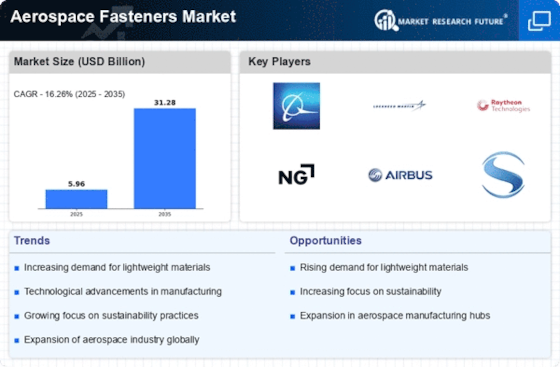
As per MRFR analysis, the Aerospace Fasteners Market Size was estimated at 5.964 USD Billion in 2024. The Aerospace Fasteners industry is projected to grow from 6.934 USD Billion in 2025 to 31.28 USD Billion by 2035, exhibiting a compound annual growth rate (CAGR) of 16.26 during the forecast period 2025 - 2035.

Key Market Trends & Highlights

The Aerospace Fasteners Market is poised for growth driven by technological advancements and increasing demand for lightweight materials.

  • The market is experiencing a notable shift towards lightweight materials, particularly in the North American region.
  • Sustainability is becoming a focal point, influencing design and manufacturing processes across the industry.
  • Automation in manufacturing processes is gaining traction, enhancing efficiency and precision in fastener production.
  • The increasing demand for commercial aircraft and advancements in fastener design are key drivers propelling market growth, especially in the Asia-Pacific region.

Market Size & Forecast

2024 Market Size 5.964 (USD Billion)
2035 Market Size 31.28 (USD Billion)
CAGR (2025 - 2035) 16.26%
Largest Regional Market Share in 2024 North America

Major Players

<p>Boeing (US), Lockheed Martin (US), Raytheon Technologies (US), Northrop Grumman (US), Airbus (FR), Safran (FR), General Electric (US), Honeywell (US), LISI Aerospace (FR), Triumph Group (US)</p>

Market Trends

The Aerospace Fasteners Market is currently experiencing a dynamic evolution, driven by advancements in technology and increasing demand for lightweight materials. Manufacturers are focusing on developing innovative fastening solutions that enhance performance while reducing weight. This shift is particularly relevant in the context of modern aircraft design, where efficiency and fuel economy are paramount. Additionally, the growing emphasis on sustainability is prompting companies to explore eco-friendly materials and production processes, which may reshape the competitive landscape of the industry. Moreover, the Aerospace Fasteners Market is witnessing a trend towards automation and digitalization in manufacturing processes. This transformation could lead to improved precision and reduced lead times, thereby enhancing overall productivity. As the industry adapts to these changes, collaboration between manufacturers and aerospace companies appears to be intensifying, fostering a more integrated supply chain. The future of the Aerospace Fasteners Market seems poised for growth, with ongoing innovations likely to play a crucial role in meeting the evolving needs of the aerospace sector.

Shift Towards Lightweight Materials

The Aerospace Fasteners Market is increasingly leaning towards the use of lightweight materials. This trend is driven by the need for improved fuel efficiency and performance in aircraft design. Manufacturers are exploring advanced composites and alloys that not only reduce weight but also maintain structural integrity.

Emphasis on Sustainability

Sustainability is becoming a focal point within the Aerospace Fasteners Market. Companies are actively seeking eco-friendly materials and sustainable manufacturing practices. This shift reflects a broader industry commitment to reducing environmental impact and aligning with global sustainability goals.

Automation in Manufacturing Processes

The integration of automation and digital technologies in manufacturing is transforming the Aerospace Fasteners Market. This trend is likely to enhance precision, reduce production times, and improve overall efficiency. As companies adopt these technologies, the competitive landscape may evolve significantly.

Aerospace Fasteners Market Market Drivers

Emerging Markets and Globalization

Emerging markets are becoming increasingly influential in the Aerospace Fasteners Market. As countries in Asia, the Middle East, and Latin America invest in their aviation infrastructure, the demand for aerospace fasteners is expected to grow. The globalization of the aerospace supply chain further facilitates this trend, as manufacturers seek to establish partnerships and expand their reach in these burgeoning markets. Additionally, the rise of low-cost carriers in emerging economies is likely to drive demand for new aircraft, thereby increasing the need for fasteners. The Aerospace Fasteners Market must navigate these opportunities while addressing the challenges posed by varying regulatory environments and market dynamics in different regions.

Growth of Defense and Military Aviation

The Aerospace Fasteners Market is significantly influenced by the growth of defense and military aviation sectors. Increased defense budgets in various countries have led to a rise in military aircraft production and modernization programs. This trend is expected to drive demand for aerospace fasteners, which are essential for the assembly and maintenance of military aircraft. The defense sector's focus on enhancing operational capabilities and readiness further emphasizes the need for reliable fasteners that can withstand extreme conditions. As military contracts expand, the Aerospace Fasteners Market is likely to see a corresponding increase in demand for specialized fasteners designed for defense applications.

Increasing Demand for Commercial Aircraft

The Aerospace Fasteners Market is experiencing a notable surge in demand for commercial aircraft, driven by the expansion of air travel and the need for fleet modernization. As airlines seek to enhance operational efficiency and passenger comfort, the production of new aircraft models is on the rise. This trend is reflected in the projected increase in aircraft deliveries, which is expected to reach approximately 39,000 units over the next two decades. Consequently, the demand for aerospace fasteners, which are critical components in aircraft assembly, is anticipated to grow significantly. The Aerospace Fasteners Market must adapt to this increasing demand by ensuring the availability of high-quality fasteners that meet stringent safety and performance standards.

Regulatory Compliance and Safety Standards

Regulatory compliance and safety standards are critical drivers in the Aerospace Fasteners Market. The aerospace sector is subject to stringent regulations that govern the manufacturing and use of fasteners in aircraft. Compliance with these regulations is essential to ensure the safety and reliability of aircraft operations. As regulatory bodies continue to update and enforce safety standards, manufacturers in the Aerospace Fasteners Market must invest in quality assurance processes and certifications. This focus on compliance not only enhances product safety but also fosters consumer confidence in aerospace products. Consequently, the demand for certified aerospace fasteners is expected to rise as manufacturers strive to meet these evolving standards.

Technological Advancements in Fastener Design

Technological advancements are playing a pivotal role in shaping the Aerospace Fasteners Market. Innovations in materials science and engineering have led to the development of advanced fasteners that offer enhanced performance characteristics, such as improved strength-to-weight ratios and corrosion resistance. These advancements are particularly relevant as the aerospace sector increasingly adopts lightweight materials to improve fuel efficiency. Furthermore, the integration of computer-aided design (CAD) and simulation tools in the fastener design process allows for more precise and efficient manufacturing. As a result, manufacturers in the Aerospace Fasteners Market are better equipped to meet the evolving needs of aircraft manufacturers and maintain compliance with regulatory standards.

Market Segment Insights

By Product: Nuts & Bolts (Largest) vs. Screws (Fastest-Growing)

<p>In the Aerospace Fasteners Market, the product segment highlights a diverse array of fastening solutions, prominently featuring nuts and bolts, rivets, screws, and others. Among these, nuts and bolts occupy the largest share due to their widespread application in various aerospace structures where they ensure durability and safety. Rivets remain a significant player as well, leveraging their strong structural capabilities, while screws and other fasteners are increasingly tailored to meet specific aerospace needs, enhancing their market presence.</p>

<p>Nuts & Bolts (Dominant) vs. Screws (Emerging)</p>

<p>Nuts and bolts are a dominant force in the Aerospace Fasteners Market owing to their exceptional strength and reliability in critical applications like aircraft assembly and maintenance. Their enduring design has stood the test of time, making them a preferred choice across numerous aerospace projects. In contrast, screws are emerging as an innovative and versatile option, driven by advancements in materials and design. They offer ease of installation and repair, appealing to modern aerospace engineers who seek to reduce weight while maintaining structural integrity. As the industry evolves, the demand for specialized screws continues to grow, indicating a shift towards more sophisticated fastening solutions.</p>

By Material: Aluminum (Largest) vs. Titanium (Fastest-Growing)

<p>The Aerospace Fasteners Market is significantly influenced by various materials, with Aluminum leading the segment due to its lightweight and corrosion-resistant properties. It accounts for a substantial portion of the market share, favored in airframe and other structural applications. Alloy Steel, although a strong candidate, holds a second position, primarily utilized in high-strength and fatigue-resistant fasteners, while Titanium is emerging as a prominent choice due to its remarkable strength-to-weight ratio and resistance to extreme temperatures. Titanium is rapidly gaining traction in the aerospace industry as manufacturers seek to enhance fuel efficiency and reduce weight in aircraft design. The demand for advanced materials like Titanium is driven by the increasing focus on innovative aerospace technologies, alongside growing environmental regulations pushing for lighter and more durable components. As a result, we expect the Titanium segment to continue its upward trajectory, indicating its critical importance for future aerospace applications.</p>

<p>Aluminum (Dominant) vs. Alloy Steel (Emerging)</p>

<p>Aluminum fasteners are a dominant force in the Aerospace Fasteners Market, thanks to their lightweight and high resistance to corrosion, making them ideal for various aircraft components. This dominance is reinforced by the material's affordability and wide availability, catering to mass production needs. On the other hand, Alloy Steel fasteners are emerging as a key competitor, prized for their high strength and durability. They are commonly used in high-load applications and can withstand significant stress, contributing to enhanced safety in aerospace constructions. As technological advancements continue to evolve, Alloy Steel is increasingly being adapted to meet stringent aerospace standards, setting the stage for greater integration into future aircraft designs.</p>

By End User: Fuselage (Largest) vs. Control Surfaces (Fastest-Growing)

<p>The aerospace fasteners market is segmented by end user into fuselage, control surfaces, interior, and others, with fuselage dominating the market share due to its structural importance. Fuselage fasteners are critical for maintaining the integrity and safety of the aircraft, leading to their significant usage in commercial and military aircraft manufacturing. Control surfaces, while capturing a smaller share presently, are gaining ground rapidly as new technologies integrate into aircraft design, enhancing functionality and performance.</p>

<p>Fuselage (Dominant) vs. Control Surfaces (Emerging)</p>

<p>Fuselage fasteners are essential components used in the construction of aircraft bodies, making them a dominant segment in the aerospace market. Their role in ensuring structural integrity cannot be understated, which drives ongoing demand in both commercial and military aircraft sectors. In contrast, control surfaces fasteners are emerging as a significant focus area due to innovations in aerospace engineering, such as advanced materials and design optimizations. As aircraft manufacturers strive to enhance performance and reduce weight, the fast-growing adoption of control surfaces fasteners reflects changing priorities in aerodynamics and efficiency.</p>

Get more detailed insights about Aerospace Fasteners Market Research Report - Global Forecast till 2035

Regional Insights

By Region, the study provides market insights into North America, Europe, Asia-Pacific and the Rest of the World. The North American Aerospace Fasteners Market area will dominate this market because this area is home to prestigious aircraft producers like Textron, Boeing, and Bombardier, among others. Also, the Region's adoption of cutting-edge manufacturing techniques and greater financial support for R&D initiatives contribute to North America's market expansion. Further, the major countries studied in the market report are The U.S., Canada, German, France, the UK, Italy, Spain, China, Japan, India, Australia, South Korea, and Brazil.

Source Secondary Research, Primary Research, Market Research Future Database and Analyst Review

The Asia Pacific aerospace fasteners market is anticipated to expand at the greatest rate during the forecast period. The expansion and increase in OEM presence in the local aviation market are credited with this rise. Large fasteners are being exported from Asia to North American and European aircraft makers. Moreover, one of the obvious factors driving the market development in Asia Pacific is the Region's expanding aviation industry. It is projected that Asian nations, including China, India, Japan, and South Korea, would accelerate the regional market expansion.

Moreover, the China Aerospace Fasteners Market held the largest market share, and the India Aerospace Fasteners Market was the fastest-growing market in the Asia-Pacific region. The European aerospace fasteners market recorded the second-highest share in the base year. This significant growth in demand for aircraft fasteners is due to established European nations, including Germany, France, the United Kingdom, Russia, and Italy. Also, the existence of top aircraft producers like Dassault Aviation, Airbus SE, and Leonardo SPA, among others, is assisting in boosting the market expansion in Europe.

Further, the Germany Aerospace Fasteners Market held the largest market share, and the UK Aerospace Fasteners Market was the fastest-growing market in the European Region.

Key Players and Competitive Insights

Leading industry companies are investing significantly in R&D to broaden their product offerings, which will spur further expansion of the market for Aerospace Fasteners Market products. Important market developments include new product releases, contractual agreements, mergers and acquisitions, greater investments, and collaboration with other organizations. Market participants are also engaging in a number of strategic actions to increase their worldwide presence. The Aerospace Fasteners industry must offer products at reasonable prices to grow and thrive in a more cutthroat and competitive environment.

One of the primary business strategies manufacturers employ in the worldwide Aerospace Fasteners industry to benefit customers and expand the market sector is local manufacturing to reduce operating costs. Some of the biggest medical benefits in recent years have come from the Aerospace Fasteners industry. Major players in the Aerospace Fasteners Market, including 3V Fasteners Company (US), TriMas (US), Alcoa Corporation (US), Arconic Inc (US), B&B SpecialtiesInc (US),  Ho-Ho-Kus Inc (US), TFI Aerospace (Canada), The Boeing Company (US), National Aerospace Fasteners Market Corporation (Taiwan), and others, are attempting to increase market demand by investing in research and development operations.

A part of TriMas Corporation, TriMas Aerospace is a top designer and producer of aerospace specialty products. Safran Nacelles and Sonaca Group inked a long-term deal with TriMas Aerospace, a U.S.-based corporation, in June 2019. The business committed to providing blind fasteners for the partner firms' aviation systems under the terms of this contract. The worldwide aerospace value chain, LISI AEROSPACE, is focused on designing and producing high-tech metal components that improve aircraft performance and safety.

With the signing of an extended agreement in March 2021, LISI Aerospace will continue providing the Boeing Company with almost 6,000 unique component numbers supporting all Boeing commercial programs (Boeing 737, 747, 767, 777, and 787).

Key Companies in the Aerospace Fasteners Market market include

Industry Developments

In September 2023, 3D Systems, a prominent U.S. additive manufacturing company, secured a USD 10.8 million contract from the U.S. Air Force to develop a Large-Format Metal 3D Printer Advanced Technology Demonstrator, aimed at advancing additive manufacturing capabilities for hypersonic production

Future Outlook

Aerospace Fasteners Market Future Outlook

<p>The Aerospace Fasteners Market is projected to grow at a 16.26% CAGR from 2024 to 2035, driven by advancements in aerospace technology, increasing aircraft production, and rising demand for lightweight materials.</p>

New opportunities lie in:

  • <p>Development of advanced composite fasteners for weight reduction</p>
  • <p>Integration of smart fasteners with IoT capabilities</p>
  • <p>Expansion into emerging markets with tailored aerospace solutions</p>

<p>By 2035, the Aerospace Fasteners Market is expected to achieve robust growth and innovation.</p>

Market Segmentation

Aerospace Fasteners Market Product Outlook

  • Nuts & Bolts
  • Rivets
  • Screws
  • others

Aerospace Fasteners Market End User Outlook

  • Fuselage
  • Control Surfaces
  • Interior
  • others

Aerospace Fasteners Market Material Outlook

  • Aluminum
  • Alloy Steel
  • Titanium
  • Others

Report Scope

MARKET SIZE 20245.964(USD Billion)
MARKET SIZE 20256.934(USD Billion)
MARKET SIZE 203531.28(USD Billion)
COMPOUND ANNUAL GROWTH RATE (CAGR)16.26% (2024 - 2035)
REPORT COVERAGERevenue Forecast, Competitive Landscape, Growth Factors, and Trends
BASE YEAR2024
Market Forecast Period2025 - 2035
Historical Data2019 - 2024
Market Forecast UnitsUSD Billion
Key Companies ProfiledMarket analysis in progress
Segments CoveredMarket segmentation analysis in progress
Key Market OpportunitiesIntegration of advanced materials and automation in the Aerospace Fasteners Market enhances performance and reduces manufacturing costs.
Key Market DynamicsTechnological advancements and regulatory changes drive innovation and competition in the Aerospace Fasteners Market.
Countries CoveredNorth America, Europe, APAC, South America, MEA

FAQs

What is the current valuation of the Aerospace Fasteners Market in 2025?

The Aerospace Fasteners Market is valued at approximately 5.964 USD Billion in 2024.

What is the projected market size for the Aerospace Fasteners Market by 2035?

The market is projected to reach approximately 31.28 USD Billion by 2035.

What is the expected CAGR for the Aerospace Fasteners Market during the forecast period 2025 - 2035?

The expected CAGR for the Aerospace Fasteners Market during the forecast period 2025 - 2035 is 16.26%.

Which product segment holds the highest valuation in the Aerospace Fasteners Market?

The 'Others' category within the product segment holds the highest valuation at approximately 12.96 USD Billion.

How does the valuation of aluminum fasteners compare to other materials in 2025?

Aluminum fasteners are valued at approximately 8.64 USD Billion, making them the leading material in the Aerospace Fasteners Market.

What are the key end-user segments for Aerospace Fasteners?

Key end-user segments include Fuselage, Control Surfaces, and Interior, with Fuselage valued at approximately 8.5 USD Billion.

  1. SECTION I: EXECUTIVE SUMMARY AND KEY HIGHLIGHTS
    1. EXECUTIVE SUMMARY
      1. Market Overview
      2. Key Findings
      3. Market Segmentation
      4. Competitive Landscape
      5. Challenges and Opportunities
      6. Future Outlook
  2. SECTION II: SCOPING, METHODOLOGY AND MARKET STRUCTURE
    1. MARKET INTRODUCTION
      1. Definition
      2. Scope of the study
    2. RESEARCH METHODOLOGY
      1. Overview
      2. Data Mining
      3. Secondary Research
      4. Primary Research
      5. Forecasting Model
      6. Market Size Estimation
      7. Data Triangulation
      8. Validation
  3. SECTION III: QUALITATIVE ANALYSIS
    1. MARKET DYNAMICS
      1. Overview
      2. Drivers
      3. Restraints
      4. Opportunities
    2. MARKET FACTOR ANALYSIS
      1. Value chain Analysis
      2. Porter's Five Forces Analysis
      3. COVID-19 Impact Analysis
  4. SECTION IV: QUANTITATIVE ANALYSIS
    1. Aerospace & Defense, BY Product (USD Billion)
      1. Nuts & Bolts
      2. Rivets
      3. Screws
      4. others
    2. Aerospace & Defense, BY Material (USD Billion)
      1. Aluminum
      2. Alloy Steel
      3. Titanium
      4. Others
    3. Aerospace & Defense, BY End User (USD Billion)
      1. Fuselage
      2. Control Surfaces
      3. Interior
      4. others
    4. Aerospace & Defense, BY Region (USD Billion)
      1. North America
      2. Europe
      3. APAC
      4. South America
      5. MEA
  5. SECTION V: COMPETITIVE ANALYSIS
    1. Competitive Landscape
      1. Overview
      2. Competitive Analysis
      3. Market share Analysis
      4. Major Growth Strategy in the Aerospace & Defense
      5. Competitive Benchmarking
      6. Leading Players in Terms of Number of Developments in the Aerospace & Defense
      7. Key developments and growth strategies
      8. Major Players Financial Matrix
    2. Company Profiles
      1. Boeing (US)
      2. Lockheed Martin (US)
      3. Raytheon Technologies (US)
      4. Northrop Grumman (US)
      5. Airbus (FR)
      6. Safran (FR)
      7. General Electric (US)
      8. Honeywell (US)
      9. LISI Aerospace (FR)
      10. Triumph Group (US)
    3. Appendix
      1. References
      2. Related Reports
  6. LIST OF FIGURES
    1. MARKET SYNOPSIS
    2. NORTH AMERICA MARKET ANALYSIS
    3. US MARKET ANALYSIS BY PRODUCT
    4. US MARKET ANALYSIS BY MATERIAL
    5. US MARKET ANALYSIS BY END USER
    6. CANADA MARKET ANALYSIS BY PRODUCT
    7. CANADA MARKET ANALYSIS BY MATERIAL
    8. CANADA MARKET ANALYSIS BY END USER
    9. EUROPE MARKET ANALYSIS
    10. GERMANY MARKET ANALYSIS BY PRODUCT
    11. GERMANY MARKET ANALYSIS BY MATERIAL
    12. GERMANY MARKET ANALYSIS BY END USER
    13. UK MARKET ANALYSIS BY PRODUCT
    14. UK MARKET ANALYSIS BY MATERIAL
    15. UK MARKET ANALYSIS BY END USER
    16. FRANCE MARKET ANALYSIS BY PRODUCT
    17. FRANCE MARKET ANALYSIS BY MATERIAL
    18. FRANCE MARKET ANALYSIS BY END USER
    19. RUSSIA MARKET ANALYSIS BY PRODUCT
    20. RUSSIA MARKET ANALYSIS BY MATERIAL
    21. RUSSIA MARKET ANALYSIS BY END USER
    22. ITALY MARKET ANALYSIS BY PRODUCT
    23. ITALY MARKET ANALYSIS BY MATERIAL
    24. ITALY MARKET ANALYSIS BY END USER
    25. SPAIN MARKET ANALYSIS BY PRODUCT
    26. SPAIN MARKET ANALYSIS BY MATERIAL
    27. SPAIN MARKET ANALYSIS BY END USER
    28. REST OF EUROPE MARKET ANALYSIS BY PRODUCT
    29. REST OF EUROPE MARKET ANALYSIS BY MATERIAL
    30. REST OF EUROPE MARKET ANALYSIS BY END USER
    31. APAC MARKET ANALYSIS
    32. CHINA MARKET ANALYSIS BY PRODUCT
    33. CHINA MARKET ANALYSIS BY MATERIAL
    34. CHINA MARKET ANALYSIS BY END USER
    35. INDIA MARKET ANALYSIS BY PRODUCT
    36. INDIA MARKET ANALYSIS BY MATERIAL
    37. INDIA MARKET ANALYSIS BY END USER
    38. JAPAN MARKET ANALYSIS BY PRODUCT
    39. JAPAN MARKET ANALYSIS BY MATERIAL
    40. JAPAN MARKET ANALYSIS BY END USER
    41. SOUTH KOREA MARKET ANALYSIS BY PRODUCT
    42. SOUTH KOREA MARKET ANALYSIS BY MATERIAL
    43. SOUTH KOREA MARKET ANALYSIS BY END USER
    44. MALAYSIA MARKET ANALYSIS BY PRODUCT
    45. MALAYSIA MARKET ANALYSIS BY MATERIAL
    46. MALAYSIA MARKET ANALYSIS BY END USER
    47. THAILAND MARKET ANALYSIS BY PRODUCT
    48. THAILAND MARKET ANALYSIS BY MATERIAL
    49. THAILAND MARKET ANALYSIS BY END USER
    50. INDONESIA MARKET ANALYSIS BY PRODUCT
    51. INDONESIA MARKET ANALYSIS BY MATERIAL
    52. INDONESIA MARKET ANALYSIS BY END USER
    53. REST OF APAC MARKET ANALYSIS BY PRODUCT
    54. REST OF APAC MARKET ANALYSIS BY MATERIAL
    55. REST OF APAC MARKET ANALYSIS BY END USER
    56. SOUTH AMERICA MARKET ANALYSIS
    57. BRAZIL MARKET ANALYSIS BY PRODUCT
    58. BRAZIL MARKET ANALYSIS BY MATERIAL
    59. BRAZIL MARKET ANALYSIS BY END USER
    60. MEXICO MARKET ANALYSIS BY PRODUCT
    61. MEXICO MARKET ANALYSIS BY MATERIAL
    62. MEXICO MARKET ANALYSIS BY END USER
    63. ARGENTINA MARKET ANALYSIS BY PRODUCT
    64. ARGENTINA MARKET ANALYSIS BY MATERIAL
    65. ARGENTINA MARKET ANALYSIS BY END USER
    66. REST OF SOUTH AMERICA MARKET ANALYSIS BY PRODUCT
    67. REST OF SOUTH AMERICA MARKET ANALYSIS BY MATERIAL
    68. REST OF SOUTH AMERICA MARKET ANALYSIS BY END USER
    69. MEA MARKET ANALYSIS
    70. GCC COUNTRIES MARKET ANALYSIS BY PRODUCT
    71. GCC COUNTRIES MARKET ANALYSIS BY MATERIAL
    72. GCC COUNTRIES MARKET ANALYSIS BY END USER
    73. SOUTH AFRICA MARKET ANALYSIS BY PRODUCT
    74. SOUTH AFRICA MARKET ANALYSIS BY MATERIAL
    75. SOUTH AFRICA MARKET ANALYSIS BY END USER
    76. REST OF MEA MARKET ANALYSIS BY PRODUCT
    77. REST OF MEA MARKET ANALYSIS BY MATERIAL
    78. REST OF MEA MARKET ANALYSIS BY END USER
    79. KEY BUYING CRITERIA OF AEROSPACE & DEFENSE
    80. RESEARCH PROCESS OF MRFR
    81. DRO ANALYSIS OF AEROSPACE & DEFENSE
    82. DRIVERS IMPACT ANALYSIS: AEROSPACE & DEFENSE
    83. RESTRAINTS IMPACT ANALYSIS: AEROSPACE & DEFENSE
    84. SUPPLY / VALUE CHAIN: AEROSPACE & DEFENSE
    85. AEROSPACE & DEFENSE, BY PRODUCT, 2024 (% SHARE)
    86. AEROSPACE & DEFENSE, BY PRODUCT, 2024 TO 2035 (USD Billion)
    87. AEROSPACE & DEFENSE, BY MATERIAL, 2024 (% SHARE)
    88. AEROSPACE & DEFENSE, BY MATERIAL, 2024 TO 2035 (USD Billion)
    89. AEROSPACE & DEFENSE, BY END USER, 2024 (% SHARE)
    90. AEROSPACE & DEFENSE, BY END USER, 2024 TO 2035 (USD Billion)
    91. BENCHMARKING OF MAJOR COMPETITORS
  7. LIST OF TABLES
    1. LIST OF ASSUMPTIONS
    2. North America MARKET SIZE ESTIMATES; FORECAST
      1. BY PRODUCT, 2025-2035 (USD Billion)
      2. BY MATERIAL, 2025-2035 (USD Billion)
      3. BY END USER, 2025-2035 (USD Billion)
    3. US MARKET SIZE ESTIMATES; FORECAST
      1. BY PRODUCT, 2025-2035 (USD Billion)
      2. BY MATERIAL, 2025-2035 (USD Billion)
      3. BY END USER, 2025-2035 (USD Billion)
    4. Canada MARKET SIZE ESTIMATES; FORECAST
      1. BY PRODUCT, 2025-2035 (USD Billion)
      2. BY MATERIAL, 2025-2035 (USD Billion)
      3. BY END USER, 2025-2035 (USD Billion)
    5. Europe MARKET SIZE ESTIMATES; FORECAST
      1. BY PRODUCT, 2025-2035 (USD Billion)
      2. BY MATERIAL, 2025-2035 (USD Billion)
      3. BY END USER, 2025-2035 (USD Billion)
    6. Germany MARKET SIZE ESTIMATES; FORECAST
      1. BY PRODUCT, 2025-2035 (USD Billion)
      2. BY MATERIAL, 2025-2035 (USD Billion)
      3. BY END USER, 2025-2035 (USD Billion)
    7. UK MARKET SIZE ESTIMATES; FORECAST
      1. BY PRODUCT, 2025-2035 (USD Billion)
      2. BY MATERIAL, 2025-2035 (USD Billion)
      3. BY END USER, 2025-2035 (USD Billion)
    8. France MARKET SIZE ESTIMATES; FORECAST
      1. BY PRODUCT, 2025-2035 (USD Billion)
      2. BY MATERIAL, 2025-2035 (USD Billion)
      3. BY END USER, 2025-2035 (USD Billion)
    9. Russia MARKET SIZE ESTIMATES; FORECAST
      1. BY PRODUCT, 2025-2035 (USD Billion)
      2. BY MATERIAL, 2025-2035 (USD Billion)
      3. BY END USER, 2025-2035 (USD Billion)
    10. Italy MARKET SIZE ESTIMATES; FORECAST
      1. BY PRODUCT, 2025-2035 (USD Billion)
      2. BY MATERIAL, 2025-2035 (USD Billion)
      3. BY END USER, 2025-2035 (USD Billion)
    11. Spain MARKET SIZE ESTIMATES; FORECAST
      1. BY PRODUCT, 2025-2035 (USD Billion)
      2. BY MATERIAL, 2025-2035 (USD Billion)
      3. BY END USER, 2025-2035 (USD Billion)
    12. Rest of Europe MARKET SIZE ESTIMATES; FORECAST
      1. BY PRODUCT, 2025-2035 (USD Billion)
      2. BY MATERIAL, 2025-2035 (USD Billion)
      3. BY END USER, 2025-2035 (USD Billion)
    13. APAC MARKET SIZE ESTIMATES; FORECAST
      1. BY PRODUCT, 2025-2035 (USD Billion)
      2. BY MATERIAL, 2025-2035 (USD Billion)
      3. BY END USER, 2025-2035 (USD Billion)
    14. China MARKET SIZE ESTIMATES; FORECAST
      1. BY PRODUCT, 2025-2035 (USD Billion)
      2. BY MATERIAL, 2025-2035 (USD Billion)
      3. BY END USER, 2025-2035 (USD Billion)
    15. India MARKET SIZE ESTIMATES; FORECAST
      1. BY PRODUCT, 2025-2035 (USD Billion)
      2. BY MATERIAL, 2025-2035 (USD Billion)
      3. BY END USER, 2025-2035 (USD Billion)
    16. Japan MARKET SIZE ESTIMATES; FORECAST
      1. BY PRODUCT, 2025-2035 (USD Billion)
      2. BY MATERIAL, 2025-2035 (USD Billion)
      3. BY END USER, 2025-2035 (USD Billion)
    17. South Korea MARKET SIZE ESTIMATES; FORECAST
      1. BY PRODUCT, 2025-2035 (USD Billion)
      2. BY MATERIAL, 2025-2035 (USD Billion)
      3. BY END USER, 2025-2035 (USD Billion)
    18. Malaysia MARKET SIZE ESTIMATES; FORECAST
      1. BY PRODUCT, 2025-2035 (USD Billion)
      2. BY MATERIAL, 2025-2035 (USD Billion)
      3. BY END USER, 2025-2035 (USD Billion)
    19. Thailand MARKET SIZE ESTIMATES; FORECAST
      1. BY PRODUCT, 2025-2035 (USD Billion)
      2. BY MATERIAL, 2025-2035 (USD Billion)
      3. BY END USER, 2025-2035 (USD Billion)
    20. Indonesia MARKET SIZE ESTIMATES; FORECAST
      1. BY PRODUCT, 2025-2035 (USD Billion)
      2. BY MATERIAL, 2025-2035 (USD Billion)
      3. BY END USER, 2025-2035 (USD Billion)
    21. Rest of APAC MARKET SIZE ESTIMATES; FORECAST
      1. BY PRODUCT, 2025-2035 (USD Billion)
      2. BY MATERIAL, 2025-2035 (USD Billion)
      3. BY END USER, 2025-2035 (USD Billion)
    22. South America MARKET SIZE ESTIMATES; FORECAST
      1. BY PRODUCT, 2025-2035 (USD Billion)
      2. BY MATERIAL, 2025-2035 (USD Billion)
      3. BY END USER, 2025-2035 (USD Billion)
    23. Brazil MARKET SIZE ESTIMATES; FORECAST
      1. BY PRODUCT, 2025-2035 (USD Billion)
      2. BY MATERIAL, 2025-2035 (USD Billion)
      3. BY END USER, 2025-2035 (USD Billion)
    24. Mexico MARKET SIZE ESTIMATES; FORECAST
      1. BY PRODUCT, 2025-2035 (USD Billion)
      2. BY MATERIAL, 2025-2035 (USD Billion)
      3. BY END USER, 2025-2035 (USD Billion)
    25. Argentina MARKET SIZE ESTIMATES; FORECAST
      1. BY PRODUCT, 2025-2035 (USD Billion)
      2. BY MATERIAL, 2025-2035 (USD Billion)
      3. BY END USER, 2025-2035 (USD Billion)
    26. Rest of South America MARKET SIZE ESTIMATES; FORECAST
      1. BY PRODUCT, 2025-2035 (USD Billion)
      2. BY MATERIAL, 2025-2035 (USD Billion)
      3. BY END USER, 2025-2035 (USD Billion)
    27. MEA MARKET SIZE ESTIMATES; FORECAST
      1. BY PRODUCT, 2025-2035 (USD Billion)
      2. BY MATERIAL, 2025-2035 (USD Billion)
      3. BY END USER, 2025-2035 (USD Billion)
    28. GCC Countries MARKET SIZE ESTIMATES; FORECAST
      1. BY PRODUCT, 2025-2035 (USD Billion)
      2. BY MATERIAL, 2025-2035 (USD Billion)
      3. BY END USER, 2025-2035 (USD Billion)
    29. South Africa MARKET SIZE ESTIMATES; FORECAST
      1. BY PRODUCT, 2025-2035 (USD Billion)
      2. BY MATERIAL, 2025-2035 (USD Billion)
      3. BY END USER, 2025-2035 (USD Billion)
    30. Rest of MEA MARKET SIZE ESTIMATES; FORECAST
      1. BY PRODUCT, 2025-2035 (USD Billion)
      2. BY MATERIAL, 2025-2035 (USD Billion)
      3. BY END USER, 2025-2035 (USD Billion)
    31. PRODUCT LAUNCH/PRODUCT DEVELOPMENT/APPROVAL
    32. ACQUISITION/PARTNERSHIP

Aerospace Fasteners Product Outlook (USD Billion, 2019-2030)

Nuts & Bolts

Rivets

Screws

Others

Aerospace Fasteners Material Outlook (USD Billion, 2019-2030)

Aluminum

Alloy Steel

Titanium

Others

Aerospace Fasteners End-User Outlook (USD Billion, 2019-2030)

Fuselage

Control Surfaces

Interior

Aerospace Fasteners Regional Outlook (USD Billion, 2019-2030)

North America Outlook (USD Billion, 2019-2030)

North America Aerospace Fasteners by Product

Nuts & Bolts

Rivets

Screws

others

North America Aerospace Fasteners by Material

Aluminum

Alloy Steel

Titanium

Others

North America Aerospace Fasteners by End-User

Fuselage

Control Surfaces

Interior

US Outlook (USD Billion, 2019-2030)

US Aerospace Fasteners by Product

Nuts & Bolts

Rivets

Screws

others

US Aerospace Fasteners by Material

Aluminum

Alloy Steel

Titanium

Others

US Aerospace Fasteners by End-User

Fuselage

Control Surfaces

Interior

CANADA Outlook (USD Billion, 2019-2030)

CANADA Aerospace Fasteners by Product

Nuts & Bolts

Rivets

Screws

others

CANADA Aerospace Fasteners by Material

Aluminum

Alloy Steel

Titanium

Others

CANADA Aerospace Fasteners by End-User

Fuselage

Control Surfaces

Interior

Europe Outlook (USD Billion, 2019-2030)

Europe Aerospace Fasteners by Product

Nuts & Bolts

Rivets

Screws

others

Europe Aerospace Fasteners by Material

Aluminum

Alloy Steel

Titanium

Others

Europe Aerospace Fasteners by End-User

Fuselage

Control Surfaces

Interior

Germany Outlook (USD Billion, 2019-2030)

Germany Aerospace Fasteners by Product

Nuts & Bolts

Rivets

Screws

others

Germany Aerospace Fasteners by Material

Aluminum

Alloy Steel

Titanium

Others

Germany Aerospace Fasteners by End-User

Fuselage

Control Surfaces

Interior

France Outlook (USD Billion, 2019-2030)

France Aerospace Fasteners by Product

Nuts & Bolts

Rivets

Screws

others

France Aerospace Fasteners by Material

Aluminum

Alloy Steel

Titanium

Others

France Aerospace Fasteners by End-User

Fuselage

Control Surfaces

Interior

UK Outlook (USD Billion, 2019-2030)

UK Aerospace Fasteners by Product

Nuts & Bolts

Rivets

Screws

others

UK Aerospace Fasteners by Material

Aluminum

Alloy Steel

Titanium

Others

UK Aerospace Fasteners by End-User

Fuselage

Control Surfaces

Interior

ITALY Outlook (USD Billion, 2019-2030)

ITALY Aerospace Fasteners by Product

Nuts & Bolts

Rivets

Screws

others

ITALY Aerospace Fasteners by Material

Aluminum

Alloy Steel

Titanium

Others

ITALY Aerospace Fasteners by End-User

Fuselage

Control Surfaces

Interior


SPAIN Outlook (USD Billion, 2019-2030)

Spain Aerospace Fasteners by Product

Nuts & Bolts

Rivets

Screws

others

Spain Aerospace Fasteners by Material

Aluminum

Alloy Steel

Titanium

Others

Spain Aerospace Fasteners by End-User

Fuselage

Control Surfaces

Interior

Rest Of Europe Outlook (USD Billion, 2019-2030)

Rest Of Europe Aerospace Fasteners by Product

Nuts & Bolts

Rivets

Screws

others

REST OF EUROPE Aerospace Fasteners by Material

Aluminum

Alloy Steel

Titanium

Others

REST OF EUROPE Aerospace Fasteners by End-User

Fuselage

Control Surfaces

Interior

Asia-Pacific Outlook (USD Billion, 2019-2030)

Asia-Pacific Aerospace Fasteners by Product

Nuts & Bolts

Rivets

Screws

others

Asia-Pacific Aerospace Fasteners by Material

Aluminum

Alloy Steel

Titanium

Others

Asia-Pacific Aerospace Fasteners by End-User

Fuselage

Control Surfaces

Interior


China Outlook (USD Billion, 2019-2030)

China Aerospace Fasteners by Product

Nuts & Bolts

Rivets

Screws

others

China Aerospace Fasteners by Material

Aluminum

Alloy Steel

Titanium

Others

China Aerospace Fasteners by End-User

Fuselage

Control Surfaces

Interior

Japan Outlook (USD Billion, 2019-2030)

Japan Aerospace Fasteners by Product

Nuts & Bolts

Rivets

Screws

others

Japan Aerospace Fasteners by Material

Aluminum

Alloy Steel

Titanium

Others

Japan Aerospace Fasteners by End-User

Fuselage

Control Surfaces

Interior

India Outlook (USD Billion, 2019-2030)

India Aerospace Fasteners by Product

Nuts & Bolts

Rivets

Screws

others


India Aerospace Fasteners by Material

Aluminum

Alloy Steel

Titanium

Others

India Aerospace Fasteners by End-User

Fuselage

Control Surfaces

Interior

Australia Outlook (USD Billion, 2019-2030)

Australia Aerospace Fasteners by Product

Nuts & Bolts

Rivets

Screws

others

Australia Aerospace Fasteners by Material

Aluminum

Alloy Steel

Titanium

Others

Australia Aerospace Fasteners by End-User

Fuselage

Control Surfaces & Interior

Rest of Asia-Pacific Outlook (USD Billion, 2019-2030)

Rest of Asia-Pacific Aerospace Fasteners by Product

Nuts & Bolts

Rivets

Screws

others

Rest of Asia-Pacific Aerospace Fasteners by Material

Aluminum

Alloy Steel

Titanium

Others

Rest of Asia-Pacific Aerospace Fasteners by End-User

Fuselage

Control Surfaces

Interior

Rest of the World Outlook (USD Billion, 2019-2030)

Rest of the World Aerospace Fasteners by Product

Nuts & Bolts

Rivets

Screws

others

Rest of the World Aerospace Fasteners by Material

Aluminum

Alloy Steel

Titanium

Others

Rest of the World Aerospace Fasteners by End-User

Fuselage

Control Surfaces

Interior


Middle East Outlook (USD Billion, 2019-2030)

Middle East Aerospace Fasteners by Product

Nuts & Bolts

Rivets

Screws

others

Middle East Aerospace Fasteners by Material

Aluminum

Alloy Steel

Titanium

Others

Middle East Aerospace Fasteners by End-User

Fuselage

Control Surfaces

Interior

Africa Outlook (USD Billion, 2019-2030)

Africa Aerospace Fasteners by Product

Nuts & Bolts

Rivets

Screws

others

Africa Aerospace Fasteners by Material

Aluminum

Alloy Steel

Titanium

Others

Africa Aerospace Fasteners by End-User

Fuselage

Control Surfaces

Interior

Latin America Outlook (USD Billion, 2019-2030)

Latin America Aerospace Fasteners by Product

Nuts & Bolts

Rivets

Screws

others

Latin America Aerospace Fasteners by Material

Aluminum

Alloy Steel

Titanium

Others

Latin America Aerospace Fasteners by End-User

Fuselage

Control Surfaces

Interior

Infographic

Free Sample Request

Kindly complete the form below to receive a free sample of this Report

Get Free Sample

Customer Strories

Compare Licence

×
Features License Type
Single User Multiuser License Enterprise User
Price $4,950 $5,950 $7,250
Maximum User Access Limit 1 User Upto 10 Users Unrestricted Access Throughout the Organization
Free Customization
Direct Access to Analyst
Deliverable Format
Platform Access
Discount on Next Purchase 10% 15% 15%
Printable Versions