×
Request Free Sample ×

Kindly complete the form below to receive a free sample of this Report

* Please use a valid business email

Leading companies partner with us for data-driven Insights

clients tt-cursor
Hero Background

Aerospace Defense Telemetry Market

ID: MRFR/AD/0889-CR
128 Pages
Sejal Akre
October 2016

Aerospace and Defense Telemetry Market Report by Equipment (Data Acquisition Unit, Telemetry Transmitters, Flight Termination Receivers, and Other Equipment), by Application (Aircraft, Spacecraft, UAVs, and Others), and by Region Forecast to 2035

Share:
Download PDF ×

We do not share your information with anyone. However, we may send you emails based on your report interest from time to time. You may contact us at any time to opt-out.

Aerospace Defense Telemetry Market Infographic
Purchase Options

Aerospace Defense Telemetry Market Summary

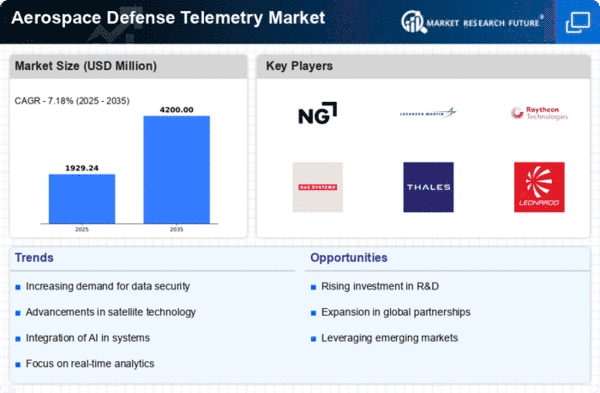
As per MRFR analysis, the Aerospace Defense Telemetry Market Size was estimated at 1800.0 USD Million in 2024. The Aerospace Defense Telemetry industry is projected to grow from 2100.0 in 2025 to 4200.0 by 2035, exhibiting a compound annual growth rate (CAGR) of 7.18 during the forecast period 2025 - 2035.

Key Market Trends & Highlights

The Aerospace Defense Telemetry Market is poised for substantial growth driven by technological advancements and increasing defense investments.

  • The market is experiencing a digital transformation in telemetry systems, enhancing data collection and analysis capabilities.
  • Cybersecurity measures are becoming a focal point as the industry seeks to protect sensitive data from emerging threats.
  • Integration of advanced technologies is reshaping telemetry applications, particularly in the military and unmanned aerial vehicle segments.
  • Increased defense budgets and a growing demand for real-time data are key drivers propelling market expansion, especially in North America and the Asia-Pacific region.

Market Size & Forecast

2024 Market Size 1800.0 (USD Million)
2035 Market Size 4200.0 (USD Million)
CAGR (2025 - 2035) 7.18%

Major Players

Northrop Grumman (US), Lockheed Martin (US), Raytheon Technologies (US), BAE Systems (GB), Thales Group (FR), Leonardo (IT), General Dynamics (US), Hewlett Packard Enterprise (US), L3Harris Technologies (US)

Aerospace Defense Telemetry Market Trends

The Aerospace Defense Telemetry Market is currently experiencing a transformative phase, driven by advancements in technology and increasing demand for real-time data transmission in defense applications. The integration of sophisticated telemetry systems into military operations enhances situational awareness and decision-making capabilities. As nations prioritize modernization of their defense infrastructure, the need for reliable telemetry solutions becomes paramount. This market is characterized by a diverse range of applications, including missile testing, aircraft monitoring, and satellite communications, which collectively contribute to its growth trajectory. Moreover, the Aerospace Defense Telemetry Market is witnessing a shift towards the adoption of digital telemetry systems, which offer improved accuracy and efficiency compared to traditional analog systems. The emphasis on cybersecurity in defense operations further propels the demand for advanced telemetry solutions that ensure secure data transmission. As the geopolitical landscape evolves, the market is likely to expand, with emerging technologies such as artificial intelligence and machine learning playing a pivotal role in shaping future telemetry systems. The convergence of these factors suggests a robust outlook for the Aerospace Defense Telemetry Market in the coming years.

Digital Transformation in Telemetry Systems

The Aerospace Defense Telemetry Market is increasingly embracing digital technologies, which enhance data accuracy and transmission efficiency. This shift towards digital systems allows for better integration with modern defense platforms, facilitating real-time data analysis and improved operational capabilities.

Focus on Cybersecurity Measures

As the reliance on telemetry systems grows, so does the emphasis on cybersecurity. The Aerospace Defense Telemetry Market is witnessing heightened investments in secure data transmission technologies to protect sensitive information from potential cyber threats, ensuring the integrity of defense operations.

Integration of Advanced Technologies

The incorporation of advanced technologies such as artificial intelligence and machine learning is becoming prevalent in the Aerospace Defense Telemetry Market. These innovations enable predictive analytics and automated decision-making, enhancing the overall effectiveness of telemetry systems in defense applications.

Aerospace Defense Telemetry Market Drivers

Market Growth Projections

The Global Aerospace and Defense Telemetry Industry is poised for substantial growth in the coming years, with projections indicating a market value of 0.48 USD Billion in 2024 and an anticipated increase to 1.49 USD Billion by 2035. This growth trajectory suggests a compound annual growth rate of 10.82% from 2025 to 2035, reflecting the increasing reliance on telemetry systems in both military and civilian aerospace applications. The market dynamics are influenced by various factors, including technological advancements, rising defense budgets, and the expansion of space exploration initiatives. As these trends continue to evolve, the telemetry market is likely to witness significant developments.

Growing Focus on National Security

The Global Aerospace and Defense Telemetry Industry is significantly influenced by the growing focus on national security across various nations. Heightened geopolitical tensions and the need for robust defense mechanisms have led governments to prioritize investments in defense technologies, including telemetry systems. Countries are increasingly recognizing the importance of real-time data for decision-making in defense operations. For instance, nations in the Asia-Pacific region are ramping up their defense budgets, which includes funding for telemetry systems that enhance surveillance and reconnaissance capabilities. This trend is expected to propel the market towards a projected value of 1.49 USD Billion by 2035.

Emerging Markets and Defense Spending

Emerging markets are becoming increasingly significant in the Global Aerospace and Defense Telemetry Industry, as countries in regions such as Asia, Africa, and Latin America ramp up their defense spending. These nations are recognizing the necessity of modernizing their military capabilities, which includes investing in telemetry systems for improved operational effectiveness. For instance, countries like India and Brazil are enhancing their defense budgets to incorporate advanced telemetry technologies. This trend not only supports local industries but also attracts foreign investments, further stimulating market growth. The increasing defense spending in these emerging markets is expected to have a lasting impact on the telemetry sector.

Expansion of Space Exploration Programs

The expansion of space exploration programs is a notable driver of the Global Aerospace and Defense Telemetry Industry. As countries and private entities invest in space missions, the demand for telemetry systems that can monitor and transmit data from spacecraft is rising. Telemetry plays a crucial role in ensuring the safety and success of space missions by providing critical information about vehicle performance and environmental conditions. For example, NASA's Artemis program aims to return humans to the Moon, necessitating advanced telemetry solutions for mission success. This growing sector is likely to contribute to the overall market growth, reflecting the increasing importance of telemetry in aerospace applications.

Increasing Demand for Advanced Military Systems

The Global Aerospace and Defense Telemetry Industry experiences a surge in demand for advanced military systems, driven by the need for enhanced situational awareness and operational efficiency. Governments worldwide are investing heavily in modernizing their defense capabilities, which includes the integration of telemetry systems for real-time data transmission and analysis. For instance, the United States Department of Defense has allocated substantial budgets for research and development in telemetry technologies, which are crucial for the effective operation of unmanned aerial vehicles and missile systems. This trend is expected to contribute significantly to the market's growth, with projections indicating a market value of 0.48 USD Billion in 2024.

Technological Advancements in Telemetry Systems

Technological advancements play a pivotal role in shaping the Global Aerospace and Defense Telemetry Industry. Innovations such as miniaturization of sensors, improved data processing capabilities, and enhanced communication protocols are transforming telemetry systems. These advancements enable more efficient data collection and transmission, which is vital for both military and civilian applications. For example, the development of advanced satellite telemetry systems allows for better tracking and monitoring of aerospace vehicles. As these technologies continue to evolve, they are likely to drive market growth, with an anticipated compound annual growth rate of 10.82% from 2025 to 2035.

Market Segment Insights

By Application: Unmanned Aerial Vehicle (Largest) vs. Space Exploration (Fastest-Growing)

In the Aerospace Defense Telemetry Market, the application segment comprises several crucial areas, including Flight Test, Missile Test, Unmanned Aerial Vehicle (UAV), Space Exploration, and Satellite Communication. Among these, UAV holds the largest market share due to its extensive adoption in military and commercial operations, facilitating advanced surveillance and reconnaissance missions. In contrast, Space Exploration is emerging as the fastest-growing segment, driven by increased governmental and private investments in space missions and satellite launches aimed at enhancing communication and global positioning systems.

UAV (Dominant) vs. Space Exploration (Emerging)

The Unmanned Aerial Vehicle (UAV) segment dominates the Aerospace Defense Telemetry Market, characterized by its versatile usage in various applications, including surveillance, logistics, and military operations. This dominance is fueled by technological advancements in drone capabilities and a rising demand for unmanned systems to reduce risk and enhance mission effectiveness. On the other hand, the Space Exploration segment is witnessing exponential growth, attributed to the increased focus on ambitious projects such as Mars missions and lunar landings. This segment's growth is also enhanced by collaborative efforts between governmental bodies and private enterprises, highlighting the burgeoning interest in space technologies and the need for advanced telemetry systems.

By End Use: Military (Largest) vs. Civil Aviation (Fastest-Growing)

In the Aerospace Defense Telemetry Market, the Military segment holds the largest share, driven by ongoing military innovations and defense spending. This sector encompasses a variety of applications including weapons testing, troop movement tracking, and mission planning, highlighting its critical role in national security and defense operations. Additionally, the Civil Aviation segment has emerged as the fastest-growing area, fueled by advancements in technology and a rising focus on enhancing air safety and efficiency. Civil aviation telemetry systems are increasingly being integrated into commercial aircraft for real-time data transmission and analytics.

Military (Dominant) vs. Civil Aviation (Emerging)

The Military segment stands out as the dominant force in the Aerospace Defense Telemetry Market, characterized by significant investments in advanced telemetry systems for various defense applications. Military telemetry includes vital functions such as missile tracking, unmanned vehicle operations, and training simulations, which are essential for modern warfare strategies. In contrast, the Civil Aviation segment is regarded as an emerging market, rapidly evolving due to the increasing integration of telemetry in commercial flights. This segment is focused on improving passenger safety, operational efficiency, and real-time decision-making capabilities, making it attractive for airlines and regulatory bodies aiming to enhance their operational frameworks.

By Technology: Telemetry Data Processing (Largest) vs. Telemetry Software Solutions (Fastest-Growing)

The Aerospace Defense Telemetry Market is experiencing a dynamic distribution of market share among various technology segments. Telemetry Data Processing stands out as the largest segment due to its critical role in analyzing and interpreting telemetry data, essential for decision-making in defense operations. Following closely is Telemetry Signal Processing, which also holds significant share as it enhances the quality and reliability of signals received during missions. Meanwhile, Telemetry Software Solutions is emerging, rapidly gaining traction as advancements in software capabilities streamline operations and improve user interfaces. As the industry adapts to technological advancements, growth trends are leaning towards automated telemetry solutions. The push for real-time data analysis in defense settings is a key driver for Telemetry Software Solutions, while the need for robust data interpretation remains a priority, fueling demand for Telemetry Data Processing. Increased investments in R&D and a focus on technological innovation within the aerospace defense sector are catalyzing growth across these segments, indicating a robust competitive landscape in telemetry technologies.

Technology: Telemetry Data Processing (Dominant) vs. Telemetry Hardware Solutions (Emerging)

In the Aerospace Defense Telemetry Market, Telemetry Data Processing emerges as the dominant technology, providing vital analytical support that underpins mission success. It utilizes algorithms and computational techniques to extract actionable insights from raw telemetry data, ensuring timely decision-making. Telemetry Hardware Solutions, while regarded as an emerging segment, represents innovative trends in physical components and devices used in telemetry systems. As the industry advances, these hardware solutions are being designed to support increased data transmission rates and improved signal integrity. The synergy between robust hardware and sophisticated software capabilities is thus becoming critical, enabling enhanced operational effectiveness and redefining traditional telemetry paradigms.

By Component: Sensors (Largest) vs. Transmitters (Fastest-Growing)

In the Aerospace Defense Telemetry Market, the 'Components' segment reveals a dynamic distribution of market share among key values. Sensors dominate the landscape, representing the largest share due to their critical role in data collection and operational functionality. Following them, transmitters are gaining momentum, showcasing a robust growth trajectory as the demand for real-time data transmission increases across defense applications.

Sensors (Dominant) vs. Transmitters (Emerging)

Sensors have long been established as a dominant force in the Aerospace Defense Telemetry Market, attributed to their essential function in gathering accurate data for analysis and decision-making. Their wide range of applications, including environmental sensing and equipment monitoring, enhances their appeal. Conversely, transmitters are emerging as a vital segment, driven by the expanding need for efficient communication systems capable of handling vast amounts of telemetry data. This growth is spurred by technological advancements that improve transmission reliability and speed in complex defense environments, paving the way for greater integration of telemetry in various aerospace applications.

Get more detailed insights about Aerospace Defense Telemetry Market

Regional Insights

North America : Market Leader in Telemetry

North America continues to lead the Aerospace Defense Telemetry Market, holding a significant share of 900.0M in 2024. The region's growth is driven by increased defense budgets, technological advancements, and a focus on modernization of military systems. Regulatory support from government agencies further catalyzes demand, ensuring compliance with stringent safety and operational standards. The competitive landscape is robust, featuring key players such as Northrop Grumman, Lockheed Martin, and Raytheon Technologies. These companies are at the forefront of innovation, developing cutting-edge telemetry solutions. The U.S. remains the dominant country, with substantial investments in R&D and a strong emphasis on enhancing defense capabilities, solidifying its position in the global market.

Europe : Emerging Market Dynamics

Europe's Aerospace Defense Telemetry Market is poised for growth, with a market size of 450.0M in 2024. The region is witnessing increased defense spending driven by geopolitical tensions and the need for advanced military capabilities. Regulatory frameworks are evolving to support innovation while ensuring compliance with safety standards, which is crucial for market expansion. Leading countries like the UK, France, and Germany are investing heavily in defense technologies, fostering a competitive environment. Key players such as BAE Systems and Thales Group are actively enhancing their product offerings. The European market is characterized by collaboration among nations to develop integrated defense systems, further boosting the telemetry sector.

Asia-Pacific : Rapid Growth Potential

The Asia-Pacific region is rapidly emerging as a significant player in the Aerospace Defense Telemetry Market, with a market size of 360.0M in 2024. Growth is fueled by increasing defense budgets, modernization efforts, and a rising focus on indigenous defense capabilities. Countries are enhancing their regulatory frameworks to support innovation and ensure compliance with international standards, driving market demand. Key players in this region include companies like Leonardo and L3Harris Technologies, which are expanding their presence. Countries such as India, Japan, and Australia are leading the charge, investing in advanced telemetry systems to bolster their defense capabilities. The competitive landscape is evolving, with a focus on partnerships and collaborations to enhance technological advancements.

Middle East and Africa : Developing Market Landscape

The Middle East and Africa region is gradually developing its Aerospace Defense Telemetry Market, with a market size of 90.0M in 2024. The growth is driven by increasing defense expenditures and a focus on enhancing military capabilities. Regulatory bodies are working to create frameworks that support the development of advanced defense technologies, which is essential for market growth. Countries like the UAE and South Africa are leading the market, with investments in modernizing their defense systems. The competitive landscape includes both local and international players, with a focus on partnerships to enhance technological capabilities. The region's strategic importance is attracting attention from global defense companies, further stimulating market growth.

Key Players and Competitive Insights

The Aerospace Defense Telemetry Market is characterized by a dynamic competitive landscape, driven by technological advancements and increasing defense budgets across various nations. Key players such as Northrop Grumman (US), Lockheed Martin (US), and Raytheon Technologies (US) are at the forefront, focusing on innovation and strategic partnerships to enhance their market positions. Northrop Grumman (US) emphasizes the integration of advanced telemetry systems into unmanned aerial vehicles (UAVs), while Lockheed Martin (US) is leveraging its extensive experience in aerospace to develop next-generation telemetry solutions. Raytheon Technologies (US) is also investing heavily in digital transformation initiatives, aiming to streamline operations and improve data analytics capabilities, which collectively shapes a competitive environment that is increasingly reliant on technological prowess and strategic collaborations.

In terms of business tactics, companies are localizing manufacturing and optimizing supply chains to enhance operational efficiency and reduce costs. The market structure appears moderately fragmented, with several key players exerting considerable influence. This fragmentation allows for niche players to emerge, yet the collective strength of major companies like BAE Systems (GB) and Thales Group (FR) ensures that competition remains robust and innovation-driven.

In November 2025, BAE Systems (GB) announced a strategic partnership with a leading technology firm to develop advanced telemetry systems for military applications. This collaboration is expected to enhance BAE's capabilities in real-time data transmission and analysis, thereby improving operational effectiveness for defense clients. The strategic importance of this partnership lies in its potential to integrate cutting-edge technologies, which could set new benchmarks in the telemetry domain.

In October 2025, Thales Group (FR) unveiled a new telemetry solution designed for next-generation fighter jets, showcasing its commitment to innovation. This development not only reinforces Thales's position as a leader in aerospace technology but also highlights the increasing demand for sophisticated telemetry systems in modern combat scenarios. The introduction of this solution is likely to attract significant interest from defense ministries worldwide, further solidifying Thales's market presence.

In September 2025, L3Harris Technologies (US) expanded its telemetry capabilities through the acquisition of a smaller tech firm specializing in satellite communications. This acquisition is strategically significant as it allows L3Harris to enhance its telemetry offerings by integrating satellite data into its systems, thereby providing clients with more comprehensive solutions. The move reflects a broader trend in the industry towards consolidation and the pursuit of technological synergies.

As of December 2025, current trends in the Aerospace Defense Telemetry Market are increasingly defined by digitalization, sustainability, and the integration of artificial intelligence (AI). Strategic alliances are becoming more prevalent, as companies recognize the need to collaborate to stay competitive in a rapidly evolving landscape. Looking ahead, competitive differentiation is likely to shift from price-based competition to a focus on innovation, technology, and supply chain reliability. This evolution suggests that companies that prioritize R&D and strategic partnerships will be better positioned to thrive in the future.

Key Companies in the Aerospace Defense Telemetry Market market include

Industry Developments

Leonardo's Satellite Constellation Initiative

Italian aerospace and defense company Leonardo has announced plans to launch a constellation of approximately 40 satellites by 2028. This  USD 1.35 billion project, supported by the Italian Ministry of Defence, aims to provide enhanced services in climatology, agriculture, and security, offering an alternative to existing systems like Elon Musk's Starlink. ​

Airbus to Develop French Military Communications Network

Airbus has secured a contract worth up to USD 480 million to construct a communications network for the French air and naval forces. The project, spanning up to 10 years, involves deploying the network on over 80 ships between 2028 and 2032, focusing on enhanced cybersecurity to counter increasing cyber threats. ​

Advancements in Optical Communication Technology

In 2023, NASA achieved a milestone by transmitting 200 gigabits of data per second from a satellite using optical communication technology. French company Cailabs has emerged as a key player in this field, securing significant contracts, including one from the French Ministry of Defence, and building multiple ground stations. The shift towards optical communications promises faster and more secure data transmission in aerospace applications. 

Firefly Aerospace's Rapid-Response Launch Contract

Cedar Park-based Firefly Aerospace has secured a USD 21.8 million contract with the U.S. Space Force for a rapid-response rocket launch mission named Victus Sol. This mission aims to demonstrate the ability to deploy payloads into orbit with just 24 hours' notice, enhancing national defense capabilities. ​

Japan's Successful Defense Satellite Launch

Japan successfully launched the Kirameki No. 3 defense satellite using its new H3 rocket. The satellite employs X-band communication, providing stable, weather-resistant data-sharing capabilities essential for Japan's Self-Defense Forces, marking a significant step in enhancing the country's military communication infrastructure.

Aerospace and Defense Telemetry Market Segment 

By market type 

  • Defence 
  • Aerospace 

By application 

  • Missles and guided weapons 
  • Aircraft 
  • Unmanned aerial vehicles 
  • Spacecraft 

By system 

  • Flight termination receiver 
  • Data acquisition unit 
  • Telemetry transmitters 

By end-users 

  • Regulatory Bodies
  • Aerospace defence providers 
  • Defense organisations 
  • Component providers 
  • Research intuitions 

Aerospace and Defense Telemetry Market Regional Analysis 

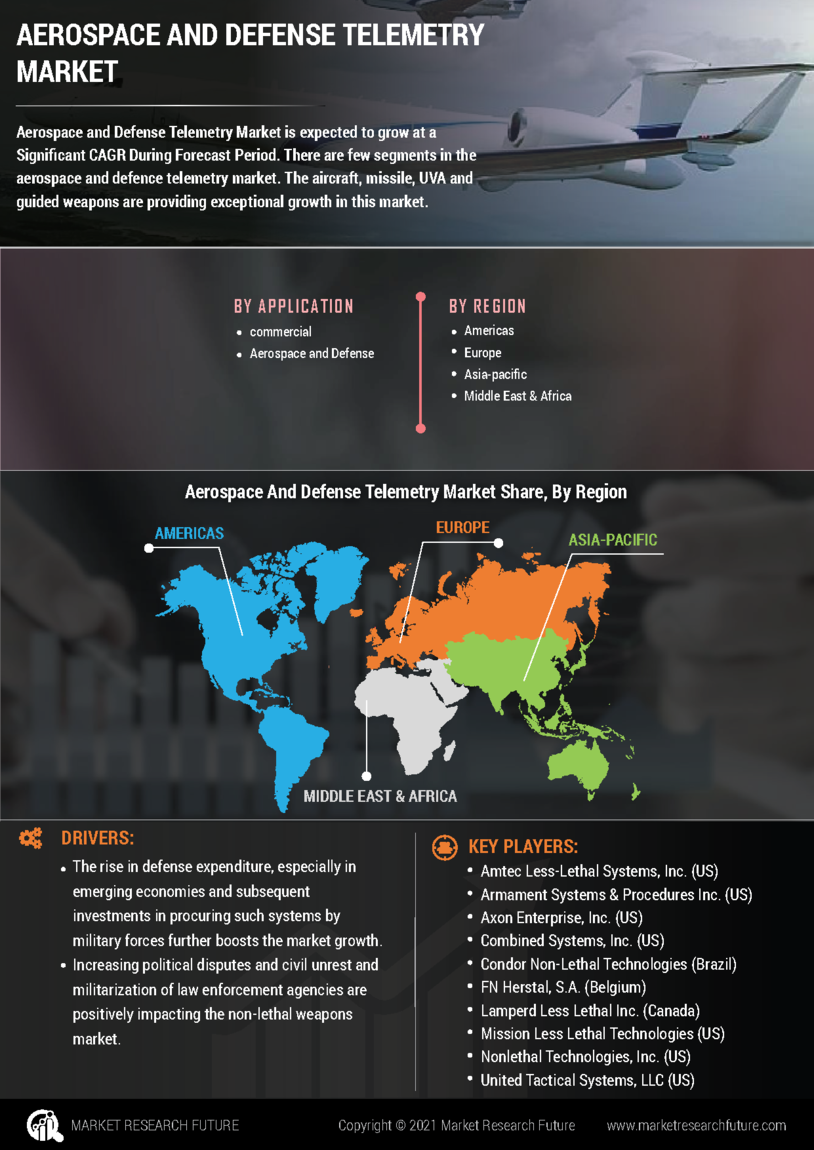
The regional Aerospace and Defense Telemetry Market defense telemetry market is fragmented into Asia Pacific, North America, the Middle East and Europe. Europe will lead the telemetry market in the forecast period. However, Asia Pacific remains the fastest-growing telemetry markets. The highest demand rate is projected in the Asia Pacific region. Australia, China, Japan and India are the key contributors to the aerospace & defence market. The telemetry market is gaining more popularity in the Middle East and Africa regions. The regional players of the market are taking serious measures to expand the market.

The technological advancements by the key players will further enhance the market. The key players are offering cost-effectiveness and clarity to the products. These developments will uplift the overall aerospace & defence market. 

Recent developments 

  • The key players of the aerospace and defence telemetry market are launching hybrid telemetry systems. The new age telemetry devices offer excellent communication and information transmission features.  
  • The key players of the market are enhancing their market acquisitions and partnership by implementing their market expansion measures. 
  • The key players in North America are receiving new billion-dollar projects from the US armed and military forces. 

Future Outlook

Aerospace Defense Telemetry Market Future Outlook

The Aerospace Defense Telemetry Market is projected to grow at a 7.18% CAGR from 2024 to 2035, driven by advancements in technology, increased defense budgets, and rising demand for real-time data analytics.

New opportunities lie in:

  • Development of advanced telemetry systems for unmanned aerial vehicles (UAVs)
  • Integration of AI-driven analytics for predictive maintenance solutions
  • Expansion of telemetry services in emerging markets for defense applications

By 2035, the market is expected to achieve robust growth, positioning itself as a leader in aerospace defense technology.

Market Segmentation

Aerospace Defense Telemetry Market End Use Outlook

  • Military
  • Civil Aviation
  • Space Agencies
  • Research Institutions
  • Defense Contractors

Aerospace Defense Telemetry Market Component Outlook

  • Sensors
  • Transmitters
  • Receivers
  • Data Recorders
  • Processing Units

Aerospace Defense Telemetry Market Technology Outlook

  • Telemetry Data Processing
  • Telemetry Transmission
  • Telemetry Signal Processing
  • Telemetry Software Solutions
  • Telemetry Hardware Solutions

Aerospace Defense Telemetry Market Application Outlook

  • Flight Test
  • Missile Test
  • Space Exploration
  • Unmanned Aerial Vehicle
  • Satellite Communication

Report Scope

MARKET SIZE 20241800.0(USD Million)
MARKET SIZE 20252100.0(USD Million)
MARKET SIZE 20354200.0(USD Million)
COMPOUND ANNUAL GROWTH RATE (CAGR)7.18% (2024 - 2035)
REPORT COVERAGERevenue Forecast, Competitive Landscape, Growth Factors, and Trends
BASE YEAR2024
Market Forecast Period2025 - 2035
Historical Data2019 - 2024
Market Forecast UnitsUSD Million
Key Companies ProfiledNorthrop Grumman (US), Lockheed Martin (US), Raytheon Technologies (US), BAE Systems (GB), Thales Group (FR), Leonardo (IT), General Dynamics (US), Hewlett Packard Enterprise (US), L3Harris Technologies (US)
Segments CoveredApplication, End Use, Technology, Component
Key Market OpportunitiesIntegration of advanced data analytics and artificial intelligence in Aerospace Defense Telemetry Market enhances operational efficiency.
Key Market DynamicsTechnological advancements and regulatory changes drive innovation and competition in the Aerospace Defense Telemetry Market.
Countries CoveredNorth America, Europe, APAC, South America, MEA

Market Highlights

Author
Sejal Akre
Senior Research Analyst

She has over 5 years of rich experience, in market research and consulting providing valuable market insights to client. Hands on expertise in management consulting, and extensive knowledge in domain including ICT, Automotive & Transportation and Aerospace & Defense. She is skilled in Go-to market strategy, industry analysis, market sizing, in depth company profiling, competitive intelligence & benchmarking and value chain amongst others.

Leave a Comment

FAQs

At what rate is the Aerospace and Defense Telemetry Market anticipated to grow in the coming years?

Aerospace and Defense Telemetry Market is expected to witness a CAGR of approximately 10.82% during the period 2025 to 2035.

What are the main applications covered in the report?

The main applications covered in the report include Aircraft, Spacecraft, UAVs, and more.

Which equipment-based segment can take the lead in the Aerospace and Defense Telemetry Market?

The data acquisition unit segment has taken the lead in the Aerospace and Defense Telemetry Market.

Which region is the Aerospace and Defense Telemetry Market leader?

North America is the Aerospace and Defense Telemetry Market leader.

Why is North America leading the Aerospace and Defense Telemetry Market?

North America is leading the market owing to the massive expenditure and the frequent technological innovations that lead to high demand for telemetry systems. The Canadian government also invests significantly in the development of advanced systems such as telemetry systems.

What are the top growth boosters in the global Aerospace and Defense Telemetry Market?

The top growth boosters in the global market are growing demand of radio and satellite-based telemetry for military & defense application, investment in R&D to develop control & communications systems, and utilization of UAV for remote sensing.

Download Free Sample

Kindly complete the form below to receive a free sample of this Report

Compare Licence

×
Features License Type
Single User Multiuser License Enterprise User
Price $4,950 $5,950 $7,250
Maximum User Access Limit 1 User Upto 10 Users Unrestricted Access Throughout the Organization
Free Customization
Direct Access to Analyst
Deliverable Format
Platform Access
Discount on Next Purchase 10% 15% 15%
Printable Versions