
Request Free Sample ×

Kindly complete the form below to receive a free sample of this Report

* Please use a valid business email

Leading companies partner with us for data-driven Insights

clients tt-cursor
Hero Background
English
Chinese
French
Japanese
Korean
German
Spanish

Advanced Connectivity in the Oil and Gas Sector Market Analysis

ID: MRFR/ICT/10645-HCR
215 Pages
Ankit Gupta
March 2026

Advanced Connectivity in the Oil & Gas Sector Market Research Report: Information By Assets Type (Onshore and Offshore), By Connectivity (Cellular, Low-Earth orbit (LEO) satellites, Wireline/Fixed, Shortrange, LPWAN, Wireless Low-Power Networks, Optical fiber, and Others), By Application, (Remote monitoring and control, Real-time data analytics, Virtual reality (VR) and augmented reality (AR), and Others) By Region (North America, Europe, Asia-Pacific, Middle East and Africa and South America) - Forecast Till 2035

Share:
Download PDF ×

We do not share your information with anyone. However, we may send you emails based on your report interest from time to time. You may contact us at any time to opt-out.

Advanced Connectivity in the Oil and Gas Sector Market Infographic
Purchase Options

Market Analysis

In-depth Analysis of Advanced Connectivity in the Oil and Gas Sector Market Industry Landscape

The Oil & Gas quarter is experiencing a large transformation with the adoption of Advanced Connectivity technology, pushed through various market factors that can be shaping the demand and implementation of Advanced Connectivity answers. One of the important thing market elements using the increase of Advanced Connectivity inside the Oil & Gas sector is the increasing cognizance of operational performance and cost optimization. Advanced connectivity technology, including the Industrial Internet of Things (IIoT), part computing, and 5G networks, enable the actual-time monitoring and management of remote property and operations. For instance, sensors and connected gadgets can provide real-time statistics on equipment's overall performance, environmental situations, and manufacturing levels. This information may be analyzed in real-time to become aware of inefficiencies, expect upkeep desires, and optimize manufacturing techniques. Moreover, the want for effective asset control is another sizeable market issue in the Oil & Gas quarter. Advanced Connectivity technology allows far-off tracking and control of essential belongings, including pipelines, drilling rigs, and manufacturing facilities. IIoT devices and sensors can offer real-time information on asset performance, health, and upkeep requirements. This information may be used to optimize asset usage, prevent device disasters, and increase asset lifespan. Advanced Connectivity solutions additionally enable predictive protection techniques, wherein asset health records are analyzed to discover capacity troubles earlier than they occur, lowering downtime and enhancing asset reliability. Additionally, the focus on safety and environmental sustainability is influencing the adoption of Advanced Connectivity technologies inside the Oil & Gas area. Advanced Connectivity answers permit actual-time monitoring of safety parameters, which include gas leaks, gadget malfunctions, and worker situations. Connected sensors and devices can locate anomalies and cause instant indicators, taking into consideration fast response and mitigation of safety dangers. Furthermore, the increasing adoption of data analytics and artificial intelligence (AI) is riding the demand for Advanced Connectivity within the Oil & Gas sector. Advanced connectivity technologies permit the gathering and transmission of big volumes of records from various resources, which may then be analyzed to derive precious insights. Moreover, the combination of Advanced Connectivity technology in faraway and offshore operations is another sizeable market component in the Oil & Gas area. Oil and fuel operations often take location in faraway and tough environments in which connectivity is restricted. Advanced connectivity solutions, such as satellite communications and mesh networks, permit the transmission and conversation of actual-time records in those far-off locations. This connectivity enables remote monitoring, management, and collaboration, improving operational efficiency and protection in far-off and offshore operations.


Author
Author Profile
Ankit Gupta
Team Lead - Research

Ankit Gupta is a seasoned market intelligence and strategic research professional with over six plus years of experience in the ICT and Semiconductor industries. With academic roots in Telecom, Marketing, and Electronics, he blends technical insight with business strategy. Ankit has led 200+ projects, including work for Fortune 500 clients like Microsoft and Rio Tinto, covering market sizing, tech forecasting, and go-to-market strategies. Known for bridging engineering and enterprise decision-making, his insights support growth, innovation, and investment planning across diverse technology markets.

Leave a Comment

FAQs

What is the projected market valuation for advanced connectivity in the oil and gas sector by 2035?

<p>The projected market valuation for advanced connectivity in the oil and gas sector is expected to reach 25.0 USD Billion by 2035.</p>

What was the market valuation for advanced connectivity in the oil and gas sector in 2024?

<p>The overall market valuation for advanced connectivity in the oil and gas sector was 12.5 USD Billion in 2024.</p>

What is the expected CAGR for the advanced connectivity market in the oil and gas sector from 2025 to 2035?

<p>The expected CAGR for the advanced connectivity market in the oil and gas sector during the forecast period 2025 - 2035 is 6.5%.</p>

Which companies are considered key players in the advanced connectivity in the oil and gas sector market?

<p>Key players in the market include Schlumberger, Halliburton, Baker Hughes, Siemens, Honeywell, Emerson Electric, Rockwell Automation, ABB, General Electric, and Cisco Systems.</p>

What are the main applications driving the advanced connectivity market in the oil and gas sector?

<p>The main applications driving the market include Remote Monitoring, Data Analytics, Predictive Maintenance, and Asset Management, with valuations ranging from 2.5 to 7.0 USD Billion.</p>

How does the Internet of Things contribute to the advanced connectivity market in the oil and gas sector?

<p>The Internet of Things is projected to contribute between 3.0 and 6.0 USD Billion to the advanced connectivity market in the oil and gas sector.</p>

What are the different connectivity types in the advanced connectivity market for oil and gas?

<p>Connectivity types include Satellite Communication, Wireless Communication, and Fiber Optic Communication, with valuations from 3.0 to 11.0 USD Billion.</p>

What deployment modes are available in the advanced connectivity market for the oil and gas sector?

<p>Deployment modes include On-Premises, Cloud-Based, and Hybrid, with market valuations ranging from 3.5 to 10.0 USD Billion.</p>

What is the projected growth for the midstream segment in the advanced connectivity market?

<p>The midstream segment is projected to grow, with valuations expected to range from 4.0 to 8.0 USD Billion.</p>

How does predictive maintenance impact the advanced connectivity market in the oil and gas sector?

<p>Predictive Maintenance is anticipated to drive market growth, with valuations expected to range from 3.5 to 7.0 USD Billion.</p>

Market Summary

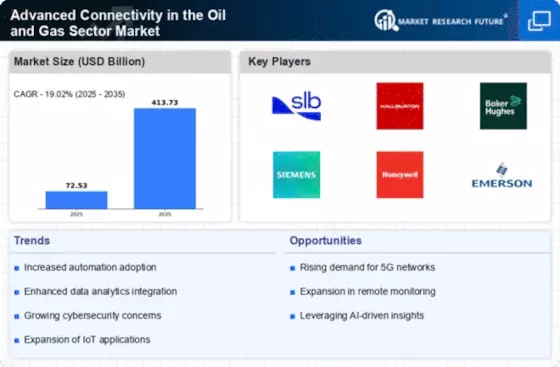
As per MRFR analysis, the Advanced Connectivity in the Oil and Gas Sector. was estimated at 60.94 USD Billion in 2024. The Advanced Connectivity industry is projected to grow from 72.53 USD Billion in 2025 to 413.73 USD Billion by 2035, exhibiting a compound annual growth rate (CAGR) of 19.02% during the forecast period 2025 - 2035.

Key Market Trends & Highlights

The Advanced Connectivity in the Oil and Gas Sector Market is poised for substantial growth driven by technological advancements and evolving operational needs.

  • The market experiences increased adoption of IoT solutions, particularly in North America, enhancing operational efficiency. A strong focus on cybersecurity measures is evident, as companies prioritize the protection of sensitive data in both North America and Asia-Pacific. There is an emphasis on data analytics, enabling companies to derive actionable insights from vast amounts of operational data. Key market drivers include the integration of smart technologies and the growing demand for remote operations, which are shaping the landscape in both the upstream and midstream segments.

Market Size & Forecast

2024 Market Size 60.94 (USD Billion)
2035 Market Size 413.73 (USD Billion)
CAGR (2025 - 2035) 19.02%
Largest Regional Market Share in 2024 North America

Major Players

Schlumberger (US), Halliburton (US), Baker Hughes (US), Siemens (DE), Honeywell (US), Emerson Electric (US), Rockwell Automation (US), ABB (CH), Cisco Systems (US), General Electric (US)

Market Trends

The Advanced Connectivity in the Oil and Gas Sector Market is currently experiencing a transformative phase, driven by the increasing demand for real-time data and enhanced operational efficiency. Companies are increasingly adopting advanced technologies such as the Internet of Things (IoT), artificial intelligence, and cloud computing to optimize their operations. This shift towards digitalization is not merely a trend but appears to be a fundamental change in how the industry operates. Enhanced connectivity solutions are enabling firms to monitor assets remotely, predict maintenance needs, and improve safety protocols, thereby reducing operational risks and costs. Moreover, the integration of advanced connectivity solutions is fostering collaboration across various stakeholders in the oil and gas ecosystem. This interconnectedness allows for better decision-making and resource allocation, which is crucial in a sector characterized by fluctuating market conditions. As the industry continues to evolve, the emphasis on sustainability and environmental responsibility is likely to shape future connectivity strategies. Companies may increasingly seek solutions that not only enhance productivity but also align with global sustainability goals, indicating a potential shift in focus towards greener technologies and practices in the Advanced Connectivity in the Oil and Gas Sector Market.

Increased Adoption of IoT Solutions

The integration of Internet of Things (IoT) technologies is becoming more prevalent in the Advanced Connectivity in the Oil and Gas Sector Market. This trend suggests that companies are leveraging IoT devices to gather real-time data from various operations, which enhances monitoring and decision-making processes.

Focus on Cybersecurity Measures

As connectivity increases, so does the need for robust cybersecurity protocols. The Advanced Connectivity in the Oil and Gas Sector Market appears to be prioritizing the implementation of advanced security measures to protect sensitive data and infrastructure from potential cyber threats.

Emphasis on Data Analytics

The utilization of data analytics tools is gaining traction within the Advanced Connectivity in the Oil and Gas Sector Market. This trend indicates that firms are increasingly relying on data-driven insights to optimize operations, improve efficiency, and make informed strategic decisions.

Advanced Connectivity in the Oil and Gas Sector Market Market Drivers

Enhanced Data Security Measures

Enhanced data security measures are becoming increasingly vital in the Advanced Connectivity in the Oil and Gas Sector Market. With the rise of cyber threats, companies are compelled to invest in robust security solutions to protect sensitive data and maintain operational integrity. The implementation of advanced connectivity solutions often includes integrated cybersecurity features that safeguard against potential breaches. Recent reports suggest that the market for cybersecurity in the oil and gas sector is anticipated to grow significantly, driven by the need for secure data transmission and storage. As firms prioritize the protection of their digital assets, the demand for advanced connectivity solutions that incorporate strong security measures is likely to increase, ensuring the resilience of operations in a challenging environment.

Integration of Smart Technologies

The integration of smart technologies is a pivotal driver in the Advanced Connectivity in the Oil and Gas Sector Market. As companies increasingly adopt smart sensors and devices, they enhance operational efficiency and safety. For instance, the implementation of smart technologies can lead to a reduction in operational costs by up to 20%, as reported by industry analyses. This integration facilitates real-time monitoring and predictive maintenance, which are crucial for minimizing downtime and optimizing resource allocation. Furthermore, the ability to collect and analyze data from various sources allows for improved decision-making processes. Consequently, the demand for advanced connectivity solutions that support these technologies is likely to grow, as firms seek to remain competitive in a rapidly evolving market.

Growing Demand for Remote Operations

The growing demand for remote operations is a significant driver in the Advanced Connectivity in the Oil and Gas Sector Market. As companies seek to enhance operational efficiency and reduce costs, remote monitoring and control systems are becoming essential. The ability to manage operations from a distance allows for better resource management and quicker response times to potential issues. Recent studies indicate that the market for remote operations technologies is expected to grow at a compound annual growth rate of over 15% in the coming years. This trend is particularly relevant in offshore drilling and exploration, where advanced connectivity solutions enable real-time data transmission and decision-making. As such, the demand for advanced connectivity solutions that support remote operations is likely to increase.

Investment in Digital Transformation

Investment in digital transformation is a crucial driver of the Advanced Connectivity in the Oil and Gas Sector Market. Companies are increasingly recognizing the need to modernize their operations through digital technologies. This transformation often involves the adoption of advanced connectivity solutions that facilitate data sharing and collaboration across various departments. According to recent market analyses, investments in digital technologies within the oil and gas sector are projected to reach several billion dollars by 2027. This shift towards digitalization not only enhances operational efficiency but also improves the overall competitiveness of firms in the market. As organizations continue to prioritize digital transformation, the demand for advanced connectivity solutions is expected to rise correspondingly.

Regulatory Compliance and Safety Standards

Regulatory compliance and safety standards are increasingly influencing the Advanced Connectivity in the Oil and Gas Sector Market. Governments and regulatory bodies are imposing stringent regulations to ensure safety and environmental protection. This has led to a heightened focus on connectivity solutions that can monitor compliance in real-time. For example, the implementation of advanced connectivity systems can help companies adhere to regulations by providing accurate data on emissions and operational practices. The market for compliance-related technologies is projected to expand significantly, as firms invest in systems that not only meet regulatory requirements but also enhance safety protocols. This trend underscores the necessity for advanced connectivity solutions that facilitate compliance and promote sustainable practices.

Market Segment Insights

By Application: Data Analytics (Largest) vs. Predictive Maintenance (Fastest-Growing)

<p>The Advanced Connectivity in the Oil and Gas Sector Market showcases a diverse distribution of applications, with Data Analytics leading the charge due to its pivotal role in enhancing decision-making processes and operational efficiencies. Remote Monitoring and Asset Management also contribute significantly, each addressing specific needs within the industry, ultimately creating a balanced market landscape driven by technological needs and regulatory compliance. As the sector evolves, Predictive Maintenance is emerging as the fastest-growing application, reflecting the industry's transition towards more proactive management strategies. The integration of IoT and advanced analytics is reshaping maintenance protocols and enabling operators to intervene before failures occur, thus maximizing uptime and reducing costs. This shift signifies a broader trend where collaboration between technology and operational efficiency becomes increasingly vital for market players.</p>

<p>Data Analytics (Dominant) vs. Asset Management (Emerging)</p>

<p>In the context of the Advanced Connectivity in the Oil and Gas Sector Market, Data Analytics has established itself as a dominant force, providing critical insights that drive operational efficiencies and strategic decision-making. Its capabilities encompass vast areas including real-time data processing and trend analysis which are imperative for modern oil and gas operations. In contrast, Asset Management is an emerging area demonstrating significant potential for growth, leveraging connectivity to enhance inventory tracking and lifecycle management. As companies invest in digital transformation, the focus on integrating advanced connectivity solutions into asset management frameworks is expected to optimize resource utilization and improve overall operational effectiveness, marking a pivotal shift in how assets are managed in the sector.</p>

By Technology: Internet of Things (Largest) vs. Cloud Computing (Fastest-Growing)

<p>In the advanced connectivity market within the oil and gas sector, the Internet of Things (IoT) leads the segment, capturing the largest share due to its transformative potential in enhancing operational efficiency and real-time monitoring. Cloud computing follows closely as a pivotal contributor, facilitating scalable data management and process automation. Artificial intelligence and big data also play substantial roles but remain smaller in market share compared to IoT and cloud solutions. Growth trends indicate a robust trajectory for cloud computing, driven by the increasing demand for flexible and secure data solutions among oil and gas companies. IoT continues to revolutionize the sector through smart sensors and predictive maintenance capabilities, while AI and big data analytics gain momentum as tools for optimizing operations and improving decision-making processes. These technologies collectively enhance connectivity and data utilization, enabling industry players to harness the full potential of Industry 4.0 initiatives.</p>

<p>Technology: IoT (Dominant) vs. AI (Emerging)</p>

<p>The Internet of Things (IoT) stands as the dominant technology in advanced connectivity for the oil and gas sector, offering unparalleled advantages in remote monitoring, predictive maintenance, and enhanced safety. It facilitates seamless communication between devices, allowing for real-time data collection and analysis, which significantly boosts operational efficiency. In contrast, artificial intelligence (AI) emerges as an innovative technology with immense potential to transform data analytics and process automation within the industry. While IoT provides the infrastructure for connectivity, AI harnesses the data generated to drive insights, automate decision-making, and optimize performance. As AI technologies evolve, their integration into IoT systems promises to create smarter and more responsive operational frameworks.</p>

By End Use: Midstream (Largest) vs. Upstream (Fastest-Growing)

<p>The advanced connectivity market within the oil and gas sector is segmented into three primary areas: upstream, midstream, and downstream. The midstream segment holds the largest share of the market due to its critical role in the transportation and storage of petroleum products. This segment benefits from extensive investment in infrastructure and technology that enhances operational efficiency and safety. The downstream segment, while traditionally significant, shows less growth potential compared to midstream, which continues to attract major investments and innovations. The growth trends in the upstream segment are driven by rapid technological advancements and increased exploration activities. It is becoming the fastest-growing segment as companies seek to adopt advanced connectivity solutions for real-time data analytics and enhanced decision-making capabilities. Factors such as rising energy demands and shifts towards sustainable practices also drive transformation, leading to greater integration of advanced technologies in exploration and production activities.</p>

<p>Midstream (Dominant) vs. Upstream (Emerging)</p>

<p>In the advanced connectivity landscape of the oil and gas sector, the midstream segment is recognized as the dominant player, owing to its essential function in logistics and distribution. Midstream operations heavily rely on advanced connectivity solutions that facilitate real-time monitoring, predictive maintenance, and efficient management of assets. This segment has established itself as a leader in deploying IoT applications and data analytics, enhancing operational efficiency and reducing downtime. On the other hand, the upstream segment is emerging rapidly, propelled by innovative technologies that drive exploration and production processes. Although historically less dominant, the upstream segment is witnessing increased investment in advanced connectivity to improve exploration outcomes and increase operational agility. Both segments are vital, but midstream currently showcases robust capabilities against the backdrop of evolving industry demands.</p>

By Connectivity Type: Satellite Communication (Largest) vs. Wireless Communication (Fastest-Growing)

The Advanced Connectivity in the Oil and Gas Sector Market showcases a competitive landscape among primary connectivity types: <a href="satellite%20communication%20-%20https://www.marketresearchfuture.com/reports/satellite-communication-market-8466">Satellite Communication</a>, Wireless Communication, and Fiber Optic Communication. Satellite Communication holds the largest market share due to its reliability and widespread coverage, particularly in remote locations where traditional communication methods falter. Wireless Communication, while currently smaller in share, is gaining traction thanks to its flexibility and rapid implementation in various oil and gas operations.

Satellite Communication (Dominant) vs. Wireless Communication (Emerging)

<a href="satellite%20communication%20-%20https://www.marketresearchfuture.com/reports/satellite-communication-market-8466">Satellite Communication </a>is a dominant force in the oil and gas sector, providing essential connectivity in challenging environments such as offshore platforms and remote oil fields. Its capability to maintain communication over vast distances and in areas lacking infrastructure makes it invaluable. On the other hand, Wireless Communication is emerging as a strong alternative, driven by advancements in technology that reduce costs and improve signal strength and reach. The increasing reliance on real-time  and remote monitoring in oil and gas operations is further propelling the growth of wireless solutions, offering a more agile and responsive communication framework for companies.

By Deployment Mode: Cloud-Based (Largest) vs. Hybrid (Fastest-Growing)

<p>The deployment mode segment for advanced connectivity in the oil and gas sector is primarily led by cloud-based solutions, which have gained significant traction due to their scalability and flexibility. On-premises deployments, while still relevant, are gradually reducing in market share as organizations seek more agile options, with cloud-based setups commanding a large part of the market. Hybrid solutions, which combine both on-premises and cloud capabilities, are also gaining favor, particularly among enterprises looking to balance control with the benefits of cloud scalability.</p>

<p>Deployment Mode: Cloud-Based (Dominant) vs. Hybrid (Emerging)</p>

<p>Cloud-based deployment in the oil and gas sector stands out as the dominant choice for many enterprises, driven by its ability to offer seamless scalability and integration with advanced technologies such as IoT and big data analysis. It provides organizations with enhanced operational efficiency and reduced upfront costs. Conversely, hybrid deployments are emerging as a preferred solution for companies that require a balance between in-house data management and the flexibility of the cloud. This approach allows organizations to leverage existing on-premises infrastructure while progressively adopting cloud technologies, effectively addressing concerns related to data security and compliance.</p>

Get more detailed insights about Advanced Connectivity in the Oil & Gas Sector Market Research Report - Forecast till 2035

Regional Insights

North America : Market Leader in Connectivity

North America leads the Advanced Connectivity in the Oil and Gas Sector Market, holding a significant market share of 32.56% as of 2024. The region's growth is driven by technological advancements, increased investments in digital transformation, and a strong regulatory framework promoting innovation. The demand for real-time data analytics and IoT solutions is surging, enhancing operational efficiency and safety in oil and gas operations. The competitive landscape is robust, with key players like Schlumberger, Halliburton, and Baker Hughes dominating the market. The U.S. is the primary contributor, leveraging its technological prowess and extensive infrastructure. Companies are increasingly focusing on partnerships and collaborations to enhance their service offerings, ensuring they remain at the forefront of connectivity solutions in the sector.

Europe : Emerging Hub for Innovation

Europe is witnessing a growing demand for advanced connectivity solutions in the oil and gas sector, with a market share of 15.29% in 2024. The region's growth is fueled by stringent environmental regulations and a push towards sustainable energy practices. Governments are investing in digital infrastructure to enhance operational efficiency and reduce carbon footprints, creating a favorable environment for market expansion. Leading countries like Germany and the UK are at the forefront, with major players such as Siemens and ABB driving innovation. The competitive landscape is characterized by a mix of established firms and emerging startups, all vying to capture market share. The European market is increasingly focusing on integrating AI and IoT technologies to optimize operations and improve safety standards.

Asia-Pacific : Rapidly Growing Market Potential

Asia-Pacific is emerging as a significant player in the Advanced Connectivity in the Oil and Gas Sector Market, with a market share of 10.12% in 2024. The region's growth is driven by increasing energy demands, rapid industrialization, and government initiatives aimed at enhancing digital infrastructure. Countries are focusing on adopting advanced technologies to improve operational efficiency and safety in oil and gas operations. China and India are leading the charge, with substantial investments in digital transformation. The competitive landscape includes both global giants and local players, creating a dynamic market environment. Companies are increasingly collaborating to leverage technological advancements and meet the growing demand for connectivity solutions in the sector.

Middle East and Africa : Resource-Rich Frontier

The Middle East and Africa region, with a market share of 3.97% in 2024, is gradually adopting advanced connectivity solutions in the oil and gas sector. The growth is driven by the need for enhanced operational efficiency and the integration of digital technologies. Governments are recognizing the importance of modernizing infrastructure to attract foreign investments and improve productivity in the sector. Leading countries like Saudi Arabia and the UAE are investing heavily in digital transformation initiatives. The competitive landscape is evolving, with both international and local players striving to establish a foothold. Companies are focusing on innovative solutions to address the unique challenges of the region, ensuring sustainable growth in the oil and gas sector.

Key Players and Competitive Insights

The Advanced Connectivity in the Oil and Gas Sector Market is characterized by a dynamic competitive landscape, driven by the increasing demand for digital transformation and enhanced operational efficiency. Key players such as Schlumberger (US), Halliburton (US), and Siemens (DE) are strategically positioned to leverage their technological expertise and innovative solutions. Schlumberger (US) focuses on integrating advanced data analytics and IoT technologies to optimize drilling operations, while Halliburton (US) emphasizes its commitment to sustainability through the development of eco-friendly solutions. Siemens (DE) is actively pursuing partnerships to enhance its digital offerings, thereby shaping a competitive environment that prioritizes innovation and collaboration.
The market structure appears moderately fragmented, with several players vying for market share through localized manufacturing and supply chain optimization. Companies are increasingly localizing their operations to reduce costs and improve responsiveness to regional demands. This strategy not only enhances operational efficiency but also fosters closer relationships with local stakeholders, thereby strengthening their competitive positions. The collective influence of these key players contributes to a competitive landscape that is both diverse and dynamic, with a focus on technological advancement and customer-centric solutions.
In January 2026, Baker Hughes (US) announced a strategic partnership with a leading technology firm to develop AI-driven predictive maintenance solutions for oil and gas operations. This collaboration is expected to enhance operational reliability and reduce downtime, thereby providing Baker Hughes (US) with a competitive edge in the market. The integration of AI technologies into their service offerings signifies a shift towards more intelligent and automated solutions, aligning with industry trends towards digitalization.
In December 2025, Honeywell (US) launched a new suite of advanced connectivity solutions aimed at improving real-time data sharing across oil and gas operations. This initiative is particularly significant as it addresses the growing need for seamless communication and data integration in complex operational environments. By enhancing connectivity, Honeywell (US) positions itself as a leader in facilitating digital transformation within the sector, potentially increasing its market share.
In November 2025, Emerson Electric (US) unveiled a new platform designed to optimize supply chain management through enhanced data analytics capabilities. This strategic move is indicative of Emerson's commitment to leveraging technology to improve operational efficiency and reduce costs. By focusing on supply chain reliability, Emerson Electric (US) aims to differentiate itself in a competitive market where efficiency and responsiveness are paramount.
As of February 2026, the most pressing trends shaping competition in the Advanced Connectivity in the Oil and Gas Sector Market include digitalization, sustainability, and the integration of AI technologies. Strategic alliances are increasingly becoming a cornerstone of competitive strategy, enabling companies to pool resources and expertise to drive innovation. The competitive differentiation is likely to evolve from traditional price-based competition towards a focus on technological innovation, reliability, and sustainable practices. This shift underscores the importance of adaptability and forward-thinking strategies in navigating the complexities of the modern oil and gas landscape.

Key Companies in the Advanced Connectivity in the Oil and Gas Sector Market include

Industry Developments

July 2023, ABB introduces a new I/O series to satisfy the digital needs of the oil and gas industries. To give clients more alternatives for addressing the problems of today's oil and gas industry's digital connectivity, ABB is expanding its XIO series of remote input/output controllers. To enable real-time monitoring and control, increase data accessibility, and improve data integrity, the extended XIO series makes use of a new Ethernet-to-Serial passthrough application.

October 2021, In order to assist operators in optimizing oil and gas production, Schlumberger and AVEVA have formed a partnership to integrate edge, AI, and cloud digital technologies. The companies will collaborate to expedite how energy operators obtain, process, and act on field data for improved wellsite performance and efficiency.

Future Outlook

Advanced Connectivity in the Oil and Gas Sector Market Future Outlook

The Advanced Connectivity in the Oil and Gas Sector Market is projected to grow at a 19.02% CAGR from 2024 to 2035, driven by digital transformation, IoT integration, and enhanced operational efficiency.

New opportunities lie in:

  • <p>Development of AI-driven predictive maintenance solutions Implementation of blockchain for supply chain transparency Expansion of 5G networks for real-time data transmission</p>

By 2035, the market is expected to achieve substantial growth, driven by technological advancements and increased connectivity.

Market Segmentation

Advanced Connectivity in the Oil and Gas Sector Market End Use Outlook

  • Upstream
  • Midstream
  • Downstream

Advanced Connectivity in the Oil and Gas Sector Market Technology Outlook

  • Internet of Things
  • Cloud Computing
  • Artificial Intelligence
  • Big Data

Advanced Connectivity in the Oil and Gas Sector Market Application Outlook

  • Remote Monitoring
  • Data Analytics
  • Predictive Maintenance
  • Asset Management

Advanced Connectivity in the Oil and Gas Sector Market Deployment Type Outlook

  • On-Premises
  • Cloud-Based
  • Hybrid

Advanced Connectivity in the Oil and Gas Sector Market Connectivity Type Outlook

  • Satellite Communication
  • Wireless Communication
  • Fiber Optic Communication

Report Scope

MARKET SIZE 2024 60.94(USD Billion)
MARKET SIZE 2025 72.53(USD Billion)
MARKET SIZE 2035 413.73(USD Billion)
COMPOUND ANNUAL GROWTH RATE (CAGR) 19.02% (2024 - 2035)
REPORT COVERAGE Revenue Forecast, Competitive Landscape, Growth Factors, and Trends
BASE YEAR 2024
Market Forecast Period 2025 - 2035
Historical Data 2019 - 2024
Market Forecast Units USD Billion
Key Companies Profiled Schlumberger (US), Halliburton (US), Baker Hughes (US), Siemens (DE), Honeywell (US), Emerson Electric (US), Rockwell Automation (US), ABB (CH), Cisco Systems (US), General Electric (US)
Segments Covered Application, Technology, End Use, Connectivity Type, Deployment Type
Key Market Opportunities Integration of Internet of Things (IoT) for real-time data analytics in the Advanced Connectivity in the Oil and Gas Sector Market.
Key Market Dynamics Rising demand for real-time data analytics drives innovation in connectivity solutions within the oil and gas sector.
Countries Covered North America, Europe, APAC, South America, MEA

FAQs

What is the projected market valuation for advanced connectivity in the oil and gas sector by 2035?

<p>The projected market valuation for advanced connectivity in the oil and gas sector is expected to reach 25.0 USD Billion by 2035.</p>

What was the market valuation for advanced connectivity in the oil and gas sector in 2024?

<p>The overall market valuation for advanced connectivity in the oil and gas sector was 12.5 USD Billion in 2024.</p>

What is the expected CAGR for the advanced connectivity market in the oil and gas sector from 2025 to 2035?

<p>The expected CAGR for the advanced connectivity market in the oil and gas sector during the forecast period 2025 - 2035 is 6.5%.</p>

Which companies are considered key players in the advanced connectivity in the oil and gas sector market?

<p>Key players in the market include Schlumberger, Halliburton, Baker Hughes, Siemens, Honeywell, Emerson Electric, Rockwell Automation, ABB, General Electric, and Cisco Systems.</p>

What are the main applications driving the advanced connectivity market in the oil and gas sector?

<p>The main applications driving the market include Remote Monitoring, Data Analytics, Predictive Maintenance, and Asset Management, with valuations ranging from 2.5 to 7.0 USD Billion.</p>

How does the Internet of Things contribute to the advanced connectivity market in the oil and gas sector?

<p>The Internet of Things is projected to contribute between 3.0 and 6.0 USD Billion to the advanced connectivity market in the oil and gas sector.</p>

What are the different connectivity types in the advanced connectivity market for oil and gas?

<p>Connectivity types include Satellite Communication, Wireless Communication, and Fiber Optic Communication, with valuations from 3.0 to 11.0 USD Billion.</p>

What deployment modes are available in the advanced connectivity market for the oil and gas sector?

<p>Deployment modes include On-Premises, Cloud-Based, and Hybrid, with market valuations ranging from 3.5 to 10.0 USD Billion.</p>

What is the projected growth for the midstream segment in the advanced connectivity market?

<p>The midstream segment is projected to grow, with valuations expected to range from 4.0 to 8.0 USD Billion.</p>

How does predictive maintenance impact the advanced connectivity market in the oil and gas sector?

<p>Predictive Maintenance is anticipated to drive market growth, with valuations expected to range from 3.5 to 7.0 USD Billion.</p>

  1. SECTION I: EXECUTIVE SUMMARY AND KEY HIGHLIGHTS
    1. | 1.1 EXECUTIVE SUMMARY
    2. | | 1.1.1 Market Overview
    3. | | 1.1.2 Key Findings
    4. | | 1.1.3 Market Segmentation
    5. | | 1.1.4 Competitive Landscape
    6. | | 1.1.5 Challenges and Opportunities
    7. | | 1.1.6 Future Outlook
  2. SECTION II: SCOPING, METHODOLOGY AND MARKET STRUCTURE
    1. | 2.1 MARKET INTRODUCTION
    2. | | 2.1.1 Definition
    3. | | 2.1.2 Scope of the study
    4. | | | 2.1.2.1 Research Objective
    5. | | | 2.1.2.2 Assumption
    6. | | | 2.1.2.3 Limitations
    7. | 2.2 RESEARCH METHODOLOGY
    8. | | 2.2.1 Overview
    9. | | 2.2.2 Data Mining
    10. | | 2.2.3 Secondary Research
    11. | | 2.2.4 Primary Research
    12. | | | 2.2.4.1 Primary Interviews and Information Gathering Process
    13. | | | 2.2.4.2 Breakdown of Primary Respondents
    14. | | 2.2.5 Forecasting Model
    15. | | 2.2.6 Market Size Estimation
    16. | | | 2.2.6.1 Bottom-Up Approach
    17. | | | 2.2.6.2 Top-Down Approach
    18. | | 2.2.7 Data Triangulation
    19. | | 2.2.8 Validation
  3. SECTION III: QUALITATIVE ANALYSIS
    1. | 3.1 MARKET DYNAMICS
    2. | | 3.1.1 Overview
    3. | | 3.1.2 Drivers
    4. | | 3.1.3 Restraints
    5. | | 3.1.4 Opportunities
    6. | 3.2 MARKET FACTOR ANALYSIS
    7. | | 3.2.1 Value chain Analysis
    8. | | 3.2.2 Porter's Five Forces Analysis
    9. | | | 3.2.2.1 Bargaining Power of Suppliers
    10. | | | 3.2.2.2 Bargaining Power of Buyers
    11. | | | 3.2.2.3 Threat of New Entrants
    12. | | | 3.2.2.4 Threat of Substitutes
    13. | | | 3.2.2.5 Intensity of Rivalry
    14. | | 3.2.3 COVID-19 Impact Analysis
    15. | | | 3.2.3.1 Market Impact Analysis
    16. | | | 3.2.3.2 Regional Impact
    17. | | | 3.2.3.3 Opportunity and Threat Analysis
  4. SECTION IV: QUANTITATIVE ANALYSIS
    1. | 4.1 Information and Communications Technology, BY Application (USD Billion)
    2. | | 4.1.1 Remote Monitoring
    3. | | 4.1.2 Data Analytics
    4. | | 4.1.3 Predictive Maintenance
    5. | | 4.1.4 Asset Management
    6. | 4.2 Information and Communications Technology, BY Technology (USD Billion)
    7. | | 4.2.1 Internet of Things
    8. | | 4.2.2 Cloud Computing
    9. | | 4.2.3 Artificial Intelligence
    10. | | 4.2.4 Big Data
    11. | 4.3 Information and Communications Technology, BY End Use (USD Billion)
    12. | | 4.3.1 Upstream
    13. | | 4.3.2 Midstream
    14. | | 4.3.3 Downstream
    15. | 4.4 Information and Communications Technology, BY Connectivity Type (USD Billion)
    16. | | 4.4.1 Satellite Communication
    17. | | 4.4.2 Wireless Communication
    18. | | 4.4.3 Fiber Optic Communication
    19. | 4.5 Information and Communications Technology, BY Deployment Mode (USD Billion)
    20. | | 4.5.1 On-Premises
    21. | | 4.5.2 Cloud-Based
    22. | | 4.5.3 Hybrid
    23. | 4.6 Information and Communications Technology, BY Region (USD Billion)
    24. | | 4.6.1 North America
    25. | | | 4.6.1.1 US
    26. | | | 4.6.1.2 Canada
    27. | | 4.6.2 Europe
    28. | | | 4.6.2.1 Germany
    29. | | | 4.6.2.2 UK
    30. | | | 4.6.2.3 France
    31. | | | 4.6.2.4 Russia
    32. | | | 4.6.2.5 Italy
    33. | | | 4.6.2.6 Spain
    34. | | | 4.6.2.7 Rest of Europe
    35. | | 4.6.3 APAC
    36. | | | 4.6.3.1 China
    37. | | | 4.6.3.2 India
    38. | | | 4.6.3.3 Japan
    39. | | | 4.6.3.4 South Korea
    40. | | | 4.6.3.5 Malaysia
    41. | | | 4.6.3.6 Thailand
    42. | | | 4.6.3.7 Indonesia
    43. | | | 4.6.3.8 Rest of APAC
    44. | | 4.6.4 South America
    45. | | | 4.6.4.1 Brazil
    46. | | | 4.6.4.2 Mexico
    47. | | | 4.6.4.3 Argentina
    48. | | | 4.6.4.4 Rest of South America
    49. | | 4.6.5 MEA
    50. | | | 4.6.5.1 GCC Countries
    51. | | | 4.6.5.2 South Africa
    52. | | | 4.6.5.3 Rest of MEA
  5. SECTION V: COMPETITIVE ANALYSIS
    1. | 5.1 Competitive Landscape
    2. | | 5.1.1 Overview
    3. | | 5.1.2 Competitive Analysis
    4. | | 5.1.3 Market share Analysis
    5. | | 5.1.4 Major Growth Strategy in the Information and Communications Technology
    6. | | 5.1.5 Competitive Benchmarking
    7. | | 5.1.6 Leading Players in Terms of Number of Developments in the Information and Communications Technology
    8. | | 5.1.7 Key developments and growth strategies
    9. | | | 5.1.7.1 New Product Launch/Service Deployment
    10. | | | 5.1.7.2 Merger & Acquisitions
    11. | | | 5.1.7.3 Joint Ventures
    12. | | 5.1.8 Major Players Financial Matrix
    13. | | | 5.1.8.1 Sales and Operating Income
    14. | | | 5.1.8.2 Major Players R&D Expenditure. 2023
    15. | 5.2 Company Profiles
    16. | | 5.2.1 Schlumberger (US)
    17. | | | 5.2.1.1 Financial Overview
    18. | | | 5.2.1.2 Products Offered
    19. | | | 5.2.1.3 Key Developments
    20. | | | 5.2.1.4 SWOT Analysis
    21. | | | 5.2.1.5 Key Strategies
    22. | | 5.2.2 Halliburton (US)
    23. | | | 5.2.2.1 Financial Overview
    24. | | | 5.2.2.2 Products Offered
    25. | | | 5.2.2.3 Key Developments
    26. | | | 5.2.2.4 SWOT Analysis
    27. | | | 5.2.2.5 Key Strategies
    28. | | 5.2.3 Baker Hughes (US)
    29. | | | 5.2.3.1 Financial Overview
    30. | | | 5.2.3.2 Products Offered
    31. | | | 5.2.3.3 Key Developments
    32. | | | 5.2.3.4 SWOT Analysis
    33. | | | 5.2.3.5 Key Strategies
    34. | | 5.2.4 Siemens (DE)
    35. | | | 5.2.4.1 Financial Overview
    36. | | | 5.2.4.2 Products Offered
    37. | | | 5.2.4.3 Key Developments
    38. | | | 5.2.4.4 SWOT Analysis
    39. | | | 5.2.4.5 Key Strategies
    40. | | 5.2.5 Honeywell (US)
    41. | | | 5.2.5.1 Financial Overview
    42. | | | 5.2.5.2 Products Offered
    43. | | | 5.2.5.3 Key Developments
    44. | | | 5.2.5.4 SWOT Analysis
    45. | | | 5.2.5.5 Key Strategies
    46. | | 5.2.6 Emerson Electric (US)
    47. | | | 5.2.6.1 Financial Overview
    48. | | | 5.2.6.2 Products Offered
    49. | | | 5.2.6.3 Key Developments
    50. | | | 5.2.6.4 SWOT Analysis
    51. | | | 5.2.6.5 Key Strategies
    52. | | 5.2.7 Rockwell Automation (US)
    53. | | | 5.2.7.1 Financial Overview
    54. | | | 5.2.7.2 Products Offered
    55. | | | 5.2.7.3 Key Developments
    56. | | | 5.2.7.4 SWOT Analysis
    57. | | | 5.2.7.5 Key Strategies
    58. | | 5.2.8 ABB (CH)
    59. | | | 5.2.8.1 Financial Overview
    60. | | | 5.2.8.2 Products Offered
    61. | | | 5.2.8.3 Key Developments
    62. | | | 5.2.8.4 SWOT Analysis
    63. | | | 5.2.8.5 Key Strategies
    64. | | 5.2.9 General Electric (US)
    65. | | | 5.2.9.1 Financial Overview
    66. | | | 5.2.9.2 Products Offered
    67. | | | 5.2.9.3 Key Developments
    68. | | | 5.2.9.4 SWOT Analysis
    69. | | | 5.2.9.5 Key Strategies
    70. | | 5.2.10 Cisco Systems (US)
    71. | | | 5.2.10.1 Financial Overview
    72. | | | 5.2.10.2 Products Offered
    73. | | | 5.2.10.3 Key Developments
    74. | | | 5.2.10.4 SWOT Analysis
    75. | | | 5.2.10.5 Key Strategies
    76. | 5.3 Appendix
    77. | | 5.3.1 References
    78. | | 5.3.2 Related Reports
  6. LIST OF FIGURES
    1. | 6.1 MARKET SYNOPSIS
    2. | 6.2 NORTH AMERICA MARKET ANALYSIS
    3. | 6.3 US MARKET ANALYSIS BY APPLICATION
    4. | 6.4 US MARKET ANALYSIS BY TECHNOLOGY
    5. | 6.5 US MARKET ANALYSIS BY END USE
    6. | 6.6 US MARKET ANALYSIS BY CONNECTIVITY TYPE
    7. | 6.7 US MARKET ANALYSIS BY DEPLOYMENT MODE
    8. | 6.8 CANADA MARKET ANALYSIS BY APPLICATION
    9. | 6.9 CANADA MARKET ANALYSIS BY TECHNOLOGY
    10. | 6.10 CANADA MARKET ANALYSIS BY END USE
    11. | 6.11 CANADA MARKET ANALYSIS BY CONNECTIVITY TYPE
    12. | 6.12 CANADA MARKET ANALYSIS BY DEPLOYMENT MODE
    13. | 6.13 EUROPE MARKET ANALYSIS
    14. | 6.14 GERMANY MARKET ANALYSIS BY APPLICATION
    15. | 6.15 GERMANY MARKET ANALYSIS BY TECHNOLOGY
    16. | 6.16 GERMANY MARKET ANALYSIS BY END USE
    17. | 6.17 GERMANY MARKET ANALYSIS BY CONNECTIVITY TYPE
    18. | 6.18 GERMANY MARKET ANALYSIS BY DEPLOYMENT MODE
    19. | 6.19 UK MARKET ANALYSIS BY APPLICATION
    20. | 6.20 UK MARKET ANALYSIS BY TECHNOLOGY
    21. | 6.21 UK MARKET ANALYSIS BY END USE
    22. | 6.22 UK MARKET ANALYSIS BY CONNECTIVITY TYPE
    23. | 6.23 UK MARKET ANALYSIS BY DEPLOYMENT MODE
    24. | 6.24 FRANCE MARKET ANALYSIS BY APPLICATION
    25. | 6.25 FRANCE MARKET ANALYSIS BY TECHNOLOGY
    26. | 6.26 FRANCE MARKET ANALYSIS BY END USE
    27. | 6.27 FRANCE MARKET ANALYSIS BY CONNECTIVITY TYPE
    28. | 6.28 FRANCE MARKET ANALYSIS BY DEPLOYMENT MODE
    29. | 6.29 RUSSIA MARKET ANALYSIS BY APPLICATION
    30. | 6.30 RUSSIA MARKET ANALYSIS BY TECHNOLOGY
    31. | 6.31 RUSSIA MARKET ANALYSIS BY END USE
    32. | 6.32 RUSSIA MARKET ANALYSIS BY CONNECTIVITY TYPE
    33. | 6.33 RUSSIA MARKET ANALYSIS BY DEPLOYMENT MODE
    34. | 6.34 ITALY MARKET ANALYSIS BY APPLICATION
    35. | 6.35 ITALY MARKET ANALYSIS BY TECHNOLOGY
    36. | 6.36 ITALY MARKET ANALYSIS BY END USE
    37. | 6.37 ITALY MARKET ANALYSIS BY CONNECTIVITY TYPE
    38. | 6.38 ITALY MARKET ANALYSIS BY DEPLOYMENT MODE
    39. | 6.39 SPAIN MARKET ANALYSIS BY APPLICATION
    40. | 6.40 SPAIN MARKET ANALYSIS BY TECHNOLOGY
    41. | 6.41 SPAIN MARKET ANALYSIS BY END USE
    42. | 6.42 SPAIN MARKET ANALYSIS BY CONNECTIVITY TYPE
    43. | 6.43 SPAIN MARKET ANALYSIS BY DEPLOYMENT MODE
    44. | 6.44 REST OF EUROPE MARKET ANALYSIS BY APPLICATION
    45. | 6.45 REST OF EUROPE MARKET ANALYSIS BY TECHNOLOGY
    46. | 6.46 REST OF EUROPE MARKET ANALYSIS BY END USE
    47. | 6.47 REST OF EUROPE MARKET ANALYSIS BY CONNECTIVITY TYPE
    48. | 6.48 REST OF EUROPE MARKET ANALYSIS BY DEPLOYMENT MODE
    49. | 6.49 APAC MARKET ANALYSIS
    50. | 6.50 CHINA MARKET ANALYSIS BY APPLICATION
    51. | 6.51 CHINA MARKET ANALYSIS BY TECHNOLOGY
    52. | 6.52 CHINA MARKET ANALYSIS BY END USE
    53. | 6.53 CHINA MARKET ANALYSIS BY CONNECTIVITY TYPE
    54. | 6.54 CHINA MARKET ANALYSIS BY DEPLOYMENT MODE
    55. | 6.55 INDIA MARKET ANALYSIS BY APPLICATION
    56. | 6.56 INDIA MARKET ANALYSIS BY TECHNOLOGY
    57. | 6.57 INDIA MARKET ANALYSIS BY END USE
    58. | 6.58 INDIA MARKET ANALYSIS BY CONNECTIVITY TYPE
    59. | 6.59 INDIA MARKET ANALYSIS BY DEPLOYMENT MODE
    60. | 6.60 JAPAN MARKET ANALYSIS BY APPLICATION
    61. | 6.61 JAPAN MARKET ANALYSIS BY TECHNOLOGY
    62. | 6.62 JAPAN MARKET ANALYSIS BY END USE
    63. | 6.63 JAPAN MARKET ANALYSIS BY CONNECTIVITY TYPE
    64. | 6.64 JAPAN MARKET ANALYSIS BY DEPLOYMENT MODE
    65. | 6.65 SOUTH KOREA MARKET ANALYSIS BY APPLICATION
    66. | 6.66 SOUTH KOREA MARKET ANALYSIS BY TECHNOLOGY
    67. | 6.67 SOUTH KOREA MARKET ANALYSIS BY END USE
    68. | 6.68 SOUTH KOREA MARKET ANALYSIS BY CONNECTIVITY TYPE
    69. | 6.69 SOUTH KOREA MARKET ANALYSIS BY DEPLOYMENT MODE
    70. | 6.70 MALAYSIA MARKET ANALYSIS BY APPLICATION
    71. | 6.71 MALAYSIA MARKET ANALYSIS BY TECHNOLOGY
    72. | 6.72 MALAYSIA MARKET ANALYSIS BY END USE
    73. | 6.73 MALAYSIA MARKET ANALYSIS BY CONNECTIVITY TYPE
    74. | 6.74 MALAYSIA MARKET ANALYSIS BY DEPLOYMENT MODE
    75. | 6.75 THAILAND MARKET ANALYSIS BY APPLICATION
    76. | 6.76 THAILAND MARKET ANALYSIS BY TECHNOLOGY
    77. | 6.77 THAILAND MARKET ANALYSIS BY END USE
    78. | 6.78 THAILAND MARKET ANALYSIS BY CONNECTIVITY TYPE
    79. | 6.79 THAILAND MARKET ANALYSIS BY DEPLOYMENT MODE
    80. | 6.80 INDONESIA MARKET ANALYSIS BY APPLICATION
    81. | 6.81 INDONESIA MARKET ANALYSIS BY TECHNOLOGY
    82. | 6.82 INDONESIA MARKET ANALYSIS BY END USE
    83. | 6.83 INDONESIA MARKET ANALYSIS BY CONNECTIVITY TYPE
    84. | 6.84 INDONESIA MARKET ANALYSIS BY DEPLOYMENT MODE
    85. | 6.85 REST OF APAC MARKET ANALYSIS BY APPLICATION
    86. | 6.86 REST OF APAC MARKET ANALYSIS BY TECHNOLOGY
    87. | 6.87 REST OF APAC MARKET ANALYSIS BY END USE
    88. | 6.88 REST OF APAC MARKET ANALYSIS BY CONNECTIVITY TYPE
    89. | 6.89 REST OF APAC MARKET ANALYSIS BY DEPLOYMENT MODE
    90. | 6.90 SOUTH AMERICA MARKET ANALYSIS
    91. | 6.91 BRAZIL MARKET ANALYSIS BY APPLICATION
    92. | 6.92 BRAZIL MARKET ANALYSIS BY TECHNOLOGY
    93. | 6.93 BRAZIL MARKET ANALYSIS BY END USE
    94. | 6.94 BRAZIL MARKET ANALYSIS BY CONNECTIVITY TYPE
    95. | 6.95 BRAZIL MARKET ANALYSIS BY DEPLOYMENT MODE
    96. | 6.96 MEXICO MARKET ANALYSIS BY APPLICATION
    97. | 6.97 MEXICO MARKET ANALYSIS BY TECHNOLOGY
    98. | 6.98 MEXICO MARKET ANALYSIS BY END USE
    99. | 6.99 MEXICO MARKET ANALYSIS BY CONNECTIVITY TYPE
    100. | 6.100 MEXICO MARKET ANALYSIS BY DEPLOYMENT MODE
    101. | 6.101 ARGENTINA MARKET ANALYSIS BY APPLICATION
    102. | 6.102 ARGENTINA MARKET ANALYSIS BY TECHNOLOGY
    103. | 6.103 ARGENTINA MARKET ANALYSIS BY END USE
    104. | 6.104 ARGENTINA MARKET ANALYSIS BY CONNECTIVITY TYPE
    105. | 6.105 ARGENTINA MARKET ANALYSIS BY DEPLOYMENT MODE
    106. | 6.106 REST OF SOUTH AMERICA MARKET ANALYSIS BY APPLICATION
    107. | 6.107 REST OF SOUTH AMERICA MARKET ANALYSIS BY TECHNOLOGY
    108. | 6.108 REST OF SOUTH AMERICA MARKET ANALYSIS BY END USE
    109. | 6.109 REST OF SOUTH AMERICA MARKET ANALYSIS BY CONNECTIVITY TYPE
    110. | 6.110 REST OF SOUTH AMERICA MARKET ANALYSIS BY DEPLOYMENT MODE
    111. | 6.111 MEA MARKET ANALYSIS
    112. | 6.112 GCC COUNTRIES MARKET ANALYSIS BY APPLICATION
    113. | 6.113 GCC COUNTRIES MARKET ANALYSIS BY TECHNOLOGY
    114. | 6.114 GCC COUNTRIES MARKET ANALYSIS BY END USE
    115. | 6.115 GCC COUNTRIES MARKET ANALYSIS BY CONNECTIVITY TYPE
    116. | 6.116 GCC COUNTRIES MARKET ANALYSIS BY DEPLOYMENT MODE
    117. | 6.117 SOUTH AFRICA MARKET ANALYSIS BY APPLICATION
    118. | 6.118 SOUTH AFRICA MARKET ANALYSIS BY TECHNOLOGY
    119. | 6.119 SOUTH AFRICA MARKET ANALYSIS BY END USE
    120. | 6.120 SOUTH AFRICA MARKET ANALYSIS BY CONNECTIVITY TYPE
    121. | 6.121 SOUTH AFRICA MARKET ANALYSIS BY DEPLOYMENT MODE
    122. | 6.122 REST OF MEA MARKET ANALYSIS BY APPLICATION
    123. | 6.123 REST OF MEA MARKET ANALYSIS BY TECHNOLOGY
    124. | 6.124 REST OF MEA MARKET ANALYSIS BY END USE
    125. | 6.125 REST OF MEA MARKET ANALYSIS BY CONNECTIVITY TYPE
    126. | 6.126 REST OF MEA MARKET ANALYSIS BY DEPLOYMENT MODE
    127. | 6.127 KEY BUYING CRITERIA OF INFORMATION AND COMMUNICATIONS TECHNOLOGY
    128. | 6.128 RESEARCH PROCESS OF MRFR
    129. | 6.129 DRO ANALYSIS OF INFORMATION AND COMMUNICATIONS TECHNOLOGY
    130. | 6.130 DRIVERS IMPACT ANALYSIS: INFORMATION AND COMMUNICATIONS TECHNOLOGY
    131. | 6.131 RESTRAINTS IMPACT ANALYSIS: INFORMATION AND COMMUNICATIONS TECHNOLOGY
    132. | 6.132 SUPPLY / VALUE CHAIN: INFORMATION AND COMMUNICATIONS TECHNOLOGY
    133. | 6.133 INFORMATION AND COMMUNICATIONS TECHNOLOGY, BY APPLICATION, 2024 (% SHARE)
    134. | 6.134 INFORMATION AND COMMUNICATIONS TECHNOLOGY, BY APPLICATION, 2024 TO 2035 (USD Billion)
    135. | 6.135 INFORMATION AND COMMUNICATIONS TECHNOLOGY, BY TECHNOLOGY, 2024 (% SHARE)
    136. | 6.136 INFORMATION AND COMMUNICATIONS TECHNOLOGY, BY TECHNOLOGY, 2024 TO 2035 (USD Billion)
    137. | 6.137 INFORMATION AND COMMUNICATIONS TECHNOLOGY, BY END USE, 2024 (% SHARE)
    138. | 6.138 INFORMATION AND COMMUNICATIONS TECHNOLOGY, BY END USE, 2024 TO 2035 (USD Billion)
    139. | 6.139 INFORMATION AND COMMUNICATIONS TECHNOLOGY, BY CONNECTIVITY TYPE, 2024 (% SHARE)
    140. | 6.140 INFORMATION AND COMMUNICATIONS TECHNOLOGY, BY CONNECTIVITY TYPE, 2024 TO 2035 (USD Billion)
    141. | 6.141 INFORMATION AND COMMUNICATIONS TECHNOLOGY, BY DEPLOYMENT MODE, 2024 (% SHARE)
    142. | 6.142 INFORMATION AND COMMUNICATIONS TECHNOLOGY, BY DEPLOYMENT MODE, 2024 TO 2035 (USD Billion)
    143. | 6.143 BENCHMARKING OF MAJOR COMPETITORS
  7. LIST OF TABLES
    1. | 7.1 LIST OF ASSUMPTIONS
    2. | | 7.1.1
    3. | 7.2 North America MARKET SIZE ESTIMATES; FORECAST
    4. | | 7.2.1 BY APPLICATION, 2025-2035 (USD Billion)
    5. | | 7.2.2 BY TECHNOLOGY, 2025-2035 (USD Billion)
    6. | | 7.2.3 BY END USE, 2025-2035 (USD Billion)
    7. | | 7.2.4 BY CONNECTIVITY TYPE, 2025-2035 (USD Billion)
    8. | | 7.2.5 BY DEPLOYMENT MODE, 2025-2035 (USD Billion)
    9. | 7.3 US MARKET SIZE ESTIMATES; FORECAST
    10. | | 7.3.1 BY APPLICATION, 2025-2035 (USD Billion)
    11. | | 7.3.2 BY TECHNOLOGY, 2025-2035 (USD Billion)
    12. | | 7.3.3 BY END USE, 2025-2035 (USD Billion)
    13. | | 7.3.4 BY CONNECTIVITY TYPE, 2025-2035 (USD Billion)
    14. | | 7.3.5 BY DEPLOYMENT MODE, 2025-2035 (USD Billion)
    15. | 7.4 Canada MARKET SIZE ESTIMATES; FORECAST
    16. | | 7.4.1 BY APPLICATION, 2025-2035 (USD Billion)
    17. | | 7.4.2 BY TECHNOLOGY, 2025-2035 (USD Billion)
    18. | | 7.4.3 BY END USE, 2025-2035 (USD Billion)
    19. | | 7.4.4 BY CONNECTIVITY TYPE, 2025-2035 (USD Billion)
    20. | | 7.4.5 BY DEPLOYMENT MODE, 2025-2035 (USD Billion)
    21. | 7.5 Europe MARKET SIZE ESTIMATES; FORECAST
    22. | | 7.5.1 BY APPLICATION, 2025-2035 (USD Billion)
    23. | | 7.5.2 BY TECHNOLOGY, 2025-2035 (USD Billion)
    24. | | 7.5.3 BY END USE, 2025-2035 (USD Billion)
    25. | | 7.5.4 BY CONNECTIVITY TYPE, 2025-2035 (USD Billion)
    26. | | 7.5.5 BY DEPLOYMENT MODE, 2025-2035 (USD Billion)
    27. | 7.6 Germany MARKET SIZE ESTIMATES; FORECAST
    28. | | 7.6.1 BY APPLICATION, 2025-2035 (USD Billion)
    29. | | 7.6.2 BY TECHNOLOGY, 2025-2035 (USD Billion)
    30. | | 7.6.3 BY END USE, 2025-2035 (USD Billion)
    31. | | 7.6.4 BY CONNECTIVITY TYPE, 2025-2035 (USD Billion)
    32. | | 7.6.5 BY DEPLOYMENT MODE, 2025-2035 (USD Billion)
    33. | 7.7 UK MARKET SIZE ESTIMATES; FORECAST
    34. | | 7.7.1 BY APPLICATION, 2025-2035 (USD Billion)
    35. | | 7.7.2 BY TECHNOLOGY, 2025-2035 (USD Billion)
    36. | | 7.7.3 BY END USE, 2025-2035 (USD Billion)
    37. | | 7.7.4 BY CONNECTIVITY TYPE, 2025-2035 (USD Billion)
    38. | | 7.7.5 BY DEPLOYMENT MODE, 2025-2035 (USD Billion)
    39. | 7.8 France MARKET SIZE ESTIMATES; FORECAST
    40. | | 7.8.1 BY APPLICATION, 2025-2035 (USD Billion)
    41. | | 7.8.2 BY TECHNOLOGY, 2025-2035 (USD Billion)
    42. | | 7.8.3 BY END USE, 2025-2035 (USD Billion)
    43. | | 7.8.4 BY CONNECTIVITY TYPE, 2025-2035 (USD Billion)
    44. | | 7.8.5 BY DEPLOYMENT MODE, 2025-2035 (USD Billion)
    45. | 7.9 Russia MARKET SIZE ESTIMATES; FORECAST
    46. | | 7.9.1 BY APPLICATION, 2025-2035 (USD Billion)
    47. | | 7.9.2 BY TECHNOLOGY, 2025-2035 (USD Billion)
    48. | | 7.9.3 BY END USE, 2025-2035 (USD Billion)
    49. | | 7.9.4 BY CONNECTIVITY TYPE, 2025-2035 (USD Billion)
    50. | | 7.9.5 BY DEPLOYMENT MODE, 2025-2035 (USD Billion)
    51. | 7.10 Italy MARKET SIZE ESTIMATES; FORECAST
    52. | | 7.10.1 BY APPLICATION, 2025-2035 (USD Billion)
    53. | | 7.10.2 BY TECHNOLOGY, 2025-2035 (USD Billion)
    54. | | 7.10.3 BY END USE, 2025-2035 (USD Billion)
    55. | | 7.10.4 BY CONNECTIVITY TYPE, 2025-2035 (USD Billion)
    56. | | 7.10.5 BY DEPLOYMENT MODE, 2025-2035 (USD Billion)
    57. | 7.11 Spain MARKET SIZE ESTIMATES; FORECAST
    58. | | 7.11.1 BY APPLICATION, 2025-2035 (USD Billion)
    59. | | 7.11.2 BY TECHNOLOGY, 2025-2035 (USD Billion)
    60. | | 7.11.3 BY END USE, 2025-2035 (USD Billion)
    61. | | 7.11.4 BY CONNECTIVITY TYPE, 2025-2035 (USD Billion)
    62. | | 7.11.5 BY DEPLOYMENT MODE, 2025-2035 (USD Billion)
    63. | 7.12 Rest of Europe MARKET SIZE ESTIMATES; FORECAST
    64. | | 7.12.1 BY APPLICATION, 2025-2035 (USD Billion)
    65. | | 7.12.2 BY TECHNOLOGY, 2025-2035 (USD Billion)
    66. | | 7.12.3 BY END USE, 2025-2035 (USD Billion)
    67. | | 7.12.4 BY CONNECTIVITY TYPE, 2025-2035 (USD Billion)
    68. | | 7.12.5 BY DEPLOYMENT MODE, 2025-2035 (USD Billion)
    69. | 7.13 APAC MARKET SIZE ESTIMATES; FORECAST
    70. | | 7.13.1 BY APPLICATION, 2025-2035 (USD Billion)
    71. | | 7.13.2 BY TECHNOLOGY, 2025-2035 (USD Billion)
    72. | | 7.13.3 BY END USE, 2025-2035 (USD Billion)
    73. | | 7.13.4 BY CONNECTIVITY TYPE, 2025-2035 (USD Billion)
    74. | | 7.13.5 BY DEPLOYMENT MODE, 2025-2035 (USD Billion)
    75. | 7.14 China MARKET SIZE ESTIMATES; FORECAST
    76. | | 7.14.1 BY APPLICATION, 2025-2035 (USD Billion)
    77. | | 7.14.2 BY TECHNOLOGY, 2025-2035 (USD Billion)
    78. | | 7.14.3 BY END USE, 2025-2035 (USD Billion)
    79. | | 7.14.4 BY CONNECTIVITY TYPE, 2025-2035 (USD Billion)
    80. | | 7.14.5 BY DEPLOYMENT MODE, 2025-2035 (USD Billion)
    81. | 7.15 India MARKET SIZE ESTIMATES; FORECAST
    82. | | 7.15.1 BY APPLICATION, 2025-2035 (USD Billion)
    83. | | 7.15.2 BY TECHNOLOGY, 2025-2035 (USD Billion)
    84. | | 7.15.3 BY END USE, 2025-2035 (USD Billion)
    85. | | 7.15.4 BY CONNECTIVITY TYPE, 2025-2035 (USD Billion)
    86. | | 7.15.5 BY DEPLOYMENT MODE, 2025-2035 (USD Billion)
    87. | 7.16 Japan MARKET SIZE ESTIMATES; FORECAST
    88. | | 7.16.1 BY APPLICATION, 2025-2035 (USD Billion)
    89. | | 7.16.2 BY TECHNOLOGY, 2025-2035 (USD Billion)
    90. | | 7.16.3 BY END USE, 2025-2035 (USD Billion)
    91. | | 7.16.4 BY CONNECTIVITY TYPE, 2025-2035 (USD Billion)
    92. | | 7.16.5 BY DEPLOYMENT MODE, 2025-2035 (USD Billion)
    93. | 7.17 South Korea MARKET SIZE ESTIMATES; FORECAST
    94. | | 7.17.1 BY APPLICATION, 2025-2035 (USD Billion)
    95. | | 7.17.2 BY TECHNOLOGY, 2025-2035 (USD Billion)
    96. | | 7.17.3 BY END USE, 2025-2035 (USD Billion)
    97. | | 7.17.4 BY CONNECTIVITY TYPE, 2025-2035 (USD Billion)
    98. | | 7.17.5 BY DEPLOYMENT MODE, 2025-2035 (USD Billion)
    99. | 7.18 Malaysia MARKET SIZE ESTIMATES; FORECAST
    100. | | 7.18.1 BY APPLICATION, 2025-2035 (USD Billion)
    101. | | 7.18.2 BY TECHNOLOGY, 2025-2035 (USD Billion)
    102. | | 7.18.3 BY END USE, 2025-2035 (USD Billion)
    103. | | 7.18.4 BY CONNECTIVITY TYPE, 2025-2035 (USD Billion)
    104. | | 7.18.5 BY DEPLOYMENT MODE, 2025-2035 (USD Billion)
    105. | 7.19 Thailand MARKET SIZE ESTIMATES; FORECAST
    106. | | 7.19.1 BY APPLICATION, 2025-2035 (USD Billion)
    107. | | 7.19.2 BY TECHNOLOGY, 2025-2035 (USD Billion)
    108. | | 7.19.3 BY END USE, 2025-2035 (USD Billion)
    109. | | 7.19.4 BY CONNECTIVITY TYPE, 2025-2035 (USD Billion)
    110. | | 7.19.5 BY DEPLOYMENT MODE, 2025-2035 (USD Billion)
    111. | 7.20 Indonesia MARKET SIZE ESTIMATES; FORECAST
    112. | | 7.20.1 BY APPLICATION, 2025-2035 (USD Billion)
    113. | | 7.20.2 BY TECHNOLOGY, 2025-2035 (USD Billion)
    114. | | 7.20.3 BY END USE, 2025-2035 (USD Billion)
    115. | | 7.20.4 BY CONNECTIVITY TYPE, 2025-2035 (USD Billion)
    116. | | 7.20.5 BY DEPLOYMENT MODE, 2025-2035 (USD Billion)
    117. | 7.21 Rest of APAC MARKET SIZE ESTIMATES; FORECAST
    118. | | 7.21.1 BY APPLICATION, 2025-2035 (USD Billion)
    119. | | 7.21.2 BY TECHNOLOGY, 2025-2035 (USD Billion)
    120. | | 7.21.3 BY END USE, 2025-2035 (USD Billion)
    121. | | 7.21.4 BY CONNECTIVITY TYPE, 2025-2035 (USD Billion)
    122. | | 7.21.5 BY DEPLOYMENT MODE, 2025-2035 (USD Billion)
    123. | 7.22 South America MARKET SIZE ESTIMATES; FORECAST
    124. | | 7.22.1 BY APPLICATION, 2025-2035 (USD Billion)
    125. | | 7.22.2 BY TECHNOLOGY, 2025-2035 (USD Billion)
    126. | | 7.22.3 BY END USE, 2025-2035 (USD Billion)
    127. | | 7.22.4 BY CONNECTIVITY TYPE, 2025-2035 (USD Billion)
    128. | | 7.22.5 BY DEPLOYMENT MODE, 2025-2035 (USD Billion)
    129. | 7.23 Brazil MARKET SIZE ESTIMATES; FORECAST
    130. | | 7.23.1 BY APPLICATION, 2025-2035 (USD Billion)
    131. | | 7.23.2 BY TECHNOLOGY, 2025-2035 (USD Billion)
    132. | | 7.23.3 BY END USE, 2025-2035 (USD Billion)
    133. | | 7.23.4 BY CONNECTIVITY TYPE, 2025-2035 (USD Billion)
    134. | | 7.23.5 BY DEPLOYMENT MODE, 2025-2035 (USD Billion)
    135. | 7.24 Mexico MARKET SIZE ESTIMATES; FORECAST
    136. | | 7.24.1 BY APPLICATION, 2025-2035 (USD Billion)
    137. | | 7.24.2 BY TECHNOLOGY, 2025-2035 (USD Billion)
    138. | | 7.24.3 BY END USE, 2025-2035 (USD Billion)
    139. | | 7.24.4 BY CONNECTIVITY TYPE, 2025-2035 (USD Billion)
    140. | | 7.24.5 BY DEPLOYMENT MODE, 2025-2035 (USD Billion)
    141. | 7.25 Argentina MARKET SIZE ESTIMATES; FORECAST
    142. | | 7.25.1 BY APPLICATION, 2025-2035 (USD Billion)
    143. | | 7.25.2 BY TECHNOLOGY, 2025-2035 (USD Billion)
    144. | | 7.25.3 BY END USE, 2025-2035 (USD Billion)
    145. | | 7.25.4 BY CONNECTIVITY TYPE, 2025-2035 (USD Billion)
    146. | | 7.25.5 BY DEPLOYMENT MODE, 2025-2035 (USD Billion)
    147. | 7.26 Rest of South America MARKET SIZE ESTIMATES; FORECAST
    148. | | 7.26.1 BY APPLICATION, 2025-2035 (USD Billion)
    149. | | 7.26.2 BY TECHNOLOGY, 2025-2035 (USD Billion)
    150. | | 7.26.3 BY END USE, 2025-2035 (USD Billion)
    151. | | 7.26.4 BY CONNECTIVITY TYPE, 2025-2035 (USD Billion)
    152. | | 7.26.5 BY DEPLOYMENT MODE, 2025-2035 (USD Billion)
    153. | 7.27 MEA MARKET SIZE ESTIMATES; FORECAST
    154. | | 7.27.1 BY APPLICATION, 2025-2035 (USD Billion)
    155. | | 7.27.2 BY TECHNOLOGY, 2025-2035 (USD Billion)
    156. | | 7.27.3 BY END USE, 2025-2035 (USD Billion)
    157. | | 7.27.4 BY CONNECTIVITY TYPE, 2025-2035 (USD Billion)
    158. | | 7.27.5 BY DEPLOYMENT MODE, 2025-2035 (USD Billion)
    159. | 7.28 GCC Countries MARKET SIZE ESTIMATES; FORECAST
    160. | | 7.28.1 BY APPLICATION, 2025-2035 (USD Billion)
    161. | | 7.28.2 BY TECHNOLOGY, 2025-2035 (USD Billion)
    162. | | 7.28.3 BY END USE, 2025-2035 (USD Billion)
    163. | | 7.28.4 BY CONNECTIVITY TYPE, 2025-2035 (USD Billion)
    164. | | 7.28.5 BY DEPLOYMENT MODE, 2025-2035 (USD Billion)
    165. | 7.29 South Africa MARKET SIZE ESTIMATES; FORECAST
    166. | | 7.29.1 BY APPLICATION, 2025-2035 (USD Billion)
    167. | | 7.29.2 BY TECHNOLOGY, 2025-2035 (USD Billion)
    168. | | 7.29.3 BY END USE, 2025-2035 (USD Billion)
    169. | | 7.29.4 BY CONNECTIVITY TYPE, 2025-2035 (USD Billion)
    170. | | 7.29.5 BY DEPLOYMENT MODE, 2025-2035 (USD Billion)
    171. | 7.30 Rest of MEA MARKET SIZE ESTIMATES; FORECAST
    172. | | 7.30.1 BY APPLICATION, 2025-2035 (USD Billion)
    173. | | 7.30.2 BY TECHNOLOGY, 2025-2035 (USD Billion)
    174. | | 7.30.3 BY END USE, 2025-2035 (USD Billion)
    175. | | 7.30.4 BY CONNECTIVITY TYPE, 2025-2035 (USD Billion)
    176. | | 7.30.5 BY DEPLOYMENT MODE, 2025-2035 (USD Billion)
    177. | 7.31 PRODUCT LAUNCH/PRODUCT DEVELOPMENT/APPROVAL
    178. | | 7.31.1
    179. | 7.32 ACQUISITION/PARTNERSHIP
    180. | | 7.32.1

Information and Communications Technology Market Segmentation

Information and Communications Technology By Application (USD Billion, 2025-2035)

  • Remote Monitoring
  • Data Analytics
  • Predictive Maintenance
  • Asset Management

Information and Communications Technology By Technology (USD Billion, 2025-2035)

  • Internet of Things
  • Cloud Computing
  • Artificial Intelligence
  • Big Data

Information and Communications Technology By End Use (USD Billion, 2025-2035)

  • Upstream
  • Midstream
  • Downstream

Information and Communications Technology By Connectivity Type (USD Billion, 2025-2035)

  • Satellite Communication
  • Wireless Communication
  • Fiber Optic Communication

Information and Communications Technology By Deployment Mode (USD Billion, 2025-2035)

  • On-Premises
  • Cloud-Based
  • Hybrid
Infographic

Free Sample Request

Kindly complete the form below to receive a free sample of this Report

Get Free Sample

Customer Strories

Compare Licence

×
Features License Type
Single User Multiuser License Enterprise User
Price $4,950 $5,950 $7,250
Maximum User Access Limit 1 User Upto 10 Users Unrestricted Access Throughout the Organization
Free Customization
Direct Access to Analyst
Deliverable Format
Platform Access
Discount on Next Purchase 10% 15% 15%
Printable Versions