×
Request Free Sample ×

Kindly complete the form below to receive a free sample of this Report

* Please use a valid business email

Leading companies partner with us for data-driven Insights

clients tt-cursor
Hero Background
English
Chinese
French
Japanese
Korean
German
Spanish

Addison’s Disease Market Size

ID: MRFR/Pharma/5165-HCR
90 Pages
Rahul Gotadki
October 2025

Addison’s Disease Market Research Report by Diagnosis (Laboratory Testing and Imaging Tests), Treatment (Oral Corticosteroid and Corticosteroid Injections), End User (Hospitals and Clinics, Diagnostic Laboratories, and Others) -Forecast till 2035

Share:
Download PDF ×

We do not share your information with anyone. However, we may send you emails based on your report interest from time to time. You may contact us at any time to opt-out.

Addison’s Disease Market Infographic
×
Addison’s Disease Market Infographic Full View
Purchase Options

Addison S Disease Size

Addison’s Disease Market Growth Projections and Opportunities

Addison's disease market prospect will be around USD 0.58 billion by 2030 with 10.7% rate of CAGR in the time span of forecasting. As the Addison's Disease market is determined by a set of driving forces, the composite of these elements solely determines its dynamics. Hypopituitarism is a rare but problems with the pituitary is a chronic endocrine disorder that is concerned with the insufficient production of hormones by the adrenal glands. Besides the rarity of the disease itself there is another key factor that plays a role in creating the problem – low awareness and late diagnosis that result in a greater difficulties with the disease management. Given its infrequent occurrence compared to common diseases, the demand of unusual treatment plans/drugs is not as much as other high-priority needs. Pharmaceutical industry engages the significant level of responsibility, investigating the ways to achieve the hormonal compensation in Addison's Disease to satisfy the specific demands of affected individuals. The market for treatment of Addison's disease experiences major changes as the result of innovation in medications that determine the development of such a competitive landscape among pharmaceutical companies, and all those companies are focused on the development of such effective and customized solutions in the field of management of Addison's disease.

Regulatory barriers could also shape the Adams Disease market. Strict laws and of the doctors certify the security and performance of the medications to manage the rare endocrine disorder called hyperparathyroidism. Meeting the prerequisites of regulatory guidelines is legal for drug companies at their attempt to bring new remedies to the market, as or new medicinesh are regarded as safe and efficient by healthcare professionals and patients after having to receive an approval from the regulatory authorities.

The economy perspective creates a major part of what’s the nature of Addison’s Disease market. The limited number of patients may pose economic problems in terms of economic viability for pharma companies. Research and development costs are expensive and small market size may make the drugs uncompetitive on the market. Besides, the arising economic burden, as the patient is supposed to cover healthcare costs and lose productivity due to chronic condition, may be an important factor determining the cost and availability of treatments within populations of different classes. While economic conditions, the trend of healthcare expenditure and different kinds of insurance have an influence on the growth of the addison's disease market that in turn aids in identification and obtaining of the prescribed treatments by the patients.

Patient education initiatives are absolutely of higher importance in that they affect the Addisnon's Disease field. Owing to the rarity of the endocrine disorder, consultations on giving awareness about Addison's Disease, its signs and therapeutic modalities are among the earliest possible diagnosis and management. Healthcare professionals and lobby groups do awareness campaigns to make sure that patients and the normal public get the right information and thus develops a proactive attitude towards managing Addison's disease and approaching appropriate medical treatment.
Addison’s Disease Market Size Graph
Author
Rahul Gotadki
Assistant Manager

He holds an experience of about 7+ years in Market Research and Business Consulting, working under the spectrum of Life Sciences and Healthcare domains. Rahul conceptualizes and implements a scalable business strategy and provides strategic leadership to the clients. His expertise lies in market estimation, competitive intelligence, pipeline analysis, customer assessment, etc. In addition to the above, his other responsibility includes strategic tracking of high growth markets & advising clients on the potential areas of focus they could direct their business initiatives

Leave a Comment

FAQs

At what CAGR is the Addison’s disease market projected to grow during the forecast period?

The Addison’s disease market is projected to grow at a 10.84% CAGR between 2024-2035.

Which region is projected to command the largest share in the Addison’s disease market?

North America is projected to command the largest share in the Addison’s disease market.

Which treatment segment will dominate the Addison’s disease market?

Oral corticosteroids segment will dominate the Addison’s disease market.

What are the key factors driving the Addison’s disease market?

Rising healthcare expenditure and growing awareness about the disease is boosting market growth.

Which factors may limit Addison’s disease market growth?

Inability to diagnose Addison’s disease may limit market growth.

Market Summary

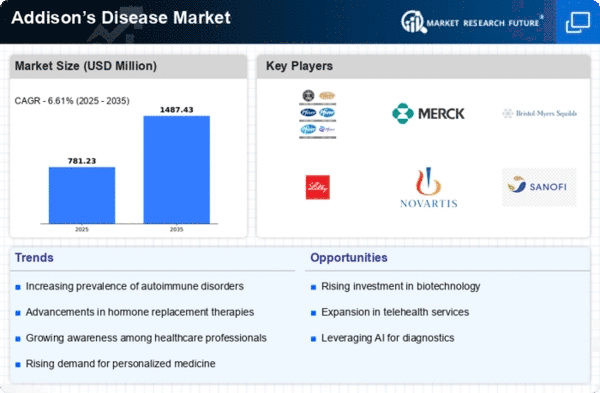
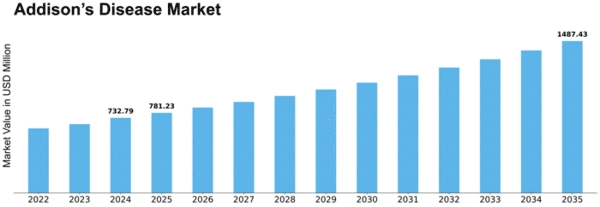
As per MRFR analysis, the Addison’s Disease Market Size was estimated at 732.79 USD Million in 2024. The Addison’s Disease industry is projected to grow from 788.29 USD Million in 2025 to 1487.43 USD Million by 2035, exhibiting a compound annual growth rate (CAGR) of 6.61 during the forecast period 2025 - 2035.

Key Market Trends & Highlights

The Addison's Disease Market is experiencing notable growth driven by increased awareness and advancements in treatment options.

  • Rising awareness and education about Addison's Disease are fostering a more informed patient population in North America.
  • Advancements in personalized medicine are enhancing treatment efficacy, particularly in the hormonal testing segment, which remains the largest.
  • Collaborative research initiatives are propelling innovation in the Asia-Pacific region, recognized as the fastest-growing market.
  • The increasing prevalence of Addison's Disease and rising demand for hormone replacement therapies are key drivers of market expansion.

Market Size & Forecast

2024 Market Size 732.79 (USD Million)
2035 Market Size 1487.43 (USD Million)
CAGR (2025 - 2035) 6.61%
Largest Regional Market Share in 2024 North America

Major Players

Pfizer Inc (US), Merck & Co Inc (US), Bristol-Myers Squibb Company (US), Eli Lilly and Company (US), Novartis AG (CH), Sanofi S.A. (FR), AstraZeneca PLC (GB), GlaxoSmithKline PLC (GB), Teva Pharmaceutical Industries Ltd (IL)

Market Trends

The Addison’s Disease Market is currently experiencing a notable evolution, driven by a combination of increasing awareness and advancements in treatment options. As healthcare professionals and patients alike become more informed about this rare endocrine disorder, the demand for effective therapies is on the rise. This heightened awareness is likely to foster a more proactive approach to diagnosis and management, potentially leading to improved patient outcomes. Furthermore, ongoing research into the underlying mechanisms of Addison's Disease may yield innovative therapeutic strategies, enhancing the overall treatment landscape. In addition to awareness, the Addison’s Disease Market is influenced by the growing emphasis on personalized medicine. Tailoring treatment plans to individual patient profiles appears to be gaining traction, as healthcare providers recognize the importance of addressing unique patient needs. This trend may lead to the development of targeted therapies that could improve efficacy and minimize side effects. Moreover, the collaboration between pharmaceutical companies and research institutions is likely to accelerate the introduction of novel therapies, thereby expanding the market and offering new hope to those affected by this condition.

Rising Awareness and Education

The increasing focus on education regarding Addison's Disease is fostering a more informed patient population. This trend is likely to enhance early diagnosis and treatment adherence, ultimately improving patient outcomes.

Advancements in Personalized Medicine

The shift towards personalized medicine is becoming more pronounced within the Addison’s Disease Market. Tailoring treatments to individual patient profiles may lead to more effective management strategies and improved therapeutic results.

Collaborative Research Initiatives

The collaboration between pharmaceutical companies and research institutions is expected to drive innovation in the Addison’s Disease Market. Such partnerships may facilitate the development of novel therapies, expanding treatment options for patients.

Addison’s Disease Market Market Drivers

Development of Targeted Therapies

The emergence of targeted therapies is reshaping the Global Addison's Disease Market Industry. Pharmaceutical companies are increasingly focusing on developing medications that specifically address the hormonal deficiencies associated with Addison's disease. These targeted treatments aim to improve patient outcomes by providing more effective management of symptoms. As research progresses, new therapies are expected to enter the market, potentially increasing the overall market size. By 2035, the market is anticipated to reach 7.29 USD Billion, driven by the introduction of innovative treatment options that cater to the unique needs of Addison's disease patients.

Advancements in Diagnostic Techniques

Innovations in diagnostic methodologies are significantly impacting the Global Addison's Disease Market Industry. Enhanced imaging techniques and hormonal assays facilitate earlier and more accurate diagnosis of Addison's disease. For instance, the introduction of advanced blood tests allows for the precise measurement of cortisol levels, leading to timely intervention. As diagnostic capabilities improve, healthcare providers can identify patients sooner, which may lead to better management of the disease. This trend is likely to contribute to the market's growth, as early diagnosis correlates with improved patient outcomes and increased demand for treatment options.

Rising Prevalence of Addison's Disease

The Global Addison's Disease Market Industry is experiencing growth due to the increasing prevalence of Addison's disease. This condition, characterized by insufficient production of adrenal hormones, affects approximately 60 to 100 individuals per million globally. As awareness of this rare disorder rises, more patients are being diagnosed, contributing to market expansion. The growing number of diagnosed cases is expected to drive demand for treatment options, thereby enhancing the market's value. In 2024, the market is projected to reach 2.34 USD Billion, reflecting the urgent need for effective therapies and management strategies.

Growing Awareness and Education Initiatives

The Global Addison's Disease Market Industry benefits from increased awareness and educational initiatives aimed at both healthcare professionals and the general public. Organizations and advocacy groups are actively promoting information about Addison's disease, its symptoms, and treatment options. This heightened awareness encourages individuals experiencing symptoms to seek medical attention, leading to more diagnoses. As a result, the market is likely to see an uptick in demand for therapies and management solutions. The ongoing education efforts are crucial in fostering a better understanding of the disease, which may ultimately enhance patient care and treatment adherence.

Increased Investment in Healthcare Infrastructure

Investment in healthcare infrastructure is a critical driver for the Global Addison's Disease Market Industry. Governments and private entities are allocating resources to enhance healthcare facilities, improve access to care, and support research initiatives. This investment is particularly vital in regions where healthcare access is limited, as it enables better diagnosis and treatment of Addison's disease. Improved healthcare infrastructure can lead to a more robust supply chain for medications and therapies, ultimately benefiting patients. As healthcare systems evolve, the market is likely to experience growth, reflecting the positive impact of these investments on patient care.

Market Segment Insights

By Diagnosis Type: Hormonal Testing (Largest) vs. Clinical Evaluation (Fastest-Growing)

In the Addison’s Disease Market, the Diagnosis Type segment is dominated by Hormonal Testing, which constitutes the largest share among various diagnostic approaches. Clinical Evaluation, while not as predominant in market share, is emerging and rapidly gaining traction as an essential diagnostic tool. Imaging Studies and Genetic Testing, though relevant, account for comparatively smaller shares in the overall market distribution. Coupled with clinical consultations, hormonal testing remains a pivotal method due to its direct relation to adrenal function. Growth in the Diagnosis Type segment is being propelled by increased awareness about Addison’s Disease, advancements in testing methodologies, and the rising incidence of autoimmune disorders. The growing emphasis on early and accurate diagnosis is fostering the adoption of innovative diagnostic techniques, particularly in hormonal testing. Clinical Evaluation continues to grow, fueled by its versatility in assessing patient history and symptoms, which is crucial in the context of Addison’s Disease management and diagnosis.

Hormonal Testing (Dominant) vs. Clinical Evaluation (Emerging)

Hormonal Testing is the dominant player in the Diagnosis Type segment of the Addison’s Disease market, recognized for its critical role in measuring cortisol and aldosterone levels, which are directly linked to adrenal function. This testing method is highly reliable and forms the backbone of endocrine diagnostics, providing physicians with essential data to confirm a diagnosis of Addison's Disease. On the other hand, Clinical Evaluation is emerging as a vital approach, characterized by patient history, clinical signs, and symptom assessments, enabling a comprehensive understanding before laboratories confirm through hormonal assays. As physicians increasingly adopt a multifaceted approach to diagnosis, the combination of these two methods is becoming standard practice, enhancing the diagnostic roadmap for Addison's Disease.

By Treatment Type: Hormone Replacement Therapy (Largest) vs. Medications (Fastest-Growing)

The Treatment Type segment in the Addison’s Disease Market showcases a promising landscape, with Hormone Replacement Therapy leading the market as the largest segment, attributed to its critical role in managing cortisol deficiency in patients. Medications also play a significant role, capturing a substantial portion of the market share. Both these segments address essential aspects of treating Addison’s disease, fostering competition and innovation in therapeutic options for patients.

Hormone Replacement Therapy: Dominant vs. Medications: Emerging

Hormone Replacement Therapy remains the dominant approach in treating Addison's Disease, primarily due to its effectiveness in supplying the body with the necessary hormones it lacks. This method ensures patients maintain hormonal balance, ultimately enhancing their quality of life. On the other hand, Medications represent an emerging segment, quickly gaining traction as newer pharmaceutical options become available. These medications not only address hormone deficiencies but also focus on managing symptoms associated with Addison's Disease, appealing to a broader range of patients. The continuous advancements in drug formulations and delivery methods are likely to accelerate the growth of medications within this market.

By Patient Demographics: Age Group (Largest) vs. Gender (Fastest-Growing)

In the Addison’s Disease market, age groups show a significant distribution predominantly favoring the elderly, particularly those aged 60 and above, who account for a substantial share. Younger demographics, while important, comprise a smaller percentage of patients affected by Addison's Disease, indicating a clear market inclination towards older patients who often have more complex health profiles that require specialized care.

Age Group: 60+ (Dominant) vs. Gender: Female (Emerging)

In the Addison's Disease market, patients aged 60 and above represent the dominant age group, influenced by the higher prevalence of autoimmune diseases and related conditions within this demographic. Conversely, females are emerging as a significant segment due to a growing recognition of gender-specific health issues and a rise in diagnoses among women. This increasing awareness is fueled by advocacy efforts and research focusing on gender disparities in Addison's disease presentations, indicating a shift in diagnostic patterns and treatment considerations that cater specifically to this group.

By Healthcare Setting: Hospitals (Largest) vs. Specialty Clinics (Fastest-Growing)

In the Addison's Disease Market, hospitals account for the largest share, primarily due to their comprehensive capabilities in managing complex cases and offering specialized care. Specialty clinics, while smaller in overall market share, are rapidly gaining traction as centers focused on comprehensive diagnosis and ongoing management of Addison's Disease. The growth of these clinics underscores a shift toward more specialized care environments tailored to patient needs.

Hospitals (Dominant) vs. Specialty Clinics (Emerging)

Hospitals play a dominant role in the treatment of Addison's Disease, offering extensive resources, advanced diagnostic technologies, and specialized treatment protocols that cater to patients with complex conditions. Their ability to provide multidisciplinary care, including endocrinologists, nutritionists, and mental health professionals, enhances patient outcomes. On the other hand, specialty clinics are emerging as an essential aspect of the healthcare landscape, focusing on personalized care and patient education. They benefit from a stronger patient-physician relationship and streamlined processes that can lead to more efficient treatment pathways and improved disease management.

Get more detailed insights about Addison’s Disease Market Research Report- Forecast till 2035

Regional Insights

North America : Market Leader in Innovation

North America is poised to maintain its leadership in the Addison’s Disease market, holding a significant market share of $400.0M in 2024. The region benefits from advanced healthcare infrastructure, high awareness levels, and robust regulatory frameworks that support drug development. The increasing prevalence of autoimmune disorders and the growing demand for effective therapies are key growth drivers, alongside favorable reimbursement policies that enhance patient access to treatments. The competitive landscape in North America is characterized by the presence of major pharmaceutical players such as Pfizer Inc, Merck & Co Inc, and Bristol-Myers Squibb Company. These companies are actively engaged in research and development to innovate treatment options for Addison’s Disease. The U.S. remains the leading country, supported by a strong pipeline of therapies and a focus on personalized medicine, ensuring continued growth in this market segment.

Europe : Emerging Market with Potential

Europe is witnessing a growing market for Addison’s Disease, with a market size of $200.0M in 2024. The region's growth is driven by increasing awareness of the disease, advancements in diagnostic technologies, and supportive healthcare policies. Regulatory bodies are focusing on improving access to treatments, which is expected to further stimulate market growth. The rising incidence of adrenal insufficiency and the demand for innovative therapies are also contributing to this upward trend. Leading countries in Europe include Germany, France, and the UK, where key players like Novartis AG and Sanofi S.A. are actively involved. The competitive landscape is evolving, with a mix of established companies and emerging biotech firms. The European Medicines Agency (EMA) is committed to ensuring that patients have access to safe and effective treatments, which is crucial for market expansion.

Asia-Pacific : Emerging Powerhouse in Healthcare

The Asia-Pacific region is emerging as a significant player in the Addison’s Disease market, with a market size of $100.0M in 2024. Factors such as increasing healthcare expenditure, rising awareness of autoimmune diseases, and improving healthcare infrastructure are driving market growth. The region is also witnessing a shift towards personalized medicine, which is expected to enhance treatment outcomes for patients suffering from Addison’s Disease. Countries like Japan, Australia, and India are leading the charge in this market. The presence of key players such as Teva Pharmaceutical Industries Ltd is notable, as they focus on expanding their product offerings. The competitive landscape is becoming more dynamic, with local companies entering the market, thereby increasing competition and driving innovation. However, regulatory challenges remain a concern for new entrants.

Middle East and Africa : Resource-Rich Frontier for Growth

The Middle East and Africa (MEA) region represents an untapped market for Addison’s Disease, with a market size of $32.79M in 2024. The growth in this region is primarily driven by increasing healthcare investments, rising awareness of chronic diseases, and the need for improved healthcare services. Governments are focusing on enhancing healthcare access and affordability, which is expected to create opportunities for market players in the coming years. Leading countries in the MEA region include South Africa and the UAE, where there is a growing presence of pharmaceutical companies. The competitive landscape is still developing, with both multinational corporations and local firms vying for market share. The World Health Organization emphasizes the importance of strengthening healthcare systems to address the needs of patients with chronic conditions, which is vital for market growth.

Key Players and Competitive Insights

The Addison’s Disease Market is characterized by a competitive landscape that is increasingly shaped by innovation, strategic partnerships, and a focus on patient-centric solutions. Key players such as Pfizer Inc (US), Merck & Co Inc (US), and Novartis AG (CH) are actively engaged in enhancing their product portfolios and expanding their market reach. Pfizer Inc (US) has positioned itself as a leader in the development of novel therapies, emphasizing research and development to address unmet medical needs. Meanwhile, Merck & Co Inc (US) has adopted a strategy of regional expansion, particularly in emerging markets, to capitalize on the growing demand for Addison’s disease treatments. Novartis AG (CH) appears to be focusing on digital transformation, leveraging technology to improve patient engagement and streamline operations, which collectively shapes a dynamic competitive environment.In terms of business tactics, companies are increasingly localizing manufacturing and optimizing supply chains to enhance efficiency and reduce costs. The market structure is moderately fragmented, with several players vying for market share. However, the collective influence of major companies like AstraZeneca PLC (GB) and Sanofi S.A. (FR) is notable, as they continue to drive innovation and set industry standards.

In November AstraZeneca PLC (GB) announced a strategic partnership with a leading biotechnology firm to co-develop a new treatment for Addison’s disease. This collaboration is expected to leverage advanced biomanufacturing techniques, potentially accelerating the development timeline and enhancing the therapeutic options available to patients. Such partnerships indicate a trend towards collaborative innovation in the market.

In October Sanofi S.A. (FR) launched a new digital health platform aimed at improving patient adherence to treatment regimens for Addison’s disease. This initiative underscores the growing importance of technology in managing chronic conditions and reflects a broader industry trend towards integrating digital solutions into healthcare delivery. By enhancing patient engagement, Sanofi S.A. (FR) aims to improve health outcomes and strengthen its market position.

In September Merck & Co Inc (US) expanded its clinical trial program for a promising new therapy targeting adrenal insufficiency, which includes Addison’s disease. This expansion not only demonstrates Merck’s commitment to advancing treatment options but also highlights the competitive pressure to innovate in a market that is increasingly focused on personalized medicine. The results of these trials could significantly influence Merck’s future market positioning.

As of December current competitive trends in the Addison’s Disease Market are heavily influenced by digitalization, sustainability, and the integration of artificial intelligence (AI) into drug development processes. Strategic alliances are becoming more prevalent, as companies recognize the value of collaboration in driving innovation. The competitive landscape is shifting from traditional price-based competition to a focus on technological advancements, supply chain reliability, and the development of innovative therapies. This evolution suggests that companies that prioritize differentiation through innovation and patient-centric solutions are likely to thrive in the future.

Key Companies in the Addison’s Disease Market include

Industry Developments

Lupin Ltd (Lupin) is a pharmaceutical company that produces and markets generic and branded pharmaceuticals, as well as active pharmaceutical ingredients (APIs). Cardiovascular, diabetes etc are all part of the company's product range. Oral, ophthalmic, dermatological, and inhalation product research are key priorities for the organization. The company's operations are reported under a single segment, Pharmaceuticals. Formulations, active pharmaceutical ingredients (APIs), generic formulations, and biotechnology products are all part of Lupin's business.

In August 2015, Amgen, a biotechnology corporation located in the United States, launched its significantly enlarged production plant in Dun Laoghaire, Ireland. The $300 million expansion expanded manufacturing facilities to the existing factory, enhancing its capabilities and positioning it as a major hub for Amgen's global operations. The move was part of Amgen's long-term plan to manufacture all of its pharmaceuticals at the Dun Laoghaire facility, ensuring a steady supply of Amgen's medicines for severely sick patients across the world.

Global Addison’s Disease Market, by Diagnosis

  • Laboratory Tests
    • Blood Tests
    • ACTH Stimulation Tests
    • Insulin-Induced Hypoglycemia Test
    • Other Tests
  • Imaging Tests
    • Chest Radiography
    • CT Scan

Global Addison’s Disease Market, by Treatment

  • Oral Corticosteroid
  • Corticosteroid Injections

Global Addison’s Disease Market, by End User

  • Hospitals and Clinics
  • Diagnostic Laboratories
  • Other End Users

Global Addison’s Disease Market, by Region

  • Americas
    • North America
      • US
      • Canada
    • South America
  • Europe
    • Western Europe
      • Germany
      • France
      • Italy
      • Spain
      • UK
      • Rest of Western Europe
    • Eastern Europe
  • Asia-Pacific
    • Japan
    • China
    • India
    • Australia
    • South Korea
    • Rest of Asia-Pacific
  • Middle East & Africa
    • Middle East
    • Africa

Global Addison’s Disease Market, by Key Players

  • Pfizer Inc.
  • Boehringer Ingelheim International GmbH
  • Shire
  • Tocris Bioscience
  • GlaxoSmithKline Plc
  • Merck KGaA
  • Lupin Pharmaceuticals, Inc.
  • Abbott
  • Amgen Limited & Amgen Ireland Limited

Future Outlook

Addison’s Disease Market Future Outlook

The Addison’s Disease Market is projected to grow at a 6.61% CAGR from 2025 to 2035, driven by increasing awareness, advancements in treatment options, and rising healthcare expenditure.

New opportunities lie in:

  • Development of personalized hormone replacement therapies
  • Expansion of telehealth services for patient monitoring
  • Investment in AI-driven diagnostic tools for early detection

By 2035, the Addison’s Disease Market is expected to achieve substantial growth and innovation.

Market Segmentation

Addison’s Disease Market Diagnosis Type Outlook

  • Clinical Evaluation
  • Hormonal Testing
  • Imaging Studies
  • Genetic Testing

Addison’s Disease Market Treatment Type Outlook

  • Hormone Replacement Therapy
  • Medications
  • Surgical Interventions
  • Lifestyle Modifications

Addison’s Disease Market Healthcare Setting Outlook

  • Hospitals
  • Specialty Clinics
  • Primary Care
  • Home Healthcare

Addison’s Disease Market Patient Demographics Outlook

  • Age Group
  • Gender
  • Socioeconomic Status
  • Comorbid Conditions

Report Scope

MARKET SIZE 2024732.79(USD Million)
MARKET SIZE 2025788.29(USD Million)
MARKET SIZE 20351487.43(USD Million)
COMPOUND ANNUAL GROWTH RATE (CAGR)6.61% (2025 - 2035)
REPORT COVERAGERevenue Forecast, Competitive Landscape, Growth Factors, and Trends
BASE YEAR2024
Market Forecast Period2025 - 2035
Historical Data2019 - 2024
Market Forecast UnitsUSD Million
Key Companies ProfiledPfizer Inc (US), Merck & Co Inc (US), Bristol-Myers Squibb Company (US), Eli Lilly and Company (US), Novartis AG (CH), Sanofi S.A. (FR), AstraZeneca PLC (GB), GlaxoSmithKline PLC (GB), Teva Pharmaceutical Industries Ltd (IL)
Segments CoveredDiagnosis Type, Treatment Type, Patient Demographics, Healthcare Setting
Key Market OpportunitiesAdvancements in personalized medicine enhance treatment options in the Addison’s Disease Market.
Key Market DynamicsRising demand for personalized therapies drives innovation and competition in the Addison’s Disease treatment landscape.
Countries CoveredNorth America, Europe, APAC, South America, MEA

FAQs

At what CAGR is the Addison’s disease market projected to grow during the forecast period?

The Addison’s disease market is projected to grow at a 10.84% CAGR between 2024-2035.

Which region is projected to command the largest share in the Addison’s disease market?

North America is projected to command the largest share in the Addison’s disease market.

Which treatment segment will dominate the Addison’s disease market?

Oral corticosteroids segment will dominate the Addison’s disease market.

What are the key factors driving the Addison’s disease market?

Rising healthcare expenditure and growing awareness about the disease is boosting market growth.

Which factors may limit Addison’s disease market growth?

Inability to diagnose Addison’s disease may limit market growth.

  1. SECTION I: EXECUTIVE SUMMARY AND KEY HIGHLIGHTS
    1. | 1.1 EXECUTIVE SUMMARY
    2. | 1.1.1 Market Overview
    3. | 1.1.2 Key Findings
    4. | 1.1.3 Market Segmentation
    5. | 1.1.4 Competitive Landscape
    6. | 1.1.5 Challenges and Opportunities
    7. | 1.1.6 Future Outlook
  2. SECTION II: SCOPING, METHODOLOGY AND MARKET STRUCTURE
    1. | 2.1 MARKET INTRODUCTION
    2. | 2.1.1 Definition
    3. | 2.1.2 Scope of the study
    4. |-- 2.1.2.1 Research Objective
    5. |-- 2.1.2.2 Assumption
    6. |-- 2.1.2.3 Limitations
    7. | 2.2 RESEARCH METHODOLOGY
    8. | 2.2.1 Overview
    9. | 2.2.2 Data Mining
    10. | 2.2.3 Secondary Research
    11. | 2.2.4 Primary Research
    12. |-- 2.2.4.1 Primary Interviews and Information Gathering Process
    13. |-- 2.2.4.2 Breakdown of Primary Respondents
    14. | 2.2.5 Forecasting Model
    15. | 2.2.6 Market Size Estimation
    16. |-- 2.2.6.1 Bottom-Up Approach
    17. |-- 2.2.6.2 Top-Down Approach
    18. | 2.2.7 Data Triangulation
    19. | 2.2.8 Validation
  3. SECTION III: QUALITATIVE ANALYSIS
    1. | 3.1 MARKET DYNAMICS
    2. | 3.1.1 Overview
    3. | 3.1.2 Drivers
    4. | 3.1.3 Restraints
    5. | 3.1.4 Opportunities
    6. | 3.2 MARKET FACTOR ANALYSIS
    7. | 3.2.1 Value chain Analysis
    8. | 3.2.2 Porter's Five Forces Analysis
    9. |-- 3.2.2.1 Bargaining Power of Suppliers
    10. |-- 3.2.2.2 Bargaining Power of Buyers
    11. |-- 3.2.2.3 Threat of New Entrants
    12. |-- 3.2.2.4 Threat of Substitutes
    13. |-- 3.2.2.5 Intensity of Rivalry
    14. | 3.2.3 COVID-19 Impact Analysis
    15. |-- 3.2.3.1 Market Impact Analysis
    16. |-- 3.2.3.2 Regional Impact
    17. |-- 3.2.3.3 Opportunity and Threat Analysis
  4. SECTION IV: QUANTITATIVE ANALYSIS
    1. | 4.1 Healthcare, BY Diagnosis Type (USD Million)
    2. | 4.1.1 Clinical Evaluation
    3. | 4.1.2 Hormonal Testing
    4. | 4.1.3 Imaging Studies
    5. | 4.1.4 Genetic Testing
    6. | 4.2 Healthcare, BY Treatment Type (USD Million)
    7. | 4.2.1 Hormone Replacement Therapy
    8. | 4.2.2 Medications
    9. | 4.2.3 Surgical Interventions
    10. | 4.2.4 Lifestyle Modifications
    11. | 4.3 Healthcare, BY Patient Demographics (USD Million)
    12. | 4.3.1 Age Group
    13. | 4.3.2 Gender
    14. | 4.3.3 Socioeconomic Status
    15. | 4.3.4 Comorbid Conditions
    16. | 4.4 Healthcare, BY Healthcare Setting (USD Million)
    17. | 4.4.1 Hospitals
    18. | 4.4.2 Specialty Clinics
    19. | 4.4.3 Primary Care
    20. | 4.4.4 Home Healthcare
    21. | 4.5 Healthcare, BY Region (USD Million)
    22. | 4.5.1 North America
    23. |-- 4.5.1.1 US
    24. |-- 4.5.1.2 Canada
    25. | 4.5.2 Europe
    26. |-- 4.5.2.1 Germany
    27. |-- 4.5.2.2 UK
    28. |-- 4.5.2.3 France
    29. |-- 4.5.2.4 Russia
    30. |-- 4.5.2.5 Italy
    31. |-- 4.5.2.6 Spain
    32. |-- 4.5.2.7 Rest of Europe
    33. | 4.5.3 APAC
    34. |-- 4.5.3.1 China
    35. |-- 4.5.3.2 India
    36. |-- 4.5.3.3 Japan
    37. |-- 4.5.3.4 South Korea
    38. |-- 4.5.3.5 Malaysia
    39. |-- 4.5.3.6 Thailand
    40. |-- 4.5.3.7 Indonesia
    41. |-- 4.5.3.8 Rest of APAC
    42. | 4.5.4 South America
    43. |-- 4.5.4.1 Brazil
    44. |-- 4.5.4.2 Mexico
    45. |-- 4.5.4.3 Argentina
    46. |-- 4.5.4.4 Rest of South America
    47. | 4.5.5 MEA
    48. |-- 4.5.5.1 GCC Countries
    49. |-- 4.5.5.2 South Africa
    50. |-- 4.5.5.3 Rest of MEA
  5. SECTION V: COMPETITIVE ANALYSIS
    1. | 5.1 Competitive Landscape
    2. | 5.1.1 Overview
    3. | 5.1.2 Competitive Analysis
    4. | 5.1.3 Market share Analysis
    5. | 5.1.4 Major Growth Strategy in the Healthcare
    6. | 5.1.5 Competitive Benchmarking
    7. | 5.1.6 Leading Players in Terms of Number of Developments in the Healthcare
    8. | 5.1.7 Key developments and growth strategies
    9. |-- 5.1.7.1 New Product Launch/Service Deployment
    10. |-- 5.1.7.2 Merger & Acquisitions
    11. |-- 5.1.7.3 Joint Ventures
    12. | 5.1.8 Major Players Financial Matrix
    13. |-- 5.1.8.1 Sales and Operating Income
    14. |-- 5.1.8.2 Major Players R&D Expenditure. 2023
    15. | 5.2 Company Profiles
    16. | 5.2.1 Pfizer Inc (US)
    17. |-- 5.2.1.1 Financial Overview
    18. |-- 5.2.1.2 Products Offered
    19. |-- 5.2.1.3 Key Developments
    20. |-- 5.2.1.4 SWOT Analysis
    21. |-- 5.2.1.5 Key Strategies
    22. | 5.2.2 Merck & Co Inc (US)
    23. |-- 5.2.2.1 Financial Overview
    24. |-- 5.2.2.2 Products Offered
    25. |-- 5.2.2.3 Key Developments
    26. |-- 5.2.2.4 SWOT Analysis
    27. |-- 5.2.2.5 Key Strategies
    28. | 5.2.3 Bristol-Myers Squibb Company (US)
    29. |-- 5.2.3.1 Financial Overview
    30. |-- 5.2.3.2 Products Offered
    31. |-- 5.2.3.3 Key Developments
    32. |-- 5.2.3.4 SWOT Analysis
    33. |-- 5.2.3.5 Key Strategies
    34. | 5.2.4 Eli Lilly and Company (US)
    35. |-- 5.2.4.1 Financial Overview
    36. |-- 5.2.4.2 Products Offered
    37. |-- 5.2.4.3 Key Developments
    38. |-- 5.2.4.4 SWOT Analysis
    39. |-- 5.2.4.5 Key Strategies
    40. | 5.2.5 Novartis AG (CH)
    41. |-- 5.2.5.1 Financial Overview
    42. |-- 5.2.5.2 Products Offered
    43. |-- 5.2.5.3 Key Developments
    44. |-- 5.2.5.4 SWOT Analysis
    45. |-- 5.2.5.5 Key Strategies
    46. | 5.2.6 Sanofi S.A. (FR)
    47. |-- 5.2.6.1 Financial Overview
    48. |-- 5.2.6.2 Products Offered
    49. |-- 5.2.6.3 Key Developments
    50. |-- 5.2.6.4 SWOT Analysis
    51. |-- 5.2.6.5 Key Strategies
    52. | 5.2.7 AstraZeneca PLC (GB)
    53. |-- 5.2.7.1 Financial Overview
    54. |-- 5.2.7.2 Products Offered
    55. |-- 5.2.7.3 Key Developments
    56. |-- 5.2.7.4 SWOT Analysis
    57. |-- 5.2.7.5 Key Strategies
    58. | 5.2.8 GlaxoSmithKline PLC (GB)
    59. |-- 5.2.8.1 Financial Overview
    60. |-- 5.2.8.2 Products Offered
    61. |-- 5.2.8.3 Key Developments
    62. |-- 5.2.8.4 SWOT Analysis
    63. |-- 5.2.8.5 Key Strategies
    64. | 5.2.9 Teva Pharmaceutical Industries Ltd (IL)
    65. |-- 5.2.9.1 Financial Overview
    66. |-- 5.2.9.2 Products Offered
    67. |-- 5.2.9.3 Key Developments
    68. |-- 5.2.9.4 SWOT Analysis
    69. |-- 5.2.9.5 Key Strategies
    70. | 5.3 Appendix
    71. | 5.3.1 References
    72. | 5.3.2 Related Reports

Healthcare Market Segmentation

Healthcare By Diagnosis Type (USD Million, 2025-2035)

  • Clinical Evaluation
  • Hormonal Testing
  • Imaging Studies
  • Genetic Testing

Healthcare By Treatment Type (USD Million, 2025-2035)

  • Hormone Replacement Therapy
  • Medications
  • Surgical Interventions
  • Lifestyle Modifications

Healthcare By Patient Demographics (USD Million, 2025-2035)

  • Age Group
  • Gender
  • Socioeconomic Status
  • Comorbid Conditions

Healthcare By Healthcare Setting (USD Million, 2025-2035)

  • Hospitals
  • Specialty Clinics
  • Primary Care
  • Home Healthcare
Infographic

Free Sample Request

Kindly complete the form below to receive a free sample of this Report

Get Free Sample

Customer Strories

Compare Licence

×
Features License Type
Single User Multiuser License Enterprise User
Price $4,950 $5,950 $7,250
Maximum User Access Limit 1 User Upto 10 Users Unrestricted Access Throughout the Organization
Free Customization
Direct Access to Analyst
Deliverable Format
Platform Access
Discount on Next Purchase 10% 15% 15%
Printable Versions