

Request Free Sample ×

Kindly complete the form below to receive a free sample of this Report

* Please use a valid business email

Leading companies partner with us for data-driven Insights

clients tt-cursor
Hero Background
English
Chinese
French
Japanese
Korean
German
Spanish

Adaptive Robot Market Share

ID: MRFR/SEM/5575-HCR
100 Pages
Ankit Gupta
April 2026

Adaptive Robot Market Size, Share and Research Report By Technology (Vision & Sensors, Learning, Perception, & Speech Recognition, and Mobility & Navigation), By Computing Location (On-Board, On-Cloud), By Application (Industrial Robot, Consumer Robot, Logistics Robot, Service Robot), By End-User (Automotive, Aerospace, Electronics, Food & Beverage, Healthcare, Retail, BFSI, Travel & Transportation, Education, Entertainment), And By Region (North America, Europe, Asia-Pacific, And Rest Of The World) –Industry Forecast Till 2035

Share:
Download PDF ×

We do not share your information with anyone. However, we may send you emails based on your report interest from time to time. You may contact us at any time to opt-out.

Adaptive Robot Market Infographic
Purchase Options

Market Share

Adaptive Robot Market Share Analysis

The Adaptive robot Market, marked by means of its dynamic programs in industries including logistics, healthcare, and agriculture, employs various marketplace percentage positioning techniques to advantage a competitive part. One outstanding strategy is technological differentiation, where corporations focus on enhancing the adaptability and intelligence of their robots. By incorporating superior sensors, device mastering algorithms, and real-time records processing skills, agencies can offer adaptive robots that can swiftly respond to changing environments and duties. This technological area, now not the most effective, attracts agencies searching for trendy solutions; however, it additionally positions agencies as leaders in offering current adaptive robotic technology. Cost optimization is another vital method in the Adaptive Robot Market. Companies strive to make their robots extra lower priced by means of streamlining production strategies, sourcing materials efficiently, and attaining economies of scale. This value leadership approach allows organizations to provide aggressive pricing, making their adaptive robots accessible to a broader range of customers. However, it's miles essential for agencies to strike stability among cost discounts and retain first-rate requirements to ensure sustained success inside the marketplace. Collaboration and partnerships play a huge function in shaping the marketplace percentage positioning of companies within the Adaptive Robot Market. Many corporations pick to collaborate with technology companies, research institutions, and other enterprise gamers to mix their information and sources. Such collaborations can cause the development of revolutionary adaptive robotic answers and boost marketplace penetration. By leveraging synergies, companies can beautify their market role and address diverse customer needs correctly. Customer-centric strategies are increasingly vital within the Adaptive Robot Market. Companies that prioritize patron feedback, provide comprehensive training and assistance offerings, and customize their robots based totally on precise industry requirements can build sturdy and lasting relationships with customers. Investment in research and improvement (R and D) remains a cornerstone for success within the Adaptive Robot Market. Innovations in adaptive control algorithms, swarm robotics, and human-robot collaboration are riding the evolution of adaptive robots. Companies that spend money on R and D sports can introduce groundbreaking answers, differentiate themselves in the market, and stabilize a larger market share. Staying at the forefront of technological improvements is essential for meeting the ever-converting needs of industries adopting adaptive robotic answers.

Author
Author Profile
Ankit Gupta
Team Lead - Research

Ankit Gupta is a seasoned market intelligence and strategic research professional with over six plus years of experience in the ICT and Semiconductor industries. With academic roots in Telecom, Marketing, and Electronics, he blends technical insight with business strategy. Ankit has led 200+ projects, including work for Fortune 500 clients like Microsoft and Rio Tinto, covering market sizing, tech forecasting, and go-to-market strategies. Known for bridging engineering and enterprise decision-making, his insights support growth, innovation, and investment planning across diverse technology markets.

Leave a Comment

FAQs

What is the projected market valuation of the Adaptive Robot Market by 2035?

<p>The Adaptive Robot Market is projected to reach a valuation of 86.75 USD Billion by 2035.</p>

What was the market valuation of the Adaptive Robot Market in 2024?

<p>In 2024, the Adaptive Robot Market had a valuation of 8.7 USD Billion.</p>

What is the expected CAGR for the Adaptive Robot Market during the forecast period 2025 - 2035?

<p>The expected CAGR for the Adaptive Robot Market during the forecast period 2025 - 2035 is 23.25%.</p>

Which companies are considered key players in the Adaptive Robot Market?

<p>Key players in the Adaptive Robot Market include Boston Dynamics, ABB, KUKA, FANUC, Yaskawa Electric, Universal Robots, Intuitive Surgical, Cyberdyne, NVIDIA, and SoftBank Robotics.</p>

What are the main technology segments within the Adaptive Robot Market?

<p>The main technology segments include Vision & Sensors, Learning, Perception, & Speech Recognition, and Mobility & Navigation.</p>

How much is the Mobility & Navigation segment valued at in 2025?

<p>The Mobility & Navigation segment is valued at 34.65 USD Billion in 2025.</p>

What applications are driving growth in the Adaptive Robot Market?

Applications driving growth include Industrial Robots, Consumer Robots, Logistics Robots, and Service Robots.

What is the projected value of the On-Cloud computing location segment by 2035?

The On-Cloud computing location segment is projected to reach 51.75 USD Billion by 2035.

Which end-user sectors are expected to contribute significantly to the Adaptive Robot Market?

Significant end-user sectors include Automotive, Aerospace, Electronics, Food &amp; Beverage, Healthcare, and Retail.

What was the valuation of the Healthcare sector within the Adaptive Robot Market in 2024?

The Healthcare sector was valued at 1.5 USD Billion within the Adaptive Robot Market in 2024.

Market Summary

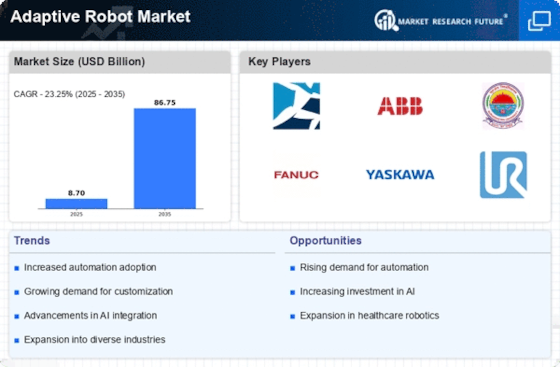
As per Market Research Future analysis, the Adaptive Robot Market Size was estimated at 8.7 USD Billion in 2024. The Adaptive Robot industry is projected to grow from 10.72 USD Billion in 2025 to 86.75 USD Billion by 2035, exhibiting a compound annual growth rate (CAGR) of 23.25% during the forecast period 2025 - 2035

Key Market Trends & Highlights

The Adaptive Robot Market is experiencing robust growth driven by technological advancements and increasing demand across various sectors.

  • The market is witnessing increased adoption in healthcare, particularly in surgical assistance and patient care. Manufacturing is expanding its use of adaptive robots, enhancing productivity and operational efficiency. Collaborative robotics is gaining traction, enabling safer human-robot interactions in diverse environments. Technological advancements and rising demand for automation are key drivers propelling growth in North America and Asia-Pacific, particularly in the Vision & Sensors and On-Board segments.

Market Size & Forecast

2024 Market Size 8.7 (USD Billion)
2035 Market Size 86.75 (USD Billion)
CAGR (2025 - 2035) 23.25%
Largest Regional Market Share in 2024 North America

Major Players

Boston Dynamics (US), ABB (CH), KUKA (DE), FANUC (JP), Yaskawa Electric (JP), Universal Robots (DK), Intuitive Surgical (US), Cyberdyne (JP), NVIDIA (US), SoftBank Robotics (JP)

Market Trends

The Adaptive Robot Market is currently experiencing a transformative phase characterized by rapid advancements in technology and increasing demand across various sectors. This market encompasses robots that can adjust their actions based on environmental changes, making them suitable for diverse applications such as manufacturing, healthcare, and logistics. The integration of artificial intelligence and machine learning into these robots enhances their capabilities, allowing for improved efficiency and productivity. As industries seek to optimize operations and reduce costs, the adoption of adaptive robots is likely to rise, indicating a shift towards automation and smart technologies. Moreover, the growing emphasis on safety and precision in operations is propelling the development of adaptive robots. These machines are designed to work alongside humans, ensuring a collaborative environment that enhances overall performance. The Adaptive Robot Market appears poised for substantial growth, driven by innovations that cater to specific industry needs. As organizations increasingly recognize the benefits of automation, the future landscape of this market may witness further diversification and specialization, reflecting the evolving demands of the global economy.

Increased Adoption in Healthcare

The healthcare sector is increasingly integrating adaptive robots to assist in surgeries, rehabilitation, and patient care. These robots enhance precision and reduce recovery times, indicating a trend towards automation in medical practices.

Expansion in Manufacturing

Manufacturers are progressively utilizing adaptive robots to streamline production processes. These robots can adjust to varying tasks, suggesting a shift towards more flexible and efficient manufacturing systems.

Focus on Collaborative Robotics

There is a growing emphasis on collaborative robots that work alongside human operators. This trend highlights the importance of safety and efficiency, as adaptive robots are designed to enhance human capabilities rather than replace them.

Adaptive Robot Market Market Drivers

Rising Demand for Automation

The Adaptive Robot Market is witnessing a notable increase in demand for automation across various sectors, including logistics, agriculture, and manufacturing. As industries strive for greater efficiency and productivity, the adoption of adaptive robots is becoming more prevalent. For example, in manufacturing, robots are utilized for tasks such as assembly, welding, and quality control, which enhances operational efficiency. Market data indicates that the automation sector is expected to grow at a compound annual growth rate of over 10% in the coming years. This rising demand for automation not only streamlines processes but also reduces labor costs, thereby propelling the growth of the Adaptive Robot Market.

Shift Towards Sustainable Practices

The Adaptive Robot Market is also influenced by a growing shift towards sustainable practices across various sectors. Companies are increasingly recognizing the importance of reducing their environmental footprint, and adaptive robots play a crucial role in achieving these goals. For example, robots can optimize resource usage in agriculture, leading to reduced waste and improved crop yields. Furthermore, in manufacturing, adaptive robots can enhance energy efficiency by streamlining production processes. Market trends indicate that sustainability is becoming a key consideration for businesses, which may drive further investment in adaptive robotics solutions, thereby fostering growth within the Adaptive Robot Market.

Technological Advancements in Robotics

The Adaptive Robot Market is experiencing a surge in technological advancements, particularly in artificial intelligence and machine learning. These innovations enable robots to learn from their environments and adapt to various tasks, enhancing their efficiency and effectiveness. For instance, the integration of AI algorithms allows robots to process vast amounts of data in real-time, making them more responsive to dynamic conditions. According to recent data, the market for AI in robotics is projected to grow significantly, indicating a robust demand for adaptive robots that can perform complex functions autonomously. This trend suggests that as technology continues to evolve, the capabilities of adaptive robots will expand, driving further investment and development within the Adaptive Robot Market.

Growing Need for Enhanced Safety and Efficiency

The Adaptive Robot Market is increasingly driven by the need for enhanced safety and efficiency in various operational environments. Industries such as construction and healthcare are particularly focused on integrating adaptive robots to minimize risks and improve productivity. For instance, robots can perform hazardous tasks, reducing the likelihood of workplace accidents. Additionally, in healthcare, adaptive robots assist in surgeries and patient care, ensuring higher precision and better outcomes. Market analysis suggests that the emphasis on safety and efficiency will continue to propel the adoption of adaptive robots, thereby expanding the Adaptive Robot Market.

Increased Investment in Research and Development

Investment in research and development is a critical driver for the Adaptive Robot Market. Companies and governments are allocating substantial resources to explore new technologies and applications for adaptive robots. This focus on R&D is essential for fostering innovation and improving the capabilities of robots, enabling them to perform more complex tasks. Recent statistics reveal that R&D spending in robotics is projected to reach billions of dollars annually, reflecting a strong commitment to advancing the field. As new technologies emerge, the Adaptive Robot Market is likely to benefit from enhanced product offerings and improved performance, attracting further investment and interest.

Market Segment Insights

By Technology: Vision & Sensors (Largest) vs. Learning, Perception, & Speech Recognition (Fastest-Growing)

The Adaptive Robot Market is witnessing a dynamic landscape where 'Vision &amp; Sensors' represents the largest segment, dominating market share with a significant lead over other technologies. This segment is critical as it enables robots to perceive their environment, facilitating interaction and operation in varied settings. Close on its heels, 'Learning, Perception, &amp; Speech Recognition' is emerging as a fast-growing sector, revolutionizing how robots understand and respond to human cues, thereby enhancing user experience. Growth trends indicate that advancements in artificial intelligence and machine learning are propelling the 'Learning, Perception, &amp; Speech Recognition' segment. As consumers demand more intuitive and interactive technologies, the application of sophisticated algorithms in this domain fosters rapid innovation. Simultaneously, the 'Vision &amp; Sensors' segment benefits from increased investments in robotics, driving innovations in imaging technology, which is pivotal for autonomous operations in industries such as warehousing and healthcare.

Technology: Vision &amp; Sensors (Dominant) vs. Learning, Perception, &amp; Speech Recognition (Emerging)

The 'Vision &amp; Sensors' segment remains dominant in the Adaptive Robot Market, characterized by its crucial role in enabling robots to recognize and navigate their environments effectively. This technology encompasses a variety of sensors, including cameras, LiDAR, and infrared sensors, all of which contribute to enhanced situational awareness and decision-making. Companies are investing heavily in refining these technologies, ensuring they meet the increasing demands for automation in sectors ranging from manufacturing to service delivery. In contrast, the 'Learning, Perception, &amp; Speech Recognition' segment is rapidly emerging, driven by innovations in artificial intelligence. This segment focuses on creating robots that can learn from their environments and understand human speech, making them more adaptable and user-friendly. As this technology matures, it is expected to bridge the gap between human operators and robotic systems, enhancing operational efficiency and user satisfaction.

By Computing Location: On-Board (Largest) vs. On-Cloud (Fastest-Growing)

The Adaptive Robot Market is witnessing a significant distribution between the On-Board and On-Cloud computing locations. On-Board solutions are currently the largest segment, providing quick response times and processing power directly at the robot's location. In contrast, the On-Cloud segment, while relatively smaller in share, is rapidly gaining traction due to its scalability and the advancements in cloud computing technology. This dynamic is shifting priorities among developers and end-users alike, contributing to a diversification of strategies across the market.

Computing Location: On-Board (Dominant) vs. On-Cloud (Emerging)

On-Board computing has established itself as a dominant force within the Adaptive Robot Market, characterized by its ability to handle real-time data processing and decision-making directly on the robotic device. This setup is particularly crucial for applications requiring immediate feedback and minimal latency, such as industrial automation and autonomous vehicles. Conversely, the On-Cloud computing segment is emerging rapidly due to its flexibility and cost-effectiveness, making it attractive for deploying advanced analytics and machine learning algorithms without the need for significant on-site infrastructure. As businesses increasingly adopt IoT and AI technologies, the demand for cloud-based solutions is projected to grow, complementing the traditional On-Board setups and creating a more integrated robotics landscape.

By Application: Industrial Robot (Largest) vs. Logistics Robot (Fastest-Growing)

In the Adaptive Robot Market, the application segment showcases a diverse distribution among key players such as Industrial Robots, Consumer Robots, Logistics Robots, and Service Robots. Industrial Robots currently hold the largest share, driven by advancements in automation technology and their widespread adoption in manufacturing processes. Meanwhile, the Logistics Robot segment is rapidly gaining traction, fueled by increasing e-commerce activities and the demand for efficient supply chain solutions. As the market continues to evolve, these segments are expected to significantly influence the overall dynamics of adaptive robots. Growth trends indicate that while Industrial Robots remain pivotal in traditional settings, Logistics Robots are emerging as a game-changer in the adaptive robotics landscape. Factors such as the integration of AI and machine learning technologies, coupled with heightened consumer expectations for quicker delivery times, are propelling the growth of Logistics Robots. Furthermore, as industries adapt to a post-pandemic economy, the demand for flexible automation in warehouse and distribution tasks is likely to accelerate the adoption of logistics solutions in the coming years.

Industrial Robots (Dominant) vs. Consumer Robots (Emerging)

Industrial Robots dominate the Adaptive Robot Market due to their crucial role in automating monotonous tasks across various manufacturing processes. Their capabilities in performing high-precision applications, coupled with increased productivity and reduced labor costs, make them indispensable in industries such as automotive, electronics, and heavy machinery. However, as technology progresses, Consumer Robots are emerging as a vital and growing segment that caters to personal and household needs. Ranging from robotic vacuum cleaners to advanced personal assistants, Consumer Robots are becoming increasingly sophisticated, leveraging AI and IoT to enhance user experiences. This segment’s growth is fueled by rising disposable incomes and a trend towards smart homes, positioning Consumer Robots as an essential part of modern living.

By End-User: Automotive (Largest) vs. Healthcare (Fastest-Growing)

The Adaptive Robot Market is witnessing significant participation from various end-users, with the automotive sector occupying the largest market share. This is attributed to the automotive industry's increasing reliance on automation for assembly lines and quality control processes. Additionally, sectors like electronics and food &amp; beverage also contribute notably, although they hold smaller portions of the overall market share compared to automotive. Businesses in these sectors are adopting adaptive robots to enhance efficiency and precision in their operations, creating a competitive landscape amongst them. Moreover, healthcare is emerging as the fastest-growing segment within the adaptive robot market. The need for advanced surgical robots and robotic rehabilitation systems is driving rapid adoption in hospitals and clinics. This surge is fueled by an aging population and the increasing demand for minimally invasive surgeries, indicating that while automotive remains dominant, healthcare is likely to catch up swiftly in the coming years.

Automotive (Dominant) vs. Healthcare (Emerging)

The automotive sector stands out as the dominant player in the adaptive robot market. The industry's shift toward automation and smart manufacturing has led to a surge in the deployment of adaptive robots for tasks such as assembly, painting, and welding. Companies in this sector value precision and speed, and adaptive robots are well-equipped to meet these demands. Conversely, healthcare is an emerging segment marked by rapid growth and innovation. Robots in this space are utilized for surgical assistance, remote surgeries, and rehabilitation, addressing critical needs for efficiency and accuracy. As adaptive robots become more sophisticated, both sectors will likely enhance their collaboration with technology providers to leverage advancements, indicating a bright future for the adaptive robot market.

Get more detailed insights about Adaptive Robot Market Research Report - Global Forecast till 2035

Regional Insights

North America : Innovation and Investment Hub

North America is the largest market for adaptive robots, holding approximately 40% of the global share. The region's growth is driven by significant investments in automation technologies, increasing demand for efficiency in manufacturing, and supportive government policies promoting robotics innovation. The U.S. leads this market, followed closely by Canada, which contributes around 15% to the overall market share. Regulatory frameworks are evolving to support the integration of robotics in various sectors. The competitive landscape in North America is robust, featuring key players like Boston Dynamics, Intuitive Surgical, and NVIDIA. These companies are at the forefront of technological advancements, focusing on AI integration and machine learning capabilities in adaptive robots. The presence of established tech hubs and research institutions further enhances the region's innovation potential, making it a focal point for adaptive robotics development.

Europe : Strong Manufacturing Backbone

Europe is the second-largest market for adaptive robots, accounting for approximately 30% of the global market share. The region's growth is fueled by a strong manufacturing sector, particularly in Germany and France, where there is a high demand for automation to enhance productivity and reduce labor costs. Regulatory support from the European Union, including initiatives for Industry 4.0, is catalyzing the adoption of advanced robotics technologies across various industries. Leading countries in Europe include Germany, which is home to major players like KUKA and ABB, and France, which is increasingly investing in robotics for healthcare and manufacturing. The competitive landscape is characterized by a mix of established firms and innovative startups, all striving to enhance their offerings in adaptive robotics. The region's focus on sustainability and efficiency is driving further advancements in this sector.

Asia-Pacific : Emerging Powerhouse in Robotics

Asia-Pacific is witnessing rapid growth in the adaptive robot market, holding approximately 25% of the global share. The region's expansion is driven by increasing industrial automation, particularly in countries like Japan and China, where there is a strong push for technological advancement. Government initiatives aimed at boosting robotics and AI adoption are also significant growth catalysts, with Japan leading the charge in robotics innovation and manufacturing. Japan, China, and South Korea are the leading countries in this region, with major companies like FANUC, Yaskawa Electric, and SoftBank Robotics playing pivotal roles. The competitive landscape is vibrant, with a mix of traditional manufacturing firms and tech startups focusing on robotics solutions. The region's emphasis on smart factories and automation technologies is expected to further accelerate market growth in the coming years.

Middle East and Africa : Resource-Rich Frontier

The Middle East and Africa are emerging as a significant market for adaptive robots, holding about 5% of the global share. The growth in this region is primarily driven by investments in infrastructure and a growing focus on automation in sectors like oil and gas, manufacturing, and healthcare. Countries like the UAE and South Africa are leading the way, with government initiatives aimed at diversifying economies and enhancing technological capabilities. In the competitive landscape, there is a mix of local and international players, with companies increasingly looking to invest in adaptive robotics to improve operational efficiency. The presence of key players is gradually increasing, and as the region continues to develop its technological infrastructure, the demand for adaptive robots is expected to rise significantly in the coming years.

Key Players and Competitive Insights

Leading market players are investing heavily in research and development in order to expand their product lines, which will help the Adaptive Robot Market, grow even more. Market participants are also undertaking a variety of strategic activities to expand their global footprint, with important market developments including new product launches, contractual agreements, mergers and acquisitions, higher investments, and collaboration with other organizations. To expand and survive in a more competitive and rising market climate, Adaptive Robotindustry must offer cost-effective items.Manufacturing locally to minimize operational costs is one of the key business tactics used by manufacturers in the global Adaptive Robot industry to benefit clients and increase the market sector. In recent years, the Adaptive Robot industry has offered some of the most significant advantages to medicine. Major players in the Adaptive Robot Market, including Robert Bosch GmbH (Germany), Yaskawa Motoman (U.S), Huawei Technologies Co. Ltd. (China), Google, Inc. (U.S), and Toyota Motor Corporation (Japan) and others, are attempting to increase market demand by investing in research and development operations.Boston Dynamics is an engineering and robotics design firm based in Boston, Massachusetts, that was created in 1992 as a spin-off from the Massachusetts Institute of Technology. Boston Dynamics, headquartered in Waltham, Massachusetts, has been owned by the Hyundai Motor Group since December 2020, however the acquisition was officially completed in June 2021. Boston Dynamics creates a line of dynamic, highly mobile robots such as BigDog, Spot, Atlas, and Handle. Spot has been commercially accessible since 2019, making it Boston Dynamics' first commercially available robot, while the company has declared its intention to commercialize other robots as well, including Handle.In 2021, Boston Dynamics has announced the release of Stretch, a new robot. The robot is intended to automate warehouse and distribution centre box movement activities.ABB Ltd. is a global Swedish-Swiss enterprise headquartered in Zürich, Switzerland. ASEA Brown Boveri was created in 1988 when Sweden's Allmänna Svenska Elektriska Aktiebolaget (ASEA) and Switzerland's Brown, Boveri & Cie amalgamated to form ASEA Brown Boveri, afterwards abbreviated to ABB. Both firms were founded in the late 1800s and were major makers of electrical equipment, a business in which ABB is still involved today. Since then, the company has grown into robotics and automation technology. In 2020, ABB Group has announced the release of its latest IRB 1300 robot.The robot is intended for use in the food and beverage industries for high-speed pick and place tasks.

Key Companies in the Adaptive Robot Market include

Industry Developments

In February 2023, Flexiv displayed its newest adaptive robotic solutions at ATX West 2023, one of the leading annual events in North America on automation and design technology. Flexiv robots demonstrated material removal, assembly, material handling, dispensing and even ball balancing.

 In February 2023, Universal Robots and Yaskawa Motoman have teamed up with Rapid Robotics, a Robotics as a Service (RaaS) company to enhance the process of robot deployment in an accelerated manner throughout the United States. United Kingdom acquires India-based chemical company Briar Chemicals in 2022.The acquisition will help expand business into all sectors. Cefex would now become a global partner in agrochemical business.

In 2021, Boston Dynamics released Stretch –a new robot–that yearned to automate warehouse and box distribution operations.

In March 2021, Norwegian University of Oslo researchers came up with Dyret — a four-legged robot that could adjust the length of its legs and walking gait while going through various surfaces.

China's adaptive robots manufacturer Flexiv raised more than $100M during a series B funding round held in January 2021.

November 2021, Scientists from Norway University created Dyret, a four lakh robot that can alter its walking pace and leg length on the fly as it approaches the surface.

Future Outlook

Adaptive Robot Market Future Outlook

The Adaptive Robot Market is projected to grow at a 23.25% CAGR from 2025 to 2035, driven by advancements in AI, automation, and increasing demand for efficiency.

New opportunities lie in:

  • Development of customizable robotic solutions for diverse industries.</p><p>Integration of AI-driven analytics for predictive maintenance.</p><p>Expansion into emerging markets with tailored adaptive technologies.

By 2035, the Adaptive Robot Market is poised for substantial growth, reflecting its critical role in various sectors.

Market Segmentation

Adaptive Robot Market End-User Outlook

  • Automotive
  • Aerospace
  • Electronics
  • Food & Beverage
  • Healthcare
  • Retail
  • BFSI
  • Travel & Transportation
  • Education
  • Entertainment

Adaptive Robot Market Technology Outlook

  • Vision & Sensors
  • Learning
  • Perception
  • & Speech Recognition
  • Mobility & Navigation

Adaptive Robot Market Application Outlook

  • Industrial Robot
  • Consumer Robot
  • Logistics Robot
  • Service Robot

Adaptive Robot Market Computing Location Outlook

  • On-Board
  • On-Cloud

Report Scope

MARKET SIZE 2024 8.7(USD Billion)
MARKET SIZE 2025 10.72(USD Billion)
MARKET SIZE 2035 86.75(USD Billion)
COMPOUND ANNUAL GROWTH RATE (CAGR) 23.25% (2025 - 2035)
REPORT COVERAGE Revenue Forecast, Competitive Landscape, Growth Factors, and Trends
BASE YEAR 2024
Market Forecast Period 2025 - 2035
Historical Data 2019 - 2024
Market Forecast Units USD Billion
Key Companies Profiled Boston Dynamics (US), ABB (CH), KUKA (DE), FANUC (JP), Yaskawa Electric (JP), Universal Robots (DK), Intuitive Surgical (US), Cyberdyne (JP), NVIDIA (US), SoftBank Robotics (JP)
Segments Covered Technology, Computing Location, Application, End-User, Region
Key Market Opportunities Integration of artificial intelligence enhances adaptability and efficiency in the Adaptive Robot Market.
Key Market Dynamics Rising demand for automation drives innovation and competition in the adaptive robot market, reshaping industry standards.
Countries Covered North America, Europe, APAC, South America, MEA

FAQs

What is the projected market valuation of the Adaptive Robot Market by 2035?

<p>The Adaptive Robot Market is projected to reach a valuation of 86.75 USD Billion by 2035.</p>

What was the market valuation of the Adaptive Robot Market in 2024?

<p>In 2024, the Adaptive Robot Market had a valuation of 8.7 USD Billion.</p>

What is the expected CAGR for the Adaptive Robot Market during the forecast period 2025 - 2035?

<p>The expected CAGR for the Adaptive Robot Market during the forecast period 2025 - 2035 is 23.25%.</p>

Which companies are considered key players in the Adaptive Robot Market?

<p>Key players in the Adaptive Robot Market include Boston Dynamics, ABB, KUKA, FANUC, Yaskawa Electric, Universal Robots, Intuitive Surgical, Cyberdyne, NVIDIA, and SoftBank Robotics.</p>

What are the main technology segments within the Adaptive Robot Market?

<p>The main technology segments include Vision & Sensors, Learning, Perception, & Speech Recognition, and Mobility & Navigation.</p>

How much is the Mobility & Navigation segment valued at in 2025?

<p>The Mobility & Navigation segment is valued at 34.65 USD Billion in 2025.</p>

What applications are driving growth in the Adaptive Robot Market?

Applications driving growth include Industrial Robots, Consumer Robots, Logistics Robots, and Service Robots.

What is the projected value of the On-Cloud computing location segment by 2035?

The On-Cloud computing location segment is projected to reach 51.75 USD Billion by 2035.

Which end-user sectors are expected to contribute significantly to the Adaptive Robot Market?

Significant end-user sectors include Automotive, Aerospace, Electronics, Food &amp; Beverage, Healthcare, and Retail.

What was the valuation of the Healthcare sector within the Adaptive Robot Market in 2024?

The Healthcare sector was valued at 1.5 USD Billion within the Adaptive Robot Market in 2024.

  1. SECTION I: EXECUTIVE SUMMARY AND KEY HIGHLIGHTS
    1. | 1.1 EXECUTIVE SUMMARY
    2. | | 1.1.1 Market Overview
    3. | | 1.1.2 Key Findings
    4. | | 1.1.3 Market Segmentation
    5. | | 1.1.4 Competitive Landscape
    6. | | 1.1.5 Challenges and Opportunities
    7. | | 1.1.6 Future Outlook
  2. SECTION II: SCOPING, METHODOLOGY AND MARKET STRUCTURE
    1. | 2.1 MARKET INTRODUCTION
    2. | | 2.1.1 Definition
    3. | | 2.1.2 Scope of the study
    4. | | | 2.1.2.1 Research Objective
    5. | | | 2.1.2.2 Assumption
    6. | | | 2.1.2.3 Limitations
    7. | 2.2 RESEARCH METHODOLOGY
    8. | | 2.2.1 Overview
    9. | | 2.2.2 Data Mining
    10. | | 2.2.3 Secondary Research
    11. | | 2.2.4 Primary Research
    12. | | | 2.2.4.1 Primary Interviews and Information Gathering Process
    13. | | | 2.2.4.2 Breakdown of Primary Respondents
    14. | | 2.2.5 Forecasting Model
    15. | | 2.2.6 Market Size Estimation
    16. | | | 2.2.6.1 Bottom-Up Approach
    17. | | | 2.2.6.2 Top-Down Approach
    18. | | 2.2.7 Data Triangulation
    19. | | 2.2.8 Validation
  3. SECTION III: QUALITATIVE ANALYSIS
    1. | 3.1 MARKET DYNAMICS
    2. | | 3.1.1 Overview
    3. | | 3.1.2 Drivers
    4. | | 3.1.3 Restraints
    5. | | 3.1.4 Opportunities
    6. | 3.2 MARKET FACTOR ANALYSIS
    7. | | 3.2.1 Value chain Analysis
    8. | | 3.2.2 Porter's Five Forces Analysis
    9. | | | 3.2.2.1 Bargaining Power of Suppliers
    10. | | | 3.2.2.2 Bargaining Power of Buyers
    11. | | | 3.2.2.3 Threat of New Entrants
    12. | | | 3.2.2.4 Threat of Substitutes
    13. | | | 3.2.2.5 Intensity of Rivalry
    14. | | 3.2.3 COVID-19 Impact Analysis
    15. | | | 3.2.3.1 Market Impact Analysis
    16. | | | 3.2.3.2 Regional Impact
    17. | | | 3.2.3.3 Opportunity and Threat Analysis
  4. SECTION IV: QUANTITATIVE ANALYSIS
    1. | 4.1 Semiconductor & Electronics, BY Technology (USD Billion)
    2. | | 4.1.1 Vision & Sensors
    3. | | 4.1.2 Learning, Perception, & Speech Recognition
    4. | | 4.1.3 Mobility & Navigation
    5. | 4.2 Semiconductor & Electronics, BY Computing Location (USD Billion)
    6. | | 4.2.1 On-Board
    7. | | 4.2.2 On-Cloud
    8. | 4.3 Semiconductor & Electronics, BY Application (USD Billion)
    9. | | 4.3.1 Industrial Robot
    10. | | 4.3.2 Consumer Robot
    11. | | 4.3.3 Logistics Robot
    12. | | 4.3.4 Service Robot
    13. | 4.4 Semiconductor & Electronics, BY End-User (USD Billion)
    14. | | 4.4.1 Automotive
    15. | | 4.4.2 Aerospace
    16. | | 4.4.3 Electronics
    17. | | 4.4.4 Food & Beverage
    18. | | 4.4.5 Healthcare
    19. | | 4.4.6 Retail
    20. | | 4.4.7 BFSI
    21. | | 4.4.8 Travel & Transportation
    22. | | 4.4.9 Education
    23. | | 4.4.10 Entertainment
    24. | 4.5 Semiconductor & Electronics, BY Region (USD Billion)
    25. | | 4.5.1 North America
    26. | | | 4.5.1.1 US
    27. | | | 4.5.1.2 Canada
    28. | | 4.5.2 Europe
    29. | | | 4.5.2.1 Germany
    30. | | | 4.5.2.2 UK
    31. | | | 4.5.2.3 France
    32. | | | 4.5.2.4 Russia
    33. | | | 4.5.2.5 Italy
    34. | | | 4.5.2.6 Spain
    35. | | | 4.5.2.7 Rest of Europe
    36. | | 4.5.3 APAC
    37. | | | 4.5.3.1 China
    38. | | | 4.5.3.2 India
    39. | | | 4.5.3.3 Japan
    40. | | | 4.5.3.4 South Korea
    41. | | | 4.5.3.5 Malaysia
    42. | | | 4.5.3.6 Thailand
    43. | | | 4.5.3.7 Indonesia
    44. | | | 4.5.3.8 Rest of APAC
    45. | | 4.5.4 South America
    46. | | | 4.5.4.1 Brazil
    47. | | | 4.5.4.2 Mexico
    48. | | | 4.5.4.3 Argentina
    49. | | | 4.5.4.4 Rest of South America
    50. | | 4.5.5 MEA
    51. | | | 4.5.5.1 GCC Countries
    52. | | | 4.5.5.2 South Africa
    53. | | | 4.5.5.3 Rest of MEA
  5. SECTION V: COMPETITIVE ANALYSIS
    1. | 5.1 Competitive Landscape
    2. | | 5.1.1 Overview
    3. | | 5.1.2 Competitive Analysis
    4. | | 5.1.3 Market share Analysis
    5. | | 5.1.4 Major Growth Strategy in the Semiconductor & Electronics
    6. | | 5.1.5 Competitive Benchmarking
    7. | | 5.1.6 Leading Players in Terms of Number of Developments in the Semiconductor & Electronics
    8. | | 5.1.7 Key developments and growth strategies
    9. | | | 5.1.7.1 New Product Launch/Service Deployment
    10. | | | 5.1.7.2 Merger & Acquisitions
    11. | | | 5.1.7.3 Joint Ventures
    12. | | 5.1.8 Major Players Financial Matrix
    13. | | | 5.1.8.1 Sales and Operating Income
    14. | | | 5.1.8.2 Major Players R&D Expenditure. 2023
    15. | 5.2 Company Profiles
    16. | | 5.2.1 Boston Dynamics (US)
    17. | | | 5.2.1.1 Financial Overview
    18. | | | 5.2.1.2 Products Offered
    19. | | | 5.2.1.3 Key Developments
    20. | | | 5.2.1.4 SWOT Analysis
    21. | | | 5.2.1.5 Key Strategies
    22. | | 5.2.2 ABB (CH)
    23. | | | 5.2.2.1 Financial Overview
    24. | | | 5.2.2.2 Products Offered
    25. | | | 5.2.2.3 Key Developments
    26. | | | 5.2.2.4 SWOT Analysis
    27. | | | 5.2.2.5 Key Strategies
    28. | | 5.2.3 KUKA (DE)
    29. | | | 5.2.3.1 Financial Overview
    30. | | | 5.2.3.2 Products Offered
    31. | | | 5.2.3.3 Key Developments
    32. | | | 5.2.3.4 SWOT Analysis
    33. | | | 5.2.3.5 Key Strategies
    34. | | 5.2.4 FANUC (JP)
    35. | | | 5.2.4.1 Financial Overview
    36. | | | 5.2.4.2 Products Offered
    37. | | | 5.2.4.3 Key Developments
    38. | | | 5.2.4.4 SWOT Analysis
    39. | | | 5.2.4.5 Key Strategies
    40. | | 5.2.5 Yaskawa Electric (JP)
    41. | | | 5.2.5.1 Financial Overview
    42. | | | 5.2.5.2 Products Offered
    43. | | | 5.2.5.3 Key Developments
    44. | | | 5.2.5.4 SWOT Analysis
    45. | | | 5.2.5.5 Key Strategies
    46. | | 5.2.6 Universal Robots (DK)
    47. | | | 5.2.6.1 Financial Overview
    48. | | | 5.2.6.2 Products Offered
    49. | | | 5.2.6.3 Key Developments
    50. | | | 5.2.6.4 SWOT Analysis
    51. | | | 5.2.6.5 Key Strategies
    52. | | 5.2.7 Intuitive Surgical (US)
    53. | | | 5.2.7.1 Financial Overview
    54. | | | 5.2.7.2 Products Offered
    55. | | | 5.2.7.3 Key Developments
    56. | | | 5.2.7.4 SWOT Analysis
    57. | | | 5.2.7.5 Key Strategies
    58. | | 5.2.8 Cyberdyne (JP)
    59. | | | 5.2.8.1 Financial Overview
    60. | | | 5.2.8.2 Products Offered
    61. | | | 5.2.8.3 Key Developments
    62. | | | 5.2.8.4 SWOT Analysis
    63. | | | 5.2.8.5 Key Strategies
    64. | | 5.2.9 NVIDIA (US)
    65. | | | 5.2.9.1 Financial Overview
    66. | | | 5.2.9.2 Products Offered
    67. | | | 5.2.9.3 Key Developments
    68. | | | 5.2.9.4 SWOT Analysis
    69. | | | 5.2.9.5 Key Strategies
    70. | | 5.2.10 SoftBank Robotics (JP)
    71. | | | 5.2.10.1 Financial Overview
    72. | | | 5.2.10.2 Products Offered
    73. | | | 5.2.10.3 Key Developments
    74. | | | 5.2.10.4 SWOT Analysis
    75. | | | 5.2.10.5 Key Strategies
    76. | 5.3 Appendix
    77. | | 5.3.1 References
    78. | | 5.3.2 Related Reports
  6. LIST OF FIGURES
    1. | 6.1 MARKET SYNOPSIS
    2. | 6.2 NORTH AMERICA MARKET ANALYSIS
    3. | 6.3 US MARKET ANALYSIS BY TECHNOLOGY
    4. | 6.4 US MARKET ANALYSIS BY COMPUTING LOCATION
    5. | 6.5 US MARKET ANALYSIS BY APPLICATION
    6. | 6.6 US MARKET ANALYSIS BY END-USER
    7. | 6.7 CANADA MARKET ANALYSIS BY TECHNOLOGY
    8. | 6.8 CANADA MARKET ANALYSIS BY COMPUTING LOCATION
    9. | 6.9 CANADA MARKET ANALYSIS BY APPLICATION
    10. | 6.10 CANADA MARKET ANALYSIS BY END-USER
    11. | 6.11 EUROPE MARKET ANALYSIS
    12. | 6.12 GERMANY MARKET ANALYSIS BY TECHNOLOGY
    13. | 6.13 GERMANY MARKET ANALYSIS BY COMPUTING LOCATION
    14. | 6.14 GERMANY MARKET ANALYSIS BY APPLICATION
    15. | 6.15 GERMANY MARKET ANALYSIS BY END-USER
    16. | 6.16 UK MARKET ANALYSIS BY TECHNOLOGY
    17. | 6.17 UK MARKET ANALYSIS BY COMPUTING LOCATION
    18. | 6.18 UK MARKET ANALYSIS BY APPLICATION
    19. | 6.19 UK MARKET ANALYSIS BY END-USER
    20. | 6.20 FRANCE MARKET ANALYSIS BY TECHNOLOGY
    21. | 6.21 FRANCE MARKET ANALYSIS BY COMPUTING LOCATION
    22. | 6.22 FRANCE MARKET ANALYSIS BY APPLICATION
    23. | 6.23 FRANCE MARKET ANALYSIS BY END-USER
    24. | 6.24 RUSSIA MARKET ANALYSIS BY TECHNOLOGY
    25. | 6.25 RUSSIA MARKET ANALYSIS BY COMPUTING LOCATION
    26. | 6.26 RUSSIA MARKET ANALYSIS BY APPLICATION
    27. | 6.27 RUSSIA MARKET ANALYSIS BY END-USER
    28. | 6.28 ITALY MARKET ANALYSIS BY TECHNOLOGY
    29. | 6.29 ITALY MARKET ANALYSIS BY COMPUTING LOCATION
    30. | 6.30 ITALY MARKET ANALYSIS BY APPLICATION
    31. | 6.31 ITALY MARKET ANALYSIS BY END-USER
    32. | 6.32 SPAIN MARKET ANALYSIS BY TECHNOLOGY
    33. | 6.33 SPAIN MARKET ANALYSIS BY COMPUTING LOCATION
    34. | 6.34 SPAIN MARKET ANALYSIS BY APPLICATION
    35. | 6.35 SPAIN MARKET ANALYSIS BY END-USER
    36. | 6.36 REST OF EUROPE MARKET ANALYSIS BY TECHNOLOGY
    37. | 6.37 REST OF EUROPE MARKET ANALYSIS BY COMPUTING LOCATION
    38. | 6.38 REST OF EUROPE MARKET ANALYSIS BY APPLICATION
    39. | 6.39 REST OF EUROPE MARKET ANALYSIS BY END-USER
    40. | 6.40 APAC MARKET ANALYSIS
    41. | 6.41 CHINA MARKET ANALYSIS BY TECHNOLOGY
    42. | 6.42 CHINA MARKET ANALYSIS BY COMPUTING LOCATION
    43. | 6.43 CHINA MARKET ANALYSIS BY APPLICATION
    44. | 6.44 CHINA MARKET ANALYSIS BY END-USER
    45. | 6.45 INDIA MARKET ANALYSIS BY TECHNOLOGY
    46. | 6.46 INDIA MARKET ANALYSIS BY COMPUTING LOCATION
    47. | 6.47 INDIA MARKET ANALYSIS BY APPLICATION
    48. | 6.48 INDIA MARKET ANALYSIS BY END-USER
    49. | 6.49 JAPAN MARKET ANALYSIS BY TECHNOLOGY
    50. | 6.50 JAPAN MARKET ANALYSIS BY COMPUTING LOCATION
    51. | 6.51 JAPAN MARKET ANALYSIS BY APPLICATION
    52. | 6.52 JAPAN MARKET ANALYSIS BY END-USER
    53. | 6.53 SOUTH KOREA MARKET ANALYSIS BY TECHNOLOGY
    54. | 6.54 SOUTH KOREA MARKET ANALYSIS BY COMPUTING LOCATION
    55. | 6.55 SOUTH KOREA MARKET ANALYSIS BY APPLICATION
    56. | 6.56 SOUTH KOREA MARKET ANALYSIS BY END-USER
    57. | 6.57 MALAYSIA MARKET ANALYSIS BY TECHNOLOGY
    58. | 6.58 MALAYSIA MARKET ANALYSIS BY COMPUTING LOCATION
    59. | 6.59 MALAYSIA MARKET ANALYSIS BY APPLICATION
    60. | 6.60 MALAYSIA MARKET ANALYSIS BY END-USER
    61. | 6.61 THAILAND MARKET ANALYSIS BY TECHNOLOGY
    62. | 6.62 THAILAND MARKET ANALYSIS BY COMPUTING LOCATION
    63. | 6.63 THAILAND MARKET ANALYSIS BY APPLICATION
    64. | 6.64 THAILAND MARKET ANALYSIS BY END-USER
    65. | 6.65 INDONESIA MARKET ANALYSIS BY TECHNOLOGY
    66. | 6.66 INDONESIA MARKET ANALYSIS BY COMPUTING LOCATION
    67. | 6.67 INDONESIA MARKET ANALYSIS BY APPLICATION
    68. | 6.68 INDONESIA MARKET ANALYSIS BY END-USER
    69. | 6.69 REST OF APAC MARKET ANALYSIS BY TECHNOLOGY
    70. | 6.70 REST OF APAC MARKET ANALYSIS BY COMPUTING LOCATION
    71. | 6.71 REST OF APAC MARKET ANALYSIS BY APPLICATION
    72. | 6.72 REST OF APAC MARKET ANALYSIS BY END-USER
    73. | 6.73 SOUTH AMERICA MARKET ANALYSIS
    74. | 6.74 BRAZIL MARKET ANALYSIS BY TECHNOLOGY
    75. | 6.75 BRAZIL MARKET ANALYSIS BY COMPUTING LOCATION
    76. | 6.76 BRAZIL MARKET ANALYSIS BY APPLICATION
    77. | 6.77 BRAZIL MARKET ANALYSIS BY END-USER
    78. | 6.78 MEXICO MARKET ANALYSIS BY TECHNOLOGY
    79. | 6.79 MEXICO MARKET ANALYSIS BY COMPUTING LOCATION
    80. | 6.80 MEXICO MARKET ANALYSIS BY APPLICATION
    81. | 6.81 MEXICO MARKET ANALYSIS BY END-USER
    82. | 6.82 ARGENTINA MARKET ANALYSIS BY TECHNOLOGY
    83. | 6.83 ARGENTINA MARKET ANALYSIS BY COMPUTING LOCATION
    84. | 6.84 ARGENTINA MARKET ANALYSIS BY APPLICATION
    85. | 6.85 ARGENTINA MARKET ANALYSIS BY END-USER
    86. | 6.86 REST OF SOUTH AMERICA MARKET ANALYSIS BY TECHNOLOGY
    87. | 6.87 REST OF SOUTH AMERICA MARKET ANALYSIS BY COMPUTING LOCATION
    88. | 6.88 REST OF SOUTH AMERICA MARKET ANALYSIS BY APPLICATION
    89. | 6.89 REST OF SOUTH AMERICA MARKET ANALYSIS BY END-USER
    90. | 6.90 MEA MARKET ANALYSIS
    91. | 6.91 GCC COUNTRIES MARKET ANALYSIS BY TECHNOLOGY
    92. | 6.92 GCC COUNTRIES MARKET ANALYSIS BY COMPUTING LOCATION
    93. | 6.93 GCC COUNTRIES MARKET ANALYSIS BY APPLICATION
    94. | 6.94 GCC COUNTRIES MARKET ANALYSIS BY END-USER
    95. | 6.95 SOUTH AFRICA MARKET ANALYSIS BY TECHNOLOGY
    96. | 6.96 SOUTH AFRICA MARKET ANALYSIS BY COMPUTING LOCATION
    97. | 6.97 SOUTH AFRICA MARKET ANALYSIS BY APPLICATION
    98. | 6.98 SOUTH AFRICA MARKET ANALYSIS BY END-USER
    99. | 6.99 REST OF MEA MARKET ANALYSIS BY TECHNOLOGY
    100. | 6.100 REST OF MEA MARKET ANALYSIS BY COMPUTING LOCATION
    101. | 6.101 REST OF MEA MARKET ANALYSIS BY APPLICATION
    102. | 6.102 REST OF MEA MARKET ANALYSIS BY END-USER
    103. | 6.103 KEY BUYING CRITERIA OF SEMICONDUCTOR & ELECTRONICS
    104. | 6.104 RESEARCH PROCESS OF MRFR
    105. | 6.105 DRO ANALYSIS OF SEMICONDUCTOR & ELECTRONICS
    106. | 6.106 DRIVERS IMPACT ANALYSIS: SEMICONDUCTOR & ELECTRONICS
    107. | 6.107 RESTRAINTS IMPACT ANALYSIS: SEMICONDUCTOR & ELECTRONICS
    108. | 6.108 SUPPLY / VALUE CHAIN: SEMICONDUCTOR & ELECTRONICS
    109. | 6.109 SEMICONDUCTOR & ELECTRONICS, BY TECHNOLOGY, 2024 (% SHARE)
    110. | 6.110 SEMICONDUCTOR & ELECTRONICS, BY TECHNOLOGY, 2024 TO 2035 (USD Billion)
    111. | 6.111 SEMICONDUCTOR & ELECTRONICS, BY COMPUTING LOCATION, 2024 (% SHARE)
    112. | 6.112 SEMICONDUCTOR & ELECTRONICS, BY COMPUTING LOCATION, 2024 TO 2035 (USD Billion)
    113. | 6.113 SEMICONDUCTOR & ELECTRONICS, BY APPLICATION, 2024 (% SHARE)
    114. | 6.114 SEMICONDUCTOR & ELECTRONICS, BY APPLICATION, 2024 TO 2035 (USD Billion)
    115. | 6.115 SEMICONDUCTOR & ELECTRONICS, BY END-USER, 2024 (% SHARE)
    116. | 6.116 SEMICONDUCTOR & ELECTRONICS, BY END-USER, 2024 TO 2035 (USD Billion)
    117. | 6.117 BENCHMARKING OF MAJOR COMPETITORS
  7. LIST OF TABLES
    1. | 7.1 LIST OF ASSUMPTIONS
    2. | | 7.1.1
    3. | 7.2 North America MARKET SIZE ESTIMATES; FORECAST
    4. | | 7.2.1 BY TECHNOLOGY, 2025-2035 (USD Billion)
    5. | | 7.2.2 BY COMPUTING LOCATION, 2025-2035 (USD Billion)
    6. | | 7.2.3 BY APPLICATION, 2025-2035 (USD Billion)
    7. | | 7.2.4 BY END-USER, 2025-2035 (USD Billion)
    8. | 7.3 US MARKET SIZE ESTIMATES; FORECAST
    9. | | 7.3.1 BY TECHNOLOGY, 2025-2035 (USD Billion)
    10. | | 7.3.2 BY COMPUTING LOCATION, 2025-2035 (USD Billion)
    11. | | 7.3.3 BY APPLICATION, 2025-2035 (USD Billion)
    12. | | 7.3.4 BY END-USER, 2025-2035 (USD Billion)
    13. | 7.4 Canada MARKET SIZE ESTIMATES; FORECAST
    14. | | 7.4.1 BY TECHNOLOGY, 2025-2035 (USD Billion)
    15. | | 7.4.2 BY COMPUTING LOCATION, 2025-2035 (USD Billion)
    16. | | 7.4.3 BY APPLICATION, 2025-2035 (USD Billion)
    17. | | 7.4.4 BY END-USER, 2025-2035 (USD Billion)
    18. | 7.5 Europe MARKET SIZE ESTIMATES; FORECAST
    19. | | 7.5.1 BY TECHNOLOGY, 2025-2035 (USD Billion)
    20. | | 7.5.2 BY COMPUTING LOCATION, 2025-2035 (USD Billion)
    21. | | 7.5.3 BY APPLICATION, 2025-2035 (USD Billion)
    22. | | 7.5.4 BY END-USER, 2025-2035 (USD Billion)
    23. | 7.6 Germany MARKET SIZE ESTIMATES; FORECAST
    24. | | 7.6.1 BY TECHNOLOGY, 2025-2035 (USD Billion)
    25. | | 7.6.2 BY COMPUTING LOCATION, 2025-2035 (USD Billion)
    26. | | 7.6.3 BY APPLICATION, 2025-2035 (USD Billion)
    27. | | 7.6.4 BY END-USER, 2025-2035 (USD Billion)
    28. | 7.7 UK MARKET SIZE ESTIMATES; FORECAST
    29. | | 7.7.1 BY TECHNOLOGY, 2025-2035 (USD Billion)
    30. | | 7.7.2 BY COMPUTING LOCATION, 2025-2035 (USD Billion)
    31. | | 7.7.3 BY APPLICATION, 2025-2035 (USD Billion)
    32. | | 7.7.4 BY END-USER, 2025-2035 (USD Billion)
    33. | 7.8 France MARKET SIZE ESTIMATES; FORECAST
    34. | | 7.8.1 BY TECHNOLOGY, 2025-2035 (USD Billion)
    35. | | 7.8.2 BY COMPUTING LOCATION, 2025-2035 (USD Billion)
    36. | | 7.8.3 BY APPLICATION, 2025-2035 (USD Billion)
    37. | | 7.8.4 BY END-USER, 2025-2035 (USD Billion)
    38. | 7.9 Russia MARKET SIZE ESTIMATES; FORECAST
    39. | | 7.9.1 BY TECHNOLOGY, 2025-2035 (USD Billion)
    40. | | 7.9.2 BY COMPUTING LOCATION, 2025-2035 (USD Billion)
    41. | | 7.9.3 BY APPLICATION, 2025-2035 (USD Billion)
    42. | | 7.9.4 BY END-USER, 2025-2035 (USD Billion)
    43. | 7.10 Italy MARKET SIZE ESTIMATES; FORECAST
    44. | | 7.10.1 BY TECHNOLOGY, 2025-2035 (USD Billion)
    45. | | 7.10.2 BY COMPUTING LOCATION, 2025-2035 (USD Billion)
    46. | | 7.10.3 BY APPLICATION, 2025-2035 (USD Billion)
    47. | | 7.10.4 BY END-USER, 2025-2035 (USD Billion)
    48. | 7.11 Spain MARKET SIZE ESTIMATES; FORECAST
    49. | | 7.11.1 BY TECHNOLOGY, 2025-2035 (USD Billion)
    50. | | 7.11.2 BY COMPUTING LOCATION, 2025-2035 (USD Billion)
    51. | | 7.11.3 BY APPLICATION, 2025-2035 (USD Billion)
    52. | | 7.11.4 BY END-USER, 2025-2035 (USD Billion)
    53. | 7.12 Rest of Europe MARKET SIZE ESTIMATES; FORECAST
    54. | | 7.12.1 BY TECHNOLOGY, 2025-2035 (USD Billion)
    55. | | 7.12.2 BY COMPUTING LOCATION, 2025-2035 (USD Billion)
    56. | | 7.12.3 BY APPLICATION, 2025-2035 (USD Billion)
    57. | | 7.12.4 BY END-USER, 2025-2035 (USD Billion)
    58. | 7.13 APAC MARKET SIZE ESTIMATES; FORECAST
    59. | | 7.13.1 BY TECHNOLOGY, 2025-2035 (USD Billion)
    60. | | 7.13.2 BY COMPUTING LOCATION, 2025-2035 (USD Billion)
    61. | | 7.13.3 BY APPLICATION, 2025-2035 (USD Billion)
    62. | | 7.13.4 BY END-USER, 2025-2035 (USD Billion)
    63. | 7.14 China MARKET SIZE ESTIMATES; FORECAST
    64. | | 7.14.1 BY TECHNOLOGY, 2025-2035 (USD Billion)
    65. | | 7.14.2 BY COMPUTING LOCATION, 2025-2035 (USD Billion)
    66. | | 7.14.3 BY APPLICATION, 2025-2035 (USD Billion)
    67. | | 7.14.4 BY END-USER, 2025-2035 (USD Billion)
    68. | 7.15 India MARKET SIZE ESTIMATES; FORECAST
    69. | | 7.15.1 BY TECHNOLOGY, 2025-2035 (USD Billion)
    70. | | 7.15.2 BY COMPUTING LOCATION, 2025-2035 (USD Billion)
    71. | | 7.15.3 BY APPLICATION, 2025-2035 (USD Billion)
    72. | | 7.15.4 BY END-USER, 2025-2035 (USD Billion)
    73. | 7.16 Japan MARKET SIZE ESTIMATES; FORECAST
    74. | | 7.16.1 BY TECHNOLOGY, 2025-2035 (USD Billion)
    75. | | 7.16.2 BY COMPUTING LOCATION, 2025-2035 (USD Billion)
    76. | | 7.16.3 BY APPLICATION, 2025-2035 (USD Billion)
    77. | | 7.16.4 BY END-USER, 2025-2035 (USD Billion)
    78. | 7.17 South Korea MARKET SIZE ESTIMATES; FORECAST
    79. | | 7.17.1 BY TECHNOLOGY, 2025-2035 (USD Billion)
    80. | | 7.17.2 BY COMPUTING LOCATION, 2025-2035 (USD Billion)
    81. | | 7.17.3 BY APPLICATION, 2025-2035 (USD Billion)
    82. | | 7.17.4 BY END-USER, 2025-2035 (USD Billion)
    83. | 7.18 Malaysia MARKET SIZE ESTIMATES; FORECAST
    84. | | 7.18.1 BY TECHNOLOGY, 2025-2035 (USD Billion)
    85. | | 7.18.2 BY COMPUTING LOCATION, 2025-2035 (USD Billion)
    86. | | 7.18.3 BY APPLICATION, 2025-2035 (USD Billion)
    87. | | 7.18.4 BY END-USER, 2025-2035 (USD Billion)
    88. | 7.19 Thailand MARKET SIZE ESTIMATES; FORECAST
    89. | | 7.19.1 BY TECHNOLOGY, 2025-2035 (USD Billion)
    90. | | 7.19.2 BY COMPUTING LOCATION, 2025-2035 (USD Billion)
    91. | | 7.19.3 BY APPLICATION, 2025-2035 (USD Billion)
    92. | | 7.19.4 BY END-USER, 2025-2035 (USD Billion)
    93. | 7.20 Indonesia MARKET SIZE ESTIMATES; FORECAST
    94. | | 7.20.1 BY TECHNOLOGY, 2025-2035 (USD Billion)
    95. | | 7.20.2 BY COMPUTING LOCATION, 2025-2035 (USD Billion)
    96. | | 7.20.3 BY APPLICATION, 2025-2035 (USD Billion)
    97. | | 7.20.4 BY END-USER, 2025-2035 (USD Billion)
    98. | 7.21 Rest of APAC MARKET SIZE ESTIMATES; FORECAST
    99. | | 7.21.1 BY TECHNOLOGY, 2025-2035 (USD Billion)
    100. | | 7.21.2 BY COMPUTING LOCATION, 2025-2035 (USD Billion)
    101. | | 7.21.3 BY APPLICATION, 2025-2035 (USD Billion)
    102. | | 7.21.4 BY END-USER, 2025-2035 (USD Billion)
    103. | 7.22 South America MARKET SIZE ESTIMATES; FORECAST
    104. | | 7.22.1 BY TECHNOLOGY, 2025-2035 (USD Billion)
    105. | | 7.22.2 BY COMPUTING LOCATION, 2025-2035 (USD Billion)
    106. | | 7.22.3 BY APPLICATION, 2025-2035 (USD Billion)
    107. | | 7.22.4 BY END-USER, 2025-2035 (USD Billion)
    108. | 7.23 Brazil MARKET SIZE ESTIMATES; FORECAST
    109. | | 7.23.1 BY TECHNOLOGY, 2025-2035 (USD Billion)
    110. | | 7.23.2 BY COMPUTING LOCATION, 2025-2035 (USD Billion)
    111. | | 7.23.3 BY APPLICATION, 2025-2035 (USD Billion)
    112. | | 7.23.4 BY END-USER, 2025-2035 (USD Billion)
    113. | 7.24 Mexico MARKET SIZE ESTIMATES; FORECAST
    114. | | 7.24.1 BY TECHNOLOGY, 2025-2035 (USD Billion)
    115. | | 7.24.2 BY COMPUTING LOCATION, 2025-2035 (USD Billion)
    116. | | 7.24.3 BY APPLICATION, 2025-2035 (USD Billion)
    117. | | 7.24.4 BY END-USER, 2025-2035 (USD Billion)
    118. | 7.25 Argentina MARKET SIZE ESTIMATES; FORECAST
    119. | | 7.25.1 BY TECHNOLOGY, 2025-2035 (USD Billion)
    120. | | 7.25.2 BY COMPUTING LOCATION, 2025-2035 (USD Billion)
    121. | | 7.25.3 BY APPLICATION, 2025-2035 (USD Billion)
    122. | | 7.25.4 BY END-USER, 2025-2035 (USD Billion)
    123. | 7.26 Rest of South America MARKET SIZE ESTIMATES; FORECAST
    124. | | 7.26.1 BY TECHNOLOGY, 2025-2035 (USD Billion)
    125. | | 7.26.2 BY COMPUTING LOCATION, 2025-2035 (USD Billion)
    126. | | 7.26.3 BY APPLICATION, 2025-2035 (USD Billion)
    127. | | 7.26.4 BY END-USER, 2025-2035 (USD Billion)
    128. | 7.27 MEA MARKET SIZE ESTIMATES; FORECAST
    129. | | 7.27.1 BY TECHNOLOGY, 2025-2035 (USD Billion)
    130. | | 7.27.2 BY COMPUTING LOCATION, 2025-2035 (USD Billion)
    131. | | 7.27.3 BY APPLICATION, 2025-2035 (USD Billion)
    132. | | 7.27.4 BY END-USER, 2025-2035 (USD Billion)
    133. | 7.28 GCC Countries MARKET SIZE ESTIMATES; FORECAST
    134. | | 7.28.1 BY TECHNOLOGY, 2025-2035 (USD Billion)
    135. | | 7.28.2 BY COMPUTING LOCATION, 2025-2035 (USD Billion)
    136. | | 7.28.3 BY APPLICATION, 2025-2035 (USD Billion)
    137. | | 7.28.4 BY END-USER, 2025-2035 (USD Billion)
    138. | 7.29 South Africa MARKET SIZE ESTIMATES; FORECAST
    139. | | 7.29.1 BY TECHNOLOGY, 2025-2035 (USD Billion)
    140. | | 7.29.2 BY COMPUTING LOCATION, 2025-2035 (USD Billion)
    141. | | 7.29.3 BY APPLICATION, 2025-2035 (USD Billion)
    142. | | 7.29.4 BY END-USER, 2025-2035 (USD Billion)
    143. | 7.30 Rest of MEA MARKET SIZE ESTIMATES; FORECAST
    144. | | 7.30.1 BY TECHNOLOGY, 2025-2035 (USD Billion)
    145. | | 7.30.2 BY COMPUTING LOCATION, 2025-2035 (USD Billion)
    146. | | 7.30.3 BY APPLICATION, 2025-2035 (USD Billion)
    147. | | 7.30.4 BY END-USER, 2025-2035 (USD Billion)
    148. | 7.31 PRODUCT LAUNCH/PRODUCT DEVELOPMENT/APPROVAL
    149. | | 7.31.1
    150. | 7.32 ACQUISITION/PARTNERSHIP
    151. | | 7.32.1

Semiconductor & Electronics Market Segmentation

Semiconductor & Electronics By Technology (USD Billion, 2025-2035)

  • Vision & Sensors
  • Learning, Perception, & Speech Recognition
  • Mobility & Navigation

Semiconductor & Electronics By Computing Location (USD Billion, 2025-2035)

  • On-Board
  • On-Cloud

Semiconductor & Electronics By Application (USD Billion, 2025-2035)

  • Industrial Robot
  • Consumer Robot
  • Logistics Robot
  • Service Robot

Semiconductor & Electronics By End-User (USD Billion, 2025-2035)

  • Automotive
  • Aerospace
  • Electronics
  • Food & Beverage
  • Healthcare
  • Retail
  • BFSI
  • Travel & Transportation
  • Education
  • Entertainment
Infographic

Free Sample Request

Kindly complete the form below to receive a free sample of this Report

Get Free Sample

Customer Strories

Compare Licence

×
Features License Type
Single User Multiuser License Enterprise User
Price $4,950 $5,950 $7,250
Maximum User Access Limit 1 User Upto 10 Users Unrestricted Access Throughout the Organization
Free Customization
Direct Access to Analyst
Deliverable Format
Platform Access
Discount on Next Purchase 10% 15% 15%
Printable Versions















