Adalimumab Drug Market (2026 - 2035)

ID: MRFR/HC/40324-HCR 200 Pages Rahul Gotadki Last Updated: November 16, 2026
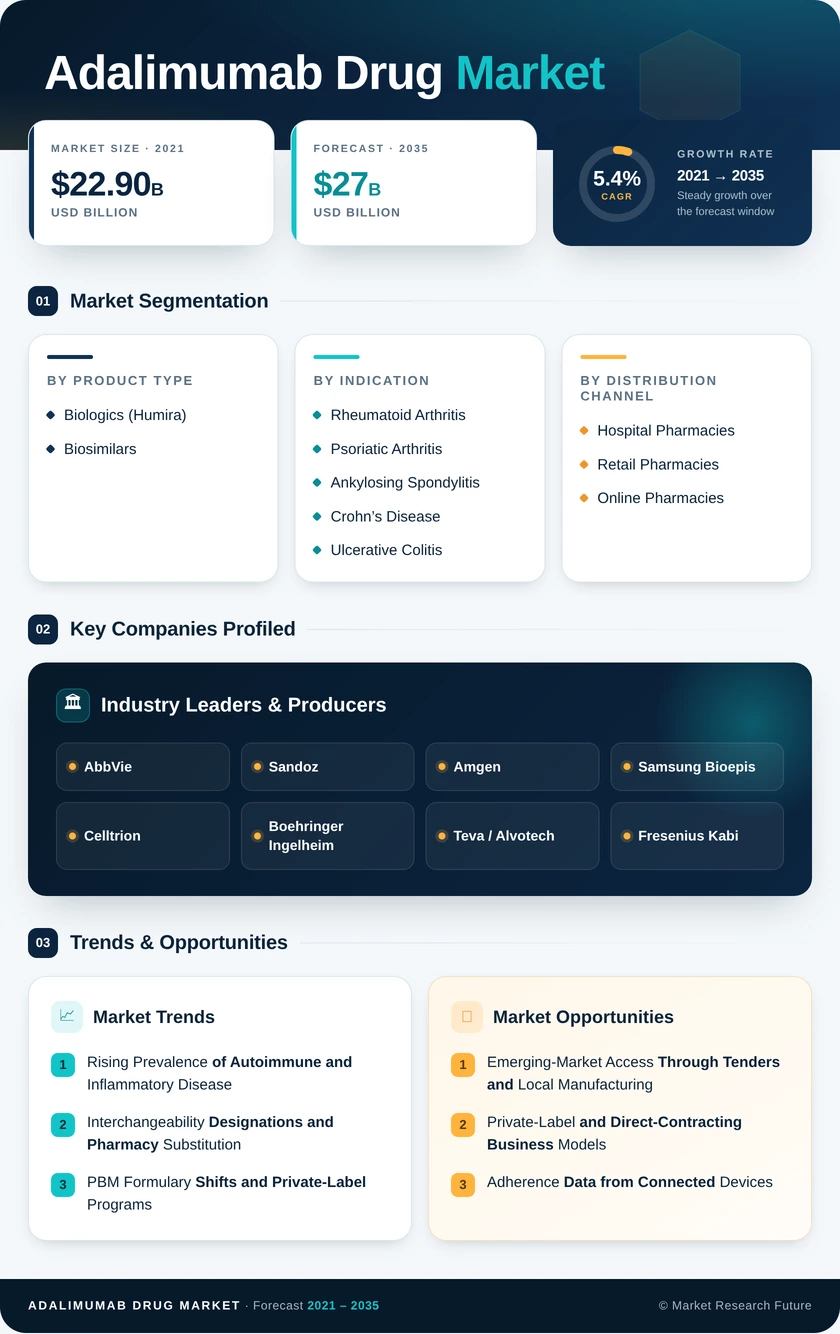
Adalimumab Drug Market Research Report By Product Type (Biologics (Humira), Biosimilars), By Indication (Rheumatoid Arthritis, Psoriatic Arthritis, Ankylosing Spondylitis, Crohn’s Disease, Ulcerative Colitis, Plaque Psoriasis, Hidradenitis Suppurativa, Juvenile Idiopathic Arthritis, Uveitis, Others), By Distribution Channel (Hospital Pharmacies, Retail Pharmacies, Online Pharmacies) and By Regional (North America, Europe, South America, Asia Pacific, Middle East and Africa) - Growth & Industry Forecast 2026 To 2035
Adalimumab Drug Market
Market Size
Forecast Period2026-2035
CAGR (2026-2035)5.4%
2025 Market SizeUSD 16.01 Billion
2035 Market SizeUSD 27.00 Billion
Key Players
AbbVie
Sandoz
Amgen
Samsung Bioepis
Celltrion
Boehringer Ingelheim
Opportunities
  • Emerging-Market Access Through Tenders and Local Manufacturing
  • Private-Label and Direct-Contracting Business Models
  • Adherence Data from Connected Devices
  1. 1 Market Summary | |
  2. 2 Key Report Takeaways | |
    1. 2.1 By Product Type | |
    2. 2.2 By Indication | |
    3. 2.3 By Distribution Channel | |
    4. 2.4 By Region | |
  3. 3 Market Size and Forecast (2021–2035) | |
  4. 4 Driver Impact Analysis | |
    1. 4.1 Rising Prevalence of Autoimmune and Inflammatory Disease | |
    2. 4.2 Interchangeability Designations and Pharmacy Substitution | |
    3. 4.3 PBM Formulary Shifts and Private-Label Programs | |
    4. 4.4 Reimbursement and Tender Reform in Emerging Economies | |
    5. 4.5 High-Concentration, Citrate-Free Formulations and Device Upgrades | |
    6. 4.6 Label Breadth in Rarer Dermatologic and Ophthalmic Indications | |
  5. 5 Restraints Impact Analysis | |
    1. 5.1 Net Price Erosion from Biosimilar Competition | |
    2. 5.2 Displacement by Newer Mechanisms | |
    3. 5.3 Rebate-Driven Pricing Complexity | |
    4. 5.4 Safety Warnings and Monitoring Burden | |
    5. 5.5 Affordability and Cold-Chain Gaps in Low-Income Markets | |
  6. 6 Opportunities | |
    1. 6.1 Emerging-Market Access Through Tenders and Local Manufacturing | |
    2. 6.2 Private-Label and Direct-Contracting Business Models | |
    3. 6.3 Adherence Data from Connected Devices | |
    4. 6.4 Pediatric and Rare-Indication Expansion | |
    5. 6.5 Next-Generation Delivery Formats | |
  7. 7 Regional Market Share and Country-Level Analysis | |
    1. 7.1 North America | | |
      1. 7.1.1 United States | | |
      2. 7.1.2 Canada | | |
      3. 7.1.3 Mexico | |
    2. 7.2 Europe | | |
      1. 7.2.1 Germany | | |
      2. 7.2.2 United Kingdom | | |
      3. 7.2.3 France | | |
      4. 7.2.4 Italy | | |
      5. 7.2.5 Spain | | |
      6. 7.2.6 Rest of Europe | |
    3. 7.3 Asia-Pacific | | |
      1. 7.3.1 China | | |
      2. 7.3.2 India | | |
      3. 7.3.3 Japan | | |
      4. 7.3.4 South Korea | | |
      5. 7.3.5 Australia | | |
      6. 7.3.6 Rest of Asia-Pacific | |
    4. 7.4 South America | | |
      1. 7.4.1 Brazil | | |
      2. 7.4.2 Argentina | | |
      3. 7.4.3 Rest of South America | |
    5. 7.5 Middle East and Africa | | |
      1. 7.5.1 GCC | | |
      2. 7.5.2 South Africa | | |
      3. 7.5.3 Rest of Middle East and Africa | |
  8. 8 Future Outlook (2026–2035) | |
    1. 8.1 Biosimilars Become the Default Supply | |
    2. 8.2 Connected Care and Remote Monitoring | |
    3. 8.3 Payer Policy and Out-of-Pocket Reform | |
    4. 8.4 Manufacturing Localization and Supply Resilience | |
  9. 9 Segmentation Analysis | |
    1. 9.1 By Product Type | | |
      1. 9.1.1 Biologics (Humira) | | |
      2. 9.1.2 Biosimilars | |
    2. 9.2 By Indication | | |
      1. 9.2.1 Rheumatoid Arthritis | | |
      2. 9.2.2 Psoriatic Arthritis | | |
      3. 9.2.3 Ankylosing Spondylitis | | |
      4. 9.2.4 Crohn’s Disease | | |
      5. 9.2.5 Ulcerative Colitis | | |
      6. 9.2.6 Plaque Psoriasis | | |
      7. 9.2.7 Hidradenitis Suppurativa | | |
      8. 9.2.8 Juvenile Idiopathic Arthritis | | |
      9. 9.2.9 Uveitis | | |
      10. 9.2.10 Others | |
    3. 9.3 By Distribution Channel | | |
      1. 9.3.1 Hospital Pharmacies | | |
      2. 9.3.2 Retail Pharmacies | | |
      3. 9.3.3 Online Pharmacies | |
  10. 10 Competitive Landscape | |
    1. 10.1 Market Concentration Analysis | |
    2. 10.2 Competitive Benchmarking Matrix | |
  11. 11 Recent News & Developments | |
  12. 12 Report Scope and Methodology | |
  13. 13 Detailed Sources and Citations | |
  14. 14 Frequently Asked Questions (FAQs) | | LIST OF TABLES | |
  15. TABLE 1 Global Adalimumab Drug Market Size & Forecast, by Revenue (USD Billion), 2021–2035 | |
  16. TABLE 2 Driver Impact Analysis – Global Adalimumab Drug Market | |
  17. TABLE 3 Restraints Impact Analysis – Global Adalimumab Drug Market | |
  18. TABLE 4 Global Adalimumab Drug Market, Regional Summary, 2025 | |
  19. TABLE 5 North America Adalimumab Drug Market, by Country, 2025 | |
  20. TABLE 6 Europe Adalimumab Drug Market, by Country, 2025 | |
  21. TABLE 7 Asia-Pacific Adalimumab Drug Market, by Country, 2025 | |
  22. TABLE 8 South America Adalimumab Drug Market, by Country, 2025 | |
  23. TABLE 9 Middle East and Africa Adalimumab Drug Market, by Country, 2025 | |
  24. TABLE 10 Global Adalimumab Drug Market, by Product Type, 2025 | |
  25. TABLE 11 Global Adalimumab Drug Market, by Indication, 2025 | |
  26. TABLE 12 Global Adalimumab Drug Market, by Distribution Channel, 2025 | |
  27. TABLE 13 Competitive Benchmarking Matrix – Global Adalimumab Drug Market | |
  28. TABLE 14 Report Scope and Methodology | |
  29. TABLE 15 Detailed Sources and Citations | | LIST OF FIGURES | |
  30. FIGURE 1 Global Adalimumab Drug Market Dynamics – Drivers, Restraints and Opportunities | |
  31. FIGURE 2 Adalimumab Value Chain Analysis | |
  32. FIGURE 3 Porter's Five Forces Analysis – Adalimumab | |
  33. FIGURE 4 Global Adalimumab Drug Market Size Trend, 2021–2035 (USD Billion) | |
  34. FIGURE 5 Global Adalimumab Drug Market Share, by Product Type, 2025 | |
  35. FIGURE 6 Global Adalimumab Drug Market Share, by Indication, 2025 | |
  36. FIGURE 7 Global Adalimumab Drug Market Share, by Distribution Channel, 2025 | |
  37. FIGURE 8 Global Adalimumab Drug Market Share, by Region, 2025 | |
  38. FIGURE 9 Competitive Landscape – Estimated Revenue Share Ranges, 2025

Segmentation Quick Reference

DimensionSub-SegmentsDominant SegmentFastest Growing Segment
By Product TypeBiologics (Humira), BiosimilarsBiologics (Humira) – 72.4% shareBiosimilars – 6.0% CAGR
By IndicationRheumatoid Arthritis, Psoriatic Arthritis, Ankylosing Spondylitis, Crohn’s Disease, Ulcerative Colitis, Plaque Psoriasis, Hidradenitis Suppurativa, Juvenile Idiopathic Arthritis, Uveitis, OthersRheumatoid Arthritis – 40.5% shareHidradenitis Suppurativa – 6.3% CAGR
By Distribution ChannelHospital Pharmacies, Retail Pharmacies, Online PharmaciesHospital Pharmacies – 48.4% shareOnline Pharmacies – 6.5% CAGR
By RegionNorth America, Europe, Asia-Pacific, South America, Middle East and AfricaNorth America – 48.6% shareAsia-Pacific – 7.1% CAGR

Market Segmentation Overview

By Product Type

Sub-SegmentKey Trend
Biologics (Humira)Retains share through patient-support programs while net prices fall
BiosimilarsRapid uptake driven by interchangeable designations and PBM private labels

Biologics (Humira) still leads this dimension with a 72.4% share, because prescriber habit, copay assistance and established device training keep many existing patients on the originator. Biosimilars grow fastest at a 6.0% CAGR, as interchangeable high-concentration products let pharmacists substitute at the counter and PBMs place them first on formularies.

By Indication

Sub-SegmentKey Trend
Rheumatoid ArthritisLargest base; gradual pressure from JAK and IL-6 agents
Psoriatic ArthritisSteady growth on better imaging-based diagnosis
Ankylosing SpondylitisEarlier recognition of axial spondyloarthritis
Crohn’s DiseaseDurable use due to surgical deferral benefits
Ulcerative ColitisGuideline competition from newer agents
Plaque PsoriasisShare loss to IL-17 and IL-23 inhibitors
Hidradenitis SuppurativaFastest growth; few biologic alternatives
Juvenile Idiopathic ArthritisStable pediatric niche
UveitisLimited systemic biologic competition
OthersSmaller and emerging uses

Rheumatoid Arthritis remains the leading indication at a 40.5% share, anchored by guidelines that place TNF-α inhibition early in treatment. Hidradenitis Suppurativa grows fastest at a 6.3% CAGR because few approved biologics match adalimumab's efficacy and dermatologists are diagnosing the disease earlier. Plaque Psoriasis lags as IL-17 and IL-23 agents take new patients.

By Distribution Channel

Sub-SegmentKey Trend
Hospital PharmaciesInitiation and complex-case management
Retail PharmaciesPartnerships with specialty-pharmacy operators
Online PharmaciesHome delivery and telehealth integration

Hospital Pharmacies lead with a 48.4% share because diagnosis, first doses and complex cases run through hospital specialists. Online Pharmacies grow fastest at a 6.5% CAGR as patients on stable maintenance therapy move to mail-order delivery with automated refills, while Retail Pharmacies rely on specialty-pharmacy partners to keep these patients.


Download PDF ×

We do not share your information with anyone. However, we may send you emails based on your report interest from time to time. You may contact us at any time to opt-out.