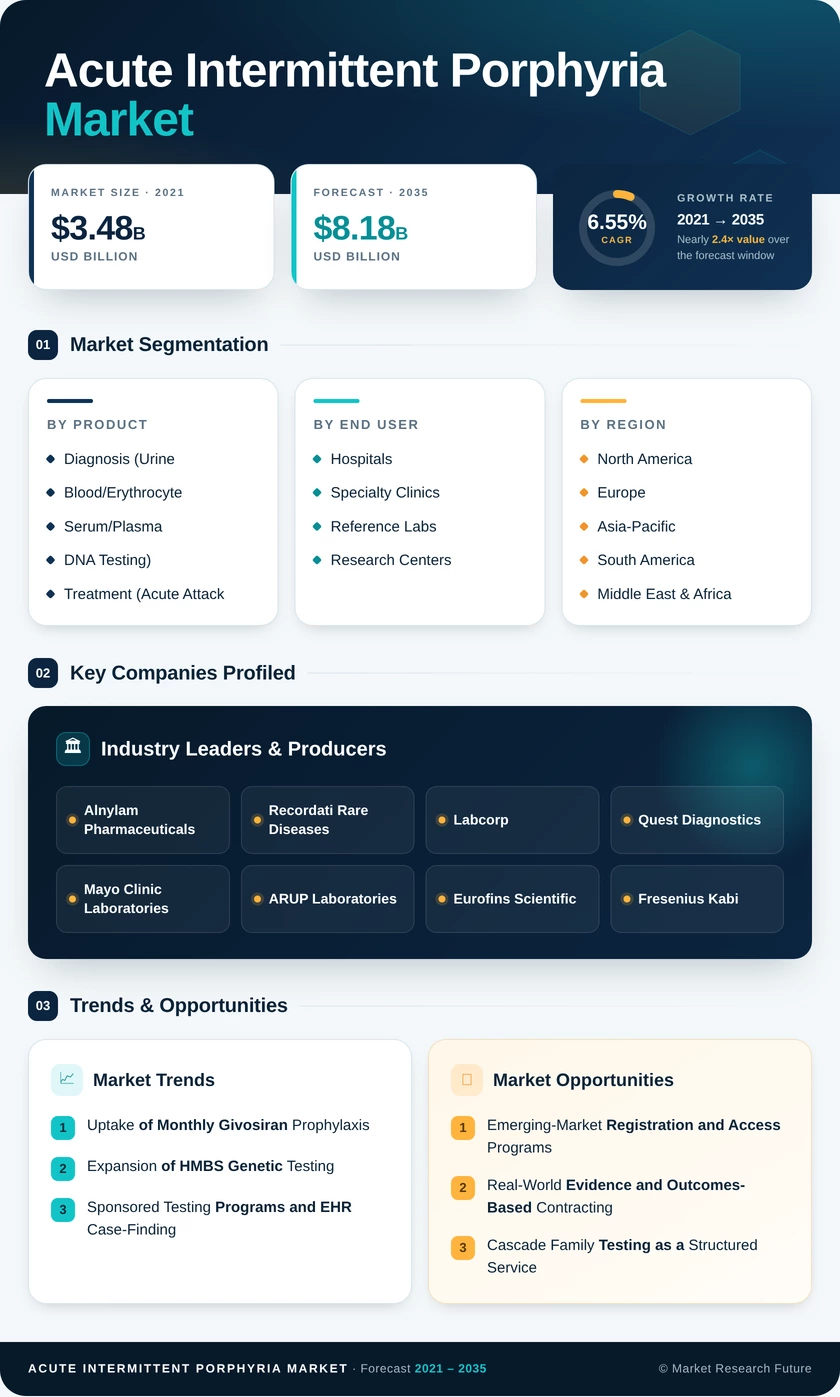
Segmentation Quick Reference
| Dimension | Sub-Segments | Dominant Segment | Fastest Growing Segment |
|---|
| By Product | Diagnosis (Urine, Blood/Erythrocyte, Serum/Plasma, DNA Testing); Treatment (Acute Attack, Preventive, Supportive, Definitive Interventions) | Treatment (70.1% share) | Diagnosis (8.5% CAGR (2026–2035)) |
| By End User | Hospitals, Specialty Clinics, Reference Labs, Research Centers | Hospitals (51.6% share) | Specialty Clinics (10.2% CAGR (2026–2035)) |
| By Region | North America, Europe, Asia-Pacific, South America, Middle East & Africa | North America (41.6% share) | Asia-Pacific (8.4% CAGR (2026–2035)) |
Market Segmentation Overview
| Sub-Segment | Key Trend |
|---|
| Diagnosis | Shift from urine-only screening to HMBS sequencing and cascade family testing |
| Treatment | Shift from episodic hemin infusions to monthly preventive prophylaxis |
Treatment leads the product dimension with a 70.1% share, because hemin infusions and annual prophylaxis are far more expensive than any single diagnostic test. Diagnosis grows faster, at an 8.5% CAGR, as guidelines call for genetic confirmation and each proband triggers testing of relatives. Within these, Preventive therapy and DNA Testing are the fastest-growing sub-segments, showing that the market is moving toward early identification and ongoing prevention.
| Sub-Segment | Key Trend |
|---|
| Hospitals | Remain essential for acute attacks and hemin dispensing |
| Specialty Clinics | Absorbing stable patients on monthly outpatient prophylaxis |
| Reference Labs | Consolidating quantitative porphyrin and HMBS testing |
| Research Centers | Hosting natural-history studies and gene editing trials |
Hospitals lead with a 51.6% share because acute attacks still require urgent inpatient care and pharmacy-controlled hemin. Specialty Clinics grow fastest, at a 10.2% CAGR, as patients on monthly prophylaxis move to planned outpatient visits in hepatology and hematology services. Reference Labs keep a solid revenue base by consolidating specialized testing that most hospital laboratories do not perform in-house.


 Noah Malgeri
Co-Founder

 Peter Groot koerkamp
Account and Business Manager

 Younghwan Choi
Senior Retail Manager

 Mark Irwin
Management Consultant

 Akif Moroglu
Strategy & Business Development Director

 Guilherme Gomes Martins
Product Management Director

 Joseph Aguayo
Sales Operations & Pricing Manager

 La Terria Dodd
Program Support Specialist

 Rob Kooiker
Group Product Manager HVAC & Fire Protection GMA