
Request Free Sample ×

Kindly complete the form below to receive a free sample of this Report

* Please use a valid business email

Leading companies partner with us for data-driven Insights

clients tt-cursor
Hero Background
English
Chinese
French
Japanese
Korean
German
Spanish

Active and Intelligent Packaging Market Share

ID: MRFR/PCM/4102-CR
100 Pages
Snehal Singh
September 2022

Active & Intelligent Packaging Market Research Report Information By Technology (Oxygen Scavenger, Shelf life sensing, Time Temperature Indicator, Moisture Absorber, Others) Application Type (Food and Beverage, Healthcare, Pharmaceutical, Personal Care, Others) Forecast 2030

Share:
Download PDF ×

We do not share your information with anyone. However, we may send you emails based on your report interest from time to time. You may contact us at any time to opt-out.

Active and Intelligent Packaging Market Infographic
Purchase Options

Market Share

Active and Intelligent Packaging Market Share Analysis

Key players in the active intelligent packaging market determine how competitive it will be based on strategies they adopt. In order for one company to outperform another player within the industry; marketing/branding efforts should be exceptional; differentiation of its products from those of competitors as well as entering into strategic alliances with other firms. Additionally, the rise of e-commerce platforms and digital applications has also seen the transformation of beauty products marketing and sales that further enhance market dynamics. Therefore, companies must be flexible enough to adjust in order to survive the tough competition that is currently experienced within the industry.

The myriad factors which together affect Active & Intelligent Packaging Market determine both its growth and trajectory. The consumer behavior is one key determinant since changing preferences coupled with increased personal care interest causes demand for cosmetics. Technological advancements have also had a great impact on the market especially in active and intelligent packaging. Innovations such as QR codes, RFID tags, and sensors printed on packages influence the consumers’ satisfaction level by ensuring safety of their commodities.

Economic conditions plus disposable income levels shape market trends in Active & Intelligent Packaging Market . In an uptick, clients may shift their expenditure patterns towards expensive makeup items thus spurring developments here. Moreover, during economic downturns, there is likely to be a preference for cheaper alternatives thus influencing market dynamics greatly. Furthermore, global trade can be affected by geopolitical issues that can destabilize entire markets through altering availability or costs associated with raw materials.

Regulations and environmental concerns are increasingly influencing the Active & Intelligent Packaging Market. This has resulted in companies investing more in packaging due to health safety concerns as well as ingredient transparency. Additionally, there is a growing demand for sustainable packaging, driven by customer understanding of environmental issues which drive the market.

Augmented reality (AR) and virtual reality (VR) integration into beauty industry’s product marketing have helped to expand the market. These types of technologies affect consumers’ purchasing decision because they offer them an immersive and interactive experience. Besides, today active and intelligent packaging is becoming faster with time-temperature indicators freshness sensors antimicrobial coatings etcetera. These functionalities are making it easier to use while removing buyer anxieties on safety.

The strategies used by major players determine competition within Active & Intelligent Packaging Market. Marketing and branding efforts are one way to gain competitive advantage; so is product differentiation or strategic partnerships. E-commerce plus digital platforms have also brought significant changes in how beauty products are marketed or sold hence impacting markets even further. Successful business leaders are those who adapt quickly to changes in this dynamic environment.

Active & Intelligent Packaging Market is shaped by consumer demographics too. The aging population has created demand for anti-aging and skin care products leading to progress within this particular field. On the other hand, young people normally go for eco-friendly or cruelty free merchandise hence those firms that want their customers back must be aware of these demographic characteristics.

Author
Author Profile
Snehal Singh
Manager - Research

High acumen in analyzing complex macro & micro markets with more than 6 years of work experience in the field of market research. By implementing her analytical skills in forecasting and estimation into market research reports, she has expertise in Packaging, Construction, and Equipment domains. She handles a team size of 20-25 resources and ensures smooth running of the projects, associated marketing activities, and client servicing.

Leave a Comment

FAQs

What is the projected market valuation of the active intelligent packaging market by 2035?

<p>The active intelligent packaging market is projected to reach a valuation of 45.0 USD Billion by 2035.</p>

What was the market valuation of the active intelligent packaging market in 2024?

<p>In 2024, the active intelligent packaging market was valued at 28.5 USD Billion.</p>

What is the expected CAGR for the active intelligent packaging market during the forecast period 2025 - 2035?

<p>The expected CAGR for the active intelligent packaging market during the forecast period 2025 - 2035 is 4.24%.</p>

Which companies are considered key players in the active intelligent packaging market?

<p>Key players in the active intelligent packaging market include Amcor, Sealed Air, Mondi, Tetra Pak, and Smurfit Kappa.</p>

What are the main applications of active intelligent packaging?

<p>The main applications of active intelligent packaging include food packaging, pharmaceutical packaging, electronics packaging, and cosmetic packaging.</p>

How much is the food packaging segment expected to grow by 2035?

<p>The food packaging segment is expected to grow from 10.0 USD Billion to 16.0 USD Billion by 2035.</p>

What technologies are utilized in active intelligent packaging?

<p>Technologies utilized in active intelligent packaging include oxygen scavengers, moisture control, temperature indicators, and time-temperature indicators.</p>

What is the projected growth for the intelligent packaging segment by 2035?

<p>The intelligent packaging segment is projected to grow from 8.5 USD Billion to 12.0 USD Billion by 2035.</p>

Which material types are predominantly used in active intelligent packaging?

<p>Predominant material types in active intelligent packaging include plastic, paper, metal, and glass.</p>

What end-use sectors are driving the demand for active intelligent packaging?

<p>The end-use sectors driving demand include food and beverage, healthcare, consumer goods, and electronics.</p>

Market Summary

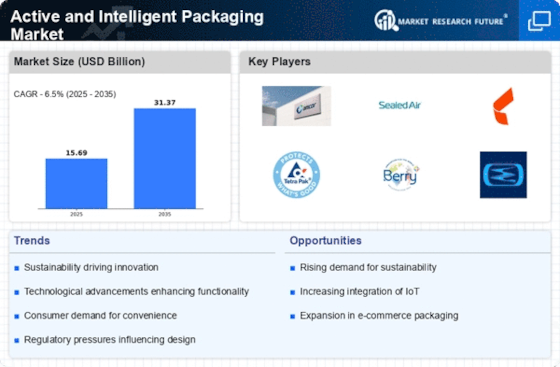
As per Market Research Future analysis, the Active and Intelligent Packaging Market was estimated at 15.69 USD Billion in 2024. The Active and Intelligent Packaging industry is projected to grow from 16.71 USD Billion in 2025 to 31.37 USD Billion by 2035, exhibiting a compound annual growth rate (CAGR) of 6.5% during the forecast period 2025 - 2035

Key Market Trends & Highlights

The Active and Intelligent Packaging Market is poised for substantial growth driven by sustainability and technological advancements.

  • North America remains the largest market for active and intelligent packaging, reflecting a strong demand for innovative solutions.
  • Asia-Pacific is identified as the fastest-growing region, indicating a shift towards advanced packaging technologies.
  • The Oxygen Scavenger segment leads the market, while the Time Temperature Indicator segment is rapidly gaining traction.
  • Key market drivers include sustainability initiatives and the growth of e-commerce, which are shaping consumer preferences.

Market Size & Forecast

2024 Market Size 15.69 (USD Billion)
2035 Market Size 31.37 (USD Billion)
CAGR (2025 - 2035) 6.5%
Largest Regional Market Share in 2024 North America

Major Players

Amcor (AU), Sealed Air (US), Mondi Group (GB), Tetra Pak (SE), Berry Global (US), Smurfit Kappa (IE), Sonoco Products (US), Huhtamaki (FI), WestRock (US)

Market Trends

The Active and Intelligent Packaging Market is currently experiencing a transformative phase, driven by advancements in technology and increasing consumer demand for enhanced product safety and quality. This market encompasses a variety of packaging solutions that not only preserve the integrity of products but also provide real-time information about their condition. As sustainability becomes a focal point for industries, the integration of eco-friendly materials and processes is gaining traction, suggesting a shift towards more responsible packaging practices. Furthermore, the rise of e-commerce is influencing packaging design, as companies seek to ensure that products arrive in optimal condition while minimizing waste. In addition to technological innovations, the Active and Intelligent Packaging Market is witnessing a growing emphasis on consumer engagement. Packaging is evolving from a mere protective layer to a medium of communication, offering interactive features that enhance the user experience. This trend indicates a potential for brands to build stronger connections with their customers through personalized packaging solutions. As the market continues to evolve, it appears poised for substantial growth, driven by the dual forces of innovation and consumer preference for smarter, more sustainable packaging options.

Sustainability Initiatives

The Active and Intelligent Packaging Market is increasingly focusing on sustainability, with companies exploring biodegradable and recyclable materials. This trend reflects a broader commitment to environmental responsibility, as consumers become more conscious of their purchasing choices. Brands are likely to adopt eco-friendly practices to align with consumer expectations and regulatory requirements.

Technological Advancements

Innovations in technology are reshaping the Active and Intelligent Packaging Market, with developments in sensors and smart labels enhancing product monitoring. These advancements enable real-time tracking of freshness and quality, providing valuable information to both consumers and manufacturers. The integration of such technologies may lead to improved supply chain efficiency and reduced waste.

Consumer-Centric Design

There is a noticeable shift towards consumer-centric design in the Active and Intelligent Packaging Market. Packaging is being reimagined to enhance user experience, incorporating features that engage consumers and provide added value. This trend suggests that brands are recognizing the importance of packaging as a tool for communication and differentiation in a competitive marketplace.

Active and Intelligent Packaging Market Market Drivers

E-commerce Growth

The rapid growth of e-commerce is a key driver for the Active and Intelligent Packaging Market. As online shopping continues to gain traction, the demand for packaging that ensures product integrity during transit has surged. Active and intelligent packaging solutions, such as temperature-controlled packaging and tamper-evident seals, are becoming essential for e-commerce businesses to maintain product quality and consumer trust. Data suggests that the e-commerce sector is expected to reach USD 6 trillion by 2024, further amplifying the need for innovative packaging solutions. This trend is likely to propel the Active and Intelligent Packaging Market, as companies seek to enhance their packaging strategies to meet the unique challenges posed by online retail.

Regulatory Compliance

Regulatory compliance is a significant driver for the Active and Intelligent Packaging Market. Governments worldwide are implementing stringent regulations regarding food safety, labeling, and environmental impact. These regulations compel manufacturers to adopt advanced packaging solutions that meet safety standards and reduce environmental footprints. For example, the European Union has established regulations that mandate clear labeling of food products, which has led to increased demand for intelligent packaging that provides real-time information. As compliance becomes more complex, companies are likely to invest in active and intelligent packaging technologies to ensure adherence to these regulations, thereby driving growth in the market.

Consumer-Centric Design

The shift towards consumer-centric design is increasingly influencing the Active and Intelligent Packaging Market. Modern consumers demand packaging that not only protects products but also enhances their overall experience. This includes features such as easy-open designs, resealable options, and informative labeling. Research indicates that 70% of consumers are willing to pay more for products that offer superior packaging. Companies are responding by investing in innovative designs that cater to these preferences, thereby improving customer satisfaction and loyalty. This trend is expected to propel the Active and Intelligent Packaging Market forward, as businesses recognize the importance of aligning packaging solutions with consumer expectations.

Sustainability Initiatives

The increasing emphasis on sustainability is a pivotal driver for the Active and Intelligent Packaging Market. As consumers become more environmentally conscious, companies are compelled to adopt eco-friendly packaging solutions. This shift is reflected in the growing demand for biodegradable and recyclable materials, which are integral to active and intelligent packaging. According to recent data, the market for sustainable packaging is projected to reach USD 500 billion by 2027, indicating a robust growth trajectory. Companies that integrate sustainable practices into their packaging strategies not only enhance their brand image but also comply with stringent regulations aimed at reducing plastic waste. This trend is likely to continue influencing the Active and Intelligent Packaging Market, as businesses seek to align with consumer values and regulatory requirements.

Technological Advancements

Technological advancements play a crucial role in shaping the Active and Intelligent Packaging Market. Innovations such as smart sensors, RFID technology, and nanotechnology are revolutionizing packaging solutions. These technologies enable real-time monitoring of product conditions, enhancing shelf life and ensuring safety. For instance, the integration of temperature-sensitive indicators can alert consumers to potential spoilage, thereby reducing food waste. The market for smart packaging is expected to grow significantly, with estimates suggesting a compound annual growth rate of over 10% through 2028. As technology continues to evolve, the Active and Intelligent Packaging Market is likely to witness the emergence of new applications and functionalities, further driving its expansion.

Market Segment Insights

By Application: Food Packaging (Largest) vs. Pharmaceutical Packaging (Fastest-Growing)

<p>The active intelligent packaging market showcases a diverse distribution of applications, with food packaging holding the largest share. This segment thrives due to the increasing demand for freshness and safety in food products, driven by changing consumer lifestyles and a heightened focus on food waste reduction. Pharmacological packaging, on the other hand, is emerging rapidly as regulatory requirements intensify around drug safety and traceability.</p>

<p>Food Packaging (Dominant) vs. Pharmaceutical Packaging (Emerging)</p>

<p>Food packaging has established itself as a dominant force within the active intelligent packaging market, characterized by its ability to enhance product shelf life and maintain quality through active components. It is primarily driven by consumer demand for smarter, more eco-friendly solutions to preserve food without sacrificing quality. Conversely, pharmaceutical packaging is emerging as a critical segment, spurred by advancements in technology and increasing regulatory scrutiny. This sector focuses on preserving the integrity of medications and preventing counterfeiting, utilizing smart sensors and tracking technologies to enhance safety and compliance.</p>

By Technology: Oxygen Scavengers (Largest) vs. Temperature Indicators (Fastest-Growing)

<p>In the active intelligent packaging market, the technology segment is primarily dominated by oxygen scavengers, which play a crucial role in extending the shelf life of sensitive products by absorbing oxygen. This technology holds the largest market share due to its widespread application across various sectors, including food and pharmaceuticals. In contrast, temperature indicators are emerging as the fastest-growing segment, gaining traction due to the increasing demand for temperature-sensitive goods, highlighting the importance of proper storage conditions during transportation.</p>

<p>Technology: Oxygen Scavengers (Dominant) vs. Temperature Indicators (Emerging)</p>

<p>Oxygen scavengers are a dominant technology in the active intelligent packaging market, effectively minimizing the detrimental effects of oxygen on product quality. They are widely utilized in packaging foods, beverages, and pharmaceuticals, where oxidation poses significant risks. On the other hand, temperature indicators are emerging rapidly as consumers and businesses alike recognize the importance of maintaining optimal temperature conditions. These indicators provide valuable insights into temperature exposure, making them essential in the logistics of pharmaceuticals and perishable goods. This juxtaposition between the dominant established players and the rapidly growing technologies illustrates a dynamic interplay in the market, driven by evolving consumer needs and regulatory standards.</p>

By End Use: Food and Beverage (Largest) vs. Healthcare (Fastest-Growing)

<p>In the active intelligent packaging market, the 'End Use' segment demonstrates a diverse distribution of market share across several key sectors. Notably, the Food and Beverage segment stands out as the largest contributor, driven by increasing consumer demand for freshness, safety, and traceability in food products. This sector benefits significantly from innovations in packaging solutions that enhance shelf life and monitor food conditions. On the other hand, the Healthcare sector is recognized as the fastest-growing segment within this market. This growth is fueled by rising investments in smart packaging technologies aimed at improving patient safety and medication adherence. The increasing demand for pharmaceutical traceability and the prevalence of chronic diseases further propel the adoption of intelligent packaging solutions in healthcare applications.</p>

<p>Food and Beverage (Dominant) vs. Healthcare (Emerging)</p>

<p>The Food and Beverage sector remains dominant in the active intelligent packaging market, characterized by its wide range of applications aimed at enhancing food quality and safety. This segment utilizes advanced technologies such as sensors and indicators to monitor freshness, quality, and safety, significantly influencing consumer choices. With increasing concerns regarding food waste and spoilage, companies are investing heavily in innovative packaging solutions that not only extend shelf life but also provide real-time information regarding the state of the product. Conversely, the Healthcare sector is emerging rapidly, driven by the need for more sophisticated packaging that enhances drug delivery and patient compliance. Smart packaging solutions in this sector include features like temperature control and medicine tracking, which are crucial for ensuring the efficacy of pharmaceuticals. As governments and organizations push for stringent regulations, the demand for intelligent packaging in healthcare is expected to grow, showcasing its critical role in enhancing patient outcomes.</p>

By Material Type: Plastic (Largest) vs. Paper (Fastest-Growing)

<p>The active intelligent packaging market is segmented by material type, with plastic holding the largest share due to its versatility, flexibility, and cost-effectiveness in creating smart packaging solutions. On the other hand, the paper segment is witnessing rapid growth, driven by the increasing consumer preference for sustainable and eco-friendly packaging materials. Paper's ability to be easily recycled and its biodegradability are pivotal factors attracting investments, pushing its market share upward.</p>

<p>Material Type: Plastic (Dominant) vs. Paper (Emerging)</p>

<p>Plastic dominates the active intelligent packaging landscape, favored for its lightweight properties, durability, and ability to seamlessly integrate smart solutions like sensors and indicators. Innovations in plastic technology are leading to enhanced functionalities, making it a staple in various applications. Conversely, paper is emerging as a preferred choice among environmentally conscious brands, tapping into a growing consumer base that prioritizes sustainable packaging. The evolution of paper into a smart packaging medium through advancements in printing technologies and coatings is facilitating its rise, enabling it to compete effectively against plastics. This shift symbolizes a broader trend towards sustainability in packaging.</p>

By Functionality: Active Packaging (Largest) vs. Smart Packaging (Fastest-Growing)

<p>The active intelligent packaging market exhibits a diverse range of functionalities, with active packaging emerging as the dominant segment. Active packaging, which utilizes smart materials to extend shelf life and maintain product quality, plays a significant role in various applications such as food preservation. In contrast, smart packaging is gaining traction, characterized by its ability to communicate information about the product’s condition, thus enhancing consumer experience and safety. The distribution of market share demonstrates a robust inclination towards active packaging solutions due to their established effectiveness in ensuring product quality. Growth trends in this segment are driven by increasing consumer demand for longer shelf life and enhanced product safety. Technological advancements in materials science and sensor technologies are propelling the smart packaging segment, making it the fastest-growing category in the market. Additionally, stringent regulatory frameworks focusing on food safety are encouraging manufacturers to adopt active and intelligent solutions. Innovations that integrate functionalities such as temperature monitoring and freshness indicators are expected to further boost this segment's growth in coming years.</p>

<p>Packaging: Active Packaging (Dominant) vs. Smart Packaging (Emerging)</p>

<p>Active packaging is characterized by its unique capability to interact with the product or its environment, ensuring extended freshness and quality preservation. It typically incorporates elements that can absorb or emit substances to prevent spoilage, serving a vital role in the food and pharmaceutical sectors. The dominant position of active packaging is attributed to its proven effectiveness and reliability, becoming a standard in many applications. Conversely, smart packaging represents an emerging trend focused on integrating advanced technology to provide real-time information regarding the product's status. It utilizes sensors and indicators to enhance transparency and safety, thereby capturing the interest of consumers looking for enhanced interaction with their products. As these technologies evolve, smart packaging is efficiently gaining market share, appealing to a tech-savvy consumer base.</p>

Get more detailed insights about Active & Intelligent Packaging Market Research Report—Global Forecast till 2035

Regional Insights

North America : Innovation and Sustainability Leader

North America is the largest market for active and intelligent packaging, holding approximately 40% of the global share. The region's growth is driven by increasing consumer demand for sustainable packaging solutions and stringent regulations promoting eco-friendly practices. The rise in e-commerce and food delivery services further fuels the demand for innovative packaging technologies that enhance product safety and shelf life. The United States and Canada are the leading countries in this market, with major players like Sealed Air, Berry Global, and WestRock dominating the landscape. The competitive environment is characterized by continuous innovation and investment in R&D to develop smart packaging solutions. The presence of established companies and a robust supply chain infrastructure contribute to the region's strong market position.

Europe : Regulatory-Driven Market Growth

Europe is the second-largest market for active and intelligent packaging, accounting for around 30% of the global market share. The region's growth is significantly influenced by stringent regulations aimed at reducing plastic waste and promoting sustainable packaging solutions. The European Union's Green Deal and Circular Economy Action Plan are key drivers, encouraging companies to adopt innovative packaging technologies that align with environmental goals. Leading countries in this market include Germany, France, and the UK, where companies like Mondi Group and Tetra Pak are at the forefront of innovation. The competitive landscape is marked by a strong emphasis on sustainability, with many firms investing in research to develop biodegradable and recyclable packaging solutions. This focus on eco-friendly practices positions Europe as a leader in the active and intelligent packaging sector.

Asia-Pacific : Emerging Market Potential

Asia-Pacific is witnessing rapid growth in the active and intelligent packaging market, holding approximately 25% of the global share. The region's expansion is driven by increasing urbanization, rising disposable incomes, and a growing demand for packaged food and beverages. Additionally, government initiatives promoting food safety and quality standards are catalyzing the adoption of advanced packaging technologies across various industries. China, Japan, and India are the leading countries in this market, with significant contributions from local and international players. Companies like Huhtamaki and Amcor are actively investing in the region to enhance their market presence. The competitive landscape is evolving, with a focus on innovation and sustainability, as businesses strive to meet the changing consumer preferences and regulatory requirements.

Middle East and Africa : Untapped Market Opportunities

The Middle East and Africa region is emerging as a significant player in the active and intelligent packaging market, accounting for about 5% of the global share. The growth is driven by increasing investments in infrastructure, rising consumer awareness about packaging benefits, and a growing food and beverage industry. Additionally, government initiatives aimed at enhancing food safety standards are propelling the demand for advanced packaging solutions. Countries like South Africa and the UAE are leading the market, with a mix of local and international companies vying for market share. The competitive landscape is characterized by a focus on innovation and the introduction of smart packaging technologies. Key players are exploring partnerships and collaborations to expand their reach and enhance product offerings in this evolving market.

Key Players and Competitive Insights

The Active and Intelligent Packaging Market is currently characterized by a dynamic competitive landscape, driven by increasing consumer demand for sustainable packaging solutions and enhanced product safety. Key players such as Amcor (AU), Sealed Air (US), and Tetra Pak (SE) are strategically positioning themselves through innovation and partnerships. Amcor (AU) has focused on developing biodegradable materials, while Sealed Air (US) emphasizes smart packaging technologies that enhance supply chain visibility. Tetra Pak (SE) continues to invest in sustainable practices, aiming to reduce its carbon footprint, which collectively shapes a competitive environment that prioritizes sustainability and technological advancement.

In terms of business tactics, companies are increasingly localizing manufacturing to reduce lead times and optimize supply chains. The market appears moderately fragmented, with several key players exerting influence through strategic collaborations and technological advancements. This structure allows for a diverse range of offerings, catering to various consumer needs while fostering competition among established and emerging players.

In August 2025, Amcor (AU) announced a partnership with a leading food manufacturer to develop a new line of recyclable packaging solutions. This collaboration is significant as it not only enhances Amcor's product portfolio but also aligns with the growing consumer preference for environmentally friendly packaging. Such strategic alliances are likely to bolster Amcor's market position and drive innovation in sustainable packaging.

In September 2025, Sealed Air (US) launched a new smart packaging solution that integrates IoT technology to monitor product conditions during transit. This move is crucial as it addresses the increasing demand for transparency in supply chains, allowing companies to ensure product integrity and reduce waste. By leveraging technology, Sealed Air (US) positions itself as a leader in the intelligent packaging segment, potentially attracting new clients seeking advanced solutions.

In July 2025, Tetra Pak (SE) unveiled its latest initiative aimed at enhancing the recyclability of its packaging materials. This initiative is particularly relevant in the context of global sustainability goals, as it demonstrates Tetra Pak's commitment to reducing environmental impact. By focusing on innovation in recyclability, Tetra Pak (SE) not only strengthens its brand reputation but also aligns with regulatory trends favoring sustainable practices.

As of October 2025, the competitive trends in the Active and Intelligent Packaging Market are increasingly defined by digitalization, sustainability, and the integration of artificial intelligence. Strategic alliances among key players are shaping the landscape, fostering innovation and enhancing product offerings. Looking ahead, it is likely that competitive differentiation will evolve from traditional price-based competition to a focus on technological innovation, sustainability, and supply chain reliability, reflecting the changing priorities of consumers and regulatory frameworks.

Key Companies in the Active and Intelligent Packaging Market include

Industry Developments

    • In Jan 2020, Amcor PLC announced its partnership with Moda vacuum packaging systems in North America and Latin America. The partnership is aimed at offering innovative packaging solutions and enhancing operational capabilities of the packaging systems to strengthen its ability to deliver valuable products and services to our customers.
    • In Feb 2019, Crown Holdings, Inc. partnered with Danone Waters Brazil to launch its newest brand, 4U by Danone. The 4U line features two carbonated juices and two flavoured teas, all made with 100% natural ingredients.
    • In April 2017, Ball Corporation and Unilever partnered to bring a more sustainable aluminium aerosol can to the market. Ball's partnership with Unilever to lightweight their can using Real technology brings significant environmental benefits while ensuring the same performance.

Future Outlook

Active and Intelligent Packaging Market Future Outlook

The Active and Intelligent Packaging Market is projected to grow at a 6.5% CAGR from 2025 to 2035, driven by technological advancements, sustainability trends, and consumer demand for enhanced product safety.

New opportunities lie in:

  • Integration of IoT-enabled packaging solutions for real-time monitoring.
  • Development of biodegradable active packaging materials to meet sustainability goals.
  • Expansion into emerging markets with tailored packaging solutions for local needs.

By 2035, the market is expected to be robust, driven by innovation and sustainability.

Market Segmentation

Active and Intelligent Packaging Market Technology Outlook

  • Oxygen Scavenger
  • Shelf life sensing
  • Time Temperature Indicator
  • Moisture Absorber
  • Others

Active and Intelligent Packaging Market Application Type Outlook

  • Food and Beverage
  • Healthcare
  • Pharmaceutical
  • Personal Care
  • Others

Report Scope

MARKET SIZE 2024 15.69(USD Billion)
MARKET SIZE 2025 16.71(USD Billion)
MARKET SIZE 2035 31.37(USD Billion)
COMPOUND ANNUAL GROWTH RATE (CAGR) 6.5% (2025 - 2035)
REPORT COVERAGE Revenue Forecast, Competitive Landscape, Growth Factors, and Trends
BASE YEAR 2024
Market Forecast Period 2025 - 2035
Historical Data 2019 - 2024
Market Forecast Units USD Billion
Key Companies Profiled Amcor (AU), Sealed Air (US), Mondi Group (GB), Tetra Pak (SE), Berry Global (US), Smurfit Kappa (IE), Sonoco Products (US), Huhtamaki (FI), WestRock (US)
Segments Covered Technology
Key Market Opportunities Integration of smart sensors enhances consumer engagement in the Active and Intelligent Packaging Market.
Key Market Dynamics Rising consumer demand for sustainability drives innovation in active and intelligent packaging solutions across various industries.
Countries Covered North America, Europe, APAC, South America, MEA

FAQs

What is the projected market valuation of the active intelligent packaging market by 2035?

<p>The active intelligent packaging market is projected to reach a valuation of 45.0 USD Billion by 2035.</p>

What was the market valuation of the active intelligent packaging market in 2024?

<p>In 2024, the active intelligent packaging market was valued at 28.5 USD Billion.</p>

What is the expected CAGR for the active intelligent packaging market during the forecast period 2025 - 2035?

<p>The expected CAGR for the active intelligent packaging market during the forecast period 2025 - 2035 is 4.24%.</p>

Which companies are considered key players in the active intelligent packaging market?

<p>Key players in the active intelligent packaging market include Amcor, Sealed Air, Mondi, Tetra Pak, and Smurfit Kappa.</p>

What are the main applications of active intelligent packaging?

<p>The main applications of active intelligent packaging include food packaging, pharmaceutical packaging, electronics packaging, and cosmetic packaging.</p>

How much is the food packaging segment expected to grow by 2035?

<p>The food packaging segment is expected to grow from 10.0 USD Billion to 16.0 USD Billion by 2035.</p>

What technologies are utilized in active intelligent packaging?

<p>Technologies utilized in active intelligent packaging include oxygen scavengers, moisture control, temperature indicators, and time-temperature indicators.</p>

What is the projected growth for the intelligent packaging segment by 2035?

<p>The intelligent packaging segment is projected to grow from 8.5 USD Billion to 12.0 USD Billion by 2035.</p>

Which material types are predominantly used in active intelligent packaging?

<p>Predominant material types in active intelligent packaging include plastic, paper, metal, and glass.</p>

What end-use sectors are driving the demand for active intelligent packaging?

<p>The end-use sectors driving demand include food and beverage, healthcare, consumer goods, and electronics.</p>

  1. SECTION I: EXECUTIVE SUMMARY AND KEY HIGHLIGHTS
    1. | 1.1 EXECUTIVE SUMMARY
    2. | | 1.1.1 Market Overview
    3. | | 1.1.2 Key Findings
    4. | | 1.1.3 Market Segmentation
    5. | | 1.1.4 Competitive Landscape
    6. | | 1.1.5 Challenges and Opportunities
    7. | | 1.1.6 Future Outlook
  2. SECTION II: SCOPING, METHODOLOGY AND MARKET STRUCTURE
    1. | 2.1 MARKET INTRODUCTION
    2. | | 2.1.1 Definition
    3. | | 2.1.2 Scope of the study
    4. | | | 2.1.2.1 Research Objective
    5. | | | 2.1.2.2 Assumption
    6. | | | 2.1.2.3 Limitations
    7. | 2.2 RESEARCH METHODOLOGY
    8. | | 2.2.1 Overview
    9. | | 2.2.2 Data Mining
    10. | | 2.2.3 Secondary Research
    11. | | 2.2.4 Primary Research
    12. | | | 2.2.4.1 Primary Interviews and Information Gathering Process
    13. | | | 2.2.4.2 Breakdown of Primary Respondents
    14. | | 2.2.5 Forecasting Model
    15. | | 2.2.6 Market Size Estimation
    16. | | | 2.2.6.1 Bottom-Up Approach
    17. | | | 2.2.6.2 Top-Down Approach
    18. | | 2.2.7 Data Triangulation
    19. | | 2.2.8 Validation
  3. SECTION III: QUALITATIVE ANALYSIS
    1. | 3.1 MARKET DYNAMICS
    2. | | 3.1.1 Overview
    3. | | 3.1.2 Drivers
    4. | | 3.1.3 Restraints
    5. | | 3.1.4 Opportunities
    6. | 3.2 MARKET FACTOR ANALYSIS
    7. | | 3.2.1 Value chain Analysis
    8. | | 3.2.2 Porter's Five Forces Analysis
    9. | | | 3.2.2.1 Bargaining Power of Suppliers
    10. | | | 3.2.2.2 Bargaining Power of Buyers
    11. | | | 3.2.2.3 Threat of New Entrants
    12. | | | 3.2.2.4 Threat of Substitutes
    13. | | | 3.2.2.5 Intensity of Rivalry
    14. | | 3.2.3 COVID-19 Impact Analysis
    15. | | | 3.2.3.1 Market Impact Analysis
    16. | | | 3.2.3.2 Regional Impact
    17. | | | 3.2.3.3 Opportunity and Threat Analysis
  4. SECTION IV: QUANTITATIVE ANALYSIS
    1. | 4.1 Packaging & Transport, BY Technology (USD Billion)
    2. | | 4.1.1 Oxygen Scavenger
    3. | | 4.1.2 Shelf life sensing
    4. | | 4.1.3 Time Temperature Indicator
    5. | | 4.1.4 Moisture Absorber
    6. | | 4.1.5 Others
    7. | 4.2 Packaging & Transport, BY Application Type (USD Billion)
    8. | | 4.2.1 Food and Beverage
    9. | | 4.2.2 Healthcare
    10. | | 4.2.3 Pharmaceutical
    11. | | 4.2.4 Personal Care
    12. | | 4.2.5 Others
    13. | 4.3 Packaging & Transport, BY Region (USD Billion)
    14. | | 4.3.1 North America
    15. | | | 4.3.1.1 US
    16. | | | 4.3.1.2 Canada
    17. | | 4.3.2 Europe
    18. | | | 4.3.2.1 Germany
    19. | | | 4.3.2.2 UK
    20. | | | 4.3.2.3 France
    21. | | | 4.3.2.4 Russia
    22. | | | 4.3.2.5 Italy
    23. | | | 4.3.2.6 Spain
    24. | | | 4.3.2.7 Rest of Europe
    25. | | 4.3.3 APAC
    26. | | | 4.3.3.1 China
    27. | | | 4.3.3.2 India
    28. | | | 4.3.3.3 Japan
    29. | | | 4.3.3.4 South Korea
    30. | | | 4.3.3.5 Malaysia
    31. | | | 4.3.3.6 Thailand
    32. | | | 4.3.3.7 Indonesia
    33. | | | 4.3.3.8 Rest of APAC
    34. | | 4.3.4 South America
    35. | | | 4.3.4.1 Brazil
    36. | | | 4.3.4.2 Mexico
    37. | | | 4.3.4.3 Argentina
    38. | | | 4.3.4.4 Rest of South America
    39. | | 4.3.5 MEA
    40. | | | 4.3.5.1 GCC Countries
    41. | | | 4.3.5.2 South Africa
    42. | | | 4.3.5.3 Rest of MEA
  5. SECTION V: COMPETITIVE ANALYSIS
    1. | 5.1 Competitive Landscape
    2. | | 5.1.1 Overview
    3. | | 5.1.2 Competitive Analysis
    4. | | 5.1.3 Market share Analysis
    5. | | 5.1.4 Major Growth Strategy in the Packaging & Transport
    6. | | 5.1.5 Competitive Benchmarking
    7. | | 5.1.6 Leading Players in Terms of Number of Developments in the Packaging & Transport
    8. | | 5.1.7 Key developments and growth strategies
    9. | | | 5.1.7.1 New Product Launch/Service Deployment
    10. | | | 5.1.7.2 Merger & Acquisitions
    11. | | | 5.1.7.3 Joint Ventures
    12. | | 5.1.8 Major Players Financial Matrix
    13. | | | 5.1.8.1 Sales and Operating Income
    14. | | | 5.1.8.2 Major Players R&D Expenditure. 2023
    15. | 5.2 Company Profiles
    16. | | 5.2.1 Amcor (AU)
    17. | | | 5.2.1.1 Financial Overview
    18. | | | 5.2.1.2 Products Offered
    19. | | | 5.2.1.3 Key Developments
    20. | | | 5.2.1.4 SWOT Analysis
    21. | | | 5.2.1.5 Key Strategies
    22. | | 5.2.2 Sealed Air (US)
    23. | | | 5.2.2.1 Financial Overview
    24. | | | 5.2.2.2 Products Offered
    25. | | | 5.2.2.3 Key Developments
    26. | | | 5.2.2.4 SWOT Analysis
    27. | | | 5.2.2.5 Key Strategies
    28. | | 5.2.3 Mondi Group (GB)
    29. | | | 5.2.3.1 Financial Overview
    30. | | | 5.2.3.2 Products Offered
    31. | | | 5.2.3.3 Key Developments
    32. | | | 5.2.3.4 SWOT Analysis
    33. | | | 5.2.3.5 Key Strategies
    34. | | 5.2.4 Tetra Pak (SE)
    35. | | | 5.2.4.1 Financial Overview
    36. | | | 5.2.4.2 Products Offered
    37. | | | 5.2.4.3 Key Developments
    38. | | | 5.2.4.4 SWOT Analysis
    39. | | | 5.2.4.5 Key Strategies
    40. | | 5.2.5 Berry Global (US)
    41. | | | 5.2.5.1 Financial Overview
    42. | | | 5.2.5.2 Products Offered
    43. | | | 5.2.5.3 Key Developments
    44. | | | 5.2.5.4 SWOT Analysis
    45. | | | 5.2.5.5 Key Strategies
    46. | | 5.2.6 Smurfit Kappa (IE)
    47. | | | 5.2.6.1 Financial Overview
    48. | | | 5.2.6.2 Products Offered
    49. | | | 5.2.6.3 Key Developments
    50. | | | 5.2.6.4 SWOT Analysis
    51. | | | 5.2.6.5 Key Strategies
    52. | | 5.2.7 Sonoco Products (US)
    53. | | | 5.2.7.1 Financial Overview
    54. | | | 5.2.7.2 Products Offered
    55. | | | 5.2.7.3 Key Developments
    56. | | | 5.2.7.4 SWOT Analysis
    57. | | | 5.2.7.5 Key Strategies
    58. | | 5.2.8 Huhtamaki (FI)
    59. | | | 5.2.8.1 Financial Overview
    60. | | | 5.2.8.2 Products Offered
    61. | | | 5.2.8.3 Key Developments
    62. | | | 5.2.8.4 SWOT Analysis
    63. | | | 5.2.8.5 Key Strategies
    64. | | 5.2.9 WestRock (US)
    65. | | | 5.2.9.1 Financial Overview
    66. | | | 5.2.9.2 Products Offered
    67. | | | 5.2.9.3 Key Developments
    68. | | | 5.2.9.4 SWOT Analysis
    69. | | | 5.2.9.5 Key Strategies
    70. | 5.3 Appendix
    71. | | 5.3.1 References
    72. | | 5.3.2 Related Reports
  6. LIST OF FIGURES
    1. | 6.1 MARKET SYNOPSIS
    2. | 6.2 NORTH AMERICA MARKET ANALYSIS
    3. | 6.3 US MARKET ANALYSIS BY TECHNOLOGY
    4. | 6.4 US MARKET ANALYSIS BY APPLICATION TYPE
    5. | 6.5 CANADA MARKET ANALYSIS BY TECHNOLOGY
    6. | 6.6 CANADA MARKET ANALYSIS BY APPLICATION TYPE
    7. | 6.7 EUROPE MARKET ANALYSIS
    8. | 6.8 GERMANY MARKET ANALYSIS BY TECHNOLOGY
    9. | 6.9 GERMANY MARKET ANALYSIS BY APPLICATION TYPE
    10. | 6.10 UK MARKET ANALYSIS BY TECHNOLOGY
    11. | 6.11 UK MARKET ANALYSIS BY APPLICATION TYPE
    12. | 6.12 FRANCE MARKET ANALYSIS BY TECHNOLOGY
    13. | 6.13 FRANCE MARKET ANALYSIS BY APPLICATION TYPE
    14. | 6.14 RUSSIA MARKET ANALYSIS BY TECHNOLOGY
    15. | 6.15 RUSSIA MARKET ANALYSIS BY APPLICATION TYPE
    16. | 6.16 ITALY MARKET ANALYSIS BY TECHNOLOGY
    17. | 6.17 ITALY MARKET ANALYSIS BY APPLICATION TYPE
    18. | 6.18 SPAIN MARKET ANALYSIS BY TECHNOLOGY
    19. | 6.19 SPAIN MARKET ANALYSIS BY APPLICATION TYPE
    20. | 6.20 REST OF EUROPE MARKET ANALYSIS BY TECHNOLOGY
    21. | 6.21 REST OF EUROPE MARKET ANALYSIS BY APPLICATION TYPE
    22. | 6.22 APAC MARKET ANALYSIS
    23. | 6.23 CHINA MARKET ANALYSIS BY TECHNOLOGY
    24. | 6.24 CHINA MARKET ANALYSIS BY APPLICATION TYPE
    25. | 6.25 INDIA MARKET ANALYSIS BY TECHNOLOGY
    26. | 6.26 INDIA MARKET ANALYSIS BY APPLICATION TYPE
    27. | 6.27 JAPAN MARKET ANALYSIS BY TECHNOLOGY
    28. | 6.28 JAPAN MARKET ANALYSIS BY APPLICATION TYPE
    29. | 6.29 SOUTH KOREA MARKET ANALYSIS BY TECHNOLOGY
    30. | 6.30 SOUTH KOREA MARKET ANALYSIS BY APPLICATION TYPE
    31. | 6.31 MALAYSIA MARKET ANALYSIS BY TECHNOLOGY
    32. | 6.32 MALAYSIA MARKET ANALYSIS BY APPLICATION TYPE
    33. | 6.33 THAILAND MARKET ANALYSIS BY TECHNOLOGY
    34. | 6.34 THAILAND MARKET ANALYSIS BY APPLICATION TYPE
    35. | 6.35 INDONESIA MARKET ANALYSIS BY TECHNOLOGY
    36. | 6.36 INDONESIA MARKET ANALYSIS BY APPLICATION TYPE
    37. | 6.37 REST OF APAC MARKET ANALYSIS BY TECHNOLOGY
    38. | 6.38 REST OF APAC MARKET ANALYSIS BY APPLICATION TYPE
    39. | 6.39 SOUTH AMERICA MARKET ANALYSIS
    40. | 6.40 BRAZIL MARKET ANALYSIS BY TECHNOLOGY
    41. | 6.41 BRAZIL MARKET ANALYSIS BY APPLICATION TYPE
    42. | 6.42 MEXICO MARKET ANALYSIS BY TECHNOLOGY
    43. | 6.43 MEXICO MARKET ANALYSIS BY APPLICATION TYPE
    44. | 6.44 ARGENTINA MARKET ANALYSIS BY TECHNOLOGY
    45. | 6.45 ARGENTINA MARKET ANALYSIS BY APPLICATION TYPE
    46. | 6.46 REST OF SOUTH AMERICA MARKET ANALYSIS BY TECHNOLOGY
    47. | 6.47 REST OF SOUTH AMERICA MARKET ANALYSIS BY APPLICATION TYPE
    48. | 6.48 MEA MARKET ANALYSIS
    49. | 6.49 GCC COUNTRIES MARKET ANALYSIS BY TECHNOLOGY
    50. | 6.50 GCC COUNTRIES MARKET ANALYSIS BY APPLICATION TYPE
    51. | 6.51 SOUTH AFRICA MARKET ANALYSIS BY TECHNOLOGY
    52. | 6.52 SOUTH AFRICA MARKET ANALYSIS BY APPLICATION TYPE
    53. | 6.53 REST OF MEA MARKET ANALYSIS BY TECHNOLOGY
    54. | 6.54 REST OF MEA MARKET ANALYSIS BY APPLICATION TYPE
    55. | 6.55 KEY BUYING CRITERIA OF PACKAGING & TRANSPORT
    56. | 6.56 RESEARCH PROCESS OF MRFR
    57. | 6.57 DRO ANALYSIS OF PACKAGING & TRANSPORT
    58. | 6.58 DRIVERS IMPACT ANALYSIS: PACKAGING & TRANSPORT
    59. | 6.59 RESTRAINTS IMPACT ANALYSIS: PACKAGING & TRANSPORT
    60. | 6.60 SUPPLY / VALUE CHAIN: PACKAGING & TRANSPORT
    61. | 6.61 PACKAGING & TRANSPORT, BY TECHNOLOGY, 2024 (% SHARE)
    62. | 6.62 PACKAGING & TRANSPORT, BY TECHNOLOGY, 2024 TO 2035 (USD Billion)
    63. | 6.63 PACKAGING & TRANSPORT, BY APPLICATION TYPE, 2024 (% SHARE)
    64. | 6.64 PACKAGING & TRANSPORT, BY APPLICATION TYPE, 2024 TO 2035 (USD Billion)
    65. | 6.65 BENCHMARKING OF MAJOR COMPETITORS
  7. LIST OF TABLES
    1. | 7.1 LIST OF ASSUMPTIONS
    2. | | 7.1.1
    3. | 7.2 North America MARKET SIZE ESTIMATES; FORECAST
    4. | | 7.2.1 BY TECHNOLOGY, 2025-2035 (USD Billion)
    5. | | 7.2.2 BY APPLICATION TYPE, 2025-2035 (USD Billion)
    6. | 7.3 US MARKET SIZE ESTIMATES; FORECAST
    7. | | 7.3.1 BY TECHNOLOGY, 2025-2035 (USD Billion)
    8. | | 7.3.2 BY APPLICATION TYPE, 2025-2035 (USD Billion)
    9. | 7.4 Canada MARKET SIZE ESTIMATES; FORECAST
    10. | | 7.4.1 BY TECHNOLOGY, 2025-2035 (USD Billion)
    11. | | 7.4.2 BY APPLICATION TYPE, 2025-2035 (USD Billion)
    12. | 7.5 Europe MARKET SIZE ESTIMATES; FORECAST
    13. | | 7.5.1 BY TECHNOLOGY, 2025-2035 (USD Billion)
    14. | | 7.5.2 BY APPLICATION TYPE, 2025-2035 (USD Billion)
    15. | 7.6 Germany MARKET SIZE ESTIMATES; FORECAST
    16. | | 7.6.1 BY TECHNOLOGY, 2025-2035 (USD Billion)
    17. | | 7.6.2 BY APPLICATION TYPE, 2025-2035 (USD Billion)
    18. | 7.7 UK MARKET SIZE ESTIMATES; FORECAST
    19. | | 7.7.1 BY TECHNOLOGY, 2025-2035 (USD Billion)
    20. | | 7.7.2 BY APPLICATION TYPE, 2025-2035 (USD Billion)
    21. | 7.8 France MARKET SIZE ESTIMATES; FORECAST
    22. | | 7.8.1 BY TECHNOLOGY, 2025-2035 (USD Billion)
    23. | | 7.8.2 BY APPLICATION TYPE, 2025-2035 (USD Billion)
    24. | 7.9 Russia MARKET SIZE ESTIMATES; FORECAST
    25. | | 7.9.1 BY TECHNOLOGY, 2025-2035 (USD Billion)
    26. | | 7.9.2 BY APPLICATION TYPE, 2025-2035 (USD Billion)
    27. | 7.10 Italy MARKET SIZE ESTIMATES; FORECAST
    28. | | 7.10.1 BY TECHNOLOGY, 2025-2035 (USD Billion)
    29. | | 7.10.2 BY APPLICATION TYPE, 2025-2035 (USD Billion)
    30. | 7.11 Spain MARKET SIZE ESTIMATES; FORECAST
    31. | | 7.11.1 BY TECHNOLOGY, 2025-2035 (USD Billion)
    32. | | 7.11.2 BY APPLICATION TYPE, 2025-2035 (USD Billion)
    33. | 7.12 Rest of Europe MARKET SIZE ESTIMATES; FORECAST
    34. | | 7.12.1 BY TECHNOLOGY, 2025-2035 (USD Billion)
    35. | | 7.12.2 BY APPLICATION TYPE, 2025-2035 (USD Billion)
    36. | 7.13 APAC MARKET SIZE ESTIMATES; FORECAST
    37. | | 7.13.1 BY TECHNOLOGY, 2025-2035 (USD Billion)
    38. | | 7.13.2 BY APPLICATION TYPE, 2025-2035 (USD Billion)
    39. | 7.14 China MARKET SIZE ESTIMATES; FORECAST
    40. | | 7.14.1 BY TECHNOLOGY, 2025-2035 (USD Billion)
    41. | | 7.14.2 BY APPLICATION TYPE, 2025-2035 (USD Billion)
    42. | 7.15 India MARKET SIZE ESTIMATES; FORECAST
    43. | | 7.15.1 BY TECHNOLOGY, 2025-2035 (USD Billion)
    44. | | 7.15.2 BY APPLICATION TYPE, 2025-2035 (USD Billion)
    45. | 7.16 Japan MARKET SIZE ESTIMATES; FORECAST
    46. | | 7.16.1 BY TECHNOLOGY, 2025-2035 (USD Billion)
    47. | | 7.16.2 BY APPLICATION TYPE, 2025-2035 (USD Billion)
    48. | 7.17 South Korea MARKET SIZE ESTIMATES; FORECAST
    49. | | 7.17.1 BY TECHNOLOGY, 2025-2035 (USD Billion)
    50. | | 7.17.2 BY APPLICATION TYPE, 2025-2035 (USD Billion)
    51. | 7.18 Malaysia MARKET SIZE ESTIMATES; FORECAST
    52. | | 7.18.1 BY TECHNOLOGY, 2025-2035 (USD Billion)
    53. | | 7.18.2 BY APPLICATION TYPE, 2025-2035 (USD Billion)
    54. | 7.19 Thailand MARKET SIZE ESTIMATES; FORECAST
    55. | | 7.19.1 BY TECHNOLOGY, 2025-2035 (USD Billion)
    56. | | 7.19.2 BY APPLICATION TYPE, 2025-2035 (USD Billion)
    57. | 7.20 Indonesia MARKET SIZE ESTIMATES; FORECAST
    58. | | 7.20.1 BY TECHNOLOGY, 2025-2035 (USD Billion)
    59. | | 7.20.2 BY APPLICATION TYPE, 2025-2035 (USD Billion)
    60. | 7.21 Rest of APAC MARKET SIZE ESTIMATES; FORECAST
    61. | | 7.21.1 BY TECHNOLOGY, 2025-2035 (USD Billion)
    62. | | 7.21.2 BY APPLICATION TYPE, 2025-2035 (USD Billion)
    63. | 7.22 South America MARKET SIZE ESTIMATES; FORECAST
    64. | | 7.22.1 BY TECHNOLOGY, 2025-2035 (USD Billion)
    65. | | 7.22.2 BY APPLICATION TYPE, 2025-2035 (USD Billion)
    66. | 7.23 Brazil MARKET SIZE ESTIMATES; FORECAST
    67. | | 7.23.1 BY TECHNOLOGY, 2025-2035 (USD Billion)
    68. | | 7.23.2 BY APPLICATION TYPE, 2025-2035 (USD Billion)
    69. | 7.24 Mexico MARKET SIZE ESTIMATES; FORECAST
    70. | | 7.24.1 BY TECHNOLOGY, 2025-2035 (USD Billion)
    71. | | 7.24.2 BY APPLICATION TYPE, 2025-2035 (USD Billion)
    72. | 7.25 Argentina MARKET SIZE ESTIMATES; FORECAST
    73. | | 7.25.1 BY TECHNOLOGY, 2025-2035 (USD Billion)
    74. | | 7.25.2 BY APPLICATION TYPE, 2025-2035 (USD Billion)
    75. | 7.26 Rest of South America MARKET SIZE ESTIMATES; FORECAST
    76. | | 7.26.1 BY TECHNOLOGY, 2025-2035 (USD Billion)
    77. | | 7.26.2 BY APPLICATION TYPE, 2025-2035 (USD Billion)
    78. | 7.27 MEA MARKET SIZE ESTIMATES; FORECAST
    79. | | 7.27.1 BY TECHNOLOGY, 2025-2035 (USD Billion)
    80. | | 7.27.2 BY APPLICATION TYPE, 2025-2035 (USD Billion)
    81. | 7.28 GCC Countries MARKET SIZE ESTIMATES; FORECAST
    82. | | 7.28.1 BY TECHNOLOGY, 2025-2035 (USD Billion)
    83. | | 7.28.2 BY APPLICATION TYPE, 2025-2035 (USD Billion)
    84. | 7.29 South Africa MARKET SIZE ESTIMATES; FORECAST
    85. | | 7.29.1 BY TECHNOLOGY, 2025-2035 (USD Billion)
    86. | | 7.29.2 BY APPLICATION TYPE, 2025-2035 (USD Billion)
    87. | 7.30 Rest of MEA MARKET SIZE ESTIMATES; FORECAST
    88. | | 7.30.1 BY TECHNOLOGY, 2025-2035 (USD Billion)
    89. | | 7.30.2 BY APPLICATION TYPE, 2025-2035 (USD Billion)
    90. | 7.31 PRODUCT LAUNCH/PRODUCT DEVELOPMENT/APPROVAL
    91. | | 7.31.1
    92. | 7.32 ACQUISITION/PARTNERSHIP
    93. | | 7.32.1

Packaging & Transport Market Segmentation

Packaging & Transport By Technology (USD Billion, 2025-2035)

  • Oxygen Scavenger
  • Shelf life sensing
  • Time Temperature Indicator
  • Moisture Absorber
  • Others

Packaging & Transport By Application Type (USD Billion, 2025-2035)

  • Food and Beverage
  • Healthcare
  • Pharmaceutical
  • Personal Care
  • Others
Infographic

Free Sample Request

Kindly complete the form below to receive a free sample of this Report

Get Free Sample

Customer Strories

Compare Licence

×
Features License Type
Single User Multiuser License Enterprise User
Price $4,950 $5,950 $7,250
Maximum User Access Limit 1 User Upto 10 Users Unrestricted Access Throughout the Organization
Free Customization
Direct Access to Analyst
Deliverable Format
Platform Access
Discount on Next Purchase 10% 15% 15%
Printable Versions
%>