Request Free Sample ×

Kindly complete the form below to receive a free sample of this Report

* Please use a valid business email

Leading companies partner with us for data-driven Insights

clients tt-cursor
Hero Background

Pediatric Catheters Market

ID: MRFR/MED/6390-HCR
95 Pages
Vikita Thakur
April 2026

Pediatric Catheters Market Research Report by Product Type (Cardiovascular Catheters, Urology Catheters, Intravenous Catheters, Neurovascular Catheters, Specialty Catheters and Others), End User (Hospitals, Clinics, Ambulatory Surgical Centers and Others) and Region - Forecast till 2035

Share:
Download PDF ×

We do not share your information with anyone. However, we may send you emails based on your report interest from time to time. You may contact us at any time to opt-out.

Pediatric Catheters Market Infographic
Purchase Options

Pediatric Catheters Market Summary

As per Market Research Future analysis, the Pediatric Catheters Market Size was estimated at 8.977 USD Billion in 2024. The Pediatric Catheters industry is projected to grow from 9.828 USD Billion in 2025 to 24.31 USD Billion by 2035, exhibiting a compound annual growth rate (CAGR) of 9.48% during the forecast period 2025 - 2035

Key Market Trends & Highlights

The Pediatric Catheters Market is experiencing robust growth driven by technological advancements and increasing healthcare focus.

  • Technological advancements are enhancing the efficacy and safety of pediatric catheters, leading to improved patient outcomes.
  • North America remains the largest market for pediatric catheters, while the Asia-Pacific region is emerging as the fastest-growing market.
  • Intravenous catheters dominate the market, whereas urology catheters are witnessing the fastest growth due to rising demand.
  • The increasing pediatric population and rising incidence of congenital disorders are key drivers propelling market expansion.

Market Size & Forecast

2024 Market Size 8.977 (USD Billion)
2035 Market Size 24.31 (USD Billion)
CAGR (2025 - 2035) 9.48%

Major Players

Medtronic (US), Boston Scientific (US), B. Braun Melsungen AG (DE), Teleflex Incorporated (US), Smiths Medical (US), Hollister Incorporated (US), ConvaTec Group (GB), Cook Medical (US), Fresenius Kabi (DE)

Our Impact
Enabled $4.3B Revenue Impact for Fortune 500 and Leading Multinationals
Partnering with 2000+ Global Organizations Each Year
30K+ Citations by Top-Tier Firms in the Industry

Pediatric Catheters Market Trends

The Pediatric Catheters Market is currently experiencing a notable evolution, driven by advancements in medical technology and an increasing awareness of pediatric healthcare needs. The demand for specialized catheters designed for children is on the rise, as healthcare providers seek to enhance patient comfort and safety.

Innovations in materials and designs are contributing to improved outcomes, making these devices more effective and easier to use. Furthermore, the growing prevalence of chronic conditions among children necessitates the use of catheters for long-term management, thereby expanding the market's scope. In addition, regulatory bodies are placing greater emphasis on the safety and efficacy of pediatric medical devices, which is likely to influence product development and market dynamics.

Manufacturers are focusing on creating catheters that minimize complications and enhance usability, which may lead to increased adoption in clinical settings. As the Pediatric Catheters Market continues to evolve, it appears poised for growth, driven by technological advancements and a commitment to improving pediatric care.

Technological Advancements

The Pediatric Catheters Market is witnessing a surge in technological innovations, with manufacturers developing advanced materials and designs that enhance the functionality and safety of catheters. These advancements aim to reduce complications and improve patient comfort, thereby increasing the appeal of these devices in clinical settings.

Regulatory Focus on Safety

There is a growing emphasis on regulatory standards concerning pediatric medical devices, which is shaping the Pediatric Catheters Market. Stricter guidelines are prompting manufacturers to prioritize safety and efficacy in their product offerings, potentially leading to higher quality standards across the industry.

Rising Chronic Conditions

The increasing prevalence of chronic health issues among children is driving demand within the Pediatric Catheters Market. As more children require long-term catheterization for management of these conditions, the market is likely to expand, necessitating innovative solutions tailored to pediatric patients.

Pediatric Catheters Market Drivers

Technological Innovations

Technological advancements in catheter design and materials are significantly influencing the Pediatric Catheters Market. Innovations such as biocompatible materials and advanced manufacturing techniques are enhancing the safety and efficacy of pediatric catheters. For instance, the introduction of catheters with antimicrobial coatings has been shown to reduce infection rates, which is a critical concern in pediatric care. Additionally, the development of smaller, more flexible catheters allows for easier insertion and greater comfort for young patients. These technological improvements not only enhance patient outcomes but also encourage healthcare facilities to adopt newer products, thereby driving growth in the Pediatric Catheters Market.

Increasing Pediatric Population

The rising pediatric population is a crucial driver for the Pediatric Catheters Market. As the number of children requiring medical interventions increases, the demand for pediatric catheters is likely to grow. According to recent demographic data, the population of children under the age of 18 is projected to rise steadily, leading to a higher incidence of conditions that necessitate catheterization. This trend suggests that healthcare providers will need to invest in specialized pediatric catheters to cater to this expanding demographic. Furthermore, the increasing awareness among parents regarding pediatric health issues may also contribute to the demand for these medical devices, thereby propelling the Pediatric Catheters Market forward.

Enhanced Focus on Pediatric Healthcare

There is an increasing emphasis on pediatric healthcare, which is driving the Pediatric Catheters Market. Governments and healthcare organizations are recognizing the need for specialized medical devices tailored to children. This focus is reflected in policy initiatives aimed at improving pediatric care standards and increasing funding for pediatric health programs. As a result, healthcare providers are more likely to invest in pediatric-specific products, including catheters. The growing recognition of the unique healthcare needs of children is likely to lead to a more robust market for pediatric catheters, as stakeholders prioritize the development and distribution of these essential medical devices.

Regulatory Support for Pediatric Devices

Regulatory bodies are increasingly supporting the development of pediatric medical devices, which is beneficial for the Pediatric Catheters Market. Initiatives aimed at expediting the approval process for pediatric-specific products are encouraging manufacturers to innovate and bring new catheters to market. This regulatory support is crucial, as it not only enhances the availability of specialized devices but also ensures that they meet safety and efficacy standards. As a result, healthcare providers are more inclined to adopt these products, knowing they have undergone rigorous evaluation. This trend is likely to stimulate growth in the Pediatric Catheters Market, as more pediatric catheters become accessible to healthcare facilities.

Rising Incidence of Congenital Disorders

The increasing prevalence of congenital disorders is a significant factor propelling the Pediatric Catheters Market. Conditions such as congenital heart defects and urinary tract malformations often require catheterization for effective management. Recent studies indicate that approximately 1 in 33 infants is born with a congenital anomaly, necessitating specialized medical interventions. As healthcare systems strive to provide better care for these patients, the demand for pediatric catheters is expected to rise. This trend underscores the importance of developing catheters that are specifically designed for the unique anatomical and physiological needs of children, thereby fostering growth in the Pediatric Catheters Market.

Market Segment Insights

By Product Type: Intravenous Catheters (Largest) vs. Urology Catheters (Fastest-Growing)

In the Pediatric Catheters Market, the distribution of market share among product types reveals that intravenous catheters hold the largest share due to their widespread applications in pediatric care. Following closely are urology catheters, cardiovascular catheters, and neurovascular catheters, each holding significant positions but comparatively less market dominance. Specialty catheters and other categories contribute to the niche demands, catering to specific pediatric needs.

 The growth trends in this segment indicate a surge in demand for urology catheters, attributed to rising incidences of pediatric urological conditions. Intravenous catheters remain popular due to advancements in technology and increasing awareness of effective treatment in pediatric populations. Innovations in catheter design and safety features are further propelling the growth of urology catheters, marking them as the fastest-growing segment in this market.

Intravenous Catheters (Dominant) vs. Urology Catheters (Emerging)

Intravenous catheters are characterized by their broad applicability in pediatric healthcare, serving crucial roles in medication delivery, fluid administration, and blood sampling. Their dominance is reinforced by a combination of reliable performance and technological advancements ensuring safety and ease of usage. Conversely, urology catheters, while emerging, are gaining traction rapidly due to increased awareness of pediatric urological health issues. These catheters are specially designed to address the unique anatomical and physiological challenges faced in pediatric patients, ensuring effectiveness and minimizing complications. With innovative designs and a focus on comfort, urology catheters are positioned well for substantial growth in the coming years.

By End User: Hospitals & Clinics (Largest) vs. Ambulatory Surgical Centers (Fastest-Growing)

In the Pediatric Catheters Market, 'Hospitals & Clinics' dominate the end-user segment, accounting for the largest share due to their comprehensive capabilities and specialized care for pediatric patients. These facilities often have advanced medical technology and access to a wider range of pediatric catheter types, making them the preferred choice for many healthcare providers and patients alike. On the other hand, 'Ambulatory Surgical Centers' are emerging as a strong contender, capitalizing on the growing demand for outpatient procedures and minimally invasive techniques that require specialized catheter solutions.

Hospitals & Clinics (Dominant) vs. Ambulatory Surgical Centers (Emerging)

In the pediatric catheters market, 'Hospitals & Clinics' play a pivotal role as the dominant end-user segment, equipped with the necessary infrastructure and personnel to manage complex pediatric cases. They provide a comprehensive range of services from diagnosis to treatment, ensuring that children receive the best care possible. Conversely, 'Ambulatory Surgical Centers' represent an emerging market, leveraging the shift towards outpatient care and efficiency in surgical processes. These centers focus on minimizing patient recovery time and costs, driving an increased demand for specialized catheters designed for outpatient procedures. The collaboration between these two segments is crucial as they contribute significantly to the advancement of pediatric care.

Get more detailed insights about Pediatric Catheters Market

Regional Insights

North America : Market Leader in Innovation

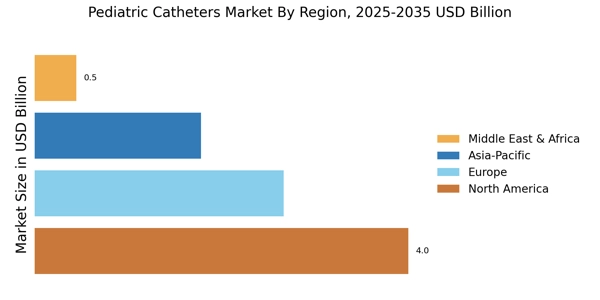
North America is the largest market for pediatric catheters, holding approximately 45% of the global share. The region's growth is driven by advanced healthcare infrastructure, increasing prevalence of pediatric diseases, and a strong focus on innovation. Regulatory support from agencies like the FDA further catalyzes market expansion, ensuring safety and efficacy in pediatric healthcare products. The demand for minimally invasive procedures is also on the rise, contributing to market growth. The United States is the leading country in this market, followed by Canada. Major players such as Medtronic, Boston Scientific, and Teleflex Incorporated dominate the landscape, leveraging their technological advancements and extensive distribution networks. The competitive environment is characterized by continuous product development and strategic partnerships, enhancing the availability of specialized pediatric catheters. This dynamic landscape positions North America as a hub for pediatric healthcare innovation.

Europe : Emerging Regulatory Frameworks

Europe is the second-largest market for pediatric catheters, accounting for approximately 30% of the global market share. The region's growth is propelled by increasing healthcare expenditure, a rising number of pediatric surgeries, and stringent regulatory frameworks that ensure product safety. The European Medicines Agency (EMA) plays a crucial role in regulating medical devices, fostering innovation while maintaining high safety standards. The demand for advanced catheter technologies is also rising, driven by the need for improved patient outcomes. Germany and the United Kingdom are the leading countries in this market, with a strong presence of key players like B. Braun Melsungen AG and Fresenius Kabi. The competitive landscape is marked by collaborations and mergers aimed at enhancing product offerings and market reach. Companies are increasingly focusing on research and development to introduce innovative solutions tailored to pediatric needs, ensuring a robust market presence in Europe.

Asia-Pacific : Rapidly Growing Market Potential

Asia-Pacific is witnessing rapid growth in the pediatric catheters market, holding approximately 20% of the global share. The region's expansion is driven by increasing healthcare access, rising awareness of pediatric health issues, and a growing population. Countries like India and China are investing heavily in healthcare infrastructure, which is expected to boost the demand for pediatric medical devices. Additionally, government initiatives aimed at improving child healthcare are further propelling market growth. China and India are the leading countries in this region, with a burgeoning market for pediatric catheters. The competitive landscape is evolving, with both local and international players striving to capture market share. Companies are focusing on affordability and accessibility, tailoring their products to meet the specific needs of pediatric patients. This dynamic environment presents significant opportunities for growth in the Asia-Pacific pediatric catheters market.

Middle East and Africa : Untapped Market Opportunities

The Middle East and Africa region is gradually emerging in the pediatric catheters market, currently holding about 5% of the global share. The growth is primarily driven by increasing healthcare investments, rising awareness of pediatric health issues, and government initiatives aimed at improving healthcare access. Countries like South Africa and the UAE are making strides in enhancing their healthcare systems, which is expected to boost the demand for pediatric medical devices in the coming years. South Africa is the leading country in this region, with a growing presence of both local and international players. The competitive landscape is characterized by a focus on affordability and accessibility, as companies aim to cater to the unique needs of pediatric patients. As healthcare infrastructure continues to improve, the Middle East and Africa present significant untapped opportunities for growth in the pediatric catheters market.

Pediatric Catheters Market Regional Image

Key Players and Competitive Insights

The Pediatric Catheters Market is characterized by a dynamic competitive landscape, driven by increasing healthcare needs and technological advancements. Key players such as Medtronic (US), Boston Scientific (US), and B. Braun Melsungen AG (DE) are at the forefront, each adopting distinct strategies to enhance their market presence. Medtronic (US) focuses on innovation through the development of advanced catheter technologies, while Boston Scientific (US) emphasizes strategic partnerships to expand its product offerings. B. Braun Melsungen AG (DE) is leveraging its extensive global network to optimize supply chains and enhance distribution efficiency. Collectively, these strategies contribute to a competitive environment that is increasingly shaped by innovation and collaboration.

In terms of business tactics, companies are localizing manufacturing to reduce costs and improve responsiveness to regional demands. The Pediatric Catheters Market appears moderately fragmented, with several players vying for market share. The influence of key players is significant, as their operational strategies often set benchmarks for industry standards and practices, thereby shaping the overall market structure.

In August 2025, Teleflex Incorporated (US) announced the launch of a new line of pediatric catheters designed specifically for neonatal patients. This strategic move not only addresses a critical gap in the market but also reinforces Teleflex's commitment to innovation in pediatric healthcare. By focusing on the unique needs of this vulnerable population, Teleflex positions itself as a leader in specialized catheter solutions, potentially enhancing its market share and brand loyalty.

In September 2025, Smiths Medical (US) entered into a partnership with a leading pediatric hospital network to develop tailored catheter solutions. This collaboration is indicative of a broader trend where companies are aligning with healthcare providers to co-create products that meet specific clinical needs. Such partnerships may enhance product relevance and accelerate the adoption of new technologies in clinical settings, thereby strengthening Smiths Medical's competitive position.

In July 2025, ConvaTec Group (GB) expanded its manufacturing capabilities in Europe to better serve the pediatric market. This expansion is strategically important as it allows ConvaTec to streamline its supply chain and respond more effectively to regional demands. By enhancing its production capacity, the company is likely to improve its market responsiveness and operational efficiency, which are critical in a competitive landscape where speed and reliability are paramount.

As of October 2025, the Pediatric Catheters Market is witnessing trends such as digitalization and sustainability, which are reshaping competitive dynamics. Companies are increasingly integrating artificial intelligence into their product development processes, enhancing precision and efficiency. Strategic alliances are becoming more prevalent, as firms recognize the value of collaboration in driving innovation. Looking ahead, competitive differentiation is expected to evolve, with a shift from price-based competition to a focus on technological advancements, innovative solutions, and robust supply chain management.

Key Companies in the Pediatric Catheters Market include

Industry Developments

In May 2022

BeiGene, a science-driven biotechnology company leader, focuses on innovative and affordable medicines for better treatment outcomes and accessing patients worldwide. The company has announced that the China National Medical Products Administration granted conditional approval for BLINCYTO injection to treat pediatric patients with refractory (R/R) CD19-positive B-cell precursor acute lymphoblastic leukemia. 

In April 2022

Bendit Technologies, an Israeli medical device company, received 510(k) clearance from US Food and Drug Administration for its steerable Bendit21 microcatheter device. 

This news of the clearance came after the Bendit neuro catheter was used in two life-saving procedures in the US. The Bendit technology presents a transformative paradigm in endovascular navigation for revolutionizing and accessing the vasculature. It will improve treatments of arterial and venous systems in the brain.

Future Outlook

Pediatric Catheters Market Future Outlook

The Pediatric Catheters Market is projected to grow at a 9.48% CAGR from 2025 to 2035, driven by technological advancements, increasing healthcare expenditure, and rising pediatric patient populations.

New opportunities lie in:

  • Development of biocompatible catheter materials for enhanced patient safety.
  • Expansion of telehealth services for remote catheter management.
  • Implementation of AI-driven analytics for personalized catheter care.

By 2035, the Pediatric Catheters Market is expected to achieve substantial growth and innovation.

Market Segmentation

Pediatric Catheters Market End User Outlook

  • Hospitals & Clinics
  • Ambulatory Surgical Centers
  • Others

Pediatric Catheters Market Product Type Outlook

  • Cardiovascular Catheters
  • Urology Catheters
  • Intravenous Catheters
  • Neurovascular Catheters
  • Specialty Catheters
  • Others

Report Scope

MARKET SIZE 2024 8.977(USD Billion)
MARKET SIZE 2025 9.828(USD Billion)
MARKET SIZE 2035 24.31(USD Billion)
COMPOUND ANNUAL GROWTH RATE (CAGR) 9.48% (2025 - 2035)
REPORT COVERAGE Revenue Forecast, Competitive Landscape, Growth Factors, and Trends
BASE YEAR 2024
Market Forecast Period 2025 - 2035
Historical Data 2019 - 2024
Market Forecast Units USD Billion
Key Companies Profiled Medtronic (US), Boston Scientific (US), B. Braun Melsungen AG (DE), Teleflex Incorporated (US), Smiths Medical (US), Hollister Incorporated (US), ConvaTec Group (GB), Cook Medical (US), Fresenius Kabi (DE)
Segments Covered Product Type
Key Market Opportunities Advancements in biocompatible materials enhance safety and comfort in the Pediatric Catheters Market.
Key Market Dynamics Rising demand for minimally invasive procedures drives innovation and competition in the Pediatric Catheters Market.
Countries Covered North America, Europe, APAC, South America, MEA

Market Highlights

Author
Author
Author Profile
Vikita Thakur LinkedIn
Senior Research Analyst
She holds an experience of about 5+ years in market research and business consulting projects for sectors such as life sciences, medical devices, and healthcare IT. She possesses a robust background in data analysis, market estimation, competitive intelligence, pipeline analysis market trend identification, and consumer behavior insights. Her expertise lies in technical Sales support, client interaction and project management, designing and implementing market research studies, conducting competitive analysis, and synthesizing complex data into actionable recommendations that drive business growth.
Co-Author
Co-Author Profile
Kinjoll Dey LinkedIn
Senior Research Analyst
He is an extremely curious individual currently working in Healthcare and Medical Devices Domain. Kinjoll is comfortably versed in data centric research backed by healthcare educational background. He leverages extensive data mining and analytics tools such as Primary and Secondary Research, Statistical Analysis, Machine Learning, Data Modelling. His key role also involves Technical Sales Support, Client Interaction and Project management within the Healthcare team. Lastly, he showcases extensive affinity towards learning new skills and remain fascinated in implementing them.
Leave a Comment

FAQs

What is the projected market valuation of the Pediatric Catheters Market by 2035?

The Pediatric Catheters Market is projected to reach a valuation of 24.31 USD Billion by 2035.

What was the market valuation of the Pediatric Catheters Market in 2024?

In 2024, the Pediatric Catheters Market was valued at 8.977 USD Billion.

What is the expected CAGR for the Pediatric Catheters Market during the forecast period 2025 - 2035?

The expected CAGR for the Pediatric Catheters Market during the forecast period 2025 - 2035 is 9.48%.

Which product type segment is projected to have the highest valuation by 2035?

The Intravenous Catheters segment is projected to reach a valuation of 7.0 USD Billion by 2035.

What are the key players in the Pediatric Catheters Market?

Key players in the Pediatric Catheters Market include Medtronic, Boston Scientific, and B. Braun Melsungen AG.

How does the Urology Catheters segment perform in terms of valuation?

The Urology Catheters segment was valued at 1.2 USD Billion in 2024 and is projected to grow to 3.5 USD Billion by 2035.

What is the projected valuation for the Hospitals & Clinics end-user segment by 2035?

The Hospitals & Clinics end-user segment is projected to reach a valuation of 9.5 USD Billion by 2035.

What is the expected growth for the Specialty Catheters segment from 2024 to 2035?

The Specialty Catheters segment is expected to grow from 1.0 USD Billion in 2024 to 3.0 USD Billion by 2035.

What is the valuation of the Ambulatory Surgical Centers segment in 2024?

The Ambulatory Surgical Centers segment was valued at 2.6915 USD Billion in 2024.

How does the performance of the Others segment compare between 2024 and 2035?

The Others segment is expected to grow from 2.777 USD Billion in 2024 to 3.81 USD Billion by 2035.
Download Free Sample

Kindly complete the form below to receive a free sample of this Report

Compare Licence

×
Features License Type
Single User Multiuser License Enterprise User
Price $4,950 $5,950 $7,250
Maximum User Access Limit 1 User Upto 10 Users Unrestricted Access Throughout the Organization
Free Customization
Direct Access to Analyst
Deliverable Format
Platform Access
Discount on Next Purchase 10% 15% 15%
Printable Versions