×
Hero Background
English
Chinese
French
Japanese
Korean
German
Spanish

Pediatric Catheters Market Analysis

ID: MRFR/MED/6390-HCR
95 Pages
Kinjoll Dey
October 2025

Pediatric Catheters Market Research Report by Product Type (Cardiovascular Catheters, Urology Catheters, Intravenous Catheters, Neurovascular Catheters, Specialty Catheters and Others), End User (Hospitals, Clinics, Ambulatory Surgical Centers and Others) and Region - Forecast till 2035

Share:
Download PDF ×

We do not share your information with anyone. However, we may send you emails based on your report interest from time to time. You may contact us at any time to opt-out.

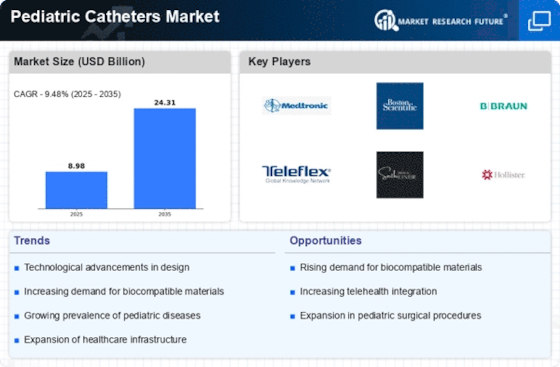
Pediatric Catheters Market Infographic
Purchase Options

Market Analysis

In-depth Analysis of Pediatric Catheters Market Industry Landscape

The pediatric catheter market plays an essential role in addressing the specific clinical desires of youngsters, encompassing a wide variety of catheter types designed particularly for pediatric sufferers. The marketplace dynamics are substantially influenced by the growing incidence of pediatric problems, which include congenital anomalies and urinary tract troubles, riding the demand for specialized catheters tailor-made to the anatomical and physiological necessities of kids. The shift towards minimally invasive processes is a key market trend. Pediatric catheters are increasingly being used in minimally invasive surgeries and diagnostic strategies, offering reduced restoration times and less trauma for young patients. Stringent regulatory pointers and requirements are influencing market dynamics. Compliance with safety and pleasant requirements is vital for manufacturers, impacting product development, advertising, and marketplace entry techniques. The pediatric catheter market is witnessing global enlargement, with growing marketplace penetration in developing areas. Improving healthcare infrastructure and rising healthcare expenditure contribute to the marketplace's growth on a global scale. Collaborations among medical device producers and healthcare establishments are getting extra accepted. Such a partnership's purpose is to mix expertise and sources, fostering innovation and the development of pediatric catheters that meet unique scientific desires. Cost constraints and repayment challenges continue to be sizable hurdles within the market. The high price of superior pediatric catheters, coupled with compensation uncertainties, can obstruct marketplace growth, in particular in regions with constrained economic resources. Patient-centric techniques are gaining significance, with producers focusing on person-friendly designs and infant-pleasant features. Customization of catheters to meet the specific desires of pediatric patients is turning into a key approach for marketplace gamers. Intense competition among key market players is fostering innovation and product development. Market leaders are investing in research and improvement to stay ahead, introducing new catheter designs and features to gain a competitive edge. Performing catheterization techniques in pediatric patients poses precise challenges. The market dynamics are motivated by ongoing efforts to overcome those challenges, such as growing smaller and more bendy catheters to decorate procedural achievement costs. There is a great shift toward home healthcare for pediatric patients, influencing the demand for person-pleasant catheters that mothers and father or caregivers can effortlessly manage. This trend is altering the conventional medical institution-centric method of pediatric care. The destiny of the pediatric catheter market is promising, with a focal point on non-stop innovation, enhancing affected person effects, and addressing the unmet needs of pediatric patients.


Author
Kinjoll Dey
Research Analyst Level I

He is an extremely curious individual currently working in Healthcare and Medical Devices Domain. Kinjoll is comfortably versed in data centric research backed by healthcare educational background. He leverages extensive data mining and analytics tools such as Primary and Secondary Research, Statistical Analysis, Machine Learning, Data Modelling. His key role also involves Technical Sales Support, Client Interaction and Project management within the Healthcare team. Lastly, he showcases extensive affinity towards learning new skills and remain fascinated in implementing them.

Leave a Comment

FAQs

What is the projected market valuation of the Pediatric Catheters Market by 2035?

The Pediatric Catheters Market is projected to reach a valuation of 24.31 USD Billion by 2035.

What was the market valuation of the Pediatric Catheters Market in 2024?

In 2024, the Pediatric Catheters Market was valued at 8.977 USD Billion.

What is the expected CAGR for the Pediatric Catheters Market during the forecast period 2025 - 2035?

The expected CAGR for the Pediatric Catheters Market during the forecast period 2025 - 2035 is 9.48%.

Which product type segment is projected to have the highest valuation by 2035?

The Intravenous Catheters segment is projected to reach a valuation of 7.0 USD Billion by 2035.

What are the key players in the Pediatric Catheters Market?

Key players in the Pediatric Catheters Market include Medtronic, Boston Scientific, and B. Braun Melsungen AG.

Market Summary

As per MRFR analysis, the Pediatric Catheters Market Size was estimated at 8.977 USD Billion in 2024. The Pediatric Catheters industry is projected to grow from 9.828 USD Billion in 2025 to 24.31 USD Billion by 2035, exhibiting a compound annual growth rate (CAGR) of 9.48 during the forecast period 2025 - 2035.

Key Market Trends & Highlights

The Pediatric Catheters Market is experiencing robust growth driven by technological advancements and increasing healthcare focus.

  • Technological advancements are enhancing the efficacy and safety of pediatric catheters, leading to improved patient outcomes.
  • North America remains the largest market for pediatric catheters, while the Asia-Pacific region is emerging as the fastest-growing market.
  • Intravenous catheters dominate the market, whereas urology catheters are witnessing the fastest growth due to rising demand.
  • The increasing pediatric population and rising incidence of congenital disorders are key drivers propelling market expansion.

Market Size & Forecast

2024 Market Size 8.977 (USD Billion)
2035 Market Size 24.31 (USD Billion)
CAGR (2025 - 2035) 9.48%
Largest Regional Market Share in 2024 Americas

Major Players

<p>Medtronic (US), Boston Scientific (US), B. Braun Melsungen AG (DE), Teleflex Incorporated (US), Smiths Medical (US), Hollister Incorporated (US), ConvaTec Group (GB), Cook Medical (US), Fresenius Kabi (DE)</p>

Market Trends

The Pediatric Catheters Market is currently experiencing a notable evolution, driven by advancements in medical technology and an increasing awareness of pediatric healthcare needs. The demand for specialized catheters designed for children is on the rise, as healthcare providers seek to enhance patient comfort and safety. Innovations in materials and designs are contributing to improved outcomes, making these devices more effective and easier to use. Furthermore, the growing prevalence of chronic conditions among children necessitates the use of catheters for long-term management, thereby expanding the market's scope. In addition, regulatory bodies are placing greater emphasis on the safety and efficacy of pediatric medical devices, which is likely to influence product development and market dynamics. Manufacturers are focusing on creating catheters that minimize complications and enhance usability, which may lead to increased adoption in clinical settings. As the Pediatric Catheters Market continues to evolve, it appears poised for growth, driven by technological advancements and a commitment to improving pediatric care.

Technological Advancements

The Pediatric Catheters Market is witnessing a surge in technological innovations, with manufacturers developing advanced materials and designs that enhance the functionality and safety of catheters. These advancements aim to reduce complications and improve patient comfort, thereby increasing the appeal of these devices in clinical settings.

Regulatory Focus on Safety

There is a growing emphasis on regulatory standards concerning pediatric medical devices, which is shaping the Pediatric Catheters Market. Stricter guidelines are prompting manufacturers to prioritize safety and efficacy in their product offerings, potentially leading to higher quality standards across the industry.

Rising Chronic Conditions

The increasing prevalence of chronic health issues among children is driving demand within the Pediatric Catheters Market. As more children require long-term catheterization for management of these conditions, the market is likely to expand, necessitating innovative solutions tailored to pediatric patients.

Pediatric Catheters Market Market Drivers

Technological Innovations

Technological advancements in catheter design and materials are significantly influencing the Pediatric Catheters Market. Innovations such as biocompatible materials and advanced manufacturing techniques are enhancing the safety and efficacy of pediatric catheters. For instance, the introduction of catheters with antimicrobial coatings has been shown to reduce infection rates, which is a critical concern in pediatric care. Additionally, the development of smaller, more flexible catheters allows for easier insertion and greater comfort for young patients. These technological improvements not only enhance patient outcomes but also encourage healthcare facilities to adopt newer products, thereby driving growth in the Pediatric Catheters Market.

Increasing Pediatric Population

The rising pediatric population is a crucial driver for the Pediatric Catheters Market. As the number of children requiring medical interventions increases, the demand for pediatric catheters is likely to grow. According to recent demographic data, the population of children under the age of 18 is projected to rise steadily, leading to a higher incidence of conditions that necessitate catheterization. This trend suggests that healthcare providers will need to invest in specialized pediatric catheters to cater to this expanding demographic. Furthermore, the increasing awareness among parents regarding pediatric health issues may also contribute to the demand for these medical devices, thereby propelling the Pediatric Catheters Market forward.

Enhanced Focus on Pediatric Healthcare

There is an increasing emphasis on pediatric healthcare, which is driving the Pediatric Catheters Market. Governments and healthcare organizations are recognizing the need for specialized medical devices tailored to children. This focus is reflected in policy initiatives aimed at improving pediatric care standards and increasing funding for pediatric health programs. As a result, healthcare providers are more likely to invest in pediatric-specific products, including catheters. The growing recognition of the unique healthcare needs of children is likely to lead to a more robust market for pediatric catheters, as stakeholders prioritize the development and distribution of these essential medical devices.

Regulatory Support for Pediatric Devices

Regulatory bodies are increasingly supporting the development of pediatric medical devices, which is beneficial for the Pediatric Catheters Market. Initiatives aimed at expediting the approval process for pediatric-specific products are encouraging manufacturers to innovate and bring new catheters to market. This regulatory support is crucial, as it not only enhances the availability of specialized devices but also ensures that they meet safety and efficacy standards. As a result, healthcare providers are more inclined to adopt these products, knowing they have undergone rigorous evaluation. This trend is likely to stimulate growth in the Pediatric Catheters Market, as more pediatric catheters become accessible to healthcare facilities.

Rising Incidence of Congenital Disorders

The increasing prevalence of congenital disorders is a significant factor propelling the Pediatric Catheters Market. Conditions such as congenital heart defects and urinary tract malformations often require catheterization for effective management. Recent studies indicate that approximately 1 in 33 infants is born with a congenital anomaly, necessitating specialized medical interventions. As healthcare systems strive to provide better care for these patients, the demand for pediatric catheters is expected to rise. This trend underscores the importance of developing catheters that are specifically designed for the unique anatomical and physiological needs of children, thereby fostering growth in the Pediatric Catheters Market.

Market Segment Insights

By Product Type: Intravenous Catheters (Largest) vs. Urology Catheters (Fastest-Growing)

<p>In the Pediatric Catheters Market, the distribution of market share among product types reveals that intravenous catheters hold the largest share due to their widespread applications in pediatric care. Following closely are urology catheters, cardiovascular catheters, and neurovascular catheters, each holding significant positions but comparatively less market dominance. Specialty catheters and other categories contribute to the niche demands, catering to specific pediatric needs. The growth trends in this segment indicate a surge in demand for urology catheters, attributed to rising incidences of pediatric urological conditions. Intravenous catheters remain popular due to advancements in technology and increasing awareness of effective treatment in pediatric populations. Innovations in catheter design and safety features are further propelling the growth of urology catheters, marking them as the fastest-growing segment in this market.</p>

<p>Intravenous Catheters (Dominant) vs. Urology Catheters (Emerging)</p>

<p>Intravenous catheters are characterized by their broad applicability in pediatric healthcare, serving crucial roles in medication delivery, fluid administration, and blood sampling. Their dominance is reinforced by a combination of reliable performance and technological advancements ensuring safety and ease of usage. Conversely, urology catheters, while emerging, are gaining traction rapidly due to increased awareness of pediatric urological health issues. These catheters are specially designed to address the unique anatomical and physiological challenges faced in pediatric patients, ensuring effectiveness and minimizing complications. With innovative designs and a focus on comfort, urology catheters are positioned well for substantial growth in the coming years.</p>

By End User: Hospitals & Clinics (Largest) vs. Ambulatory Surgical Centers (Fastest-Growing)

<p>In the Pediatric Catheters Market, 'Hospitals & Clinics' dominate the end-user segment, accounting for the largest share due to their comprehensive capabilities and specialized care for pediatric patients. These facilities often have advanced medical technology and access to a wider range of pediatric catheter types, making them the preferred choice for many healthcare providers and patients alike. On the other hand, 'Ambulatory Surgical Centers' are emerging as a strong contender, capitalizing on the growing demand for outpatient procedures and minimally invasive techniques that require specialized catheter solutions.</p>

<p>Hospitals & Clinics (Dominant) vs. Ambulatory Surgical Centers (Emerging)</p>

<p>In the pediatric catheters market, 'Hospitals & Clinics' play a pivotal role as the dominant end-user segment, equipped with the necessary infrastructure and personnel to manage complex pediatric cases. They provide a comprehensive range of services from diagnosis to treatment, ensuring that children receive the best care possible. Conversely, 'Ambulatory Surgical Centers' represent an emerging market, leveraging the shift towards outpatient care and efficiency in surgical processes. These centers focus on minimizing patient recovery time and costs, driving an increased demand for specialized catheters designed for outpatient procedures. The collaboration between these two segments is crucial as they contribute significantly to the advancement of pediatric care.</p>

Get more detailed insights about Pediatric Catheters Market Research Report - Forecast till 2035

Regional Insights

Key Companies in the Pediatric Catheters Market market include

Industry Developments

In May 2022

BeiGene, a science-driven biotechnology company leader, focuses on innovative and affordable medicines for better treatment outcomes and accessing patients worldwide. The company has announced that the China National Medical Products Administration granted conditional approval for BLINCYTO injection to treat pediatric patients with refractory (R/R) CD19-positive B-cell precursor acute lymphoblastic leukemia. 

In April 2022

Bendit Technologies, an Israeli medical device company, received 510(k) clearance from US Food and Drug Administration for its steerable Bendit21 microcatheter device. 

This news of the clearance came after the Bendit neuro catheter was used in two life-saving procedures in the US. The Bendit technology presents a transformative paradigm in endovascular navigation for revolutionizing and accessing the vasculature. It will improve treatments of arterial and venous systems in the brain.

Future Outlook

Pediatric Catheters Market Future Outlook

<p>The Pediatric Catheters Market is projected to grow at a 9.48% CAGR from 2024 to 2035, driven by technological advancements, increasing healthcare expenditure, and rising pediatric patient populations.</p>

New opportunities lie in:

  • <p>Development of biocompatible catheter materials for enhanced patient safety.</p>
  • <p>Expansion of telehealth services for remote catheter management.</p>
  • <p>Implementation of AI-driven analytics for personalized catheter care.</p>

<p>By 2035, the Pediatric Catheters Market is expected to achieve substantial growth and innovation.</p>

Market Segmentation

Pediatric Catheters Market End User Outlook

  • Hospitals & Clinics
  • Ambulatory Surgical Centers
  • Others

Pediatric Catheters Market Product Type Outlook

  • Cardiovascular Catheters
  • Urology Catheters
  • Intravenous Catheters
  • Neurovascular Catheters
  • Specialty Catheters
  • Others

Report Scope

MARKET SIZE 20248.977(USD Billion)
MARKET SIZE 20259.828(USD Billion)
MARKET SIZE 203524.31(USD Billion)
COMPOUND ANNUAL GROWTH RATE (CAGR)9.48% (2024 - 2035)
REPORT COVERAGERevenue Forecast, Competitive Landscape, Growth Factors, and Trends
BASE YEAR2024
Market Forecast Period2025 - 2035
Historical Data2019 - 2024
Market Forecast UnitsUSD Billion
Key Companies ProfiledMarket analysis in progress
Segments CoveredMarket segmentation analysis in progress
Key Market OpportunitiesAdvancements in biocompatible materials enhance safety and comfort in the Pediatric Catheters Market.
Key Market DynamicsRising demand for minimally invasive procedures drives innovation and competition in the Pediatric Catheters Market.
Countries CoveredNorth America, Europe, APAC, South America, MEA

FAQs

What is the projected market valuation of the Pediatric Catheters Market by 2035?

The Pediatric Catheters Market is projected to reach a valuation of 24.31 USD Billion by 2035.

What was the market valuation of the Pediatric Catheters Market in 2024?

In 2024, the Pediatric Catheters Market was valued at 8.977 USD Billion.

What is the expected CAGR for the Pediatric Catheters Market during the forecast period 2025 - 2035?

The expected CAGR for the Pediatric Catheters Market during the forecast period 2025 - 2035 is 9.48%.

Which product type segment is projected to have the highest valuation by 2035?

The Intravenous Catheters segment is projected to reach a valuation of 7.0 USD Billion by 2035.

What are the key players in the Pediatric Catheters Market?

Key players in the Pediatric Catheters Market include Medtronic, Boston Scientific, and B. Braun Melsungen AG.

  1. SECTION I: EXECUTIVE SUMMARY AND KEY HIGHLIGHTS
    1. EXECUTIVE SUMMARY
      1. Market Overview
      2. Key Findings
      3. Market Segmentation
      4. Competitive Landscape
      5. Challenges and Opportunities
      6. Future Outlook
  2. SECTION II: SCOPING, METHODOLOGY AND MARKET STRUCTURE
    1. MARKET INTRODUCTION
      1. Definition
      2. Scope of the study
    2. RESEARCH METHODOLOGY
      1. Overview
      2. Data Mining
      3. Secondary Research
      4. Primary Research
      5. Forecasting Model
      6. Market Size Estimation
      7. Data Triangulation
      8. Validation
  3. SECTION III: QUALITATIVE ANALYSIS
    1. MARKET DYNAMICS
      1. Overview
      2. Drivers
      3. Restraints
      4. Opportunities
    2. MARKET FACTOR ANALYSIS
      1. Value chain Analysis
      2. Porter's Five Forces Analysis
      3. COVID-19 Impact Analysis
  4. SECTION IV: QUANTITATIVE ANALYSIS
    1. Healthcare, BY Product Type (USD Billion)
      1. Cardiovascular Catheters
      2. Urology Catheters
      3. Intravenous Catheters
      4. Neurovascular Catheters
      5. Specialty Catheters
      6. Others
    2. Healthcare, BY End User (USD Billion)
      1. Hospitals & Clinics
      2. Ambulatory Surgical Centers
      3. Others
    3. Healthcare, BY Region (USD Billion)
      1. North America
      2. Europe
      3. APAC
      4. South America
      5. MEA
  5. SECTION V: COMPETITIVE ANALYSIS
    1. Competitive Landscape
      1. Overview
      2. Competitive Analysis
      3. Market share Analysis
      4. Major Growth Strategy in the Healthcare
      5. Competitive Benchmarking
      6. Leading Players in Terms of Number of Developments in the Healthcare
      7. Key developments and growth strategies
      8. Major Players Financial Matrix
    2. Company Profiles
      1. Medtronic (US)
      2. Boston Scientific (US)
      3. B. Braun Melsungen AG (DE)
      4. Teleflex Incorporated (US)
      5. Smiths Medical (US)
      6. Hollister Incorporated (US)
      7. ConvaTec Group (GB)
      8. Cook Medical (US)
      9. Fresenius Kabi (DE)
    3. Appendix
      1. References
      2. Related Reports
  6. LIST OF FIGURES
    1. MARKET SYNOPSIS
    2. NORTH AMERICA MARKET ANALYSIS
    3. US MARKET ANALYSIS BY PRODUCT TYPE
    4. US MARKET ANALYSIS BY END USER
    5. CANADA MARKET ANALYSIS BY PRODUCT TYPE
    6. CANADA MARKET ANALYSIS BY END USER
    7. EUROPE MARKET ANALYSIS
    8. GERMANY MARKET ANALYSIS BY PRODUCT TYPE
    9. GERMANY MARKET ANALYSIS BY END USER
    10. UK MARKET ANALYSIS BY PRODUCT TYPE
    11. UK MARKET ANALYSIS BY END USER
    12. FRANCE MARKET ANALYSIS BY PRODUCT TYPE
    13. FRANCE MARKET ANALYSIS BY END USER
    14. RUSSIA MARKET ANALYSIS BY PRODUCT TYPE
    15. RUSSIA MARKET ANALYSIS BY END USER
    16. ITALY MARKET ANALYSIS BY PRODUCT TYPE
    17. ITALY MARKET ANALYSIS BY END USER
    18. SPAIN MARKET ANALYSIS BY PRODUCT TYPE
    19. SPAIN MARKET ANALYSIS BY END USER
    20. REST OF EUROPE MARKET ANALYSIS BY PRODUCT TYPE
    21. REST OF EUROPE MARKET ANALYSIS BY END USER
    22. APAC MARKET ANALYSIS
    23. CHINA MARKET ANALYSIS BY PRODUCT TYPE
    24. CHINA MARKET ANALYSIS BY END USER
    25. INDIA MARKET ANALYSIS BY PRODUCT TYPE
    26. INDIA MARKET ANALYSIS BY END USER
    27. JAPAN MARKET ANALYSIS BY PRODUCT TYPE
    28. JAPAN MARKET ANALYSIS BY END USER
    29. SOUTH KOREA MARKET ANALYSIS BY PRODUCT TYPE
    30. SOUTH KOREA MARKET ANALYSIS BY END USER
    31. MALAYSIA MARKET ANALYSIS BY PRODUCT TYPE
    32. MALAYSIA MARKET ANALYSIS BY END USER
    33. THAILAND MARKET ANALYSIS BY PRODUCT TYPE
    34. THAILAND MARKET ANALYSIS BY END USER
    35. INDONESIA MARKET ANALYSIS BY PRODUCT TYPE
    36. INDONESIA MARKET ANALYSIS BY END USER
    37. REST OF APAC MARKET ANALYSIS BY PRODUCT TYPE
    38. REST OF APAC MARKET ANALYSIS BY END USER
    39. SOUTH AMERICA MARKET ANALYSIS
    40. BRAZIL MARKET ANALYSIS BY PRODUCT TYPE
    41. BRAZIL MARKET ANALYSIS BY END USER
    42. MEXICO MARKET ANALYSIS BY PRODUCT TYPE
    43. MEXICO MARKET ANALYSIS BY END USER
    44. ARGENTINA MARKET ANALYSIS BY PRODUCT TYPE
    45. ARGENTINA MARKET ANALYSIS BY END USER
    46. REST OF SOUTH AMERICA MARKET ANALYSIS BY PRODUCT TYPE
    47. REST OF SOUTH AMERICA MARKET ANALYSIS BY END USER
    48. MEA MARKET ANALYSIS
    49. GCC COUNTRIES MARKET ANALYSIS BY PRODUCT TYPE
    50. GCC COUNTRIES MARKET ANALYSIS BY END USER
    51. SOUTH AFRICA MARKET ANALYSIS BY PRODUCT TYPE
    52. SOUTH AFRICA MARKET ANALYSIS BY END USER
    53. REST OF MEA MARKET ANALYSIS BY PRODUCT TYPE
    54. REST OF MEA MARKET ANALYSIS BY END USER
    55. KEY BUYING CRITERIA OF HEALTHCARE
    56. RESEARCH PROCESS OF MRFR
    57. DRO ANALYSIS OF HEALTHCARE
    58. DRIVERS IMPACT ANALYSIS: HEALTHCARE
    59. RESTRAINTS IMPACT ANALYSIS: HEALTHCARE
    60. SUPPLY / VALUE CHAIN: HEALTHCARE
    61. HEALTHCARE, BY PRODUCT TYPE, 2024 (% SHARE)
    62. HEALTHCARE, BY PRODUCT TYPE, 2024 TO 2035 (USD Billion)
    63. HEALTHCARE, BY END USER, 2024 (% SHARE)
    64. HEALTHCARE, BY END USER, 2024 TO 2035 (USD Billion)
    65. BENCHMARKING OF MAJOR COMPETITORS
  7. LIST OF TABLES
    1. LIST OF ASSUMPTIONS
    2. North America MARKET SIZE ESTIMATES; FORECAST
      1. BY PRODUCT TYPE, 2025-2035 (USD Billion)
      2. BY END USER, 2025-2035 (USD Billion)
    3. US MARKET SIZE ESTIMATES; FORECAST
      1. BY PRODUCT TYPE, 2025-2035 (USD Billion)
      2. BY END USER, 2025-2035 (USD Billion)
    4. Canada MARKET SIZE ESTIMATES; FORECAST
      1. BY PRODUCT TYPE, 2025-2035 (USD Billion)
      2. BY END USER, 2025-2035 (USD Billion)
    5. Europe MARKET SIZE ESTIMATES; FORECAST
      1. BY PRODUCT TYPE, 2025-2035 (USD Billion)
      2. BY END USER, 2025-2035 (USD Billion)
    6. Germany MARKET SIZE ESTIMATES; FORECAST
      1. BY PRODUCT TYPE, 2025-2035 (USD Billion)
      2. BY END USER, 2025-2035 (USD Billion)
    7. UK MARKET SIZE ESTIMATES; FORECAST
      1. BY PRODUCT TYPE, 2025-2035 (USD Billion)
      2. BY END USER, 2025-2035 (USD Billion)
    8. France MARKET SIZE ESTIMATES; FORECAST
      1. BY PRODUCT TYPE, 2025-2035 (USD Billion)
      2. BY END USER, 2025-2035 (USD Billion)
    9. Russia MARKET SIZE ESTIMATES; FORECAST
      1. BY PRODUCT TYPE, 2025-2035 (USD Billion)
      2. BY END USER, 2025-2035 (USD Billion)
    10. Italy MARKET SIZE ESTIMATES; FORECAST
      1. BY PRODUCT TYPE, 2025-2035 (USD Billion)
      2. BY END USER, 2025-2035 (USD Billion)
    11. Spain MARKET SIZE ESTIMATES; FORECAST
      1. BY PRODUCT TYPE, 2025-2035 (USD Billion)
      2. BY END USER, 2025-2035 (USD Billion)
    12. Rest of Europe MARKET SIZE ESTIMATES; FORECAST
      1. BY PRODUCT TYPE, 2025-2035 (USD Billion)
      2. BY END USER, 2025-2035 (USD Billion)
    13. APAC MARKET SIZE ESTIMATES; FORECAST
      1. BY PRODUCT TYPE, 2025-2035 (USD Billion)
      2. BY END USER, 2025-2035 (USD Billion)
    14. China MARKET SIZE ESTIMATES; FORECAST
      1. BY PRODUCT TYPE, 2025-2035 (USD Billion)
      2. BY END USER, 2025-2035 (USD Billion)
    15. India MARKET SIZE ESTIMATES; FORECAST
      1. BY PRODUCT TYPE, 2025-2035 (USD Billion)
      2. BY END USER, 2025-2035 (USD Billion)
    16. Japan MARKET SIZE ESTIMATES; FORECAST
      1. BY PRODUCT TYPE, 2025-2035 (USD Billion)
      2. BY END USER, 2025-2035 (USD Billion)
    17. South Korea MARKET SIZE ESTIMATES; FORECAST
      1. BY PRODUCT TYPE, 2025-2035 (USD Billion)
      2. BY END USER, 2025-2035 (USD Billion)
    18. Malaysia MARKET SIZE ESTIMATES; FORECAST
      1. BY PRODUCT TYPE, 2025-2035 (USD Billion)
      2. BY END USER, 2025-2035 (USD Billion)
    19. Thailand MARKET SIZE ESTIMATES; FORECAST
      1. BY PRODUCT TYPE, 2025-2035 (USD Billion)
      2. BY END USER, 2025-2035 (USD Billion)
    20. Indonesia MARKET SIZE ESTIMATES; FORECAST
      1. BY PRODUCT TYPE, 2025-2035 (USD Billion)
      2. BY END USER, 2025-2035 (USD Billion)
    21. Rest of APAC MARKET SIZE ESTIMATES; FORECAST
      1. BY PRODUCT TYPE, 2025-2035 (USD Billion)
      2. BY END USER, 2025-2035 (USD Billion)
    22. South America MARKET SIZE ESTIMATES; FORECAST
      1. BY PRODUCT TYPE, 2025-2035 (USD Billion)
      2. BY END USER, 2025-2035 (USD Billion)
    23. Brazil MARKET SIZE ESTIMATES; FORECAST
      1. BY PRODUCT TYPE, 2025-2035 (USD Billion)
      2. BY END USER, 2025-2035 (USD Billion)
    24. Mexico MARKET SIZE ESTIMATES; FORECAST
      1. BY PRODUCT TYPE, 2025-2035 (USD Billion)
      2. BY END USER, 2025-2035 (USD Billion)
    25. Argentina MARKET SIZE ESTIMATES; FORECAST
      1. BY PRODUCT TYPE, 2025-2035 (USD Billion)
      2. BY END USER, 2025-2035 (USD Billion)
    26. Rest of South America MARKET SIZE ESTIMATES; FORECAST
      1. BY PRODUCT TYPE, 2025-2035 (USD Billion)
      2. BY END USER, 2025-2035 (USD Billion)
    27. MEA MARKET SIZE ESTIMATES; FORECAST
      1. BY PRODUCT TYPE, 2025-2035 (USD Billion)
      2. BY END USER, 2025-2035 (USD Billion)
    28. GCC Countries MARKET SIZE ESTIMATES; FORECAST
      1. BY PRODUCT TYPE, 2025-2035 (USD Billion)
      2. BY END USER, 2025-2035 (USD Billion)
    29. South Africa MARKET SIZE ESTIMATES; FORECAST
      1. BY PRODUCT TYPE, 2025-2035 (USD Billion)
      2. BY END USER, 2025-2035 (USD Billion)
    30. Rest of MEA MARKET SIZE ESTIMATES; FORECAST
      1. BY PRODUCT TYPE, 2025-2035 (USD Billion)
      2. BY END USER, 2025-2035 (USD Billion)
    31. PRODUCT LAUNCH/PRODUCT DEVELOPMENT/APPROVAL
    32. ACQUISITION/PARTNERSHIP

Pediatric Catheters Market Segmentation

Market Segmentation Overview

  • Detailed segmentation data will be available in the full report
  • Comprehensive analysis by multiple parameters
  • Regional and country-level breakdowns
  • Market size forecasts by segment
Infographic

Free Sample Request

Kindly complete the form below to receive a free sample of this Report

Get Free Sample

Customer Strories

Compare Licence

×
Features License Type
Single User Multiuser License Enterprise User
Price $4,950 $5,950 $7,250
Maximum User Access Limit 1 User Upto 10 Users Unrestricted Access Throughout the Organization
Free Customization
Direct Access to Analyst
Deliverable Format
Platform Access
Discount on Next Purchase 10% 15% 15%
Printable Versions