Request Free Sample ×

Kindly complete the form below to receive a free sample of this Report

* Please use a valid business email

Leading companies partner with us for data-driven Insights

clients tt-cursor
Hero Background
English
Chinese
French
Japanese
Korean
German
Spanish

4K TV Market Analysis

ID: MRFR/SEM/2140-HCR
200 Pages
Ankit Gupta
Last Updated: April 06, 2026

4K TV Market Size, Share and Research Report By Type (55 Inch, < 55 Inch, 65 Inch), By End-users (Household, Public), And By Region (North America, Europe, Asia-Pacific, And Rest Of The World) – Industry Forecast Till 2035

Share:
Download PDF ×

We do not share your information with anyone. However, we may send you emails based on your report interest from time to time. You may contact us at any time to opt-out.

4K TV Market Infographic
Purchase Options

Market Analysis

In-depth Analysis of 4K TV Market Industry Landscape

The global 4K TV market is characterized by dynamic and multifaceted marketplace dynamics, reflecting the speedy evolution of the television era, and converting consumer preferences. As a phase of the wider TV market, the demand for 4K TVs has seen large growth due to the growing choice for better resolution and immersive viewing experiences. One of the number one forces behind the market dynamics is the relentless pursuit of more desirable image quality. Consumers are increasingly attracted to the advanced readability and detail presented by the 4K decision, which is four times that of conventional Full HD TVs. Competitive pressures also play a pivotal position in shaping the dynamics of the worldwide 4K TV marketplace. Key enterprise gamers engage in fierce opposition to capture market percentage via improvements in layout, capabilities, and pricing techniques. This competition fosters non-stop improvements in 4K TV technology, mainly to the improvement of thinner panels, higher evaluation ratios, and superior HDR (High Dynamic Range) abilities. Consumer conduct and possibilities significantly impact the market dynamics of 4K TVs. As customers become more tech-savvy and seek immersive home leisure reviews, the demand for large screen sizes and smart TV functionalities has risen. The integration of clever features, including streaming services, voice management, and connectivity with other clever devices, has emerged as a key trend in the market. The worldwide 4K TV market is also prompted by broader enterprise tendencies, which include the proliferation of streaming offerings and the growing availability of 4K content material. As streaming platforms and content material producers embrace higher resolutions, clients are inspired to upgrade their TVs to revel in the benefits of 4K content material completely. Economic elements and affordability play a role in shaping the market dynamics of 4K TVs. While the expenses of 4K TVs have regularly declined over the years, affordability remains a key consideration for many purchasers. Manufacturers are looking to strike stability by imparting superior features and preserving competitive pricing to cater to a huge patron base. Economic fluctuations and client spending patterns can have an impact on the adoption rates of 4K TVs in special regions, impacting marketplace dynamics on a global scale. Regulatory standards and environmental concerns contribute to the evolving dynamics of the 4K TV marketplace. Manufacturers are increasingly focused on energy performance and sustainability, mainly on the improvement of eco-friendly models and compliance with global power standards. As regulations evolve, producers must adapt to satisfy environmental requirements, influencing the layout and production techniques of 4K TVs.


Author
Author Profile
Ankit Gupta
Team Lead - Research

Ankit Gupta is a seasoned market intelligence and strategic research professional with over six plus years of experience in the ICT and Semiconductor industries. With academic roots in Telecom, Marketing, and Electronics, he blends technical insight with business strategy. Ankit has led 200+ projects, including work for Fortune 500 clients like Microsoft and Rio Tinto, covering market sizing, tech forecasting, and go-to-market strategies. Known for bridging engineering and enterprise decision-making, his insights support growth, innovation, and investment planning across diverse technology markets.

Leave a Comment

FAQs

What is the current valuation of the 4K TV market as of 2024?

<p>The 4K TV market was valued at 255.6 USD Billion in 2024.</p>

What is the projected market valuation for the 4K TV market in 2035?

<p>The market is projected to reach 2177.63 USD Billion by 2035.</p>

What is the expected CAGR for the 4K TV market during the forecast period 2025 - 2035?

<p>The expected CAGR for the 4K TV market during 2025 - 2035 is 21.5%.</p>

Which companies are the key players in the 4K TV market?

<p>Key players include Samsung Electronics, LG Electronics, Sony Corporation, TCL Technology, and Hisense Group.</p>

How does the 4K TV market perform in the home entertainment segment?

<p>The home entertainment segment was valued at 102.24 USD Billion in 2024 and is expected to grow significantly.</p>

What is the market size for 4K TVs by screen size in 2024?

<p>In 2024, the market size for 50 to 65 inches was 80.0 USD Billion, while above 75 inches was valued at 75.6 USD Billion.</p>

What are the leading display technologies in the 4K TV market?

LED technology led the market with a valuation of 102.24 USD Billion in 2024, followed by OLED and QLED.

What is the market performance of 4K TVs in the gaming segment?

The gaming segment was valued at 51.12 USD Billion in 2024, indicating a robust interest in gaming applications.

How does the price range affect the 4K TV market?

In 2024, the premium price range segment was valued at 85.56 USD Billion, reflecting consumer preferences for high-quality products.

What is the market outlook for 4K TVs in professional use?

The professional use segment was valued at 25.56 USD Billion in 2024, suggesting potential growth opportunities in this area.

Market Summary

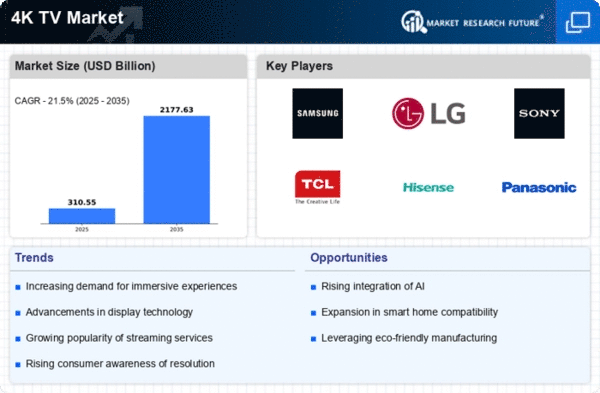
As per MRFR analysis, the 4K TV Market Size was estimated at 255.6 USD Billion in 2024. The 4K TV industry is projected to grow from 310.56 USD Billion in 2025 to 2177.63 USD Billion by 2035, exhibiting a compound annual growth rate (CAGR) of 21.5% during the forecast period 2025 - 2035.

Key Market Trends & Highlights

The 4K TV market is experiencing robust growth driven by technological advancements and changing consumer preferences.

  • The demand for immersive experiences continues to rise, propelling the adoption of 4K TVs in North America. Integration of smart features is becoming increasingly prevalent, enhancing user engagement and functionality in the home entertainment segment. Sustainability initiatives are influencing purchasing decisions, as consumers seek eco-friendly options in their 4K TV choices. Advancements in display technology and the availability of streaming services are key drivers, particularly in the 66 to 75 inches segment, which is witnessing rapid growth.

Market Size & Forecast

2024 Market Size 255.6 (USD Billion)
2035 Market Size 2177.63 (USD Billion)
CAGR (2025 - 2035) 21.5%
Largest Regional Market Share in 2024 Asia-Pacific

Major Players

Samsung (KR), LG Electronics (KR), Sony (JP), TCL (CN), Hisense (CN), Panasonic (JP), Philips (NL), Vizio (US), Sharp (JP)

Market Trends

The 4K TV Market is currently experiencing a dynamic evolution, characterized by rapid technological advancements and shifting consumer preferences. As the demand for high-resolution displays continues to rise, manufacturers are increasingly focusing on enhancing picture quality, color accuracy, and overall viewing experience. This trend is driven by the proliferation of streaming services and the growing availability of 4K content, which encourages consumers to upgrade their existing television sets. In the consumer electronics segment, demand for 4k content for TV is accelerating adoption of advanced display technologies. Furthermore, the integration of smart technology into 4K TVs is becoming more prevalent, allowing users to access a wide range of applications and services directly from their devices. The proliferation of 4K programming across streaming and broadcast platforms persists in facilitating market expansion.

In addition to technological improvements, the 4K TV Market is witnessing a notable shift towards more sustainable practices. Companies are exploring eco-friendly materials and energy-efficient designs, reflecting a broader societal emphasis on environmental responsibility. Therefore, consumers are progressively upgrading their current TV set to enable ultra-high-definition viewing. This shift not only appeals to environmentally conscious consumers but also aligns with regulatory trends aimed at reducing electronic waste. As the market continues to evolve, it appears poised for further growth, driven by innovation and a commitment to sustainability.

Rising Demand for Immersive Experiences

Consumers are increasingly seeking immersive viewing experiences, prompting manufacturers to enhance the visual and audio quality of 4K TVs. This trend is evident in the development of advanced sound systems and features that create a more engaging home theater environment.

Integration of Smart Features

The integration of smart technology into 4K TVs is becoming increasingly prevalent. Consumers are seeking devices that not only provide high-quality visuals but also offer seamless access to streaming platforms and smart home functionalities. Questions such as can Firestick stream 4k are increasingly influencing purchasing decisions among value-conscious consumers. This trend indicates a shift towards multifunctional devices that cater to diverse entertainment needs. Smart connectivity, AI upscaling, and HDR support are now core 4k TV features shaping consumer purchasing decisions.

Sustainability Initiatives

The 4K TV Market is gradually embracing sustainability, with manufacturers focusing on eco-friendly materials and energy-efficient designs. This trend reflects a growing consumer preference for environmentally responsible products, as well as compliance with regulations aimed at reducing electronic waste. This trend promotes innovation in organic 4K TV panels that provide enhanced efficiency and a diminished environmental footprint. Companies are likely to enhance their sustainability efforts to attract conscientious buyers.

4K TV Market Market Drivers

Market Growth Projections

The Global 4K TV Market Industry is projected to experience substantial growth, with estimates indicating a market value of 2177.6 USD Billion by 2035. This growth trajectory is supported by various factors, including rising consumer demand for high-resolution displays, technological advancements, and the increasing adoption of smart TVs. The anticipated CAGR of 21.5% from 2025 to 2035 suggests a robust expansion phase, driven by innovations and changing consumer preferences. Such projections highlight the potential for significant investment opportunities within the Global 4K TV Market Industry, as stakeholders seek to capitalize on this burgeoning market.

Declining Prices of 4K TVs

The declining prices of 4K TVs significantly contribute to the expansion of the Global 4K TV Market Industry. As production costs decrease and competition among manufacturers intensifies, consumers are presented with more affordable options. This price reduction makes 4K technology accessible to a wider audience, encouraging upgrades from older HD models. The affordability of 4K TVs is expected to drive sales, as consumers recognize the value of enhanced viewing experiences without breaking the bank. Consequently, this trend is likely to bolster the market's growth, further solidifying the Global 4K TV Market Industry's position in the electronics sector.

Increasing Adoption of Smart TVs

The increasing adoption of smart TVs is a key driver for the Global 4K TV Market Industry, as consumers gravitate towards devices that offer internet connectivity and access to streaming services. Smart TVs equipped with 4K capabilities allow users to enjoy a wide range of content, including movies, shows, and games, all in high resolution. This trend is further fueled by the proliferation of smart home devices, which integrate seamlessly with smart TVs. As a result, the Global 4K TV Market Industry is likely to witness substantial growth, with a projected CAGR of 21.5% from 2025 to 2035, indicating a robust future for smart 4K televisions.

Growing Popularity of Gaming and E-Sports

The growing popularity of gaming and e-sports is a notable driver for the Global 4K TV Market Industry, as gamers increasingly seek high-resolution displays for an immersive experience. The demand for 4K TVs is amplified by the release of next-generation gaming consoles that support 4K output, allowing players to enjoy visually stunning graphics. This trend not only attracts avid gamers but also appeals to casual users who appreciate high-quality visuals. As the gaming industry continues to expand, the Global 4K TV Market Industry is poised for growth, with an increasing number of consumers investing in 4K televisions to enhance their gaming experiences.

Technological Advancements in Display Technology

Technological advancements play a pivotal role in the Global 4K TV Market Industry, as manufacturers continuously innovate to enhance display quality and performance. The introduction of OLED and QLED technologies has significantly improved color accuracy, contrast ratios, and energy efficiency. These advancements not only attract tech-savvy consumers but also cater to a broader audience seeking better visual experiences. The ongoing research and development efforts are expected to sustain the industry's growth trajectory, with projections indicating a market value of 2177.6 USD Billion by 2035. Such innovations are crucial for maintaining competitiveness in the Global 4K TV Market Industry.

Rising Consumer Demand for High-Resolution Displays

The Global 4K TV Market Industry experiences a surge in consumer demand for high-resolution displays, driven by the increasing availability of 4K content across various platforms. Streaming services, such as Netflix and Amazon Prime, are expanding their libraries to include more 4K content, which enhances the viewing experience. As of 2024, the market is valued at approximately 255.6 USD Billion, reflecting a growing preference for superior image quality. This trend is likely to continue, as consumers increasingly seek immersive viewing experiences, thereby propelling the growth of the Global 4K TV Market Industry.

Market Segment Insights

By Application: Home Entertainment (Largest) vs. Gaming (Fastest-Growing)

<p>The 4K TV market exhibits a diverse application landscape, primarily dominated by the Home Entertainment segment, which accounts for a significant portion of market share. This segment's stronghold is characterized by the increasing preference for high-resolution content among consumers for their viewing pleasure. Major players are continuously rolling out advanced models to enhance the home cinema experience, further solidifying Home Entertainment's leading position in the market. On the other hand, the Gaming segment has emerged as the fastest-growing application. With the rise of gaming consoles and PC gaming, the demand for 4K TVs that offer high refresh rates and low input lag has surged. As gamers increasingly seek immersive experiences, this segment is poised for rapid expansion, fueled by technological advancements in gaming and improved content availability.</p>

<p>Home Entertainment (Dominant) vs. Gaming (Emerging)</p>

<p>In the context of the 4K TV market, Home Entertainment remains the dominant segment, appealing to consumers seeking an immersive viewing experience with high-definition clarity. With various smart features, including streaming capabilities and compatibility with high-quality sound systems, Home Entertainment aligns well with contemporary viewing habits. Conversely, the Gaming segment is an emerging powerhouse characterized by its focus on delivering superior visual quality and performance for gamers. As game developers increasingly produce content tailored for 4K resolutions, this segment is outpacing others in growth, driven by a younger demographic's enthusiasm and technological innovations that enhance gameplay experiences. Both segments play critical roles, yet their dynamics cater to unique consumer preferences.</p>

By Screen Size: 50 to 65 inches (Largest) vs. 66 to 75 inches (Fastest-Growing)

In the 4K TV market, the screen size segment shows diverse preferences among consumers. The largest share is held by the 50 to 65 inches category, appealing to a wide range of households seeking a balance between viewing quality and space. Meanwhile, segments such as 66 to 75 inches are gaining traction as buyers are starting to prefer larger displays for an immersive viewing experience, contributing to a gradual shift in 4K TV market dynamics. This transition indicates an increasing consumer inclination towards big TV screen sizes within domestic entertainment arrangements.

50 to 65 inches (Dominant) vs. 66 to 75 inches (Emerging)

The 50 to 65 inches segment stands as the dominant player in the 4K TV market, catering to consumers who prioritize a mix of high-definition viewing and manageable screen size for different room dimensions. Its popularity is driven by versatility, making it suitable for various settings, from small apartments to spacious living rooms. On the other hand, the 66 to 75 inches segment is emerging as a strong competitor, buoyed by the increasing consumer demand for cinematic experiences at home. Manufacturers are expanding 4k sizing options to meet diverse consumer viewing preferences. This growth is largely attributed to advancements in screen technology, enticing features such as smart capabilities, and the affordability of larger models, setting up a dynamic competition within the market.

By Display Technology: OLED (Largest) vs. QLED (Fastest-Growing)

In the 4K TV market, the distribution of display technologies illustrates a competitive landscape where OLED stands as the largest segment, owing to its superior picture quality and vibrant colors. This technology has carved out a significant portion of the market, appealing particularly to consumers seeking top-notch viewing experiences. On the other hand, QLED, while established, is gaining momentum rapidly, thanks to advancements in quantum dot technology that enhance brightness and color accuracy, thus attracting a broader audience.

Technology: OLED (Dominant) vs. QLED (Emerging)

OLED technology remains dominant in the 4K TV market, primarily due to its unmatched contrast ratios and color accuracy, making it a preferred choice for high-end consumers. Meanwhile, MicroLED technology stands as an emerging contender, showcasing the potential for improved longevity, brilliant brightness, and modular designs. While OLEDs are celebrated for their deep blacks and wide viewing angles, MicroLEDs are entering the 4K TV market with promises of preventing burn-in issues and exciting possibilities for customization. Advancements in panel engineering have significantly enhanced 4k TV display clarity and color accuracy. This dynamic presents a competitive landscape where OLEDs appeal to luxury buyers, while MicroLEDs may attract tech enthusiasts eager for the latest innovations. As both technologies evolve, their market positions continue to influence consumer choices and shape future trends.

By Resolution: 3840 x 2160 (Largest) vs. 8K (Fastest-Growing)

In the 4K TV market, the resolution segment showcases a diverse landscape. The 3840 x 2160 resolution remains the largest segment, dominating sales due to its widespread adoption across various consumer demographics. This resolution's balance of quality and affordability has appealed to both casual viewers and tech enthusiasts alike. In contrast, the 8K resolution represents a significant emerging trend, capturing attention as manufacturers push advancements in display technology, albeit from a smaller market base.<br>With technological innovations and increased content availability, the growth prospects for higher resolution options are promising. The rising demand for immersive viewing experiences has propelled 8K TVs to the forefront, despite the prevailing popularity of 4K. As consumers seek better clarity and improved visual experiences, the momentum for 8K technology is expected to grow rapidly, aided by increased marketing and content production tailored for ultra-high-definition viewing. The increasing availability of 4K resolution TV shows is augmenting the demand for high-definition home entertainment systems.

Resolution: 3840 x 2160 (Dominant) vs. 8K (Emerging)

The 3840 x 2160 resolution dominates the 4K TV market, characterized by its widespread compatibility with various streaming platforms and content sources. This resolution has become the standard for high-definition television, ensuring a robust supply of content catering to the majority of consumers. The consumer 4K segment continues to gain from declining prices and advancements in panel technologies.  Additionally, it often comes at a more affordable price, appealing to budget-conscious buyers. On the other hand, the 8K resolution is emerging as a premium option in the market, characterized by its superior pixel density and potential for unparalleled clarity. As more manufacturers enter this segment, the availability of 8K content will likely increase, appealing to early adopters and tech enthusiasts eager for the latest advancements in television technology.

By Price Range: Budget (Largest) vs. Luxury (Fastest-Growing)

<p>In the 4K TV market, the price range segment is characterized by distinct divisions that cater to various consumer preferences and budgets. The Budget category dominates the market, appealing to cost-conscious consumers who prioritize value over luxury features. Mid-Range options serve a sizable audience looking for a balance between performance and price, while Premium and Luxury segments attract those seeking high-end specifications and features. Overall, the Budget category holds significant market share, yet the Luxury segment is attracting an increasing number of consumers as technology advances.</p>

<p>Budget (Dominant) vs. Luxury (Emerging)</p>

<p>The Budget segment continues to be a dominant player in the 4K TV market, appealing to a broad demographic that values affordability without sacrificing essential features. Many consumers in this segment are first-time buyers or families seeking reliable viewing options. Conversely, the Luxury segment is emerging, driven by affluent consumers seeking the latest technology, stunning visuals, and smart integrations in their TVs. This segment often showcases ultra-premium specifications, such as OLED displays and advanced smart features, making it highly desirable. As technological improvements continue, the Luxury segment is expected to gain traction, catering to a niche market that values exclusivity and state-of-the-art innovation.</p>

Get more detailed insights about 4K TV Market Research Report- Forecast 2035

Regional Insights

North America : Tech-Driven Market Growth

North America is witnessing robust growth in the 4K TV market, driven by increasing consumer demand for high-definition content and advancements in streaming technology. With a market size of $60.0 million, the region is capitalizing on the popularity of smart TVs and enhanced viewing experiences. Regulatory support for digital broadcasting and content delivery is further fueling this growth, making it a key player in the global market.

The competitive landscape in North America is dominated by major players such as Samsung Electronics, LG Electronics, and Sony Corporation. Multiple manufacturers in the region have launched models that are comparable to the world's 4K TVs in terms of performance and size. These companies are continuously innovating to meet consumer preferences, offering a range of features like OLED technology and smart capabilities. The presence of Vizio Inc. also highlights the competitive nature of the market, catering to diverse consumer needs and preferences.

Europe : Diverse Market Dynamics

Europe's 4K TV market is characterized by a diverse consumer base and a strong inclination towards innovative technology. With a market size of $50.0 million, the region is experiencing growth driven by increasing disposable incomes and a shift towards premium viewing experiences. Regulatory initiatives promoting energy efficiency and digital content accessibility are also contributing to market expansion, making Europe a significant player in the global landscape. Adoption of 4k TV in the world continues to rise as affordability and content availability improve.

Leading countries such as Germany, the UK, and France are at the forefront of this growth, with key players like Philips and Panasonic leading the charge. The competitive landscape is marked by a focus on sustainability and smart technology, with manufacturers investing in eco-friendly production methods. This innovation-driven environment is expected to enhance the market's appeal and drive further adoption of 4K TVs.

Asia-Pacific : Leading Global Market

The Asia-Pacific region is the largest market for 4K TVs, projected to reach $130.0 million by December 2025. This growth is driven by rapid urbanization, increasing disposable incomes, and a strong demand for high-definition content. Government initiatives promoting digital infrastructure and smart city projects are also contributing to market expansion. The region's diverse consumer base is increasingly inclined towards premium products, further boosting sales. China, Japan, and South Korea are the leading countries in this market, with key players like Samsung, LG Electronics, and TCL dominating. The competitive landscape is intense, with companies continuously innovating to offer advanced features and superior picture quality. The presence of a robust supply chain and distribution network ensures that 4K TVs are widely available, catering to the growing consumer demand.

Middle East and Africa : Emerging Market Potential

The Middle East and Africa 4K TV market is projected to reach $15.6 million by December 2025, driven by increasing urbanization and a growing middle class. The demand for high-quality entertainment options is rising, supported by improvements in digital infrastructure and access to streaming services. Regulatory efforts to enhance consumer protection and promote energy-efficient products are also contributing to market growth. Leading countries in this region include South Africa and the UAE, where consumer interest in premium electronics is on the rise. The competitive landscape features both global brands and local manufacturers, with companies like Hisense and LG Electronics making significant inroads. The market is characterized by a growing retail presence and online sales channels, making 4K TVs more accessible to consumers.

Key Players and Competitive Insights

The 4K TV Market is currently characterized by intense competition and rapid technological advancements, driven by consumer demand for enhanced viewing experiences and the proliferation of streaming services. Major players such as Samsung (KR), LG Electronics (KR), and Sony (JP) are at the forefront, each adopting distinct strategies to maintain their market positions. Samsung (KR) focuses on innovation, particularly in QLED technology, while LG Electronics (KR) emphasizes OLED displays, showcasing their commitment to superior picture quality. Sony (JP) leverages its strong brand reputation and content ecosystem, integrating its television offerings with PlayStation services to enhance user engagement. Collectively, these strategies contribute to a dynamic competitive environment, where differentiation is increasingly based on technological superiority and user experience rather than mere pricing. Key business tactics within the market include localizing manufacturing and optimizing supply chains to enhance efficiency and responsiveness to consumer needs. The competitive structure appears moderately fragmented, with several key players holding substantial market shares. This fragmentation allows for a diverse range of products and innovations, fostering a competitive atmosphere where companies must continuously adapt to maintain relevance. In November 2025, LG Electronics (KR) announced a strategic partnership with a leading streaming service to integrate advanced AI features into its 4K TVs. This collaboration aims to enhance content recommendations and user interaction, positioning LG as a pioneer in smart TV technology. The strategic importance of this move lies in its potential to attract tech-savvy consumers who prioritize seamless integration of entertainment and technology. In October 2025, Samsung (KR) unveiled its latest line of 4K TVs featuring enhanced gaming capabilities, specifically targeting the growing gaming market. This initiative not only showcases Samsung's commitment to innovation but also reflects a strategic pivot towards capturing a younger demographic that values high-performance gaming experiences. The significance of this development is underscored by the increasing convergence of gaming and traditional television viewing. In September 2025, Sony (JP) expanded its 4K TV lineup with models that incorporate advanced sound technology, enhancing the overall viewing experience. This strategic move indicates Sony's focus on creating a holistic entertainment ecosystem, where audio-visual quality is paramount. By investing in sound technology, Sony aims to differentiate itself in a crowded market, appealing to audiophiles and cinephiles alike. As of December 2025, current trends in the 4K TV Market are heavily influenced by digitalization, sustainability, and AI integration. Strategic alliances are increasingly shaping the competitive landscape, as companies recognize the value of collaboration in enhancing product offerings and market reach. Looking ahead, competitive differentiation is likely to evolve, shifting from price-based competition to a focus on innovation, technology, and supply chain reliability. This transition suggests that companies that prioritize cutting-edge technology and sustainable practices will be better positioned to thrive in the future.

Key Companies in the 4K TV Market include

Industry Developments

In October 2024, Apple TV announced the potential release of the Apple TV 4K 4th generation, stating that it would be available in late 2024 or early 2025. The device will reportedly house a camera and an A16 or A17 chip and will also support Apple Intelligence, allow users to call using FaceTime, and have motion control systems. In order to take on inexpensive streaming devices, the TV will likely come out at a price point that is less than USD 100. This action is expected to increase Apple's brand share specifically in the 4K TV market for 4K televisions.

In May 2024, Panasonic actually came up with the W95A 4K Ultra HD TVs, not forgetting its Mini LED panel technology, as they are equipped with Fire TV and also the W90A, which comprises of Full Array Local Dimming and has Panasonic Premium TV housing features and thus, enables superior entertainment experience and enhanced gaming sessions. With the Fire TV experience incorporated, these new TVs from Panasonic provide an exquisite and unique streaming experience to the customers.

Panasonic TVs have launched the W95A series for TV and gamers who are looking for appropriately priced LED TVs that are great in playability, quality, and customization. The W95A will be placed at 55, 65 as well as 75-inch screen sizes. And W90A will be offered in 43, 50, 55, 65 inches.

In September 2023, Hisense Group, at the recently held CEDIA Expo 2023, introduced a massive 100-inch 4K TV Market, which, they say, rivals the viewing experience of the television; such models were developed with high-end video game consoles in view. Also of great importance was the mini-LED backlit TV, which had over 1600 different localized zones for controllable brightness and contrast for enhanced picture depth and quality, thereby ensuring high definition.

May 2023: The Crystal 4K iSmart UHD TV, Samsung's most recent smart TV model, can accomplish all of this and more since it seamlessly integrates into your everyday life and tracks your usage habits to improve your watching experience. The new device, which has a very affordable price, intends to make 4K watching and intelligent IOT capabilities like these available to everyone. Does the Samsung Crystal 4K iSmart UHD TV live up to the promise, then? Let's look at the characteristics that set this new device unique from the many displays that already cover the walls of the electronics stores.

The Crystal 4K iSmart UHD TV is compatible with an add-on camera, which, when attached to the TV, transforms it into an AV device for video conferences, conferencing, and even transforms it into a sizable work screen for days when you work from home. With this TV, you may wirelessly connect your laptop, desktop, and mobile device to the TV itself. You may get a Crystal 4K iSmart UHD TV right now and receive a Slim Fit Webcam, valued at $8,900, absolutely free as part of a unique continuing limited-time offer.

August 2022: The Ultra-edge 4K display, which is the centre piece of VU's new line of Ultra 4K TVs exclusively for the Indian market, has been launched. The screen is touted to offer features including Pro-picture Calibration, Parental Block, Upbeat Surround Sound, Backlight Controller, and 40% increased Brightness. With costs ranging from 25,999 to 48,999, the range comprises TVs with screen sizes of 45, 50, 55, and 65 inches.

The VU TVs have Pro Picture Calibration in addition to the Ultra-edge 4K display, allowing users to adjust the gamma correction, color temperature, noise reduction, HDMI dynamic range, and other features for a personalized watching experience. For improved audio, it also offers Upbeat Surround sound option. Along with 30Watt Box Speakers, Sports Mode, and built-in Dolby Audio and DTS Virtual X Surround Sound Technologies, this is also included.

Future Outlook

4K TV Market Future Outlook

The 4K TV market is projected to grow at a 21.5% CAGR from 2025 to 2035, driven by technological advancements, increasing consumer demand, and enhanced viewing experiences.

New opportunities lie in:

  • <p>Expansion into smart home integration solutions Development of subscription-based content delivery platforms Investment in eco-friendly manufacturing processes</p>

By 2035, the 4K TV market is poised for substantial growth and innovation. Similarly, the increasing availability of 4K TVs on the market exemplifies wider trends toward enhanced premium consumer experiences.

Market Segmentation

4K TV Market Resolution Outlook

  • 3840 x 2160
  • 8K
  • HDR
  • Standard

4K TV Market Application Outlook

  • Home Entertainment
  • Gaming
  • Professional Use
  • Streaming Services

4K TV Market Price Range Outlook

  • Budget
  • Mid-Range
  • Premium
  • Luxury

4K TV Market Screen Size Outlook

  • Less than 50 inches
  • 50 to 65 inches
  • 66 to 75 inches
  • More than 75 inches

4K TV Market Display Technology Outlook

  • LED
  • OLED
  • QLED
  • MicroLED

Report Scope

MARKET SIZE 2024 255.6(USD Billion)
MARKET SIZE 2025 310.56(USD Billion)
MARKET SIZE 2035 2177.63(USD Billion)
COMPOUND ANNUAL GROWTH RATE (CAGR) 21.5% (2025 - 2035)
REPORT COVERAGE Revenue Forecast, Competitive Landscape, Growth Factors, and Trends
BASE YEAR 2024
Market Forecast Period 2025 - 2035
Historical Data 2019 - 2024
Market Forecast Units USD Billion
Key Companies Profiled Samsung (KR), LG Electronics (KR), Sony (JP), TCL (CN), Hisense (CN), Panasonic (JP), Philips (NL), Vizio (US), Sharp (JP)
Segments Covered Application, Screen Size, Display Technology, Resolution, Price Range
Key Market Opportunities Integration of advanced display technologies enhances viewing experiences in the 4K TV Market.
Key Market Dynamics Rising consumer demand for enhanced viewing experiences drives innovation and competition in the 4K TV market.
Countries Covered North America, Europe, APAC, South America, MEA

FAQs

What is the current valuation of the 4K TV market as of 2024?

<p>The 4K TV market was valued at 255.6 USD Billion in 2024.</p>

What is the projected market valuation for the 4K TV market in 2035?

<p>The market is projected to reach 2177.63 USD Billion by 2035.</p>

What is the expected CAGR for the 4K TV market during the forecast period 2025 - 2035?

<p>The expected CAGR for the 4K TV market during 2025 - 2035 is 21.5%.</p>

Which companies are the key players in the 4K TV market?

<p>Key players include Samsung Electronics, LG Electronics, Sony Corporation, TCL Technology, and Hisense Group.</p>

How does the 4K TV market perform in the home entertainment segment?

<p>The home entertainment segment was valued at 102.24 USD Billion in 2024 and is expected to grow significantly.</p>

What is the market size for 4K TVs by screen size in 2024?

<p>In 2024, the market size for 50 to 65 inches was 80.0 USD Billion, while above 75 inches was valued at 75.6 USD Billion.</p>

What are the leading display technologies in the 4K TV market?

LED technology led the market with a valuation of 102.24 USD Billion in 2024, followed by OLED and QLED.

What is the market performance of 4K TVs in the gaming segment?

The gaming segment was valued at 51.12 USD Billion in 2024, indicating a robust interest in gaming applications.

How does the price range affect the 4K TV market?

In 2024, the premium price range segment was valued at 85.56 USD Billion, reflecting consumer preferences for high-quality products.

What is the market outlook for 4K TVs in professional use?

The professional use segment was valued at 25.56 USD Billion in 2024, suggesting potential growth opportunities in this area.

  1. SECTION I: EXECUTIVE SUMMARY AND KEY HIGHLIGHTS
    1. | 1.1 EXECUTIVE SUMMARY
    2. | | 1.1.1 Market Overview
    3. | | 1.1.2 Key Findings
    4. | | 1.1.3 Market Segmentation
    5. | | 1.1.4 Competitive Landscape
    6. | | 1.1.5 Challenges and Opportunities
    7. | | 1.1.6 Future Outlook
  2. SECTION II: SCOPING, METHODOLOGY AND MARKET STRUCTURE
    1. | 2.1 MARKET INTRODUCTION
    2. | | 2.1.1 Definition
    3. | | 2.1.2 Scope of the study
    4. | | | 2.1.2.1 Research Objective
    5. | | | 2.1.2.2 Assumption
    6. | | | 2.1.2.3 Limitations
    7. | 2.2 RESEARCH METHODOLOGY
    8. | | 2.2.1 Overview
    9. | | 2.2.2 Data Mining
    10. | | 2.2.3 Secondary Research
    11. | | 2.2.4 Primary Research
    12. | | | 2.2.4.1 Primary Interviews and Information Gathering Process
    13. | | | 2.2.4.2 Breakdown of Primary Respondents
    14. | | 2.2.5 Forecasting Model
    15. | | 2.2.6 Market Size Estimation
    16. | | | 2.2.6.1 Bottom-Up Approach
    17. | | | 2.2.6.2 Top-Down Approach
    18. | | 2.2.7 Data Triangulation
    19. | | 2.2.8 Validation
  3. SECTION III: QUALITATIVE ANALYSIS
    1. | 3.1 MARKET DYNAMICS
    2. | | 3.1.1 Overview
    3. | | 3.1.2 Drivers
    4. | | 3.1.3 Restraints
    5. | | 3.1.4 Opportunities
    6. | 3.2 MARKET FACTOR ANALYSIS
    7. | | 3.2.1 Value chain Analysis
    8. | | 3.2.2 Porter's Five Forces Analysis
    9. | | | 3.2.2.1 Bargaining Power of Suppliers
    10. | | | 3.2.2.2 Bargaining Power of Buyers
    11. | | | 3.2.2.3 Threat of New Entrants
    12. | | | 3.2.2.4 Threat of Substitutes
    13. | | | 3.2.2.5 Intensity of Rivalry
    14. | | 3.2.3 COVID-19 Impact Analysis
    15. | | | 3.2.3.1 Market Impact Analysis
    16. | | | 3.2.3.2 Regional Impact
    17. | | | 3.2.3.3 Opportunity and Threat Analysis
  4. SECTION IV: QUANTITATIVE ANALYSIS
    1. | 4.1 Semiconductor & Electronics, BY Application (USD Billion)
    2. | | 4.1.1 Home Entertainment
    3. | | 4.1.2 Gaming
    4. | | 4.1.3 Professional Use
    5. | | 4.1.4 Streaming Services
    6. | 4.2 Semiconductor & Electronics, BY Screen Size (USD Billion)
    7. | | 4.2.1 Less than 50 inches
    8. | | 4.2.2 50 to 65 inches
    9. | | 4.2.3 66 to 75 inches
    10. | | 4.2.4 Above 75 inches
    11. | 4.3 Semiconductor & Electronics, BY Display Technology (USD Billion)
    12. | | 4.3.1 LED
    13. | | 4.3.2 OLED
    14. | | 4.3.3 QLED
    15. | | 4.3.4 MicroLED
    16. | 4.4 Semiconductor & Electronics, BY Resolution (USD Billion)
    17. | | 4.4.1 3840 x 2160
    18. | | 4.4.2 8K
    19. | | 4.4.3 HDR
    20. | | 4.4.4 Standard
    21. | 4.5 Semiconductor & Electronics, BY Price Range (USD Billion)
    22. | | 4.5.1 Budget
    23. | | 4.5.2 Mid-Range
    24. | | 4.5.3 Premium
    25. | | 4.5.4 Luxury
    26. | 4.6 Semiconductor & Electronics, BY Region (USD Billion)
    27. | | 4.6.1 North America
    28. | | | 4.6.1.1 US
    29. | | | 4.6.1.2 Canada
    30. | | 4.6.2 Europe
    31. | | | 4.6.2.1 Germany
    32. | | | 4.6.2.2 UK
    33. | | | 4.6.2.3 France
    34. | | | 4.6.2.4 Russia
    35. | | | 4.6.2.5 Italy
    36. | | | 4.6.2.6 Spain
    37. | | | 4.6.2.7 Rest of Europe
    38. | | 4.6.3 APAC
    39. | | | 4.6.3.1 China
    40. | | | 4.6.3.2 India
    41. | | | 4.6.3.3 Japan
    42. | | | 4.6.3.4 South Korea
    43. | | | 4.6.3.5 Malaysia
    44. | | | 4.6.3.6 Thailand
    45. | | | 4.6.3.7 Indonesia
    46. | | | 4.6.3.8 Rest of APAC
    47. | | 4.6.4 South America
    48. | | | 4.6.4.1 Brazil
    49. | | | 4.6.4.2 Mexico
    50. | | | 4.6.4.3 Argentina
    51. | | | 4.6.4.4 Rest of South America
    52. | | 4.6.5 MEA
    53. | | | 4.6.5.1 GCC Countries
    54. | | | 4.6.5.2 South Africa
    55. | | | 4.6.5.3 Rest of MEA
  5. SECTION V: COMPETITIVE ANALYSIS
    1. | 5.1 Competitive Landscape
    2. | | 5.1.1 Overview
    3. | | 5.1.2 Competitive Analysis
    4. | | 5.1.3 Market share Analysis
    5. | | 5.1.4 Major Growth Strategy in the Semiconductor & Electronics
    6. | | 5.1.5 Competitive Benchmarking
    7. | | 5.1.6 Leading Players in Terms of Number of Developments in the Semiconductor & Electronics
    8. | | 5.1.7 Key developments and growth strategies
    9. | | | 5.1.7.1 New Product Launch/Service Deployment
    10. | | | 5.1.7.2 Merger & Acquisitions
    11. | | | 5.1.7.3 Joint Ventures
    12. | | 5.1.8 Major Players Financial Matrix
    13. | | | 5.1.8.1 Sales and Operating Income
    14. | | | 5.1.8.2 Major Players R&D Expenditure. 2023
    15. | 5.2 Company Profiles
    16. | | 5.2.1 Samsung Electronics (KR)
    17. | | | 5.2.1.1 Financial Overview
    18. | | | 5.2.1.2 Products Offered
    19. | | | 5.2.1.3 Key Developments
    20. | | | 5.2.1.4 SWOT Analysis
    21. | | | 5.2.1.5 Key Strategies
    22. | | 5.2.2 LG Electronics (KR)
    23. | | | 5.2.2.1 Financial Overview
    24. | | | 5.2.2.2 Products Offered
    25. | | | 5.2.2.3 Key Developments
    26. | | | 5.2.2.4 SWOT Analysis
    27. | | | 5.2.2.5 Key Strategies
    28. | | 5.2.3 Sony Corporation (JP)
    29. | | | 5.2.3.1 Financial Overview
    30. | | | 5.2.3.2 Products Offered
    31. | | | 5.2.3.3 Key Developments
    32. | | | 5.2.3.4 SWOT Analysis
    33. | | | 5.2.3.5 Key Strategies
    34. | | 5.2.4 TCL Technology (CN)
    35. | | | 5.2.4.1 Financial Overview
    36. | | | 5.2.4.2 Products Offered
    37. | | | 5.2.4.3 Key Developments
    38. | | | 5.2.4.4 SWOT Analysis
    39. | | | 5.2.4.5 Key Strategies
    40. | | 5.2.5 Hisense Group (CN)
    41. | | | 5.2.5.1 Financial Overview
    42. | | | 5.2.5.2 Products Offered
    43. | | | 5.2.5.3 Key Developments
    44. | | | 5.2.5.4 SWOT Analysis
    45. | | | 5.2.5.5 Key Strategies
    46. | | 5.2.6 Panasonic Corporation (JP)
    47. | | | 5.2.6.1 Financial Overview
    48. | | | 5.2.6.2 Products Offered
    49. | | | 5.2.6.3 Key Developments
    50. | | | 5.2.6.4 SWOT Analysis
    51. | | | 5.2.6.5 Key Strategies
    52. | | 5.2.7 Philips (NL)
    53. | | | 5.2.7.1 Financial Overview
    54. | | | 5.2.7.2 Products Offered
    55. | | | 5.2.7.3 Key Developments
    56. | | | 5.2.7.4 SWOT Analysis
    57. | | | 5.2.7.5 Key Strategies
    58. | | 5.2.8 Sharp Corporation (JP)
    59. | | | 5.2.8.1 Financial Overview
    60. | | | 5.2.8.2 Products Offered
    61. | | | 5.2.8.3 Key Developments
    62. | | | 5.2.8.4 SWOT Analysis
    63. | | | 5.2.8.5 Key Strategies
    64. | | 5.2.9 Vizio Inc. (US)
    65. | | | 5.2.9.1 Financial Overview
    66. | | | 5.2.9.2 Products Offered
    67. | | | 5.2.9.3 Key Developments
    68. | | | 5.2.9.4 SWOT Analysis
    69. | | | 5.2.9.5 Key Strategies
    70. | 5.3 Appendix
    71. | | 5.3.1 References
    72. | | 5.3.2 Related Reports
  6. LIST OF FIGURES
    1. | 6.1 MARKET SYNOPSIS
    2. | 6.2 NORTH AMERICA MARKET ANALYSIS
    3. | 6.3 US MARKET ANALYSIS BY APPLICATION
    4. | 6.4 US MARKET ANALYSIS BY SCREEN SIZE
    5. | 6.5 US MARKET ANALYSIS BY DISPLAY TECHNOLOGY
    6. | 6.6 US MARKET ANALYSIS BY RESOLUTION
    7. | 6.7 US MARKET ANALYSIS BY PRICE RANGE
    8. | 6.8 CANADA MARKET ANALYSIS BY APPLICATION
    9. | 6.9 CANADA MARKET ANALYSIS BY SCREEN SIZE
    10. | 6.10 CANADA MARKET ANALYSIS BY DISPLAY TECHNOLOGY
    11. | 6.11 CANADA MARKET ANALYSIS BY RESOLUTION
    12. | 6.12 CANADA MARKET ANALYSIS BY PRICE RANGE
    13. | 6.13 EUROPE MARKET ANALYSIS
    14. | 6.14 GERMANY MARKET ANALYSIS BY APPLICATION
    15. | 6.15 GERMANY MARKET ANALYSIS BY SCREEN SIZE
    16. | 6.16 GERMANY MARKET ANALYSIS BY DISPLAY TECHNOLOGY
    17. | 6.17 GERMANY MARKET ANALYSIS BY RESOLUTION
    18. | 6.18 GERMANY MARKET ANALYSIS BY PRICE RANGE
    19. | 6.19 UK MARKET ANALYSIS BY APPLICATION
    20. | 6.20 UK MARKET ANALYSIS BY SCREEN SIZE
    21. | 6.21 UK MARKET ANALYSIS BY DISPLAY TECHNOLOGY
    22. | 6.22 UK MARKET ANALYSIS BY RESOLUTION
    23. | 6.23 UK MARKET ANALYSIS BY PRICE RANGE
    24. | 6.24 FRANCE MARKET ANALYSIS BY APPLICATION
    25. | 6.25 FRANCE MARKET ANALYSIS BY SCREEN SIZE
    26. | 6.26 FRANCE MARKET ANALYSIS BY DISPLAY TECHNOLOGY
    27. | 6.27 FRANCE MARKET ANALYSIS BY RESOLUTION
    28. | 6.28 FRANCE MARKET ANALYSIS BY PRICE RANGE
    29. | 6.29 RUSSIA MARKET ANALYSIS BY APPLICATION
    30. | 6.30 RUSSIA MARKET ANALYSIS BY SCREEN SIZE
    31. | 6.31 RUSSIA MARKET ANALYSIS BY DISPLAY TECHNOLOGY
    32. | 6.32 RUSSIA MARKET ANALYSIS BY RESOLUTION
    33. | 6.33 RUSSIA MARKET ANALYSIS BY PRICE RANGE
    34. | 6.34 ITALY MARKET ANALYSIS BY APPLICATION
    35. | 6.35 ITALY MARKET ANALYSIS BY SCREEN SIZE
    36. | 6.36 ITALY MARKET ANALYSIS BY DISPLAY TECHNOLOGY
    37. | 6.37 ITALY MARKET ANALYSIS BY RESOLUTION
    38. | 6.38 ITALY MARKET ANALYSIS BY PRICE RANGE
    39. | 6.39 SPAIN MARKET ANALYSIS BY APPLICATION
    40. | 6.40 SPAIN MARKET ANALYSIS BY SCREEN SIZE
    41. | 6.41 SPAIN MARKET ANALYSIS BY DISPLAY TECHNOLOGY
    42. | 6.42 SPAIN MARKET ANALYSIS BY RESOLUTION
    43. | 6.43 SPAIN MARKET ANALYSIS BY PRICE RANGE
    44. | 6.44 REST OF EUROPE MARKET ANALYSIS BY APPLICATION
    45. | 6.45 REST OF EUROPE MARKET ANALYSIS BY SCREEN SIZE
    46. | 6.46 REST OF EUROPE MARKET ANALYSIS BY DISPLAY TECHNOLOGY
    47. | 6.47 REST OF EUROPE MARKET ANALYSIS BY RESOLUTION
    48. | 6.48 REST OF EUROPE MARKET ANALYSIS BY PRICE RANGE
    49. | 6.49 APAC MARKET ANALYSIS
    50. | 6.50 CHINA MARKET ANALYSIS BY APPLICATION
    51. | 6.51 CHINA MARKET ANALYSIS BY SCREEN SIZE
    52. | 6.52 CHINA MARKET ANALYSIS BY DISPLAY TECHNOLOGY
    53. | 6.53 CHINA MARKET ANALYSIS BY RESOLUTION
    54. | 6.54 CHINA MARKET ANALYSIS BY PRICE RANGE
    55. | 6.55 INDIA MARKET ANALYSIS BY APPLICATION
    56. | 6.56 INDIA MARKET ANALYSIS BY SCREEN SIZE
    57. | 6.57 INDIA MARKET ANALYSIS BY DISPLAY TECHNOLOGY
    58. | 6.58 INDIA MARKET ANALYSIS BY RESOLUTION
    59. | 6.59 INDIA MARKET ANALYSIS BY PRICE RANGE
    60. | 6.60 JAPAN MARKET ANALYSIS BY APPLICATION
    61. | 6.61 JAPAN MARKET ANALYSIS BY SCREEN SIZE
    62. | 6.62 JAPAN MARKET ANALYSIS BY DISPLAY TECHNOLOGY
    63. | 6.63 JAPAN MARKET ANALYSIS BY RESOLUTION
    64. | 6.64 JAPAN MARKET ANALYSIS BY PRICE RANGE
    65. | 6.65 SOUTH KOREA MARKET ANALYSIS BY APPLICATION
    66. | 6.66 SOUTH KOREA MARKET ANALYSIS BY SCREEN SIZE
    67. | 6.67 SOUTH KOREA MARKET ANALYSIS BY DISPLAY TECHNOLOGY
    68. | 6.68 SOUTH KOREA MARKET ANALYSIS BY RESOLUTION
    69. | 6.69 SOUTH KOREA MARKET ANALYSIS BY PRICE RANGE
    70. | 6.70 MALAYSIA MARKET ANALYSIS BY APPLICATION
    71. | 6.71 MALAYSIA MARKET ANALYSIS BY SCREEN SIZE
    72. | 6.72 MALAYSIA MARKET ANALYSIS BY DISPLAY TECHNOLOGY
    73. | 6.73 MALAYSIA MARKET ANALYSIS BY RESOLUTION
    74. | 6.74 MALAYSIA MARKET ANALYSIS BY PRICE RANGE
    75. | 6.75 THAILAND MARKET ANALYSIS BY APPLICATION
    76. | 6.76 THAILAND MARKET ANALYSIS BY SCREEN SIZE
    77. | 6.77 THAILAND MARKET ANALYSIS BY DISPLAY TECHNOLOGY
    78. | 6.78 THAILAND MARKET ANALYSIS BY RESOLUTION
    79. | 6.79 THAILAND MARKET ANALYSIS BY PRICE RANGE
    80. | 6.80 INDONESIA MARKET ANALYSIS BY APPLICATION
    81. | 6.81 INDONESIA MARKET ANALYSIS BY SCREEN SIZE
    82. | 6.82 INDONESIA MARKET ANALYSIS BY DISPLAY TECHNOLOGY
    83. | 6.83 INDONESIA MARKET ANALYSIS BY RESOLUTION
    84. | 6.84 INDONESIA MARKET ANALYSIS BY PRICE RANGE
    85. | 6.85 REST OF APAC MARKET ANALYSIS BY APPLICATION
    86. | 6.86 REST OF APAC MARKET ANALYSIS BY SCREEN SIZE
    87. | 6.87 REST OF APAC MARKET ANALYSIS BY DISPLAY TECHNOLOGY
    88. | 6.88 REST OF APAC MARKET ANALYSIS BY RESOLUTION
    89. | 6.89 REST OF APAC MARKET ANALYSIS BY PRICE RANGE
    90. | 6.90 SOUTH AMERICA MARKET ANALYSIS
    91. | 6.91 BRAZIL MARKET ANALYSIS BY APPLICATION
    92. | 6.92 BRAZIL MARKET ANALYSIS BY SCREEN SIZE
    93. | 6.93 BRAZIL MARKET ANALYSIS BY DISPLAY TECHNOLOGY
    94. | 6.94 BRAZIL MARKET ANALYSIS BY RESOLUTION
    95. | 6.95 BRAZIL MARKET ANALYSIS BY PRICE RANGE
    96. | 6.96 MEXICO MARKET ANALYSIS BY APPLICATION
    97. | 6.97 MEXICO MARKET ANALYSIS BY SCREEN SIZE
    98. | 6.98 MEXICO MARKET ANALYSIS BY DISPLAY TECHNOLOGY
    99. | 6.99 MEXICO MARKET ANALYSIS BY RESOLUTION
    100. | 6.100 MEXICO MARKET ANALYSIS BY PRICE RANGE
    101. | 6.101 ARGENTINA MARKET ANALYSIS BY APPLICATION
    102. | 6.102 ARGENTINA MARKET ANALYSIS BY SCREEN SIZE
    103. | 6.103 ARGENTINA MARKET ANALYSIS BY DISPLAY TECHNOLOGY
    104. | 6.104 ARGENTINA MARKET ANALYSIS BY RESOLUTION
    105. | 6.105 ARGENTINA MARKET ANALYSIS BY PRICE RANGE
    106. | 6.106 REST OF SOUTH AMERICA MARKET ANALYSIS BY APPLICATION
    107. | 6.107 REST OF SOUTH AMERICA MARKET ANALYSIS BY SCREEN SIZE
    108. | 6.108 REST OF SOUTH AMERICA MARKET ANALYSIS BY DISPLAY TECHNOLOGY
    109. | 6.109 REST OF SOUTH AMERICA MARKET ANALYSIS BY RESOLUTION
    110. | 6.110 REST OF SOUTH AMERICA MARKET ANALYSIS BY PRICE RANGE
    111. | 6.111 MEA MARKET ANALYSIS
    112. | 6.112 GCC COUNTRIES MARKET ANALYSIS BY APPLICATION
    113. | 6.113 GCC COUNTRIES MARKET ANALYSIS BY SCREEN SIZE
    114. | 6.114 GCC COUNTRIES MARKET ANALYSIS BY DISPLAY TECHNOLOGY
    115. | 6.115 GCC COUNTRIES MARKET ANALYSIS BY RESOLUTION
    116. | 6.116 GCC COUNTRIES MARKET ANALYSIS BY PRICE RANGE
    117. | 6.117 SOUTH AFRICA MARKET ANALYSIS BY APPLICATION
    118. | 6.118 SOUTH AFRICA MARKET ANALYSIS BY SCREEN SIZE
    119. | 6.119 SOUTH AFRICA MARKET ANALYSIS BY DISPLAY TECHNOLOGY
    120. | 6.120 SOUTH AFRICA MARKET ANALYSIS BY RESOLUTION
    121. | 6.121 SOUTH AFRICA MARKET ANALYSIS BY PRICE RANGE
    122. | 6.122 REST OF MEA MARKET ANALYSIS BY APPLICATION
    123. | 6.123 REST OF MEA MARKET ANALYSIS BY SCREEN SIZE
    124. | 6.124 REST OF MEA MARKET ANALYSIS BY DISPLAY TECHNOLOGY
    125. | 6.125 REST OF MEA MARKET ANALYSIS BY RESOLUTION
    126. | 6.126 REST OF MEA MARKET ANALYSIS BY PRICE RANGE
    127. | 6.127 KEY BUYING CRITERIA OF SEMICONDUCTOR & ELECTRONICS
    128. | 6.128 RESEARCH PROCESS OF MRFR
    129. | 6.129 DRO ANALYSIS OF SEMICONDUCTOR & ELECTRONICS
    130. | 6.130 DRIVERS IMPACT ANALYSIS: SEMICONDUCTOR & ELECTRONICS
    131. | 6.131 RESTRAINTS IMPACT ANALYSIS: SEMICONDUCTOR & ELECTRONICS
    132. | 6.132 SUPPLY / VALUE CHAIN: SEMICONDUCTOR & ELECTRONICS
    133. | 6.133 SEMICONDUCTOR & ELECTRONICS, BY APPLICATION, 2024 (% SHARE)
    134. | 6.134 SEMICONDUCTOR & ELECTRONICS, BY APPLICATION, 2024 TO 2035 (USD Billion)
    135. | 6.135 SEMICONDUCTOR & ELECTRONICS, BY SCREEN SIZE, 2024 (% SHARE)
    136. | 6.136 SEMICONDUCTOR & ELECTRONICS, BY SCREEN SIZE, 2024 TO 2035 (USD Billion)
    137. | 6.137 SEMICONDUCTOR & ELECTRONICS, BY DISPLAY TECHNOLOGY, 2024 (% SHARE)
    138. | 6.138 SEMICONDUCTOR & ELECTRONICS, BY DISPLAY TECHNOLOGY, 2024 TO 2035 (USD Billion)
    139. | 6.139 SEMICONDUCTOR & ELECTRONICS, BY RESOLUTION, 2024 (% SHARE)
    140. | 6.140 SEMICONDUCTOR & ELECTRONICS, BY RESOLUTION, 2024 TO 2035 (USD Billion)
    141. | 6.141 SEMICONDUCTOR & ELECTRONICS, BY PRICE RANGE, 2024 (% SHARE)
    142. | 6.142 SEMICONDUCTOR & ELECTRONICS, BY PRICE RANGE, 2024 TO 2035 (USD Billion)
    143. | 6.143 BENCHMARKING OF MAJOR COMPETITORS
  7. LIST OF TABLES
    1. | 7.1 LIST OF ASSUMPTIONS
    2. | | 7.1.1
    3. | 7.2 North America MARKET SIZE ESTIMATES; FORECAST
    4. | | 7.2.1 BY APPLICATION, 2025-2035 (USD Billion)
    5. | | 7.2.2 BY SCREEN SIZE, 2025-2035 (USD Billion)
    6. | | 7.2.3 BY DISPLAY TECHNOLOGY, 2025-2035 (USD Billion)
    7. | | 7.2.4 BY RESOLUTION, 2025-2035 (USD Billion)
    8. | | 7.2.5 BY PRICE RANGE, 2025-2035 (USD Billion)
    9. | 7.3 US MARKET SIZE ESTIMATES; FORECAST
    10. | | 7.3.1 BY APPLICATION, 2025-2035 (USD Billion)
    11. | | 7.3.2 BY SCREEN SIZE, 2025-2035 (USD Billion)
    12. | | 7.3.3 BY DISPLAY TECHNOLOGY, 2025-2035 (USD Billion)
    13. | | 7.3.4 BY RESOLUTION, 2025-2035 (USD Billion)
    14. | | 7.3.5 BY PRICE RANGE, 2025-2035 (USD Billion)
    15. | 7.4 Canada MARKET SIZE ESTIMATES; FORECAST
    16. | | 7.4.1 BY APPLICATION, 2025-2035 (USD Billion)
    17. | | 7.4.2 BY SCREEN SIZE, 2025-2035 (USD Billion)
    18. | | 7.4.3 BY DISPLAY TECHNOLOGY, 2025-2035 (USD Billion)
    19. | | 7.4.4 BY RESOLUTION, 2025-2035 (USD Billion)
    20. | | 7.4.5 BY PRICE RANGE, 2025-2035 (USD Billion)
    21. | 7.5 Europe MARKET SIZE ESTIMATES; FORECAST
    22. | | 7.5.1 BY APPLICATION, 2025-2035 (USD Billion)
    23. | | 7.5.2 BY SCREEN SIZE, 2025-2035 (USD Billion)
    24. | | 7.5.3 BY DISPLAY TECHNOLOGY, 2025-2035 (USD Billion)
    25. | | 7.5.4 BY RESOLUTION, 2025-2035 (USD Billion)
    26. | | 7.5.5 BY PRICE RANGE, 2025-2035 (USD Billion)
    27. | 7.6 Germany MARKET SIZE ESTIMATES; FORECAST
    28. | | 7.6.1 BY APPLICATION, 2025-2035 (USD Billion)
    29. | | 7.6.2 BY SCREEN SIZE, 2025-2035 (USD Billion)
    30. | | 7.6.3 BY DISPLAY TECHNOLOGY, 2025-2035 (USD Billion)
    31. | | 7.6.4 BY RESOLUTION, 2025-2035 (USD Billion)
    32. | | 7.6.5 BY PRICE RANGE, 2025-2035 (USD Billion)
    33. | 7.7 UK MARKET SIZE ESTIMATES; FORECAST
    34. | | 7.7.1 BY APPLICATION, 2025-2035 (USD Billion)
    35. | | 7.7.2 BY SCREEN SIZE, 2025-2035 (USD Billion)
    36. | | 7.7.3 BY DISPLAY TECHNOLOGY, 2025-2035 (USD Billion)
    37. | | 7.7.4 BY RESOLUTION, 2025-2035 (USD Billion)
    38. | | 7.7.5 BY PRICE RANGE, 2025-2035 (USD Billion)
    39. | 7.8 France MARKET SIZE ESTIMATES; FORECAST
    40. | | 7.8.1 BY APPLICATION, 2025-2035 (USD Billion)
    41. | | 7.8.2 BY SCREEN SIZE, 2025-2035 (USD Billion)
    42. | | 7.8.3 BY DISPLAY TECHNOLOGY, 2025-2035 (USD Billion)
    43. | | 7.8.4 BY RESOLUTION, 2025-2035 (USD Billion)
    44. | | 7.8.5 BY PRICE RANGE, 2025-2035 (USD Billion)
    45. | 7.9 Russia MARKET SIZE ESTIMATES; FORECAST
    46. | | 7.9.1 BY APPLICATION, 2025-2035 (USD Billion)
    47. | | 7.9.2 BY SCREEN SIZE, 2025-2035 (USD Billion)
    48. | | 7.9.3 BY DISPLAY TECHNOLOGY, 2025-2035 (USD Billion)
    49. | | 7.9.4 BY RESOLUTION, 2025-2035 (USD Billion)
    50. | | 7.9.5 BY PRICE RANGE, 2025-2035 (USD Billion)
    51. | 7.10 Italy MARKET SIZE ESTIMATES; FORECAST
    52. | | 7.10.1 BY APPLICATION, 2025-2035 (USD Billion)
    53. | | 7.10.2 BY SCREEN SIZE, 2025-2035 (USD Billion)
    54. | | 7.10.3 BY DISPLAY TECHNOLOGY, 2025-2035 (USD Billion)
    55. | | 7.10.4 BY RESOLUTION, 2025-2035 (USD Billion)
    56. | | 7.10.5 BY PRICE RANGE, 2025-2035 (USD Billion)
    57. | 7.11 Spain MARKET SIZE ESTIMATES; FORECAST
    58. | | 7.11.1 BY APPLICATION, 2025-2035 (USD Billion)
    59. | | 7.11.2 BY SCREEN SIZE, 2025-2035 (USD Billion)
    60. | | 7.11.3 BY DISPLAY TECHNOLOGY, 2025-2035 (USD Billion)
    61. | | 7.11.4 BY RESOLUTION, 2025-2035 (USD Billion)
    62. | | 7.11.5 BY PRICE RANGE, 2025-2035 (USD Billion)
    63. | 7.12 Rest of Europe MARKET SIZE ESTIMATES; FORECAST
    64. | | 7.12.1 BY APPLICATION, 2025-2035 (USD Billion)
    65. | | 7.12.2 BY SCREEN SIZE, 2025-2035 (USD Billion)
    66. | | 7.12.3 BY DISPLAY TECHNOLOGY, 2025-2035 (USD Billion)
    67. | | 7.12.4 BY RESOLUTION, 2025-2035 (USD Billion)
    68. | | 7.12.5 BY PRICE RANGE, 2025-2035 (USD Billion)
    69. | 7.13 APAC MARKET SIZE ESTIMATES; FORECAST
    70. | | 7.13.1 BY APPLICATION, 2025-2035 (USD Billion)
    71. | | 7.13.2 BY SCREEN SIZE, 2025-2035 (USD Billion)
    72. | | 7.13.3 BY DISPLAY TECHNOLOGY, 2025-2035 (USD Billion)
    73. | | 7.13.4 BY RESOLUTION, 2025-2035 (USD Billion)
    74. | | 7.13.5 BY PRICE RANGE, 2025-2035 (USD Billion)
    75. | 7.14 China MARKET SIZE ESTIMATES; FORECAST
    76. | | 7.14.1 BY APPLICATION, 2025-2035 (USD Billion)
    77. | | 7.14.2 BY SCREEN SIZE, 2025-2035 (USD Billion)
    78. | | 7.14.3 BY DISPLAY TECHNOLOGY, 2025-2035 (USD Billion)
    79. | | 7.14.4 BY RESOLUTION, 2025-2035 (USD Billion)
    80. | | 7.14.5 BY PRICE RANGE, 2025-2035 (USD Billion)
    81. | 7.15 India MARKET SIZE ESTIMATES; FORECAST
    82. | | 7.15.1 BY APPLICATION, 2025-2035 (USD Billion)
    83. | | 7.15.2 BY SCREEN SIZE, 2025-2035 (USD Billion)
    84. | | 7.15.3 BY DISPLAY TECHNOLOGY, 2025-2035 (USD Billion)
    85. | | 7.15.4 BY RESOLUTION, 2025-2035 (USD Billion)
    86. | | 7.15.5 BY PRICE RANGE, 2025-2035 (USD Billion)
    87. | 7.16 Japan MARKET SIZE ESTIMATES; FORECAST
    88. | | 7.16.1 BY APPLICATION, 2025-2035 (USD Billion)
    89. | | 7.16.2 BY SCREEN SIZE, 2025-2035 (USD Billion)
    90. | | 7.16.3 BY DISPLAY TECHNOLOGY, 2025-2035 (USD Billion)
    91. | | 7.16.4 BY RESOLUTION, 2025-2035 (USD Billion)
    92. | | 7.16.5 BY PRICE RANGE, 2025-2035 (USD Billion)
    93. | 7.17 South Korea MARKET SIZE ESTIMATES; FORECAST
    94. | | 7.17.1 BY APPLICATION, 2025-2035 (USD Billion)
    95. | | 7.17.2 BY SCREEN SIZE, 2025-2035 (USD Billion)
    96. | | 7.17.3 BY DISPLAY TECHNOLOGY, 2025-2035 (USD Billion)
    97. | | 7.17.4 BY RESOLUTION, 2025-2035 (USD Billion)
    98. | | 7.17.5 BY PRICE RANGE, 2025-2035 (USD Billion)
    99. | 7.18 Malaysia MARKET SIZE ESTIMATES; FORECAST
    100. | | 7.18.1 BY APPLICATION, 2025-2035 (USD Billion)
    101. | | 7.18.2 BY SCREEN SIZE, 2025-2035 (USD Billion)
    102. | | 7.18.3 BY DISPLAY TECHNOLOGY, 2025-2035 (USD Billion)
    103. | | 7.18.4 BY RESOLUTION, 2025-2035 (USD Billion)
    104. | | 7.18.5 BY PRICE RANGE, 2025-2035 (USD Billion)
    105. | 7.19 Thailand MARKET SIZE ESTIMATES; FORECAST
    106. | | 7.19.1 BY APPLICATION, 2025-2035 (USD Billion)
    107. | | 7.19.2 BY SCREEN SIZE, 2025-2035 (USD Billion)
    108. | | 7.19.3 BY DISPLAY TECHNOLOGY, 2025-2035 (USD Billion)
    109. | | 7.19.4 BY RESOLUTION, 2025-2035 (USD Billion)
    110. | | 7.19.5 BY PRICE RANGE, 2025-2035 (USD Billion)
    111. | 7.20 Indonesia MARKET SIZE ESTIMATES; FORECAST
    112. | | 7.20.1 BY APPLICATION, 2025-2035 (USD Billion)
    113. | | 7.20.2 BY SCREEN SIZE, 2025-2035 (USD Billion)
    114. | | 7.20.3 BY DISPLAY TECHNOLOGY, 2025-2035 (USD Billion)
    115. | | 7.20.4 BY RESOLUTION, 2025-2035 (USD Billion)
    116. | | 7.20.5 BY PRICE RANGE, 2025-2035 (USD Billion)
    117. | 7.21 Rest of APAC MARKET SIZE ESTIMATES; FORECAST
    118. | | 7.21.1 BY APPLICATION, 2025-2035 (USD Billion)
    119. | | 7.21.2 BY SCREEN SIZE, 2025-2035 (USD Billion)
    120. | | 7.21.3 BY DISPLAY TECHNOLOGY, 2025-2035 (USD Billion)
    121. | | 7.21.4 BY RESOLUTION, 2025-2035 (USD Billion)
    122. | | 7.21.5 BY PRICE RANGE, 2025-2035 (USD Billion)
    123. | 7.22 South America MARKET SIZE ESTIMATES; FORECAST
    124. | | 7.22.1 BY APPLICATION, 2025-2035 (USD Billion)
    125. | | 7.22.2 BY SCREEN SIZE, 2025-2035 (USD Billion)
    126. | | 7.22.3 BY DISPLAY TECHNOLOGY, 2025-2035 (USD Billion)
    127. | | 7.22.4 BY RESOLUTION, 2025-2035 (USD Billion)
    128. | | 7.22.5 BY PRICE RANGE, 2025-2035 (USD Billion)
    129. | 7.23 Brazil MARKET SIZE ESTIMATES; FORECAST
    130. | | 7.23.1 BY APPLICATION, 2025-2035 (USD Billion)
    131. | | 7.23.2 BY SCREEN SIZE, 2025-2035 (USD Billion)
    132. | | 7.23.3 BY DISPLAY TECHNOLOGY, 2025-2035 (USD Billion)
    133. | | 7.23.4 BY RESOLUTION, 2025-2035 (USD Billion)
    134. | | 7.23.5 BY PRICE RANGE, 2025-2035 (USD Billion)
    135. | 7.24 Mexico MARKET SIZE ESTIMATES; FORECAST
    136. | | 7.24.1 BY APPLICATION, 2025-2035 (USD Billion)
    137. | | 7.24.2 BY SCREEN SIZE, 2025-2035 (USD Billion)
    138. | | 7.24.3 BY DISPLAY TECHNOLOGY, 2025-2035 (USD Billion)
    139. | | 7.24.4 BY RESOLUTION, 2025-2035 (USD Billion)
    140. | | 7.24.5 BY PRICE RANGE, 2025-2035 (USD Billion)
    141. | 7.25 Argentina MARKET SIZE ESTIMATES; FORECAST
    142. | | 7.25.1 BY APPLICATION, 2025-2035 (USD Billion)
    143. | | 7.25.2 BY SCREEN SIZE, 2025-2035 (USD Billion)
    144. | | 7.25.3 BY DISPLAY TECHNOLOGY, 2025-2035 (USD Billion)
    145. | | 7.25.4 BY RESOLUTION, 2025-2035 (USD Billion)
    146. | | 7.25.5 BY PRICE RANGE, 2025-2035 (USD Billion)
    147. | 7.26 Rest of South America MARKET SIZE ESTIMATES; FORECAST
    148. | | 7.26.1 BY APPLICATION, 2025-2035 (USD Billion)
    149. | | 7.26.2 BY SCREEN SIZE, 2025-2035 (USD Billion)
    150. | | 7.26.3 BY DISPLAY TECHNOLOGY, 2025-2035 (USD Billion)
    151. | | 7.26.4 BY RESOLUTION, 2025-2035 (USD Billion)
    152. | | 7.26.5 BY PRICE RANGE, 2025-2035 (USD Billion)
    153. | 7.27 MEA MARKET SIZE ESTIMATES; FORECAST
    154. | | 7.27.1 BY APPLICATION, 2025-2035 (USD Billion)
    155. | | 7.27.2 BY SCREEN SIZE, 2025-2035 (USD Billion)
    156. | | 7.27.3 BY DISPLAY TECHNOLOGY, 2025-2035 (USD Billion)
    157. | | 7.27.4 BY RESOLUTION, 2025-2035 (USD Billion)
    158. | | 7.27.5 BY PRICE RANGE, 2025-2035 (USD Billion)
    159. | 7.28 GCC Countries MARKET SIZE ESTIMATES; FORECAST
    160. | | 7.28.1 BY APPLICATION, 2025-2035 (USD Billion)
    161. | | 7.28.2 BY SCREEN SIZE, 2025-2035 (USD Billion)
    162. | | 7.28.3 BY DISPLAY TECHNOLOGY, 2025-2035 (USD Billion)
    163. | | 7.28.4 BY RESOLUTION, 2025-2035 (USD Billion)
    164. | | 7.28.5 BY PRICE RANGE, 2025-2035 (USD Billion)
    165. | 7.29 South Africa MARKET SIZE ESTIMATES; FORECAST
    166. | | 7.29.1 BY APPLICATION, 2025-2035 (USD Billion)
    167. | | 7.29.2 BY SCREEN SIZE, 2025-2035 (USD Billion)
    168. | | 7.29.3 BY DISPLAY TECHNOLOGY, 2025-2035 (USD Billion)
    169. | | 7.29.4 BY RESOLUTION, 2025-2035 (USD Billion)
    170. | | 7.29.5 BY PRICE RANGE, 2025-2035 (USD Billion)
    171. | 7.30 Rest of MEA MARKET SIZE ESTIMATES; FORECAST
    172. | | 7.30.1 BY APPLICATION, 2025-2035 (USD Billion)
    173. | | 7.30.2 BY SCREEN SIZE, 2025-2035 (USD Billion)
    174. | | 7.30.3 BY DISPLAY TECHNOLOGY, 2025-2035 (USD Billion)
    175. | | 7.30.4 BY RESOLUTION, 2025-2035 (USD Billion)
    176. | | 7.30.5 BY PRICE RANGE, 2025-2035 (USD Billion)
    177. | 7.31 PRODUCT LAUNCH/PRODUCT DEVELOPMENT/APPROVAL
    178. | | 7.31.1
    179. | 7.32 ACQUISITION/PARTNERSHIP
    180. | | 7.32.1

Semiconductor & Electronics Market Segmentation

Semiconductor & Electronics By Application (USD Billion, 2025-2035)

  • Home Entertainment
  • Gaming
  • Professional Use
  • Streaming Services

Semiconductor & Electronics By Screen Size (USD Billion, 2025-2035)

  • Less than 50 inches
  • 50 to 65 inches
  • 66 to 75 inches
  • Above 75 inches

Semiconductor & Electronics By Display Technology (USD Billion, 2025-2035)

  • LED
  • OLED
  • QLED
  • MicroLED

Semiconductor & Electronics By Resolution (USD Billion, 2025-2035)

  • 3840 x 2160
  • 8K
  • HDR
  • Standard

Semiconductor & Electronics By Price Range (USD Billion, 2025-2035)

  • Budget
  • Mid-Range
  • Premium
  • Luxury
Infographic

Free Sample Request

Kindly complete the form below to receive a free sample of this Report

Get Free Sample

Customer Strories

Compare Licence

×
Features License Type
Single User Multiuser License Enterprise User
Price $4,950 $5,950 $7,250
Maximum User Access Limit 1 User Upto 10 Users Unrestricted Access Throughout the Organization
Free Customization
Direct Access to Analyst
Deliverable Format
Platform Access
Discount on Next Purchase 10% 15% 15%
Printable Versions