Request Free Sample ×

Kindly complete the form below to receive a free sample of this Report

* Please use a valid business email

Leading companies partner with us for data-driven Insights

clients tt-cursor
Hero Background
English
Chinese
French
Japanese
Korean
German
Spanish

3D Cell Culture Market Trends

ID: MRFR/HC/4472-CR
200 Pages
Rahul Gotadki
July 2025

3D Cell Culture Market Research Report: Size, Share, Trend Analysis By Applications (Drug Discovery, Toxicology Testing, Regenerative Medicine, Cancer Research), By Technique (Spheroid Culture, Organ-on-a-Chip, Microfluidics, Bioreactor Systems), By End Use (Pharmaceutical Companies, Biotechnology Companies, Academic Research Institutes, CROs), By Product (Reagents, Instruments, Services) and By Regional (North America, Europe, South America, Asia Pacific, Middle East and Africa) - Growth Outlook & Industry Forecast 2025 To 2035

Share:
Download PDF ×

We do not share your information with anyone. However, we may send you emails based on your report interest from time to time. You may contact us at any time to opt-out.

3D Cell Culture Market Infographic
Purchase Options

Market Trends

Key Emerging Trends in the 3D Cell Culture Market

The 3-D Cell Culture market is presenting process transformative tendencies driven by advancements in mobile biology, growing consciousness of customized medication, and the demand for extra physiologically relevant in vitro trends. One amazing trend is the developing adoption of 3-D Cell Culture systems over traditional 2D trends. The trend in the direction of organoids and spheroids is gaining prominence within the 3-D Cell Culture market. Organoids, which are miniaturized and simplified variations of organs, and spheroids, spherical cell aggregates, mimic the structural and purposeful characteristics of tissues more as they should than conventional trends. This trend aligns with the developing demand in growing affected person-particular models for studying diseases, screening drug applicants, and advancing personalized medicinal drug tactics. Bioprinting technology is rising as a massive trend in the 3-D Cell Culture market. Bioprinting allows the best layer, with the aid of the layer deposition of cells, biomaterials, and growth factors, to create 3-D tissue constructs. The integration of microfluidics and 3-D Cell Culture is shaping tendencies inside the market. Microfluidic gadgets provide managed microenvironments that mimic the dynamic conditions experienced by cells in vivo. This trend allows researchers to create extra sophisticated trends for reading mobile conduct, drug responses, and disease mechanisms. The combination of microfluidics and 3-D Cell Culture complements the precision and reproducibility of experimental setups, contributing to more accurate and reliable effects. Cancer research is using trends inside the 3-D Cell Culture market, with a growing emphasis on the usage of 3-D trends to look at tumor biology and drug responses. 3-D Cell Cultures better replicate the tumor microenvironment, enabling researchers to observe cancer progression, metastasis, and drug resistance more efficiently. The trend closer to excessive-throughput screening in 3-D Cell Culture is improving drug discovery tactics. Researchers are leveraging automated structures and robotics to conduct massive-scale screenings of drug candidates through the usage of 3-D Cell Culture models. This trend addresses the want for extra efficient and predictive drug checking out methods, decreasing the reliance on animal trends and accelerating the drug development pipeline. The impact of the COVID-19 pandemic has elevated traits within the 3-D Cell Culture market, especially within the context of virus studies and vaccine improvement. 3-D Cell Culture trends are utilized to observe viral infections, screen antiviral compounds, and examine vaccine applicants.


Author
Author Profile
Rahul Gotadki
Research Manager

He holds an experience of about 9+ years in Market Research and Business Consulting, working under the spectrum of Life Sciences and Healthcare domains. Rahul conceptualizes and implements a scalable business strategy and provides strategic leadership to the clients. His expertise lies in market estimation, competitive intelligence, pipeline analysis, customer assessment, etc.

Leave a Comment

FAQs

What is the projected market valuation of the market by 2035?

The projected market valuation for the 3D Cell Culture Market by 2035 is 8.065 USD Billion.

What was the market valuation of the market in 2024?

The overall market valuation of the 3D Cell Culture Market was 2.61 USD Billion in 2024.

What is the expected CAGR for the market during the forecast period 2025 - 2035?

The expected CAGR for the 3D Cell Culture Market during the forecast period 2025 - 2035 is 10.8%.

Which application segment is projected to have the highest valuation by 2035?

<p>The Drug Discovery application segment is projected to reach 2.45 USD Billion by 2035.</p>

What are the key techniques used in the 3D Cell Culture Market?

<p>Key techniques in the 3D Cell Culture Market include Spheroid Culture, Organ-on-a-Chip, Microfluidics, and Bioreactor Systems.</p>

Which product category is expected to grow the most by 2035?

<p>The Services product category is expected to grow to 3.0 USD Billion by 2035.</p>

Who are the leading companies in the market?

Leading companies in the market include Thermo Fisher Scientific, Corning, Merck KGaA, and Lonza Group.

What is the projected valuation for the Toxicology Testing segment by 2035?

<p>The Toxicology Testing segment is projected to reach 1.63 USD Billion by 2035.</p>

How does the market for Academic Research Institutes compare to Pharmaceutical Companies?

<p>By 2035, the market for Pharmaceutical Companies is projected at 2.4 USD Billion, while Academic Research Institutes are expected to reach 1.56 USD Billion.</p>

What is the anticipated growth for the Organ-on-a-Chip technique by 2035?

<p>The Organ-on-a-Chip technique is anticipated to grow to 1.95 USD Billion by 2035.</p>

Market Summary

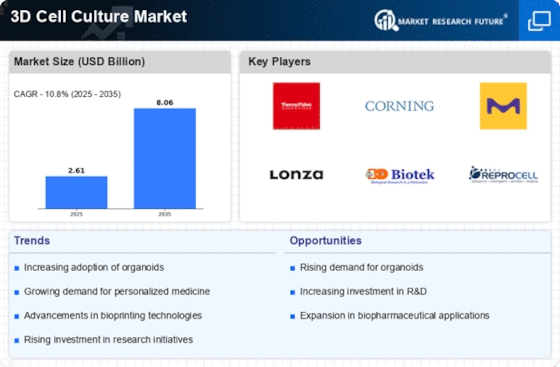
As per Market Research Future analysis, the 3D Cell Culture Market size was valued at USD 2.61 Billion in 2024. The market is projected to grow from USD 2.892 Billion in 2025 to USD 8.065 Billion by 2035, exhibiting a CAGR of 10.8% during the forecast period 2025-2035. North America led the market with over 45.98% share, generating around USD 1.2 billion in revenue.
 
Advancements in 3D cell culture technologies that better replicate in vivo environments are driving adoption, improving drug discovery, toxicity testing, and disease modeling, and reducing reliance on animal models, thus enabling more predictive results in pharmaceutical and biotech research.
 
Over 90 % of drug candidates that show promise in preclinical tests fail in clinical trials, often due to inadequacies of 2D models — prompting growing uptake of 3D culture systems to improve predictability.

Key Market Trends & Highlights

The 3D Cell Culture Market is poised for substantial growth driven by technological advancements and increasing demand for personalized medicine.

  • North America led the 3D cell culture market with 45.98 % share in 2024, driven by strong biotech R&D investments. Europe’s market reached USD 0.78 B in 2024, representing a robust 30 % share with rising cancer research adoption. Drug discovery applications commanded 45 % market share in 2024, fueling demand for predictive human models. Spheroid culture techniques held 60 % share in 2024, due to widespread adoption across research sectors. Pharmaceutical companies accounted for 55 % of end‑use market share, leveraging 3D systems for enhanced development.

Market Size & Forecast

2024 Market Size 2.61 (USD Billion)
2035 Market Size 8.065 (USD Billion)
CAGR (2025 - 2035) 10.8%
Largest Regional Market Share in 2024 North America

Major Players

Companies such as <a href="https://www.thermofisher.com/in/en/home/life-science/cell-culture/organoids-spheroids-3d-cell-culture.html">Thermo Fisher Scientific</a> (US), Corning (US), Merck KGaA (DE), Lonza Group (CH), 3D Biotek (US), ReproCELL (JP), InSphero (CH), TissUse (DE), <a href="https://www.cellink.com/">CELLINK </a>(SE) are some of the major participants in the global market.

Market Trends

The 3D Cell Culture Market is currently experiencing a transformative phase, driven by advancements in technology and a growing understanding of cellular behavior in three-dimensional environments. This market appears to be expanding as researchers and pharmaceutical companies increasingly recognize the limitations of traditional two-dimensional cell cultures. The shift towards three-dimensional systems is likely influenced by their ability to more accurately mimic in vivo conditions, thereby enhancing the relevance of experimental results.

Furthermore, the integration of innovative materials and biocompatible scaffolds is facilitating the development of more sophisticated models, which may lead to improved drug discovery and toxicity testing processes. In addition, the rising demand for personalized medicine is propelling the growth of the market. As healthcare continues to evolve, there is a noticeable trend towards tailored therapies that cater to individual patient needs.

This shift necessitates the use of advanced cell culture techniques that can better replicate human physiology. Consequently, the market is poised for further expansion as stakeholders invest in research and development to create more effective and reliable 3D cell culture systems. Overall, the future of the market appears promising, with numerous opportunities for innovation and growth on the horizon.

Technological Advancements

The market is witnessing a surge in technological innovations that enhance the capabilities of cell culture media systems. These advancements include the development of novel biomaterials and microfabrication techniques, which enable the creation of more complex and physiologically relevant models. As a result, researchers are better equipped to study cellular interactions and drug responses, potentially leading to breakthroughs in various therapeutic areas.

3D cell culture platforms enhance drug discovery by mimicking human tissue architecture, addressing high drug failure rates: >90 % of preclinical successes fail in clinical stages, showing a critical need for better models that 3D systems provide.

Increased Focus on Personalized Medicine

There is a growing emphasis on personalized medicine within the market, as healthcare providers seek to tailor treatments to individual patients. This trend is driving demand for advanced cell culture models that can accurately reflect patient-specific responses. Consequently, stakeholders are investing in the development of customized 3D cell culture systems that facilitate the study of unique disease mechanisms and treatment responses.

3D culture models facilitate personalized approaches by enabling patient‑specific cellular responses, improving understanding of disease mechanisms and treatment variability — vital for precision medicine’s growing role in oncology and regenerative therapies.

Regulatory Support and Funding

The market is benefiting from increased regulatory support and funding initiatives aimed at promoting innovative research methodologies. Governments and regulatory bodies are recognizing the potential of 3D cell culture systems to improve drug development processes and reduce reliance on animal health testing. This support is likely to encourage further investment in the market, fostering growth and innovation.

Although WHO and CDC don’t publish market economics, increasing regulatory emphasis on reducing animal testing and improving human relevance in drug discovery indirectly supports 3D culture adoption, backed by industry capitalization and research grants expanding 3D model development globally.

3D Cell Culture Market Market Drivers

Rising Demand for Drug Discovery

The 3D Cell Culture Market is experiencing a notable increase in demand for drug discovery applications. This trend is largely driven by the need for more predictive models that can better mimic human physiology compared to traditional 2D cultures. As pharmaceutical companies seek to enhance the efficiency of their drug development processes, the adoption of 3D cell culture technologies is becoming more prevalent.
 
Reports indicate that the market for drug discovery using 3D cell cultures is projected to grow significantly, with estimates suggesting a compound annual growth rate (CAGR) of over 15% in the coming years. This growth is indicative of the industry's shift towards more innovative and effective methodologies in drug testing and development.

Advancements in Tissue Engineering

The 3D Cell Culture Market is witnessing substantial advancements in tissue engineering, which is reshaping the landscape of regenerative medicine. Innovations in biomaterials and scaffold design are enabling the creation of more complex tissue structures that closely resemble native tissues. This evolution is crucial for applications in transplantation and disease modeling.
 
The market for tissue engineering is expected to expand, with projections indicating a potential growth rate of around 20% annually. Such advancements not only enhance the capabilities of 3D cell cultures but also open new avenues for research and therapeutic applications, thereby driving the overall market forward.

Emergence of Personalized Medicine

The 3D Cell Culture Market is significantly impacted by the emergence of personalized medicine, which emphasizes tailored treatment approaches based on individual patient profiles. 3D cell cultures offer the potential to create patient-specific models that can predict responses to therapies more accurately than traditional methods.
 
This capability is particularly valuable in oncology, where understanding tumor behavior is critical for effective treatment planning. The market for personalized medicine is projected to grow substantially, with estimates suggesting a CAGR of over 10% in the next few years. This trend underscores the importance of 3D cell cultures in advancing personalized therapeutic strategies.

Growing Awareness of Ethical Considerations

The 3D Cell Culture Market is increasingly influenced by growing awareness of ethical considerations surrounding animal testing. As regulatory bodies and consumers advocate for more humane research practices, the demand for alternative methods, such as 3D cell cultures, is rising.
 
This shift is prompting researchers to adopt 3D models that not only reduce reliance on animal testing but also provide more relevant biological insights. The market is likely to see a surge in adoption rates as institutions and companies align their practices with ethical standards. This trend not only supports the market's growth but also enhances its reputation within the scientific community.

Increased Investment in Research and Development

The 3D Cell Culture Market is benefiting from increased investment in research and development across various sectors, including biotechnology and pharmaceuticals. This influx of funding is facilitating the exploration of novel applications for 3D cell cultures, such as cancer research and toxicology studies.
 
As organizations recognize the limitations of traditional cell culture methods, they are allocating more resources towards developing advanced 3D models. Data suggests that R&D spending in this area could reach billions of dollars, reflecting a strong commitment to innovation. This trend is likely to propel the market further, as new discoveries and technologies emerge.

Market Segment Insights

By Application: Drug Discovery (Largest) vs. Cancer Research (Fastest-Growing)

The application segment shows a varied distribution of market share, with Drug Discovery capturing the largest 3D Cell Culture Market share at 45%. This dominance is fueled by the increasing demand for new drug development and testing methodologies that reduce reliance on animal testing. Other applications like Toxicology Testing and <a title="regenerative medicine" href="https://www.marketresearchfuture.com/reports/regenerative-medicine-market-2220" target="_blank" rel="noopener">Regenerative Medicine</a> are also critical but lag behind in overall market presence. Cancer Research, while a smaller contributor currently, is rapidly increasing its share due to rising investments and advancements in personalized medicine.

Drug Discovery (Dominant) vs. Cancer Research (Emerging)

Drug Discovery remains a dominant segment within the market share, primarily due to technological advancements and the industry's shift toward more ethical testing methods. It enables researchers to better mimic human tissues and pathways, leading to improved drug efficacy and safety profiles. On the other hand, Cancer Research is emerging as a significant player, propelled by increased awareness and investment in oncology therapies. This segment benefits from innovative approaches, such as organ-on-a-chip models, which provide more accurate representations of tumor environments, thus enhancing the development of targeted cancer treatments.

By Technique: Spheroid Culture (Largest) vs. Organ-on-a-Chip (Fastest-Growing)

Spheroid Culture accounts for the largest share of the 3D Cell Culture Market at 60%, highlighting its widespread adoption due to ease of use and versatility across different cell types. It has become the method of choice for drug development and cancer research, fostering significant investment in this area. In contrast, Organ-on-a-Chip is gaining traction and represents the fastest-growing segment of the market, enabled by advances in microfabrication technology and increasing interest from pharmaceutical companies seeking to replicate human organ functions for research and testing purposes.

Technique: Spheroid Culture (Dominant) vs. Organ-on-a-Chip (Emerging)

Spheroid Culture stands as the dominant technique in the market share due to its capacity to closely mimic in vivo environments, offering superior cell-to-cell interactions and physiological relevance. It is widely utilized in <a title="drug screening" href="https://www.marketresearchfuture.com/reports/drug-screening-market-20685" target="_blank" rel="noopener">drug screening</a> and toxicology studies, leveraging its scalability and reproducibility. On the other hand, Organ-on-a-Chip is an emerging technique that allows researchers to model human organs' functionality in a controlled environment. This approach is rapidly gaining popularity for its potential to improve drug efficacy and safety profiles by closely mimicking human body responses, thus positioning itself as a game-changer in preclinical research.

By End Use: Pharmaceutical Companies (Largest) vs. Academic Research Institutes (Fastest-Growing)

The market shows a diverse distribution across its end-use segments, with pharmaceutical companies holding the largest 3D cell culture market share at 55%.. These organizations leverage advanced 3D culture techniques to enhance drug discovery and development processes, ensuring more reliable preclinical models. Conversely, academic research institutes are emerging as the fastest-growing segment, driven by their increasing focus on innovative research methodologies that incorporate 3D cell cultures for various biomedical applications.

Pharmaceutical Companies (Dominant) vs. Academic Research Institutes (Emerging)

Pharmaceutical companies play a dominant role in the 3D cell culture market, utilizing these advanced techniques for their critical research and development activities. They focus on improving therapeutic responses and predictive accuracy in drug testing, which propels demand for robust 3D cell culture technologies. On the other hand, academic research institutes are rapidly emerging as pivotal players in this sector. Their commitment to pioneering studies in tissue regeneration, cancer research, and personalized medicine fosters a growing interest in 3D cell cultures, leading to increased adoption in educational and experimental settings.

By Product: Reagents (Largest) vs. Instruments (Fastest-Growing)

Reagents have become the largest segment, holding a substantial 65% share of the 3D Cell Culture Market because of their crucial role in cell culture processes. This dominance is driven by the increasing demand for advanced cell culture techniques that rely heavily on high-quality reagents for optimal performance. Instruments, on the other hand, are witnessing rapid growth, fueled by technological advancements and increasing adoption of automated systems that enhance experimental consistency and reproducibility. The growth trends in this segment are heavily influenced by the expanding applications of 3D cell culture across various sectors, including drug development, cancer research, and personalized medicine. As researchers increasingly recognize the benefits of using 3D cell culture models over traditional 2D systems, demand for both reagents and instruments is expected to rise. Furthermore, the advent of novel technologies and innovative solutions in 3D cell culture is also driving the growth of the instruments segment, positioning it as the fastest-growing area in this market.

Reagents (Dominant) vs. Services (Emerging)

In the context of the market share, Reagents stand out as the dominant category due to their integral role in supporting various cell culture processes. This segment includes culture media, scaffolds, and other essential components that are crucial for maintaining cell viability and functionality. Their widespread use across research and clinical applications solidifies their position in the market. Meanwhile, Services are emerging as an important segment, offering support in areas such as training, custom development, and technical assistance. As more researchers and companies shift towards 3D cell culture methodologies, the demand for specialized services that can assist with implementation and troubleshooting is on the rise. The interplay of these two segments showcases the comprehensive ecosystem surrounding 3D cell culture, with reagents serving as the foundation and services providing essential support for users.

Get more detailed insights about 3D Cell Culture Market Research Report – Forecast to 2035

Regional Insights

North America : Innovation and Research Hub

North America dominated the global 3D Cell Culture Market in 2024, reaching a market size of USD 1.2 billion. The region's growth is driven by increasing investments in biotechnology and pharmaceutical research, alongside a surge in demand for advanced drug testing methods. Regulatory support from agencies like the FDA further catalyzes market expansion, promoting innovative technologies and methodologies in cell culture practices. 

The United States is the largest market, followed by Canada, both showcasing a robust competitive landscape with key players such as Corning, Thermo Fisher Scientific, and Lonza Group. These companies are at the forefront of technological advancements, offering a wide range of products and services that cater to the growing needs of researchers and healthcare professionals. The presence of leading academic institutions also fosters collaboration and innovation in the sector.

North America dominates due to strong biotech investments and R&D, with 46.4 % market share in 2025, reflecting high adoption of advanced 3D systems in drug discovery, cancer research, and precision medicine.

Europe : Emerging Research Powerhouse

Europe is witnessing significant growth in the market, holding around 30% of the global share. The region benefits from strong regulatory frameworks and funding initiatives aimed at enhancing research capabilities in biotechnology and pharmaceuticals. Countries like Germany and the UK are leading this growth, driven by increasing adoption of 3D cell culture technologies in drug development and personalized medicine.

Germany stands out as a key player, with companies like Merck KGaA and TissUse leading the market. The competitive landscape is characterized by a mix of established firms and innovative startups, all striving to enhance the efficacy of cell culture systems. Collaborative efforts between academia and industry further bolster the region's position, ensuring a steady pipeline of advancements in 3D cell culture technologies.

Europe’s investment in biotechnology and healthcare research supports robust 3D cell culture use, accounting for 30 % of global market share in 2024, driven by widespread cancer research and regenerative medicine initiatives.

Asia-Pacific : Rapidly Growing Market

The Asia-Pacific region is emerging as a significant player in the market, accounting for approximately 20% of the global share. This growth is fueled by increasing investments in healthcare infrastructure and a rising demand for advanced research methodologies. Countries like Japan and China are at the forefront, with government initiatives promoting biotechnology research and development as a priority area for economic growth.

Japan, with companies like ReproCELL and InSphero, is leading the charge in innovative 3D cell culture solutions. The competitive landscape is evolving, with both local and international players vying for market share. The region's focus on personalized medicine and regenerative therapies is driving the adoption of 3D cell culture technologies, making it a hotbed for research and development in the life sciences sector.

Middle East and Africa : Emerging Market Potential

The Middle East and Africa region is gradually developing its market, currently holding about 5% of the global share. The growth is primarily driven by increasing investments in healthcare and biotechnology sectors, alongside a rising awareness of the benefits of advanced cell culture technologies. Countries like South Africa and the UAE are making strides in establishing research facilities and fostering innovation in this field.

South Africa is emerging as a key player, with local companies beginning to adopt 3D cell culture technologies for research and development. The competitive landscape is still in its infancy, but there is a growing interest from international firms looking to enter the market. Government initiatives aimed at enhancing research capabilities are expected to further stimulate growth in the region, paving the way for future advancements in 3D cell culture applications.

Key Players and Competitive Insights

The 3D Cell Culture Market is currently characterized by a dynamic competitive landscape, driven by advancements in biotechnology and increasing demand for more accurate in vitro models. Key players such as Corning (US), Thermo Fisher Scientific (US), and Merck KGaA (DE) are at the forefront, each adopting distinct strategies to enhance their market positioning. Corning (US) focuses on innovation in materials and technologies for 3D cell culture, while Thermo Fisher Scientific (US) emphasizes a broad portfolio of products and services that cater to diverse research needs.
 
Merck KGaA (DE) is leveraging its global reach to expand its offerings in the life sciences analytics sector, indicating a trend towards comprehensive solutions that integrate various aspects of cell culture. The competitive structure of the market appears moderately fragmented, with numerous players contributing to a diverse array of products and services. Companies are increasingly localizing manufacturing and optimizing supply chains to enhance efficiency and responsiveness to market demands. This collective influence of key players fosters a competitive environment where innovation and operational excellence are paramount, allowing firms to differentiate themselves in a crowded marketplace.
 
In August 2025, Corning (US) announced the launch of a new line of advanced 3D cell culture products designed to improve cell viability and functionality. This strategic move is likely to reinforce Corning's position as a leader in the market, as it addresses the growing need for more sophisticated cell culture systems that can better mimic in vivo conditions. The introduction of these products may also enhance customer loyalty and attract new clients seeking cutting-edge solutions.
 
In July 2025, Thermo Fisher Scientific (US) expanded its collaboration with leading academic institutions to develop innovative 3D cell culture models. This partnership is indicative of a broader trend towards collaborative research efforts, which can accelerate the development of new technologies and applications. By aligning with academic leaders, Thermo Fisher Scientific not only enhances its product offerings but also positions itself as a thought leader in the field, potentially driving future growth. In September 2025, Merck KGaA (DE) unveiled a new initiative aimed at integrating artificial intelligence into its 3D cell culture platforms.
 
This strategic action reflects a growing trend towards digitalization within the industry, as companies seek to leverage AI for improved data analysis and predictive modeling. By adopting such advanced technologies, Merck KGaA is likely to enhance its competitive edge and offer more sophisticated solutions to its customers. As of October 2025, the competitive trends in the market are increasingly defined by digitalization, sustainability, and the integration of artificial intelligence.
 
Strategic alliances are playing a crucial role in shaping the landscape, as companies collaborate to enhance their technological capabilities and market reach. Looking ahead, it appears that competitive differentiation will evolve from traditional price-based competition to a focus on innovation, technological advancement, and supply chain reliability, underscoring the importance of adaptability in a rapidly changing market.

Key Companies in the 3D Cell Culture Market include

Industry Developments

Recent developments in the global 3D cell culture market have seen significant advancements and market dynamics. Companies like ReproCELL, Thermo Fisher Scientific, and Corning are increasingly focusing on innovation to enhance their product offerings.

In early 2023, Miltenyi Biotec expanded its expertise in biosensing and cellular analysis by acquiring lino Biotech, a Zurich-based company known for its specialisation in focal molography—an advanced biosensor technology utilised in bioprocess monitoring and potency testing for cell and gene therapies.

Likewise, Thermo Fisher Scientific announced consistent growth in its life sciences division, fuelled by increasing demand for tools that facilitate drug discovery and tissue engineering applications. In October 2022, the company introduced the DynaSpin single-use centrifuge system, designed to enhance the efficiency and scalability of cell-culture harvesting processes within bioprocessing workflows.

In May 2023, Roche inaugurated the Institute of Human Biology in Basel, Switzerland—an initiative dedicated to the advancement of human tissue–based model systems, including organoids. This strategic decision highlights the industry's transition towards research platforms that are more physiologically relevant for cancer and drug development.

There has been a consistent increase in global investment in biotechnology, bolstered by government entities and research organisations that are proactively financing advancements in 3D cell culture and organoid technologies. The recent advancements are driving the expansion of the global market and strengthening its significance in cutting-edge biomedical research.

The focus on developing more sophisticated models for better mimicry of the in vivo environment is a key trend, shaping the future of the market. Overall, these companies are poised to benefit significantly from the increasing adoption of 3D cell culture technologies across various sectors.

Future Outlook

3D Cell Culture Market Future Outlook

The 3D Cell Culture Market size is projected to reach USD 8.065 Billion by 2035, growing at a CAGR of 10.8%, driven by advancements in drug discovery, personalized medicine, and increased funding for research.

New opportunities lie in:

  • <p>Development of advanced bioreactor systems for scalable production Integration of AI-driven analytics for enhanced data interpretation Expansion into emerging markets with tailored 3D culture solutions</p>

By 2035, the 3D Cell Culture Market is expected to be a pivotal component of biomedical research and development.

Market Segmentation

3D Cell Culture Market End Use Outlook

  • Pharmaceutical Companies
  • Biotechnology Companies
  • Academic Research Institutes
  • CROs

3D Cell Culture Market Product Outlook

  • Reagents
  • Instruments
  • Services

3D Cell Culture Market Technique Outlook

  • Spheroid Culture
  • Organ-on-a-Chip
  • Microfluidics
  • Bioreactor Systems

3D Cell Culture Market Application Outlook

  • Drug Discovery
  • Toxicology Testing
  • Regenerative Medicine
  • Cancer Research

Report Scope

MARKET SIZE 2024 2.61(USD Billion)
MARKET SIZE 2025 2.892(USD Billion)
MARKET SIZE 2035 8.065(USD Billion)
COMPOUND ANNUAL GROWTH RATE (CAGR) 10.8% (2025 - 2035)
REPORT COVERAGE Revenue Forecast, Competitive Landscape, Growth Factors, and Trends
BASE YEAR 2024
Market Forecast Period 2025 - 2035
Historical Data 2019 - 2024
Market Forecast Units USD Billion
Key Companies Profiled Thermo Fisher Scientific (US), Corning (US), Merck KGaA (DE), Lonza Group (CH), 3D Biotek (US), ReproCELL (JP), InSphero (CH), TissUse (DE), CELLINK (SE)
Segments Covered Applications, Technique, End Use, Product, Regional
Key Market Opportunities Advancements in organ-on-a-chip technologies enhance drug testing in the 3D Cell Culture Market.
Key Market Dynamics Technological advancements in 3D cell culture are driving innovation and enhancing drug development processes across various sectors.
Countries Covered North America, Europe, APAC, South America, MEA

FAQs

What is the projected market valuation of the market by 2035?

The projected market valuation for the 3D Cell Culture Market by 2035 is 8.065 USD Billion.

What was the market valuation of the market in 2024?

The overall market valuation of the 3D Cell Culture Market was 2.61 USD Billion in 2024.

What is the expected CAGR for the market during the forecast period 2025 - 2035?

The expected CAGR for the 3D Cell Culture Market during the forecast period 2025 - 2035 is 10.8%.

Which application segment is projected to have the highest valuation by 2035?

<p>The Drug Discovery application segment is projected to reach 2.45 USD Billion by 2035.</p>

What are the key techniques used in the 3D Cell Culture Market?

<p>Key techniques in the 3D Cell Culture Market include Spheroid Culture, Organ-on-a-Chip, Microfluidics, and Bioreactor Systems.</p>

Which product category is expected to grow the most by 2035?

<p>The Services product category is expected to grow to 3.0 USD Billion by 2035.</p>

Who are the leading companies in the market?

Leading companies in the market include Thermo Fisher Scientific, Corning, Merck KGaA, and Lonza Group.

What is the projected valuation for the Toxicology Testing segment by 2035?

<p>The Toxicology Testing segment is projected to reach 1.63 USD Billion by 2035.</p>

How does the market for Academic Research Institutes compare to Pharmaceutical Companies?

<p>By 2035, the market for Pharmaceutical Companies is projected at 2.4 USD Billion, while Academic Research Institutes are expected to reach 1.56 USD Billion.</p>

What is the anticipated growth for the Organ-on-a-Chip technique by 2035?

<p>The Organ-on-a-Chip technique is anticipated to grow to 1.95 USD Billion by 2035.</p>

  1. SECTION I: EXECUTIVE SUMMARY AND KEY HIGHLIGHTS |
    1. EXECUTIVE SUMMARY | |
      1. Market Overview | |
      2. Key Findings | |
      3. Market Segmentation | |
      4. Competitive Landscape | |
      5. Challenges and Opportunities | |
      6. Future Outlook 2
  2. SECTION II: SCOPING, METHODOLOGY AND MARKET STRUCTURE |
    1. MARKET INTRODUCTION | |
      1. Definition | |
      2. Scope of the study | | |
    2. RESEARCH METHODOLOGY | |
      1. Overview | |
      2. Data Mining | |
      3. Secondary Research | |
      4. Primary Research | | |
      5. Forecasting Model | |
      6. Market Size Estimation | | |
      7. Data Triangulation | |
      8. Validation 3
  3. SECTION III: QUALITATIVE ANALYSIS |
    1. MARKET DYNAMICS | |
      1. Overview | |
      2. Drivers | |
      3. Restraints | |
      4. Opportunities |
    2. MARKET FACTOR ANALYSIS | |
      1. Value chain Analysis | |
      2. Porter's Five Forces Analysis | | |
      3. COVID-19 Impact Analysis | | |
  4. SECTION IV: QUANTITATIVE ANALYSIS |
    1. Healthcare, BY Application (USD Billion) | |
      1. Drug Discovery | |
      2. Toxicology Testing | |
      3. Regenerative Medicine | |
      4. Cancer Research |
    2. Healthcare, BY Technique (USD Billion) | |
      1. Spheroid Culture | |
      2. Organ-on-a-Chip | |
      3. Microfluidics | |
      4. Bioreactor Systems |
    3. Healthcare, BY End Use (USD Billion) | |
      1. Pharmaceutical Companies | |
      2. Biotechnology Companies | |
      3. Academic Research Institutes | |
      4. CROs |
    4. Healthcare, BY Product (USD Billion) | |
      1. Reagents | |
      2. Instruments | |
      3. Services |
    5. Healthcare, BY Region (USD Billion) | |
      1. North America | | |
      2. Europe | | |
      3. APAC | | |
      4. South America | | |
      5. MEA | | |
  5. SECTION V: COMPETITIVE ANALYSIS |
    1. Competitive Landscape | |
      1. Overview | |
      2. Competitive Analysis | |
      3. Market share Analysis | |
      4. Major Growth Strategy in the Healthcare | |
      5. Competitive Benchmarking | |
      6. Leading Players in Terms of Number of Developments in the Healthcare | |
      7. Key developments and growth strategies | | |
      8. Major Players Financial Matrix | | |
    2. Company Profiles | |
      1. Thermo Fisher Scientific (US) | | |
      2. Corning (US) | | |
      3. Merck KGaA (DE) | | |
      4. Lonza Group (CH) | | |
      5. 3D Biotek (US) | | |
      6. ReproCELL (JP) | | |
      7. InSphero (CH) | | |
      8. TissUse (DE) | | |
      9. CELLINK (SE) | | |
    3. Appendix | |
      1. References | |
      2. Related Reports 6 LIST OF FIGURES |
    4. MARKET SYNOPSIS |
    5. NORTH AMERICA MARKET ANALYSIS |
    6. US MARKET ANALYSIS BY APPLICATION |
    7. US MARKET ANALYSIS BY TECHNIQUE |
    8. US MARKET ANALYSIS BY END USE |
    9. US MARKET ANALYSIS BY PRODUCT |
    10. CANADA MARKET ANALYSIS BY APPLICATION |
    11. CANADA MARKET ANALYSIS BY TECHNIQUE |
    12. CANADA MARKET ANALYSIS BY END USE |
    13. CANADA MARKET ANALYSIS BY PRODUCT |
    14. EUROPE MARKET ANALYSIS |
    15. GERMANY MARKET ANALYSIS BY APPLICATION |
    16. GERMANY MARKET ANALYSIS BY TECHNIQUE |
    17. GERMANY MARKET ANALYSIS BY END USE |
    18. GERMANY MARKET ANALYSIS BY PRODUCT |
    19. UK MARKET ANALYSIS BY APPLICATION |
    20. UK MARKET ANALYSIS BY TECHNIQUE |
    21. UK MARKET ANALYSIS BY END USE |
    22. UK MARKET ANALYSIS BY PRODUCT |
    23. FRANCE MARKET ANALYSIS BY APPLICATION |
    24. FRANCE MARKET ANALYSIS BY TECHNIQUE |
    25. FRANCE MARKET ANALYSIS BY END USE |
    26. FRANCE MARKET ANALYSIS BY PRODUCT |
    27. RUSSIA MARKET ANALYSIS BY APPLICATION |
    28. RUSSIA MARKET ANALYSIS BY TECHNIQUE |
    29. RUSSIA MARKET ANALYSIS BY END USE |
    30. RUSSIA MARKET ANALYSIS BY PRODUCT |
    31. ITALY MARKET ANALYSIS BY APPLICATION |
    32. ITALY MARKET ANALYSIS BY TECHNIQUE |
    33. ITALY MARKET ANALYSIS BY END USE |
    34. ITALY MARKET ANALYSIS BY PRODUCT |
    35. SPAIN MARKET ANALYSIS BY APPLICATION |
    36. SPAIN MARKET ANALYSIS BY TECHNIQUE |
    37. SPAIN MARKET ANALYSIS BY END USE |
    38. SPAIN MARKET ANALYSIS BY PRODUCT |
    39. REST OF EUROPE MARKET ANALYSIS BY APPLICATION |
    40. REST OF EUROPE MARKET ANALYSIS BY TECHNIQUE |
    41. REST OF EUROPE MARKET ANALYSIS BY END USE |
    42. REST OF EUROPE MARKET ANALYSIS BY PRODUCT |
    43. APAC MARKET ANALYSIS |
    44. CHINA MARKET ANALYSIS BY APPLICATION |
    45. CHINA MARKET ANALYSIS BY TECHNIQUE |
    46. CHINA MARKET ANALYSIS BY END USE |
    47. CHINA MARKET ANALYSIS BY PRODUCT |
    48. INDIA MARKET ANALYSIS BY APPLICATION |
    49. INDIA MARKET ANALYSIS BY TECHNIQUE |
    50. INDIA MARKET ANALYSIS BY END USE |
    51. INDIA MARKET ANALYSIS BY PRODUCT |
    52. JAPAN MARKET ANALYSIS BY APPLICATION |
    53. JAPAN MARKET ANALYSIS BY TECHNIQUE |
    54. JAPAN MARKET ANALYSIS BY END USE |
    55. JAPAN MARKET ANALYSIS BY PRODUCT |
    56. SOUTH KOREA MARKET ANALYSIS BY APPLICATION |
    57. SOUTH KOREA MARKET ANALYSIS BY TECHNIQUE |
    58. SOUTH KOREA MARKET ANALYSIS BY END USE |
    59. SOUTH KOREA MARKET ANALYSIS BY PRODUCT |
    60. MALAYSIA MARKET ANALYSIS BY APPLICATION |
    61. MALAYSIA MARKET ANALYSIS BY TECHNIQUE |
    62. MALAYSIA MARKET ANALYSIS BY END USE |
    63. MALAYSIA MARKET ANALYSIS BY PRODUCT |
    64. THAILAND MARKET ANALYSIS BY APPLICATION |
    65. THAILAND MARKET ANALYSIS BY TECHNIQUE |
    66. THAILAND MARKET ANALYSIS BY END USE |
    67. THAILAND MARKET ANALYSIS BY PRODUCT |
    68. INDONESIA MARKET ANALYSIS BY APPLICATION |
    69. INDONESIA MARKET ANALYSIS BY TECHNIQUE |
    70. INDONESIA MARKET ANALYSIS BY END USE |
    71. INDONESIA MARKET ANALYSIS BY PRODUCT |
    72. REST OF APAC MARKET ANALYSIS BY APPLICATION |
    73. REST OF APAC MARKET ANALYSIS BY TECHNIQUE |
    74. REST OF APAC MARKET ANALYSIS BY END USE |
    75. REST OF APAC MARKET ANALYSIS BY PRODUCT |
    76. SOUTH AMERICA MARKET ANALYSIS |
    77. BRAZIL MARKET ANALYSIS BY APPLICATION |
    78. BRAZIL MARKET ANALYSIS BY TECHNIQUE |
    79. BRAZIL MARKET ANALYSIS BY END USE |
    80. BRAZIL MARKET ANALYSIS BY PRODUCT |
    81. MEXICO MARKET ANALYSIS BY APPLICATION |
    82. MEXICO MARKET ANALYSIS BY TECHNIQUE |
    83. MEXICO MARKET ANALYSIS BY END USE |
    84. MEXICO MARKET ANALYSIS BY PRODUCT |
    85. ARGENTINA MARKET ANALYSIS BY APPLICATION |
    86. ARGENTINA MARKET ANALYSIS BY TECHNIQUE |
    87. ARGENTINA MARKET ANALYSIS BY END USE |
    88. ARGENTINA MARKET ANALYSIS BY PRODUCT |
    89. REST OF SOUTH AMERICA MARKET ANALYSIS BY APPLICATION |
    90. REST OF SOUTH AMERICA MARKET ANALYSIS BY TECHNIQUE |
    91. REST OF SOUTH AMERICA MARKET ANALYSIS BY END USE |
    92. REST OF SOUTH AMERICA MARKET ANALYSIS BY PRODUCT |
    93. MEA MARKET ANALYSIS |
    94. GCC COUNTRIES MARKET ANALYSIS BY APPLICATION |
    95. GCC COUNTRIES MARKET ANALYSIS BY TECHNIQUE |
    96. GCC COUNTRIES MARKET ANALYSIS BY END USE |
    97. GCC COUNTRIES MARKET ANALYSIS BY PRODUCT |
    98. SOUTH AFRICA MARKET ANALYSIS BY APPLICATION |
    99. SOUTH AFRICA MARKET ANALYSIS BY TECHNIQUE |
    100. SOUTH AFRICA MARKET ANALYSIS BY END USE |
    101. SOUTH AFRICA MARKET ANALYSIS BY PRODUCT |
    102. REST OF MEA MARKET ANALYSIS BY APPLICATION |
    103. REST OF MEA MARKET ANALYSIS BY TECHNIQUE |
    104. REST OF MEA MARKET ANALYSIS BY END USE |
    105. REST OF MEA MARKET ANALYSIS BY PRODUCT |
    106. KEY BUYING CRITERIA OF HEALTHCARE |
    107. RESEARCH PROCESS OF MRFR |
    108. DRO ANALYSIS OF HEALTHCARE |
    109. DRIVERS IMPACT ANALYSIS: HEALTHCARE |
    110. RESTRAINTS IMPACT ANALYSIS: HEALTHCARE |
    111. SUPPLY / VALUE CHAIN: HEALTHCARE |
    112. HEALTHCARE, BY APPLICATION, 2024 (% SHARE) |
    113. HEALTHCARE, BY APPLICATION, 2024 TO 2035 (USD Billion) |
    114. HEALTHCARE, BY TECHNIQUE, 2024 (% SHARE) |
    115. HEALTHCARE, BY TECHNIQUE, 2024 TO 2035 (USD Billion) |
    116. HEALTHCARE, BY END USE, 2024 (% SHARE) |
    117. HEALTHCARE, BY END USE, 2024 TO 2035 (USD Billion) |
    118. HEALTHCARE, BY PRODUCT, 2024 (% SHARE) |
    119. HEALTHCARE, BY PRODUCT, 2024 TO 2035 (USD Billion) |
    120. BENCHMARKING OF MAJOR COMPETITORS 7 LIST OF TABLES |
    121. LIST OF ASSUMPTIONS | |
      1. |
    122. North America MARKET SIZE ESTIMATES; FORECAST | |
      1. BY APPLICATION, 2025-2035 (USD Billion) | |
      2. BY TECHNIQUE, 2025-2035 (USD Billion) | |
      3. BY END USE, 2025-2035 (USD Billion) | |
      4. BY PRODUCT, 2025-2035 (USD Billion) |
    123. US MARKET SIZE ESTIMATES; FORECAST | |
      1. BY APPLICATION, 2025-2035 (USD Billion) | |
      2. BY TECHNIQUE, 2025-2035 (USD Billion) | |
      3. BY END USE, 2025-2035 (USD Billion) | |
      4. BY PRODUCT, 2025-2035 (USD Billion) |
    124. Canada MARKET SIZE ESTIMATES; FORECAST | |
      1. BY APPLICATION, 2025-2035 (USD Billion) | |
      2. BY TECHNIQUE, 2025-2035 (USD Billion) | |
      3. BY END USE, 2025-2035 (USD Billion) | |
      4. BY PRODUCT, 2025-2035 (USD Billion) |
    125. Europe MARKET SIZE ESTIMATES; FORECAST | |
      1. BY APPLICATION, 2025-2035 (USD Billion) | |
      2. BY TECHNIQUE, 2025-2035 (USD Billion) | |
      3. BY END USE, 2025-2035 (USD Billion) | |
      4. BY PRODUCT, 2025-2035 (USD Billion) |
    126. Germany MARKET SIZE ESTIMATES; FORECAST | |
      1. BY APPLICATION, 2025-2035 (USD Billion) | |
      2. BY TECHNIQUE, 2025-2035 (USD Billion) | |
      3. BY END USE, 2025-2035 (USD Billion) | |
      4. BY PRODUCT, 2025-2035 (USD Billion) |
    127. UK MARKET SIZE ESTIMATES; FORECAST | |
      1. BY APPLICATION, 2025-2035 (USD Billion) | |
      2. BY TECHNIQUE, 2025-2035 (USD Billion) | |
      3. BY END USE, 2025-2035 (USD Billion) | |
      4. BY PRODUCT, 2025-2035 (USD Billion) |
    128. France MARKET SIZE ESTIMATES; FORECAST | |
      1. BY APPLICATION, 2025-2035 (USD Billion) | |
      2. BY TECHNIQUE, 2025-2035 (USD Billion) | |
      3. BY END USE, 2025-2035 (USD Billion) | |
      4. BY PRODUCT, 2025-2035 (USD Billion) |
    129. Russia MARKET SIZE ESTIMATES; FORECAST | |
      1. BY APPLICATION, 2025-2035 (USD Billion) | |
      2. BY TECHNIQUE, 2025-2035 (USD Billion) | |
      3. BY END USE, 2025-2035 (USD Billion) | |
      4. BY PRODUCT, 2025-2035 (USD Billion) |
    130. Italy MARKET SIZE ESTIMATES; FORECAST | |
      1. BY APPLICATION, 2025-2035 (USD Billion) | |
      2. BY TECHNIQUE, 2025-2035 (USD Billion) | |
      3. BY END USE, 2025-2035 (USD Billion) | |
      4. BY PRODUCT, 2025-2035 (USD Billion) |
    131. Spain MARKET SIZE ESTIMATES; FORECAST | |
      1. BY APPLICATION, 2025-2035 (USD Billion) | |
      2. BY TECHNIQUE, 2025-2035 (USD Billion) | |
      3. BY END USE, 2025-2035 (USD Billion) | |
      4. BY PRODUCT, 2025-2035 (USD Billion) |
    132. Rest of Europe MARKET SIZE ESTIMATES; FORECAST | |
      1. BY APPLICATION, 2025-2035 (USD Billion) | |
      2. BY TECHNIQUE, 2025-2035 (USD Billion) | |
      3. BY END USE, 2025-2035 (USD Billion) | |
      4. BY PRODUCT, 2025-2035 (USD Billion) |
    133. APAC MARKET SIZE ESTIMATES; FORECAST | |
      1. BY APPLICATION, 2025-2035 (USD Billion) | |
      2. BY TECHNIQUE, 2025-2035 (USD Billion) | |
      3. BY END USE, 2025-2035 (USD Billion) | |
      4. BY PRODUCT, 2025-2035 (USD Billion) |
    134. China MARKET SIZE ESTIMATES; FORECAST | |
      1. BY APPLICATION, 2025-2035 (USD Billion) | |
      2. BY TECHNIQUE, 2025-2035 (USD Billion) | |
      3. BY END USE, 2025-2035 (USD Billion) | |
      4. BY PRODUCT, 2025-2035 (USD Billion) |
    135. India MARKET SIZE ESTIMATES; FORECAST | |
      1. BY APPLICATION, 2025-2035 (USD Billion) | |
      2. BY TECHNIQUE, 2025-2035 (USD Billion) | |
      3. BY END USE, 2025-2035 (USD Billion) | |
      4. BY PRODUCT, 2025-2035 (USD Billion) |
    136. Japan MARKET SIZE ESTIMATES; FORECAST | |
      1. BY APPLICATION, 2025-2035 (USD Billion) | |
      2. BY TECHNIQUE, 2025-2035 (USD Billion) | |
      3. BY END USE, 2025-2035 (USD Billion) | |
      4. BY PRODUCT, 2025-2035 (USD Billion) |
    137. South Korea MARKET SIZE ESTIMATES; FORECAST | |
      1. BY APPLICATION, 2025-2035 (USD Billion) | |
      2. BY TECHNIQUE, 2025-2035 (USD Billion) | |
      3. BY END USE, 2025-2035 (USD Billion) | |
      4. BY PRODUCT, 2025-2035 (USD Billion) |
    138. Malaysia MARKET SIZE ESTIMATES; FORECAST | |
      1. BY APPLICATION, 2025-2035 (USD Billion) | |
      2. BY TECHNIQUE, 2025-2035 (USD Billion) | |
      3. BY END USE, 2025-2035 (USD Billion) | |
      4. BY PRODUCT, 2025-2035 (USD Billion) |
    139. Thailand MARKET SIZE ESTIMATES; FORECAST | |
      1. BY APPLICATION, 2025-2035 (USD Billion) | |
      2. BY TECHNIQUE, 2025-2035 (USD Billion) | |
      3. BY END USE, 2025-2035 (USD Billion) | |
      4. BY PRODUCT, 2025-2035 (USD Billion) |
    140. Indonesia MARKET SIZE ESTIMATES; FORECAST | |
      1. BY APPLICATION, 2025-2035 (USD Billion) | |
      2. BY TECHNIQUE, 2025-2035 (USD Billion) | |
      3. BY END USE, 2025-2035 (USD Billion) | |
      4. BY PRODUCT, 2025-2035 (USD Billion) |
    141. Rest of APAC MARKET SIZE ESTIMATES; FORECAST | |
      1. BY APPLICATION, 2025-2035 (USD Billion) | |
      2. BY TECHNIQUE, 2025-2035 (USD Billion) | |
      3. BY END USE, 2025-2035 (USD Billion) | |
      4. BY PRODUCT, 2025-2035 (USD Billion) |
    142. South America MARKET SIZE ESTIMATES; FORECAST | |
      1. BY APPLICATION, 2025-2035 (USD Billion) | |
      2. BY TECHNIQUE, 2025-2035 (USD Billion) | |
      3. BY END USE, 2025-2035 (USD Billion) | |
      4. BY PRODUCT, 2025-2035 (USD Billion) |
    143. Brazil MARKET SIZE ESTIMATES; FORECAST | |
      1. BY APPLICATION, 2025-2035 (USD Billion) | |
      2. BY TECHNIQUE, 2025-2035 (USD Billion) | |
      3. BY END USE, 2025-2035 (USD Billion) | |
      4. BY PRODUCT, 2025-2035 (USD Billion) |
    144. Mexico MARKET SIZE ESTIMATES; FORECAST | |
      1. BY APPLICATION, 2025-2035 (USD Billion) | |
      2. BY TECHNIQUE, 2025-2035 (USD Billion) | |
      3. BY END USE, 2025-2035 (USD Billion) | |
      4. BY PRODUCT, 2025-2035 (USD Billion) |
    145. Argentina MARKET SIZE ESTIMATES; FORECAST | |
      1. BY APPLICATION, 2025-2035 (USD Billion) | |
      2. BY TECHNIQUE, 2025-2035 (USD Billion) | |
      3. BY END USE, 2025-2035 (USD Billion) | |
      4. BY PRODUCT, 2025-2035 (USD Billion) |
    146. Rest of South America MARKET SIZE ESTIMATES; FORECAST | |
      1. BY APPLICATION, 2025-2035 (USD Billion) | |
      2. BY TECHNIQUE, 2025-2035 (USD Billion) | |
      3. BY END USE, 2025-2035 (USD Billion) | |
      4. BY PRODUCT, 2025-2035 (USD Billion) |
    147. MEA MARKET SIZE ESTIMATES; FORECAST | |
      1. BY APPLICATION, 2025-2035 (USD Billion) | |
      2. BY TECHNIQUE, 2025-2035 (USD Billion) | |
      3. BY END USE, 2025-2035 (USD Billion) | |
      4. BY PRODUCT, 2025-2035 (USD Billion) |
    148. GCC Countries MARKET SIZE ESTIMATES; FORECAST | |
      1. BY APPLICATION, 2025-2035 (USD Billion) | |
      2. BY TECHNIQUE, 2025-2035 (USD Billion) | |
      3. BY END USE, 2025-2035 (USD Billion) | |
      4. BY PRODUCT, 2025-2035 (USD Billion) |
    149. South Africa MARKET SIZE ESTIMATES; FORECAST | |
      1. BY APPLICATION, 2025-2035 (USD Billion) | |
      2. BY TECHNIQUE, 2025-2035 (USD Billion) | |
      3. BY END USE, 2025-2035 (USD Billion) | |
      4. BY PRODUCT, 2025-2035 (USD Billion) |
    150. Rest of MEA MARKET SIZE ESTIMATES; FORECAST | |
      1. BY APPLICATION, 2025-2035 (USD Billion) | |
      2. BY TECHNIQUE, 2025-2035 (USD Billion) | |
      3. BY END USE, 2025-2035 (USD Billion) | |
      4. BY PRODUCT, 2025-2035 (USD Billion) |
    151. PRODUCT LAUNCH/PRODUCT DEVELOPMENT/APPROVAL | |
      1. |
    152. ACQUISITION/PARTNERSHIP | |

Healthcare Market Segmentation

Healthcare By Application (USD Billion, 2025-2035)

  • Drug Discovery
  • Toxicology Testing
  • Regenerative Medicine
  • Cancer Research

Healthcare By Technique (USD Billion, 2025-2035)

  • Spheroid Culture
  • Organ-on-a-Chip
  • Microfluidics
  • Bioreactor Systems

Healthcare By End Use (USD Billion, 2025-2035)

  • Pharmaceutical Companies
  • Biotechnology Companies
  • Academic Research Institutes
  • CROs

Healthcare By Product (USD Billion, 2025-2035)

  • Reagents
  • Instruments
  • Services
Infographic

Free Sample Request

Kindly complete the form below to receive a free sample of this Report

Get Free Sample

Customer Strories

Compare Licence

×
Features License Type
Single User Multiuser License Enterprise User
Price $4,950 $5,950 $7,250
Maximum User Access Limit 1 User Upto 10 Users Unrestricted Access Throughout the Organization
Free Customization
Direct Access to Analyst
Deliverable Format
Platform Access
Discount on Next Purchase 10% 15% 15%
Printable Versions