×
Hero Background
English
Chinese
French
Japanese
Korean
German
Spanish

2 4 Dichlorobenzyl Alcohol Market Share

ID: MRFR/CnM/2962-HCR
133 Pages
Priya Nagrale
October 2025

2, 4-Dichlorobenzyl Alcohol (DCBA) Market Research Report Information: by Application (Preservative, Insecticide, Chemical Intermediate, and Others), by End Use Industry (Pharmaceutical, Agriculture, Cosmetics & Personal Care, General Industry, and Others), and by Region- Forecast till 2035

Share:
Download PDF ×

We do not share your information with anyone. However, we may send you emails based on your report interest from time to time. You may contact us at any time to opt-out.

2 4 Dichlorobenzyl Alcohol Market Infographic
Purchase Options

Market Share

2 4 Dichlorobenzyl Alcohol Market Share Analysis

In order to gain a competitive advantage and a reasonable share of the 2-4 Dichlorobenzyl Alcohol market under review, companies operating therein use different strategies aimed at achieving a certain portion of market share. Product differentiation is one common strategy employed by these companies. Research is channeled towards discovering unique formulations or improving existing qualities of 2,4-Dichlorobenzyl alcohol so that they can have products with higher efficacy, safety, or other values that will make them more appealing than those produced by competitors. Finally, pricing strategy forms an essential basis for positioning market shares in a given business environment. Some firms choose the cost leadership approach, hence aiming at being the lowest-cost producers in their markets. In this case, they are able to target price-sensitive consumers, thus expanding their customer base further by using competitive pricing practices on their products, which will enable them to attract price-conscious clients who would want low prices on commodities that they buy frequently. On the contrary, premium pricing strategies are used when targeting particular sections of customers who perceive such higher costs as an indication of value-added qualities or even exclusivity due to limited access. It should be noted that maintaining a balance between prices and perceived value enables organizations to dominate over rivals in the 2-4 Dichlorobenzyl Alcohol market. Distribution channels also influence market positioning. Efficient distribution networks can ensure that products reach consumers promptly and consistently. Companies may establish partnerships with core distributors or retailers, placing their products at key locations. Branding is another crucial part of market share positioning in the 2,4-dichlorobenzyl Alcohol market. Having a strong positive brand can bring about a significant impact on customers' preferences. To create awareness, highlight unique selling propositions, and build trust among consumers, enterprises do marketing and promotional activities for which they invest in so many resources. It would then mean that once a brand has become well-known and reputable, it can be sold at higher prices compared to other brands, thereby enjoying the largest market share since most people often prefer purchasing products from their preferred brands. On the other hand, strategic alliances and partnerships may be employed as effective strategies to position a product's market share. Partnering with other firms or making strategic alliances gives access to complementary resources, technologies, or markets. Given this synergy, a company is likely to have more presence in the market thus giving an edge over its competitors. Additionally, research institutions can facilitate joint ventures or collaborations with companies to accelerate innovation processes, hence introducing groundbreaking new products that give them a competitive advantage.

Author
Priya Nagrale
Senior Research Analyst

With an experience of over five years in market research industry (Chemicals & Materials domain), I gather and analyze market data from diverse sources to produce results, which are then presented back to a client. Also, provide recommendations based on the findings. As a Senior Research Analyst, I perform quality checks (QC) for market estimations, QC for reports, and handle queries and work extensively on client customizations. Also, handle the responsibilities of client proposals, report planning, report finalization, and execution

Leave a Comment

Market Summary

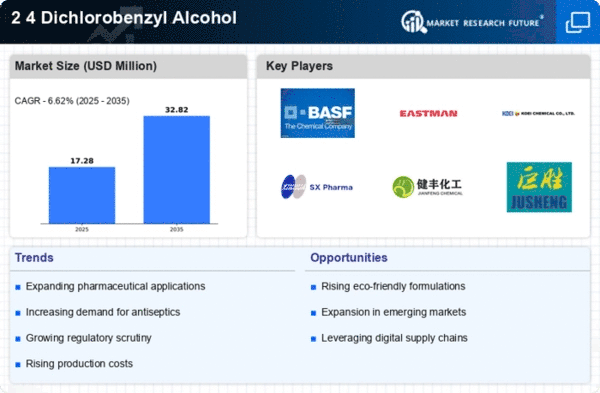
As per MRFR analysis, the 2 4 Dichlorobenzyl Alcohol Size was estimated at 16.21 USD Million in 2024. The 2 4 Dichlorobenzyl Alcohol industry is projected to grow from 17.29 in 2025 to 32.82 by 2035, exhibiting a compound annual growth rate (CAGR) of 6.62 during the forecast period 2025 - 2035.

Key Market Trends & Highlights

The 2 4 Dichlorobenzyl Alcohol Market is experiencing robust growth driven by diverse applications and increasing consumer awareness.

  • The market is witnessing rising demand in the healthcare sector, particularly in North America, which remains the largest market.
  • In Asia-Pacific, the market is expanding rapidly, driven by a growing preference for hygiene products among consumers.
  • The antiseptic segment dominates the market, while the disinfectant segment is emerging as the fastest-growing category.
  • Key market drivers include increasing applications in personal care products and regulatory support for antimicrobial agents.

Market Size & Forecast

2024 Market Size 16.21 (USD Million)
2035 Market Size 32.82 (USD Million)
CAGR (2025 - 2035) 6.62%
Largest Regional Market Share in 2024 North America

Major Players

<p>BASF SE (DE), Eastman Chemical Company (US), Kraton Corporation (US), Solvay SA (BE), Huntsman Corporation (US), Lanxess AG (DE), Albemarle Corporation (US), Mitsubishi Gas Chemical Company (JP)</p>

Market Trends

The 2 4 Dichlorobenzyl Alcohol Market is currently experiencing notable developments, driven by various factors influencing its demand and supply dynamics. This compound, primarily utilized in the production of antiseptics and disinfectants, has garnered attention due to its effectiveness against a range of pathogens. As industries increasingly prioritize hygiene and safety, the relevance of 2 4 Dichlorobenzyl Alcohol appears to be on the rise. Furthermore, regulatory frameworks surrounding chemical usage are evolving, which may impact market accessibility and compliance requirements. In addition, the growing awareness of health and wellness among consumers is likely to bolster the demand for products containing 2 4 Dichlorobenzyl Alcohol. Manufacturers are adapting to these shifts by innovating formulations and enhancing product efficacy. The market landscape is characterized by a blend of established players and emerging companies, each vying for a competitive edge. As the global focus on sanitation intensifies, the 2 4 Dichlorobenzyl Alcohol Market is poised for potential growth, reflecting broader trends in public health and safety.

Rising Demand in Healthcare Sector

The healthcare industry is increasingly adopting 2 4 Dichlorobenzyl Alcohol for its antiseptic properties. This trend is likely fueled by heightened awareness of infection control and the need for effective disinfectants in medical settings.

Regulatory Changes and Compliance

Evolving regulations regarding chemical safety and environmental impact may influence the production and distribution of 2 4 Dichlorobenzyl Alcohol. Companies are adapting to these changes to ensure compliance and maintain market access.

Consumer Preference for Hygiene Products

There is a noticeable shift in consumer behavior towards products that emphasize cleanliness and safety. This trend suggests that products containing 2 4 Dichlorobenzyl Alcohol may see increased market penetration as consumers prioritize health.

2 4 Dichlorobenzyl Alcohol Market Market Drivers

Increasing Regulatory Support

The Global 2, 4-Dichlorobenzyl Alcohol Market Industry is likely to benefit from increasing regulatory support aimed at ensuring product safety and efficacy. Governments worldwide are implementing stringent regulations regarding the use of chemical compounds in consumer products, which may enhance the credibility and demand for 2, 4-Dichlorobenzyl Alcohol. Compliance with these regulations can lead to greater market acceptance and expansion opportunities. As a result, the industry may experience a compound annual growth rate of 5.49% from 2025 to 2035, reflecting the positive impact of regulatory frameworks on market dynamics.

Rising Demand for Antiseptics

The Global 2, 4-Dichlorobenzyl Alcohol Market Industry experiences a notable increase in demand for antiseptic products, driven by heightened awareness of hygiene and infection control. This compound is widely utilized in various antiseptic formulations, including hand sanitizers and surface disinfectants. As consumers prioritize health and safety, the market is projected to reach 250 USD Million in 2024. This trend is likely to continue, with the market expanding as more industries adopt stringent hygiene protocols, thereby bolstering the growth of the Global 2, 4-Dichlorobenzyl Alcohol Market Industry.

Expansion of Personal Care Products

The Global 2, 4-Dichlorobenzyl Alcohol Market Industry is witnessing a surge in the incorporation of this compound in personal care products, such as skin creams and lotions. The compound's antimicrobial properties make it an attractive ingredient for enhancing product safety and shelf life. As consumer preferences shift towards products that offer both efficacy and safety, the market is expected to grow significantly. This trend aligns with the broader movement towards clean beauty and wellness, further solidifying the role of 2, 4-Dichlorobenzyl Alcohol in the personal care sector within the Global 2, 4-Dichlorobenzyl Alcohol Market Industry.

Growth in Pharmaceutical Applications

The Global 2, 4-Dichlorobenzyl Alcohol Market Industry benefits from its extensive use in the pharmaceutical sector, particularly in the formulation of medications and topical treatments. The compound's properties as a preservative and antimicrobial agent enhance product stability and efficacy. As the pharmaceutical industry evolves, the demand for effective preservatives is expected to rise, contributing to a projected market value of 450 USD Million by 2035. This growth is indicative of the compound's critical role in ensuring the safety and longevity of pharmaceutical products within the Global 2, 4-Dichlorobenzyl Alcohol Market Industry.

Technological Advancements in Production

The Global 2, 4-Dichlorobenzyl Alcohol Market Industry is poised for growth due to ongoing technological advancements in production processes. Innovations in synthesis methods and purification techniques are likely to enhance the efficiency and cost-effectiveness of producing this compound. As production becomes more streamlined, manufacturers can meet the rising demand while maintaining product quality. This efficiency may contribute to the overall market growth, aligning with the anticipated increase in market value and the compound's applications across various sectors.

Market Segment Insights

By Application: Antiseptic (Largest) vs. Disinfectant (Fastest-Growing)

<p>In the 2 4 Dichlorobenzyl Alcohol Market, the application segment has a prominent distribution with antiseptics taking the largest market share. Antiseptics are widely used in healthcare settings for their effectiveness in preventing infections, thereby reinforcing their dominant position. Disinfectants, on the other hand, are emerging as the fastest-growing category within this segment, driven by the rising demand for hygiene products across various sectors, including residential and commercial spaces.</p>

<p>Disinfectant: Fastest-Growing vs. Preservative: Emerging</p>

<p>The disinfectant category within the 2 4 Dichlorobenzyl Alcohol application segment is characterized by its rapid expansion, spurred by heightened awareness of health and hygiene among consumers. This growth can be attributed to the increased usage of disinfectant products in both public health initiatives and personal care routines. On the flip side, preservatives, though labeled as emerging, play a crucial role in extending the shelf-life of products across food, pharmaceuticals, and cosmetics. As regulatory pressures increase, the demand for effective preservatives that ensure product safety and quality is likely to grow, positioning them strategically in the market alongside disinfectants.</p>

By End Use: Pharmaceuticals (Largest) vs. Cosmetics (Fastest-Growing)

<p>The 2 4 Dichlorobenzyl Alcohol Market demonstrates a diverse distribution of market share across various end-use segments. Pharmaceuticals constitute the largest segment due to their essential role as an antiseptic and preservative in a wide range of medical formulations. Following this, cosmetics have emerged as a significant player, leveraging the compound's preservative qualities to enhance product longevity and stability. Household products and industrial cleaning are other notable segments, each contributing to the market's overall diversity and stability. Growth trends for the 2 4 Dichlorobenzyl Alcohol Market are driven by a combination of increasing demand in pharmaceuticals and a growing inclination toward high-quality cosmetic products. Pharmaceuticals are propelled by rising health consciousness and the continual development of new medications. Conversely, the cosmetics segment is experiencing rapid growth, fueled by consumer trends toward natural and long-lasting products that utilize 2 4 Dichlorobenzyl Alcohol for its efficacy. Innovation and sustainable practices in formulation are shaping the trajectory of this market segment.</p>

<p>Pharmaceuticals (Dominant) vs. Industrial Cleaning (Emerging)</p>

<p>Pharmaceuticals hold a dominant position within the 2 4 Dichlorobenzyl Alcohol Market, attributed to their critical applications in formulations where antiseptic properties are paramount. This segment benefits from stringent regulatory support and a robust pipeline of pharmaceutical products, indicating stability and growth potential. On the other side, industrial cleaning represents an emerging segment, gaining traction due to the increasing need for effective cleaning agents in various industries. The rise in industrial activities and stringent hygiene regulations drive demand for 2 4 Dichlorobenzyl Alcohol as a component in cleaning solutions, positioning it as a vital ingredient aimed at improving efficiency and safety in industrial settings. The interaction between these segments highlights a dynamic market landscape, with Pharmaceuticals as the backbone and Industrial Cleaning as a rapidly evolving area.</p>

By Formulation Type: Liquid (Largest) vs. Powder (Fastest-Growing)

<p>In the 2 4 Dichlorobenzyl Alcohol Market, the formulation types exhibit a diverse market share distribution. Liquid formulations take the lead as the most popular option, benefiting from ease of application and effective dispersion. Following closely are powder formulations, which are gaining traction due to their stability and ease of transport. Gel formulations, while less prominent, maintain a steady presence, appealing to niche segments that value specific application characteristics. Growth trends in this segment are influenced by various factors including technological advancements and changing consumer preferences. The demand for liquid formulations remains robust as industries seek versatile applications ranging from industrial to personal care products. Conversely, powder formulations are emerging as a fast-growing choice driven by their convenience and efficacy, particularly in the cleaning and disinfecting sectors, indicating a dynamic shift in market preferences.</p>

<p>Formulation: Liquid (Dominant) vs. Powder (Emerging)</p>

<p>Liquid formulations of 2 4 Dichlorobenzyl Alcohol dominate the market due to their broad applicability and effectiveness. They are widely used in industrial, household, and healthcare applications, making them indispensable in various sectors. The dominant market position is attributed to their favorable characteristics such as easy application, rapid dissolution, and effective distribution. Meanwhile, powder formulations are emerging as a significant segment, finding favor due to their advantage in terms of shelf stability and transport efficiency. These formulations enable precise dosing and reduce waste, making them appealing in manufacturing contexts. As businesses strive to adapt to evolving consumer preferences, the contrast between the established dominance of liquid forms and the rapid rise of powders signifies a pivotal evolution in the formulation landscape.</p>

By Distribution Channel: Online (Largest) vs. Offline Retail (Fastest-Growing)

<p>In the 2 4 Dichlorobenzyl Alcohol Market, the distribution channel landscape is predominantly led by the online segment, which captures the largest share due to the increasing trend of e-commerce and direct-to-consumer models. This segment benefits from a wider reach and convenience, allowing customers to access products more easily. Conversely, the offline retail segment, while smaller in comparison, exhibits significant growth potential as consumers continue to seek out physical stores for purchasing chemicals, driven by the tangible experience it provides. The growth trends in this segment are compelling, particularly for offline retail, which is adapting to a resurgence in face-to-face engagements post-pandemic. Enhanced shopping experiences and better customer service are driving this segment's growth. Additionally, the online channel continues to maximize its dominance by investing in digital marketing and optimizing user experiences, ensuring long-term sustainability and customer loyalty in a competitive marketplace.</p>

<p>Online (Dominant) vs. Offline Retail (Emerging)</p>

<p>The online distribution channel stands out as the dominant force in the 2 4 Dichlorobenzyl Alcohol market, characterized by its expansive reach and 24/7 availability for consumers. Online platforms leverage advanced data analytics to personalize the shopping experience and frequently offer promotional discounts, which enhance customer acquisition and retention strategies. In contrast, offline retail, while traditionally established, is emerging with greater urgency as it appeals to a segment of customers who prefer direct interaction and physical examination of products before purchase. This channel is also capitalizing on the growing trend of local sourcing and sustainability, positioning itself as a crucial alternative that caters to environmentally-conscious consumers who value the immediacy and tangible aspects of shopping.</p>

By Concentration Level: Medium Concentration (Largest) vs. High Concentration (Fastest-Growing)

<p>In the 2 4 Dichlorobenzyl Alcohol Market, the concentration levels are segmented into low, medium, and high concentrations, with medium concentration holding the largest market share. This segment appeals to a wide range of applications, making it the preferred choice among manufacturers and consumers alike. Low concentration products hold a smaller share, primarily targeting niche markets where high potency is not required, while high concentration products are becoming increasingly popular due to their effectiveness in industrial applications.</p>

<p>Medium Concentration (Dominant) vs. High Concentration (Emerging)</p>

<p>Medium concentration of 2 4 Dichlorobenzyl Alcohol is characterized by its versatility, allowing it to be used effectively in cosmetics, pharmaceuticals, and cleaning products. This segment is dominant due to its balance of efficacy and safety, making it suitable for consumer use. In contrast, high concentration products are emerging as a significant player in the market, primarily driven by industrial demand for strong disinfectants and solvents. The rising awareness about the effectiveness of high concentrations in specialized applications is propelling their growth, creating a competitive landscape where both segments vie for market share.</p>

Get more detailed insights about 2, 4-Dichlorobenzyl Alcohol Market Research Report- Forecast to 2035

Regional Insights

North America : Market Leader in Growth

North America is poised to maintain its leadership in the 2 4 Dichlorobenzyl Alcohol market, holding a significant market share of 8.1 in 2024. The region's growth is driven by increasing demand in pharmaceuticals and personal care products, alongside stringent regulatory frameworks that promote safety and efficacy. The presence of major manufacturers and a robust supply chain further bolster market expansion, making it a focal point for innovation and investment. The United States stands out as the leading country in this region, with key players such as BASF SE, Eastman Chemical Company, and Huntsman Corporation driving competition. The competitive landscape is characterized by strategic partnerships and technological advancements aimed at enhancing product quality and sustainability. As the market evolves, these companies are expected to leverage their expertise to capture emerging opportunities, ensuring North America's continued dominance.

Europe : Emerging Market Dynamics

Europe's 2 4 Dichlorobenzyl Alcohol market is projected to grow, with a market size of 4.8 in 2025. The region benefits from a strong regulatory environment that emphasizes chemical safety and environmental sustainability. Increasing demand from the cosmetics and pharmaceutical sectors is driving growth, alongside initiatives aimed at reducing carbon footprints. The European market is adapting to these trends, positioning itself as a hub for innovation and sustainable practices. Leading countries such as Germany, France, and the UK are at the forefront of this market, with companies like Solvay SA and Lanxess AG playing pivotal roles. The competitive landscape is marked by a focus on research and development, with firms investing in new technologies to enhance product offerings. As the market matures, collaboration between industry players and regulatory bodies will be crucial for navigating challenges and capitalizing on growth opportunities.

Asia-Pacific : Emerging Powerhouse in Chemicals

The Asia-Pacific region is witnessing significant growth in the 2 4 Dichlorobenzyl Alcohol market, with a market size of 2.8 in 2025. This growth is fueled by rising industrialization and increasing demand for personal care products. Regulatory frameworks are evolving to ensure safety and compliance, which is further driving market expansion. The region's diverse consumer base and growing middle class are also contributing to the demand for high-quality chemical products. Countries like China, Japan, and India are leading the charge in this market, with key players such as Mitsubishi Gas Chemical Company and Kraton Corporation establishing a strong presence. The competitive landscape is characterized by rapid innovation and strategic partnerships aimed at enhancing product offerings. As the market continues to grow, companies are expected to focus on sustainability and efficiency to meet the evolving needs of consumers and regulatory standards.

Middle East and Africa : Resource-Rich Frontier

The Middle East and Africa (MEA) region presents a nascent but promising market for 2 4 Dichlorobenzyl Alcohol, with a market size of 0.51 in 2025. The growth in this region is primarily driven by increasing industrial activities and a rising demand for personal care and household products. Regulatory frameworks are gradually being established to ensure product safety and environmental compliance, which will further enhance market prospects. The region's rich natural resources provide a unique advantage for chemical production. Countries such as South Africa and the UAE are emerging as key players in this market, with local manufacturers beginning to establish their foothold. The competitive landscape is still developing, but there is potential for growth as international companies look to expand their operations in the region. As the market matures, collaboration between local and global players will be essential for driving innovation and meeting consumer demands.

Key Players and Competitive Insights

The 2 4 Dichlorobenzyl Alcohol Market is characterized by a competitive landscape that is increasingly shaped by innovation, strategic partnerships, and a focus on sustainability. Key players such as BASF SE (DE), Eastman Chemical Company (US), and Huntsman Corporation (US) are actively pursuing strategies that enhance their market positioning. BASF SE (DE) emphasizes innovation in product development, aiming to meet the evolving demands of various end-use industries. Meanwhile, Eastman Chemical Company (US) has been focusing on expanding its operational footprint through strategic acquisitions and partnerships, which appear to bolster its competitive edge. Huntsman Corporation (US) is also investing in digital transformation initiatives, which may enhance operational efficiency and customer engagement, thereby influencing the overall market dynamics.

The business tactics employed by these companies include localizing manufacturing and optimizing supply chains to enhance responsiveness to market demands. The market structure is moderately fragmented, with several players vying for market share. However, the collective influence of major companies like BASF SE (DE) and Eastman Chemical Company (US) suggests a trend towards consolidation, as these firms leverage their resources to gain competitive advantages.

In November 2025, BASF SE (DE) announced the launch of a new production facility aimed at increasing its output of 2 4 Dichlorobenzyl Alcohol. This strategic move is likely to enhance its capacity to meet growing global demand, particularly in the pharmaceutical and personal care sectors. The establishment of this facility not only signifies BASF's commitment to innovation but also reflects its proactive approach to addressing supply chain challenges.

In October 2025, Eastman Chemical Company (US) completed the acquisition of a specialty chemicals firm, which is expected to expand its product portfolio in the 2 4 Dichlorobenzyl Alcohol segment. This acquisition may provide Eastman with enhanced capabilities in research and development, allowing it to introduce more advanced formulations that cater to specific customer needs. Such strategic actions indicate a clear intent to strengthen its market position through diversification and innovation.

In September 2025, Huntsman Corporation (US) launched a new sustainability initiative aimed at reducing the carbon footprint of its production processes. This initiative is likely to resonate well with environmentally conscious consumers and businesses, positioning Huntsman as a leader in sustainable practices within the 2 4 Dichlorobenzyl Alcohol Market. The focus on sustainability not only aligns with global trends but also enhances the company's brand reputation and customer loyalty.

As of December 2025, the competitive trends in the market are increasingly defined by digitalization, sustainability, and the integration of advanced technologies such as AI. Strategic alliances among key players are shaping the landscape, fostering innovation and enhancing supply chain reliability. The shift from price-based competition to a focus on technological advancement and sustainable practices is evident, suggesting that future competitive differentiation will hinge on the ability to innovate and adapt to changing market dynamics.

Key Companies in the 2 4 Dichlorobenzyl Alcohol Market market include

Industry Developments

Future Outlook

2 4 Dichlorobenzyl Alcohol Market Future Outlook

<p>The 2 4 Dichlorobenzyl Alcohol Market is projected to grow at a 6.62% CAGR from 2024 to 2035, driven by increasing demand in pharmaceuticals, personal care, and industrial applications.</p>

New opportunities lie in:

  • <p>Expansion into emerging markets with tailored formulations</p>
  • <p>Development of eco-friendly production processes</p>
  • <p>Strategic partnerships with pharmaceutical companies for innovative applications</p>

<p>By 2035, the market is expected to solidify its position as a key player in diverse industries.</p>

Market Segmentation

2 4 Dichlorobenzyl Alcohol Market End Use Outlook

  • Pharmaceuticals
  • Cosmetics
  • Household Products
  • Industrial Cleaning

2 4 Dichlorobenzyl Alcohol Market Application Outlook

  • Antiseptic
  • Disinfectant
  • Preservative
  • Solvent

2 4 Dichlorobenzyl Alcohol Market Formulation Type Outlook

  • Liquid
  • Powder
  • Gel

2 4 Dichlorobenzyl Alcohol Market Concentration Level Outlook

  • Low Concentration
  • Medium Concentration
  • High Concentration

2 4 Dichlorobenzyl Alcohol Market Distribution Channel Outlook

  • Online
  • Offline Retail
  • Direct Sales

Report Scope

MARKET SIZE 202416.21(USD Million)
MARKET SIZE 202517.29(USD Million)
MARKET SIZE 203532.82(USD Million)
COMPOUND ANNUAL GROWTH RATE (CAGR)6.62% (2024 - 2035)
REPORT COVERAGERevenue Forecast, Competitive Landscape, Growth Factors, and Trends
BASE YEAR2024
Market Forecast Period2025 - 2035
Historical Data2019 - 2024
Market Forecast UnitsUSD Million
Key Companies ProfiledBASF SE (DE), Eastman Chemical Company (US), Kraton Corporation (US), Solvay SA (BE), Huntsman Corporation (US), Lanxess AG (DE), Albemarle Corporation (US), Mitsubishi Gas Chemical Company (JP)
Segments CoveredApplication, End Use, Formulation Type, Distribution Channel, Concentration Level
Key Market OpportunitiesGrowing demand for antimicrobial agents in personal care products enhances opportunities in the 2 4 Dichlorobenzyl Alcohol Market.
Key Market DynamicsRising demand for 2 4 Dichlorobenzyl Alcohol in personal care products drives competitive dynamics and regulatory scrutiny.
Countries CoveredNorth America, Europe, APAC, South America, MEA

FAQs

  1. Executive Summary
  2. Scope of the Report
    1. Market Definition
    2. Scope of the
      1. Research Objectives
      2. Assumptions & Limitations
    3. Study
    4. Markets Structure
  3. Market Research
    1. Methodology
    2. Research Process
    3. Secondary Research
    4. Primary Research
    5. Forecast Model
  4. Market Landscape
    1. Five Forces Analysis
    2. of New Entrants
    3. of Buyers
    4. Value Chain/Supply Chain of Global 2, 4 Dichlorobenzyl Alcohol Market
  5. Threat
  6. Bargaining Power
  7. Threat of Substitutes
  8. Segment Rivalry
  9. Industry Overview of Global 2, 4 Dichlorobenzyl
    1. Alcohol Market
    2. Introduction
    3. Growth Drivers
    4. Impact Analysis
    5. Market Challenges
    6. Impact Analysis
    7. Market Trends
    8. Introduction
    9. Growth Trends
    10. Impact analysis
  10. Global 2, 4
    1. Dichlorobenzyl Alcohol Market by Application
    2. Introduction
    3. Preservative
      1. Market Estimates & Forecast,
      2. Market Estimates & Forecast by Region, 2020-2027
    4. Insecticide
      1. Market Estimates & Forecast,
      2. Market Estimates & Forecast by Region, 2020-2027
    5. Chemical Intermediate
      1. Market Estimates
      2. Market Estimates & Forecast by Region,
    6. & Forecast, 2020-2027
    7. Others
      1. Market Estimates &
      2. Market Estimates & Forecast by Region,
    8. Forecast, 2020-2027
  11. Global 2, 4 Dichlorobenzyl Alcohol Market
    1. by End Use Industry
    2. Introduction
      1. Market Estimates & Forecast, 2020-2027
      2. Market Estimates & Forecast by Region, 2020-2027
      3. Market Estimates & Forecast, 2020-2027
      4. Market Estimates & Forecast by Region, 2020-2027
      5. Market Estimates & Forecast,
      6. Market Estimates & Forecast by Region, 2020-2027
    3. Pharmaceutical
    4. Agriculture
    5. Cosmetics & Personal Care
    6. General Industry
      1. Market Estimates &
      2. Market Estimates & Forecast by Region,
    7. Forecast, 2020-2027
    8. Others
      1. Market Estimates &
      2. Market Estimates & Forecast by Region,
    9. Forecast, 2020-2027
  12. Global 2, 4 Dichlorobenzyl Alcohol Market by
    1. Region
    2. Introduction
      1. US
      2. Canada
    3. North America
    4. Europe
      1. Germany
      2. Italy
      3. Spain
      4. UK
    5. France
    6. Asia Pacific
      1. India
      2. Japan
      3. Australia
      4. New Zealand
      5. Rest of Asia Pacific
    7. China
    8. Middle
      1. Turkey
      2. Israel
      3. North Africa
      4. GCC
      5. Rest of
    9. East & Africa
    10. Middle East & Africa
    11. Latin America
      1. Argentina
      2. Rest of
    12. Brazil
    13. Latin America
  13. Company Landscape
    1. Company Profiles
    2. BASF SE
      1. Company Overview
      2. Product/Business
      3. Financial Updates
    3. Segment Overview
    4. Key Developments
    5. Reckitt Benckiser
      1. Company Overview
      2. Product/Business Segment Overview
      3. Key Developments
      4. Company Overview
      5. Financial
      6. Key Developments
    6. Healthcare International Ltd.
    7. Financial Updates
    8. Sigma-Aldrich Co. LLC
    9. Product/Business Segment Overview
    10. Updates
    11. EMKA-Chemie
      1. Company Overview
      2. Financial
      3. Key Developments
    12. Gmbh & Co. KG
    13. Product/Business Segment Overview
    14. Updates
    15. Santa
      1. Company Overview
      2. Financial
      3. Key Developments
    16. Cruz Biotechnology, Inc.
    17. Product/Business Segment Overview
    18. Updates
    19. Bioxera
      1. Company Overview
      2. Financial
      3. Key Developments
    20. Pharma Private Limited
    21. Product/Business Segment Overview
    22. Updates
    23. Benzo
      1. Company Overview
      2. Financial
      3. Key Developments
    24. Chem Industries Pvt. Ltd.
    25. Product/Business Segment Overview
    26. Updates
    27. Conclusion
    28. LIST OF TABLES:
    29. Table
  14. World Population by Major Regions (2020-2027)
  15. Global 2, 4 Dichlorobenzyl Alcohol
    1. Market: By Region, 2020-2027
    2. Table 3
    3. North America 2, 4 Dichlorobenzyl Alcohol Market: By Country, 2020-2027
  16. Europe 2, 4 Dichlorobenzyl
    1. Alcohol Market: By Country, 2020-2027
    2. Table 5
    3. Asia Pacific 2, 4 Dichlorobenzyl Alcohol Market: By Country, 2020-2027
  17. Middle East & Africa
    1. 2, 4 Dichlorobenzyl Alcohol Market: By Country, 2020-2027
    2. Table
  18. Latin America 2, 4 Dichlorobenzyl Alcohol
    1. Market: By Country, 2020-2027
    2. Table 8
    3. Global 2, 4 Dichlorobenzyl Alcohol by Application Market: By Regions,
  19. North America
    1. 2, 4 Dichlorobenzyl Alcohol by Application Market: By Country, 2020-2027
  20. Europe 2, 4 Dichlorobenzyl Alcohol by
    1. Application Market: By Country, 2020-2027
  21. Asia-Pacific
    1. 2, 4 Dichlorobenzyl Alcohol by Application Market: By Country, 2020-2027
  22. Middle East & Africa 2, 4 Dichlorobenzyl
    1. Alcohol by Application Market: By Country, 2020-2027
    2. Table
  23. Latin America 2, 4 Dichlorobenzyl Alcohol by Application
    1. Market: By Country, 2020-2027
  24. North
    1. America 2, 4 Dichlorobenzyl Alcohol for End Use Industry: By Country, 2020-2027
  25. Europe 2, 4 Dichlorobenzyl Alcohol for
    1. End Use Industry: By Country, 2020-2027
  26. Asia-Pacific
    1. 2, 4 Dichlorobenzyl Alcohol for End Use Industry: By Country, 2020-2027
  27. Middle East & Africa 2, 4 Dichlorobenzyl Alcohol
    1. for End Use Industry: By Country, 2020-2027
    2. Table 18
    3. Latin America 2, 4 Dichlorobenzyl Alcohol for End Use Industry: By Country,
  28. Global Application Market: By Region,
  29. Global End Use Industry Market:
    1. By Region, 2020-2027
  30. North America 2, 4 Dichlorobenzyl
  31. Alcohol Market, By Country
  32. North America
  33. 2, 4 Dichlorobenzyl Alcohol Market, By Application
    1. Table 23
  34. North America 2, 4 Dichlorobenzyl Alcohol Market, By End Use Industry
  35. Europe: 2, 4 Dichlorobenzyl Alcohol Market, By
    1. Country
  36. Europe: 2, 4 Dichlorobenzyl Alcohol
  37. Market, By Application
  38. Europe: 2, 4 Dichlorobenzyl
  39. Alcohol Market, By End Use Industry
  40. Asia-Pacific:
  41. 2, 4 Dichlorobenzyl Alcohol Market, By Country
    1. Table 28
  42. Asia-Pacific: 2, 4 Dichlorobenzyl Alcohol Market, By Application
  43. Asia-Pacific: 2, 4 Dichlorobenzyl Alcohol Market,
    1. By End Use Industry
  44. Middle East & Africa:
  45. 2, 4 Dichlorobenzyl Alcohol Market, By Country
    1. Table 31
  46. Middle East & Africa 2, 4 Dichlorobenzyl Alcohol Market, By Application
  47. Middle East & Africa: 2, 4 Dichlorobenzyl Alcohol
  48. Market, By End Use Industry
  49. Latin America:
  50. 2, 4 Dichlorobenzyl Alcohol Market, By Country
    1. Table 34
  51. Latin America 2, 4 Dichlorobenzyl Alcohol Market, By Application
  52. Latin America: 2, 4 Dichlorobenzyl Alcohol Market,
    1. By End Use Industry
    2. LIST
    3. OF FIGURES:
  53. Global 2, 4 Dichlorobenzyl Alcohol Market
    1. segmentation
  54. Forecast Methodology
  55. Five Forces
    1. Analysis of Global 2, 4 Dichlorobenzyl Alcohol Market
  56. Value
    1. Chain of Global 2, 4 Dichlorobenzyl Alcohol Market
  57. Share of
  58. Global 2, 4 Dichlorobenzyl Alcohol Market in 2020, by country (in %)
    1. FIGURE
  59. Global 2, 4 Dichlorobenzyl Alcohol Market, 2020-2027,
    1. FIGURE 7
    2. Sub segments of End Use Industry
  60. Global 2, 4 Dichlorobenzyl
    1. Alcohol Market size by End Use Industry, 2020
  61. Share of
    1. Global 2, 4 Dichlorobenzyl Alcohol Market by End Use Industry, 2020-2027
  62. Global 2, 4 Dichlorobenzyl Alcohol Market size by Application,
  63. Share of Global 2, 4 Dichlorobenzyl Alcohol Market by
    1. Application, 2020-2027

2, 4-Dichlorobenzyl Alcohol Market Segmentation

Market Segmentation Overview

  • Detailed segmentation data will be available in the full report
  • Comprehensive analysis by multiple parameters
  • Regional and country-level breakdowns
  • Market size forecasts by segment
Infographic

Free Sample Request

Kindly complete the form below to receive a free sample of this Report

Get Free Sample

Customer Strories

Compare Licence

×
Features License Type
Single User Multiuser License Enterprise User
Price $4,950 $5,950 $7,250
Maximum User Access Limit 1 User Upto 10 Users Unrestricted Access Throughout the Organization
Free Customization
Direct Access to Analyst
Deliverable Format
Platform Access
Discount on Next Purchase 10% 15% 15%
Printable Versions