ダプトマイシン市場 概要
主要な市場動向とハイライト
市場規模と予測
| CAGR (2025 - 2035) | 3.27% |
| CAGR (2025 - 2035) | 3.27% |
The Daptomycin Market is currently experiencing notable developments driven by various factors. The increasing prevalence of bacterial infections, particularly those caused by resistant strains, has led to a heightened demand for effective antimicrobial agents. Daptomycin Market, a lipopeptide antibiotic, is recognized for its efficacy against Gram-positive bacteria, including methicillin-resistant Staphylococcus aureus (MRSA).
This growing awareness among healthcare professionals regarding the limitations of traditional antibiotics appears to be propelling the market forward. Furthermore, the ongoing research and development efforts aimed at enhancing the therapeutic applications of Daptomycin Market suggest a promising future for this segment.
In addition to the rising incidence of infections, the Daptomycin Market is influenced by the expanding geriatric population, which is more susceptible to various health complications. The increasing focus on personalized medicine and targeted therapies may also play a role in shaping market dynamics.
As healthcare systems evolve, the integration of Daptomycin Market into treatment protocols for complex infections could become more prevalent. Overall, the Daptomycin Market seems poised for growth, driven by both clinical needs and advancements in pharmaceutical research.
The Daptomycin Market is witnessing a surge in demand due to the escalating issue of antibiotic resistance. As conventional antibiotics become less effective against resistant bacterial strains, healthcare providers are increasingly turning to Daptomycin Market as a viable alternative. This trend highlights the urgent need for innovative solutions in the fight against resistant infections.
The aging population is contributing to the growth of the Daptomycin Market. Older adults often face multiple health challenges, making them more vulnerable to severe infections. Consequently, there is a growing emphasis on effective treatment options, including Daptomycin Market, to address the unique healthcare needs of this demographic.
Ongoing research initiatives aimed at expanding the applications of Daptomycin Market are shaping the market landscape. Innovations in formulation and delivery methods may enhance the drug's effectiveness and broaden its therapeutic use. This trend indicates a proactive approach within the pharmaceutical industry to optimize Daptomycin Market's potential.
The expansion of hospital settings and healthcare facilities is significantly influencing the Daptomycin Market. As hospitals increase their capacity to treat complex infections, the demand for advanced antibiotics like daptomycin is expected to rise. The establishment of specialized infection control units within hospitals enhances the focus on managing resistant infections, further driving the need for effective treatment options.
Data suggests that the number of hospitals equipped to handle severe infections has increased, leading to a higher utilization of daptomycin. This trend indicates a growing recognition of the importance of targeted therapies in hospital settings, which is likely to bolster the Daptomycin Market in the coming years.
The growing demand for targeted therapies in infectious disease management is a crucial driver for the Daptomycin Market. As the medical community increasingly recognizes the need for precision in treatment, daptomycin's targeted action against specific bacterial strains becomes more relevant. This trend is reflected in the rising number of clinical studies focusing on daptomycin's efficacy in various infection types.
The Daptomycin Market is likely to experience growth as healthcare providers seek to implement targeted therapies that minimize side effects and enhance treatment outcomes. This shift towards precision medicine underscores the potential for daptomycin to play a pivotal role in the future of infectious disease treatment.
The rising incidence of skin infections, particularly those caused by methicillin-resistant Staphylococcus aureus (MRSA), is a primary driver for the Daptomycin Market. As healthcare providers seek effective treatment options, daptomycin's unique mechanism of action against resistant strains positions it favorably. Reports indicate that skin and soft tissue infections account for a substantial portion of hospital admissions, with daptomycin being a preferred choice due to its efficacy.
The increasing prevalence of these infections necessitates the availability of potent antibiotics, thereby propelling the demand for daptomycin. Furthermore, the Daptomycin Market is likely to benefit from the growing awareness among healthcare professionals regarding the importance of timely and effective treatment for such infections.
The rising awareness of antibiotic stewardship programs is shaping the Daptomycin Market. These programs aim to optimize antibiotic use to combat resistance, thereby increasing the focus on effective agents like daptomycin. Healthcare institutions are increasingly adopting guidelines that promote the judicious use of antibiotics, which includes the use of daptomycin for specific infections.
This shift is likely to enhance the market for daptomycin as it is recognized for its effectiveness against resistant pathogens. Moreover, the Daptomycin Market may see growth as healthcare providers prioritize treatments that align with stewardship principles, ensuring that daptomycin remains a vital option in the therapeutic arsenal.
Technological advancements in drug delivery systems are poised to impact the Daptomycin Market positively. Innovations in formulation and delivery methods enhance the efficacy and safety of daptomycin, making it more appealing to healthcare providers. For instance, the development of extended-release formulations could improve patient compliance and therapeutic outcomes.
As these technologies evolve, they may facilitate the broader application of daptomycin in various clinical settings. The Daptomycin Market stands to benefit from these advancements, as they may lead to increased adoption and utilization of daptomycin in treating complex infections, thereby expanding its market reach.
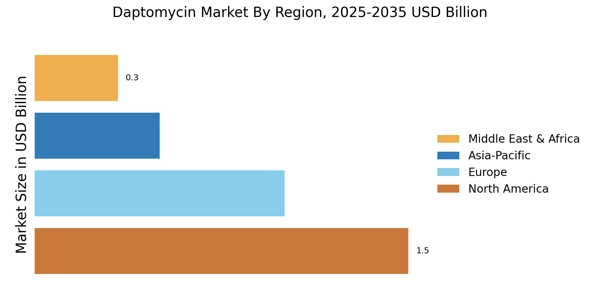
North America is the largest market for Daptomycin Market, accounting for approximately 45% of the global share. The region's growth is driven by increasing incidences of bacterial infections, a strong healthcare infrastructure, and favorable reimbursement policies. Regulatory support from agencies like the FDA further catalyzes market expansion, ensuring rapid approval of new therapies and generics.
The United States dominates this market, with significant contributions from Canada. Key players such as Merck & Co., Pfizer, and Cubist Pharmaceuticals are actively involved in research and development, enhancing competitive dynamics. The presence of advanced healthcare facilities and a high demand for effective antibiotics bolster the market, making it a focal point for pharmaceutical investments.
Europe is the second-largest market for Daptomycin Market, holding around 30% of the global market share. The region's growth is propelled by rising healthcare expenditures, increasing awareness of antibiotic resistance, and stringent regulations promoting the use of effective antibiotics. The European Medicines Agency (EMA) plays a crucial role in ensuring the availability of innovative treatments, thereby enhancing market potential.
Leading countries include Germany, France, and the UK, where healthcare systems are increasingly adopting Daptomycin Market for treating complex infections. Major players like AstraZeneca and Novartis are expanding their portfolios, contributing to a competitive landscape. The focus on research and development, along with collaborations among pharmaceutical companies, is expected to drive further growth in this region.
Asia-Pacific is witnessing rapid growth in the Daptomycin Market, accounting for approximately 15% of the global share. The region's expansion is driven by increasing healthcare investments, a rising prevalence of bacterial infections, and growing awareness of antibiotic resistance. Countries like China and India are leading this growth, supported by government initiatives to improve healthcare access and affordability.
China and India are the primary markets, with significant contributions from Australia and Japan. The competitive landscape is evolving, with local and international players like Teva Pharmaceutical Industries and Hikma Pharmaceuticals entering the market. The increasing demand for effective antibiotics and the expansion of healthcare infrastructure are key factors driving market growth in this region.
The Middle East and Africa (MEA) region is gradually emerging in the Daptomycin Market, holding about 10% of the global share. The growth is primarily driven by increasing healthcare investments, rising incidences of bacterial infections, and a growing focus on improving healthcare infrastructure. Regulatory bodies in various countries are also promoting the use of effective antibiotics to combat resistance, which is crucial for market development.
Leading countries in this region include South Africa, UAE, and Saudi Arabia, where healthcare systems are evolving to meet rising demands. The presence of key players is limited but growing, with companies like Baxter International making strides in the market. The increasing collaboration between governments and pharmaceutical companies is expected to enhance market dynamics and drive growth in the coming years.
The Daptomycin Market is characterized by a dynamic competitive landscape, driven by increasing demand for effective treatments against resistant bacterial infections. Key players such as Cubist Pharmaceuticals (US), Merck & Co. (US), and Pfizer (US) are at the forefront, each employing distinct strategies to enhance their market presence. Cubist Pharmaceuticals (US) focuses on innovation, particularly in developing new formulations of Daptomycin to improve efficacy and patient compliance.
Merck & Co. (US) emphasizes strategic partnerships and collaborations to expand its research capabilities, while Pfizer (US) is leveraging its extensive distribution network to enhance accessibility to its Daptomycin products. Collectively, these strategies contribute to a competitive environment that is increasingly centered on innovation and strategic alliances.
The Daptomycin Market exhibits a moderately fragmented structure, with several key players vying for market share. Companies are adopting various business tactics, such as localizing manufacturing to reduce costs and optimize supply chains. This approach not only enhances operational efficiency but also allows for quicker responses to market demands. The collective influence of these key players shapes the market dynamics, as they compete not only on product offerings but also on service delivery and customer engagement.
In August 2025, Merck & Co. (US) announced a strategic partnership with a leading biotechnology firm to co-develop a next-generation Daptomycin formulation aimed at addressing multi-drug resistant infections. This collaboration is significant as it not only enhances Merck's research capabilities but also positions the company to capture a larger share of the growing market for advanced antibiotic therapies. The partnership underscores the importance of innovation in maintaining competitive advantage in a rapidly evolving market.
In September 2025, Pfizer (US) launched a new digital platform designed to streamline the distribution of Daptomycin, enhancing accessibility for healthcare providers. This initiative reflects Pfizer's commitment to leveraging technology to improve patient outcomes and operational efficiency. By integrating digital solutions into its supply chain, Pfizer aims to differentiate itself in a crowded market, potentially setting a new standard for distribution practices in the pharmaceutical industry.
In July 2025, Cubist Pharmaceuticals (US) expanded its manufacturing capabilities by investing in a new facility dedicated to the production of Daptomycin. This strategic move is likely to bolster Cubist's production capacity and reduce lead times, thereby enhancing its competitive positioning. The investment not only signifies Cubist's commitment to meeting rising demand but also highlights the importance of supply chain reliability in the current market landscape.
As of October 2025, the Daptomycin Market is witnessing trends such as digitalization, sustainability, and the integration of artificial intelligence in drug development and distribution. Strategic alliances are increasingly shaping the competitive landscape, as companies recognize the value of collaboration in driving innovation. Looking ahead, competitive differentiation is expected to evolve, with a shift from price-based competition to a focus on technological advancements, innovative solutions, and robust supply chain management. This transition may redefine how companies position themselves in the market, emphasizing the need for agility and responsiveness to changing healthcare needs.
In October 2022, The company's frozen premix "Daptomycin in 0.9% Sodium Chloride Injection" pages and an FDA review document for a Galaxy-container premix exist. None of the snippets I could see carried a dated announcement. I can't give you an approval or launch date without guessing.The FDA document also mentions an October 2022 notice about a different premix product, so the history is easy to misread.
ダプトマイシン市場は、抗生物質耐性の増加と医療支出の増加により、2024年から2035年までの間に年平均成長率3.27%で成長することが予測されています。
新しい機会は以下にあります:
2035年までに、ダプトマイシン市場は世界の抗生物質市場において重要なプレーヤーとしての地位を確立することが期待されています。
| 市場規模 2024 | 3.32(億米ドル) |
| 市場規模 2025 | 3.429(億米ドル) |
| 市場規模 2035 | 4.731(億米ドル) |
| 年平均成長率 (CAGR) | 3.27% (2024 - 2035) |
| レポートの範囲 | 収益予測、競争環境、成長要因、トレンド |
| 基準年 | 2024 |
| 市場予測期間 | 2025 - 2035 |
| 過去データ | 2019 - 2024 |
| 市場予測単位 | 億米ドル |
| 主要企業のプロファイル | 市場分析進行中 |
| カバーされるセグメント | 市場セグメンテーション分析進行中 |
| 主要市場機会 | 耐性細菌感染に対する効果的な治療法の需要の高まりがダプトマイシン市場の拡大を促進しています。 |
| 主要市場ダイナミクス | 抗生物質耐性の増加と医療現場における治療プロトコルの進化により、ダプトマイシンの需要が高まっています。 |
| カバーされる国 | 北米、ヨーロッパ、APAC、南米、中東・アフリカ |
The secondary research process involved comprehensive analysis of regulatory databases, peer-reviewed medical journals, clinical publications, and authoritative health organizations. Key sources included the US Food & Drug Administration (FDA), European Medicines Agency (EMA), Centers for Disease Control and Prevention (CDC), National Institutes of Health (NIH), National Center for Biotechnology Information (NCBI/PubMed), World Health Organization (WHO) Global Health Observatory, European Centre for Disease Prevention and Control (ECDC), Infectious Diseases Society of America (IDSA), American Society of Health-System Pharmacists (ASHP), Centers for Medicare & Medicaid Services (CMS), IQVIA National Sales Perspectives, Symphony Health Solutions, EU Eurostat Health Database, and national health ministry reports from key markets including China NMPA, India CDSCO, and Japan PMDA. These sources were used to collect antibiotic resistance surveillance data, daptomycin prescription volumes, hospital admission statistics for complicated skin structure infections and bacteremia, regulatory approval data, clinical safety studies, pricing trends, and competitive landscape analysis for branded and generic daptomycin formulations across 350mg and 500mg strengths.
In order to gather both qualitative and quantitative insights, supply-side and demand-side stakeholders were interviewed during the primary research process. CEOs, VPs of Manufacturing Operations, heads of regulatory affairs, and commercial directors from daptomycin producers, API suppliers, and contract manufacturing organizations (CMOs) were examples of supply-side sources. Infectious disease specialists, hospital pharmacists, heads of antimicrobial stewardship committees, procurement leaders from integrated health networks, and pharmacy directors from long-term acute care institutions, tertiary care hospitals, and outpatient infusion clinics were among the demand-side sources. Primary research obtained information on clinical adoption patterns, formulary placement strategies, and reimbursement dynamics across pediatric and adult patient populations, validated market segmentation by indication (complicated skin structure infections vs. bacteremia), and confirmed generic entry timelines and pricing erosion patterns.
Primary Respondent Breakdown:
By Designation: C-level Primaries (32%), Director Level (31%), Others (37%)
By Region: North America (38%), Europe (29%), Asia-Pacific (26%), Rest of World (7%)
Global market valuation was derived through revenue mapping and prescription volume analysis. The methodology included:
Identification of 35+ key manufacturers and API suppliers across North America, Europe, Asia-Pacific, and Latin America
Product mapping across 350mg and 500mg strength formulations, covering both branded (Cubicin) and generic daptomycin portfolios
Analysis of reported and modeled annual revenues specific to daptomycin product lines, incorporating hospital purchasing data and wholesale acquisition cost (WAC) pricing
Coverage of manufacturers representing 75-80% of global market share in 2024
Extrapolation using bottom-up (prescription volume × ASP by country/region, segmented by indication and age group) and top-down (manufacturer revenue validation, adjusted for API supplier volumes) approaches to derive segment-specific valuations for complicated skin structure infections, bacteremia, pediatric, and adult market segments
このレポートの無料サンプルを受け取るには、以下のフォームにご記入ください
“This is really good guys. Excellent work on a tight deadline. I will continue to use you going forward and recommend you to others. Nice job”
“Thanks for sending the report it gives us a good global view of the Betaïne market.”
“We found the report very insightful! we found your research firm very helpful. I'm sending this email to secure our future business.”
“I am very pleased with how market segments have been defined in a relevant way for my purposes (such as "Portable Freezers & refrigerators" and "last-mile"). In general the report is well structured. Thanks very much for your efforts.”
“We got the report in time, we really thank you for your support in this process. I also thank to all of your team as they did a great job.”
“The Automotive 48V ECU Components Procurement Intelligence Study” was a complex project, but the Market Research Future (MRFR) team handled it with quality, agility, and customer-centricity. They delivered all requested data on time and within the agreed scope. The team, including Shubhendra Anand and Rahul Gotadki, was always readily available to clarify questions and swiftly implement necessary adjustments, driving the project to a successful conclusion within a very demanding timeframe.
I would also like to specifically commend Akshay Agarwal for his responsiveness and support at every stage—from our initial inquiry on May 6th through to final delivery on June 18th. His dedication made the entire process seamless.”
“Thanks. It’s been a pleasure working with you, please use me as reference with any other Intel employees.”
“Thank you, this will be very helpful for OQS.”
“I have been reading the first document or the study, ,the Global HVAC and FP market report 2021 till 2026. Must say, good info! I have not gone in depth at all parts, but got a good indication of the data inside!”