• Cat-intel
  • MedIntelliX
  • Resources
  • About Us
  • Hero Background
    English
    Chinese
    French
    Japanese
    Korean
    German
    Spanish

    Pitch Based Carbon Fiber Market Trends

    ID: MRFR/CnM/6743-CR
    128 Pages
    Chitranshi Jaiswal
    May 2023

    Pitch-Based Carbon Fiber Market Research Report Information By Type (Composites and Non-Composites), By Application (Aerospace & Defense, Automotive, Construction, Wind Energy, Sports & Leisure, and Others), And By Region (North America, Europe, Asia-Pacific, And Rest Of The World) –Market Forecast Till 2035

    Share:
    Download PDF ×

    We do not share your information with anyone. However, we may send you emails based on your report interest from time to time. You may contact us at any time to opt-out.

    Pitch Based Carbon Fiber Market Infographic
    Purchase Options

    Market Trends

    Key Emerging Trends in the Pitch Based Carbon Fiber Market

    Introduction: In the past twenty years, the aerospace & defense industry has seen a surge in the demand for carbon fibers. These fibers have become increasingly popular due to their outstanding performance compared to metals. With high tensile strength, resistance to chemicals, stiffness, low thermal expansion, and lightweight properties, carbon fibers are making a mark in the aerospace & defense sector.

    Lightweight Advantage in Aerospace: The aerospace industry previously relied on aluminum for building aircraft because it's a sturdy metal. However, aluminum is heavier than carbon fiber, adding extra weight to the aircraft. Passenger and cargo weight also contribute to this, resulting in increased fuel consumption. To overcome these challenges, the aerospace industry switched from aluminum to carbon fiber as the primary material for aircraft construction.

    Boeing and Airbus Adoption: In 2003, Boeing Co became the pioneer in using carbon fiber as the primary construction material for its 787 commercial jetliners. This included crucial parts like the fuselage, wings, tail, and more. Airbus followed suit, manufacturing aircraft like the A350 XWB and A380 with carbon fiber composites. The shift has led to reduced fuel consumption, emissions, maintenance needs, and overall costs. It also enhances the passenger experience by minimizing engine vibrations. Predictions suggest that approximately 9,000 new wide-bodied aircraft will be built with pitch-based carbon fiber composites in the next 20 years.

    Defense Applications: Pitch-based carbon fibers find extensive use in defense applications. These fibers are employed in various defense equipment, including vehicles, helmets, weaponry, ballistic missiles, and protective gear. The defense spending globally has seen a steady increase, with the USA contributing 40% to the global military expenditure in 2021. Anticipated further increments in military expenditures by governments, including those of China, the USA, Middle Eastern countries, and Russia, are expected to drive the demand for pitch-based carbon fibers.

    Market Growth Outlook: The growing demand for pitch-based carbon fibers in the aerospace & defense industry is poised to propel the global pitch-based carbon fiber market forward during the forecast period. As more aircraft manufacturers embrace carbon fiber, and defense applications continue to expand, the market is set for substantial growth.

    Conclusion: Carbon fibers are revolutionizing the aerospace & defense industry with their lightweight yet durable properties. The transition from traditional materials to carbon fibers is evident in major aircraft manufacturers, signaling a shift toward enhanced performance, reduced costs, and an overall positive impact on the industry.


    Author
    Chitranshi Jaiswal
    Research Analyst Level I

    In her 3 years of experience in the market research field, she has handled critical cross-domain projects. She has an in-depth knowledge of market estimation & analysis, problem-solving, primary as well as secondary research, and team management.She holds an engineering degree and is an MBA professional from a well-known university, capable of evaluating the market and competitive conditions. An exceptional strategist with excellent communication skills and a passion for delivering cutting-edge & practical insights for the market. Proficient in multi-tasking, and can successfully deal with competing demands, while maintaining complete confidentiality. Generated business through active client and project development, networking, and high-quality responses. Her knowledge and skills have helped in making solid business decisions, securing funding from investors, and avoiding business failures.

    Leave a Comment

    FAQs

    How much is the Pitch Based Carbon Fiber market?

    Pitch Based Carbon Fiber Market size was valued at USD 0.91 Billion in 2024

    What is the growth rate of the Pitch Based Carbon Fiber market?

    Pitch Based Carbon Fiber Market is projected to grow at a CAGR of 6.62% during the forecast period, 2025-2035

    Which region held the largest Pitch Based Carbon Fiber market share?

    North America had the largest share of the Pitch Based Carbon Fibermarket.

    Who are the key players in the Pitch Based Carbon Fiber market?

    The key players in the Pitch Based Carbon Fiber market are Hexcel Corporation (US), Hyosung Corporation (South Korea), Mitsubishi Chemical Corporation (Japan), Teijin Limited (Japan), Cytec Industries, Inc. (US), DowAksa (Georgia), OJSC «SvetlogorskKhimvolokno» (Belarus), Nippon Graphite Fiber Co., Ltd (Japan), Kureha Corporation (Japan), SGL Carbon (Germany), Toray Industries Inc. (Japan).

    Which type led the Pitch Based Carbon Fiber market?

    The composites category dominated the Pitch Based Carbon Fiber market in 2024.

    Which application had the largest Pitch Based Carbon Fiber market share?

    Aerospace & defense had the largest share of the Pitch Based Carbon Fibermarket.

    Market Summary

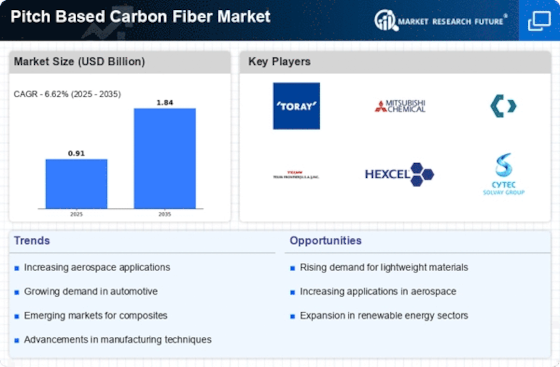
    As per Market Research Future Analysis, the global Pitch-Based Carbon Fiber market was valued at USD 0.91 Billion in 2024 and is projected to reach USD 1.84 Billion by 2035, growing at a CAGR of 6.62% from 2025 to 2035. The market is primarily driven by increasing demand in the aerospace & defense sector and the growth of the wind energy industry. Pitch-based carbon fibers are favored for their excellent tensile strength, thermal stability, and lightweight properties, making them ideal for critical aerospace applications. The market is also witnessing a shift towards sustainable materials, with pitch-based carbon fibers offering reduced environmental impact compared to traditional materials. Advancements in manufacturing technologies are enhancing production efficiency and product quality, further supporting market growth.

    Key Market Trends & Highlights

    The Pitch-Based Carbon Fiber market is experiencing significant growth driven by key trends.

    • Market Size in 2024: USD 0.91 Billion; Projected to reach USD 1.84 Billion by 2035.
    • CAGR from 2025 to 2035: 6.62%; driven by aerospace & defense demand.
    • Composites segment dominates due to high strength-to-weight ratios; applications in aircraft and automotive.
    • North America leads the market share; strong presence of major players and advanced manufacturing capabilities.

    Market Size & Forecast

    2024 Market Size USD 0.91 Billion
    2035 Market Size USD 1.84 Billion
    CAGR (2024-2035) 6.62%
    Largest Regional Market Share in 2024 North America.

    Major Players

    Key players include Hexcel Corporation (US), Hyosung Corporation (South Korea), Mitsubishi Chemical Corporation (Japan), Teijin Limited (Japan), and SGL Carbon (Germany).

    Market Trends

    Growing demand in the aerospace industry is driving the market growth

    The rising demand in the aerospace industry drives the market CAGR for pitch-based carbon fiber. These fibers exhibit excellent tensile strength, high modulus, and outstanding thermal stability, making them ideal for aerospace applications. Carbon fiber-reinforced composites, incorporating pitch-based carbon fibers, offer enhanced structural integrity while reducing weight, contributing to fuel efficiency and increased payload capacity. Moreover, the aerospace sector's continuous focus on improving safety standards has further boosted the demand for pitch-based carbon fibers. These fibers' exceptional impact resistance and fatigue properties make them suitable for critical aerospace components, such as aircraft wings, fuselage structures, and engine parts.

    As a result, the pitch-based carbon fiber market is witnessing growth due to the spreading aerospace industry.

    Furthermore, pitch-based carbon fibers in lightweight applications contribute to energy conservation and lower carbon emissions during the product's lifecycle. The market's inclination towards sustainability has also prompted research and development efforts in the recycling and reuse of carbon fiber-reinforced composites. The development of effective recycling technologies will reduce waste and drive the adoption of pitch-based carbon fibers, as they can be recycled and incorporated into new products.

    The pitch-based carbon fiber market has witnessed significant advancements in manufacturing technologies, contributing to improved product quality, enhanced production efficiency, and cost reduction. Traditionally, the production of pitch-based carbon fibers involves complex and time-consuming processes. However, recent developments have enabled the adoption of innovative manufacturing techniques, leading to increased production volumes and reduced manufacturing costs. One such advancement is the utilization of continuous pitch-based carbon fiber production methods, allowing for the production of longer fibers with consistent quality.

    Constant production lines have helped overcome the limitations associated with batch production, enabling manufacturers to cater to the growing demand from various industries.

    The pitch-based carbon fiber market is experiencing significant growth driven by the aerospace industry's demand, advancements in manufacturing technologies, and the increasing focus on sustainability. As enterprises seek lightweight and high-strength materials, pitch-based carbon fibers provide a compelling solution with exceptional mechanical properties and thermal stability. With ongoing research and development efforts to enhance manufacturing techniques and promote recycling, the pitch-based carbon fiber market is expected to witness continued expansion, driving the Pitch Based Carbon Fiber market revenue.

    The increasing demand for lightweight and high-strength materials in aerospace and automotive applications is driving the growth of the pitch-based carbon fiber market, reflecting a broader trend towards advanced material technologies.

    U.S. Department of Energy

    Pitch Based Carbon Fiber Market Market Drivers

    Market Growth Projections

    The Global Pitch Based Carbon Fiber Market Industry is projected to experience substantial growth over the next decade. With a market value of 0.91 USD Billion in 2024, it is expected to reach 1.72 USD Billion by 2035, reflecting a CAGR of 5.96% from 2025 to 2035. This growth trajectory indicates a strong demand for pitch-based carbon fibers across various industries, driven by their unique properties and applications. As the market evolves, it is likely to attract new entrants and foster innovation, further enhancing its potential.

    Growing Demand in Aerospace Sector

    The Global Pitch Based Carbon Fiber Market Industry is witnessing a notable surge in demand from the aerospace sector. This growth is primarily attributed to the material's lightweight properties and high strength-to-weight ratio, which are essential for enhancing fuel efficiency and performance in aircraft. For instance, major aerospace manufacturers are increasingly integrating pitch-based carbon fibers into their designs to reduce overall weight and improve structural integrity. As a result, the market is projected to reach 0.91 USD Billion in 2024, with expectations of further expansion as the aerospace industry continues to innovate and prioritize sustainable materials.

    Expansion in Automotive Applications

    The Global Pitch Based Carbon Fiber Market Industry is also experiencing significant growth due to its expanding applications in the automotive sector. Automakers are increasingly adopting pitch-based carbon fibers to manufacture lightweight components that enhance vehicle performance and fuel efficiency. This trend is driven by stringent regulations aimed at reducing carbon emissions and improving energy efficiency. As a result, the market is anticipated to grow at a CAGR of 5.96% from 2025 to 2035, potentially reaching 1.72 USD Billion by 2035. The integration of these materials in high-performance vehicles exemplifies the industry's shift towards advanced composite materials.

    Rising Demand for Lightweight Materials

    The Global Pitch Based Carbon Fiber Market Industry is benefiting from the rising demand for lightweight materials across various sectors. Industries such as sports equipment, construction, and renewable energy are increasingly utilizing pitch-based carbon fibers to create products that require high strength and low weight. This trend is particularly evident in the wind energy sector, where lightweight materials contribute to more efficient turbine designs. The growing emphasis on sustainability and performance is likely to drive further adoption of pitch-based carbon fibers, positioning the market for continued growth in the coming years.

    Technological Advancements in Production

    Technological advancements in the production of pitch-based carbon fibers are significantly influencing the Global Pitch Based Carbon Fiber Market Industry. Innovations in manufacturing processes, such as improved spinning techniques and enhanced stabilization methods, are enabling the production of higher quality fibers at reduced costs. These advancements not only enhance the performance characteristics of the fibers but also make them more accessible for various applications. As production efficiency increases, the market is likely to expand, attracting new players and fostering competition. This dynamic environment may lead to further innovations and applications across multiple industries.

    Increased Investment in Research and Development

    Increased investment in research and development is playing a crucial role in shaping the Global Pitch Based Carbon Fiber Market Industry. Governments and private entities are allocating significant resources to explore new applications and improve the properties of pitch-based carbon fibers. This focus on innovation is expected to yield breakthroughs that enhance the performance and versatility of these materials. As new applications emerge, such as in the medical and electronics fields, the market is likely to expand, creating opportunities for manufacturers and researchers alike. This investment-driven growth could lead to a more robust and diverse market landscape.

    Market Segment Insights

    Pitch-Based Carbon Fiber Type Insights

    The  Pitch Based Carbon Fiber market segmentation, based on type, includes composites and non-composites. The composites segment dominated the market. They offer high strength-to-weight ratios, excellent stiffness, and superior corrosion resistance. Composites find applications in manufacturing components such as aircraft wings, automotive body panels, sporting goods, and turbine blades. The demand for carbon fiber composites is expected to grow steadily in the coming years, driven by the increasing need for lightweight and high-performance materials in various industries.

    Pitch-Based Carbon Fiber Application Insights

    The  Pitch Based Carbon Fiber market segmentation, based on application, includes aerospace & defense, automotive, construction, wind energy, sports & leisure, and others. The aerospace & defense category generated the most income due to their exceptional mechanical properties. Carbon fibers are extensively used in aircraft components, missiles, unmanned aerial vehicles, and military equipment. The increasing demand for fuel-efficient aircraft and the need for lightweight, high-strength materials in defense applications drive this segment's growth of carbon fibers.

    Figure 1:  Pitch-Based Carbon Fiber Market, by Application, 2022 & 2032 (USD Billion)

    Source: Secondary Research, Primary Research, Market Research Future Database, and Analyst Review

    Get more detailed insights about Pitch-Based Carbon Fiber Market Research Report - Forecast till 2035

    Regional Insights

    By region, the study provides market insights into North America, Europe, Asia-Pacific, and the Rest of the World. The North American Pitch Based Carbon Fiber market area will dominate this market due to the strong presence of major players and advanced manufacturing capabilities. The increasing demand for fuel-efficient and lightweight aircraft has propelled the use of carbon fiber composites in aircraft manufacturing. Moreover, the region's focus on renewable energy sources has led to using carbon fiber in wind turbine blades.

    The presence of stringent regulations on emissions and the growing emphasis on sustainability further drive the market growth in this region.

    Further, the major countries studied in the market report are The US, Canada, German, France, the UK, Italy, Spain, China, Japan, India, Australia, South Korea, and Brazil.

    Figure 2:  PITCH BASED CARBON FIBER MARKET SHARE BY REGION 2022 (USD Billion)

    PITCH BASED CARBON FIBER MARKET SHARE BY REGION 2022

    Source: Secondary Research, Primary Research, Market Research Future Database, and Analyst Review

    Europe Pitch Based Carbon Fiber market accounts for the second-largest market share due to the strong automotive industry, which has been a key driver for adopting carbon fiber composites. Additionally, the region has witnessed a surge in wind energy installations, leading to the increased usage of carbon fiber in wind turbine components. Furthermore, the European Union's focus on reducing carbon emissions and promoting sustainable solutions has further accelerated the market growth in this region.

    Additionally, the German Pitch Based Carbon Fiber market had the largest market share, and the UK Pitch Based Carbon Fiber market was the fastest growing market in the European region.

    The Asia-Pacific Pitch Based Carbon Fiber Market is expected to grow significantly from 2023 to 2032. The region has witnessed rapid industrialization and urbanization, driving the demand for lightweight and high-strength materials. The rising middle-class population and increasing disposable income have led to an upsurge in demand for luxury and high-performance vehicles, thereby fueling the growth of the carbon fiber market. However, the market in this region is also majorly competitive due to the presence of several local manufacturers.

    Moreover, China’s Pitch Based Carbon Fiber market held the largest market share, and the Indian Pitch Based Carbon Fiber market was the fastest-growing market in the Asia-Pacific region.

    Key Players and Competitive Insights

    Leading market players are investing heavily in research and development to expand their product lines, which will help the Pitch-Based Carbon Fiber market grow even more. Market participants are also undertaking various strategic activities to expand their  footprint, with important market developments including new product launches, contractual agreements, mergers and acquisitions, higher investments, and collaboration with other organizations. To expand and survive in a more competitive and rising market climate, Pitch Based Carbon Fiber industry must offer cost-effective items.

    Manufacturing locally to minimize operational costs is one of the key business tactics manufacturers use in the  Pitch Based Carbon Fiber industry to benefit clients and increase the market sector. In recent years, the Pitch Based Carbon Fiber industry has offered some of the most significant medical advantages.

    Major players in the Pitch Based Carbon Fiber market, including Hexcel Corporation (US), Hyosung Corporation (South Korea), Mitsubishi Chemical Corporation (Japan), Teijin Limited (Japan), Cytec Industries, Inc. (US), DowAksa (Georgia), OJSC «SvetlogorskKhimvolokno» (Belarus), Nippon Graphite Fiber Co., Ltd (Japan), Kureha Corporation (Japan), SGL Carbon (Germany), Toray Industries Inc. (Japan), and others, are attempting to increase market demand by investing in research and development operations.

    Nick L. Stanage's Hexcel Corporation, founded in 1948 in Stamford, Connecticut, United States, is an American materials company that develops and manufactures structural materials. It sells the products in commercial, military, and recreational markets for use in aircraft, space launch vehicles, sports equipment, and automotive products. In May 2021, Hexcel Corporation built a flagship Center of Excellence for Research & Technology to support next-generation developments in advanced composites technologies in Utah.

    This new R&T center is the company's center for innovation and development in North America and a showcase for the company's new composites technology, providing space for future growth in the years ahead.

    Hyun-Joon Cho, Hyosung Advanced Materials Corporation, founded in 1966, is located in Seoul, South Korea. The South Korean company operates in chemical, industrial machinery, IT, trade, and construction. It has been known for its technologies, which involve hydrogen vehicles, such as carbon fiber, for the fuel tank. In May 2021, Hyosung Advanced Materials announced the expansion of its Jeonju carbon fiber plant to 6,500 tons.

    The addition of production facilities is aimed at responding to the increasing demand for carbon fibers used in fuel tanks of hydrogen cars that are emerging as eco-friendly cars of the future and high-pressure containers for compressed natural gas.

    Key Companies in the Pitch Based Carbon Fiber Market market include

    Industry Developments

    April 2021: Mitsubishi Chemical Corporation integrated subsidiaries at the national level in the US, the UK, and Germany. By sharing and combining expertise and resources, this integration will enhance cooperation and strengthen overall business capabilities in these three countries. The company will also attempt to improve customer responsiveness based on these countries and provide solutions to each country.

    Future Outlook

    Pitch Based Carbon Fiber Market Future Outlook

    The Pitch Based Carbon Fiber Market is projected to grow at a 6.62% CAGR from 2025 to 2035, driven by advancements in aerospace, automotive applications, and renewable energy technologies.

    New opportunities lie in:

    • Develop lightweight, high-strength composites for aerospace applications to enhance fuel efficiency.
    • Invest in recycling technologies for pitch-based carbon fibers to meet sustainability demands.
    • Expand production capabilities in emerging markets to capture growing industrial applications.

    By 2035, the Pitch Based Carbon Fiber Market is expected to achieve substantial growth, solidifying its role in advanced material applications.

    Market Segmentation

    Pitch-Based Carbon Fiber Type Outlook

    • Composites
    • Non-Composites

    Pitch-Based Carbon Fiber Regional Outlook

    North America
    • US
    • Canada

    Pitch-Based Carbon Fiber Application Outlook

    • Aerospace & Defense
    • Automotive
    • Construction
    • Wind Energy
    • Sports & Leisure
    • Others

    Report Scope

    Report Attribute/Metric Details
    Market Size 2024 USD 0.91 Billion
    Market Size 2035 1.84 (Value (USD Billion))
    Compound Annual Growth Rate (CAGR) 6.62% (2025 - 2035)
    Base Year 2024
    Market Forecast Period 2025 - 2035
    Historical Data 2018- 2022
    Market Forecast Units Value (USD Billion)
    Report Coverage Revenue Forecast, Market Competitive Landscape, Growth Factors, and Trends
    Segments Covered Type, Application, and Region
    Geographies Covered North America, Europe, Asia Pacific, and the Rest of the World
    Countries Covered The US, Canada, German, France, UK, Italy, Spain, China, Japan, India, Australia, South Korea, and Brazil
    Key Companies Profiled Hexcel Corporation (US), Hyosung Corporation (South Korea), Mitsubishi Chemical Corporation (Japan), Teijin Limited (Japan), Cytec Industries, Inc. (US), DowAksa (Georgia), OJSC «SvetlogorskKhimvolokno» (Belarus), Nippon Graphite Fiber Co., Ltd (Japan), Kureha Corporation (Japan), SGL Carbon (Germany), Toray Industries Inc. (Japan).
    Key Market Opportunities The increasing use of carbon fibers in the automotive and construction industry.
    Key Market Dynamics Growth in the wind energy sector. The increase in demand for carbon fibers in the aerospace & defense industry.
    Market Size 2025 0.97 (Value (USD Billion))

    FAQs

    How much is the Pitch Based Carbon Fiber market?

    Pitch Based Carbon Fiber Market size was valued at USD 0.91 Billion in 2024

    What is the growth rate of the Pitch Based Carbon Fiber market?

    Pitch Based Carbon Fiber Market is projected to grow at a CAGR of 6.62% during the forecast period, 2025-2035

    Which region held the largest Pitch Based Carbon Fiber market share?

    North America had the largest share of the Pitch Based Carbon Fibermarket.

    Who are the key players in the Pitch Based Carbon Fiber market?

    The key players in the Pitch Based Carbon Fiber market are Hexcel Corporation (US), Hyosung Corporation (South Korea), Mitsubishi Chemical Corporation (Japan), Teijin Limited (Japan), Cytec Industries, Inc. (US), DowAksa (Georgia), OJSC «SvetlogorskKhimvolokno» (Belarus), Nippon Graphite Fiber Co., Ltd (Japan), Kureha Corporation (Japan), SGL Carbon (Germany), Toray Industries Inc. (Japan).

    Which type led the Pitch Based Carbon Fiber market?

    The composites category dominated the Pitch Based Carbon Fiber market in 2024.

    Which application had the largest Pitch Based Carbon Fiber market share?

    Aerospace & defense had the largest share of the Pitch Based Carbon Fibermarket.

    1. SECTION I: EXECUTIVE SUMMARY AND KEY HIGHLIGHTS
      1. | 1.1 EXECUTIVE SUMMARY
      2. | | 1.1.1 Market Overview
      3. | | 1.1.2 Key Findings
      4. | | 1.1.3 Market Segmentation
      5. | | 1.1.4 Competitive Landscape
      6. | | 1.1.5 Challenges and Opportunities
      7. | | 1.1.6 Future Outlook
    2. SECTION II: SCOPING, METHODOLOGY AND MARKET STRUCTURE
      1. | 2.1 MARKET INTRODUCTION
      2. | | 2.1.1 Definition
      3. | | 2.1.2 Scope of the study
      4. | | | 2.1.2.1 Research Objective
      5. | | | 2.1.2.2 Assumption
      6. | | | 2.1.2.3 Limitations
      7. | 2.2 RESEARCH METHODOLOGY
      8. | | 2.2.1 Overview
      9. | | 2.2.2 Data Mining
      10. | | 2.2.3 Secondary Research
      11. | | 2.2.4 Primary Research
      12. | | | 2.2.4.1 Primary Interviews and Information Gathering Process
      13. | | | 2.2.4.2 Breakdown of Primary Respondents
      14. | | 2.2.5 Forecasting Model
      15. | | 2.2.6 Market Size Estimation
      16. | | | 2.2.6.1 Bottom-Up Approach
      17. | | | 2.2.6.2 Top-Down Approach
      18. | | 2.2.7 Data Triangulation
      19. | | 2.2.8 Validation
    3. SECTION III: QUALITATIVE ANALYSIS
      1. | 3.1 MARKET DYNAMICS
      2. | | 3.1.1 Overview
      3. | | 3.1.2 Drivers
      4. | | 3.1.3 Restraints
      5. | | 3.1.4 Opportunities
      6. | 3.2 MARKET FACTOR ANALYSIS
      7. | | 3.2.1 Value chain Analysis
      8. | | 3.2.2 Porter's Five Forces Analysis
      9. | | | 3.2.2.1 Bargaining Power of Suppliers
      10. | | | 3.2.2.2 Bargaining Power of Buyers
      11. | | | 3.2.2.3 Threat of New Entrants
      12. | | | 3.2.2.4 Threat of Substitutes
      13. | | | 3.2.2.5 Intensity of Rivalry
      14. | | 3.2.3 COVID-19 Impact Analysis
      15. | | | 3.2.3.1 Market Impact Analysis
      16. | | | 3.2.3.2 Regional Impact
      17. | | | 3.2.3.3 Opportunity and Threat Analysis
    4. SECTION IV: QUANTITATIVE ANALYSIS
      1. | 4.1 Chemicals and Materials, BY Type (USD Billion)
      2. | | 4.1.1 Composites
      3. | | 4.1.2 Non-Composites
      4. | 4.2 Chemicals and Materials, BY Application (USD Billion)
      5. | | 4.2.1 Aerospace & Defense
      6. | | 4.2.2 Automotive
      7. | | 4.2.3 Construction
      8. | | 4.2.4 Wind Energy
      9. | | 4.2.5 Sports & Leisure
      10. | | 4.2.6 Others
      11. | 4.3 Chemicals and Materials, BY Region (USD Billion)
      12. | | 4.3.1 North America
      13. | | | 4.3.1.1 US
      14. | | | 4.3.1.2 Canada
      15. | | 4.3.2 Europe
      16. | | | 4.3.2.1 Germany
      17. | | | 4.3.2.2 UK
      18. | | | 4.3.2.3 France
      19. | | | 4.3.2.4 Russia
      20. | | | 4.3.2.5 Italy
      21. | | | 4.3.2.6 Spain
      22. | | | 4.3.2.7 Rest of Europe
      23. | | 4.3.3 APAC
      24. | | | 4.3.3.1 China
      25. | | | 4.3.3.2 India
      26. | | | 4.3.3.3 Japan
      27. | | | 4.3.3.4 South Korea
      28. | | | 4.3.3.5 Malaysia
      29. | | | 4.3.3.6 Thailand
      30. | | | 4.3.3.7 Indonesia
      31. | | | 4.3.3.8 Rest of APAC
      32. | | 4.3.4 South America
      33. | | | 4.3.4.1 Brazil
      34. | | | 4.3.4.2 Mexico
      35. | | | 4.3.4.3 Argentina
      36. | | | 4.3.4.4 Rest of South America
      37. | | 4.3.5 MEA
      38. | | | 4.3.5.1 GCC Countries
      39. | | | 4.3.5.2 South Africa
      40. | | | 4.3.5.3 Rest of MEA
    5. SECTION V: COMPETITIVE ANALYSIS
      1. | 5.1 Competitive Landscape
      2. | | 5.1.1 Overview
      3. | | 5.1.2 Competitive Analysis
      4. | | 5.1.3 Market share Analysis
      5. | | 5.1.4 Major Growth Strategy in the Chemicals and Materials
      6. | | 5.1.5 Competitive Benchmarking
      7. | | 5.1.6 Leading Players in Terms of Number of Developments in the Chemicals and Materials
      8. | | 5.1.7 Key developments and growth strategies
      9. | | | 5.1.7.1 New Product Launch/Service Deployment
      10. | | | 5.1.7.2 Merger & Acquisitions
      11. | | | 5.1.7.3 Joint Ventures
      12. | | 5.1.8 Major Players Financial Matrix
      13. | | | 5.1.8.1 Sales and Operating Income
      14. | | | 5.1.8.2 Major Players R&D Expenditure. 2023
      15. | 5.2 Company Profiles
      16. | | 5.2.1 Toray Industries (JP)
      17. | | | 5.2.1.1 Financial Overview
      18. | | | 5.2.1.2 Products Offered
      19. | | | 5.2.1.3 Key Developments
      20. | | | 5.2.1.4 SWOT Analysis
      21. | | | 5.2.1.5 Key Strategies
      22. | | 5.2.2 Mitsubishi Chemical Corporation (JP)
      23. | | | 5.2.2.1 Financial Overview
      24. | | | 5.2.2.2 Products Offered
      25. | | | 5.2.2.3 Key Developments
      26. | | | 5.2.2.4 SWOT Analysis
      27. | | | 5.2.2.5 Key Strategies
      28. | | 5.2.3 SGL Carbon (DE)
      29. | | | 5.2.3.1 Financial Overview
      30. | | | 5.2.3.2 Products Offered
      31. | | | 5.2.3.3 Key Developments
      32. | | | 5.2.3.4 SWOT Analysis
      33. | | | 5.2.3.5 Key Strategies
      34. | | 5.2.4 Teijin Limited (JP)
      35. | | | 5.2.4.1 Financial Overview
      36. | | | 5.2.4.2 Products Offered
      37. | | | 5.2.4.3 Key Developments
      38. | | | 5.2.4.4 SWOT Analysis
      39. | | | 5.2.4.5 Key Strategies
      40. | | 5.2.5 Hexcel Corporation (US)
      41. | | | 5.2.5.1 Financial Overview
      42. | | | 5.2.5.2 Products Offered
      43. | | | 5.2.5.3 Key Developments
      44. | | | 5.2.5.4 SWOT Analysis
      45. | | | 5.2.5.5 Key Strategies
      46. | | 5.2.6 Cytec Solvay Group (BE)
      47. | | | 5.2.6.1 Financial Overview
      48. | | | 5.2.6.2 Products Offered
      49. | | | 5.2.6.3 Key Developments
      50. | | | 5.2.6.4 SWOT Analysis
      51. | | | 5.2.6.5 Key Strategies
      52. | | 5.2.7 Zoltek Companies (US)
      53. | | | 5.2.7.1 Financial Overview
      54. | | | 5.2.7.2 Products Offered
      55. | | | 5.2.7.3 Key Developments
      56. | | | 5.2.7.4 SWOT Analysis
      57. | | | 5.2.7.5 Key Strategies
      58. | | 5.2.8 Kordsa Teknik Tekstil A.S. (TR)
      59. | | | 5.2.8.1 Financial Overview
      60. | | | 5.2.8.2 Products Offered
      61. | | | 5.2.8.3 Key Developments
      62. | | | 5.2.8.4 SWOT Analysis
      63. | | | 5.2.8.5 Key Strategies
      64. | | 5.2.9 Formosa Plastics Corporation (TW)
      65. | | | 5.2.9.1 Financial Overview
      66. | | | 5.2.9.2 Products Offered
      67. | | | 5.2.9.3 Key Developments
      68. | | | 5.2.9.4 SWOT Analysis
      69. | | | 5.2.9.5 Key Strategies
      70. | 5.3 Appendix
      71. | | 5.3.1 References
      72. | | 5.3.2 Related Reports
    6. LIST OF FIGURES
      1. | 6.1 MARKET SYNOPSIS
      2. | 6.2 NORTH AMERICA MARKET ANALYSIS
      3. | 6.3 US MARKET ANALYSIS BY TYPE
      4. | 6.4 US MARKET ANALYSIS BY APPLICATION
      5. | 6.5 CANADA MARKET ANALYSIS BY TYPE
      6. | 6.6 CANADA MARKET ANALYSIS BY APPLICATION
      7. | 6.7 EUROPE MARKET ANALYSIS
      8. | 6.8 GERMANY MARKET ANALYSIS BY TYPE
      9. | 6.9 GERMANY MARKET ANALYSIS BY APPLICATION
      10. | 6.10 UK MARKET ANALYSIS BY TYPE
      11. | 6.11 UK MARKET ANALYSIS BY APPLICATION
      12. | 6.12 FRANCE MARKET ANALYSIS BY TYPE
      13. | 6.13 FRANCE MARKET ANALYSIS BY APPLICATION
      14. | 6.14 RUSSIA MARKET ANALYSIS BY TYPE
      15. | 6.15 RUSSIA MARKET ANALYSIS BY APPLICATION
      16. | 6.16 ITALY MARKET ANALYSIS BY TYPE
      17. | 6.17 ITALY MARKET ANALYSIS BY APPLICATION
      18. | 6.18 SPAIN MARKET ANALYSIS BY TYPE
      19. | 6.19 SPAIN MARKET ANALYSIS BY APPLICATION
      20. | 6.20 REST OF EUROPE MARKET ANALYSIS BY TYPE
      21. | 6.21 REST OF EUROPE MARKET ANALYSIS BY APPLICATION
      22. | 6.22 APAC MARKET ANALYSIS
      23. | 6.23 CHINA MARKET ANALYSIS BY TYPE
      24. | 6.24 CHINA MARKET ANALYSIS BY APPLICATION
      25. | 6.25 INDIA MARKET ANALYSIS BY TYPE
      26. | 6.26 INDIA MARKET ANALYSIS BY APPLICATION
      27. | 6.27 JAPAN MARKET ANALYSIS BY TYPE
      28. | 6.28 JAPAN MARKET ANALYSIS BY APPLICATION
      29. | 6.29 SOUTH KOREA MARKET ANALYSIS BY TYPE
      30. | 6.30 SOUTH KOREA MARKET ANALYSIS BY APPLICATION
      31. | 6.31 MALAYSIA MARKET ANALYSIS BY TYPE
      32. | 6.32 MALAYSIA MARKET ANALYSIS BY APPLICATION
      33. | 6.33 THAILAND MARKET ANALYSIS BY TYPE
      34. | 6.34 THAILAND MARKET ANALYSIS BY APPLICATION
      35. | 6.35 INDONESIA MARKET ANALYSIS BY TYPE
      36. | 6.36 INDONESIA MARKET ANALYSIS BY APPLICATION
      37. | 6.37 REST OF APAC MARKET ANALYSIS BY TYPE
      38. | 6.38 REST OF APAC MARKET ANALYSIS BY APPLICATION
      39. | 6.39 SOUTH AMERICA MARKET ANALYSIS
      40. | 6.40 BRAZIL MARKET ANALYSIS BY TYPE
      41. | 6.41 BRAZIL MARKET ANALYSIS BY APPLICATION
      42. | 6.42 MEXICO MARKET ANALYSIS BY TYPE
      43. | 6.43 MEXICO MARKET ANALYSIS BY APPLICATION
      44. | 6.44 ARGENTINA MARKET ANALYSIS BY TYPE
      45. | 6.45 ARGENTINA MARKET ANALYSIS BY APPLICATION
      46. | 6.46 REST OF SOUTH AMERICA MARKET ANALYSIS BY TYPE
      47. | 6.47 REST OF SOUTH AMERICA MARKET ANALYSIS BY APPLICATION
      48. | 6.48 MEA MARKET ANALYSIS
      49. | 6.49 GCC COUNTRIES MARKET ANALYSIS BY TYPE
      50. | 6.50 GCC COUNTRIES MARKET ANALYSIS BY APPLICATION
      51. | 6.51 SOUTH AFRICA MARKET ANALYSIS BY TYPE
      52. | 6.52 SOUTH AFRICA MARKET ANALYSIS BY APPLICATION
      53. | 6.53 REST OF MEA MARKET ANALYSIS BY TYPE
      54. | 6.54 REST OF MEA MARKET ANALYSIS BY APPLICATION
      55. | 6.55 KEY BUYING CRITERIA OF CHEMICALS AND MATERIALS
      56. | 6.56 RESEARCH PROCESS OF MRFR
      57. | 6.57 DRO ANALYSIS OF CHEMICALS AND MATERIALS
      58. | 6.58 DRIVERS IMPACT ANALYSIS: CHEMICALS AND MATERIALS
      59. | 6.59 RESTRAINTS IMPACT ANALYSIS: CHEMICALS AND MATERIALS
      60. | 6.60 SUPPLY / VALUE CHAIN: CHEMICALS AND MATERIALS
      61. | 6.61 CHEMICALS AND MATERIALS, BY TYPE, 2024 (% SHARE)
      62. | 6.62 CHEMICALS AND MATERIALS, BY TYPE, 2024 TO 2035 (USD Billion)
      63. | 6.63 CHEMICALS AND MATERIALS, BY APPLICATION, 2024 (% SHARE)
      64. | 6.64 CHEMICALS AND MATERIALS, BY APPLICATION, 2024 TO 2035 (USD Billion)
      65. | 6.65 BENCHMARKING OF MAJOR COMPETITORS
    7. LIST OF TABLES
      1. | 7.1 LIST OF ASSUMPTIONS
      2. | | 7.1.1
      3. | 7.2 North America MARKET SIZE ESTIMATES; FORECAST
      4. | | 7.2.1 BY TYPE, 2025-2035 (USD Billion)
      5. | | 7.2.2 BY APPLICATION, 2025-2035 (USD Billion)
      6. | 7.3 US MARKET SIZE ESTIMATES; FORECAST
      7. | | 7.3.1 BY TYPE, 2025-2035 (USD Billion)
      8. | | 7.3.2 BY APPLICATION, 2025-2035 (USD Billion)
      9. | 7.4 Canada MARKET SIZE ESTIMATES; FORECAST
      10. | | 7.4.1 BY TYPE, 2025-2035 (USD Billion)
      11. | | 7.4.2 BY APPLICATION, 2025-2035 (USD Billion)
      12. | 7.5 Europe MARKET SIZE ESTIMATES; FORECAST
      13. | | 7.5.1 BY TYPE, 2025-2035 (USD Billion)
      14. | | 7.5.2 BY APPLICATION, 2025-2035 (USD Billion)
      15. | 7.6 Germany MARKET SIZE ESTIMATES; FORECAST
      16. | | 7.6.1 BY TYPE, 2025-2035 (USD Billion)
      17. | | 7.6.2 BY APPLICATION, 2025-2035 (USD Billion)
      18. | 7.7 UK MARKET SIZE ESTIMATES; FORECAST
      19. | | 7.7.1 BY TYPE, 2025-2035 (USD Billion)
      20. | | 7.7.2 BY APPLICATION, 2025-2035 (USD Billion)
      21. | 7.8 France MARKET SIZE ESTIMATES; FORECAST
      22. | | 7.8.1 BY TYPE, 2025-2035 (USD Billion)
      23. | | 7.8.2 BY APPLICATION, 2025-2035 (USD Billion)
      24. | 7.9 Russia MARKET SIZE ESTIMATES; FORECAST
      25. | | 7.9.1 BY TYPE, 2025-2035 (USD Billion)
      26. | | 7.9.2 BY APPLICATION, 2025-2035 (USD Billion)
      27. | 7.10 Italy MARKET SIZE ESTIMATES; FORECAST
      28. | | 7.10.1 BY TYPE, 2025-2035 (USD Billion)
      29. | | 7.10.2 BY APPLICATION, 2025-2035 (USD Billion)
      30. | 7.11 Spain MARKET SIZE ESTIMATES; FORECAST
      31. | | 7.11.1 BY TYPE, 2025-2035 (USD Billion)
      32. | | 7.11.2 BY APPLICATION, 2025-2035 (USD Billion)
      33. | 7.12 Rest of Europe MARKET SIZE ESTIMATES; FORECAST
      34. | | 7.12.1 BY TYPE, 2025-2035 (USD Billion)
      35. | | 7.12.2 BY APPLICATION, 2025-2035 (USD Billion)
      36. | 7.13 APAC MARKET SIZE ESTIMATES; FORECAST
      37. | | 7.13.1 BY TYPE, 2025-2035 (USD Billion)
      38. | | 7.13.2 BY APPLICATION, 2025-2035 (USD Billion)
      39. | 7.14 China MARKET SIZE ESTIMATES; FORECAST
      40. | | 7.14.1 BY TYPE, 2025-2035 (USD Billion)
      41. | | 7.14.2 BY APPLICATION, 2025-2035 (USD Billion)
      42. | 7.15 India MARKET SIZE ESTIMATES; FORECAST
      43. | | 7.15.1 BY TYPE, 2025-2035 (USD Billion)
      44. | | 7.15.2 BY APPLICATION, 2025-2035 (USD Billion)
      45. | 7.16 Japan MARKET SIZE ESTIMATES; FORECAST
      46. | | 7.16.1 BY TYPE, 2025-2035 (USD Billion)
      47. | | 7.16.2 BY APPLICATION, 2025-2035 (USD Billion)
      48. | 7.17 South Korea MARKET SIZE ESTIMATES; FORECAST
      49. | | 7.17.1 BY TYPE, 2025-2035 (USD Billion)
      50. | | 7.17.2 BY APPLICATION, 2025-2035 (USD Billion)
      51. | 7.18 Malaysia MARKET SIZE ESTIMATES; FORECAST
      52. | | 7.18.1 BY TYPE, 2025-2035 (USD Billion)
      53. | | 7.18.2 BY APPLICATION, 2025-2035 (USD Billion)
      54. | 7.19 Thailand MARKET SIZE ESTIMATES; FORECAST
      55. | | 7.19.1 BY TYPE, 2025-2035 (USD Billion)
      56. | | 7.19.2 BY APPLICATION, 2025-2035 (USD Billion)
      57. | 7.20 Indonesia MARKET SIZE ESTIMATES; FORECAST
      58. | | 7.20.1 BY TYPE, 2025-2035 (USD Billion)
      59. | | 7.20.2 BY APPLICATION, 2025-2035 (USD Billion)
      60. | 7.21 Rest of APAC MARKET SIZE ESTIMATES; FORECAST
      61. | | 7.21.1 BY TYPE, 2025-2035 (USD Billion)
      62. | | 7.21.2 BY APPLICATION, 2025-2035 (USD Billion)
      63. | 7.22 South America MARKET SIZE ESTIMATES; FORECAST
      64. | | 7.22.1 BY TYPE, 2025-2035 (USD Billion)
      65. | | 7.22.2 BY APPLICATION, 2025-2035 (USD Billion)
      66. | 7.23 Brazil MARKET SIZE ESTIMATES; FORECAST
      67. | | 7.23.1 BY TYPE, 2025-2035 (USD Billion)
      68. | | 7.23.2 BY APPLICATION, 2025-2035 (USD Billion)
      69. | 7.24 Mexico MARKET SIZE ESTIMATES; FORECAST
      70. | | 7.24.1 BY TYPE, 2025-2035 (USD Billion)
      71. | | 7.24.2 BY APPLICATION, 2025-2035 (USD Billion)
      72. | 7.25 Argentina MARKET SIZE ESTIMATES; FORECAST
      73. | | 7.25.1 BY TYPE, 2025-2035 (USD Billion)
      74. | | 7.25.2 BY APPLICATION, 2025-2035 (USD Billion)
      75. | 7.26 Rest of South America MARKET SIZE ESTIMATES; FORECAST
      76. | | 7.26.1 BY TYPE, 2025-2035 (USD Billion)
      77. | | 7.26.2 BY APPLICATION, 2025-2035 (USD Billion)
      78. | 7.27 MEA MARKET SIZE ESTIMATES; FORECAST
      79. | | 7.27.1 BY TYPE, 2025-2035 (USD Billion)
      80. | | 7.27.2 BY APPLICATION, 2025-2035 (USD Billion)
      81. | 7.28 GCC Countries MARKET SIZE ESTIMATES; FORECAST
      82. | | 7.28.1 BY TYPE, 2025-2035 (USD Billion)
      83. | | 7.28.2 BY APPLICATION, 2025-2035 (USD Billion)
      84. | 7.29 South Africa MARKET SIZE ESTIMATES; FORECAST
      85. | | 7.29.1 BY TYPE, 2025-2035 (USD Billion)
      86. | | 7.29.2 BY APPLICATION, 2025-2035 (USD Billion)
      87. | 7.30 Rest of MEA MARKET SIZE ESTIMATES; FORECAST
      88. | | 7.30.1 BY TYPE, 2025-2035 (USD Billion)
      89. | | 7.30.2 BY APPLICATION, 2025-2035 (USD Billion)
      90. | 7.31 PRODUCT LAUNCH/PRODUCT DEVELOPMENT/APPROVAL
      91. | | 7.31.1
      92. | 7.32 ACQUISITION/PARTNERSHIP
      93. | | 7.32.1

    Pitch Based Carbon Fiber Type Outlook (USD Billion, 2018-2032)

    • Composites
    • Non-Composites

    Pitch Based Carbon Fiber Application Outlook (USD Billion, 2018-2032)

    • Aerospace & Defense
    • Automotive
    • Construction
    • Wind Energy
    • Sports & Leisure
    • Others

    Pitch Based Carbon Fiber Regional Outlook (USD Billion, 2018-2032)

    • North America Outlook (USD Billion, 2018-2032)

      • North America Pitch Based Carbon Fiber by Type
        • Composites
        • Non-Composites
      • North America Pitch Based Carbon Fiber by Application
        • Aerospace & Defense
        • Automotive
        • Construction
        • Wind Energy
        • Sports & Leisure
        • Others
      • US Outlook (USD Billion, 2018-2032)

      • US Pitch Based Carbon Fiber by Type
        • Composites
        • Non-Composites
      • US Pitch Based Carbon Fiber by Application
        • Aerospace & Defense
        • Automotive
        • Construction
        • Wind Energy
        • Sports & Leisure
        • Others
      • CANADA Outlook (USD Billion, 2018-2032)

      • CANADA Pitch Based Carbon Fiber by Type
        • Composites
        • Non-Composites
      • CANADA Pitch Based Carbon Fiber by Application
        • Aerospace & Defense
        • Automotive
        • Construction
        • Wind Energy
        • Sports & Leisure
        • Others
    • Europe Outlook (USD Billion, 2018-2032)

      • Europe Pitch Based Carbon Fiber by Type
        • Composites
        • Non-Composites
      • Europe Pitch Based Carbon Fiber by Application
        • Aerospace & Defense
        • Automotive
        • Construction
        • Wind Energy
        • Sports & Leisure
        • Others
      • Germany Outlook (USD Billion, 2018-2032)

      • Germany Pitch Based Carbon Fiber by Type
        • Composites
        • Non-Composites
      • Germany Pitch Based Carbon Fiber by Application
        • Aerospace & Defense
        • Automotive
        • Construction
        • Wind Energy
        • Sports & Leisure
        • Others
      • France Outlook (USD Billion, 2018-2032)

      • France Pitch Based Carbon Fiber by Type
        • Composites
        • Non-Composites
      • France Pitch Based Carbon Fiber by Application
        • Aerospace & Defense
        • Automotive
        • Construction
        • Wind Energy
        • Sports & Leisure
        • Others
      • UK Outlook (USD Billion, 2018-2032)

      • UK Pitch Based Carbon Fiber by Type
        • Composites
        • Non-Composites
      • UK Pitch Based Carbon Fiber by Application
        • Aerospace & Defense
        • Automotive
        • Construction
        • Wind Energy
        • Sports & Leisure
        • Others
      • ITALY Outlook (USD Billion, 2018-2032)

      • ITALY Pitch Based Carbon Fiber by Type
        • Composites
        • Non-Composites
      • ITALY Pitch Based Carbon Fiber by Application
        • Aerospace & Defense
        • Automotive
        • Construction
        • Wind Energy
        • Sports & Leisure
        • Others
      • SPAIN Outlook (USD Billion, 2018-2032)

      • Spain Pitch Based Carbon Fiber by Type
        • Composites
        • Non-Composites
      • Spain Pitch Based Carbon Fiber by Application
        • Aerospace & Defense
        • Automotive
        • Construction
        • Wind Energy
        • Sports & Leisure
        • Others
      • Rest Of Europe Outlook (USD Billion, 2018-2032)

      • Rest Of Europe Pitch Based Carbon Fiber by Type
        • Composites
        • Non-Composites
      • REST OF EUROPE Pitch Based Carbon Fiber by Application
        • Aerospace & Defense
        • Automotive
        • Construction
        • Wind Energy
        • Sports & Leisure
        • Others
    • Asia-Pacific Outlook (USD Billion, 2018-2032)

      • Asia-Pacific Pitch Based Carbon Fiber by Type
        • Composites
        • Non-Composites
      • Asia-Pacific Pitch Based Carbon Fiber by Application
        • Aerospace & Defense
        • Automotive
        • Construction
        • Wind Energy
        • Sports & Leisure
        • Others
      • China Outlook (USD Billion, 2018-2032)

      • China Pitch Based Carbon Fiber by Type
        • Composites
        • Non-Composites
      • China Pitch Based Carbon Fiber by Application
        • Aerospace & Defense
        • Automotive
        • Construction
        • Wind Energy
        • Sports & Leisure
        • Others
      • Japan Outlook (USD Billion, 2018-2032)

      • Japan Pitch Based Carbon Fiber by Type
        • Composites
        • Non-Composites
      • Japan Pitch Based Carbon Fiber by Application
        • Aerospace & Defense
        • Automotive
        • Construction
        • Wind Energy
        • Sports & Leisure
        • Others
      • India Outlook (USD Billion, 2018-2032)

      • India Pitch Based Carbon Fiber by Type
        • Composites
        • Non-Composites
      • India Pitch Based Carbon Fiber by Application
        • Aerospace & Defense
        • Automotive
        • Construction
        • Wind Energy
        • Sports & Leisure
        • Others
      • Australia Outlook (USD Billion, 2018-2032)

      • Australia Pitch Based Carbon Fiber by Type
        • Composites
        • Non-Composites
      • Australia Pitch Based Carbon Fiber by Application
        • Aerospace & Defense
        • Automotive
        • Construction
        • Wind Energy
        • Sports & Leisure
        • Others
      • Rest of Asia-Pacific Outlook (USD Billion, 2018-2032)

      • Rest of Asia-Pacific Pitch Based Carbon Fiber by Type
        • Composites
        • Non-Composites
      • Rest of Asia-Pacific Pitch Based Carbon Fiber by Application
        • Aerospace & Defense
        • Automotive
        • Construction
        • Wind Energy
        • Sports & Leisure
        • Others
    • Rest of the World Outlook (USD Billion, 2018-2032)

      • Rest of the World Pitch Based Carbon Fiber by Type
        • Composites
        • Non-Composites
      • Rest of the World Pitch Based Carbon Fiber by Application
        • Aerospace & Defense
        • Automotive
        • Construction
        • Wind Energy
        • Sports & Leisure
        • Others
      • Middle East Outlook (USD Billion, 2018-2032)

      • Middle East Pitch Based Carbon Fiber by Type
        • Composites
        • Non-Composites
      • Middle East Pitch Based Carbon Fiber by Application
        • Aerospace & Defense
        • Automotive
        • Construction
        • Wind Energy
        • Sports & Leisure
        • Others
      • Africa Outlook (USD Billion, 2018-2032)

      • Africa Pitch Based Carbon Fiber by Type
        • Composites
        • Non-Composites
      • Africa Pitch Based Carbon Fiber by Application
        • Aerospace & Defense
        • Automotive
        • Construction
        • Wind Energy
        • Sports & Leisure
        • Others
      • Latin America Outlook (USD Billion, 2018-2032)

      • Latin America Pitch Based Carbon Fiber by Type
        • Composites
        • Non-Composites
      • Latin America Pitch Based Carbon Fiber by Application
        • Aerospace & Defense
        • Automotive
        • Construction
        • Wind Energy
        • Sports & Leisure
        • Others
    Infographic

    Free Sample Request

    Kindly complete the form below to receive a free sample of this Report

    Get Free Sample

    Customer Strories

    “I am very pleased with how market segments have been defined in a relevant way for my purposes (such as "Portable Freezers & refrigerators" and "last-mile"). In general the report is well structured. Thanks very much for your efforts.”

    Victoria Milne

    Founder
    Case Study
    Chemicals and Materials

    Compare Licence

    ×
    Features License Type
    Single User Multiuser License Enterprise User
    Price $4,950 $5,950 $7,250
    Maximum User Access Limit 1 User Upto 10 Users Unrestricted Access Throughout the Organization
    Free Customization
    Direct Access to Analyst
    Deliverable Format
    Platform Access
    Discount on Next Purchase 10% 15% 15%
    Printable Versions