×
  • Cat-intel
  • MedIntelliX
  • Resources
  • About Us
  • Hero Background
    English
    Chinese
    French
    Japanese
    Korean
    German
    Spanish

    Non Metallurgical Alumina Market Size

    ID: MRFR/CnM/10310-CR
    128 Pages
    Anshula Mandaokar
    June 2023

    Non-Metallurgical Alumina Market Research Report Information By Type (Calcined Alumina and Alumina Trihydrate), By Application (Refractories, Abrasives, Ceramics, Aluminum Sulphate, ATH Fire Retardant, And Others), and By Region (North America, Europe, Asia-Pacific, and Rest of the World) - Forecast Till 2035

    Share:
    Download PDF ×

    We do not share your information with anyone. However, we may send you emails based on your report interest from time to time. You may contact us at any time to opt-out.

    Non Metallurgical Alumina Market Infographic
    Purchase Options

    Non Metallurgical Alumina Size

    Non Metallurgical Alumina Market Growth Projections and Opportunities

    The non-metallurgical alumina market is poised for significant growth, with an anticipated Compound Annual Growth Rate (CAGR) of 6.72% during the forecast period spanning from 2022 to 2030. Various sectors, including refractories, abrasives, cement, and chemicals, are the primary contributors to the expansion of non-metallurgical alumina applications. However, these consumer industries have witnessed diverse trajectories in recent times. While certain segments, like chemicals utilizing alumina trihydrate (ATH) for water treatment, have maintained stability, others such as refractories and abrasives faced notable contractions, albeit showing signs of recovery.

    In 2021, the global non-metallurgical alumina market held a valuation of USD 1,885.00 million, and it is anticipated to soar to USD 3,380.43 million by 2030, reflecting a robust CAGR of 6.72% throughout the forecast duration. The geographical distribution of this market showcases Asia Pacific as the frontrunner, accounting for the largest market share at 50.23%, followed by North America with a share of 21.64%, and Europe contributing 18.68%. Moreover, in terms of expected growth rates, Asia Pacific is forecasted to lead with the highest CAGR of 7.06%, trailed by North America at 6.70%, spanning the period from 2022 to 2030.

    The application landscape of non-metallurgical alumina is diverse, with its utilization across refractories, abrasives, cement, and chemicals sectors. Refractories and abrasives, in particular, have faced challenges, experiencing a notable reduction in their markets, yet signs of recovery are evident. The alumina trihydrate (ATH)-based chemicals used in water treatment, on the other hand, have demonstrated relative stability in their market performance.

    Looking ahead, the non-metallurgical alumina market is poised for substantial expansion, driven by diverse applications and recovering sectors. The refractories and abrasives segments, which encountered contractions, are anticipated to rebound, contributing to the overall growth trajectory of non-metallurgical alumina. As industries stabilize and resume growth, the demand for alumina in various applications is expected to witness an upswing, further propelling the market.

    Non Metallurgical Alumina Market Size Graph
    Author
    Anshula Mandaokar
    Team Lead - Research

    Anshula Mandaokar holds an academic degree in Chemical Engineering and has been contributing to the field for more than 5 years. She has expertise in Market Research and Business Consulting and serves as a Team Lead for a reputed Market Research firm under the Chemicals and Materials domain spectrum. She has worked on multiple projects, generating explicit results in a quick turnaround time. Her understanding of data interpretation justifies her role as a leader.

    Leave a Comment

    FAQs

    How much is the non-metallurgical alumina market?

    1,885.00 million (2021)

    How Big is the China non-metallurgical alumina market?

    550.13 million (2021)

    Which region held the largest market share in the non-metallurgical alumina market?

    Asia Pacific

    Who are the key players in the non-metallurgical alumina market?

    Alcoa Corporation, Almatis GMBH, Alteo Alumina, Alumina D.O.O – Zvornik, Dadco Alumina and Chemicals Limited, Hindalco Industries Ltd, Aluminum Corporation of China Limited, Atlantic Alumina Company (ATALCO), RUSAL and PT Indonesia Chemical Alumina (ICA)

    Which Type led the non-metallurgical alumina market?

    Alumina Trihydrate

    Which application had the largest market share in the non-metallurgical alumina market?

    Refractories

    Market Summary

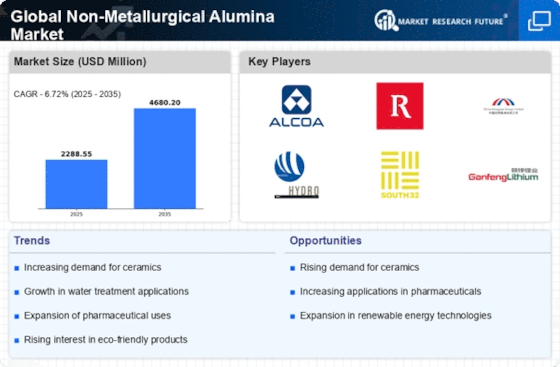
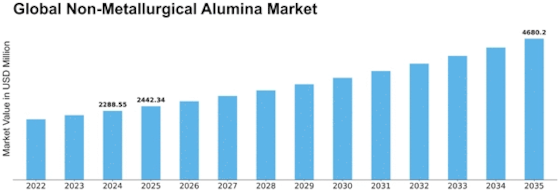
    As per MRFR analysis, the Global Non-Metallurgical Alumina Market Size was estimated at 2288.55 USD Million in 2024. The Non-Metallurgical Alumina industry is projected to grow from 2442.34 USD Million in 2025 to 4680.2 USD Million by 2035, exhibiting a compound annual growth rate (CAGR) of 6.72 during the forecast period 2025 - 2035.

    Key Market Trends & Highlights

    The Global Non-Metallurgical Alumina Market is poised for growth driven by sustainability and technological advancements.

    • North America remains the largest market for non-metallurgical alumina, driven by robust demand in various industrial applications.
    • Asia-Pacific is emerging as the fastest-growing region, reflecting increasing investments in infrastructure and manufacturing.
    • Calcined alumina continues to dominate the market, while alumina trihydrate is witnessing rapid growth due to its diverse applications.
    • Rising demand in the chemical industry and the expansion of the ceramics market are key drivers propelling market growth.

    Market Size & Forecast

    2024 Market Size 2288.55 (USD Million)
    2035 Market Size 4680.2 (USD Million)
    CAGR (2025 - 2035) 6.72%
    Largest Regional Market Share in 2024 Asia Pacific

    Major Players

    <p>Alcoa Corporation (US), Rio Tinto (GB), China Hongqiao Group Limited (CN), Norsk Hydro ASA (NO), South32 Limited (AU), Jiangxi Ganfeng Lithium Co., Ltd. (CN), Alumina Limited (AU), Shandong Weiqiao Pioneering Group Co., Ltd. (CN)</p>

    Market Trends

    The Global Non-Metallurgical Alumina Market is currently experiencing a dynamic phase characterized by evolving demand patterns and technological advancements. This sector, primarily focused on the production of alumina for applications outside of metallurgy, is witnessing a shift towards more sustainable practices. Industries such as ceramics, glass, and chemicals are increasingly seeking high-purity alumina, which is driving innovation in production methods. Furthermore, the growing emphasis on environmental regulations is prompting manufacturers to adopt cleaner technologies, thereby enhancing their competitive edge in the market. In addition, the Global Non-Metallurgical Alumina Market is influenced by the rising demand for advanced materials in various sectors. The expansion of the electronics and automotive industries is creating new opportunities for alumina applications, particularly in the production of components that require high thermal stability and electrical insulation. As companies strive to meet these demands, collaboration between suppliers and end-users is becoming more prevalent, fostering a more integrated supply chain. Overall, the market appears poised for growth, with potential for further diversification in product offerings and applications.

    Sustainability Initiatives

    The focus on sustainability within the Global Non-Metallurgical Alumina Market is intensifying. Companies are increasingly adopting eco-friendly practices, such as reducing waste and utilizing renewable energy sources in production processes. This trend not only aligns with global environmental goals but also appeals to consumers who prioritize sustainable products.

    Technological Advancements

    Innovations in production technologies are reshaping the Global Non-Metallurgical Alumina Market. Enhanced methods for refining and processing alumina are emerging, leading to improved product quality and efficiency. These advancements may enable manufacturers to meet the growing demand for high-purity alumina across various applications.

    Diversification of Applications

    The range of applications for non-metallurgical alumina is expanding significantly. Industries such as electronics, ceramics, and pharmaceuticals are increasingly utilizing alumina for specialized purposes. This diversification suggests a robust potential for market growth as new sectors recognize the benefits of alumina in their processes.

    Non Metallurgical Alumina Market Market Drivers

    Expansion of the Ceramics Market

    The ceramics market is undergoing substantial growth, which is positively impacting the Global Non-Metallurgical Alumina Market. Non-metallurgical alumina is a critical component in the production of advanced ceramics, utilized in applications ranging from electronics to medical devices. The increasing demand for high-performance ceramics, driven by technological advancements and the need for lightweight materials, suggests a robust future for non-metallurgical alumina. Market data indicates that the ceramics segment is expected to grow at a rate of approximately 6% annually, further solidifying the position of non-metallurgical alumina as a vital ingredient in this expanding market.

    Growth in the Refractories Sector

    The refractories sector is witnessing a surge in demand, primarily due to the increasing need for high-temperature resistant materials in various industries, including steel and glass manufacturing. Non-metallurgical alumina plays a crucial role in the production of refractories, which are essential for maintaining the integrity of industrial furnaces and kilns. As industries continue to expand and modernize, the Global Non-Metallurgical Alumina Market is poised for growth, with estimates suggesting that the refractories market could grow by 4% annually. This trend indicates a sustained demand for non-metallurgical alumina, as manufacturers seek reliable materials to enhance the performance and longevity of their products.

    Rising Demand in the Chemical Industry

    The chemical industry is experiencing a notable increase in demand for non-metallurgical alumina, primarily due to its application in the production of various chemicals and catalysts. This trend is driven by the growing need for high-purity alumina in the synthesis of specialty chemicals, which are essential for numerous industrial processes. As the chemical sector expands, the Global Non-Metallurgical Alumina Market is likely to benefit significantly, with projections indicating a compound annual growth rate of around 5% over the next few years. This growth is further supported by the increasing focus on sustainable practices within the chemical industry, which often necessitates the use of high-quality raw materials such as non-metallurgical alumina.

    Increasing Focus on Sustainable Materials

    The growing emphasis on sustainability across various industries is influencing the Global Non-Metallurgical Alumina Market. As companies strive to reduce their environmental footprint, the demand for sustainable materials, including non-metallurgical alumina, is on the rise. This trend is particularly evident in sectors such as construction and automotive, where eco-friendly materials are becoming a priority. Market analysis suggests that the shift towards sustainable practices could lead to a significant increase in the use of non-metallurgical alumina, as it is often derived from bauxite through processes that can be optimized for lower emissions. This focus on sustainability may drive innovation and open new avenues for growth in the market.

    Technological Innovations in Production Processes

    Technological innovations in the production processes of non-metallurgical alumina are likely to enhance efficiency and reduce costs, thereby driving growth in the Global Non-Metallurgical Alumina Market. Advances in extraction and refining techniques are enabling manufacturers to produce higher purity alumina with lower energy consumption. This not only meets the increasing quality demands from end-users but also aligns with global sustainability goals. As production methods become more efficient, the market could see a reduction in prices, making non-metallurgical alumina more accessible to a broader range of industries. This potential shift may lead to an increase in applications and overall market expansion.

    Market Segment Insights

    By Type: Calcined Alumina (Largest) vs. Alumina Trihydrate (Fastest-Growing)

    <p>In the Global Non-Metallurgical Alumina Market, the distribution of market share among the segment values is notably pronounced. Calcined alumina stands as the dominant force, leveraging its extensive applications in various industries, including ceramics and refractories. In comparison, alumina trihydrate holds a smaller yet rapidly expanding segment, driven by its essential role in water treatment and as a flame retardant. The distinct applications of each type highlight their varied market positions and potential for growth.</p>

    <p>Calcined Alumina: Dominant vs. Alumina Trihydrate: Emerging</p>

    <p>Calcined alumina is recognized for its high purity and versatile applications, giving it a significant edge in markets such as ceramics and abrasives, establishing its dominant position. Meanwhile, alumina trihydrate is emerging due to its sustainable qualities and crucial role in environmental applications, particularly in water treatment and flame retardancy. The shift towards eco-friendly solutions and the growing demand for effective flame retardants contribute to the rapid growth of alumina trihydrate, indicating a favorable market trend for both segments. While calcined alumina continues to benefit from established industries, alumina trihydrate’s increasing relevance signifies a promising future in the non-metallurgical alumina market.</p>

    By Application: Refractories (Largest) vs. Aluminum Sulphate (Fastest-Growing)

    <p>The Global Non-Metallurgical Alumina Market showcases a diverse range of applications, with refractories leading the charge, holding the largest share. This segment is critical for high-temperature industrial processes, primarily in the steel and ceramics sectors. Following refractories, aluminum sulphate is emerging rapidly as a significant player, spurred by increased demand in water treatment plants and paper manufacturing. The abrasives and ceramics segments, while important, occupy smaller niches, catering to specialized industries that require sophisticated materials for specific applications. Growth trends indicate a robust expansion in the aluminum sulphate segment, attributed to its rising adoption across various industries as a coagulant and flocculant. Similarly, the refractories segment is expected to sustain its dominance, driven by ongoing industrial activities and investments in infrastructure. Factors such as technological advancements and increased production capacities are further propelling the growth of both traditional and emerging applications within the non-metallurgical alumina market.</p>

    <p>Refractories (Dominant) vs. Aluminum Sulphate (Emerging)</p>

    <p>Refractories are regarded as the dominant player in the non-metallurgical alumina market, owing to their critical role in high-temperature applications, particularly in industries like steelmaking and ceramics. They are engineered to withstand extreme temperatures and harsh conditions, making them indispensable for furnaces and kilns. In contrast, aluminum sulphate is emerging as a vital component across various sectors, especially for water purification and paper production. Its ease of use and effectiveness as a coagulant drives its rapid acceptance in the market. While refractories remain established and robust, the growing environmental awareness and regulatory pressures are creating new opportunities for aluminum sulphate, leading to an exciting dynamic between these two segments.</p>

    Get more detailed insights about Non-Metallurgical Alumina Market Research Report—Global Forecast till 2035

    Regional Insights

    North America : Innovation and Sustainability Focus

    North America is witnessing significant growth in the non-metallurgical alumina market, driven by increasing demand from the chemical and refining sectors. The region is characterized by stringent environmental regulations that promote sustainable practices, contributing to a market share of approximately 30%. The U.S. and Canada are the largest markets, with the U.S. holding around 20% of the global market share, followed closely by Canada at 10%. Key players such as Alcoa Corporation and Rio Tinto are leading the charge in innovation and sustainability initiatives. The competitive landscape is marked by a focus on advanced technologies and eco-friendly production methods. The presence of established companies and a robust regulatory framework further enhance market dynamics, positioning North America as a leader in the non-metallurgical alumina sector.

    Europe : Regulatory Framework and Innovation

    Europe is emerging as a key player in the non-metallurgical alumina market, driven by stringent environmental regulations and a strong focus on sustainability. The region holds approximately 25% of the global market share, with Germany and France being the largest contributors. The European Union's Green Deal and various national policies are catalyzing growth, promoting the use of non-metallurgical alumina in various applications. Leading countries like Germany and France are home to major players such as Norsk Hydro and Rio Tinto, which are investing heavily in sustainable practices. The competitive landscape is characterized by innovation in production processes and a shift towards circular economy principles. This focus on sustainability not only meets regulatory requirements but also aligns with consumer demand for eco-friendly products.

    Asia-Pacific : Emerging Markets and Demand Surge

    The Asia-Pacific region is witnessing a surge in demand for non-metallurgical alumina, primarily driven by rapid industrialization and urbanization. This region accounts for approximately 35% of the global market share, with China being the largest market, holding around 25%. The increasing use of alumina in various applications, including ceramics and chemicals, is further propelling growth. Regulatory support for sustainable practices is also becoming more prominent. China, along with Australia, is home to key players like China Hongqiao Group and South32 Limited. The competitive landscape is marked by a mix of established companies and emerging players, all vying for market share. The presence of abundant natural resources and a growing manufacturing base positions Asia-Pacific as a powerhouse in the non-metallurgical alumina market, driving innovation and investment.

    Middle East and Africa : Resource-Rich and Emerging Markets

    The Middle East and Africa region is gradually emerging in the non-metallurgical alumina market, driven by abundant natural resources and increasing industrial activities. The region holds about 10% of the global market share, with South Africa and the UAE being the leading countries. The growth is supported by government initiatives aimed at diversifying economies and promoting local manufacturing. Countries like South Africa are focusing on enhancing their production capabilities, while the UAE is investing in infrastructure to support industrial growth. The competitive landscape is characterized by a mix of local and international players, with companies like Shandong Weiqiao Pioneering Group making significant inroads. The region's potential for growth is substantial, given its resource wealth and strategic initiatives to boost the non-metallurgical alumina sector.

    Key Players and Competitive Insights

    Major market players are spending a lot of money on R&D to increase their product lines, which will help the non-metallurgical alumina market grow even more. Market participants are also taking a range of strategic initiatives to grow their worldwide footprint, including new product launches, contractual agreements, mergers and acquisitions, increased investments, and collaboration with other organizations. Competitors in the non-metallurgical alumina industry must offer cost-effective items to expand and survive in an increasingly competitive and rising market environment.

    One of the primary business strategies adopted by manufacturers in the global non-metallurgical alumina industry to benefit clients and expand the non-metallurgical alumina market sector is to manufacture locally to reduce operating costs. In recent years, non-metallurgical alumina has come up with various features with some of the most significant benefits.

    Key Companies in the Non Metallurgical Alumina Market market include

    Industry Developments

    In July 2022, Aluminum Corporation of China Limited (Chalco) acquires a 19% Stake in Yunnan Aluminium. After the transaction, Chalco is the largest shareholder of Yunnan Aluminium, holding 29.10% of the shares.

    In October 2021, Alcoa of Australia Limited (AoA), a subsidiary of Alcoa Corporation formed a joint venture with Western Australia-based FYI Resources Ltd for development activities to produce high-purity alumina, or HPA to enter the growing high-purity alumina market to address the increasing demand for sustainable products through a joint development project.

    In June 2023,

     The Chinese government announced that it would be increasing its support for the domestic alumina industry. The government plans to provide subsidies for alumina production and investment in new capacity.

    Future Outlook

    Non Metallurgical Alumina Market Future Outlook

    <p>The Global Non-Metallurgical Alumina Market is projected to grow at a 6.72% CAGR from 2024 to 2035, driven by increasing demand in various industrial applications and sustainable practices.</p>

    New opportunities lie in:

    • <p>Expansion into emerging markets with tailored product offerings.</p>
    • <p>Development of eco-friendly alumina production technologies.</p>
    • <p>Strategic partnerships with end-users for customized solutions.</p>

    <p>By 2035, the market is expected to solidify its position as a leader in sustainable industrial materials.</p>

    Market Segmentation

    Non-Metallurgical Alumina Type Outlook

    • Calcined Alumina
    • Alumina Trihydrate

    Non-Metallurgical Alumina Regional Outlook

    North America
    • US
    • Canada

    Non-Metallurgical Alumina Application Outlook

    • Refractories
    • Abrasives
    • Ceramics
    • Aluminum Sulphate
    • ATH Fire Retardant
    • Others

    Report Scope

    MARKET SIZE 20242288.55(USD Million)
    MARKET SIZE 20252442.34(USD Million)
    MARKET SIZE 20354680.2(USD Million)
    COMPOUND ANNUAL GROWTH RATE (CAGR)6.72% (2024 - 2035)
    REPORT COVERAGERevenue Forecast, Competitive Landscape, Growth Factors, and Trends
    BASE YEAR2024
    Market Forecast Period2025 - 2035
    Historical Data2019 - 2024
    Market Forecast UnitsUSD Million
    Key Companies ProfiledMarket analysis in progress
    Segments CoveredMarket segmentation analysis in progress
    Key Market OpportunitiesGrowing demand for sustainable materials drives innovation in the Global Non-Metallurgical Alumina Market.
    Key Market DynamicsRising demand for sustainable materials drives innovation and competition in the non-metallurgical alumina sector.
    Countries CoveredNorth America, Europe, APAC, South America, MEA

    FAQs

    How much is the non-metallurgical alumina market?

    1,885.00 million (2021)

    How Big is the China non-metallurgical alumina market?

    550.13 million (2021)

    Which region held the largest market share in the non-metallurgical alumina market?

    Asia Pacific

    Who are the key players in the non-metallurgical alumina market?

    Alcoa Corporation, Almatis GMBH, Alteo Alumina, Alumina D.O.O – Zvornik, Dadco Alumina and Chemicals Limited, Hindalco Industries Ltd, Aluminum Corporation of China Limited, Atlantic Alumina Company (ATALCO), RUSAL and PT Indonesia Chemical Alumina (ICA)

    Which Type led the non-metallurgical alumina market?

    Alumina Trihydrate

    Which application had the largest market share in the non-metallurgical alumina market?

    Refractories

    1. Executive Summary
    2. Scope of the Report
      1. Market
      2. Definition
      3. 2.2
      4. Scope of the Study
      5. 2.3
      6. List of Assumptions
      7. 2.4
      8. Markets Structure
      9. 3
      10. Market Research Methodology
      11. Research Process
      12. Primary Research
      13. Secondary Research
      14. Market Size Estimation
      15. Forecast Model
    3. Market Factor Analysis
      1. Supply Chain Analysis
        1. Raw Material Suppliers
        2. Manufacturers/Service Providers of Non-Metallurgical
        3. End-Users
      2. Alumina
      3. 4.1.3
      4. Distributors/Retailers/Wholesalers/E-Commerce Merchants
      5. Porter’s Five Forces Model
        1. Threat of New Entrants
        2. Intensity
        3. Threat of Substitutes
        4. Bargaining Power of Suppliers
        5. Bargaining Power of Buyers
      6. of Competitive Rivalry
      7. Pricing Analysis
    4. Market Dynamics
      1. of Global Non-Metallurgical Alumina Market
      2. Introduction
      3. Drivers
      4. Restraints
      5. Opportunities
      6. Challenges
    5. Global Non-Metallurgical Alumina Market, by Type
      1. Introduction
      2. Calcined Alumina
        1. Market Estimates
        2. Market Estimates & Forecast, by Region, 2019–2030
      3. & Forecast, 2019–2030
      4. Alumina Trihydrate
        1. Market Estimates &
        2. Market Estimates & Forecast, by Region, 2019–2030
      5. 6.4
      6. Forecast, 2019–2030
    6. Global Non-Metallurgical
    7. Alumina Market, by Application
      1. Introduction
      2. Refractories
        1. Market Estimates & Forecast, 2019–2030
        2. Market Estimates &
      3. Forecast, by Region, 2019–2030
      4. Abrasives
        1. Market Estimates & Forecast, 2019–2030
        2. Market Estimates
      5. & Forecast, by Region, 2019–2030
      6. Ceramics
        1. Market Estimates & Forecast, 2019–2030
        2. Market Estimates
      7. & Forecast, by Region, 2019–2030
      8. Aluminum Sulphate
        1. Market Estimates & Forecast, 2019–2030
        2. Market Estimates
      9. & Forecast, by Region, 2019–2030
      10. ATH Fire Retardant
        1. Market Estimates & Forecast, 2019–2030
        2. Market Estimates
      11. & Forecast, by Region, 2019–2030
      12. Others
        1. Market Estimates & Forecast, 2019–2030
        2. Market Estimates
      13. & Forecast, by Region, 2019–2030
    8. Global Non-Metallurgical Alumina Market, by Region
      1. Introduction
      2. North America
        1. Market Estimates
        2. Market Estimates & Forecast, by Type, 2019–2030
        3. Market Estimates
        4. US
      3. & Forecast, 2019–2030
      4. & Forecast, by Application, 2019–2030
      5. & Forecast, by Type, 2019–2030
      6. 8.2.5
      7. Canada
      8. 8.2.5.1
      9. Market Estimates & Forecast, 2019–2030
      10. 8.2.5.3
    9. Market Estimates & Forecast, by Application, 2019–2030
      1. Europe
        1. Market Estimates &
        2. Market Estimates & Forecast, by Type, 2019–2030
        3. Market Estimates
        4. Germany
      2. Forecast, 2019–2030
      3. & Forecast, by Application, 2019–2030
      4. & Forecast, by Type, 2019–2030
      5. 8.3.5
      6. France
      7. 8.3.5.1
      8. Market Estimates & Forecast, 2019–2030
      9. 8.3.5.3
    10. Market Estimates & Forecast, by Application, 2019–2030
      1. Forecast, 2019–2030
      2. & Forecast, by Application, 2019–2030
      3. & Forecast, by Type, 2019–2030
      4. 8.3.8
      5. UK
      6. 8.3.8.1
      7. Market Estimates & Forecast, 2019–2030
      8. 8.3.8.3
    11. Italy
    12. Market Estimates &
    13. Market Estimates & Forecast, by Type, 2019–2030
    14. Market Estimates
    15. Spain
    16. Market Estimates & Forecast, 2019–2030
    17. Market Estimates
    18. Market Estimates & Forecast, by Application,
    19. Market Estimates & Forecast, by Type,
    20. Market Estimates & Forecast, by Application, 2019–2030
      1. Forecast, 2019–2030
      2. & Forecast, by Application, 2019–2030
      3. & Forecast, by Type, 2019–2030
      4. 8.4
      5. Asia-Pacific
      6. 8.4.1.1
      7. Market Estimates & Forecast, 2019–2030
      8. 8.4.1.3
    21. Russia
    22. Market Estimates &
    23. Market Estimates & Forecast, by Type, 2019–2030
    24. Market Estimates
    25. Rest of Europe
    26. Market Estimates & Forecast, 2019–2030
    27. Market Estimates
    28. Market Estimates & Forecast, by Application,
    29. Market Estimates & Forecast, by Type,
    30. Market Estimates & Forecast, by Application, 2019–2030
      1. Forecast, 2019–2030
      2. & Forecast, by Application, 2019–2030
      3. & Forecast, by Type, 2019–2030
      4. 8.4.4
      5. Japan
      6. 8.4.4.1
      7. Market Estimates & Forecast, 2019–2030
      8. 8.4.4.3
    31. China
    32. Market Estimates &
    33. Market Estimates & Forecast, by Type, 2019–2030
    34. Market Estimates
    35. India
    36. Market Estimates & Forecast, 2019–2030
    37. Market Estimates
    38. Market Estimates & Forecast, by Application,
    39. Market Estimates & Forecast, by Type,
    40. Market Estimates & Forecast, by Application, 2019–2030
      1. Forecast, 2019–2030
      2. & Forecast, by Application, 2019–2030
      3. & Forecast, by Type, 2019–2030
      4. 8.5
      5. Latin America
      6. 8.5.1.1
      7. Market Estimates & Forecast, 2019–2030
      8. 8.5.1.3
    41. Indonesia
    42. Market Estimates &
    43. Market Estimates & Forecast, by Type, 2019–2030
    44. Market Estimates
    45. Rest of Asia-Pacific
    46. Market Estimates & Forecast, 2019–2030
    47. Market Estimates
    48. Market Estimates & Forecast, by Application,
    49. Market Estimates & Forecast, by Type,
    50. Market Estimates & Forecast, by Application, 2019–2030
      1. Forecast, 2019–2030
      2. & Forecast, by Application, 2019–2030
      3. & Forecast, by Type, 2019–2030
      4. 8.5.4
      5. Rest of Latin America
      6. 8.5.4.1
      7. Market Estimates & Forecast, 2019–2030
      8. 8.5.4.3
    51. Brazil
    52. Market Estimates &
    53. Market Estimates & Forecast, by Type, 2019–2030
    54. Market Estimates
    55. Mexico
    56. Market Estimates & Forecast, 2019–2030
    57. Market Estimates
    58. Market Estimates & Forecast, by Application,
    59. Market Estimates & Forecast, by Type,
    60. Market Estimates & Forecast, by Application, 2019–2030
      1. Middle East & Africa
      2. & Forecast, 2019–2030
      3. & Forecast, by Application, 2019–2030
      4. & Forecast, by Type, 2019–2030
      5. 8.6.3
      6. GCC
      7. 8.6.3.1
      8. Market Estimates & Forecast, 2019–2030
      9. 8.6.3.3
    61. Market Estimates
    62. Market Estimates & Forecast, by Type, 2019–2030
    63. Market Estimates
    64. South Africa
    65. Market Estimates & Forecast, 2019–2030
    66. Market Estimates
    67. Market Estimates & Forecast, by Application,
    68. Market Estimates & Forecast, by Type,
    69. Market Estimates & Forecast, by Application, 2019–2030
      1. & Africa
      2. 8.6.4.1
      3. Market Estimates & Forecast, 2019–2030
      4. 8.6.4.3
    70. Rest of the Middle East
    71. Market Estimates & Forecast, by Type,
    72. Market Estimates & Forecast, by Application, 2019–2030
    73. Competitive Landscape
      1. Introduction
      2. Market Key Strategies
      3. Competitive Benchmarking
      4. Key Development Analysis
      5. (Expansions/Mergers & Acquisitions/Joint Ventures/New Non-Metallurgical Alumina
      6. Developments/Agreements/Investments)
    74. Company Profiles
      1. Alcoa Corporation
        1. Company Overview
        2. Financial Overview
        3. Products Offered
        4. Key Developments
        5. SWOT Analysis
        6. Key Strategies
      2. Almatis Gmbh
      3. Alteo Alumina
      4. Alumina D.O.O – Zvornik
      5. Dadco Alumina and Chemicals
      6. Limited
      7. 10.6
      8. Hindalco Industries Ltd
      9. Aluminum Corporation of China Limited
      10. Atlantic Alumina Company (ATALCO)
      11. RUSAL
      12. PT Indonesia Chemical
      13. Alumina (ICA)
      14. 11
      15. Appendix
      16. LIST
    75. OF TABLES
      1. Table
    76. 1: Global Non-Metallurgical Alumina Market, by region, 2019–2030
      1. Table 2: North America:
    77. Non-Metallurgical Alumina Market, by Country, 2019–2030
      1. Table 3: Europe: Non-Metallurgical
    78. Alumina Market, by Country, 2019–2030
      1. Table 4: Asia-Pacific: Non-Metallurgical Alumina
    79. Market, by Country, 2019–2030
      1. Table 5: Middle East & Africa: Non-Metallurgical Alumina
    80. Market, by Country, 2019–2030
      1. Table 6: Latin America: Non-Metallurgical Alumina Market,
      2. by Country, 2019–2030
    81. Table 13: Global Non-Metallurgical Alumina Type Market, by Region,
      1. Table
    82. 14: North America: Non-Metallurgical Alumina Type Market, by Country, 2019–2030
      1. Table 15: Europe: Non-Metallurgical
    83. Alumina Type Market, by Country, 2019–2030
      1. Table 16: Asia-Pacific: Non-Metallurgical Alumina
    84. Type Market, by Country, 2019–2030
      1. Table 17: Middle East & Africa: Non-Metallurgical Alumina
    85. Type Market, by Country, 2019–2030
      1. Table 18: Latin America: Non-Metallurgical Alumina Type
    86. Market, by Country, 2019–2030
      1. Table 19: Global Non-Metallurgical Alumina Type Market,
      2. by Region, 2019–2030
      3. Table 20: North America: Non-Metallurgical Alumina Type Market, by
      4. Country, 2019–2030
    87. Table 21: Europe: Non-Metallurgical Alumina Type Market, by Country,
      1. Table
    88. 22: Asia-Pacific: Non-Metallurgical Alumina Type Market, by Country, 2019–2030
      1. Table 23: Middle East
    89. & Africa: Non-Metallurgical Alumina Type Market, by Country, 2019–2030
      1. Table 24: Latin America:
    90. Non-Metallurgical Alumina Type Market, by Country, 2019–2030
      1. Table 25: Global Non-Metallurgical
    91. Alumina Type Market, by Region, 2019–2030
      1. Table 26: Global Non-Metallurgical Alumina Type Market,
      2. by Region, 2019–2030
    92. Table 27: North America: Non-Metallurgical Alumina Market, by Country,
      1. Table
    93. 29: North America: Non-Metallurgical Alumina Market, by Type, 2019–2030
      1. Table 30: North America:
    94. Non-Metallurgical Alumina Market, by Application, 2019–2030
      1. Table 31: Europe: Non-Metallurgical
    95. Alumina Market, by Country, 2019–2030
      1. Table 32: Europe: Non-Metallurgical Alumina Market,
      2. by Type, 2019–2030
    96. Table 33: Europe: Non-Metallurgical Alumina Market, by Application,
      1. Table
    97. 34: Asia-Pacific: Non-Metallurgical Alumina Market, by Country, 2019–2030
      1. Table 35: Asia-Pacific:
    98. Non-Metallurgical Alumina Market, by Type, 2019–2030
      1. Table 36: Asia-Pacific: Non-Metallurgical Alumina
    99. Market, by Application, 2019–2030
      1. Table 37: Middle East & Africa: Non-Metallurgical Alumina
    100. Market, by Country, 2019–2030
      1. Table 38: Middle East & Africa: Non-Metallurgical Alumina
    101. Market, by Type, 2019–2030
      1. Table 39: Middle East & Africa: Non-Metallurgical Alumina Market,
      2. by Application, 2019–2030
    102. Table 40: Latin America: Non-Metallurgical Alumina Market, by Country,
      1. Table
    103. 41: Latin America: Non-Metallurgical Alumina Market, by Type, 2019–2030
      1. Table 42: Latin America:
    104. Non-Metallurgical Alumina Market, by Application, 2019–2030
    105. LIST OF FIGURES
    106. Global
      1. Non-Metallurgical Alumina Market Segmentation
    107. Forecast Research Methodology
    108. Porter’s
      1. Five Forces Analysis of Global Non-Metallurgical Alumina Market
    109. Value Chain/Supply Chain
      1. of Global Non-Metallurgical Alumina Market
    110. Share of Global Non-Metallurgical Alumina
    111. Market, by Country, 2021 (%)
    112. Global Non-Metallurgical Alumina Market, 2019–2030
    113. Global Non-Metallurgical
    114. Alumina Market Size, by Type, 2019–2030
    115. Share of Global Non-Metallurgical Alumina
    116. Market, by Type, 2020 (%)
    117. Global Non-Metallurgical Alumina Market Size, by Application,
      1. FIGURE
    118. Share of Global Non-Metallurgical Alumina Market, by Application, 2021 (%)

    Non-Metallurgical Alumina Market Segmentation

    Non-Metallurgical Alumina Type Outlook (USD Million, 2019–2030)

    • Calcined Alumina
    • Alumina Trihydrate

    Non-Metallurgical Alumina Application Outlook (USD Million, 2019–2030)

    • Refractories
    • Abrasives
    • Ceramics
    • Aluminum Sulphate
    • ATH Fire Retardant
    • Others

    Non-Metallurgical Alumina Regional Outlook (USD Million, 2019–2030)

    • North America Outlook (USD Million, 2019–2030)

      • North America Non-Metallurgical Alumina by Type
        • Calcined Alumina
        • Alumina Trihydrate
      • North America Non-Metallurgical Alumina by Application
        • Refractories
        • Abrasives
        • Ceramics
        • Aluminum Sulphate
        • ATH Fire Retardant
        • Others
    • US Outlook (USD Million, 2019–2030)

      • US Non-Metallurgical Alumina by Type
        • Calcined Alumina
        • Alumina Trihydrate
      • US Non-Metallurgical Alumina by Application
        • Refractories
        • Abrasives
        • Ceramics
        • Aluminum Sulphate
        • ATH Fire Retardant
        • Others
      • CANADA Outlook (USD Million, 2019–2030)

      • CANADA Non-Metallurgical Alumina by Type
        • Calcined Alumina
        • Alumina Trihydrate
      • CANADA Non-Metallurgical Alumina by Application
        • Refractories
        • Abrasives
        • Ceramics
        • Aluminum Sulphate
        • ATH Fire Retardant
        • Others
    • Europe Outlook (USD Million, 2019–2030)

      • Europe Non-Metallurgical Alumina by Type
        • Calcined Alumina
        • Alumina Trihydrate
      • Europe Non-Metallurgical Alumina by Application
        • Refractories
        • Abrasives
        • Ceramics
        • Aluminum Sulphate
        • ATH Fire Retardant
        • Others
    • Germany Outlook (USD Million, 2019–2030)

      • Germany Non-Metallurgical Alumina by Type
        • Calcined Alumina
        • Alumina Trihydrate
      • Germany Non-Metallurgical Alumina by Application
        • Refractories
        • Abrasives
        • Ceramics
        • Aluminum Sulphate
        • ATH Fire Retardant
        • Others
    • France Outlook (USD Million, 2019–2030)

      • France Non-Metallurgical Alumina by Type
        • Calcined Alumina
        • Alumina Trihydrate
      • France Non-Metallurgical Alumina by Application
        • Refractories
        • Abrasives
        • Ceramics
        • Aluminum Sulphate
        • ATH Fire Retardant
        • Others
    • UK Outlook (USD Million, 2019–2030)

      • UK Non-Metallurgical Alumina by Type
        • Calcined Alumina
        • Alumina Trihydrate
      • UK Non-Metallurgical Alumina by Application
        • Refractories
        • Abrasives
        • Ceramics
        • Aluminum Sulphate
        • ATH Fire Retardant
        • Others
    • ITALY Outlook (USD Million, 2019–2030)

      • ITALY Non-Metallurgical Alumina by Type
        • Calcined Alumina
        • Alumina Trihydrate
      • ITALY Non-Metallurgical Alumina by Application
        • Refractories
        • Abrasives
        • Ceramics
        • Aluminum Sulphate
        • ATH Fire Retardant
        • Others
    • SPAIN Outlook (USD Million, 2019–2030)

      • Spain Non-Metallurgical Alumina by Type
        • Calcined Alumina
        • Alumina Trihydrate
      • Spain Non-Metallurgical Alumina by Application
        • Refractories
        • Abrasives
        • Ceramics
        • Aluminum Sulphate
        • ATH Fire Retardant
        • Others
    • Rest Of Europe Outlook (USD Million, 2019–2030)

      • Rest of Europe Non-Metallurgical Alumina by Type
        • Calcined Alumina
        • Alumina Trihydrate
      • REST of EUROPE Non-Metallurgical Alumina by Application
        • Refractories
        • Abrasives
        • Ceramics
        • Aluminum Sulphate
        • ATH Fire Retardant
        • Others
    • Asia-Pacific Outlook (USD Million, 2019–2030)

      • Asia-Pacific Non-Metallurgical Alumina by Type
        • Calcined Alumina
        • Alumina Trihydrate
      • Asia-Pacific Non-Metallurgical Alumina by Application
        • Refractories
        • Abrasives
        • Ceramics
        • Aluminum Sulphate
        • ATH Fire Retardant
        • Others
    • China Outlook (USD Million, 2019–2030)

      • China Non-Metallurgical Alumina by Type
        • Calcined Alumina
        • Alumina Trihydrate
      • China Non-Metallurgical Alumina by Application
        • Refractories
        • Abrasives
        • Ceramics
        • Aluminum Sulphate
        • ATH Fire Retardant
        • Others
    • Japan Outlook (USD Million, 2019–2030)

      • Japan Non-Metallurgical Alumina by Type
        • Calcined Alumina
        • Alumina Trihydrate
      • Japan Non-Metallurgical Alumina by Application
        • Refractories
        • Abrasives
        • Ceramics
        • Aluminum Sulphate
        • ATH Fire Retardant
        • Others
    • India Outlook (USD Million, 2019–2030)

      • India Non-Metallurgical Alumina by Type
        • Calcined Alumina
        • Alumina Trihydrate
      • India Non-Metallurgical Alumina by Application
        • Refractories
        • Abrasives
        • Ceramics
        • Aluminum Sulphate
        • ATH Fire Retardant
        • Others
    • Indonesia Outlook (USD Million, 2019–2030)

      • Indonesia Non-Metallurgical Alumina by Type
        • Calcined Alumina
        • Alumina Trihydrate
      • Indonesia Non-Metallurgical Alumina by Application
        • Refractories
        • Abrasives
        • Ceramics
        • Aluminum Sulphate
        • ATH Fire Retardant
        • Others
    • Rest of Asia-Pacific Outlook (USD Million, 2019–2030)

      • Rest of Asia-Pacific Non-Metallurgical Alumina by Type
        • Calcined Alumina
        • Alumina Trihydrate
      • Rest of Asia-Pacific Non-Metallurgical Alumina by Application
        • Refractories
        • Abrasives
        • Ceramics
        • Aluminum Sulphate
        • ATH Fire Retardant
        • Others
    • Rest of the World Outlook (USD Million, 2019–2030)

      • Rest of the World Non-Metallurgical Alumina by Type
        • Calcined Alumina
        • Alumina Trihydrate
      • Rest of the World Non-Metallurgical Alumina by Application
        • Refractories
        • Abrasives
        • Ceramics
        • Aluminum Sulphate
        • ATH Fire Retardant
        • Others
    • Middle East Outlook (USD Million, 2019–2030)

      • Middle East Non-Metallurgical Alumina by Type
        • Calcined Alumina
        • Alumina Trihydrate
      • Middle East Non-Metallurgical Alumina by Application
        • Refractories
        • Abrasives
        • Ceramics
        • Aluminum Sulphate
        • ATH Fire Retardant
        • Others
    • Africa Outlook (USD Million, 2019–2030)

      • Africa Non-Metallurgical Alumina by Type
        • Calcined Alumina
        • Alumina Trihydrate
      • Africa Non-Metallurgical Alumina by Application
        • Refractories
        • Abrasives
        • Ceramics
        • Aluminum Sulphate
        • ATH Fire Retardant
        • Others
    • Latin America Outlook (USD Million, 2019–2030)

      • Latin America Non-Metallurgical Alumina by Type
        • Calcined Alumina
        • Alumina Trihydrate
      • Latin America Non-Metallurgical Alumina by Application
        • Refractories
        • Abrasives
        • Ceramics
        • Aluminum Sulphate
        • ATH Fire Retardant
        • Others
    Infographic

    Free Sample Request

    Kindly complete the form below to receive a free sample of this Report

    Get Free Sample

    Customer Strories

    “I am very pleased with how market segments have been defined in a relevant way for my purposes (such as "Portable Freezers & refrigerators" and "last-mile"). In general the report is well structured. Thanks very much for your efforts.”

    Victoria Milne

    Founder
    Case Study
    Chemicals and Materials

    Compare Licence

    ×
    Features License Type
    Single User Multiuser License Enterprise User
    Price $4,950 $5,950 $7,250
    Maximum User Access Limit 1 User Upto 10 Users Unrestricted Access Throughout the Organization
    Free Customization
    Direct Access to Analyst
    Deliverable Format
    Platform Access
    Discount on Next Purchase 10% 15% 15%
    Printable Versions