×
  • Cat-intel
  • MedIntelliX
  • Resources
  • About Us
  • Hero Background
    English
    Chinese
    French
    Japanese
    Korean
    German
    Spanish

    Milk Tank Cooling System Market Analysis

    ID: MRFR/IA - E/10589-HCR
    128 Pages
    Snehal Singh
    October 2025

    Milk Tank Cooling System Market Research Report Information By Type (Direct Expansion System Tank, Ice Bank Tank and Others), By Configuration (Open Milk Tank, Fully Enclosed Milk Tank and Others), By Cleaning (In-farm, In-plant and Others), By Industry Vertical (Food, FMCG, Cold Storage and Others) And By Region (North America, Europe, Asia-Pacific, And Rest Of The World) –Market Forecast Till...

    Share:
    Download PDF ×

    We do not share your information with anyone. However, we may send you emails based on your report interest from time to time. You may contact us at any time to opt-out.

    Milk Tank Cooling System Market Infographic
    Purchase Options

    Market Analysis

    In-depth Analysis of Milk Tank Cooling System Market Industry Landscape

    A number of factors influence the growth and development of the milk tank cooling system market. One key driver is global demand for dairy products because as population increases while dietary preferences change thereby calling for more efficient and reliable milk storage solutions. Milk tank cooling systems play an essential role in maintaining quality and freshness of milk making them indispensable in satisfying needs of this sector.

    Modern cooling procedures, energy systems, and sophisticated monitoring may improve these equipment' efficiency and performance. Manufacturers are creating eco-friendly and energy-saving solutions for dairy producers as sustainability becomes a priority.

    In severe or changeable conditions, milk quality must be preserved using specific chilling methods. The distribution and adoption of cooling systems adapted for local climatic conditions depends on where most dairy farms are located leading to a wide range of market opportunities as well as challenges.

    Among such factors includes region’s economic health, dairy industry investments, and government support for agriculture which shape the purchasing power of farmers thereby also influencing demand for cooling solutions. Economic stability together with favorable financial conditions encourage more investment in upgrading dairy operations including switching into advanced milk tank cooling technologies.

    The policies established by respective governments significantly influence the milk tank cooling system market. Cooling system design and manufacturing processes have to meet specific regulations concerning milk quality standards, environmental impact concerns, and energy efficiency. Furthermore, grants plus other forms of financial aid extended by states increase accessibility hence foster growth within this sector.

    Another force shaping this market is competition within the industry itself. Established enterprises compete with new entrants causing significant shifts in the industry structure. They compete using different parameters such as product reliability, energy consumption rates (efficiency), cost or pricing , and after sale services or support. For firms that want to grow their businesses beyond their boundaries it will be vital that they form strategic alliances with other players in sectors like livestock extension officers’ organizations, cooperative societies working in cattle rearing business among others.

    Consumer consciousness coupled with changing preferences is also applicable to milk tank cooling systems markets. Consumers are more cautious about eating fresh foods hence need animals feeds which are not contaminated so that there is no disease spread to the milk. Thus, milk tank cooling systems are part of a system that ensures quality milk preservation from the farm all the way to processing facilities, and this is what determines whether dairies purchase them or not.


    Author
    Snehal Singh
    Assistant Manager - Research

    High acumen in analyzing complex macro & micro markets with more than 6 years of work experience in the field of market research. By implementing her analytical skills in forecasting and estimation into market research reports, she has expertise in Packaging, Construction, and Equipment domains. She handles a team size of 20-25 resources and ensures smooth running of the projects, associated marketing activities, and client servicing.

    Leave a Comment

    FAQs

    What is the current market valuation of the Milk Tank Cooling System Market?

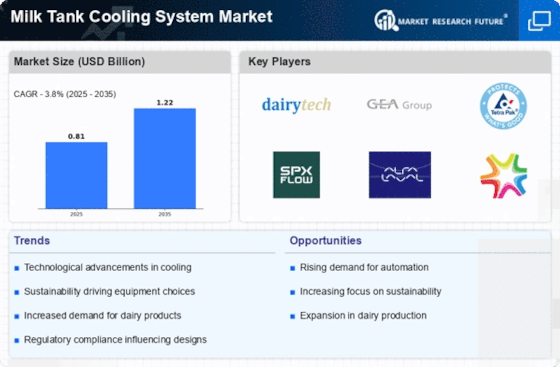
    The market valuation of the Milk Tank Cooling System Market was 0.8064 USD Billion in 2024.

    What is the projected market size for the Milk Tank Cooling System Market by 2035?

    The projected market size for the Milk Tank Cooling System Market is expected to reach 1.216 USD Billion by 2035.

    What is the expected CAGR for the Milk Tank Cooling System Market during the forecast period?

    The expected CAGR for the Milk Tank Cooling System Market from 2025 to 2035 is 3.8%.

    Which companies are considered key players in the Milk Tank Cooling System Market?

    Key players in the Milk Tank Cooling System Market include DairyTech, GEA Group, Tetra Pak, SPX Flow, and Alfa Laval.

    What are the main types of milk tank cooling systems available in the market?

    The main types of milk tank cooling systems include Direct Expansion System Tanks, Ice Bank Tanks, and others.

    How did the Direct Expansion System Tank segment perform in 2024?

    In 2024, the Direct Expansion System Tank segment was valued at approximately 0.32256 USD Billion.

    Market Summary

    As per MRFR analysis, the Milk Tank Cooling System Market Size was estimated at 0.8064 USD Billion in 2024. The Milk Tank Cooling System industry is projected to grow from 0.8371 in 2025 to 1.216 by 2035, exhibiting a compound annual growth rate (CAGR) of 3.8 during the forecast period 2025 - 2035.

    Key Market Trends & Highlights

    The Milk Tank Cooling System Market is poised for growth driven by technological advancements and sustainability initiatives.

    • Technological advancements are enhancing the efficiency and performance of milk cooling systems, particularly in North America.
    • Sustainability initiatives are increasingly influencing market dynamics, with a focus on energy-efficient solutions in the Asia-Pacific region.
    • The Direct Expansion System Tank remains the largest segment, while the Ice Bank Tank is experiencing rapid growth due to its innovative cooling methods.
    • Key market drivers include the rising dairy production and increasing awareness of food safety, which are shaping demand across various segments.

    Market Size & Forecast

    2024 Market Size 0.8064 (USD Billion)
    2035 Market Size 1.216 (USD Billion)
    CAGR (2025 - 2035) 3.8%
    Largest Regional Market Share in 2024 North America

    Major Players

    <p>DairyTech (US), GEA Group (DE), Tetra Pak (SE), SPX Flow (US), Alfa Laval (SE), FrieslandCampina (NL), Pentair (US), Hygiena (US), Sanimax (CA)</p>

    Market Trends

    The Milk Tank Cooling System Market is currently experiencing a notable transformation driven by advancements in technology and increasing awareness regarding food safety. As dairy producers strive to maintain the quality of milk, the demand for efficient cooling systems has surged. These systems not only preserve the freshness of milk but also enhance its shelf life, thereby contributing to reduced waste. Furthermore, the integration of smart technologies into cooling systems appears to be a growing trend, allowing for real-time monitoring and optimization of cooling processes. This shift towards automation and data-driven solutions indicates a potential evolution in operational efficiency within the dairy sector. In addition to technological advancements, sustainability concerns are influencing the Milk Tank Cooling System Market. Producers are increasingly seeking eco-friendly solutions that minimize energy consumption and reduce carbon footprints. This trend aligns with global efforts to promote sustainable practices in agriculture and food production. As a result, manufacturers are likely to focus on developing systems that utilize renewable energy sources and innovative materials. Overall, the Milk Tank Cooling System Market seems poised for growth, driven by a combination of technological innovation and a commitment to sustainability.

    Technological Advancements

    The Milk Tank Cooling System Market is witnessing a surge in the adoption of advanced technologies. Innovations such as IoT-enabled systems allow for real-time monitoring and control, enhancing operational efficiency. These technologies facilitate predictive maintenance, reducing downtime and ensuring optimal performance.

    Sustainability Initiatives

    There is a growing emphasis on sustainability within the Milk Tank Cooling System Market. Producers are increasingly prioritizing energy-efficient solutions that minimize environmental impact. This trend reflects a broader commitment to sustainable practices in the dairy industry.

    Regulatory Compliance

    The Milk Tank Cooling System Market is influenced by stringent food safety regulations. Compliance with these standards necessitates the use of reliable cooling systems that ensure the preservation of milk quality. This regulatory landscape drives demand for advanced cooling technologies.

    Milk Tank Cooling System Market Market Drivers

    Technological Innovations

    Technological advancements play a crucial role in shaping the Milk Tank Cooling System Market. Innovations such as smart cooling systems equipped with IoT capabilities are becoming increasingly prevalent. These systems allow for real-time monitoring of temperature and milk quality, thereby enhancing operational efficiency. The integration of automation in cooling processes not only reduces energy consumption but also minimizes human error, leading to improved product safety. Furthermore, the market has witnessed the introduction of energy-efficient cooling technologies that comply with environmental regulations. As a result, stakeholders are more inclined to adopt these advanced systems, which are projected to account for a significant share of the market. The ongoing evolution of technology in the Milk Tank Cooling System Market suggests a promising future for both manufacturers and consumers.

    Increasing Dairy Production

    The rising demand for dairy products is a primary driver for the Milk Tank Cooling System Market. As populations grow and dietary preferences shift towards dairy consumption, the need for efficient milk storage and cooling solutions becomes paramount. In recent years, dairy production has seen a notable increase, with reports indicating a rise of approximately 2.5% annually in milk output. This surge necessitates advanced cooling systems to maintain product quality and safety during storage and transportation. Consequently, dairy farmers and processors are investing in modern cooling technologies to ensure compliance with health standards and to extend the shelf life of milk products. The Milk Tank Cooling System Market is thus positioned to benefit from this upward trend in dairy production, as stakeholders seek reliable solutions to meet consumer demands.

    Rising Awareness of Food Safety

    The heightened awareness surrounding food safety is a significant driver for the Milk Tank Cooling System Market. Consumers are increasingly concerned about the quality and safety of dairy products, prompting stricter regulations and standards for milk storage and handling. This trend has led to a growing emphasis on the implementation of effective cooling systems to prevent spoilage and contamination. Regulatory bodies are enforcing guidelines that require dairy producers to maintain specific temperature ranges during storage and transportation. As a result, the demand for reliable milk cooling solutions is expected to rise. The Milk Tank Cooling System Market is likely to experience growth as dairy producers invest in systems that ensure compliance with these food safety standards, ultimately enhancing consumer trust in dairy products.

    Sustainability and Energy Efficiency

    Sustainability initiatives are increasingly influencing the Milk Tank Cooling System Market. As environmental concerns gain prominence, dairy producers are seeking energy-efficient cooling solutions that reduce their carbon footprint. The adoption of eco-friendly refrigerants and energy-saving technologies is becoming a priority for many stakeholders. Reports indicate that energy-efficient cooling systems can reduce operational costs by up to 30%, making them an attractive option for dairy farms and processing facilities. Additionally, the shift towards sustainable practices aligns with consumer preferences for environmentally responsible products. This trend is likely to drive investments in innovative cooling technologies that not only meet regulatory requirements but also contribute to sustainability goals. The Milk Tank Cooling System Market is thus poised for growth as it adapts to these evolving consumer and regulatory demands.

    Expansion of Dairy Processing Facilities

    The expansion of dairy processing facilities is a notable driver for the Milk Tank Cooling System Market. As the dairy sector continues to grow, there is a corresponding increase in the establishment of new processing plants aimed at meeting rising consumer demand. This expansion necessitates the installation of advanced milk cooling systems to ensure efficient operations and product quality. Recent data suggests that the number of dairy processing facilities has increased by approximately 5% annually, reflecting the industry's robust growth trajectory. Consequently, the demand for reliable and efficient cooling solutions is expected to rise in tandem with this expansion. The Milk Tank Cooling System Market stands to benefit from this trend, as processors seek to enhance their capabilities and maintain competitive advantages in a rapidly evolving market.

    Market Segment Insights

    By Type: Direct Expansion System Tank (Largest) vs. Ice Bank Tank (Fastest-Growing)

    <p>In the Milk Tank Cooling System Market, the Direct Expansion System Tank holds the largest share, reflecting its widespread adoption due to its efficient cooling capabilities. Its established presence in the market showcases its reliability and compatibility with various operational environments, making it a preferred choice among dairy producers. Ice Bank Tanks, while trailing behind in market share, are rapidly gaining traction due to their innovative cooling process that allows for lower operational costs and enhanced energy efficiency. This shift indicates a growing preference for environmentally sustainable cooling solutions in dairy operations.</p>

    <p>Cooling Technology: Direct Expansion System (Dominant) vs. Ice Bank Tank (Emerging)</p>

    <p>The Direct Expansion System is characterized by its direct cooling method, which efficiently transfers heat from the milk to the refrigerant, ensuring optimal preservation of milk quality. This system is dominant in the market due to its effectiveness and ease of installation, catering to large-scale dairy operations that prioritize performance. Conversely, the Ice Bank Tank is emerging as a notable alternative, favorably viewed for its ability to store and reuse cooling energy, which not only reduces energy costs but also meets the increasing demand for sustainable practices in the dairy industry. The transition toward Ice Bank Tanks highlights a significant trend towards innovative cooling technologies driven by economic and environmental considerations.</p>

    By Configuration: Open Milk Tank (Largest) vs. Fully Enclosed Milk Tank (Fastest-Growing)

    <p>The Milk Tank Cooling System Market showcases a diverse range of configurations, with Open Milk Tanks commanding the most significant market share. Their design allows for efficient cooling and ease of access, making them a preferred choice among dairy producers. Fully Enclosed Milk Tanks, while currently smaller in market presence, exhibit the fastest growth as manufacturers increasingly recognize their efficiency and ability to maintain product integrity during transport and storage. The trend towards Fully Enclosed Milk Tanks is driven by several factors, including rising safety standards and innovations in technology that enhance cooling efficacy. Additionally, growing demands for quality assurance and traceability in dairy products are pushing operations to upgrade to more sophisticated cooling systems, providing opportunities for expansion in this segment of the market.</p>

    <p>Open Milk Tank (Dominant) vs. Fully Enclosed Milk Tank (Emerging)</p>

    <p>Open Milk Tanks are the dominant segment in the Milk Tank Cooling System Market due to their long-standing presence and proven efficacy in dairy operations. These tanks provide ease of sanitation and maintenance, thus appealing to smaller dairy farms. In contrast, Fully Enclosed Milk Tanks are emerging as a crucial part of modern dairy logistics, characterized by superior insulation and protection from environmental factors. This makes them ideal for larger operations that prioritize quality and efficiency. The shift towards enclosed systems reflects broader industry innovations aimed at enhancing safety and product longevity, as dairy producers look to meet growing consumer expectations for high-quality, uncontaminated milk.</p>

    By Cleaning: In-Farm (Largest) vs. In-Plant (Fastest-Growing)

    <p>The Cleaning segment within the Milk Tank Cooling System Market comprises primarily of three key categories: In-Farm, In-Plant, and Others. Among these, the In-Farm cleaning solutions dominate the market, gaining a significant share as dairy producers increasingly focus on maintaining hygiene on-site. In contrast, In-Plant cleaning methods are witnessing robust growth due to their efficiency and effectiveness in larger facilities. The Others category, while relevant, holds a smaller share compared to these two primary segments.</p>

    <p>In-Farm (Dominant) vs. In-Plant (Emerging)</p>

    <p>The In-Farm cleaning segment is characterized by its convenience and direct applicability in dairy farms, where prompt hygiene maintenance is crucial for quality milk production. This segment includes solutions that are specifically tailored for on-site applications, ensuring that equipment is cleaned immediately after use. On the other hand, the In-Plant segment is gaining traction as operational efficiency becomes more critical in larger facilities. This segment encompasses advanced cleaning technologies that can handle the scale and complexity of industrial operations, making them essential for producers looking to optimize their cleaning processes. As both segments evolve, they each play a vital role in ensuring the overall sanitation and efficiency of milk cooling systems.</p>

    By Industry Vertical: Food (Largest) vs. FMCG (Fastest-Growing)

    <p>In the Milk Tank Cooling System Market, the industry verticals display diverse roles and market share distributions. The food sector thrives as the largest segment, driven by the ever-present demand for dairy products that necessitate effective cooling solutions. Following closely, the fast-moving consumer goods (FMCG) sector is experiencing rapid expansion as the need for cold chain logistics in the distribution of perishable items escalates, revealing significant opportunities for growth.</p>

    <p>Food (Dominant) vs. FMCG (Emerging)</p>

    <p>The Food sector stands as the dominant player in the Milk Tank Cooling System Market, characterized by its established infrastructure and extensive network serving dairy processing and distribution. Companies within this vertical often emphasize efficiency and sustainability in cooling operations to meet both regulatory standards and consumer expectations. Conversely, the FMCG sector emerges vigorously with a focus on enhanced cold storage capabilities, reflecting shifts in consumer behavior towards faster and fresher products. This sector's growth is fueled by innovations in logistics and technology, representing a key area for potential investment and development.</p>

    Get more detailed insights about Milk Tank Cooling System Market Research Report – Forecast till 2035

    Regional Insights

    North America : Innovation and Sustainability Focus

    North America is the largest market for milk tank cooling systems, holding approximately 40% of the global market share. The region's growth is driven by increasing dairy production, technological advancements, and stringent food safety regulations. The demand for energy-efficient cooling solutions is also rising, supported by government incentives for sustainable practices. The US Milk Tank Cooling System and Canada Milk Tank Cooling System are the primary contributors to this market, with a strong emphasis on innovation and sustainability. The competitive landscape in North America features key players such as DairyTech, SPX Flow, and Pentair, who are investing in R&D to enhance product offerings. The presence of established dairy farms and a robust supply chain further bolster market growth. Additionally, the region benefits from a well-developed infrastructure that supports the distribution and maintenance of cooling systems, ensuring high standards of milk quality and safety.

    Europe : Regulatory-Driven Market Growth

    Europe is the second-largest market for milk tank cooling systems, accounting for approximately 30% of the global market share. The region's growth is propelled by stringent EU regulations on food safety and quality, which mandate efficient cooling systems in dairy operations. Additionally, the increasing focus on sustainability and energy efficiency is driving demand for advanced cooling technologies. Countries like Germany and France are leading the market, supported by favorable government policies and funding for dairy innovation. The competitive landscape in Europe is characterized by major players such as GEA Group, Tetra Pak, and Alfa Laval, who are continuously innovating to meet regulatory standards. The presence of a well-established dairy industry, coupled with a strong emphasis on quality assurance, enhances the market's growth potential. Furthermore, collaborations between manufacturers and dairy producers are fostering advancements in cooling technologies, ensuring compliance with evolving regulations.

    Asia-Pacific : Emerging Market with High Potential

    Asia-Pacific is witnessing rapid growth in the milk tank cooling system market, holding approximately 20% of the global market share. The region's expansion is driven by increasing dairy consumption, rising disposable incomes, and a growing population. Countries like India and China are at the forefront, with significant investments in dairy infrastructure and technology. Government initiatives aimed at boosting the dairy sector further catalyze market growth, making it a key area for future investments. The competitive landscape in Asia-Pacific is evolving, with both local and international players vying for market share. Companies such as FrieslandCampina and local manufacturers are focusing on affordable and efficient cooling solutions to cater to the diverse needs of dairy farmers. The region's unique challenges, including varying climatic conditions and infrastructure limitations, are prompting innovations in cooling technologies, ensuring that the market remains dynamic and responsive to local demands.

    Middle East and Africa : Untapped Market Opportunities

    The Middle East and Africa region is emerging as a significant market for milk tank cooling systems, accounting for approximately 10% of the global market share. The growth is driven by increasing dairy production and consumption, alongside a rising awareness of food safety standards. Countries like South Africa and Kenya are leading the charge, with investments in modern dairy farming practices and cooling technologies. The region's diverse climatic conditions necessitate efficient cooling solutions, further driving demand. The competitive landscape in this region is characterized by a mix of local and international players, with companies like Sanimax and Hygiena making strides in the market. The presence of government initiatives aimed at enhancing dairy production and quality is fostering a conducive environment for market growth. Additionally, partnerships between stakeholders in the dairy supply chain are crucial for addressing the unique challenges faced in this region, ensuring the adoption of effective cooling systems.

    Key Players and Competitive Insights

    The Milk Tank Cooling System Market is currently characterized by a dynamic competitive landscape, driven by increasing demand for efficient dairy processing and stringent food safety regulations. Key players such as DairyTech (US), GEA Group (DE), and Tetra Pak (SE) are strategically positioned to leverage innovation and technological advancements. DairyTech (US) focuses on enhancing energy efficiency in its cooling systems, while GEA Group (DE) emphasizes sustainable practices through its eco-friendly cooling solutions. Tetra Pak (SE) is actively pursuing digital transformation initiatives, integrating IoT technologies to optimize operational efficiency. Collectively, these strategies not only enhance their market presence but also contribute to a more competitive environment, where innovation and sustainability are paramount.

    In terms of business tactics, companies are increasingly localizing manufacturing to reduce lead times and optimize supply chains. This approach appears to be particularly effective in a moderately fragmented market, where the collective influence of key players shapes pricing strategies and product offerings. The emphasis on supply chain optimization is likely to enhance operational resilience, allowing companies to respond swiftly to market fluctuations and customer demands.

    In August 2025, GEA Group (DE) announced a partnership with a leading dairy cooperative to develop a new line of energy-efficient milk cooling systems. This collaboration is expected to enhance GEA's product portfolio while addressing the growing demand for sustainable dairy processing solutions. The strategic importance of this partnership lies in its potential to position GEA as a leader in eco-friendly technologies, aligning with global sustainability goals.

    In September 2025, Tetra Pak (SE) launched an innovative digital platform designed to monitor and optimize milk cooling processes in real-time. This initiative not only underscores Tetra Pak's commitment to digital transformation but also enhances operational efficiency for dairy producers. The strategic significance of this development is evident in its potential to reduce energy consumption and improve product quality, thereby reinforcing Tetra Pak's competitive edge in the market.

    In July 2025, DairyTech (US) unveiled a new range of smart cooling systems equipped with AI-driven analytics. This technological advancement aims to provide dairy farmers with actionable insights to optimize their cooling processes. The strategic relevance of this innovation is substantial, as it positions DairyTech at the forefront of the digitalization trend within the dairy industry, potentially leading to increased market share and customer loyalty.

    As of October 2025, the Milk Tank Cooling System Market is witnessing a shift towards digitalization, sustainability, and AI integration. Strategic alliances among key players are increasingly shaping the competitive landscape, fostering innovation and collaboration. The evolution of competitive differentiation appears to be moving away from traditional price-based competition towards a focus on technological advancements, supply chain reliability, and sustainable practices. This trend suggests that companies that prioritize innovation and adaptability will likely thrive in the future.

    Key Companies in the Milk Tank Cooling System Market market include

    Industry Developments

    September 2021: The Swedish Company Wedholms, which makes dairy equipment, introduced a CO2 milk-cooling tank. A byproduct of industrial recycling is the CO2 that the tank uses. In addition, the tank provides a substantial energy savings over traditional methods.

    August 2021: Bel Brands USA and the Dairy Farmers of America (DFA) have partnered to introduce a sustainable dairy cooling initiative. Reducing greenhouse gas emissions was the partnership's main goal.

    Future Outlook

    Milk Tank Cooling System Market Future Outlook

    <p>The Milk Tank Cooling System Market is projected to grow at a 3.8% CAGR from 2024 to 2035, driven by technological advancements, increasing dairy production, and rising demand for quality milk preservation.</p>

    New opportunities lie in:

    • <p>Integration of IoT for real-time monitoring and efficiency optimization.</p>
    • <p>Development of energy-efficient cooling technologies to reduce operational costs.</p>
    • <p>Expansion into emerging markets with tailored cooling solutions for local dairy industries.</p>

    <p>By 2035, the market is expected to achieve robust growth, reflecting evolving industry needs and technological innovations.</p>

    Market Segmentation

    Milk Tank Cooling System Market Type Outlook

    • Direct Expansion System Tank
    • Ice Bank Tank
    • Others

    Milk Tank Cooling System Market Cleaning Outlook

    • In-Farm
    • In-Plant
    • Others

    Milk Tank Cooling System Market Configuration Outlook

    • Open Milk Tank
    • Fully Enclosed Milk Tank
    • Others

    Milk Tank Cooling System Market Industry Vertical Outlook

    • Food
    • FMCG
    • Cold Storage
    • Others

    Report Scope

    MARKET SIZE 20240.8064(USD Billion)
    MARKET SIZE 20250.8371(USD Billion)
    MARKET SIZE 20351.216(USD Billion)
    COMPOUND ANNUAL GROWTH RATE (CAGR)3.8% (2024 - 2035)
    REPORT COVERAGERevenue Forecast, Competitive Landscape, Growth Factors, and Trends
    BASE YEAR2024
    Market Forecast Period2025 - 2035
    Historical Data2019 - 2024
    Market Forecast UnitsUSD Billion
    Key Companies ProfiledMarket analysis in progress
    Segments CoveredMarket segmentation analysis in progress
    Key Market OpportunitiesIntegration of advanced automation technologies enhances efficiency in the Milk Tank Cooling System Market.
    Key Market DynamicsTechnological advancements and regulatory changes drive innovation in the Milk Tank Cooling System market.
    Countries CoveredNorth America, Europe, APAC, South America, MEA

    FAQs

    What is the current market valuation of the Milk Tank Cooling System Market?

    The market valuation of the Milk Tank Cooling System Market was 0.8064 USD Billion in 2024.

    What is the projected market size for the Milk Tank Cooling System Market by 2035?

    The projected market size for the Milk Tank Cooling System Market is expected to reach 1.216 USD Billion by 2035.

    What is the expected CAGR for the Milk Tank Cooling System Market during the forecast period?

    The expected CAGR for the Milk Tank Cooling System Market from 2025 to 2035 is 3.8%.

    Which companies are considered key players in the Milk Tank Cooling System Market?

    Key players in the Milk Tank Cooling System Market include DairyTech, GEA Group, Tetra Pak, SPX Flow, and Alfa Laval.

    What are the main types of milk tank cooling systems available in the market?

    The main types of milk tank cooling systems include Direct Expansion System Tanks, Ice Bank Tanks, and others.

    How did the Direct Expansion System Tank segment perform in 2024?

    In 2024, the Direct Expansion System Tank segment was valued at approximately 0.32256 USD Billion.

    1. SECTION I: EXECUTIVE SUMMARY AND KEY HIGHLIGHTS
      1. | 1.1 EXECUTIVE SUMMARY
      2. | | 1.1.1 Market Overview
      3. | | 1.1.2 Key Findings
      4. | | 1.1.3 Market Segmentation
      5. | | 1.1.4 Competitive Landscape
      6. | | 1.1.5 Challenges and Opportunities
      7. | | 1.1.6 Future Outlook
    2. SECTION II: SCOPING, METHODOLOGY AND MARKET STRUCTURE
      1. | 2.1 MARKET INTRODUCTION
      2. | | 2.1.1 Definition
      3. | | 2.1.2 Scope of the study
      4. | | | 2.1.2.1 Research Objective
      5. | | | 2.1.2.2 Assumption
      6. | | | 2.1.2.3 Limitations
      7. | 2.2 RESEARCH METHODOLOGY
      8. | | 2.2.1 Overview
      9. | | 2.2.2 Data Mining
      10. | | 2.2.3 Secondary Research
      11. | | 2.2.4 Primary Research
      12. | | | 2.2.4.1 Primary Interviews and Information Gathering Process
      13. | | | 2.2.4.2 Breakdown of Primary Respondents
      14. | | 2.2.5 Forecasting Model
      15. | | 2.2.6 Market Size Estimation
      16. | | | 2.2.6.1 Bottom-Up Approach
      17. | | | 2.2.6.2 Top-Down Approach
      18. | | 2.2.7 Data Triangulation
      19. | | 2.2.8 Validation
    3. SECTION III: QUALITATIVE ANALYSIS
      1. | 3.1 MARKET DYNAMICS
      2. | | 3.1.1 Overview
      3. | | 3.1.2 Drivers
      4. | | 3.1.3 Restraints
      5. | | 3.1.4 Opportunities
      6. | 3.2 MARKET FACTOR ANALYSIS
      7. | | 3.2.1 Value chain Analysis
      8. | | 3.2.2 Porter's Five Forces Analysis
      9. | | | 3.2.2.1 Bargaining Power of Suppliers
      10. | | | 3.2.2.2 Bargaining Power of Buyers
      11. | | | 3.2.2.3 Threat of New Entrants
      12. | | | 3.2.2.4 Threat of Substitutes
      13. | | | 3.2.2.5 Intensity of Rivalry
      14. | | 3.2.3 COVID-19 Impact Analysis
      15. | | | 3.2.3.1 Market Impact Analysis
      16. | | | 3.2.3.2 Regional Impact
      17. | | | 3.2.3.3 Opportunity and Threat Analysis
    4. SECTION IV: QUANTITATIVE ANALYSIS
      1. | 4.1 Security, Access Control and Robotics, BY Type (USD Billion)
      2. | | 4.1.1 Direct Expansion System Tank
      3. | | 4.1.2 Ice Bank Tank
      4. | | 4.1.3 Others
      5. | 4.2 Security, Access Control and Robotics, BY Configuration (USD Billion)
      6. | | 4.2.1 Open Milk Tank
      7. | | 4.2.2 Fully Enclosed Milk Tank
      8. | | 4.2.3 Others
      9. | 4.3 Security, Access Control and Robotics, BY Cleaning (USD Billion)
      10. | | 4.3.1 In-Farm
      11. | | 4.3.2 In-Plant
      12. | | 4.3.3 Others
      13. | 4.4 Security, Access Control and Robotics, BY Industry Vertical (USD Billion)
      14. | | 4.4.1 Food
      15. | | 4.4.2 FMCG
      16. | | 4.4.3 Cold Storage
      17. | | 4.4.4 Others
      18. | 4.5 Security, Access Control and Robotics, BY Region (USD Billion)
      19. | | 4.5.1 North America
      20. | | | 4.5.1.1 US
      21. | | | 4.5.1.2 Canada
      22. | | 4.5.2 Europe
      23. | | | 4.5.2.1 Germany
      24. | | | 4.5.2.2 UK
      25. | | | 4.5.2.3 France
      26. | | | 4.5.2.4 Russia
      27. | | | 4.5.2.5 Italy
      28. | | | 4.5.2.6 Spain
      29. | | | 4.5.2.7 Rest of Europe
      30. | | 4.5.3 APAC
      31. | | | 4.5.3.1 China
      32. | | | 4.5.3.2 India
      33. | | | 4.5.3.3 Japan
      34. | | | 4.5.3.4 South Korea
      35. | | | 4.5.3.5 Malaysia
      36. | | | 4.5.3.6 Thailand
      37. | | | 4.5.3.7 Indonesia
      38. | | | 4.5.3.8 Rest of APAC
      39. | | 4.5.4 South America
      40. | | | 4.5.4.1 Brazil
      41. | | | 4.5.4.2 Mexico
      42. | | | 4.5.4.3 Argentina
      43. | | | 4.5.4.4 Rest of South America
      44. | | 4.5.5 MEA
      45. | | | 4.5.5.1 GCC Countries
      46. | | | 4.5.5.2 South Africa
      47. | | | 4.5.5.3 Rest of MEA
    5. SECTION V: COMPETITIVE ANALYSIS
      1. | 5.1 Competitive Landscape
      2. | | 5.1.1 Overview
      3. | | 5.1.2 Competitive Analysis
      4. | | 5.1.3 Market share Analysis
      5. | | 5.1.4 Major Growth Strategy in the Security, Access Control and Robotics
      6. | | 5.1.5 Competitive Benchmarking
      7. | | 5.1.6 Leading Players in Terms of Number of Developments in the Security, Access Control and Robotics
      8. | | 5.1.7 Key developments and growth strategies
      9. | | | 5.1.7.1 New Product Launch/Service Deployment
      10. | | | 5.1.7.2 Merger & Acquisitions
      11. | | | 5.1.7.3 Joint Ventures
      12. | | 5.1.8 Major Players Financial Matrix
      13. | | | 5.1.8.1 Sales and Operating Income
      14. | | | 5.1.8.2 Major Players R&D Expenditure. 2023
      15. | 5.2 Company Profiles
      16. | | 5.2.1 DairyTech (US)
      17. | | | 5.2.1.1 Financial Overview
      18. | | | 5.2.1.2 Products Offered
      19. | | | 5.2.1.3 Key Developments
      20. | | | 5.2.1.4 SWOT Analysis
      21. | | | 5.2.1.5 Key Strategies
      22. | | 5.2.2 GEA Group (DE)
      23. | | | 5.2.2.1 Financial Overview
      24. | | | 5.2.2.2 Products Offered
      25. | | | 5.2.2.3 Key Developments
      26. | | | 5.2.2.4 SWOT Analysis
      27. | | | 5.2.2.5 Key Strategies
      28. | | 5.2.3 Tetra Pak (SE)
      29. | | | 5.2.3.1 Financial Overview
      30. | | | 5.2.3.2 Products Offered
      31. | | | 5.2.3.3 Key Developments
      32. | | | 5.2.3.4 SWOT Analysis
      33. | | | 5.2.3.5 Key Strategies
      34. | | 5.2.4 SPX Flow (US)
      35. | | | 5.2.4.1 Financial Overview
      36. | | | 5.2.4.2 Products Offered
      37. | | | 5.2.4.3 Key Developments
      38. | | | 5.2.4.4 SWOT Analysis
      39. | | | 5.2.4.5 Key Strategies
      40. | | 5.2.5 Alfa Laval (SE)
      41. | | | 5.2.5.1 Financial Overview
      42. | | | 5.2.5.2 Products Offered
      43. | | | 5.2.5.3 Key Developments
      44. | | | 5.2.5.4 SWOT Analysis
      45. | | | 5.2.5.5 Key Strategies
      46. | | 5.2.6 FrieslandCampina (NL)
      47. | | | 5.2.6.1 Financial Overview
      48. | | | 5.2.6.2 Products Offered
      49. | | | 5.2.6.3 Key Developments
      50. | | | 5.2.6.4 SWOT Analysis
      51. | | | 5.2.6.5 Key Strategies
      52. | | 5.2.7 Pentair (US)
      53. | | | 5.2.7.1 Financial Overview
      54. | | | 5.2.7.2 Products Offered
      55. | | | 5.2.7.3 Key Developments
      56. | | | 5.2.7.4 SWOT Analysis
      57. | | | 5.2.7.5 Key Strategies
      58. | | 5.2.8 Hygiena (US)
      59. | | | 5.2.8.1 Financial Overview
      60. | | | 5.2.8.2 Products Offered
      61. | | | 5.2.8.3 Key Developments
      62. | | | 5.2.8.4 SWOT Analysis
      63. | | | 5.2.8.5 Key Strategies
      64. | | 5.2.9 Sanimax (CA)
      65. | | | 5.2.9.1 Financial Overview
      66. | | | 5.2.9.2 Products Offered
      67. | | | 5.2.9.3 Key Developments
      68. | | | 5.2.9.4 SWOT Analysis
      69. | | | 5.2.9.5 Key Strategies
      70. | 5.3 Appendix
      71. | | 5.3.1 References
      72. | | 5.3.2 Related Reports
    6. LIST OF FIGURES
      1. | 6.1 MARKET SYNOPSIS
      2. | 6.2 NORTH AMERICA MARKET ANALYSIS
      3. | 6.3 US MARKET ANALYSIS BY TYPE
      4. | 6.4 US MARKET ANALYSIS BY CONFIGURATION
      5. | 6.5 US MARKET ANALYSIS BY CLEANING
      6. | 6.6 US MARKET ANALYSIS BY INDUSTRY VERTICAL
      7. | 6.7 CANADA MARKET ANALYSIS BY TYPE
      8. | 6.8 CANADA MARKET ANALYSIS BY CONFIGURATION
      9. | 6.9 CANADA MARKET ANALYSIS BY CLEANING
      10. | 6.10 CANADA MARKET ANALYSIS BY INDUSTRY VERTICAL
      11. | 6.11 EUROPE MARKET ANALYSIS
      12. | 6.12 GERMANY MARKET ANALYSIS BY TYPE
      13. | 6.13 GERMANY MARKET ANALYSIS BY CONFIGURATION
      14. | 6.14 GERMANY MARKET ANALYSIS BY CLEANING
      15. | 6.15 GERMANY MARKET ANALYSIS BY INDUSTRY VERTICAL
      16. | 6.16 UK MARKET ANALYSIS BY TYPE
      17. | 6.17 UK MARKET ANALYSIS BY CONFIGURATION
      18. | 6.18 UK MARKET ANALYSIS BY CLEANING
      19. | 6.19 UK MARKET ANALYSIS BY INDUSTRY VERTICAL
      20. | 6.20 FRANCE MARKET ANALYSIS BY TYPE
      21. | 6.21 FRANCE MARKET ANALYSIS BY CONFIGURATION
      22. | 6.22 FRANCE MARKET ANALYSIS BY CLEANING
      23. | 6.23 FRANCE MARKET ANALYSIS BY INDUSTRY VERTICAL
      24. | 6.24 RUSSIA MARKET ANALYSIS BY TYPE
      25. | 6.25 RUSSIA MARKET ANALYSIS BY CONFIGURATION
      26. | 6.26 RUSSIA MARKET ANALYSIS BY CLEANING
      27. | 6.27 RUSSIA MARKET ANALYSIS BY INDUSTRY VERTICAL
      28. | 6.28 ITALY MARKET ANALYSIS BY TYPE
      29. | 6.29 ITALY MARKET ANALYSIS BY CONFIGURATION
      30. | 6.30 ITALY MARKET ANALYSIS BY CLEANING
      31. | 6.31 ITALY MARKET ANALYSIS BY INDUSTRY VERTICAL
      32. | 6.32 SPAIN MARKET ANALYSIS BY TYPE
      33. | 6.33 SPAIN MARKET ANALYSIS BY CONFIGURATION
      34. | 6.34 SPAIN MARKET ANALYSIS BY CLEANING
      35. | 6.35 SPAIN MARKET ANALYSIS BY INDUSTRY VERTICAL
      36. | 6.36 REST OF EUROPE MARKET ANALYSIS BY TYPE
      37. | 6.37 REST OF EUROPE MARKET ANALYSIS BY CONFIGURATION
      38. | 6.38 REST OF EUROPE MARKET ANALYSIS BY CLEANING
      39. | 6.39 REST OF EUROPE MARKET ANALYSIS BY INDUSTRY VERTICAL
      40. | 6.40 APAC MARKET ANALYSIS
      41. | 6.41 CHINA MARKET ANALYSIS BY TYPE
      42. | 6.42 CHINA MARKET ANALYSIS BY CONFIGURATION
      43. | 6.43 CHINA MARKET ANALYSIS BY CLEANING
      44. | 6.44 CHINA MARKET ANALYSIS BY INDUSTRY VERTICAL
      45. | 6.45 INDIA MARKET ANALYSIS BY TYPE
      46. | 6.46 INDIA MARKET ANALYSIS BY CONFIGURATION
      47. | 6.47 INDIA MARKET ANALYSIS BY CLEANING
      48. | 6.48 INDIA MARKET ANALYSIS BY INDUSTRY VERTICAL
      49. | 6.49 JAPAN MARKET ANALYSIS BY TYPE
      50. | 6.50 JAPAN MARKET ANALYSIS BY CONFIGURATION
      51. | 6.51 JAPAN MARKET ANALYSIS BY CLEANING
      52. | 6.52 JAPAN MARKET ANALYSIS BY INDUSTRY VERTICAL
      53. | 6.53 SOUTH KOREA MARKET ANALYSIS BY TYPE
      54. | 6.54 SOUTH KOREA MARKET ANALYSIS BY CONFIGURATION
      55. | 6.55 SOUTH KOREA MARKET ANALYSIS BY CLEANING
      56. | 6.56 SOUTH KOREA MARKET ANALYSIS BY INDUSTRY VERTICAL
      57. | 6.57 MALAYSIA MARKET ANALYSIS BY TYPE
      58. | 6.58 MALAYSIA MARKET ANALYSIS BY CONFIGURATION
      59. | 6.59 MALAYSIA MARKET ANALYSIS BY CLEANING
      60. | 6.60 MALAYSIA MARKET ANALYSIS BY INDUSTRY VERTICAL
      61. | 6.61 THAILAND MARKET ANALYSIS BY TYPE
      62. | 6.62 THAILAND MARKET ANALYSIS BY CONFIGURATION
      63. | 6.63 THAILAND MARKET ANALYSIS BY CLEANING
      64. | 6.64 THAILAND MARKET ANALYSIS BY INDUSTRY VERTICAL
      65. | 6.65 INDONESIA MARKET ANALYSIS BY TYPE
      66. | 6.66 INDONESIA MARKET ANALYSIS BY CONFIGURATION
      67. | 6.67 INDONESIA MARKET ANALYSIS BY CLEANING
      68. | 6.68 INDONESIA MARKET ANALYSIS BY INDUSTRY VERTICAL
      69. | 6.69 REST OF APAC MARKET ANALYSIS BY TYPE
      70. | 6.70 REST OF APAC MARKET ANALYSIS BY CONFIGURATION
      71. | 6.71 REST OF APAC MARKET ANALYSIS BY CLEANING
      72. | 6.72 REST OF APAC MARKET ANALYSIS BY INDUSTRY VERTICAL
      73. | 6.73 SOUTH AMERICA MARKET ANALYSIS
      74. | 6.74 BRAZIL MARKET ANALYSIS BY TYPE
      75. | 6.75 BRAZIL MARKET ANALYSIS BY CONFIGURATION
      76. | 6.76 BRAZIL MARKET ANALYSIS BY CLEANING
      77. | 6.77 BRAZIL MARKET ANALYSIS BY INDUSTRY VERTICAL
      78. | 6.78 MEXICO MARKET ANALYSIS BY TYPE
      79. | 6.79 MEXICO MARKET ANALYSIS BY CONFIGURATION
      80. | 6.80 MEXICO MARKET ANALYSIS BY CLEANING
      81. | 6.81 MEXICO MARKET ANALYSIS BY INDUSTRY VERTICAL
      82. | 6.82 ARGENTINA MARKET ANALYSIS BY TYPE
      83. | 6.83 ARGENTINA MARKET ANALYSIS BY CONFIGURATION
      84. | 6.84 ARGENTINA MARKET ANALYSIS BY CLEANING
      85. | 6.85 ARGENTINA MARKET ANALYSIS BY INDUSTRY VERTICAL
      86. | 6.86 REST OF SOUTH AMERICA MARKET ANALYSIS BY TYPE
      87. | 6.87 REST OF SOUTH AMERICA MARKET ANALYSIS BY CONFIGURATION
      88. | 6.88 REST OF SOUTH AMERICA MARKET ANALYSIS BY CLEANING
      89. | 6.89 REST OF SOUTH AMERICA MARKET ANALYSIS BY INDUSTRY VERTICAL
      90. | 6.90 MEA MARKET ANALYSIS
      91. | 6.91 GCC COUNTRIES MARKET ANALYSIS BY TYPE
      92. | 6.92 GCC COUNTRIES MARKET ANALYSIS BY CONFIGURATION
      93. | 6.93 GCC COUNTRIES MARKET ANALYSIS BY CLEANING
      94. | 6.94 GCC COUNTRIES MARKET ANALYSIS BY INDUSTRY VERTICAL
      95. | 6.95 SOUTH AFRICA MARKET ANALYSIS BY TYPE
      96. | 6.96 SOUTH AFRICA MARKET ANALYSIS BY CONFIGURATION
      97. | 6.97 SOUTH AFRICA MARKET ANALYSIS BY CLEANING
      98. | 6.98 SOUTH AFRICA MARKET ANALYSIS BY INDUSTRY VERTICAL
      99. | 6.99 REST OF MEA MARKET ANALYSIS BY TYPE
      100. | 6.100 REST OF MEA MARKET ANALYSIS BY CONFIGURATION
      101. | 6.101 REST OF MEA MARKET ANALYSIS BY CLEANING
      102. | 6.102 REST OF MEA MARKET ANALYSIS BY INDUSTRY VERTICAL
      103. | 6.103 KEY BUYING CRITERIA OF SECURITY, ACCESS CONTROL AND ROBOTICS
      104. | 6.104 RESEARCH PROCESS OF MRFR
      105. | 6.105 DRO ANALYSIS OF SECURITY, ACCESS CONTROL AND ROBOTICS
      106. | 6.106 DRIVERS IMPACT ANALYSIS: SECURITY, ACCESS CONTROL AND ROBOTICS
      107. | 6.107 RESTRAINTS IMPACT ANALYSIS: SECURITY, ACCESS CONTROL AND ROBOTICS
      108. | 6.108 SUPPLY / VALUE CHAIN: SECURITY, ACCESS CONTROL AND ROBOTICS
      109. | 6.109 SECURITY, ACCESS CONTROL AND ROBOTICS, BY TYPE, 2024 (% SHARE)
      110. | 6.110 SECURITY, ACCESS CONTROL AND ROBOTICS, BY TYPE, 2024 TO 2035 (USD Billion)
      111. | 6.111 SECURITY, ACCESS CONTROL AND ROBOTICS, BY CONFIGURATION, 2024 (% SHARE)
      112. | 6.112 SECURITY, ACCESS CONTROL AND ROBOTICS, BY CONFIGURATION, 2024 TO 2035 (USD Billion)
      113. | 6.113 SECURITY, ACCESS CONTROL AND ROBOTICS, BY CLEANING, 2024 (% SHARE)
      114. | 6.114 SECURITY, ACCESS CONTROL AND ROBOTICS, BY CLEANING, 2024 TO 2035 (USD Billion)
      115. | 6.115 SECURITY, ACCESS CONTROL AND ROBOTICS, BY INDUSTRY VERTICAL, 2024 (% SHARE)
      116. | 6.116 SECURITY, ACCESS CONTROL AND ROBOTICS, BY INDUSTRY VERTICAL, 2024 TO 2035 (USD Billion)
      117. | 6.117 BENCHMARKING OF MAJOR COMPETITORS
    7. LIST OF TABLES
      1. | 7.1 LIST OF ASSUMPTIONS
      2. | | 7.1.1
      3. | 7.2 North America MARKET SIZE ESTIMATES; FORECAST
      4. | | 7.2.1 BY TYPE, 2025-2035 (USD Billion)
      5. | | 7.2.2 BY CONFIGURATION, 2025-2035 (USD Billion)
      6. | | 7.2.3 BY CLEANING, 2025-2035 (USD Billion)
      7. | | 7.2.4 BY INDUSTRY VERTICAL, 2025-2035 (USD Billion)
      8. | 7.3 US MARKET SIZE ESTIMATES; FORECAST
      9. | | 7.3.1 BY TYPE, 2025-2035 (USD Billion)
      10. | | 7.3.2 BY CONFIGURATION, 2025-2035 (USD Billion)
      11. | | 7.3.3 BY CLEANING, 2025-2035 (USD Billion)
      12. | | 7.3.4 BY INDUSTRY VERTICAL, 2025-2035 (USD Billion)
      13. | 7.4 Canada MARKET SIZE ESTIMATES; FORECAST
      14. | | 7.4.1 BY TYPE, 2025-2035 (USD Billion)
      15. | | 7.4.2 BY CONFIGURATION, 2025-2035 (USD Billion)
      16. | | 7.4.3 BY CLEANING, 2025-2035 (USD Billion)
      17. | | 7.4.4 BY INDUSTRY VERTICAL, 2025-2035 (USD Billion)
      18. | 7.5 Europe MARKET SIZE ESTIMATES; FORECAST
      19. | | 7.5.1 BY TYPE, 2025-2035 (USD Billion)
      20. | | 7.5.2 BY CONFIGURATION, 2025-2035 (USD Billion)
      21. | | 7.5.3 BY CLEANING, 2025-2035 (USD Billion)
      22. | | 7.5.4 BY INDUSTRY VERTICAL, 2025-2035 (USD Billion)
      23. | 7.6 Germany MARKET SIZE ESTIMATES; FORECAST
      24. | | 7.6.1 BY TYPE, 2025-2035 (USD Billion)
      25. | | 7.6.2 BY CONFIGURATION, 2025-2035 (USD Billion)
      26. | | 7.6.3 BY CLEANING, 2025-2035 (USD Billion)
      27. | | 7.6.4 BY INDUSTRY VERTICAL, 2025-2035 (USD Billion)
      28. | 7.7 UK MARKET SIZE ESTIMATES; FORECAST
      29. | | 7.7.1 BY TYPE, 2025-2035 (USD Billion)
      30. | | 7.7.2 BY CONFIGURATION, 2025-2035 (USD Billion)
      31. | | 7.7.3 BY CLEANING, 2025-2035 (USD Billion)
      32. | | 7.7.4 BY INDUSTRY VERTICAL, 2025-2035 (USD Billion)
      33. | 7.8 France MARKET SIZE ESTIMATES; FORECAST
      34. | | 7.8.1 BY TYPE, 2025-2035 (USD Billion)
      35. | | 7.8.2 BY CONFIGURATION, 2025-2035 (USD Billion)
      36. | | 7.8.3 BY CLEANING, 2025-2035 (USD Billion)
      37. | | 7.8.4 BY INDUSTRY VERTICAL, 2025-2035 (USD Billion)
      38. | 7.9 Russia MARKET SIZE ESTIMATES; FORECAST
      39. | | 7.9.1 BY TYPE, 2025-2035 (USD Billion)
      40. | | 7.9.2 BY CONFIGURATION, 2025-2035 (USD Billion)
      41. | | 7.9.3 BY CLEANING, 2025-2035 (USD Billion)
      42. | | 7.9.4 BY INDUSTRY VERTICAL, 2025-2035 (USD Billion)
      43. | 7.10 Italy MARKET SIZE ESTIMATES; FORECAST
      44. | | 7.10.1 BY TYPE, 2025-2035 (USD Billion)
      45. | | 7.10.2 BY CONFIGURATION, 2025-2035 (USD Billion)
      46. | | 7.10.3 BY CLEANING, 2025-2035 (USD Billion)
      47. | | 7.10.4 BY INDUSTRY VERTICAL, 2025-2035 (USD Billion)
      48. | 7.11 Spain MARKET SIZE ESTIMATES; FORECAST
      49. | | 7.11.1 BY TYPE, 2025-2035 (USD Billion)
      50. | | 7.11.2 BY CONFIGURATION, 2025-2035 (USD Billion)
      51. | | 7.11.3 BY CLEANING, 2025-2035 (USD Billion)
      52. | | 7.11.4 BY INDUSTRY VERTICAL, 2025-2035 (USD Billion)
      53. | 7.12 Rest of Europe MARKET SIZE ESTIMATES; FORECAST
      54. | | 7.12.1 BY TYPE, 2025-2035 (USD Billion)
      55. | | 7.12.2 BY CONFIGURATION, 2025-2035 (USD Billion)
      56. | | 7.12.3 BY CLEANING, 2025-2035 (USD Billion)
      57. | | 7.12.4 BY INDUSTRY VERTICAL, 2025-2035 (USD Billion)
      58. | 7.13 APAC MARKET SIZE ESTIMATES; FORECAST
      59. | | 7.13.1 BY TYPE, 2025-2035 (USD Billion)
      60. | | 7.13.2 BY CONFIGURATION, 2025-2035 (USD Billion)
      61. | | 7.13.3 BY CLEANING, 2025-2035 (USD Billion)
      62. | | 7.13.4 BY INDUSTRY VERTICAL, 2025-2035 (USD Billion)
      63. | 7.14 China MARKET SIZE ESTIMATES; FORECAST
      64. | | 7.14.1 BY TYPE, 2025-2035 (USD Billion)
      65. | | 7.14.2 BY CONFIGURATION, 2025-2035 (USD Billion)
      66. | | 7.14.3 BY CLEANING, 2025-2035 (USD Billion)
      67. | | 7.14.4 BY INDUSTRY VERTICAL, 2025-2035 (USD Billion)
      68. | 7.15 India MARKET SIZE ESTIMATES; FORECAST
      69. | | 7.15.1 BY TYPE, 2025-2035 (USD Billion)
      70. | | 7.15.2 BY CONFIGURATION, 2025-2035 (USD Billion)
      71. | | 7.15.3 BY CLEANING, 2025-2035 (USD Billion)
      72. | | 7.15.4 BY INDUSTRY VERTICAL, 2025-2035 (USD Billion)
      73. | 7.16 Japan MARKET SIZE ESTIMATES; FORECAST
      74. | | 7.16.1 BY TYPE, 2025-2035 (USD Billion)
      75. | | 7.16.2 BY CONFIGURATION, 2025-2035 (USD Billion)
      76. | | 7.16.3 BY CLEANING, 2025-2035 (USD Billion)
      77. | | 7.16.4 BY INDUSTRY VERTICAL, 2025-2035 (USD Billion)
      78. | 7.17 South Korea MARKET SIZE ESTIMATES; FORECAST
      79. | | 7.17.1 BY TYPE, 2025-2035 (USD Billion)
      80. | | 7.17.2 BY CONFIGURATION, 2025-2035 (USD Billion)
      81. | | 7.17.3 BY CLEANING, 2025-2035 (USD Billion)
      82. | | 7.17.4 BY INDUSTRY VERTICAL, 2025-2035 (USD Billion)
      83. | 7.18 Malaysia MARKET SIZE ESTIMATES; FORECAST
      84. | | 7.18.1 BY TYPE, 2025-2035 (USD Billion)
      85. | | 7.18.2 BY CONFIGURATION, 2025-2035 (USD Billion)
      86. | | 7.18.3 BY CLEANING, 2025-2035 (USD Billion)
      87. | | 7.18.4 BY INDUSTRY VERTICAL, 2025-2035 (USD Billion)
      88. | 7.19 Thailand MARKET SIZE ESTIMATES; FORECAST
      89. | | 7.19.1 BY TYPE, 2025-2035 (USD Billion)
      90. | | 7.19.2 BY CONFIGURATION, 2025-2035 (USD Billion)
      91. | | 7.19.3 BY CLEANING, 2025-2035 (USD Billion)
      92. | | 7.19.4 BY INDUSTRY VERTICAL, 2025-2035 (USD Billion)
      93. | 7.20 Indonesia MARKET SIZE ESTIMATES; FORECAST
      94. | | 7.20.1 BY TYPE, 2025-2035 (USD Billion)
      95. | | 7.20.2 BY CONFIGURATION, 2025-2035 (USD Billion)
      96. | | 7.20.3 BY CLEANING, 2025-2035 (USD Billion)
      97. | | 7.20.4 BY INDUSTRY VERTICAL, 2025-2035 (USD Billion)
      98. | 7.21 Rest of APAC MARKET SIZE ESTIMATES; FORECAST
      99. | | 7.21.1 BY TYPE, 2025-2035 (USD Billion)
      100. | | 7.21.2 BY CONFIGURATION, 2025-2035 (USD Billion)
      101. | | 7.21.3 BY CLEANING, 2025-2035 (USD Billion)
      102. | | 7.21.4 BY INDUSTRY VERTICAL, 2025-2035 (USD Billion)
      103. | 7.22 South America MARKET SIZE ESTIMATES; FORECAST
      104. | | 7.22.1 BY TYPE, 2025-2035 (USD Billion)
      105. | | 7.22.2 BY CONFIGURATION, 2025-2035 (USD Billion)
      106. | | 7.22.3 BY CLEANING, 2025-2035 (USD Billion)
      107. | | 7.22.4 BY INDUSTRY VERTICAL, 2025-2035 (USD Billion)
      108. | 7.23 Brazil MARKET SIZE ESTIMATES; FORECAST
      109. | | 7.23.1 BY TYPE, 2025-2035 (USD Billion)
      110. | | 7.23.2 BY CONFIGURATION, 2025-2035 (USD Billion)
      111. | | 7.23.3 BY CLEANING, 2025-2035 (USD Billion)
      112. | | 7.23.4 BY INDUSTRY VERTICAL, 2025-2035 (USD Billion)
      113. | 7.24 Mexico MARKET SIZE ESTIMATES; FORECAST
      114. | | 7.24.1 BY TYPE, 2025-2035 (USD Billion)
      115. | | 7.24.2 BY CONFIGURATION, 2025-2035 (USD Billion)
      116. | | 7.24.3 BY CLEANING, 2025-2035 (USD Billion)
      117. | | 7.24.4 BY INDUSTRY VERTICAL, 2025-2035 (USD Billion)
      118. | 7.25 Argentina MARKET SIZE ESTIMATES; FORECAST
      119. | | 7.25.1 BY TYPE, 2025-2035 (USD Billion)
      120. | | 7.25.2 BY CONFIGURATION, 2025-2035 (USD Billion)
      121. | | 7.25.3 BY CLEANING, 2025-2035 (USD Billion)
      122. | | 7.25.4 BY INDUSTRY VERTICAL, 2025-2035 (USD Billion)
      123. | 7.26 Rest of South America MARKET SIZE ESTIMATES; FORECAST
      124. | | 7.26.1 BY TYPE, 2025-2035 (USD Billion)
      125. | | 7.26.2 BY CONFIGURATION, 2025-2035 (USD Billion)
      126. | | 7.26.3 BY CLEANING, 2025-2035 (USD Billion)
      127. | | 7.26.4 BY INDUSTRY VERTICAL, 2025-2035 (USD Billion)
      128. | 7.27 MEA MARKET SIZE ESTIMATES; FORECAST
      129. | | 7.27.1 BY TYPE, 2025-2035 (USD Billion)
      130. | | 7.27.2 BY CONFIGURATION, 2025-2035 (USD Billion)
      131. | | 7.27.3 BY CLEANING, 2025-2035 (USD Billion)
      132. | | 7.27.4 BY INDUSTRY VERTICAL, 2025-2035 (USD Billion)
      133. | 7.28 GCC Countries MARKET SIZE ESTIMATES; FORECAST
      134. | | 7.28.1 BY TYPE, 2025-2035 (USD Billion)
      135. | | 7.28.2 BY CONFIGURATION, 2025-2035 (USD Billion)
      136. | | 7.28.3 BY CLEANING, 2025-2035 (USD Billion)
      137. | | 7.28.4 BY INDUSTRY VERTICAL, 2025-2035 (USD Billion)
      138. | 7.29 South Africa MARKET SIZE ESTIMATES; FORECAST
      139. | | 7.29.1 BY TYPE, 2025-2035 (USD Billion)
      140. | | 7.29.2 BY CONFIGURATION, 2025-2035 (USD Billion)
      141. | | 7.29.3 BY CLEANING, 2025-2035 (USD Billion)
      142. | | 7.29.4 BY INDUSTRY VERTICAL, 2025-2035 (USD Billion)
      143. | 7.30 Rest of MEA MARKET SIZE ESTIMATES; FORECAST
      144. | | 7.30.1 BY TYPE, 2025-2035 (USD Billion)
      145. | | 7.30.2 BY CONFIGURATION, 2025-2035 (USD Billion)
      146. | | 7.30.3 BY CLEANING, 2025-2035 (USD Billion)
      147. | | 7.30.4 BY INDUSTRY VERTICAL, 2025-2035 (USD Billion)
      148. | 7.31 PRODUCT LAUNCH/PRODUCT DEVELOPMENT/APPROVAL
      149. | | 7.31.1
      150. | 7.32 ACQUISITION/PARTNERSHIP
      151. | | 7.32.1

    Milk Tank Cooling System Market Segmentation

    Milk Tank Cooling System Type Outlook (USD Billion, 2018-2032)

    Direct Expansion System Tank

    Ice Bank Tank

    Others

    Milk Tank Cooling System Configuration Outlook (USD Billion, 2018-2032)

    Open milk tank

    Fully enclosed milk tank

    Others

    Milk Tank Cooling System Cleaning Outlook (USD Billion, 2018-2032)

    In-farm

    In-plant

    Others

    Milk Tank Cooling System Industry Vertical Outlook (USD Billion, 2018-2032)

    Food

    FMCG

    Cold storage

    Others

    Milk Tank Cooling System Regional Outlook (USD Billion, 2018-2032)

    North America Outlook (USD Billion, 2018-2032)

    Milk Tank Cooling System By Type

    Direct Expansion System Tank

    Ice Bank Tank

    Others

    Milk Tank Cooling System By Configuration

    Open milk tank

    Fully enclosed milk tank

    Others

    Milk Tank Cooling System By Cleaning

    In-farm

    In-plant

    Others

    Milk Tank Cooling System By Industry Vertical

    Food

    FMCG

    Cold storage

    Others

    US Outlook (USD Billion, 2018-2032)

    Milk Tank Cooling System By Type

    Direct Expansion System Tank

    Ice Bank Tank

    Others

    Milk Tank Cooling System By Configuration

    Open milk tank

    Fully enclosed milk tank

    Others

    Milk Tank Cooling System By Cleaning

    In-farm

    In-plant

    Others

    Milk Tank Cooling System By Industry Vertical

    Food

    FMCG

    Cold storage

    Others

    Canada Outlook (USD Billion, 2018-2032)

    Milk Tank Cooling System By Type

    Direct Expansion System Tank

    Ice Bank Tank

    Others

    Milk Tank Cooling System By Configuration

    Open milk tank

    Fully enclosed milk tank

    Others

    Milk Tank Cooling System By Cleaning

    In-farm

    In-plant

    Others

    Milk Tank Cooling System By Industry Vertical

    Food

    FMCG

    Cold storage

    Others

    Europe Outlook (USD Billion, 2018-2032)

    Milk Tank Cooling System By Type

    Direct Expansion System Tank

    Ice Bank Tank

    Others

    Milk Tank Cooling System By Configuration

    Open milk tank

    Fully enclosed milk tank

    Others

    Milk Tank Cooling System By Cleaning

    In-farm

    In-plant

    Others

    Milk Tank Cooling System By Industry Vertical

    Food

    FMCG

    Cold storage

    Others

    Germany Outlook (USD Billion, 2018-2032)

    Milk Tank Cooling System By Type

    Direct Expansion System Tank

    Ice Bank Tank

    Others

    Milk Tank Cooling System By Configuration

    Open milk tank

    Fully enclosed milk tank

    Others

    Milk Tank Cooling System By Cleaning

    In-farm

    In-plant

    Others

    Milk Tank Cooling System By Industry Vertical

    Food

    FMCG

    Cold storage

    Others

    France Outlook (USD Billion, 2018-2032)

    Milk Tank Cooling System By Type

    Direct Expansion System Tank

    Ice Bank Tank

    Others

    Milk Tank Cooling System By Configuration

    Open milk tank

    Fully enclosed milk tank

    Others

    Milk Tank Cooling System By Cleaning

    In-farm

    In-plant

    Others

    Milk Tank Cooling System By Industry Vertical

    Food

    FMCG

    Cold storage

    Others

    UK Outlook (USD Billion, 2018-2032)

    Milk Tank Cooling System By Type

    Direct Expansion System Tank

    Ice Bank Tank

    Others

    Milk Tank Cooling System By Configuration

    Open milk tank

    Fully enclosed milk tank

    Others

    Milk Tank Cooling System By Cleaning

    In-farm

    In-plant

    Others

    Milk Tank Cooling System By Industry Vertical

    Food

    FMCG

    Cold storage

    Others

    Italy Outlook (USD Billion, 2018-2032)

    Milk Tank Cooling System By Type

    Direct Expansion System Tank

    Ice Bank Tank

    Others

    Milk Tank Cooling System By Configuration

    Open milk tank

    Fully enclosed milk tank

    Others

    Milk Tank Cooling System By Cleaning

    In-farm

    In-plant

    Others

    Milk Tank Cooling System By Industry Vertical

    Food

    FMCG

    Cold storage

    Others

    Spain Outlook (USD Billion, 2018-2032)

    Milk Tank Cooling System By Type

    Direct Expansion System Tank

    Ice Bank Tank

    Others

    Milk Tank Cooling System By Configuration

    Open milk tank

    Fully enclosed milk tank

    Others

    Milk Tank Cooling System By Cleaning

    In-farm

    In-plant

    Others

    Milk Tank Cooling System By Industry Vertical

    Food

    FMCG

    Cold storage

    Others

    Rest Of Europe Outlook (USD Billion, 2018-2032)

    Milk Tank Cooling System By Type

    Direct Expansion System Tank

    Ice Bank Tank

    Others

    Milk Tank Cooling System By Configuration

    Open milk tank

    Fully enclosed milk tank

    Others

    Milk Tank Cooling System By Cleaning

    In-farm

    In-plant

    Others

    Milk Tank Cooling System By Industry Vertical

    Food

    FMCG

    Cold storage

    Others

    Asia-Pacific Outlook (USD Billion, 2018-2032)

    Milk Tank Cooling System By Type

    Direct Expansion System Tank

    Ice Bank Tank

    Others

    Milk Tank Cooling System By Configuration

    Open milk tank

    Fully enclosed milk tank

    Others

    Milk Tank Cooling System By Cleaning

    In-farm

    In-plant

    Others

    Milk Tank Cooling System By Industry Vertical

    Food

    FMCG

    Cold storage

    Others

    China Outlook (USD Billion, 2018-2032)

    Milk Tank Cooling System By Type

    Direct Expansion System Tank

    Ice Bank Tank

    Others

    Milk Tank Cooling System By Configuration

    Open milk tank

    Fully enclosed milk tank

    Others

    Milk Tank Cooling System By Cleaning

    In-farm

    In-plant

    Others

    Milk Tank Cooling System By Industry Vertical

    Food

    FMCG

    Cold storage

    Others

    Japan Outlook (USD Billion, 2018-2032)

    Milk Tank Cooling System By Type

    Direct Expansion System Tank

    Ice Bank Tank

    Others

    Milk Tank Cooling System By Configuration

    Open milk tank

    Fully enclosed milk tank

    Others

    Milk Tank Cooling System By Cleaning

    In-farm

    In-plant

    Others

    Milk Tank Cooling System By Industry Vertical

    Food

    FMCG

    Cold storage

    Others

    India Outlook (USD Billion, 2018-2032)

    Milk Tank Cooling System By Type

    Direct Expansion System Tank

    Ice Bank Tank

    Others

    Milk Tank Cooling System By Configuration

    Open milk tank

    Fully enclosed milk tank

    Others

    Milk Tank Cooling System By Cleaning

    In-farm

    In-plant

    Others

    Milk Tank Cooling System By Industry Vertical

    Food

    FMCG

    Cold storage

    Others

    Australia Outlook (USD Billion, 2018-2032)

    Milk Tank Cooling System By Type

    Direct Expansion System Tank

    Ice Bank Tank

    Others

    Milk Tank Cooling System By Configuration

    Open milk tank

    Fully enclosed milk tank

    Others

    Milk Tank Cooling System By Cleaning

    In-farm

    In-plant

    Others

    Milk Tank Cooling System By Industry Vertical

    Food

    FMCG

    Cold storage

    Others

    Rest of Asia-Pacific Outlook (USD Billion, 2018-2032)

    Milk Tank Cooling System By Type

    Direct Expansion System Tank

    Ice Bank Tank

    Others

    Milk Tank Cooling System By Configuration

    Open milk tank

    Fully enclosed milk tank

    Others

    Milk Tank Cooling System By Cleaning

    In-farm

    In-plant

    Others

    Milk Tank Cooling System By Industry Vertical

    Food

    FMCG

    Cold storage

    Others

    Rest of the World Outlook (USD Billion, 2018-2032)

    Milk Tank Cooling System By Type

    Direct Expansion System Tank

    Ice Bank Tank

    Others

    Milk Tank Cooling System By Configuration

    Open milk tank

    Fully enclosed milk tank

    Others

    Milk Tank Cooling System By Cleaning

    In-farm

    In-plant

    Others

    Milk Tank Cooling System By Industry Vertical

    Food

    FMCG

    Cold storage

    Others

    Middle East Outlook (USD Billion, 2018-2032)

    Milk Tank Cooling System By Type

    Direct Expansion System Tank

    Ice Bank Tank

    Others

    Milk Tank Cooling System By Configuration

    Open milk tank

    Fully enclosed milk tank

    Others

    Milk Tank Cooling System By Cleaning

    In-farm

    In-plant

    Others

    Milk Tank Cooling System By Industry Vertical

    Food

    FMCG

    Cold storage

    Others

    Africa Outlook (USD Billion, 2018-2032)

    Milk Tank Cooling System By Type

    Direct Expansion System Tank

    Ice Bank Tank

    Others

    Milk Tank Cooling System By Configuration

    Open milk tank

    Fully enclosed milk tank

    Others

    Milk Tank Cooling System By Cleaning

    In-farm

    In-plant

    Others

    Milk Tank Cooling System By Industry Vertical

    Food

    FMCG

    Cold storage

    Others

    Latin America Outlook (USD Billion, 2018-2032)

    Milk Tank Cooling System By Type

    Direct Expansion System Tank

    Ice Bank Tank

    Others

    Milk Tank Cooling System By Configuration

    Open milk tank

    Fully enclosed milk tank

    Others

    Milk Tank Cooling System By Cleaning

    In-farm

    In-plant

    Others

    Milk Tank Cooling System By Industry Vertical

    Food

    FMCG

    Cold storage

    Others

    Infographic

    Free Sample Request

    Kindly complete the form below to receive a free sample of this Report

    Get Free Sample

    Customer Strories

    “I am very pleased with how market segments have been defined in a relevant way for my purposes (such as "Portable Freezers & refrigerators" and "last-mile"). In general the report is well structured. Thanks very much for your efforts.”

    Victoria Milne

    Founder
    Case Study
    Chemicals and Materials

    Compare Licence

    ×
    Features License Type
    Single User Multiuser License Enterprise User
    Price $4,950 $5,950 $7,250
    Maximum User Access Limit 1 User Upto 10 Users Unrestricted Access Throughout the Organization
    Free Customization
    Direct Access to Analyst
    Deliverable Format
    Platform Access
    Discount on Next Purchase 10% 15% 15%
    Printable Versions