×
Hero Background
English
Chinese
French
Japanese
Korean
German
Spanish

Immersive Technology in Gaming Industry Market Size

ID: MRFR/ICT/10610-HCR
128 Pages
Ankit Gupta
October 2025

Immersive Technology in Gaming Industry Market Research Report Information By Component (Hardware, Head-Mounted Display (HMD), Gesture Tracking Devices (GTD), Projectors & Display Walls (PDW), Software/Platform, Services, Professional and Managed), By Technology (Mixed Reality (MR), Virtual Reality (VR), Augmented Reality (AR) and 360 Film), By Application (Training & Learning, Emergency Services, Product Development and Sales & Marketing) And By Region (North America, Europe, Asia-Pacific, And Rest Of The World) –Market Forecast... read more

Share:
Download PDF ×

We do not share your information with anyone. However, we may send you emails based on your report interest from time to time. You may contact us at any time to opt-out.

Immersive Technology in Gaming Industry Market Infographic
Purchase Options

Immersive Technology In Gaming Industry Size

Immersive Technology in Gaming Industry Market Growth Projections and Opportunities

The market dynamics of immersive technology in gaming are undergoing significant shifts driven by various factors reshaping the landscape of gaming experiences. Immersive technologies, such as virtual reality (VR), augmented reality (AR), and mixed reality (MR), have revolutionized the way players engage with video games, offering immersive, interactive, and lifelike experiences. As technology advances and consumer preferences evolve, the demand for immersive gaming experiences continues to grow, fueling innovation and competition in the gaming industry.

One of the primary drivers behind the evolving market dynamics is the advancement of immersive technologies and hardware. Over the past decade, significant advancements have been made in VR and AR technologies, resulting in more affordable, accessible, and high-quality immersive gaming experiences. VR headsets, such as Oculus Rift, HTC Vive, and PlayStation VR, offer players immersive worlds and interactive gameplay, while AR-enabled devices, such as smartphones and tablets, overlay digital content onto the real world, creating unique gaming experiences.

Moreover, the increasing popularity of esports and multiplayer gaming is driving demand for immersive gaming experiences that offer social interaction and competitive gameplay. Immersive technologies enable players to collaborate, compete, and communicate with friends and strangers in virtual environments, enhancing the social aspect of gaming. VR esports tournaments, for example, attract millions of viewers and participants worldwide, showcasing the potential of immersive gaming experiences to engage audiences and drive community engagement.

Furthermore, the rise of digital distribution platforms and cloud gaming services has democratized access to immersive gaming experiences, making them more accessible to players around the world. Digital storefronts, such as Steam, Oculus Store, and PlayStation Store, offer a wide range of VR and AR games for download, allowing players to access immersive gaming content from the comfort of their homes. Cloud gaming services, such as Google Stadia, NVIDIA GeForce Now, and Xbox Cloud Gaming, stream immersive gaming experiences to a variety of devices, eliminating the need for expensive hardware and enabling players to enjoy high-quality gaming experiences on any device with an internet connection.

Additionally, the integration of immersive technologies into existing gaming franchises and genres is driving innovation and expanding the market for immersive gaming experiences. Game developers are leveraging VR, AR, and MR technologies to create new gameplay mechanics, storytelling techniques, and interactive experiences that enhance immersion and engagement. From first-person shooters and role-playing games to puzzle games and simulations, immersive technologies are transforming traditional gaming experiences and opening up new possibilities for creativity and innovation in game design.

Moreover, the COVID-19 pandemic has accelerated the adoption of immersive gaming experiences as players seek out virtual worlds and escapism during times of social distancing and lockdowns. With traditional entertainment options limited and social gatherings restricted, players turned to immersive gaming experiences to connect with friends, explore virtual worlds, and escape from the stresses of everyday life. The pandemic also highlighted the potential of immersive technologies to facilitate remote social interaction and collaboration, driving interest and investment in VR and AR gaming experiences.

Furthermore, the increasing convergence of entertainment and technology is driving collaboration and partnerships between gaming companies, content creators, and technology providers to create immersive gaming experiences. Gaming companies are partnering with Hollywood studios, musicians, and brands to create immersive gaming experiences that blend storytelling, music, and interactive gameplay. Technology providers are collaborating with game developers to integrate immersive technologies into existing gaming platforms and create new hardware and software solutions that enhance immersion and engagement.

Immersive Technology in Gaming Industry Market Size Graph
Author
Ankit Gupta
Senior Research Analyst

Ankit Gupta is an analyst in market research industry in ICT and SEMI industry. With post-graduation in "Telecom and Marketing Management" and graduation in "Electronics and Telecommunication" vertical he is well versed with recent development in ICT industry as a whole. Having worked on more than 150+ reports including consultation for fortune 500 companies such as Microsoft and Rio Tinto in identifying solutions with respect to business problems his opinions are inclined towards mixture of technical and managerial aspects.

Leave a Comment

FAQs

What is the current market valuation of the Immersive Technology in the Gaming Industry?

The market valuation of the Immersive Technology in the Gaming Industry was 13.17 USD Billion in 2024.

What is the projected market size for Immersive Technology in Gaming by 2035?

The projected market size for Immersive Technology in Gaming is expected to reach 175.13 USD Billion by 2035.

What is the expected CAGR for the Immersive Technology in Gaming Industry from 2025 to 2035?

The expected CAGR for the Immersive Technology in Gaming Industry during the forecast period 2025 - 2035 is 26.52%.

Which companies are considered key players in the Immersive Technology in Gaming Industry?

Key players in the market include Meta Platforms, Sony Interactive Entertainment, Microsoft, Valve Corporation, NVIDIA Corporation, Epic Games, Unity Technologies, and Oculus VR.

What are the main segments of the Immersive Technology in Gaming Industry?

The main segments include Hardware, Technology, and Application, with various components such as Head-Mounted Displays and Mixed Reality.

How much was the valuation of the Hardware segment in 2024?

The valuation of the Hardware segment was 3.0 USD Billion in 2024.

Market Summary

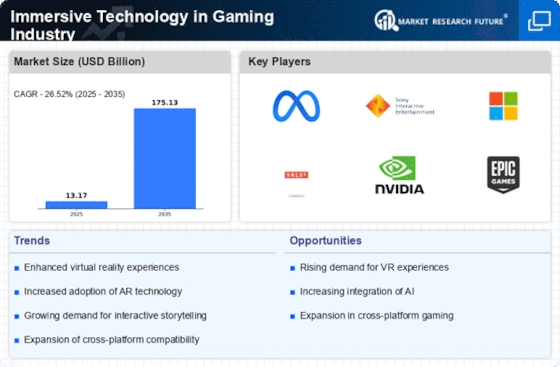
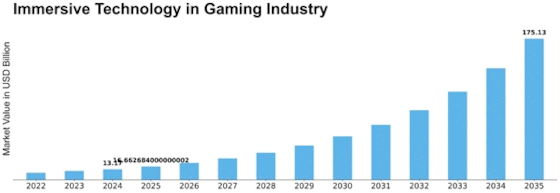
As per MRFR analysis, the Immersive Technology in Gaming Market Size was estimated at 13.17 USD Billion in 2024. The Immersive Technology in Gaming industry is projected to grow from 16.66 USD Billion in 2025 to 175.13 USD Billion by 2035, exhibiting a compound annual growth rate (CAGR) of 26.52 during the forecast period 2025 - 2035.

Key Market Trends & Highlights

The immersive technology market in gaming is experiencing robust growth driven by user engagement and technological advancements.

  • Enhanced user engagement is becoming a hallmark of immersive gaming experiences, particularly in North America.
  • The Asia-Pacific region is witnessing rapid growth in mixed reality applications, indicating a shift in consumer preferences.
  • AI integration for personalization is revolutionizing software platforms, making them the fastest-growing segment in the industry.
  • Technological advancements in hardware and the growing demand for immersive experiences are key drivers propelling market expansion.

Market Size & Forecast

2024 Market Size 13.17 (USD Billion)
2035 Market Size 175.13 (USD Billion)
CAGR (2025 - 2035) 26.52%
Largest Regional Market Share in 2024 North America

Major Players

<p>Meta Platforms (US), Sony Interactive Entertainment (JP), Microsoft (US), Valve Corporation (US), NVIDIA Corporation (US), Epic Games (US), Unity Technologies (US), Oculus VR (US)</p>

Market Trends

The Immersive Technology in Gaming Industry Market is currently experiencing a transformative phase, characterized by rapid advancements in virtual reality, augmented reality, and mixed reality. These technologies are reshaping the gaming landscape, offering players unprecedented levels of engagement and interactivity. As developers increasingly integrate immersive elements into their games, the demand for high-quality hardware and software solutions continues to rise. This evolution not only enhances user experiences but also fosters a more dynamic gaming community, where players can connect and collaborate in virtual environments. Furthermore, the integration of artificial intelligence and machine learning into immersive technologies is likely to create more personalized gaming experiences, adapting to individual player preferences and behaviors. In addition to technological advancements, the Immersive Technology in Gaming Industry Market is witnessing a growing interest from various sectors, including education and training. This cross-industry appeal suggests that immersive gaming experiences may serve as effective tools for skill development and learning. As the boundaries between gaming and other fields blur, the potential for innovative applications expands. Consequently, stakeholders in the gaming industry must remain vigilant and adaptable to capitalize on emerging opportunities, ensuring they stay ahead in this rapidly evolving market.

Enhanced User Engagement

The focus on creating more immersive experiences is leading to heightened user engagement. Developers are leveraging advanced technologies to craft environments that captivate players, encouraging longer play sessions and deeper emotional connections.

Cross-Industry Applications

The Immersive Technology in Gaming Industry Market is increasingly influencing sectors beyond entertainment. Educational institutions and corporate training programs are exploring the use of immersive gaming for skill acquisition and knowledge retention.

AI Integration for Personalization

Artificial intelligence is playing a crucial role in tailoring gaming experiences. By analyzing player behavior, AI can adjust game dynamics, ensuring that each user encounters a unique and engaging journey.

Immersive Technology in Gaming Industry Market Market Drivers

Technological Advancements in Hardware

The Immersive Technology Market is experiencing rapid advancements in hardware capabilities, which significantly enhances user experiences. Innovations in virtual reality (VR) headsets, augmented reality (AR) devices, and motion tracking systems are becoming more sophisticated and affordable. For instance, the introduction of high-resolution displays and improved field of view in VR headsets has led to a more realistic gaming environment. According to recent data, the market for VR headsets is projected to reach approximately 12 billion USD by 2025, indicating a robust growth trajectory. This surge in hardware development not only attracts gamers but also encourages developers to create more immersive content, thereby driving the overall growth of the Immersive Technology in Gaming Industry Market.

Growing Demand for Immersive Experiences

There is a notable increase in consumer demand for immersive experiences within the Immersive Technology Market. Gamers are increasingly seeking out experiences that offer deeper engagement and interactivity. This trend is reflected in the rising popularity of immersive gaming genres, such as simulation and role-playing games, which often utilize VR and AR technologies. Market analysis suggests that the immersive gaming segment is expected to grow at a compound annual growth rate (CAGR) of over 30% through the next few years. This growing demand compels developers to innovate and enhance their offerings, thereby propelling the Immersive Technology in Gaming Industry Market forward.

Increased Investment in Game Development

Investment in game development is on the rise, particularly in the realm of immersive technologies. Developers are allocating more resources to create high-quality, immersive gaming experiences that leverage cutting-edge technologies. This trend is supported by the increasing availability of funding from venture capitalists and tech companies looking to capitalize on the potential of the Immersive Technology Market. Reports indicate that funding for immersive gaming projects has increased by over 40% in recent years, suggesting a strong belief in the future profitability of these technologies. This influx of capital enables developers to experiment with new ideas and push the boundaries of what is possible in gaming.

Integration of Social Features in Gaming

The integration of social features into gaming experiences is becoming a key driver in the Immersive Technology Market. As players seek more social interaction within games, developers are incorporating features that allow for shared experiences, such as multiplayer modes and social networking capabilities. This trend is particularly evident in immersive games that utilize VR and AR, where players can interact with each other in real-time, enhancing the overall experience. Market data suggests that games with strong social components are likely to see higher retention rates, which is crucial for the long-term success of the Immersive Technology in Gaming Industry Market. This focus on social interaction not only enriches gameplay but also fosters community building among players.

Expansion of Esports and Competitive Gaming

The rise of esports and competitive gaming has created a fertile ground for the Immersive Technology Market. As esports events gain popularity, there is an increasing need for immersive technologies that enhance viewer engagement and player performance. Technologies such as VR and AR are being integrated into esports to provide unique viewing experiences, allowing fans to feel as though they are part of the action. Recent statistics indicate that the esports market is expected to surpass 1.5 billion USD by 2025, highlighting the lucrative opportunities for immersive technology applications. This expansion not only attracts investment but also fosters innovation within the Immersive Technology in Gaming Industry Market.

Market Segment Insights

By Component: Hardware (Largest) vs. Software/Platform (Fastest-Growing)

<p>The Immersive Technology in Gaming Industry Market showcases a diverse array of components, with Hardware holding the largest market share. Among the hardware, Head-Mounted Displays (HMD) and Gesture Tracking Devices (GTD) are pivotal in providing immersive experiences. As a significant segment, Hardware benefits from the increasing demand for high-quality gaming experiences, while Software/Platform has emerged rapidly due to advancements in virtual and augmented reality technologies. This growth is driven by rising consumer interest in immersive experiences and game developers' focus on enhancing user interactions through sophisticated software solutions. The growth trends in the component segment reflect a shift towards more integrated immersive technology solutions. Hardware components are anticipated to maintain their dominance as the backbone of immersive gaming, but Software/Platforms are expected to witness the fastest growth due to ongoing technology innovations and the integration of artificial intelligence in games. This evolution fosters a synergy between hardware and software, creating an environment ripe for continued expansion in the immersive gaming landscape.</p>

<p>Hardware: HMD (Dominant) vs. GTD (Emerging)</p>

<p>In the Immersive Technology in Gaming Industry Market, Head-Mounted Displays (HMD) emerge as the dominant hardware segment, offering gamers an unparalleled immersive experience through VR capabilities. HMDs are characterized by their high-resolution displays and advanced tracking systems, which provide realistic surroundings and enhance user engagement. On the other hand, Gesture Tracking Devices (GTD) represent the emerging segment, gaining traction for their ability to facilitate natural interactions within virtual environments. GTDs enhance gameplay by allowing players to control elements through gestures, making gaming more intuitive. As the market evolves, the synergy between HMDs and GTDs is expected to redefine gaming experiences, leading to innovative applications and an enriched user experience.</p>

By Technology: Virtual Reality (Largest) vs. Mixed Reality (Fastest-Growing)

<p>The Immersive Technology in Gaming Industry Market is experiencing a significant shift in market share among its core segments. Currently, Virtual Reality (VR) holds the largest portion of the market, as gaming experiences become increasingly immersive and engaging. Following closely is Mixed Reality (MR), which has shown tremendous growth potential as it merges both real and digital worlds, offering users unique gameplay experiences. The success of these technologies indicates a strong consumer preference for interactive and immersive gaming.</p>

<p>Technology: VR (Dominant) vs. MR (Emerging)</p>

<p>Virtual Reality (VR) has established itself as the dominant force within the Immersive Technology segment, thanks to its ability to deliver fully immersive experiences that transport players into new worlds. This technology allows users to engage with a virtual environment through headsets and specialized controllers, fostering a deep sense of presence. Conversely, Mixed Reality (MR) is emerging rapidly, as it combines real-world and digital elements, enabling more interactive gameplay. This segment is attracting attention due to its innovative approach, appealing to both gamers and developers who seek to create unique, hybrid experiences that enhance traditional gaming.</p>

By Application: Training & Learning (Largest) vs. Emergency Services (Fastest-Growing)

<p>The application segment of immersive technology in the gaming industry is primarily dominated by Training & Learning solutions, which hold a significant share of the market. In this sector, educational methodologies are integrating immersive technologies to deliver interactive and engaging learning experiences. On the other hand, Emergency Services is demonstrating rapid growth as organizations harness the power of immersive simulations for training first responders, enhancing critical skills in high-pressure scenarios. This dual focus highlights the diversity of applications in this market.</p>

<p>Training & Learning (Dominant) vs. Emergency Services (Emerging)</p>

<p>Training & Learning continues to be the dominant application of immersive technology within the gaming industry, with its emphasis on enhancing learning experiences through gamified approaches and simulations. This segment is characterized by high adoption rates in educational institutions and corporate training programs that value interactive content. Conversely, Emergency Services emerges as a fast-growing segment, leveraging immersive technology to offer realistic training environments for emergency response teams. This includes virtual simulations of disaster scenarios, which improve preparedness and response efficacy. As both segments evolve, their unique applications reflect broader trends toward innovative training solutions.</p>

Get more detailed insights about Immersive Technology in Gaming Industry Market Research Report – Forecast till 2035

Regional Insights

North America : Innovation and Market Leadership

North America is the largest market for immersive technology in the gaming industry, holding approximately 45% of the global market share. Key growth drivers include high consumer spending, advanced technological infrastructure, and a strong presence of major gaming companies. Regulatory support for technology innovation further fuels market expansion, with initiatives aimed at enhancing digital experiences and consumer protection. The United States leads the region, with significant contributions from Canada. Major players like Meta Platforms, Microsoft, and Epic Games are headquartered here, driving innovation and competition. The competitive landscape is characterized by rapid advancements in VR and AR technologies, with companies investing heavily in research and development to enhance user experiences and expand their market reach.

Europe : Emerging Market with Potential

Europe is the second-largest market for immersive technology in gaming, accounting for around 30% of the global market share. The region benefits from a diverse consumer base and increasing demand for innovative gaming experiences. Regulatory frameworks promoting digital innovation and consumer rights are pivotal in shaping market dynamics, encouraging investment in immersive technologies. Leading countries include the United Kingdom, Germany, and France, where a vibrant gaming culture and strong developer communities thrive. Key players like Sony Interactive Entertainment and Unity Technologies are prominent in the region, fostering a competitive environment. The European market is characterized by collaborations between tech companies and gaming studios, enhancing the development of immersive gaming experiences.

Asia-Pacific : Rapid Growth and Adoption

Asia-Pacific is witnessing rapid growth in the immersive technology gaming sector, holding approximately 20% of the global market share. The region's growth is driven by increasing smartphone penetration, a young population, and rising disposable incomes. Countries like China and Japan are at the forefront, with supportive government policies promoting technology adoption and innovation in gaming. China is the largest market in the region, followed by Japan, where companies are investing heavily in VR and AR technologies. The competitive landscape is vibrant, with local players like Sony and emerging startups driving innovation. The presence of major global companies further enhances the region's market dynamics, making it a key player in the immersive gaming industry.

Middle East and Africa : Untapped Market Opportunities

The Middle East and Africa represent an emerging market for immersive technology in gaming, currently holding about 5% of the global market share. The region is characterized by a young demographic and increasing internet penetration, which are key drivers for market growth. Government initiatives aimed at diversifying economies and promoting digital innovation are also contributing to the sector's development. Countries like South Africa and the UAE are leading the way, with growing gaming communities and investments in technology. The competitive landscape is evolving, with both local and international players entering the market. As infrastructure improves and consumer interest rises, the region is poised for significant growth in immersive gaming technologies.

Key Players and Competitive Insights

Leading market players are investing heavily in research and development in order to expand their product lines, which will help the Immersive Technology in Gaming Industry Market, grow even more. Market participants are also undertaking a variety of strategic activities to expand their footprint, with important market developments including new product launches, contractual agreements, mergers and acquisitions, higher investments, and collaboration with other organizations. To expand and survive in a more competitive and rising market climate, Immersive Technology in Gaming Industry industry must offer cost-effective items.

Manufacturing locally to minimize operational costs is one of the key business tactics used by manufacturers in the Immersive Technology in Gaming Industry industry to benefit clients and increase the market sector. In recent years, the Immersive Technology in Gaming Industry industry has offered some of the most significant advantages to medicine.

Major players in the Immersive Technology in Gaming Industry Market, including Acer Inc., Atheer, Inc., AVEVA Group PLC, Barco NV, Blippar Ltd., Carl Zeiss AG, CM Labs Simulations Inc., EON Reality, Inc., FAAC Incorporated, Google, LLC, HCL Technologies Limited, Honeywell International, Inc., HTC Corporation, Immersive Media Company, Immersive Technologies Pty Limited, Lockheed Martin Corporation, Magic Leap, Inc., NCTech Limited, Oculus (Facebook Technologies, LLC.), Samsung Group, Sony Corporation, Unity Software Inc., Varjo Technologies Oy, VI-grade GmbH, Zeality Inc. and others, are attempting to increase market demand by investing in research and development operations.

Google LLC (Google), an affiliate of Alphabet Inc., provides online search and advertising services. The company's primary business segments include advertising, search, platforms and operating systems, enterprise products, and hardware. These are just a few of the products and services it provides: Google Search, Google Chrome, Google Docs, Google Calendar, Google Photos, Google Meet, Google Drive, Google Finance, Google Play Books, Google News, Google Earth, Google Ad Manager, Google Play, AdMob, Google Maps, AdSense, Gmail, Google Groups, and YouTube. The business has operations in the Americas, Europe, Asia-Pacific, Middle East, and Africa.

Google's main office is located in Mountain View, California, in the United States.

HCL Technologies Ltd (HCL) is a provider of software and IT infrastructure services. The company offers a wide range of services in the following areas: industry software services, engineering and R&D services, cybersecurity, cloud native services, digital and analytics services, DRYiCE, IoT works, HCL software services, SIAM/XaaS products & advanced services. The following sectors are served by HCL: banking, finance, manufacturing, telecommunications, retail and CPG, media and entertainment, life sciences, insurance, capital markets, oil and gas, mining and natural resources, automotive, chemical and process industries, high-tech, industrial manufacturing, energy and utility, healthcare, travel, transportation, hospitality, and logistics.

The company operates an international offshore infrastructure in addition to a network of offices across the Americas, Asia-Pacific, the Middle East, Africa, and Europe. HCL's headquarters are in Noida, Uttar Pradesh, in India.

Key Companies in the Immersive Technology in Gaming Industry Market market include

Industry Developments

In March 2022, StatusPRO, Inc., a sports tech and gaming company, has teamed up with the National Football League to create an NFL-authorized virtual-reality video game.

This December 2021 deal between Brelyon (an MIT spin-off making innovative ultra-immersive display technologies) and GameWorks (a leading eSport and entertainment company) on deploying virtual display technology for e-sports is mind-blowing. GameWorks’ American locations are to have Brelyon’s full-size gaming stations.

Collaboration among Oculus VR, indie studio Armature, and publisher Capcom led Resident Evil 4 VR remake onto Oculus Quest 2 in April 2021. Facebook, its parent company, is looking to continue using Quest as a marketing tool.

In April 2024, XR Immersive Tech Inc. (“Immersive Tech”, or the “Company”) (CSE: VRAI) (FSE:79W) (OTCQB: FNTTF), an industry leader in Social Entertainment, AI, VR, and AR content and experiences, is thrilled to announce the partnership with Smilegate Entertainment Inc to bring one of most popular first-person shooter VR games in the world Crossfire: Sierra Squad to VR locations worldwide through its subsidiary Synthesis VR (SynthesisVR). The SynthesisVR software platform is one of the largest VR out-of-home entertainment marketplaces for games, educational experiences, and training worldwide.

SynthesisVR has over 450 VR arcades globally and a market of over 400+ VR games.

During May 2024 month’s end, i.e., on May 23rd, Sony revealed its “Creative Entertainment Vision” during a corporate strategy meeting. This plan outlines what the company wants to achieve in the next decade by highlighting how new technology will change entertainment. SONY’S CREATIVE ENTERTAINMENT VISION serves as a compass for future business decisions and investments, where they want to be in ten years, given the rapid technological developments that are reshaping entertainment.

An Indian metaverse research and advisory firm, Metaverse911, has established a Metaverse Experience Centre (MEC) in Noida. The firm officially launched this experience center on Tuesday to enable industry leaders and other Web3 enthusiasts to discover its potential. The center will let visitors indulge in immersive technologies that include Augmented Reality (AR) and Virtual Reality (VR) — all of which make for key components that bring the digital ecosystem to life in the metaverse.

Future Outlook

Immersive Technology in Gaming Industry Market Future Outlook

<p>The Immersive Technology in Gaming Industry Market is projected to grow at a 26.52% CAGR from 2024 to 2035, driven by advancements in hardware, software, and user engagement strategies.</p>

New opportunities lie in:

  • <p>Development of cross-platform immersive gaming experiences</p>
  • <p>Integration of AI-driven personalized gaming environments</p>
  • <p>Expansion of subscription-based immersive content services</p>

<p>By 2035, the market is expected to be robust, driven by innovation and diverse revenue streams.</p>

Market Segmentation

Immersive Technology in Gaming Industry Market Component Outlook

  • Hardware
  • Head-Mounted Display (HMD)
  • Gesture Tracking Devices (GTD)
  • Projectors & Display Walls (PDW)
  • Software/Platform
  • Services
  • Professional
  • Managed

Immersive Technology in Gaming Industry Market Technology Outlook

  • Mixed Reality (MR)
  • Virtual Reality (VR)
  • Augmented Reality (AR)
  • 360 Film

Immersive Technology in Gaming Industry Market Application Outlook

  • Training & Learning
  • Emergency Services
  • Product Development
  • Sales & Marketing

Report Scope

MARKET SIZE 202413.17(USD Billion)
MARKET SIZE 202516.66(USD Billion)
MARKET SIZE 2035175.13(USD Billion)
COMPOUND ANNUAL GROWTH RATE (CAGR)26.52% (2024 - 2035)
REPORT COVERAGERevenue Forecast, Competitive Landscape, Growth Factors, and Trends
BASE YEAR2024
Market Forecast Period2025 - 2035
Historical Data2019 - 2024
Market Forecast UnitsUSD Billion
Key Companies ProfiledMarket analysis in progress
Segments CoveredMarket segmentation analysis in progress
Key Market OpportunitiesIntegration of augmented reality and virtual reality enhances user engagement in the Immersive Technology in Gaming Industry.
Key Market DynamicsRising consumer demand for immersive experiences drives innovation and competition in the gaming technology sector.
Countries CoveredNorth America, Europe, APAC, South America, MEA

FAQs

What is the current market valuation of the Immersive Technology in the Gaming Industry?

The market valuation of the Immersive Technology in the Gaming Industry was 13.17 USD Billion in 2024.

What is the projected market size for Immersive Technology in Gaming by 2035?

The projected market size for Immersive Technology in Gaming is expected to reach 175.13 USD Billion by 2035.

What is the expected CAGR for the Immersive Technology in Gaming Industry from 2025 to 2035?

The expected CAGR for the Immersive Technology in Gaming Industry during the forecast period 2025 - 2035 is 26.52%.

Which companies are considered key players in the Immersive Technology in Gaming Industry?

Key players in the market include Meta Platforms, Sony Interactive Entertainment, Microsoft, Valve Corporation, NVIDIA Corporation, Epic Games, Unity Technologies, and Oculus VR.

What are the main segments of the Immersive Technology in Gaming Industry?

The main segments include Hardware, Technology, and Application, with various components such as Head-Mounted Displays and Mixed Reality.

How much was the valuation of the Hardware segment in 2024?

The valuation of the Hardware segment was 3.0 USD Billion in 2024.

  1. Executive summary
  2. Market Introduction
    1. Definition
      1. Research Objective
      2. Assumptions
      3. Limitations
    2. Scope of the Study
  3. Research Methodology
    1. Overview
    2. Data Mining
    3. Secondary
    4. Research
    5. Primary Research
      1. Primary Interviews and Information Gathering
      2. Breakdown of Primary Respondents
    6. Process
    7. Forecasting Modality
      1. Bottom-Up Approach
      2. Top-Down Approach
    8. Market Size Estimation
    9. Data Triangulation
    10. Validation
  4. Market Dynamics
    1. Overview
    2. Drivers
    3. Restraints
    4. Opportunities
  5. Market Factor Analysis
    1. Value Chain Analysis
    2. Porter’s Five Forces Analysis
      1. Bargaining Power of Suppliers
      2. Threat of New Entrants
      3. Threat
      4. Intensity of Rivalry
    3. Bargaining Power of Buyers
    4. of Substitutes
    5. COVID-19 Impact Analysis
      1. Market Impact Analysis
      2. Regional Impact
      3. Opportunity
    6. and Threat Analysis
  6. GLOBAL Immersive Technology in Gaming Industry MARKET, BY
    1. Component
    2. Overview
    3. Hardware
      1. Head-Mounted Display (HMD)
      2. Gesture
      3. Projectors & Display Walls (PDW)
    4. Tracking Devices (GTD)
    5. Software/Platform
      1. Professional
      2. Managed
    6. Services
  7. GLOBAL Immersive Technology
  8. in Gaming Industry MARKET, BY Technology
    1. Overview
    2. Mixed Reality (MR)
    3. Virtual Reality (VR)
    4. Augmented Reality (AR)
    5. 360 Film
  9. GLOBAL
  10. Immersive Technology in Gaming Industry MARKET, BY Application
    1. Overview
    2. Training & Learning
    3. Emergency Services
    4. Product Development
    5. Sales & Marketing
  11. GLOBAL Immersive Technology in Gaming Industry MARKET, by
    1. Region
    2. Overview
    3. North America
      1. U.S.
      2. Canada
    4. Europe
      1. France
      2. U.K
      3. Italy
      4. Spain
      5. Rest
    5. Germany
    6. of Europe
    7. Asia-Pacific
      1. China
      2. India
      3. Japan
      4. Australia
      5. Rest of Asia-Pacific
      6. Middle East
      7. Africa
      8. Latin America
    8. South Korea
    9. Rest of the World
    10. Competitive Landscape
    11. Overview
    12. Competitive Analysis
    13. Market Share Analysis
    14. Major Growth Strategy in the Global Immersive Technology
    15. in Gaming Industry Market,
    16. Competitive Benchmarking
    17. Leading
    18. Players in Terms of Number of Developments in the Global Immersive Technology in
    19. Gaming Industry Market,
    20. Key developments and Growth Strategies
      1. Merger & Acquisitions
    21. New Component Launch/Technology Application
    22. Joint Ventures
    23. Major Players Financial Matrix
      1. Sales & Operating
      2. Major Players R&D Expenditure. 2022
    24. Income, 2022
  12. Company
    1. ProfileS
    2. ACER INC.
      1. Company Overview
      2. Financial Overview
      3. Key Developments
      4. SWOT Analysis
    3. Product Offered
    4. Key Strategies
    5. Atheer, Inc.
      1. Company Overview
      2. Financial
      3. Product Offered
      4. Key Developments
      5. SWOT Analysis
    6. Overview
    7. Key Strategies
    8. AVEVA Group PLC
      1. Company Overview
      2. Product Offered
      3. Key Developments
      4. Key Strategies
    9. Financial Overview
    10. SWOT Analysis
    11. Barco NV
      1. Company
      2. Financial Overview
      3. Product Offered
      4. Key
      5. SWOT Analysis
      6. Key Strategies
      7. Company Overview
      8. Financial Overview
      9. Key Developments
      10. SWOT Analysis
    12. Overview
    13. Developments
    14. Blippar Ltd.
    15. Product Offered
    16. Key Strategies
    17. Carl Zeiss AG
      1. Company Overview
      2. Financial
      3. Product Offered
      4. Key Developments
      5. SWOT Analysis
    18. Overview
    19. Key Strategies
    20. CM Labs Simulations Inc.
      1. Company Overview
      2. Product Offered
      3. Key Developments
      4. Key Strategies
    21. Financial Overview
    22. SWOT Analysis
    23. EON Reality, Inc.
      1. Financial Overview
      2. Product Offered
      3. SWOT Analysis
      4. Key Strategies
      5. Company Overview
      6. Financial Overview
      7. Key Developments
      8. SWOT Analysis
    24. Company Overview
    25. Key Developments
    26. FAAC Incorporated
    27. Product Offered
    28. Key Strategies
    29. Google, LLC
      1. Company Overview
      2. Financial
      3. Product Offered
      4. Key Developments
      5. SWOT Analysis
    30. Overview
    31. Key Strategies
    32. HCL Technologies Limited
      1. Company Overview
      2. Product Offered
      3. Key Developments
      4. Key Strategies
    33. Financial Overview
    34. SWOT Analysis
    35. Honeywell International,
      1. Company Overview
      2. Financial Overview
      3. Key Developments
      4. SWOT Analysis
    36. Inc.
    37. Product Offered
    38. Key Strategies
    39. HTC Corporation
      1. Company Overview
      2. Product Offered
      3. Key Developments
      4. Key Strategies
    40. Financial Overview
    41. SWOT Analysis
    42. Immersive Media Company
      1. Financial Overview
      2. Product Offered
      3. SWOT Analysis
      4. Key Strategies
      5. Company Overview
      6. Financial
      7. Product Offered
      8. Key Developments
      9. SWOT Analysis
    43. Company Overview
    44. Key Developments
    45. Immersive Technologies Pty Limited
    46. Overview
    47. Key Strategies
    48. Lockheed Martin Corporation
      1. Company Overview
      2. Product Offered
      3. Key Developments
      4. Key Strategies
    49. Financial Overview
    50. SWOT Analysis
    51. Magic Leap, Inc.
      1. Financial Overview
      2. Product Offered
      3. SWOT Analysis
      4. Key Strategies
      5. Company Overview
      6. Financial Overview
      7. Key Developments
      8. SWOT Analysis
    52. Company Overview
    53. Key Developments
    54. NCTech Limited
    55. Product Offered
    56. Key Strategies
    57. Oculus (Facebook Technologies, LLC.)
      1. Company
      2. Financial Overview
      3. Product Offered
      4. Key
      5. SWOT Analysis
      6. Key Strategies
      7. Company Overview
      8. Financial Overview
      9. Key Developments
      10. SWOT Analysis
    58. Overview
    59. Developments
    60. Samsung Group
    61. Product Offered
    62. Key Strategies
    63. Sony Corporation
      1. Company Overview
      2. Product Offered
      3. Key Developments
      4. Key Strategies
    64. Financial Overview
    65. SWOT Analysis
    66. Unity Software Inc.
      1. Financial Overview
      2. Product Offered
      3. SWOT Analysis
      4. Key Strategies
      5. Company Overview
      6. Financial Overview
      7. Key Developments
      8. SWOT Analysis
    67. Company Overview
    68. Key Developments
    69. Varjo Technologies Oy
    70. Product Offered
    71. Key Strategies
    72. VI-grade GmbH
      1. Company Overview
      2. Financial
      3. Product Offered
      4. Key Developments
      5. SWOT Analysis
    73. Overview
    74. Key Strategies
    75. Zeality Inc.
      1. Company Overview
      2. Financial
      3. Product Offered
      4. Key Developments
      5. SWOT Analysis
    76. Overview
    77. Key Strategies
  13. Appendix
    1. References
    2. Related Reports
    3. LIST
  14. OF TABLES
  15. Global Immersive Technology in Gaming Industry Market, Synopsis,
  16. Global Immersive Technology in Gaming Industry Market, Estimates
    1. & Forecast, 2018-2032 (USD BILLION)
  17. GLOBAL Immersive Technology in
  18. Gaming Industry MARKET, BY Component, 2018-2032 (USD BILLION)
  19. GLOBAL
  20. Immersive Technology in Gaming Industry MARKET, BY TECHNOLOGY, 2018-2032 (USD BILLION)
    1. TABLE
  21. GLOBAL Immersive Technology in Gaming Industry MARKET, BY APPLICATION, 2018-2032
    1. (USD BILLION)
  22. North America Immersive Technology in Gaming Industry
  23. MARKET, BY Component, 2018-2032 (USD BILLION)
  24. North America Immersive
  25. Technology in Gaming Industry MARKET, BY TECHNOLOGY, 2018-2032 (USD BILLION)
    1. TABLE
  26. North America Immersive Technology in Gaming Industry MARKET, BY APPLICATION,
  27. North America Immersive Technology in Gaming
  28. Industry MARKET, BY Country, 2018-2032 (USD BILLION)
  29. U.S. Immersive Technology
  30. in Gaming Industry MARKET, BY Component, 2018-2032 (USD BILLION)
  31. U.S.
  32. Immersive Technology in Gaming Industry MARKET, BY TECHNOLOGY, 2018-2032 (USD BILLION)
    1. TABLE
  33. U.S. Immersive Technology in Gaming Industry MARKET, BY APPLICATION, 2018-2032
    1. (USD BILLION)
  34. Canada Immersive Technology in Gaming Industry MARKET,
    1. BY Component, 2018-2032 (USD BILLION)
  35. Canada Immersive Technology
  36. in Gaming Industry MARKET, BY TECHNOLOGY, 2018-2032 (USD BILLION)
  37. Canada
  38. Immersive Technology in Gaming Industry MARKET, BY APPLICATION, 2018-2032 (USD BILLION)
    1. TABLE
  39. Europe Immersive Technology in Gaming Industry MARKET, BY Component, 2018-2032
    1. (USD BILLION)
  40. Europe Immersive Technology in Gaming Industry MARKET,
    1. BY TECHNOLOGY, 2018-2032 (USD BILLION)
  41. Europe Immersive Technology
  42. in Gaming Industry MARKET, BY APPLICATION, 2018-2032 (USD BILLION)
  43. Europe
  44. Immersive Technology in Gaming Industry MARKET, BY Country, 2018-2032 (USD BILLION)
    1. TABLE
  45. Germany Immersive Technology in Gaming Industry MARKET, BY Component, 2018-2032
    1. (USD BILLION)
  46. Germany Immersive Technology in Gaming Industry MARKET,
    1. BY TECHNOLOGY, 2018-2032 (USD BILLION)
  47. Germany Immersive Technology
  48. in Gaming Industry MARKET, BY APPLICATION, 2018-2032 (USD BILLION)
  49. France
  50. Immersive Technology in Gaming Industry MARKET, BY Component, 2018-2032 (USD BILLION)
    1. TABLE
  51. France Immersive Technology in Gaming Industry MARKET, BY TECHNOLOGY, 2018-2032
    1. (USD BILLION)
  52. France Immersive Technology in Gaming Industry MARKET,
    1. BY APPLICATION, 2018-2032 (USD BILLION)
  53. Italy Immersive Technology in
  54. Gaming Industry MARKET, BY Component, 2018-2032 (USD BILLION)
  55. Italy
  56. Immersive Technology in Gaming Industry MARKET, BY TECHNOLOGY, 2018-2032 (USD BILLION)
    1. TABLE
  57. Italy Immersive Technology in Gaming Industry MARKET, BY APPLICATION, 2018-2032
    1. (USD BILLION)
  58. Spain Immersive Technology in Gaming Industry MARKET,
    1. BY Component, 2018-2032 (USD BILLION)
  59. Spain Immersive Technology in
  60. Gaming Industry MARKET, BY TECHNOLOGY, 2018-2032 (USD BILLION)
  61. Spain
  62. Immersive Technology in Gaming Industry MARKET, BY APPLICATION, 2018-2032 (USD BILLION)
    1. TABLE
  63. U.K Immersive Technology in Gaming Industry MARKET, BY Component, 2018-2032 (USD
    1. BILLION)
  64. U.K Immersive Technology in Gaming Industry MARKET, BY TECHNOLOGY,
  65. U.K Immersive Technology in Gaming Industry
  66. MARKET, BY APPLICATION, 2018-2032 (USD BILLION)
  67. Rest of Europe Immersive
  68. Technology in Gaming Industry MARKET, BY Component, 2018-2032 (USD BILLION)
    1. TABLE
  69. Rest of Europe Immersive Technology in Gaming Industry MARKET, BY TECHNOLOGY,
  70. Rest of Europe Immersive Technology in
  71. Gaming Industry MARKET, BY APPLICATION, 2018-2032 (USD BILLION)
  72. Asia
  73. Pacific Immersive Technology in Gaming Industry MARKET, BY Component, 2018-2032
    1. (USD BILLION)
  74. Asia Pacific Immersive Technology in Gaming Industry
  75. MARKET, BY TECHNOLOGY, 2018-2032 (USD BILLION)
  76. Asia Pacific Immersive
  77. Technology in Gaming Industry MARKET, BY APPLICATION, 2018-2032 (USD BILLION)
    1. TABLE
  78. Asia Pacific Immersive Technology in Gaming Industry MARKET, BY Country, 2018-2032
    1. (USD BILLION)
  79. Japan Immersive Technology in Gaming Industry MARKET,
    1. BY Component, 2018-2032 (USD BILLION)
  80. Japan Immersive Technology in
  81. Gaming Industry MARKET, BY TECHNOLOGY, 2018-2032 (USD BILLION)
  82. Japan
  83. Immersive Technology in Gaming Industry MARKET, BY APPLICATION, 2018-2032 (USD BILLION)
    1. TABLE
  84. China Immersive Technology in Gaming Industry MARKET, BY Component, 2018-2032
    1. (USD BILLION)
  85. China Immersive Technology in Gaming Industry MARKET,
    1. BY TECHNOLOGY, 2018-2032 (USD BILLION)
  86. China Immersive Technology in
  87. Gaming Industry MARKET, BY APPLICATION, 2018-2032 (USD BILLION)
  88. India
  89. Immersive Technology in Gaming Industry MARKET, BY Component, 2018-2032 (USD BILLION)
    1. TABLE
  90. India Immersive Technology in Gaming Industry MARKET, BY TECHNOLOGY, 2018-2032
    1. (USD BILLION)
  91. India Immersive Technology in Gaming Industry MARKET,
    1. BY APPLICATION, 2018-2032 (USD BILLION)
  92. Australia Immersive Technology
  93. in Gaming Industry MARKET, BY Component, 2018-2032 (USD BILLION)
  94. Australia
  95. Immersive Technology in Gaming Industry MARKET, BY TECHNOLOGY, 2018-2032 (USD BILLION)
    1. TABLE
  96. Australia Immersive Technology in Gaming Industry MARKET, BY APPLICATION, 2018-2032
    1. (USD BILLION)
  97. south korea Immersive Technology in Gaming Industry
  98. MARKET, BY Component, 2018-2032 (USD BILLION)
  99. south korea Immersive
  100. Technology in Gaming Industry MARKET, BY TECHNOLOGY, 2018-2032 (USD BILLION)
    1. TABLE
  101. south korea Immersive Technology in Gaming Industry MARKET, BY APPLICATION, 2018-2032
    1. (USD BILLION)
  102. Rest of asia-pacific Immersive Technology in Gaming
  103. Industry MARKET, BY Component, 2018-2032 (USD BILLION)
  104. Rest of asia-pacific
  105. Immersive Technology in Gaming Industry MARKET, BY TECHNOLOGY, 2018-2032 (USD BILLION)
    1. TABLE
  106. Rest of asia-pacific Immersive Technology in Gaming Industry MARKET, BY APPLICATION,
  107. Rest of WOrld Immersive Technology in Gaming
  108. Industry MARKET, BY Component, 2018-2032 (USD BILLION)
  109. Rest of WOrld Immersive
  110. Technology in Gaming Industry MARKET, BY TECHNOLOGY, 2018-2032 (USD BILLION)
    1. TABLE
  111. Rest of WOrld Immersive Technology in Gaming Industry MARKET, BY APPLICATION,
  112. Rest of WOrld Immersive Technology in Gaming
  113. Industry MARKET, BY Country, 2018-2032 (USD BILLION)
  114. Middle east Immersive
  115. Technology in Gaming Industry MARKET, BY Component, 2018-2032 (USD BILLION)
    1. TABLE
  116. Middle east Immersive Technology in Gaming Industry MARKET, BY TECHNOLOGY, 2018-2032
    1. (USD BILLION)
  117. Middle east Immersive Technology in Gaming Industry
  118. MARKET, BY APPLICATION, 2018-2032 (USD BILLION)
  119. Africa Immersive Technology
  120. in Gaming Industry MARKET, BY Component, 2018-2032 (USD BILLION)
  121. Africa
  122. Immersive Technology in Gaming Industry MARKET, BY TECHNOLOGY, 2018-2032 (USD BILLION)
    1. TABLE
  123. Africa Immersive Technology in Gaming Industry MARKET, BY APPLICATION, 2018-2032
    1. (USD BILLION)
  124. Latin america Immersive Technology in Gaming Industry
  125. MARKET, BY Component, 2018-2032 (USD BILLION)
  126. Latin america Immersive
  127. Technology in Gaming Industry MARKET, BY TECHNOLOGY, 2018-2032 (USD BILLION)
    1. TABLE
  128. Latin america Immersive Technology in Gaming Industry MARKET, BY APPLICATION,
  129. LIST OF FIGURES
  130. Research Process
    1. FIGURE
  131. Market Structure for the Global Immersive Technology in Gaming Industry Market
    1. FIGURE
  132. Market Dynamics for the Global Immersive Technology in Gaming Industry Market
    1. FIGURE
  133. Global Immersive Technology in Gaming Industry Market, Share (%), BY Component,
  134. Global Immersive Technology in Gaming Industry Market, Share (%),
    1. BY TECHNOLOGY, 2022
  135. Global Immersive Technology in Gaming Industry Market,
    1. Share (%), BY APPLICATION, 2022
  136. Global Immersive Technology in Gaming Industry
  137. Market, Share (%), by Region, 2022
  138. north AMERICA: Immersive Technology
  139. in Gaming Industry MARKET, SHARE (%), BY REGION, 2022
  140. Europe: Immersive Technology
  141. in Gaming Industry MARKET, SHARE (%), BY REGION, 2022
  142. Asia-Pacific: Immersive
  143. Technology in Gaming Industry MARKET, SHARE (%), BY REGION, 2022
    1. FIGURE 11
    2. Rest of the world: Immersive Technology in Gaming Industry MARKET, SHARE (%), BY
    3. REGION, 2022
  144. Global Immersive Technology in Gaming Industry Market:
    1. Company Share Analysis, 2022 (%)
  145. ACER INC.: FINANCIAL OVERVIEW SNAPSHOT
    1. FIGURE
  146. ACER INC.: SWOT ANALYSIS
  147. Atheer, Inc.: FINANCIAL OVERVIEW SNAPSHOT
    1. FIGURE
  148. Atheer, Inc., Inc.: SWOT ANALYSIS
  149. AVEVA Group PLC.: FINANCIAL
    1. OVERVIEW SNAPSHOT
  150. AVEVA Group PLC: SWOT ANALYSIS
  151. Barco NV: FINANCIAL
    1. OVERVIEW SNAPSHOT
  152. Barco NV: SWOT ANALYSIS
  153. Blippar Ltd.: FINANCIAL
    1. OVERVIEW SNAPSHOT
  154. Blippar Ltd.: SWOT ANALYSIS
  155. Carl Zeiss AG: FINANCIAL
    1. OVERVIEW SNAPSHOT
  156. Carl Zeiss AG: SWOT ANALYSIS
  157. CM Labs Simulations
    1. Inc.: FINANCIAL OVERVIEW SNAPSHOT
  158. CM Labs Simulations Inc.: SWOT ANALYSIS
    1. FIGURE
  159. EON Reality, Inc.: FINANCIAL OVERVIEW SNAPSHOT
  160. EON Reality, Inc.: SWOT
    1. ANALYSIS
  161. FAAC Incorporated: FINANCIAL OVERVIEW SNAPSHOT
    1. FIGURE 30
    2. FAAC Incorporated: SWOT ANALYSIS
  162. Google, LLC: FINANCIAL OVERVIEW SNAPSHOT
    1. FIGURE
  163. Google, LLC.: SWOT ANALYSIS
  164. HCL Technologies Limited: FINANCIAL OVERVIEW
    1. SNAPSHOT
  165. HCL Technologies Limited: SWOT ANALYSIS
  166. Honeywell International,
    1. Inc.: FINANCIAL OVERVIEW SNAPSHOT
  167. Honeywell International, Inc.: SWOT ANALYSIS
    1. FIGURE
  168. HTC Corporation: FINANCIAL OVERVIEW SNAPSHOT
  169. HTC Corporation: SWOT
    1. ANALYSIS
  170. Immersive Media Company: FINANCIAL OVERVIEW SNAPSHOT
    1. FIGURE
  171. Immersive Media Company.: SWOT ANALYSIS
  172. Immersive Technologies
    1. Pty Limited: FINANCIAL OVERVIEW SNAPSHOT
  173. Immersive Technologies Pty
    1. Limited, LLC: SWOT ANALYSIS
  174. Lockheed Martin Corporation: FINANCIAL
    1. OVERVIEW SNAPSHOT
  175. Lockheed Martin Corporation: SWOT ANALYSIS
    1. FIGURE
  176. NCTech Limited: FINANCIAL OVERVIEW SNAPSHOT
  177. NCTech Limited: SWOT
    1. ANALYSIS
  178. Oculus (Facebook Technologies, LLC.): FINANCIAL OVERVIEW SNAPSHOT
  179. Oculus (Facebook Technologies, LLC.): SWOT ANALYSIS
    1. FIGURE
  180. Samsung Group: FINANCIAL OVERVIEW SNAPSHOT
  181. Samsung Group: SWOT
    1. ANALYSIS
  182. Sony Corporation: FINANCIAL OVERVIEW SNAPSHOT
    1. FIGURE 52
    2. Sony Corporation: SWOT ANALYSIS
  183. Unity Software Inc.: FINANCIAL OVERVIEW
    1. SNAPSHOT
  184. Unity Software Inc.: SWOT ANALYSIS
  185. Varjo Technologies Oy:
    1. FINANCIAL OVERVIEW SNAPSHOT
  186. Varjo Technologies Oy: SWOT ANALYSIS
    1. FIGURE
  187. VI-grade GmbH: FINANCIAL OVERVIEW SNAPSHOT
  188. VI-grade GmbH: SWOT
    1. ANALYSIS
  189. VI-grade GmbH: FINANCIAL OVERVIEW SNAPSHOT
    1. FIGURE 60
    2. VI-grade GmbH: SWOT ANALYSIS

Immersive Technology in Gaming Industry Market Segmentation

Market Segmentation Overview

  • Detailed segmentation data will be available in the full report
  • Comprehensive analysis by multiple parameters
  • Regional and country-level breakdowns
  • Market size forecasts by segment
Infographic

Free Sample Request

Kindly complete the form below to receive a free sample of this Report

Get Free Sample

Customer Strories

Compare Licence

×
Features License Type
Single User Multiuser License Enterprise User
Price $4,950 $5,950 $7,250
Maximum User Access Limit 1 User Upto 10 Users Unrestricted Access Throughout the Organization
Free Customization
Direct Access to Analyst
Deliverable Format
Platform Access
Discount on Next Purchase 10% 15% 15%
Printable Versions