×
  • Cat-intel
  • MedIntelliX
  • Resources
  • About Us
  • Hero Background
    English
    Chinese
    French
    Japanese
    Korean
    German
    Spanish

    Dry Eye Syndrome Market Analysis

    ID: MRFR/Pharma/4139-HCR
    90 Pages
    Rahul Gotadki
    October 2025

    Dry Eye Syndrome Market Research Report By Product Type (Artificial Tears, Anti-Inflammatory Drugs, Punctal Plugs, Surgical Devices), By Cause of Dry Eye Syndrome (Aging, Medication Induced, Environmental Factors, Medical Conditions), By Distribution Channel (Online Pharmacy, Retail Pharmacy, Hospital Pharmacy, Specialty Clinics), By End User (Hospitals, Ophthalmology Clinics, Home Care) and By...

    Share:
    Download PDF ×

    We do not share your information with anyone. However, we may send you emails based on your report interest from time to time. You may contact us at any time to opt-out.

    Dry Eye Syndrome Market Infographic
    Purchase Options

    Market Analysis

    In-depth Analysis of Dry Eye Syndrome Market Industry Landscape

    The medical care industry has put critical accentuation on the Dry Eye Syndrome (DES) market because of the condition's rising commonness on a worldwide scale. Ecological variables, maturing populaces, and changes in way of life all add to a rising number of people encountering side effects of dry eyes, which thusly shapes the market elements in this area. A fundamental market dynamic is the expanded acknowledgment and improved symptomatic limits relating to Dry Eye Condition. There is a developing pattern among people to look for clinical consideration for dry eye side effects as mindfulness crusades get energy, bringing about prior identification and determination. Viability upgrading treatment choices are popular because of this pattern. Mechanical Headways in Analytic Devices: There is a striking rise in the improvement of demonstrative devices intended to address Dry Eye Disorder on the lookout. Complex clinical gadgets and tear film analysers enable professionals to assess the state with more prominent accuracy, in this way working with individualized restorative techniques. The previously mentioned improvements assume a critical part in the extension and movement of the DES business. The elements of the DES market are altogether influenced by the extending geriatric populace. The occurrence of dry eye side effects will in general ascent with propelling age; therefore, an extending number of patients are looking for easing from uneasiness and vision-related intricacies. The ongoing segment change is impacting the market interest for precaution and remedial measures. The market for decongestive careful gadgets (DES) is recognized by a wide exhibit of treatment modalities, which include professionally prescribed prescriptions, calming drugs, punctal plugs, and counterfeit tears. The availability of numerous treatment options enables healthcare professionals to tailor interventions for dry eye symptoms based on their severity and underlying causes, facilitating market expansion. Concentrate on Innovative Drug Development: Drug organizations put vigorously in dry eye disorder innovative work to present novel prescriptions. The examination of unfulfilled requests in the market is driving the quest for creative plans, conveyance approaches, and remedial targets. Patients will encounter more viable and durable help because of this accentuation on advancement. Market Ramifications of Way of life Changes: The commonness of dry eye side effects is affected by changes in indoor warming and ventilation, uplifted screen time, and ecological contamination. These way of life factors influence the market elements, which has prompted the formation of items intended to target specific ecological and social boosts related with Dry Eye Disorder. The multiplication of web-based business stages has essentially changed the circulation channels through which dry eye items are proposed to shoppers. Online sales and direct-to-consumer marketing have grown in popularity, making it easier for people to get prescription and over-the-counter dry eye treatments. This shift in distribution channels is altering market dynamics and accessibility. The DES market's dynamics are significantly influenced by the regulatory environment and new therapy approval procedures. In their quest for commercializing novel medicines, associations experience the test of sticking to administrative commitments, leading clinical preliminaries, and guaranteeing patient security. The unique idea of the administrative structure essentially impacts the cutthroat scene of the dry eye industry. Extension of the Worldwide Market and Arising Economies: With an end goal to reach underserved populaces in arising economies, the DES market is extending universally. The market potential for dry eye items is supposed to increment in these districts as medical services foundation improves, and mindfulness raises. Organizations working in the dry eye market are progressively integrating worldwide development methodologies into their development techniques.

    Author
    Rahul Gotadki
    Assistant Manager

    He holds an experience of about 7+ years in Market Research and Business Consulting, working under the spectrum of Life Sciences and Healthcare domains. Rahul conceptualizes and implements a scalable business strategy and provides strategic leadership to the clients. His expertise lies in market estimation, competitive intelligence, pipeline analysis, customer assessment, etc. In addition to the above, his other responsibility includes strategic tracking of high growth markets & advising clients on the potential areas of focus they could direct their business initiatives

    Leave a Comment

    FAQs

    What is the projected growth of the Dry Eye Syndrome market?

    The Dry Eye Syndrome market is the expected increase in total market value of 9.15 USD billion over a defined forecast period 2025–2035. It is driven by factors such as demand trends, technological advances, regulatory changes, and geographic expansion.

    What is the size of the Dry Eye Syndrome market?

    Dry Eye Syndrome market size was valued at approximately 5.17 billion USD in 2024. This figure will reach 9.15 billion USD covering all regions (America, Europe, Asia, MEA and ROW), focusing its segments / services / distribution channels till 2035.

    What is the CAGR of the Dry Eye Syndrome market?

    Dry Eye Syndrome market is expected to grow at a CAGR of 5.33% between 2025 and 2035.

    How much will the Dry Eye Syndrome market be worth by 2035?

    Dry Eye Syndrome market is expected to be worth of 9.15 billion USD, reflecting growth driven by usage, technology and global demands by the end of 2035.

    How will the Dry Eye Syndrome market perform over the next 10 years?

    Over the next 10 years the Dry Eye Syndrome market is expected to shift from usd billion 5.17 to 9.15 billion USD, led by adoption of advanced tech, demographic trends, regulatory approvals, with potential headwinds from 2025 to 2035.

    What was the projected market size of the Dry Eye Syndrome Market in 2024?

    The Dry Eye Syndrome Market was valued at 4.79 USD Billion in 2024.

    What is the anticipated market size for the Dry Eye Syndrome Market by 2035?

    By 2035, the overall market for Global Dry Eye Syndrome is expected to reach 8.0 USD Billion.

    Which region held the largest market share for the Dry Eye Syndrome Market in 2024?

    In 2024, North America held the largest market share, valued at 2.1 USD Billion.

    What is the expected growth rate for the North American market from 2024 to 2035?

    The North American market is anticipated to grow to 3.5 USD Billion by 2035.

    How much was the Artificial Tears segment valued in 2024 and what is its forecast for 2035?

    The Artificial Tears segment was valued at 2.3 USD Billion in 2024 and projected to reach 3.8 USD Billion by 2035.

    Market Summary

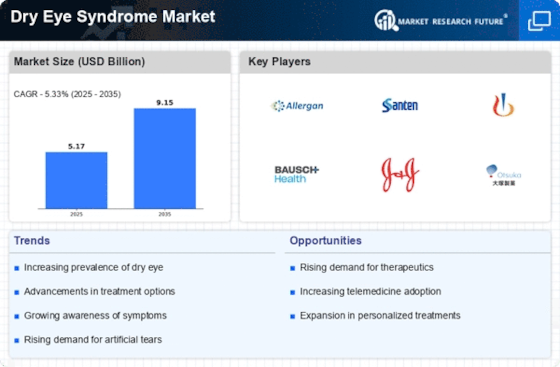
    As per MRFR analysis, the Dry Eye Syndrome Market Size was estimated at 5.17 USD Billion in 2024. The Dry Eye Syndrome industry is projected to grow from 5.446 USD Billion in 2025 to 9.155 USD Billion by 2035, exhibiting a compound annual growth rate (CAGR) of 5.33 during the forecast period 2025 - 2035.

    Key Market Trends & Highlights

    The Dry Eye Syndrome Market is experiencing notable growth driven by increasing awareness and technological advancements.

    • Rising awareness and education about dry eye syndrome are enhancing patient engagement and treatment adherence.
    • Technological advancements in treatment options are leading to more effective and personalized therapies for patients.
    • The North American market remains the largest, while the Asia-Pacific region is emerging as the fastest-growing market for dry eye syndrome treatments.
    • The increasing prevalence of dry eye syndrome and the rising incidence of environmental factors are key drivers propelling market growth.

    Market Size & Forecast

    2024 Market Size 5.17 (USD Billion)
    2035 Market Size 9.155 (USD Billion)
    CAGR (2025 - 2035) 5.33%
    Largest Regional Market Share in 2024 North America

    Major Players

    <p>Allergan (US), Santen Pharmaceutical (JP), Novartis (CH), Bausch Health (CA), Johnson & Johnson (US), Otsuka Pharmaceutical (JP), Hyaluronic Acid (US), Eyevance Pharmaceuticals (US)</p>

    Market Trends

    The Dry Eye Syndrome Market is currently experiencing notable transformations driven by various factors. Increasing awareness regarding eye health and the prevalence of dry eye conditions are contributing to a growing demand for effective treatment options. Patients are becoming more informed about their symptoms, leading to a rise in consultations with healthcare professionals. This trend is further supported by advancements in technology, which are facilitating the development of innovative therapies and diagnostic tools. As a result, pharmaceutical companies are focusing on research and development to introduce new products that cater to the needs of patients suffering from this condition. Moreover, the Dry Eye Syndrome Market is witnessing a shift towards personalized medicine. Tailored treatment plans that consider individual patient profiles are becoming more common, enhancing the effectiveness of interventions. This approach not only improves patient outcomes but also fosters greater patient satisfaction. Additionally, the increasing prevalence of digital device usage is likely to exacerbate dry eye symptoms, prompting further exploration of preventive measures and therapeutic solutions. Overall, the Dry Eye Syndrome Market appears poised for growth, driven by a combination of heightened awareness, technological advancements, and a focus on personalized care.

    Rising Awareness and Education

    There is a growing emphasis on educating the public about dry eye syndrome. Increased awareness campaigns are helping individuals recognize symptoms earlier, leading to timely interventions and consultations with healthcare providers.

    Technological Advancements in Treatment

    Innovations in treatment modalities are emerging, with new therapies and devices being developed to address dry eye syndrome. These advancements are enhancing the effectiveness of existing treatments and providing patients with more options.

    Shift Towards Personalized Medicine

    The market is gradually moving towards personalized treatment approaches. Tailored therapies that consider individual patient characteristics are becoming more prevalent, potentially improving treatment outcomes and patient satisfaction.

    Dry Eye Syndrome Market Market Drivers

    Advancements in Diagnostic Technologies

    Technological innovations in diagnostic tools are transforming the Dry Eye Syndrome Market. Enhanced diagnostic capabilities allow for earlier detection and more accurate assessments of dry eye conditions. Devices such as tear break-up time analyzers and osmolarity testing equipment are becoming more prevalent, enabling healthcare professionals to tailor treatment plans effectively. The introduction of point-of-care testing devices has the potential to streamline patient evaluations, leading to timely interventions. As awareness of the importance of precise diagnostics grows, the demand for these advanced technologies is expected to rise, thereby fostering growth within the Dry Eye Syndrome Market. This trend may also encourage collaborations between technology firms and healthcare providers, further enhancing the market landscape.

    Increasing Prevalence of Dry Eye Syndrome

    The rising incidence of Dry Eye Syndrome is a pivotal driver in the Dry Eye Syndrome Market. Factors such as aging populations and increased screen time contribute to this trend. Research indicates that approximately 5 to 30 percent of the population experiences symptoms of dry eye, with higher rates observed in older adults. This growing prevalence necessitates enhanced treatment options and drives demand for innovative therapies. As more individuals seek relief from discomfort, the market is likely to expand, prompting pharmaceutical companies to invest in research and development. The increasing recognition of dry eye as a chronic condition further emphasizes the need for effective management strategies, thereby propelling the Dry Eye Syndrome Market forward.

    Rising Incidence of Environmental Factors

    Environmental factors are playing a crucial role in the increasing prevalence of Dry Eye Syndrome, thereby impacting the Dry Eye Syndrome Market. Factors such as air pollution, prolonged exposure to screens, and dry indoor environments contribute to the exacerbation of dry eye symptoms. Studies indicate that individuals living in urban areas are more susceptible to dry eye conditions due to these environmental stressors. As awareness of these contributing factors grows, there is a heightened demand for preventive measures and effective treatments. This trend is likely to drive market growth as consumers seek solutions that mitigate the effects of environmental influences on eye health. Consequently, the Dry Eye Syndrome Market may see an influx of products designed to address these specific challenges.

    Increased Focus on Eye Health and Wellness

    The growing emphasis on overall eye health and wellness is significantly influencing the Dry Eye Syndrome Market. As consumers become more health-conscious, there is a rising interest in maintaining optimal eye function and preventing conditions like dry eye. Educational campaigns and initiatives aimed at promoting eye health are gaining traction, leading to increased awareness of dry eye symptoms and available treatments. This heightened focus is likely to drive demand for both preventive and therapeutic products within the market. Furthermore, the integration of eye health into broader wellness trends may encourage collaborations between eye care professionals and wellness brands, fostering innovation in the Dry Eye Syndrome Market. As a result, the market is poised for growth as consumers actively seek solutions to enhance their eye health.

    Growing Demand for Innovative Treatment Options

    The Dry Eye Syndrome Market is witnessing a surge in demand for novel treatment modalities. Traditional therapies, such as artificial tears, are increasingly supplemented by advanced options like anti-inflammatory medications and regenerative therapies. The market is projected to experience substantial growth, with estimates suggesting a compound annual growth rate of over 5 percent in the coming years. Patients are seeking more effective solutions that address the underlying causes of dry eye rather than merely alleviating symptoms. This shift in patient preferences is prompting pharmaceutical companies to invest in research and development of innovative products. As a result, the Dry Eye Syndrome Market is likely to evolve, offering a broader range of therapeutic choices to meet diverse patient needs.

    Market Segment Insights

    Dry Eye Syndrome Market Product Type Insights

    <p>The Dry Eye Syndrome Market revenue is projected to grow significantly, with the Product Type segment revealing critical insights into its composition. In 2024, the overall market was valued at 4.79 USD Billion. Within this segment, various product types play crucial roles in addressing the symptoms of Dry Eye Syndrome and are anticipated to see robust growth. The Artificial Tears product type stands out with a significant market value of 2.3 USD Billion in 2024, accounting for a majority holding in the overall market.</p>

    <p>This prominence can be attributed to the extensive use of artificial tears for symptom relief, making it a staple in the treatment of dry eye conditions.Following closely, Anti-Inflammatory Drugs are valued at 1.0 USD Billion in 2024, highlighting their importance in managing inflammation associated with dry eyes, thus providing the second largest contribution to the market. The growth of this category is driven by increasing awareness and diagnosis of chronic dry eye conditions among the population.</p>

    <p>Punctal Plugs, worth 0.8 USD Billion in 2024, serve as a minimally invasive option for patients who do not respond adequately to topical treatments, thereby proving vital in the management of dry eye symptoms.This category is gaining traction due to the increase in patient preference for non-pharmaceutical solutions. <a href="https://www.marketresearchfuture.com/reports/surgical-equipment-market-556">Surgical Devices</a>, valued at 0.69 USD Billion in the same year, reflect a smaller yet significant segment of the market as they provide permanent solutions for severe cases of dry eye syndrome. The increasing number of eye surgeries and growing acceptance of surgical interventions are major drivers for this segment.</p>

    Dry Eye Syndrome Market Cause of Dry Eye Syndrome Insights

    <p>The Dry Eye Syndrome Market reached a valuation of 4.79 USD Billion in 2024, reflecting an important area of focus regarding the causes of this condition. The primary causes consist of Aging, Medication Induced, Environmental Factors, and Medical Conditions. Aging is particularly significant, as the natural degeneration of tear production leads to increased prevalence, making this group of individuals more susceptible.</p>

    <p>Medication Induced causes account for a substantial share, as numerous prescription drugs can cause dry eyes as a side effect, making awareness crucial for both patients and healthcare providers.Environmental Factors such as pollution and prolonged screen time are increasingly recognized as important contributors to dry eye conditions, especially in urban areas with high exposure rates. Lastly, various Medical Conditions, including autoimmune disorders, play a pivotal role as well, creating a population that requires tailored interventions.</p>

    <p>As these factors continue to drive growth, understanding their specific impacts will be vital in addressing the needs within the Dry Eye Syndrome Market and optimizing treatment approaches for those affected.</p>

    Dry Eye Syndrome Market Distribution Channel Insights

    <p>The Dry Eye Syndrome Market is poised for substantial growth, reached a value of 4.79 USD Billion in 2024. Within this market, the Distribution Channel segment plays a pivotal role in ensuring that consumers gain access to necessary treatments. The diverse channels include Online Pharmacy, Retail Pharmacy, Hospital Pharmacy, and Specialty Clinics, each providing unique advantages.</p>

    <p>Online Pharmacy has gained significant traction due to the convenience and accessibility it offers to patients, allowing for easy procurement of prescriptions and over-the-counter products without the need for physical visits. Retail Pharmacy remains a dominant presence, serving as a primary point for consumers to obtain dry eye treatments while also offering personalized consultations. Hospital Pharmacy plays an integral part in managing acute care cases and providing critical medication through healthcare facilities. Additionally, Specialty Clinics, which focus on eye care, are essential for offering tailored treatments and expert advice, thus addressing more complex dry eye cases.</p>

    <p>The integration of these channels enhances market growth by bridging patient needs with product availability, thereby facilitating improved health outcomes globally.The rise in awareness around dry eye conditions and the increasing prevalence of the syndrome further fuels the demand across these channels.</p>

    Dry Eye Syndrome Market End User Insights

    <p>The Dry Eye Syndrome Market reached a valuation of 4.79 billion USD in 2024, showcasing a significant demand in various End User categories. The market growth is bolstered by an increasing prevalence of dry eye conditions and rising awareness of eye health. Among the End User categories, hospitals and ophthalmology clinics play a crucial role in providing specialized care and treatment options, contributing to the overall market dynamics.</p>

    <p>Hospitals offer comprehensive services and advanced treatment modalities, positioning themselves as major players in managing dry eye syndrome.Additionally, ophthalmology clinics specialize in diagnosing and treating eye disorders, ensuring a steady influx of patients seeking relief from dry eye symptoms. Home care is also gaining traction as patients prefer managing their conditions in the comfort of their homes, making it a prominent segment in the market.</p>

    <p>The Dry Eye Syndrome Market segmentation highlights the diverse needs of patients, providing ample opportunities for growth and innovation in treatment approaches across these End User categories, thereby significantly influencing market trends and statistics by catering to patient-specific requirements and preferences.</p>

    Get more detailed insights about Dry Eye Syndrome Market Research Report- Forecast to 2035

    Regional Insights

    North America : Leading Market for Innovation

    North America is the largest market for Dry Eye Syndrome treatments, accounting for approximately 45% of the global market share. The region's growth is driven by increasing prevalence of dry eye conditions, heightened awareness, and advancements in treatment options. Regulatory support from agencies like the FDA has also catalyzed market expansion, facilitating quicker approvals for innovative therapies and devices. The United States is the primary contributor, with significant market players such as Allergan, Johnson & Johnson, and Bausch Health leading the competitive landscape. The presence of advanced healthcare infrastructure and a strong focus on research and development further bolster the market. Canada also plays a vital role, contributing to the overall growth with its increasing adoption of new treatment modalities.

    Europe : Emerging Regulatory Frameworks

    Europe is witnessing significant growth in the Dry Eye Syndrome market, holding approximately 30% of the global share. The region benefits from a robust regulatory framework that encourages innovation and ensures patient safety. Countries like Germany and France are at the forefront, with increasing investments in healthcare and rising awareness about dry eye conditions driving demand for effective treatments. Leading players such as Santen Pharmaceutical and Novartis are actively involved in the European market, focusing on developing advanced therapies. The competitive landscape is characterized by a mix of established companies and emerging startups, all striving to meet the growing needs of patients. The European Medicines Agency (EMA) plays a crucial role in regulating new treatments, ensuring they meet stringent safety and efficacy standards.

    Asia-Pacific : Rapidly Growing Market Potential

    Asia-Pacific is rapidly emerging as a significant market for Dry Eye Syndrome treatments, accounting for about 20% of the global market share. The region's growth is fueled by increasing urbanization, changing lifestyles, and a rising aging population, which collectively contribute to a higher prevalence of dry eye conditions. Additionally, government initiatives aimed at improving healthcare access are further driving market expansion. Countries like Japan and China are leading the charge, with major players such as Otsuka Pharmaceutical and Hyaluronic Acid making substantial investments in research and development. The competitive landscape is evolving, with both local and international companies vying for market share. The region's diverse healthcare systems and varying regulatory environments present both challenges and opportunities for market entrants.

    Middle East and Africa : Untapped Market Opportunities

    The Middle East and Africa region is gradually emerging in the Dry Eye Syndrome market, holding approximately 5% of the global share. The growth is primarily driven by increasing awareness of eye health and the rising prevalence of dry eye conditions, particularly in urban areas. Government initiatives aimed at enhancing healthcare infrastructure are also contributing to market development, creating opportunities for new entrants. Countries like South Africa and the UAE are leading the market, with a growing number of healthcare facilities and increasing access to advanced treatments. The competitive landscape is characterized by a mix of local and international players, with a focus on providing affordable and effective solutions. As awareness continues to grow, the region is expected to attract more investments in eye care solutions.

    Key Players and Competitive Insights

    The Dry Eye Syndrome Market has seen constant growth and evolution driven by increasing awareness among patients and healthcare providers, alongside a rise in the prevalence of dry eye conditions globally. The competitive landscape is characterized by several prominent players who are continuously innovating and expanding their product portfolios to cater to the needs of patients. Companies in this market focus on developing advanced therapeutic solutions, including prescription eye drops, over-the-counter products, and a variety of surgical options aimed at alleviating symptoms and improving the quality of life for patients suffering from this chronic condition.

    Strategic partnerships, investments in research and development, and targeted marketing efforts are also crucial for companies to maintain a competitive edge in the market. Allergan has made a significant impact on the Dry Eye Syndrome Market with its strong portfolio of innovative treatments designed to address dry eye symptoms effectively. The company has established a robust market presence, driven by its flagship products that have gained widespread acceptance among healthcare professionals and patients alike. 

    Allergan's strengths lie in its commitment to research and development, allowing it to stay at the forefront of technology and treatment options. The company has also effectively utilized marketing strategies to raise awareness about its therapies, fostering strong relationships with healthcare providers and driving product adoption. Its strategic focus on customer education further enhances its competitive position, ensuring that it remains a key player in the dry eye market segment. Novartis has also established itself as a formidable competitor in the Dry Eye Syndrome Market by offering a range of key products that cater to various aspects of dry eye treatment.

    The company has made strategic investments in research and development, leading to the launch of innovative therapies that address unmet medical needs. Novartis's strengths include a strong global presence, a diverse portfolio that spans pharmaceuticals and over-the-counter medications, and successful marketing campaigns that resonate with both consumers and medical professionals. 

    The company has also pursued mergers and acquisitions to acquire complementary technologies and products, enhancing its market share and expanding its reach in the dry eye segment. These initiatives further solidify Novartis's competitive edge, allowing it to leverage its existing resources and networks to deliver effective solutions to patients worldwide.

    Key Companies in the Dry Eye Syndrome Market market include

    Industry Developments

    In recent months, the Dry Eye Syndrome Market has witnessed significant developments with major players like Allergan, Novartis, and Regeneron Pharmaceuticals advancing their product pipelines.

    Notably, in September 2023, Bausch Health announced the launch of a new dry eye treatment aimed at addressing severe symptoms and expanding its market share. Additionally, Ocuphire Pharma has been gaining attention for its clinical trials focused on innovative therapies for dry eye, showcasing ongoing Research and Development efforts in the sector.

    Mergers and acquisitions have also played a notable role; for instance, in August 2023, Johnson and Johnson completed the acquisition of a leading dry eye treatment firm, which was seen as a strategic move to enhance their therapeutic offerings. The market valuation for companies within this space is projected to grow substantially due to increasing prevalence rates of dry eye syndrome globally, fuelled by factors such as an aging population and rising screen time among younger demographics.

    Furthermore, the overall market has been impacted by significant technological advancements in treatment options, including the emergence of preservative-free formulations and novel drug delivery systems that have garnered consumer interest and investment in recent years.

    Future Outlook

    Dry Eye Syndrome Market Future Outlook

    <p>The Dry Eye Syndrome Market is projected to grow at a 5.33% CAGR from 2024 to 2035, driven by increasing prevalence, technological advancements, and rising awareness.</p>

    New opportunities lie in:

    • <p>Development of personalized treatment plans using AI analytics.</p>
    • <p>Expansion of telemedicine platforms for remote consultations.</p>
    • <p>Investment in innovative drug delivery systems for enhanced efficacy.</p>

    <p>By 2035, the Dry Eye Syndrome Market is expected to achieve substantial growth, reflecting evolving consumer needs and technological advancements.</p>

    Market Segmentation

    Dry Eye Syndrome Market End User Outlook

    • Hospitals
    • Ophthalmology Clinics
    • Home Care

    Dry Eye Syndrome Market Regional Outlook

    • North America
    • Europe
    • South America
    • Asia Pacific
    • Middle East and Africa

    Dry Eye Syndrome Market Product Type Outlook

    • Artificial Tears
    • Anti-Inflammatory Drugs
    • Punctal Plugs
    • Surgical Devices

    Dry Eye Syndrome Market Distribution Channel Outlook

    • Online Pharmacy
    • Retail Pharmacy
    • Hospital Pharmacy
    • Specialty Clinics

    Dry Eye Syndrome Market Cause of Dry Eye Syndrome Outlook

    • Aging
    • Medication Induced
    • Environmental Factors
    • Medical Conditions

    Report Scope

    MARKET SIZE 20245.17(USD Billion)
    MARKET SIZE 20255.446(USD Billion)
    MARKET SIZE 20359.155(USD Billion)
    COMPOUND ANNUAL GROWTH RATE (CAGR)5.33% (2024 - 2035)
    REPORT COVERAGERevenue Forecast, Competitive Landscape, Growth Factors, and Trends
    BASE YEAR2024
    Market Forecast Period2025 - 2035
    Historical Data2019 - 2024
    Market Forecast UnitsUSD Billion
    Key Companies ProfiledMarket analysis in progress
    Segments CoveredMarket segmentation analysis in progress
    Key Market OpportunitiesAdvancements in digital therapeutics and personalized treatments enhance prospects in the Dry Eye Syndrome Market.
    Key Market DynamicsRising prevalence of dry eye syndrome drives demand for innovative therapies and advanced treatment options in the market.
    Countries CoveredNorth America, Europe, APAC, South America, MEA

    FAQs

    What is the projected growth of the Dry Eye Syndrome market?

    The Dry Eye Syndrome market is the expected increase in total market value of 9.15 USD billion over a defined forecast period 2025–2035. It is driven by factors such as demand trends, technological advances, regulatory changes, and geographic expansion.

    What is the size of the Dry Eye Syndrome market?

    Dry Eye Syndrome market size was valued at approximately 5.17 billion USD in 2024. This figure will reach 9.15 billion USD covering all regions (America, Europe, Asia, MEA and ROW), focusing its segments / services / distribution channels till 2035.

    What is the CAGR of the Dry Eye Syndrome market?

    Dry Eye Syndrome market is expected to grow at a CAGR of 5.33% between 2025 and 2035.

    How much will the Dry Eye Syndrome market be worth by 2035?

    Dry Eye Syndrome market is expected to be worth of 9.15 billion USD, reflecting growth driven by usage, technology and global demands by the end of 2035.

    How will the Dry Eye Syndrome market perform over the next 10 years?

    Over the next 10 years the Dry Eye Syndrome market is expected to shift from usd billion 5.17 to 9.15 billion USD, led by adoption of advanced tech, demographic trends, regulatory approvals, with potential headwinds from 2025 to 2035.

    What was the projected market size of the Dry Eye Syndrome Market in 2024?

    The Dry Eye Syndrome Market was valued at 4.79 USD Billion in 2024.

    What is the anticipated market size for the Dry Eye Syndrome Market by 2035?

    By 2035, the overall market for Global Dry Eye Syndrome is expected to reach 8.0 USD Billion.

    Which region held the largest market share for the Dry Eye Syndrome Market in 2024?

    In 2024, North America held the largest market share, valued at 2.1 USD Billion.

    What is the expected growth rate for the North American market from 2024 to 2035?

    The North American market is anticipated to grow to 3.5 USD Billion by 2035.

    How much was the Artificial Tears segment valued in 2024 and what is its forecast for 2035?

    The Artificial Tears segment was valued at 2.3 USD Billion in 2024 and projected to reach 3.8 USD Billion by 2035.

    1. SECTION I: EXECUTIVE SUMMARY AND KEY HIGHLIGHTS
      1. | 1.1 EXECUTIVE SUMMARY
      2. | | 1.1.1 Market Overview
      3. | | 1.1.2 Key Findings
      4. | | 1.1.3 Market Segmentation
      5. | | 1.1.4 Competitive Landscape
      6. | | 1.1.5 Challenges and Opportunities
      7. | | 1.1.6 Future Outlook
    2. SECTION II: SCOPING, METHODOLOGY AND MARKET STRUCTURE
      1. | 2.1 MARKET INTRODUCTION
      2. | | 2.1.1 Definition
      3. | | 2.1.2 Scope of the study
      4. | | | 2.1.2.1 Research Objective
      5. | | | 2.1.2.2 Assumption
      6. | | | 2.1.2.3 Limitations
      7. | 2.2 RESEARCH METHODOLOGY
      8. | | 2.2.1 Overview
      9. | | 2.2.2 Data Mining
      10. | | 2.2.3 Secondary Research
      11. | | 2.2.4 Primary Research
      12. | | | 2.2.4.1 Primary Interviews and Information Gathering Process
      13. | | | 2.2.4.2 Breakdown of Primary Respondents
      14. | | 2.2.5 Forecasting Model
      15. | | 2.2.6 Market Size Estimation
      16. | | | 2.2.6.1 Bottom-Up Approach
      17. | | | 2.2.6.2 Top-Down Approach
      18. | | 2.2.7 Data Triangulation
      19. | | 2.2.8 Validation
    3. SECTION III: QUALITATIVE ANALYSIS
      1. | 3.1 MARKET DYNAMICS
      2. | | 3.1.1 Overview
      3. | | 3.1.2 Drivers
      4. | | 3.1.3 Restraints
      5. | | 3.1.4 Opportunities
      6. | 3.2 MARKET FACTOR ANALYSIS
      7. | | 3.2.1 Value chain Analysis
      8. | | 3.2.2 Porter's Five Forces Analysis
      9. | | | 3.2.2.1 Bargaining Power of Suppliers
      10. | | | 3.2.2.2 Bargaining Power of Buyers
      11. | | | 3.2.2.3 Threat of New Entrants
      12. | | | 3.2.2.4 Threat of Substitutes
      13. | | | 3.2.2.5 Intensity of Rivalry
      14. | | 3.2.3 COVID-19 Impact Analysis
      15. | | | 3.2.3.1 Market Impact Analysis
      16. | | | 3.2.3.2 Regional Impact
      17. | | | 3.2.3.3 Opportunity and Threat Analysis
    4. SECTION IV: QUANTITATIVE ANALYSIS
      1. | 4.1 Healthcare, BY Type (USD Billion)
      2. | | 4.1.1 Artificial Tears
      3. | | 4.1.2 Anti-Inflammatory Drugs
      4. | | 4.1.3 Punctal Plugs
      5. | | 4.1.4 Surgical Devices
      6. | 4.2 Healthcare, BY Cause of Dry Eye Syndrome (USD Billion)
      7. | | 4.2.1 Aging
      8. | | 4.2.2 Medication Induced
      9. | | 4.2.3 Environmental Factors
      10. | | 4.2.4 Medical Conditions
      11. | 4.3 Healthcare, BY Distribution Channel (USD Billion)
      12. | | 4.3.1 Online Pharmacy
      13. | | 4.3.2 Retail Pharmacy
      14. | | 4.3.3 Hospital Pharmacy
      15. | | 4.3.4 Specialty Clinics
      16. | 4.4 Healthcare, BY End User (USD Billion)
      17. | | 4.4.1 Hospitals
      18. | | 4.4.2 Ophthalmology Clinics
      19. | | 4.4.3 Home Care
      20. | 4.5 Healthcare, BY Region (USD Billion)
      21. | | 4.5.1 North America
      22. | | | 4.5.1.1 US
      23. | | | 4.5.1.2 Canada
      24. | | 4.5.2 Europe
      25. | | | 4.5.2.1 Germany
      26. | | | 4.5.2.2 UK
      27. | | | 4.5.2.3 France
      28. | | | 4.5.2.4 Russia
      29. | | | 4.5.2.5 Italy
      30. | | | 4.5.2.6 Spain
      31. | | | 4.5.2.7 Rest of Europe
      32. | | 4.5.3 APAC
      33. | | | 4.5.3.1 China
      34. | | | 4.5.3.2 India
      35. | | | 4.5.3.3 Japan
      36. | | | 4.5.3.4 South Korea
      37. | | | 4.5.3.5 Malaysia
      38. | | | 4.5.3.6 Thailand
      39. | | | 4.5.3.7 Indonesia
      40. | | | 4.5.3.8 Rest of APAC
      41. | | 4.5.4 South America
      42. | | | 4.5.4.1 Brazil
      43. | | | 4.5.4.2 Mexico
      44. | | | 4.5.4.3 Argentina
      45. | | | 4.5.4.4 Rest of South America
      46. | | 4.5.5 MEA
      47. | | | 4.5.5.1 GCC Countries
      48. | | | 4.5.5.2 South Africa
      49. | | | 4.5.5.3 Rest of MEA
    5. SECTION V: COMPETITIVE ANALYSIS
      1. | 5.1 Competitive Landscape
      2. | | 5.1.1 Overview
      3. | | 5.1.2 Competitive Analysis
      4. | | 5.1.3 Market share Analysis
      5. | | 5.1.4 Major Growth Strategy in the Healthcare
      6. | | 5.1.5 Competitive Benchmarking
      7. | | 5.1.6 Leading Players in Terms of Number of Developments in the Healthcare
      8. | | 5.1.7 Key developments and growth strategies
      9. | | | 5.1.7.1 New Product Launch/Service Deployment
      10. | | | 5.1.7.2 Merger & Acquisitions
      11. | | | 5.1.7.3 Joint Ventures
      12. | | 5.1.8 Major Players Financial Matrix
      13. | | | 5.1.8.1 Sales and Operating Income
      14. | | | 5.1.8.2 Major Players R&D Expenditure. 2023
      15. | 5.2 Company Profiles
      16. | | 5.2.1 Allergan (US)
      17. | | | 5.2.1.1 Financial Overview
      18. | | | 5.2.1.2 Products Offered
      19. | | | 5.2.1.3 Key Developments
      20. | | | 5.2.1.4 SWOT Analysis
      21. | | | 5.2.1.5 Key Strategies
      22. | | 5.2.2 Santen Pharmaceutical (JP)
      23. | | | 5.2.2.1 Financial Overview
      24. | | | 5.2.2.2 Products Offered
      25. | | | 5.2.2.3 Key Developments
      26. | | | 5.2.2.4 SWOT Analysis
      27. | | | 5.2.2.5 Key Strategies
      28. | | 5.2.3 Novartis (CH)
      29. | | | 5.2.3.1 Financial Overview
      30. | | | 5.2.3.2 Products Offered
      31. | | | 5.2.3.3 Key Developments
      32. | | | 5.2.3.4 SWOT Analysis
      33. | | | 5.2.3.5 Key Strategies
      34. | | 5.2.4 Bausch Health (CA)
      35. | | | 5.2.4.1 Financial Overview
      36. | | | 5.2.4.2 Products Offered
      37. | | | 5.2.4.3 Key Developments
      38. | | | 5.2.4.4 SWOT Analysis
      39. | | | 5.2.4.5 Key Strategies
      40. | | 5.2.5 Johnson & Johnson (US)
      41. | | | 5.2.5.1 Financial Overview
      42. | | | 5.2.5.2 Products Offered
      43. | | | 5.2.5.3 Key Developments
      44. | | | 5.2.5.4 SWOT Analysis
      45. | | | 5.2.5.5 Key Strategies
      46. | | 5.2.6 Otsuka Pharmaceutical (JP)
      47. | | | 5.2.6.1 Financial Overview
      48. | | | 5.2.6.2 Products Offered
      49. | | | 5.2.6.3 Key Developments
      50. | | | 5.2.6.4 SWOT Analysis
      51. | | | 5.2.6.5 Key Strategies
      52. | | 5.2.7 Hyaluronic Acid (US)
      53. | | | 5.2.7.1 Financial Overview
      54. | | | 5.2.7.2 Products Offered
      55. | | | 5.2.7.3 Key Developments
      56. | | | 5.2.7.4 SWOT Analysis
      57. | | | 5.2.7.5 Key Strategies
      58. | | 5.2.8 Eyevance Pharmaceuticals (US)
      59. | | | 5.2.8.1 Financial Overview
      60. | | | 5.2.8.2 Products Offered
      61. | | | 5.2.8.3 Key Developments
      62. | | | 5.2.8.4 SWOT Analysis
      63. | | | 5.2.8.5 Key Strategies
      64. | 5.3 Appendix
      65. | | 5.3.1 References
      66. | | 5.3.2 Related Reports
    6. LIST OF FIGURES
      1. | 6.1 MARKET SYNOPSIS
      2. | 6.2 NORTH AMERICA MARKET ANALYSIS
      3. | 6.3 US MARKET ANALYSIS BY TYPE
      4. | 6.4 US MARKET ANALYSIS BY CAUSE OF DRY EYE SYNDROME
      5. | 6.5 US MARKET ANALYSIS BY DISTRIBUTION CHANNEL
      6. | 6.6 US MARKET ANALYSIS BY END USER
      7. | 6.7 CANADA MARKET ANALYSIS BY TYPE
      8. | 6.8 CANADA MARKET ANALYSIS BY CAUSE OF DRY EYE SYNDROME
      9. | 6.9 CANADA MARKET ANALYSIS BY DISTRIBUTION CHANNEL
      10. | 6.10 CANADA MARKET ANALYSIS BY END USER
      11. | 6.11 EUROPE MARKET ANALYSIS
      12. | 6.12 GERMANY MARKET ANALYSIS BY TYPE
      13. | 6.13 GERMANY MARKET ANALYSIS BY CAUSE OF DRY EYE SYNDROME
      14. | 6.14 GERMANY MARKET ANALYSIS BY DISTRIBUTION CHANNEL
      15. | 6.15 GERMANY MARKET ANALYSIS BY END USER
      16. | 6.16 UK MARKET ANALYSIS BY TYPE
      17. | 6.17 UK MARKET ANALYSIS BY CAUSE OF DRY EYE SYNDROME
      18. | 6.18 UK MARKET ANALYSIS BY DISTRIBUTION CHANNEL
      19. | 6.19 UK MARKET ANALYSIS BY END USER
      20. | 6.20 FRANCE MARKET ANALYSIS BY TYPE
      21. | 6.21 FRANCE MARKET ANALYSIS BY CAUSE OF DRY EYE SYNDROME
      22. | 6.22 FRANCE MARKET ANALYSIS BY DISTRIBUTION CHANNEL
      23. | 6.23 FRANCE MARKET ANALYSIS BY END USER
      24. | 6.24 RUSSIA MARKET ANALYSIS BY TYPE
      25. | 6.25 RUSSIA MARKET ANALYSIS BY CAUSE OF DRY EYE SYNDROME
      26. | 6.26 RUSSIA MARKET ANALYSIS BY DISTRIBUTION CHANNEL
      27. | 6.27 RUSSIA MARKET ANALYSIS BY END USER
      28. | 6.28 ITALY MARKET ANALYSIS BY TYPE
      29. | 6.29 ITALY MARKET ANALYSIS BY CAUSE OF DRY EYE SYNDROME
      30. | 6.30 ITALY MARKET ANALYSIS BY DISTRIBUTION CHANNEL
      31. | 6.31 ITALY MARKET ANALYSIS BY END USER
      32. | 6.32 SPAIN MARKET ANALYSIS BY TYPE
      33. | 6.33 SPAIN MARKET ANALYSIS BY CAUSE OF DRY EYE SYNDROME
      34. | 6.34 SPAIN MARKET ANALYSIS BY DISTRIBUTION CHANNEL
      35. | 6.35 SPAIN MARKET ANALYSIS BY END USER
      36. | 6.36 REST OF EUROPE MARKET ANALYSIS BY TYPE
      37. | 6.37 REST OF EUROPE MARKET ANALYSIS BY CAUSE OF DRY EYE SYNDROME
      38. | 6.38 REST OF EUROPE MARKET ANALYSIS BY DISTRIBUTION CHANNEL
      39. | 6.39 REST OF EUROPE MARKET ANALYSIS BY END USER
      40. | 6.40 APAC MARKET ANALYSIS
      41. | 6.41 CHINA MARKET ANALYSIS BY TYPE
      42. | 6.42 CHINA MARKET ANALYSIS BY CAUSE OF DRY EYE SYNDROME
      43. | 6.43 CHINA MARKET ANALYSIS BY DISTRIBUTION CHANNEL
      44. | 6.44 CHINA MARKET ANALYSIS BY END USER
      45. | 6.45 INDIA MARKET ANALYSIS BY TYPE
      46. | 6.46 INDIA MARKET ANALYSIS BY CAUSE OF DRY EYE SYNDROME
      47. | 6.47 INDIA MARKET ANALYSIS BY DISTRIBUTION CHANNEL
      48. | 6.48 INDIA MARKET ANALYSIS BY END USER
      49. | 6.49 JAPAN MARKET ANALYSIS BY TYPE
      50. | 6.50 JAPAN MARKET ANALYSIS BY CAUSE OF DRY EYE SYNDROME
      51. | 6.51 JAPAN MARKET ANALYSIS BY DISTRIBUTION CHANNEL
      52. | 6.52 JAPAN MARKET ANALYSIS BY END USER
      53. | 6.53 SOUTH KOREA MARKET ANALYSIS BY TYPE
      54. | 6.54 SOUTH KOREA MARKET ANALYSIS BY CAUSE OF DRY EYE SYNDROME
      55. | 6.55 SOUTH KOREA MARKET ANALYSIS BY DISTRIBUTION CHANNEL
      56. | 6.56 SOUTH KOREA MARKET ANALYSIS BY END USER
      57. | 6.57 MALAYSIA MARKET ANALYSIS BY TYPE
      58. | 6.58 MALAYSIA MARKET ANALYSIS BY CAUSE OF DRY EYE SYNDROME
      59. | 6.59 MALAYSIA MARKET ANALYSIS BY DISTRIBUTION CHANNEL
      60. | 6.60 MALAYSIA MARKET ANALYSIS BY END USER
      61. | 6.61 THAILAND MARKET ANALYSIS BY TYPE
      62. | 6.62 THAILAND MARKET ANALYSIS BY CAUSE OF DRY EYE SYNDROME
      63. | 6.63 THAILAND MARKET ANALYSIS BY DISTRIBUTION CHANNEL
      64. | 6.64 THAILAND MARKET ANALYSIS BY END USER
      65. | 6.65 INDONESIA MARKET ANALYSIS BY TYPE
      66. | 6.66 INDONESIA MARKET ANALYSIS BY CAUSE OF DRY EYE SYNDROME
      67. | 6.67 INDONESIA MARKET ANALYSIS BY DISTRIBUTION CHANNEL
      68. | 6.68 INDONESIA MARKET ANALYSIS BY END USER
      69. | 6.69 REST OF APAC MARKET ANALYSIS BY TYPE
      70. | 6.70 REST OF APAC MARKET ANALYSIS BY CAUSE OF DRY EYE SYNDROME
      71. | 6.71 REST OF APAC MARKET ANALYSIS BY DISTRIBUTION CHANNEL
      72. | 6.72 REST OF APAC MARKET ANALYSIS BY END USER
      73. | 6.73 SOUTH AMERICA MARKET ANALYSIS
      74. | 6.74 BRAZIL MARKET ANALYSIS BY TYPE
      75. | 6.75 BRAZIL MARKET ANALYSIS BY CAUSE OF DRY EYE SYNDROME
      76. | 6.76 BRAZIL MARKET ANALYSIS BY DISTRIBUTION CHANNEL
      77. | 6.77 BRAZIL MARKET ANALYSIS BY END USER
      78. | 6.78 MEXICO MARKET ANALYSIS BY TYPE
      79. | 6.79 MEXICO MARKET ANALYSIS BY CAUSE OF DRY EYE SYNDROME
      80. | 6.80 MEXICO MARKET ANALYSIS BY DISTRIBUTION CHANNEL
      81. | 6.81 MEXICO MARKET ANALYSIS BY END USER
      82. | 6.82 ARGENTINA MARKET ANALYSIS BY TYPE
      83. | 6.83 ARGENTINA MARKET ANALYSIS BY CAUSE OF DRY EYE SYNDROME
      84. | 6.84 ARGENTINA MARKET ANALYSIS BY DISTRIBUTION CHANNEL
      85. | 6.85 ARGENTINA MARKET ANALYSIS BY END USER
      86. | 6.86 REST OF SOUTH AMERICA MARKET ANALYSIS BY TYPE
      87. | 6.87 REST OF SOUTH AMERICA MARKET ANALYSIS BY CAUSE OF DRY EYE SYNDROME
      88. | 6.88 REST OF SOUTH AMERICA MARKET ANALYSIS BY DISTRIBUTION CHANNEL
      89. | 6.89 REST OF SOUTH AMERICA MARKET ANALYSIS BY END USER
      90. | 6.90 MEA MARKET ANALYSIS
      91. | 6.91 GCC COUNTRIES MARKET ANALYSIS BY TYPE
      92. | 6.92 GCC COUNTRIES MARKET ANALYSIS BY CAUSE OF DRY EYE SYNDROME
      93. | 6.93 GCC COUNTRIES MARKET ANALYSIS BY DISTRIBUTION CHANNEL
      94. | 6.94 GCC COUNTRIES MARKET ANALYSIS BY END USER
      95. | 6.95 SOUTH AFRICA MARKET ANALYSIS BY TYPE
      96. | 6.96 SOUTH AFRICA MARKET ANALYSIS BY CAUSE OF DRY EYE SYNDROME
      97. | 6.97 SOUTH AFRICA MARKET ANALYSIS BY DISTRIBUTION CHANNEL
      98. | 6.98 SOUTH AFRICA MARKET ANALYSIS BY END USER
      99. | 6.99 REST OF MEA MARKET ANALYSIS BY TYPE
      100. | 6.100 REST OF MEA MARKET ANALYSIS BY CAUSE OF DRY EYE SYNDROME
      101. | 6.101 REST OF MEA MARKET ANALYSIS BY DISTRIBUTION CHANNEL
      102. | 6.102 REST OF MEA MARKET ANALYSIS BY END USER
      103. | 6.103 KEY BUYING CRITERIA OF HEALTHCARE
      104. | 6.104 RESEARCH PROCESS OF MRFR
      105. | 6.105 DRO ANALYSIS OF HEALTHCARE
      106. | 6.106 DRIVERS IMPACT ANALYSIS: HEALTHCARE
      107. | 6.107 RESTRAINTS IMPACT ANALYSIS: HEALTHCARE
      108. | 6.108 SUPPLY / VALUE CHAIN: HEALTHCARE
      109. | 6.109 HEALTHCARE, BY TYPE, 2024 (% SHARE)
      110. | 6.110 HEALTHCARE, BY TYPE, 2024 TO 2035 (USD Billion)
      111. | 6.111 HEALTHCARE, BY CAUSE OF DRY EYE SYNDROME, 2024 (% SHARE)
      112. | 6.112 HEALTHCARE, BY CAUSE OF DRY EYE SYNDROME, 2024 TO 2035 (USD Billion)
      113. | 6.113 HEALTHCARE, BY DISTRIBUTION CHANNEL, 2024 (% SHARE)
      114. | 6.114 HEALTHCARE, BY DISTRIBUTION CHANNEL, 2024 TO 2035 (USD Billion)
      115. | 6.115 HEALTHCARE, BY END USER, 2024 (% SHARE)
      116. | 6.116 HEALTHCARE, BY END USER, 2024 TO 2035 (USD Billion)
      117. | 6.117 BENCHMARKING OF MAJOR COMPETITORS
    7. LIST OF TABLES
      1. | 7.1 LIST OF ASSUMPTIONS
      2. | | 7.1.1
      3. | 7.2 North America MARKET SIZE ESTIMATES; FORECAST
      4. | | 7.2.1 BY TYPE, 2025-2035 (USD Billion)
      5. | | 7.2.2 BY CAUSE OF DRY EYE SYNDROME, 2025-2035 (USD Billion)
      6. | | 7.2.3 BY DISTRIBUTION CHANNEL, 2025-2035 (USD Billion)
      7. | | 7.2.4 BY END USER, 2025-2035 (USD Billion)
      8. | 7.3 US MARKET SIZE ESTIMATES; FORECAST
      9. | | 7.3.1 BY TYPE, 2025-2035 (USD Billion)
      10. | | 7.3.2 BY CAUSE OF DRY EYE SYNDROME, 2025-2035 (USD Billion)
      11. | | 7.3.3 BY DISTRIBUTION CHANNEL, 2025-2035 (USD Billion)
      12. | | 7.3.4 BY END USER, 2025-2035 (USD Billion)
      13. | 7.4 Canada MARKET SIZE ESTIMATES; FORECAST
      14. | | 7.4.1 BY TYPE, 2025-2035 (USD Billion)
      15. | | 7.4.2 BY CAUSE OF DRY EYE SYNDROME, 2025-2035 (USD Billion)
      16. | | 7.4.3 BY DISTRIBUTION CHANNEL, 2025-2035 (USD Billion)
      17. | | 7.4.4 BY END USER, 2025-2035 (USD Billion)
      18. | 7.5 Europe MARKET SIZE ESTIMATES; FORECAST
      19. | | 7.5.1 BY TYPE, 2025-2035 (USD Billion)
      20. | | 7.5.2 BY CAUSE OF DRY EYE SYNDROME, 2025-2035 (USD Billion)
      21. | | 7.5.3 BY DISTRIBUTION CHANNEL, 2025-2035 (USD Billion)
      22. | | 7.5.4 BY END USER, 2025-2035 (USD Billion)
      23. | 7.6 Germany MARKET SIZE ESTIMATES; FORECAST
      24. | | 7.6.1 BY TYPE, 2025-2035 (USD Billion)
      25. | | 7.6.2 BY CAUSE OF DRY EYE SYNDROME, 2025-2035 (USD Billion)
      26. | | 7.6.3 BY DISTRIBUTION CHANNEL, 2025-2035 (USD Billion)
      27. | | 7.6.4 BY END USER, 2025-2035 (USD Billion)
      28. | 7.7 UK MARKET SIZE ESTIMATES; FORECAST
      29. | | 7.7.1 BY TYPE, 2025-2035 (USD Billion)
      30. | | 7.7.2 BY CAUSE OF DRY EYE SYNDROME, 2025-2035 (USD Billion)
      31. | | 7.7.3 BY DISTRIBUTION CHANNEL, 2025-2035 (USD Billion)
      32. | | 7.7.4 BY END USER, 2025-2035 (USD Billion)
      33. | 7.8 France MARKET SIZE ESTIMATES; FORECAST
      34. | | 7.8.1 BY TYPE, 2025-2035 (USD Billion)
      35. | | 7.8.2 BY CAUSE OF DRY EYE SYNDROME, 2025-2035 (USD Billion)
      36. | | 7.8.3 BY DISTRIBUTION CHANNEL, 2025-2035 (USD Billion)
      37. | | 7.8.4 BY END USER, 2025-2035 (USD Billion)
      38. | 7.9 Russia MARKET SIZE ESTIMATES; FORECAST
      39. | | 7.9.1 BY TYPE, 2025-2035 (USD Billion)
      40. | | 7.9.2 BY CAUSE OF DRY EYE SYNDROME, 2025-2035 (USD Billion)
      41. | | 7.9.3 BY DISTRIBUTION CHANNEL, 2025-2035 (USD Billion)
      42. | | 7.9.4 BY END USER, 2025-2035 (USD Billion)
      43. | 7.10 Italy MARKET SIZE ESTIMATES; FORECAST
      44. | | 7.10.1 BY TYPE, 2025-2035 (USD Billion)
      45. | | 7.10.2 BY CAUSE OF DRY EYE SYNDROME, 2025-2035 (USD Billion)
      46. | | 7.10.3 BY DISTRIBUTION CHANNEL, 2025-2035 (USD Billion)
      47. | | 7.10.4 BY END USER, 2025-2035 (USD Billion)
      48. | 7.11 Spain MARKET SIZE ESTIMATES; FORECAST
      49. | | 7.11.1 BY TYPE, 2025-2035 (USD Billion)
      50. | | 7.11.2 BY CAUSE OF DRY EYE SYNDROME, 2025-2035 (USD Billion)
      51. | | 7.11.3 BY DISTRIBUTION CHANNEL, 2025-2035 (USD Billion)
      52. | | 7.11.4 BY END USER, 2025-2035 (USD Billion)
      53. | 7.12 Rest of Europe MARKET SIZE ESTIMATES; FORECAST
      54. | | 7.12.1 BY TYPE, 2025-2035 (USD Billion)
      55. | | 7.12.2 BY CAUSE OF DRY EYE SYNDROME, 2025-2035 (USD Billion)
      56. | | 7.12.3 BY DISTRIBUTION CHANNEL, 2025-2035 (USD Billion)
      57. | | 7.12.4 BY END USER, 2025-2035 (USD Billion)
      58. | 7.13 APAC MARKET SIZE ESTIMATES; FORECAST
      59. | | 7.13.1 BY TYPE, 2025-2035 (USD Billion)
      60. | | 7.13.2 BY CAUSE OF DRY EYE SYNDROME, 2025-2035 (USD Billion)
      61. | | 7.13.3 BY DISTRIBUTION CHANNEL, 2025-2035 (USD Billion)
      62. | | 7.13.4 BY END USER, 2025-2035 (USD Billion)
      63. | 7.14 China MARKET SIZE ESTIMATES; FORECAST
      64. | | 7.14.1 BY TYPE, 2025-2035 (USD Billion)
      65. | | 7.14.2 BY CAUSE OF DRY EYE SYNDROME, 2025-2035 (USD Billion)
      66. | | 7.14.3 BY DISTRIBUTION CHANNEL, 2025-2035 (USD Billion)
      67. | | 7.14.4 BY END USER, 2025-2035 (USD Billion)
      68. | 7.15 India MARKET SIZE ESTIMATES; FORECAST
      69. | | 7.15.1 BY TYPE, 2025-2035 (USD Billion)
      70. | | 7.15.2 BY CAUSE OF DRY EYE SYNDROME, 2025-2035 (USD Billion)
      71. | | 7.15.3 BY DISTRIBUTION CHANNEL, 2025-2035 (USD Billion)
      72. | | 7.15.4 BY END USER, 2025-2035 (USD Billion)
      73. | 7.16 Japan MARKET SIZE ESTIMATES; FORECAST
      74. | | 7.16.1 BY TYPE, 2025-2035 (USD Billion)
      75. | | 7.16.2 BY CAUSE OF DRY EYE SYNDROME, 2025-2035 (USD Billion)
      76. | | 7.16.3 BY DISTRIBUTION CHANNEL, 2025-2035 (USD Billion)
      77. | | 7.16.4 BY END USER, 2025-2035 (USD Billion)
      78. | 7.17 South Korea MARKET SIZE ESTIMATES; FORECAST
      79. | | 7.17.1 BY TYPE, 2025-2035 (USD Billion)
      80. | | 7.17.2 BY CAUSE OF DRY EYE SYNDROME, 2025-2035 (USD Billion)
      81. | | 7.17.3 BY DISTRIBUTION CHANNEL, 2025-2035 (USD Billion)
      82. | | 7.17.4 BY END USER, 2025-2035 (USD Billion)
      83. | 7.18 Malaysia MARKET SIZE ESTIMATES; FORECAST
      84. | | 7.18.1 BY TYPE, 2025-2035 (USD Billion)
      85. | | 7.18.2 BY CAUSE OF DRY EYE SYNDROME, 2025-2035 (USD Billion)
      86. | | 7.18.3 BY DISTRIBUTION CHANNEL, 2025-2035 (USD Billion)
      87. | | 7.18.4 BY END USER, 2025-2035 (USD Billion)
      88. | 7.19 Thailand MARKET SIZE ESTIMATES; FORECAST
      89. | | 7.19.1 BY TYPE, 2025-2035 (USD Billion)
      90. | | 7.19.2 BY CAUSE OF DRY EYE SYNDROME, 2025-2035 (USD Billion)
      91. | | 7.19.3 BY DISTRIBUTION CHANNEL, 2025-2035 (USD Billion)
      92. | | 7.19.4 BY END USER, 2025-2035 (USD Billion)
      93. | 7.20 Indonesia MARKET SIZE ESTIMATES; FORECAST
      94. | | 7.20.1 BY TYPE, 2025-2035 (USD Billion)
      95. | | 7.20.2 BY CAUSE OF DRY EYE SYNDROME, 2025-2035 (USD Billion)
      96. | | 7.20.3 BY DISTRIBUTION CHANNEL, 2025-2035 (USD Billion)
      97. | | 7.20.4 BY END USER, 2025-2035 (USD Billion)
      98. | 7.21 Rest of APAC MARKET SIZE ESTIMATES; FORECAST
      99. | | 7.21.1 BY TYPE, 2025-2035 (USD Billion)
      100. | | 7.21.2 BY CAUSE OF DRY EYE SYNDROME, 2025-2035 (USD Billion)
      101. | | 7.21.3 BY DISTRIBUTION CHANNEL, 2025-2035 (USD Billion)
      102. | | 7.21.4 BY END USER, 2025-2035 (USD Billion)
      103. | 7.22 South America MARKET SIZE ESTIMATES; FORECAST
      104. | | 7.22.1 BY TYPE, 2025-2035 (USD Billion)
      105. | | 7.22.2 BY CAUSE OF DRY EYE SYNDROME, 2025-2035 (USD Billion)
      106. | | 7.22.3 BY DISTRIBUTION CHANNEL, 2025-2035 (USD Billion)
      107. | | 7.22.4 BY END USER, 2025-2035 (USD Billion)
      108. | 7.23 Brazil MARKET SIZE ESTIMATES; FORECAST
      109. | | 7.23.1 BY TYPE, 2025-2035 (USD Billion)
      110. | | 7.23.2 BY CAUSE OF DRY EYE SYNDROME, 2025-2035 (USD Billion)
      111. | | 7.23.3 BY DISTRIBUTION CHANNEL, 2025-2035 (USD Billion)
      112. | | 7.23.4 BY END USER, 2025-2035 (USD Billion)
      113. | 7.24 Mexico MARKET SIZE ESTIMATES; FORECAST
      114. | | 7.24.1 BY TYPE, 2025-2035 (USD Billion)
      115. | | 7.24.2 BY CAUSE OF DRY EYE SYNDROME, 2025-2035 (USD Billion)
      116. | | 7.24.3 BY DISTRIBUTION CHANNEL, 2025-2035 (USD Billion)
      117. | | 7.24.4 BY END USER, 2025-2035 (USD Billion)
      118. | 7.25 Argentina MARKET SIZE ESTIMATES; FORECAST
      119. | | 7.25.1 BY TYPE, 2025-2035 (USD Billion)
      120. | | 7.25.2 BY CAUSE OF DRY EYE SYNDROME, 2025-2035 (USD Billion)
      121. | | 7.25.3 BY DISTRIBUTION CHANNEL, 2025-2035 (USD Billion)
      122. | | 7.25.4 BY END USER, 2025-2035 (USD Billion)
      123. | 7.26 Rest of South America MARKET SIZE ESTIMATES; FORECAST
      124. | | 7.26.1 BY TYPE, 2025-2035 (USD Billion)
      125. | | 7.26.2 BY CAUSE OF DRY EYE SYNDROME, 2025-2035 (USD Billion)
      126. | | 7.26.3 BY DISTRIBUTION CHANNEL, 2025-2035 (USD Billion)
      127. | | 7.26.4 BY END USER, 2025-2035 (USD Billion)
      128. | 7.27 MEA MARKET SIZE ESTIMATES; FORECAST
      129. | | 7.27.1 BY TYPE, 2025-2035 (USD Billion)
      130. | | 7.27.2 BY CAUSE OF DRY EYE SYNDROME, 2025-2035 (USD Billion)
      131. | | 7.27.3 BY DISTRIBUTION CHANNEL, 2025-2035 (USD Billion)
      132. | | 7.27.4 BY END USER, 2025-2035 (USD Billion)
      133. | 7.28 GCC Countries MARKET SIZE ESTIMATES; FORECAST
      134. | | 7.28.1 BY TYPE, 2025-2035 (USD Billion)
      135. | | 7.28.2 BY CAUSE OF DRY EYE SYNDROME, 2025-2035 (USD Billion)
      136. | | 7.28.3 BY DISTRIBUTION CHANNEL, 2025-2035 (USD Billion)
      137. | | 7.28.4 BY END USER, 2025-2035 (USD Billion)
      138. | 7.29 South Africa MARKET SIZE ESTIMATES; FORECAST
      139. | | 7.29.1 BY TYPE, 2025-2035 (USD Billion)
      140. | | 7.29.2 BY CAUSE OF DRY EYE SYNDROME, 2025-2035 (USD Billion)
      141. | | 7.29.3 BY DISTRIBUTION CHANNEL, 2025-2035 (USD Billion)
      142. | | 7.29.4 BY END USER, 2025-2035 (USD Billion)
      143. | 7.30 Rest of MEA MARKET SIZE ESTIMATES; FORECAST
      144. | | 7.30.1 BY TYPE, 2025-2035 (USD Billion)
      145. | | 7.30.2 BY CAUSE OF DRY EYE SYNDROME, 2025-2035 (USD Billion)
      146. | | 7.30.3 BY DISTRIBUTION CHANNEL, 2025-2035 (USD Billion)
      147. | | 7.30.4 BY END USER, 2025-2035 (USD Billion)
      148. | 7.31 PRODUCT LAUNCH/PRODUCT DEVELOPMENT/APPROVAL
      149. | | 7.31.1
      150. | 7.32 ACQUISITION/PARTNERSHIP
      151. | | 7.32.1

    Dry Eye Syndrome Market Segmentation

    Dry Eye Syndrome Market By Product Type (USD Billion, 2019-2035)

    Artificial Tears

    Anti-Inflammatory Drugs

    Punctal Plugs

    Surgical Devices

    Dry Eye Syndrome Market By Cause of Dry Eye Syndrome (USD Billion, 2019-2035)

    Aging

    Medication Induced

    Environmental Factors

    Medical Conditions

    Dry Eye Syndrome Market By Distribution Channel (USD Billion, 2019-2035)

    Online Pharmacy

    Retail Pharmacy

    Hospital Pharmacy

    Specialty Clinics

    Dry Eye Syndrome Market By End User (USD Billion, 2019-2035)

    Hospitals

    Ophthalmology Clinics

    Home Care

    Dry Eye Syndrome Market By Regional (USD Billion, 2019-2035)

    North America

    Europe

    South America

    Asia Pacific

    Middle East and Africa

    Dry Eye Syndrome Market Regional Outlook (USD Billion, 2019-2035)

    North America Outlook (USD Billion, 2019-2035)

    North America Dry Eye Syndrome Market by Product Type

    Artificial Tears

    Anti-Inflammatory Drugs

    Punctal Plugs

    Surgical Devices

    North America Dry Eye Syndrome Market by Cause of Dry Eye Syndrome Type

    Aging

    Medication Induced

    Environmental Factors

    Medical Conditions

    North America Dry Eye Syndrome Market by Distribution Channel Type

    Online Pharmacy

    Retail Pharmacy

    Hospital Pharmacy

    Specialty Clinics

    North America Dry Eye Syndrome Market by End User Type

    Hospitals

    Ophthalmology Clinics

    Home Care

    North America Dry Eye Syndrome Market by Regional Type

    US

    Canada

    US Outlook (USD Billion, 2019-2035)

    US Dry Eye Syndrome Market by Product Type

    Artificial Tears

    Anti-Inflammatory Drugs

    Punctal Plugs

    Surgical Devices

    US Dry Eye Syndrome Market by Cause of Dry Eye Syndrome Type

    Aging

    Medication Induced

    Environmental Factors

    Medical Conditions

    US Dry Eye Syndrome Market by Distribution Channel Type

    Online Pharmacy

    Retail Pharmacy

    Hospital Pharmacy

    Specialty Clinics

    US Dry Eye Syndrome Market by End User Type

    Hospitals

    Ophthalmology Clinics

    Home Care

    CANADA Outlook (USD Billion, 2019-2035)

    CANADA Dry Eye Syndrome Market by Product Type

    Artificial Tears

    Anti-Inflammatory Drugs

    Punctal Plugs

    Surgical Devices

    CANADA Dry Eye Syndrome Market by Cause of Dry Eye Syndrome Type

    Aging

    Medication Induced

    Environmental Factors

    Medical Conditions

    CANADA Dry Eye Syndrome Market by Distribution Channel Type

    Online Pharmacy

    Retail Pharmacy

    Hospital Pharmacy

    Specialty Clinics

    CANADA Dry Eye Syndrome Market by End User Type

    Hospitals

    Ophthalmology Clinics

    Home Care

    Europe Outlook (USD Billion, 2019-2035)

    Europe Dry Eye Syndrome Market by Product Type

    Artificial Tears

    Anti-Inflammatory Drugs

    Punctal Plugs

    Surgical Devices

    Europe Dry Eye Syndrome Market by Cause of Dry Eye Syndrome Type

    Aging

    Medication Induced

    Environmental Factors

    Medical Conditions

    Europe Dry Eye Syndrome Market by Distribution Channel Type

    Online Pharmacy

    Retail Pharmacy

    Hospital Pharmacy

    Specialty Clinics

    Europe Dry Eye Syndrome Market by End User Type

    Hospitals

    Ophthalmology Clinics

    Home Care

    Europe Dry Eye Syndrome Market by Regional Type

    Germany

    UK

    France

    Russia

    Italy

    Spain

    Rest of Europe

    GERMANY Outlook (USD Billion, 2019-2035)

    GERMANY Dry Eye Syndrome Market by Product Type

    Artificial Tears

    Anti-Inflammatory Drugs

    Punctal Plugs

    Surgical Devices

    GERMANY Dry Eye Syndrome Market by Cause of Dry Eye Syndrome Type

    Aging

    Medication Induced

    Environmental Factors

    Medical Conditions

    GERMANY Dry Eye Syndrome Market by Distribution Channel Type

    Online Pharmacy

    Retail Pharmacy

    Hospital Pharmacy

    Specialty Clinics

    GERMANY Dry Eye Syndrome Market by End User Type

    Hospitals

    Ophthalmology Clinics

    Home Care

    UK Outlook (USD Billion, 2019-2035)

    UK Dry Eye Syndrome Market by Product Type

    Artificial Tears

    Anti-Inflammatory Drugs

    Punctal Plugs

    Surgical Devices

    UK Dry Eye Syndrome Market by Cause of Dry Eye Syndrome Type

    Aging

    Medication Induced

    Environmental Factors

    Medical Conditions

    UK Dry Eye Syndrome Market by Distribution Channel Type

    Online Pharmacy

    Retail Pharmacy

    Hospital Pharmacy

    Specialty Clinics

    UK Dry Eye Syndrome Market by End User Type

    Hospitals

    Ophthalmology Clinics

    Home Care

    FRANCE Outlook (USD Billion, 2019-2035)

    FRANCE Dry Eye Syndrome Market by Product Type

    Artificial Tears

    Anti-Inflammatory Drugs

    Punctal Plugs

    Surgical Devices

    FRANCE Dry Eye Syndrome Market by Cause of Dry Eye Syndrome Type

    Aging

    Medication Induced

    Environmental Factors

    Medical Conditions

    FRANCE Dry Eye Syndrome Market by Distribution Channel Type

    Online Pharmacy

    Retail Pharmacy

    Hospital Pharmacy

    Specialty Clinics

    FRANCE Dry Eye Syndrome Market by End User Type

    Hospitals

    Ophthalmology Clinics

    Home Care

    RUSSIA Outlook (USD Billion, 2019-2035)

    RUSSIA Dry Eye Syndrome Market by Product Type

    Artificial Tears

    Anti-Inflammatory Drugs

    Punctal Plugs

    Surgical Devices

    RUSSIA Dry Eye Syndrome Market by Cause of Dry Eye Syndrome Type

    Aging

    Medication Induced

    Environmental Factors

    Medical Conditions

    RUSSIA Dry Eye Syndrome Market by Distribution Channel Type

    Online Pharmacy

    Retail Pharmacy

    Hospital Pharmacy

    Specialty Clinics

    RUSSIA Dry Eye Syndrome Market by End User Type

    Hospitals

    Ophthalmology Clinics

    Home Care

    ITALY Outlook (USD Billion, 2019-2035)

    ITALY Dry Eye Syndrome Market by Product Type

    Artificial Tears

    Anti-Inflammatory Drugs

    Punctal Plugs

    Surgical Devices

    ITALY Dry Eye Syndrome Market by Cause of Dry Eye Syndrome Type

    Aging

    Medication Induced

    Environmental Factors

    Medical Conditions

    ITALY Dry Eye Syndrome Market by Distribution Channel Type

    Online Pharmacy

    Retail Pharmacy

    Hospital Pharmacy

    Specialty Clinics

    ITALY Dry Eye Syndrome Market by End User Type

    Hospitals

    Ophthalmology Clinics

    Home Care

    SPAIN Outlook (USD Billion, 2019-2035)

    SPAIN Dry Eye Syndrome Market by Product Type

    Artificial Tears

    Anti-Inflammatory Drugs

    Punctal Plugs

    Surgical Devices

    SPAIN Dry Eye Syndrome Market by Cause of Dry Eye Syndrome Type

    Aging

    Medication Induced

    Environmental Factors

    Medical Conditions

    SPAIN Dry Eye Syndrome Market by Distribution Channel Type

    Online Pharmacy

    Retail Pharmacy

    Hospital Pharmacy

    Specialty Clinics

    SPAIN Dry Eye Syndrome Market by End User Type

    Hospitals

    Ophthalmology Clinics

    Home Care

    REST OF EUROPE Outlook (USD Billion, 2019-2035)

    REST OF EUROPE Dry Eye Syndrome Market by Product Type

    Artificial Tears

    Anti-Inflammatory Drugs

    Punctal Plugs

    Surgical Devices

    REST OF EUROPE Dry Eye Syndrome Market by Cause of Dry Eye Syndrome Type

    Aging

    Medication Induced

    Environmental Factors

    Medical Conditions

    REST OF EUROPE Dry Eye Syndrome Market by Distribution Channel Type

    Online Pharmacy

    Retail Pharmacy

    Hospital Pharmacy

    Specialty Clinics

    REST OF EUROPE Dry Eye Syndrome Market by End User Type

    Hospitals

    Ophthalmology Clinics

    Home Care

    APAC Outlook (USD Billion, 2019-2035)

    APAC Dry Eye Syndrome Market by Product Type

    Artificial Tears

    Anti-Inflammatory Drugs

    Punctal Plugs

    Surgical Devices

    APAC Dry Eye Syndrome Market by Cause of Dry Eye Syndrome Type

    Aging

    Medication Induced

    Environmental Factors

    Medical Conditions

    APAC Dry Eye Syndrome Market by Distribution Channel Type

    Online Pharmacy

    Retail Pharmacy

    Hospital Pharmacy

    Specialty Clinics

    APAC Dry Eye Syndrome Market by End User Type

    Hospitals

    Ophthalmology Clinics

    Home Care

    APAC Dry Eye Syndrome Market by Regional Type

    China

    India

    Japan

    South Korea

    Malaysia

    Thailand

    Indonesia

    Rest of APAC

    CHINA Outlook (USD Billion, 2019-2035)

    CHINA Dry Eye Syndrome Market by Product Type

    Artificial Tears

    Anti-Inflammatory Drugs

    Punctal Plugs

    Surgical Devices

    CHINA Dry Eye Syndrome Market by Cause of Dry Eye Syndrome Type

    Aging

    Medication Induced

    Environmental Factors

    Medical Conditions

    CHINA Dry Eye Syndrome Market by Distribution Channel Type

    Online Pharmacy

    Retail Pharmacy

    Hospital Pharmacy

    Specialty Clinics

    CHINA Dry Eye Syndrome Market by End User Type

    Hospitals

    Ophthalmology Clinics

    Home Care

    INDIA Outlook (USD Billion, 2019-2035)

    INDIA Dry Eye Syndrome Market by Product Type

    Artificial Tears

    Anti-Inflammatory Drugs

    Punctal Plugs

    Surgical Devices

    INDIA Dry Eye Syndrome Market by Cause of Dry Eye Syndrome Type

    Aging

    Medication Induced

    Environmental Factors

    Medical Conditions

    INDIA Dry Eye Syndrome Market by Distribution Channel Type

    Online Pharmacy

    Retail Pharmacy

    Hospital Pharmacy

    Specialty Clinics

    INDIA Dry Eye Syndrome Market by End User Type

    Hospitals

    Ophthalmology Clinics

    Home Care

    JAPAN Outlook (USD Billion, 2019-2035)

    JAPAN Dry Eye Syndrome Market by Product Type

    Artificial Tears

    Anti-Inflammatory Drugs

    Punctal Plugs

    Surgical Devices

    JAPAN Dry Eye Syndrome Market by Cause of Dry Eye Syndrome Type

    Aging

    Medication Induced

    Environmental Factors

    Medical Conditions

    JAPAN Dry Eye Syndrome Market by Distribution Channel Type

    Online Pharmacy

    Retail Pharmacy

    Hospital Pharmacy

    Specialty Clinics

    JAPAN Dry Eye Syndrome Market by End User Type

    Hospitals

    Ophthalmology Clinics

    Home Care

    SOUTH KOREA Outlook (USD Billion, 2019-2035)

    SOUTH KOREA Dry Eye Syndrome Market by Product Type

    Artificial Tears

    Anti-Inflammatory Drugs

    Punctal Plugs

    Surgical Devices

    SOUTH KOREA Dry Eye Syndrome Market by Cause of Dry Eye Syndrome Type

    Aging

    Medication Induced

    Environmental Factors

    Medical Conditions

    SOUTH KOREA Dry Eye Syndrome Market by Distribution Channel Type

    Online Pharmacy

    Retail Pharmacy

    Hospital Pharmacy

    Specialty Clinics

    SOUTH KOREA Dry Eye Syndrome Market by End User Type

    Hospitals

    Ophthalmology Clinics

    Home Care

    MALAYSIA Outlook (USD Billion, 2019-2035)

    MALAYSIA Dry Eye Syndrome Market by Product Type

    Artificial Tears

    Anti-Inflammatory Drugs

    Punctal Plugs

    Surgical Devices

    MALAYSIA Dry Eye Syndrome Market by Cause of Dry Eye Syndrome Type

    Aging

    Medication Induced

    Environmental Factors

    Medical Conditions

    MALAYSIA Dry Eye Syndrome Market by Distribution Channel Type

    Online Pharmacy

    Retail Pharmacy

    Hospital Pharmacy

    Specialty Clinics

    MALAYSIA Dry Eye Syndrome Market by End User Type

    Hospitals

    Ophthalmology Clinics

    Home Care

    THAILAND Outlook (USD Billion, 2019-2035)

    THAILAND Dry Eye Syndrome Market by Product Type

    Artificial Tears

    Anti-Inflammatory Drugs

    Punctal Plugs

    Surgical Devices

    THAILAND Dry Eye Syndrome Market by Cause of Dry Eye Syndrome Type

    Aging

    Medication Induced

    Environmental Factors

    Medical Conditions

    THAILAND Dry Eye Syndrome Market by Distribution Channel Type

    Online Pharmacy

    Retail Pharmacy

    Hospital Pharmacy

    Specialty Clinics

    THAILAND Dry Eye Syndrome Market by End User Type

    Hospitals

    Ophthalmology Clinics

    Home Care

    INDONESIA Outlook (USD Billion, 2019-2035)

    INDONESIA Dry Eye Syndrome Market by Product Type

    Artificial Tears

    Anti-Inflammatory Drugs

    Punctal Plugs

    Surgical Devices

    INDONESIA Dry Eye Syndrome Market by Cause of Dry Eye Syndrome Type

    Aging

    Medication Induced

    Environmental Factors

    Medical Conditions

    INDONESIA Dry Eye Syndrome Market by Distribution Channel Type

    Online Pharmacy

    Retail Pharmacy

    Hospital Pharmacy

    Specialty Clinics

    INDONESIA Dry Eye Syndrome Market by End User Type

    Hospitals

    Ophthalmology Clinics

    Home Care

    REST OF APAC Outlook (USD Billion, 2019-2035)

    REST OF APAC Dry Eye Syndrome Market by Product Type

    Artificial Tears

    Anti-Inflammatory Drugs

    Punctal Plugs

    Surgical Devices

    REST OF APAC Dry Eye Syndrome Market by Cause of Dry Eye Syndrome Type

    Aging

    Medication Induced

    Environmental Factors

    Medical Conditions

    REST OF APAC Dry Eye Syndrome Market by Distribution Channel Type

    Online Pharmacy

    Retail Pharmacy

    Hospital Pharmacy

    Specialty Clinics

    REST OF APAC Dry Eye Syndrome Market by End User Type

    Hospitals

    Ophthalmology Clinics

    Home Care

    South America Outlook (USD Billion, 2019-2035)

    South America Dry Eye Syndrome Market by Product Type

    Artificial Tears

    Anti-Inflammatory Drugs

    Punctal Plugs

    Surgical Devices

    South America Dry Eye Syndrome Market by Cause of Dry Eye Syndrome Type

    Aging

    Medication Induced

    Environmental Factors

    Medical Conditions

    South America Dry Eye Syndrome Market by Distribution Channel Type

    Online Pharmacy

    Retail Pharmacy

    Hospital Pharmacy

    Specialty Clinics

    South America Dry Eye Syndrome Market by End User Type

    Hospitals

    Ophthalmology Clinics

    Home Care

    South America Dry Eye Syndrome Market by Regional Type

    Brazil

    Mexico

    Argentina

    Rest of South America

    BRAZIL Outlook (USD Billion, 2019-2035)

    BRAZIL Dry Eye Syndrome Market by Product Type

    Artificial Tears

    Anti-Inflammatory Drugs

    Punctal Plugs

    Surgical Devices

    BRAZIL Dry Eye Syndrome Market by Cause of Dry Eye Syndrome Type

    Aging

    Medication Induced

    Environmental Factors

    Medical Conditions

    BRAZIL Dry Eye Syndrome Market by Distribution Channel Type

    Online Pharmacy

    Retail Pharmacy

    Hospital Pharmacy

    Specialty Clinics

    BRAZIL Dry Eye Syndrome Market by End User Type

    Hospitals

    Ophthalmology Clinics

    Home Care

    MEXICO Outlook (USD Billion, 2019-2035)

    MEXICO Dry Eye Syndrome Market by Product Type

    Artificial Tears

    Anti-Inflammatory Drugs

    Punctal Plugs

    Surgical Devices

    MEXICO Dry Eye Syndrome Market by Cause of Dry Eye Syndrome Type

    Aging

    Medication Induced

    Environmental Factors

    Medical Conditions

    MEXICO Dry Eye Syndrome Market by Distribution Channel Type

    Online Pharmacy

    Retail Pharmacy

    Hospital Pharmacy

    Specialty Clinics

    MEXICO Dry Eye Syndrome Market by End User Type

    Hospitals

    Ophthalmology Clinics

    Home Care

    ARGENTINA Outlook (USD Billion, 2019-2035)

    ARGENTINA Dry Eye Syndrome Market by Product Type

    Artificial Tears

    Anti-Inflammatory Drugs

    Punctal Plugs

    Surgical Devices

    ARGENTINA Dry Eye Syndrome Market by Cause of Dry Eye Syndrome Type

    Aging

    Medication Induced

    Environmental Factors

    Medical Conditions

    ARGENTINA Dry Eye Syndrome Market by Distribution Channel Type

    Online Pharmacy

    Retail Pharmacy

    Hospital Pharmacy

    Specialty Clinics

    ARGENTINA Dry Eye Syndrome Market by End User Type

    Hospitals

    Ophthalmology Clinics

    Home Care

    REST OF SOUTH AMERICA Outlook (USD Billion, 2019-2035)

    REST OF SOUTH AMERICA Dry Eye Syndrome Market by Product Type

    Artificial Tears

    Anti-Inflammatory Drugs

    Punctal Plugs

    Surgical Devices

    REST OF SOUTH AMERICA Dry Eye Syndrome Market by Cause of Dry Eye Syndrome Type

    Aging

    Medication Induced

    Environmental Factors

    Medical Conditions

    REST OF SOUTH AMERICA Dry Eye Syndrome Market by Distribution Channel Type

    Online Pharmacy

    Retail Pharmacy

    Hospital Pharmacy

    Specialty Clinics

    REST OF SOUTH AMERICA Dry Eye Syndrome Market by End User Type

    Hospitals

    Ophthalmology Clinics

    Home Care

    MEA Outlook (USD Billion, 2019-2035)

    MEA Dry Eye Syndrome Market by Product Type

    Artificial Tears

    Anti-Inflammatory Drugs

    Punctal Plugs

    Surgical Devices

    MEA Dry Eye Syndrome Market by Cause of Dry Eye Syndrome Type

    Aging

    Medication Induced

    Environmental Factors

    Medical Conditions

    MEA Dry Eye Syndrome Market by Distribution Channel Type

    Online Pharmacy

    Retail Pharmacy

    Hospital Pharmacy

    Specialty Clinics

    MEA Dry Eye Syndrome Market by End User Type

    Hospitals

    Ophthalmology Clinics

    Home Care

    MEA Dry Eye Syndrome Market by Regional Type

    GCC Countries

    South Africa

    Rest of MEA

    GCC COUNTRIES Outlook (USD Billion, 2019-2035)

    GCC COUNTRIES Dry Eye Syndrome Market by Product Type

    Artificial Tears

    Anti-Inflammatory Drugs

    Punctal Plugs

    Surgical Devices

    GCC COUNTRIES Dry Eye Syndrome Market by Cause of Dry Eye Syndrome Type

    Aging

    Medication Induced

    Environmental Factors

    Medical Conditions

    GCC COUNTRIES Dry Eye Syndrome Market by Distribution Channel Type

    Online Pharmacy

    Retail Pharmacy

    Hospital Pharmacy

    Specialty Clinics

    GCC COUNTRIES Dry Eye Syndrome Market by End User Type

    Hospitals

    Ophthalmology Clinics

    Home Care

    SOUTH AFRICA Outlook (USD Billion, 2019-2035)

    SOUTH AFRICA Dry Eye Syndrome Market by Product Type

    Artificial Tears

    Anti-Inflammatory Drugs

    Punctal Plugs

    Surgical Devices

    SOUTH AFRICA Dry Eye Syndrome Market by Cause of Dry Eye Syndrome Type

    Aging

    Medication Induced

    Environmental Factors

    Medical Conditions

    SOUTH AFRICA Dry Eye Syndrome Market by Distribution Channel Type

    Online Pharmacy

    Retail Pharmacy

    Hospital Pharmacy

    Specialty Clinics

    SOUTH AFRICA Dry Eye Syndrome Market by End User Type

    Hospitals

    Ophthalmology Clinics

    Home Care

    REST OF MEA Outlook (USD Billion, 2019-2035)

    REST OF MEA Dry Eye Syndrome Market by Product Type

    Artificial Tears

    Anti-Inflammatory Drugs

    Punctal Plugs

    Surgical Devices

    REST OF MEA Dry Eye Syndrome Market by Cause of Dry Eye Syndrome Type

    Aging

    Medication Induced

    Environmental Factors

    Medical Conditions

    REST OF MEA Dry Eye Syndrome Market by Distribution Channel Type

    Online Pharmacy

    Retail Pharmacy

    Hospital Pharmacy

    Specialty Clinics

    REST OF MEA Dry Eye Syndrome Market by End User Type

    Hospitals

    Ophthalmology Clinics

    Home Care



    Infographic

    Free Sample Request

    Kindly complete the form below to receive a free sample of this Report

    Get Free Sample

    Customer Strories

    “I am very pleased with how market segments have been defined in a relevant way for my purposes (such as "Portable Freezers & refrigerators" and "last-mile"). In general the report is well structured. Thanks very much for your efforts.”

    Victoria Milne

    Founder
    Case Study
    Chemicals and Materials

    Compare Licence

    ×
    Features License Type
    Single User Multiuser License Enterprise User
    Price $4,950 $5,950 $7,250
    Maximum User Access Limit 1 User Upto 10 Users Unrestricted Access Throughout the Organization
    Free Customization
    Direct Access to Analyst
    Deliverable Format
    Platform Access
    Discount on Next Purchase 10% 15% 15%
    Printable Versions