Periphere Interventionsmarkt Zusammenfassung
Wichtige Markttrends & Highlights
Marktgröße & Prognose
| CAGR (2025 - 2035) | 7.77% |
| CAGR (2025 - 2035) | 7.77% |
The Peripheral Intervention Market is currently experiencing a dynamic evolution, driven by advancements in technology and an increasing prevalence of vascular diseases. Innovations in minimally invasive procedures are reshaping treatment paradigms, allowing for enhanced patient outcomes and reduced recovery times. Furthermore, the growing geriatric population, coupled with rising awareness regarding peripheral vascular conditions, is likely to propel demand for various intervention devices. As healthcare systems worldwide adapt to these changes, the market appears poised for substantial growth, with a focus on improving accessibility and affordability of treatments.
In addition, the Peripheral Intervention Market is witnessing a shift towards personalized medicine, where tailored approaches to treatment are becoming more prevalent. This trend is supported by ongoing research and development efforts aimed at creating specialized devices that cater to individual patient needs. Moreover, collaborations between medical device manufacturers and healthcare providers are fostering innovation and expanding the range of available solutions. Overall, the market's trajectory suggests a promising future, characterized by continuous advancements and a commitment to enhancing patient care.
The Peripheral Intervention Market is significantly influenced by rapid technological advancements. Innovations in imaging techniques and device design are enhancing the precision and effectiveness of interventions. These developments not only improve procedural outcomes but also contribute to shorter hospital stays and quicker recovery times for patients.
An increasing incidence of vascular diseases is driving demand within the Peripheral Intervention Market. As more individuals are diagnosed with conditions such as peripheral artery disease, healthcare providers are seeking effective intervention solutions. This trend underscores the necessity for ongoing research and development in the field.
The shift towards personalized medicine is becoming increasingly evident in the Peripheral Intervention Market. Tailored treatment approaches are gaining traction, as healthcare professionals aim to provide customized solutions that address the unique needs of each patient. This trend is likely to enhance treatment efficacy and patient satisfaction.
The trend towards personalized medicine is significantly influencing the Peripheral Intervention Market. Tailoring treatment plans to individual patient needs enhances the efficacy of interventions and improves overall outcomes. This approach is particularly relevant in the context of vascular diseases, where patient-specific factors such as genetics, lifestyle, and comorbidities play a crucial role in treatment success.
The market is witnessing an increase in the development of customized devices and therapies that cater to these unique patient profiles. As healthcare systems increasingly adopt personalized strategies, the Peripheral Intervention Market is likely to see a surge in demand for innovative solutions that align with this trend. This shift not only enhances patient care but also drives market growth as stakeholders invest in research and development to create more effective, individualized treatment options.
Government initiatives and funding are pivotal in shaping the Peripheral Intervention Market. Various health authorities are recognizing the importance of addressing vascular diseases and are allocating resources to improve treatment accessibility and outcomes. For instance, funding for research and development of new peripheral intervention technologies is on the rise, with several countries implementing programs aimed at enhancing healthcare infrastructure.
These initiatives are likely to stimulate innovation within the market, encouraging companies to develop advanced devices and therapies. Additionally, public health campaigns aimed at raising awareness about vascular health are expected to increase patient engagement and demand for interventions. As a result, the Peripheral Intervention Market stands to benefit from these supportive governmental actions, which may lead to a more robust and dynamic market landscape.
The aging population, coupled with lifestyle changes, is a significant driver of the Peripheral Intervention Market. As individuals age, the risk of developing vascular diseases escalates, necessitating effective intervention strategies. Moreover, lifestyle factors such as sedentary behavior, poor diet, and increased prevalence of diabetes are contributing to the rise in vascular conditions.
Data indicates that by 2030, the number of individuals aged 65 and older is expected to reach 1.5 billion, creating a substantial demand for peripheral interventions. This demographic shift is prompting healthcare providers to focus on preventive measures and advanced treatment options. Consequently, the Peripheral Intervention Market is likely to expand as it adapts to the needs of an aging population, emphasizing the importance of innovative solutions to address the challenges posed by these lifestyle changes.
The increasing incidence of vascular diseases is a critical driver for the Peripheral Intervention Market. Conditions such as peripheral artery disease (PAD) and chronic venous insufficiency are becoming more prevalent, particularly among aging populations. Data suggests that approximately 8 to 12 million individuals in the United States alone are affected by PAD, highlighting a substantial patient base requiring intervention.
This rising prevalence is prompting healthcare providers to seek advanced treatment options, thereby fueling demand for peripheral intervention devices. As awareness of vascular health continues to grow, the market is likely to expand, with an emphasis on innovative solutions that address these conditions effectively. The Peripheral Intervention Market is thus positioned to benefit from this demographic shift, as more patients seek timely and effective interventions.
The Peripheral Intervention Market is experiencing a notable transformation due to rapid technological advancements. Innovations such as minimally invasive techniques, advanced imaging modalities, and the development of bioresorbable stents are enhancing procedural outcomes. For instance, the introduction of robotic-assisted devices is streamlining complex interventions, thereby reducing recovery times and improving patient satisfaction.
According to recent data, the market for peripheral vascular devices is projected to reach USD 8 billion by 2026, driven by these technological innovations. Furthermore, the integration of artificial intelligence in imaging and diagnostics is likely to enhance the precision of interventions, making them safer and more effective. This trend indicates a shift towards more sophisticated and efficient treatment options within the Peripheral Intervention Market.
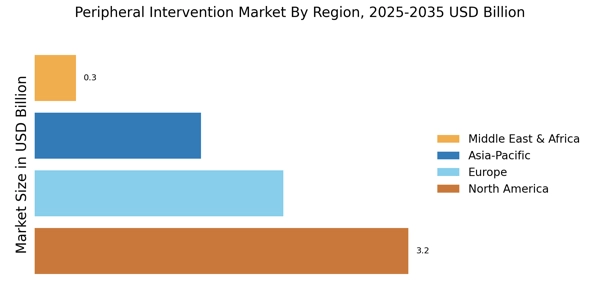
North America is the largest market for peripheral interventions, accounting for approximately 45% of the global share. The growth is driven by an aging population, increasing prevalence of peripheral artery disease, and advancements in medical technology. Regulatory support from agencies like the FDA has also catalyzed innovation and market entry for new devices, enhancing patient outcomes and expanding treatment options.
The United States is the primary contributor, with key players such as Medtronic, Boston Scientific, and Abbott Laboratories leading the market. The competitive landscape is characterized by continuous innovation and strategic partnerships among these companies. The presence of advanced healthcare infrastructure and high healthcare expenditure further solidifies North America's position as a hub for peripheral intervention technologies.
Europe is the second-largest market for peripheral interventions, holding around 30% of the global market share. The region is witnessing growth due to increasing awareness of peripheral diseases, favorable reimbursement policies, and a robust regulatory framework. The European Medicines Agency (EMA) has been instrumental in streamlining the approval process for new devices, thus encouraging innovation and market entry.
Leading countries include Germany, France, and the UK, where significant investments in healthcare technology are being made. Major players like B. Braun Melsungen AG and Philips are expanding their product offerings to meet the rising demand. The competitive landscape is marked by collaborations and mergers, enhancing the capabilities of companies to deliver advanced solutions in peripheral interventions.
Asia-Pacific is rapidly emerging as a significant player in the peripheral intervention market, accounting for approximately 20% of the global share. The growth is driven by rising healthcare expenditures, increasing prevalence of chronic diseases, and a growing elderly population. Countries like China and India are witnessing a surge in demand for advanced medical technologies, supported by government initiatives aimed at improving healthcare access and quality.
China is the largest market in the region, with a competitive landscape featuring both local and international players. Companies like Terumo Corporation and Cook Medical are expanding their presence, focusing on innovative solutions tailored to regional needs. The market is characterized by a mix of established firms and new entrants, fostering a dynamic environment for growth and development.
The Middle East and Africa region is gradually emerging in the peripheral intervention market, holding about 5% of the global share. The growth is primarily driven by increasing healthcare investments, rising awareness of peripheral diseases, and improving healthcare infrastructure. Governments are focusing on enhancing healthcare services, which is expected to boost the demand for advanced medical devices in the coming years.
Leading countries in this region include South Africa and the UAE, where there is a growing presence of international players. Companies are increasingly investing in local partnerships to enhance their market reach. The competitive landscape is evolving, with a focus on innovative solutions and improved patient care, making this region a potential hotspot for future growth in peripheral interventions.
The Peripheral Intervention Market is characterized by a dynamic competitive landscape, driven by technological advancements, increasing prevalence of peripheral vascular diseases, and a growing geriatric population. Major players such as Medtronic (US), Boston Scientific (US), and Abbott Laboratories (US) are strategically positioned to leverage innovation and expand their market share. Medtronic (US) focuses on enhancing its product portfolio through continuous innovation, while Boston Scientific (US) emphasizes strategic partnerships to bolster its technological capabilities. Abbott Laboratories (US) is actively pursuing regional expansion, particularly in emerging markets, which collectively shapes a competitive environment that is increasingly reliant on innovation and strategic collaborations.Key business tactics within the Peripheral Intervention Market include localizing manufacturing and optimizing supply chains to enhance operational efficiency. The market structure appears moderately fragmented, with several key players exerting influence over various segments. This fragmentation allows for a diverse range of products and services, fostering competition that drives innovation. The collective influence of these major players is significant, as they continuously adapt to market demands and regulatory changes, thereby shaping the overall competitive dynamics.
In August Medtronic (US) announced the launch of its next-generation peripheral balloon catheter, which incorporates advanced drug delivery technology. This strategic move is likely to enhance patient outcomes and solidify Medtronic's position as a leader in the peripheral intervention space. The introduction of this innovative product aligns with the company's commitment to addressing unmet medical needs and demonstrates its focus on research and development.
In September Boston Scientific (US) entered into a partnership with a leading digital health company to integrate AI-driven analytics into its peripheral intervention devices. This collaboration is expected to enhance the functionality of their products, providing clinicians with real-time data to improve patient management. The strategic importance of this partnership lies in its potential to revolutionize the way peripheral interventions are performed, thereby positioning Boston Scientific at the forefront of technological advancement in the market.
In July Abbott Laboratories (US) expanded its manufacturing capabilities in Asia to meet the growing demand for peripheral intervention devices. This expansion not only enhances Abbott's supply chain resilience but also allows for quicker response times to market needs. The strategic importance of this move is underscored by the increasing demand for innovative solutions in the region, which Abbott aims to capitalize on through localized production.
As of October current competitive trends in the Peripheral Intervention Market are heavily influenced by digitalization, sustainability, and the integration of artificial intelligence. Strategic alliances are increasingly shaping the landscape, as companies recognize the value of collaboration in driving innovation. Looking ahead, competitive differentiation is likely to evolve from traditional price-based competition to a focus on technological innovation, enhanced patient outcomes, and supply chain reliability. This shift underscores the importance of adaptability and forward-thinking strategies in maintaining a competitive edge in the market.




In July 2026, Abbott received FDA approval for a longer-length (76mm) version of its Esprit BTK Everolimus Eluting Resorbable Scaffold System, a first-of-its-kind dissolving stent for treating chronic limb-threatening ischemia (CLTI) in arteries below the knee, followed by a CE Mark for the same device in Europe in August 2026. This expands treatment options for the most severe form of peripheral artery disease, where patients previously had only balloon angioplasty, which has poor long-term patency; the dissolving design leaves no permanent implant behind. (Source: vascularnews.com)
In May 2026, Boston Scientific announced positive results from its pivotal FRACTURE IDE trial evaluating the investigational SEISMIQ 4CE Coronary Intravascular Lithotripsy (IVL) Catheter for severely calcified coronary artery disease, built on the same console as the company's SEISMIQ IVL Peripheral Catheter, which received FDA clearance in 2025 for severely calcified peripheral artery disease. This validates and extends Boston Scientific's core IVL calcium-modification platform (acquired via Bolt Medical in 2025) from peripheral into coronary disease, reinforcing its position in one of the fastest-growing device segments spanning both peripheral and coronary care. (Source: news.bostonscientific.com)
In April 2026, Medtronic completed its acquisition of CathWorks Ltd., a privately held medical device company focused on diagnosing and treating coronary artery disease, strengthening its Coronary & Peripheral Vascular (CPV) division. This expands Medtronic's combined coronary and peripheral vascular diagnostics and treatment capabilities, a division that also grew from strength in peripheral vascular health products like IN.PACT Admiral and endoVenous offerings. (Source: SEC.gov, Medtronic FY2026 10-K)
Der Markt für periphere Interventionen wird voraussichtlich von 2024 bis 2035 mit einer durchschnittlichen jährlichen Wachstumsrate (CAGR) von 7,77 % wachsen, angetrieben durch technologische Fortschritte, die zunehmende Verbreitung von Gefäßerkrankungen und steigende Gesundheitsausgaben.
Neue Möglichkeiten liegen in:
Bis 2035 wird erwartet, dass der Markt für periphere Interventionen ein erhebliches Wachstum erzielt, das den sich entwickelnden Gesundheitsbedürfnissen Rechnung trägt.
| MARKET SIZE 2024 | 7.047(USD Billion) |
| MARKET SIZE 2025 | 7.595(USD Billion) |
| MARKET SIZE 2035 | 16.05(USD Billion) |
| COMPOUND ANNUAL GROWTH RATE (CAGR) | 7.77% (2025 - 2035) |
| REPORT COVERAGE | Revenue Forecast, Competitive Landscape, Growth Factors, and Trends |
| BASE YEAR | 2024 |
| Market Forecast Period | 2025 - 2035 |
| Historical Data | 2019 - 2024 |
| Market Forecast Units | USD Billion |
| Key Companies Profiled | Medtronic (US), Boston Scientific (US), Abbott Laboratories (US), B. Braun Melsungen AG (DE), Terumo Corporation (JP), Cook Medical (US), Cardinal Health (US), Johnson & Johnson (US), Philips (NL) |
| Segments Covered | Intervention Type, Device Type, Indication, Technology, End-User, Regional |
| Key Market Opportunities | Advancements in minimally invasive techniques enhance growth potential in the Peripheral Intervention Market. |
| Key Market Dynamics | Technological advancements and regulatory changes drive innovation and competition in the Peripheral Intervention Market. |
| Countries Covered | North America, Europe, APAC, South America, MEA |
 Rahul Gotadki

Bitte füllen Sie das folgende Formular aus, um ein kostenloses Muster dieses Berichts zu erhalten


“This is really good guys. Excellent work on a tight deadline. I will continue to use you going forward and recommend you to others. Nice job”
 Noah Malgeri
Co-Founder

“Thanks for sending the report it gives us a good global view of the Betaïne market.”
 Peter Groot koerkamp
Account and Business Manager

“We found the report very insightful! we found your research firm very helpful. I'm sending this email to secure our future business.”
 Younghwan Choi
Senior Retail Manager

“I am very pleased with how market segments have been defined in a relevant way for my purposes (such as "Portable Freezers & refrigerators" and "last-mile"). In general the report is well structured. Thanks very much for your efforts.”
 Mark Irwin
Management Consultant

“We got the report in time, we really thank you for your support in this process. I also thank to all of your team as they did a great job.”
 Akif Moroglu
Strategy & Business Development Director

“The Automotive 48V ECU Components Procurement Intelligence Study” was a complex project, but the Market Research Future (MRFR) team handled it with quality, agility, and customer-centricity. They delivered all requested data on time and within the agreed scope. The team, including Shubhendra Anand and Rahul Gotadki, was always readily available to clarify questions and swiftly implement necessary adjustments, driving the project to a successful conclusion within a very demanding timeframe.
I would also like to specifically commend Akshay Agarwal for his responsiveness and support at every stage—from our initial inquiry on May 6th through to final delivery on June 18th. His dedication made the entire process seamless.”
 Guilherme Gomes Martins
Product Management Director

“Thanks. It’s been a pleasure working with you, please use me as reference with any other Intel employees.”
 Joseph Aguayo
Sales Operations & Pricing Manager

“Thank you, this will be very helpful for OQS.”
 La Terria Dodd
Program Support Specialist

“I have been reading the first document or the study, ,the Global HVAC and FP market report 2021 till 2026. Must say, good info! I have not gone in depth at all parts, but got a good indication of the data inside!”
 Rob Kooiker
Group Product Manager HVAC & Fire Protection GMA



