Wettbewerbsfähiger Markt für lokale Austauschbetreiber Zusammenfassung
Wichtige Markttrends & Highlights
Marktgröße & Prognose
| CAGR (2025 - 2035) | 4.33% |
| CAGR (2025 - 2035) | 4.33% |
The Competitive Local Exchange Carrier Market is currently experiencing a dynamic evolution, driven by advancements in technology and shifting consumer preferences. As telecommunications infrastructure continues to modernize, local exchange carriers are adapting to provide enhanced services that meet the demands of both residential and business customers. The rise of digital communication platforms and the increasing reliance on high-speed internet have compelled these carriers to innovate and diversify their offerings. This transformation is not merely a response to competition; it reflects a broader trend towards integrated communication solutions that encompass voice, data, and video services. Moreover, regulatory changes and the push for greater competition in the telecommunications sector are reshaping the landscape. Local exchange carriers are now more focused on customer-centric strategies, aiming to improve service quality and customer satisfaction. This shift is indicative of a market that is not only competitive but also increasingly collaborative, as carriers explore partnerships and alliances to enhance their service portfolios. The Competitive Local Exchange Carrier Market appears poised for further growth, with potential opportunities emerging in areas such as cloud services and IoT connectivity, which could redefine traditional service models.
The Competitive Local Exchange Carrier Market is witnessing rapid technological advancements that are reshaping service delivery. Innovations in fiber-optic technology and wireless communication are enabling carriers to offer faster and more reliable services. This trend suggests a shift towards next-generation networks that can support increasing data demands and enhance user experiences.
Regulatory changes are playing a crucial role in the Competitive Local Exchange Carrier Market. Governments are implementing policies aimed at fostering competition and ensuring fair access to telecommunications infrastructure. These changes may lead to a more level playing field, encouraging new entrants and stimulating innovation among existing carriers.
There is a noticeable shift towards customer-centric strategies within the Competitive Local Exchange Carrier Market. Carriers are increasingly focusing on understanding customer needs and preferences, leading to tailored service offerings. This trend indicates a move away from traditional models, as companies strive to enhance customer satisfaction and loyalty.
The Competitive Local Exchange Carrier Market is currently experiencing a surge in demand for high-speed internet services. As consumers and businesses alike seek faster and more reliable connectivity, local exchange carriers are compelled to enhance their infrastructure. According to recent data, the number of broadband subscriptions has increased significantly, with a notable rise in fiber-optic connections. This trend indicates that competitive local exchange carriers must invest in advanced technologies to meet customer expectations. The growing reliance on digital services, including remote work and online education, further fuels this demand. Consequently, local exchange carriers are likely to expand their service offerings and improve network capabilities to capture a larger market share.
In the Competitive Local Exchange Carrier Market, Voice over IP (VoIP) leads the service type segment, capturing a significant market share due to its cost-effectiveness and expanding adoption among businesses and residential users. Integrated Services Digital Network (ISDN) and T1 and T3 lines follow, though they represent a smaller portion of the market as newer technologies emerge. Dedicated Internet Access (DIA) is experiencing growth as companies seek reliable high-speed internet solutions for their operations, signaling a shift from traditional offerings. The growth trends in this segment are primarily driven by the increasing demand for high-quality voice services, the rise of remote work, and the proliferation of internet-based communication tools. VoIP adoption is surging as organizations seek to reduce operational costs, while DIA is becoming more popular due to the need for faster internet solutions as businesses pursue digital transformation. ISDN, while still used, faces pressure from more advanced technologies, indicating a transition towards more contemporary communication infrastructures.
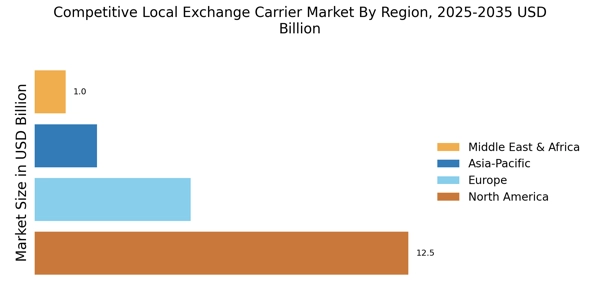
North America is the largest market for Competitive Local Exchange Carriers (CLECs), holding approximately 60% of the global market share. The region's growth is driven by increasing demand for high-speed internet and regulatory support for competition among service providers. The Federal Communications Commission (FCC) has implemented policies to promote market entry and innovation, further fueling growth in this sector. The United States is the primary player in this market, with key companies like AT&T, Verizon, and CenturyLink leading the charge. The competitive landscape is characterized by a mix of established giants and emerging players, all vying for market share. The presence of these major companies ensures a robust infrastructure and a wide range of services, catering to both residential and business customers.
Europe is witnessing a significant transformation in the Competitive Local Exchange Carrier Market, with a market share of approximately 25%. The growth is driven by increasing demand for broadband services and regulatory frameworks that encourage competition. The European Union has been proactive in implementing policies aimed at enhancing connectivity and reducing barriers for new entrants, which has catalyzed market expansion across member states. Leading countries in this region include the United Kingdom, Germany, and France, where local exchange carriers are increasingly competing with traditional telecom operators. The competitive landscape is evolving, with both established players and new entrants focusing on innovative service offerings. Companies are investing in next-generation technologies to enhance service delivery and customer experience, positioning themselves for future growth.
The Asia-Pacific region is rapidly emerging as a significant player in the Competitive Local Exchange Carrier Market, holding about 10% of the global market share. The growth is fueled by increasing urbanization, rising internet penetration, and government initiatives aimed at enhancing digital infrastructure. Countries like India and China are leading this growth, supported by favorable regulatory environments that encourage competition and investment in telecommunications. In this region, the competitive landscape is marked by a mix of local and international players, with companies striving to offer innovative solutions to meet the diverse needs of consumers. The presence of major telecommunications firms and a growing number of startups are driving competition, leading to improved service quality and customer satisfaction. This dynamic environment is expected to continue fostering growth in the coming years.
The Middle East and Africa region is gradually developing its Competitive Local Exchange Carrier Market, currently holding around 5% of the global market share. The growth is primarily driven by increasing demand for telecommunications services and government initiatives aimed at improving connectivity. Regulatory bodies in various countries are working to create a more competitive environment, which is essential for attracting investment and enhancing service delivery. Leading countries in this region include South Africa, Nigeria, and Kenya, where local exchange carriers are beginning to emerge as viable alternatives to traditional telecom operators. The competitive landscape is still evolving, with a mix of established players and new entrants. As infrastructure improves and competition intensifies, the market is expected to grow, providing more options for consumers and businesses alike.
The Competitive Local Exchange Carrier Market is characterized by a dynamic interplay of innovation, strategic partnerships, and regional expansion, which collectively drive growth. Key players such as AT&T (US), Verizon (US), and CenturyLink (US) are at the forefront of this competitive landscape. AT&T (US) has focused on enhancing its fiber-optic network, aiming to provide high-speed internet access to underserved areas, thereby positioning itself as a leader in digital transformation. Verizon (US), on the other hand, has been investing heavily in 5G technology, which not only enhances mobile connectivity but also supports the development of smart cities and IoT applications. CenturyLink (US) has adopted a strategy centered around mergers and acquisitions, seeking to consolidate its market position and expand its service offerings, particularly in cloud solutions and managed services. These strategies collectively shape a competitive environment that emphasizes technological advancement and customer-centric solutions.In terms of business tactics, companies are increasingly localizing their operations and optimizing supply chains to enhance service delivery and reduce costs. The market structure appears moderately fragmented, with several players vying for market share, yet the influence of major companies remains substantial. This competitive structure allows for a diverse range of services and innovations, catering to varying customer needs across different regions.
In August AT&T (US) announced a significant investment in expanding its fiber-optic network, aiming to reach an additional 1 million homes by the end of 2026. This strategic move is crucial as it not only enhances AT&T's competitive edge in the broadband market but also addresses the growing demand for high-speed internet, particularly in rural areas. By prioritizing infrastructure development, AT&T positions itself as a key player in bridging the digital divide.
In September Verizon (US) launched a new initiative focused on integrating AI into its customer service operations. This initiative aims to streamline customer interactions and improve service efficiency. The strategic importance of this move lies in Verizon's commitment to enhancing customer experience through technology, which could potentially lead to increased customer loyalty and retention in a highly competitive market.
In July CenturyLink (US) completed the acquisition of a regional telecommunications provider, which significantly bolstered its service capabilities in the Midwest. This acquisition is strategically important as it not only expands CenturyLink's customer base but also enhances its ability to offer bundled services, thereby increasing its competitiveness against larger rivals.
As of October the Competitive Local Exchange Carrier Market is witnessing trends that emphasize digitalization, sustainability, and the integration of advanced technologies such as AI. Strategic alliances among companies are increasingly shaping the landscape, allowing for shared resources and expertise. Looking ahead, competitive differentiation is likely to evolve from traditional price-based competition to a focus on innovation, technological advancements, and supply chain reliability. This shift suggests that companies will need to invest in cutting-edge solutions and sustainable practices to maintain their competitive edge.






Q3 2026: CenturyLink / Lumen (US): Lumen Technologies announced its plans to transfer its stock exchange listing to Nasdaq and launched its Intelligent Internet platform to provide enterprise cloud agility.
Q3 2026: Windstream (US): Windstream Parent received key regulatory approvals for its transaction with Uniti Group, with the combined surviving entity operating under Uniti Group.
Q3 2026: TDS Telecom (US): TDS Telecom completed its acquisition of Granite State Communications while raising its full-year guidance for fiber address deliveries.
Q3 2026: Cox Communications (US): Charter Communications officially closed its $34.5 billion acquisition of Cox Communications to build nationwide cable and broadband scale.
The Competitive Local Exchange Carrier Market (CLEC) market is expected to witness substantial growth over the forecast period, driven by increasing demand for high-speed internet, cloud-based services, and the proliferation of mobile devices. In 2023, the market was valued at around USD 19.19 billion, and it is projected to reach USD 28.1 billion by 2032, exhibiting a CAGR of 4.33%.
In 2022, AT&T announced plans to expand its fiber network to reach an additional 30 million customer locations by 2025. This investment is expected to drive growth in the CLEC market by providing faster and more reliable internet access to consumers and businesses.
Verizon is also investing heavily in its fiber network, with plans to reach 20 million additional customer locations by 2023. This investment is expected to further intensify competition in the CLEC market and drive down prices for consumers.
In 2023, T-Mobile and Sprint completed their merger, creating the second-largest wireless carrier in the United States. This merger is expected to have a significant impact on the CLEC market, as T-Mobile and Sprint will now be able to offer bundled services that include wireless, broadband, and home phone services.The COVID-19 pandemic has accelerated the adoption of digital technologies, leading to increased demand for CLEC services. As more people work and learn from home, they require reliable and affordable internet access. This trend is expected to continue in the post-pandemic era, driving growth in the CLEC market.
Der Markt für wettbewerbliche lokale Telefonanbieter wird von 2024 bis 2035 voraussichtlich mit einer durchschnittlichen jährlichen Wachstumsrate (CAGR) von 4,33 % wachsen, angetrieben durch technologische Fortschritte und die steigende Nachfrage nach Hochgeschwindigkeitsverbindungen.
Neue Möglichkeiten liegen in:
Bis 2035 wird erwartet, dass der Markt seine Position als wichtiger Akteur im globalen Telekommunikationssektor festigt.
| MARKET SIZE 2024 | 20.9(USD Billion) |
| MARKET SIZE 2025 | 21.8(USD Billion) |
| MARKET SIZE 2035 | 33.32(USD Billion) |
| COMPOUND ANNUAL GROWTH RATE (CAGR) | 4.33% (2025 - 2035) |
| REPORT COVERAGE | Revenue Forecast, Competitive Landscape, Growth Factors, and Trends |
| BASE YEAR | 2024 |
| Market Forecast Period | 2025 - 2035 |
| Historical Data | 2019 - 2024 |
| Market Forecast Units | USD Billion |
| Key Companies Profiled | AT&T (US), Verizon (US), CenturyLink (US), Frontier Communications (US), Windstream (US), TDS Telecom (US), Cox Communications (US), Comcast (US) |
| Segments Covered | Service Type, Business Size, Deployment Model, Application, Regional |
| Key Market Opportunities | Integration of advanced technologies enhances service offerings in the Competitive Local Exchange Carrier Market. |
| Key Market Dynamics | Intensifying competition among providers drives innovation and service differentiation in the Competitive Local Exchange Carrier Market. |
| Countries Covered | North America, Europe, APAC, South America, MEA |
 Ankit Gupta

 Aarti Dhapte
Bitte füllen Sie das folgende Formular aus, um ein kostenloses Muster dieses Berichts zu erhalten


“This is really good guys. Excellent work on a tight deadline. I will continue to use you going forward and recommend you to others. Nice job”
 Noah Malgeri
Co-Founder

“Thanks for sending the report it gives us a good global view of the Betaïne market.”
 Peter Groot koerkamp
Account and Business Manager

“We found the report very insightful! we found your research firm very helpful. I'm sending this email to secure our future business.”
 Younghwan Choi
Senior Retail Manager

“I am very pleased with how market segments have been defined in a relevant way for my purposes (such as "Portable Freezers & refrigerators" and "last-mile"). In general the report is well structured. Thanks very much for your efforts.”
 Mark Irwin
Management Consultant

“We got the report in time, we really thank you for your support in this process. I also thank to all of your team as they did a great job.”
 Akif Moroglu
Strategy & Business Development Director

“The Automotive 48V ECU Components Procurement Intelligence Study” was a complex project, but the Market Research Future (MRFR) team handled it with quality, agility, and customer-centricity. They delivered all requested data on time and within the agreed scope. The team, including Shubhendra Anand and Rahul Gotadki, was always readily available to clarify questions and swiftly implement necessary adjustments, driving the project to a successful conclusion within a very demanding timeframe.
I would also like to specifically commend Akshay Agarwal for his responsiveness and support at every stage—from our initial inquiry on May 6th through to final delivery on June 18th. His dedication made the entire process seamless.”
 Guilherme Gomes Martins
Product Management Director

“Thanks. It’s been a pleasure working with you, please use me as reference with any other Intel employees.”
 Joseph Aguayo
Sales Operations & Pricing Manager

“Thank you, this will be very helpful for OQS.”
 La Terria Dodd
Program Support Specialist

“I have been reading the first document or the study, ,the Global HVAC and FP market report 2021 till 2026. Must say, good info! I have not gone in depth at all parts, but got a good indication of the data inside!”
 Rob Kooiker
Group Product Manager HVAC & Fire Protection GMA


