Chemikalien als Dienstleistung Markt Zusammenfassung
Wichtige Markttrends & Highlights
Marktgröße & Prognose
| CAGR (2025 - 2035) | 7.38% |
The Chemical as a Service Market is evolving rapidly, driven by the increasing demand for sustainable and efficient chemical solutions. Companies are shifting from traditional ownership models to service-oriented approaches, which allow for greater flexibility and reduced environmental impact. This transition appears to be influenced by a growing awareness of the need for sustainable practices across various industries. As organizations seek to optimize their operations, the Chemical as a Service Market model offers a viable alternative that aligns with their sustainability goals. Moreover, the market is characterized by a diverse range of applications, spanning sectors such as agriculture, pharmaceuticals, and manufacturing. This diversification suggests that the Chemical as a Service Market is not only adaptable but also resilient in the face of changing economic conditions. The emphasis on innovation and technology integration further enhances the appeal of this model, as companies leverage advanced analytics and digital tools to improve service delivery. Overall, the Chemical as a Service Market is poised for continued growth, reflecting broader trends towards sustainability and efficiency in the global economy.
The Chemical as a Service Market is increasingly emphasizing sustainability, as companies strive to minimize their environmental footprint. This trend indicates a shift towards eco-friendly practices, where service providers offer solutions that reduce waste and promote resource efficiency.
The integration of advanced technologies is becoming a hallmark of the Chemical as a Service Market. Companies are leveraging digital tools and data analytics to enhance service delivery, optimize processes, and improve customer experiences, suggesting a move towards more sophisticated service models.
Customization is emerging as a key trend within the Chemical as a Service Market. Service providers are tailoring their offerings to meet specific client needs, which enhances flexibility and responsiveness. This trend reflects a broader demand for personalized solutions in various industries.
Die Kosteneffizienz bleibt ein grundlegender Treiber im Markt für Chemie als Dienstleistung. Unternehmen suchen zunehmend nach Möglichkeiten, die Betriebskosten zu senken und gleichzeitig hohe Qualitätsstandards aufrechtzuerhalten. Der Übergang zu dienstleistungsbasierten Modellen ermöglicht es Unternehmen, die Ressourcenzuteilung zu optimieren und die Investitionsausgaben zu minimieren. Durch das Outsourcing chemischer Dienstleistungen können Organisationen sich auf ihre Kernkompetenzen konzentrieren und erhebliche Einsparungen erzielen. Marktdaten zeigen, dass Unternehmen, die Lösungen im Markt für Chemie als Dienstleistung nutzen, die Kosten im Vergleich zu traditionellen Modellen um bis zu 20 % senken können. Dieser finanzielle Anreiz wird voraussichtlich das Wachstum des Marktes für Chemie als Dienstleistung vorantreiben, da immer mehr Unternehmen die Vorteile kosteneffizienter chemischer Lösungen erkennen.
Regulatorische Compliance ist ein entscheidender Treiber, der den Markt für Chemie als Dienstleistung beeinflusst. Da Regierungen weltweit strengere Vorschriften zur chemischen Sicherheit und zur Umweltverträglichkeit umsetzen, sind Unternehmen gezwungen, konforme Praktiken zu übernehmen. Diese Notwendigkeit schafft Chancen für Dienstleister, die Expertise im Umgang mit komplexen regulatorischen Rahmenbedingungen anbieten können. Der Markt für compliancebezogene Dienstleistungen wird voraussichtlich wachsen, wobei Schätzungen eine Wachstumsrate von etwa 7 % jährlich vorschlagen. Durch die Gewährleistung der Einhaltung von Vorschriften können Unternehmen Risiken mindern und ihren Ruf verbessern, wodurch die Nachfrage im Markt für Chemie als Dienstleistung gesteigert wird.
Die zunehmende Betonung der Nachhaltigkeit im Chemie-als-Service-Markt treibt die Nachfrage nach umweltfreundlichen Lösungen voran. Unternehmen übernehmen zunehmend nachhaltige Praktiken, um ihren CO2-Fußabdruck zu reduzieren und strengen Umweltvorschriften zu entsprechen. Dieser Wandel ist offensichtlich, da Organisationen bestrebt sind, Abfall zu minimieren und die Ressourceneffizienz zu steigern. Der Markt für nachhaltige Chemikalien wird voraussichtlich erheblich wachsen, wobei Schätzungen eine durchschnittliche jährliche Wachstumsrate (CAGR) von über 10 % in den kommenden Jahren vorschlagen. Da Unternehmen Nachhaltigkeit priorisieren, wird der Chemie-als-Service-Markt voraussichtlich einen Anstieg der Nachfrage nach innovativen, umweltfreundlichen chemischen Lösungen erleben, die mit den Zielen der sozialen Verantwortung von Unternehmen in Einklang stehen.
Anpassung und Flexibilität werden zu entscheidenden Treibern im Markt für Chemie als Dienstleistung. Die Kunden verlangen zunehmend maßgeschneiderte Lösungen, die ihren spezifischen Bedürfnissen entsprechen, was zu einem Abkehr von Einheitslösungen führt. Dieser Trend ist besonders ausgeprägt in Sektoren wie der Pharmaindustrie und Spezialchemikalien, wo einzigartige Formulierungen unerlässlich sind. Die Fähigkeit, maßgeschneiderte chemische Lösungen anzubieten, erhöht nicht nur die Kundenzufriedenheit, sondern fördert auch langfristige Partnerschaften. Marktanalysen zeigen, dass Unternehmen, die flexible Dienstleistungsmodelle anbieten, wahrscheinlich einen größeren Anteil am Markt für Chemie als Dienstleistung gewinnen werden, da sie sich effektiver an die sich ändernden Anforderungen der Kunden anpassen können.
Technologische Fortschritte verändern den Markt für Chemie als Dienstleistung und ermöglichen eine verbesserte Effizienz und Produktivität. Innovationen in den Bereichen Automatisierung, Datenanalyse und künstliche Intelligenz optimieren die chemischen Produktionsprozesse, senken die Kosten und verbessern die Produktqualität. Beispielsweise ermöglicht die Integration von IoT-Geräten eine Echtzeitüberwachung chemischer Prozesse, was zu optimierten Abläufen führt. Es wird erwartet, dass der Markt einen signifikanten Anstieg der Akzeptanz dieser Technologien verzeichnen wird, wobei Prognosen eine Wachstumsrate von etwa 8 % jährlich angeben. Während Unternehmen Technologie nutzen, um ihre Dienstleistungsangebote zu verbessern, steht der Markt für Chemie als Dienstleistung vor einer erheblichen Transformation.
In the Chemical as a Service Market, the segment values demonstrate a dynamic market share distribution. Specialty Chemicals hold the largest share, reflecting their essential role in industries such as pharmaceuticals and agrochemicals, where tailored solutions are crucial. Following closely are Basic Chemicals, which serve as fundamental inputs across various manufacturing processes. Surfactants and Polymers also contribute significantly to the market landscape, benefiting from diverse applications in everyday consumer products and industrial sectors.
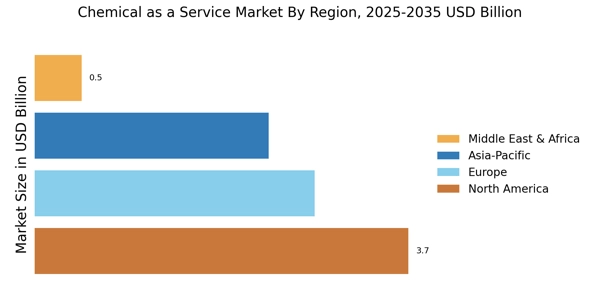
North America is the largest market for Chemical as a Service Market, holding approximately 40% of the global market share. The region's growth is driven by increasing demand for sustainable chemical solutions and stringent environmental regulations. The push for innovation in chemical processes and the adoption of circular economy principles are key catalysts for market expansion. Additionally, government incentives for green technologies further bolster this growth. The United States and Canada are the leading countries in this region, with major players like Dow Inc. and BASF SE establishing a strong presence. The competitive landscape is characterized by significant investments in R&D and partnerships aimed at enhancing service offerings. The focus on digital transformation and automation in chemical processes is also reshaping the market dynamics, making it more efficient and responsive to customer needs.
Europe is the second-largest market for Chemical as a Service Market, accounting for approximately 30% of the global market share. The region's growth is significantly influenced by stringent regulations aimed at reducing carbon emissions and promoting sustainable practices. The European Green Deal and REACH regulations are pivotal in driving demand for innovative chemical solutions that align with environmental goals. This regulatory framework encourages companies to adopt more sustainable practices, fostering market growth. Germany, France, and the Netherlands are the leading countries in this market, with key players like BASF SE and Evonik Industries AG leading the charge. The competitive landscape is marked by a strong emphasis on innovation and collaboration among industry stakeholders. Companies are increasingly focusing on developing customized solutions to meet specific customer needs, enhancing their market position and driving growth.
Asia-Pacific is rapidly emerging as a significant player in the Chemical as a Service Market, holding approximately 25% of the global market share. The region's growth is driven by increasing industrialization, urbanization, and a rising demand for specialty chemicals. Countries like China and India are at the forefront, with government initiatives promoting sustainable practices and innovation in the chemical sector. The region's diverse industrial base further supports the demand for chemical services, making it a key growth area. China is the largest market in the region, followed by India and Japan. The competitive landscape is characterized by a mix of local and international players, including Mitsubishi Chemical Corporation and SABIC. Companies are focusing on expanding their service offerings and enhancing operational efficiencies to capture a larger market share. The emphasis on research and development is also crucial for maintaining competitiveness in this dynamic market.
The Middle East and Africa region is witnessing a gradual increase in the Chemical as a Service Market, holding approximately 5% of the global market share. The growth is primarily driven by the region's abundant natural resources and the increasing demand for petrochemicals. Countries like Saudi Arabia and the UAE are investing heavily in diversifying their economies and enhancing their chemical manufacturing capabilities, which is expected to boost market growth in the coming years. Saudi Arabia is the leading country in this region, with major players like SABIC dominating the market. The competitive landscape is evolving, with a focus on innovation and sustainability. Companies are increasingly looking to adopt advanced technologies and processes to improve efficiency and reduce environmental impact. The presence of significant investments in infrastructure and technology further supports the growth of the chemical services market in this region.
The Chemical as a Service Market is currently characterized by a dynamic competitive landscape, driven by increasing demand for sustainable solutions and innovative service models. Key players such as BASF SE (Germany), Dow Inc. (US), and SABIC (Saudi Arabia) are strategically positioning themselves through a combination of technological advancements and collaborative partnerships. For instance, BASF SE (Germany) has been focusing on digital transformation initiatives to enhance operational efficiency and customer engagement, while Dow Inc. (US) emphasizes sustainability in its service offerings, aiming to reduce carbon footprints across its supply chain. These strategies collectively foster a competitive environment that prioritizes innovation and responsiveness to market needs.In terms of business tactics, companies are increasingly localizing manufacturing to reduce lead times and optimize supply chains. The market structure appears moderately fragmented, with several players vying for market share, yet the influence of major corporations remains substantial. This competitive structure allows for a diverse range of service offerings, catering to various customer needs while also encouraging smaller firms to innovate and differentiate themselves.
In August Dow Inc. (US) announced a strategic partnership with a leading technology firm to develop AI-driven solutions for chemical production optimization. This move is likely to enhance Dow's operational capabilities, enabling more efficient resource utilization and reduced waste, which aligns with the growing emphasis on sustainability in the industry. Such partnerships may also position Dow as a leader in the integration of advanced technologies within the Chemical as a Service framework.
In September SABIC (Saudi Arabia) launched a new initiative aimed at enhancing circular economy practices within its service offerings. This initiative focuses on recycling and reusing materials, which not only addresses environmental concerns but also appeals to a growing segment of eco-conscious consumers. The strategic importance of this initiative lies in its potential to differentiate SABIC in a competitive market increasingly focused on sustainability.
In October Evonik Industries AG (Germany) unveiled a new digital platform designed to streamline customer interactions and improve service delivery. This platform is expected to enhance customer experience by providing real-time data and insights, thereby fostering stronger relationships and loyalty. The introduction of such digital solutions indicates a broader trend towards digitalization in the Chemical as a Service Market, where companies are leveraging technology to enhance service efficiency and customer satisfaction.
As of October current competitive trends are heavily influenced by digitalization, sustainability, and the integration of AI technologies. Strategic alliances are becoming increasingly vital, as they enable companies to pool resources and expertise to tackle complex challenges. Looking ahead, it appears that competitive differentiation will evolve from traditional price-based competition to a focus on innovation, technological advancement, and supply chain reliability, reflecting the industry's shift towards more sustainable and efficient practices.
December 2025: 3E and ServiceNow – Partnership to deliver integrated chemical management solutions
3E announced a partnership with ServiceNow to provide safety data sheets (SDS) and indexed chemical data for ServiceNow's Health and Safety Chemical Management Solution. The integration brings 3E's 3E Protect SDS library and regulatory chemical information into the ServiceNow AI Platform, helping businesses centralize chemical inventories, streamline regulatory compliance and improve workplace chemical safety. This development supports the digitalization of chemical management services.
November 2025: Ecolab – Cooling as a Service program launched for data centers
Ecolab introduced an integrated Cooling as a Service (CaaS) program designed to improve cooling performance and resource efficiency in data centers. The solution combines its 3D TRASAR technology for direct-to-chip liquid cooling with smart Coolant Distribution Unit capabilities, alongside chemical and water-management expertise. The service-based approach enables data center operators to optimize cooling operations, monitor system performance and improve resource utilization. It demonstrates the expansion of service-based chemical and water-management models into high-growth data infrastructure applications.
2026: Häffner – Smart Chemicals digital service models for chemical supply and inventory management
Häffner's Smart Chemicals portfolio combines digital process optimization with chemical supply services through Track & Return and ChemAbo models. Track & Return uses sensor information, including container location, fill levels and temperature, to improve returnable-container management. ChemAbo supports automated replenishment through vendor-managed inventory. Häffner has also outlined a chemical-leasing model based on consumption and pay-per-use, extending its service offering beyond conventional chemical sales.
2026: SAFECHEM – COMPLEASE chemical leasing promotes performance-based solvent management
SAFECHEM highlighted its COMPLEASE chemical-leasing model at the 2026 International Manufacturing Technology Show (IMTS). Instead of purchasing solvents by volume, customers pay a fixed monthly fee for a performance package that includes fresh solvent supply, collection of used solvent through the SAFE-TAINER system, waste analysis, technical consultancy and related process support. The model illustrates how chemical suppliers are shifting toward integrated service contracts that combine product supply, recovery and technical assistance.
Der Markt für Chemie als Dienstleistung wird von 2024 bis 2035 voraussichtlich mit einer durchschnittlichen jährlichen Wachstumsrate (CAGR) von 7,38 % wachsen, angetrieben durch Nachhaltigkeitsinitiativen, technologische Fortschritte und die steigende Nachfrage nach maßgeschneiderten chemischen Lösungen.
Neue Möglichkeiten liegen in:
Bis 2035 wird erwartet, dass der Markt ein robustes Wachstum erzielt und sich als führend in nachhaltigen chemischen Lösungen positioniert.
| MARKET SIZE 2024 | 9.348(USD Billion) |
| MARKET SIZE 2025 | 10.04(USD Billion) |
| MARKET SIZE 2035 | 20.46(USD Billion) |
| COMPOUND ANNUAL GROWTH RATE (CAGR) | 7.38% (2025 - 2035) |
| REPORT COVERAGE | Revenue Forecast, Competitive Landscape, Growth Factors, and Trends |
| BASE YEAR | 2024 |
| Market Forecast Period | 2025 - 2035 |
| Historical Data | 2019 - 2024 |
| Market Forecast Units | USD Billion |
| Key Companies Profiled | BASF SE (DE), Dow Inc. (US), SABIC (SA), Evonik Industries AG (DE), LyondellBasell Industries N.V. (US), Mitsubishi Chemical Corporation (JP), Solvay S.A. (BE), Eastman Chemical Company (US), AkzoNobel N.V. (NL) |
| Segments Covered | Chemical Type, Service Type, Industry Application, Deployment Model, End User, Regional |
| Key Market Opportunities | Integration of sustainable practices and digital solutions in the Chemical as a Service Market. |
| Key Market Dynamics | Rising demand for sustainable solutions drives innovation and competition in the Chemical as a Service Market. |
| Countries Covered | North America, Europe, APAC, South America, MEA |
 Priya Nagrale

Bitte füllen Sie das folgende Formular aus, um ein kostenloses Muster dieses Berichts zu erhalten


“This is really good guys. Excellent work on a tight deadline. I will continue to use you going forward and recommend you to others. Nice job”
 Noah Malgeri
Co-Founder

“Thanks for sending the report it gives us a good global view of the Betaïne market.”
 Peter Groot koerkamp
Account and Business Manager

“We found the report very insightful! we found your research firm very helpful. I'm sending this email to secure our future business.”
 Younghwan Choi
Senior Retail Manager

“I am very pleased with how market segments have been defined in a relevant way for my purposes (such as "Portable Freezers & refrigerators" and "last-mile"). In general the report is well structured. Thanks very much for your efforts.”
 Mark Irwin
Management Consultant

“We got the report in time, we really thank you for your support in this process. I also thank to all of your team as they did a great job.”
 Akif Moroglu
Strategy & Business Development Director

“The Automotive 48V ECU Components Procurement Intelligence Study” was a complex project, but the Market Research Future (MRFR) team handled it with quality, agility, and customer-centricity. They delivered all requested data on time and within the agreed scope. The team, including Shubhendra Anand and Rahul Gotadki, was always readily available to clarify questions and swiftly implement necessary adjustments, driving the project to a successful conclusion within a very demanding timeframe.
I would also like to specifically commend Akshay Agarwal for his responsiveness and support at every stage—from our initial inquiry on May 6th through to final delivery on June 18th. His dedication made the entire process seamless.”
 Guilherme Gomes Martins
Product Management Director

“Thanks. It’s been a pleasure working with you, please use me as reference with any other Intel employees.”
 Joseph Aguayo
Sales Operations & Pricing Manager

“Thank you, this will be very helpful for OQS.”
 La Terria Dodd
Program Support Specialist

“I have been reading the first document or the study, ,the Global HVAC and FP market report 2021 till 2026. Must say, good info! I have not gone in depth at all parts, but got a good indication of the data inside!”
 Rob Kooiker
Group Product Manager HVAC & Fire Protection GMA