Request Free Sample ×

Kindly complete the form below to receive a free sample of this Report

* Please use a valid business email

Leading companies partner with us for data-driven Insights

clients tt-cursor
Hero Background

Bio-Based Succinic Acid Market

ID: MRFR/CnM/6309-HCR
111 Pages
Chitranshi Jaiswal
Last Updated: May 15, 2026

Informationen zum Marktforschungsbericht zu biobasierter Bernsteinsäure nach Verarbeitungstyp (Ammoniumsulfatverfahren, Direktkristallisationsverfahren), Anwendung (1,4-Butandiol, Polybutylensuccinat, Weichmacher), Endverbrauchsindustrie (Chemie, Lebensmittel) und regionaler Prognose bis 2030

Teilen
Download PDF ×

We do not share your information with anyone. However, we may send you emails based on your report interest from time to time. You may contact us at any time to opt-out.

Bio-Based Succinic Acid Market Infographic
Purchase Options

Marktüberblick über biobasierte Bernsteinsäure

pLaut den Forschungsberichten von MRFR wird der globale Markt für biobasierte Bernsteinsäure im Berichtszeitraum voraussichtlich mit einer gesunden CAGR von 19,6 % florieren. Der Bericht prognostiziert außerdem, dass der Markt bis zum Ende des Prognosezeitraums 900 Millionen USD erreichen wird. Im Allgemeinen wird Bernsteinsäure hauptsächlich aus der C4-Fraktion von Naphtha und einem Vier-Kohlenstoff-Kohlenwasserstoff über Maleinsäureanhydrid hergestellt. Die Bernsteinsäure wird anschließend durch Hydrierung von Hydrat und Maleinsäureanhydrid gewonnen. Die umweltfreundliche Bernsteinsäure wird häufig zur Herstellung von Beschichtungen, Harzen und Tinte verwendet.

Die zunehmende globale Umweltverschmutzung und der steigende CO2-Fußabdruck werden voraussichtlich das Wachstum des Marktes für biobasierte Bernsteinsäure vorantreiben. Zu diesem globalen Markt gehören viele geografische Standorte, darunter Nordamerika, der Nahe Osten, Afrika, Europa, der asiatisch-pazifische Raum und andere. Davon wird der nordamerikanische Regionalmarkt im Prognosezeitraum voraussichtlich den größten Marktanteil generieren.

Der globale Markt für biobasierte Bernsteinsäure wurde basierend auf Anwendung, Endverbrauchsbranche und verarbeitetem Typ segmentiert. Darüber hinaus wurde die Endverbrauchsbranche in Lebensmittel und Getränke, Körperpflege, Pharmazie, Landwirtschaft und Chemie segmentiert. Das Segment verarbeiteter Typ ist in verschiedene Bereiche unterteilt, wie z. B. Direktkristallisationsverfahren, Elektrodialyseverfahren und Ammoniumsulfatverfahren. Das Anwendungssegment ist in verschiedene Bereiche wie 1,4-Butandiol, Lösungsmittel und Beschichtungen, Weichmacher, Polymere und Ester, Polybutylensuccinat und andere.

Globaler Markt für biobasierte Bernsteinsäure nach Anwendung, 2017 (%)
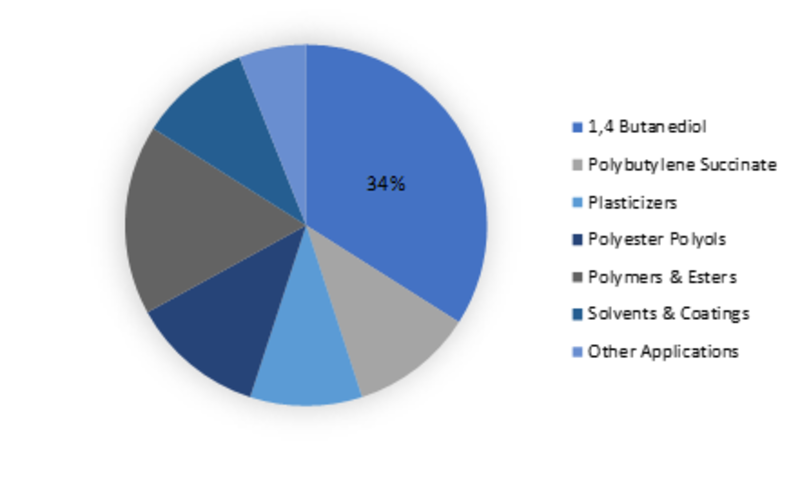
Globaler Markt für biobasierte Bernsteinsäure nach Anwendung, 2017 (%)

Quelle: MRFR-Analyse

Segmentanalyse

pDer globale Markt für biobasierte Bernsteinsäure wurde nach Verarbeitungstyp, Anwendung, Endverbrauchsbranche und Region segmentiert.

Basierend auf dem Verarbeitungstyp ist der globale Markt für biobasierte Bernsteinsäure Der Markt für biobasierte Bernsteinsäure wurde in das Ammoniumsulfatverfahren, das Direktkristallisationsverfahren und das Elektrodialyseverfahren unterteilt.

Nach Anwendung wurde die globale biobasierte Bernsteinsäure in 1,4-Butandiol, Polybutylensuccinat, Weichmacher, Polyesterpolyole, Polymere und Ester, Lösungsmittel und Beschichtungen sowie andere Anwendungen kategorisiert.

Nach Endverbrauchsindustrie wurde die globale biobasierte Bernsteinsäure in die Branchen Chemie, Lebensmittel und Getränke, Pharmazie, Körperpflege und Landwirtschaft unterteilt.

Regionale Analyse

pDer globale Markt für biobasierte Bernsteinsäure erstreckt sich über fünf Regionen, nämlich Asien-Pazifik, Nordamerika, Europa, Lateinamerika sowie den Nahen Osten und Afrika.

Der nordamerikanische Markt hatte 2018 den größten Anteil am globalen Markt für biobasierte Bernsteinsäure. Die zunehmende Verwendung biobasierter Bernsteinsäure in der chemischen und pharmazeutischen Industrie treibt das Wachstum des Marktes für biobasierte Bernsteinsäure in der Region voran. Es wird erwartet, dass der regionale Markt im Prognosezeitraum seine beherrschende Stellung behält.

Der asiatisch-pazifische Markt für biobasierte Bernsteinsäure war der am schnellsten wachsende und hatte 2018 den zweitgrößten Anteil. Die steigende Nachfrage in der Pharma-, Automobil- und Agrarindustrie in Indien, China, Thailand und Südkorea wird voraussichtlich das Wachstum des Marktes für biobasierte Bernsteinsäure in der Region ankurbeln. Es wird erwartet, dass der asiatisch-pazifische Raum bis zum Ende des Prognosezeitraums der dominierende regionale Markt sein wird.

Der europäische Markt folgte dem asiatisch-pazifischen Markt 2018 hinsichtlich des Marktanteils dicht auf. Die zunehmende Verwendung biobasierter Bernsteinsäure in Lebensmitteln und Die Getränke- und Körperpflegeindustrie wird voraussichtlich der Hauptfaktor sein, der zum Wachstum des Marktes für biobasierte Bernsteinsäure in der Region beiträgt. Der europäische Markt wird im Prognosezeitraum voraussichtlich ein beträchtliches Wachstum verzeichnen.

Der lateinamerikanische Markt wird im Prognosezeitraum voraussichtlich ein moderates Wachstum verzeichnen. Das Wachstum ist auf die zunehmenden Umweltbedenken und die Verlagerung der chemischen Industrie in der Region hin zur Verwendung von biobasierter Bernsteinsäure zurückzuführen.

Der Markt für biobasierte Bernsteinsäure im Nahen Osten und Afrika wird im Prognosezeitraum voraussichtlich ein schleppendes Wachstum verzeichnen, da die Erdölindustrie stark vertreten ist und die Hersteller bei der Herstellung von Bernsteinsäure stark von Erdöl abhängig sind.

Markt für biobasierte Bernsteinsäure – Marktteilnehmer

pBioAmber Inc (USA), DSM (Niederlande), Mitsui Co., Ltd (Japan), Mitsubishi Chemical Corporation (Japan), BASF SE (Deutschland), Roquette Frères (Frankreich), Corbion (Niederlande) und Reverdia (Niederlande) sind einige der wichtigsten Akteure auf dem globalen Markt für biobasierte Bernsteinsäure. Neueste Entwicklung

Im Februar 2022

Bio MADE oder das Bioindustrial Manufacturing and Design Ecosystem stellt derzeit 16 innovativen Projekten Bundesmittel in Höhe von 5,8 Millionen US-Dollar zur Verfügung, die die Kapazitäten, das Wissen und die Belegschaft im Bereich der bioindustriellen Fertigung in den USA verbessern sollen. Darüber hinaus stärken diese Projekte das Ökosystem, indem sie den nicht-bundesstaatlichen Kostenanteil von zusätzlichen 6,3 Millionen US-Dollar nutzen.

Zielgruppe:

    • Hersteller und Produzenten von biobasierter Bernsteinsäure
    • Händler und Distributoren von biobasierter Bernsteinsäure
    • Rohstofflieferanten
    • Verstaatlichte Labore
    • Forschungs- und Entwicklungsorganisationen

FAQs

What is the projected market valuation for the Bio-Based Succinic Acid Market in 2035?

The projected market valuation for the Bio-Based Succinic Acid Market in 2035 is 75.2 USD Million.

What was the market valuation for Bio-Based Succinic Acid in 2024?

The overall market valuation for Bio-Based Succinic Acid was 17.45 USD Million in 2024.

What is the expected CAGR for the Bio-Based Succinic Acid Market from 2025 to 2035?

The expected CAGR for the Bio-Based Succinic Acid Market during the forecast period 2025 - 2035 is 14.2%.

Which companies are considered key players in the Bio-Based Succinic Acid Market?

Key players in the Bio-Based Succinic Acid Market include BioAmber, Myriant, Reverdia, Succinity, Green Biologics, Genomatica, Cargill, and BASF.

What are the main applications of Bio-Based Succinic Acid and their market values?

Main applications include Food and Beverage (15.0 USD Million), Pharmaceuticals (18.0 USD Million), and Bioplastics (20.0 USD Million) among others.

How does the market for Bio-Based Succinic Acid compare across different production methods?

Production methods include Fermentation (32.5 USD Million), Chemical Synthesis (20.0 USD Million), and Enzymatic Process (15.0 USD Million), indicating diverse approaches.

What are the projected market values for Bio-Based Succinic Acid by source in 2035?

Projected market values by source include Corn (22.0 USD Million), Sugarcane (18.0 USD Million), and Cellulosic Biomass (13.2 USD Million) in 2035.

What purity levels are available in the Bio-Based Succinic Acid Market?

Purity levels include Low Purity (15.0 USD Million), Medium Purity (30.0 USD Million), and High Purity (30.2 USD Million), reflecting varying quality standards.

What end-use segments are driving the Bio-Based Succinic Acid Market?

End-use segments include Industrial Chemicals (15.5 USD Million), Solvents (18.0 USD Million), and Coatings (15.7 USD Million), showcasing broad applicability.

How does the Bio-Based Succinic Acid Market's growth potential appear in the context of sustainability?

The growth potential of the Bio-Based Succinic Acid Market appears robust, driven by increasing demand for sustainable alternatives in various industries.
Autor
Author
Author Profile
Chitranshi Jaiswal LinkedIn
Team Lead - Research
Chitranshi is a Team Leader in the Chemicals & Materials (CnM) and Energy & Power (EnP) domains, with 6+ years of experience in market research. She leads and mentors teams to deliver cross-domain projects that equip clients with actionable insights and growth strategies. She is skilled in market estimation, forecasting, competitive benchmarking, and both primary & secondary research, enabling her to turn complex data into decision-ready insights. An engineer and MBA professional, she combines technical expertise with strategic acumen to solve dynamic market challenges. Chitranshi has successfully managed projects that support market entry, investment planning, and competitive positioning, while building strong client relationships. Certified in Advanced Excel & Power BI she leverages data-driven approaches to ensure accuracy, clarity, and impactful outcomes.
Einen Kommentar hinterlassen

Research Approach

Secondary Research

The secondary research process involved comprehensive analysis of regulatory databases, peer-reviewed scientific journals, chemical industry publications, and authoritative environmental and industrial organizations. Key sources included the US Environmental Protection Agency (EPA), US Department of Energy (DOE) / National Renewable Energy Laboratory (NREL), European Chemicals Agency (ECHA), European Commission Joint Research Centre (JRC), International Energy Agency (IEA), Organisation for Economic Co-operation and Development (OECD), Food and Drug Administration (FDA) for food-grade chemical approvals, US Department of Agriculture (USDA) BioPreferred Program, European Committee for Standardization (CEN), International Organization for Standardization (ISO) for bio-based product standards, National Center for Biotechnology Information (NCBI/PubMed) for fermentation and enzymatic process studies, ScienceDirect / Elsevier, Wiley Online Library, American Chemical Society (ACS) Publications, Chemical & Engineering News, ICIS Chemical Business, S&P Global Commodity Insights, Grand View Research, Verified Market Research, and national statistical databases from key markets including Eurostat, US Census Bureau, China National Bureau of Statistics, and India Ministry of Chemicals and Fertilizers. These sources were used to collect production capacity data, regulatory approval statuses for bio-based chemical pathways, fermentation technology advancements, feedstock availability studies, sustainability lifecycle assessments (LCA), and market landscape analysis for bio-based succinic acid across fermentation-derived, enzymatic, and emerging bioreactor technology platforms.

Primary Research

In order to gather both qualitative and quantitative insights, supply-side and demand-side stakeholders were interviewed during the primary research process. CEOs, vice presidents of technology and process development, heads of regulatory affairs, sustainability officers, and commercial directors from producers of bio-based succinic acid, industrial biotechnology companies, suppliers of fermentation technology, and suppliers of agricultural feedstock were examples of supply-side sources. Procurement heads and R&D directors from specialty chemical companies, manufacturers of bioplastics (polybutylene succinate, or PBS), food and beverage formulators, buyers of pharmaceutical excipients, developers of cosmetics and personal care products, and producers of industrial coatings and adhesives were examples of demand-side sources. Primary research verified product pipeline timelines for commercial-scale fermentation facilities, obtained information on feedstock pricing volatility, offtake agreement structures, and sustainability certification dynamics, and validated market segmentation across process type (ammonium sulphate process, direct crystallization process), application (1,4-butanediol, polybutylene succinate, plasticizers), and end-use industry (chemical, food).

Primary Respondent Breakdown:

By Designation: C-level Primaries (32%), Director Level (30%), Others (38%)

By Region: North America (32%), Europe (30%), Asia-Pacific (28%), Rest of World (10%)

Market Size Estimation

Global market valuation was derived through revenue mapping and production capacity analysis. The methodology included:

Identification of 35+ key manufacturers and technology developers across North America, Europe, Asia-Pacific, and Latin America

Product mapping across fermentation-based, chemical synthesis, enzymatic process, and bioreactor technology platforms

Analysis of reported and modeled annual revenues specific to bio-based succinic acid portfolios

Coverage of manufacturers and technology licensors representing 65–70% of global market share in 2024

Extrapolation using bottom-up (production volume × average selling price by region, adjusted for purity grade: low, medium, high, ultra-high) and top-down (manufacturer revenue validation and capacity utilization rates) approaches to derive segment-specific valuations for application segments including 1,4-butanediol, polybutylene succinate, plasticizers, solvents, adhesives, and coatings.

Kostenloses Muster herunterladen

Bitte füllen Sie das folgende Formular aus, um ein kostenloses Muster dieses Berichts zu erhalten

Compare Licence

×
Features License Type
Single User Multiuser License Enterprise User
Price $4,950 $5,950 $7,250
Maximum User Access Limit 1 User Upto 10 Users Unrestricted Access Throughout the Organization
Free Customization
Direct Access to Analyst
Deliverable Format
Platform Access
Discount on Next Purchase 10% 15% 15%
Printable Versions















