Scaffolding Innovation: A Backbone for Modern Construction and Event Solutions
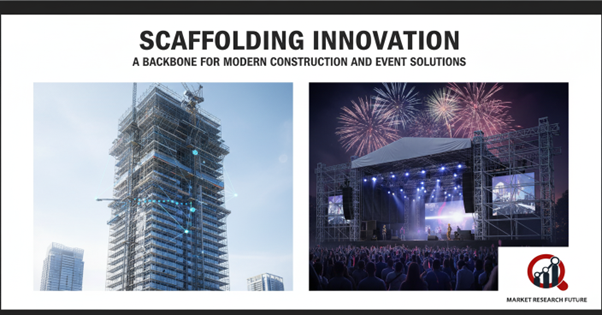
In 2025, the scaffolding industry will have changed dramatically in response to new technologies, more stringent laws, and the growing demands of various industries. The market, which has historically been dominated by big players, now benefits from the contributions of smaller, more flexible businesses that offer specialized solutions for regional projects.
While Europe and North America are concentrating on sustainability and safer, modular systems, the Asia Pacific continues to be the most dynamic region, with construction booms in rapidly urbanizing cities. The fact that scaffolding has expanded beyond construction to support cultural projects, entertainment, and industrial maintenance, thereby enhancing its value across industries, is what really sets it apart today.
What is scaffolding?
Fundamentally, scaffolding is the makeshift framework that is put up to support personnel, tools, and supplies at heights. Its function is straightforward but essential: it makes sure that work can be done effectively, safely, and in places that would otherwise be inaccessible.
In 2025, scaffolding is seen as an innovation facilitator rather than just a structural requirement. Grand stages, art installations, and viewing stands are all made with it by event planners. For the upkeep of intricate industrial facilities, engineers depend on it. When working on environmentally sensitive projects or heritage sites, architects use scaffolding to create innovative solutions.
This adaptability highlights how scaffolding has evolved into a system that links safety, creativity, and functionality across industries.
Why Scaffolding Is Still Necessary
Scaffolding remains an indispensable tool despite the advent of drones, robotics, and sophisticated construction equipment. Among the strongest arguments are the following:
- Unmatched Safety: To ensure optimal stability, modern scaffolds are built with guardrails, locking mechanisms, and reinforced joints.
- Increased Productivity: When crews have a stable footing and easy access to difficult-to-reach areas, they can work more efficiently and quickly.
- Applications across Industries: In addition to construction, scaffolding is used in shipbuilding, mining, aerospace, cultural events, and even disaster relief.
- Innovation in Materials: Scaffolding is becoming more portable and environmentally friendly thanks to lightweight metals, modular joints, and recyclable alternatives.
- Adaptability: Scaffolding can be tailored for projects of any size, whether it's a local cultural festival or a tall skyscraper.
Acquisitions & Mergers: The Continuous Approach
Consolidation remains the key to growth for world leaders. Through mergers and acquisitions, businesses can enter new markets, introduce cutting-edge technologies, and provide a range of scaffolding options to satisfy particular local requirements.
For instance, businesses are increasingly working with tech startups that focus on automation, safety monitoring tools, or digital design. By combining physical structures with digital intelligence, these collaborations enable scaffolding companies to remain ahead of the curve and provide clients with solutions that go beyond hardware.
Growth-Driven Government Policies
The scaffolding landscape has been actively shaped by governments around the world. Demand has increased as a result of significant infrastructure investments, more stringent workplace safety regulations, and incentives for environmentally friendly building practices.
- Infrastructure Development: Scaffolding is essential to the timely completion of large-scale urbanization drives in Asia, megaprojects in the Middle East, and smart city initiatives worldwide.
- Workplace Safety: In order to prevent dangerous makeshift systems, updated occupational safety regulations now mandate certified scaffolding.
- Cultural Preservation: Scaffolding is used in many heritage restoration projects that are funded by governments in order to safeguard both workers and delicate historical structures.
- Event Support: Scaffolding is used for stands, stages, and pavilions at large-scale events, such as sporting competitions and cultural fairs, which are supported by national and regional authorities.
Scaffolding businesses are not only satisfying demand but also establishing new benchmarks for sustainability and safety by conforming to government regulations.
New Developments in 2025
The scaffolding industry is defined by a number of revolutionary trends as we move closer to 2025:
Prefabricated and modular systems are popular because they are simple to assemble, requiring less work and saving time.
- Digital Tools: Before scaffolds arrive at the site, virtual planning using Building Information Modeling (BIM) guarantees their efficiency and safety.
- Eco-Friendly Practices: In line with sustainable building objectives, businesses are investigating recyclable materials, eco-coatings, and reusable designs.
- Event-Driven Demand: Scaffolding is becoming more and more necessary for temporary but secure infrastructure at sporting events, concerts, festivals, and exhibitions.
- Rental Growth: A booming rental market has resulted from many organizations favoring short-term rentals due to rising ownership costs.
- Smart Safety Monitoring: To lower the risk of scaffolding collapse or misuse, IoT sensors and computer vision systems are being combined to monitor scaffolding structures in real time.
Scaffolding's Future in Events and Construction
Scaffolding is expected to become an even more integral component of contemporary development in the future. It will encourage futuristic building concepts like prefabricated homes, green buildings, and vertical cities. It will provide the framework for audience-engaging immersive experiences, transient structures, and imaginative installations at events.
Hybrid scaffolding systems, which combine digital and traditional hardware, are also anticipated to become more popular. Consider scaffolds that have the ability to self-monitor, warn employees of potential dangers, and even adjust to shifting environmental conditions.
Scaffolding will continue to be not only relevant but also necessary as industries push the limits of sustainability, safety, and creativity. By supporting initiatives that mold skylines, conserve cultures, and unite communities, it acts as a silent partner in human progress.
In conclusion
Scaffolding has expanded significantly since its inception as a temporary support structure by 2025. These days, it acts as a flexible facilitator, connecting sectors such as infrastructure, entertainment, and culture. It is essential in today's rapidly evolving world because of its role in guaranteeing safety, effectiveness, and adaptability.
Scaffolding will remain a foundation for progress, enabling us to build higher, safer, greener, and more creatively than ever before, thanks to governments supporting infrastructure growth, businesses investing in innovation, and industries finding new uses.