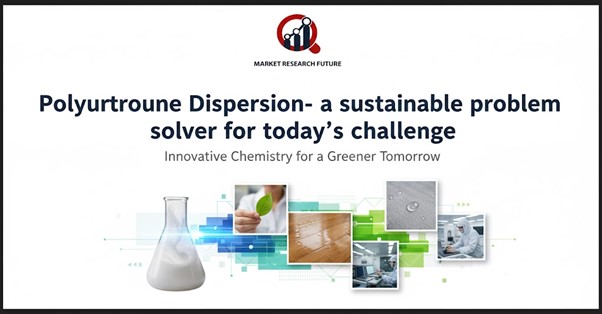
Overview of the Polyurethane Dispersion Market
Growing adoption of polyurethane dispersion in the construction industry is driving the global polyurethane dispersion market from USD 2.7 billion in 2024 to USD 5.95 billion by 2035. The pace of the advancement of the ecosystem is subject to an impressive CAGR of 7.45% through 2035.
Polyurethane dispersion (PUD) is an aqueous, anionic dispersion with high molecular weight, derived from either aromatic or aliphatic isocyanates and can be produced with or without emulsifiers.
PUDs exhibit excellent properties, including extreme temperature durability, superior tensile strength, high abrasion resistance, and elasticity. These characteristics make them suitable for leather and wood finishes, PVC and concrete floor coverings, and textile coatings.
In coatings, PUDs serve as film formers or binders and are also used to develop other technical products. Typically, polyurethane dispersions are synthesized by reacting a polyester, polyether, or polycarbonate diol with a hydrophilizing diol and a diisocyanate.
Depending on the diol-to-diisocyanate ratio, the resulting polyurethane can be either isocyanate (NCO) or hydroxyl functional. The global polyurethane dispersion market is witnessing growing demand, driven by robust growth in end-use industries such as coatings, leather finishing, and textiles.
However, fluctuations in crude oil prices have led to high raw material costs, which could hamper market growth over the forecast period. Additionally, mature markets like Germany, the UK, Canada, and the US are expected to exhibit average growth due to production shifting toward the Asia-Pacific region.
Rising Demand for Water-Based Polyurethane Dispersions
Water-based PUDs, in which urethane polymer particles are dispersed in water, are emerging as a fast-growing segment of the polyurethane coating industry. Driven by environmental regulations, such as the Clean Air Act, and technological advancements, water-based PUDs are increasingly replacing solvent-based products.
These dispersions offer impact strength, abrasion resistance, low-temperature flexibility, high blocking resistance, long-term elasticity, UV and weather resistance, and excellent abrasion resistance. They are widely applied in flexible films and cellulosic substrates for industrial laminates.
Hybrid coatings, combining polyacrylic polymer dispersions with epoxies, polyesters, alkyds, or polyurethanes, are also expected to play a significant role in next-generation water-based coatings, with adoption influenced by production costs and industrial uptake.
Asia-Pacific Market Dynamics
The Asia-Pacific region is gaining momentum due to strong end-use industries, including automotive, construction, furniture, textiles, and leather. The growing demand for polyurethane-based coatings in automotive applications is predicted to drive global PUD market growth.
Favorable policies in India, including 100% FDI in the automotive sector, further support market expansion. China and India dominate leather goods exports, while rising foreign direct investment and the expansion of the textile industry in developing Asia-Pacific economies are expected to boost PUD demand.
Additionally, e-commerce growth and increased product availability are anticipated to fuel sales of textile and leather products, further propelling the polyurethane dispersion market.
Competitive Landscape
The PUD market is dominated by leading global players, who capture a significant portion of the market revenue.
Prominent manufacturers include Lubrizol Corporation, Michelman, Inc., Mitsui Chemicals Inc., Perstorp Holding AB, Lamberti S.p.A., LANXESS AG, Alberdingk Boley GmbH, Hauthaway Corporation, Chase Corporation, VCM Polyurethanes PVT. Ltd., allnex, Covestro AG, DowDuPont, Inc., BASF SE, and 3M.
These companies pursue mergers and acquisitions to expand market reach and diversify business lines.