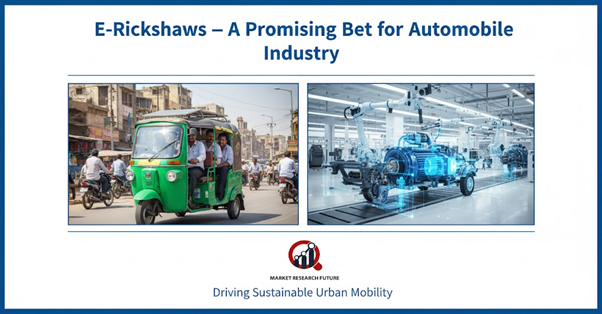
Overview of E-rickshaw Market
The rising environmental concerns among consumers have surged the demand for better alternatives, which curb carbon footprints. Owing to this rising demand, the e-rickshaw market is projected to propagate through the forecast period at a CAGR of 7.68%, which will elevate the valuation from USD 10.14 billion in 2024 to USD 22.89 billion by 2035.
An emerging sector within the automobile industry, the electric three-wheeler market, also known as the E-rickshaw or E-tricycle, has proven to be one of the most profitable and transformative ventures in recent years.
These vehicles are powered by rechargeable batteries and designed to transport both passengers and utility goods, offering a sustainable and economical alternative to conventional fuel-powered vehicles.
Significant Parts of Electric Three-wheelers
- Rechargeable Batteries: Typically lithium-ion or lead-acid batteries, with a capacity range of 650–1400 watts.
- PM BLDC Motors: Permanent Magnet Brushless DC motors, known for their efficiency and low maintenance.
Why Do We Need Electric Vehicles?
- Rising Concern About Fuel Prices
According to the U.S. Department of Transportation, between January and June 2022, regular gasoline prices surged by 49%, and diesel prices rose by 55%. These fluctuations have intensified the need for alternative energy vehicles, reducing dependence on petroleum imports and promoting energy independence.

- Increased CO2 Emissions
The transport sector is one of the largest contributors to air pollution. In contrast, electric three-wheelers produce zero tailpipe emissions, leading to an estimated reduction of 1,036.6 tonnes of CO₂ emissions per day, thereby contributing to cleaner air and better public health.
- Government initiatives
Governments worldwide are rolling out eco-friendly initiatives and policies promoting electric mobility. Subsidies, tax incentives, and infrastructure support are driving the replacement of traditional vehicles with electric ones, fostering a sustainable automotive ecosystem.
Reason for Electric Three-wheeler Vehicle Growth Acceleration
- Quick Option for Small Carriages
Electric three-wheelers serve as an ideal mode for last-mile connectivity and small-scale deliveries. Their zero-emission nature and compact design make them perfect for urban logistics and short-distance transport.
- Easy Maintenance
Being battery-operated, these vehicles require minimal maintenance compared to internal combustion engine (ICE) vehicles. They eliminate the dependency on fuel stations, offering convenience through at-home or on-site charging options.
- Good Battery Life
Modern lithium-ion batteries provide higher energy density, shorter charging durations, and longer lifespans, making electric three-wheelers more efficient and reliable than ever.
- Low Cost of Ownership
Although the initial purchase price may be slightly higher, the operational cost per kilometer is significantly lower. With negligible fuel expenses and minimal servicing needs, electric three-wheelers prove cost-effective over time.
Global Growth Prospects for the Electric Three-wheeler Market
Government initiatives, rising air pollution, higher fuel costs, and sustainable options for a healthier environment boost the demand for electric vehicles in the market. The global electric three-wheeler market is anticipated to grow at a high rate compared to previous years.
Considering this inclination towards EV vehicles, many start-up companies like Arcimoto, Nobecars, and others have boomed the landscape electric three-wheeler market, accelerating its market growth.
The electric three-wheeler vehicle market is experiencing colossal acceleration. It would contribute a more significant impact towards a greener environment while making the Automobile Industry play an essential role in the future growth and dealings of a country.