3D Concrete Printing: The Concept of the New Era
Introduction to the 3D Concrete Printing Market
Owing to the propelling surge to integrate sustainable and eco-friendly materials in the construction industry, the demand for 3D concrete printing technology is proliferating. The size of the global 3D concrete printing market is anticipated to change from USD 0.19 million in 2024 to USD 24.39 million by 2035, adhering to a massive CAGR of 55.6%.
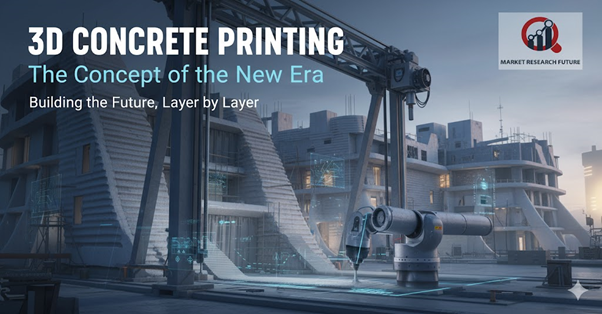
3D concrete printing is revolutionizing construction by enabling the creation of intricate designs, rapid prototyping, and cost-efficient fabrication.
Leveraging advanced computational technologies and state-of-the-art 3D printers, the technology is reshaping how buildings and infrastructure are conceptualized and constructed.
From residential homes to industrial components, 3D concrete printing offers the promise of faster project completion, lower material usage, and reduced labor costs.
Advantages and Limitations
While 3D concrete printing provides significant benefits, it faces certain technical challenges that must be addressed before widespread adoption:
- Material Placement and Phase Transition: Precise control over the transition from fresh to hardened concrete is critical.
- Structural Integrity: Layer stacking can produce “cold joints,” weakening the structure.
- Reinforcement: Effective integration of steel or fiber reinforcement is necessary.
- Surface Quality and Standards: Polishing, long-term durability, and regulatory standards remain areas for development.
Key properties to enhance for successful 3D printing include extrudability, flowability, buildability, open hours, and layer-to-layer interactions.
Applications and Future Prospects
Though the technology traces back to the 1980s (Stereolithography and Fused Deposition Modelling), 3D concrete printing is now gaining traction in construction. It promises mass customization, eco-friendly solutions, and cost-effective building processes. The technology is likely to be utilized for:
- Prefabricated panels and components on-site or in factories
- Rapid construction of residential and commercial buildings
- Specialized industrial and infrastructural applications
Market Trends and Regional Insights
The Asia-Pacific region is emerging as a key market due to rising housing demand, rapid urbanization, and governmental support. Countries like India are experiencing a housing shortage, driving adoption of innovative construction technologies.
Developed regions are also witnessing increased demand for sustainable and customizable housing solutions.
Impact of COVID-19
The pandemic highlighted 3D concrete printing’s potential, enabling the rapid construction of isolation wards, hospitals, and emergency shelters. The technology demonstrated its ability to reduce labor dependency and accelerate construction timelines during critical situations.
Labor and Cost Benefits
Construction is traditionally labor-intensive with low productivity. 3D concrete printing can reduce labor costs by up to 80%, addressing workforce shortages in regions reliant on migrant labor. Conversely, countries with local labor-dependent construction industries may face job displacement challenges.
Conclusion
3D concrete printing is poised to transform the construction industry by combining automation, cost efficiency, and sustainability.
With technological advancements, standardization, and increasing adoption, it is expected to become a mainstream construction solution, meeting the demands of a rapidly urbanizing and resource-conscious world.