医疗保健客户数据平台市场 摘要
主要市场趋势和亮点
市场规模与预测
| CAGR (2025 - 2035) | 23.34% |
主要参与者
Salesforce(US), Oracle (US), SAP (DE), Microsoft (US), IBM(US), Adobe (US), Cerner (US), Epic Systems (US), HealthCatalyst (US)
| CAGR (2025 - 2035) | 23.34% |
医疗客户数据平台市场目前正经历一个变革阶段,推动这一变化的是对个性化患者参与和数据驱动决策日益增长的需求。医疗行业的组织正在认识到整合不同数据源以创建患者互动统一视图的价值。这种整合不仅提高了护理质量,还促进了运营效率的改善。随着医疗提供者努力满足患者不断变化的期望,对能够分析和解释大量信息的复杂数据平台的需求正在上升。此外,合规性和数据安全问题促使组织投资于强大的解决方案,以确保患者隐私,同时最大化收集数据的效用。此外,技术的持续进步,如人工智能和机器学习,可能在塑造医疗客户数据平台市场的未来中发挥关键作用。这些技术似乎增强了数据平台的能力,使得更准确的预测和洞察成为可能。随着医疗实体继续适应快速变化的环境,利用客户数据推动战略举措的重视变得愈加明显。这一趋势表明市场前景乐观,因为利益相关者寻求利用数据的力量来改善患者结果和简化运营。
整合各种数据源的趋势正变得越来越普遍。医疗组织正在认识到从多个平台整合患者信息以创建全面的患者互动视图的必要性。这种整合促进了更好的决策,并增强了整体患者体验。
随着数据泄露和隐私问题的持续上升,医疗客户数据平台市场对数据安全的重视程度不断增加。组织正在优先实施先进的安全措施,以保护敏感的患者信息,确保遵守监管标准。
先进分析工具的采用在医疗提供者中正获得越来越多的关注。这些工具使组织能够从大型数据集中提取可操作的洞察,从而改善患者护理和运营效率。对数据驱动策略的关注可能会塑造医疗服务的未来。
The rise of telehealth services is significantly influencing the Healthcare Customer Data Platform Market. As healthcare providers increasingly adopt telehealth solutions, the need for integrated data platforms that can manage patient interactions and data across various channels becomes apparent. Telehealth services have expanded access to care, allowing patients to receive medical attention from the comfort of their homes.
This shift has led to a growing demand for platforms that can aggregate and analyze data from telehealth interactions, ensuring continuity of care. Market analysts suggest that the telehealth market could reach over 250 billion dollars by 2027, highlighting the potential for growth in the Healthcare Customer Data Platform Market as organizations seek to optimize their telehealth offerings through effective data management.
The focus on personalized medicine is reshaping the Healthcare Customer Data Platform Market. As healthcare providers increasingly recognize the importance of tailoring treatments to individual patient needs, the demand for data platforms that can analyze vast amounts of patient data is likely to grow. Personalized medicine relies heavily on data analytics to identify the most effective treatments based on genetic, environmental, and lifestyle factors.
This trend is expected to drive innovation within the Healthcare Customer Data Platform Market, as organizations seek to develop solutions that can support personalized treatment plans. The market for personalized medicine is projected to reach approximately 2 trillion dollars by 2030, indicating a substantial opportunity for data platforms that can facilitate this shift towards more individualized care.
Increased investment in healthcare IT is a prominent driver of the Healthcare Customer Data Platform Market. As healthcare organizations recognize the importance of technology in improving operational efficiency and patient outcomes, they are allocating more resources towards IT solutions. This trend is evidenced by the projected growth of the healthcare IT market, which is expected to exceed 500 billion dollars by 2025.
Such investments are likely to enhance the capabilities of customer data platforms, enabling better data integration, analytics, and patient engagement. Consequently, the Healthcare Customer Data Platform Market stands to benefit from this influx of capital, as organizations seek to leverage technology to improve their services and meet the evolving demands of patients.
The integration of patient engagement tools into the Healthcare Customer Data Platform Market is becoming increasingly vital. These tools facilitate better communication between healthcare providers and patients, enhancing the overall patient experience. As healthcare organizations strive to improve patient satisfaction, the demand for platforms that can seamlessly integrate these tools is likely to rise.
According to recent estimates, the patient engagement solutions market is projected to reach approximately 20 billion dollars by 2026, indicating a robust growth trajectory. This integration not only streamlines communication but also allows for personalized care, which is essential in today's healthcare landscape. Consequently, the Healthcare Customer Data Platform Market is expected to benefit significantly from this trend, as organizations seek to leverage data to foster stronger patient relationships.
Regulatory compliance and data governance are critical drivers in the Healthcare Customer Data Platform Market. With the increasing complexity of healthcare regulations, organizations must ensure that their data management practices align with legal requirements. The Health Insurance Portability and Accountability Act (HIPAA) and other regulations necessitate stringent data protection measures.
As a result, healthcare organizations are investing in customer data platforms that not only manage patient data effectively but also ensure compliance with these regulations. This focus on compliance is projected to drive market growth, as organizations recognize the importance of safeguarding sensitive information. The Healthcare Customer Data Platform Market is likely to see a surge in demand for solutions that offer robust compliance features, thereby enhancing trust and security in patient data management.
医疗客户数据平台市场中的部署模型细分在云解决方案和本地解决方案之间呈现出明显的市场份额分布。云部署占据了最大的份额,主要是由于组织寻求灵活性、可扩展性以及与其他服务的集成便利性。相反,尽管本地解决方案在当前市场份额中较小,但由于满足需要控制敏感数据和遵守严格监管要求的机构,它们正在迅速崛起。该细分市场的增长趋势受到技术进步和对数据安全与隐私日益增长的需求的显著影响。云模型因其能够提供创新的医疗解决方案而迅速发展,这些解决方案增强了患者参与度和数据分析。与此同时,随着医疗组织投资于强大的基础设施以遵守严格的监管标准,本地模型也在迅速增长,导致了一种结合了两种模型优点的混合方法。
云(主导)与本地部署(新兴)
云部署模型是医疗客户数据平台市场的主导者,以其可扩展性、用户友好性和成本效益而闻名。它允许医疗组织在不承担重大硬件前期投资的情况下访问更新的平台和工具。相比之下,尽管本地模型被视为新兴,但更受优先考虑数据主权、安全性和遵守医疗法规的组织青睐。选择本地解决方案的机构越来越专注于建立配备先进安全措施的数据中心,从而增强对其数据资产的控制。随着组织评估其战略,这些模型之间的区别变得至关重要,每种模型都提供了针对特定运营需求量身定制的独特优势。
在医疗保健客户数据平台市场中,组件细分主要分为软件和服务。软件已成为最大的细分市场,因为医疗保健组织越来越多地采用先进技术来更有效地管理患者数据。这一趋势导致了提供者在数据管理和客户参与方面的重大转变。同时,服务也在快速增长,因为医疗保健实体寻求全面的支持解决方案,以优化其平台、改善用户体验并确保遵守监管标准。
软件(主导)与服务(新兴)
软件组件在医疗客户数据平台市场中仍然占据主导地位,因为它在数据集成、分析和安全性方面发挥着关键作用。随着医疗机构优先考虑数字化转型,软件解决方案已成为管理大量患者数据、增强决策能力和促进更好结果的必需品。相比之下,服务代表了新兴领域,受到个性化支持和咨询需求的推动,以帮助应对复杂的软件实施并确保高效使用。这两个组件之间的相互作用创造了一个动态市场,在这个市场中,软件作为支柱,而服务则增强了提供给医疗服务提供者的整体价值。
在医疗客户数据平台市场中,数据类型至关重要,因为它们定义了从各种来源获得的洞察。患者数据目前占据最大的市场份额,反映了其在推动个性化医疗解决方案和改善患者结果方面的重要性。提供者数据紧随其后,由于对整合医疗服务和改善提供者之间的护理协调的需求,显示出强劲的地位。
患者数据(主导)与提供者数据(新兴)
患者数据的特点在于其全面性,包括健康记录、人口统计信息和治疗历史,这些对于创建个性化的医疗体验至关重要。它通过使医疗机构能够根据个体患者的需求量身定制服务而主导市场。另一方面,提供者数据因医疗专业人员之间日益重视合作而逐渐兴起。这种数据类型包括有关医疗提供者的资格、专业和实践的信息,这对于促进综合护理模式和确保最佳患者结果越来越重要。
在医疗客户数据平台市场(CDP)中,医院在最终用户中占据最大的市场份额,利用这些平台有效管理大量患者数据。尽管诊所的市场份额较小,但由于对个性化患者参与和精简运营的日益需求,它们正在迅速采用医疗CDP。这一转变强调了在各类医疗机构中数据驱动决策的重要性。该细分市场的增长趋势表明,诊所的投资正在稳步增加,使其成为增长最快的用户细分市场。推动这一增长的因素包括对数据分析的需求上升,以提升患者护理和运营效率。此外,向基于价值的护理模式的转变也激励诊所采用能够利用患者洞察力以改善医疗服务的解决方案。
医院:主导与诊所:新兴
医院在医疗客户数据平台市场中占据主导地位,利用复杂的CDP系统整合来自各种来源的患者数据,如电子健康记录(EHR)和账单系统。这种整合使医院能够通过全面的洞察和分析来改善患者的治疗结果。另一方面,诊所作为重要的竞争者,越来越认识到CDP在改善患者参与度和运营工作流程方面的好处。随着诊所采用这些技术,它们专注于量身定制的患者体验、互操作性和实时数据访问,从而推动其在市场中的增长。
在医疗客户数据平台市场中,患者关系管理占据了最大的市场份额,反映了其在提升患者参与度和满意度方面的关键作用。该细分市场专注于通过有效的沟通策略提供个性化护理,促进长期的患者关系。尽管市场营销自动化目前的份额较小,但随着医疗机构寻求简化其营销工作并改善患者外展,它正在迅速获得关注,成为这一竞争激烈的市场中的强有力竞争者。增长趋势表明,分析与报告以及数据治理与安全的需求显著增加。随着监管要求的增加和对可操作见解的需求,这些细分市场预计将大幅增长。随着医疗行业的发展,组织优先考虑数据安全和分析,从而推动这些领域的创新和进步,最终扩大它们对整体客户数据平台市场的贡献。
患者关系管理(主导)与数据治理和安全(新兴)
患者关系管理在医疗客户数据平台市场中占据主导地位,强调建立和维护与患者之间强大联系的必要性。该领域的特点是关注个性化服务、针对性沟通和强有力的参与策略,使医疗服务提供者能够有效满足个别患者的需求。另一方面,数据治理和安全性正成为一个关键领域,受到保护敏感患者信息和确保遵守法规日益重要性的推动。该领域专注于实施安全措施和治理政策,突显出医疗行业对数据完整性和保护日益增强的意识。这两个领域反映了现代医疗服务交付的基本方面。
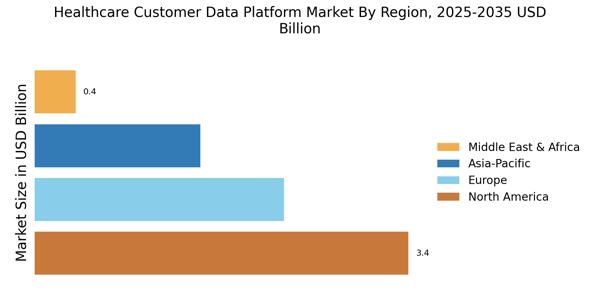
North America is the largest market for Healthcare Customer Data Platforms, holding approximately 45% of the global market share. The region's growth is driven by increasing healthcare digitization, regulatory support for data interoperability, and rising demand for personalized patient experiences. The U.S. government has implemented various initiatives to enhance healthcare IT infrastructure, further fueling market expansion.
The United States is the primary player in this Healthcare Customer Data Platform Market, with significant contributions from Canada. Major companies like Salesforce, Oracle, and Cerner dominate the landscape, leveraging advanced technologies to improve patient engagement and operational efficiency. The competitive environment is characterized by continuous innovation and strategic partnerships among key players, ensuring robust market dynamics.
Europe is witnessing significant growth in the Healthcare Customer Data Platform Market, accounting for about 30% of the global share. The region's expansion is largely driven by stringent data protection regulations like GDPR, which compel healthcare organizations to adopt advanced data management solutions. Additionally, the increasing focus on patient-centric care and digital transformation initiatives are key growth catalysts.
Leading countries in this region include Germany, the UK, and France, where major players like SAP and IBM are actively enhancing their offerings. The competitive landscape is marked by a mix of established firms and innovative startups, all striving to meet the evolving needs of healthcare providers. The presence of regulatory bodies ensures that data privacy and security remain top priorities in the Healthcare Customer Data Platform Market.
Asia-Pacific is rapidly emerging as a significant player in the Healthcare Customer Data Platform Market, holding approximately 20% of the global market share. The region's growth is fueled by increasing healthcare expenditure, rising internet penetration, and a growing emphasis on digital health solutions. Countries like China and India are leading this transformation, supported by government initiatives aimed at enhancing healthcare infrastructure and technology adoption.
China and India are at the forefront, with a burgeoning number of startups and established companies entering the Healthcare Customer Data Platform Market. The competitive landscape is diverse, featuring both local and international players. Companies are focusing on innovative solutions to cater to the unique needs of the region, ensuring a dynamic and competitive environment that fosters growth and development.
The Middle East and Africa region is gradually emerging in the Healthcare Customer Data Platform Market, currently holding about 5% of the global share. The growth is driven by increasing investments in healthcare infrastructure, a rising demand for digital health solutions, and government initiatives aimed at improving healthcare delivery. Countries like the UAE and South Africa are leading the charge, focusing on enhancing patient care through technology adoption.
The competitive landscape is still developing, with a mix of local and international players entering the Healthcare Customer Data Platform Market. Key players are exploring partnerships and collaborations to expand their reach and enhance service offerings. The region's unique challenges present opportunities for innovative solutions tailored to local needs, making it a promising market for future growth.
The Healthcare Customer Data Platform Market is currently characterized by a dynamic competitive landscape, driven by the increasing demand for personalized patient experiences and data-driven decision-making. Major players such as Salesforce (US), Oracle (US), and Microsoft (US) are strategically positioning themselves through innovation and partnerships. Salesforce (US) focuses on enhancing its platform capabilities to integrate patient data seamlessly, while Oracle (US) emphasizes its cloud-based solutions to improve healthcare analytics. Microsoft (US) is leveraging its Azure cloud services to facilitate data interoperability, which is crucial for healthcare providers aiming to deliver comprehensive care.
Collectively, these strategies not only enhance their market presence but also foster a competitive environment that prioritizes technological advancement and customer-centric solutions. In terms of business tactics, companies are increasingly localizing their operations and optimizing supply chains to respond to regional healthcare needs effectively. The Healthcare Customer Data Platform Market appears moderately fragmented, with a mix of established players and emerging startups. This structure allows for diverse offerings, yet the influence of key players remains substantial, as they set benchmarks for innovation and service delivery in the Healthcare Customer Data Platform Market sector.
In August 2025, Salesforce (US) announced a strategic partnership with a leading telehealth provider to enhance its customer data platform capabilities. This collaboration aims to integrate telehealth data into Salesforce’s ecosystem, thereby enabling healthcare organizations to gain deeper insights into patient interactions and outcomes. The significance of this move lies in its potential to streamline patient engagement processes, ultimately improving care delivery and operational efficiency.
In September 2025, Oracle (US) unveiled a new suite of AI-driven analytics tools designed specifically for healthcare providers. This initiative is expected to empower organizations to harness predictive analytics for better patient outcomes. The strategic importance of this development is underscored by the growing reliance on data analytics in healthcare, suggesting that Oracle is positioning itself as a leader in the integration of AI within customer data platforms.
In October 2025, Microsoft (US) launched an initiative aimed at enhancing data security and compliance within its healthcare solutions. This move is particularly relevant given the increasing scrutiny on data privacy in the healthcare sector. By prioritizing security, Microsoft not only addresses regulatory concerns but also builds trust with healthcare providers, which is essential for long-term partnerships.
As of October 2025, the competitive trends in the Healthcare Customer Data Platform Market are increasingly defined by digitalization, sustainability, and the integration of artificial intelligence. Strategic alliances are becoming more prevalent, as companies recognize the value of collaboration in enhancing their service offerings. Looking ahead, competitive differentiation is likely to evolve from traditional price-based strategies to a focus on innovation, technological advancements, and the reliability of supply chains. This shift indicates a broader trend where companies that prioritize these elements may gain a competitive edge in an ever-evolving market.




In October 2026, Epic Systems paused most product development for six weeks after testing with Anthropic's Mythos AI model uncovered a flaw in certain customer configurations of its MyChart patient portal. The flaw could have let outsiders view patient records without leaving a trace in audit logs, and Epic said its broader roadmap remains on track. It matters for patient-data platforms because Epic holds records for more than 320 million patients, so a weakness in how patient data is exposed is an industry-wide event. (Source: startupfortune.com)
In July 2026, Health Catalyst completed the $147 million sale of its Vitalware mid-revenue-cycle business to Med-Metrix, closing on July 31 after the agreement was signed June 4. The company used the proceeds to repay its roughly $160 million term loan, and says it will now concentrate on its AI and analytics platform and its data foundation for health systems. For a data and analytics vendor, it's a clear shift from services toward a core data and AI layer. (Source: hitconsultant.net)
In September 2026, Salesforce said Gartner named it a Leader in the 2026 Magic Quadrant for Healthcare Provider Industry Cloud Platforms. Salesforce points to its governed data foundation, built from Informatica, MuleSoft, and Data 360, as the way health systems unify clinical and engagement data into one view of a patient. This is analyst recognition rather than a product launch, but it's the most recent dated item from Salesforce, the leading customer-data-platform vendor on your list. (Source: salesforce.com)
医疗保健客户数据平台市场预计将在2024年至2035年间以23.34%的年均增长率增长,推动因素包括日益增长的数据整合需求和个性化患者参与策略。
新机遇在于:
到2035年,市场预计将会强劲,由创新解决方案和战略合作伙伴关系推动。
| 2024年市场规模 | 7.468(十亿美元) |
| 2025年市场规模 | 9.211(十亿美元) |
| 2035年市场规模 | 75.07(十亿美元) |
| 年复合增长率(CAGR) | 23.34%(2024 - 2035) |
| 报告覆盖范围 | 收入预测、竞争格局、增长因素和趋势 |
| 基准年 | 2024 |
| 市场预测期 | 2025 - 2035 |
| 历史数据 | 2019 - 2024 |
| 市场预测单位 | 十亿美元 |
| 关键公司简介 | 市场分析进行中 |
| 覆盖的细分市场 | 市场细分分析进行中 |
| 关键市场机会 | 人工智能的整合增强了医疗客户数据平台市场中的患者参与度。 |
| 关键市场动态 | 对个性化医疗的需求上升推动了医疗客户数据平台的创新,增强了患者参与和数据整合。 |
| 覆盖的国家 | 北美、欧洲、亚太、南美、中东和非洲 |
 Rahul Gotadki

The secondary research process involved comprehensive analysis of regulatory databases, peer-reviewed healthcare IT journals, technology publications, and authoritative health informatics organizations. Key sources included the US Department of Health and Human Services (HHS), Office of the National Coordinator for Health Information Technology (ONC), Centers for Medicare & Medicaid Services (CMS), HealthIT.gov, European Commission Digital Health and Care, European Health Data Space (EHDS), International Organization for Standardization (ISO/TC 215 Health Informatics), Healthcare Information and Management Systems Society (HIMSS), American Medical Informatics Association (AMIA), National Institutes of Health (NIH) - National Center for Biotechnology Information (NCBI/PubMed), Organisation for Economic Co-operation and Development (OECD) Health Statistics, World Health Organization (WHO) Digital Health Repository, International Telecommunication Union (ITU) ICT Statistics, and national digital health agency reports from key markets including NHS Digital (UK), Australian Digital Health Agency, and Canada Health Infoway. These sources were used to collect healthcare IT adoption statistics, regulatory compliance frameworks (HIPAA, GDPR, HITECH Act), interoperability standards (HL7 FHIR), digital health investment data, and market landscape analysis for cloud-based CDP solutions, on-premises deployments, patient data management systems, provider network solutions, and payer analytics platforms.
Qualitative and quantitative insights were obtained by interviewing supply-side and demand-side stakeholders during the primary research process. The supply-side sources consist of Chief Executive Officers, Chief Technology Officers, VPs of Healthcare Solutions, Chief Data Officers, Heads of Product Strategy, regulatory compliance officers, and commercial directors from healthcare CDP software vendors, cloud infrastructure providers, health IT consultancies, and system integrators. Chief Information Officers, Chief Medical Information Officers, the Vice President of Analytics, the Director of Patient Experience, CRM managers from integrated delivery networks (IDNs), health system executives, pharmacy chain digital officers, payer organization IT leaders, and procurement heads from hospitals, specialty clinics, accountable care organizations (ACOs), and health insurance providers comprised demand-side sources. Market segmentation was validated across deployment models (cloud vs. on-premises), product roadmap timelines were confirmed, and insights on EHR integration patterns, data governance frameworks, pricing models (subscription vs. perpetual licensing), and value-based care reimbursement dynamics were gathered through primary research.
Primary Respondent Breakdown:
By Designation: C-level Primaries (28%), Director Level (35%), Others (37%)
By Region: North America (32%), Europe (30%), Asia-Pacific (28%), Rest of World (10%)
Global market valuation was derived through revenue mapping and healthcare data volume analysis. The methodology included:
Identification of 50+ key technology vendors and healthcare IT providers across North America, Europe, Asia-Pacific, Latin America, and Middle East & Africa
Product mapping across software platforms (CDP engines, analytics modules, integration middleware) and professional services (implementation, consulting, managed services)
Segmentation by data types: Patient demographic and clinical data, Provider network and referral data, Payer claims and eligibility data, Pharmacy dispensing and adherence data
End-user coverage across: Hospitals and health systems, Ambulatory clinics and physician practices, Retail and specialty pharmacies, Commercial and government payers
Application coverage across: Patient relationship management and engagement, Marketing automation and campaign management, Population health analytics and reporting, Data governance, privacy, and security compliance
Analysis of reported and modeled annual revenues specific to healthcare CDP portfolios, including subscription ARR (Annual Recurring Revenue), professional services revenue, and perpetual license maintenance
Coverage of vendors representing 75-80% of global market share in 2024, including Salesforce Health Cloud, Oracle Health, Microsoft Cloud for Healthcare, SAP Health, IBM Watson Health, Adobe Experience Cloud for Healthcare, Cerner HealtheIntent, Epic MyChart and CRM modules, and Health Catalyst data platform
Extrapolation using bottom-up (healthcare organization count × CDP adoption rate × average contract value by country/segment) and top-down (vendor revenue validation and market share modeling) approaches to derive segment-specific valuations across deployment models, components, data types, end users, applications, and regional markets
请填写以下表格以获取本报告的免费样本


“This is really good guys. Excellent work on a tight deadline. I will continue to use you going forward and recommend you to others. Nice job”
 Noah Malgeri
Co-Founder

“Thanks for sending the report it gives us a good global view of the Betaïne market.”
 Peter Groot koerkamp
Account and Business Manager

“We found the report very insightful! we found your research firm very helpful. I'm sending this email to secure our future business.”
 Younghwan Choi
Senior Retail Manager

“I am very pleased with how market segments have been defined in a relevant way for my purposes (such as "Portable Freezers & refrigerators" and "last-mile"). In general the report is well structured. Thanks very much for your efforts.”
 Mark Irwin
Management Consultant

“We got the report in time, we really thank you for your support in this process. I also thank to all of your team as they did a great job.”
 Akif Moroglu
Strategy & Business Development Director

“The Automotive 48V ECU Components Procurement Intelligence Study” was a complex project, but the Market Research Future (MRFR) team handled it with quality, agility, and customer-centricity. They delivered all requested data on time and within the agreed scope. The team, including Shubhendra Anand and Rahul Gotadki, was always readily available to clarify questions and swiftly implement necessary adjustments, driving the project to a successful conclusion within a very demanding timeframe.
I would also like to specifically commend Akshay Agarwal for his responsiveness and support at every stage—from our initial inquiry on May 6th through to final delivery on June 18th. His dedication made the entire process seamless.”
 Guilherme Gomes Martins
Product Management Director

“Thanks. It’s been a pleasure working with you, please use me as reference with any other Intel employees.”
 Joseph Aguayo
Sales Operations & Pricing Manager

“Thank you, this will be very helpful for OQS.”
 La Terria Dodd
Program Support Specialist

“I have been reading the first document or the study, ,the Global HVAC and FP market report 2021 till 2026. Must say, good info! I have not gone in depth at all parts, but got a good indication of the data inside!”
 Rob Kooiker
Group Product Manager HVAC & Fire Protection GMA



