
×
  • Cat-intel
  • MedIntelliX
  • Resources
  • About Us
  • Hero Background
    English
    Chinese
    French
    Japanese
    Korean
    German
    Spanish

    Zero-Touch Provisioning Market Size

    ID: MRFR/ICT/10185-HCR
    128 Pages
    Shubham Munde
    October 2025

    Zero-Touch Provisioning Market Research Report Information By Component (Platform and Services), Device Type (Routers, Switches, Access Points, Firewalls, IoT Devices, and Others), Network Complexity (Multi-Vendor Environment, Complex Network Architecture, and Dynamic Network Environment), Enterprise Size (Large Enterprises and Small & Medium Enterprises), Industry (IT & Telecommunicati...

    Share:
    Download PDF ×

    We do not share your information with anyone. However, we may send you emails based on your report interest from time to time. You may contact us at any time to opt-out.

    Zero-Touch Provisioning Market Infographic
    Purchase Options

    Zero Touch Provisioning Size

    Zero-Touch Provisioning Market Growth Projections and Opportunities

    Zero-Contact Provisioning (ZTP) has become a major aspect of organization and device management, changing how companies communicate and manage their systems. The Zero-Contact Provisioning market is shaped by mechanical advances, automation, and IT infrastructure growth.

    Zero-Contact Provisioning allows devices and organization components to be configured and sent without human intervention. This streamlines the provisioning procedure, saving time and resources for device setup and management. The need for agility and productivity in complex IT environments drives ZTP's market components.

    Modern IT infrastructure complexity drives Zero-Contact Provisioning market growth. A consistent and automated provisioning method becomes essential as companies adopt distributed computing, Web of Things (IoT), and edge calculating. ZTP addresses this need by standardizing and automating setup and transmission, allowing devices to be swiftly integrated into the organization without user intervention.

    The growing importance of organization security shapes ZTP's market. As digital threats evolve, companies are emphasizing safe and reliable provisioning. Zero-Contact Provisioning uses established security measures to transfer devices safely. This improves security and ensures that devices comply with authorities from the start.

    The arrival of 5G technology also drives Zero-Contact Provisioning market aspects. As 5G networks grow more widespread, the number of connected devices will increase, needing a flexible and efficient provisioning system. ZTP's automated and standardised methodology helps 5G companies manage the massive device flood by ensuring that they can be quickly and reliably coordinated into the ecosystem.

    ZTP's market aspects are also influenced by wider digital transformation. Advanced change campaigns are underway throughout industries to be competitive and responsive to market demands. Zero-Contact Provisioning supports this pattern by promptly sending and managing the computerized framework needed for advanced modification with deftness and development.

    Despite competition, some retailers are helping the Zero-Contact Provisioning sector grow. These suppliers offer device provisioning, computerization, coordination, and investigation. In the serious arena, customer experience, adaptability, and industrial requirements are prioritized."
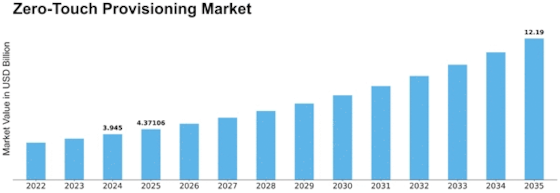
    Zero-Touch Provisioning Market Size Graph
    Author
    Shubham Munde
    Research Analyst Level II

    With a technical background in information technology & semiconductors, Shubham has 4.5+ years of experience in market research and analytics with the tasks of data mining, analysis, and project execution. He is the POC for our clients, for their consulting projects running under the ICT/Semiconductor domain. Shubham holds a Bachelor’s in Information and Technology and a Master of Business Administration (MBA). Shubham has executed over 150 research projects for our clients under the brand name Market Research Future in the last 2 years. His core skill is building the research respondent relation for gathering the primary information from industry and market estimation for niche markets. He is having expertise in conducting secondary & primary research, market estimations, market projections, competitive analysis, analysing current market trends and market dynamics, deep-dive analysis on market scenarios, consumer behaviour, technological impact analysis, consulting, analytics, etc. He has worked on fortune 500 companies' syndicate and consulting projects along with several government projects. He has worked on the projects of top tech brands such as IBM, Google, Microsoft, AWS, Meta, Oracle, Cisco Systems, Samsung, Accenture, VMware, Schneider Electric, Dell, HP, Ericsson, and so many others. He has worked on Metaverse, Web 3.0, Zero-Trust security, cyber-security, blockchain, quantum computing, robotics, 5G technology, High-Performance computing, data centers, AI, automation, IT equipment, sensors, semiconductors, consumer electronics and so many tech domain projects.

    Leave a Comment

    FAQs

    How much is the Zero-Touch Provisioning market?

    The Zero-Touch Provisioning Market size was valued at USD 3.94 Billion in 2024.

    What is the growth rate of the Zero-Touch Provisioning market?

    The global market is projected to grow at a CAGR of 10.80% during the forecast period, 2025-2034.

    Which region held the largest market share in the Zero-Touch Provisioning market?

    Asia Pacific had the largest share in the global market

    Who are the key players in the Zero-Touch Provisioning market?

    The key players in the market are Cisco Systems, Inc., Nokia Corporation, Telefonaktiebolaget LM Ericsson, Huawei Technologies Co., Ltd., ZTE Corporation, Juniper Networks, Inc., Hewlett Packard Enterprise Development LP, Arista Networks, Inc., Extreme Networks, Riverbed Technology

    Which Component led the Zero-Touch Provisioning market?

    The Platform Component dominated the market in 2024.

    Which Device Type had the largest market share in the Zero-Touch Provisioning market?

    The Switches Device Type had the largest share in the global market.

    Market Summary

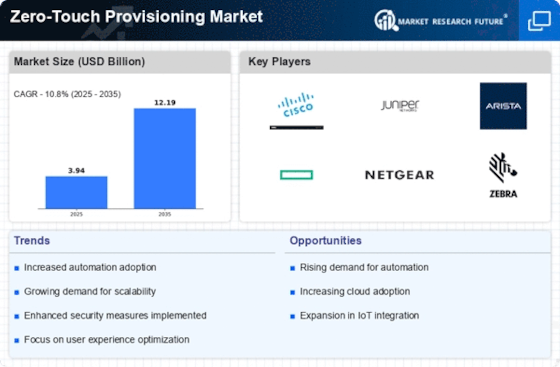
    The Global Zero-Touch Provisioning Market is projected to grow from 3.94 USD Billion in 2024 to 12.19 USD Billion by 2035.

    Key Market Trends & Highlights

    Zero-Touch Provisioning Key Trends and Highlights

    • The market is expected to experience a compound annual growth rate (CAGR) of 11.07 percent from 2025 to 2035.
    • By 2035, the market valuation is anticipated to reach 12.5 USD Billion, indicating robust growth potential.
    • in 2024, the market is valued at 3.94 USD Billion, reflecting the increasing demand for automation in network provisioning.
    • Growing adoption of zero-touch provisioning due to the need for operational efficiency is a major market driver.

    Market Size & Forecast

    2024 Market Size 3.94 (USD Billion)
    2035 Market Size 12.19 (USD Billion)
    CAGR (2025-2035) 10.80%
    Largest Regional Market Share in 2024 latin_america)

    Major Players

    Cisco Systems, Inc., Nokia Corporation, Telefonaktiebolaget LM Ericsson, Huawei Technologies Co., Ltd., ZTE Corporation, Juniper Networks, Inc., Hewlett Packard Enterprise Development LP, Arista Networks, Inc., Extreme Networks, Riverbed Technology

    Market Trends

    Rising need for eliminating manual configuration is driving the market growth

    Manual configuration is labor-intensive, expensive, time-consuming, and error-prone. Someone on site with some basic configuration skills and a laptop is required to set up the device for basic functionality before the setup can be completed via the central administration system. Instead of being transported to the installation place, the item could instead be brought to a staging area. Due to the requirement to deliver the item twice and send it through customs twice, this is also costly. Additionally, this may unintentionally transmit an equipment with an IP address meant for one site to any other site.

    The orchestration and administration of networks and network-related services have undergone a significant transformation as a result of the widespread adoption of 5G networks and the large-scale introduction of network slicing. The market for zero-touch provisioning is expanding because many enterprise clients are modernizing their network infrastructure to increase network security and ensure more effective data flow.

    Because it enables the creation of effective, economical, and responsive system architectures, the Internet of Things (IoT) is crucial to automation technologies. Solutions for the industrial internet of things (IIoT) facilitate quick connections between industrial equipment and increase efficiency and transparency. Edge computing and IIoT solutions streamline the entire lifecycle of device management and shop floor software. Businesses are quickly adopting IIoT technology to optimize the manufacturing process and enhance the consumer experience. Thus, driving the Zero-Touch Provisioning market revenue.

    Zero-Touch Provisioning Market Market Drivers

    Market Growth Projections

    The Global Zero-Touch Provisioning Market Industry is poised for substantial growth, with projections indicating a market size of 3.95 USD Billion in 2024 and a remarkable increase to 12.5 USD Billion by 2035. The anticipated compound annual growth rate (CAGR) of 11.07% from 2025 to 2035 underscores the increasing adoption of zero-touch provisioning solutions across various sectors. This growth trajectory reflects the rising demand for automation, the proliferation of IoT devices, and the need for enhanced security measures. As organizations continue to recognize the value of efficient provisioning methods, the market is expected to expand significantly.

    Enhanced Security Features

    Security concerns are paramount in the Global Zero-Touch Provisioning Market Industry, driving the adoption of advanced provisioning solutions. Zero-touch provisioning offers enhanced security features that protect devices during the onboarding process. By automating device configuration, organizations can ensure that security protocols are consistently applied, reducing vulnerabilities associated with manual setups. This is particularly relevant in sectors such as finance and healthcare, where data protection is critical. As businesses prioritize security in their operations, the demand for zero-touch provisioning solutions is expected to rise, further propelling market growth.

    Rising Adoption of IoT Devices

    The proliferation of Internet of Things devices significantly influences the Global Zero-Touch Provisioning Market Industry. As more organizations integrate IoT solutions into their operations, the need for efficient provisioning methods becomes paramount. Zero-touch provisioning facilitates the seamless onboarding of IoT devices, ensuring they are configured and operational without manual intervention. This capability is essential for industries such as manufacturing and smart cities, where large volumes of devices require rapid deployment. The anticipated growth in IoT deployments is expected to contribute to the market's expansion, with projections indicating a rise to 12.5 USD Billion by 2035.

    Integration with Cloud Services

    The integration of zero-touch provisioning with cloud services is reshaping the Global Zero-Touch Provisioning Market Industry. As organizations increasingly migrate to cloud-based infrastructures, the need for efficient provisioning methods that align with cloud environments becomes evident. Zero-touch provisioning simplifies the deployment of cloud-connected devices, ensuring they are configured correctly and promptly. This integration not only enhances operational efficiency but also supports scalability, allowing businesses to adapt to changing demands. The synergy between zero-touch provisioning and cloud services is likely to drive market growth, as organizations seek to leverage the benefits of both technologies.

    Increasing Demand for Automation

    The Global Zero-Touch Provisioning Market Industry experiences a surge in demand for automation across various sectors. Organizations are increasingly adopting automated solutions to streamline operations, reduce human error, and enhance efficiency. This trend is particularly evident in the telecommunications sector, where service providers leverage zero-touch provisioning to expedite device configuration and management. As a result, the market is projected to reach 3.95 USD Billion in 2024, reflecting a growing recognition of the benefits associated with automated provisioning solutions. The shift towards automation is likely to continue driving growth in the Global Zero-Touch Provisioning Market Industry.

    Cost Efficiency and Resource Optimization

    Cost efficiency remains a critical driver in the Global Zero-Touch Provisioning Market Industry. Organizations are increasingly seeking solutions that minimize operational costs while maximizing resource utilization. Zero-touch provisioning enables businesses to reduce the time and labor associated with device setup, thereby lowering overall expenses. This approach not only streamlines processes but also allows IT teams to focus on more strategic initiatives. As companies recognize the financial benefits of adopting zero-touch provisioning, the market is likely to witness robust growth, supported by a projected CAGR of 11.07% from 2025 to 2035.

    Market Segment Insights

    Zero-Touch Provisioning Component Insights

    The Zero-Touch Provisioning Market segmentation, based on Component includes platform and services. In 2022, the platform category had a market share of approximately 69.0%, dominating the whole market. ZTP solutions, which provide businesses numerous benefits including streamlined deployment and configuration, increased dependability, lower deployment costs, and improved network visibility and management, are credited with the expansion.

    Zero-Touch Provisioning Device Type Insights

    The Zero-Touch Provisioning Market segmentation, based on device type, includes routers, switches, access points, firewalls, IoT devices, and others. In 2022, the switches category gained market share and controlled the whole market. Large companies' increased use of the internet and the cloud to quickly build and implement network components is being blamed for the expansion as well as the emerging usage of edge devices. The market is expanding because to the rising use of switches in outdoor environments by a variety of industries, including smart cities, oil & gas, IT & telecom, among others, to increase communication across applications.

    Zero-Touch Provisioning Network Complexity Insights

    The Zero-Touch Provisioning Market segmentation, based on network complexity, includes multi-vendor environment, complex network architecture, and dynamic network environment. In 2022, the complex network architecture category had a market share of more than 43.0%, dominating the whole market. Large businesses and organizations use complex network environments, which have two domains, subnetworks, many layers, and interdependencies between networking systems and devices, while sharing a common network control protocol between two host systems.

    By allocating controllers to different regions for region-based network management, zero touch provisioning automates the deployment of all the devices inside the network system, manages large workloads, and eliminates human interaction.

    Figure 2: Zero-Touch Provisioning Market, by Network Complexity, 2022 & 2032 (USD Billion)

    Source: Secondary Research, Primary Research, Market Research Future Database and Analyst Review

    Zero-Touch Provisioning Enterprise Size Insights

    The Zero-Touch Provisioning Market segmentation, based on Enterprise Size, includes large enterprises and small & medium enterprises. The large enterprises category dominated the overall market in 2022 owing to increasing adoption of zero touch provisioning, network virtualization solutions, and network automation across large enterprises.

    Zero-Touch Provisioning Industry Insights

    The Zero-Touch Provisioning Market segmentation, based on Industry, includes IT & telecommunications, manufacturing, healthcare, retail, and others. The IT & Telecommunications segment dominated the overall market in 2022 owing to increasing number of connected consumer devices.

    Get more detailed insights about Zero-Touch Provisioning Market Research Report—Global Forecast till 2035

    Regional Insights

    By Region, the study provides the market insights into North America, Europe, Asia-Pacific and Rest of the World. With a market share of over 45.80% during the course of the projection period, Asia Pacific dominated. The development is attributable to the region's rising connected device population, the quick adoption of zero touch provisioning by large businesses and SMEs, and the increasing penetration of network automation solutions. Rising partnerships, collaborations, investments in smart city infrastructure, and new product releases are all contributing considerably to the expansion of the Asia Pacific market, which is the source of the growth in the area.

    Further, China’s Zero-Touch Provisioning market held the largest market share, and the Indian Zero-Touch Provisioning market was the fastest growing market in the Asia-Pacific region.

    Further, the major countries studied in the market report are The U.S., Canada, German, France, the UK, Italy, Spain, China, Japan, India, Australia, South Korea, and Brazil.

    Figure 3: Zero-Touch Provisioning Market SHARE BY REGION 2022 (%)

    Zero-Touch Provisioning Market SHARE BY REGION

    Source: Secondary Research, Primary Research, Market Research Future Database and Analyst Review

    North America Zero-Touch Provisioning market accounts for the second-largest market share. Throughout the forecast period, North America is anticipated to experience significant growth. The area has a highly developed infrastructure and a sizable research and development base, which will enable it to dominate the global market in terms of revenue throughout the anticipated time. Modern technologies, including ZTP, have been able to be implemented more quickly because to a well-established infrastructure. Further, the U.S. Zero-Touch Provisioning market held the largest market share, and the Canada Zero-Touch Provisioning market was the fastest growing market in the North America region.

    Europe Zero-Touch Provisioning market accounts for the Third-largest market share Large and dispersed consumer bases in Germany and the United Kingdom are what drive demand and open up new regional prospects. The region's growing need to cut CAPEX and the upgrading network infrastructure are the main drivers of the growth. Additionally, the region's untapped potential is bringing forward fresh investment chances for advanced ZTP. The presence of multinational corporations is growing throughout Europe, creating a large consumer base that presents profitable potential for the industry. Further, the German Zero-Touch Provisioning market held the largest market share, and the U.K.

    Zero-Touch Provisioning market was the fastest growing market in the European region.

    Key Players and Competitive Insights

    Leading market players are investing heavily in research and development in order to expand their Product lines, which will help the Zero-Touch Provisioning market, grow even more. Market participants are also undertaking a variety of strategic activities to expand their global footprint, with important market developments including new product launches, contractual agreements, mergers and acquisitions, higher investments, and collaboration with other organizations. To expand and survive in a more competitive and rising market climate, Zero-Touch Provisioning Industry must offer cost-effective items.

    Manufacturing locally to minimize operational costs is one of the key business tactics used by manufacturers in the global Zero-Touch Provisioning Industry to benefit clients and increase the market sector. In recent years, the Zero-Touch Provisioning Industry has offered some of the most significant advantages to medicine. Major players in the Zero-Touch Provisioning market, including Cisco Systems, Inc., Nokia Corporation, Telefonaktiebolaget LM Ericsson, Huawei Technologies Co., Ltd., ZTE Corporation, Juniper Networks, Inc., Hewlett Packard Enterprise Development LP, Arista Networks, Inc., Extreme Networks, Riverbed Technology, are attempting to increase market demand by investing in research and development operations.

    Intent-based solutions for networking, security, collaboration, apps, and the cloud are integrated by Cisco Systems Inc (Cisco). The company sells wireless equipment, controllers, access points, switches, modules, routers, and interfaces. The company's products and technology assist its customers in managing additional network connections from devices, users, and other entities. Oil and gas, education, financial services, government, healthcare, mining, sports, media, entertainment, retail, utilities, and transportation are just a few of the many industries that Cisco supports. Through its direct sales team and channel partners, which include service providers, system integrators, distributors, and resellers, it markets its solutions.

    Across the Americas, Europe, the Middle East, Africa, Asia-Pacific, Japan, and China, the company has business and operational presence. The U.S. city of San Jose, California, is home to Cisco. Cisco and American television provider DISH Wireless entered into a contract in November 2021.

    Intelligent solution and cloud-based service provider Hewlett Packard Enterprise Co (HPE). The company's product line includes software, converged systems, servers, storage devices, networking goods, cloud service-based products, and bespoke financial solutions. Additionally, it offers services for IT consulting, IT support, instruction, and training. Small and medium-sized organizations, financial services, healthcare, manufacturing, and telecommunications industries are among the commercial and big enterprise groups HPE serves. Resellers, distribution partners, original equipment manufacturers, independent software vendors, system integrators, and direct sales teams are all ways that HPE distributes its products.

    Hewlett Packard Enterprise and Qualcomm Technologies, Inc., a pioneer in wireless technology, cooperated in February 2022.

    Key Companies in the Zero-Touch Provisioning Market market include

    Industry Developments

    • Q1 2024: Arista Networks Introduces Zero Touch Provisioning for Cloud Networking Arista Networks announced the launch of its new Zero Touch Provisioning (ZTP) solution for cloud networking, designed to automate device onboarding and configuration for large-scale data centers.
    • Q2 2024: ZPE Systems Expands Zero Touch Provisioning Capabilities with New Nodegrid OS Release ZPE Systems released an updated version of its Nodegrid OS, enhancing zero touch provisioning features to support more complex network environments and multi-vendor device integration.
    • Q2 2024: Cisco Launches Zero Touch Provisioning for SD-WAN Devices Cisco announced the launch of zero touch provisioning for its SD-WAN devices, enabling automated deployment and configuration for enterprise customers.
    • Q2 2024: Juniper Networks Announces Partnership with Equinix to Deliver Zero Touch Provisioning for Hybrid Cloud Juniper Networks and Equinix entered a partnership to offer zero touch provisioning solutions for hybrid cloud environments, aiming to simplify network automation for joint customers.
    • Q3 2024: Extreme Networks Unveils Zero Touch Provisioning for Universal Platforms Extreme Networks launched zero touch provisioning capabilities for its universal platforms, allowing customers to automate network device setup and reduce manual intervention.
    • Q3 2024: Startup NetAuto Raises $15M Series A to Accelerate Zero Touch Provisioning Platform Development NetAuto, a startup focused on network automation, secured $15 million in Series A funding to expand its zero touch provisioning platform and accelerate product development.
    • Q4 2024: HPE Acquires Zero Touch Provisioning Specialist CloudNetIQ Hewlett Packard Enterprise (HPE) acquired CloudNetIQ, a company specializing in zero touch provisioning solutions, to strengthen its network automation portfolio.
    • Q4 2024: Nokia Wins Major Zero Touch Provisioning Contract with European Telecom Operator Nokia secured a contract to provide zero touch provisioning solutions to a leading European telecom operator, supporting large-scale network automation and device onboarding.
    • Q1 2025: Zero Touch Provisioning Startup AutoConfig Files for IPO AutoConfig, a startup specializing in zero touch provisioning software, filed for an initial public offering to raise capital for global expansion.
    • Q1 2025: Cisco Expands Zero Touch Provisioning to IoT Edge Devices Cisco announced the extension of its zero touch provisioning technology to IoT edge devices, enabling automated deployment and management for industrial customers.
    • Q2 2025: Juniper Networks Appoints New VP to Lead Zero Touch Provisioning Strategy Juniper Networks appointed a new Vice President to oversee its zero touch provisioning strategy, aiming to accelerate innovation and market adoption.
    • Q2 2025: Extreme Networks Opens New R&D Facility Focused on Zero Touch Provisioning Extreme Networks opened a new research and development facility dedicated to advancing zero touch provisioning technologies and network automation solutions.

    Future Outlook

    Zero-Touch Provisioning Market Future Outlook

    The Zero-Touch Provisioning Market is projected to grow at 10.80% CAGR from 2025 to 2035, driven by increasing automation and demand for efficient network management solutions.

    New opportunities lie in:

    • Develop AI-driven analytics tools for enhanced provisioning efficiency.
    • Expand service offerings in emerging markets with tailored solutions.
    • Leverage partnerships with IoT manufacturers to integrate zero-touch capabilities.

    By 2035, the Zero-Touch Provisioning Market is expected to be a pivotal component of global network management strategies.

    Market Segmentation

    Zero-Touch Provisioning Industry Outlook

    • IT & Telecommunications
    • Manufacturing
    • Healthcare
    • Retail
    • Others

    Zero-Touch Provisioning Regional Outlook

    • US.
    • Canada

    Zero-Touch Provisioning Component Outlook

    • Platform
    • Services

    Zero-Touch Provisioning Device Type Outlook

    • Routers
    • Switches
    • Access Points
    • Firewalls
    • IoT Devices
    • Others

    Zero-Touch Provisioning Enterprise Size Outlook

    • Large Enterprises
    • Small & Medium Enterprises

    Zero-Touch Provisioning Network Complexity Outlook

    • Multi-Vendor Environment
    • Complex Network Architecture
    • Dynamic Network Environment

    Report Scope

    Report Attribute/Metric Details
    Market Size 2024 3.94 (USD Billion)
    Market Size 2025 4.37 (USD Billion)
    Market Size 2035 12.19 (USD Billion)
    Compound Annual Growth Rate (CAGR) 10.80% (2025 - 2035)
    Report Coverage Revenue Forecast, Competitive Landscape, Growth Factors, and Trends
    Base Year 2024
    Market Forecast Period 2025 - 2035
    Historical Data 2019 - 2023
    Market Forecast Units USD Billion
    Segments Covered Component, Device Type, Network Complexity, Enterprise Size, Industry, and Region
    Geographies Covered North America, Europe, Asia Pacific, and the Rest of the World
    Countries Covered The U.S., Canada, German, France, UK, Italy, Spain, China, Japan, India, Australia, South Korea, and Brazil
    Key Companies Profiled Cisco Systems, Inc., Nokia Corporation, Telefonaktiebolaget LM Ericsson, Huawei Technologies Co., Ltd., ZTE Corporation, Juniper Networks, Inc., Hewlett Packard Enterprise Development LP, Arista Networks, Inc., Extreme Networks, Riverbed Technology
    Key Market Opportunities Rising adoption of smart devices
    Key Market Dynamics Rising number of connected consumer devices, Internet of Things (IoT), and industrial machines deployed across commercial, consumer, industrial, and infrastructure spaces and increase in pivotal deployment of 5G networks

    FAQs

    How much is the Zero-Touch Provisioning market?

    The Zero-Touch Provisioning Market size was valued at USD 3.94 Billion in 2024.

    What is the growth rate of the Zero-Touch Provisioning market?

    The global market is projected to grow at a CAGR of 10.80% during the forecast period, 2025-2034.

    Which region held the largest market share in the Zero-Touch Provisioning market?

    Asia Pacific had the largest share in the global market

    Who are the key players in the Zero-Touch Provisioning market?

    The key players in the market are Cisco Systems, Inc., Nokia Corporation, Telefonaktiebolaget LM Ericsson, Huawei Technologies Co., Ltd., ZTE Corporation, Juniper Networks, Inc., Hewlett Packard Enterprise Development LP, Arista Networks, Inc., Extreme Networks, Riverbed Technology

    Which Component led the Zero-Touch Provisioning market?

    The Platform Component dominated the market in 2024.

    Which Device Type had the largest market share in the Zero-Touch Provisioning market?

    The Switches Device Type had the largest share in the global market.

    1. SECTION I: EXECUTIVE SUMMARY AND KEY HIGHLIGHTS
      1. | 1.1 EXECUTIVE SUMMARY
      2. | | 1.1.1 Market Overview
      3. | | 1.1.2 Key Findings
      4. | | 1.1.3 Market Segmentation
      5. | | 1.1.4 Competitive Landscape
      6. | | 1.1.5 Challenges and Opportunities
      7. | | 1.1.6 Future Outlook
    2. SECTION II: SCOPING, METHODOLOGY AND MARKET STRUCTURE
      1. | 2.1 MARKET INTRODUCTION
      2. | | 2.1.1 Definition
      3. | | 2.1.2 Scope of the study
      4. | | | 2.1.2.1 Research Objective
      5. | | | 2.1.2.2 Assumption
      6. | | | 2.1.2.3 Limitations
      7. | 2.2 RESEARCH METHODOLOGY
      8. | | 2.2.1 Overview
      9. | | 2.2.2 Data Mining
      10. | | 2.2.3 Secondary Research
      11. | | 2.2.4 Primary Research
      12. | | | 2.2.4.1 Primary Interviews and Information Gathering Process
      13. | | | 2.2.4.2 Breakdown of Primary Respondents
      14. | | 2.2.5 Forecasting Model
      15. | | 2.2.6 Market Size Estimation
      16. | | | 2.2.6.1 Bottom-Up Approach
      17. | | | 2.2.6.2 Top-Down Approach
      18. | | 2.2.7 Data Triangulation
      19. | | 2.2.8 Validation
    3. SECTION III: QUALITATIVE ANALYSIS
      1. | 3.1 MARKET DYNAMICS
      2. | | 3.1.1 Overview
      3. | | 3.1.2 Drivers
      4. | | 3.1.3 Restraints
      5. | | 3.1.4 Opportunities
      6. | 3.2 MARKET FACTOR ANALYSIS
      7. | | 3.2.1 Value chain Analysis
      8. | | 3.2.2 Porter's Five Forces Analysis
      9. | | | 3.2.2.1 Bargaining Power of Suppliers
      10. | | | 3.2.2.2 Bargaining Power of Buyers
      11. | | | 3.2.2.3 Threat of New Entrants
      12. | | | 3.2.2.4 Threat of Substitutes
      13. | | | 3.2.2.5 Intensity of Rivalry
      14. | | 3.2.3 COVID-19 Impact Analysis
      15. | | | 3.2.3.1 Market Impact Analysis
      16. | | | 3.2.3.2 Regional Impact
      17. | | | 3.2.3.3 Opportunity and Threat Analysis
    4. SECTION IV: QUANTITATIVE ANALYSIS
      1. | 4.1 Information and Communications Technology, BY Component (USD Billion)
      2. | | 4.1.1 Platform
      3. | | 4.1.2 Services
      4. | 4.2 Information and Communications Technology, BY Device Type (USD Billion)
      5. | | 4.2.1 Routers
      6. | | 4.2.2 Switches
      7. | | 4.2.3 Access Points
      8. | | 4.2.4 Firewalls
      9. | | 4.2.5 IoT Devices
      10. | | 4.2.6 Others
      11. | 4.3 Information and Communications Technology, BY Network Complexity (USD Billion)
      12. | | 4.3.1 Multi-Vendor Environment
      13. | | 4.3.2 Complex Network Architecture
      14. | | 4.3.3 Dynamic Network Environment
      15. | 4.4 Information and Communications Technology, BY Enterprise Size (USD Billion)
      16. | | 4.4.1 Large Enterprises
      17. | | 4.4.2 Small & Medium Enterprises
      18. | 4.5 Information and Communications Technology, BY Industry (USD Billion)
      19. | | 4.5.1 IT & Telecommunications
      20. | | 4.5.2 Manufacturing
      21. | | 4.5.3 Healthcare
      22. | | 4.5.4 Retail
      23. | | 4.5.5 Others
      24. | 4.6 Information and Communications Technology, BY Region (USD Billion)
      25. | | 4.6.1 North America
      26. | | | 4.6.1.1 US
      27. | | | 4.6.1.2 Canada
      28. | | 4.6.2 Europe
      29. | | | 4.6.2.1 Germany
      30. | | | 4.6.2.2 UK
      31. | | | 4.6.2.3 France
      32. | | | 4.6.2.4 Russia
      33. | | | 4.6.2.5 Italy
      34. | | | 4.6.2.6 Spain
      35. | | | 4.6.2.7 Rest of Europe
      36. | | 4.6.3 APAC
      37. | | | 4.6.3.1 China
      38. | | | 4.6.3.2 India
      39. | | | 4.6.3.3 Japan
      40. | | | 4.6.3.4 South Korea
      41. | | | 4.6.3.5 Malaysia
      42. | | | 4.6.3.6 Thailand
      43. | | | 4.6.3.7 Indonesia
      44. | | | 4.6.3.8 Rest of APAC
      45. | | 4.6.4 South America
      46. | | | 4.6.4.1 Brazil
      47. | | | 4.6.4.2 Mexico
      48. | | | 4.6.4.3 Argentina
      49. | | | 4.6.4.4 Rest of South America
      50. | | 4.6.5 MEA
      51. | | | 4.6.5.1 GCC Countries
      52. | | | 4.6.5.2 South Africa
      53. | | | 4.6.5.3 Rest of MEA
    5. SECTION V: COMPETITIVE ANALYSIS
      1. | 5.1 Competitive Landscape
      2. | | 5.1.1 Overview
      3. | | 5.1.2 Competitive Analysis
      4. | | 5.1.3 Market share Analysis
      5. | | 5.1.4 Major Growth Strategy in the Information and Communications Technology
      6. | | 5.1.5 Competitive Benchmarking
      7. | | 5.1.6 Leading Players in Terms of Number of Developments in the Information and Communications Technology
      8. | | 5.1.7 Key developments and growth strategies
      9. | | | 5.1.7.1 New Product Launch/Service Deployment
      10. | | | 5.1.7.2 Merger & Acquisitions
      11. | | | 5.1.7.3 Joint Ventures
      12. | | 5.1.8 Major Players Financial Matrix
      13. | | | 5.1.8.1 Sales and Operating Income
      14. | | | 5.1.8.2 Major Players R&D Expenditure. 2023
      15. | 5.2 Company Profiles
      16. | | 5.2.1 Cisco Systems (US)
      17. | | | 5.2.1.1 Financial Overview
      18. | | | 5.2.1.2 Products Offered
      19. | | | 5.2.1.3 Key Developments
      20. | | | 5.2.1.4 SWOT Analysis
      21. | | | 5.2.1.5 Key Strategies
      22. | | 5.2.2 Juniper Networks (US)
      23. | | | 5.2.2.1 Financial Overview
      24. | | | 5.2.2.2 Products Offered
      25. | | | 5.2.2.3 Key Developments
      26. | | | 5.2.2.4 SWOT Analysis
      27. | | | 5.2.2.5 Key Strategies
      28. | | 5.2.3 Arista Networks (US)
      29. | | | 5.2.3.1 Financial Overview
      30. | | | 5.2.3.2 Products Offered
      31. | | | 5.2.3.3 Key Developments
      32. | | | 5.2.3.4 SWOT Analysis
      33. | | | 5.2.3.5 Key Strategies
      34. | | 5.2.4 Hewlett Packard Enterprise (US)
      35. | | | 5.2.4.1 Financial Overview
      36. | | | 5.2.4.2 Products Offered
      37. | | | 5.2.4.3 Key Developments
      38. | | | 5.2.4.4 SWOT Analysis
      39. | | | 5.2.4.5 Key Strategies
      40. | | 5.2.5 Netgear (US)
      41. | | | 5.2.5.1 Financial Overview
      42. | | | 5.2.5.2 Products Offered
      43. | | | 5.2.5.3 Key Developments
      44. | | | 5.2.5.4 SWOT Analysis
      45. | | | 5.2.5.5 Key Strategies
      46. | | 5.2.6 Zebra Technologies (US)
      47. | | | 5.2.6.1 Financial Overview
      48. | | | 5.2.6.2 Products Offered
      49. | | | 5.2.6.3 Key Developments
      50. | | | 5.2.6.4 SWOT Analysis
      51. | | | 5.2.6.5 Key Strategies
      52. | | 5.2.7 D-Link Corporation (TW)
      53. | | | 5.2.7.1 Financial Overview
      54. | | | 5.2.7.2 Products Offered
      55. | | | 5.2.7.3 Key Developments
      56. | | | 5.2.7.4 SWOT Analysis
      57. | | | 5.2.7.5 Key Strategies
      58. | | 5.2.8 TP-Link Technologies (CN)
      59. | | | 5.2.8.1 Financial Overview
      60. | | | 5.2.8.2 Products Offered
      61. | | | 5.2.8.3 Key Developments
      62. | | | 5.2.8.4 SWOT Analysis
      63. | | | 5.2.8.5 Key Strategies
      64. | | 5.2.9 Ubiquiti Networks (US)
      65. | | | 5.2.9.1 Financial Overview
      66. | | | 5.2.9.2 Products Offered
      67. | | | 5.2.9.3 Key Developments
      68. | | | 5.2.9.4 SWOT Analysis
      69. | | | 5.2.9.5 Key Strategies
      70. | 5.3 Appendix
      71. | | 5.3.1 References
      72. | | 5.3.2 Related Reports
    6. LIST OF FIGURES
      1. | 6.1 MARKET SYNOPSIS
      2. | 6.2 NORTH AMERICA MARKET ANALYSIS
      3. | 6.3 US MARKET ANALYSIS BY COMPONENT
      4. | 6.4 US MARKET ANALYSIS BY DEVICE TYPE
      5. | 6.5 US MARKET ANALYSIS BY NETWORK COMPLEXITY
      6. | 6.6 US MARKET ANALYSIS BY ENTERPRISE SIZE
      7. | 6.7 US MARKET ANALYSIS BY INDUSTRY
      8. | 6.8 CANADA MARKET ANALYSIS BY COMPONENT
      9. | 6.9 CANADA MARKET ANALYSIS BY DEVICE TYPE
      10. | 6.10 CANADA MARKET ANALYSIS BY NETWORK COMPLEXITY
      11. | 6.11 CANADA MARKET ANALYSIS BY ENTERPRISE SIZE
      12. | 6.12 CANADA MARKET ANALYSIS BY INDUSTRY
      13. | 6.13 EUROPE MARKET ANALYSIS
      14. | 6.14 GERMANY MARKET ANALYSIS BY COMPONENT
      15. | 6.15 GERMANY MARKET ANALYSIS BY DEVICE TYPE
      16. | 6.16 GERMANY MARKET ANALYSIS BY NETWORK COMPLEXITY
      17. | 6.17 GERMANY MARKET ANALYSIS BY ENTERPRISE SIZE
      18. | 6.18 GERMANY MARKET ANALYSIS BY INDUSTRY
      19. | 6.19 UK MARKET ANALYSIS BY COMPONENT
      20. | 6.20 UK MARKET ANALYSIS BY DEVICE TYPE
      21. | 6.21 UK MARKET ANALYSIS BY NETWORK COMPLEXITY
      22. | 6.22 UK MARKET ANALYSIS BY ENTERPRISE SIZE
      23. | 6.23 UK MARKET ANALYSIS BY INDUSTRY
      24. | 6.24 FRANCE MARKET ANALYSIS BY COMPONENT
      25. | 6.25 FRANCE MARKET ANALYSIS BY DEVICE TYPE
      26. | 6.26 FRANCE MARKET ANALYSIS BY NETWORK COMPLEXITY
      27. | 6.27 FRANCE MARKET ANALYSIS BY ENTERPRISE SIZE
      28. | 6.28 FRANCE MARKET ANALYSIS BY INDUSTRY
      29. | 6.29 RUSSIA MARKET ANALYSIS BY COMPONENT
      30. | 6.30 RUSSIA MARKET ANALYSIS BY DEVICE TYPE
      31. | 6.31 RUSSIA MARKET ANALYSIS BY NETWORK COMPLEXITY
      32. | 6.32 RUSSIA MARKET ANALYSIS BY ENTERPRISE SIZE
      33. | 6.33 RUSSIA MARKET ANALYSIS BY INDUSTRY
      34. | 6.34 ITALY MARKET ANALYSIS BY COMPONENT
      35. | 6.35 ITALY MARKET ANALYSIS BY DEVICE TYPE
      36. | 6.36 ITALY MARKET ANALYSIS BY NETWORK COMPLEXITY
      37. | 6.37 ITALY MARKET ANALYSIS BY ENTERPRISE SIZE
      38. | 6.38 ITALY MARKET ANALYSIS BY INDUSTRY
      39. | 6.39 SPAIN MARKET ANALYSIS BY COMPONENT
      40. | 6.40 SPAIN MARKET ANALYSIS BY DEVICE TYPE
      41. | 6.41 SPAIN MARKET ANALYSIS BY NETWORK COMPLEXITY
      42. | 6.42 SPAIN MARKET ANALYSIS BY ENTERPRISE SIZE
      43. | 6.43 SPAIN MARKET ANALYSIS BY INDUSTRY
      44. | 6.44 REST OF EUROPE MARKET ANALYSIS BY COMPONENT
      45. | 6.45 REST OF EUROPE MARKET ANALYSIS BY DEVICE TYPE
      46. | 6.46 REST OF EUROPE MARKET ANALYSIS BY NETWORK COMPLEXITY
      47. | 6.47 REST OF EUROPE MARKET ANALYSIS BY ENTERPRISE SIZE
      48. | 6.48 REST OF EUROPE MARKET ANALYSIS BY INDUSTRY
      49. | 6.49 APAC MARKET ANALYSIS
      50. | 6.50 CHINA MARKET ANALYSIS BY COMPONENT
      51. | 6.51 CHINA MARKET ANALYSIS BY DEVICE TYPE
      52. | 6.52 CHINA MARKET ANALYSIS BY NETWORK COMPLEXITY
      53. | 6.53 CHINA MARKET ANALYSIS BY ENTERPRISE SIZE
      54. | 6.54 CHINA MARKET ANALYSIS BY INDUSTRY
      55. | 6.55 INDIA MARKET ANALYSIS BY COMPONENT
      56. | 6.56 INDIA MARKET ANALYSIS BY DEVICE TYPE
      57. | 6.57 INDIA MARKET ANALYSIS BY NETWORK COMPLEXITY
      58. | 6.58 INDIA MARKET ANALYSIS BY ENTERPRISE SIZE
      59. | 6.59 INDIA MARKET ANALYSIS BY INDUSTRY
      60. | 6.60 JAPAN MARKET ANALYSIS BY COMPONENT
      61. | 6.61 JAPAN MARKET ANALYSIS BY DEVICE TYPE
      62. | 6.62 JAPAN MARKET ANALYSIS BY NETWORK COMPLEXITY
      63. | 6.63 JAPAN MARKET ANALYSIS BY ENTERPRISE SIZE
      64. | 6.64 JAPAN MARKET ANALYSIS BY INDUSTRY
      65. | 6.65 SOUTH KOREA MARKET ANALYSIS BY COMPONENT
      66. | 6.66 SOUTH KOREA MARKET ANALYSIS BY DEVICE TYPE
      67. | 6.67 SOUTH KOREA MARKET ANALYSIS BY NETWORK COMPLEXITY
      68. | 6.68 SOUTH KOREA MARKET ANALYSIS BY ENTERPRISE SIZE
      69. | 6.69 SOUTH KOREA MARKET ANALYSIS BY INDUSTRY
      70. | 6.70 MALAYSIA MARKET ANALYSIS BY COMPONENT
      71. | 6.71 MALAYSIA MARKET ANALYSIS BY DEVICE TYPE
      72. | 6.72 MALAYSIA MARKET ANALYSIS BY NETWORK COMPLEXITY
      73. | 6.73 MALAYSIA MARKET ANALYSIS BY ENTERPRISE SIZE
      74. | 6.74 MALAYSIA MARKET ANALYSIS BY INDUSTRY
      75. | 6.75 THAILAND MARKET ANALYSIS BY COMPONENT
      76. | 6.76 THAILAND MARKET ANALYSIS BY DEVICE TYPE
      77. | 6.77 THAILAND MARKET ANALYSIS BY NETWORK COMPLEXITY
      78. | 6.78 THAILAND MARKET ANALYSIS BY ENTERPRISE SIZE
      79. | 6.79 THAILAND MARKET ANALYSIS BY INDUSTRY
      80. | 6.80 INDONESIA MARKET ANALYSIS BY COMPONENT
      81. | 6.81 INDONESIA MARKET ANALYSIS BY DEVICE TYPE
      82. | 6.82 INDONESIA MARKET ANALYSIS BY NETWORK COMPLEXITY
      83. | 6.83 INDONESIA MARKET ANALYSIS BY ENTERPRISE SIZE
      84. | 6.84 INDONESIA MARKET ANALYSIS BY INDUSTRY
      85. | 6.85 REST OF APAC MARKET ANALYSIS BY COMPONENT
      86. | 6.86 REST OF APAC MARKET ANALYSIS BY DEVICE TYPE
      87. | 6.87 REST OF APAC MARKET ANALYSIS BY NETWORK COMPLEXITY
      88. | 6.88 REST OF APAC MARKET ANALYSIS BY ENTERPRISE SIZE
      89. | 6.89 REST OF APAC MARKET ANALYSIS BY INDUSTRY
      90. | 6.90 SOUTH AMERICA MARKET ANALYSIS
      91. | 6.91 BRAZIL MARKET ANALYSIS BY COMPONENT
      92. | 6.92 BRAZIL MARKET ANALYSIS BY DEVICE TYPE
      93. | 6.93 BRAZIL MARKET ANALYSIS BY NETWORK COMPLEXITY
      94. | 6.94 BRAZIL MARKET ANALYSIS BY ENTERPRISE SIZE
      95. | 6.95 BRAZIL MARKET ANALYSIS BY INDUSTRY
      96. | 6.96 MEXICO MARKET ANALYSIS BY COMPONENT
      97. | 6.97 MEXICO MARKET ANALYSIS BY DEVICE TYPE
      98. | 6.98 MEXICO MARKET ANALYSIS BY NETWORK COMPLEXITY
      99. | 6.99 MEXICO MARKET ANALYSIS BY ENTERPRISE SIZE
      100. | 6.100 MEXICO MARKET ANALYSIS BY INDUSTRY
      101. | 6.101 ARGENTINA MARKET ANALYSIS BY COMPONENT
      102. | 6.102 ARGENTINA MARKET ANALYSIS BY DEVICE TYPE
      103. | 6.103 ARGENTINA MARKET ANALYSIS BY NETWORK COMPLEXITY
      104. | 6.104 ARGENTINA MARKET ANALYSIS BY ENTERPRISE SIZE
      105. | 6.105 ARGENTINA MARKET ANALYSIS BY INDUSTRY
      106. | 6.106 REST OF SOUTH AMERICA MARKET ANALYSIS BY COMPONENT
      107. | 6.107 REST OF SOUTH AMERICA MARKET ANALYSIS BY DEVICE TYPE
      108. | 6.108 REST OF SOUTH AMERICA MARKET ANALYSIS BY NETWORK COMPLEXITY
      109. | 6.109 REST OF SOUTH AMERICA MARKET ANALYSIS BY ENTERPRISE SIZE
      110. | 6.110 REST OF SOUTH AMERICA MARKET ANALYSIS BY INDUSTRY
      111. | 6.111 MEA MARKET ANALYSIS
      112. | 6.112 GCC COUNTRIES MARKET ANALYSIS BY COMPONENT
      113. | 6.113 GCC COUNTRIES MARKET ANALYSIS BY DEVICE TYPE
      114. | 6.114 GCC COUNTRIES MARKET ANALYSIS BY NETWORK COMPLEXITY
      115. | 6.115 GCC COUNTRIES MARKET ANALYSIS BY ENTERPRISE SIZE
      116. | 6.116 GCC COUNTRIES MARKET ANALYSIS BY INDUSTRY
      117. | 6.117 SOUTH AFRICA MARKET ANALYSIS BY COMPONENT
      118. | 6.118 SOUTH AFRICA MARKET ANALYSIS BY DEVICE TYPE
      119. | 6.119 SOUTH AFRICA MARKET ANALYSIS BY NETWORK COMPLEXITY
      120. | 6.120 SOUTH AFRICA MARKET ANALYSIS BY ENTERPRISE SIZE
      121. | 6.121 SOUTH AFRICA MARKET ANALYSIS BY INDUSTRY
      122. | 6.122 REST OF MEA MARKET ANALYSIS BY COMPONENT
      123. | 6.123 REST OF MEA MARKET ANALYSIS BY DEVICE TYPE
      124. | 6.124 REST OF MEA MARKET ANALYSIS BY NETWORK COMPLEXITY
      125. | 6.125 REST OF MEA MARKET ANALYSIS BY ENTERPRISE SIZE
      126. | 6.126 REST OF MEA MARKET ANALYSIS BY INDUSTRY
      127. | 6.127 KEY BUYING CRITERIA OF INFORMATION AND COMMUNICATIONS TECHNOLOGY
      128. | 6.128 RESEARCH PROCESS OF MRFR
      129. | 6.129 DRO ANALYSIS OF INFORMATION AND COMMUNICATIONS TECHNOLOGY
      130. | 6.130 DRIVERS IMPACT ANALYSIS: INFORMATION AND COMMUNICATIONS TECHNOLOGY
      131. | 6.131 RESTRAINTS IMPACT ANALYSIS: INFORMATION AND COMMUNICATIONS TECHNOLOGY
      132. | 6.132 SUPPLY / VALUE CHAIN: INFORMATION AND COMMUNICATIONS TECHNOLOGY
      133. | 6.133 INFORMATION AND COMMUNICATIONS TECHNOLOGY, BY COMPONENT, 2024 (% SHARE)
      134. | 6.134 INFORMATION AND COMMUNICATIONS TECHNOLOGY, BY COMPONENT, 2024 TO 2035 (USD Billion)
      135. | 6.135 INFORMATION AND COMMUNICATIONS TECHNOLOGY, BY DEVICE TYPE, 2024 (% SHARE)
      136. | 6.136 INFORMATION AND COMMUNICATIONS TECHNOLOGY, BY DEVICE TYPE, 2024 TO 2035 (USD Billion)
      137. | 6.137 INFORMATION AND COMMUNICATIONS TECHNOLOGY, BY NETWORK COMPLEXITY, 2024 (% SHARE)
      138. | 6.138 INFORMATION AND COMMUNICATIONS TECHNOLOGY, BY NETWORK COMPLEXITY, 2024 TO 2035 (USD Billion)
      139. | 6.139 INFORMATION AND COMMUNICATIONS TECHNOLOGY, BY ENTERPRISE SIZE, 2024 (% SHARE)
      140. | 6.140 INFORMATION AND COMMUNICATIONS TECHNOLOGY, BY ENTERPRISE SIZE, 2024 TO 2035 (USD Billion)
      141. | 6.141 INFORMATION AND COMMUNICATIONS TECHNOLOGY, BY INDUSTRY, 2024 (% SHARE)
      142. | 6.142 INFORMATION AND COMMUNICATIONS TECHNOLOGY, BY INDUSTRY, 2024 TO 2035 (USD Billion)
      143. | 6.143 BENCHMARKING OF MAJOR COMPETITORS
    7. LIST OF TABLES
      1. | 7.1 LIST OF ASSUMPTIONS
      2. | | 7.1.1
      3. | 7.2 North America MARKET SIZE ESTIMATES; FORECAST
      4. | | 7.2.1 BY COMPONENT, 2025-2035 (USD Billion)
      5. | | 7.2.2 BY DEVICE TYPE, 2025-2035 (USD Billion)
      6. | | 7.2.3 BY NETWORK COMPLEXITY, 2025-2035 (USD Billion)
      7. | | 7.2.4 BY ENTERPRISE SIZE, 2025-2035 (USD Billion)
      8. | | 7.2.5 BY INDUSTRY, 2025-2035 (USD Billion)
      9. | 7.3 US MARKET SIZE ESTIMATES; FORECAST
      10. | | 7.3.1 BY COMPONENT, 2025-2035 (USD Billion)
      11. | | 7.3.2 BY DEVICE TYPE, 2025-2035 (USD Billion)
      12. | | 7.3.3 BY NETWORK COMPLEXITY, 2025-2035 (USD Billion)
      13. | | 7.3.4 BY ENTERPRISE SIZE, 2025-2035 (USD Billion)
      14. | | 7.3.5 BY INDUSTRY, 2025-2035 (USD Billion)
      15. | 7.4 Canada MARKET SIZE ESTIMATES; FORECAST
      16. | | 7.4.1 BY COMPONENT, 2025-2035 (USD Billion)
      17. | | 7.4.2 BY DEVICE TYPE, 2025-2035 (USD Billion)
      18. | | 7.4.3 BY NETWORK COMPLEXITY, 2025-2035 (USD Billion)
      19. | | 7.4.4 BY ENTERPRISE SIZE, 2025-2035 (USD Billion)
      20. | | 7.4.5 BY INDUSTRY, 2025-2035 (USD Billion)
      21. | 7.5 Europe MARKET SIZE ESTIMATES; FORECAST
      22. | | 7.5.1 BY COMPONENT, 2025-2035 (USD Billion)
      23. | | 7.5.2 BY DEVICE TYPE, 2025-2035 (USD Billion)
      24. | | 7.5.3 BY NETWORK COMPLEXITY, 2025-2035 (USD Billion)
      25. | | 7.5.4 BY ENTERPRISE SIZE, 2025-2035 (USD Billion)
      26. | | 7.5.5 BY INDUSTRY, 2025-2035 (USD Billion)
      27. | 7.6 Germany MARKET SIZE ESTIMATES; FORECAST
      28. | | 7.6.1 BY COMPONENT, 2025-2035 (USD Billion)
      29. | | 7.6.2 BY DEVICE TYPE, 2025-2035 (USD Billion)
      30. | | 7.6.3 BY NETWORK COMPLEXITY, 2025-2035 (USD Billion)
      31. | | 7.6.4 BY ENTERPRISE SIZE, 2025-2035 (USD Billion)
      32. | | 7.6.5 BY INDUSTRY, 2025-2035 (USD Billion)
      33. | 7.7 UK MARKET SIZE ESTIMATES; FORECAST
      34. | | 7.7.1 BY COMPONENT, 2025-2035 (USD Billion)
      35. | | 7.7.2 BY DEVICE TYPE, 2025-2035 (USD Billion)
      36. | | 7.7.3 BY NETWORK COMPLEXITY, 2025-2035 (USD Billion)
      37. | | 7.7.4 BY ENTERPRISE SIZE, 2025-2035 (USD Billion)
      38. | | 7.7.5 BY INDUSTRY, 2025-2035 (USD Billion)
      39. | 7.8 France MARKET SIZE ESTIMATES; FORECAST
      40. | | 7.8.1 BY COMPONENT, 2025-2035 (USD Billion)
      41. | | 7.8.2 BY DEVICE TYPE, 2025-2035 (USD Billion)
      42. | | 7.8.3 BY NETWORK COMPLEXITY, 2025-2035 (USD Billion)
      43. | | 7.8.4 BY ENTERPRISE SIZE, 2025-2035 (USD Billion)
      44. | | 7.8.5 BY INDUSTRY, 2025-2035 (USD Billion)
      45. | 7.9 Russia MARKET SIZE ESTIMATES; FORECAST
      46. | | 7.9.1 BY COMPONENT, 2025-2035 (USD Billion)
      47. | | 7.9.2 BY DEVICE TYPE, 2025-2035 (USD Billion)
      48. | | 7.9.3 BY NETWORK COMPLEXITY, 2025-2035 (USD Billion)
      49. | | 7.9.4 BY ENTERPRISE SIZE, 2025-2035 (USD Billion)
      50. | | 7.9.5 BY INDUSTRY, 2025-2035 (USD Billion)
      51. | 7.10 Italy MARKET SIZE ESTIMATES; FORECAST
      52. | | 7.10.1 BY COMPONENT, 2025-2035 (USD Billion)
      53. | | 7.10.2 BY DEVICE TYPE, 2025-2035 (USD Billion)
      54. | | 7.10.3 BY NETWORK COMPLEXITY, 2025-2035 (USD Billion)
      55. | | 7.10.4 BY ENTERPRISE SIZE, 2025-2035 (USD Billion)
      56. | | 7.10.5 BY INDUSTRY, 2025-2035 (USD Billion)
      57. | 7.11 Spain MARKET SIZE ESTIMATES; FORECAST
      58. | | 7.11.1 BY COMPONENT, 2025-2035 (USD Billion)
      59. | | 7.11.2 BY DEVICE TYPE, 2025-2035 (USD Billion)
      60. | | 7.11.3 BY NETWORK COMPLEXITY, 2025-2035 (USD Billion)
      61. | | 7.11.4 BY ENTERPRISE SIZE, 2025-2035 (USD Billion)
      62. | | 7.11.5 BY INDUSTRY, 2025-2035 (USD Billion)
      63. | 7.12 Rest of Europe MARKET SIZE ESTIMATES; FORECAST
      64. | | 7.12.1 BY COMPONENT, 2025-2035 (USD Billion)
      65. | | 7.12.2 BY DEVICE TYPE, 2025-2035 (USD Billion)
      66. | | 7.12.3 BY NETWORK COMPLEXITY, 2025-2035 (USD Billion)
      67. | | 7.12.4 BY ENTERPRISE SIZE, 2025-2035 (USD Billion)
      68. | | 7.12.5 BY INDUSTRY, 2025-2035 (USD Billion)
      69. | 7.13 APAC MARKET SIZE ESTIMATES; FORECAST
      70. | | 7.13.1 BY COMPONENT, 2025-2035 (USD Billion)
      71. | | 7.13.2 BY DEVICE TYPE, 2025-2035 (USD Billion)
      72. | | 7.13.3 BY NETWORK COMPLEXITY, 2025-2035 (USD Billion)
      73. | | 7.13.4 BY ENTERPRISE SIZE, 2025-2035 (USD Billion)
      74. | | 7.13.5 BY INDUSTRY, 2025-2035 (USD Billion)
      75. | 7.14 China MARKET SIZE ESTIMATES; FORECAST
      76. | | 7.14.1 BY COMPONENT, 2025-2035 (USD Billion)
      77. | | 7.14.2 BY DEVICE TYPE, 2025-2035 (USD Billion)
      78. | | 7.14.3 BY NETWORK COMPLEXITY, 2025-2035 (USD Billion)
      79. | | 7.14.4 BY ENTERPRISE SIZE, 2025-2035 (USD Billion)
      80. | | 7.14.5 BY INDUSTRY, 2025-2035 (USD Billion)
      81. | 7.15 India MARKET SIZE ESTIMATES; FORECAST
      82. | | 7.15.1 BY COMPONENT, 2025-2035 (USD Billion)
      83. | | 7.15.2 BY DEVICE TYPE, 2025-2035 (USD Billion)
      84. | | 7.15.3 BY NETWORK COMPLEXITY, 2025-2035 (USD Billion)
      85. | | 7.15.4 BY ENTERPRISE SIZE, 2025-2035 (USD Billion)
      86. | | 7.15.5 BY INDUSTRY, 2025-2035 (USD Billion)
      87. | 7.16 Japan MARKET SIZE ESTIMATES; FORECAST
      88. | | 7.16.1 BY COMPONENT, 2025-2035 (USD Billion)
      89. | | 7.16.2 BY DEVICE TYPE, 2025-2035 (USD Billion)
      90. | | 7.16.3 BY NETWORK COMPLEXITY, 2025-2035 (USD Billion)
      91. | | 7.16.4 BY ENTERPRISE SIZE, 2025-2035 (USD Billion)
      92. | | 7.16.5 BY INDUSTRY, 2025-2035 (USD Billion)
      93. | 7.17 South Korea MARKET SIZE ESTIMATES; FORECAST
      94. | | 7.17.1 BY COMPONENT, 2025-2035 (USD Billion)
      95. | | 7.17.2 BY DEVICE TYPE, 2025-2035 (USD Billion)
      96. | | 7.17.3 BY NETWORK COMPLEXITY, 2025-2035 (USD Billion)
      97. | | 7.17.4 BY ENTERPRISE SIZE, 2025-2035 (USD Billion)
      98. | | 7.17.5 BY INDUSTRY, 2025-2035 (USD Billion)
      99. | 7.18 Malaysia MARKET SIZE ESTIMATES; FORECAST
      100. | | 7.18.1 BY COMPONENT, 2025-2035 (USD Billion)
      101. | | 7.18.2 BY DEVICE TYPE, 2025-2035 (USD Billion)
      102. | | 7.18.3 BY NETWORK COMPLEXITY, 2025-2035 (USD Billion)
      103. | | 7.18.4 BY ENTERPRISE SIZE, 2025-2035 (USD Billion)
      104. | | 7.18.5 BY INDUSTRY, 2025-2035 (USD Billion)
      105. | 7.19 Thailand MARKET SIZE ESTIMATES; FORECAST
      106. | | 7.19.1 BY COMPONENT, 2025-2035 (USD Billion)
      107. | | 7.19.2 BY DEVICE TYPE, 2025-2035 (USD Billion)
      108. | | 7.19.3 BY NETWORK COMPLEXITY, 2025-2035 (USD Billion)
      109. | | 7.19.4 BY ENTERPRISE SIZE, 2025-2035 (USD Billion)
      110. | | 7.19.5 BY INDUSTRY, 2025-2035 (USD Billion)
      111. | 7.20 Indonesia MARKET SIZE ESTIMATES; FORECAST
      112. | | 7.20.1 BY COMPONENT, 2025-2035 (USD Billion)
      113. | | 7.20.2 BY DEVICE TYPE, 2025-2035 (USD Billion)
      114. | | 7.20.3 BY NETWORK COMPLEXITY, 2025-2035 (USD Billion)
      115. | | 7.20.4 BY ENTERPRISE SIZE, 2025-2035 (USD Billion)
      116. | | 7.20.5 BY INDUSTRY, 2025-2035 (USD Billion)
      117. | 7.21 Rest of APAC MARKET SIZE ESTIMATES; FORECAST
      118. | | 7.21.1 BY COMPONENT, 2025-2035 (USD Billion)
      119. | | 7.21.2 BY DEVICE TYPE, 2025-2035 (USD Billion)
      120. | | 7.21.3 BY NETWORK COMPLEXITY, 2025-2035 (USD Billion)
      121. | | 7.21.4 BY ENTERPRISE SIZE, 2025-2035 (USD Billion)
      122. | | 7.21.5 BY INDUSTRY, 2025-2035 (USD Billion)
      123. | 7.22 South America MARKET SIZE ESTIMATES; FORECAST
      124. | | 7.22.1 BY COMPONENT, 2025-2035 (USD Billion)
      125. | | 7.22.2 BY DEVICE TYPE, 2025-2035 (USD Billion)
      126. | | 7.22.3 BY NETWORK COMPLEXITY, 2025-2035 (USD Billion)
      127. | | 7.22.4 BY ENTERPRISE SIZE, 2025-2035 (USD Billion)
      128. | | 7.22.5 BY INDUSTRY, 2025-2035 (USD Billion)
      129. | 7.23 Brazil MARKET SIZE ESTIMATES; FORECAST
      130. | | 7.23.1 BY COMPONENT, 2025-2035 (USD Billion)
      131. | | 7.23.2 BY DEVICE TYPE, 2025-2035 (USD Billion)
      132. | | 7.23.3 BY NETWORK COMPLEXITY, 2025-2035 (USD Billion)
      133. | | 7.23.4 BY ENTERPRISE SIZE, 2025-2035 (USD Billion)
      134. | | 7.23.5 BY INDUSTRY, 2025-2035 (USD Billion)
      135. | 7.24 Mexico MARKET SIZE ESTIMATES; FORECAST
      136. | | 7.24.1 BY COMPONENT, 2025-2035 (USD Billion)
      137. | | 7.24.2 BY DEVICE TYPE, 2025-2035 (USD Billion)
      138. | | 7.24.3 BY NETWORK COMPLEXITY, 2025-2035 (USD Billion)
      139. | | 7.24.4 BY ENTERPRISE SIZE, 2025-2035 (USD Billion)
      140. | | 7.24.5 BY INDUSTRY, 2025-2035 (USD Billion)
      141. | 7.25 Argentina MARKET SIZE ESTIMATES; FORECAST
      142. | | 7.25.1 BY COMPONENT, 2025-2035 (USD Billion)
      143. | | 7.25.2 BY DEVICE TYPE, 2025-2035 (USD Billion)
      144. | | 7.25.3 BY NETWORK COMPLEXITY, 2025-2035 (USD Billion)
      145. | | 7.25.4 BY ENTERPRISE SIZE, 2025-2035 (USD Billion)
      146. | | 7.25.5 BY INDUSTRY, 2025-2035 (USD Billion)
      147. | 7.26 Rest of South America MARKET SIZE ESTIMATES; FORECAST
      148. | | 7.26.1 BY COMPONENT, 2025-2035 (USD Billion)
      149. | | 7.26.2 BY DEVICE TYPE, 2025-2035 (USD Billion)
      150. | | 7.26.3 BY NETWORK COMPLEXITY, 2025-2035 (USD Billion)
      151. | | 7.26.4 BY ENTERPRISE SIZE, 2025-2035 (USD Billion)
      152. | | 7.26.5 BY INDUSTRY, 2025-2035 (USD Billion)
      153. | 7.27 MEA MARKET SIZE ESTIMATES; FORECAST
      154. | | 7.27.1 BY COMPONENT, 2025-2035 (USD Billion)
      155. | | 7.27.2 BY DEVICE TYPE, 2025-2035 (USD Billion)
      156. | | 7.27.3 BY NETWORK COMPLEXITY, 2025-2035 (USD Billion)
      157. | | 7.27.4 BY ENTERPRISE SIZE, 2025-2035 (USD Billion)
      158. | | 7.27.5 BY INDUSTRY, 2025-2035 (USD Billion)
      159. | 7.28 GCC Countries MARKET SIZE ESTIMATES; FORECAST
      160. | | 7.28.1 BY COMPONENT, 2025-2035 (USD Billion)
      161. | | 7.28.2 BY DEVICE TYPE, 2025-2035 (USD Billion)
      162. | | 7.28.3 BY NETWORK COMPLEXITY, 2025-2035 (USD Billion)
      163. | | 7.28.4 BY ENTERPRISE SIZE, 2025-2035 (USD Billion)
      164. | | 7.28.5 BY INDUSTRY, 2025-2035 (USD Billion)
      165. | 7.29 South Africa MARKET SIZE ESTIMATES; FORECAST
      166. | | 7.29.1 BY COMPONENT, 2025-2035 (USD Billion)
      167. | | 7.29.2 BY DEVICE TYPE, 2025-2035 (USD Billion)
      168. | | 7.29.3 BY NETWORK COMPLEXITY, 2025-2035 (USD Billion)
      169. | | 7.29.4 BY ENTERPRISE SIZE, 2025-2035 (USD Billion)
      170. | | 7.29.5 BY INDUSTRY, 2025-2035 (USD Billion)
      171. | 7.30 Rest of MEA MARKET SIZE ESTIMATES; FORECAST
      172. | | 7.30.1 BY COMPONENT, 2025-2035 (USD Billion)
      173. | | 7.30.2 BY DEVICE TYPE, 2025-2035 (USD Billion)
      174. | | 7.30.3 BY NETWORK COMPLEXITY, 2025-2035 (USD Billion)
      175. | | 7.30.4 BY ENTERPRISE SIZE, 2025-2035 (USD Billion)
      176. | | 7.30.5 BY INDUSTRY, 2025-2035 (USD Billion)
      177. | 7.31 PRODUCT LAUNCH/PRODUCT DEVELOPMENT/APPROVAL
      178. | | 7.31.1
      179. | 7.32 ACQUISITION/PARTNERSHIP
      180. | | 7.32.1

    Zero-Touch Provisioning Market Segmentation

    Zero-Touch Provisioning Component Outlook (USD Billion, 2018-2032)

    • Platform
    • Services

    Zero-Touch Provisioning Device Type Outlook (USD Billion, 2018-2032)

    • Routers
    • Switches
    • Access Points
    • Firewalls
    • IoT Devices
    • Others

    Zero-Touch Provisioning Network Complexity Outlook (USD Billion, 2018-2032)

    • Multi-Vendor Environment
    • Complex Network Architecture
    • Dynamic Network Environment

    Zero-Touch Provisioning Enterprise Size Outlook (USD Billion, 2018-2032)

    • Large Enterprises
    • Small & Medium Enterprises

    Zero-Touch Provisioning Industry Outlook (USD Billion, 2018-2032)

    • IT & Telecommunications
    • Manufacturing
    • Healthcare
    • Retail
    • Others

    Zero-Touch Provisioning Regional Outlook (USD Billion, 2018-2032)

    • North America Outlook (USD Billion, 2018-2032)

      • Zero-Touch Provisioning by Component
        • Platform
        • Services
      • Zero-Touch Provisioning by Device Type
        • Routers
        • Switches
        • Access Points
        • Firewalls
        • IoT Devices
        • Others
      • Zero-Touch Provisioning by Network Complexity
        • Multi-Vendor Environment
        • Complex Network Architecture
        • Dynamic Network Environment
      • Zero-Touch Provisioning by Enterprise Size
        • Large Enterprises
        • Small & Medium Enterprises
      • Zero-Touch Provisioning by Industry
        • IT & Telecommunications
        • Manufacturing
        • Healthcare
        • Retail
        • Others
      • US Outlook (USD Billion, 2018-2032)

      • Zero-Touch Provisioning by Component
        • Platform
        • Services
      • Zero-Touch Provisioning by Device Type
        • Routers
        • Switches
        • Access Points
        • Firewalls
        • IoT Devices
        • Others
      • Zero-Touch Provisioning by Network Complexity
        • Multi-Vendor Environment
        • Complex Network Architecture
        • Dynamic Network Environment
      • Zero-Touch Provisioning by Enterprise Size
        • Large Enterprises
        • Small & Medium Enterprises
      • Zero-Touch Provisioning by Industry
        • IT & Telecommunications
        • Manufacturing
        • Healthcare
        • Retail
        • Others
      • Canada Outlook (USD Billion, 2018-2032)

      • Zero-Touch Provisioning by Component
        • Platform
        • Services
      • Zero-Touch Provisioning by Device Type
        • Routers
        • Switches
        • Access Points
        • Firewalls
        • IoT Devices
        • Others
      • Zero-Touch Provisioning by Network Complexity
        • Multi-Vendor Environment
        • Complex Network Architecture
        • Dynamic Network Environment
      • Zero-Touch Provisioning by Enterprise Size
        • Large Enterprises
        • Small & Medium Enterprises
      • Zero-Touch Provisioning by Industry
        • IT & Telecommunications
        • Manufacturing
        • Healthcare
        • Retail
        • Others
    • Europe Outlook (USD Billion, 2018-2032)

      • Zero-Touch Provisioning by Component
        • Platform
        • Services
      • Zero-Touch Provisioning by Device Type
        • Routers
        • Switches
        • Access Points
        • Firewalls
        • IoT Devices
        • Others
      • Zero-Touch Provisioning by Network Complexity
        • Multi-Vendor Environment
        • Complex Network Architecture
        • Dynamic Network Environment
      • Zero-Touch Provisioning by Enterprise Size
        • Large Enterprises
        • Small & Medium Enterprises
      • Zero-Touch Provisioning by Industry
        • IT & Telecommunications
        • Manufacturing
        • Healthcare
        • Retail
    Infographic

    Free Sample Request

    Kindly complete the form below to receive a free sample of this Report

    Get Free Sample

    Customer Strories

    “I am very pleased with how market segments have been defined in a relevant way for my purposes (such as "Portable Freezers & refrigerators" and "last-mile"). In general the report is well structured. Thanks very much for your efforts.”

    Victoria Milne

    Founder
    Case Study
    Chemicals and Materials

    Compare Licence

    ×
    Features License Type
    Single User Multiuser License Enterprise User
    Price $4,950 $5,950 $7,250
    Maximum User Access Limit 1 User Upto 10 Users Unrestricted Access Throughout the Organization
    Free Customization
    Direct Access to Analyst
    Deliverable Format
    Platform Access
    Discount on Next Purchase 10% 15% 15%
    Printable Versions