×
Request Free Sample ×

Kindly complete the form below to receive a free sample of this Report

* Please use a valid business email

Leading companies partner with us for data-driven Insights

clients tt-cursor
Hero Background
English
Chinese
French
Japanese
Korean
German
Spanish

Zeolites Market Trends

ID: MRFR/CnM/10421-CR
111 Pages
Chitranshi Jaiswal
July 2023

Zeolites Market Research Report Information By Product (Natural and Synthetic [Zeolite A {3A,4A,5A}, Type X {NaX, Low Silica-X, LiX}, Others]) By Application (Detergents, Air Separation and Others) and By Region -Global Forecast to 2035

Share:
Download PDF ×

We do not share your information with anyone. However, we may send you emails based on your report interest from time to time. You may contact us at any time to opt-out.

Zeolites Market Infographic
Purchase Options

Market Trends

Key Emerging Trends in the Zeolites Market

The zeolites market has experienced significant growth in recent years, driven by various market trends and factors. Zeolites are crystalline, hydrated aluminosilicates with a porous structure, widely used as catalysts, adsorbents, and ion-exchangers in various industries such as petrochemicals, detergents, water treatment, and construction.

One major trend driving the zeolites market is the increasing demand for environmentally friendly and sustainable products. Zeolites are known for their eco-friendly nature and versatility in applications such as water purification and air filtration. As concerns over environmental pollution and sustainability continue to rise, there is a growing preference for zeolite-based solutions over traditional alternatives.

Another key trend in the zeolites market is the expanding applications across different industries. Zeolites are used in a wide range of applications, including gas separation, catalysis, agriculture, and construction. The versatility of zeolites and their ability to perform various functions make them highly attractive to different industries seeking innovative solutions to improve efficiency and sustainability.

Additionally, technological advancements and innovations in zeolite production and processing techniques are driving market growth. Manufacturers are investing in research and development to enhance the properties and performance of zeolites, leading to the development of new and improved products tailored to specific applications. This innovation-driven approach is expected to fuel further market expansion and create new opportunities in the coming years.

Moreover, the growing awareness and adoption of zeolites in emerging economies are contributing to market growth. Countries in regions such as Asia-Pacific and Latin America are witnessing rapid industrialization and urbanization, driving demand for zeolites in various applications such as construction materials, water treatment, and agriculture. As these economies continue to develop, the zeolites market is expected to experience sustained growth due to increasing demand from diverse end-user industries.

Furthermore, regulatory initiatives and policies promoting the use of environmentally friendly products are influencing market dynamics. Governments around the world are implementing regulations aimed at reducing emissions, conserving resources, and promoting sustainable development. Zeolites, with their environmentally friendly properties and diverse applications, are well-positioned to benefit from these regulatory trends, driving market growth in the long run.

On the supply side, the zeolites market is characterized by the presence of several key players operating globally. These companies are focusing on expanding their production capacities, enhancing product offerings, and strengthening their distribution networks to gain a competitive edge in the market. Strategic collaborations, partnerships, and mergers and acquisitions are also common strategies adopted by market players to consolidate their market presence and expand their customer base.

Author
Chitranshi Jaiswal
Team Lead - Research

Chitranshi is a Team Leader in the Chemicals & Materials (CnM) and Energy & Power (EnP) domains, with 6+ years of experience in market research. She leads and mentors teams to deliver cross-domain projects that equip clients with actionable insights and growth strategies. She is skilled in market estimation, forecasting, competitive benchmarking, and both primary & secondary research, enabling her to turn complex data into decision-ready insights. An engineer and MBA professional, she combines technical expertise with strategic acumen to solve dynamic market challenges. Chitranshi has successfully managed projects that support market entry, investment planning, and competitive positioning, while building strong client relationships. Certified in Advanced Excel & Power BI she leverages data-driven approaches to ensure accuracy, clarity, and impactful outcomes.

Leave a Comment

FAQs

What is the current valuation of the Zeolites Market as of 2024?

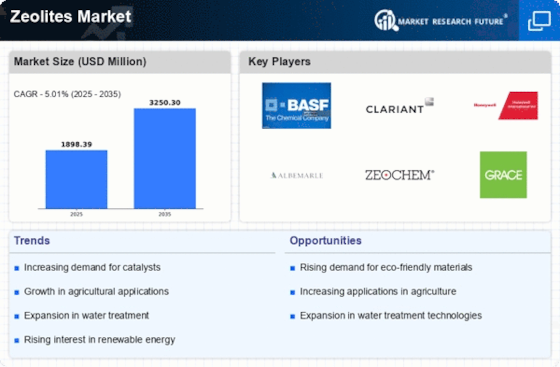
<p>The Zeolites Market was valued at 1898.39 USD Million in 2024.</p>

What is the projected market valuation for the Zeolites Market in 2035?

<p>The market is projected to reach a valuation of 3250.3 USD Million by 2035.</p>

What is the expected CAGR for the Zeolites Market during the forecast period 2025 - 2035?

<p>The expected CAGR for the Zeolites Market during the forecast period 2025 - 2035 is 5.01%.</p>

Which companies are considered key players in the Zeolites Market?

<p>Key players in the Zeolites Market include BASF SE, Clariant AG, Honeywell International Inc., and Albemarle Corporation.</p>

What are the main product segments in the Zeolites Market?

<p>The main product segments in the Zeolites Market are Natural and Synthetic zeolites, with valuations of 800.0 to 1300.0 USD Million and 1098.39 to 1950.3 USD Million, respectively.</p>

What applications are driving growth in the Zeolites Market?

<p>Applications driving growth include Detergents, Air Separation, and others, with Detergents valued between 950.0 and 1600.0 USD Million.</p>

How does the performance of synthetic zeolites compare to natural zeolites?

Synthetic zeolites, valued between 1098.39 and 1950.3 USD Million, appear to have a higher market performance compared to natural zeolites.

What is the market size for air separation applications in the Zeolites Market?

The market size for air separation applications is projected to be between 600.0 and 1000.0 USD Million.

What trends are influencing the Zeolites Market in 2025?

Trends influencing the Zeolites Market in 2025 include increasing demand for synthetic zeolites and applications in environmental and industrial sectors.

What potential challenges might the Zeolites Market face in the coming years?

Potential challenges may include fluctuations in raw material prices and competition among key players like W.R. Grace &amp; Co. and Tosoh Corporation.

Market Summary

As per Market Research Future analysis, the Zeolites Market Size was estimated at 9 USD Billion in 2024. The Zeolites industry is projected to grow from USD 9.3 Billion in 2025 to USD 13.4 Billion by 2035, exhibiting a compound annual growth rate (CAGR) of 3.7% during the forecast period 2025 - 2035

Key Market Trends & Highlights

The Zeolites Market is poised for robust growth driven by sustainability and technological advancements.

  • North America remains the largest market for zeolites, primarily due to its extensive applications in agriculture and water treatment. The Asia-Pacific region is emerging as the fastest-growing market, fueled by increasing industrialization and urbanization. Natural zeolites dominate the market, while synthetic zeolites are witnessing rapid growth due to their versatility in various applications. Rising demand in agriculture and innovations in water treatment are key drivers propelling the zeolites market forward.

Market Size & Forecast

2024 Market Size 9 (USD Billion)
2035 Market Size 13.4 (USD Billion)
CAGR (2025 - 2035) 3.7%
Largest Regional Market Share in 2024 Asia Pacific

Major Players

BASF SE, Clariant AG, Honeywell International Inc., Albemarle Corporation, Zeochem AG, W.R. Grace &amp; Co., Tosoh Corporation, Arkema S.A, GCMIL

Market Trends

The Zeolites Market is currently experiencing a dynamic phase characterized by evolving applications and increasing demand across various sectors. This market encompasses a range of natural and synthetic zeolites, which are utilized in industries such as agriculture, water treatment, and petrochemicals. The versatility of zeolites, attributed to their unique porous structure and ion-exchange capabilities, positions them as essential materials in numerous processes. As environmental concerns rise, the focus on sustainable practices is likely to drive innovations in zeolite applications, enhancing their role in promoting eco-friendly solutions.

Moreover, the zeolite molecular sieve market appears to be influenced by advancements in technology and research, which may lead to the development of novel zeolite formulations.  These innovations could potentially expand their utility in emerging fields, such as renewable energy and pharmaceuticals. The growing awareness of zeolites' benefits, including their ability to improve soil health and reduce pollution, suggests a promising outlook for the zeolite market.  Stakeholders are likely to explore new opportunities, fostering collaborations that could further enhance the market's growth trajectory.

Sustainable Agriculture Practices

The Zeolites Market is witnessing a shift towards sustainable agricultural practices. Zeolites Market are increasingly recognized for their ability to enhance soil quality, retain moisture, and improve nutrient availability. This trend indicates a growing preference among farmers for eco-friendly solutions that promote crop yield while minimizing environmental impact.

Water Treatment Innovations

Innovations in water treatment technologies are significantly impacting the zeolite molecular sieve market. Materials across the synthetic zeolites market are utilized for their adsorption properties, which aid in removing contaminants from water. . This trend highlights the increasing reliance on zeolites for effective and sustainable water purification methods.

Advancements in Petrochemical Applications

The petrochemical sector is exploring new applications for zeolites, particularly in catalytic processes. The ability of zeolites to act as catalysts in refining and chemical production suggests a potential expansion of their role in enhancing efficiency and reducing emissions in this industry.

Zeolites Market Market Drivers

Rising Demand in Agriculture

The Zeolites Market is experiencing a notable surge in demand due to the increasing adoption of sustainable agriculture practices. Zeolites Market are utilized as soil amendments, enhancing nutrient retention and improving soil structure. This is particularly relevant as the agricultural sector seeks to optimize yield while minimizing environmental impact. The market for zeolites in agriculture is projected to grow at a compound annual growth rate of approximately 5.2% over the next few years. This growth is driven by the need for eco-friendly solutions that promote soil health and crop productivity, thereby positioning zeolites as a critical component in modern agricultural practices.

Innovations in Water Treatment

The Zeolites Market is significantly influenced by advancements in water treatment technologies. Zeolites Market are employed in various filtration processes, effectively removing heavy metals and contaminants from water. As water scarcity becomes an increasingly pressing issue, the demand for efficient water purification methods is on the rise. The market for zeolites in water treatment applications is expected to expand, with a projected growth rate of around 6.5% annually. This trend underscores the importance of zeolites in addressing global water quality challenges, making them indispensable in the quest for sustainable water management solutions.

Growth in Petrochemical Applications

The Zeolites Market is poised for growth due to the expanding use of zeolites in petrochemical applications. These materials serve as catalysts in various chemical processes, enhancing efficiency and selectivity. The petrochemical sector is increasingly relying on zeolites to improve production yields and reduce energy consumption. With The Zeolites Market projected to reach USD 5 trillion by 2026, the demand for zeolite-based catalysts is likely to increase correspondingly. This trend highlights the pivotal role of zeolites in optimizing chemical processes, thereby reinforcing their significance in the petrochemical industry.

Environmental Regulations and Compliance

The Zeolites Market is also driven by stringent environmental regulations aimed at reducing pollution and promoting sustainable practices. Governments worldwide are implementing policies that encourage the use of eco-friendly materials, including zeolites, in various industrial applications. This regulatory landscape is fostering innovation and investment in zeolite technologies, as industries seek to comply with environmental standards. The market is expected to benefit from this trend, with an anticipated growth rate of 4.8% as companies increasingly turn to zeolites for their environmental advantages. This shift not only supports compliance but also enhances corporate sustainability initiatives.

Technological Advancements in Zeolite Production

The Zeolites Market is witnessing a transformation due to technological advancements in zeolite production methods. Innovations such as improved synthesis techniques and enhanced processing capabilities are enabling manufacturers to produce high-quality zeolites more efficiently. This is likely to lead to a reduction in production costs and an increase in the availability of zeolite products across various sectors. As the demand for specialized zeolite applications grows, these advancements are expected to drive market expansion, with a projected growth rate of 5.5%. This evolution in production technology is crucial for meeting the diverse needs of industries reliant on zeolites.

Market Segment Insights

By Product: Natural (Largest) vs. Synthetic (Fastest-Growing)

<p>The zeolites market is predominantly divided into two main segments: natural and synthetic zeolites. Natural zeolites currently hold a significant share, leveraging their abundant occurrence and low processing requirements. This category benefits from traditional applications in agriculture, water purification, and construction, which has kept its market presence stable over the years. Synthetic zeolites, while smaller in terms of market share, are rapidly gaining ground due to their tailored properties that cater to specific industrial applications, including catalysis and ion-exchange processes.</p>

<p>Zeolites: Natural (Dominant) vs. Synthetic (Emerging)</p>

<p>Natural zeolites are derived from geological deposits and are characterized by their porous structure and chemical stability. They dominate the market due to their cost-effectiveness and eco-friendly nature, commonly used in agriculture for soil enhancement and in water treatment due to their ability to absorb heavy metals and ammonia. Conversely, synthetic zeolites are engineered for specific applications, offering enhanced performance in catalysis and gas separation. Their emergence as a preferred choice in high-tech industries is propelled by innovations in chemical processes and increasing demand for efficient materials, making them a key player in the evolving zeolites market.</p>

By Application: Detergents (Largest) vs. Air Separation (Fastest-Growing)

<p>In the Zeolites Market, the application segment is categorized into Detergents, Air Separation, and Others. Detergents account for the largest share, largely due to their widespread use in household and industrial cleaning products. Conversely, the Air Separation application is rapidly growing, driven by the increasing demand for high-purity gases in various industries such as healthcare and electronics. The 'Others' category includes niche applications like agriculture and catalysis, which, while smaller, contribute significantly to the overall market dynamics.</p>

<p>Detergents (Dominant) vs. Air Separation (Emerging)</p>

<p>The Detergents segment remains dominant in the Zeolites Market, characterized by the high demand for efficient cleaning agents. Zeolites in detergents act as water softeners and builders, enhancing cleaning efficiency in various formulations. This segment benefits from consumer preference for eco-friendly products, leading to innovations in formulation. However, Air Separation is emerging as a high-growth segment, spurred by technological advancements that improve the efficiency and effectiveness of zeolite-based <a href="https://www.marketresearchfuture.com/reports/adsorbents-market-5271" target="_blank" title="adsorbents">adsorbents</a> in gas separation processes. As industries strive for lower carbon footprints and optimize production, the role of zeolites in air separation is becoming increasingly vital.</p>

By Type: Natural Zeolite (Largest) vs. Synthetic Zeolite (Fastest-Growing)

<p>The zeolite market is characterized by a diverse range of types, where natural zeolite holds the largest share, driven by its inherent properties and applications in agriculture, water treatment, and construction. In contrast, synthetic zeolite, while being a smaller segment overall, is noted for its rapid growth, especially in industrial applications such as catalysis and gas separation, owing to advanced production methods that enhance its functionality and versatility. Market dynamics are influenced by the expanding applications of zeolites in emerging economies, which propel the demand for both natural and synthetic forms. The increasing preference for eco-friendly and sustainable solutions in various industries also favors natural zeolite, while sectors requiring high purity and functionality favor synthetic options, highlighting a dual growth trajectory in the zeolite market.</p>

<p>Natural Zeolite (Dominant) vs. Modified Zeolite (Emerging)</p>

<p>Natural zeolite is recognized for its abundance, affordability, and multifunctional attributes, making it a dominant player in the zeolite market. Its applications span across agriculture for soil enhancement, in animal husbandry as feed additives, and in wastewater treatment due to its ability to remove heavy metals and nutrients. On the other hand, modified zeolite is considered an emerging segment, driven by innovations that improve its adsorption capabilities and chemical reactivity. Industries are increasingly adopting modified zeolite for specialized applications such as catalysts in chemical processes and as adsorbents in gas purification systems. This innovation trend is transforming modified zeolite from a niche offering into a valuable commodity capable of meeting evolving industrial demands.</p>

By Form: Powder (Largest) vs. Granules (Fastest-Growing)

<p>In the zeolite market, the Powder form currently holds the largest market share due to its wide applications in various industries, including agriculture, water treatment, and petrochemicals. Granules, while having a smaller share compared to Powder, are gaining traction rapidly due to their specialty uses and favorable properties, making them a preferred choice for specific applications. The versatility of both forms caters to distinct consumer needs, showcasing a diverse landscape within the segment that reflects varying demand across sectors.</p>

<p>Powder (Dominant) vs. Granules (Emerging)</p>

<p>The Powder form of zeolite is dominant in the market primarily because of its versatility and effectiveness in various applications such as adsorbents, catalysts, and ion-exchange materials. It caters to a broad range of industries, contributing to its strong market presence. On the other hand, Granules are emerging rapidly, benefiting from their preferred use in applications that require controlled release and effective adsorption in a more structured format. The customization opportunities with granules further enhance their appeal, making them a significant focal point for manufacturers aiming to meet specialized market demands. The distinct characteristics of each form contribute to the overall growth of the zeolite market.</p>

By Functionality: Ion Exchange (Largest) vs. Molecular Sieving (Fastest-Growing)

<p>The zeolite market is characterized by a diverse range of functionalities, with ion exchange leading the charge, constituting a significant portion of the overall market share. Ion exchange is widely utilized in water purification and softening applications, contributing to its dominant position. In contrast, molecular sieving, while smaller in current share, is emerging rapidly due to its applications in gas separation and industry-specific processes, highlighting a growing interest in sustainable technologies.</p>

<p>Ion Exchange (Dominant) vs. Molecular Sieving (Emerging)</p>

<p>Ion exchange is a well-established functionality in the zeolite market, renowned for its effectiveness in water treatment and purification processes. This segment not only boasts a long history of application but also benefits from a robust demand in residential, commercial, and industrial sectors. On the other hand, molecular sieving represents an emerging trend, capitalizing on advancements in separation technologies. This segment is increasingly favored in the petrochemical industry for its ability to selectively filter molecules, making it integral to future processes designed for efficiency and minimal environmental impact. As a result, while ion exchange remains dominant, molecular sieving is poised for rapid gains.</p>

Get more detailed insights about Zeolites Market Research Report—Global Forecast till 2035

Regional Insights

Based on Region, the Zeolites Market is segmented into North America, Europe, Asia-Pacific, Middle East & Africa, and Latin America. The Asia Pacific Zeolites Market held the maximum market share and is also expected to account for the significant revenue share during the forecast period. The zeolite market demand in the Asia Pacific region is majorly driven by the easy availability of the raw materials and the increasing zeolite demand from applications such as air separation, detergents, and others. The large population and increased disposable income of the customers, will boost the demand for zeolite-based products such as detergents.

For instance, according to international trade administrations, the cosmetic and toiletries market of china is valued at US$52.3 billion in 2020. The split of the market is as follows: skincare 51%, make up 12%, hair care 12%, oral care 10%, baby care 6%, fragrances 2%, and others 7%. Europe is expected to show healthy growth in the market for zeolites during the forecast period due to major zeolites product manufacturers and the rapid industrialization in these regions. North America is also expected to show lucrative growth in the forecast period, further categorized into US and Canada.

Key Players and Competitive Insights

Key market players are emphasizing significantly on R&D for increasing their product offerings, which will further help the Zeolites Market to grow considerably. Market players are adopting several business development strategies such as acquisitions, mergers, collaborations, and partnerships to enhance their market presence and acquire larger customer base. To survive in the competitive market, industry players must provide cost effective products. The Zeolites Market is very competitive with market players trying to develop unique and innovative products and solutions, which could render the competitors’ offerings obsolete. The competitive environment is likely to grow further owing to rising technological advancements. Some of the key players operating in the Zeolites Market are BASF SE, Clariant, Tosoh Corporation, W. R. Grace & Co., Union Showa K.K., Albemarle Corporation, Zeochem AG, National Aluminum Company Limited (NALCO), PQ Corporation, and Huiying Chemical Industry (Xiamen) Co., Ltd (China). To increase their global reach and client base, key firms are concentrating on acquisitions and product innovation. BASF SE: BASF SE (BASF) is one of the leading chemical manufacturers in the world. The company operates its business through five segments: chemicals, performance products, functional materials and solutions, agricultural solutions, and others. However, as of January 2019, the company has divided its business into six divisions: materials, industrial solutions, chemicals, surface technologies, agricultural solutions, and nutrition & care. The company operates through 12 divisions that manage 54 global and regional business units and develop strategies for 86 strategic businesses. BASF marks its presence in 90 countries and operates through six Verbund sites and 232 additional production sites which interlink the working of production plants, energy flows, and infrastructure in different regions. The company operates in Europe and has a strong active presence in the Asia-Pacific, the Americas, the Middle East & Africa. Clariant: Clariant is a leading specialty chemical company in the world. It operates through three business segments: care chemicals, catalysis, and natural resources. The operations of the company are categorized into seven business units: catalysts, additives, industrial & consumer specialties, functional minerals, masterbatches, oil & mining services, and pigments. The additives business segment of the company is a leading provider of flame retardants, performance additives, and advanced surface solutions for functional effects in plastics, coatings, inks, and consumer applications. Also, the company is the world’s largest producer of specialty zeolite powders with two production units in Germany & South Africa. It offers synthetic zeolites for various applications from chemical production to refining, and from odor removal to off-gas purification. It has 67 manufacturing facilities that produce and sell across several regions, including Europe, the Middle East & Africa, Asia-Pacific, North America, and Latin America. United States Antimony Corporation declared in 2024 that it will formally introduce its zeolite cattle feed ingredient under the "CattleMaxTM" brand through its fully owned subsidiary, Bear River Zeolite Company. The brand will be nested within Zeo-True Naturals, BRZ's current product line. CattleMaxTM will first be available in large "super sacks," but different package options are being developed for clients on a smaller scale. ZeoDAC, Inc., a promising new player in the direct air capture of carbon dioxide market, announced the establishment of the company in 2024. In order to fulfill its purpose of "Capturing Carbon Dioxide from Air to Create a Better Tomorrow," ZeoDAC uses best-in-class zeolites and other advantaged solid materials to quickly scale up their carbon-capturing technology for direct air carbon capture (DAC).

Key Companies in the Zeolites Market include

Industry Developments

In January 2024, BASF SE increased zeolite production at its site in Germany to meet the increasing need for zeolite catalyst and adsorbent products used in refining, petrochemicals, and other environmental industries. This expansion is a step towards BASF’s consistent plan to improve its position in the specialty chemicals industry.

In December 2023, Clariant AG launched a new product line of synthetic zeolites that are specifically intended for heavy metal wastewater treatment. These zeolites facilitate better industry compliance to ever more stringent environmental controls. The company's focus on eco-friendly modifications demonstrates Clariant's dedication to sustainability.

In November 2023, Tosoh Corporation announced the progress in the development of gas separation zeolite membranes with high performance. The company targets these membranes to the markets of carbon capture and hydrogen purification which supports the global transition to clean energy.

In October 2023, Zeochem AG has also diversified into the pharmaceutical and food industries with a new range of molecular sieve zeolites. These improved adsorbents increase product stability and shelf life for moisture sensitive products. These new zeolites have broadened the scope of Zeochem’s market to high purity materials.

In August 2023, KNT Group has established a strategic alliance with a chemical company in Europe to develop novel zeolite materials for automotive emission control systems. The objective of this cooperation is to improve Selective Catalytic Reduction (SCR) technology to comply with more stringent vehicle emission standards.

In July 2023, Huiying Chemical Industry Xiamen Co., Ltd. upgraded its facilities in China to meet rising demand for eco-friendly detergent grade zeolites. This expansion comes as the market transitions from phosphate-based products in cleaning for industrial and domestic use.

In June 2023, Albemarle Corporation started a project to optimize zeolite catalysts for biofuel production at one of its research centers. The project is in line with Albemarle’s strategy for sustainable development of alternative energy sources.

Future Outlook

Zeolites Market Future Outlook

The Zeolites Market is projected to grow at a 3.7% CAGR from 2025 to 2035, driven by increasing demand in agriculture, water treatment, and petrochemical industries.

New opportunities lie in:

  • <p>Development of advanced zeolite catalysts for biofuel production. Expansion into emerging markets with tailored zeolite solutions. Investment in sustainable mining practices to enhance supply chain resilience.</p>

By 2035, the Zeolites Market is expected to achieve robust growth, driven by innovation and strategic investments.

Market Segmentation

Zeolites Market Product Outlook

  • Natural
  • Synthetic

Zeolites Market Application Outlook

  • Detergents
  • Air Separation
  • Others

Report Scope

MARKET SIZE 2024 9 (USD Billion)
MARKET SIZE 2025 9.3 (USD Billion)
MARKET SIZE 2035 13.4 (USD Billion)
COMPOUND ANNUAL GROWTH RATE (CAGR) 3.7 % (2025 - 2035)
REPORT COVERAGE Revenue Forecast, Competitive Landscape, Growth Factors, and Trends
BASE YEAR 2024
Market Forecast Period 2025 - 2035
Historical Data 2019 - 2024
Market Forecast Units USD Million
Key Companies Profiled BASF SE, Clariant AG, Honeywell International Inc., Albemarle Corporation, Zeochem AG, W.R. Grace & Co., Tosoh Corporation, Arkema S.A, GCMIL
Segments Covered Product, Application, Region -Global Forecast to 2035
Key Market Opportunities Growing demand for sustainable water treatment solutions drives innovation in the Zeolites Market.
Key Market Dynamics Rising demand for zeolites in environmental applications drives innovation and competitive dynamics in the market.
Countries Covered North America, Europe, APAC, South America, MEA

FAQs

What is the current valuation of the Zeolites Market as of 2024?

<p>The Zeolites Market was valued at 1898.39 USD Million in 2024.</p>

What is the projected market valuation for the Zeolites Market in 2035?

<p>The market is projected to reach a valuation of 3250.3 USD Million by 2035.</p>

What is the expected CAGR for the Zeolites Market during the forecast period 2025 - 2035?

<p>The expected CAGR for the Zeolites Market during the forecast period 2025 - 2035 is 5.01%.</p>

Which companies are considered key players in the Zeolites Market?

<p>Key players in the Zeolites Market include BASF SE, Clariant AG, Honeywell International Inc., and Albemarle Corporation.</p>

What are the main product segments in the Zeolites Market?

<p>The main product segments in the Zeolites Market are Natural and Synthetic zeolites, with valuations of 800.0 to 1300.0 USD Million and 1098.39 to 1950.3 USD Million, respectively.</p>

What applications are driving growth in the Zeolites Market?

<p>Applications driving growth include Detergents, Air Separation, and others, with Detergents valued between 950.0 and 1600.0 USD Million.</p>

How does the performance of synthetic zeolites compare to natural zeolites?

Synthetic zeolites, valued between 1098.39 and 1950.3 USD Million, appear to have a higher market performance compared to natural zeolites.

What is the market size for air separation applications in the Zeolites Market?

The market size for air separation applications is projected to be between 600.0 and 1000.0 USD Million.

What trends are influencing the Zeolites Market in 2025?

Trends influencing the Zeolites Market in 2025 include increasing demand for synthetic zeolites and applications in environmental and industrial sectors.

What potential challenges might the Zeolites Market face in the coming years?

Potential challenges may include fluctuations in raw material prices and competition among key players like W.R. Grace &amp; Co. and Tosoh Corporation.

  1. SECTION I: EXECUTIVE SUMMARY AND KEY HIGHLIGHTS
    1. | 1.1 EXECUTIVE SUMMARY
    2. | | 1.1.1 Market Overview
    3. | | 1.1.2 Key Findings
    4. | | 1.1.3 Market Segmentation
    5. | | 1.1.4 Competitive Landscape
    6. | | 1.1.5 Challenges and Opportunities
    7. | | 1.1.6 Future Outlook
  2. SECTION II: SCOPING, METHODOLOGY AND MARKET STRUCTURE
    1. | 2.1 MARKET INTRODUCTION
    2. | | 2.1.1 Definition
    3. | | 2.1.2 Scope of the study
    4. | | | 2.1.2.1 Research Objective
    5. | | | 2.1.2.2 Assumption
    6. | | | 2.1.2.3 Limitations
    7. | 2.2 RESEARCH METHODOLOGY
    8. | | 2.2.1 Overview
    9. | | 2.2.2 Data Mining
    10. | | 2.2.3 Secondary Research
    11. | | 2.2.4 Primary Research
    12. | | | 2.2.4.1 Primary Interviews and Information Gathering Process
    13. | | | 2.2.4.2 Breakdown of Primary Respondents
    14. | | 2.2.5 Forecasting Model
    15. | | 2.2.6 Market Size Estimation
    16. | | | 2.2.6.1 Bottom-Up Approach
    17. | | | 2.2.6.2 Top-Down Approach
    18. | | 2.2.7 Data Triangulation
    19. | | 2.2.8 Validation
  3. SECTION III: QUALITATIVE ANALYSIS
    1. | 3.1 MARKET DYNAMICS
    2. | | 3.1.1 Overview
    3. | | 3.1.2 Drivers
    4. | | 3.1.3 Restraints
    5. | | 3.1.4 Opportunities
    6. | 3.2 MARKET FACTOR ANALYSIS
    7. | | 3.2.1 Value chain Analysis
    8. | | 3.2.2 Porter's Five Forces Analysis
    9. | | | 3.2.2.1 Bargaining Power of Suppliers
    10. | | | 3.2.2.2 Bargaining Power of Buyers
    11. | | | 3.2.2.3 Threat of New Entrants
    12. | | | 3.2.2.4 Threat of Substitutes
    13. | | | 3.2.2.5 Intensity of Rivalry
    14. | | 3.2.3 COVID-19 Impact Analysis
    15. | | | 3.2.3.1 Market Impact Analysis
    16. | | | 3.2.3.2 Regional Impact
    17. | | | 3.2.3.3 Opportunity and Threat Analysis
  4. SECTION IV: QUANTITATIVE ANALYSIS
    1. | 4.1 Chemicals and Materials, BY Product (USD Million)
    2. | | 4.1.1 Natural
    3. | | 4.1.2 Synthetic
    4. | 4.2 Chemicals and Materials, BY Application (USD Million)
    5. | | 4.2.1 Detergents
    6. | | 4.2.2 Air Separation
    7. | | 4.2.3 Others
    8. | 4.3 Chemicals and Materials, BY Region (USD Million)
    9. | | 4.3.1 North America
    10. | | | 4.3.1.1 US
    11. | | | 4.3.1.2 Canada
    12. | | 4.3.2 Europe
    13. | | | 4.3.2.1 Germany
    14. | | | 4.3.2.2 UK
    15. | | | 4.3.2.3 France
    16. | | | 4.3.2.4 Russia
    17. | | | 4.3.2.5 Italy
    18. | | | 4.3.2.6 Spain
    19. | | | 4.3.2.7 Rest of Europe
    20. | | 4.3.3 APAC
    21. | | | 4.3.3.1 China
    22. | | | 4.3.3.2 India
    23. | | | 4.3.3.3 Japan
    24. | | | 4.3.3.4 South Korea
    25. | | | 4.3.3.5 Malaysia
    26. | | | 4.3.3.6 Thailand
    27. | | | 4.3.3.7 Indonesia
    28. | | | 4.3.3.8 Rest of APAC
    29. | | 4.3.4 South America
    30. | | | 4.3.4.1 Brazil
    31. | | | 4.3.4.2 Mexico
    32. | | | 4.3.4.3 Argentina
    33. | | | 4.3.4.4 Rest of South America
    34. | | 4.3.5 MEA
    35. | | | 4.3.5.1 GCC Countries
    36. | | | 4.3.5.2 South Africa
    37. | | | 4.3.5.3 Rest of MEA
  5. SECTION V: COMPETITIVE ANALYSIS
    1. | 5.1 Competitive Landscape
    2. | | 5.1.1 Overview
    3. | | 5.1.2 Competitive Analysis
    4. | | 5.1.3 Market share Analysis
    5. | | 5.1.4 Major Growth Strategy in the Chemicals and Materials
    6. | | 5.1.5 Competitive Benchmarking
    7. | | 5.1.6 Leading Players in Terms of Number of Developments in the Chemicals and Materials
    8. | | 5.1.7 Key developments and growth strategies
    9. | | | 5.1.7.1 New Product Launch/Service Deployment
    10. | | | 5.1.7.2 Merger & Acquisitions
    11. | | | 5.1.7.3 Joint Ventures
    12. | | 5.1.8 Major Players Financial Matrix
    13. | | | 5.1.8.1 Sales and Operating Income
    14. | | | 5.1.8.2 Major Players R&D Expenditure. 2023
    15. | 5.2 Company Profiles
    16. | | 5.2.1 BASF SE (DE)
    17. | | | 5.2.1.1 Financial Overview
    18. | | | 5.2.1.2 Products Offered
    19. | | | 5.2.1.3 Key Developments
    20. | | | 5.2.1.4 SWOT Analysis
    21. | | | 5.2.1.5 Key Strategies
    22. | | 5.2.2 Clariant AG (CH)
    23. | | | 5.2.2.1 Financial Overview
    24. | | | 5.2.2.2 Products Offered
    25. | | | 5.2.2.3 Key Developments
    26. | | | 5.2.2.4 SWOT Analysis
    27. | | | 5.2.2.5 Key Strategies
    28. | | 5.2.3 Honeywell International Inc. (US)
    29. | | | 5.2.3.1 Financial Overview
    30. | | | 5.2.3.2 Products Offered
    31. | | | 5.2.3.3 Key Developments
    32. | | | 5.2.3.4 SWOT Analysis
    33. | | | 5.2.3.5 Key Strategies
    34. | | 5.2.4 Albemarle Corporation (US)
    35. | | | 5.2.4.1 Financial Overview
    36. | | | 5.2.4.2 Products Offered
    37. | | | 5.2.4.3 Key Developments
    38. | | | 5.2.4.4 SWOT Analysis
    39. | | | 5.2.4.5 Key Strategies
    40. | | 5.2.5 Zeochem AG (CH)
    41. | | | 5.2.5.1 Financial Overview
    42. | | | 5.2.5.2 Products Offered
    43. | | | 5.2.5.3 Key Developments
    44. | | | 5.2.5.4 SWOT Analysis
    45. | | | 5.2.5.5 Key Strategies
    46. | | 5.2.6 W.R. Grace & Co. (US)
    47. | | | 5.2.6.1 Financial Overview
    48. | | | 5.2.6.2 Products Offered
    49. | | | 5.2.6.3 Key Developments
    50. | | | 5.2.6.4 SWOT Analysis
    51. | | | 5.2.6.5 Key Strategies
    52. | | 5.2.7 Tosoh Corporation (JP)
    53. | | | 5.2.7.1 Financial Overview
    54. | | | 5.2.7.2 Products Offered
    55. | | | 5.2.7.3 Key Developments
    56. | | | 5.2.7.4 SWOT Analysis
    57. | | | 5.2.7.5 Key Strategies
    58. | | 5.2.8 Arkema S.A. (FR)
    59. | | | 5.2.8.1 Financial Overview
    60. | | | 5.2.8.2 Products Offered
    61. | | | 5.2.8.3 Key Developments
    62. | | | 5.2.8.4 SWOT Analysis
    63. | | | 5.2.8.5 Key Strategies
    64. | | 5.2.9 Molecular Sieves, Inc. (US)
    65. | | | 5.2.9.1 Financial Overview
    66. | | | 5.2.9.2 Products Offered
    67. | | | 5.2.9.3 Key Developments
    68. | | | 5.2.9.4 SWOT Analysis
    69. | | | 5.2.9.5 Key Strategies
    70. | 5.3 Appendix
    71. | | 5.3.1 References
    72. | | 5.3.2 Related Reports
  6. LIST OF FIGURES
    1. | 6.1 MARKET SYNOPSIS
    2. | 6.2 NORTH AMERICA MARKET ANALYSIS
    3. | 6.3 US MARKET ANALYSIS BY PRODUCT
    4. | 6.4 US MARKET ANALYSIS BY APPLICATION
    5. | 6.5 CANADA MARKET ANALYSIS BY PRODUCT
    6. | 6.6 CANADA MARKET ANALYSIS BY APPLICATION
    7. | 6.7 EUROPE MARKET ANALYSIS
    8. | 6.8 GERMANY MARKET ANALYSIS BY PRODUCT
    9. | 6.9 GERMANY MARKET ANALYSIS BY APPLICATION
    10. | 6.10 UK MARKET ANALYSIS BY PRODUCT
    11. | 6.11 UK MARKET ANALYSIS BY APPLICATION
    12. | 6.12 FRANCE MARKET ANALYSIS BY PRODUCT
    13. | 6.13 FRANCE MARKET ANALYSIS BY APPLICATION
    14. | 6.14 RUSSIA MARKET ANALYSIS BY PRODUCT
    15. | 6.15 RUSSIA MARKET ANALYSIS BY APPLICATION
    16. | 6.16 ITALY MARKET ANALYSIS BY PRODUCT
    17. | 6.17 ITALY MARKET ANALYSIS BY APPLICATION
    18. | 6.18 SPAIN MARKET ANALYSIS BY PRODUCT
    19. | 6.19 SPAIN MARKET ANALYSIS BY APPLICATION
    20. | 6.20 REST OF EUROPE MARKET ANALYSIS BY PRODUCT
    21. | 6.21 REST OF EUROPE MARKET ANALYSIS BY APPLICATION
    22. | 6.22 APAC MARKET ANALYSIS
    23. | 6.23 CHINA MARKET ANALYSIS BY PRODUCT
    24. | 6.24 CHINA MARKET ANALYSIS BY APPLICATION
    25. | 6.25 INDIA MARKET ANALYSIS BY PRODUCT
    26. | 6.26 INDIA MARKET ANALYSIS BY APPLICATION
    27. | 6.27 JAPAN MARKET ANALYSIS BY PRODUCT
    28. | 6.28 JAPAN MARKET ANALYSIS BY APPLICATION
    29. | 6.29 SOUTH KOREA MARKET ANALYSIS BY PRODUCT
    30. | 6.30 SOUTH KOREA MARKET ANALYSIS BY APPLICATION
    31. | 6.31 MALAYSIA MARKET ANALYSIS BY PRODUCT
    32. | 6.32 MALAYSIA MARKET ANALYSIS BY APPLICATION
    33. | 6.33 THAILAND MARKET ANALYSIS BY PRODUCT
    34. | 6.34 THAILAND MARKET ANALYSIS BY APPLICATION
    35. | 6.35 INDONESIA MARKET ANALYSIS BY PRODUCT
    36. | 6.36 INDONESIA MARKET ANALYSIS BY APPLICATION
    37. | 6.37 REST OF APAC MARKET ANALYSIS BY PRODUCT
    38. | 6.38 REST OF APAC MARKET ANALYSIS BY APPLICATION
    39. | 6.39 SOUTH AMERICA MARKET ANALYSIS
    40. | 6.40 BRAZIL MARKET ANALYSIS BY PRODUCT
    41. | 6.41 BRAZIL MARKET ANALYSIS BY APPLICATION
    42. | 6.42 MEXICO MARKET ANALYSIS BY PRODUCT
    43. | 6.43 MEXICO MARKET ANALYSIS BY APPLICATION
    44. | 6.44 ARGENTINA MARKET ANALYSIS BY PRODUCT
    45. | 6.45 ARGENTINA MARKET ANALYSIS BY APPLICATION
    46. | 6.46 REST OF SOUTH AMERICA MARKET ANALYSIS BY PRODUCT
    47. | 6.47 REST OF SOUTH AMERICA MARKET ANALYSIS BY APPLICATION
    48. | 6.48 MEA MARKET ANALYSIS
    49. | 6.49 GCC COUNTRIES MARKET ANALYSIS BY PRODUCT
    50. | 6.50 GCC COUNTRIES MARKET ANALYSIS BY APPLICATION
    51. | 6.51 SOUTH AFRICA MARKET ANALYSIS BY PRODUCT
    52. | 6.52 SOUTH AFRICA MARKET ANALYSIS BY APPLICATION
    53. | 6.53 REST OF MEA MARKET ANALYSIS BY PRODUCT
    54. | 6.54 REST OF MEA MARKET ANALYSIS BY APPLICATION
    55. | 6.55 KEY BUYING CRITERIA OF CHEMICALS AND MATERIALS
    56. | 6.56 RESEARCH PROCESS OF MRFR
    57. | 6.57 DRO ANALYSIS OF CHEMICALS AND MATERIALS
    58. | 6.58 DRIVERS IMPACT ANALYSIS: CHEMICALS AND MATERIALS
    59. | 6.59 RESTRAINTS IMPACT ANALYSIS: CHEMICALS AND MATERIALS
    60. | 6.60 SUPPLY / VALUE CHAIN: CHEMICALS AND MATERIALS
    61. | 6.61 CHEMICALS AND MATERIALS, BY PRODUCT, 2024 (% SHARE)
    62. | 6.62 CHEMICALS AND MATERIALS, BY PRODUCT, 2024 TO 2035 (USD Million)
    63. | 6.63 CHEMICALS AND MATERIALS, BY APPLICATION, 2024 (% SHARE)
    64. | 6.64 CHEMICALS AND MATERIALS, BY APPLICATION, 2024 TO 2035 (USD Million)
    65. | 6.65 BENCHMARKING OF MAJOR COMPETITORS
  7. LIST OF TABLES
    1. | 7.1 LIST OF ASSUMPTIONS
    2. | | 7.1.1
    3. | 7.2 North America MARKET SIZE ESTIMATES; FORECAST
    4. | | 7.2.1 BY PRODUCT, 2025-2035 (USD Million)
    5. | | 7.2.2 BY APPLICATION, 2025-2035 (USD Million)
    6. | 7.3 US MARKET SIZE ESTIMATES; FORECAST
    7. | | 7.3.1 BY PRODUCT, 2025-2035 (USD Million)
    8. | | 7.3.2 BY APPLICATION, 2025-2035 (USD Million)
    9. | 7.4 Canada MARKET SIZE ESTIMATES; FORECAST
    10. | | 7.4.1 BY PRODUCT, 2025-2035 (USD Million)
    11. | | 7.4.2 BY APPLICATION, 2025-2035 (USD Million)
    12. | 7.5 Europe MARKET SIZE ESTIMATES; FORECAST
    13. | | 7.5.1 BY PRODUCT, 2025-2035 (USD Million)
    14. | | 7.5.2 BY APPLICATION, 2025-2035 (USD Million)
    15. | 7.6 Germany MARKET SIZE ESTIMATES; FORECAST
    16. | | 7.6.1 BY PRODUCT, 2025-2035 (USD Million)
    17. | | 7.6.2 BY APPLICATION, 2025-2035 (USD Million)
    18. | 7.7 UK MARKET SIZE ESTIMATES; FORECAST
    19. | | 7.7.1 BY PRODUCT, 2025-2035 (USD Million)
    20. | | 7.7.2 BY APPLICATION, 2025-2035 (USD Million)
    21. | 7.8 France MARKET SIZE ESTIMATES; FORECAST
    22. | | 7.8.1 BY PRODUCT, 2025-2035 (USD Million)
    23. | | 7.8.2 BY APPLICATION, 2025-2035 (USD Million)
    24. | 7.9 Russia MARKET SIZE ESTIMATES; FORECAST
    25. | | 7.9.1 BY PRODUCT, 2025-2035 (USD Million)
    26. | | 7.9.2 BY APPLICATION, 2025-2035 (USD Million)
    27. | 7.10 Italy MARKET SIZE ESTIMATES; FORECAST
    28. | | 7.10.1 BY PRODUCT, 2025-2035 (USD Million)
    29. | | 7.10.2 BY APPLICATION, 2025-2035 (USD Million)
    30. | 7.11 Spain MARKET SIZE ESTIMATES; FORECAST
    31. | | 7.11.1 BY PRODUCT, 2025-2035 (USD Million)
    32. | | 7.11.2 BY APPLICATION, 2025-2035 (USD Million)
    33. | 7.12 Rest of Europe MARKET SIZE ESTIMATES; FORECAST
    34. | | 7.12.1 BY PRODUCT, 2025-2035 (USD Million)
    35. | | 7.12.2 BY APPLICATION, 2025-2035 (USD Million)
    36. | 7.13 APAC MARKET SIZE ESTIMATES; FORECAST
    37. | | 7.13.1 BY PRODUCT, 2025-2035 (USD Million)
    38. | | 7.13.2 BY APPLICATION, 2025-2035 (USD Million)
    39. | 7.14 China MARKET SIZE ESTIMATES; FORECAST
    40. | | 7.14.1 BY PRODUCT, 2025-2035 (USD Million)
    41. | | 7.14.2 BY APPLICATION, 2025-2035 (USD Million)
    42. | 7.15 India MARKET SIZE ESTIMATES; FORECAST
    43. | | 7.15.1 BY PRODUCT, 2025-2035 (USD Million)
    44. | | 7.15.2 BY APPLICATION, 2025-2035 (USD Million)
    45. | 7.16 Japan MARKET SIZE ESTIMATES; FORECAST
    46. | | 7.16.1 BY PRODUCT, 2025-2035 (USD Million)
    47. | | 7.16.2 BY APPLICATION, 2025-2035 (USD Million)
    48. | 7.17 South Korea MARKET SIZE ESTIMATES; FORECAST
    49. | | 7.17.1 BY PRODUCT, 2025-2035 (USD Million)
    50. | | 7.17.2 BY APPLICATION, 2025-2035 (USD Million)
    51. | 7.18 Malaysia MARKET SIZE ESTIMATES; FORECAST
    52. | | 7.18.1 BY PRODUCT, 2025-2035 (USD Million)
    53. | | 7.18.2 BY APPLICATION, 2025-2035 (USD Million)
    54. | 7.19 Thailand MARKET SIZE ESTIMATES; FORECAST
    55. | | 7.19.1 BY PRODUCT, 2025-2035 (USD Million)
    56. | | 7.19.2 BY APPLICATION, 2025-2035 (USD Million)
    57. | 7.20 Indonesia MARKET SIZE ESTIMATES; FORECAST
    58. | | 7.20.1 BY PRODUCT, 2025-2035 (USD Million)
    59. | | 7.20.2 BY APPLICATION, 2025-2035 (USD Million)
    60. | 7.21 Rest of APAC MARKET SIZE ESTIMATES; FORECAST
    61. | | 7.21.1 BY PRODUCT, 2025-2035 (USD Million)
    62. | | 7.21.2 BY APPLICATION, 2025-2035 (USD Million)
    63. | 7.22 South America MARKET SIZE ESTIMATES; FORECAST
    64. | | 7.22.1 BY PRODUCT, 2025-2035 (USD Million)
    65. | | 7.22.2 BY APPLICATION, 2025-2035 (USD Million)
    66. | 7.23 Brazil MARKET SIZE ESTIMATES; FORECAST
    67. | | 7.23.1 BY PRODUCT, 2025-2035 (USD Million)
    68. | | 7.23.2 BY APPLICATION, 2025-2035 (USD Million)
    69. | 7.24 Mexico MARKET SIZE ESTIMATES; FORECAST
    70. | | 7.24.1 BY PRODUCT, 2025-2035 (USD Million)
    71. | | 7.24.2 BY APPLICATION, 2025-2035 (USD Million)
    72. | 7.25 Argentina MARKET SIZE ESTIMATES; FORECAST
    73. | | 7.25.1 BY PRODUCT, 2025-2035 (USD Million)
    74. | | 7.25.2 BY APPLICATION, 2025-2035 (USD Million)
    75. | 7.26 Rest of South America MARKET SIZE ESTIMATES; FORECAST
    76. | | 7.26.1 BY PRODUCT, 2025-2035 (USD Million)
    77. | | 7.26.2 BY APPLICATION, 2025-2035 (USD Million)
    78. | 7.27 MEA MARKET SIZE ESTIMATES; FORECAST
    79. | | 7.27.1 BY PRODUCT, 2025-2035 (USD Million)
    80. | | 7.27.2 BY APPLICATION, 2025-2035 (USD Million)
    81. | 7.28 GCC Countries MARKET SIZE ESTIMATES; FORECAST
    82. | | 7.28.1 BY PRODUCT, 2025-2035 (USD Million)
    83. | | 7.28.2 BY APPLICATION, 2025-2035 (USD Million)
    84. | 7.29 South Africa MARKET SIZE ESTIMATES; FORECAST
    85. | | 7.29.1 BY PRODUCT, 2025-2035 (USD Million)
    86. | | 7.29.2 BY APPLICATION, 2025-2035 (USD Million)
    87. | 7.30 Rest of MEA MARKET SIZE ESTIMATES; FORECAST
    88. | | 7.30.1 BY PRODUCT, 2025-2035 (USD Million)
    89. | | 7.30.2 BY APPLICATION, 2025-2035 (USD Million)
    90. | 7.31 PRODUCT LAUNCH/PRODUCT DEVELOPMENT/APPROVAL
    91. | | 7.31.1
    92. | 7.32 ACQUISITION/PARTNERSHIP
    93. | | 7.32.1

Chemicals and Materials Market Segmentation

Chemicals and Materials By Product (USD Million, 2025-2035)

  • Natural
  • Synthetic

Chemicals and Materials By Application (USD Million, 2025-2035)

  • Detergents
  • Air Separation
  • Others
Infographic

Free Sample Request

Kindly complete the form below to receive a free sample of this Report

Get Free Sample

Customer Strories

Compare Licence

×
Features License Type
Single User Multiuser License Enterprise User
Price $4,950 $5,950 $7,250
Maximum User Access Limit 1 User Upto 10 Users Unrestricted Access Throughout the Organization
Free Customization
Direct Access to Analyst
Deliverable Format
Platform Access
Discount on Next Purchase 10% 15% 15%
Printable Versions