Request Free Sample ×

Kindly complete the form below to receive a free sample of this Report

* Please use a valid business email

Leading companies partner with us for data-driven Insights

clients tt-cursor
Hero Background
English
Chinese
French
Japanese
Korean
German
Spanish

Wooden Floor Market Trends

ID: MRFR/PCM/5355-HCR
111 Pages
Snehal Singh
March 2026

Wooden Floor Market Research Report Information By End User (Residential and Non-residential), By Type (Solid Hardwood Floor, Engineered Floor, Bamboo Floor, Laminate Floor, and Others), And By Region (North America, Europe, Asia-Pacific, and Rest Of The World) –Market Forecast Till 2035

Share:
Download PDF ×

We do not share your information with anyone. However, we may send you emails based on your report interest from time to time. You may contact us at any time to opt-out.

Wooden Floor Market Infographic
Purchase Options

Market Trends

Key Emerging Trends in the Wooden Floor Market

Recent years have witnessed changes in wooden floor market trends owing to consumer preferences and technological advancements. The rise of sustainable flooring has been witnessed recently. As customers become more environmentally conscious they get inclined towards wood from sources whereby forests are ethically managed or certified by Forest Stewardship Council (FSC). This practice stems from global tendencies for sustainable materials and procedures.

Technology has shaped the hardwood floor business through improved treatments and coatings. Finishing developments have made wooden floors tougher while prolonging their lifespan. Water-resistant coatings now make timber flooring possible even in kitchens and baths previously inappropriate for them. Consequently, this technical revolution meets customer needs thus spurring market.

Another trend witnessed in hardwood floors is customization. The modern consumer wants personalized products that reflect his/her interests and match with interior design preferences. This has led to provision of different woods in terms of species, colorations, treatments and board widths by manufacturers. Wood flooring can be customized for architectural or design purposes.

In recent years, hardwood floors have become more popular in America, and it is linked to many developments. Wooden floors provide warmth and a sense of timelessness to a space thus enhancing various kinds of themes. Many individuals appreciate oak flooring because it goes well with both conventional and contemporary design concepts.

Among the Northern American countries, United States has largest use of wooden flooring. As such, this country has experienced growth due to the need for affordable yet practical enough floorings that are equally attractive in commercial or residential buildings.

The popularity of hardwood floors can be attributed to their robustness and permanence. Oak, maple and walnut are used on the floor as they create surfaces that can endure day-to-day activities. This durability raises owners’ property values and makes oak flooring a long-term solution. Hardwood floor industry market is driven by consumer tastes, economic conditions, environmental issues, technological advancements among others like real estate patterns, government regulations as well as extreme competition. To survive in such changing environment calls for vigilance and adaptability on the part of stakeholders.


Author
Author Profile
Snehal Singh
Manager - Research

High acumen in analyzing complex macro & micro markets with more than 6 years of work experience in the field of market research. By implementing her analytical skills in forecasting and estimation into market research reports, she has expertise in Packaging, Construction, and Equipment domains. She handles a team size of 20-25 resources and ensures smooth running of the projects, associated marketing activities, and client servicing.

Leave a Comment

FAQs

What is the current valuation of the Wooden Floor Market?

<p>As of 2024, the Wooden Floor Market was valued at 33.8 USD Billion.</p>

What is the projected market valuation for the Wooden Floor Market in 2035?

<p>The Wooden Floor Market is projected to reach a valuation of 47.5 USD Billion by 2035.</p>

What is the expected CAGR for the Wooden Floor Market during the forecast period 2025 - 2035?

<p>The expected CAGR for the Wooden Floor Market from 2025 to 2035 is 3.14%.</p>

Which segment of the Wooden Floor Market had the highest valuation in 2024?

<p>In 2024, the Residential segment of the Wooden Floor Market was valued at 20.0 USD Billion.</p>

How does the Non-residential segment compare to the Residential segment in terms of valuation?

<p>The Non-residential segment was valued at 13.8 USD Billion in 2024, which is lower than the Residential segment.</p>

What types of wooden floors are included in the market analysis?

<p>The market analysis includes Solid Hardwood Floor, Engineered Floor, Bamboo Floor, Laminate Floor, and Others.</p>

Which type of wooden floor had the highest valuation in 2024?

The Engineered Floor type had the highest valuation at 12.0 USD Billion in 2024.

What is the projected growth for Solid Hardwood Floors by 2035?

Solid Hardwood Floors are projected to grow from 10.0 USD Billion in 2024 to 14.0 USD Billion by 2035.

Who are the key players in the Wooden Floor Market?

Key players in the Wooden Floor Market include Mohawk Industries, Armstrong Flooring, Shaw Industries, Tarkett, and Kahrs Group.

What is the expected trend for Bamboo Floors in the Wooden Floor Market?

Bamboo Floors are expected to grow from 4.0 USD Billion in 2024 to 6.0 USD Billion by 2035.

Market Summary

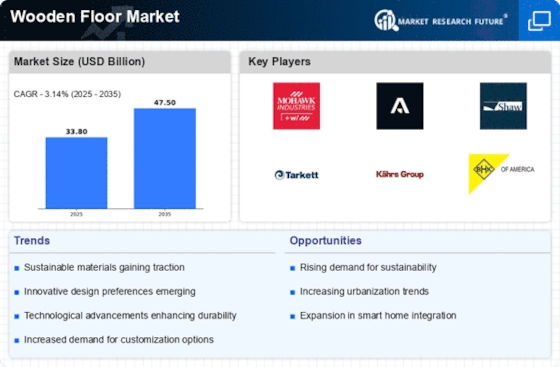
As per Market Research Future analysis, the Wooden Floor Market Size was estimated at 33.8 USD Billion in 2024. The Wooden Floor industry is projected to grow from 34.86 USD Billion in 2025 to 47.5 USD Billion by 2035, exhibiting a compound annual growth rate (CAGR) of 3.14% during the forecast period 2025 - 2035

Key Market Trends & Highlights

The Wooden Floor Market is experiencing a dynamic shift towards sustainability and innovation.

  • The market is increasingly driven by a focus on sustainability and eco-friendliness, particularly in North America. Technological advancements in manufacturing processes are enhancing product quality and variety, especially in the Asia-Pacific region. Urbanization and lifestyle changes are propelling demand in the residential segment, which remains the largest market. Rising disposable income and health trends are driving growth in the engineered floor segment, which is currently the fastest-growing.

Market Size & Forecast

2024 Market Size 33.8 (USD Billion)
2035 Market Size 47.5 (USD Billion)
CAGR (2025 - 2035) 3.14%
Largest Regional Market Share in 2024 North America

Major Players

Mohawk Industries (US), Armstrong Flooring (US), Shaw Industries (US), Tarkett (FR), Kahrs Group (SE), BHK of America (US), Pergo (US), BerryAlloc (BE), Quick-Step (BE)

Market Trends

The Wooden Floor Market is currently experiencing a dynamic evolution, driven by various factors that influence consumer preferences and industry practices. The increasing emphasis on sustainability and eco-friendliness has led to a growing demand for wooden flooring products sourced from responsibly managed forests. This trend aligns with a broader societal shift towards environmentally conscious living, where consumers are more inclined to invest in materials that reflect their values. Additionally, advancements in manufacturing technologies have enhanced the durability and aesthetic appeal of wooden floors, making them a more attractive option for both residential and commercial spaces.

Moreover, the rise of urbanization and changing lifestyles contribute to the expansion of the Wooden Floor Market. As more individuals seek to create comfortable and stylish living environments, the versatility of wooden flooring becomes increasingly appealing. The market appears to be adapting to these evolving needs by offering a diverse range of designs, finishes, and installation options. This adaptability suggests that the wooden floor market  t is poised for continued growth, as it caters to the desires of modern consumers who prioritize both functionality and aesthetics in their flooring choices.

Sustainability Focus

There is a notable shift towards sustainable practices within the Wooden Floor Market. Consumers are increasingly seeking products that are sourced from responsibly managed forests, reflecting a growing awareness of environmental issues. This trend encourages manufacturers to adopt eco-friendly materials and production methods.

Technological Advancements

Innovations in manufacturing processes are enhancing the quality and durability of wooden flooring. These advancements allow for a wider variety of styles and finishes, appealing to a broader audience. As technology continues to evolve, the Wooden Floor Market is likely to see even more sophisticated offerings.

Urbanization and Lifestyle Changes

The ongoing trend of urbanization is influencing the Wooden Floor Market significantly. As more people move to urban areas, there is an increased demand for stylish and functional flooring solutions. This shift in lifestyle preferences drives the market to provide diverse options that cater to modern living spaces.

Wooden Floor Market Market Drivers

Health and Wellness Trends

The growing focus on health and wellness is emerging as a significant driver in the Wooden Floor Market. Consumers are increasingly seeking materials that contribute to a healthier indoor environment, and wooden flooring is often favored for its natural properties. Unlike synthetic alternatives, wooden floors can help regulate humidity and improve air quality, making them an attractive option for health-conscious individuals. In 2025, it is expected that the demand for wooden flooring will be bolstered by this trend, as more consumers prioritize products that enhance their well-being. The Wooden Floor Market is thus likely to see a rise in the popularity of finishes and treatments that further promote health benefits, aligning with the broader wellness movement.

Sustainability and Eco-Friendliness

The increasing emphasis on sustainability and eco-friendliness is a pivotal driver in the Wooden Floor Market. Consumers are becoming more aware of the environmental impact of their choices, leading to a surge in demand for sustainably sourced wooden flooring. This trend is reflected in the growing popularity of certifications such as FSC (Forest Stewardship Council) and PEFC (Programme for the Endorsement of Forest Certification). In 2025, it is estimated that the market for sustainable wooden flooring will account for a substantial portion of overall sales, as homeowners and businesses alike prioritize eco-conscious materials. The Wooden Floor Market is thus witnessing a shift towards products that not only enhance aesthetic appeal but also align with environmental values.

Urbanization and Changing Lifestyles

Urbanization and evolving lifestyles are key factors propelling the Wooden Floor Market. As more individuals migrate to urban areas, there is a growing demand for stylish and functional flooring solutions that cater to modern living spaces. The trend towards open-concept homes and minimalist designs has led to an increased preference for wooden flooring, which is perceived as both elegant and versatile. In 2025, it is projected that urban areas will see a significant rise in the installation of wooden floors, as they complement contemporary interior designs. This shift in consumer behavior is likely to enhance the market dynamics of the Wooden Floor Market, creating opportunities for manufacturers to innovate and expand their product offerings.

Technological Innovations in Manufacturing

Technological advancements in manufacturing processes are significantly influencing the Wooden Floor Market. Innovations such as engineered wood technology and advanced finishing techniques have improved the durability and aesthetic qualities of wooden floors. For instance, the introduction of moisture-resistant engineered wood has expanded the application of wooden flooring in areas previously deemed unsuitable. Furthermore, automation in production has led to increased efficiency and reduced costs, making high-quality wooden flooring more accessible to consumers. As these technologies continue to evolve, they are likely to reshape consumer expectations and preferences within the Wooden Floor Market, driving further growth and diversification.

Rising Disposable Income and Home Renovations

The rise in disposable income across various demographics is a notable driver for the Wooden Floor Market. As consumers experience increased financial stability, they are more inclined to invest in home renovations and upgrades, including the installation of wooden flooring. This trend is particularly evident in emerging markets, where a growing middle class is seeking to enhance their living environments. In 2025, it is anticipated that the demand for premium wooden flooring options will rise, as consumers prioritize quality and aesthetics in their home improvement projects. Consequently, the Wooden Floor Market is likely to benefit from this trend, as more homeowners opt for luxurious and durable flooring solutions.

Market Segment Insights

By End User: Residential (Largest) vs. Non-residential (Fastest-Growing)

In the Wooden Floor Market, the Residential segment holds the largest share, driven by the continual demand for aesthetic appeal, durability, and sustainability in homes. As homeowners increasingly prioritize flooring options that enhance the visual appeal and value of their properties, the market for wooden floors has seen a significant uptick in adoption among this demographic. In contrast, the Non-residential segment is witnessing rapid growth, fueled by an uptick in commercial spaces seeking environmentally-friendly and stylish flooring solutions.

End User: Residential (Dominant) vs. Non-residential (Emerging)

The Residential segment is characterized by a demand for high-quality wooden floors that offer not just durability but also style and warmth to living spaces. Consumers in this sector are often inclined towards options that are sustainable and help in reducing energy costs, contributing to their overall market dominance. On the other hand, the Non-residential segment is emerging rapidly, as businesses recognize the benefits of using wooden floors in office spaces, retail outlets, and hospitality venues. This segment is marked by innovation and design-led choices, appealing to a corporate audience that values aesthetics and functionality in their workspaces.

By Type: Solid Hardwood Floor (Largest) vs. Engineered Floor (Fastest-Growing)

The Wooden Floor Market is primarily segmented into Solid Hardwood Floor, Engineered Floor, <a href="https://www.marketresearchfuture.com/reports/bamboos-market-19240">Bamboo</a> Floor, Laminate Floor, and Others. Solid Hardwood Floor holds the largest market share due to its traditional appeal, durability, and high quality. Meanwhile, Engineered Floor, consisting of multiple layers of wood, emerges as the fastest-growing segment. Consumers appreciate its affordability and versatility in design, contributing to its increasing adoption in modern homes and commercial spaces.

Solid Hardwood Floor (Dominant) vs. Engineered Floor (Emerging)

Solid Hardwood Floor is considered the dominant segment in the Wooden Floor Market due to its timeless appeal, superior durability, and the fact that it can be refinished multiple times, extending its lifespan significantly. It is primarily composed of solid wood planks, known for their aesthetic appeal and ability to add value to any property. In contrast, Engineered Floor, while still high in quality, represents the emerging alternative. It is crafted using real wood but offers better moisture resistance and dimensional stability, making it ideal for varying climates and home environments. This has positioned it favorably among cost-conscious consumers and those seeking sustainable options.

Get more detailed insights about Wooden Floor Market Research Report- Global Forecast 2035

Regional Insights

North America : Market Leader in Innovation

North America is the largest market for wooden flooring, accounting for approximately 40% of the global market share. The growth is driven by rising consumer preferences for sustainable and eco-friendly materials, alongside increasing disposable incomes. Regulatory support for green building initiatives further catalyzes demand, making it a key player in the wooden floor market. The United States leads the region, with significant contributions from Canada. Major players like Mohawk Industries, Shaw Industries, and Armstrong Flooring dominate the competitive landscape, focusing on innovation and sustainability. The presence of these key players ensures a robust supply chain and a variety of product offerings, catering to diverse consumer needs.

Europe : Sustainable Growth and Innovation

Europe is the second-largest market for wooden flooring, holding around 30% of the global market share. The region's growth is fueled by increasing demand for sustainable building materials and stringent environmental regulations. Countries like Germany and France are at the forefront, with initiatives promoting eco-friendly construction practices, which significantly influence market dynamics. Germany is the leading country in this sector, followed closely by France and Sweden. The competitive landscape features key players such as Tarkett and Kahrs Group, who are innovating in product design and sustainability. The presence of these companies enhances market competition, driving advancements in technology and product offerings, which cater to the evolving consumer preferences.

Asia-Pacific : Rapid Growth and Urbanization

Asia-Pacific is witnessing rapid growth in the wooden flooring market, driven by urbanization and rising disposable incomes. The region holds approximately 25% of the global market share, with countries like China and India leading the demand. The increasing trend of home renovations and new constructions is further propelling market growth, supported by favorable government policies promoting sustainable building materials. China is the largest market in the region, followed by India and Japan. The competitive landscape is characterized by both local and international players, including BHK of America and Pergo. These companies are focusing on expanding their product lines and enhancing distribution networks to meet the growing consumer demand for quality wooden flooring solutions.

Middle East and Africa : Emerging Market Potential

The Middle East and Africa region is emerging as a potential market for wooden flooring, accounting for about 5% of the global market share. The growth is driven by increasing urbanization, rising construction activities, and a growing preference for aesthetic and durable flooring solutions. Countries like the UAE and South Africa are leading this trend, supported by government initiatives to boost the construction sector. The competitive landscape is still developing, with a mix of local and international players. Companies are increasingly focusing on quality and design to cater to the evolving consumer preferences. The presence of key players like BerryAlloc and Quick-Step is enhancing market dynamics, contributing to the overall growth of the wooden flooring market in the region.

Key Players and Competitive Insights

The Wooden Floor Market is currently characterized by a dynamic competitive landscape, driven by factors such as increasing consumer preference for sustainable materials, technological advancements in manufacturing, and a growing trend towards home improvement. Major players like Mohawk Industries (US), Armstrong Flooring (US), and Tarkett (FR) are strategically positioning themselves through innovation and regional expansion. Mohawk Industries (US) focuses on enhancing its product offerings with eco-friendly materials, while Armstrong Flooring (US) emphasizes digital transformation to streamline operations and improve customer engagement. Tarkett (FR) is actively pursuing partnerships to expand its market reach, collectively shaping a competitive environment that prioritizes sustainability and technological integration.Key business tactics within the Wooden Floor Market include localizing manufacturing to reduce costs and optimize supply chains. The market structure appears moderately fragmented, with several key players exerting influence over various segments. This fragmentation allows for niche players to thrive, while larger companies leverage their scale to implement cost-effective strategies. The collective influence of these key players fosters a competitive atmosphere where innovation and customer-centric approaches are paramount.
In August Mohawk Industries (US) announced the launch of a new line of sustainable hardwood flooring products, which utilize reclaimed wood and environmentally friendly finishes. This strategic move not only aligns with the growing consumer demand for eco-conscious products but also positions Mohawk as a leader in sustainability within the market. The introduction of these products is likely to enhance brand loyalty and attract environmentally aware consumers.
In September Armstrong Flooring (US) unveiled a digital platform aimed at enhancing customer experience through virtual design tools and augmented reality features. This initiative reflects a significant investment in digital transformation, allowing customers to visualize flooring options in their spaces before making a purchase. Such a strategy may improve customer satisfaction and drive sales, indicating a shift towards more interactive and personalized shopping experiences.
In July Tarkett (FR) entered into a strategic partnership with a technology firm to develop smart flooring solutions that integrate IoT capabilities. This collaboration is expected to enhance product functionality and appeal to tech-savvy consumers. By embracing innovation, Tarkett is likely to differentiate itself in a competitive market, catering to the increasing demand for smart home solutions.
As of October the Wooden Floor Market is witnessing trends such as digitalization, sustainability, and the integration of artificial intelligence in product development. Strategic alliances are becoming increasingly important, as companies seek to leverage complementary strengths to enhance their offerings. The competitive differentiation is expected to evolve from traditional price-based competition towards a focus on innovation, technology, and supply chain reliability, suggesting a transformative shift in how companies engage with consumers and position themselves in the market.

Key Companies in the Wooden Floor Market include

Industry Developments

June 2021: LL Flooring has announced opening new stores in West Virginia, including Beckley and Hattiesburg. Customers can choose the perfect floor by visualizing how it will look by uploading photos of any area and selecting from hundreds of floor ideas at the new stores, with design centers with video capability. Besides, with this acquisition, the corporation currently has 416 locations nationally.

May 2021: Armstrong Flooring has introduced three new premium flooring collections: Biome, Terra, and Coalesce. All three collections are made in the United States and have a 2.5 mm structure with a 20-mil wear layer and Diamond 10 Technology for stain, scratch, and scuff resistance. As a result, this new launch will complement the company's existing product offering.

April 2021: The Kahrs Group introduced 'Kahrs Life,' a new form of wooden floor with qualities like vinyl floors. This new product has a thickness of 7 mm and is suitable for renovation because it fits many existing doors and thresholds better. In addition, it is quite durable and may be utilized in various settings, including conference rooms, businesses, hotel rooms, homes, and summer villas.

Future Outlook

Wooden Floor Market Future Outlook

The Wooden Floor Market is projected to grow at a 3.14% CAGR from 2025 to 2035, driven by increasing consumer preferences for sustainable materials and home renovation activities.

New opportunities lie in:

  • <p>Expansion into eco-friendly product lines</p>
  • <p> </p>
  • <p>Development of <a href="https://www.marketresearchfuture.com/reports/smart-flooring-market-28122" target="_blank" title="smart flooring">smart flooring</a> solutions</p>
  • <p>Partnerships with interior design firms for exclusive collections</p>

By 2035, the Wooden Floor Market is expected to achieve robust growth, reflecting evolving consumer demands and innovative product offerings.

Market Segmentation

Wooden Floor Market Type Outlook

  • Solid Hardwood Floor
  • Engineered Floor
  • Bamboo Floor
  • Laminate Floor
  • Others

Wooden Floor Market End User Outlook

  • Residential
  • Non-residential

Report Scope

MARKET SIZE 2024 33.8(USD Billion)
MARKET SIZE 2025 34.86(USD Billion)
MARKET SIZE 2035 47.5(USD Billion)
COMPOUND ANNUAL GROWTH RATE (CAGR) 3.14% (2025 - 2035)
REPORT COVERAGE Revenue Forecast, Competitive Landscape, Growth Factors, and Trends
BASE YEAR 2024
Market Forecast Period 2025 - 2035
Historical Data 2019 - 2024
Market Forecast Units USD Billion
Key Companies Profiled Mohawk Industries (US), Armstrong Flooring (US), Shaw Industries (US), Tarkett (FR), Kahrs Group (SE), BHK of America (US), Pergo (US), BerryAlloc (BE), Quick-Step (BE)
Segments Covered End User, Type, Region
Key Market Opportunities Growing demand for sustainable and eco-friendly materials in the Wooden Floor Market presents significant opportunities.
Key Market Dynamics Rising consumer preference for sustainable materials drives innovation and competition in the wooden floor market.
Countries Covered North America, Europe, APAC, South America, MEA

FAQs

What is the current valuation of the Wooden Floor Market?

<p>As of 2024, the Wooden Floor Market was valued at 33.8 USD Billion.</p>

What is the projected market valuation for the Wooden Floor Market in 2035?

<p>The Wooden Floor Market is projected to reach a valuation of 47.5 USD Billion by 2035.</p>

What is the expected CAGR for the Wooden Floor Market during the forecast period 2025 - 2035?

<p>The expected CAGR for the Wooden Floor Market from 2025 to 2035 is 3.14%.</p>

Which segment of the Wooden Floor Market had the highest valuation in 2024?

<p>In 2024, the Residential segment of the Wooden Floor Market was valued at 20.0 USD Billion.</p>

How does the Non-residential segment compare to the Residential segment in terms of valuation?

<p>The Non-residential segment was valued at 13.8 USD Billion in 2024, which is lower than the Residential segment.</p>

What types of wooden floors are included in the market analysis?

<p>The market analysis includes Solid Hardwood Floor, Engineered Floor, Bamboo Floor, Laminate Floor, and Others.</p>

Which type of wooden floor had the highest valuation in 2024?

The Engineered Floor type had the highest valuation at 12.0 USD Billion in 2024.

What is the projected growth for Solid Hardwood Floors by 2035?

Solid Hardwood Floors are projected to grow from 10.0 USD Billion in 2024 to 14.0 USD Billion by 2035.

Who are the key players in the Wooden Floor Market?

Key players in the Wooden Floor Market include Mohawk Industries, Armstrong Flooring, Shaw Industries, Tarkett, and Kahrs Group.

What is the expected trend for Bamboo Floors in the Wooden Floor Market?

Bamboo Floors are expected to grow from 4.0 USD Billion in 2024 to 6.0 USD Billion by 2035.

  1. SECTION I: EXECUTIVE SUMMARY AND KEY HIGHLIGHTS
    1. | 1.1 EXECUTIVE SUMMARY
    2. | | 1.1.1 Market Overview
    3. | | 1.1.2 Key Findings
    4. | | 1.1.3 Market Segmentation
    5. | | 1.1.4 Competitive Landscape
    6. | | 1.1.5 Challenges and Opportunities
    7. | | 1.1.6 Future Outlook
  2. SECTION II: SCOPING, METHODOLOGY AND MARKET STRUCTURE
    1. | 2.1 MARKET INTRODUCTION
    2. | | 2.1.1 Definition
    3. | | 2.1.2 Scope of the study
    4. | | | 2.1.2.1 Research Objective
    5. | | | 2.1.2.2 Assumption
    6. | | | 2.1.2.3 Limitations
    7. | 2.2 RESEARCH METHODOLOGY
    8. | | 2.2.1 Overview
    9. | | 2.2.2 Data Mining
    10. | | 2.2.3 Secondary Research
    11. | | 2.2.4 Primary Research
    12. | | | 2.2.4.1 Primary Interviews and Information Gathering Process
    13. | | | 2.2.4.2 Breakdown of Primary Respondents
    14. | | 2.2.5 Forecasting Model
    15. | | 2.2.6 Market Size Estimation
    16. | | | 2.2.6.1 Bottom-Up Approach
    17. | | | 2.2.6.2 Top-Down Approach
    18. | | 2.2.7 Data Triangulation
    19. | | 2.2.8 Validation
  3. SECTION III: QUALITATIVE ANALYSIS
    1. | 3.1 MARKET DYNAMICS
    2. | | 3.1.1 Overview
    3. | | 3.1.2 Drivers
    4. | | 3.1.3 Restraints
    5. | | 3.1.4 Opportunities
    6. | 3.2 MARKET FACTOR ANALYSIS
    7. | | 3.2.1 Value chain Analysis
    8. | | 3.2.2 Porter's Five Forces Analysis
    9. | | | 3.2.2.1 Bargaining Power of Suppliers
    10. | | | 3.2.2.2 Bargaining Power of Buyers
    11. | | | 3.2.2.3 Threat of New Entrants
    12. | | | 3.2.2.4 Threat of Substitutes
    13. | | | 3.2.2.5 Intensity of Rivalry
    14. | | 3.2.3 COVID-19 Impact Analysis
    15. | | | 3.2.3.1 Market Impact Analysis
    16. | | | 3.2.3.2 Regional Impact
    17. | | | 3.2.3.3 Opportunity and Threat Analysis
  4. SECTION IV: QUANTITATIVE ANALYSIS
    1. | 4.1 Packaging & Transport, BY End User (USD Billion)
    2. | | 4.1.1 Residential
    3. | | 4.1.2 Non-residential
    4. | 4.2 Packaging & Transport, BY Type (USD Billion)
    5. | | 4.2.1 Solid Hardwood Floor
    6. | | 4.2.2 Engineered Floor
    7. | | 4.2.3 Bamboo Floor
    8. | | 4.2.4 Laminate Floor
    9. | | 4.2.5 Others
    10. | 4.3 Packaging & Transport, BY Region (USD Billion)
    11. | | 4.3.1 North America
    12. | | | 4.3.1.1 US
    13. | | | 4.3.1.2 Canada
    14. | | 4.3.2 Europe
    15. | | | 4.3.2.1 Germany
    16. | | | 4.3.2.2 UK
    17. | | | 4.3.2.3 France
    18. | | | 4.3.2.4 Russia
    19. | | | 4.3.2.5 Italy
    20. | | | 4.3.2.6 Spain
    21. | | | 4.3.2.7 Rest of Europe
    22. | | 4.3.3 APAC
    23. | | | 4.3.3.1 China
    24. | | | 4.3.3.2 India
    25. | | | 4.3.3.3 Japan
    26. | | | 4.3.3.4 South Korea
    27. | | | 4.3.3.5 Malaysia
    28. | | | 4.3.3.6 Thailand
    29. | | | 4.3.3.7 Indonesia
    30. | | | 4.3.3.8 Rest of APAC
    31. | | 4.3.4 South America
    32. | | | 4.3.4.1 Brazil
    33. | | | 4.3.4.2 Mexico
    34. | | | 4.3.4.3 Argentina
    35. | | | 4.3.4.4 Rest of South America
    36. | | 4.3.5 MEA
    37. | | | 4.3.5.1 GCC Countries
    38. | | | 4.3.5.2 South Africa
    39. | | | 4.3.5.3 Rest of MEA
  5. SECTION V: COMPETITIVE ANALYSIS
    1. | 5.1 Competitive Landscape
    2. | | 5.1.1 Overview
    3. | | 5.1.2 Competitive Analysis
    4. | | 5.1.3 Market share Analysis
    5. | | 5.1.4 Major Growth Strategy in the Packaging & Transport
    6. | | 5.1.5 Competitive Benchmarking
    7. | | 5.1.6 Leading Players in Terms of Number of Developments in the Packaging & Transport
    8. | | 5.1.7 Key developments and growth strategies
    9. | | | 5.1.7.1 New Product Launch/Service Deployment
    10. | | | 5.1.7.2 Merger & Acquisitions
    11. | | | 5.1.7.3 Joint Ventures
    12. | | 5.1.8 Major Players Financial Matrix
    13. | | | 5.1.8.1 Sales and Operating Income
    14. | | | 5.1.8.2 Major Players R&D Expenditure. 2023
    15. | 5.2 Company Profiles
    16. | | 5.2.1 Mohawk Industries (US)
    17. | | | 5.2.1.1 Financial Overview
    18. | | | 5.2.1.2 Products Offered
    19. | | | 5.2.1.3 Key Developments
    20. | | | 5.2.1.4 SWOT Analysis
    21. | | | 5.2.1.5 Key Strategies
    22. | | 5.2.2 Armstrong Flooring (US)
    23. | | | 5.2.2.1 Financial Overview
    24. | | | 5.2.2.2 Products Offered
    25. | | | 5.2.2.3 Key Developments
    26. | | | 5.2.2.4 SWOT Analysis
    27. | | | 5.2.2.5 Key Strategies
    28. | | 5.2.3 Shaw Industries (US)
    29. | | | 5.2.3.1 Financial Overview
    30. | | | 5.2.3.2 Products Offered
    31. | | | 5.2.3.3 Key Developments
    32. | | | 5.2.3.4 SWOT Analysis
    33. | | | 5.2.3.5 Key Strategies
    34. | | 5.2.4 Tarkett (FR)
    35. | | | 5.2.4.1 Financial Overview
    36. | | | 5.2.4.2 Products Offered
    37. | | | 5.2.4.3 Key Developments
    38. | | | 5.2.4.4 SWOT Analysis
    39. | | | 5.2.4.5 Key Strategies
    40. | | 5.2.5 Kahrs Group (SE)
    41. | | | 5.2.5.1 Financial Overview
    42. | | | 5.2.5.2 Products Offered
    43. | | | 5.2.5.3 Key Developments
    44. | | | 5.2.5.4 SWOT Analysis
    45. | | | 5.2.5.5 Key Strategies
    46. | | 5.2.6 BHK of America (US)
    47. | | | 5.2.6.1 Financial Overview
    48. | | | 5.2.6.2 Products Offered
    49. | | | 5.2.6.3 Key Developments
    50. | | | 5.2.6.4 SWOT Analysis
    51. | | | 5.2.6.5 Key Strategies
    52. | | 5.2.7 Pergo (US)
    53. | | | 5.2.7.1 Financial Overview
    54. | | | 5.2.7.2 Products Offered
    55. | | | 5.2.7.3 Key Developments
    56. | | | 5.2.7.4 SWOT Analysis
    57. | | | 5.2.7.5 Key Strategies
    58. | | 5.2.8 BerryAlloc (BE)
    59. | | | 5.2.8.1 Financial Overview
    60. | | | 5.2.8.2 Products Offered
    61. | | | 5.2.8.3 Key Developments
    62. | | | 5.2.8.4 SWOT Analysis
    63. | | | 5.2.8.5 Key Strategies
    64. | | 5.2.9 Quick-Step (BE)
    65. | | | 5.2.9.1 Financial Overview
    66. | | | 5.2.9.2 Products Offered
    67. | | | 5.2.9.3 Key Developments
    68. | | | 5.2.9.4 SWOT Analysis
    69. | | | 5.2.9.5 Key Strategies
    70. | 5.3 Appendix
    71. | | 5.3.1 References
    72. | | 5.3.2 Related Reports
  6. LIST OF FIGURES
    1. | 6.1 MARKET SYNOPSIS
    2. | 6.2 NORTH AMERICA MARKET ANALYSIS
    3. | 6.3 US MARKET ANALYSIS BY END USER
    4. | 6.4 US MARKET ANALYSIS BY TYPE
    5. | 6.5 CANADA MARKET ANALYSIS BY END USER
    6. | 6.6 CANADA MARKET ANALYSIS BY TYPE
    7. | 6.7 EUROPE MARKET ANALYSIS
    8. | 6.8 GERMANY MARKET ANALYSIS BY END USER
    9. | 6.9 GERMANY MARKET ANALYSIS BY TYPE
    10. | 6.10 UK MARKET ANALYSIS BY END USER
    11. | 6.11 UK MARKET ANALYSIS BY TYPE
    12. | 6.12 FRANCE MARKET ANALYSIS BY END USER
    13. | 6.13 FRANCE MARKET ANALYSIS BY TYPE
    14. | 6.14 RUSSIA MARKET ANALYSIS BY END USER
    15. | 6.15 RUSSIA MARKET ANALYSIS BY TYPE
    16. | 6.16 ITALY MARKET ANALYSIS BY END USER
    17. | 6.17 ITALY MARKET ANALYSIS BY TYPE
    18. | 6.18 SPAIN MARKET ANALYSIS BY END USER
    19. | 6.19 SPAIN MARKET ANALYSIS BY TYPE
    20. | 6.20 REST OF EUROPE MARKET ANALYSIS BY END USER
    21. | 6.21 REST OF EUROPE MARKET ANALYSIS BY TYPE
    22. | 6.22 APAC MARKET ANALYSIS
    23. | 6.23 CHINA MARKET ANALYSIS BY END USER
    24. | 6.24 CHINA MARKET ANALYSIS BY TYPE
    25. | 6.25 INDIA MARKET ANALYSIS BY END USER
    26. | 6.26 INDIA MARKET ANALYSIS BY TYPE
    27. | 6.27 JAPAN MARKET ANALYSIS BY END USER
    28. | 6.28 JAPAN MARKET ANALYSIS BY TYPE
    29. | 6.29 SOUTH KOREA MARKET ANALYSIS BY END USER
    30. | 6.30 SOUTH KOREA MARKET ANALYSIS BY TYPE
    31. | 6.31 MALAYSIA MARKET ANALYSIS BY END USER
    32. | 6.32 MALAYSIA MARKET ANALYSIS BY TYPE
    33. | 6.33 THAILAND MARKET ANALYSIS BY END USER
    34. | 6.34 THAILAND MARKET ANALYSIS BY TYPE
    35. | 6.35 INDONESIA MARKET ANALYSIS BY END USER
    36. | 6.36 INDONESIA MARKET ANALYSIS BY TYPE
    37. | 6.37 REST OF APAC MARKET ANALYSIS BY END USER
    38. | 6.38 REST OF APAC MARKET ANALYSIS BY TYPE
    39. | 6.39 SOUTH AMERICA MARKET ANALYSIS
    40. | 6.40 BRAZIL MARKET ANALYSIS BY END USER
    41. | 6.41 BRAZIL MARKET ANALYSIS BY TYPE
    42. | 6.42 MEXICO MARKET ANALYSIS BY END USER
    43. | 6.43 MEXICO MARKET ANALYSIS BY TYPE
    44. | 6.44 ARGENTINA MARKET ANALYSIS BY END USER
    45. | 6.45 ARGENTINA MARKET ANALYSIS BY TYPE
    46. | 6.46 REST OF SOUTH AMERICA MARKET ANALYSIS BY END USER
    47. | 6.47 REST OF SOUTH AMERICA MARKET ANALYSIS BY TYPE
    48. | 6.48 MEA MARKET ANALYSIS
    49. | 6.49 GCC COUNTRIES MARKET ANALYSIS BY END USER
    50. | 6.50 GCC COUNTRIES MARKET ANALYSIS BY TYPE
    51. | 6.51 SOUTH AFRICA MARKET ANALYSIS BY END USER
    52. | 6.52 SOUTH AFRICA MARKET ANALYSIS BY TYPE
    53. | 6.53 REST OF MEA MARKET ANALYSIS BY END USER
    54. | 6.54 REST OF MEA MARKET ANALYSIS BY TYPE
    55. | 6.55 KEY BUYING CRITERIA OF PACKAGING & TRANSPORT
    56. | 6.56 RESEARCH PROCESS OF MRFR
    57. | 6.57 DRO ANALYSIS OF PACKAGING & TRANSPORT
    58. | 6.58 DRIVERS IMPACT ANALYSIS: PACKAGING & TRANSPORT
    59. | 6.59 RESTRAINTS IMPACT ANALYSIS: PACKAGING & TRANSPORT
    60. | 6.60 SUPPLY / VALUE CHAIN: PACKAGING & TRANSPORT
    61. | 6.61 PACKAGING & TRANSPORT, BY END USER, 2024 (% SHARE)
    62. | 6.62 PACKAGING & TRANSPORT, BY END USER, 2024 TO 2035 (USD Billion)
    63. | 6.63 PACKAGING & TRANSPORT, BY TYPE, 2024 (% SHARE)
    64. | 6.64 PACKAGING & TRANSPORT, BY TYPE, 2024 TO 2035 (USD Billion)
    65. | 6.65 BENCHMARKING OF MAJOR COMPETITORS
  7. LIST OF TABLES
    1. | 7.1 LIST OF ASSUMPTIONS
    2. | | 7.1.1
    3. | 7.2 North America MARKET SIZE ESTIMATES; FORECAST
    4. | | 7.2.1 BY END USER, 2025-2035 (USD Billion)
    5. | | 7.2.2 BY TYPE, 2025-2035 (USD Billion)
    6. | 7.3 US MARKET SIZE ESTIMATES; FORECAST
    7. | | 7.3.1 BY END USER, 2025-2035 (USD Billion)
    8. | | 7.3.2 BY TYPE, 2025-2035 (USD Billion)
    9. | 7.4 Canada MARKET SIZE ESTIMATES; FORECAST
    10. | | 7.4.1 BY END USER, 2025-2035 (USD Billion)
    11. | | 7.4.2 BY TYPE, 2025-2035 (USD Billion)
    12. | 7.5 Europe MARKET SIZE ESTIMATES; FORECAST
    13. | | 7.5.1 BY END USER, 2025-2035 (USD Billion)
    14. | | 7.5.2 BY TYPE, 2025-2035 (USD Billion)
    15. | 7.6 Germany MARKET SIZE ESTIMATES; FORECAST
    16. | | 7.6.1 BY END USER, 2025-2035 (USD Billion)
    17. | | 7.6.2 BY TYPE, 2025-2035 (USD Billion)
    18. | 7.7 UK MARKET SIZE ESTIMATES; FORECAST
    19. | | 7.7.1 BY END USER, 2025-2035 (USD Billion)
    20. | | 7.7.2 BY TYPE, 2025-2035 (USD Billion)
    21. | 7.8 France MARKET SIZE ESTIMATES; FORECAST
    22. | | 7.8.1 BY END USER, 2025-2035 (USD Billion)
    23. | | 7.8.2 BY TYPE, 2025-2035 (USD Billion)
    24. | 7.9 Russia MARKET SIZE ESTIMATES; FORECAST
    25. | | 7.9.1 BY END USER, 2025-2035 (USD Billion)
    26. | | 7.9.2 BY TYPE, 2025-2035 (USD Billion)
    27. | 7.10 Italy MARKET SIZE ESTIMATES; FORECAST
    28. | | 7.10.1 BY END USER, 2025-2035 (USD Billion)
    29. | | 7.10.2 BY TYPE, 2025-2035 (USD Billion)
    30. | 7.11 Spain MARKET SIZE ESTIMATES; FORECAST
    31. | | 7.11.1 BY END USER, 2025-2035 (USD Billion)
    32. | | 7.11.2 BY TYPE, 2025-2035 (USD Billion)
    33. | 7.12 Rest of Europe MARKET SIZE ESTIMATES; FORECAST
    34. | | 7.12.1 BY END USER, 2025-2035 (USD Billion)
    35. | | 7.12.2 BY TYPE, 2025-2035 (USD Billion)
    36. | 7.13 APAC MARKET SIZE ESTIMATES; FORECAST
    37. | | 7.13.1 BY END USER, 2025-2035 (USD Billion)
    38. | | 7.13.2 BY TYPE, 2025-2035 (USD Billion)
    39. | 7.14 China MARKET SIZE ESTIMATES; FORECAST
    40. | | 7.14.1 BY END USER, 2025-2035 (USD Billion)
    41. | | 7.14.2 BY TYPE, 2025-2035 (USD Billion)
    42. | 7.15 India MARKET SIZE ESTIMATES; FORECAST
    43. | | 7.15.1 BY END USER, 2025-2035 (USD Billion)
    44. | | 7.15.2 BY TYPE, 2025-2035 (USD Billion)
    45. | 7.16 Japan MARKET SIZE ESTIMATES; FORECAST
    46. | | 7.16.1 BY END USER, 2025-2035 (USD Billion)
    47. | | 7.16.2 BY TYPE, 2025-2035 (USD Billion)
    48. | 7.17 South Korea MARKET SIZE ESTIMATES; FORECAST
    49. | | 7.17.1 BY END USER, 2025-2035 (USD Billion)
    50. | | 7.17.2 BY TYPE, 2025-2035 (USD Billion)
    51. | 7.18 Malaysia MARKET SIZE ESTIMATES; FORECAST
    52. | | 7.18.1 BY END USER, 2025-2035 (USD Billion)
    53. | | 7.18.2 BY TYPE, 2025-2035 (USD Billion)
    54. | 7.19 Thailand MARKET SIZE ESTIMATES; FORECAST
    55. | | 7.19.1 BY END USER, 2025-2035 (USD Billion)
    56. | | 7.19.2 BY TYPE, 2025-2035 (USD Billion)
    57. | 7.20 Indonesia MARKET SIZE ESTIMATES; FORECAST
    58. | | 7.20.1 BY END USER, 2025-2035 (USD Billion)
    59. | | 7.20.2 BY TYPE, 2025-2035 (USD Billion)
    60. | 7.21 Rest of APAC MARKET SIZE ESTIMATES; FORECAST
    61. | | 7.21.1 BY END USER, 2025-2035 (USD Billion)
    62. | | 7.21.2 BY TYPE, 2025-2035 (USD Billion)
    63. | 7.22 South America MARKET SIZE ESTIMATES; FORECAST
    64. | | 7.22.1 BY END USER, 2025-2035 (USD Billion)
    65. | | 7.22.2 BY TYPE, 2025-2035 (USD Billion)
    66. | 7.23 Brazil MARKET SIZE ESTIMATES; FORECAST
    67. | | 7.23.1 BY END USER, 2025-2035 (USD Billion)
    68. | | 7.23.2 BY TYPE, 2025-2035 (USD Billion)
    69. | 7.24 Mexico MARKET SIZE ESTIMATES; FORECAST
    70. | | 7.24.1 BY END USER, 2025-2035 (USD Billion)
    71. | | 7.24.2 BY TYPE, 2025-2035 (USD Billion)
    72. | 7.25 Argentina MARKET SIZE ESTIMATES; FORECAST
    73. | | 7.25.1 BY END USER, 2025-2035 (USD Billion)
    74. | | 7.25.2 BY TYPE, 2025-2035 (USD Billion)
    75. | 7.26 Rest of South America MARKET SIZE ESTIMATES; FORECAST
    76. | | 7.26.1 BY END USER, 2025-2035 (USD Billion)
    77. | | 7.26.2 BY TYPE, 2025-2035 (USD Billion)
    78. | 7.27 MEA MARKET SIZE ESTIMATES; FORECAST
    79. | | 7.27.1 BY END USER, 2025-2035 (USD Billion)
    80. | | 7.27.2 BY TYPE, 2025-2035 (USD Billion)
    81. | 7.28 GCC Countries MARKET SIZE ESTIMATES; FORECAST
    82. | | 7.28.1 BY END USER, 2025-2035 (USD Billion)
    83. | | 7.28.2 BY TYPE, 2025-2035 (USD Billion)
    84. | 7.29 South Africa MARKET SIZE ESTIMATES; FORECAST
    85. | | 7.29.1 BY END USER, 2025-2035 (USD Billion)
    86. | | 7.29.2 BY TYPE, 2025-2035 (USD Billion)
    87. | 7.30 Rest of MEA MARKET SIZE ESTIMATES; FORECAST
    88. | | 7.30.1 BY END USER, 2025-2035 (USD Billion)
    89. | | 7.30.2 BY TYPE, 2025-2035 (USD Billion)
    90. | 7.31 PRODUCT LAUNCH/PRODUCT DEVELOPMENT/APPROVAL
    91. | | 7.31.1
    92. | 7.32 ACQUISITION/PARTNERSHIP
    93. | | 7.32.1

Packaging & Transport Market Segmentation

Packaging & Transport By End User (USD Billion, 2025-2035)

  • Residential
  • Non-residential

Packaging & Transport By Type (USD Billion, 2025-2035)

  • Solid Hardwood Floor
  • Engineered Floor
  • Bamboo Floor
  • Laminate Floor
  • Others
Infographic

Free Sample Request

Kindly complete the form below to receive a free sample of this Report

Get Free Sample

Customer Strories

Compare Licence

×
Features License Type
Single User Multiuser License Enterprise User
Price $4,950 $5,950 $7,250
Maximum User Access Limit 1 User Upto 10 Users Unrestricted Access Throughout the Organization
Free Customization
Direct Access to Analyst
Deliverable Format
Platform Access
Discount on Next Purchase 10% 15% 15%
Printable Versions