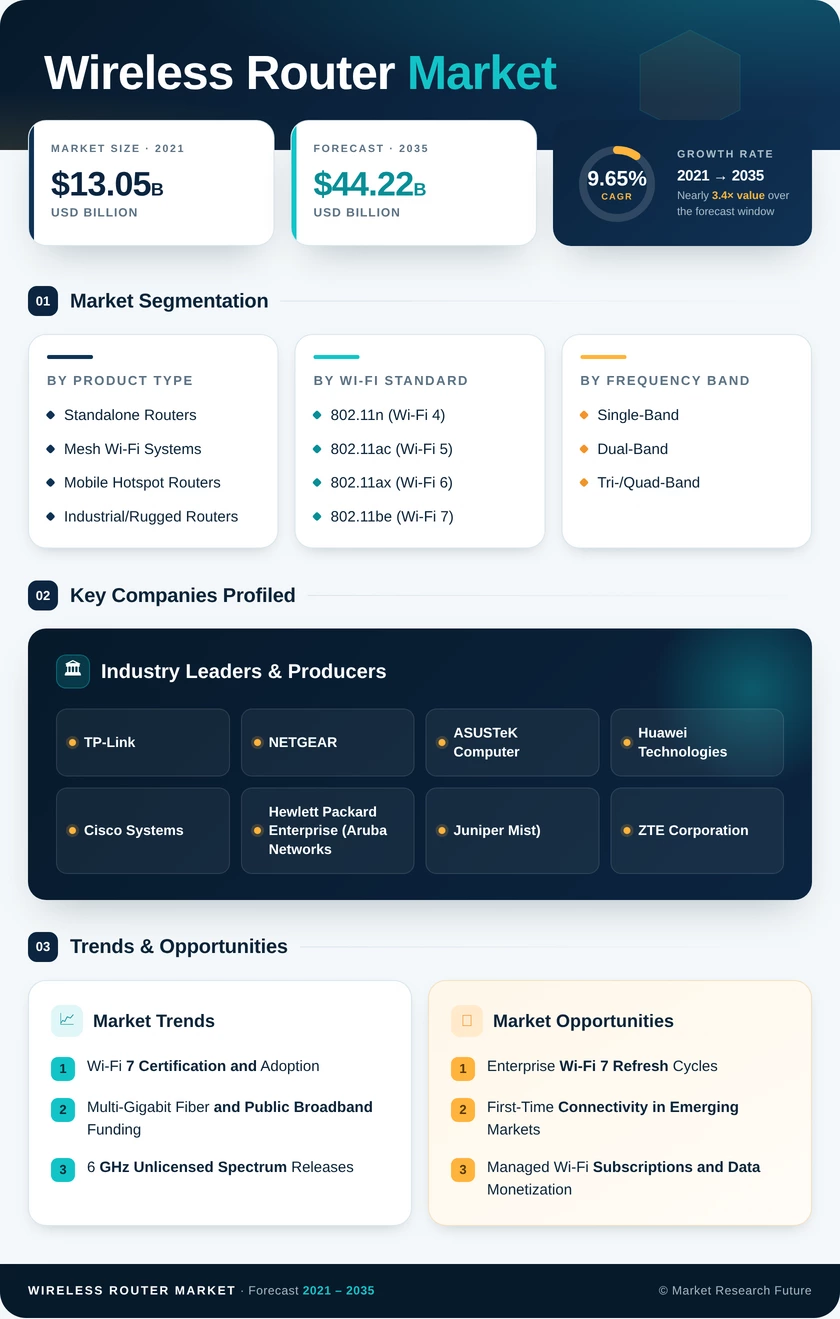
Segmentation Quick Reference
| Dimension | Sub-Segments | Dominant Segment | Fastest Growing Segment |
|---|
| By Product Type | Standalone Routers, Mesh WiFi Systems, Mobile Hotspot Routers, Industrial/Rugged Routers | Standalone Routers (46.4% share) | Mesh WiFi Systems (12.6% CAGR) |
| By WiFi Standard | 802.11n (Wi-Fi 4), 802.11ac (Wi-Fi 5), 802.11ax (Wi-Fi 6), 802.11be (Wi-Fi 7) | 802.11ac (Wi-Fi 5) (44.3% share) | 802.11be (Wi-Fi 7) (26.6% CAGR) |
| By Frequency Band | Single-Band, Dual-Band, Tri-/Quad-Band | Dual-Band (52.3% share) | Tri-/Quad-Band (16.7% CAGR) |
| By End-user Industry | Residential, Enterprise, BFSI, Education, Healthcare, Media and Entertainment, Retail, Government and Public Sector, Other Enterprises | Residential (65.0% share) | Healthcare (12.1% CAGR) |
| By Distribution Channel | Online Retailers, Offline (CE Stores, Hypermarkets) | Offline (CE Stores, Hypermarkets) (58.7% share) | Online Retailers (11.8% CAGR) |
| By Region | North America, Europe, Asia-Pacific, South America, Middle East and Africa | Asia-Pacific (39.6% share) | South America (11.9% CAGR) |
Market Segmentation Overview
| Sub-Segment | Key Trend |
|---|
| Standalone Routers | Tri-band gaming models with latency-shaping engines |
| Mesh WiFi Systems | WiFi 7 multi-link backhaul and cloud management |
| Mobile Hotspot Routers | Embedded 5G modems for rural and mobile users |
| Industrial/Rugged Routers | SD-WAN overlays and hardened enclosures |
Standalone Routers lead because carriers ship them as default gateways and gamers buy high-end single units. Mesh WiFi Systems grow fastest since multi-gigabit fiber makes coverage, not raw speed, the main complaint in larger homes. Mobile Hotspot Routers and Industrial/Rugged Routers occupy smaller niches where 5G modems and environmental certifications protect margins.
| Sub-Segment | Key Trend |
|---|
| 802.11n (Wi-Fi 4) | Retained in low-cost IoT and legacy installations |
| 802.11ac (Wi-Fi 5) | Mass-market pricing in entry retail and emerging economies |
| 802.11ax (Wi-Fi 6) | Bridge standard offering OFDMA at mid-range prices |
| 802.11be (Wi-Fi 7) | Certification-driven adoption in premium and enterprise tiers |
802.11ac (WiFi 5) leads on affordability, particularly in price-sensitive markets where entry hardware dominates. 802.11be (WiFi 7) grows fastest after WiFi Alliance certification removed interoperability doubts and enterprises began specifying multi-gigabit throughput. 802.11ax (WiFi 6) holds a large installed base as a bridge, while 802.11n (WiFi 4) continues to fade outside IoT.
| Sub-Segment | Key Trend |
|---|
| Single-Band | Persistent in cost-sensitive IoT and industrial control |
| Dual-Band | Default configuration for mid-range and ISP units |
| Tri-/Quad-Band | 6 GHz dedicated backhaul for mesh and premium models |
Dual-Band products lead because they balance cost and performance for most households and carrier deployments. Tri-/Quad-Band designs grow fastest wherever regulators open 6 GHz spectrum, as the extra radio carries mesh backhaul without consuming client capacity. Single-Band units remain only where cost and power consumption outweigh throughput.
| Sub-Segment | Key Trend |
|---|
| Residential | Hybrid work and smart-home device density |
| Enterprise | Campus refresh with AI-driven management. |
| BFSI | Low-latency networks for trading floors and branches |
| Education | High-density classroom connectivity |
| Healthcare | Telemedicine and connected medical devices |
| Media and Entertainment | Venue and live-production wireless capacity |
| Retail | Analytics-ready WiFi for inventory and shopper engagement |
| Government and Public Sector | Publicly funded rural and civic connectivity |
| Other Enterprises | Hospitality, logistics and manufacturing deployments |
Residential buyers lead on volume as hybrid work raised the bar for home coverage and reliability. Healthcare is the fastest-growing vertical because hospitals need dependable connections for telemetry and telemedicine devices. BFSI remains the largest enterprise vertical by value, while Education and Retail add steady demand tied to high-density and analytics use cases.
| Sub-Segment | Key Trend |
|---|
| Online Retailers | Direct-to-consumer bundles with subscription support |
| Offline (CE Stores, Hypermarkets) | Hands-on evaluation and carrier storefront sales |
Offline (CE Stores, Hypermarkets) leads because many buyers still want in-person advice, and carriers sell gateways through physical outlets. Online Retailers grow fastest as consumers compare specifications and reviews, and vendors push direct bundles with software subscriptions. The gap narrows most quickly in mature markets with high e-commerce penetration.


 Noah Malgeri
Co-Founder

 Peter Groot koerkamp
Account and Business Manager

 Younghwan Choi
Senior Retail Manager

 Mark Irwin
Management Consultant

 Akif Moroglu
Strategy & Business Development Director

 Guilherme Gomes Martins
Product Management Director

 Joseph Aguayo
Sales Operations & Pricing Manager

 La Terria Dodd
Program Support Specialist

 Rob Kooiker
Group Product Manager HVAC & Fire Protection GMA