
Request Free Sample ×

Kindly complete the form below to receive a free sample of this Report

* Please use a valid business email

Leading companies partner with us for data-driven Insights

clients tt-cursor
Hero Background
English
Chinese
French
Japanese
Korean
German
Spanish

Wireless Electric Vehicle Charging Market Analysis

ID: MRFR/AT/5748-HCR
128 Pages
Shubham Munde
March 2026

Wireless Electric Vehicle Charging Market Size, Share & Growth Analysis Report By Technology (Inductive Charging, Resonant Inductive Charging, Magnetic Field Charging), By Charging Infrastructure (Home Charging Stations, Public Charging Stations, Commercial Charging Stations), By End User (Individual Consumers, Fleet Operators, Government, Municipalities), By Vehicle Type (Passenger Vehicles, Light Commercial Vehicles, Heavy Commercial Vehicles) and By Regional (North America, Europe, South America, Asia Pacific, Middle East and Africa) - Industry Growth & Forecast to 2035

Share:
Download PDF ×

We do not share your information with anyone. However, we may send you emails based on your report interest from time to time. You may contact us at any time to opt-out.

Wireless Electric Vehicle Charging Market Infographic
Purchase Options

Market Analysis

In-depth Analysis of Wireless Electric Vehicle Charging Market Industry Landscape

The automotive landscape is undergoing a significant transformation with the rapid rise in the sales of electric vehicles (EVs). This surge can be attributed to a heightened awareness of environmental issues and the implementation of favorable government subsidies and schemes. As the world grapples with the impact of traditional gasoline vehicles on the environment, a global demand for electric vehicles has emerged. This article explores the driving forces behind the escalating sales of electric vehicles, focusing on the role of government initiatives and the commitment of automotive OEMs towards electrification.

Environmental Awareness Driving EV Adoption:

The escalating awareness of environmental concerns is a primary catalyst for the increasing adoption of electric vehicles. Consumers are becoming more conscious of the ecological footprint associated with traditional gasoline vehicles, prompting a shift towards cleaner and sustainable transportation alternatives. This shift is not only evident in developed nations but is also gaining momentum in emerging economies, where urbanization and industrialization have led to escalating pollution levels.

Government Initiatives and Incentives:

Governments worldwide are playing a pivotal role in promoting the widespread adoption of electric vehicles through a range of initiatives and incentives. Non-fiscal incentives, such as subsidies and grants, are being deployed to encourage consumers to choose electric vehicles over traditional combustion engine vehicles. In September 2017, the Indian Ministry of Road Transport and Highways announced a comprehensive set of non-fiscal incentives aimed at ensuring that electric vehicles constitute 15% of total vehicle sales in the country within the next five years. Such initiatives not only reduce the financial burden on consumers but also actively contribute to the growth of the electric vehicle market.

Charging Infrastructure Development:

Another critical factor influencing the rise of electric vehicles is the concerted effort to enhance charging infrastructure. Governments, in collaboration with private stakeholders, are investing in the development of an extensive and accessible charging network. The availability of convenient charging stations alleviates range anxiety – a common concern among potential EV buyers – and promotes the practicality of electric vehicles. This infrastructure development is crucial for the widespread acceptance of electric vehicles, as it addresses a key barrier to adoption.

Automotive OEMs Embrace Electrification:

Major automotive Original Equipment Manufacturers (OEMs) are steering towards electrification, aligning their strategies with the growing demand for electric vehicles. These OEMs are investing heavily in research and development to produce a diverse range of electric vehicles, including hybrid, battery-electric, and plug-in hybrid models. The commitment of automotive giants to electrification not only expands the product offerings in the electric vehicle market but also serves as a testament to the industry-wide acknowledgment of the importance of sustainable mobility.

Graphical Representation of EV Growth:

The graph below illustrates the substantial increase in the number of electric vehicles on the road between 2014 and 2019, showcasing the escalating trend in EV adoption. This growth trajectory is indicative of the shifting consumer preferences towards cleaner and greener transportation options.

[Insert Graph]

Conclusion:

The surge in electric vehicle sales is a multifaceted phenomenon driven by environmental awareness, government initiatives, and the strategic decisions of major automotive players. As the world endeavors to transition towards sustainable transportation, the collaboration between consumers, governments, and industry stakeholders becomes paramount. The continuous growth in the electric vehicle market signals a promising future for clean mobility, emphasizing the need for sustained efforts to address infrastructure challenges, enhance incentives, and further advance electric vehicle technology. As we witness this transformative era in the automotive industry, the trajectory of electric vehicle sales is poised to continue its upward ascent, shaping the future of transportation worldwide.


Author
Author Profile
Shubham Munde
Team Lead - Research

Shubham brings over 7 years of expertise in Market Intelligence and Strategic Consulting, with a strong focus on the Automotive, Aerospace, and Defense sectors. Backed by a solid foundation in semiconductors, electronics, and software, he has successfully delivered high-impact syndicated and custom research on a global scale. His core strengths include market sizing, forecasting, competitive intelligence, consumer insights, and supply chain mapping. Widely recognized for developing scalable growth strategies, Shubham empowers clients to navigate complex markets and achieve a lasting competitive edge. Trusted by start-ups and Fortune 500 companies alike, he consistently converts challenges into strategic opportunities that drive sustainable growth.

Leave a Comment

FAQs

What is the projected market valuation for the Wireless Electric Vehicle Charging Market in 2035?

<p>The projected market valuation for the Wireless Electric Vehicle Charging Market in 2035 is 15.01 USD Billion.</p>

What was the market valuation for the Wireless Electric Vehicle Charging Market in 2024?

<p>The overall market valuation for the Wireless Electric Vehicle Charging Market was 2.0 USD Billion in 2024.</p>

What is the expected CAGR for the Wireless Electric Vehicle Charging Market from 2025 to 2035?

<p>The expected CAGR for the Wireless Electric Vehicle Charging Market during the forecast period 2025 - 2035 is 20.11%.</p>

Which companies are considered key players in the Wireless Electric Vehicle Charging Market?

<p>Key players in the Wireless Electric Vehicle Charging Market include Qualcomm, BMW, Mercedes-Benz, Toyota, Nissan, Porsche, Volvo, ABB, and Siemens.</p>

What are the different technology segments in the Wireless Electric Vehicle Charging Market?

<p>The technology segments in the Wireless Electric Vehicle Charging Market include Inductive Charging, Resonant Inductive Charging, and Magnetic Field Charging.</p>

What is the projected market size for Inductive Charging by 2035?

<p>The projected market size for Inductive Charging is expected to reach 5.5 USD Billion by 2035.</p>

How does the market size for Public Charging Stations compare to Home Charging Stations in 2035?

<p>By 2035, the market size for Public Charging Stations is projected to be 5.25 USD Billion, compared to 3.75 USD Billion for Home Charging Stations.</p>

What is the expected market size for Fleet Operators in the Wireless Electric Vehicle Charging Market by 2035?

<p>The expected market size for Fleet Operators in the Wireless Electric Vehicle Charging Market is projected to be 4.0 USD Billion by 2035.</p>

Which vehicle types are included in the Wireless Electric Vehicle Charging Market analysis?

<p>The vehicle types included in the Wireless Electric Vehicle Charging Market analysis are Passenger Vehicles, Light Commercial Vehicles, and Heavy Commercial Vehicles.</p>

What is the projected market size for Heavy Commercial Vehicles in 2035?

<p>The projected market size for Heavy Commercial Vehicles in the Wireless Electric Vehicle Charging Market is expected to reach 5.0 USD Billion by 2035.</p>

Market Summary

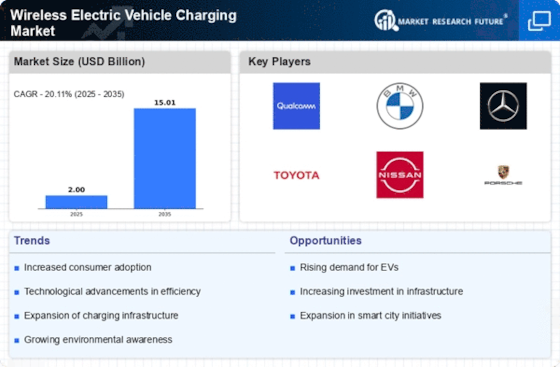
As per Market Research Future analysis, the Wireless Electric Vehicle Charging Market Size was estimated at 2.0 USD Billion in 2024. The Wireless Electric Vehicle Charging industry is projected to grow from 2.402 USD Billion in 2025 to 15.01 USD Billion by 2035, exhibiting a compound annual growth rate (CAGR) of 20.11% during the forecast period 2025 - 2035

Key Market Trends & Highlights

The Wireless Electric Vehicle Charging Market is poised for substantial growth driven by technological advancements and increasing consumer demand.

  • Technological advancements in wireless charging solutions are enhancing efficiency and user experience. North America remains the largest market, while Asia-Pacific is emerging as the fastest-growing region for wireless electric vehicle charging. Inductive charging dominates the market, whereas resonant inductive charging is rapidly gaining traction due to its innovative features. Government policies and rising environmental concerns are key drivers propelling the market forward.

Market Size & Forecast

2024 Market Size 2.0 (USD Billion)
2035 Market Size 15.01 (USD Billion)
CAGR (2025 - 2035) 20.11%
Largest Regional Market Share in 2024 North America

Major Players

<a href="https://www.qualcomm.com/automotive/two-wheelers">Qualcomm</a> (US), BMW (DE), Mercedes-Benz (DE), Toyota (JP), Nissan (JP), <a href="https://www.porsche.com/international/aboutporsche/e-performance/">Porsche</a> (DE), Volvo (SE), ABB (CH), Siemens (DE)

Market Trends

The Wireless Electric Vehicle Charging Market is currently experiencing a transformative phase, driven by advancements in technology and increasing consumer demand for sustainable transportation solutions. As electric vehicles gain traction, the need for efficient and convenient charging options becomes paramount. Wireless charging systems, which eliminate the need for physical connectors, offer a seamless experience for users, potentially enhancing the adoption of electric vehicles. This market appears to be influenced by various factors, including government initiatives promoting clean energy and the growing awareness of environmental issues. Furthermore, the integration of smart technologies into charging infrastructure may facilitate more efficient energy management, thereby appealing to both consumers and manufacturers alike. In addition, the Wireless Electric Vehicle Charging Market seems poised for growth as automakers and technology firms collaborate to develop innovative solutions. The potential for wireless charging market for electric vehicles to be implemented in public spaces, such as parking lots and roadways, indicates a shift towards more integrated urban mobility solutions. As infrastructure evolves, the market may witness increased investment and research, leading to enhanced product offerings. Overall, the Wireless Electric Vehicle Charging Market is likely to play a crucial role in the broader transition to electric mobility, reflecting a commitment to sustainable practices and technological advancement.

Technological Advancements

The Wireless Electric Vehicle Charging Market is witnessing rapid technological innovations that enhance charging efficiency and user convenience. Developments in resonant inductive charging and magnetic resonance technology are paving the way for more effective energy transfer, which could lead to faster charging times and improved vehicle range.

Government Initiatives

Various governments are actively promoting the adoption of electric vehicles through incentives and regulations. These initiatives may include subsidies for electric vehicle purchases and investments in charging infrastructure, which could significantly impact the growth trajectory of the Wireless Electric Vehicle Charging Market.

Consumer Awareness and Demand

As environmental concerns rise, consumer awareness regarding sustainable transportation options is increasing. This heightened awareness may drive demand for wireless charging solutions, as users seek convenient and eco-friendly alternatives to traditional charging methods.

Wireless Electric Vehicle Charging Market Market Drivers

Rising Environmental Concerns

The Wireless Electric Vehicle Charging Market is significantly influenced by rising environmental concerns among consumers and policymakers alike. As awareness of climate change and air pollution grows, there is an increasing demand for sustainable transportation solutions. Electric vehicles, particularly those utilizing wireless charging technology, are viewed as a cleaner alternative to fossil fuel-powered vehicles. The market is projected to grow as more consumers seek eco-friendly options, with estimates suggesting that the electric vehicle market could reach over 30 million units by 2030. This shift towards sustainability is likely to drive investments in wireless charging infrastructure, as stakeholders recognize the potential for reducing greenhouse gas emissions and promoting cleaner urban environments.

Consumer Demand for Convenience

Consumer demand for convenience is a driving force behind the Wireless Electric Vehicle Charging Market. As electric vehicle ownership rises, users are increasingly seeking hassle-free charging solutions that fit seamlessly into their lifestyles. Wireless charging technology offers the advantage of eliminating the need for physical connections, allowing vehicles to charge automatically while parked. This convenience is particularly appealing in urban environments where space is limited. Market Research Future indicates that a significant percentage of consumers prioritize ease of use when selecting charging options. As manufacturers respond to this demand by developing more user-friendly wireless charging systems, the market is likely to expand. The trend towards convenience in charging solutions is expected to play a crucial role in the future growth of the industry.

Government Policies and Incentives

Government policies play a pivotal role in shaping the Wireless Electric Vehicle Charging Market. Various countries are implementing incentives to promote electric vehicle adoption, which indirectly boosts the demand for wireless charging solutions. For example, tax rebates, grants, and subsidies for electric vehicle purchases are becoming commonplace, encouraging consumers to transition from traditional vehicles. Additionally, regulatory frameworks are being established to support the deployment of charging infrastructure, including wireless options. As governments set ambitious targets for reducing carbon emissions, the push for electric vehicles and their associated charging technologies is expected to intensify. This supportive environment is likely to foster innovation and investment in the wireless charging sector.

Increased Investment in Infrastructure

Investment in charging infrastructure is a critical driver for the Wireless Electric Vehicle Charging Market. As electric vehicle adoption accelerates, the need for robust charging networks becomes increasingly apparent. Public and private sectors are channeling funds into the development of wireless charging stations, which offer convenience and efficiency. Reports indicate that investments in charging infrastructure could exceed several billion dollars in the coming years, reflecting a commitment to enhancing the user experience. This influx of capital is likely to facilitate the deployment of advanced wireless charging technologies, making them more accessible to consumers. The establishment of widespread charging networks is essential for alleviating range anxiety and promoting the broader acceptance of electric vehicles.

Technological Innovations in Charging Solutions

The Wireless Electric Vehicle Charging Market is experiencing a surge in technological innovations that enhance charging efficiency and convenience. Recent advancements in resonant inductive charging technology have led to systems that can deliver power wirelessly with minimal energy loss. For instance, systems capable of charging vehicles at rates exceeding 20 kW are becoming more prevalent, which could significantly reduce charging times. Furthermore, the integration of smart grid technology allows for optimized energy distribution, potentially lowering costs for consumers. As these technologies mature, they are likely to attract more manufacturers and consumers, thereby expanding the market. The increasing focus on developing high-efficiency charging pads and vehicles equipped with compatible receivers indicates a promising trajectory for the industry.

Market Segment Insights

By Technology: Inductive Charging (Largest) vs. Resonant Inductive Charging (Fastest-Growing)

In the Wireless Electric Vehicle Charging Market, Inductive Charging holds the largest market share, leveraging its established technology and widespread acceptance among consumers and manufacturers alike. This segment has become synonymous with convenience, providing a seamless charging experience for electric vehicles without the need for physical connectors. Conversely, Resonant Inductive Charging, while currently smaller in market share, is gaining traction rapidly as it offers increased efficiency over traditional methods, attracting attention for innovative applications in various EV models.

Technology: Inductive Charging (Dominant) vs. Resonant Inductive Charging (Emerging)

Inductive Charging is recognized for its reliability and has a strong presence in the market, primarily due to its compatibility with existing electric vehicle models. This technology uses electromagnetic fields to transfer energy, allowing for a user-friendly experience. On the other hand, Resonant Inductive Charging is an emerging technology that is celebrated for its potential to charge vehicles more effectively over larger distances. As automotive manufacturers seek to enhance the driving experience with faster and more efficient charging solutions, Resonant Inductive Charging is poised to become a key player, capturing the interest of both consumers and investors.

By Charging Infrastructure: Public Charging Stations (Largest) vs. Home Charging Stations (Fastest-Growing)

The Wireless Electric Vehicle Charging Market is currently dominated by Public Charging Stations, which hold the largest share among the charging infrastructure segments. This segment is characterized by extensive installations in urban areas, providing convenience to EV users. The accessibility and number of public stations are crucial in facilitating the transition to electric vehicles as they lessen range anxiety and foster increased adoption rates. On the other hand, Home Charging Stations are emerging as the fastest-growing segment in this market. This growth is driven by the rising number of electric vehicle users preferring the convenience of charging at home. As battery technology improves, the efficiency and capabilities of home charging stations are advancing, making them a desirable option for many consumers.

Public Charging Stations (Dominant) vs. Home Charging Stations (Emerging)

Public Charging Stations are at the forefront of the Wireless Electric Vehicle Charging Market, serving as a vital infrastructure for facilitating widespread EV adoption. They offer a comprehensive network of charging options in urban settings, providing essential support for EV users who need quick and accessible charging solutions while on the go. Furthermore, public stations are often equipped with fast-charging technologies that can reduce charging times significantly. Conversely, Home Charging Stations are emerging rapidly due to increasing consumer preference and advancements in home installation technologies. They offer the convenience of at-home charging, allowing users to easily charge their vehicles overnight. This segment is particularly attractive for homeowners with dedicated parking spaces, who benefit from lower long-term charging costs and greater control over their vehicle charging schedules.

By End User: Individual Consumers (Largest) vs. Fleet Operators (Fastest-Growing)

In the Wireless Electric Vehicle Charging Market, the end user segment distribution is notably diverse, with individual consumers holding the largest share. This segment typically includes private vehicle owners experiencing the convenience of wireless charging technology. On the other hand, fleet operators, which encompass businesses managing several vehicles, represent the fastest-growing segment due to rising demand for enhanced operational efficiency and reduced downtime during vehicle charging. These shifts in user preferences are significantly shaping the landscape of the market. Growth trends indicate a robust increase in demand from both individual consumers and fleet operators. The market is witnessing an acceleration fueled by technological advancements in wireless charging systems and increased awareness about sustainable transportation. Fleet operators are particularly influenced by the need for greener solutions and cost reductions in vehicle maintenance and charging time. As such, the wireless electric vehicle charging solutions are increasingly becoming integral in both residential and commercial applications, further driving market adoption and expansion.

Individual Consumers (Dominant) vs. Fleet Operators (Emerging)

Individual consumers exhibit a dominant presence in the Wireless Electric Vehicle Charging Market, characterized by their demand for innovative and convenient charging solutions for personal vehicles. This group is driven by the rising adoption of electric vehicles and a growing preference for user-friendly and efficient charging options. Conversely, fleet operators are an emerging segment, increasingly leveraging wireless charging technology to enhance fleet efficiency. They seek reliable and cost-effective charging solutions that minimize vehicle downtime. Fleet operators face unique challenges such as managing multiple vehicles, which further emphasizes the need for advanced charging systems. Both segments are vital for market growth, with individual consumers leading the way while fleet operators rapidly adapt to changing technology and sustainability needs.

By Vehicle Type: Passenger Vehicles (Largest) vs. Light Commercial Vehicles (Fastest-Growing)

The Wireless Electric Vehicle Charging Market demonstrates a significant distribution among different vehicle types, with passenger vehicles accounting for the largest market share. Their widespread adoption in urban environments, coupled with technological advancements, positions them as the frontrunners in the shift towards electric mobility. On the other hand, light commercial vehicles are rapidly gaining traction, thanks to their role in delivery services and urban logistics, often seen as essential for supporting electric vehicle infrastructure in cities. In terms of growth trends, the increasing focus on sustainability and regulatory support for electric vehicles drives the adoption of wireless charging technologies. Passenger vehicles lead the way due to consumer preference for convenience and a growing network of charging stations. Meanwhile, light commercial vehicles are emerging as the fastest-growing segment, driven by their pivotal role in last-mile delivery solutions, making them attractive to fleet owners looking for efficiency and reduced downtime.

Passenger Vehicles (Dominant) vs. Light Commercial Vehicles (Emerging)

Passenger vehicles represent the dominant segment in the Wireless Electric Vehicle Charging Market, characterized by their extensive integration into personal transportation. As the most widely used vehicles, they benefit from a robust consumer base that prioritizes convenience and technological advancement. The availability of wireless charging solutions enhances their appeal, as it aligns with the lifestyle of modern drivers who favor quick and efficient charging methods. Conversely, <a href="https://www.marketresearchfuture.com/reports/light-commercial-vehicles-market-7726">light commercial vehicles</a> are emerging as key players in this landscape, particularly as urban e-commerce grows. This segment highlights the demand for practical charging solutions that minimize operational interruptions. Fleet operators are increasingly drawn to wireless charging due to its potential to streamline operations and optimize vehicle readiness, thus fostering growth in the segment.

Get more detailed insights about Wireless Electric Vehicle Charging Market Research Report – Global Forecast till 2035

Regional Insights

The Wireless Electric Vehicle Charging Market displays notable regional dynamics, with varying valuations across different geographies. In 2024, North America is projected to hold a major share, valued at 0.8 USD Billion, and is expected to expand significantly to 6.0 USD Billion by 2035. This substantial growth reflects the growing adoption of electric vehicles and advancements in charging technologies. Following closely, Europe stands at a value of 0.7 USD Billion in 2024, with a forecasted increase to 4.5 USD Billion by 2035, driven by stringent government policies promoting cleaner transportation solutions.

South America shows a smaller market at 0.2 USD Billion in 2024, rising to 1.5 USD Billion by 2035, indicating an emerging interest in electric mobility within the region. The Asia Pacific market, valued at 0.3 USD Billion in 2024, is anticipated to grow to 2.5 USD Billion by 2035, spurred by an increased focus on innovation and technology integration in countries like China and Japan. The Middle East and Africa, currently valued at 0.0 USD Billion in 2024, is likely to see moderate growth reaching 0.5 USD Billion by 2035, showcasing the region's gradual embrace of electric vehicle infrastructure.

The Wireless Electric Vehicle Charging Market segmentation illustrates the diverse adoption rates and technological advancements across these regions, with North America and Europe currently dominating the market due to established infrastructure and consumer adoption.

Key Players and Competitive Insights

The Wireless Electric Vehicle Charging Market is gaining significant momentum as the automotive industry accelerates its transition towards electric mobility. This market, characterized by rapid technological advancements and increasing consumer awareness regarding sustainability, is becoming increasingly competitive. Key players are focusing on developing innovative solutions that enhance the efficiency and convenience of charging electric vehicles without the need for physical connections. As the demand for electric vehicles surges, competition among major manufacturers has intensified, with companies striving to differentiate their offerings through unique technology, strategic partnerships, and investments in research and development. The market landscape is evolving, underscored by the emergence of new players and the evolution of existing technologies that aim to fulfill the growing need for efficient charging infrastructure. BMW has established a strong presence in the Wireless Electric Vehicle Charging Market, having positioned itself at the forefront of electric mobility solutions through its dedication to innovation and superior technology. The company's integration of wireless charging technology into its electric vehicle lineup showcases its commitment to enhancing the customer experience. BMW's technological edge is driven by substantial investments in research and development, allowing the company to pioneer advancements in inductive charging systems that cater to consumer convenience. Its extensive brand recognition and reputation for quality provide a competitive advantage as it taps into the growing demand for electric vehicles. Furthermore, BMW’s collaborations with various technological firms bolster its efforts to enhance charging efficiency, thereby strengthening its market position. Hitachi is another significant player in the Wireless Electric Vehicle Charging Market, recognized for its comprehensive approach to electric vehicle infrastructure. The company offers advanced solutions that enable seamless wireless charging technology, emphasizing their commitment to sustainability in transportation. Hitachi's strengths lie in its robust research and development capabilities, which allow for cutting-edge innovations in electric vehicle charging systems. Their market presence is further strengthened by strategic mergers and acquisitions aimed at enhancing technological capabilities and broadening their clientele across the globe. Hitachi’s key products and services include solutions that integrate electric vehicle management and charging infrastructure, which are crucial for shaping the future landscape of electric transportation. As the industry continues to evolve, Hitachi’s focus on innovation and partnerships is favorably within the competitive landscape of wireless electric vehicle charging.

Key Companies in the Wireless Electric Vehicle Charging Market include

Industry Developments

The Wireless Electric Vehicle Charging Market has seen significant developments recently, particularly with advancements in technology and partnerships. Companies like BMW, Tesla, and Mercedes-Benz are investing heavily in this sector, with a focus on enhancing charging efficiency and user convenience.

In November 2022, Hitachi and Qualcomm announced a collaboration aimed at developing advanced wireless charging systems, indicating a shift toward more integrated solutions.

Furthermore, in February 2023, ABB launched a new range of wireless charging solutions designed for commercial applications, expanding its market presence. Valuation growth has been notable, spurred by increasing demand for electric vehicles and a rising emphasis on sustainable transportation solutions, which has positively impacted market projections.

Additionally, in January 2023, WiTricity secured a partnership with Nissan to further explore wireless charging technology, enhancing collaboration within the industry. Schaeffler recently reported a 20% increase in R&D investments in this space, reflecting the urgency to innovate.

Over the last couple of years, significant efforts have also been made at regulatory levels to promote electric vehicle infrastructure, pushing for robust wireless charging solutions as part of global climate goals.

Future Outlook

Wireless Electric Vehicle Charging Market Future Outlook

The Wireless Electric Vehicle Charging Market is projected to grow at a 20.11% CAGR from 2025 to 2035, driven by technological advancements, increasing EV adoption, and supportive government policies.

New opportunities lie in:

  • <p>Development of residential wireless charging solutions for EV owners. Partnerships with automotive manufacturers for integrated charging systems. Expansion of charging infrastructure in urban areas and commercial spaces.</p>

By 2035, the market is expected to be robust, driven by innovation and widespread adoption.

Market Segmentation

Wireless Electric Vehicle Charging Market End User Outlook

  • Individual Consumers
  • Fleet Operators
  • Government
  • Municipalities

Wireless Electric Vehicle Charging Market Technology Outlook

  • Inductive Charging
  • Resonant Inductive Charging
  • Magnetic Field Charging

Wireless Electric Vehicle Charging Market Vehicle Type Outlook

  • Passenger Vehicles
  • Light Commercial Vehicles
  • Heavy Commercial Vehicles

Wireless Electric Vehicle Charging Market Charging Infrastructure Outlook

  • Home Charging Stations
  • Public Charging Stations
  • Commercial Charging Stations

Report Scope

MARKET SIZE 2024 2.0(USD Billion)
MARKET SIZE 2025 2.402(USD Billion)
MARKET SIZE 2035 15.01(USD Billion)
COMPOUND ANNUAL GROWTH RATE (CAGR) 20.11% (2025 - 2035)
REPORT COVERAGE Revenue Forecast, Competitive Landscape, Growth Factors, and Trends
BASE YEAR 2024
Market Forecast Period 2025 - 2035
Historical Data 2019 - 2024
Market Forecast Units USD Billion
Key Companies Profiled Qualcomm (US), BMW (DE), Mercedes-Benz (DE), Toyota (JP), Nissan (JP), Porsche (DE), Volvo (SE), ABB (CH), Siemens (DE)
Segments Covered Technology, Charging Infrastructure, End User, Vehicle Type, Regional
Key Market Opportunities Integration of smart grid technology enhances efficiency in the Wireless Electric Vehicle Charging Market.
Key Market Dynamics Technological advancements in wireless charging systems drive competitive dynamics and consumer adoption in the electric vehicle market.
Countries Covered North America, Europe, APAC, South America, MEA

FAQs

What is the projected market valuation for the Wireless Electric Vehicle Charging Market in 2035?

<p>The projected market valuation for the Wireless Electric Vehicle Charging Market in 2035 is 15.01 USD Billion.</p>

What was the market valuation for the Wireless Electric Vehicle Charging Market in 2024?

<p>The overall market valuation for the Wireless Electric Vehicle Charging Market was 2.0 USD Billion in 2024.</p>

What is the expected CAGR for the Wireless Electric Vehicle Charging Market from 2025 to 2035?

<p>The expected CAGR for the Wireless Electric Vehicle Charging Market during the forecast period 2025 - 2035 is 20.11%.</p>

Which companies are considered key players in the Wireless Electric Vehicle Charging Market?

<p>Key players in the Wireless Electric Vehicle Charging Market include Qualcomm, BMW, Mercedes-Benz, Toyota, Nissan, Porsche, Volvo, ABB, and Siemens.</p>

What are the different technology segments in the Wireless Electric Vehicle Charging Market?

<p>The technology segments in the Wireless Electric Vehicle Charging Market include Inductive Charging, Resonant Inductive Charging, and Magnetic Field Charging.</p>

What is the projected market size for Inductive Charging by 2035?

<p>The projected market size for Inductive Charging is expected to reach 5.5 USD Billion by 2035.</p>

How does the market size for Public Charging Stations compare to Home Charging Stations in 2035?

<p>By 2035, the market size for Public Charging Stations is projected to be 5.25 USD Billion, compared to 3.75 USD Billion for Home Charging Stations.</p>

What is the expected market size for Fleet Operators in the Wireless Electric Vehicle Charging Market by 2035?

<p>The expected market size for Fleet Operators in the Wireless Electric Vehicle Charging Market is projected to be 4.0 USD Billion by 2035.</p>

Which vehicle types are included in the Wireless Electric Vehicle Charging Market analysis?

<p>The vehicle types included in the Wireless Electric Vehicle Charging Market analysis are Passenger Vehicles, Light Commercial Vehicles, and Heavy Commercial Vehicles.</p>

What is the projected market size for Heavy Commercial Vehicles in 2035?

<p>The projected market size for Heavy Commercial Vehicles in the Wireless Electric Vehicle Charging Market is expected to reach 5.0 USD Billion by 2035.</p>

  1. SECTION I: EXECUTIVE SUMMARY AND KEY HIGHLIGHTS
    1. | 1.1 EXECUTIVE SUMMARY
    2. | | 1.1.1 Market Overview
    3. | | 1.1.2 Key Findings
    4. | | 1.1.3 Market Segmentation
    5. | | 1.1.4 Competitive Landscape
    6. | | 1.1.5 Challenges and Opportunities
    7. | | 1.1.6 Future Outlook
  2. SECTION II: SCOPING, METHODOLOGY AND MARKET STRUCTURE
    1. | 2.1 MARKET INTRODUCTION
    2. | | 2.1.1 Definition
    3. | | 2.1.2 Scope of the study
    4. | | | 2.1.2.1 Research Objective
    5. | | | 2.1.2.2 Assumption
    6. | | | 2.1.2.3 Limitations
    7. | 2.2 RESEARCH METHODOLOGY
    8. | | 2.2.1 Overview
    9. | | 2.2.2 Data Mining
    10. | | 2.2.3 Secondary Research
    11. | | 2.2.4 Primary Research
    12. | | | 2.2.4.1 Primary Interviews and Information Gathering Process
    13. | | | 2.2.4.2 Breakdown of Primary Respondents
    14. | | 2.2.5 Forecasting Model
    15. | | 2.2.6 Market Size Estimation
    16. | | | 2.2.6.1 Bottom-Up Approach
    17. | | | 2.2.6.2 Top-Down Approach
    18. | | 2.2.7 Data Triangulation
    19. | | 2.2.8 Validation
  3. SECTION III: QUALITATIVE ANALYSIS
    1. | 3.1 MARKET DYNAMICS
    2. | | 3.1.1 Overview
    3. | | 3.1.2 Drivers
    4. | | 3.1.3 Restraints
    5. | | 3.1.4 Opportunities
    6. | 3.2 MARKET FACTOR ANALYSIS
    7. | | 3.2.1 Value chain Analysis
    8. | | 3.2.2 Porter's Five Forces Analysis
    9. | | | 3.2.2.1 Bargaining Power of Suppliers
    10. | | | 3.2.2.2 Bargaining Power of Buyers
    11. | | | 3.2.2.3 Threat of New Entrants
    12. | | | 3.2.2.4 Threat of Substitutes
    13. | | | 3.2.2.5 Intensity of Rivalry
    14. | | 3.2.3 COVID-19 Impact Analysis
    15. | | | 3.2.3.1 Market Impact Analysis
    16. | | | 3.2.3.2 Regional Impact
    17. | | | 3.2.3.3 Opportunity and Threat Analysis
  4. SECTION IV: QUANTITATIVE ANALYSIS
    1. | 4.1 Automobile, BY Technology (USD Billion)
    2. | | 4.1.1 Inductive Charging
    3. | | 4.1.2 Resonant Inductive Charging
    4. | | 4.1.3 Magnetic Field Charging
    5. | 4.2 Automobile, BY Charging Infrastructure (USD Billion)
    6. | | 4.2.1 Home Charging Stations
    7. | | 4.2.2 Public Charging Stations
    8. | | 4.2.3 Commercial Charging Stations
    9. | 4.3 Automobile, BY End User (USD Billion)
    10. | | 4.3.1 Individual Consumers
    11. | | 4.3.2 Fleet Operators
    12. | | 4.3.3 Government
    13. | | 4.3.4 Municipalities
    14. | 4.4 Automobile, BY Vehicle Type (USD Billion)
    15. | | 4.4.1 Passenger Vehicles
    16. | | 4.4.2 Light Commercial Vehicles
    17. | | 4.4.3 Heavy Commercial Vehicles
    18. | 4.5 Automobile, BY Region (USD Billion)
    19. | | 4.5.1 North America
    20. | | | 4.5.1.1 US
    21. | | | 4.5.1.2 Canada
    22. | | 4.5.2 Europe
    23. | | | 4.5.2.1 Germany
    24. | | | 4.5.2.2 UK
    25. | | | 4.5.2.3 France
    26. | | | 4.5.2.4 Russia
    27. | | | 4.5.2.5 Italy
    28. | | | 4.5.2.6 Spain
    29. | | | 4.5.2.7 Rest of Europe
    30. | | 4.5.3 APAC
    31. | | | 4.5.3.1 China
    32. | | | 4.5.3.2 India
    33. | | | 4.5.3.3 Japan
    34. | | | 4.5.3.4 South Korea
    35. | | | 4.5.3.5 Malaysia
    36. | | | 4.5.3.6 Thailand
    37. | | | 4.5.3.7 Indonesia
    38. | | | 4.5.3.8 Rest of APAC
    39. | | 4.5.4 South America
    40. | | | 4.5.4.1 Brazil
    41. | | | 4.5.4.2 Mexico
    42. | | | 4.5.4.3 Argentina
    43. | | | 4.5.4.4 Rest of South America
    44. | | 4.5.5 MEA
    45. | | | 4.5.5.1 GCC Countries
    46. | | | 4.5.5.2 South Africa
    47. | | | 4.5.5.3 Rest of MEA
  5. SECTION V: COMPETITIVE ANALYSIS
    1. | 5.1 Competitive Landscape
    2. | | 5.1.1 Overview
    3. | | 5.1.2 Competitive Analysis
    4. | | 5.1.3 Market share Analysis
    5. | | 5.1.4 Major Growth Strategy in the Automobile
    6. | | 5.1.5 Competitive Benchmarking
    7. | | 5.1.6 Leading Players in Terms of Number of Developments in the Automobile
    8. | | 5.1.7 Key developments and growth strategies
    9. | | | 5.1.7.1 New Product Launch/Service Deployment
    10. | | | 5.1.7.2 Merger & Acquisitions
    11. | | | 5.1.7.3 Joint Ventures
    12. | | 5.1.8 Major Players Financial Matrix
    13. | | | 5.1.8.1 Sales and Operating Income
    14. | | | 5.1.8.2 Major Players R&D Expenditure. 2023
    15. | 5.2 Company Profiles
    16. | | 5.2.1 Qualcomm (US)
    17. | | | 5.2.1.1 Financial Overview
    18. | | | 5.2.1.2 Products Offered
    19. | | | 5.2.1.3 Key Developments
    20. | | | 5.2.1.4 SWOT Analysis
    21. | | | 5.2.1.5 Key Strategies
    22. | | 5.2.2 BMW (DE)
    23. | | | 5.2.2.1 Financial Overview
    24. | | | 5.2.2.2 Products Offered
    25. | | | 5.2.2.3 Key Developments
    26. | | | 5.2.2.4 SWOT Analysis
    27. | | | 5.2.2.5 Key Strategies
    28. | | 5.2.3 Mercedes-Benz (DE)
    29. | | | 5.2.3.1 Financial Overview
    30. | | | 5.2.3.2 Products Offered
    31. | | | 5.2.3.3 Key Developments
    32. | | | 5.2.3.4 SWOT Analysis
    33. | | | 5.2.3.5 Key Strategies
    34. | | 5.2.4 Toyota (JP)
    35. | | | 5.2.4.1 Financial Overview
    36. | | | 5.2.4.2 Products Offered
    37. | | | 5.2.4.3 Key Developments
    38. | | | 5.2.4.4 SWOT Analysis
    39. | | | 5.2.4.5 Key Strategies
    40. | | 5.2.5 Nissan (JP)
    41. | | | 5.2.5.1 Financial Overview
    42. | | | 5.2.5.2 Products Offered
    43. | | | 5.2.5.3 Key Developments
    44. | | | 5.2.5.4 SWOT Analysis
    45. | | | 5.2.5.5 Key Strategies
    46. | | 5.2.6 Porsche (DE)
    47. | | | 5.2.6.1 Financial Overview
    48. | | | 5.2.6.2 Products Offered
    49. | | | 5.2.6.3 Key Developments
    50. | | | 5.2.6.4 SWOT Analysis
    51. | | | 5.2.6.5 Key Strategies
    52. | | 5.2.7 Volvo (SE)
    53. | | | 5.2.7.1 Financial Overview
    54. | | | 5.2.7.2 Products Offered
    55. | | | 5.2.7.3 Key Developments
    56. | | | 5.2.7.4 SWOT Analysis
    57. | | | 5.2.7.5 Key Strategies
    58. | | 5.2.8 ABB (CH)
    59. | | | 5.2.8.1 Financial Overview
    60. | | | 5.2.8.2 Products Offered
    61. | | | 5.2.8.3 Key Developments
    62. | | | 5.2.8.4 SWOT Analysis
    63. | | | 5.2.8.5 Key Strategies
    64. | | 5.2.9 Siemens (DE)
    65. | | | 5.2.9.1 Financial Overview
    66. | | | 5.2.9.2 Products Offered
    67. | | | 5.2.9.3 Key Developments
    68. | | | 5.2.9.4 SWOT Analysis
    69. | | | 5.2.9.5 Key Strategies
    70. | 5.3 Appendix
    71. | | 5.3.1 References
    72. | | 5.3.2 Related Reports
  6. LIST OF FIGURES
    1. | 6.1 MARKET SYNOPSIS
    2. | 6.2 NORTH AMERICA MARKET ANALYSIS
    3. | 6.3 US MARKET ANALYSIS BY TECHNOLOGY
    4. | 6.4 US MARKET ANALYSIS BY CHARGING INFRASTRUCTURE
    5. | 6.5 US MARKET ANALYSIS BY END USER
    6. | 6.6 US MARKET ANALYSIS BY VEHICLE TYPE
    7. | 6.7 CANADA MARKET ANALYSIS BY TECHNOLOGY
    8. | 6.8 CANADA MARKET ANALYSIS BY CHARGING INFRASTRUCTURE
    9. | 6.9 CANADA MARKET ANALYSIS BY END USER
    10. | 6.10 CANADA MARKET ANALYSIS BY VEHICLE TYPE
    11. | 6.11 EUROPE MARKET ANALYSIS
    12. | 6.12 GERMANY MARKET ANALYSIS BY TECHNOLOGY
    13. | 6.13 GERMANY MARKET ANALYSIS BY CHARGING INFRASTRUCTURE
    14. | 6.14 GERMANY MARKET ANALYSIS BY END USER
    15. | 6.15 GERMANY MARKET ANALYSIS BY VEHICLE TYPE
    16. | 6.16 UK MARKET ANALYSIS BY TECHNOLOGY
    17. | 6.17 UK MARKET ANALYSIS BY CHARGING INFRASTRUCTURE
    18. | 6.18 UK MARKET ANALYSIS BY END USER
    19. | 6.19 UK MARKET ANALYSIS BY VEHICLE TYPE
    20. | 6.20 FRANCE MARKET ANALYSIS BY TECHNOLOGY
    21. | 6.21 FRANCE MARKET ANALYSIS BY CHARGING INFRASTRUCTURE
    22. | 6.22 FRANCE MARKET ANALYSIS BY END USER
    23. | 6.23 FRANCE MARKET ANALYSIS BY VEHICLE TYPE
    24. | 6.24 RUSSIA MARKET ANALYSIS BY TECHNOLOGY
    25. | 6.25 RUSSIA MARKET ANALYSIS BY CHARGING INFRASTRUCTURE
    26. | 6.26 RUSSIA MARKET ANALYSIS BY END USER
    27. | 6.27 RUSSIA MARKET ANALYSIS BY VEHICLE TYPE
    28. | 6.28 ITALY MARKET ANALYSIS BY TECHNOLOGY
    29. | 6.29 ITALY MARKET ANALYSIS BY CHARGING INFRASTRUCTURE
    30. | 6.30 ITALY MARKET ANALYSIS BY END USER
    31. | 6.31 ITALY MARKET ANALYSIS BY VEHICLE TYPE
    32. | 6.32 SPAIN MARKET ANALYSIS BY TECHNOLOGY
    33. | 6.33 SPAIN MARKET ANALYSIS BY CHARGING INFRASTRUCTURE
    34. | 6.34 SPAIN MARKET ANALYSIS BY END USER
    35. | 6.35 SPAIN MARKET ANALYSIS BY VEHICLE TYPE
    36. | 6.36 REST OF EUROPE MARKET ANALYSIS BY TECHNOLOGY
    37. | 6.37 REST OF EUROPE MARKET ANALYSIS BY CHARGING INFRASTRUCTURE
    38. | 6.38 REST OF EUROPE MARKET ANALYSIS BY END USER
    39. | 6.39 REST OF EUROPE MARKET ANALYSIS BY VEHICLE TYPE
    40. | 6.40 APAC MARKET ANALYSIS
    41. | 6.41 CHINA MARKET ANALYSIS BY TECHNOLOGY
    42. | 6.42 CHINA MARKET ANALYSIS BY CHARGING INFRASTRUCTURE
    43. | 6.43 CHINA MARKET ANALYSIS BY END USER
    44. | 6.44 CHINA MARKET ANALYSIS BY VEHICLE TYPE
    45. | 6.45 INDIA MARKET ANALYSIS BY TECHNOLOGY
    46. | 6.46 INDIA MARKET ANALYSIS BY CHARGING INFRASTRUCTURE
    47. | 6.47 INDIA MARKET ANALYSIS BY END USER
    48. | 6.48 INDIA MARKET ANALYSIS BY VEHICLE TYPE
    49. | 6.49 JAPAN MARKET ANALYSIS BY TECHNOLOGY
    50. | 6.50 JAPAN MARKET ANALYSIS BY CHARGING INFRASTRUCTURE
    51. | 6.51 JAPAN MARKET ANALYSIS BY END USER
    52. | 6.52 JAPAN MARKET ANALYSIS BY VEHICLE TYPE
    53. | 6.53 SOUTH KOREA MARKET ANALYSIS BY TECHNOLOGY
    54. | 6.54 SOUTH KOREA MARKET ANALYSIS BY CHARGING INFRASTRUCTURE
    55. | 6.55 SOUTH KOREA MARKET ANALYSIS BY END USER
    56. | 6.56 SOUTH KOREA MARKET ANALYSIS BY VEHICLE TYPE
    57. | 6.57 MALAYSIA MARKET ANALYSIS BY TECHNOLOGY
    58. | 6.58 MALAYSIA MARKET ANALYSIS BY CHARGING INFRASTRUCTURE
    59. | 6.59 MALAYSIA MARKET ANALYSIS BY END USER
    60. | 6.60 MALAYSIA MARKET ANALYSIS BY VEHICLE TYPE
    61. | 6.61 THAILAND MARKET ANALYSIS BY TECHNOLOGY
    62. | 6.62 THAILAND MARKET ANALYSIS BY CHARGING INFRASTRUCTURE
    63. | 6.63 THAILAND MARKET ANALYSIS BY END USER
    64. | 6.64 THAILAND MARKET ANALYSIS BY VEHICLE TYPE
    65. | 6.65 INDONESIA MARKET ANALYSIS BY TECHNOLOGY
    66. | 6.66 INDONESIA MARKET ANALYSIS BY CHARGING INFRASTRUCTURE
    67. | 6.67 INDONESIA MARKET ANALYSIS BY END USER
    68. | 6.68 INDONESIA MARKET ANALYSIS BY VEHICLE TYPE
    69. | 6.69 REST OF APAC MARKET ANALYSIS BY TECHNOLOGY
    70. | 6.70 REST OF APAC MARKET ANALYSIS BY CHARGING INFRASTRUCTURE
    71. | 6.71 REST OF APAC MARKET ANALYSIS BY END USER
    72. | 6.72 REST OF APAC MARKET ANALYSIS BY VEHICLE TYPE
    73. | 6.73 SOUTH AMERICA MARKET ANALYSIS
    74. | 6.74 BRAZIL MARKET ANALYSIS BY TECHNOLOGY
    75. | 6.75 BRAZIL MARKET ANALYSIS BY CHARGING INFRASTRUCTURE
    76. | 6.76 BRAZIL MARKET ANALYSIS BY END USER
    77. | 6.77 BRAZIL MARKET ANALYSIS BY VEHICLE TYPE
    78. | 6.78 MEXICO MARKET ANALYSIS BY TECHNOLOGY
    79. | 6.79 MEXICO MARKET ANALYSIS BY CHARGING INFRASTRUCTURE
    80. | 6.80 MEXICO MARKET ANALYSIS BY END USER
    81. | 6.81 MEXICO MARKET ANALYSIS BY VEHICLE TYPE
    82. | 6.82 ARGENTINA MARKET ANALYSIS BY TECHNOLOGY
    83. | 6.83 ARGENTINA MARKET ANALYSIS BY CHARGING INFRASTRUCTURE
    84. | 6.84 ARGENTINA MARKET ANALYSIS BY END USER
    85. | 6.85 ARGENTINA MARKET ANALYSIS BY VEHICLE TYPE
    86. | 6.86 REST OF SOUTH AMERICA MARKET ANALYSIS BY TECHNOLOGY
    87. | 6.87 REST OF SOUTH AMERICA MARKET ANALYSIS BY CHARGING INFRASTRUCTURE
    88. | 6.88 REST OF SOUTH AMERICA MARKET ANALYSIS BY END USER
    89. | 6.89 REST OF SOUTH AMERICA MARKET ANALYSIS BY VEHICLE TYPE
    90. | 6.90 MEA MARKET ANALYSIS
    91. | 6.91 GCC COUNTRIES MARKET ANALYSIS BY TECHNOLOGY
    92. | 6.92 GCC COUNTRIES MARKET ANALYSIS BY CHARGING INFRASTRUCTURE
    93. | 6.93 GCC COUNTRIES MARKET ANALYSIS BY END USER
    94. | 6.94 GCC COUNTRIES MARKET ANALYSIS BY VEHICLE TYPE
    95. | 6.95 SOUTH AFRICA MARKET ANALYSIS BY TECHNOLOGY
    96. | 6.96 SOUTH AFRICA MARKET ANALYSIS BY CHARGING INFRASTRUCTURE
    97. | 6.97 SOUTH AFRICA MARKET ANALYSIS BY END USER
    98. | 6.98 SOUTH AFRICA MARKET ANALYSIS BY VEHICLE TYPE
    99. | 6.99 REST OF MEA MARKET ANALYSIS BY TECHNOLOGY
    100. | 6.100 REST OF MEA MARKET ANALYSIS BY CHARGING INFRASTRUCTURE
    101. | 6.101 REST OF MEA MARKET ANALYSIS BY END USER
    102. | 6.102 REST OF MEA MARKET ANALYSIS BY VEHICLE TYPE
    103. | 6.103 KEY BUYING CRITERIA OF AUTOMOBILE
    104. | 6.104 RESEARCH PROCESS OF MRFR
    105. | 6.105 DRO ANALYSIS OF AUTOMOBILE
    106. | 6.106 DRIVERS IMPACT ANALYSIS: AUTOMOBILE
    107. | 6.107 RESTRAINTS IMPACT ANALYSIS: AUTOMOBILE
    108. | 6.108 SUPPLY / VALUE CHAIN: AUTOMOBILE
    109. | 6.109 AUTOMOBILE, BY TECHNOLOGY, 2024 (% SHARE)
    110. | 6.110 AUTOMOBILE, BY TECHNOLOGY, 2024 TO 2035 (USD Billion)
    111. | 6.111 AUTOMOBILE, BY CHARGING INFRASTRUCTURE, 2024 (% SHARE)
    112. | 6.112 AUTOMOBILE, BY CHARGING INFRASTRUCTURE, 2024 TO 2035 (USD Billion)
    113. | 6.113 AUTOMOBILE, BY END USER, 2024 (% SHARE)
    114. | 6.114 AUTOMOBILE, BY END USER, 2024 TO 2035 (USD Billion)
    115. | 6.115 AUTOMOBILE, BY VEHICLE TYPE, 2024 (% SHARE)
    116. | 6.116 AUTOMOBILE, BY VEHICLE TYPE, 2024 TO 2035 (USD Billion)
    117. | 6.117 BENCHMARKING OF MAJOR COMPETITORS
  7. LIST OF TABLES
    1. | 7.1 LIST OF ASSUMPTIONS
    2. | | 7.1.1
    3. | 7.2 North America MARKET SIZE ESTIMATES; FORECAST
    4. | | 7.2.1 BY TECHNOLOGY, 2025-2035 (USD Billion)
    5. | | 7.2.2 BY CHARGING INFRASTRUCTURE, 2025-2035 (USD Billion)
    6. | | 7.2.3 BY END USER, 2025-2035 (USD Billion)
    7. | | 7.2.4 BY VEHICLE TYPE, 2025-2035 (USD Billion)
    8. | 7.3 US MARKET SIZE ESTIMATES; FORECAST
    9. | | 7.3.1 BY TECHNOLOGY, 2025-2035 (USD Billion)
    10. | | 7.3.2 BY CHARGING INFRASTRUCTURE, 2025-2035 (USD Billion)
    11. | | 7.3.3 BY END USER, 2025-2035 (USD Billion)
    12. | | 7.3.4 BY VEHICLE TYPE, 2025-2035 (USD Billion)
    13. | 7.4 Canada MARKET SIZE ESTIMATES; FORECAST
    14. | | 7.4.1 BY TECHNOLOGY, 2025-2035 (USD Billion)
    15. | | 7.4.2 BY CHARGING INFRASTRUCTURE, 2025-2035 (USD Billion)
    16. | | 7.4.3 BY END USER, 2025-2035 (USD Billion)
    17. | | 7.4.4 BY VEHICLE TYPE, 2025-2035 (USD Billion)
    18. | 7.5 Europe MARKET SIZE ESTIMATES; FORECAST
    19. | | 7.5.1 BY TECHNOLOGY, 2025-2035 (USD Billion)
    20. | | 7.5.2 BY CHARGING INFRASTRUCTURE, 2025-2035 (USD Billion)
    21. | | 7.5.3 BY END USER, 2025-2035 (USD Billion)
    22. | | 7.5.4 BY VEHICLE TYPE, 2025-2035 (USD Billion)
    23. | 7.6 Germany MARKET SIZE ESTIMATES; FORECAST
    24. | | 7.6.1 BY TECHNOLOGY, 2025-2035 (USD Billion)
    25. | | 7.6.2 BY CHARGING INFRASTRUCTURE, 2025-2035 (USD Billion)
    26. | | 7.6.3 BY END USER, 2025-2035 (USD Billion)
    27. | | 7.6.4 BY VEHICLE TYPE, 2025-2035 (USD Billion)
    28. | 7.7 UK MARKET SIZE ESTIMATES; FORECAST
    29. | | 7.7.1 BY TECHNOLOGY, 2025-2035 (USD Billion)
    30. | | 7.7.2 BY CHARGING INFRASTRUCTURE, 2025-2035 (USD Billion)
    31. | | 7.7.3 BY END USER, 2025-2035 (USD Billion)
    32. | | 7.7.4 BY VEHICLE TYPE, 2025-2035 (USD Billion)
    33. | 7.8 France MARKET SIZE ESTIMATES; FORECAST
    34. | | 7.8.1 BY TECHNOLOGY, 2025-2035 (USD Billion)
    35. | | 7.8.2 BY CHARGING INFRASTRUCTURE, 2025-2035 (USD Billion)
    36. | | 7.8.3 BY END USER, 2025-2035 (USD Billion)
    37. | | 7.8.4 BY VEHICLE TYPE, 2025-2035 (USD Billion)
    38. | 7.9 Russia MARKET SIZE ESTIMATES; FORECAST
    39. | | 7.9.1 BY TECHNOLOGY, 2025-2035 (USD Billion)
    40. | | 7.9.2 BY CHARGING INFRASTRUCTURE, 2025-2035 (USD Billion)
    41. | | 7.9.3 BY END USER, 2025-2035 (USD Billion)
    42. | | 7.9.4 BY VEHICLE TYPE, 2025-2035 (USD Billion)
    43. | 7.10 Italy MARKET SIZE ESTIMATES; FORECAST
    44. | | 7.10.1 BY TECHNOLOGY, 2025-2035 (USD Billion)
    45. | | 7.10.2 BY CHARGING INFRASTRUCTURE, 2025-2035 (USD Billion)
    46. | | 7.10.3 BY END USER, 2025-2035 (USD Billion)
    47. | | 7.10.4 BY VEHICLE TYPE, 2025-2035 (USD Billion)
    48. | 7.11 Spain MARKET SIZE ESTIMATES; FORECAST
    49. | | 7.11.1 BY TECHNOLOGY, 2025-2035 (USD Billion)
    50. | | 7.11.2 BY CHARGING INFRASTRUCTURE, 2025-2035 (USD Billion)
    51. | | 7.11.3 BY END USER, 2025-2035 (USD Billion)
    52. | | 7.11.4 BY VEHICLE TYPE, 2025-2035 (USD Billion)
    53. | 7.12 Rest of Europe MARKET SIZE ESTIMATES; FORECAST
    54. | | 7.12.1 BY TECHNOLOGY, 2025-2035 (USD Billion)
    55. | | 7.12.2 BY CHARGING INFRASTRUCTURE, 2025-2035 (USD Billion)
    56. | | 7.12.3 BY END USER, 2025-2035 (USD Billion)
    57. | | 7.12.4 BY VEHICLE TYPE, 2025-2035 (USD Billion)
    58. | 7.13 APAC MARKET SIZE ESTIMATES; FORECAST
    59. | | 7.13.1 BY TECHNOLOGY, 2025-2035 (USD Billion)
    60. | | 7.13.2 BY CHARGING INFRASTRUCTURE, 2025-2035 (USD Billion)
    61. | | 7.13.3 BY END USER, 2025-2035 (USD Billion)
    62. | | 7.13.4 BY VEHICLE TYPE, 2025-2035 (USD Billion)
    63. | 7.14 China MARKET SIZE ESTIMATES; FORECAST
    64. | | 7.14.1 BY TECHNOLOGY, 2025-2035 (USD Billion)
    65. | | 7.14.2 BY CHARGING INFRASTRUCTURE, 2025-2035 (USD Billion)
    66. | | 7.14.3 BY END USER, 2025-2035 (USD Billion)
    67. | | 7.14.4 BY VEHICLE TYPE, 2025-2035 (USD Billion)
    68. | 7.15 India MARKET SIZE ESTIMATES; FORECAST
    69. | | 7.15.1 BY TECHNOLOGY, 2025-2035 (USD Billion)
    70. | | 7.15.2 BY CHARGING INFRASTRUCTURE, 2025-2035 (USD Billion)
    71. | | 7.15.3 BY END USER, 2025-2035 (USD Billion)
    72. | | 7.15.4 BY VEHICLE TYPE, 2025-2035 (USD Billion)
    73. | 7.16 Japan MARKET SIZE ESTIMATES; FORECAST
    74. | | 7.16.1 BY TECHNOLOGY, 2025-2035 (USD Billion)
    75. | | 7.16.2 BY CHARGING INFRASTRUCTURE, 2025-2035 (USD Billion)
    76. | | 7.16.3 BY END USER, 2025-2035 (USD Billion)
    77. | | 7.16.4 BY VEHICLE TYPE, 2025-2035 (USD Billion)
    78. | 7.17 South Korea MARKET SIZE ESTIMATES; FORECAST
    79. | | 7.17.1 BY TECHNOLOGY, 2025-2035 (USD Billion)
    80. | | 7.17.2 BY CHARGING INFRASTRUCTURE, 2025-2035 (USD Billion)
    81. | | 7.17.3 BY END USER, 2025-2035 (USD Billion)
    82. | | 7.17.4 BY VEHICLE TYPE, 2025-2035 (USD Billion)
    83. | 7.18 Malaysia MARKET SIZE ESTIMATES; FORECAST
    84. | | 7.18.1 BY TECHNOLOGY, 2025-2035 (USD Billion)
    85. | | 7.18.2 BY CHARGING INFRASTRUCTURE, 2025-2035 (USD Billion)
    86. | | 7.18.3 BY END USER, 2025-2035 (USD Billion)
    87. | | 7.18.4 BY VEHICLE TYPE, 2025-2035 (USD Billion)
    88. | 7.19 Thailand MARKET SIZE ESTIMATES; FORECAST
    89. | | 7.19.1 BY TECHNOLOGY, 2025-2035 (USD Billion)
    90. | | 7.19.2 BY CHARGING INFRASTRUCTURE, 2025-2035 (USD Billion)
    91. | | 7.19.3 BY END USER, 2025-2035 (USD Billion)
    92. | | 7.19.4 BY VEHICLE TYPE, 2025-2035 (USD Billion)
    93. | 7.20 Indonesia MARKET SIZE ESTIMATES; FORECAST
    94. | | 7.20.1 BY TECHNOLOGY, 2025-2035 (USD Billion)
    95. | | 7.20.2 BY CHARGING INFRASTRUCTURE, 2025-2035 (USD Billion)
    96. | | 7.20.3 BY END USER, 2025-2035 (USD Billion)
    97. | | 7.20.4 BY VEHICLE TYPE, 2025-2035 (USD Billion)
    98. | 7.21 Rest of APAC MARKET SIZE ESTIMATES; FORECAST
    99. | | 7.21.1 BY TECHNOLOGY, 2025-2035 (USD Billion)
    100. | | 7.21.2 BY CHARGING INFRASTRUCTURE, 2025-2035 (USD Billion)
    101. | | 7.21.3 BY END USER, 2025-2035 (USD Billion)
    102. | | 7.21.4 BY VEHICLE TYPE, 2025-2035 (USD Billion)
    103. | 7.22 South America MARKET SIZE ESTIMATES; FORECAST
    104. | | 7.22.1 BY TECHNOLOGY, 2025-2035 (USD Billion)
    105. | | 7.22.2 BY CHARGING INFRASTRUCTURE, 2025-2035 (USD Billion)
    106. | | 7.22.3 BY END USER, 2025-2035 (USD Billion)
    107. | | 7.22.4 BY VEHICLE TYPE, 2025-2035 (USD Billion)
    108. | 7.23 Brazil MARKET SIZE ESTIMATES; FORECAST
    109. | | 7.23.1 BY TECHNOLOGY, 2025-2035 (USD Billion)
    110. | | 7.23.2 BY CHARGING INFRASTRUCTURE, 2025-2035 (USD Billion)
    111. | | 7.23.3 BY END USER, 2025-2035 (USD Billion)
    112. | | 7.23.4 BY VEHICLE TYPE, 2025-2035 (USD Billion)
    113. | 7.24 Mexico MARKET SIZE ESTIMATES; FORECAST
    114. | | 7.24.1 BY TECHNOLOGY, 2025-2035 (USD Billion)
    115. | | 7.24.2 BY CHARGING INFRASTRUCTURE, 2025-2035 (USD Billion)
    116. | | 7.24.3 BY END USER, 2025-2035 (USD Billion)
    117. | | 7.24.4 BY VEHICLE TYPE, 2025-2035 (USD Billion)
    118. | 7.25 Argentina MARKET SIZE ESTIMATES; FORECAST
    119. | | 7.25.1 BY TECHNOLOGY, 2025-2035 (USD Billion)
    120. | | 7.25.2 BY CHARGING INFRASTRUCTURE, 2025-2035 (USD Billion)
    121. | | 7.25.3 BY END USER, 2025-2035 (USD Billion)
    122. | | 7.25.4 BY VEHICLE TYPE, 2025-2035 (USD Billion)
    123. | 7.26 Rest of South America MARKET SIZE ESTIMATES; FORECAST
    124. | | 7.26.1 BY TECHNOLOGY, 2025-2035 (USD Billion)
    125. | | 7.26.2 BY CHARGING INFRASTRUCTURE, 2025-2035 (USD Billion)
    126. | | 7.26.3 BY END USER, 2025-2035 (USD Billion)
    127. | | 7.26.4 BY VEHICLE TYPE, 2025-2035 (USD Billion)
    128. | 7.27 MEA MARKET SIZE ESTIMATES; FORECAST
    129. | | 7.27.1 BY TECHNOLOGY, 2025-2035 (USD Billion)
    130. | | 7.27.2 BY CHARGING INFRASTRUCTURE, 2025-2035 (USD Billion)
    131. | | 7.27.3 BY END USER, 2025-2035 (USD Billion)
    132. | | 7.27.4 BY VEHICLE TYPE, 2025-2035 (USD Billion)
    133. | 7.28 GCC Countries MARKET SIZE ESTIMATES; FORECAST
    134. | | 7.28.1 BY TECHNOLOGY, 2025-2035 (USD Billion)
    135. | | 7.28.2 BY CHARGING INFRASTRUCTURE, 2025-2035 (USD Billion)
    136. | | 7.28.3 BY END USER, 2025-2035 (USD Billion)
    137. | | 7.28.4 BY VEHICLE TYPE, 2025-2035 (USD Billion)
    138. | 7.29 South Africa MARKET SIZE ESTIMATES; FORECAST
    139. | | 7.29.1 BY TECHNOLOGY, 2025-2035 (USD Billion)
    140. | | 7.29.2 BY CHARGING INFRASTRUCTURE, 2025-2035 (USD Billion)
    141. | | 7.29.3 BY END USER, 2025-2035 (USD Billion)
    142. | | 7.29.4 BY VEHICLE TYPE, 2025-2035 (USD Billion)
    143. | 7.30 Rest of MEA MARKET SIZE ESTIMATES; FORECAST
    144. | | 7.30.1 BY TECHNOLOGY, 2025-2035 (USD Billion)
    145. | | 7.30.2 BY CHARGING INFRASTRUCTURE, 2025-2035 (USD Billion)
    146. | | 7.30.3 BY END USER, 2025-2035 (USD Billion)
    147. | | 7.30.4 BY VEHICLE TYPE, 2025-2035 (USD Billion)
    148. | 7.31 PRODUCT LAUNCH/PRODUCT DEVELOPMENT/APPROVAL
    149. | | 7.31.1
    150. | 7.32 ACQUISITION/PARTNERSHIP
    151. | | 7.32.1

Automobile Market Segmentation

Automobile By Technology (USD Billion, 2025-2035)

  • Inductive Charging
  • Resonant Inductive Charging
  • Magnetic Field Charging

Automobile By Charging Infrastructure (USD Billion, 2025-2035)

  • Home Charging Stations
  • Public Charging Stations
  • Commercial Charging Stations

Automobile By End User (USD Billion, 2025-2035)

  • Individual Consumers
  • Fleet Operators
  • Government
  • Municipalities

Automobile By Vehicle Type (USD Billion, 2025-2035)

  • Passenger Vehicles
  • Light Commercial Vehicles
  • Heavy Commercial Vehicles
Infographic

Free Sample Request

Kindly complete the form below to receive a free sample of this Report

Get Free Sample

Customer Strories

Compare Licence

×
Features License Type
Single User Multiuser License Enterprise User
Price $4,950 $5,950 $7,250
Maximum User Access Limit 1 User Upto 10 Users Unrestricted Access Throughout the Organization
Free Customization
Direct Access to Analyst
Deliverable Format
Platform Access
Discount on Next Purchase 10% 15% 15%
Printable Versions