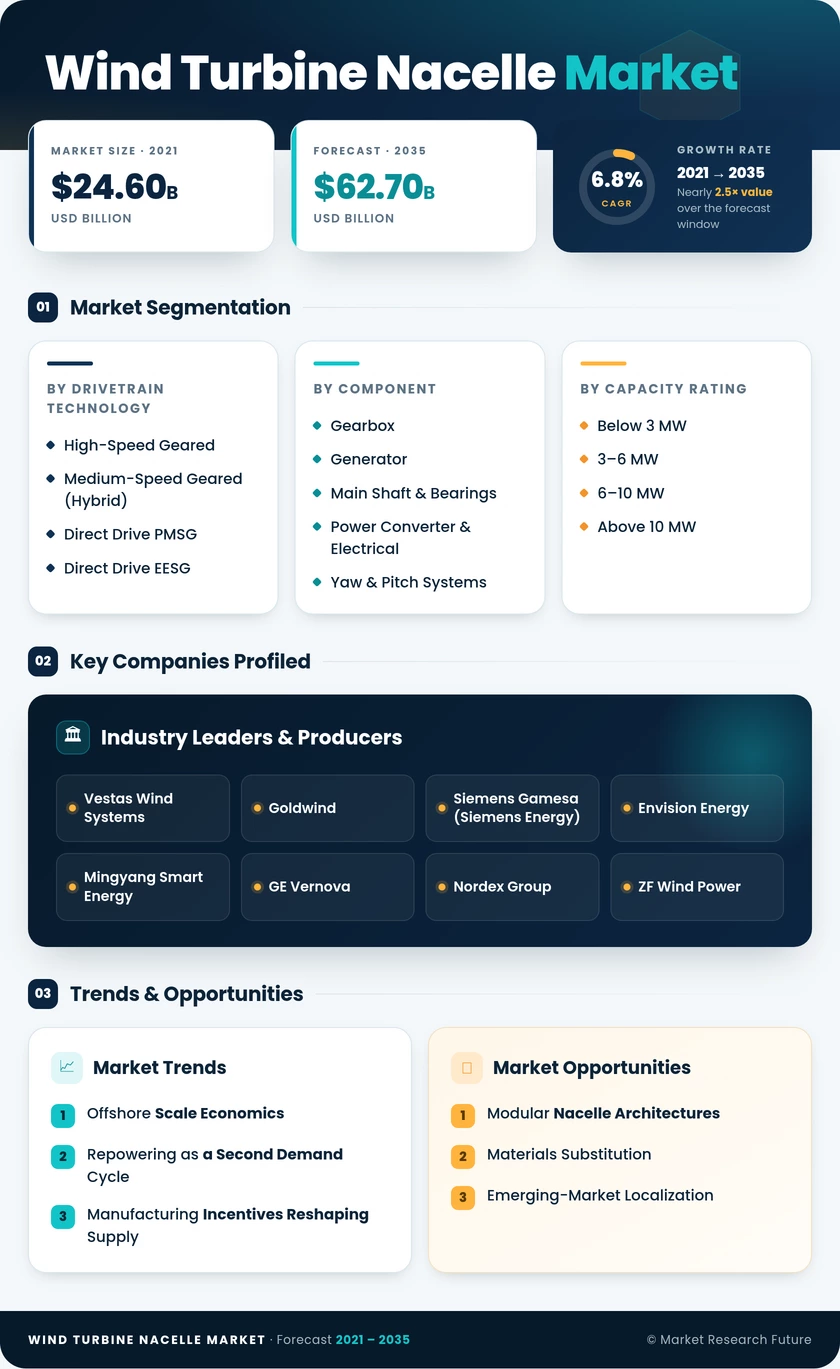
Segmentation Quick Reference
| Dimension | Sub-Segments | Dominant Segment | Fastest Growing Segment |
| By Drivetrain Technology | High-Speed Geared; Medium-Speed Geared (Hybrid); Direct Drive PMSG; Direct Drive EESG | High-Speed Geared | Medium-Speed Geared (Hybrid) |
| By Component | Gearbox; Generator; Main Shaft & Bearings; Power Converter & Electrical; Yaw & Pitch Systems; Cover, Bedplate & Auxiliary | Gearbox | Cover, Bedplate & Auxiliary |
| By Capacity Rating | Below 3 MW; 3–6 MW; 6–10 MW; Above 10 MW | 3–6 MW | Above 10 MW |
| By Installation | Onshore; Offshore | Onshore | Offshore |
| By End Use | New Installations (OEM Supply); Repowering & Retrofit; Aftermarket Replacement & Overhaul | New Installations (OEM Supply) | Repowering & Retrofit |
Market Segmentation Overview
By Drivetrain Technology
| Sub-Segment | Key Trend |
| High-Speed Geared | Retained for cost-sensitive onshore builds; share erodes steadily through 2035 |
| Medium-Speed Geared (Hybrid) | Fastest adoption in the 5–8 MW class, balancing mass against magnet content |
| Direct Drive PMSG | Default offshore architecture where availability outweighs magnet price risk |
| Direct Drive EESG | Selected where rare-earth exposure must be eliminated from the bill of materials |
Architecture choice is now a supply-chain decision as much as an engineering one. Buyers weighing magnet exposure against overhaul cost increasingly land on hybrid designs, which explains why that sub-segment outgrows both extremes.
By Component
| Sub-Segment | Key Trend |
| Gearbox | Torque density improvements extend viability into higher ratings |
| Generator | Efficiency and magnet-loading optimization dominate design roadmaps |
| Main Shaft & Bearings | Large-diameter forging capacity remains the industry's tightest bottleneck |
| Power Converter & Electrical | Grid-code compliance and fault ride-through drive specification upgrades |
| Yaw & Pitch Systems | Advanced load-mitigation control reduces structural mass elsewhere |
| Cover, Bedplate & Auxiliary | Structural material substitution and thermal management gain priority |
Value is migrating away from the gearbox and toward electrical and structural sub-systems. Suppliers positioned in converters and bedplate structures capture disproportionate growth even as headline drivetrain economics tighten.
By Capacity Rating
| Sub-Segment | Key Trend |
| Below 3 MW | Confined to constrained sites, distributed generation and replacement units |
| 3–6 MW | Mainstream onshore volume class, anchored by repowering demand |
| 6–10 MW | Bridges large onshore and early-generation fixed-bottom offshore fleets |
| Above 10 MW | Growth leader, gated by installation vessel and crane availability |
Rating inflation raises nacelle value per project faster than project count rises. That dynamic underpins revenue growth even in years when global capacity additions plateau.
By Installation
| Sub-Segment | Key Trend |
| Onshore | Repowering and land-based auctions sustain the largest revenue base |
| Offshore | Fixed-bottom and floating pipelines deliver the strongest growth rate |
Offshore demand carries heavier specification burdens — corrosion qualification, redundancy, remote diagnostics — which raises value per unit well above the onshore average. Onshore remains the volume anchor throughout the forecast.
By End Use
| Sub-Segment | Key Trend |
| New Installations (OEM Supply) | Greenfield capacity additions dominate absolute revenue |
| Repowering & Retrofit | End-of-life European and North American fleets create a second demand cycle |
| Aftermarket Replacement & Overhaul | Gearbox and generator exchange cycles build recurring revenue streams |
Aftermarket work is small in absolute terms but structurally attractive, carrying margins well above new-unit supply. Suppliers who convert warranty relationships into long-term service agreements defend that revenue against independent competition.


 Noah Malgeri
Co-Founder

 Peter Groot koerkamp
Account and Business Manager

 Younghwan Choi
Senior Retail Manager

 Mark Irwin
Management Consultant

 Akif Moroglu
Strategy & Business Development Director

 Guilherme Gomes Martins
Product Management Director

 Joseph Aguayo
Sales Operations & Pricing Manager

 La Terria Dodd
Program Support Specialist

 Rob Kooiker
Group Product Manager HVAC & Fire Protection GMA