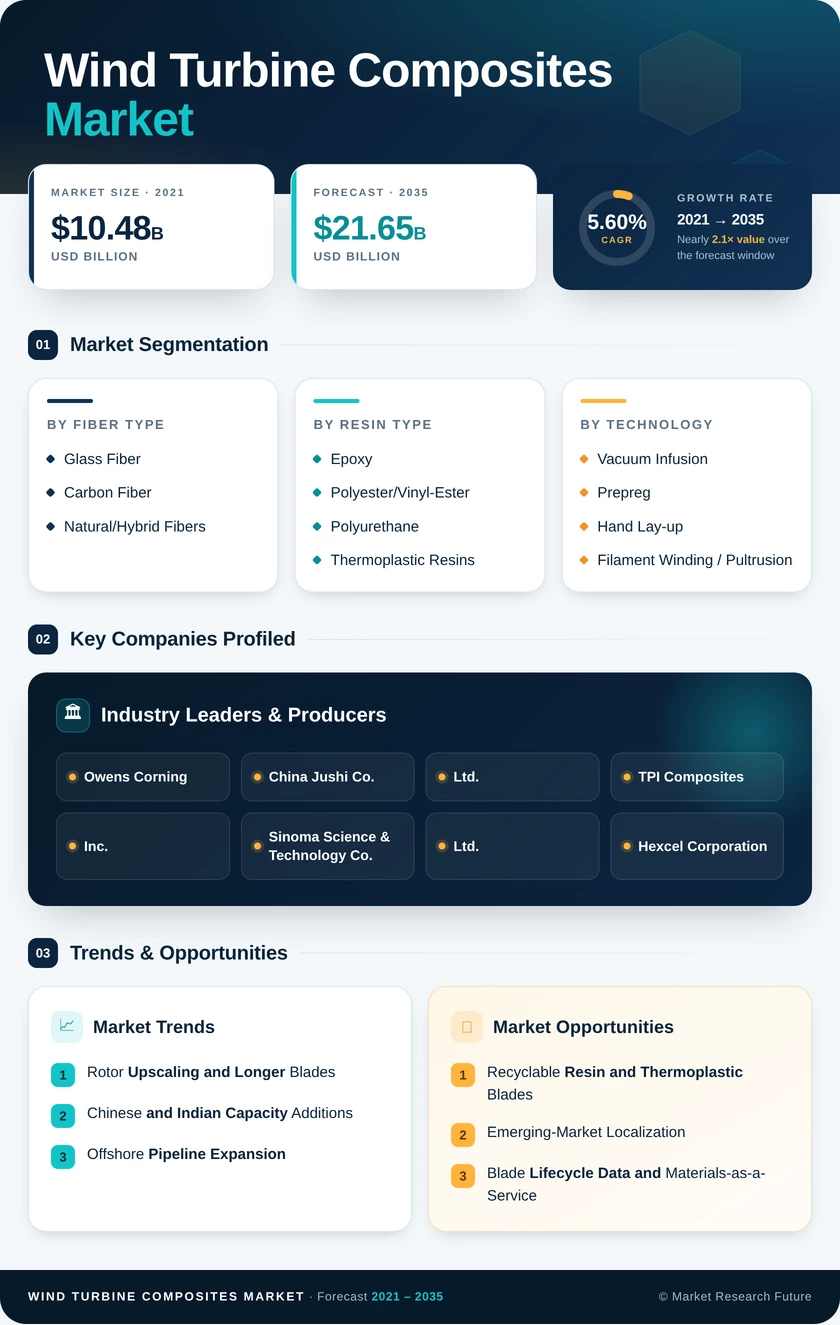
Segmentation Quick Reference
| Dimension | Sub-Segments | Dominant Segment | Fastest Growing Segment |
|---|
| By Fiber Type | Glass Fiber; Carbon Fiber; Natural/Hybrid Fibers | Glass Fiber (66.4% share) | Carbon Fiber (7.3% CAGR) |
| By Resin Type | Epoxy; Polyester/Vinyl-Ester; Polyurethane; Thermoplastic Resins | Epoxy (37.5% share) | Polyurethane (7.6% CAGR) |
| By Technology | Vacuum Infusion; Prepreg; Hand Lay-up; Filament Winding / Pultrusion | Vacuum Infusion (48.6% share) | Prepreg (6.9% CAGR) |
| By Application | Wind Blades; Nacelles and Nose Cones; Hubs, Covers and Ancillary Parts | Wind Blades (79.4% share) | Hubs, Covers and Ancillary Parts (6.1% CAGR) |
| By Region | North America; Europe; Asia-Pacific; South America; Middle-East and Africa | Asia-Pacific (52.4% share) | Middle East and Africa (7.1% CAGR) |
Market Segmentation Overview
| Sub-Segment | Key Trend |
|---|
| Glass Fiber | High-modulus grades extend glass viability on longer blades |
| Carbon Fiber | Large-tow, textile-grade carbon lowers spar-cap cost |
| Natural/Hybrid Fibers | Flax and basalt hybrids target low-embodied-carbon shells |
Glass Fiber leads because high-modulus E-glass still meets stiffness targets on most onshore blades at the lowest cost per kilogram. Carbon Fiber grows fastest as pultruded carbon planks become the default spar-cap solution once blades pass 100 m and tip deflection limits tighten. Natural/Hybrid Fibers stay niche, used mainly in shells where developers want lower embodied carbon without structural risk.
| Sub-Segment | Key Trend |
|---|
| Epoxy | Recyclable and fast-cure epoxy formulations |
| Polyester/Vinyl-Ester | Retained in cost-sensitive onshore blades and covers |
| Polyurethane | Shorter infusion cycles raise factory output |
| Thermoplastic Resins | Weldable, recyclable blade demonstrators |
Epoxy holds the leading position because OEMs have decades of fatigue and certification data behind it, and recyclable epoxy variants protect that position under landfill bans. Polyurethane is the fastest grower, since 10–25% shorter infusion cycles let plants lift output without new moulds. Polyester/Vinyl-Ester keeps a cost role in onshore parts, while Thermoplastic Resins remain early-stage.
| Sub-Segment | Key Trend |
|---|
| Vacuum Infusion | Scaled for 100 m-plus blade shells |
| Prepreg | Fast-cure systems cut oven cycles |
| Hand Lay-up | Confined to small parts and repairs |
| Filament Winding / Pultrusion | Pultruded spar-cap profiles in high demand |
Vacuum Infusion leads because it remains the most economical way to mould full-length shells for 100 m-class blades. Prepreg grows fastest where thick offshore spar caps require near-void-free laminates and fast-cure systems offset its cost premium. Filament Winding / Pultrusion is rising with pultruded spar-cap adoption, whereas Hand Lay-up continues shrinking toward repair and small-part work.
| Sub-Segment | Key Trend |
|---|
| Wind Blades | Swept-area expansion drives laminate tonnage |
| Nacelles and Nose Cones | Larger housings for 15 MW-plus turbines |
| Hubs, Covers and Ancillary Parts | Modular, transport-friendly covers and spinners |
Wind Blades dominate because every increase in rotor diameter adds disproportionately more laminate per turbine. Hubs, Covers and Ancillary Parts grow fastest as OEMs adopt modular covers and spinners that can be shipped in sections for very large nacelles. Nacelles and Nose Cones carry high value per kilogram, reflecting complex tooling and tight dimensional tolerances.


 Noah Malgeri
Co-Founder

 Peter Groot koerkamp
Account and Business Manager

 Younghwan Choi
Senior Retail Manager

 Mark Irwin
Management Consultant

 Akif Moroglu
Strategy & Business Development Director

 Guilherme Gomes Martins
Product Management Director

 Joseph Aguayo
Sales Operations & Pricing Manager

 La Terria Dodd
Program Support Specialist

 Rob Kooiker
Group Product Manager HVAC & Fire Protection GMA